
Wedding party roles for adult children are easier to choose when you treat each child as a person with a say, not as a seat to fill. This guide gives you a no-obligation worksheet that turns wishes, capacity and fit into a role your adult child can accept, change or decline without a penalty.
Choose wedding party roles for adult children in three passes. First, privately fill in a six-line worksheet for each child: their wish, their capacity, their standing with you and your partner, their comfort in the spotlight, the fit with your ceremony, and fairness across all the children. Second, replace your guesses with their real answers by asking. Third, match the total to a role band, from honored guest to full wedding party member, and always offer a free exit.
When two people marry later in life, or marry again, the guest list often includes their grown children. Those children may be thirty, forty or older. They may have jobs, partners and children of their own. They may have lived through a divorce, a death or a long single-parent stretch with one of the people getting married. Nobody can assume what part they want in the day, and nobody should assume they want none.
That is what makes wedding party roles for adult children a different question from the usual lineup. A twenty-something choosing bridesmaids is picking friends. A couple with adult children is picking between loyalty, history, geography and a handful of relationships that were there long before the wedding. The stakes feel higher because the children will be family long after the day is over.
This article is about the choosing step only. It covers the menu of wedding party roles that exist, a worksheet you can fill in for each child, a worked example, the costs adult children carry, the conversation, the alternatives, and the cases where the worksheet should be put away. It does not try to settle every family tension, and it does not promise that any role will repair a strained relationship.
A note on scope. This is general information, not legal, tax or financial advice, and it does not replace a counselor or mediator when a family conflict is serious. Every script here is an optional starting point. Change the words until they sound like you, and skip anything that does not fit your family.
Why wedding party roles for adult children are a different decision
In a standard lineup, the couple chooses a handful of close friends and relatives, announces it, and the rest of the planning follows. The wedding party roles are mostly ceremonial, the people are mostly peers, and a no is rare. That pattern breaks down when the people you are considering are your own children, because the relationship is not symmetrical and the history is not neutral.
Start with the direction of the power. A parent who asks an adult child to stand up at a wedding is asking from a position of long authority, even if the child is forty. Many adult children say yes because it is hard to say no to a parent, not because they want the job. A role chosen out of obligation can sit badly for the whole day, and it often shows in the photographs.
Next, think about timing. An adult child may have had years to get used to the idea of the marriage, or only a few months. They may be grieving the other parent. They may be worried about an inheritance, a family home or a holiday tradition, even if they never say so. Wedding party roles put the child on public display next to the new partner, and a child who is not ready can feel pushed into a performance.
Finally, think about the audience. A friend lineup is read by the guests as a friendship chart. A lineup that includes or excludes adult children is read as a statement about the whole family: who approves, who does not, who counts. Relatives will notice every choice and some will comment on it. That is one reason to settle the question early and calmly.
What is the same as any other wedding party decision
Some things carry over unchanged. A wedding party role still costs money, time and visibility. It still needs attire, a schedule, and a place in the photographs. It still works best when the person chosen understands the job and has agreed to it. If you want the general picture of how couples share planning input with relatives, the wedding decision rights guide covers who gets a say, and this article assumes you have read it or can.
What changes when the children are adults
Four things change. The child can say no and mean it. The child may carry costs and commitments the couple cannot see. The child may have a relationship with the other parent that complicates a public role. And the child is not an extra in the story. They are a main character in the family, with their own feelings about a marriage that changes what the family looks like.
Because of that, the best approach to wedding party roles is to ask before you assign. A role that is offered, understood and accepted works. A role that is announced and then defended does not. Every part of the worksheet below is built around asking, and around making sure the answer is allowed to be no.
Who this guide is for, and what it leaves out
This guide is for couples where at least one person has adult children, meaning children old enough to make their own decisions and to carry their own costs. The wedding might be a second or later marriage, a first marriage later in life, or a wedding where one partner became a parent young. The ages of the children do not matter much. What matters is that they have their own lives and can answer for themselves.
It is not about young children, who are covered by other guides on this site. If your wedding also includes grandchildren, the guest care planning guide explains how to organize supervision and handoffs for babies, children and older relatives, and this article will only touch on grandchildren where they affect an adult child’s choices.
It is also not about stepchildren who are minors, about estrangement, or about cases where a court or a custody agreement sets any part of the day. If you are in a legal situation with a child, ask a family law professional and follow their advice, because the worksheet here cannot replace it.
A few words on vocabulary
In this guide, a wedding party role means any named job or honor that sits in the visible structure of the wedding: standing in the lineup, walking with a parent, serving as a witness, giving a reading, or being named in a toast. “The wedding party” in the narrow sense means the group that stands at the front and walks in a processional. The wider set of wedding party roles includes the smaller jobs that never show up in a lineup photograph.
The difference matters because the right answer for an adult child is often something in the wider set. A child who would hate standing at the front for forty minutes might love reading a poem, signing as a witness, or hosting a table. The role menu in the next part lays out the options and what each one asks.
Words to avoid in the planning
A few labels cause trouble in blended families. Phrases like “my kids” and “your kids” can sound like teams. “Giving away” can feel loaded when a parent has died. “Best man” or “maid of honor” may not fit a child’s identity or the couple’s wishes. Use plain descriptions of the job instead, such as “stand beside me” or “sign the license as a witness”, and let the child choose how they want to be named.
If you are unsure what terms a particular child would prefer, ask them. A short question such as “What would feel comfortable to be called?” is enough, and it signals that the choice is theirs.
How to use this guide
Read through once before you fill in anything. The role menu and the worksheet are meant to be used together, and the worked case shows how the scores turn into decisions. Then work on one child at a time, in private, on paper or in a note on your phone. Do not share the worksheet itself with the children. It is a thinking tool, not a form to hand over.
Plan on a few evenings for the whole process, with the conversations spread over several weeks if there are several children. The earlier you start, the better the answers. A role you ask about nine months out is a gift. The same role announced two weeks before the wedding is a problem to be managed.
If you share the planning of wedding party roles with your partner, fill in the worksheet for your own children and let your partner fill it in for theirs. Then compare. Your partner may notice a pattern you missed, and the exercise helps you see how your children look from the outside. For the ceremony details that these wedding party roles feed into, the ceremony step-by-step guide lays out the usual sequence from processional to recessional.
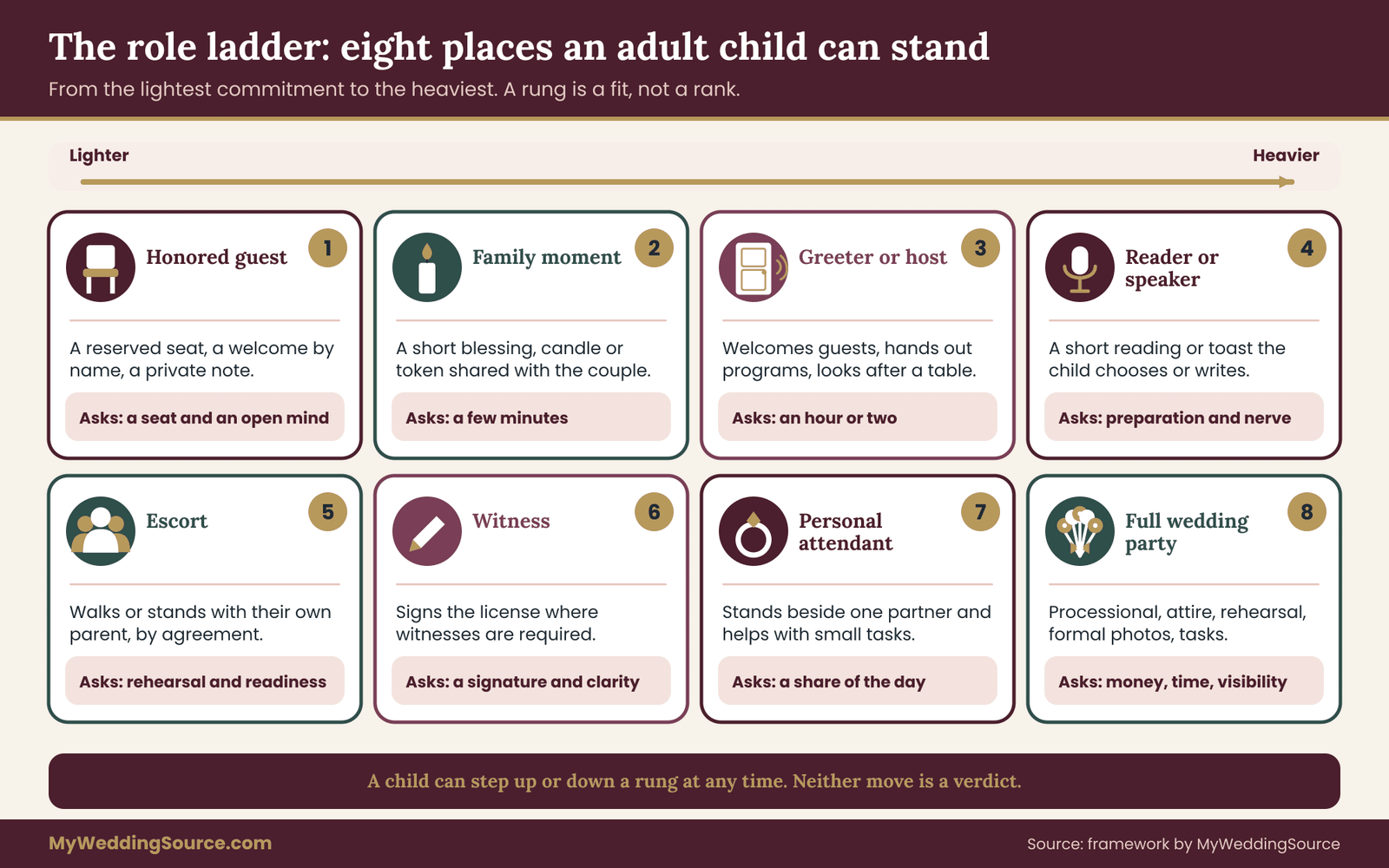
The picture above shows the role ladder: eight wedding party roles from the lightest, an honored seat among the guests, to the heaviest, full membership in the wedding party. Use it as a map while you read, and come back to it when you reach the worksheet.
Before you score anything, you need a realistic list of what you could offer. Most couples think of two options, in the lineup or not in the lineup, and that is where the hurt begins. There are many more places to put someone, and several of them suit adult children better than a place at the front. The menu below runs from the lightest commitment to the heaviest. It is not a ranking of love. A child in the lightest role can be the most loved person in the room.
For each rung, the questions that matter are the same three: what does it cost in money, what does it cost in time, and how visible is it? Keep those three in mind as you read, because they decide which wedding party roles fit which child.
Rung one: honored guest
The honored guest has no job. They sit in a reserved seat near the front, are mentioned in the welcome, and may receive a private note or small gift before the ceremony. This is the right rung for a child who does not want to be on display, who is still adjusting to the marriage, or who is traveling a long way and needs the day to be easy.
The cost is close to zero. The risk is that it can look like a demotion if siblings have visible wedding party roles and this child does not. The fix is a real gesture: a seat by the aisle, a personal conversation, a mention by name. An honored guest is not a leftover. It is a role you take as seriously as any other.
Rung two: family moment participant
A family moment is a short, shared part of the ceremony that is not a job in the lineup. Examples include a blessing of the couple by the children together, a candle or sand pouring, an exchange of small tokens, or a few sentences of support from the children standing near the couple. The children join the couple for a minute or two and then return to their seats.
The cost is a few minutes of rehearsal and a few minutes in the spotlight. It suits children who want to be part of the marriage in a visible way without committing to the full day. It also works well when several children are involved and you want to treat them as a group.
Rung three: greeter or host
A greeter welcomes guests at the door, hands out programs, or helps relatives find seats. A host might look after one table, introduce older relatives to one another, or keep an eye on a grandparent. These are working wedding party roles with a social flavor, and they suit warm, easygoing children who like to be useful.
The cost is time on the day, usually an hour or two before the ceremony or during the reception. Visibility is low to moderate. The role has the advantage of being natural for people who dislike formal photos. It also lets an adult child who is not on speaking terms with a sibling or relative choose whom they interact with, which is worth asking about.
Rung four: reader or speaker
A reader delivers a short passage, poem, blessing or welcome during the ceremony. A speaker might give a toast at a rehearsal dinner or reception. These wedding party roles are visible but brief, and they can be rehearsed. They suit children who are comfortable with words and have something to say, and they offer a way to be seen without standing for long.
The cost is preparation and a measure of nerve. Always offer a choice of content and let the child pick or write their own, within a time limit. Never hand over a script of what they should feel. The point is that the child chooses their words and feels free to say no.
Rung five: escort or walking with a parent
Some adult children walk their parent down the aisle, or stand with the parent during the ceremony. This is a role with deep symbolism, and it works best when the parent has said they would like it and the child has agreed freely. It can be done by one child or by several together, and the parent decides whether the partner joins them.
The cost is rehearsal time and a high level of visibility. It can also stir up feelings about the other parent, about the past marriage, or about being asked to hand a parent to someone new. Treat it as a request that deserves a considered answer. If the child needs time, give them time, and do not publish the plan until they have said yes.
Rung six: witness
A witness signs the marriage license and, in many places, must be present at the ceremony. Some places require witnesses and some do not, and the rules about who may serve differ. Check with the office that issues your license, and see the officiant and legal requirements guide for how to find the rules where you live.
When witnesses are required, an adult child is a natural choice because they are adults, they know the couple and they will be glad to have the signature. The cost is a few minutes and a pen. The risk is that a signature might feel like a legal statement of approval. Say plainly that the witness is confirming that the ceremony took place, and nothing more. Ask the child how they feel about it before you promise them the role.
Rung seven: personal attendant
A personal attendant stands beside one member of the couple. The title may be best person, honor attendant or simply “my son” or “my daughter” depending on what the couple wants. The attendant helps with small tasks, holds a ring or a bouquet, stands beside the partner during the ceremony and may sign as a witness.
The cost depends on how much the couple asks. In a small, informal wedding, the attendant may have little to do. In a larger wedding, the role may include a shower, a rehearsal, attire, a speech and an hour or two of photographs. Describe the job honestly before the child decides, and offer to pay for what you ask them to buy.
Rung eight: full wedding party member
The heaviest rung is a full place in the wedding party: standing at the front, walking in the processional, wearing coordinated attire, attending the rehearsal, joining formal photographs and carrying a share of the day’s tasks. It is often the one couples picture when they think of “including the kids”.
The cost can be real. There may be attire, hair, travel, time off work and childcare. The visibility is high and lasts for most of the ceremony. A full wedding party spot is the right choice when a child wants it, can afford it, and fits the shape of your day. It is the wrong choice when a child says yes to avoid hurting you.
A short guide to reading the ladder
The ladder works in two directions. For a child who wants more, you can climb. For a child who wants less, you can step down without drama. Neither is a verdict on the relationship. It is a fit between what the child can give and what the role asks.
It also works as a way to create several wedding party roles for several children. A couple with three adult children might offer one a place at the front, one a reading, and one a witness signature, and each of them might feel entirely well chosen. The key is to have a reason for each choice that you can state kindly and that does not compare the children to each other.
If your wedding party will include friends as well as children, plan the lineup in the same pass. The ceremony cue sheet guide shows how to time each role in the ceremony so that nobody waits at the front longer than they must, and it helps you see how many wedding party roles the ceremony can hold.
What each rung asks, side by side in words
Honored guest asks for a seat and an open mind. Family moment asks for a few minutes. Greeter or host asks for an hour or two of friendly work. Reader or speaker asks for preparation and courage. Escort asks for rehearsal and emotional readiness. Witness asks for a signature and a clear understanding of what it means. Personal attendant asks for a share of the day’s tasks. Full wedding party membership asks for money, time and standing at the front.
None of these wedding party roles is automatically better than another. The worksheet in the next part is the way to match each child to the rung that suits them, instead of defaulting to the one you pictured at the start.
Combining rungs
Roles can be combined. A child can be an honored guest and a reader, a witness and a greeter, an escort and a family moment participant. Combining works best when the pieces are small and the child has chosen them. Avoid stacking too many jobs on a child who has already said they want a light day, and avoid piling duties onto the child who happens to be most reliable.
If a child accepts one role and later wants another, make room if you can. If they want to step down, let them, and thank them. A role is a gift that can be returned.
The no-obligation worksheet for wedding party roles
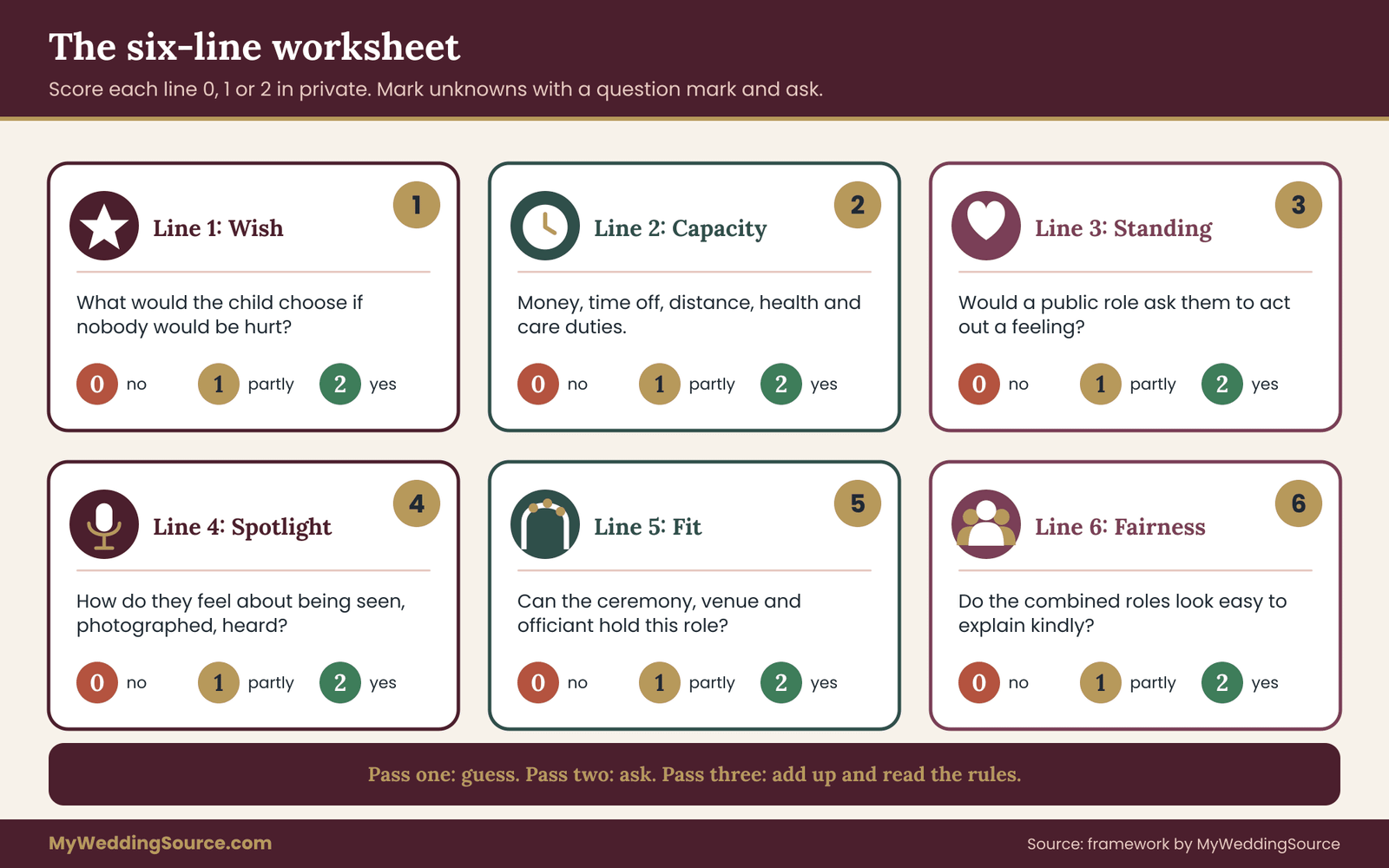
The worksheet has six lines. You fill it in once for each adult child, in three passes. In pass one you write your best private guess and mark every unknown with a question mark. In pass two you ask the child and replace guesses with their own words. In pass three you add up the scores and read the decision rules. The name “no-obligation” is literal: every route through the worksheet ends with a way for the child to say no or “something smaller” without losing anything.
Score each line zero, one or two. Two means a clear yes or a strong fit. One means partly, or unsure, or yes with conditions. Zero means a clear no or a strong mismatch. A question mark stays a question mark until you have asked, and it counts as a reason to ask, not as a score.
Line one: the child’s wish
The first line asks what the child wants. Not what they would accept, and not what they would do for you, but what they would choose if nobody would be hurt. Some adult children want a visible role and are waiting to be asked. Some want to be left alone in the audience. Some want a role but fear that asking for it would look greedy.
You cannot read this from the outside, even if you know your child well. Parents are often surprised in both directions. So in pass one, write your guess and mark it with a question mark. In pass two, ask in a way that gives a free choice, using the scripts later in this guide.
Score two when the child names a role they want. Score one when they are open but have no preference. Score zero when they say they would rather not have a role, or when their body language says so even if their words are polite.
Line two: capacity
Capacity covers everything that decides whether the child can do the job without strain. It includes money, time off work, distance, health, caregiving for their own children or parents, and the energy that a long day requires. A child can badly want a role and still not have the capacity for it.
Ask about capacity in practical terms. How far would they travel? Could they come a day early for a rehearsal? Would the cost of attire or travel be a burden? Is there a caregiving gap that needs to be filled? If the answer is yes to a burden, you can often fix it by paying for things or by choosing a lighter role. That is a reason to ask, not a reason to guess.
Score two when the child can do the role comfortably. Score one when they can do it with help, such as covering costs or arranging care. Score zero when the role is not realistic for them, in which case a wedding party spot is not the right choice.
Line three: standing with the couple
This line is the most delicate. It asks how the child stands in their relationship with you and with your partner, and whether a public role would be comfortable for all three of you. It is not a test of whether they approve. It is a test of whether a visible role would ask them to act out a feeling they do not have.
Look at the facts. Do they know your partner well? Have they met them in settings beyond a holiday? Have there been conflicts, and have those been addressed? Is the child’s other parent part of the picture in a way that makes a public role a loyalty test? A child can be warm and still not ready to stand next to the new partner.
Score two when the relationships are warm and settled. Score one when they are friendly but new or untested. Score zero when there is open tension, hurt or silence. A zero on this line does not mean the child is excluded. It means you pause public wedding party roles, talk first, and keep the day open for later.
Line four: spotlight comfort
Some people are glad to be seen and some find it painful. Spotlight comfort asks how the child feels about standing in front of a crowd, being photographed, speaking and walking in a procession. It also asks about practical matters: mobility, anxiety, a physical difference they do not wish to emphasize, or a dislike of being directed.
You can learn a lot from how the child behaves at other family events. Do they step into photos or step out? Do they take the microphone at a birthday? But again, guess lightly and ask directly. A child who looks reserved may be eager for a role that lets them step up in a controlled way, such as a short reading.
Score two when the child is at ease with attention. Score one when they are neutral or can manage it briefly. Score zero when the spotlight is a real source of dread. For a zero here, steer toward the back-of-house rungs, such as greeter or host, or toward honored guest.
Line five: fit with the ceremony
The fifth line asks whether the role fits the ceremony you are planning. A short civil ceremony at a courthouse cannot hold a procession of six. An outdoor ceremony on a slope may be difficult for a child who uses a mobility aid. A religious ceremony may have rules about who can do readings or who can stand near the front. A very small wedding may have no room for a lineup at all.
Check the practical details of the wedding party roles you have in mind. How many people can stand at the front? How long is the ceremony? What does the officiant allow? The officiant requirements guide explains what to ask the person leading your ceremony, and the cue sheet guide mentioned earlier shows how to fit wedding party roles into a timeline.
Score two when the role fits comfortably. Score one when it fits with an adjustment. Score zero when the venue, ceremony or tradition cannot hold the role.
Line six: fairness across the children
The last line looks at the whole set. When you add up the wedding party roles you are planning for several children, do they look reasonable together? Fairness does not mean identical. A child who is a witness and a child who is a reader are not equal, but they can both be well chosen. What matters is that you can state a kind reason for each, and that no child is left with the impression of having been ranked.
Read the combined wedding party roles aloud as if you were a guest or a sibling. Would anyone say, “Why was this child left out?” Does an older child get the symbolic role by default? Does the child who lives nearest get the heavy tasks by default? If you see a pattern, adjust it.
Score two when the combined picture feels balanced and easy to explain. Score one when it is explainable but uneven. Score zero when you cannot explain it without hurting someone.
Scoring the worksheet and choosing wedding party roles
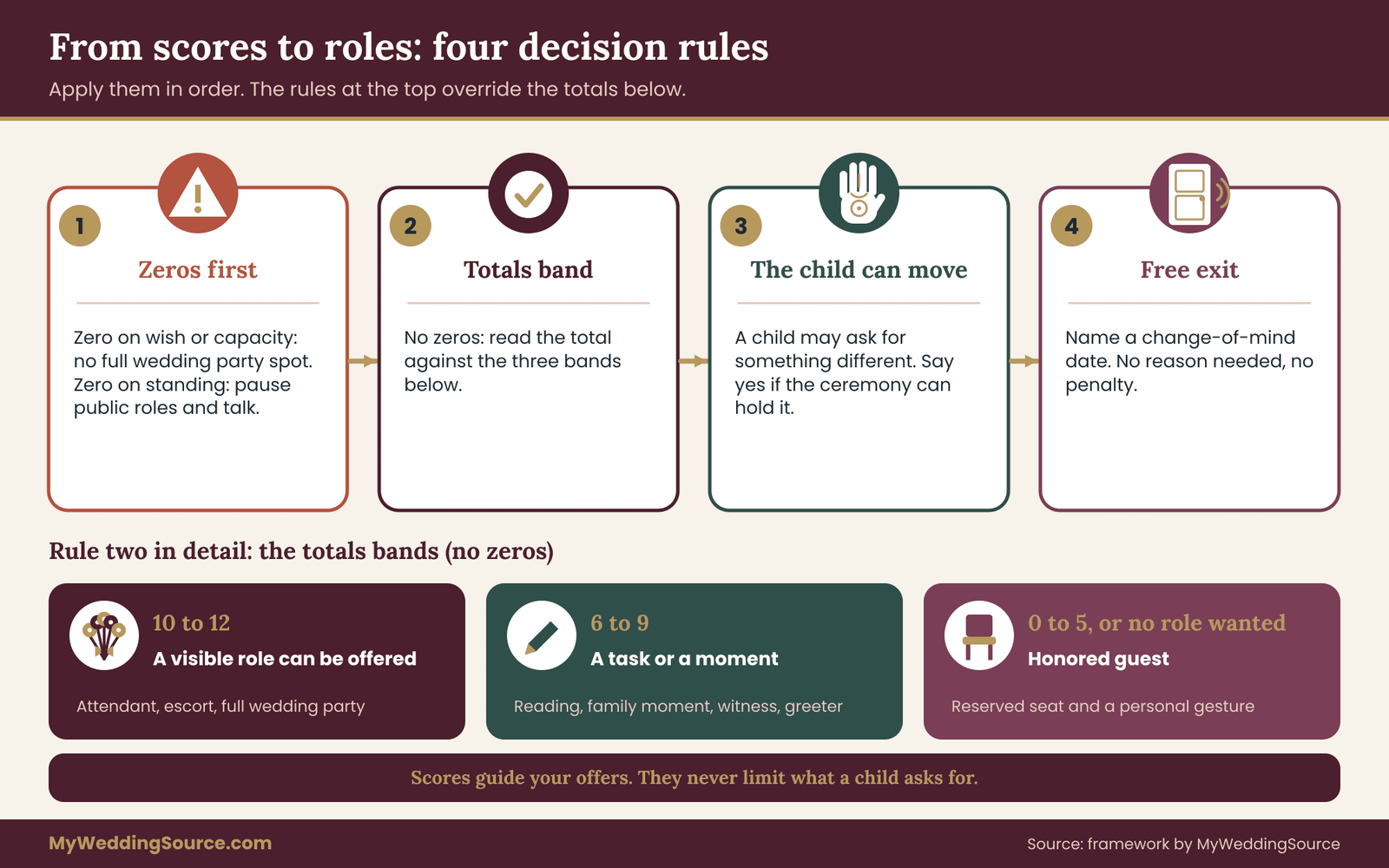
After pass two, add the six scores for each child. The total runs from zero to twelve. Then apply the decision rules in this order, because the rules at the top override the totals below.
Rule one: zeros come first
Any zero on line one or line two, the child’s wish or capacity, removes a full wedding party spot from the options.
Offer a lighter rung only if the child’s wish is at least one. A zero on line three, standing with the couple, pauses every public role until you have talked. A zero on line four removes spotlight wedding party roles. A zero on line five removes the wedding party roles that do not fit the ceremony. Zero on line six is not about the child; it is a signal to rework the whole set.
Rule two: the totals band
If there are no zeros and the total is ten or more, the child is a good candidate for a visible role. Wedding party roles at the upper rungs, such as personal attendant or full wedding party membership, can be offered, with the free exit.
If there are no zeros and the total is between six and nine, offer a task or a moment: a reading, a family moment, a witness signature, a greeter or host job. These wedding party roles give the child a real place without asking for more than they wish to give.
If the total is five or less, or if the child has indicated that they prefer no role, the honored guest rung is the right choice, with a personal gesture beforehand. Treat it with the same care as any other. A child who is simply glad to be there is a gift.
Rule three: the child can always move
Whatever the score, the child may ask for something different. A child who scores low on spotlight comfort may still ask for a reading, and that is their right. Scores guide your offers. They do not limit the child’s own requests. If the child asks for a role that the ceremony can hold, say yes unless you have a clear reason not to.
Rule four: the free exit
Every offer comes with a free exit, stated out loud. Tell the child that they can change their mind up to a date you name, and that no explanation is needed. Name a date that leaves you enough time to adjust the cue sheet, usually a few weeks before the wedding. After that date, a change is still possible but may need a practical solution.
The exit is not a formality. It lets a child say yes in the moment, without fear of being trapped, and it protects the day from a late and awkward withdrawal. Couples who offer it often find that fewer children use it than they expected, because the freedom makes yes easier.
A note on scoring honestly
The numbers are a thinking tool, not a verdict. If the total says one thing and your gut says another, look for the line that is hiding the problem. Often it is line three, standing with the couple, where hopes and facts quietly diverge. Be honest about what you see, and ask someone who knows your family if you need a second view.
Do not show the worksheet to the children when you discuss wedding party roles. It would read as a performance review. What you share is the conversation and the offer, never the scores. And do not use the scores as leverage in an argument. They are for you.
A worked case: choosing wedding party roles for four adult children
The following example is invented to show how the worksheet works. The people do not exist, and the scores are not data about any real family. Use it as a pattern, not a prediction. Any resemblance to your own family is a coincidence, and your answers will differ.
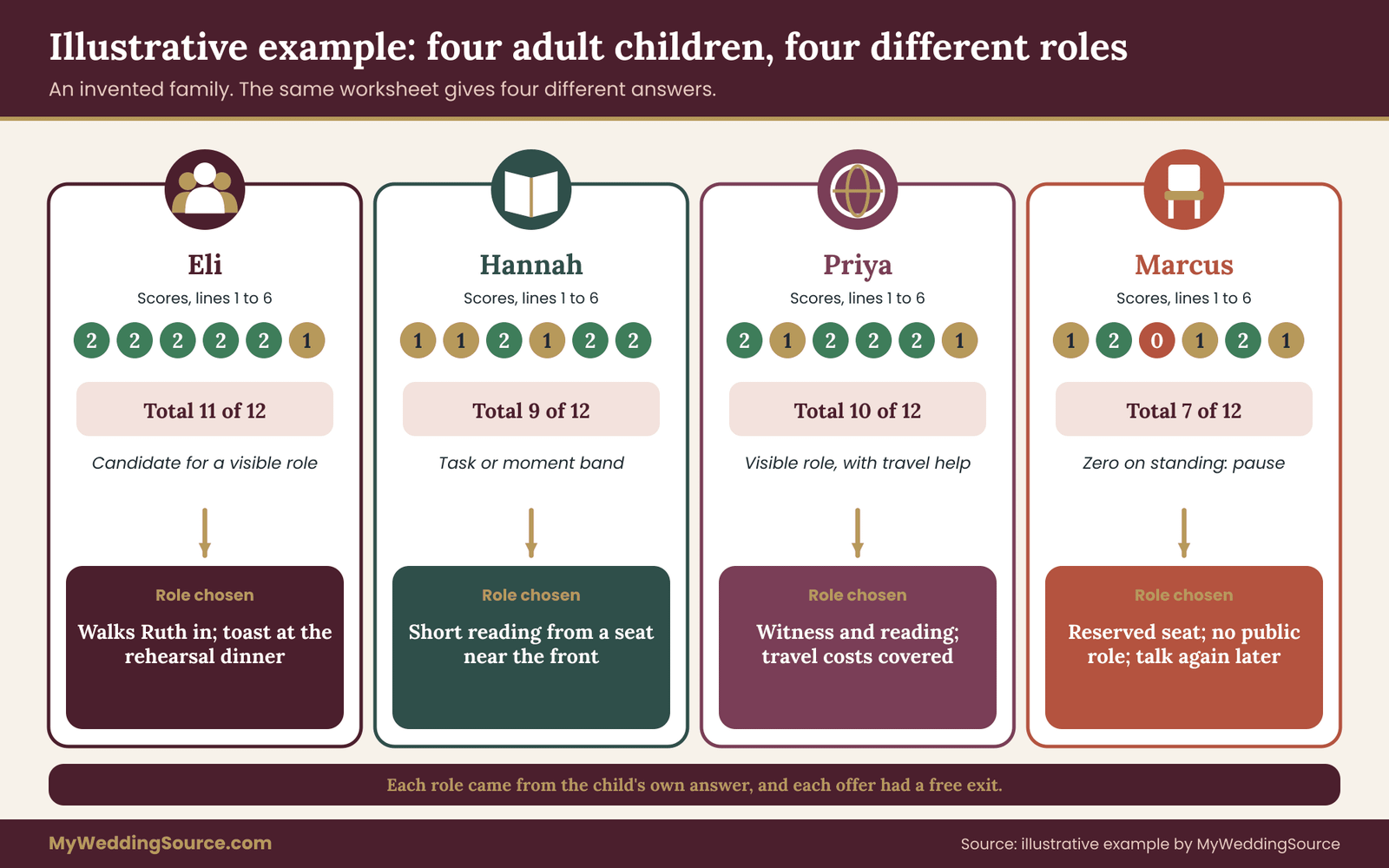
Ruth and Daniel are marrying in a small ceremony of about seventy guests, held in a garden venue with a short lawn aisle. Ruth is a widow with two adult children: Eli, in his thirties, and Hannah, in her late twenties. Daniel is divorced with two adult children: Priya, in her early thirties, who lives overseas, and Marcus, in his late twenties, who lives a short drive away. The couple has been together for several years. They have room for a small group at the front and an officiant who is flexible.
Pass one: the private guesses
Ruth and Daniel each fill in the worksheet for their own children, using question marks for what they do not know. Ruth guesses that Eli would like to walk her down the aisle and that Hannah would prefer a quiet role. Daniel guesses that Priya would love a role if travel could be managed and that Marcus is “fine” with the wedding. They compare notes and notice something: Daniel has marked Marcus’s standing as a question mark on every line except fairness.
That is useful. When a parent cannot fill in a line, it often means they have avoided asking. Daniel decides to ask Marcus first, and to hold off on any plan involving Marcus until he has.
Pass two: asking
Ruth talks with Eli over coffee. Eli says he would be honored to walk her in and would like to say a few words at the rehearsal dinner, but not at the ceremony. He is comfortable in front of people and can travel easily. He is warm with Daniel and has spent several holidays with him.
Ruth then calls Hannah. Hannah says she is pregnant and due near the wedding date. She wants to attend, and she would like a small role, but she does not want a place in a lineup, because standing for a long ceremony would be hard and she does not want her pregnancy to be the focus. She offers to do a short reading if she can sit.
Daniel video-calls Priya. She says she would love a role and has been hoping to be asked. Money and flights are the obstacle, and she needs advance notice to take time off. Daniel says he will help with the cost of the trip. Priya has met Ruth many times and is warm with her.
Daniel then visits Marcus and asks, without any proposal on the table, how he is feeling about the wedding. Marcus is quiet and then says that he is happy for his father but that the timing is hard because he is still grieving the loss of the family home after the divorce. He is not sure he wants a role. He says he does not want to cause a scene and will come.
Pass three: the scores
Here is how the worksheet looks after pass two. Each child gets a score from zero to two on each of the six lines.
Eli: wish two, capacity two, standing two, spotlight two, fit two, fairness one. Total eleven. No zeros. He is a candidate for a visible role.
Hannah: wish one, capacity one, standing two, spotlight one, fit two, fairness two. Total nine. No zeros. A task or a moment is the right band.
Priya: wish two, capacity one, standing two, spotlight two, fit two, fairness one. Total ten. No zeros. A visible role is possible, with help on travel.
Marcus: wish one, capacity two, standing zero, spotlight one, fit two, fairness one. Total seven, but there is a zero on standing. Rule one applies first: pause public wedding party roles and talk.
The decisions
For Eli, Ruth and Daniel offer to have him walk Ruth down the aisle, with the exit stated, and a short toast at the rehearsal dinner. He says yes to both. He is also asked whether he would like to be a witness. He prefers to leave that to someone else, which is fine.
For Hannah, the couple offers a short reading from a seat near the front, with a chair at the lectern if she wants it. She accepts. They check with the officiant that a seated reading can be fitted into the ceremony, and they note that if the baby arrives early, the reading will be cut without any fuss.
For Priya, the couple offers a place as a witness and a short reading. Daniel will cover the airfare, and Priya agrees. They give her a deadline to confirm that leaves time to book flights, and they tell her she can decline without hurting anyone.
For Marcus, no public role is offered. Daniel tells him that there is a reserved seat near the front, that nobody expects anything from him, and that if he wants a role later, a place can be found. They do not push. They agree to talk again closer to the wedding.
What the case shows
First, the same worksheet gives four different answers. The wedding party roles come from the children’s own words, not from a template. Second, the child with the most strain gets the lightest touch, and that is not a punishment. It is the most accurate answer to what Marcus said. Third, fairness is handled by explaining each choice in terms of that child’s own situation, not by trying to give everyone the same role.
Fourth, the case is not a happy-ending story. Marcus may still be hurt. He may come around, or he may not. The worksheet cannot guarantee any result, and a role is not a cure for a difficult family situation. What it does is to make the choices honest and the exits free.
What Ruth and Daniel say to the guests and relatives
A relative may ask why Marcus has no role. Ruth and Daniel prepare a short answer that does not discuss his feelings: “We asked each of the children what they would like, and we built the wedding party roles around that.” That is true, it protects the child, and it ends the conversation. They agree not to explain further, and not to compare the children.
They also prepare for the opposite problem. A relative may ask why Hannah, who is not in the lineup, is reading. The answer is the same. Each child was asked, and each role was chosen with them. A consistent answer is the best defense against family gossip.
How the wedding party roles fit the ceremony
Once the wedding party roles are set, the couple works them into the ceremony order. Eli walks Ruth in, Priya and a friend serve as witnesses, Hannah reads after the welcome, and the officiant mentions the children by name in the closing. The cue sheet shows who is where and when, so that nobody is waiting longer than they need to and nobody is surprised by their cue.
The couple also check the photo plan. The family photo list guide explains how to build a list of groupings so that every child appears in the pictures they want, including a few with each parent and a few with all four children, and so that nobody is made to pose in a grouping that would feel false.
What would have changed the answers
It helps to run a few what-ifs, because they show how the worksheet adapts. If Hannah’s baby arrives early, the reading is dropped and her seat is saved. If Priya cannot get time off, she joins by video for a short message and the witness role goes to a friend. If Marcus asks for a role a week before the wedding, the couple offers something small, such as a greeter spot, and asks if that feels right.
If Eli’s wish changes, say he wants to stand with Ruth rather than walk her, the couple adjusts the cue sheet. None of these changes is a crisis. Each is a small adjustment made possible because the wedding party roles were chosen by asking and the exits were free.
The load an adult child carries: money, time and standing
Adult children have a different set of costs than the friends in a typical lineup. A friend may pay for attire and a shower gift. An adult child may also be giving up time with their own children, paying for childcare, flying across the country, or taking unpaid leave. They may be paying for a role they never wanted, because a parent asked.
The couple can lower the load in three ways: by paying for what they ask the child to buy, by choosing wedding party roles that need little preparation, and by planning around the child’s calendar. A role that costs the child money should be offered only if the couple is ready to pay for it, or if the child has said they are glad to cover it.
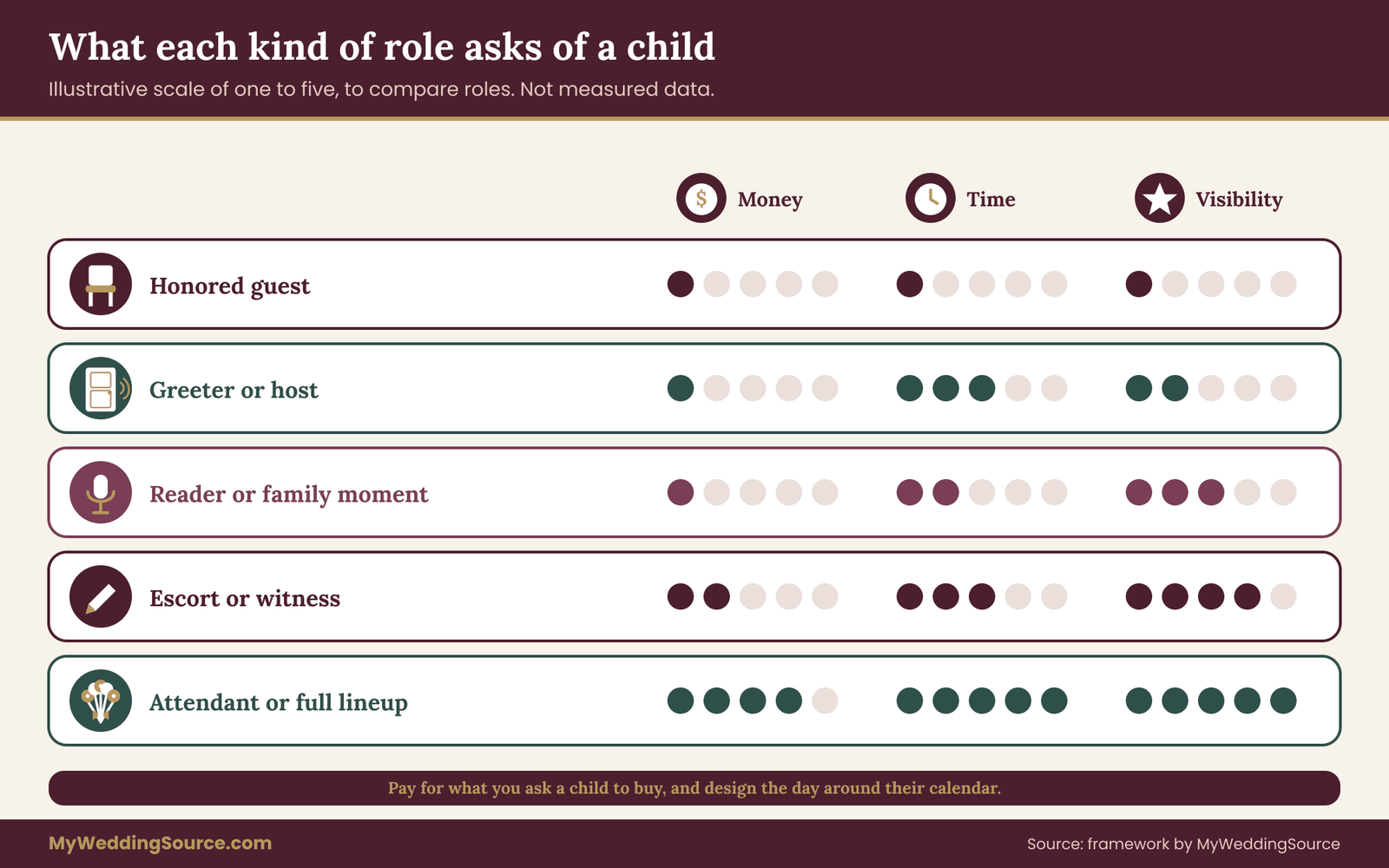
The picture shows how the three loads rise across the rungs. Use it to check whether a role you have in mind matches what the child said they can give.
Money
Make a list of the costs that each role might bring: attire, hair, travel, lodging, childcare, a gift, a share of a group event. Then decide which you will cover. If you do not know a cost, ask. If a child hesitates, do not press. The wedding budget guide can help you decide where to put these costs in your overall plan.
Offer help with the costs of wedding party roles in a way that does not embarrass the child. A simple statement works: “We would like to cover your travel and attire, and we hope that is all right.” Some children will decline help, and that is fine. Others will be relieved. In either case, the offer makes it clear that the role is not a financial test.
Time
Time is the cost most often forgotten. A full wedding party spot can take a rehearsal, a morning of preparation, formal photographs and a long day. For a child with a job and a family, that can be a real burden. Ask how much time they can give, and design the role to fit.
Give clear times in writing: when to arrive, when the photographs happen, when the ceremony starts, and when the child is free. Short, clear schedules help adult children plan their own lives around the day.
Standing
Standing is the cost that cannot be counted in money. It is the emotional work of appearing in public next to a new partner, in a role that signals approval. Some children are glad to do it. Others feel it as a performance. The worksheet’s third line exists to catch this, and the best protection is to ask and to listen.
If a child says they are not ready, thank them for telling you. Do not argue the case or say how much it would mean to you. A role given under pressure is one you will both remember badly.
When an adult child is unsure about the marriage
Not every adult child welcomes a wedding. Some are glad. Some are cautious. Some are grieving a parent, a marriage or a way of life that the new wedding seems to close. A few are openly opposed. Wedding party roles are a poor way to test or fix those feelings, and the worksheet is built to keep them from becoming a test.
The first principle is to separate the relationship from the role. A child’s reaction to the marriage is a matter between you and them, and it may take months or years to settle. The role is a smaller matter: a job in a single day. Mixing the two puts the child in a trap, because to take the role is to seem to approve, and to refuse it is to seem to reject you.
Do not use wedding party roles to win agreement
It can be tempting to offer a prominent role to a hesitant child in the hope that it will bring them around. Resist this. A role offered as a persuasion tool is easy to recognize, and it asks the child to perform a feeling they do not have. If they accept out of guilt, the day can feel strained. If they refuse, the refusal becomes a public event.
A better approach is to say what you have always wanted to say, which is that you would like them to be there, that you will hold a place for them, and that you are not asking for any more than they are ready to give. Then do exactly that. The honored guest seat is not a consolation. It is a way of saying that the child’s presence is the point.
Keep the door open without pushing
Leave room for the child to change their mind. A short note can do this: “We have kept a few wedding party roles flexible, and if you ever want one, tell us and we will find a place.” Then do not mention it again unless they do. Pressure undoes the offer.
Sometimes a child who has said no comes back with a small request. Say yes if you can. It is likely to have cost them something to ask, and a warm answer is worth more than a perfect plan.
When the answer is silence
Some children do not answer. You may send a message and hear nothing, or you may ask in person and get a vague reply. Silence is hard, and it is easy to read too much into it. It may mean the child is thinking, or is busy, or is hurt, or does not know what to say.
Wait a reasonable time before settling any wedding party roles, then follow up once, kindly and briefly. A message such as “No pressure at all, and the seat is yours either way” often draws a reply. If it does not, treat the silence as a no to any public role, keep the honored seat, and leave the door open. Do not publish a plan that depends on a child who has not answered.
When the other parent is involved
Adult children often have a living parent who is not part of the new marriage. That parent may have strong feelings about a child’s public role at the wedding. The child may feel that a visible role would be a betrayal, or may feel pressure from the other parent to take part or to stay away.
You cannot control this. You can make it easier by never asking the child to choose, by not criticizing the other parent in front of the child, and by offering wedding party roles that are small enough to be explained easily. If the child says that a role would cause trouble at home, accept that without asking for details. The child knows their situation better than you do.
When the child is a spouse or has a family of their own
An adult child who is married or partnered may need to consult their partner. A partner may have feelings about the child’s role, about the cost, or about who looks after the grandchildren. Include the partner in the conversation, at least by saying that they are welcome to join in the decision.
Also consider where the partner will sit and how they will be treated. A child who is in the lineup while their partner sits in the back will notice. A simple solution is to put the partner in the front rows near the child, or to give them a small role of their own.
Knock-on effects: grandchildren, partners, distance and health
A role for an adult child often touches other people. If a child is in the lineup, their own children may expect wedding party roles. If a child reads, their partner may wonder why they were not asked. If a child is a witness, a sibling may count the signatures. These effects are not reasons to avoid giving wedding party roles, but they are reasons to think ahead.
Grandchildren
Grandchildren are a joy and a logistical task. A child who has been asked to take part may also be asked to bring and look after their own children, and that is a hidden cost. If grandchildren are in the day, plan for them separately, so that an adult child in a role is not also on childcare duty.
The guest care planning guide covers supervision, rest areas and handoffs for the youngest guests. If a grandchild is old enough to take on a small role, such as handing out programs, ask the parent first. The parent may prefer a different role or none at all, and the choice is theirs.
Partners of adult children
The partner of an adult child is a guest with a stake in the day. They may be asked to help, or they may be left out. Think about their seat, their name card, their introductions and any role that a partner could do without extra cost. A partner who feels included is more likely to support the child’s role.
If a child has recently separated from a partner, or is bringing someone new, ask the child how they would like it handled. Do not assume. A private question, such as “How would you like us to handle your plus one?” saves later discomfort.
Siblings and step-siblings
The adult children of the two partners may not know each other well. A wedding can be the first time they spend a day together. Roles that pair them, such as joint witnesses or a joint blessing, can build connection, but they can also feel forced. Offer the pairing as an option, not an assignment.
If the children have a history of conflict, avoid wedding party roles that put them in close contact without a clear task. A role with a defined job, such as reading or greeting, is easier than a role that requires standing together for a long time.
Accessibility, distance and health
An adult child may have a disability, a chronic condition, an injury or a health issue that affects the wedding party roles they can do. Adult children may also have older parents or relatives of their own who need support. These facts are not obstacles to inclusion. They are reasons to design the wedding party roles well.
Ask, do not assume
Do not decide for a child that a role is too hard. Ask what they would like and what would help. Some children will say that a seated role is best. Others will say they want to walk the aisle and will plan around it. The goal is to remove barriers, not to remove people.
The general principle is to check the ground, the aisle width, the distance from parking, and the time that a role takes. The Americans with Disabilities Act pages listed in the sources give general information on accessibility, though they are not a wedding planning tool and your venue will have its own arrangements.
Distance and travel
A child who lives far away faces travel costs, time off, and the stress of arrival. If you want them to take a role, give early notice and offer help. If they cannot travel, a video message or a recorded reading may be an option. A child who cannot come in person is still a child with a place in the family, and the day can include them in other ways.
If a child must travel internationally, remind them to check the entry rules and documents they need well ahead. The State Department travel pages listed in the sources are the right place to check passport and visa information, and the child is best placed to do that for themselves.
Health and energy
Weddings are long days. An adult child with limited energy may need rest breaks, a seat, a quiet room and a clear end time. A role that requires standing at the front for a long ceremony may not suit them. Offer lighter wedding party roles and make rest easy.
Do not make health a topic of public discussion. Plan quietly, and let the child decide how much to share. A thoughtful arrangement that nobody notices is better than a visible accommodation that draws attention.
How to ask about wedding party roles without pressure
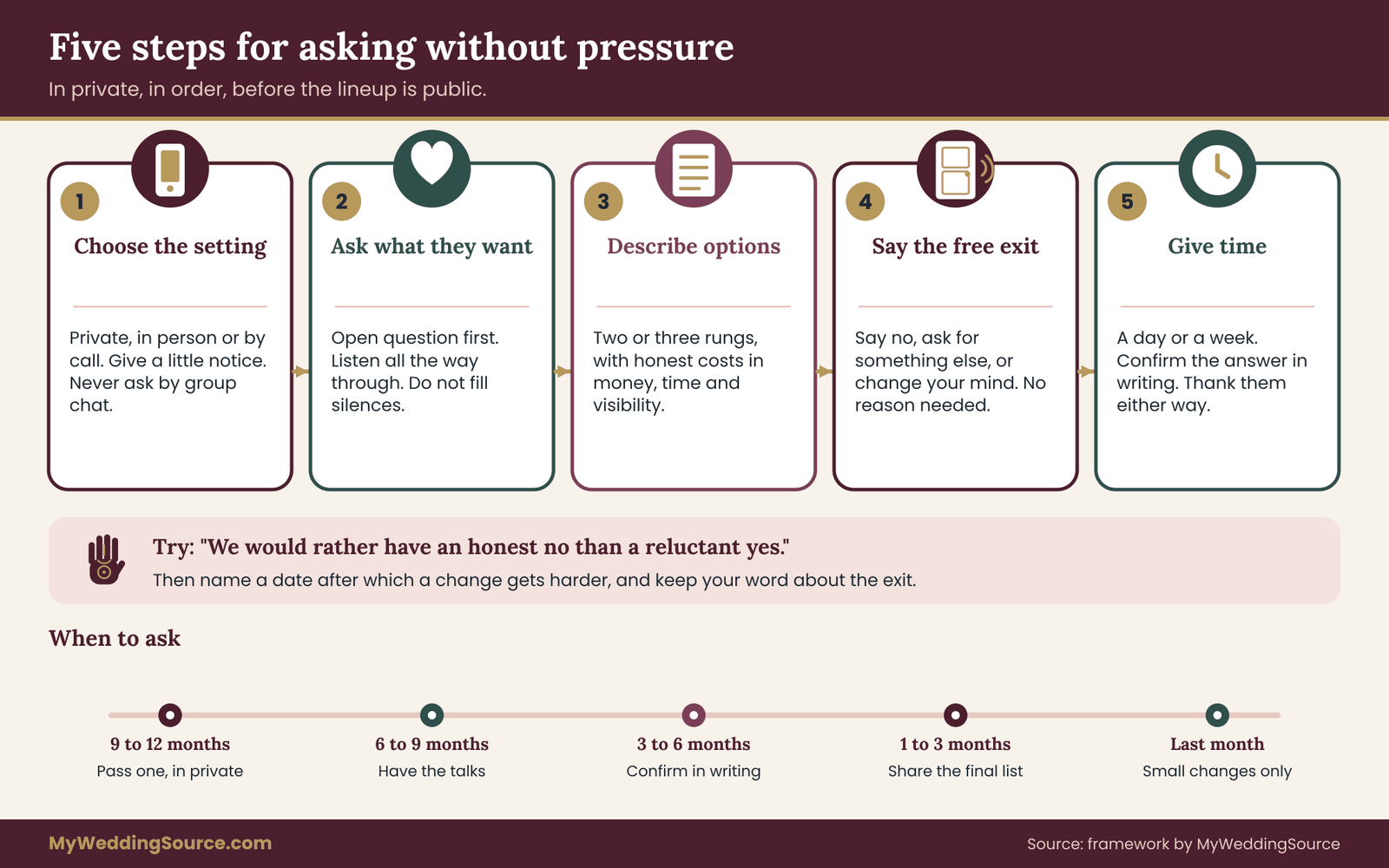
The conversation is where the worksheet either works or fails. A good conversation is short, private, unhurried and free of surprises. It happens before the lineup is public, before relatives start guessing, and before anyone else tells the child. It is held by the parent, not by a planner or a sibling, and it follows a simple order.
Step one: choose the setting
Pick a private moment, in person if you can, or by phone or video if you cannot. Avoid group chats, family dinners and any place where the child would feel watched. Do not ask by text, except to set up a time to talk. A role is a personal matter, and a screen can make it feel like a form.
Give the child a little notice so that they are not ambushed. “I would like to talk about the wedding and what part you might want to have. Is Sunday good?” is enough. It tells them the subject without revealing what you are going to ask.
Step two: ask what they want first
Start with an open question, before you mention any role. “How are you feeling about the wedding?” is a good opener. Then, “Is there a part in the day you would like to have, or would you rather just enjoy it?” This gives the child a free choice and lets you hear their wish before you say what you had in mind.
Listen all the way through. Do not rush to fill silences. If the child says they have not thought about it, say that is fine and that there is plenty of time. If they say they want a particular role, ask what it means to them. If they say nothing, give them a chance to think and offer to talk again.
Step three: describe the options honestly
If the child is open, describe two or three wedding party roles from the menu, including what each one asks. Be specific about money, time and visibility. “The witness role is a signature and a few minutes. The reading is two minutes at the front, and you could choose the passage.” A clear description helps the child decide.
Do not oversell. Avoid phrases like “it would mean the world” or “we cannot imagine anyone else”. These add pressure, and they make it harder to say no. A calm description lets the child weigh the role on its merits.
Step four: say the free exit out loud
State that the child can say no, can ask for something different, and can change their mind. “Please say no if this is not right. We would rather have an honest no than a reluctant yes.” Then name a date after which a change becomes harder. This is the sentence that makes the whole conversation safe.
Step five: let them answer in their own time
Offer the child time to think. A day or a week is reasonable. Do not ask for an answer on the spot. When they do answer, thank them, whatever the answer is. If the answer is no, say so warmly and move on. If the answer is yes, confirm the details in writing so that nobody has to rely on memory.
Scripts you can adapt
“We want you in the day in whatever way suits you. Would you like a part, or would you rather simply be with us?”
“There are a few options, from a quiet seat to a reading to standing with us. Which of these sounds like you?”
“If you say yes and later change your mind, that is fine. Just tell us, and we will sort it out.”
“If this is not right for you, we would still love to have you there, and nothing changes between us.”
Change these to fit your voice and your child. The principle is the same in each: the child’s choice comes first, and the answer is allowed to be no.
What to do when the answer is a surprise
Sometimes the child wants more than you expected. They may want to give a longer speech, to stand with you at the front, or to be involved in the planning. Listen, and do not decide on the spot. Say that you will think about it and come back. Then check the ceremony, the timeline and the other children, and give a clear answer.
Sometimes the child wants less than you hoped. That is a surprise of a different kind, and it can sting. Take a breath, thank them for telling you, and do not argue. A child who is honest with you is giving you something valuable, even if it is not what you wanted.
Alternatives and fairness when wedding party roles differ
A role in the lineup is only one way to honor an adult child. If the worksheet points elsewhere, there are many good options. The aim is to give the child a real place in the day that fits who they are and what they can give.
A private gesture
A letter, a conversation, a small gift or a shared meal before the wedding can mean as much as a public role. A private gesture is especially suitable for a child who is cautious about the marriage, because it expresses welcome without asking for a performance. Make it specific and sincere, and avoid giving it the weight of a demand.
A named place in the program
The printed program can name the children as family of the couple, and the officiant can acknowledge them in the ceremony. This gives public recognition without asking the child to do anything. Ask the child how they would like to be named before you print.
A role at a separate event
The rehearsal dinner, the morning brunch or the send-off can hold wedding party roles that the ceremony cannot. A toast at the dinner, a welcome at the brunch or the job of leading the send-off can suit a child who prefers a smaller, warmer setting. These events are often less formal and less photographed, which suits some children well.
A role before the wedding
Some children would rather help in the lead-up than appear on the day. They might help to choose the music, put together a photograph display, write a short family history for the program, or look after the guest list for their side. A planning role gives the child real influence on the day without the spotlight.
A role after the wedding
A child might host a small gathering for the couple after the honeymoon, or gather family photographs into an album. These wedding party roles extend the day, and they give a child with limited capacity a way to take part on their own schedule.
A seat and a welcome
Never underestimate the value of a seat near the front, a personal greeting at the door and a place at the family table. These are the basics of being a loved guest. Make sure they are done well, and the child will feel the difference.
Fairness across several children
When there are several adult children, from one or both partners, fairness becomes a real concern. The risk is not that you will give one child more than another. It is that the children will compare wedding party roles and read them as a ranking of love. The way to avoid this is to build the set of wedding party roles with care, and to explain each in terms of that child.
Equal is not the same as equitable
Equal means everyone gets the same. Equitable means everyone gets what fits. In a family with different children, equal wedding party roles can be wrong for all of them. A child who hates the spotlight does not want a reading because their sibling has one. A child who longs to be seen does not want to be a greeter because their sibling is a greeter.
Aim for equitable wedding party roles, and be ready to say why. “We asked each of you, and these are the parts that suited you” is a fair statement and a true one. It does not claim that the wedding party roles are the same, but it does claim that they were chosen with care.
Check the pattern
When you have drafted the full set of wedding party roles, step back and look for patterns. Do the children of one partner get all the visible wedding party roles? Does the eldest child get the symbolic role by default? Does the child who lives closest get the tasks by default? Does a child who said no to one role get passed over for every other? Patterns like these can create the impression of favoritism.
If you see one, adjust it. Offer a child a different role, or ask whether they would like one. Sometimes the fix is as simple as moving a reading from one child to another, or adding a small family moment that includes everybody.
Group wedding party roles when it makes sense
A role shared by all the children, such as a blessing, a candle or a group photograph, is a way to include everyone without ranking them. It works best when it is optional, short and meaningful. Offer it, and let any child opt out without comment.
Talk to the children as a group only with care
It may seem efficient to tell all the children at once. In most cases, it is better to talk to each one separately first, so that each hears about their own role without an audience. After that, a short note to all the children, listing the wedding party roles in plain terms, can prevent surprise. Do not announce the wedding party roles in a group chat before you have spoken to each child.
When the worksheet fails: stop conditions and what to do instead
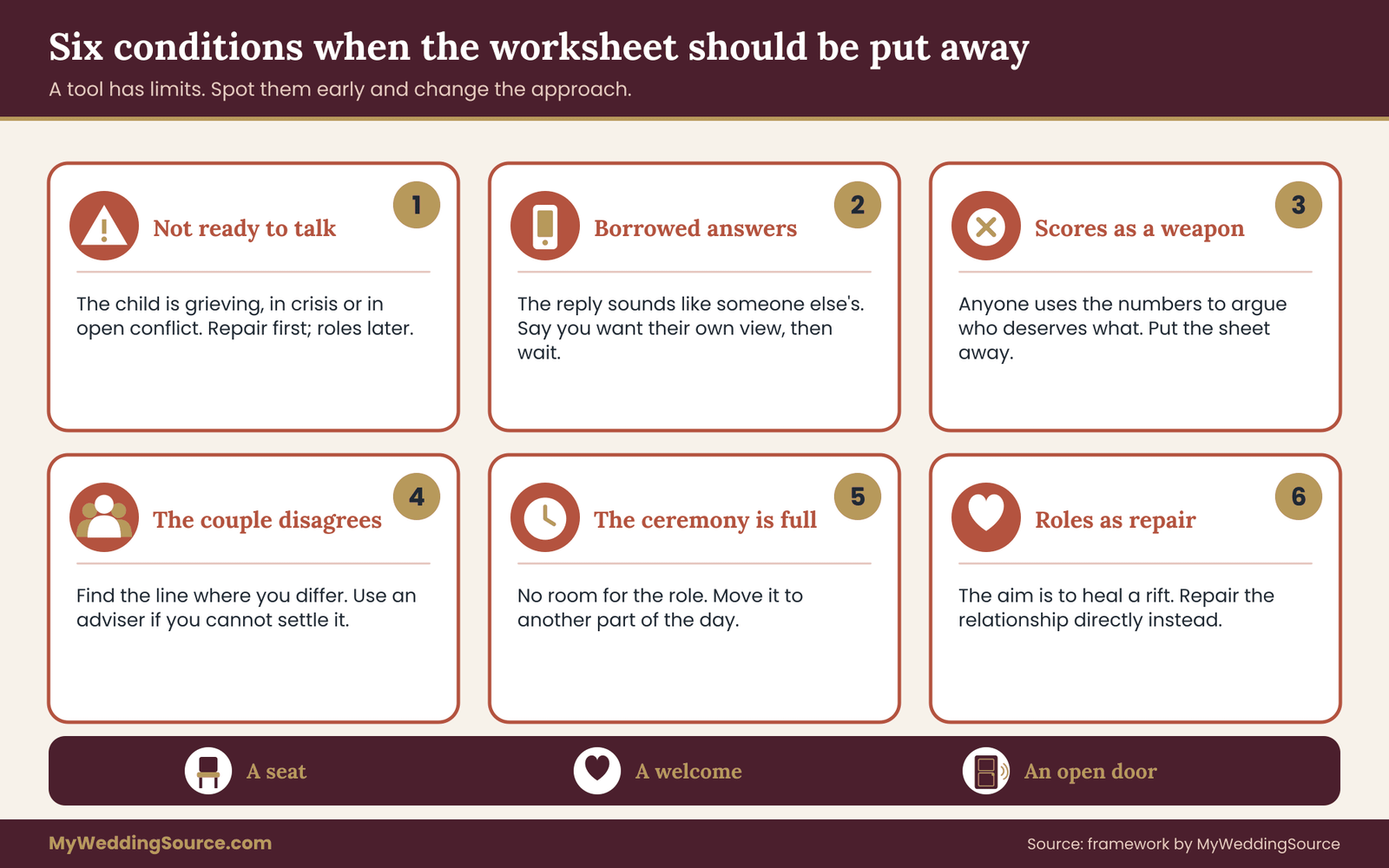
A worksheet is a tool, and every tool has limits. There are situations in which the scoring approach does not fit, or in which it would do harm. Knowing them in advance saves you from forcing a method onto a family that needs something else.
Failure one: the child is not yet able to talk about it
If a relationship is in open conflict, or the child is grieving or in crisis, a conversation about wedding party roles may be a burden. In that case, put the worksheet away. Focus on the relationship first, in whatever way the two of you can manage, and leave the wedding roles for later. A seat and a welcome are enough.
Failure two: the answers are being written by someone else
Sometimes the child’s answer is really the answer of the other parent, a partner or a sibling. You may hear a pattern of words that sound borrowed, or a sudden change after a family phone call. If you suspect this, do not press. Say that you would like to hear what they themselves think, and that there is no hurry. Then wait.
Failure three: the scores are being used as a weapon
If a parent or a partner begins to use the scores to argue about who deserves what, the worksheet has failed. It is a private tool for deciding what to offer, and it is not a measure of worth. Put it away and go back to the plain question of what each child wants and can do.
Failure four: the couple disagrees
The two people marrying may disagree about a child’s role. One may want a visible role for their child, and the other may feel uneasy. The worksheet cannot settle this. What it can do is to show where the disagreement lies, such as standing, fairness or fit. Then talk about that line directly, and if you cannot agree, take it to a trusted adviser, an officiant or a counselor. The guide to sharing wedding decisions with family covers shared decisions in more depth.
Failure five: the ceremony cannot hold the wedding party roles
A very short civil ceremony, a venue with strict rules or a religious tradition with set roles may leave no room for the wedding party roles you wanted. If so, move the wedding party roles to other parts of the day, as in the alternatives section, or change the ceremony if that is possible. Do not force a role into a ceremony that cannot hold it.
Failure six: you are using the wedding party roles to repair something
If the main reason you want a child in a role is to heal a rift, to prove a point, or to show the family that all is well, step back. A role is a poor tool for any of these. It may help, but it may make things worse, and it puts the child in the position of acting out a feeling. If you want to repair a relationship, do it directly, away from the wedding.
What to do when the worksheet fails
Go back to the simplest layer. Give each child an honored seat, a personal conversation and a real welcome. Offer to talk again later. Keep the door open, and trust that relationships change over time. Many families settle after the wedding, when the pressure is gone and the new routine has formed.
If the tension is serious, consider a family counselor or mediator. A professional can help with feelings that a worksheet cannot reach, and a few sessions can make a big difference. A wedding is a day, and the family is for life.
A timeline for asking and settling the wedding party roles
Timing makes a difference. Asking too early can feel premature. Asking too late can feel rushed. The schedule below is a guide, not a rule. Adjust it to the size of your wedding and the distance your children have to travel.
About nine to twelve months out
Fill in pass one of the worksheet in private. Decide on the ceremony shape, the size of the front group and the date. This is the time to think about money, and about which costs you can cover. If a child lives abroad, this is also the time to give them the date so that they can plan.
About six to nine months out
Have the conversations. Talk to each child separately, using the steps in this guide. Give them time to think. Record each answer and the date. Use this period to settle the wedding party roles that need the most lead time, such as travel, attire and rehearsal arrangements.
About three to six months out
Confirm the wedding party roles in writing, with a short note to each child that describes the role, the schedule, the costs you are covering and the exit date. Update the cue sheet and the photo list. If a child has changed their mind, adjust and thank them.
About one to three months out
Share the final list of wedding party roles with the children, in plain terms. Tell the officiant, the photographer and the planner. Send the children the schedule for the day and the rehearsal. Check in on anyone who seemed unsure, kindly and without pressure.
The last month
Make small changes only. Hold the exit date, and respect it. Confirm that each child knows where to be and when. On the day, appoint someone, a friend or a planner, to look after the children so that they are not responsible for their own logistics.
Your next steps
Start with one child and one evening of thinking about wedding party roles. Work through pass one of the worksheet in private. Mark every unknown with a question mark, and write down the questions you need to ask. Then choose a time to talk, and use the steps in this guide to ask.
After the conversations, add up the scores, apply the decision rules, and choose a role from the ladder. Confirm each role in writing with the free exit. Then check the combined picture for fairness, and adjust where needed.
Finally, put the wedding party roles on your ceremony cue sheet and your photo list, tell your officiant and your vendors, and let the family know. For the broader ceremony sequence and its main decisions, return to the ceremony step-by-step guide, and for manners questions that come up along the way, the wedding etiquette guide is a good companion. Then breathe. You have done the thoughtful work, and the rest is the day.
FAQ
Should adult children always be in the wedding party?
No. A place in the wedding party is one of several options, and it only works when the child wants it and can do it. Many adult children prefer a smaller role, such as a reading or a witness signature, or simply a seat among the guests. Ask each child what they would like, and build the role around the answer.
What if an adult child says no?
Thank them and accept the answer. A no is useful information, and it is better than a reluctant yes. Keep the honored guest seat open, offer a private gesture if you like, and leave the door open for later. Do not argue or explain how much the role would mean to you. Pressure turns a simple no into a family story.
How do I choose between several adult children for wedding party roles?
You do not have to choose between them in the sense of ranking. Ask each child separately, and match the role to what that child wants and can give. Then read the whole set for fairness. If you can explain each choice kindly and without comparing the children, the set will usually be accepted.
Can an adult child be a witness on the marriage license?
In many places, yes, but rules differ by state and by country. Some places require witnesses and some do not, and age or relationship rules can apply. Check with the office that issues your license and with your officiant. Then ask the child whether they would like the role before you promise it.
Should we pay for adult children’s costs?
If you ask a child to take on a role that costs money, such as attire, travel or childcare, it is kind to offer to cover those costs. Some children will decline help, and others will be relieved. Offer plainly and without pressure, and decide your budget before you ask so that the offer is real.
What if one child is hurt by the lineup?
Listen first, without defending the choice. Thank them for telling you, and say what you can offer now. If the hurt comes from a misunderstanding, clear it up kindly. If it comes from a real wish for a different role, consider whether the ceremony can hold it. A role cannot repair a deeper strain, so keep the relationship separate from the plan.
How far ahead should we ask adult children about their wedding party roles?
Several months before the wedding is a good guide, and earlier if a child must travel far or take time off work. Early notice makes it easier to say yes and easier to say no. Avoid asking in the last few weeks, when a child has little room to arrange their life around the day.
What if the other parent objects to a child’s role?
You cannot control another parent’s feelings, and the child should not be asked to choose. Offer smaller wedding party roles that are easy to explain, avoid criticizing the other parent, and accept the child’s decision without asking for reasons. If the child wants a role anyway, support them. The child knows their own situation best.
Sources
The following official and standards sources are useful for checking the facts that vary by place and change over time. Confirm current rules with the issuing agency before you rely on them.
- USA.gov: Get married: general guidance on marriage licenses and where to find your state or county office, including witness and officiant requirements.
- U.S. Census Bureau: national data on families, households and marriage, useful for general context on blended families.
- CDC National Center for Health Statistics: national marriage and divorce data and related family statistics.
- ADA.gov, U.S. Department of Justice: general information on accessibility, including for event venues and public spaces.
- U.S. Department of State, Travel: passport, visa and entry information for family members who travel internationally.
- Consumer Financial Protection Bureau: guidance on budgeting and shared costs.
- American Psychological Association: public information on family relationships, stepfamilies and coping with family change.
- National Institute on Aging: information on later-life relationships, caregiving and family planning.
- Internal Revenue Service: official guidance if you plan to give money to a child toward wedding costs and want to understand the rules.
- The Knot: a wedding industry publication with etiquette articles on wedding party roles.