
A damaged wedding cake is a decision problem before it is a dessert problem. When the cake arrives cracked, leaning, smeared or warm, the next thirty minutes should follow a short, fixed order: protect safety, record the damage, decide what can be served, and only then worry about how it looks. This guide gives you that order, a set of food-safe presentation alternatives, and an evidence log you can fill in on your phone.
When a damaged wedding cake arrives, do not sign anything and do not start repairing it yourself. Photograph the cake and its packaging, then run it through four gates in order: is it safe to eat, is it structurally sound enough to cut, can the baker repair the surface on site, and are there enough servings left. The result is one of five outcomes: serve as is, repair, cut in the kitchen behind a display piece, switch to a backup dessert, or keep only a ceremonial slice. Write down times, temperatures and names as you go.
Most stories about a damaged wedding cake share the same first mistake. Someone sees a smashed tier at four in the afternoon, feels the whole evening tilt, and starts doing five things at once. The baker is called, a friend begins smoothing frosting with a butter knife, a photo is taken from one angle, and nobody notes what time the cake left the cooler. By seven o’clock the couple has a cake of unknown safety, no useful record of what happened, and an argument about who pays.
None of that is necessary. A damaged wedding cake is usually fixable or replaceable within the time available, and the people who deal with this for a living follow a routine that is easy to borrow. The routine below is written for couples, planners, family helpers and venue staff, and it assumes no baking skill at all.
The guide to handling a damaged wedding cake is built around three tools. The first is a four-gate triage that turns “the cake is wrecked” into a specific, calm decision. The second is a menu of presentation alternatives that keep the cutting moment, the photograph and the food-safety rules intact when the original cake cannot be shown. The third is an evidence log, a one-page record that protects your claim without turning the day into paperwork.
A note on scope. This is general planning information, not legal, food-safety or insurance advice. Temperature limits, health-department rules and contract terms vary by place and by recipe, so the final word on any cake belongs to the baker, the caterer and, where it applies, your local health department.
If you are still choosing a baker or setting the production schedule, the wedding cake timeline covers those earlier steps. This article starts at the moment something has already gone wrong.
What a damaged wedding cake actually looks like
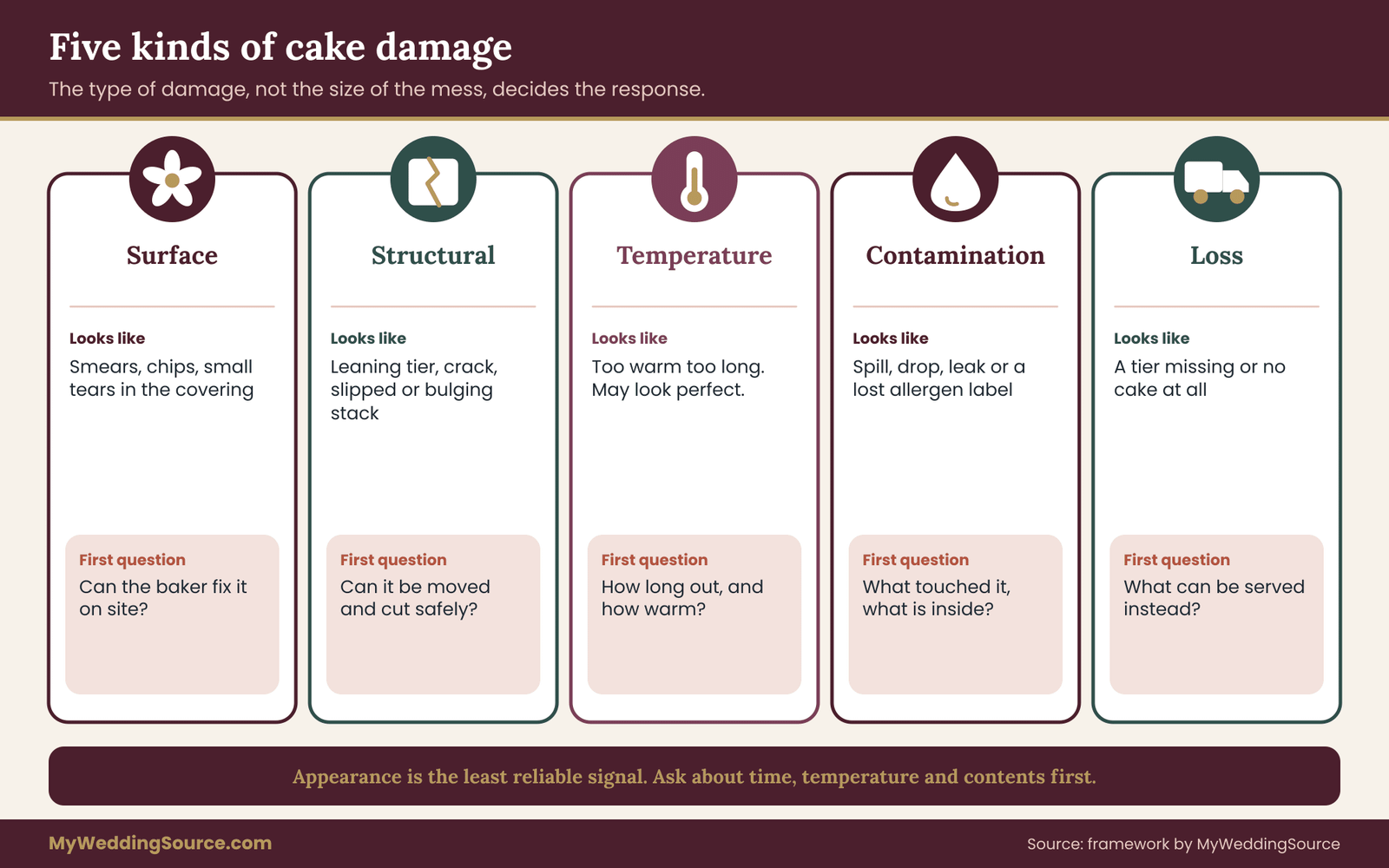
The phrase covers very different situations, and the right response depends on which one you are facing. Sorting the damage into types is the first useful thing you can do, because two cakes that look equally bad can sit on opposite sides of the line between “fix it” and “do not serve it.”
Surface damage. Smeared frosting, a thumbprint in fondant, a chipped sugar flower, a dented border, a bubble or a tear in the covering. The cake underneath is intact. This is the most common kind and the easiest to repair.
Structural damage. A tier that has slid, a visible crack across a layer, a bulging side, a stack that leans, or a tier that has dropped onto the one below. The cake may still be edible, but it may not be safe to carry, stack or cut in public.
Temperature damage. A cake that has been too warm for too long. It may look perfect on arrival or it may be sweating, slumped or glossy. This is the dangerous kind, because the harm cannot be seen.
Contamination damage. Anything that touched the cake that should not have: a spill, a dropped box, a pet in a vehicle, a leaking cooler, liquid that ran down from another item. It can also mean a label that came off or got wet, so nobody can say what is inside.
Loss damage. A cake that arrives incomplete or does not arrive at all, because the vehicle broke down, a tier was left behind or a box was dropped on the way in. The cake is not damaged so much as missing.
Why the type matters more than the size of the mess
A smeared fondant tier with a long scratch looks alarming and costs the baker ten minutes to fix. A pristine-looking cake that spent four hours in a hot van might be the one that has to be discarded. Guests and family tend to judge by appearance, which is the least reliable signal available.
That mismatch causes the two most common errors with a damaged wedding cake. People throw out a perfectly safe cake because it looks bad, and they serve a risky cake because it looks fine. A good response ignores appearance for the first few minutes and asks about temperature, time and contents first.
Where damage usually happens
Knowing where damage tends to happen helps you recognize the cause and, later, the responsible party. Cakes are most often harmed in four places.
The first is the bakery: a box packed badly, a tier stacked before it chilled, or a cake loaded onto a shelf that moves. The second is the vehicle: braking, turns, uneven roads, heat, a cake placed on a seat instead of a flat, non-slip surface, or a box that slid.
The third is the handoff: a carry from the van to the door, a tight staircase, a narrow service entrance, an elevator that does not fit the box. The fourth is the venue: a table that wobbles, a room with direct sun, a staff member who bumps the table while setting a place, a guest leaning in for a photograph.
Each of these places has a different person responsible, which is why the evidence log later in this guide asks where the cake was and who handled it at each point. If you want a plan for the delivery side of the story, the earlier planning guides on this site cover timing and placement; here the focus is what to do once the harm is done.
What this guide will not tell you
This guide does not give you a repair technique, because repairs belong to the baker and the right fix depends on the covering, the filling and the support structure. It does not give you temperature thresholds beyond the general public guidance from federal food-safety agencies, which are listed in the sources. And it does not promise that every damaged wedding cake can be saved. Some cannot, and the honest answer in that case is a good backup plan, handled calmly.
The first ten minutes after a damaged wedding cake arrives
The first ten minutes decide most of the outcome, and almost none of them involve the cake itself. What you do in this window protects three things: the safety of your guests, your ability to get a repair or refund, and your own sanity.
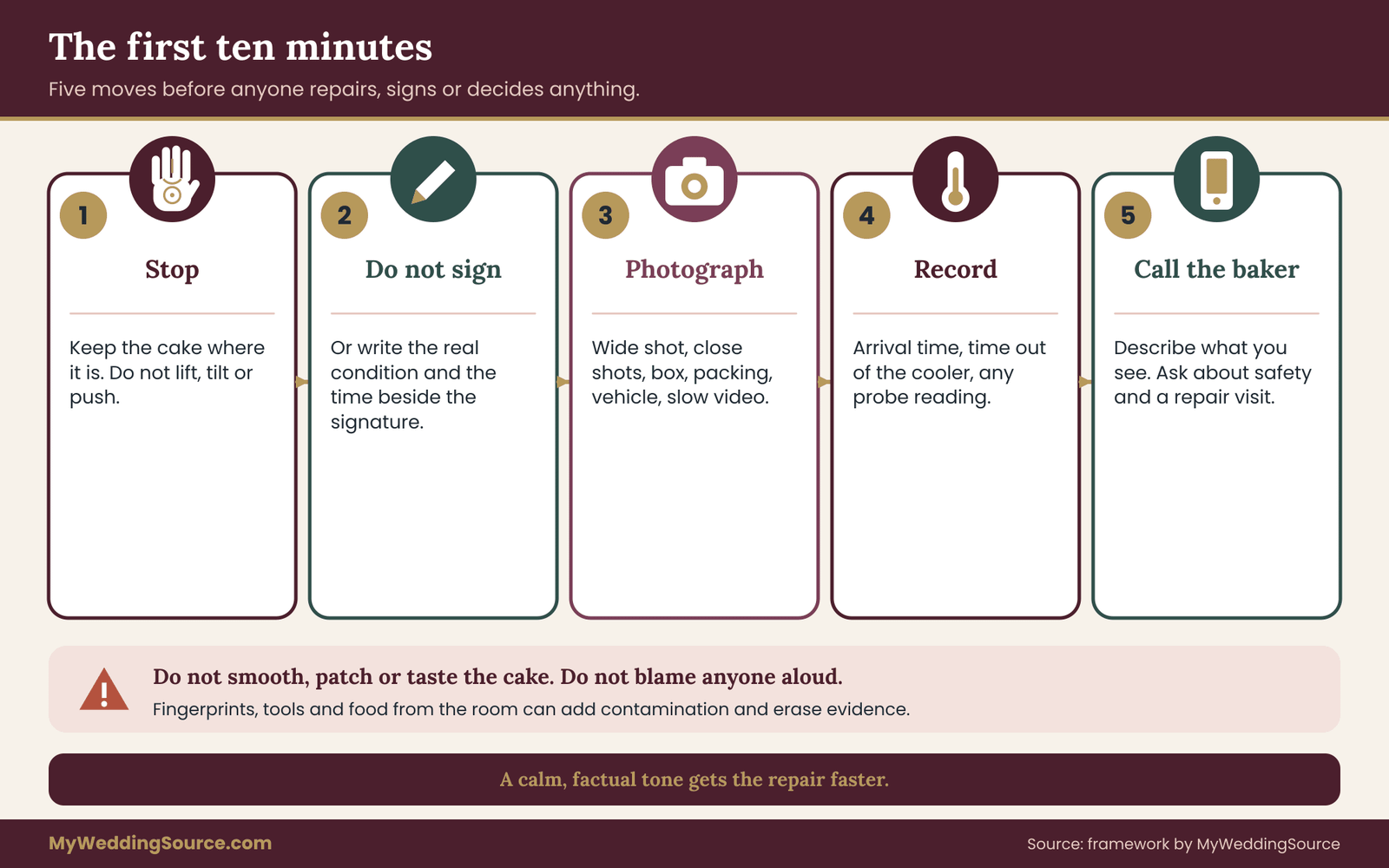
Step one: stop and keep the cake where it is. If the cake has arrived and been set down, leave it. If it is still in the vehicle or on the cart, ask the driver to stay. Moving a cake with a structural problem is how a crack becomes a collapse. Do not let well-meaning guests lift, tilt or push on it.
Step two: do not sign the delivery slip or confirm acceptance. Many bakeries and delivery services use a signature to show the cake was received in good condition. If you sign without a note, you may be agreeing that it was. If a signature is required, write the actual condition beside it, for example “tier two leaning, filling visible, received at this time,” and add the time.
Step three: take photographs before anyone touches anything. Take a wide shot of the cake in place, then closer shots of each damaged area, the cake board, the box, the packing material and the vehicle interior if it is visible. Take a short video that moves slowly around the cake. Photographs of a damaged wedding cake taken in the first minutes carry more weight than ones taken after a repair attempt.
Step four: record the time and temperature. Note the exact time the cake arrived and, if the bakery recorded one, the time it left the cooler. If a food thermometer is available from the caterer or the venue kitchen, ask a staff member to check the cake or the filling temperature and write down the number. If no thermometer exists, write that down as well.
Step five: call the baker and describe what you see. Not what you think happened, only what you can see. Ask whether they can come back, what they would do, and how long it takes. Then tell the caterer and the planner or coordinator, so that nobody is surprised later.
What not to do in the first ten minutes
With a damaged wedding cake, the temptation is to repair things yourself or to hide the problem from the couple until it is solved. Both usually backfire. Smoothing frosting with a kitchen knife adds your fingerprints and tools to the cake, may introduce contamination, and destroys the evidence of what arrived. Hiding the problem also removes the one person who has the most say in what happens next.
It is equally unhelpful to blame anyone aloud while guests, florists, photographers or children are in the room. Cakes break in transit for ordinary reasons, and the people who handled the cake are about to help you solve the problem. A calm, factual tone gets you a faster repair.
Who should handle the first ten minutes
Ideally the couple is not the one standing over the damaged wedding cake. If there is a planner or day-of coordinator, that person takes the lead. If there is not, choose one trusted person in advance, a sibling, a close friend or the venue’s event manager, and give them the authority to make the first calls and photographs. The couple hears about it from that person and decides at the point that matters: whether to serve, repair or replace.
If the cake arrives while you are getting dressed or being photographed, a short text that says “cake arrived with damage, photographed, baker called, will update at a set time” is enough. It tells you the situation is held, and it gives you a time when you will hear more.
A short script for the delivery person
A delivery driver who has just watched a cake slide may be embarrassed or defensive. A simple script helps keep the conversation useful. You can say: “Thank you for getting it here. The cake has some damage, and I’d like to document it before anything moves. Could you stay a few minutes while I take photographs and call the bakery?” This is polite, specific and asks for something the driver can do.
If the driver says the cake was fine when it left, do not argue. Say you are only recording what you see now, and ask them to note the delivery time and any incident on the way. Their account goes into the evidence log along with yours. ## The four-gate triage for a damaged wedding cake
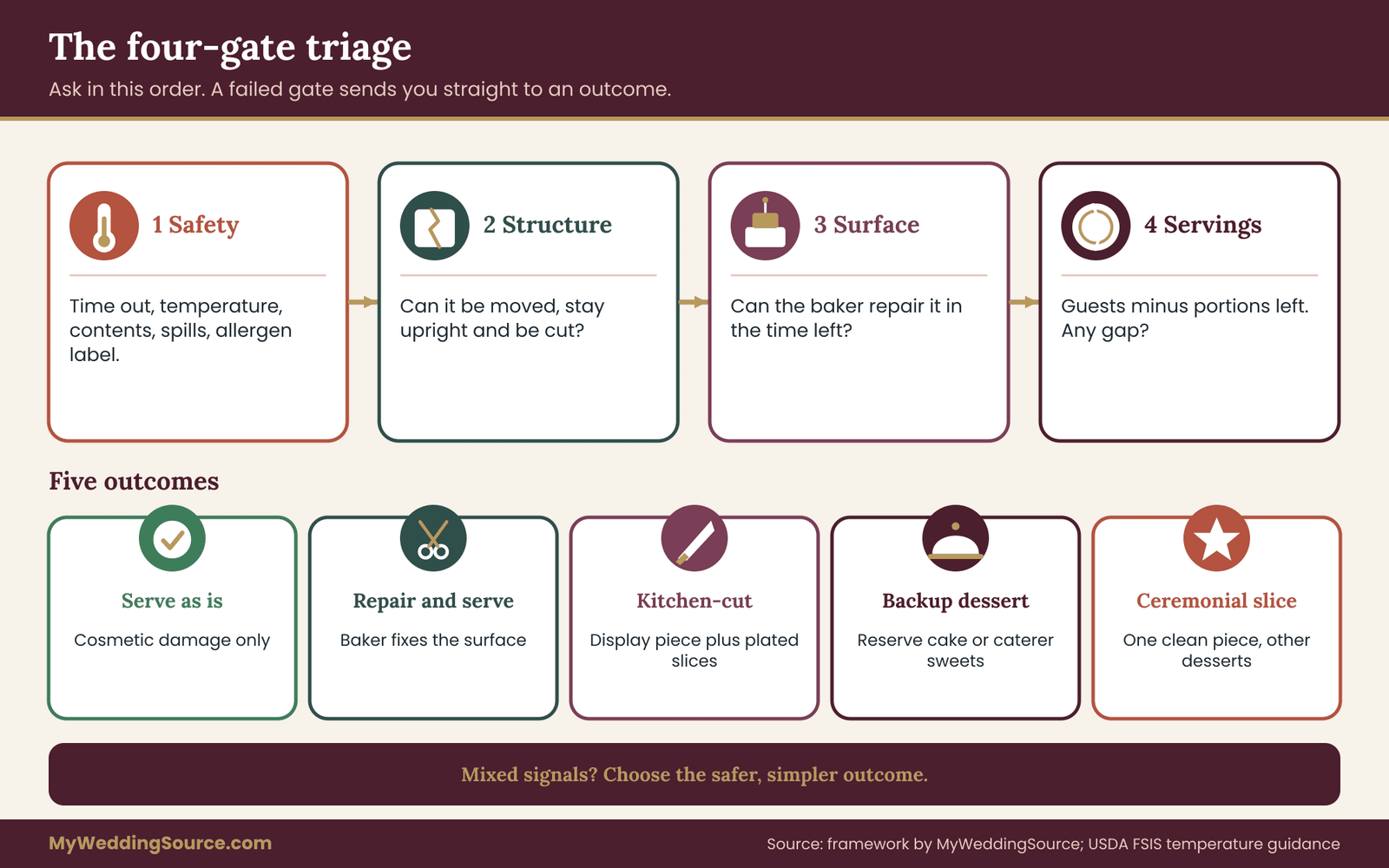
Once the first ten minutes are done and the damaged wedding cake is photographed, you need a way to decide what happens next. The method here is a four-gate triage. It is a simple sequence of questions, always asked in the same order, and each gate can stop the process. If a cake fails a gate, you do not move on to the next one; you go straight to the outcome that gate points to.
The order matters because the gates run from the most serious concern to the least. Safety comes first, because nothing else matters if the cake could make a guest ill. Structure comes second, because a cake that cannot be carried or cut cannot be served. Appearance is third, since it is a matter of repair and photographs. Servings come last, because they are a counting problem that you can solve with other food.
Gate one: is the damaged wedding cake safe to eat?
This gate belongs to the baker and the caterer, not to you. Your job is to bring them the facts they need. Federal food-safety guidance says perishable food should not stay in the temperature range between 40 and 140 degrees Fahrenheit for more than two hours, and for only one hour when the air temperature is above 90 degrees. Whether a given cake counts as perishable depends on its contents, which is why the baker’s answer carries more weight than any general rule.
Gather four facts. What are the fillings and coverings, and which of them are perishable? When did the cake leave cold storage? How long has it been out since, and in what conditions: a cool van, a hot car, a sunny room? Did anything touch the cake, spill on it or leak onto it?
If the baker says a component is perishable and the time out of the cooler is beyond the limit, the answer is to discard that component, and often the whole tier. This is a hard conversation, and it is much easier when the recorded times are on the page. A spoiled filling cannot be fixed with new frosting.
If the cake contained a label for allergens and the label has gone missing or has been soaked, treat the contents as unknown until the bakery confirms them in writing. A guest with a serious allergy deserves a confirmed answer rather than a guess about what the cake probably holds.
Gate one has three results for a damaged wedding cake. Safe, which means go to gate two. Safe in part, which means certain tiers or components are removed and you go to gate two with what remains. Not safe, which means stop and go to the backup outcome.
Gate two: is the structure sound enough to cut?
A cake can be perfectly safe and still be unable to stand. The baker or the person who built the cake is the one to judge this. Ask three questions about the damaged wedding cake: can it be moved to its table without more harm, will it stay upright until the cutting, and can a person cut it without the tiers shifting?
If the damage is a lean, a slip or a crack through a layer, the answer is often to take the tiers apart. A top tier is typically a separate, intact cake on its own board and can stand alone. Lower tiers may be removed, restacked after a rest, or cut in the kitchen. The baker may be able to reinforce a tier, but they may also tell you that the safest plan is not to restack at all.
A short rule helps with the decision. If the baker needs more than the time you have to make the structure reliable, take the cake apart rather than gamble on it. A tilting cake in front of a hundred people is a worse photograph than a tidy single tier with a plate of kitchen-cut slices beside it.
Gate two also has three results. Sound, which means go to gate three. Sound if rebuilt or reduced, which means rebuild or remove tiers and go to gate three with the smaller cake. Not sound, which means use the kitchen-cut or backup outcome.
Gate three: can the surface be repaired in time?
Now you can finally think about how it looks. Surface damage on a damaged wedding cake is common and often completely repairable. Chipped decorations can be replaced from the baker’s spare supply. A scratch in buttercream can be smoothed. Fondant tears can be covered with a flower, a ribbon, a piece of greenery that is safe for contact with food, or a trimmed border.
Ask the baker what they can fix on site, what they would need to bring, and how long it will take. Ask also what the repair will not hide. A repaired cake is usually described as good from a distance and honest up close, which is fine for most weddings and is far better than the alternative of no cake at all.
Fresh flowers added to cover damage need extra care. Many flowers are not food-safe and can carry sprays, and some are toxic. If a repair uses flowers, the baker should supply or approve them and keep them from touching the cake surface directly. The couple’s florist and the baker should agree on this before anything goes on the cake, as the article on food-safety and vendor questions for edible flowers explains in general terms.
Gate three results: repaired well enough to photograph, repaired well enough to serve but not to photograph closely, or not repairable in the time available. The second result is a common and honest answer. A cake that is not perfect from every angle can still be cut with real ceremony.
Gate four: are there enough servings left?
The last gate for a damaged wedding cake is arithmetic. Take the guest count and the number of servings the remaining cake can supply, which the baker can estimate. Subtract. If the answer is zero or positive, you are done. If it is negative, you have a gap, and the gap needs a second dessert.
Be careful with the counting if the cake was a combination of real and display tiers. A cake with a display tier or a smaller real cake behind it may never have been designed to serve everyone. The earlier guides on this site about serving counts explain how to check this before the day, and the baker can tell you at once how many portions are safe to cut.
Gap sizes lead to different choices. A small gap, a handful of servings, can be covered with a few extra desserts from the caterer. A medium gap suits a sheet cake, a tray of cupcakes or a dessert table. A large gap, where little or none of the original cake is usable, means a full backup plan, which the next section describes.
The five outcomes
After the four gates, every damaged wedding cake falls into one of five outcomes, and each has its own set of steps.
Serve as is. The cake passes all four gates, with only cosmetic damage and no repair needed. Photograph it first, then proceed as planned.
Repair and serve. The cake passes gates one and two, and the baker can fix the surface. The repair happens out of guests’ sight, ideally in a back room, and the cake is brought out later.
Cut in the kitchen behind a display piece. The cake is safe but cannot stand or does not have enough surface left to present. The couple cuts a single intact tier or a small decorated cake for the ceremony, and the rest is cut and plated in the kitchen.
Switch to a backup dessert. The cake fails gate one or gate two beyond repair, or the servings gap is large. The caterer serves a dessert prepared for this possibility, and the couple still cuts something for the ceremony.
Ceremonial slice only. Little of the cake is usable but a single clean piece remains. The couple makes a symbolic cut and the dessert course is handled by other food.
Naming the outcome out loud is helpful. “We’re on outcome three” tells the planner, the caterer and the baker the same thing in four words, and it keeps the conversation from reopening every question.
How long should the triage take?
For most cakes, the four gates take twenty to thirty minutes when the baker is reachable by phone and the people on site have the log ready. It takes longer when the baker has to travel. That is a good reason to ask the baker, well before the wedding, how fast they can reach the venue and what a repair visit includes.
Do not rush gate one. A rushed safety decision is the one most likely to be wrong, and the time you save is small. A short delay in the schedule is easier to recover from than a guest becoming ill. If the time pressure is severe, the better move is to shift to the outcome with the least risk and to make the decision about the rest later.
Who decides at each gate
It helps to name decision-makers for a damaged wedding cake in advance. The baker decides gate one for their own product and has the final say on whether a component is safe, while the caterer, who is responsible for food service at the venue, can veto serving anything they do not trust. The baker and a person on site share gate two. The baker and the couple share gate three, since looks are a matter of taste. The caterer and the planner share gate four, because they know the real guest count and the dessert course timing.
The couple should be consulted at gate three and at the outcome, not at gate one. Hearing “the cake is unsafe” is distressing, but the decision is not theirs to make. What they decide is what to do next, and with the gates already completed they are choosing between clear options instead of reacting to alarm.
A small rule for tie-breaks
When the gates give mixed signals on a damaged wedding cake, take the safer and simpler outcome. If the baker thinks a tier might be fine and the caterer is uneasy, treat it as not safe. If a repair is possible but tight on time, plan the backup in parallel. A calm couple with a good backup is better off than a couple with a perfect plan that failed in front of the guests. Many cake mishaps become funny stories later, but only if nobody went home unwell. ## Food-safe presentation alternatives when the cake cannot be shown
The cake cutting is a short moment with a lot of weight, and a damaged wedding cake threatens it. The couple stands at a table, a knife is held by two hands, and cameras are ready. You can keep that moment even when the original cake cannot be used, as long as what you cut is safe and the plan does not ask anyone to improvise. The alternatives below are ordered roughly from the closest to the original to the furthest away.
Each one is described with what it keeps, what it gives up and what it needs from the baker, the caterer and the venue. None of them is a trick or a disguise. They are honest ways to serve a dessert and hold a cutting ceremony when a damaged wedding cake takes the original off the table.

Alternative one: the intact top tier
Many tiered cakes have a top tier that sits on its own cake board and rides in its own box. If the damage is on the lower tiers, the top tier may be completely fine. It can be placed on a clean stand, perhaps with a few decorations moved from the damaged tiers, and used for the ceremonial cut.
What it keeps: the traditional look and the familiar photograph. What it gives up: servings, since a top tier feeds few people. What it needs: the baker or caterer to confirm the tier is safe and to decorate the stand cleanly. Pair this with a kitchen-cut tray for the guests.
One caution. The top tier is sometimes saved for the first anniversary. If you plan to keep it, make that decision before the wedding. A tier that has just been through a damaged wedding cake situation, or sat out for hours, should not be frozen and eaten a year later without the baker’s agreement.
Alternative two: a kitchen-cut cake behind a display piece
Caterers often cut a cake in the kitchen and plate it, which is a normal way to serve many weddings. When the display cake is damaged, a similar approach can save the evening. A smaller, undamaged cake or a single decorated tier is used for the ceremony, and a sheet cake or the safe remaining tiers are cut in the kitchen.
What it keeps: full servings and the ceremony. What it gives up: the idea that guests are eating the same cake they photographed. What it needs: a safe source of extra cake. Often this is a sheet cake the baker or caterer already has, which is why asking for a reserve sheet cake in advance is one of the cheapest forms of protection.
If the cake you are serving behind the scenes differs in flavor from the display, tell the caterer so servers can answer a guest who asks. Honest, simple answers are better than a guess.
Alternative three: a small bakery cake or a grocery bakery order
A local bakery or the bakery section of a large store can often produce a plain cake on short notice. Some will write a message on top. It will not match the original, and it should not be offered as if it did. It can still give the couple a cake to cut, with a few fresh decorations from the florist or the venue that are safe for food contact.
What it keeps: the cutting and a cake of the right size. What it gives up: design, flavor and the baker’s craft. What it needs: someone to collect it, an agreed budget, and the caterer’s permission to serve food that was not prepared in a licensed kitchen they know. Not every venue or caterer allows outside food, and some require it to come from a licensed bakery.
Cost can matter here. A small bakery cake is a few things the couple can afford without drama, while a replacement of the original is not realistic on a wedding day. Keep the receipt, because the cost belongs in the evidence log as part of any later claim.
Alternative four: cupcakes, mini desserts or a dessert table
If the main cake is gone, individual desserts can fill the gap. A caterer or dessert vendor may have stock for something like this. Cupcakes, mini tarts, cookies, brownies, individually wrapped sweets or a mixed dessert table spread the servings in a way that is easy to serve and pleasant to photograph.
What it keeps: portions for everyone and a dessert course. What it gives up: the single large cake and the classic cutting. What it needs: a vendor who can supply on short notice and a table that is set up with clear labels for common allergens. Individually wrapped items are useful for guests with allergies or restrictions.
This is also a good fit when a damaged wedding cake leaves a medium servings gap, because the desserts can sit alongside whatever part of the cake is safe. The article on desserts beyond cake covers how to plan a dessert spread from the start; in an emergency, you only need a few items that are easy to serve.
Alternative five: a decorated cutting piece
The ceremony needs something to cut, and it does not have to be a whole cake. A single round or square cake, a cheesecake, a loaf cake or a stack of cookie layers can serve as a symbolic piece. A decorated board with fruit, chocolate or sugar flowers can make it feel intentional. The key is that the item is whole, clean and food-safe, and that it is cut with a clean knife and a clean server.
What it keeps: the ceremony and the photograph. What it gives up: nearly everything else. What it needs: an item that is safe to cut and eat, a knife and a server that have been cleaned, and a clear plan for what the guests receive. This alternative is a companion to another dessert option and rarely stands alone.
Alternative six: a display-only piece with real cake elsewhere
Some couples already plan a display tier made of foam or another non-food material, with real cake served separately. If a damaged wedding cake leaves you with an empty table, a similar approach can restore the visual. A decorated stand, a floral arrangement or a smaller undamaged tier can occupy the space where the cake would be, while the desserts come from the kitchen.
If any part of a display is not edible, label it as non-edible for staff and for children, and keep it away from food contact. Anything that is going to be cut and eaten should be food-safe and kept apart from decorative materials. The earlier guide on display-only tiers explains the serving arithmetic behind this method.
A note on honesty with guests
Guests do not need a technical explanation of why a damaged wedding cake changed the dessert. A simple, calm approach works best: the cake is served, the cutting happens, and nobody makes an announcement about a disaster. If a guest asks, a short answer is enough, such as “we had a change with the cake, and we are glad to share what we have.” That keeps the day about the people and not about a delivery.
The exception is allergen information. If the dessert has changed, make sure any guest with a known allergy is told clearly and personally by the caterer or the couple, and that the new item has been checked for the specific allergen. This is a place for precision, not for reassurance.
Choosing among the alternatives for a damaged wedding cake: decision rules
With six alternatives available for a damaged wedding cake, the choice becomes a matter of three variables: how many servings you still need, how much time you have, and how much the cutting photograph matters to you. The rules below are not formulas. They are ways to narrow the options quickly so the planner and the couple can say yes to one.
Rule one: start with the servings gap
Count what is left of the damaged wedding cake. If the gap is zero, you do not need a replacement, only a presentation. Use the intact tiers or the repaired cake and move on. If the gap is small, up to about a tenth of the guests, ask the caterer for a few extra plated desserts. If the gap is medium, a sheet cake, cupcakes or a dessert table is the efficient answer. If the gap is large, a full backup is needed.
These bands are rough, and the caterer will adjust them. The aim is to match the size of the fix to the size of the problem, rather than fretting over a full replacement when a few trays would do.
Rule two: let the clock limit the options
Time cuts options quickly. With under an hour, you are in the territory of what is on site: the caterer’s reserve, the intact top tier, any desserts already in the kitchen. With a few hours, a bakery order or a collected cake becomes possible. With most of a day, a baker can sometimes make a small replacement, though a rushed cake is a risk of its own.
When the time is short, prefer options that need no new preparation. An intact tier, a reserve sheet cake and pre-wrapped desserts are all ready now. A new cake that must be made, decorated and delivered is a gamble in the same conditions that produced the problem.
Rule three: decide how much the picture matters
For some couples the cake photograph is central, while for others the cake is mostly dessert. Say which you are before the emergency. If the photograph is central, put your effort into the cutting piece and into good lighting and a clean table. If it is not, put your effort into good servings and let the cutting piece be simple.
This is a good conversation to have before the wedding with your partner, and the answer belongs on the one-page plan you give your coordinator. In the heat of the moment, a short note that says “photograph matters moderately, servings matter most” helps everyone choose.
Rule four: avoid unsafe shortcuts
The pressure to save a damaged wedding cake leads to shortcuts that are worth naming so you can refuse them. Do not serve any cake that failed gate one. Do not cut a cake that is physically unstable in a crowded room. Do not cover damage with decorations that are not meant to be eaten and then serve the slice beneath. Do not use items that came into contact with spilled liquid, a floor or another food unless the baker approves it.
Do not rely on freezing or reheating to fix a temperature problem. A cake that has been warm too long is not made safe by being chilled afterward. Chilling slows further growth but does not reverse what already happened.
Rule five: write the choice down
When you choose an alternative for the damaged wedding cake, record it in the evidence log with the time and the names of the people who agreed. That log entry is useful for three reasons. It prevents a later disagreement about what the couple said yes to. It helps you prove that you chose a reasonable fix if a refund or credit is discussed. And it tells staff exactly what to serve, so servers do not improvise.
Rule six: keep the plan small enough to carry out
For a damaged wedding cake, an elaborate rescue that needs five vendors to coordinate is itself a risk. If two options are equally acceptable, pick the one with fewer moving parts. A reserve sheet cake that is already on site is simpler than a bakery run, and a bakery run is simpler than a fresh order. Simplicity is a form of safety on a busy wedding day.
Putting the rules together
A quick way to use the rules on a damaged wedding cake is to run them in order as questions. How big is the gap? How much time do we have? How much does the photograph matter? Is there anything unsafe about the option we like? Have we written it down? Is it simple enough to do with the people we have?
If all six answers point to the same alternative, you are done. If they disagree, the unsafe-shortcut rule and the simplicity rule win, because they protect the guests and the schedule. ## The evidence log: what to record when a damaged wedding cake arrives
An evidence log for a damaged wedding cake is a single page, kept on a phone or on paper, that tells the story of the cake from the bakery to the table. It has two jobs. In the moment, it keeps your decisions consistent and keeps everyone working from the same facts. Afterward, it supports any conversation about a refund, a credit or an insurance claim, because it shows what happened without relying on anyone’s memory.
The log for a damaged wedding cake does not need to be elaborate. It needs to be started early, filled in by one person, and shared with the couple at the end of the day. Ten fields cover nearly everything, and most of them take under a minute to fill in.
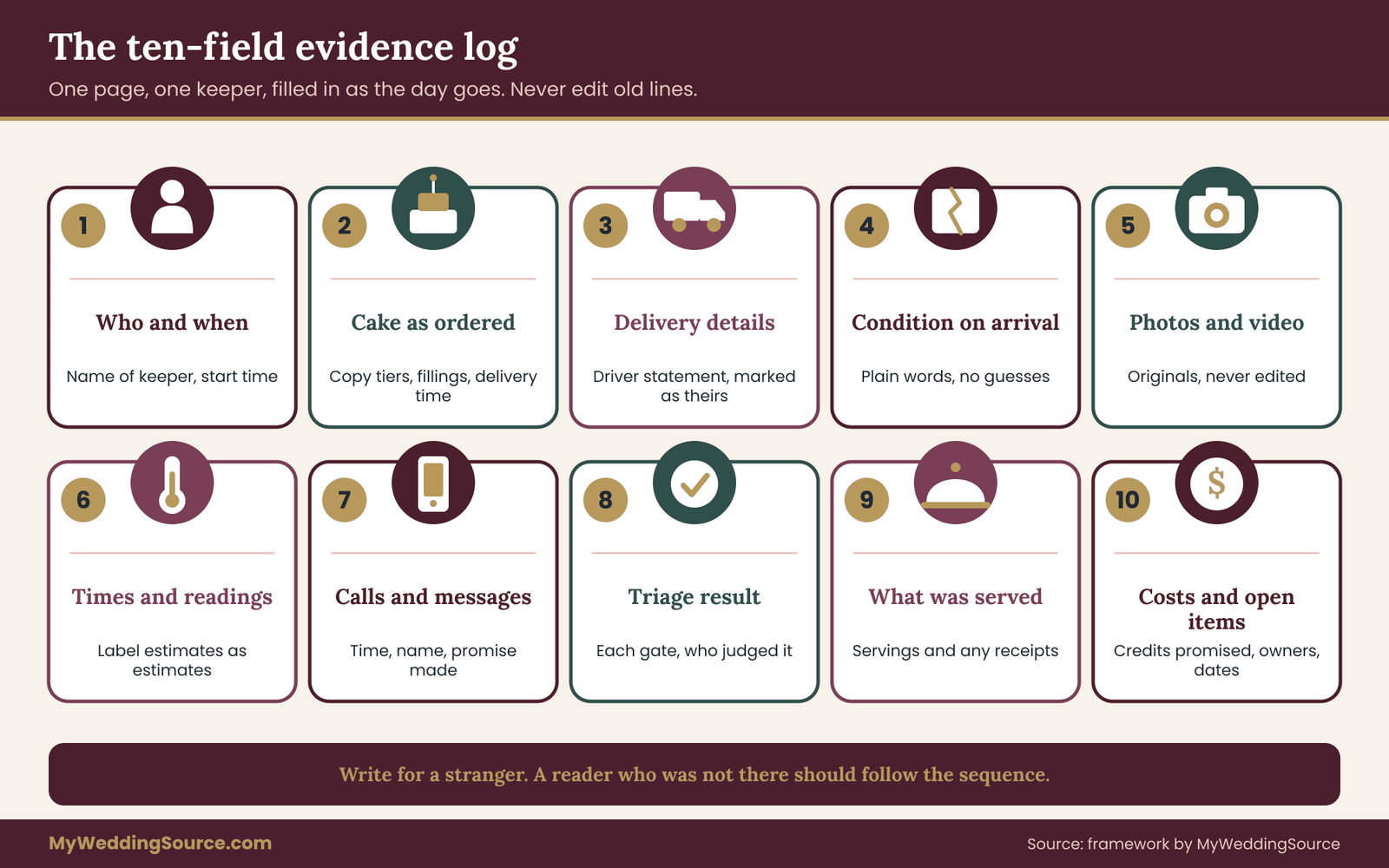
The ten fields
Field one: who and when. Write the name of the person keeping the log and the time they began. It tells a reader who saw what.
Field two: the cake as ordered. Record the order details in a line or two: number of tiers, flavors, fillings, covering, any special decorations and the delivery time that was agreed. Copy these from the contract or order confirmation, and attach a photo of the page.
Field three: delivery details. Note who delivered it, the vehicle, the arrival time, the venue entrance used and any problems on the way that the driver mentioned. If the driver gave a statement, record it in their words as closely as you can, and mark it as theirs.
Field four: the condition on arrival. Describe what you see in plain words, as if for someone who cannot see it. “Second tier leaning left, a crack across the lower third, frosting smeared on the south side, box corner crushed.” Add what you cannot say, such as “cannot tell whether the filling is cold.”
Field five: photographs and video. List the file names or the number of images, and note the times they were taken. Include the box and packing, the venue table and any surface the cake sat on. If a witness took photographs too, list theirs and who they are.
Field six: temperatures and times. Record the time the cake left cold storage if known, the arrival time, and any temperature readings with the time and the tool used. Where a reading was not possible, say so. Estimates should be labeled as estimates.
Field seven: calls and messages. Write the time of every call or text to the baker, caterer, venue and planner, with a one-line summary of what was said and any promise made. This is the field people most often skip, and it is the one that settles later arguments.
Field eight: the triage result. Record the result of each gate, who judged it and the final outcome. If the baker said a tier was not safe, record the exact wording and the time.
Field nine: what you served. Describe the alternative that was used, how many servings it supplied and whether anything was discarded. If a replacement was bought, attach the receipt.
Field ten: costs and open items. List any costs you paid, any credits promised and any follow-up steps with owners and dates.
Keeping the log honest
A log of a damaged wedding cake is only useful if it is accurate. Write what you saw and what was said, not what you conclude. “The driver said he braked hard” is a record. “The driver was careless” is a judgement, and it weakens the rest. If you are unsure of a time, write “about” and the time. If you do not know something, say so.
Do not edit earlier entries after the fact. If you learn something new, add a new line with the new time. This habit makes the log more credible, because it shows the order in which information arrived.
Photographs that help
Good evidence photographs of a damaged wedding cake are boring. Take them straight on, in even light, with something in frame that shows scale, such as a ruler, a plate or a hand placed beside the damage. Take each important area from two distances. Photograph the whole cake first, since a close-up of a crack without context can be disputed.
Keep the originals. Do not crop, filter or edit them, and avoid sending them through apps that compress them heavily. Save them in a folder labelled with the date, and back them up on the same evening. If your phone adds the time and location to the file, leave it that way.
Who reads the log, and when
The log of a damaged wedding cake has three readers. During the day, the planner, the baker and the caterer read it, mostly to coordinate. After the wedding, the couple reads it when deciding whether to ask for a refund. Later, a card issuer, an insurer, a small-claims clerk or a mediator might read it if there is a dispute.
For this reason, write for a stranger. Avoid shorthand, nicknames and inside jokes. Spell out the names of vendors. A reader who was not there should be able to follow the sequence and see that you acted reasonably.
How the log connects to your contract
A contract usually says what the bakery promised to deliver, when, in what condition, and what happens if something goes wrong. The log is the other half of that picture: it shows what actually happened. Compare them after the wedding. Look for clauses about condition on delivery, who bears the risk during transport, refund or replacement terms, and deadlines for reporting problems.
The wedding vendor contract guide on this site explains how to read the key clauses of a vendor agreement. For a cake, the most relevant are delivery and setup terms, damage and liability, the cancellation and refund terms, and any requirement to report a problem within a set time.
Some bakeries ask the couple to inspect the cake and sign on delivery. Others carry the risk until the cake is placed. Others state that their responsibility ends at the door. Knowing which applies tells you what a signature means, and it explains why the first ten minutes begin with “do not sign yet.”
A minimal version for a busy day
If the day is chaotic, use a shorter version of the damaged wedding cake log with five lines: time of arrival, what is wrong, photographs taken, who has been called and the decision made. You can fill in the rest the next morning from your photographs, texts and call history. A five-line note taken at the time is far more useful than a long one written from memory.
Who to call and what to say after a damaged wedding cake
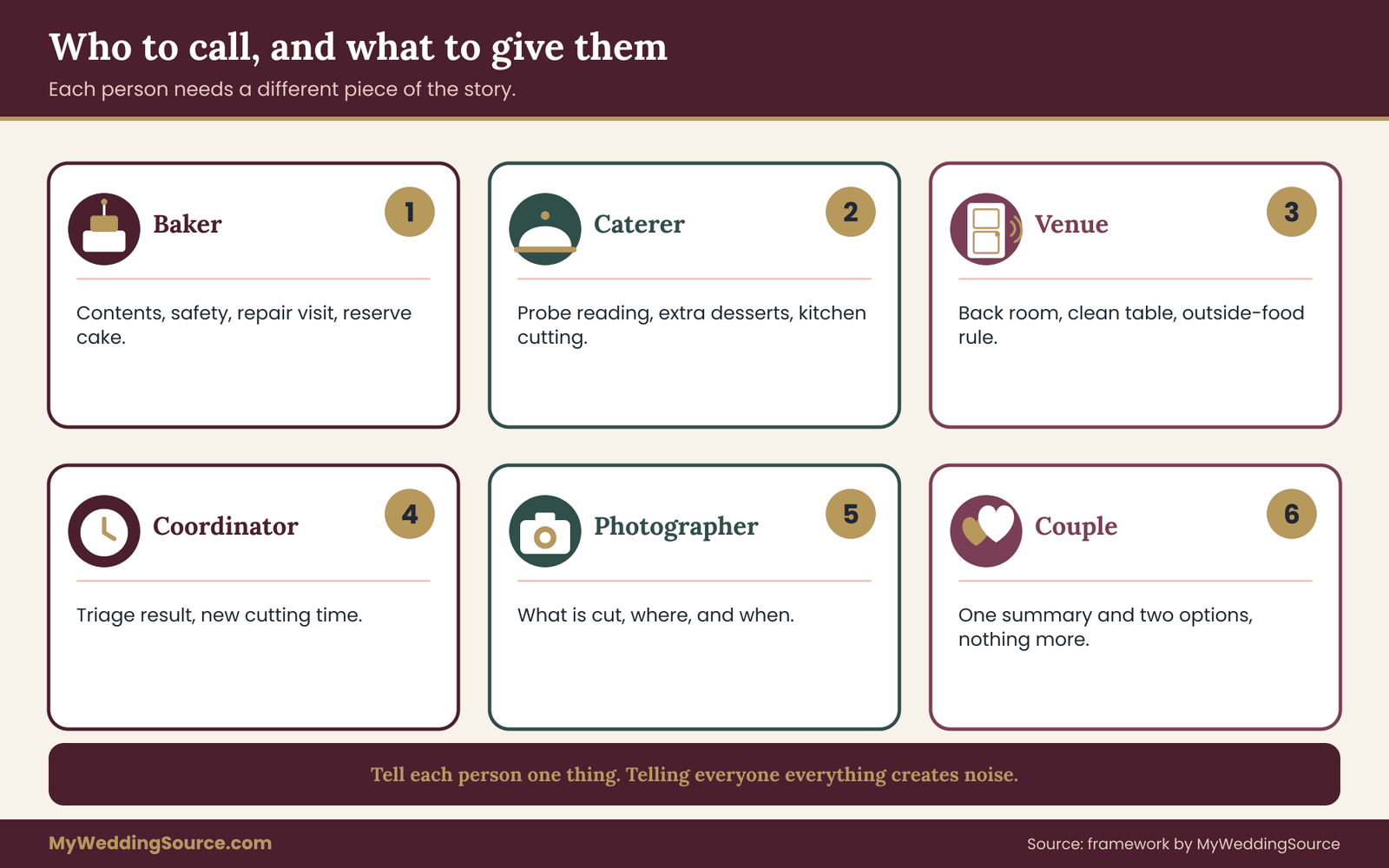
A damaged wedding cake involves several people, and each of them needs a different piece of information. Telling everyone everything about the damaged wedding cake creates noise, while telling the right person the right thing produces action. This section sets out who owns which part of the problem and gives short scripts you can adapt.
The baker or bakery
The bakery knows what is in the damaged wedding cake, how it was built, how long it can safely sit out and what repairs are possible. They are the first call after the photographs. Ask whether they can return, how soon, what they would bring and whether they have a reserve cake or components.
A useful script: “The cake arrived at this time with damage to the second tier. I have photographs. Can you tell me whether the filling is safe at this temperature and how long it has been out, and whether you can come to repair it?” It states the facts, asks specific questions and does not assign blame.
If the bakery cannot come, ask for step-by-step instructions that a caterer can follow, and ask whether they will send replacement decorations by courier. Write down every promise with the time.
The caterer
The caterer controls food service on site and often has the equipment to check temperatures, hold food and cut a cake in the kitchen. Tell the caterer about the damaged wedding cake early, because they will have to change their dessert plan. Ask whether they can check the cake’s temperature, whether they have extra desserts and whether they will serve a cake brought in from outside.
Script: “The cake has been damaged, and we are working through whether it is safe to serve. Could you check the temperature of the filling and tell us what dessert options you have on site if we need them?” The caterer may also have a rule about what they will serve, and it is better to learn it now.
The venue
The venue decides where the cake can be set up, whether there is a back room for repairs, whether outside food is allowed and whether staff can help move things. Ask the venue contact for a quiet room, a clean table and a clear path.
If the damage happened on the property, for instance a table was bumped, tell the venue calmly and record it. Venues often carry insurance and have an incident procedure. Ask what it is, but do not accuse anyone before the facts are known.
The planner or day-of coordinator
The coordinator keeps the timeline and the couple’s attention in order. Give them the triage result for the damaged wedding cake as soon as you have it, so they can move the cake cutting, extend a cocktail hour or adjust the dessert service. The wedding vendor timeline guide shows how vendor arrival times and the evening schedule link together, which is useful when the cake plan changes the order of the evening.
Script: “We are running the cake triage now and expect a decision by this time. The likely outcomes are these. Please hold the cutting until we confirm, and tell the photographer what to expect.”
The photographer and videographer
They need to know what will be cut and where, so the photograph still works. Tell them the cutting piece, the location and the planned time. If the cake is partly damaged, ask them to shoot from angles that frame the good side, and avoid telling them to hide anything in a way that surprises the couple.
They can also help with evidence. A photographer who was there when the cake arrived may have images that show the condition and the time. Ask them to keep those files.
The couple
The couple decides what happens at gate three and at the outcome. Give them a short summary and one or two options, not a long account. “The cake is safe, one tier has slid, the baker can repair the surface in about forty minutes, and we have a backup sheet cake. We suggest repair and a kitchen-cut backup. Is that okay?” Most couples are relieved to hear a plan and a recommendation.
If the news is bad, be direct and kind. “One tier cannot be served. We have enough safe cake for most guests, and the caterer will add dessert for the rest.” Then give them the next decision and the time by which it is needed.
The family
Family members often care a lot about the cake, especially when a relative made it or paid for it. Appoint one person to talk with them, so that the planner is not pulled away. A calm update helps: “We’re handling it, and the dessert will be served.” Avoid long explanations, and ask relatives not to post about it until the couple is ready.
When a family member made the cake
A cake made by a relative or friend is a special case, because feelings and a working relationship are involved. If it arrives damaged, the person who made it is likely upset. Speak to them privately, with kindness, and focus on what happens next. They may be able to repair it, or they may prefer to step back.
A homemade cake is also less likely to have a written contract or a formal food-safety process, so gate one needs extra care. Ask about the ingredients, how it was stored and how long it has been out. If the venue or caterer has rules about food prepared in a private kitchen, the same rules apply to a damaged wedding cake and to its replacement. ## A worked case: the slumped middle tier at four o’clock
The following example of a damaged wedding cake is invented to show the method in motion. The people, the bakery and the numbers are made up, and it is not a report of a real event. It follows a couple, Dana and Marcus, through a damaged wedding cake situation from arrival to the first slice.
The setup
Dana and Marcus are marrying at a restored hall for one hundred and ten guests. The ceremony is at five, dinner at seven, and the cake cutting is planned for a quarter past eight. They ordered three tiers from a small bakery: lemon sponge with a fresh berry cream filling and a buttercream covering. The top tier is a separate cake on its own board. The bakery agreed to deliver at three thirty. The caterer has a reach-in refrigerator in the hall’s kitchen.
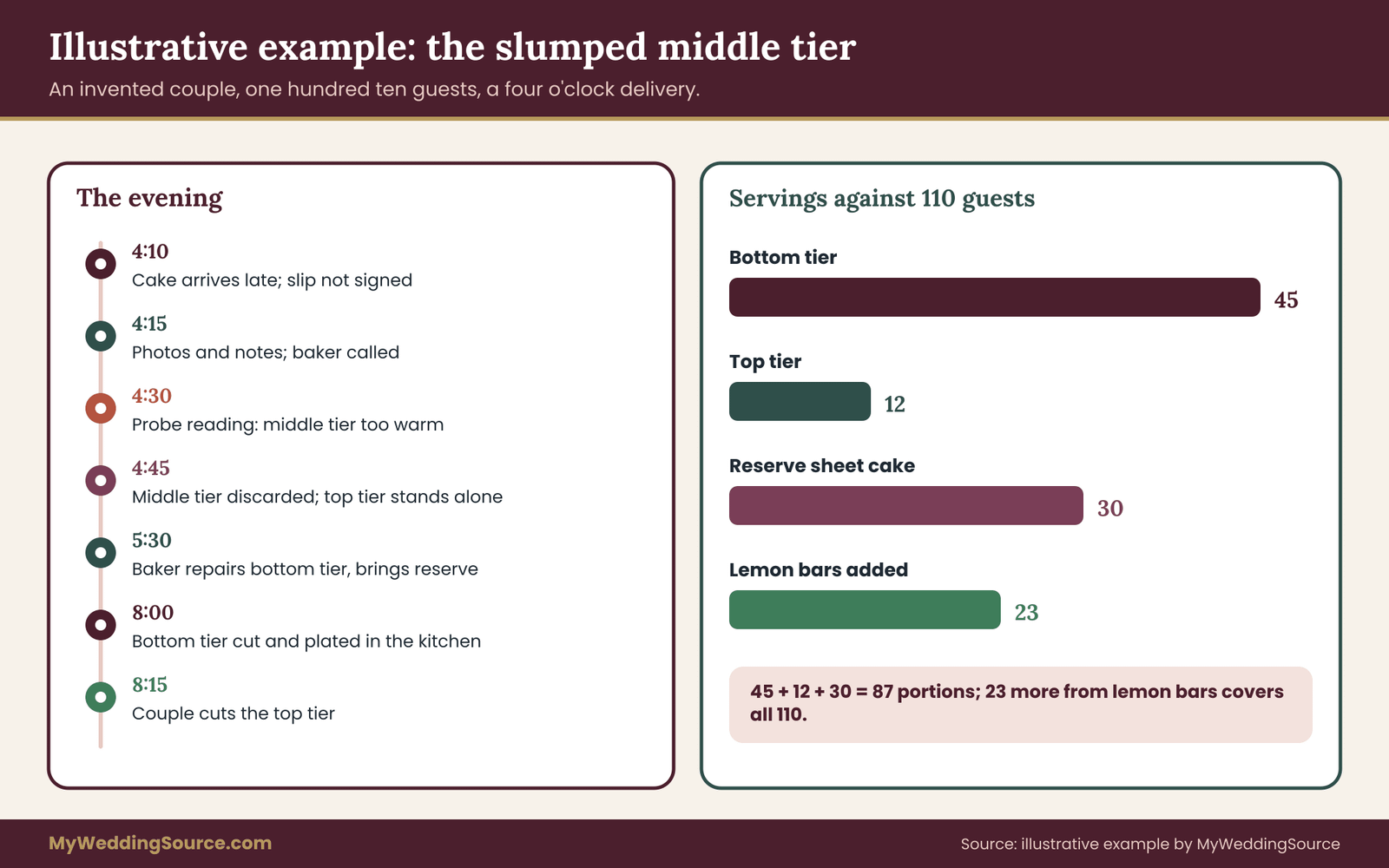
The couple’s day-of coordinator, Priya, holds the log. The bakery’s driver arrives at four ten, forty minutes late, and says there was a long detour. Priya meets the driver at the service door.
Minutes zero to ten
Priya asks the driver to wait and does not sign the slip. She takes a wide photograph of the cake inside its box on the cart, then close-ups. The middle tier has slumped on one side, so the cake leans. The buttercream on that side has a smear and a soft, shiny look. The box lid is crumpled at one corner. The van’s rear compartment, which she photographs, has no cooling unit and the driver says it was a warm afternoon.
Priya writes four lines in the log: arrival at four ten, delivery forty minutes late, middle tier slumped with a lean, box corner crushed, van not refrigerated. She records the driver’s remark about the detour as his statement. She writes “slip not signed” and the time. She then phones the bakery.
Calling the baker
The baker, Lena, answers at once. Priya reads her the log. Lena asks three questions: how long since the cake left the cooler, what the air temperature was in the van, and whether the filling looks wet or separated. Priya says it left at about two forty, so roughly an hour and a half, and that the day is warm. Lena says the cake was chilled when loaded and the buttercream is designed to hold for a few hours in a cool room, but that the berry cream filling is perishable.
Lena says she cannot judge the filling by phone and asks the caterer to take a reading. She also says she can be at the hall in forty minutes with a spare top-tier decoration set and a small reserve sheet cake from that morning’s order. Priya records both promises with the time.
Gate one: safety
The caterer, Omar, brings a probe thermometer to the cart. The filling in the slumped tier reads warmer than he likes, and he says that with the time out and the warm van he would not serve that tier. The bottom tier, which sits lower in the box and stayed cooler, reads colder. The top tier, in its own box, reads cold.
Lena agrees by phone. The middle tier fails gate one and is discarded. The bottom and top tiers pass, with the bottom tier judged safe in part until Omar can inspect the filling. Priya writes the readings, the times, the exact words of both professionals and the decision to remove the middle tier.
Gates two and three: structure and surface
With the middle tier out, the top tier cannot sit on the bottom tier as designed, since the stack was built around three. Lena says the top tier can stand alone on a stand. The bottom tier is sound but has a small gouge from the shifted tier above it. Lena can smooth the buttercream and cover the gouge with a small ring of the sugar flowers she is bringing.
The decision: the display will be the intact top tier on a clean stand, a small decorated sheet cake beside it for the ceremonial cut if the couple prefers, and the bottom tier cut and plated in the kitchen after Omar’s check. Priya notes that the repaired bottom tier will not be photographed, since it will be served from the kitchen.
Gate four: servings
Lena estimates that the bottom tier yields about forty-five servings, the top tier a dozen, and the reserve sheet cake about thirty. That totals around eighty-seven, against one hundred and ten guests. The gap is about twenty-three, which sits in the medium band.
Omar has a tray of shortbread cookies and a case of lemon bars planned for the late-night table. He can plate those to cover the gap and set them out with the cake. He also points out that two guests have a nut allergy listed, and the lemon bars are made without nuts but the cookies are not. They agree to plate the lemon bars for these guests and label them.
Telling the couple
Priya reaches Dana and Marcus after the ceremony photographs, at about a quarter to six. She keeps the message short. “The cake arrived with the middle tier damaged and unsafe, so we removed it. The top and bottom tiers are fine. The baker is coming to repair the bottom tier and bring a reserve cake. We’ll cut the top tier for you, serve the rest from the kitchen and add lemon bars so everyone has dessert. Is that okay?”
Marcus asks whether anyone will notice. Priya says a guest might notice there are two tiers instead of three, and that the caterer will answer questions plainly. Dana asks that the cutting still happen at the same time. Priya confirms. The couple agrees to the plan and asks her to keep the log for the next day.
The evening
Lena arrives at five thirty, repairs the bottom tier in the kitchen, and places the top tier on the stand with a few flowers. Omar plates the bottom tier slices at eight, while Dana and Marcus cut the top tier at a quarter past eight, with the photographer in position. The lemon bars come out with the coffee. Servers tell any guest who asks that the cake was changed for the evening and that the desserts are ready.
Nobody falls ill, and the cutting photograph shows a pretty two-layer cake on a stand. A few guests ask about the missing tier and are told briefly. By nine, the matter has dropped out of conversation.
The morning after
Priya sends the couple the log, the photographs and a short list of open items. The bakery had said it would credit the cost of the lost tier, and Priya records that as a promise to confirm in writing. The couple writes a polite message to the bakery referencing the log and asks for the credit in writing. The bakery replies the same day with a refund of the middle tier’s price, and the couple keeps the thread in their records.
This case went well for three reasons. The photographs and notes were made before anything moved. The safety decision was left to the caterer and baker and was not rushed. And the alternative was simple: an intact tier, a kitchen-cut bottom tier and extra desserts, all items that were already on site or reachable in under an hour.
What would have changed the outcome
It is worth testing the damaged wedding cake example against variations. If the baker had been unreachable, the caterer would have led gates one and two alone, and the sheet cake would have been unavailable. Omar would have used the top tier and the late-night desserts and offered the bottom tier only if he judged it safe. The couple would have had less cake but the same ceremony.
If the van had been refrigerated and the damage purely cosmetic, the cake might have passed gate one at once, and the outcome would have been a repair. If the filling had been a stable buttercream, a time-out question would have been less pressing. If the cake had been delivered at the couple’s home and then driven by a friend, the log would have recorded the friend’s account, and the question of responsibility would have been more complicated.
Money, contracts and claims after a damaged wedding cake
Once the evening is handled and the damaged wedding cake is behind you, the next question is who bears the cost. This part is less dramatic and more important to your budget. A damaged wedding cake can lead to a refund, a credit, a replacement or no remedy at all, depending on what the contract says, how the cake was paid for and what the evidence shows. The aim is to be fair, calm and organized.
This section is general information, not legal advice. Contract terms and consumer-protection rules differ by state and by situation, so confirm the details with the vendor, your card issuer, a local consumer agency or a qualified professional if the amount is large.
Start with the contract
Read the bakery’s agreement for four things that bear on a damaged wedding cake. First, who is responsible for the cake during delivery: some contracts say the bakery owns the risk until the cake is set up, while others say it ends at the door or when the customer signs. Second, what the bakery promises if the cake is damaged, such as a repair, a replacement or a refund. Third, any deadline for reporting a problem. Fourth, any limit on liability, for example a cap at the price of the cake.
If you do not have a contract and only have an order confirmation or a deposit receipt, use those. Keep every message in which the bakery described the cake, the delivery or the policy for problems.
The wedding vendor contract guide covers how couples can review vendor agreements before signing, including the clauses that apply to a delivery gone wrong. If you are reading this before booking, those clauses are worth settling in advance.
Ask for a specific remedy in writing
The day after the wedding, send the bakery a short, factual message. Describe what arrived, attach photographs and the relevant lines of the log, and state what you are asking for: a refund of a specific amount, a credit, or a reimbursement for the replacement dessert. Give a reasonable date to reply.
A useful tone is firm and friendly. “Thank you for working with us on the day. As discussed, the middle tier arrived damaged and could not be served. We are asking for a refund of the tier’s cost, and I’ve attached photographs and our notes. Please confirm by this date.” Avoid threats and avoid assigning motives.
Bakeries are small businesses with real costs, and many are eager to make it right, particularly when the evidence is clear and the request is proportionate. If the bakery offers a partial remedy, you can accept it, ask for more or ask what basis it uses. Keep the discussion in writing.
What counts as a fair amount
A fair remedy for a damaged wedding cake usually relates to the part of the cake you could not use. If one tier was lost, the cost of that tier, or the share of the price it represents, is a sensible starting point. If the whole cake was lost, the full price is reasonable, and the cost of any emergency replacement can be part of the conversation. A claim for more than the cake’s value, such as the entire wedding photographs package, is rarely realistic and tends to harm the relationship.
Be careful not to claim costs you did not have. Include only items supported by receipts or by the contract price, and keep the numbers simple. The log’s cost field helps here.
Paying by credit card
If you paid by credit card and the bakery does not resolve the problem, you may be able to dispute the charge with the card issuer. The Consumer Financial Protection Bureau explains that a billing error generally has to be reported in writing within sixty days of the statement showing the charge, and it describes how a dispute works. Other payment methods have other rules, so ask your bank or payment provider.
A dispute is a formal step. It is usually best to try the vendor first, give them a fair chance and keep the dispute for cases where they do not respond or refuse without a reason. If you do dispute a charge, send the issuer the log, the photographs, the contract and the messages. The better organized the record, the easier the review.
Other routes
If the amount is meaningful and the bakery does not respond, there are other routes. Many states and cities have a consumer protection office that accepts complaints about local businesses. The Federal Trade Commission’s consumer site explains how to report problems and where to find state resources. Small-claims court is available in many places for disputes under a certain amount, with simple procedures, and a court clerk can explain the local rules.
Venue or event insurance may also respond if you purchased it, depending on its terms. Check what the policy covers, what counts as a vendor failure and how long you have to file. Wedding insurance products vary a lot, and some exclude certain events, so read the exact wording or ask the insurer.
Be fair to the people who helped
A damaged wedding cake does not always mean fault. A cake can be harmed by a road, a heat wave or a cooler that failed, and the bakery may have done everything correctly. A bakery that arrived late, offered a repair, brought a reserve cake and stayed to help has done more than the minimum. In such cases, it may be fair to thank them, pay in full for what you used and ask only for a credit for what you could not.
The reverse also applies. If the cake was left in a hot vehicle against the bakery’s own instructions, or a promised delivery did not happen, a firmer response is reasonable. The log lets you see which situation you are in, rather than relying on how you felt on the day.
Keep the record
When everything is settled, file the damaged wedding cake log, the photographs, the contract, the messages and the refund confirmation together. The wedding planning checklist is a good place to track the closing steps with other vendors, and the same habit applies to a cake as to a photographer or a florist. A finished file, with a short note on how it ended, saves you from reopening the question months later. ## Lowering the odds of a damaged wedding cake before the wedding
You cannot remove all risk from a cake that has to travel, but you can make a damaged wedding cake less likely. You can lower it, and you can make sure that if something happens, the recovery is quick. The measures below cost little compared with the cake itself. Most are conversations and one-page notes, not purchases.
Ask the bakery how it moves cakes
Bakeries differ in how they pack and deliver, which affects the risk of a damaged wedding cake, and a few direct questions tell you a great deal. How are tiers transported: stacked, or separate and assembled on site? What vehicle is used, and does it have a cooling unit or at least air conditioning? Who delivers, and does that person assemble the cake? What is the packing, and what is on the floor of the vehicle?
A bakery that assembles on site usually has fewer structural problems, because the tiers travel separately and stable. Cakes that arrive fully stacked are a convenience, but they carry more risk on rough roads. Neither is wrong. The point is to know which one you have and to match the plan to it.
Ask also about a repair kit. Many bakers carry spare frosting, extra decorations, a small tool kit and a few spare pieces, and they may bring them on every delivery. Ask whether a repair visit is included, how fast the baker can be there and whether a second person can be sent if the delivery runs late.
Agree on a delivery window with margin
A tight delivery slot increases the risk of rushing, a late arrival and hurried setup. Ask for a window that leaves room: the cake arrives well before the point at which it is needed, but not so early that it sits out for hours. The right balance depends on the cake and on whether the venue has cold storage, which is the subject of the wedding cake timeline guide.
Include a buffer in your own plan as well. If the cake is due at three and the venue needs it by four, you have an hour for a mishap. If both times are the same, you have none.
Make the route and the entrance easy
Many cakes are harmed in the last hundred feet. Before the wedding, tell the bakery which entrance to use, where to park and how far the carry is. Ask the venue about stairs, ramps, elevators and doors that are narrow or heavy. If the path is long, ask whether a cart is available, and whether someone can hold doors.
Walk the route yourself or ask the venue contact to send a short video. A cake box that does not fit an elevator is a problem you want to find a week ahead, not on the day. The same applies to the table: ask the venue for a stable, level table with no wobble, away from doors, direct sun and heat sources.
Name the person who will receive the cake
On the day, someone should be assigned to meet the delivery, inspect the cake and call the right people. This person should not be the bride or groom. Give them the bakery’s phone number, the caterer’s contact, the venue contact, a copy of the order and the evidence log template. Make sure they know they have the authority to refuse to sign and to start the triage.
A short written plan for this person, with a line each for what to photograph, whom to call and what not to do, is worth more than any amount of last-minute advice. It can sit on the day-of contact sheet along with other vendor details.
Order a small reserve
A reserve is the most effective single protection against a damaged wedding cake. A small sheet cake of the same flavor, a dozen cupcakes or a plain cake kept at the caterer’s kitchen takes the pressure off. If the main cake arrives well, the reserve can be served as extra dessert, taken home by the couple or donated, depending on its type and the venue’s rules.
Ask the caterer and bakery how they handle this. Some bakeries make a sheet cake as part of the order for a modest cost. Some caterers have a standard dessert they can add at short notice. A reserve does not have to match the display cake. It only has to be safe, tasty and enough to cover a gap.
Plan a backup cutting piece
Along with the reserve, decide what you would cut if the main cake were unavailable. A single tier, a small cake or a simple dessert would do. Keep it in the caterer’s kitchen or in a cooler, depending on type, and tell the caterer about it. Telling the photographer what to expect also helps if the plan changes.
You may never use it. That is the aim. A backup you do not need is a small cost, while a missing cutting piece at the key moment is a large disappointment.
Put expectations in writing
Ask the bakery to confirm in writing the delivery time, the setup arrangements, who is responsible for the cake in transit and what happens if the cake is damaged. Many bakeries have standard terms. If yours does not, a short email summarizing what you agreed is enough to start. The wedding vendor due diligence checklist explains how to check a vendor’s insurance, references and policies before you commit, which helps with cake vendors as it does with every other.
If your venue requires a certificate of insurance from vendors, ask whether it applies to the bakery. A vendor with liability coverage has a route to pay for harm they cause, which helps if the damage affects the venue’s property.
Share one page with the key people
Before the wedding, send the coordinator, the caterer and the bakery a one-page summary: the cake’s contents and structure, the delivery time and place, the receiving person, the triage steps, the backup plan and the contact numbers. A shared page ensures everyone is working from the same understanding, and it shortens the first ten minutes if something goes wrong.
The page should name the allergens in the cake, since a change of dessert can create an allergen risk. It should also say who decides if a decision is needed and cannot wait for the couple. Update the page if anything changes.
Think about the weather and the season
Heat is the most common cause of temperature damage to a wedding cake, and humidity can soften some coverings. In hot weather, ask the baker about adjusting the filling or the covering, and about a cooler or air-conditioned vehicle. In cold weather, protect the cake from the cold between the vehicle and the door. A heavy rain brings its own risks for outdoor deliveries, since boxes can soak and floors can be slick.
If your wedding is outdoors, the planning for the cake’s location matters as much as its delivery. The wedding reception guest flow guide helps you think through where the cake sits in relation to entrances, the dance floor and service routes, which are the places a cake is most often bumped.
Keep a small emergency kit
A small kit kept with the coordinator can help with minor problems. Useful items include clean cloths, food-safe gloves, a probe thermometer with sanitizing wipes, a few new cake boards or plates, a clean knife and server, extra cake stands, a small stack of labels for allergens and a pen. None of these is for repairing the cake itself. They are for handling it safely and for recording what is happening.
Ask the caterer first, since many carry these already. If the venue kitchen is available, a thermometer and clean serving tools are often on hand.
Handling the cutting moment and the guests when the plan changes
Even when a damaged wedding cake has changed the plan, the evening is still a celebration. A few small choices make the change nearly invisible and keep the focus on the couple.
Keep the ceremony simple
The couple’s cake cutting is brief. Whatever piece is cut, the couple holds the knife together, makes the cut, and perhaps shares the first bite. The photographer takes a handful of pictures. It takes a minute or two. If the piece is smaller than planned, nobody will mind, and the guests are generally more interested in the couple than in the size of the cake.
Check that the knife and server are clean and that there is a plate and a napkin ready. A few details like these make the moment look planned.
Brief the staff in two sentences
The servers and bartenders will be asked about the cake. Give them two sentences: what is being served and what to say. For example: “The cake is a lemon cake and the desserts include lemon bars. If anyone asks about the display, say there was a change this evening and the desserts are ready.” This avoids invented explanations and keeps the tone light.
For allergens, servers should say that the caterer has the ingredient information and should not guess. Make sure the caterer is nearby during dessert service.
Social media and the photographer
Ask the photographer and videographer how they want to handle the cake cutting, and let them choose the angles that look best. Photographs usually show a clean table and two smiling people, not what is missing. If guests are posting, a gentle note on a sign or from the officiant about waiting until the couple has seen their photographs is enough.
If someone posts the damaged cake, the couple might prefer to ask for removal or just let it go. This is a personal choice. The wedding photography consent guide relates to this: the couple’s guidelines about posting apply equally to a cake mishap, and it is easier to decide in advance.
Keep the couple out of the repair
The couple has done enough work. Ask them to step away from the problem and to let the coordinator and the vendors run it. A bride in a gown at the back of the kitchen is not a good use of the day. A short update at a set time is enough, and if there is no update, no news is good news.
If the couple insists on being involved, give them one specific decision, such as choosing between two options, and then send them back to their guests.
Care for the person who made the mistake
A driver, a baker or a venue staff member behind the damaged wedding cake is probably feeling bad. A kind word can keep them able to help. A frightened person makes more mistakes. A short “Thank you for staying to help” goes a long way, and it often leads to a quicker repair.
This does not mean ignoring responsibility. It means holding the discussion about cost and fault for the next day, when everyone is calmer and the facts are clear.
Leftovers and the first anniversary
A damaged wedding cake changes the usual plans for leftover cake and for the top tier. If a tier has been through a temperature problem, it should not be saved. If the top tier survived intact and was kept cold, the baker can advise on whether and how to freeze it. In general, do not rely on freezing a cake that was out for a long time, and ask the baker before keeping any part of it.
Cake boxes for guests to take home should only contain cake that has passed gate one. When in doubt, leave it out. A plain, fresh item from the caterer is a safer way to send guests home with something sweet. ## When the plan fails: edge cases and failure conditions for a damaged wedding cake
No method for a damaged wedding cake covers everything. This section describes the situations where the standard triage strains or breaks, so that you recognize them early and switch to the right fallback. Each is a failure condition: a point at which the plan no longer works as written.
The baker cannot be reached
If the baker does not answer about the damaged wedding cake, the decisions at gates one and two move to the caterer or the venue’s kitchen manager. Call the bakery’s main line and any emergency number in the contract, and leave a clear message with the time and the facts. Do not wait indefinitely for a reply about a damaged wedding cake. Set a deadline, perhaps thirty minutes, after which the on-site team acts on its own judgment.
Without the baker, be conservative. A caterer with food-safety training can judge temperature and contents, and where there is doubt, the damaged wedding cake should not be served. Use the backup, record the baker’s silence in the log and follow up the next day. Do not accuse the baker of abandoning the job until you know why they were unreachable.
Nobody can check the temperature
Sometimes there is no thermometer and no way to get one before the cake must be served. In that case, rely on time and contents. If the cake has perishable components and has been out for longer than the general limit, treat it as unsafe. If the contents are all stable, the time matters less, but the baker’s word is still needed.
A guess based on the feel or smell of a cake is not a reliable test, since spoilage that matters for safety is often invisible. If the question cannot be answered, the safer answer is to leave the perishable parts out of service and to serve the stable parts only if the baker confirms by phone.
The cake is mostly fine but the couple is distraught
Sometimes the damaged wedding cake is a small problem and the couple is nonetheless upset, because the cake was a symbol and a surprise. A gentle approach works: acknowledge the feeling, show the facts, and let them decide. If the cake passes the gates, it can be fixed and served. If the couple wants a different plan for emotional reasons, that is their right, as long as safety is not compromised.
Do not talk a couple into thinking something is fine when it is not, and do not talk them out of feelings. A short pause, a glass of water and a clear summary often help more than reassurance.
A guest or relative insists the cake is fine
Occasionally someone on site, usually a well-meaning relative, says the cake is perfectly good and should just be served. This is understandable and can be dangerous. The baker and caterer, who are trained and responsible, make the safety decision. Be polite and firm: “We’re letting the caterer decide, since they’re responsible for food safety.”
If the relative made the cake, the pressure is stronger. Speak with them privately and explain that the decision follows a standard process that applies to every cake.
The damage is discovered late
Some damage appears only later. A cake that looked fine at delivery may sag after an hour, or a hidden crack may open as it is cut. A damaged wedding cake discovered late may force a change in the middle of the evening. Keep the reserve and the backup plan available until the dessert is served, and tell the caterer to flag anything unexpected when cutting begins.
If a tier slides during the cutting, stop, calmly move guests back, and take the cake to the kitchen. A quick, quiet exit is less harmful than a fall. The photographer will understand.
A guest becomes ill
If a guest feels unwell after eating cake, the first step is care for the guest. Ask the caterer to stop serving the item in question, and contact emergency services if symptoms are serious. Federal agencies advise seeking medical care for severe symptoms and reporting suspected foodborne illness to the local health department. Keep the evidence log and note who ate what, if known.
This is the scenario the safety gate exists to prevent. If the log shows that you followed a reasonable process, with professional input at gate one, you will be in a stronger position, but the main goal is the guest’s health. Do not discuss fault in the moment.
An allergen exposure
If a replacement dessert is served and a guest with an allergy may have had contact with an allergen, treat it as an emergency. Know the guest’s own plan, stop serving the item and call emergency services if there are signs of a serious reaction. The Food and Drug Administration lists the major food allergens, and the caterer should have ingredient information for every item served.
The best defense is advance clarity. Tell the caterer about each guest’s allergy before the wedding, and re-confirm after any change to the dessert. A person with a known allergy should hear directly from the caterer about what is safe.
The venue does not allow outside food
Some venues and caterers prohibit food from outside, which can block the bakery-order alternative. Ask in advance whether an exception is possible for a replacement. If not, the caterer may be able to supply a dessert, or the venue may have its own backup. This is one more reason to read the venue and catering rules before the wedding, and to plan the backup with the caterer rather than around them.
The cake is gone and no replacement exists
In the rare case that a damaged wedding cake leaves nothing usable and the timing makes a replacement impossible, the evening is still fine. The couple can cut a simple item, such as a cheesecake or a tray of brownies from the caterer, or hold a toast with a dessert course made of what is available. Guests will remember the celebration. They will not remember the cake as the main event unless it is made into one.
The recovery then moves to the week after, when you have time to ask for a refund and to enjoy a cake you pick at leisure, perhaps from a bakery you like, on a quiet evening.
Failure conditions at a glance
The triage fails when the safety question cannot be answered, when nobody on site can judge structure, when the servings gap cannot be filled, when the plan depends on a vendor who is out of reach, or when the people responsible disagree and nobody can decide. In each case, the fallback is the same: take the safest option available, serve what you can confirm is safe, record the decision and settle the rest after the wedding.
Your next steps
If your wedding is still ahead, spend one evening on three tasks. First, ask your baker how the cake travels, who delivers it, what a repair visit includes and whether a reserve sheet cake is available. Second, name the person who will receive the cake, and give them the evidence log, the four gates and the phone numbers. Third, write down your backup cutting piece and tell the caterer and the photographer.
If a damaged wedding cake has already arrived, begin with the first ten minutes: stop, do not sign, photograph, record the time and temperature, and call the baker. Then run the four gates in order and choose one of the five outcomes. Fill in the log as you go, and ask for a specific remedy in writing the next day.
Either way, keep the plan small and the records plain. A calm response to a damaged wedding cake is mostly preparation, and the preparation fits on a single page.
FAQ
Should I sign for a cake that arrives damaged?
Do not sign without noting the damage. A signature can be read as acceptance in good condition. If a signature is required, write the actual condition and the time beside it, photograph the cake and the slip, and call the bakery before anything is moved. If the driver cannot wait, ask them to note the problem on their copy as well.
How long can a cake sit out before it is unsafe?
It depends on what is inside. Federal food-safety guidance says perishable food should not stay between 40 and 140 degrees Fahrenheit for more than two hours, or one hour above 90 degrees. Many cakes have stable and perishable parts, so ask the baker and the caterer, and discard anything they say is unsafe.
Can the baker or someone else repair the cake on site?
Often yes, for surface damage such as smears, chips and small tears. A baker can usually smooth frosting and replace decorations. Structural damage and temperature problems are different, and they may mean removing tiers or discarding parts. Let the baker or caterer decide, and avoid repairing it yourself, since that can add contamination and erase evidence.
What can we cut if the cake cannot be used?
Several options work: an intact top tier, a small bakery cake, a single decorated cake, or a dessert from the caterer. The cutting piece needs to be whole, clean and safe, and the rest of the guests can be served from the kitchen or from a dessert table. Choose the simplest option that is already on site.
Who pays for a damaged wedding cake?
It depends on the contract, who had the cake when it was harmed and what the evidence shows. Read the delivery and liability terms, then ask the bakery in writing for a specific refund or credit. If that fails, a card dispute, a state consumer office or small claims may be possible. Confirm local rules and deadlines yourself.
What should I photograph as evidence?
Photograph the whole cake in place, each damaged area from two distances, the box and packing, the surface it sat on and the vehicle interior if visible. Add a short video, note the times, and keep the original files. Include any slip or message that shows the delivery time. Take these before anything is touched or repaired.
Should we tell guests the cake was damaged?
You do not need to announce it. Serve the dessert, hold the cutting and answer briefly if someone asks. The exception is allergens: if the dessert changed, the caterer should tell any guest with a known allergy exactly what is safe. Brief your servers with a short, calm line so they do not guess or invent an explanation.
Can we freeze the top tier after a mishap?
Ask the baker before saving any part of a cake that was damaged or that sat out for a long time. A tier that stayed cold and intact may be fine to freeze, but a tier that had a temperature problem should be discarded. Chilling or freezing later does not make a cake safe once time and temperature have already caused harm.
Sources
- Danger zone (40 °F to 140 °F), USDA Food Safety and Inspection Service
- FoodSafety.gov, U.S. Department of Health and Human Services
- FDA Food Code, U.S. Food and Drug Administration
- Food safety, Centers for Disease Control and Prevention
- Food allergies, U.S. Food and Drug Administration
- Ready.gov, Federal Emergency Management Agency
- How do I dispute a charge on my credit card bill?, Consumer Financial Protection Bureau
- Consumer advice, Federal Trade Commission
- USAGov, U.S. General Services Administration
- Food Allergy Research and Education