
A backyard bridal shower looks simple on paper: invite people over, put out food, hand the guest of honor a few gifts. In practice it is a small outdoor event with rented tables, a roof that may or may not be needed, and guests who have to move across grass. This guide gives you a guest movement and rental contingency worksheet so the equipment, the walking paths and the rain backup are decided together, not one panic at a time.
Plan a backyard bridal shower in this order. Walk the yard and mark seven zones. Trace the path each guest takes between them, including the slowest guest. Size your rentals to those zones and paths, not to a generic guest count. Write a rain backup with a named decision time before you pay any rental deposit. Then ask every supplier the same short list of questions about delivery access, setup time, weather terms and cancellation. If the rain plan only works when “everything goes right,” it is not a plan yet.
Most advice about hosting a backyard bridal shower starts with themes, games and menus. Those matter, but they can wait until the logistics are settled. Here the question is narrower: what has to be true about your yard, your rentals and your weather plan for the afternoon to run smoothly? A beautiful tablescape does not help if the tent arrives at noon for a one o’clock start, or if the guest of honor’s grandmother cannot reach the one shaded seat without crossing a muddy patch.
Hosting a backyard bridal shower in a private yard has real advantages. You control the guest list and the schedule, there is no venue minimum, and the setting can feel personal. It also removes the safety net a venue provides. Nobody else owns the restrooms, the backup room, the power, the parking or the cleanup. Every one of those becomes your problem, and rental equipment is the usual way to solve them.
A note on scope. This is general planning information, not legal, tax or financial advice. Local rules on tents, noise, street parking and temporary structures vary by city and county, so confirm anything that carries a rule with the office that issues it.
What changes when a backyard bridal shower leaves the living room
People often treat a backyard bridal shower as an indoor party moved outside. Three things break that assumption.
First, the space is not designed for gatherings. A living room has chairs, a floor, a ceiling, lighting, a bathroom and climate control. A yard has none of those until you add them. Every item that an indoor host takes for granted is either a rental, a borrowed item or a gap.
Second, the weather becomes a participant. Rain is the obvious risk, but it is not the only one. Direct sun in the early afternoon, a steady breeze that carries napkins across the lawn, a cold evening, a lightning forecast and a bad pollen day each change who is comfortable and where they can sit. A plan that only addresses rain leaves most of the weather unplanned.
Third, movement matters more. Indoors, guests drift between rooms on a flat floor. Outdoors they cross grass, gravel, a step down from the patio, a gate and a slope. Heels sink, walkers stall, strollers tip and a cooler becomes an obstacle. If you have not thought about the path, you will see it when the first guest hesitates at the back door.
Why rentals and movement belong in one backyard bridal shower plan
Rental equipment looks like a shopping problem and movement looks like a layout problem. They are the same problem seen from two sides. A tent is a decision about where people will stand when it rains. A set of chairs is a decision about how far someone must walk to sit. A rented restroom trailer is a decision about a path, a queue and a light after dark.
When you plan them separately, the gaps appear late. The tent is ordered for the lawn, but the only dry route from the house to the tent is the lawn. The tables fit the footprint, but the serving table blocks the route to the restroom. The rain plan moves everyone indoors, but the indoor space cannot hold the rented chairs that are already stacked in the garage.
The worksheet below is designed to remove that sequence of surprises from a backyard bridal shower. It does not require special software. A printout of the yard, a pencil and about two hours are enough.
The guest movement and rental contingency worksheet
The worksheet has six steps. Each step produces something you can write down and share with a helper or a supplier. The steps are short enough to repeat if the guest count or the date changes.
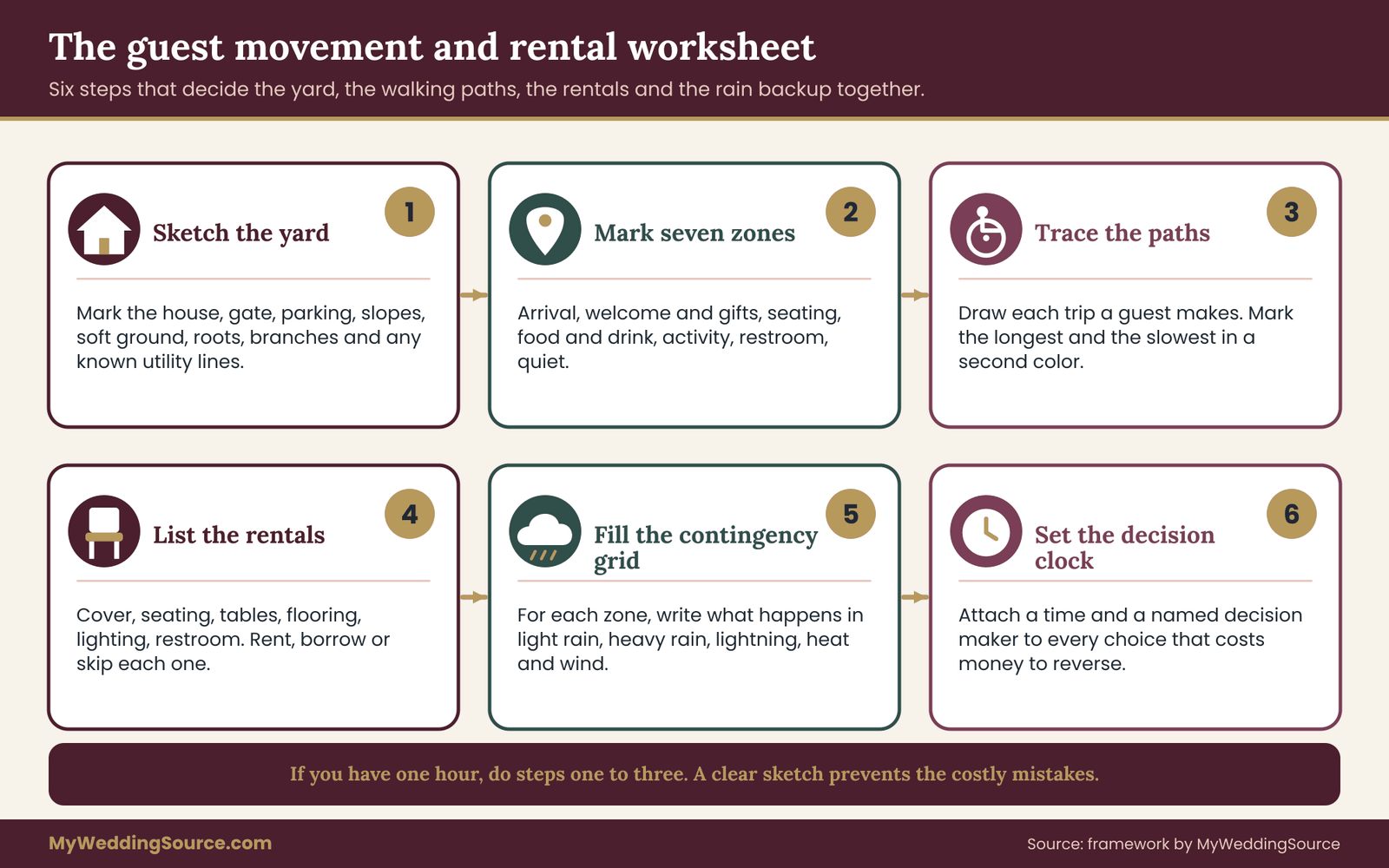
Step one: the yard sketch. Draw the yard, the house, the gate, the parking and the nearest restroom. Mark slopes, steps, soft ground, sprinkler heads, tree roots, overhead branches and any utility lines or covers you know about. You do not need a scale drawing. You need every obstacle someone might trip on or a rental truck might hit.
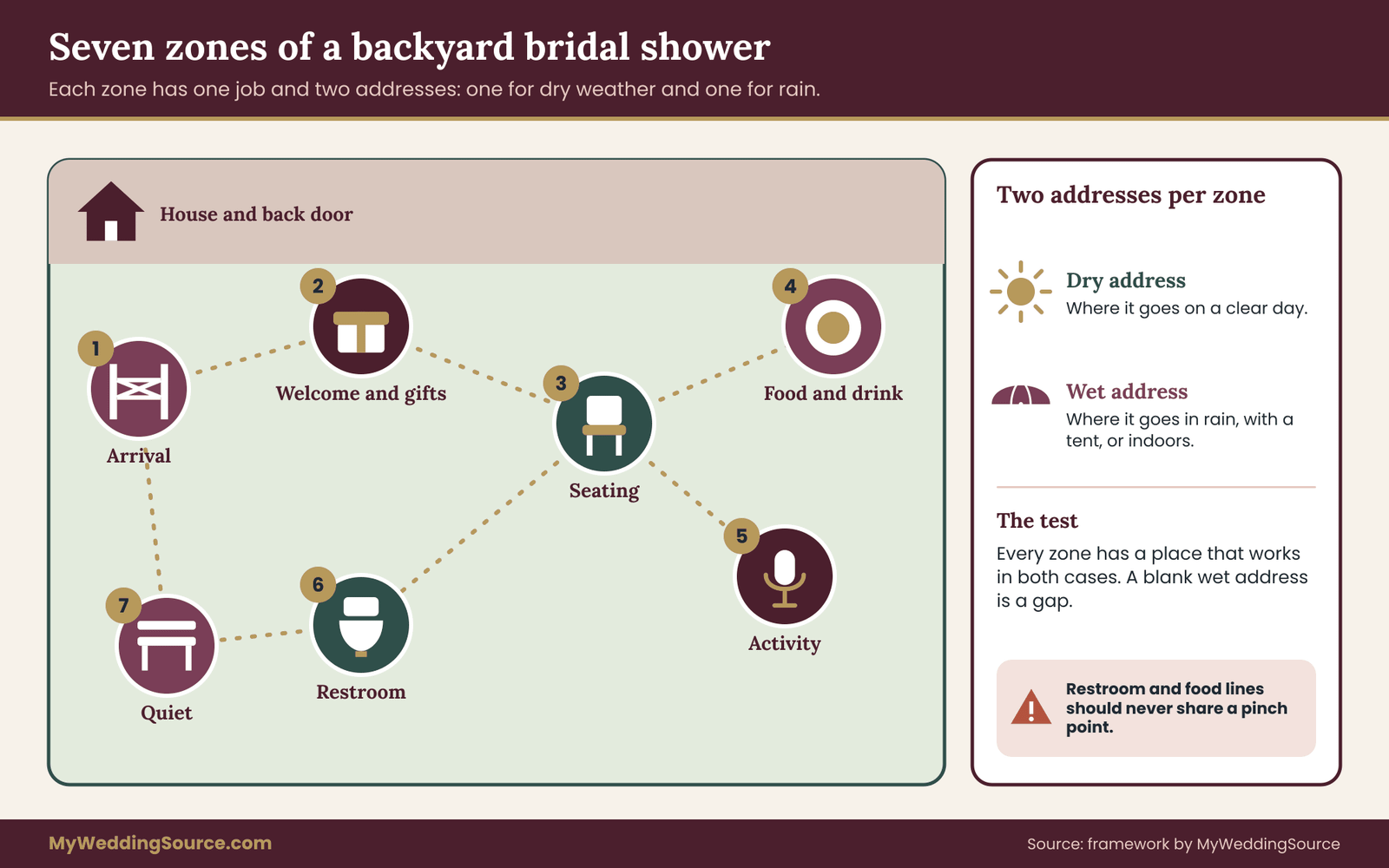
Step two: the seven zones. Place each of seven functions on the sketch: arrival, welcome and gifts, seating, food and drink, activity, restroom and quiet. Part two of this guide explains each one. The test is whether every zone has a place that works in dry weather and a place that works in rain.
Step three: the movement paths. Draw a line for each trip a guest will make: from the parking spot to the arrival zone, from arrival to a seat, from a seat to the food, from the food back to a seat, from a seat to the restroom and from anywhere to the exit. Mark the longest and the most awkward path in a different color.
Step four: the rental list. For each zone and path, write what must be supplied: shade, seating, a surface to put food on, flooring over soft ground, lighting after sunset, a restroom, a heater or fans. Decide for each item whether it is a rental, a borrowed item or something you already own.
Step five: the contingency grid. For every rental and every zone, write what happens in light rain, heavy rain, lightning, heat and wind. Some cells will say “no change.” Others will say “move to the garage” or “cancel the activity.” Empty cells are the gaps.
Step six: the decision clock. Attach a time to each choice that costs money or effort to reverse. Part four explains the clock. A tent that cannot be cancelled after Wednesday needs a go-or-hold decision by Wednesday, not by Friday evening.
Everything else in this guide supports one of those six steps for your backyard bridal shower. If you only have an hour, do steps one to three, since a clear sketch of the yard and the paths prevents most of the expensive mistakes.
How this guide fits with other planning
The worksheet focuses on the equipment, the walking routes and the weather. It does not decide the guest list, the budget split or the invitation wording. For the full planning timeline around a backyard bridal shower, the wedding planning checklist offers a broader frame, and the wedding rental planning checklist covers rental categories at wedding scale. A backyard bridal shower is smaller and less formal, so use those pages for ideas, not as a script.
The size of your backyard bridal shower matters too. A gathering of twelve people can run with a pop-up canopy, a few borrowed folding tables and the kitchen as the backup. A gathering of fifty or more raises questions about restrooms, parking, access for guests who use mobility devices and permits for a larger tent. The worksheet scales in both directions, and the sections below mark where the answers change as the count grows.
Seven zones for a backyard bridal shower
A zone is a part of the yard with one job. Naming the jobs first stops the common pattern where the food table ends up in the doorway and the gift table ends up in full sun. The seven zones below cover almost every backyard bridal shower, from a dozen guests to sixty.
Arrival. This is where guests step out of a car or off the sidewalk and learn where to go. It needs a visible entry, a clear surface and a person or sign that says “this way.” If guests might come through the side gate while others use the house, decide which one is the front door for this backyard bridal shower and mark it.
Welcome and gifts. Guests drop off gifts and cards, sign a book or pick up a drink. This zone attracts a crowd for ten minutes and then sits empty. Place it under cover, because gifts and paper do poorly in the rain, and keep it away from the main walking line so that it does not block people behind the first arrivals.
Seating. The largest zone in any backyard bridal shower. It should include a mix of seats with arms and without, some in shade, some near the restroom path and at least a few at the edge of the group for guests who prefer to leave quietly. Seating is also where rentals have the most visible effect on comfort, which Part three covers in detail.
Food and drink. Serving tables, drink stations and any warming or cooling equipment. This zone needs a firm surface, shade, power if you are using anything electric, and room to queue without blocking the walking paths. The food section later in this guide covers temperature limits and service timing.
Activity. The shower game, the gift-opening or any short program. It needs a sightline from the seats and enough sound clarity that guests at the back can follow. It does not need to be central, but it should not compete with the food line.
Restroom. Usually the house bathroom, sometimes a rented unit. It needs a lit, flat route that does not require going through a bedroom or a private part of the house. Guests will go in the middle of the program, so avoid placing it directly behind the activity area.
Quiet. A shaded, less crowded place to sit down, take a phone call, nurse a baby, rest or step away from noise. Hosts often forget this zone, and then wonder why a few guests drift to their cars. A shaded bench and a pitcher of water cover most of it.
Giving each zone of a backyard bridal shower a dry and a wet address
For every zone, write two locations on the sketch. The dry-weather address is where it goes if the day is clear. The wet-weather address is where it goes if rain starts, a tent is up, or you have moved inside. Some zones can keep the same address in both cases. A guest registry corner under a porch roof, for example, may not move at all.
Be honest about the wet-weather addresses that do not exist. If your house can hold twenty people standing but not seated, say so on the page. A backup that quietly requires skipping the seated meal is a different event, and your guests should hear about it before they arrive.
Sizing helps here, and the honest answer is that no single number fits every setup. Table and chair layouts, tent types and guest preferences differ. Ask the rental company for its seating guidance for the exact table sizes and the exact tent you are considering, and keep the figures from the supplier.
A rough check at home is to lay out the tables with painter’s tape or garden hose, set a chair at each place and walk around the arrangement yourself. If you have to turn sideways to pass a seated guest, the layout is too tight for most people.
Guest movement at a backyard bridal shower
Movement planning is the part of the backyard bridal shower worksheet that most hosts skip, and it is the part that decides who feels welcome. A path is any route a guest will take more than once. A good path is level, firm, wide enough for two people to pass, lit when it needs to be and free of items that look like part of the décor but act like hazards.
Trace the slowest guest first
Start with the guest who will move most slowly or need the most room, and trace the route from the parking spot to a seat. This guest might use a cane, a walker or a wheelchair. It might be a pregnant relative, someone recovering from surgery, a toddler who stops to look at everything or a guest in formal shoes with narrow heels. You do not need to know who will attend before you draw the route. You need a route that works for the person who might.
Mark every place where that route crosses soft ground, a threshold, a step, a hose, a cable or a gap in the fence. Then decide how each one will be solved. Options include a firm mat laid over grass, a short ramp at a step, a gravel path raked flat, a cable cover over a cord or a different gate. A rental company can often supply flooring or mats, which is the reason this step comes before the rental list.
Surfaces and shoes
Grass looks firm until it has been watered, rained on or walked on by thirty people in a line. Narrow heels sink and wheelchair casters stall in soft ground. A helpful trick is to put a note on the invitation that the backyard bridal shower is on lawn so guests can choose shoes, and to provide one dry, firm route for those who need it. The point is not to police footwear. The point is to let guests decide with the right information.
Gravel and loose stone behave differently from grass. They are stable for most walkers, but they are difficult for wheelchairs, strollers and rolling carts. Mulch and bark are similar. Pavers and patios are the easiest surfaces, though uneven pavers can catch a toe, so look at the edges.
Pinch points and queues
Pinch points appear where guests converge: the gate, the door to the house, the food table, the restroom hallway and the gift table. Look at the path lines you drew and find any place where three or more lines cross. That is where people will stand in each other’s way.
The fix is usually distance, not equipment. Put the drinks away from the food so the lines do not merge. Open a second approach to the serving table. Place the gifts to one side of the arrival path, not in it. Give the restroom a signed route that does not pass through the seating area, so that someone leaving mid-program does not walk in front of the speaker.
Lighting and the end of the day
A backyard bridal shower often runs into early evening. Paths that were obvious at two o’clock can be hard to read at seven. Plan lighting for the route to the restroom, the steps, the gate and the parking area, not only the seating. String lights are decorative but weak for walking, so add a few low, steady lights along the path or ask the rental company what it offers. If you are not sure you will need them, decide by the time you check the forecast, since many suppliers need notice.
Accessibility is a movement question at a backyard bridal shower
An accessible backyard bridal shower is one where every guest can reach the seating, the food and a restroom without being singled out. The movement worksheet gets you most of the way. For a deeper checklist of venue barriers, the accessible wedding venue red flags guide is written for wedding venues, but many of its checks apply to a yard as well.
The ADA site also publishes plain-language guidance on accessible routes if you want a reference for slopes, surface firmness and door clearances. A private home is not a public venue, but the same principles make the afternoon work for more people.
A private message to a guest who may need something is often more welcome than an announcement. Ask, “Is there anything that would make getting around the yard easier for you?” and then make the change without comment. Avoid questions that ask a guest to explain a condition.
Rental equipment for a backyard bridal shower
With the zones and paths drawn, the rental list for a backyard bridal shower almost writes itself. Each item answers a gap on the sketch. The discipline is to rent what the plan needs, not what a package suggests. Rental companies often bundle tables, chairs and linens because it is easy to quote, and a bundle can include things you would never use or skip the one thing you need.
For broader coverage of rental categories and event-scale questions, the wedding rental planning checklist is a useful companion. The list below is tuned to a daytime backyard bridal shower at a private home.

Cover: tents and canopies
A cover is the most important and most variable rental. A small pop-up canopy shades a serving table or a gift corner. A frame tent covers a seated group. A tent with sidewalls turns into a room, which matters when the backup plan is rain. Each type has different anchoring needs, and that is where most problems start.
A tent on grass usually needs stakes. A tent on a patio, a driveway or a deck cannot take stakes and needs weights, which are heavier, take longer to place and need access for the delivery crew. Before anyone drives a stake into your yard, call 811, the national call-before-you-dig number, so that buried utilities are marked. The 811 service is free in most places, but it takes a few days, so make the call when you book, not on the day before delivery.
Ask the supplier what wind rating the tent is built for, who is responsible for deciding to take it down in a storm and whether sidewalls can be added or removed on the day. Local rules on temporary structures vary, and some places require a permit above a certain tent size or require a fire inspection. Ask your city or county building or fire office; do not assume the rental company has done this for you.
Seating and tables
Count seats from the plan, not from the invitation list alone. A backyard bridal shower with a seated meal needs a seat for every guest. One with a stand-and-mingle format may need seats for roughly half, with the remainder using the high-top or the edge of the tent. Either way, include a few extras for guests who arrive unannounced or bring a child, and ask the rental company whether extra chairs can be added at a small fee a few days before the backyard bridal shower.
Round tables and long tables make different conversations. Rounds seat guests evenly and suit a seated lunch, though they take more floor. Long tables suit family-style food and use space well, but they put some guests far from anyone they know. Ask the supplier for the seating capacity it assigns to each table size and use that figure. Avoid assuming a number from a photo.
For guests who need chairs with arms, a higher seat or more space, it is simpler to order a handful for every shower than to find out on the day. Rental companies often carry padded or armed options at a small premium.
Linens, tableware and serving equipment
Linens add color, but they are also a wind and laundry decision. Light tablecloths catch gusts and lift off tables without clips or weights. If you rent linens, ask whether the price includes cleaning, whether stained linens carry a charge and how to return them. Disposable or washable cloths you own are a reasonable alternative.
Tableware rentals, such as plates, glasses and flatware, save you from running a dishwasher on repeat and avoid single-use waste. They also require rinsing, scraping or sorting on return, and breakage fees. Read the damage and loss terms before you order. For a smaller gathering, borrowed or owned dishes may be easier than a delivery.
Serving equipment, such as chafing dishes, beverage dispensers and cooler stations, depends on the menu. Check whether any piece needs a fuel source or power. Open-flame fuel under a tent raises a safety question, so ask the supplier and your local fire office before using it.
Flooring, lighting, comfort and restrooms
Flooring matters when the yard is soft, sloped or uneven. Rental companies offer interlocking panels and mats that sit over grass. These can turn a muddy lawn into a usable surface. They also need delivery access, flat ground and enough lead time.
Lighting covers paths and seating after sunset. Ask about battery-operated options that need no outlet. If you rent anything that needs power, find out where the outlets are, how much load each circuit can carry and whether the supplier requires a dedicated generator. A tripped breaker during the toast is a preventable problem.
Comfort items include fans, misting units and heaters. Fans and misters help in heat. Heaters help on a cool afternoon. Propane and fuel-burning heaters bring carbon monoxide and fire concerns, and the U.S. Consumer Product Safety Commission has guidance on fuel-burning appliances. Follow the manufacturer instructions and the supplier’s rules for use near or under a tent.
Restrooms become a rental when the guest count passes what your household facilities can handle, when you do not want a stream of visitors through your house or when the route is not accessible. Portable units and restroom trailers have different capacities, footprints and servicing needs. Ask for dimensions and the type of surface they need. Check whether an accessible unit is available if any guest might need one.
Rent, borrow or skip: a quick rule for each item
Not every item on the list has to come from a rental company. A simple rule helps you sort them. If the item protects safety or access, such as flooring over soft ground, a ramp, a tent anchored by professionals or an accessible restroom, rent it from a supplier who will stand behind it.
If the item is easy to replace and low risk, such as extra folding chairs, a few tables or a drink tub, borrowing from friends is reasonable, as long as you label each piece and agree on a return date.
If the item is something you will use again, such as washable tablecloths, a good cooler or a set of path lights, buying may beat renting over time, but only if you have somewhere to store it. A garage already full of boxes is a poor home for four folding tables. Write the decision beside each item on the list so a helper can see where it comes from and who is responsible for getting it back.
Borrowed items carry hidden costs. They arrive in different sizes, they may not match, and nobody will check the damage terms with you. A neighbor’s canopy can be perfect for shade, but if it was never designed for wind, it should not stand over seated guests. Ask whether it has weights, whether the legs lock and whether it has ever been used in a breeze. Rented gear usually comes with a crew that knows these answers.
What to skip when renting for a backyard bridal shower
Skip any item that does not fill a gap on your sketch. The thirty-inch cocktail tables, the extra linens for a table you never set, the stage for a game that needs a floor and the oversized tent that cannot fit through the gate all look good in a quote and add cost, delivery time and cleanup. If you cannot say which zone an item serves, leave it out.
Supplier questions and a delivery plan
Rental companies work on schedules, and most problems with rentals for a backyard bridal shower are schedule problems. The delivery window, the setup time, the pickup window and the weather terms all affect the day. Ask the same questions of every supplier so that you can compare answers.
Questions to ask every rental company
- What is the delivery window, and how much notice do you give before arrival?
- Who sets up, and how long will it take for the items on my order?
- What access does the crew need: gate width, driveway length, steps, ground type?
- Where will you place items, and can I mark the spots in advance?
- What happens if the forecast is bad? Do you move a delivery, add sidewalls or take items back?
- What is the cancellation or change policy, and what is the cutoff time?
- When do you pick up, and who clears the space of trash and spills?
- What damage, loss and cleaning charges apply, and how are they assessed?
- What is the final count deadline, and can I add or remove items after that?
- Do you need payment details, a deposit or an insurance certificate?
Write the answers down and keep them with the order confirmation. A phone answer you cannot find later is no help in a dispute. If the answers change the plan, send a short email summarizing what you understood and ask the supplier to confirm. The wedding vendor contract guide explains what to look for in written terms, and much of it applies even to a small rental order.
A script for the delivery call
A short call a week before the backyard bridal shower prevents many misunderstandings. You might say: “I am confirming delivery on Saturday. The gate is thirty-six inches wide, the ground beyond it is soft, and the tent location is marked with flags. Can you confirm the arrival window, the crew size and what happens if the ground is wet?” That one question about wet ground tells you whether the supplier has a plan or is hoping for the best.
Share a photo of the yard and the planned layout when you place the order, not on the delivery morning. Crews can often suggest a better position because they have seen similar yards. They can also tell you early if the tent you chose does not fit.
Timing the delivery against the backyard bridal shower
The most common timing mistake is scheduling the delivery too close to the start. A tent, tables and chairs take time to place, and a crew that arrives late leaves the host setting up with guests walking in. Ask for delivery the day before when possible, or at least several hours before guests arrive, and plan what to do if the truck is delayed.
Pickup has the same risk in reverse. Ask whether pickup is the same night, the next morning or a window, and plan for items to stay in your yard overnight. If rain is forecast after the backyard bridal shower, find out whether the supplier protects stacked items or expects you to cover them.
A rain backup for a backyard bridal shower that actually holds
A rain backup for your backyard bridal shower is a complete second plan with its own location, equipment, timing and message to guests. “We will go inside if it rains” is a hope, not a backup. Ask four questions of any backup: Where exactly does everyone go? What do they sit on and eat from? How do they get there without getting soaked? Who decides, and by when?
There are four basic kinds of backup for a backyard bridal shower. Each has a different cost, a different failure point and a different effect on the afternoon. The right one depends on your guest count, your house and how much weather risk you are willing to carry.

Option one: a tent with sidewalls
A frame tent with removable sidewalls lets the backyard bridal shower stay outdoors in most rain. It keeps the layout you planned and keeps guests together. The failure points are wind, lightning and ground water. A tent is not a safe shelter in a thunderstorm, and rain can flow across a yard and under the edge of the tent. Ask the supplier about drainage, flooring and whether the crew will adjust the setup if the ground is saturated.
This option costs the most and needs the earliest commitment. It also needs a plan for the other direction: if the day turns out dry and hot, are the sidewalls rolled up, and does the tent create heat you did not expect? A tent is a good answer to rain. It is not an answer to lightning, which Part five covers.
Option two: moving indoors
Your own house is the cheapest backup for a backyard bridal shower and the one hosts overestimate most. The test is simple. Count the seats you can fit, the tables you can use, the route from the entry and the number of people the restroom can handle. Then compare that with your confirmed guest count. If the house works for twelve and sixty are coming, it is not a backup. It is a different event.
Indoor backups also change the rental plan. Tables and chairs delivered for the yard may not fit through the door or sit in a stable position on a hard floor. Tell the supplier early if the backup is indoors, and ask whether items can be delivered to a different spot at short notice. Protect floors and plan for wet shoes, umbrellas and coats by the door.
Option three: a booked or borrowed second space
A porch, a garage, a community room, a restaurant’s private room, a friend’s larger home or a rented hall can each serve as a backup. This works well for larger groups, but it adds a second set of logistics: a deposit, a change of address for guests and a transfer of everything you have prepared. A backup venue also needs a decision time, because the venue will not hold the date forever.
Ask any second space about cancellation terms for an unused hold. A free hold that expires on Thursday is a different thing from a paid hold that is refundable until the morning. Make the decision time match the hold, and tell the hosts at the second space what you plan to do.
Option four: moving the date
The honest fourth option is to treat the date as flexible. Some showers have enough scheduling flexibility to move to the next weekend if the forecast looks bad enough far in advance. This is the least stressful backup for guests when it is decided early, and the most stressful when it is decided the night before. It only works if the guest list can handle a change, the rentals can be rescheduled without penalty and the guest of honor is comfortable with it.
Choosing a backup for your backyard bridal shower
Use these checks in order. First, does the backup hold your confirmed guest count in comfort, seated if the main plan is seated? If not, it fails. Second, can you set it up on the day with the people you actually have? If it requires a crew you do not have, it fails. Third, can you pay for it and still afford the rest? Fourth, will guests have clear instructions? A plan that is correct but not communicated looks like chaos to the people who arrive.
Many hosts combine two options. A pop-up canopy over the serving and gift areas plus an indoor space for seating can be less costly than a full tent, though it requires moving guests between zones. A tent with a booked indoor backup for lightning is more costly and more robust. There is no ranking that fits every household. The point is to choose on purpose.
What rain changes for guests
Rain changes the guest experience even when the plan holds. Shoes get wet, the walking paths become slick, hair and gifts need protection and the mood shifts. Think about three small comforts: a place to leave wet umbrellas, a mat or towels at the entry and a person to meet guests at the curb with an umbrella. These cost little and tell guests you thought about them.
Consider the guest of honor too. A shower is partly about the comfort and joy of the person being honored. A plan that keeps the guest of honor dry, close to the people they love and out of a frantic last-minute scramble is a good plan, whatever else it leaves out.
The rain-call clock for a backyard bridal shower
A backup plan for a backyard bridal shower is only useful if someone decides when to use it. The rain-call clock is the part of the worksheet that attaches times to choices. It answers the question hosts often leave open until the last minute: who decides, when and on what information?
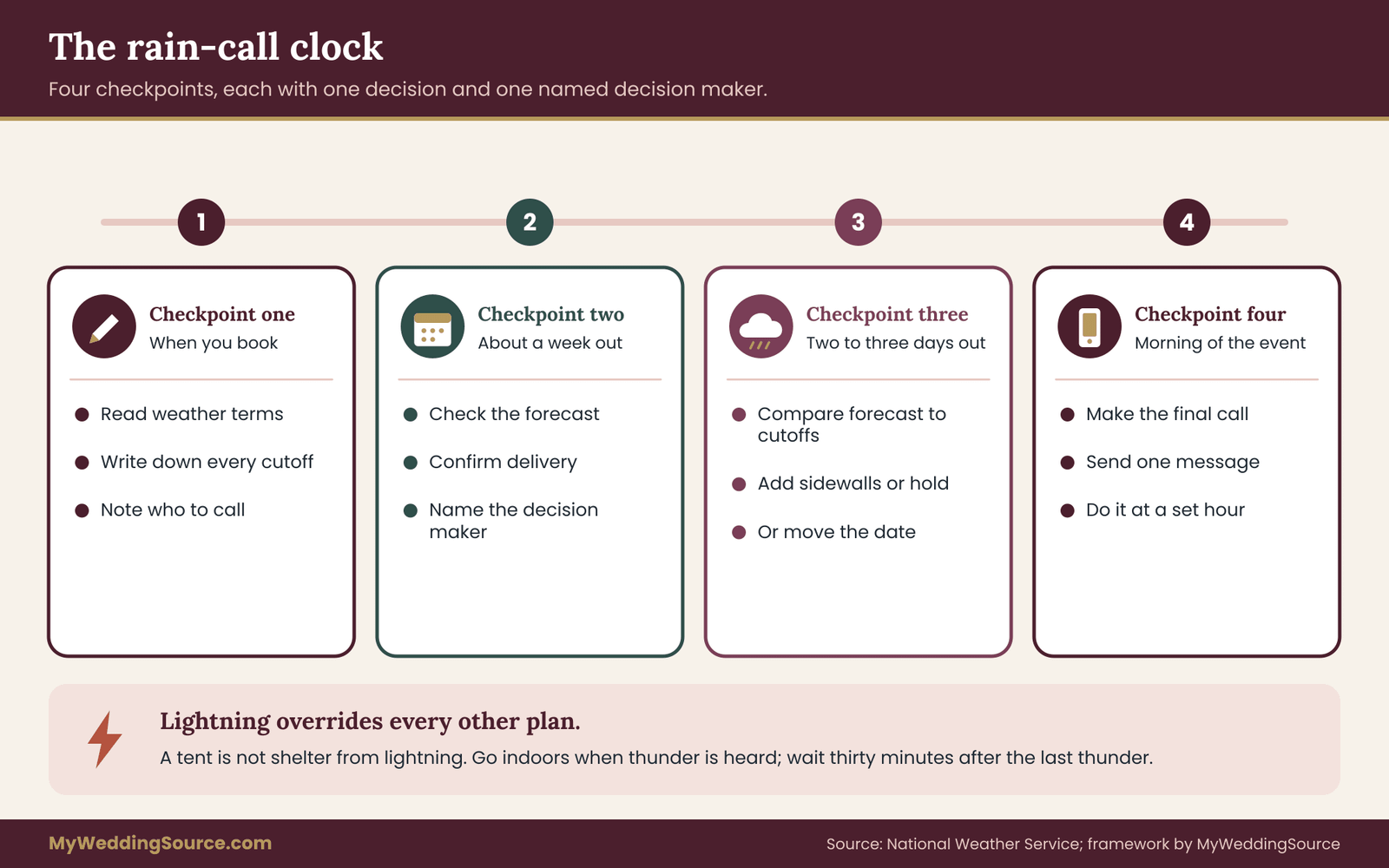
The clock has four checkpoints. The exact hours depend on your suppliers, so replace the examples with the cutoffs in your own contracts.
Checkpoint one: when you book. Before you pay a deposit, read the weather and cancellation terms for every rental. Write down the last date to change or cancel without a fee, the last date to add sidewalls or extra items and who to call. This is the checkpoint most hosts skip, and it sets the limits of everything that follows.
Checkpoint two: about a week out. Start looking at the forecast from the National Weather Service. At this distance, forecasts are a general signal, not a promise. Use it to confirm the plan, not to change it. Send the delivery confirmation, confirm the backup location and tell the helper who will make the call.
Checkpoint three: two to three days out. This is usually the last point for supplier changes that cost little or nothing. Look at the forecast again and compare it with the cutoffs you wrote down at checkpoint one. If rain is likely, order the sidewalls, confirm the indoor setup or decide to move the date. If rain is possible but unlikely, decide what level of risk you accept and write it down.
Checkpoint four: the morning of the backyard bridal shower. The final decision about the location should be made early enough for guests to hear it and for setup to follow. Consider setting a fixed time, such as nine in the morning for an afternoon event, and send one message to all guests at that hour whatever the outcome. A “we are staying outside” message is as helpful as a “we have moved indoors” message, because guests stop guessing.
Decision rules that remove the argument
Weather decisions create tension between hosts, family and the guest of honor. Agree on rules in advance so no one has to argue at the last minute.
Here are three rules that work for many households. A named person makes the final call, not a group. The call is made at the checkpoint, even if the forecast is still uncertain. And lightning, in or near the area, overrides every other plan. Write the rule on the sketch and share it with whoever is helping you.
A fourth rule is useful when money is involved: decide before the forecast how much you are willing to spend on insurance against rain. If the sidewalls cost a fixed amount and the likely alternative is a stressful afternoon indoors, you can decide now, with a clear head, rather than at midnight on Friday.
What to tell guests, and when
Your message to backyard bridal shower guests should be short, specific and sent at the checkpoint, not before. Include the address, the time, where to park and where to enter, in case any of those change. If the plan is indoors, say so. If the plan is outdoors under cover, say so, and say that umbrellas are welcome. If the date is moving, say the new date and ask guests to reply only if they cannot attend.
A text works for a small group and an email works for a larger one. Do not rely on a social media post. Send the message to the same list you used for the invitation, so no one is left out.
Weather beyond rain for a backyard bridal shower: heat, wind, lightning and bugs
Hosts plan for rain because it is the weather they can picture. The other conditions arrive without a name and quietly ruin an afternoon. A backyard bridal shower in an open yard faces five conditions: heat, sun, wind, lightning and insects. Each has a fix that is cheaper than a rain tent.
Heat and sun
A hot afternoon is hard on older guests, pregnant guests, young children and anyone taking certain medications. The Centers for Disease Control and Prevention publishes heat safety guidance, including signs of heat illness. Use it as a reference for what to watch for, and build the plan around easy prevention.
Shade comes first. Put seating, food and the quiet zone in the shade for the entire event, not only at the start. The sun moves, so stand in the yard at the time the backyard bridal shower will begin and again at the time it will end, and mark where the shade falls. A tent or canopy that looks well placed at noon may leave the guests in full sun by three.
Water comes second. Set out more cold water than you think necessary, in more than one spot, with cups or bottles that guests can reach without asking. A second water station near the quiet zone helps guests who do not want to cross the yard. Sunscreen and a few spare hats near the arrival area are small touches that guests appreciate.
Fans and misters can help, but they need power and water, and they add to the rental list. A cooler zone, such as a shaded porch or an indoor room guests can step into, may be more useful than any equipment. Tell guests where it is.
Wind
Wind rarely cancels a backyard bridal shower, but it can wreck the setup. Napkins, paper plates, tablecloths, place cards, balloons, signs and lightweight décor move first. Tents and canopies are more serious, since a gust can lift a poorly anchored frame.
Plan for wind in three ways. Weight or clip everything on the tables. Choose heavier or enclosed items for decorations. And ask the tent supplier what wind conditions require taking down or lowering the tent. A pop-up canopy that you bought for a picnic is not designed for a breezy afternoon with guests underneath it, and it should be anchored with proper weights, not tied to a chair.
If the forecast shows steady wind, consider relocating the serving zone behind the house or a fence, which acts as a windbreak. Add a note to your sketch so the delivery crew knows where each item goes.
Lightning
Lightning is the weather condition that changes the plan from comfort to safety. The National Weather Service uses the phrase “When thunder roars, go indoors” because no place outside is safe when thunderstorms are in the area, and tents and canopies do not protect people from lightning. Its guidance also says to wait until thirty minutes after the last thunder before going back out.
This has a direct effect on your rain backup. A tent is a good answer to rain and a poor answer to lightning. If thunderstorms are in the forecast, your backup must include a real building, such as the house, a garage with a solid roof or a booked indoor space.
Decide at the checkpoints who will watch radar on the day, what trigger will send guests indoors and how you will move them. A thirty-minute pause, with a plan for food and conversation indoors, is easier than an argument under a dripping tent.
Write the lightning rule in the same place as the rain rule, so that it is clear to anyone helping you. It should not depend on the host’s mood or the guest of honor’s wish to keep the party going.
Insects, pollen and the yard itself
Mosquitoes, ticks, wasps and bees can affect a backyard bridal shower. Check the yard for nests and standing water a few days before, and ask a pest professional if you find something you cannot handle. The Environmental Protection Agency offers a tool for choosing an insect repellent, and you can put a bottle in the welcome area for guests who want it. Citronella candles and similar items near food and tents raise flame questions, so follow the same safety rules as for any open flame under cover.
Pollen, grass allergies and dust can matter for guests with allergies. You cannot control them, but you can keep seating off freshly cut grass if possible and offer an indoor option for anyone who needs to step away.
Cold evenings and shoulder seasons
Spring and fall showers carry their own risks: a warm afternoon followed by a cool evening, a damp ground that stays cold and an early sunset. Heaters are an option, but they bring fire and carbon monoxide questions, so treat them as a rental that needs written guidance from the supplier. A simpler fix is to plan an early end time, set out a basket of blankets or shawls and keep a warm indoor space available.
Whatever the season, check how the yard feels at the time of day when the backyard bridal shower will be held, in the weeks before. Standing in the planned spot at the planned hour teaches more than any forecast.
Food and drink for a backyard bridal shower, outdoors
At a backyard bridal shower, food is where outdoor logistics meet health. Warm weather, shifting shade and a long serving window can turn a good menu into a risk. The point is not to make the menu complicated. It is to make serving safe and easy for the people who will be at the table.
Keep hot foods hot and cold foods cold
The U.S. Department of Agriculture’s food safety guidance says perishable food should not sit out for more than two hours, and for only one hour when the temperature is above ninety degrees Fahrenheit. Those limits shape the serving plan. Put out small amounts and refill from a cooler or the kitchen, instead of setting out everything at once. Keep cold items on ice or in shallow containers set in ice. Keep hot items in covered, heated containers or bring them out in batches.
Plan the timing of the food line against the program. If gift opening starts at two, the food should not be sitting in the sun from noon. A short serving window followed by a clear cutoff, after which perishable items go back into a cooler or the refrigerator, is easier to manage than a long open buffet.
Choose a menu that suits a backyard bridal shower
Menus that suit a yard are usually simple to serve and tolerant of heat and wind: finger foods, items that hold at room temperature for the serving window, salads with dressing on the side and desserts that do not melt. Tea parties, brunch spreads and lunch boxes all work. A heavy plated meal with several courses asks for a kitchen and a service crew most households do not have.
Label foods for common allergens and dietary needs, including vegetarian, vegan and gluten-free. A short card at each dish is enough. If a caterer is providing the food, ask for their labels. For guidance on matching a menu to different dietary needs at wedding scale, see our wedding menu planning guide; the principles of labeling and variety apply to a backyard bridal shower too.
Drinks, and what a bar needs
Water is the first drink to plan, then a non-alcoholic option that feels festive. If you serve alcohol, think about who is serving, where it is kept cold and how it affects guests who are driving. Our wedding bar service planning page covers licensing, service limits and non-alcoholic options at a larger scale, and the same ideas apply in a lighter way to a home event: set a clear end time, offer real alternatives and do not pressure anyone to drink.
A drink station is also a pinch point. Place it away from the food line, near the seating, and give it a surface that can handle spills. Ice melts quickly, so plan a second supply and a way to drain meltwater away from walking paths.
Power, water and handwashing
Check what the menu needs: refrigeration, warming trays, a coffee urn, a blender. Count the outlets near the serving zone and find out what the circuit can carry. Extension cords across walking paths are tripping hazards, so use cord covers or reroute. A generator is a rental that adds noise, fuel and fumes, and should sit away from the tent and the seating.
Handwashing matters at any outdoor food event. A sink in the house works if the route is clear. A portable handwashing station, or sanitizer at each serving point, covers the gap. It is a small item with a visible effect on how comfortable guests feel at the buffet.
Cleanup and trash
A backyard bridal shower creates more trash than an indoor party, and wind spreads it. Place bins at each zone, label them if you separate recycling and plan for the trash that must stay overnight if the pickup is the next day. Animals and insects find food scraps quickly, so close the bins and move them away from the seating.
A worked example of a backyard bridal shower plan
The example below is invented. The hosts, the yard and the numbers are illustrative, and your own sketch will look different. The aim is to show how the worksheet turns a vague idea into specific, checkable decisions.
Imagine two friends, Dana and Priya, hosting a Saturday afternoon shower for a guest of honor, Marcus, whose partner is a close friend of theirs. They expect twenty-eight guests. The yard is behind Dana’s house. It has a small patio next to the back door, a lawn that slopes gently away from the house, a side gate that is thirty-six inches wide and a single tree on the far side. The only bathroom is on the ground floor of the house.

Steps one to three: sketch, zones and paths
On the sketch, Dana marks the slope, the gate, the tree roots and a sprinkler head near the patio. The seven zones go in. Arrival is the side gate, with a sign reading “Shower this way.” Welcome and gifts sit on the patio under the porch roof. Seating goes on the flat part of the lawn, closer to the house than the tree.
Food and drink go along the fence on the shaded side of the house. The activity area is at the end of the seating, where everyone can see. The restroom is the house bathroom, reached through the back door. The quiet zone is a bench under the tree.
When Priya traces the slowest guest’s path, a problem appears. The route from the gate to the patio crosses a strip of soft ground by the sprinkler, and the step up to the back door is higher than it looks. A grandmother who uses a walker would struggle with both. The fix, decided on the page: a rented set of flooring mats from the gate to the patio, and a small portable ramp at the door, which the rental company can supply.
A second pinch point appears at the patio, where the gift table, the entrance to the house and the end of the food line all meet. They move the gifts to the corner of the patio and place the first drink station on the lawn, so the food line forms along the fence and not at the door.
Steps four and five: rentals and the contingency grid
The rental list comes straight from the gaps. A frame tent over the seating, with sidewalls available. Twenty-eight chairs plus four spares, including six with arms. Four round tables sized to the supplier’s stated capacity. Flooring mats on the path from the gate. A portable ramp. Two pop-up canopies for the food line and the drinks, borrowed from neighbors. No linens, since the hosts own washable cloths. No restroom rental, because the house bathroom works for this count, and the route is firm and lit.
In the contingency grid, light rain leaves everything in place, since the tent covers seating and the porch covers gifts. Heavy rain triggers the sidewalls and moves the food line onto the patio. Lightning moves the whole event into the house, with chairs set in the living room and the dining room, and the tent left empty. Heat sends the quiet zone and a water station to the porch. Wind means the canopies come down first and the food moves to the kitchen counter.
Looking at the lightning column, Dana sees the problem the grid was designed to reveal. The house holds about twenty guests seated, not twenty-eight. The honest fix: the lightning plan is a short indoor pause of thirty minutes with a standing and mingling format. The seated lunch resumes if the storm passes. If it does not, the afternoon becomes a smaller gift-opening indoors with a take-home food plan. Dana adds this to the guest message template so no one is surprised.
Step six: the clock
The tent supplier says sidewalls can be added until Thursday at noon and the order can be cancelled without a fee until Wednesday at noon. Marcus’s partner prefers not to move the date. So the clock reads as follows. On booking day, Dana records both cutoffs. A week out, Dana checks the National Weather Service forecast and confirms delivery for Friday morning.
On Wednesday morning, Dana and Priya decide whether to keep the tent order. On Thursday morning, they decide on sidewalls. On Saturday at nine, Priya, who has agreed to make the call, sends the guest message with the final location.
Nothing in this backyard bridal shower plan is complicated. What makes it work is that every decision has a name, a time and a reason, and that the gaps appeared on paper, not on the day.
What the backyard bridal shower example does not claim
This example does not predict costs, because rental prices and weather risk differ by region and supplier. It also does not say which option is best. A different household might choose a larger tent and skip the indoor pause, or skip the tent and use the house for everything because the guest count is small. The worksheet’s job is to make the trade-offs visible.
Hosting, budgets and etiquette without assumptions
A backyard bridal shower sits inside a web of social expectations about who hosts, who pays and what is appropriate. Those expectations vary a great deal across families, cultures and friend groups, and no single rule fits everyone. This section is about what to settle before you rent anything, so that the equipment decisions do not hide an unspoken disagreement.
Settle who is hosting the backyard bridal shower and who is paying
Decide who is hosting before you reserve equipment. A shower can have one host, a pair, a group of friends or a family. Each has different budgets and different levels of authority over the yard. If several people share the cost, agree on how, in writing, before the first deposit. A short message in the group chat is enough: who is paying for the rentals, who is paying for food and how any weather-related change will be handled.
Do not assume that any particular person, such as the bridal party or a relative, is expected to pay. Customs differ. The people hosting decide what they can afford and what they will ask of others, and the guest of honor should not be asked to cover costs of their own shower. If a rental carries a weather fee or a damage deposit, agree in advance who is responsible for it.
Keep the guest of honor in the decision loop
The guest of honor may have strong views about the guest list, the tone of the backyard bridal shower, whether to hold it at a private home and what is acceptable in terms of food, games and gifts. Ask early, and ask in a way that makes it easy to decline. Some people love a backyard gathering. Others find an outdoor event stressful because of weather, bugs, accessibility or the lack of a private space to step away. A short, direct question is better than guessing.
Write backyard bridal shower invitations that carry the logistics
An invitation is a logistics document. It should give the address, the start and end times, where to park, where to enter and whether the backyard bridal shower is on grass. It should state the weather plan in one line, such as “Rain or shine; we have a tent and an indoor backup.” It should ask guests to reply with any access needs or dietary needs. For wording and etiquette questions, see our wedding etiquette guide, which sets out general principles that carry over to showers.
Be careful with wording around gifts and money. A shower invitation should not pressure guests about the cost or the kind of gift. If you mention a registry, make it a neutral line that guests can ignore.
Be considerate to neighbors and the street
A backyard bridal shower affects neighbors through noise, parking and deliveries. A short, friendly note a few days beforehand, with the date, the end time and a phone number, prevents most complaints. Think about where guests will park, whether the street allows it and whether a rental truck can reach the gate. Check the rules of any homeowners’ association or local ordinance for temporary structures and events, and ask the issuing office when you are unsure.
A small contingency fund for a backyard bridal shower
Even a well-planned shower can run into extra costs: a delivery fee for a changed address, a last-minute fan, ice, a replacement item or a cleaning charge. Set aside a modest amount for the unexpected and agree who has authority to spend it. This is a planning habit, not a prediction that something will go wrong. It saves the afternoon from a spending argument.
When the backyard bridal shower plan changes
If you must change the plan, tell people early and plainly. A guest who learns about an indoor move from a neighbor will feel less welcome than a guest who received a message the night before. Keep a short log of what you decided and why, so that if a supplier disputes a charge, you can show the dates and the messages. The wedding vendor due diligence checklist lays out the habit of checking suppliers before you commit, and it is as useful for a rental company as for a wedding vendor.
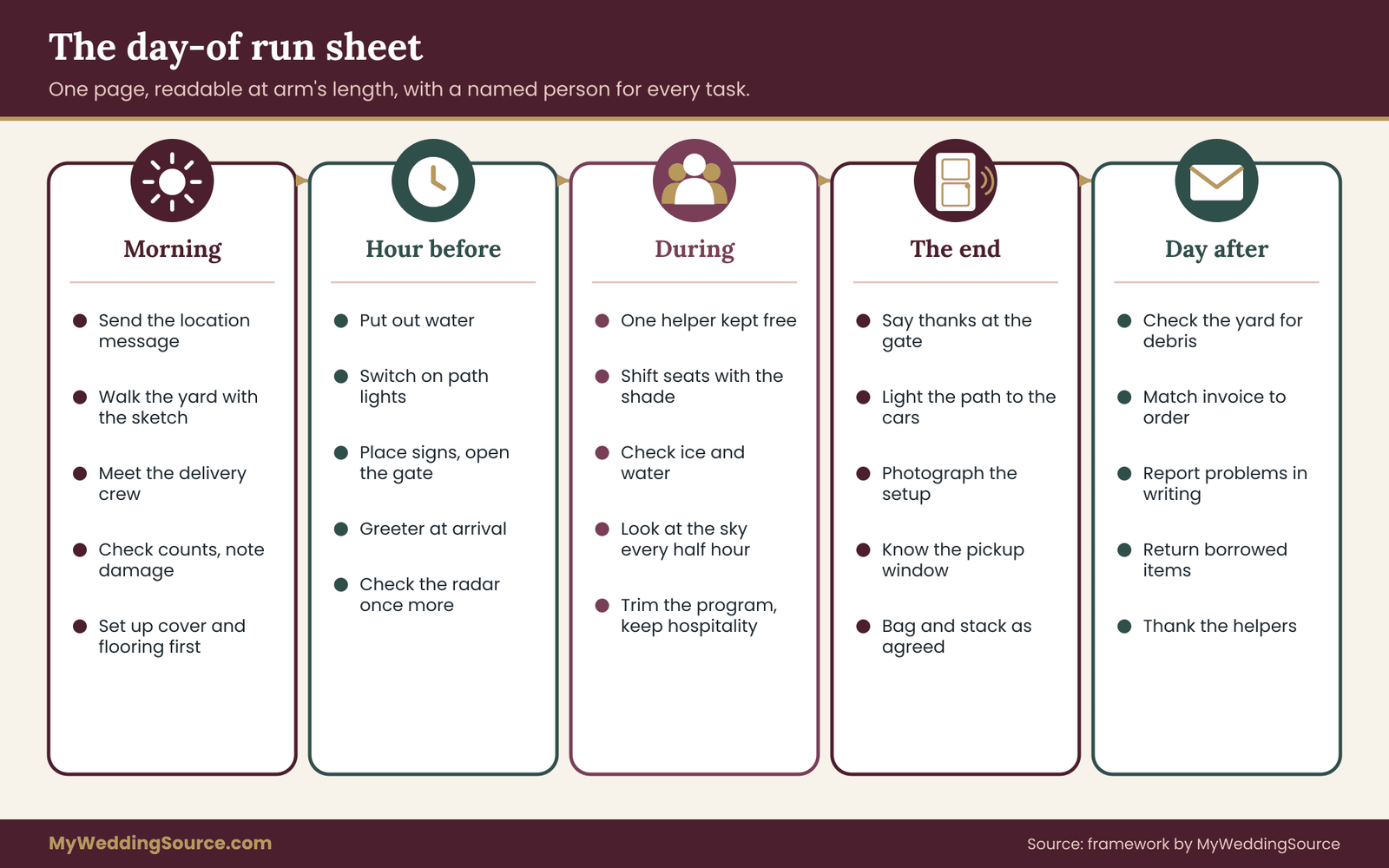
The day-of run sheet for a backyard bridal shower
A run sheet turns the worksheet into a timeline that a helper can follow without asking you every few minutes. It should fit on one page and be readable at arm’s length. Give a copy to anyone with a task, including the person who makes the weather call and the person who greets guests.
The morning of the backyard bridal shower
Start with the checkpoint message. At the time you chose, check the forecast and send the location message to guests. Walk the yard with the sketch in hand and compare it with what stands there. Look for anything that changed overnight: a branch down, standing water, a sprinkler that ran, a neighbor’s vehicle in front of the gate.
Confirm the delivery. If rentals arrive in the morning, be there to direct the crew to the marked spots. Check the count of tables and chairs against the order before the crew leaves, and note any damage on the delivery slip. It is far easier to point out a cracked chair at delivery than a week later.
Set up in the order of dependency: cover and flooring first, then tables and chairs, then the serving areas, then lights and signs, and finally the décor. Décor goes last because it is the first thing to move if the weather turns. Walk the slowest guest’s route once more, in the shoes a guest might wear.
The hour before
Set the food zone only when guests are close. Start the music or the playlist at a level that fills the yard without competing with conversation. Put out water. Open the gate, switch on any path lights that are needed and place the signs. Assign one person to greet at the arrival zone and another to point out the restroom, the quiet zone and the drinks.
Look at the sky and the radar one more time. If your lightning rule says to hold, hold. If conditions look fine, tell your helper that the plan stays as written, so everyone is working from the same assumption.
During the backyard bridal shower
Keep a helper free to handle small problems: a spill, a guest who needs a seat, a child who needs a snack, a table that wobbles. The host should be able to talk to guests, so do not make yourself the only problem-solver.
Watch the shade. Chairs and tables may need to shift as the sun moves. Check water supplies and ice at the halfway point. Check the sky every thirty minutes or so, and make a habit of it.
Keep the program short enough for guests who are standing or sitting in discomfort. A gift-opening that runs long outdoors is harder on the guest of honor and on the guests than the same event indoors. If your seating or weather is less than ideal, trim the program, not the hospitality.
The end of the backyard bridal shower
Announce the end time on the invitation and keep to it. At the close, thank guests at the arrival zone, offer to-go containers, make sure the guest of honor has a way to carry gifts and cards and watch the path as guests leave, especially if it is getting dark.
Plan the pickup. Know when the rental company arrives, which items must be ready and which are your responsibility to rinse, stack or bag. Take photos of the setup before the pickup so you have a record. Keep delivery slips and receipts in one folder until the final invoice is settled.
The day after
Check the yard for debris, glass and anything the guests left behind. Return borrowed items with a thank-you. Review the rental invoice against the order and the delivery slip. If something is wrong, contact the supplier promptly, in writing, with the facts and dates. A short note to the helpers and to the guests, with the best photos, is a good way to close the backyard bridal shower.
Your next steps
Choose one evening this week and do three things. First, draw the yard sketch and mark the seven zones. Second, trace the slowest guest’s path from the curb to a seat and write down every obstacle on it. Third, list the questions you want every rental company to answer, and add the cutoff times to a calendar. Those three steps cost nothing and tell you whether the plan is workable before any deposit.
Then work through the rest of the worksheet in order: the rental list, the contingency grid and the rain-call clock. When the plan is on paper, share it with a helper who will be at the backyard bridal shower, and ask them to find the weak spot. A fresh pair of eyes will spot the gap you have stopped seeing. For a wider view of the planning calendar around a wedding, the wedding planning checklist is a handy reference, and you can borrow its habit of attaching dates to tasks.
A backyard bridal shower does not need to be elaborate. It needs a dry place to sit, a safe way to get there, food that stays safe, and a plan that does not depend on good luck. When those four things are in place, the rest of the afternoon is easy to enjoy.
FAQ
How far ahead should I book rentals for a backyard bridal shower?
Book as soon as the date and guest count are firm, especially for tents, which can be limited on popular weekends. For smaller items, a few weeks may be enough, but supplier calendars vary by season and region. Ask each company for its lead time and its change deadline, and write both down before you pay a deposit.
Do I need a tent for a backyard bridal shower?
Not always. A small gathering may be fine with pop-up canopies and an indoor backup. A tent makes sense when you expect more guests than the house can hold, when the date falls in a rainy or very hot season or when you want the backyard bridal shower to stay outdoors whatever the weather. Match the cover to your backup plan.
What should the rain plan for a backyard bridal shower include?
It should name a location, state what guests will sit on and eat from, describe the dry route to it and set a time for the decision. It should also name the person who makes the call. A plan that lacks any of those items is a hope. Test it by counting the seats in the backup against your confirmed guest count.
Is a tent safe in a thunderstorm?
No. The National Weather Service advises that no place outside is safe when thunderstorms are nearby, and tents and canopies do not protect people from lightning. If thunder is possible, your backup must be a solid building. Move guests inside when thunder is heard and wait until thirty minutes after the last thunder to go back out.
How do I make a backyard bridal shower accessible for guests who use mobility devices?
Trace the route from the curb to the seats, the food and the restroom, and fix each obstacle: soft ground, steps, gravel and narrow gates. Rental flooring and small ramps can help. Ask guests privately whether they need anything. Keep one level, firm path open at all times and place a few armed chairs near it.
How long can food sit outside at a backyard bridal shower?
The U.S. Department of Agriculture advises that perishable food should not sit out for more than two hours, and only one hour when the temperature is above ninety degrees Fahrenheit. Put out small portions, refill from a cooler or kitchen and put leftovers away after the serving window ends. Check the agency’s page for current guidance.
Who pays for the rentals at a backyard bridal shower?
There is no single rule. Customs differ among families and friend groups. The hosts decide what they can afford, agree on the split in writing before any deposit and never ask the guest of honor to pay for their own shower. If a weather fee or damage deposit applies, decide in advance who is responsible for it.
What should I do if the forecast changes the night before?
Go back to the rain-call clock. If the supplier’s cutoff for sidewalls has passed, use the backup you have already written down. Send the guest message at the time you promised, even if the decision is to stay outdoors. Keep the call with one named person, and let lightning override every other consideration.
Sources
- Lightning safety, National Weather Service
- National Weather Service forecasts, National Oceanic and Atmospheric Administration
- Call 811 before you dig, Common Ground Alliance
- Food safety: keep food safe outdoors, FoodSafety.gov
- Heat and health, Centers for Disease Control and Prevention
- Guidance on accessible design, ADA.gov, U.S. Department of Justice
- Fuel-burning appliance and carbon monoxide safety, U.S. Consumer Product Safety Commission
- Fire and life safety resources, National Fire Protection Association
- Find the insect repellent that is right for you, U.S. Environmental Protection Agency
- Prepare for severe weather, Ready.gov