
Early flights are the quiet problem of wedding weekends: the guests who traveled farthest are often the ones who must leave before any farewell meal begins. This guide gives you a leave-by clock, four departure lanes and a grab-and-go option map, so every guest with early flights gets a proper goodbye and something to eat without forcing the whole weekend to start at dawn.
Do not design the farewell around the average guest. Find every guest with early flights, work backward from each takeoff time to a leave-by time, and sort guests into four lanes: gone before the farewell starts, able to drop in for half an hour, able to stay for the first plate, and free to stay for all of it. Then give each lane one option: a night-before goodbye and a grab-and-go bag, a lobby coffee window, an early drop-in, or the full brunch. Confirm every option with the hotel, venue and caterer in writing.
Early flights are easy to overlook. A Saturday wedding that ends at midnight and a farewell brunch that starts at ten the next morning look fine on a schedule. They look much worse from the point of view of a cousin with a flight at 7:15. That cousin has to be at the airport roughly two hours earlier, which means leaving the hotel around 4:45, which means waking at 4:00, which means leaving the reception before the cake is cut if there is going to be any sleep at all.
The brunch is not an option for anyone with early flights. The goodbye, if it happens, happens in a hallway.
None of this is anyone’s fault. Couples cannot control airline schedules, and guests often book the cheapest or the only flight out of a regional airport. But a few decisions made weeks ahead turn a rushed exit into a calm one. This article is about those decisions: how to find out who has early flights, how to translate flight times into a schedule you can act on, and which low-effort options fit which guests.
A note on scope. This is general planning information, not legal, safety or travel advice. Airport procedures, airline policies, venue rules and local food regulations differ and change, so where a rule matters the article points you to the agency or business that sets it.
The guide stays narrow on purpose. If you are still deciding whether to host a farewell meal at all, the guide on wedding brunch decisions on this site covers that question, and the main wedding planning checklist shows where a morning-after event sits among your other tasks. Here the question is smaller and more practical: what do you do about early flights, for the guests who cannot attend it?
Why early flights break the usual farewell plan
Most farewell events are built around a single assumption: that guests wake up when they like, eat when the food is ready and leave when they are done. Guests with early flights break every part of that assumption, and they break it in different ways.
They lose sleep before the day even ends. A guest who must be awake at four in the morning has an incentive to leave the reception early. That affects the end of your night, not only the morning after. Some of your most traveled guests will be missing from the last dance, and a few will slip out without saying goodbye because they do not want to interrupt.
They miss the food. Hotel breakfast service often starts after the hour these guests need to leave. Restaurants in the area may be closed. A guest who skipped dinner to talk to people, or who danced through the evening, may face a long travel day with an empty stomach and a stack of vending machine options.
They carry social cost. People who leave early often feel they are inconveniencing the hosts, so they say nothing. If you do not ask about early flights, you will not find out. A guest who quietly takes a car at five in the morning and lands home without having eaten or said goodbye to the couple is not complaining, but they are not enjoying the weekend’s final hours either.
They create a timing problem for you. If you offer something early, you need staff, supplies and someone to run it. If you offer nothing, you need to be at peace with that choice. Either way, it is a decision rather than an accident, and that is the whole point of planning for early flights.
Early flights are not the same as early departures
A neighboring problem is the guest who leaves the reception early for a reason such as a young child or a long drive home. That is a different situation with different tools. The guide on early departures for families with young children on this site covers the send-off side of that problem. Here, the defining feature is a fixed, external deadline set by an airline schedule, and the deadline is nearly always earlier than the guest would choose.
That fixed deadline is what makes early flights solvable. A departure time is a hard number. You can calculate from it. The next section does exactly that for early flights.
What counts as an early flight for planning purposes
There is no universal definition, and you should not invent one that does not fit your own weekend. A useful working definition of early flights is relative to your farewell event. If your farewell starts at ten, an early flight is any flight that forces a guest to leave the hotel before roughly nine thirty. If your farewell is a late lunch, a flight that leaves before midday may qualify. If there is no hosted farewell at all, early flights are simply the ones that depart before the hotel breakfast opens.
Defining it that way matters because it keeps the effort proportionate. A couple hosting a ten o’clock brunch for forty guests does not need a special plan for the person flying at three in the afternoon. They do need one for the person flying at seven, and for the person flying at eight forty-five, who looks safe on paper but is not.
Working backward from takeoff: the leave-by clock
The first tool in this guide is the leave-by clock. It converts a flight time into three times that matter to you: when the guest must leave the hotel, when they must wake up, and the last moment you could reasonably speak to them. Everything else in the plan hangs from those three times.
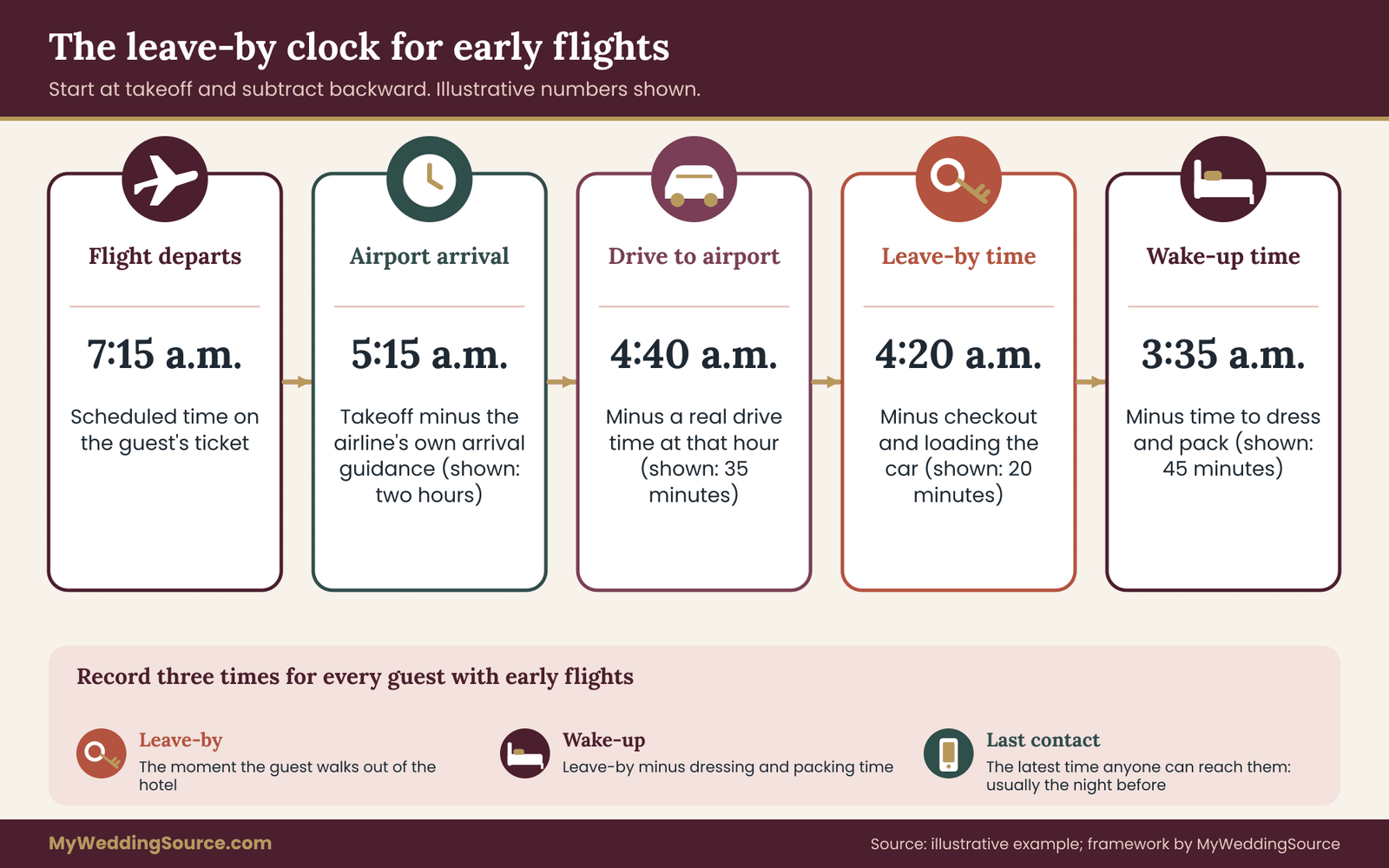
The calculation is simple subtraction. Start with the scheduled departure time on the guest’s ticket. Subtract the time the guest should be at the airport before departure. Subtract the travel time from the hotel to the airport, including any wait for a car. Subtract a margin for checkout, loading bags and a missed elevator. The result is the leave-by time. Subtract another thirty to sixty minutes for waking, dressing and packing, and you have the wake-up time.
Each term in that subtraction needs a sensible source, and none of them should come from your assumptions.
The airport arrival buffer comes from the airline and the airport. Airlines publish check-in and bag-drop cutoffs, and airports publish guidance on how early to arrive. These vary by carrier, route, time of day and whether the guest is traveling internationally or with checked bags. The Transportation Security Administration also publishes screening information, and wait times can change with the day of the week and the hour. The guest knows their airline, so ask them to apply their own airline’s guidance rather than a number you picked.
The ground time comes from a real route at a real hour. A map application will show typical drive times, but a four-thirty drive on an empty highway is not the same as a four-thirty drive during construction or in snow. If the airport is more than an hour away, add margin. If guests are sharing a car, add time for the second and third stops.
The checkout margin depends on the hotel. Some hotels offer express checkout or allow guests to leave a key card in a drop box. Others require a front desk visit and have one person on shift at that hour. Ask the hotel rather than guessing, and see the vendor questions later in this guide.
A worked leave-by calculation
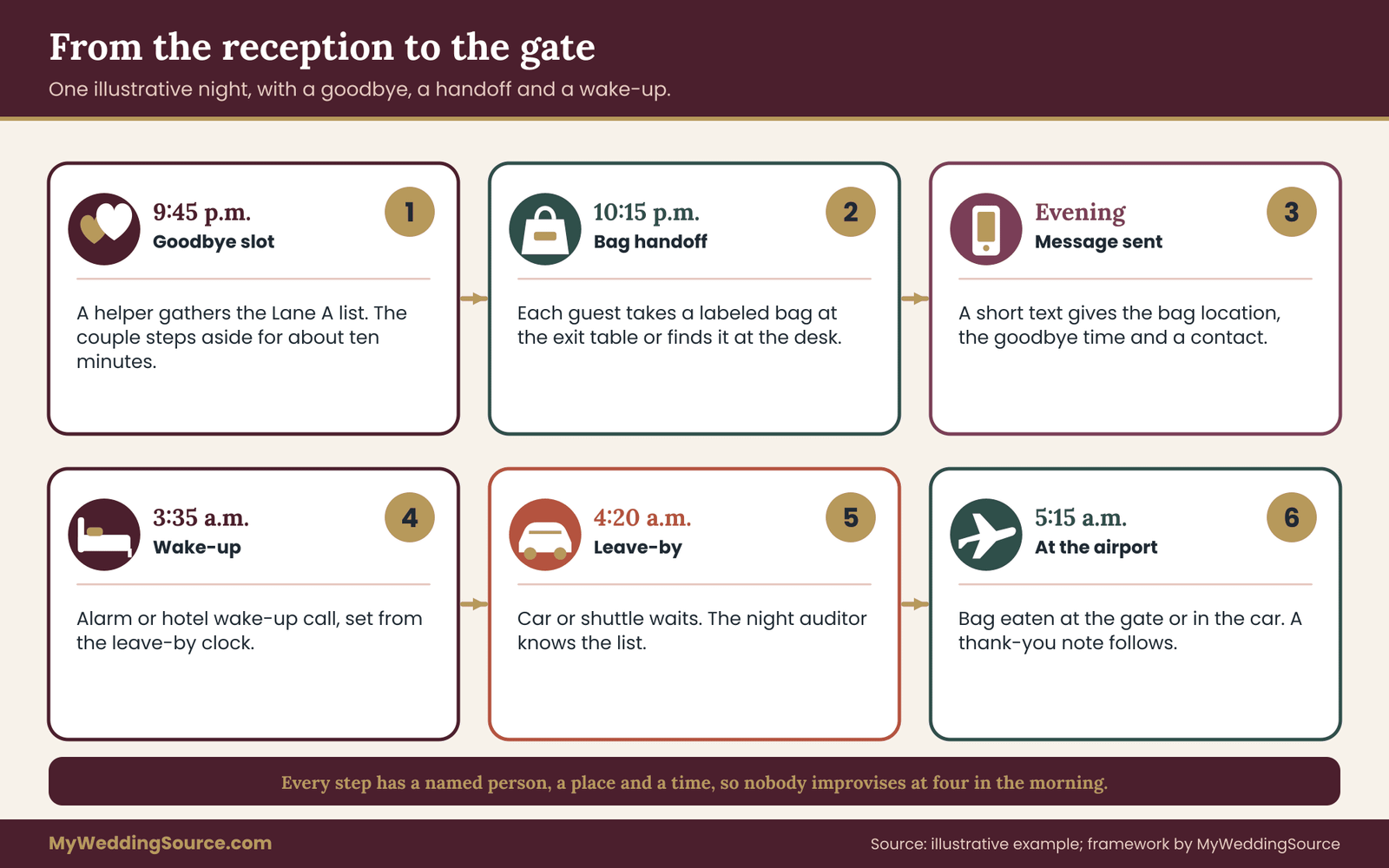
The numbers below are illustrative, not a recommendation. Suppose a guest has a flight scheduled to depart at 7:15 a.m. Their airline suggests arriving two hours before a domestic departure when checking bags, so they need to be at the airport at 5:15. The hotel is thirty-five minutes from the airport at that hour, and they plan twenty minutes for checkout and loading the car. Leave-by is 5:15 minus 55 minutes, or 4:20. Add forty-five minutes to dress and pack and the alarm goes off at 3:35.
Seen that way, a guest with early flights is not asking for a small favor. They are asking to be treated as someone whose night ends around eleven, and who needs a bag of food and a human goodbye before then. This is why the answer to early flights usually starts the night before.
Three times you can write on a card
Once you have done the subtraction for each guest with early flights, record three times: the leave-by time, the wake time and a last-contact time. The last-contact time is the latest moment you or a helper can reasonably reach the guest, which is usually the end of the evening before. Keep these on one list. It will become the working sheet for the lanes in the next section, and it takes about a minute per guest once you have the flight information.
The early flights sheet is also the thing you hand to anyone helping on the day. A friend who is told “the guests on this list leave between four and six, and they have bags waiting at the front desk” can do the job. A friend who is told “some people have early flights” cannot.
Sorting guests with early flights into four lanes
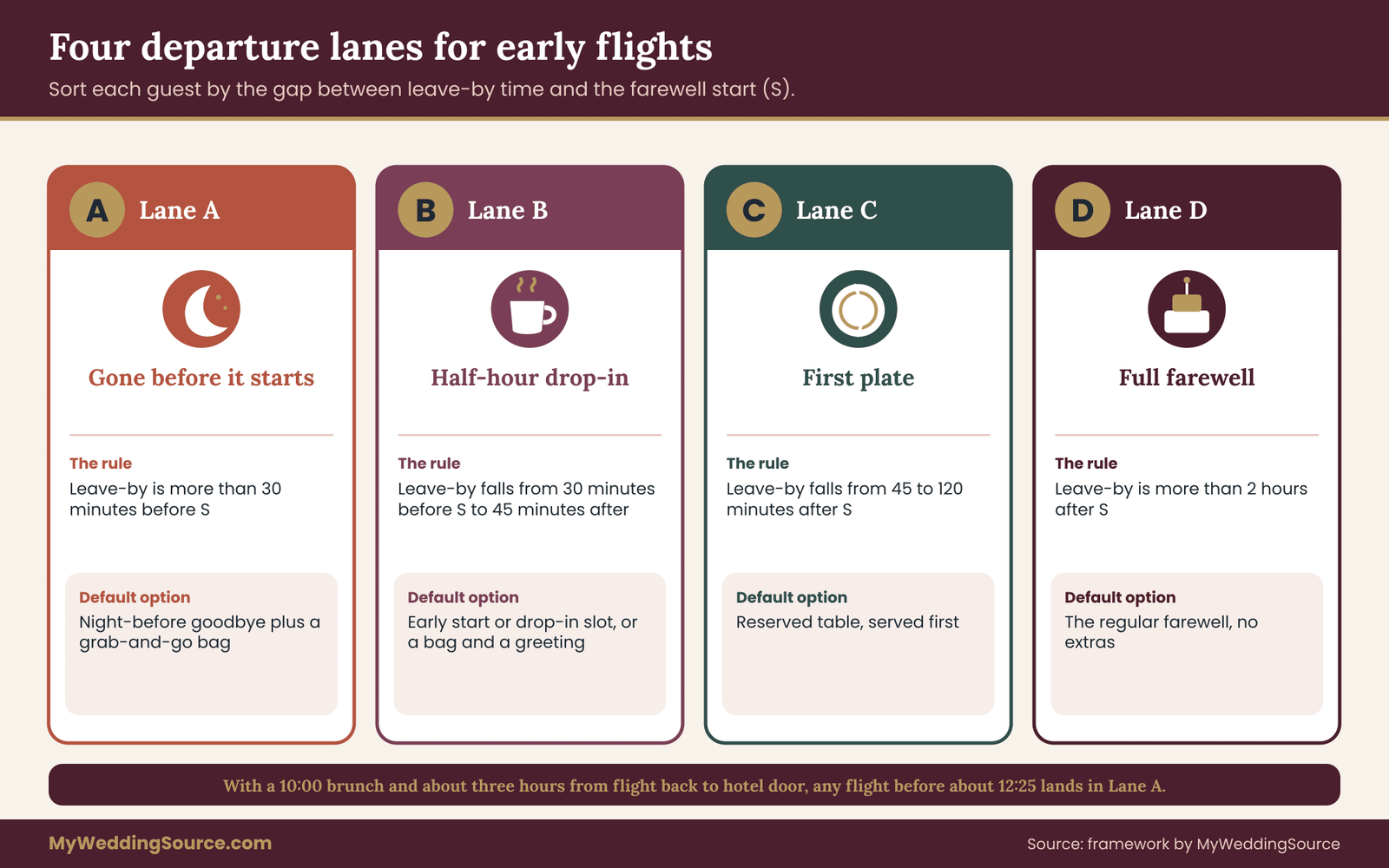
A leave-by time for early flights means nothing until you compare it with the farewell event itself. The second tool in this guide is a set of four lanes. Each lane is defined by the gap between a guest’s leave-by time and the time the farewell starts. Call the farewell start time S. If the farewell is a ten o’clock brunch, S is 10:00.
Lane A: gone before the farewell starts. The guest’s leave-by time is more than thirty minutes before S, so these are the early flights in the strict sense. For a ten o’clock brunch, that means anyone leaving the hotel before 9:30. They cannot attend, and nothing you do at the brunch will help them. Their goodbye has to happen the night before, and their food has to travel with them.
Lane B: the half-hour drop-in. The leave-by time falls between thirty minutes before S and forty-five minutes after S. These guests could join if the event had a short, early part. They would arrive as the food goes out, eat quickly, hug people and leave. The risk is that they sit through the opening chatter, look at the clock and leave without eating.
Lane C: the first plate. The leave-by time falls between forty-five and one hundred twenty minutes after S. These guests can attend for part of the event, but they need to be served early and not wait for a buffet line, a toast or a late arrival from the kitchen. A hosted farewell can serve this lane well with a few small adjustments.
Lane D: the full farewell. The leave-by time is more than two hours after S. These guests can stay for the whole event and need no special arrangements. Their flights may still be early enough to deserve a mention in your messages, but no separate option.
Why the thresholds are set this way
The numbers are a starting point, not a law. The thirty-minute cushion in Lane A exists because a guest who walks into a brunch at 9:30 with a leave-by time of 9:40 has not really attended; they have ordered a plate and left it. The forty-five-minute figure in Lane B reflects how long a guest realistically needs to arrive, get served, eat and say two or three goodbyes.
Change the thresholds if your own event runs differently. A seated, plated meal with a long first course shifts everything later. A drop-in coffee service shifts everything earlier.
What should not change is the idea of sorting. When you treat all early flights as one group, you end up with a plan that is too much for some and not enough for others. A pre-dawn breakfast for guests who could have attended a ten o’clock brunch wastes money. A brunch that opens at ten does nothing for guests who are in a taxi at four forty.
Matching each lane to one option
Each lane has a default option, and the next sections build them out. Lane A guests get a night-before goodbye and a grab-and-go bag. Lane B guests get an early coffee window or a drop-in slot before the main event. Lane C guests get an early seating or a first-plate service. Lane D guests get the regular farewell. The point of having one default per lane is that it keeps your helpers from improvising at five in the morning.
Notice what is missing: a separate, formal event for every set of early flights. Most couples will find that the lane for early flights is small, a handful of people, and that three or four well-chosen touches cover it. If the lane is large, as it might be at a destination wedding where most guests fly home on the same morning, then the farewell itself should probably move earlier, which is a different decision than any single guest’s goodbye.
Finding your list of early flights without sending a survey
You cannot sort lanes until you know who has early flights. Many couples assume they must send a long travel questionnaire, which guests ignore. A lighter approach works better.
Ask once, at RSVP, with a narrow question. Add a single optional field to your RSVP form or wedding website: “Departure flight time, if you are flying home the morning after.” A free-text field is fine. Guests who are driving home or staying a few extra days will leave it empty, and guests with early flights will fill it in. Do not ask for flight numbers, airlines or confirmation codes. You do not need them, and you should not collect more personal travel information than the task requires.
Ask again once flights are booked. Many guests do not book until six to eight weeks before the wedding, so the RSVP answer may be a guess. A short reminder message about a month out, with the same single question, catches the updates. The guide to the wedding vendor timeline is a useful place to see where a guest-facing reminder fits among the dates you are already sending.
Use the hotel block to cross-check. If you have a room block, the hotel’s rooming list and checkout dates show who is leaving Sunday morning. The guide to wedding guest hotels across different budgets and mobility needs explains how blocks, cut-off dates and accessibility requests fit together. A rooming list will never tell you a flight time, but it tells you who might have early flights.
Ask the people who book for others. Parents often book flights for adult children, and grandparents may rely on a relative to arrange travel. If you know that one relative handles a group, ask that person instead of each guest.
What to do with the data once you have it
Keep the list in one place, with only what you need: name, flight departure time, and the airport. Compute the three times from the previous section. Mark each guest with a lane. Then look at the totals, because the totals decide how elaborate any option should be.
A few simple counts of early flights guide the next decisions. How many guests are in Lane A? If it is two or three, a grab-and-go bag for each, a goodbye at the reception and one conversation with the hotel covers it. If it is twenty, a bag per guest still works but requires someone to organize the pickup, and you might want to put a small coffee station in the lobby.
How many are in Lane B? If it is eight or more, a drop-in event may be worthwhile on its own. If it is two, a bag is likely enough.
Privacy and tone when you collect travel details
Treat flight times as private. Guests have shared them for a specific purpose, so do not post a list in a group chat or on a shared document. Share the early flights lane assignments only with the people who need them: the person handing out bags, the hotel contact if you are asking for a wake-up arrangement, and perhaps the transport coordinator.
When you reach out, keep the tone warm and light. The goal is for guests to feel they have been noticed, not audited. A message such as “We would love to make sure you leave with a goodbye and something to eat” lands better than “Please submit your itinerary.” The message section later in this guide has complete wording for the RSVP line and the follow-up note.
The guest who does not respond
Some guests will not answer at all. For those, use what you know about early flights. If a guest is flying from a distant city and checked out of the hotel on Sunday according to the rooming list, assume they have a morning flight and include them in the bag count. A spare bag costs little. A guest with no bag and no breakfast on a travel day costs more in goodwill than the bag would have in food.
In the main wedding planning checklist, the list of early flights belongs in the final-two-months section, alongside seating, transportation and the final headcount.
A guest-first view of the night before
Because Lane A guests decide the whole shape of the early flights question, spend a few minutes picturing their evening. It begins as a normal wedding evening. At some point, usually between the dinner and the main dancing, they realize they should leave. They have to find a ride, which may be a car service, an app or a shuttle that you arranged.
They have to say goodbye to the couple, which is awkward if the couple is across the room taking photos. They have to pack, if they have not already done so, and they have to figure out breakfast.
Each of those steps is a place where a small act of hosting helps guests with early flights. A shuttle schedule printed on the program removes the ride question. A table card with a note that says “if you leave early, find a member of our family to say goodbye” removes the awkwardness. A bag waiting at the front desk removes the breakfast question. None of them takes much effort on the day because they were prepared in the weeks beforehand.
The grab-and-go option map for early flights
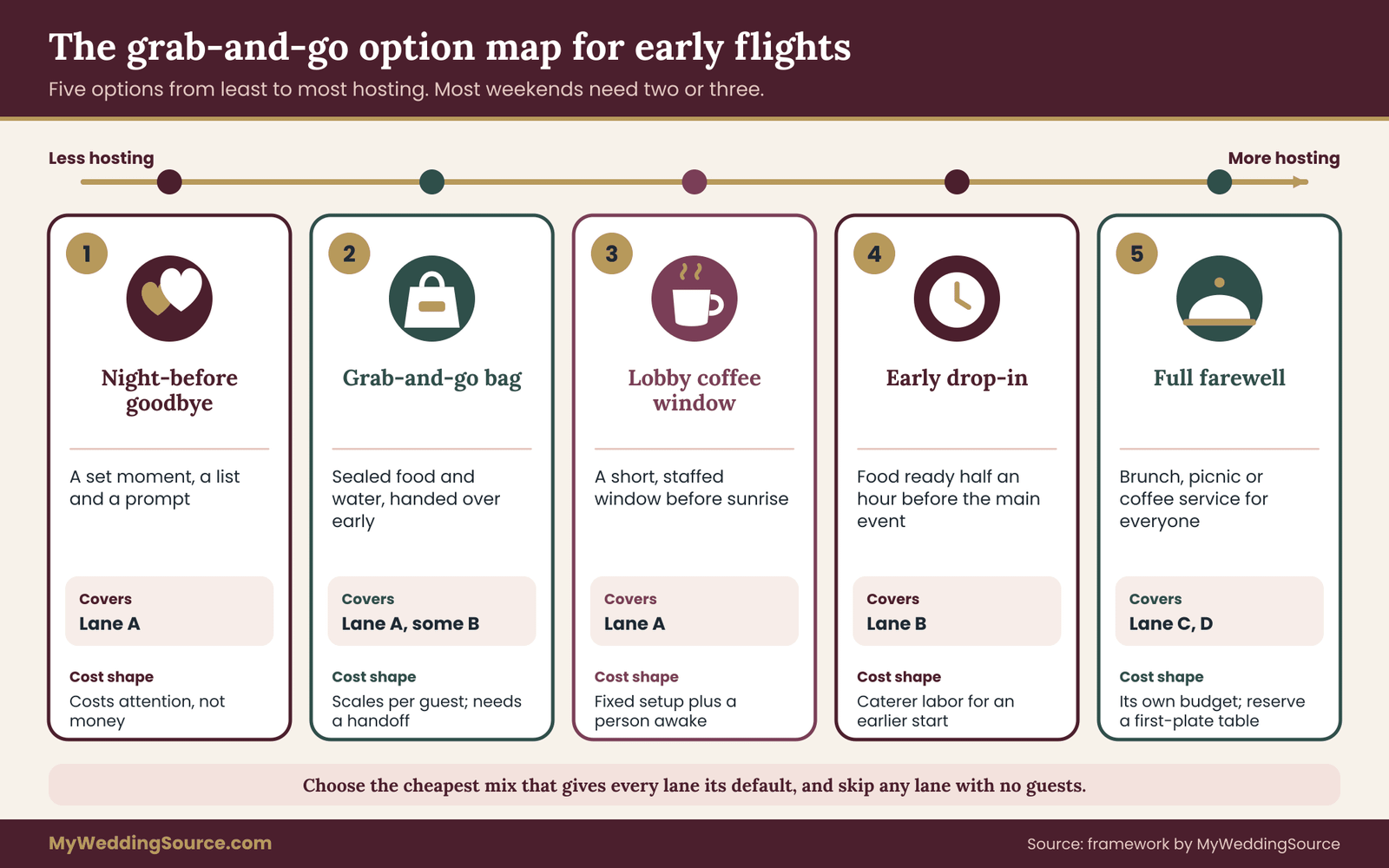
The third tool is the option map. Think of a line with “nothing hosted” at one end and “full brunch” at the other. Five options sit along it, and each one covers a different slice of the guests with early flights. You rarely need all five. Most weekends with early flights need two or three, chosen by lane.
Option one: the night-before goodbye. A deliberate moment at the reception, set apart from the dancing, where the couple (or a family member standing in) says goodbye to anyone leaving for early flights. It can be a short stop at a table, a line near the exit or a brief toast. It costs nothing but attention, and it solves the emotional half of the problem.
Option two: the grab-and-go bag. A sealed bag or box with food and drink, handed over the night before or left at the front desk. It covers Lane A almost entirely, which means most early flights. The next section covers how to build one that survives a car ride, security screening and a gate with no restaurants open.
Option three: the lobby coffee window. A short, staffed or self-serve coffee and pastry service in the hotel lobby or a hallway, open for a set window such as 4:30 to 6:30. It covers guests who leave in the early dark and want a hot drink and a hello.
Option four: the early drop-in. A half-hour slot before the main farewell, with food ready and no program. It covers Lane B. Guests arrive, eat, hug and go.
Option five: the full farewell. The brunch, picnic or coffee service the rest of the guests attend. It covers Lane D and, with an early seating or first-plate service, Lane C.
Which option for which lane
Lane A needs options one and two, and optionally three. Lane B needs option four, or a bag plus a quick greeting at the start of the farewell. Lane C needs option five with a service tweak. Lane D needs option five and nothing more.
That mapping is the framework in miniature. Before you spend money on early flights, write the lane counts on a page, draw the options against them, and select the cheapest combination that gives every lane its default. If a lane has no guests, skip its option. If a lane has one guest, a personal gesture beats an event.
Comparing the options in plain terms
Each option has a different cost shape, and the differences matter more than the dollar amounts, which vary by region and vendor.
The night-before goodbye costs attention and a few minutes at the end of dinner. It requires a person to carry the list and prompt the couple. If you are the person, you will want a friend to run the list so you are not the one counting heads while holding a drink.
The grab-and-go bag costs food and packaging, scaled by headcount. It scales linearly, so ten guests cost about twice what five do. Its hidden cost is the handoff: someone has to deliver the bags to the right place at the right time, and the hotel has to agree to hold them.
The lobby coffee window has a fixed setup cost, a table, hot water or coffee service and someone to stay awake, and then a small cost per guest. It makes sense only if you have enough guests with early flights to justify a staffed window. A good rule of thumb is that a service with fewer than six or seven expected guests is cheaper and warmer as personal bags.
The early drop-in costs the most staff time, because the kitchen or caterer must be ready earlier than the rest of the event. Ask your caterer what an extra service window adds to their invoice before you decide. If it adds a minimum labor charge, the answer may be to move the whole farewell thirty minutes earlier instead.
The full farewell is a separate decision with its own costs. The guide to building a wedding menu that works across ages and dietary preferences is a good place to settle the food side.
When the map says to do nothing
Sometimes the honest outcome of the map is “no extra option.” If your event is late, your early flights are few and your hotel serves breakfast from five, there may be nothing to add. A short personal goodbye and a reminder in the weekend schedule is enough. The early flights framework exists to find the cheap, proportionate answer, not to generate extra work.
Building a grab-and-go bag that survives the trip
A grab-and-go bag for early flights looks like a small gift, but it is closer to a travel meal. It has to be edible hours after packing, safe without refrigeration if the guest cannot chill it, and easy to carry through an airport. Treat it as a food safety and logistics problem first and a design problem second.
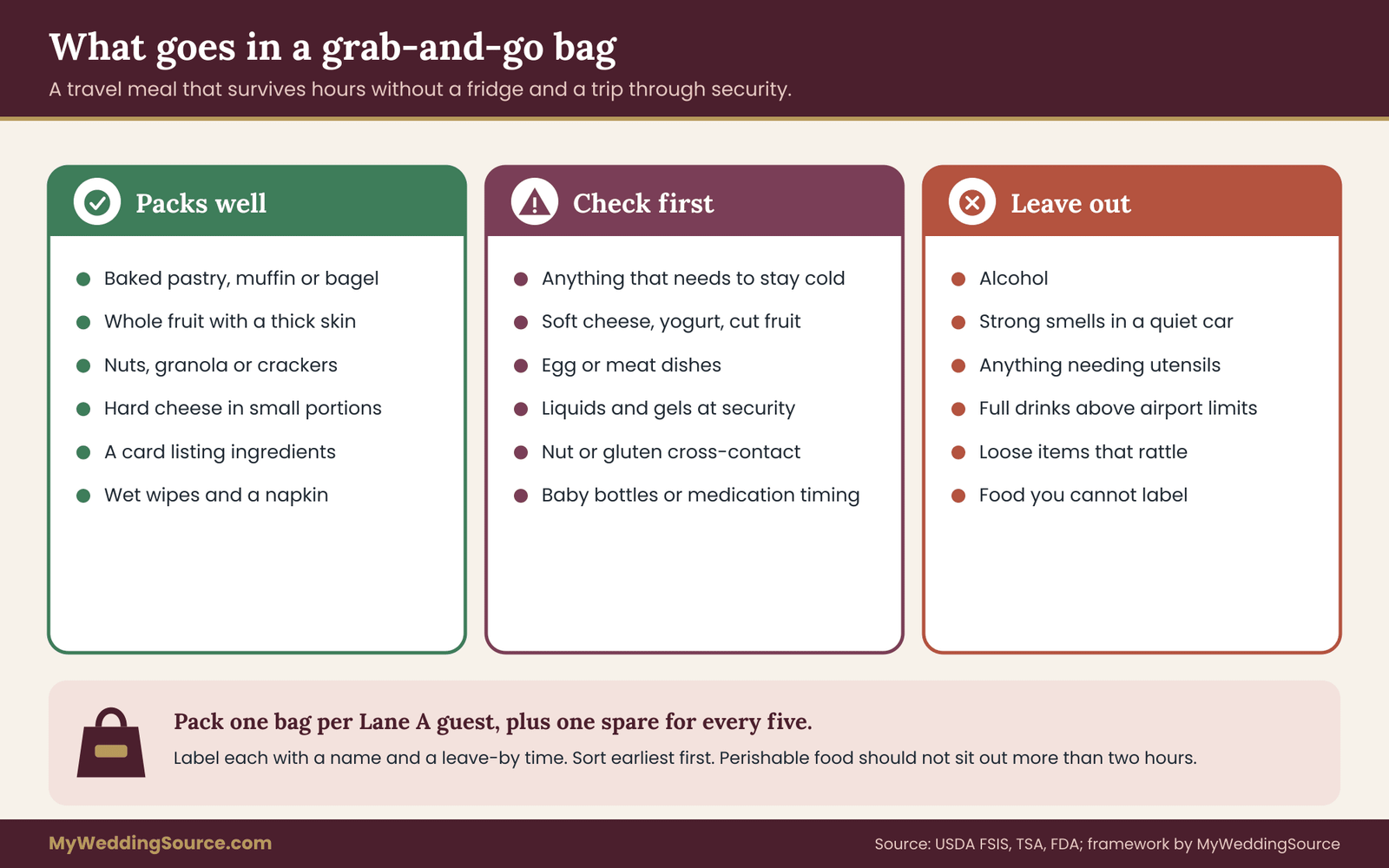
Choose food that tolerates time. Pastries, muffins, bagels, granola bars, fruit that does not bruise easily, nuts, hard cheese in small portions and packaged crackers do well. Items that need to stay cold, such as yogurt, soft cheese, cut fruit, egg dishes and anything with meat or dairy, do not. The United States Department of Agriculture advises that perishable food should not sit at room temperature for more than two hours, and for no more than one hour when the air is above ninety degrees Fahrenheit.
A bag left at a front desk overnight and picked up at four in the morning is generally fine for baked goods but not for a breakfast sandwich unless it stays properly chilled.
Respect the security line. Guests with early flights carrying the bag onto a plane will go through screening. Solid food is generally allowed, but liquids and gel-like foods are subject to size limits, and rules change. The Transportation Security Administration publishes a searchable page of what may be brought through security. Skip jams, spreads, soft cheese tubs, juice boxes and sealed drinks above the limit. A small, empty reusable bottle is a better gift than a full one, since guests can fill it after screening.
Label for allergens and say what is inside. The Food and Drug Administration explains that certain ingredients are major allergens. Pack each bag with a card listing the main ingredients, and mark nut-free or gluten-free versions clearly. If you cannot guarantee separation, say so honestly. See the section on cross-contact in the edge-cases part of this guide for sample wording.
Make it easy to carry. Use a paper bag with a fold-over top or a small box with a handle. Avoid anything that rattles loudly or smells strongly in a quiet car at five in the morning. Put the guest’s name on the outside so the right bag goes to the right person.
What belongs in the bag
A workable bag has a main item, a second item, something to drink and a small note. For example, a baked pastry or bagel, a piece of fruit with a thick skin such as an apple or orange, a bottle of water or a sealed carton of shelf-stable milk that stays within the allowed size, and a handwritten card. Add a packet of crackers or a bar for the plane. Add a pair of wet wipes. Leave out alcohol, anything with a strong smell and anything that needs utensils.
If you have the budget and the delivery arrangement, include one hot item delivered fresh: a coffee in a lidded cup handed over at the door. It is the single touch guests mention most. If you cannot guarantee someone at the door at that hour, skip it, because a coffee that sits for an hour is worse than none.
Packing quantity and spare bags
Pack one bag per guest with early flights in Lane A, and pack one spare for every five. Last-minute changes happen: a guest’s flight gets rebooked earlier, a friend who was driving decides to fly, or a spouse who was not on the list also needs one. Spares cost little and keep you out of an awkward conversation.
Give each bag two labels: the name and the leave-by time. Sort the bags for early flights in the order guests will leave, earliest first. This sounds fussy but saves a helper from digging through a stack at four in the morning while a driver waits.
Where and how to hand them over
For early flights, handing the bag over at the end of the reception is the most reliable option. It puts the bag in the guest’s hands while the goodbye is happening, and the guest carries it to the hotel. Only for guests who have already left do you need an alternative, which is usually the front desk.
If you use the desk, ask the hotel in advance whether it will hold items, where they will be kept, and whether a staff member will be on duty at the relevant hour. Put a card in each bag that says where it is, and send the guest a short text the evening before.
The wedding reception guest flow guide covers how guests move through the evening, and it helps with deciding where the handoff table can sit so it does not create a bottleneck.
Hosted options for early flights: the lobby window, the drop-in and the night-before goodbye
For early flights, bags handle food. They do not handle people. The hosted options give guests with early flights a human moment, which is usually what they would regret missing.
The night-before goodbye
The night-before goodbye is the cheapest option for early flights and the one with the highest return. The idea is to pick a time, usually after the main meal and before the dancing is at full volume, when the couple steps away for ten minutes to say goodbye to guests with early flights. You need three things: a list, a place and a prompt.
The list is your Lane A names. The place can be a quiet corner, a spot near the exit, or the couple’s table if they are seated. The prompt can come from a family member, a coordinator or a friend who walks over and says, “Do you have a minute for a few people who are leaving early?” Without the prompt, the couple will be pulled into other conversations and the moment will pass.
Keep it short. A goodbye for early flights does not need a speech. A hug, a thank-you, a mention of why this person’s trip mattered and a gentle “safe travels” does the work. If you are the person leaving, a handwritten note left on the couple’s table is a good alternative, and you can suggest that in your guest messages.
Some couples prefer to move the goodbye to the exit, standing at the door as guests leave. That is also fine, but it requires you to stay near the door, and early-leaving guests do not always leave through it at predictable times. A fixed goodbye slot is more reliable than a standing post.
The lobby coffee window
A lobby coffee window is a staffed or self-serve station in the hotel lobby or a hallway, open for a defined window before sunrise. Its job is to give guests with early flights a hot drink, a pastry and a person to say goodbye to.
Use it only if the numbers justify it. As a rough decision rule, a staffed window makes sense when you expect at least six or seven guests, or when many of your guests with early flights are older relatives who would not take a bag and walk out. Below that, bags plus a goodbye serve more people with less strain. If you decide to go ahead, treat it as a small event with its own logistics.
Set a short, fixed window. Ninety minutes is plenty. Open thirty minutes before the first guest’s leave-by time and close at the last one. A window that is open all morning needs more staff and wastes food.
Check the hotel’s rules. Many hotels do not allow outside food and drink in lobbies, or they require use of their own catering. Ask the question early, and say that it is about early flights. Some hotels will set up a coffee service for you for a fee, and some will set up a few thermoses if you sign a simple agreement. The hotel decides, not you.
Plan for a person who will stay up. The window needs an adult who is awake at four, who knows the guests by sight and who can stop the service from becoming chaotic. This is a good job for a sibling, a close friend or a wedding coordinator if the contract includes morning-after work. Do not assign it to the couple.
Keep the menu small. Hot coffee, hot water for tea, cold water, a few kinds of pastries, whole fruit and something savory. Every item adds food safety concerns and cleanup. A small menu is easier to run at that hour than a large one.
The early drop-in
The early drop-in is a half-hour slot placed before the main farewell, serving Lane B guests. Imagine a farewell brunch that opens at ten, with some early flights in the group. The drop-in opens at nine, with the first dishes ready, and the guests with early flights eat, say their goodbyes and leave by ten.
The drop-in works well when the caterer can sequence the kitchen to serve a first wave earlier. It works poorly when the kitchen is not ready until the stated start time. Ask directly. If the caterer cannot serve earlier, an alternative is to hold a small drop-in at a different location: a hotel breakfast room, a coffee shop near the hotel or a table at the venue’s café. The guide on coordinating wedding vendor timelines shows how to confirm start times with each vendor.
A drop-in has one additional risk. Guests in Lane B arrive on a tight clock, and a guest who sits through twenty minutes of waiting for food will leave hungry. Plan for food to be on the table when they arrive, not coming out of the kitchen. Put a person at the door who can greet them, point to the food and mention the time.
Serving the first plate for Lane C
Lane C guests can attend the farewell but not for the whole of it. They need to eat in the first thirty minutes and then leave without apology. Three adjustments cover this.
First, offer them an early seating or a reserved table near the food. A small sign that says “Reserved for early flights” is enough. Second, tell the kitchen or serving staff that this table is served first. In a plated service, they get the first plates; at a buffet, they go through first. Third, let the couple know where they are sitting so they can stop by early. It gives the couple a specific job in the first half hour, and they can then turn to later arrivals.
Combining options without overbuilding
It is tempting to build every option, because each one sounds reasonable. Resist. If your Lane A has four guests, a night-before goodbye and four bags is enough. Adding a coffee window on top of that spends staff time and gets very little in return. Adding a drop-in for two Lane B guests is similar. In both cases, a personal message to the guests, one or two conversations with the hotel and a note in the weekend schedule gets the same result.
A useful test is to ask what each guest would experience under your plan. If you can describe, in two sentences, the evening and morning of each person with early flights, and the description includes a goodbye and food, you have covered them.
Questions for the hotel, venue, caterer and drivers
Every option above for early flights depends on someone outside your family agreeing to do something at an unusual hour. Many hotels and vendors say yes readily if asked early and clearly, and some have limits that only surface when you ask. The vendor conversation is where plans for early flights succeed or quietly fail.
Questions for the hotel
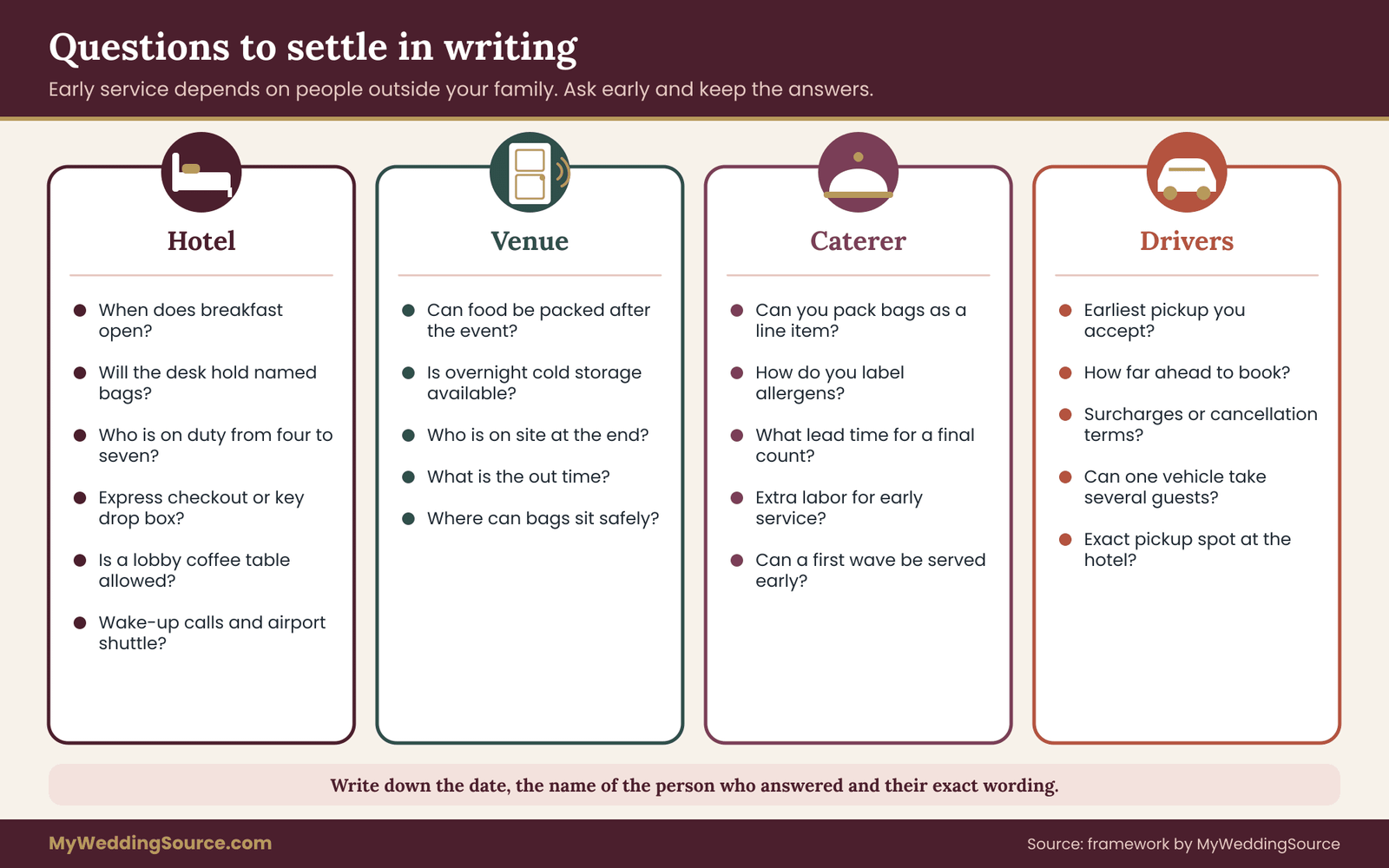
The hotel is the most important party, because most guests sleep there and leave from there. Ask these questions in writing, and keep the answers with your other documents.
- What time does breakfast service start, and is there any grab-and-go or early coffee service for guests who leave before then?
- Will the front desk hold bags or packages for named guests, and who is on duty between four and seven in the morning?
- Can guests check out without visiting the desk, for example by leaving a key card in a box or using an app?
- May we set up a self-serve coffee station in the lobby or a hallway, and is there a fee or a requirement to use hotel catering?
- Can the hotel offer wake-up calls, and can we give it a list of rooms and times?
- Is there a shuttle to the airport, and what is the first departure and the booking rule?
Hotels differ greatly here. Budget properties may have no staff overnight. Boutique hotels may have an on-call manager. Larger properties may have a business center, grab-and-go counter or a restaurant that opens early. The guide to wedding guest hotels across budgets and mobility needs is a good companion for the broader room-block conversation.
Questions for the venue
If your wedding venue and your guests’ hotel are different places, ask the venue about the hours after the event. Can the caterer pack bags from leftover or reserved food? Is there a cooler or refrigerator you may use overnight? Is there a person on site at the end of the night who can hand bags to guests? What happens to anything left behind? If the venue has a strict out time, work backward from it and decide where the bags will physically sit.
Questions for the caterer
The caterer controls the food and its safety. Ask whether they can prepare the grab-and-go bags as a line item, what they would include, how they label allergens and what lead time they need for the final count. Ask whether they will package food in a way that is safe for a four-hour wait. Ask about extra labor charges for early service or packing after the main event. Ask whether the farewell service can begin earlier than the stated time for a short early seating.
If you plan to pack the bags yourself, ask whether the caterer will provide the food in bulk, or whether you may use grocery-store items instead. Some venues and caterers restrict outside food, and others do not mind for a small scale. Ask rather than assume.
Questions for drivers and shuttles
If you arranged transportation, check the earliest pickup and the booking rules. Many car services require advance booking for early morning runs and charge surcharges. A shuttle may not run before a certain hour. Confirm the pickup location, the booking window and the cancellation terms. Send guests a short message with the number and the schedule. The guide to wedding day backup communication covers how to keep updates reaching guests when phones are silent or the group chat is a mess.
Get the answers in one place
Put each answer in one document, with the date, the person who gave it and the exact wording. If the hotel promises that someone will be at the desk at 4:30, you want to be able to show the message if no one is there. A short written confirmation also helps the hotel: it can hand the note to the night manager.
A worked example: early flights at an invented Saturday wedding
The example below is invented to show the method. The names, numbers and times are illustrative and do not describe a real wedding or a typical one. Use your own flight times and your own vendor answers.
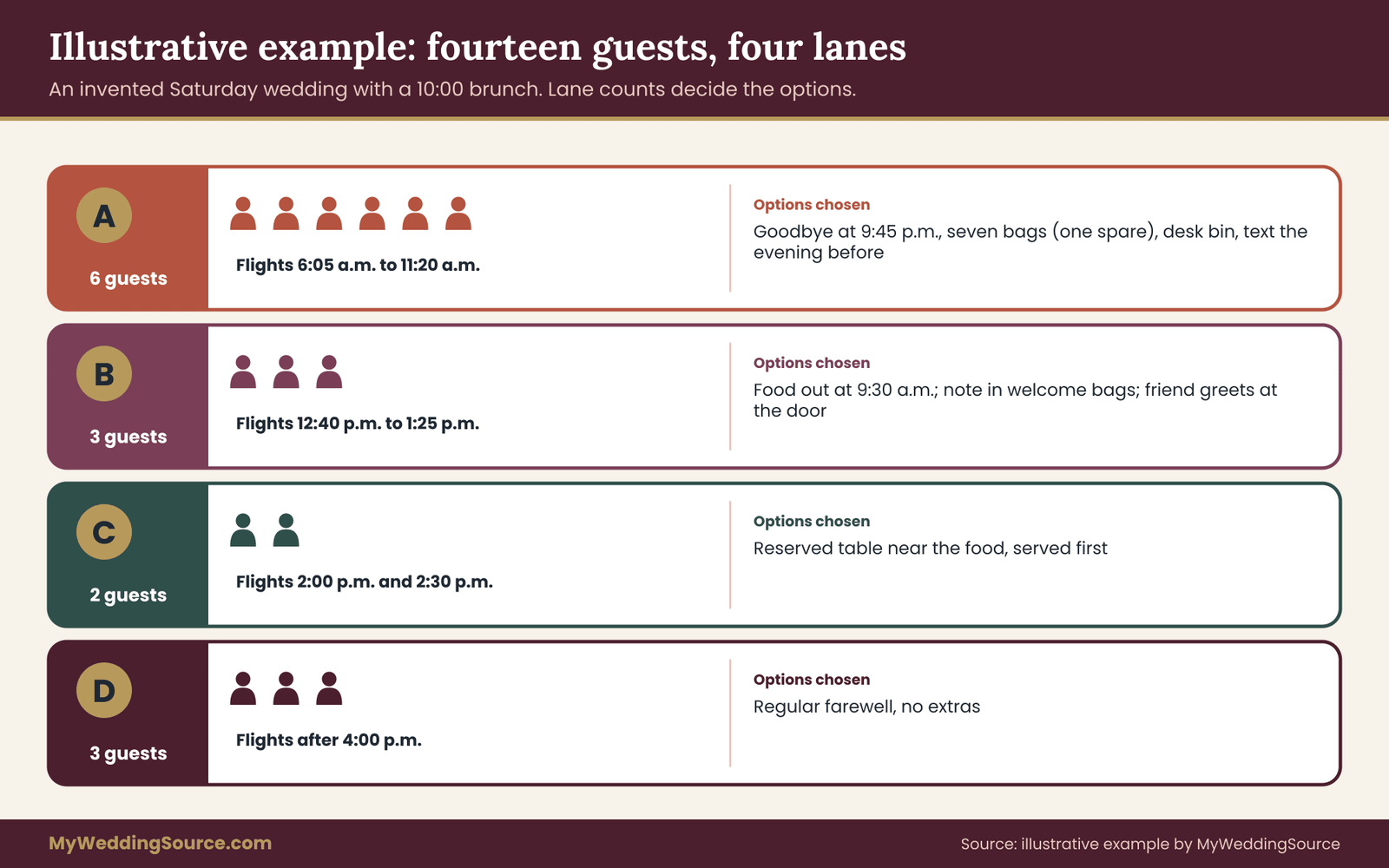
Imagine a couple hosting 120 guests at a Saturday evening wedding. The reception ends at 11:00 p.m. A farewell brunch is planned for 10:00 Sunday morning in the hotel’s event room, so S is 10:00. The airport is a thirty-five-minute drive from the hotel. The couple has collected flight times from the RSVP field and a reminder message, and fourteen guests are flying out Sunday.
At first glance, they think that about five guests have early flights. Then they run the leave-by clock on the early flights. They assume guests should reach the airport two hours before departure and allow thirty-five minutes of driving plus twenty minutes for checkout, so each leave-by time is about two hours and fifty-five minutes before the flight.
That arithmetic changes the picture. For a brunch that starts at 10:00, Lane A, with a leave-by earlier than 9:30, includes every guest whose flight leaves before about 12:25. A flight at what feels like a comfortable late morning is not comfortable at all.
Sorting the fourteen guests
Here is where the fourteen land. Six guests have flights between 6:05 a.m. and 11:20 a.m., so they are in Lane A. Three guests have flights between 12:40 p.m. and 1:25 p.m., which puts their leave-by times between 9:45 and 10:30, so they are in Lane B. Two guests have flights at 2:00 and 2:30 p.m., with leave-by times near 11:05 and 11:35, so they are in Lane C. Three guests have flights after 4:00 p.m., so they are in Lane D.
Notice what happened to the count. The couple expected a handful of early flights. The framework found nine guests with early flights or tight ones, whose Sunday morning would be shaped by a flight, six of whom could not attend the brunch at all.
The options chosen
For Lane A, the couple chooses the night-before goodbye and a grab-and-go bag. Six guests are too few to justify a staffed lobby window, so the couple skips option three. They order seven bags, one per guest plus a spare, from the caterer. The caterer proposes a pastry, a whole fruit, a shelf-stable snack and a water bottle, packed with an ingredient card.
The couple asks the hotel whether the front desk will hold the bags, and the hotel agrees to hold them in a labeled bin behind the desk and says a night auditor will be on duty until six.
Five of the six Lane A guests will leave the hotel between 3:10 and 6:15. The sixth, with the 11:20 flight, leaves around 8:25 and can use the hotel’s breakfast room, which opens at 6:30. That guest still gets a bag as a backup and a seat at the goodbye.
For Lane B, the couple asks the caterer to put the first dishes out at 9:30 for a short early start. The caterer says yes, as long as the staff count is confirmed ahead. The three Lane B guests get a note in their welcome bags that says “Doors open at 9:30 for guests with flights before 1:30; eat first, leave on time.” A friend greets them at the door.
For Lane C, the couple reserves a table near the food with a sign that reads “Early travelers” and tells the servers that table goes first. The two guests sit there and are served within ten minutes of arrival. They leave at their leave-by time, hugging the couple as they go.
For Lane D, nothing changes.
The goodbye moment for early flights
At 9:45 p.m., after the cake and before the dance floor fills, the couple’s friend Maya, in this invented example, walks over with the Lane A list. The couple steps to a corner of the room with six guests. Each hugs the couple, hands over a note or says a few words, and picks up a bag at the exit table as they leave. The whole exchange takes eight minutes. The couple is back at the dance floor by 9:55.
The example does not show a perfect system. It shows a proportionate answer to early flights. The couple spent a few conversations, one call to the caterer, one call to the hotel and an evening’s attention. The six guests with early flights eat, are thanked in person and know where their bags are. That is the target.
What the example leaves out
A few things stay uncertain, and the couple handles them honestly. They do not know how traffic will behave at four in the morning, so they tell guests to check their own routes. They do not know whether every guest will pick up a bag, so they plan for leftover bags to go to the hotel staff or a donation point after checking the hotel’s policy.
They do not know whether a flight will be delayed or cancelled. Messaging guests about a cancelled flight is a separate problem, and the plan above does not depend on it.
Wording for guests with early flights: invitations, website and day-of notes
Good planning for early flights fails if guests never hear about it. Short, specific wording does most of the work, and you do not need a long announcement. Here are the pieces to prepare, each with sample language you can adapt.
The RSVP question about early flights
Add one optional line to your RSVP form or website:
“If you are flying home on Sunday, what time does your flight leave? We would like to make sure you get a proper goodbye and something to eat.”
This does three things in two sentences: it says what you are asking, why and what the guest gets. Avoid wording that sounds like a demand, such as “You must provide your itinerary.”
The weekend schedule note
Add a short line to the schedule or the FAQ on your wedding website:
“Flying out early Sunday? Tell us your flight time. We will set aside a bag of breakfast for you and say our goodbyes Saturday night.”
If you are offering a lobby window or an early drop-in, add the time and place. Keep it in one paragraph, and do not bury it below the dress code.
The reminder about a month out
“Hi, a quick reminder about travel. If your flight home is Sunday morning, send us the time so we can plan a goodbye and a bag of food for the road. If your plans change, a quick note to us is all that is needed.”
The message the evening before
Send this the evening before, or the afternoon of the wedding, to each guest in Lane A:
“Your breakfast bag will be at the front desk after 8 p.m. We would love a hug before you go; Maya will find you after the cake. Safe travels, and thank you for coming so far.”
Replace the details with your own. The point is to give three facts: where the bag is, when the goodbye happens and who will find them. Keep the message short, since guests are busy with a wedding.
The prompt for your helper
Give the friend or family member who runs the goodbye a one-page card with the names, lanes and leave-by times. Tell them what to do in two sentences, such as: “At about 9:45, gather everyone on this list and bring them to the couple. Hand each of them their bag as they leave.” The helper does not need to understand the framework. They need to know what to say and where to walk.
Wording when you cannot offer much
If your budget, venue or hotel cannot support any of the extra options, say so kindly. A message like “We cannot host an early breakfast, but we would love to say goodbye on Saturday night and we have set aside a small bag for you” is honest and warm. Guests with early flights are used to making their own arrangements. They are grateful for being noticed.
For the full guest list and communication side, the wedding guest list guide explains how to keep contact details and notes organized in one place, which helps when you are tracking flight times alongside RSVPs.
Edge cases for early flights
The core method covers most weekends with early flights. A few situations bend it, and it is better to think them through before the week of the wedding than at four in the morning.
Red-eye and very late flights
A guest on a late-night departure, for example a flight leaving after ten at night on Sunday, has the opposite problem to early flights. Their leave-by is hours after the farewell ends, so they have a long, empty stretch with luggage and no room. This is not one of the early flights this guide is about, but it deserves a line.
Ask the hotel about late checkout or luggage storage, and consider letting those guests keep a bag at the front desk. A group of such guests sometimes ends up having an unplanned and pleasant afternoon, which you can leave to chance.
Friday and Sunday weddings
When the wedding is on Friday, the early flights are on Saturday, and the whole weekend shifts. A Sunday wedding with Monday flights collides with work schedules and often makes the problem larger, because more guests need to fly out first thing. Run the leave-by clock the same way, but expect more early flights and a higher Lane A count.
In that case it may be better to hold the farewell earlier than to add options. The same logic applies in every case: let the schedule follow the guests’ travel, not the other way around.
Remote airports and long drives
If the nearest airport is ninety minutes or more from the venue, the leave-by clock shifts dramatically. A flight at noon may produce a leave-by of 7:00 or earlier. Lane A widens, more guests have early flights, and the shuttle or car service becomes the center of the plan.
Group guests by departure time and airport, and ask whether a single larger vehicle can serve several of them. Do not assume guests can find rides at that hour. Rural car services may need booking weeks ahead, and ride-hailing may not operate at all.
Guests with mobility needs or medical needs
Guests who use wheelchairs, walkers or other equipment, or who need extra time at the airport, have a larger buffer and a longer morning. The Americans with Disabilities Act sets accessibility rules for public places, and the Department of Transportation and the Transportation Security Administration publish information about air travel with disabilities.
Ask these guests directly what support they need and when. Make sure hotel staff know which rooms need early assistance, and check that any grab-and-go items are easy to open and carry. The room side of this conversation is where a hotel’s accessible rooms and early-checkout options matter most.
Medication timing can also matter. A guest who takes medication with food needs a real meal, not a snack, so check the contents of the bag against what they can eat. Ask rather than assume.
Guests traveling with children
Children’s schedules rarely match the adults’. A family with early flights may need breakfast items that kids will accept, a cooler bag or a place to warm a bottle. Add child-friendly items to the bag: a sealed fruit pouch, a mild cracker, a plain bagel. Check that nothing in the bag is a choking risk for toddlers, since you are packing for a mixed group. And give parents a way to say goodbye without waking everyone: a text with a time, or a card slipped under the door.
Dietary restrictions and allergens
A bag handed to a guest with a food allergy is a place where a mistake is expensive. The Food and Drug Administration lists the major food allergens, and the Centers for Disease Control and Prevention explains food safety basics. Label every bag with ingredients, and keep an allergen-safe bag separate from the others.
If you cannot control cross-contact, for example because the caterer shares a kitchen, say so plainly and let the guest decide whether to take the bag. A short line is enough: “Packed in a kitchen that also handles nuts and wheat.”
For guests with religious or ethical dietary rules, ask the caterer what the contents are and offer a plain alternative, such as fruit and a sealed snack. Do not guess about what is acceptable.
Weather and darkness
Early morning in winter means ice, fog or snow, and early departures in storms can make an ordinary drive unsafe. The National Weather Service publishes forecasts and alerts. If conditions are bad, tell guests to leave more time and to check with their airline. Have a plan for the front-desk bag if guests are delayed: bags can sit longer, but only if they are food that tolerates time.
Darkness raises a smaller issue. The walkway from the hotel door to a waiting car may be poorly lit. Mention it to the hotel, and ask that someone be near the entrance when the first cars arrive.
Guests who change their minds
A guest who said they were flying at 7:00 might rebook for 10:00, or someone who planned to drive may fly. This is where spare bags and a flexible list of early flights save you. Keep the list in a place you can edit, and keep a way to reach the helper on the day. Do not ask guests to fill out a second form. A short text to a named contact is enough.
The couple’s own early flight
If the couple has its own morning flight for a honeymoon, the entire farewell plan shifts. They are in their own Lane A and cannot be the people who say goodbye. Appoint someone to host the farewell and to hand over any gifts, and write the goodbye moment into the night-before schedule. Share the couple’s departure time with guests only if you are comfortable with it; otherwise it is simpler to let the hosts handle it.
When early flights are the majority
At a destination wedding or a wedding with a very distant guest list, most guests may fly on the same morning. If more than half the guests are in Lane A, a bag per guest is a large production, and the farewell brunch is probably the wrong event. Consider replacing it with an early breakfast for everyone, a late-night snack with a goodbye table or a Saturday-night farewell. Check how such a change lands in the broader schedule, since it changes catering, transportation and staffing at once.
Cost logic and measurable checks for early flights
You do not need a spreadsheet to plan for early flights, but you do need a few numbers. Costs here are small and mostly linear, and the risks are in the details. This section gives you a way to estimate costs without inventing figures and a set of checks you can run in the final two weeks.
Where the money goes
Four categories cover nearly every cost of early flights. The first is food, whether purchased through the caterer or bought in bulk by you. Multiply the per-bag cost, which you get from a quote, by the number of Lane A guests plus a spare for every five. The second is packaging and labels: bags, boxes, cards and wipes.
These are inexpensive, but they add up when multiplied by thirty. The third is labor, which may be a caterer’s fee for early service, a hotel’s fee for a coffee station or the cost of a person who stays up. The fourth is transportation, if you are arranging shared rides.
Ask each vendor for a written quote with the items listed separately, and check which fees are per person and which are fixed. If a vendor adds a minimum labor charge for early service, compare it with the cost of shifting the whole farewell thirty minutes earlier. Sometimes the cheaper path is to change the schedule, and sometimes the cheaper path is to hand out bags.
Cost versus effect
A plain way to compare options is to count how many guests each one actually reaches and divide the cost by that number. A coffee window that serves seven guests and costs the same as seven bags may not be worth the effort, unless the guests are people you really want to see in person.
A drop-in that serves three guests who would otherwise miss the farewell entirely may be worth a modest fee. Use the lane counts as your denominator. The goal is not the lowest cost but a sensible spend for the guests you want to reach.
Measurable checks
Run the following checks on your early flights plan in the last two weeks before the wedding.
Count check. The number of guests in Lane A on your list matches the number of bags ordered, plus spares. Recount after any RSVP change.
Time check. Each guest’s leave-by time was calculated from their own flight, using their airline’s arrival guidance, a real route estimate and the hotel’s checkout process. No time came from a guess.
Handoff check. You know who will hand over each bag, where it will sit, and who is on duty at the hotel at that hour. The person has a name and a phone number, and you have confirmed both in writing.
Food safety check. Every item in the bag tolerates the expected wait without refrigeration, or you have confirmed cold storage with the hotel. Anything perishable has a time limit written on the card.
Security check. Nothing in the bag is a liquid above the airport’s limit or an item the Transportation Security Administration restricts. You have looked at the agency’s current page, not a screenshot someone sent.
Message check. Each Lane A guest has received a message in the last forty-eight hours with the bag location, the goodbye time and a contact.
Backup check. A spare person knows the plan in case the helper is delayed, sick or asleep. Share the one-page list with a second person.
What to do if a check fails
If the count is off, adjust it; extra bags are cheaper than the awkwardness of missing ones. If the time check fails because a guest never gave a flight time, put them in Lane A by default. If the handoff is unclear, move the bags to the reception exit and hand them out in person. If a food item is questionable, remove it. A smaller bag that is safe is better than a larger bag that is not.
Keep the evidence about early flights
Save the quotes, the hotel confirmation and the list. If something goes wrong with early flights, a short record helps you to resolve it, and if something goes right, it makes the plan easy to reuse for the next wedding you attend. It also keeps you from rebuilding the same spreadsheet in the middle of the night.
Your next steps
Start with the list of early flights, because everything else depends on it. This week, add the single flight-time question to your RSVP form or wedding website, and set a reminder to ask again about a month before the wedding. When the answers arrive, run the leave-by clock for each guest and sort them into lanes.
Next, set your farewell start time and write the lane counts on one page. Choose the cheapest set of options that gives every lane its default: a goodbye and a bag for Lane A, an early start or a bag for Lane B, a reserved table for Lane C and nothing extra for Lane D. Call the hotel, the venue and the caterer with the questions from this guide, and keep the answers in writing.
In the final two weeks, run the checks: count, time, handoff, food safety, security, message and backup. Send each Lane A guest a short message with the bag location and the goodbye time. Give your helper the one-page list. Then set the matter aside and enjoy the wedding. Guests with early flights do not need a grand gesture. They need to be counted, fed and thanked, and a small amount of preparation does that.
FAQ
How early should guests leave for the airport after a wedding?
It depends on the airline, the airport, the route and whether the guest has checked bags. Airlines and airports publish their own arrival guidance, and the Transportation Security Administration provides screening information. Ask each guest to apply their own airline’s recommendation, then add the drive from the hotel and a margin for checkout. That subtraction gives the leave-by time you can plan around.
Do we have to host something for guests with early flights?
No. A farewell event is a courtesy, not an obligation, and guests who book early flights usually expect to arrange their own morning. A short goodbye at the reception and a bag of food is a thoughtful, proportionate gesture. If your budget or venue cannot support more for early flights, a kind note acknowledging the early departure is enough.
What food is safe to put in a grab-and-go bag?
Choose items that tolerate several hours without refrigeration, such as baked goods, whole fruit, nuts and packaged snacks. The United States Department of Agriculture advises that perishable food should not sit out more than two hours, or one hour in hot weather. Skip egg dishes, soft cheese, cut fruit and yogurt unless the bag stays properly chilled, and label ingredients for allergens.
Can guests take a grab-and-go bag through airport security?
Solid foods are generally allowed, but liquids and gel-like foods are subject to size limits, and rules can change. The Transportation Security Administration publishes a searchable page showing what may be carried through screening. Avoid spreads, juice, soft cheese tubs and large drinks, and consider an empty reusable bottle guests can fill after security. Guests should check the agency’s current guidance before they travel.
How many guests justify a lobby coffee window?
There is no fixed number, but a staffed window usually makes sense when you expect six or seven guests or more, or when several guests with early flights are older relatives who would rather have a hot drink and a face-to-face goodbye. Below that, personal bags and a night-before goodbye serve more people with less effort. Confirm the hotel allows outside food and drink first.
What if the hotel will not hold bags or allow a coffee station?
For early flights, hand the bags to guests at the end of the reception instead, which is often the most reliable method. Ask whether the hotel will allow bags at the desk in a labeled bin, and whether it can offer its own grab-and-go breakfast. If nothing is possible, move the goodbye and the handoff to the venue exit and tell guests where to pick up their bag.
How do we ask about flight times without being intrusive?
Add one optional line to your RSVP form or website asking about early flights, meaning the departure time if the guest is flying out the morning after, and explain why you are asking. Skip flight numbers and confirmation codes. Keep the answers private, sharing them only with the person handing out bags or the hotel contact. A warm tone makes guests more willing to answer.
What if most of our guests have early flights?
If more than half the guests leave before your farewell starts, the farewell is probably in the wrong place on the schedule. Consider an earlier breakfast for everyone, a goodbye table during Saturday night or a small bag for each guest. Then decide whether the main brunch is worth keeping for the guests who stay. Discuss the change with your caterer and hotel early.
Sources
- What Can I Bring?, Transportation Security Administration
- Passenger support and travelers with disabilities, Transportation Security Administration
- The Danger Zone, food safety basics, USDA Food Safety and Inspection Service
- Food Safety, Centers for Disease Control and Prevention
- Food Allergies, U.S. Food and Drug Administration
- Aviation Consumer Protection, U.S. Department of Transportation
- Americans with Disabilities Act, U.S. Department of Justice
- Federal Aviation Administration
- Forecasts and alerts, National Weather Service
- Wedding planning advice, The Knot