
Dress pockets are one of the few wedding-dress details that change how the gown looks and how the day runs at the same time. This guide treats them as a small engineering question: where the dress pockets sit, what they can carry, how a loaded pocket shows up in photographs, and what to ask the person who makes or alters the dress.
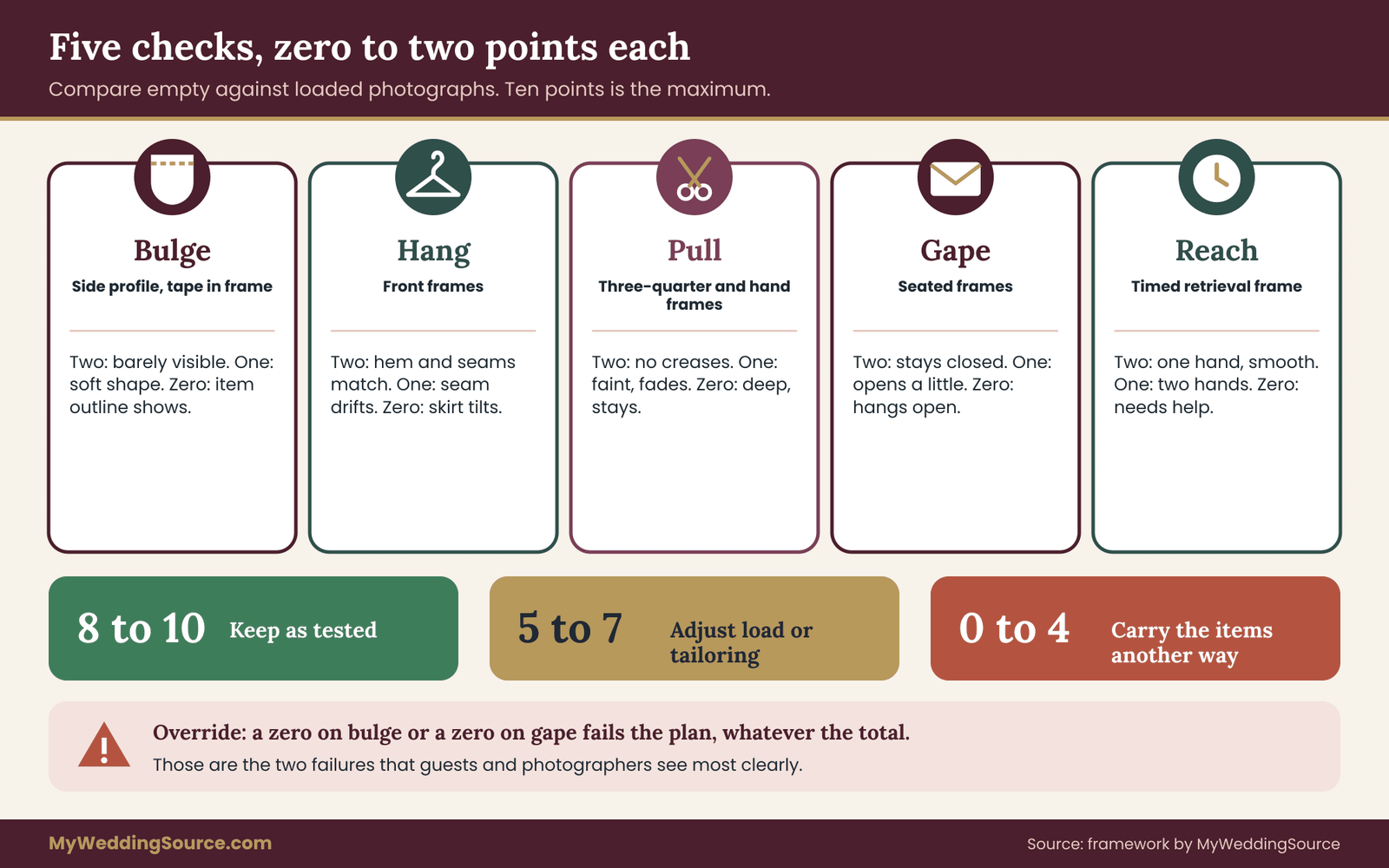
Before you commit to dress pockets, run a loaded pocket silhouette photography test. Load each pocket with the items you plan to carry, then photograph yourself in ten fixed poses front, side, three-quarter, seated, walking, hugging and with a hand in the pocket. Score five things from zero to two: bulge, hang, pull, gape and reach. A score of eight or more means keep the dress pockets as they are. Five to seven means change the load or the tailoring. Anything lower, or any zero for bulge or gape, means carry the items another way.
Dress pockets have a reputation problem in bridal fashion. Shoppers hear about them as a cheerful extra, and sellers list them as a feature, but a pocket is a hole cut into a carefully shaped skirt, and the skirt was designed without your phone, your lipstick or a folded vow card in mind. The first time most people discover what that means is in the photographs, when a small rectangle shows through the satin at the hip in every picture.
This is not an argument against dress pockets. Plenty of people want them, for good reasons: a place for tissues during the ceremony, somewhere to put a hand when the photographer says to relax, a spot for a lip balm so you do not have to find your attendant every hour. The aim here is to let you have them on purpose, with the load chosen, the position checked and the result photographed before the dress is finished.
The article moves in a fixed order. It starts with how dress pockets change a silhouette and which types exist. It then sorts what you might carry into three weight tiers, because the load decides almost everything.
After that comes the original part: the loaded pocket test, from setup through the ten poses to a scoring sheet and a decision rule. The later sections cover fabric and gown shape, questions for your designer and alterations professional, a plan for where everything lives on the day, alternatives to dress pockets, an invented worked example, and the edge cases that bend the rules.
A note on scope. This is general information, not legal, tax or financial advice. Garment construction and fit differ by designer, fabric and body, so your own fitting in the actual dress is the only real test. Where the guide touches consumer rules, such as care labels or card disputes, it points you to the agency that issues them so you can confirm the current version.
What dress pockets change about a gown’s silhouette
A silhouette is the outline a garment makes, and wedding gowns are cut to hold a specific outline. A ballgown holds a wide bell shape, a sheath follows the body closely, and an A-line widens in a straight diagonal from the waist or bust. Each of those outlines depends on the fabric hanging in one clean sweep from a seam or a waistband.
A pocket interrupts that sweep in three ways. First, it adds an opening, and an opening is a place where the fabric can pull apart or sag. Second, it adds a bag, a small second layer of cloth hanging inside the skirt, and that bag has weight even when it is empty. Third, it adds a load, which is whatever you put in the bag, and the load pulls on the opening and bends the line from the inside.
Most of the trouble comes from the third change, which is why this guide returns to it so often. An empty pocket in a full tulle skirt is almost invisible. The same pocket holding a phone can read as a flat rectangle from across the room. The garment did not change. The load did.
Why the silhouette decides how much a pocket can take
A gown with volume hides more than a gown without it. In a skirt with several layers, a pocket sits between layers and the outer layer floats over whatever you carry. In a close-fitting crepe or satin sheath, there is nowhere to hide anything. The outer fabric lies directly on the pocket bag, and even a folded tissue can show as a ridge.
That does not mean fitted gowns cannot have dress pockets. It means the pocket in a fitted gown has to be smaller, positioned in a seam where the line already breaks, and loaded with something flat and light. Later sections give a way to match load to gown shape instead of guessing.
Three things people want dress pockets for
It helps to name the job before judging the pocket. People tend to want one of three things from dress pockets.
The first is comfort and posture, a place to rest a hand that is not holding a bouquet. This job needs a deep, open pocket and almost no load. The second is emergency supplies, the tissue, lip balm, a small safety pin or a mint, which need a pocket that closes well and a load measured in grams, not ounces. The third is a phone, which is the heaviest and stiffest item most people want to carry, and the one that most often fails the test.
Write down which of the three jobs you are hiring the dress pockets to do. If the answer is the third, expect to make more compromises than the other two.
What this guide does not cover
This article is about dress pockets in the dress itself. It does not cover the broader topic of getting a dress to fit, which belongs to the site’s wedding dress fit and alterations guide. It also does not cover every accessory you might carry, since that planning sits in the guide to wedding day accessories planning. Where those topics matter, this article gives two or three sentences and then links out.
The kinds of dress pockets and where each one sits
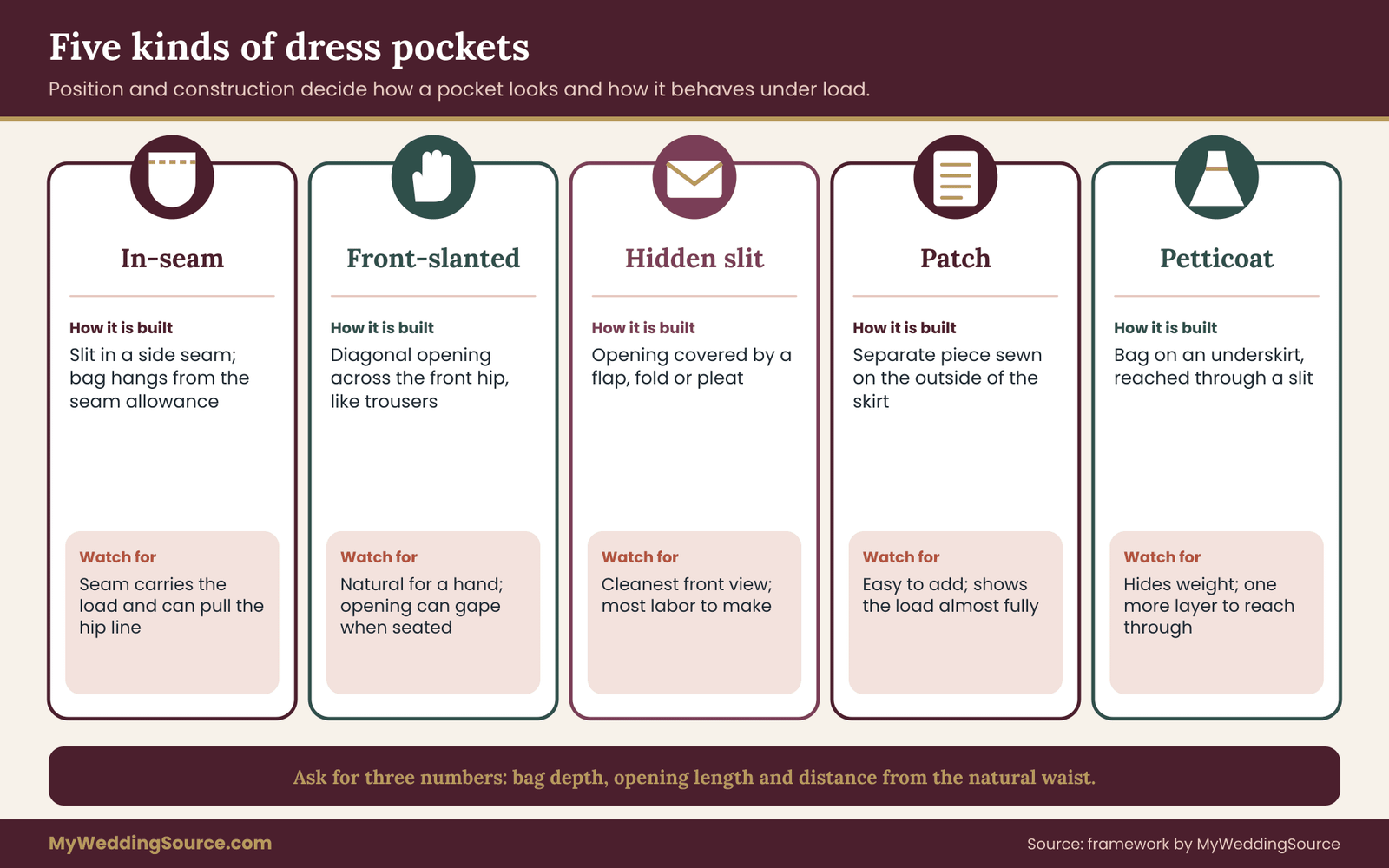
Dress pockets in bridal wear are not one thing. Position and construction change both how they look and how they behave under load, so it is worth learning the vocabulary before you walk into a fitting.
In-seam dress pockets. The pocket opening is a slit in a side seam of the skirt, and the bag hangs inside, attached to the seam allowance. This is the most common type in gowns with a natural waist or empire line, because the opening hides in a seam that already exists. The weakness is that the seam carries the load, so a heavy item pulls the seam outward and can distort the hip line.
Front-slanted dress pockets. The opening is cut on a diagonal across the front of the hip, as on trousers. Hands go in more naturally from this position, which is why people who want a relaxed pose often prefer it. The opening is more visible than an in-seam one, and the diagonal edge can gape when you sit.
Hidden slit pockets. The opening is covered by a flap, a pleat or a fold of fabric, and the bag may hang from the waistband instead of a seam. These look the cleanest from the front, and they cost the most in labor, because the cover has to match the fabric and fall correctly.
Patch pockets. A separate piece of fabric is sewn onto the outside of the skirt, which is common in casual or short dresses and jumpsuits. They are easy to see and easy to add, and they show the load almost entirely.
Petticoat or underlayer pockets. The bag sits on a separate underskirt or slip and the outer gown has a slit you can reach through. This keeps the weight off the outer fabric, though it adds a step when you need to reach the pocket.
Depth, opening length and the placement band
Three measurements describe any pocket, and they are the numbers to ask for. The first is depth, the distance from the opening to the bottom of the bag. A deeper bag lets the item sit lower and away from the waist, which usually hides it better, but a very deep bag lets small items slide out of reach. The second is opening length, which decides how easily a hand fits and how readily the pocket gapes. The third is the placement band, the distance from the natural waist to the top of the opening.
Natural waist is the narrowest part of the torso, and measuring from it keeps the number meaningful across gowns with different waistlines. If you are at a fitting, ask the fitter to measure these three numbers and write them down. If you are buying online, ask the seller, and if the seller cannot say, treat that as an answer about how much they know about the garment.
Which type suits which job
For rest-your-hand dress pockets, front-slanted or generous in-seam pockets work well. For emergency supplies, a small hidden slit pocket with a flap closes best and gives the cleanest line. For a phone, in-seam or petticoat pockets give the bag the most support. A patch pocket is rarely a good choice for anything heavy unless the dress was designed around it.
None of this is a rule that the type determines the result. The test later in this guide is what tells you whether a particular pocket in a particular gown works. The types give you a short list of options to try.
What dress pockets can hold: a load ladder
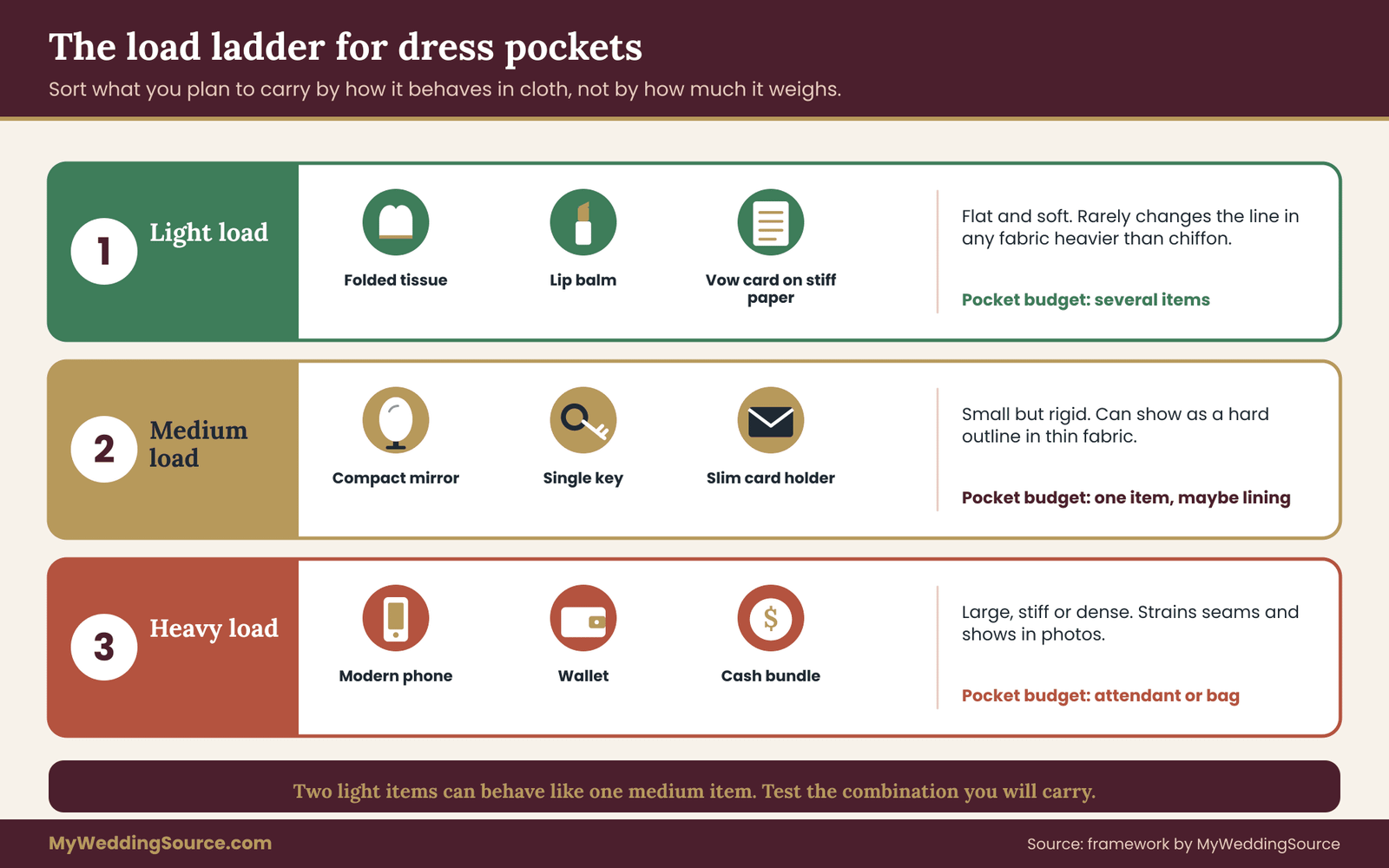
Load is the single most important variable, so it deserves its own system. This article uses a three-step load ladder. It does not rest on any measured statistics. It is a way of sorting items by how they behave in cloth, and you can sort your own items in a few minutes.
Light load. Items that are flat, soft and weigh almost nothing. A folded tissue, a lip balm, a small stack of blotting papers, a few safety pins in a flat packet, a folded vow card on stiff paper. These rarely distort a silhouette in any fabric heavier than chiffon.
Medium load. Items that are small but rigid or slightly heavy. A compact mirror, a single key, a small tin of mints, a pair of earrings in a pouch, a slim card holder. These can show as a hard outline in thin fabric and may need a deeper bag, a lining layer or a stay.
Heavy load. Items that are large, stiff or dense. A modern phone, a wallet, a full-size lipstick plus a compact together, a hearing-aid case, a bundle of cash. These strain seams, tug the skirt downward and show in photographs unless the dress was constructed for them.
How to sort your own items
Take everything you hope to carry and put it on a table. Weigh nothing, since feel is enough for sorting. Pick up each item and press it flat against your palm. If it bends or flattens, it is light. If it holds a shape and you can feel an edge, it is medium. If you can feel its outline through your fingers when you hold it in a closed hand, it is heavy.
Then add the items you plan to put in the same pocket and test the combination. Two light items together can behave like one medium item, and a medium plus a light often reads as heavy because the corners press into each other.
Pocket capacity is a budget, not a space
A pocket can physically hold more than it can carry well. A bag that fits a phone and three other things still pulls the seam out of line and drags the skirt forward.
Think of each pocket as a budget of load rather than a volume. A good starting budget for a pocket in a fitted gown is one medium item or a few light ones. A good budget for a full skirt with layers is one heavy item or a medium plus lights. The test will adjust those numbers for your dress, and your photographs will do the correcting.
Left and right are not the same
Most people are handed two dress pockets and use them equally in theory. In practice one hand is dominant, the dominant side gets reached into more often, and the phone usually lands there. That side will wear, gape and distort sooner. Plan for it by loading the non-dominant side with the heavier or less-needed item and keeping the dominant side for light things you grab often.
It also helps to think about which side faces the camera. Many couples stand with one side toward the officiant and the other toward the guests. The side that most often faces the camera should carry the lighter load.
Where the load leaves the dress
The load ladder is also a plan for what ends up elsewhere. Heavy items rarely belong in dress pockets on the day, and the test will usually confirm it. What belongs there are the light items you want within reach during the ceremony and portraits, the ones that save a trip to an attendant. The storage section later in this guide builds a plan for the rest.
The loaded pocket silhouette photography test: setup
The test has one purpose: to show you, in photographs and measurements, what your dress pockets do when they carry the things you plan to bring. It works on a finished gown, a sample you are trying in a shop, or a dress in the middle of alterations. It will not give you a score that applies to anyone else’s dress, because garment construction and fit differ by designer, and that is exactly why it is run on your own garment.
Think of the test as a small experiment with three controlled variables and one measured result. The variables are the load, the pose and the camera angle. The result is how much the silhouette changes between an unloaded and a loaded dress.
What you need
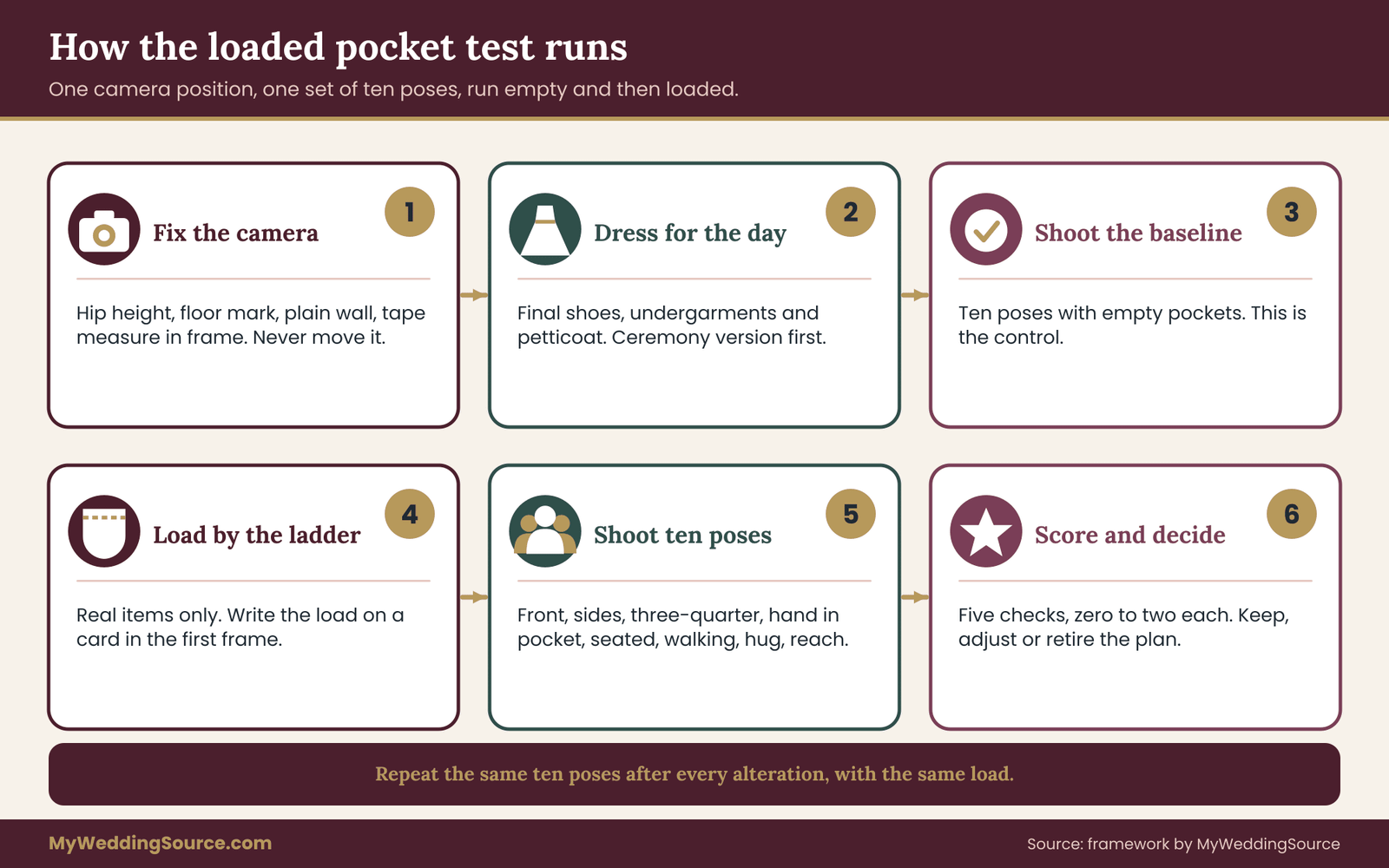
You need the dress in its final form, meaning the undergarments, shoes and petticoat you will wear. A pocket tested over a slip you will not wear tells you nothing. You need a phone or camera on a tripod or a steady shelf, set at about hip height so the photos do not exaggerate the skirt. You need a plain wall, ideally pale and without a pattern, and a tape measure that can sit visibly in frame for scale.
You need the exact items you plan to carry, not stand-ins. A different phone, a lighter lipstick or a smaller mirror produces a result you cannot trust. Finally, you need one helper to press the shutter, move items between dress pockets and call out the poses. A mirror selfie introduces its own distortions and tilts the phone toward the hips.
Set the camera once and leave it
Pick a distance that shows your whole body with a little space around it, mark the floor with tape, and stand on the same mark for every frame. Keep the zoom, height and angle fixed. If the camera moves between photos, you will not be able to compare outlines, and differences you think you see will be differences in framing.
Use even light with no flash. Light from a window to one side is fine as long as it stays constant. Strong overhead light makes shadows fall under every bulge, which exaggerates results. Soft, even light will behave more like a photographer’s work at a ceremony or a reception.
Take the baseline first
Before any loading, photograph the dress with empty dress pockets in all ten poses described in the next section. This baseline is the control. It records how the skirt hangs, where the pocket openings fall and how the fabric moves when you sit and walk. Without it you cannot tell whether a wrinkle comes from the load or from the dress.
Load by the ladder and label it
Write on a card what each pocket holds. Something like “left: tissue and lip balm; right: phone.” Keep the card in frame in the first photo of each pose set, so the files tell their own story months later. If you run several load plans, label them A, B and C in that card and the filenames.
Match the conditions of the day
The test is only as good as its resemblance to the real event. Wear the shoes you will wear, because heel height tilts the pelvis and changes the hip line. Wear the undergarments, because shapewear and structure change what sits under the pocket. If you are having a bustle or a train detached for the reception, run the test in the ceremony version first, then again in the reception version.
If the real day is hot, remember that fabrics relax with heat and humidity, and dress pockets sag a little more. You cannot reproduce the weather, but you can note it and treat borderline scores as likely to get worse, not better.
Running the test: ten frames
Ten frames are enough to catch most problems without turning the session into an afternoon. Each frame stands in for a moment on the wedding day, and each is chosen because it stresses dress pockets in a different way. Run them in order, once empty and once loaded, so you finish with twenty photographs per load plan.
Frame one: front, arms down. Stand straight, feet together, arms relaxed. This is the portrait baseline and shows whether either pocket creates a visible rectangle or a lopsided hip.
Frame two: side profile, left. Turn ninety degrees. A side view is the most honest view of bulge, since depth shows as a horizontal distance from the skirt line. Hold the tape measure near your hip, in frame.
Frame three: side profile, right. Repeat on the other side. Differences between left and right usually come from uneven loading or a seam that sits slightly differently.
Frame four: three-quarter turn. Turn halfway, as in many posed portraits. This is where the front edge of a pocket opening tends to catch the light and reveal itself.
Frame five: hand in pocket. Rest one hand in a pocket, thumb out, as a photographer might ask. Notice whether the skirt drags, whether the pocket pulls open and whether the arm looks natural.
Frame six: seated, front. Sit on a chair with your knees together and your hands in your lap. Sitting is where openings gape, the bag shifts toward the thigh and the load can press into your leg.
Frame seven: seated, side. Check the same posture from the side. A loaded phone can create a hard ridge across the thigh in this frame.
Frame eight: walking mid-stride. Take three steps, ask your helper to shoot as you move, and keep the best frame. Movement swings the load, and a heavy pocket knocks against the thigh.
Frame nine: the hug. Hug your helper or a bridesmaid. A hug presses the bodice, the arms and the hips together, and the load can dig into both of you.
Frame ten: reach. Retrieve the item from the pocket in the way you would on the day, and have your helper time it with a phone stopwatch. The timing matters for the fifth check, which the scoring section explains.
Two extra frames for particular gowns
If your gown has a long train, add a frame turning around to walk away, since the weight of a train combines with the weight of a pocket. If your gown has a ballgown skirt, add a frame where you lift the skirt slightly with one hand, as you would when climbing a step. Dress pockets in voluminous skirts can look fine standing and awkward in motion.
What to record besides photographs
Keep a short log with each frame. Note whether you felt the load, whether the pocket moved, whether the item changed position and whether anything snagged. Photographs show the outline, but you also want the feel, because a pocket that hurts after an hour of standing is a pocket you will stop using. Time the pose set as well. If the whole sequence leaves you tired or irritated, the dress may be fine and the plan too complicated.
Why ten fixed frames beat a casual try-on
A casual try-on in a mirror invites you to correct your posture without noticing. You stand a little taller, turn a little toward the best angle and forget the poses that look worse. A fixed set of frames removes that bias. It also leaves a record you can show an alterations professional, which is far more useful than saying “it looks funny when I sit.”
Reading the photos: five checks and a decision rule
With the photographs taken, you now score them. The scoring uses five checks, each worth zero, one or two points, for a maximum of ten. Zero means a problem you would notice in a photograph or while wearing the dress. One means a small flaw that a careful viewer might see. Two means the check passes cleanly.
Check one: bulge. Compare the side-profile frames, empty against loaded. Using the tape measure in frame, estimate how far the loaded pocket pushes out beyond the skirt line. Two points if you can barely see a difference. One point if you can see a soft shape but no clear edges. Zero if an outline of the item shows through the cloth or the hip clearly sticks out.
Check two: hang. Compare the front frames. Does the skirt fall in the same line loaded as empty, or does one side drag, twist or shorten? Two points if the hem and side seams look the same. One point if a seam has drifted slightly. Zero if the skirt visibly tilts or the hem sits unevenly.
Check three: pull. Look at the three-quarter and hand-in-pocket frames for wrinkle lines. Pull appears as short diagonal creases radiating from the opening. Two points for none, one for faint creases that disappear when you stand still, zero for deep creases that stay.
Check four: gape. Look at the seated frames. Does the pocket opening stay closed, or does it fall open and reveal the bag or the item? Two points if it stays closed. One point if it opens slightly in one pose. Zero if it hangs open when you sit.
Check five: reach. Use the timing from frame ten. Two points if you can retrieve the item smoothly with one hand and without help. One point if it takes two hands or a moment of searching. Zero if you need help or have to lift the skirt visibly.
The decision rule
Add the five scores. Eight to ten means keep the dress pockets and the load as tested. Five to seven means adjust, which usually means moving the heaviest item elsewhere, adding a stay or lining to the pocket bag, or shifting the opening. Zero to four means retire the plan for that load, and carry the items another way.
There is one override. A zero on bulge or a zero on gape fails the plan whatever the total, because those two are the failures guests and photographers see most clearly. A dress with a perfect score on three checks and a zero on gape still has an open pocket in the ceremony photographs.
Treat the score as a conversation starter
The score is not a verdict on the dress or on you. It is a way of telling your designer or alterations professional what you saw, in specific terms. “The right pocket gapes in the seated frames, and the phone bulges in the side profile” gives them something they can fix. A shared set of photos, labeled by frame and load plan, lets them see the same thing you see, and they can often say within a minute which changes will help.
Repeat the test after changes
Any alteration changes the answer. After a seam is reinforced, a bag is deepened or a stay is added, run the full ten frames again with the same load. It takes less time the second time because the camera marks, the card and the poses are the same, and it shows whether the change worked or merely moved the problem.
How dress pockets behave in different fabrics and gown shapes
The test tells you what happens in your dress. This section explains why, so you can predict problems before you buy or commission anything. Fabric stiffness, layering and cut interact with a pocket in predictable ways, and a few rules cover most of them.
Fabric: stiffness and weight
A stiff, structured fabric such as mikado, a heavy satin or a thick crepe holds its shape around a load. The fabric will not wrinkle sharply, but it will not hide edges either. A rigid item shows as a corner pushed against a rigid surface, and the outline reads clearly in photographs. The fabric also resists the pocket opening, so gape is less common.
A soft, drapey fabric such as chiffon, georgette or a fluid crepe behaves the opposite way. It drapes into any shape beneath it, so a load makes the cloth cling and wrinkle, and the opening sags easily. These fabrics often need a lined pocket bag in a lighter, matching material so the item does not pull the outer cloth.
Lace sits somewhere between the two, and the underlying layer matters more than the lace itself. Lace over a nude lining can hide a small load well, as the pattern breaks up the outline. Plain, smooth lace over a thin layer shows everything. Tulle and organza float, which makes them the most forgiving of dress pockets, particularly when the pocket sits in an underlayer.
Layering: where the pocket lives
A skirt with several layers gives you choices. A pocket cut into the top layer shows the load. A pocket cut into a middle layer lets the top layer float over the load and hides most of the outline. A pocket in the petticoat or underskirt hides the load almost completely, but it adds a step when you need to reach it, since you reach through a slit in the outer layer and into the inner one.
If a gown has a single layer and a close cut, there is no hiding place and the only variables are load and position. Single-layer gowns tend to pass the test with light loads and fail with heavy ones.
Silhouette by silhouette
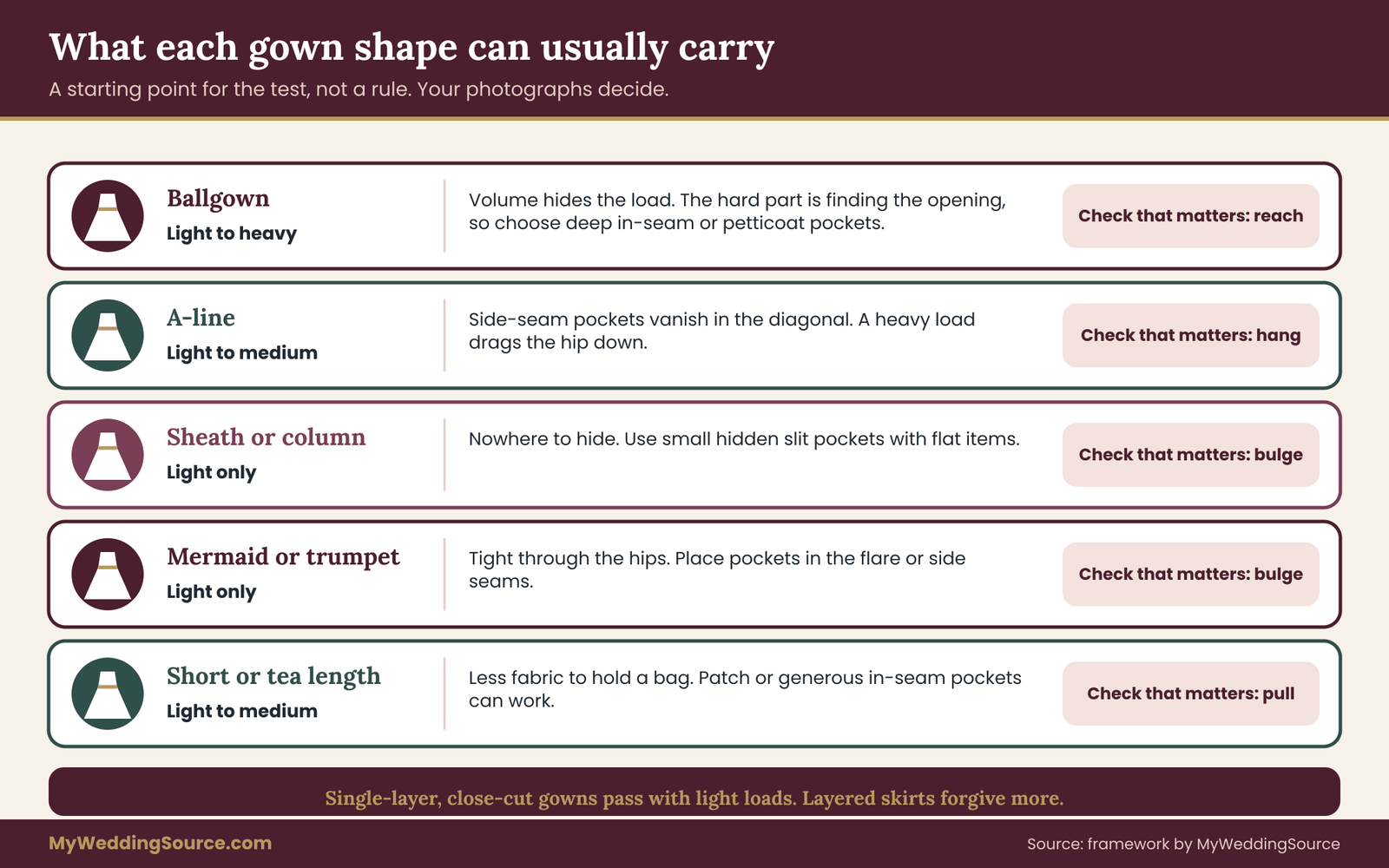
Ballgown. Volume hides loads. The challenge in a ballgown is reach, since the opening sits somewhere under yards of fabric and finding it takes effort. Long, deep in-seam pockets or petticoat pockets work best, and they let a hand slip in with the skirt barely moving.
A-line. The straight diagonal of an A-line shows any change from the waist down. In-seam dress pockets near the side seams usually disappear in the line. The risk is the hip, where the A-line starts to widen, and a heavy load can drag it downward.
Sheath and column. Close-fitting gowns are the hardest. Any bulk shows, and dress pockets can break the vertical line. Hidden slit pockets with a light, flat load are the realistic option. A phone almost never passes the test in a sheath.
Mermaid and trumpet. The fit is close through the hips and flares below the knee. Dress pockets, if present, tend to be placed in the flare or in the side seams above it. The tight section leaves no space for a load, so anything carried has to be light.
Short dresses and tea-length. A shorter skirt has less fabric to hold a pocket bag, and a loaded pocket shows more of the leg’s movement. These are often the best candidates for patch pockets or generous in-seam pockets, as long as the load stays small.
Jumpsuits and pantsuits. Trousers carry dress pockets naturally, because the pattern was built for them. Pocket depth and the cut of the hip decide the result, and the load budget is closer to everyday clothes than to gowns.
Empire and dropped waists
A gown with an empire line sits high and the skirt falls straight from under the bust. Dress pockets in that skirt hang well away from the waist, which gives them room and rarely stresses the seams. A dropped waist, where the waist seam sits at the hip, puts the seam right where the pocket opening wants to go, and the placement band measurement matters a great deal. Ask the fitter to confirm that the opening does not sit directly on the waist seam.
Questions for the designer and the alterations professional
Questions before the work begins save more money and stress than fixes after. They are also the sort of thing a good seamstress or designer expects. If you are buying a gown with dress pockets already in it, you ask the designer. If you are adding dress pockets to a gown, you ask an alterations professional. A bridal stylist can help you frame the questions, though the answers come from whoever sews.
Questions about construction
What holds the pocket bag? The answer should be a seam allowance, a waistband, a stay tape or a separate underlayer. A bag hanging from a single line of stitches in a light fabric is likely to pull.
What is the bag made of? A bag in the same fabric as the skirt adds weight. A bag in a light lining adds less. A bag in a stiff fabric can hold its own shape and show it.
How deep is it, and how long is the opening? Ask for the numbers in inches, and write them next to the test results. If you want your phone in the pocket, hold it against the proposed opening and check that your hand fits in around it.
Is there a stay or a stabilizer at the opening? A narrow strip of tape or lining along the edge keeps the opening from stretching. It is a small addition and a cheap one, and it prevents most gape.
Does the pocket affect the line of the seam? A pocket in a side seam can pull the seam forward. Ask whether the seam was reinforced or re-cut to account for it.
Questions about adding or moving dress pockets
Can dress pockets be added to this exact gown? Some gowns have fully lined skirts with internal structure, and cutting into them is risky or impractical. Others have simple seams that take a pocket easily. A professional can tell you within minutes of seeing the gown.
Where will the opening go, and why there? A good answer talks about the seam lines, the layers and the placement band. A vague answer is a warning sign.
Will the pocket work with the bustle? Bustle points pull the skirt up and back. A pocket near a bustle point can end up in the wrong place after the bustle is pinned or buttoned. Ask for a mock-up with the bustle fastened.
What will it cost, and how long will it take? Ask for the price in writing before work begins, and ask whether adding dress pockets changes the date of the final fitting. The site’s wedding dress fit and alterations guide explains how fittings are usually sequenced, so you can place this work in the right slot.
Questions about the finished result
Can we try it loaded? Ask to bring your actual items to the next fitting. A professional who understands the problem will welcome a loaded test. One who waves it off has told you something about the process.
What happens if it fails? Ask what the options are if the test shows a zero on bulge or gape. A good seamstress will say something like: shift the pocket, deepen it, line it, shrink it, or close it up. A closed pocket on a dress with an unusual cut may need its own repair.
Will you reinforce a pocket that carries more than a tissue? Reinforcement costs a little in labor and prevents tearing. If the answer depends on how heavy the load is, give an honest answer about what you plan to carry.
Questions for the photographer
Photographers see more silhouettes than anyone else, and a short conversation can save a bad frame. The site’s guide to the wedding family photo list covers how group shots are planned, and the same planning applies to pocket decisions.
Ask whether any poses depend on hands in dress pockets, such as casual walking shots. Ask whether they prefer you to keep the dress pockets empty for formal group portraits. Ask whether they will notice and fix a bulge during the shoot, and how they signal that to you. A short list, three or four lines long, is enough for most photographers.
Get promises in writing
Whatever the answers are, write them into your order, your invoice or your email. If a designer promises dress pockets of a certain depth, put the depth in the contract line. If an alterations professional agrees to add reinforcement, list it. Verbal promises disappear, and the site’s guide to wedding vendor contracts explains what to include.
When a seller cannot answer
If you are buying online and the seller cannot give you pocket depth, opening length or bag material, treat that as a gap in the listing. The Federal Trade Commission publishes guidance on clothing labels and care instructions, and a listing that says “dress pockets” with no further description is not breaking any rule, but it has not told you what you are buying.
Ask for measurements in writing. If the seller will not provide them, plan on running the test as soon as the dress arrives and know your return options before you pay.
Storage on the day: what lives where
Even a dress that passes the test cleanly cannot carry everything. The practical question on the day is not “what fits?” but “where does each item live at each hour?” A small plan, written down, prevents the classic scene of a bride searching for a phone while twenty people wait.
This section builds that plan from the load ladder. It also treats the dress pockets as one storage location among several, with strengths and weaknesses, instead of the default home for everything.
Four places to keep things
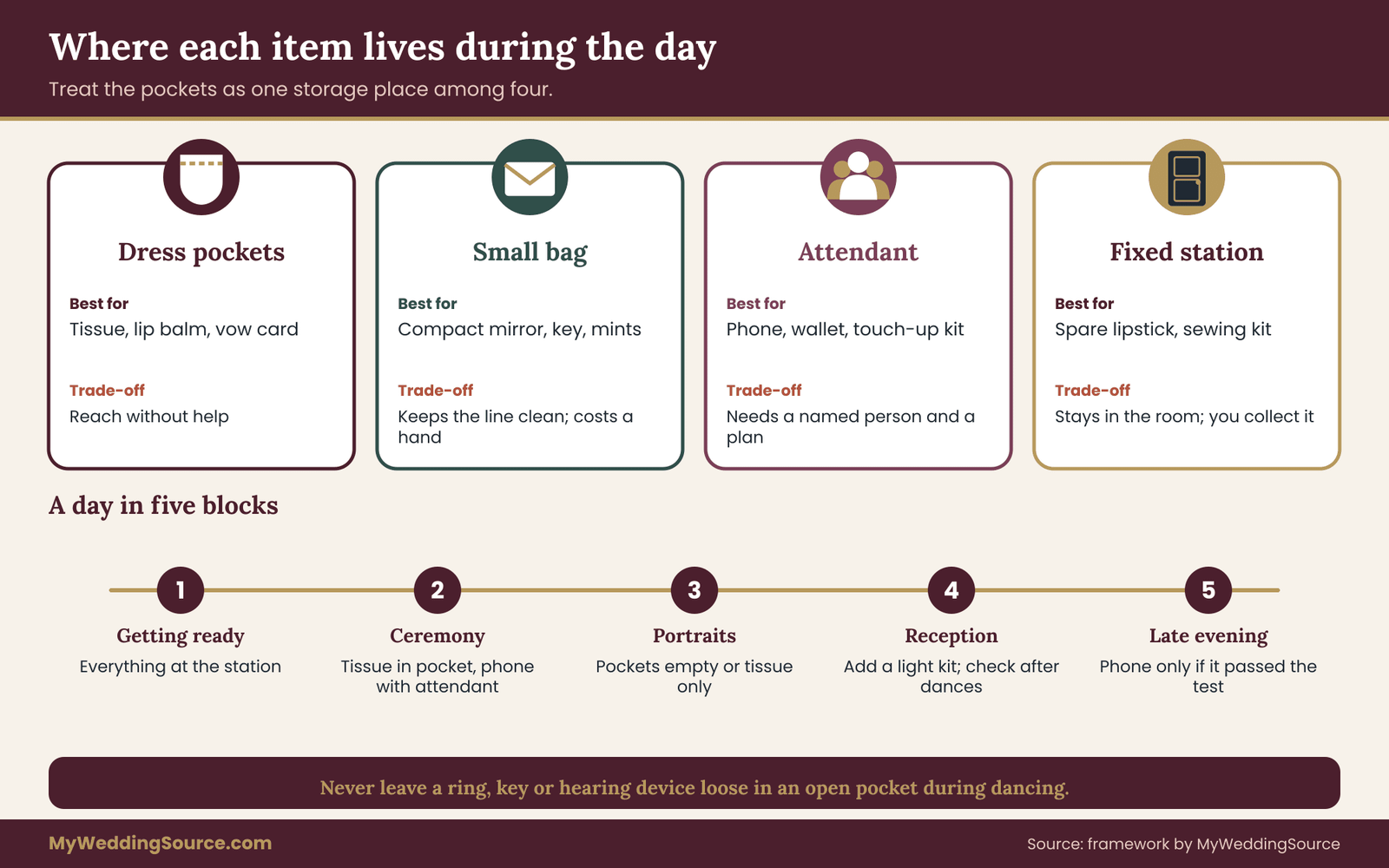
The dress pockets. Best for light items you want within reach without help: a tissue, a lip balm, a folded vow card. Worst for anything that must stay secure or dry.
A small bag carried by you. A wristlet or a small clutch holds medium items and keeps them off the dress. The cost is a free hand, and it appears in photographs unless someone takes it before each frame.
An attendant or a family member. One trusted person carries the larger kit: phone, wallet, extra tissues, a touch-up kit, mints, a spare pair of earrings. The cost is that you must find them, so you want to know where they will be at each stage of the day.
A fixed station. A bag or box in the getting-ready room, the ceremony space and the reception, where things are stored and you can collect them. This works best for items you rarely need but would hate to lose, such as a spare lipstick or a sewing kit.
A simple timeline for the day
The easiest way to plan is to walk through the day in blocks, as the timeline of a ceremony and reception usually runs, and decide for each block what is in the dress pockets.
Getting ready. Everything lives at the station. Nothing is in the dress pockets, because the dress is not on yet or because you are still taking photographs of details. Put the dress on and test one last time with the real load, in front of a mirror.
Ceremony. Dress pockets carry tissue and perhaps a folded vow card. The phone goes to the attendant, who stays within a few steps of you. Confirm in advance who is holding the phone and what you will do if someone calls.
Portraits. The dress pockets are empty or hold only the tissue. The photographer will often ask for a hand in a pocket, and that works best when the pocket is almost empty. Bring the lip balm back out for touch-ups and give it back to the attendant.
Reception. After the formal photographs, the load can grow a little. A light touch-up kit, a few mints, perhaps the phone for a toast. Check the dress pockets again after each large movement, such as a dance, since items shift and can fall out.
Late evening. Dress pockets can carry a phone if the dress passed that test, and the guests are no longer taking formal photographs. If it did not pass, the phone stays with the attendant.
Security and loss
An item in a dress pocket is out of sight, which feels secure, though it can fall out. Anything small and valuable, such as a ring, a key, a hearing device or a card, should not live in an open pocket during dancing, sitting, hugging or using a restroom. A pocket with a flap, button or zip is better than an open one. Even then, check it after any big movement.
If you are carrying the rings or a family heirloom, the best plan is to give them to a named person with a specific handoff moment, instead of relying on a pocket.
Restrooms and quick changes
Restrooms are where dress pockets surprise people. When you lift a skirt, whatever is in the pocket can slide, tip out or press into your leg. Before the ceremony, plan who will help you in the restroom, and decide whether the dress pockets are emptied beforehand. Putting a phone in a pocket and then lifting a skirt over a toilet is a mistake people only make once.
If you plan an outfit change, the handoff matters. The site’s guide to wedding day accessories planning walks through how to hand items between outfits so nothing ends up in a discarded gown.
Weather and venue factors
Wind, rain and outdoor seating change the picture. In wind, a skirt lifts and dress pockets can flip open, so a flap or a closure is worth the effort. In rain, the dress pockets can wet whatever is inside, and a phone in a damp bag is a risk. At an outdoor venue with grass or gravel, the hem gets heavy and the dress sits differently, so run the test in the shoes you will actually wear on that surface if you can.
Check venue rules too. Some venues restrict phones during the ceremony, and some couples choose unplugged ceremonies. If that applies, the phone’s place is simply not your concern during that block. The site’s guide to wedding photography consent discusses how couples set expectations about phones and cameras, and the same approach helps here.
After the wedding: dress pockets and preservation
When the day is over, empty the dress pockets before the dress goes anywhere. Tissues, lipstick smears and food crumbs leave stains and attract pests. Ask a gown cleaner whether they inspect and clean pocket bags separately, because bags can hold perspiration, makeup and dust. The Federal Trade Commission’s Care Labeling Rule requires most garments to carry care instructions, so check the label on your dress and follow it, and ask the cleaner to note any pocket-specific concerns in writing.
Museum conservators, such as the National Park Service’s museum program, publish general advice on textile storage that applies to a gown kept for years: acid-free materials, no plastic, and a cool dry place.
Alternatives to dress pockets, compared
Sometimes the test says no, and sometimes the dress has no practical place for dress pockets at all. That does not mean carrying nothing. It means choosing a different approach to the same three jobs: comfort, emergency supplies and a phone. Each alternative below trades one cost for another, and none is the best answer for every wedding.
The carry options
A wristlet or small clutch. It holds medium items and keeps the silhouette clean. The cost is a hand and a visible object in photographs. A wristlet loops around the wrist and leaves the fingers free, which makes it more practical than a clutch for hugging and dancing. The site’s guide to wedding day accessories planning covers bag styles in detail.
An attendant’s bag. One person carries a larger kit and stays near you. The cost is dependence on that person, and the need for a handoff plan. This is the most reliable option for heavy items and the one that keeps your hands free.
A garter or thigh pouch. A flat elastic band with a small pouch sits under the skirt. It carries light and medium items and hides them completely, but it is awkward to reach, and not every wearer finds it comfortable over a long day.
A pouch sewn into the bodice or lining. A flat pocket sewn into the lining near the ribs can carry a tissue or a folded card. It is invisible from outside and cannot be reached without help.
A hidden pocket in the petticoat. A separate underlayer pocket, discussed earlier, gives the most room and the least visibility, at the price of some reaching effort.
A pocket in a jacket, wrap or cape. If you wear an outer layer for part of the day, its dress pockets may be easier to adjust than the dress. The cost is that the layer comes off.
Choosing by job, not by item
If the job is comfort, a hand pocket is hard to replace. The alternatives, a bouquet, a clutch or clasped hands, do not give the same relaxed pose. If the job is emergency supplies, a small pouch carried by an attendant works as well as any pocket, as long as the attendant is nearby. If the job is the phone, an attendant or a small bag is the most dependable answer in nearly every gown.
Comparing on four questions
When you weigh an alternative, ask four questions. Does it keep the silhouette clean? Can I reach it without help? Can it be lost or knocked off? Will it appear in photographs? Write the answers for each option in a short list and pick the one that fails least.
Do not rule out a mix
Many people use more than one. Light items in the dress pockets, medium items in a small bag during the reception, and the phone with an attendant throughout. A mix spreads the load so that no single place has to carry too much, and it gives you a fallback if one fails.
What each option costs in money and time
Add up the real costs. Dress pockets added to a gown cost labor, and a reinforced or lined pocket costs more than a simple one. A wristlet costs the price of the bag. An attendant costs nothing but a little planning and a thank-you. A garter pouch is usually inexpensive.
The site’s wedding budget guide can help you place a small cost like this next to larger line items, so that a pocket alteration does not slip through the cracks. Ask for prices in writing and compare like with like, since a quote that includes lining and reinforcement is not the same as one that does not.
When to stop optimizing
A pocket plan can absorb endless attention. Set a stopping rule: if the test passes at eight or more, stop. If you have run the test twice and are still at six, choose the alternative and put your energy into something else. The goal is a day where you are not thinking about your hip.
A worked example with invented numbers
The following case is invented to show the method end to end. The person, the dress and every measurement are made up for illustration, and none of it is evidence about real garments. Your numbers will differ, which is the whole point of running the test on your own dress.
Meet Marisol, who is marrying in a crepe A-line gown with a natural waist and in-seam pockets in both side seams. The dress is a single layer over a thin slip. She wants the dress pockets to hold a phone, a tissue and a lip balm, and she has told her alterations professional that she wants to keep the plain line of the crepe.
The baseline
Marisol and her sister set up a tripod at hip height in a hallway with a pale wall. They tape a tape measure to the wall at hip level and mark a floor line. The first ten frames are with empty dress pockets. In the side profile, the skirt line runs straight from the hip to the hem, with the pocket openings invisible in the seam. In the seated frames, the openings stay closed. The baseline is clean, which tells them the dress itself is not the problem.
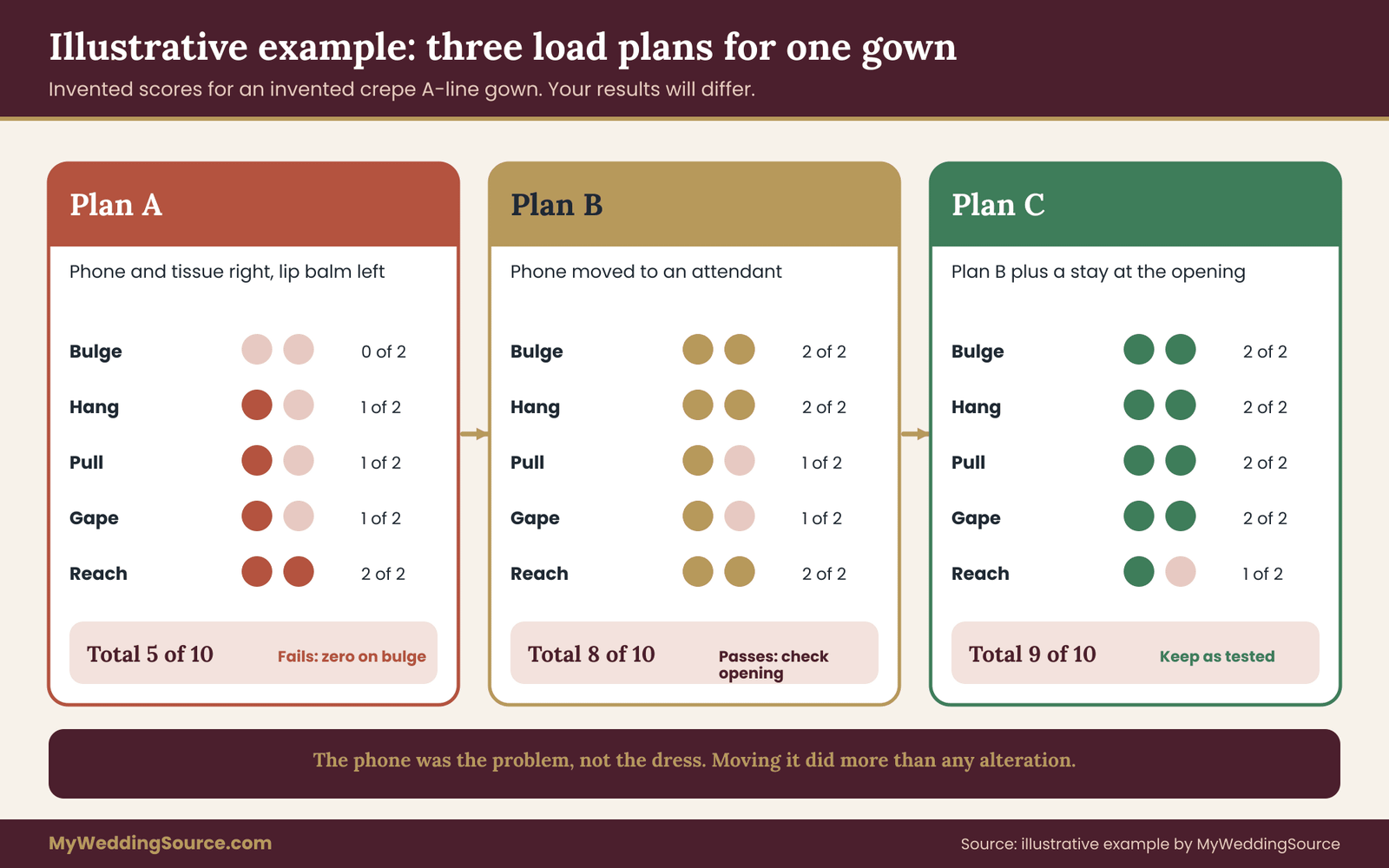
Plan A: phone and tissue on the right, lip balm on the left
Marisol puts the phone and a folded tissue in the right pocket and the lip balm in the left. She runs all ten frames again. The right side profile shows the phone pushing the crepe out about an inch and a half beyond the skirt line, and the outline of the phone’s corners is visible. The front frames show the right hem sitting slightly higher than the left. In the three-quarter frame, short diagonal creases run from the right opening toward the waist.
When she sits, the right opening falls partly open and the phone shows. She retrieves the phone in about two seconds.
Her scores: bulge zero, hang one, pull one, gape one, reach two. The total is five, and the zero on bulge triggers the override. Plan A fails.
Plan B: phone to an attendant
Marisol’s sister agrees to carry the phone. Marisol keeps the tissue and the vow card on the right, and the lip balm on the left. She runs the ten frames again. The side profile shows only a quarter inch of shape, which she and her sister agree is barely visible. The skirt hangs evenly. The creases at the opening are faint and disappear when she stands still. The right opening still opens a little in the seated frames. She reaches the tissue in about a second.
Her scores: bulge two, hang two, pull one, gape one, reach two. The total is eight, and there is no zero. Plan B passes, with a recommendation to look at the opening.
Plan C: add a stay at the opening
Marisol takes her photographs to the alterations professional. The professional points out that the opening in the right seam is a little long for such a light load and that a strip of lining tape along the edge will keep it from stretching. She also suggests deepening the bag by about an inch so a folded card sits lower. The work takes a short appointment and a small fee, which Marisol gets in writing before it starts.
After the change, Marisol repeats the ten frames. The openings stay closed in the seated frames. The creases disappear. Reach slows slightly because the shorter opening takes a bit more care, and she scores that one. The total is nine, which is a keep.
What the example shows
Three things stand out. The phone was the problem, not the dress pockets or the dress. The plan that worked moved the heavy item rather than fighting the physics. And the small alteration that finished the job was cheap precisely because the photographs told the professional where to look.
The example also shows the value of the override. Plan A scored five, which falls in the middle band and could have led Marisol to try small fixes. The zero on bulge told her something sharper: no tailoring will make a phone invisible in a single-layer crepe. A rule that catches the one failure everyone will notice in photographs is worth having.
How to adapt the example to your dress
Replace the crepe with your fabric, the phone with your heaviest item and the alteration with whatever your professional suggests. Run three plans at most. The first with your ideal load, the second with the heavy item removed, and the third with any alteration your professional recommends. Three plans are enough to find a workable answer for almost every dress, and more than three mostly adds fatigue.
Edge cases and mistakes to avoid
Not every dress or wearer fits the standard sequence. The cases below bend the rules in different directions, and each is worth thinking through before the fitting.
Dress pockets and a larger or smaller frame
Bodies carry dress pockets differently. A fuller hip gives a pocket more room to sit softly, and it can also make the opening gape if the fabric is stretched. A narrow hip leaves little room and shows bulk quickly. In both cases, measure the placement band at your own natural waist and test on your own body. A sample in a shop on a different frame is a rough guide at best, and a different person’s photographs prove little.
Pregnancy and changing bodies
If your measurements may change before the wedding, the dress pockets move with them. Placement and depth decided at an early fitting may be wrong by the final one. Schedule the test late, with the final shape, and ask your professional to leave room for adjustment. The same applies to anyone whose weight is changing for any reason.
Mobility and accessibility needs
People who use a cane, a walker or a wheelchair may need dress pockets for different reasons and in different places. A seated posture changes everything, since a pocket cut for standing can sit under the thigh when you sit. If this applies, run the test seated and with the aid you will use, and place the openings where your hand can reach them in that posture. Ask the designer about dress pockets at the front or on the arm side of a chair, and about attaching a small bag to the mobility aid itself.
Children and pets
If a child or a pet will be near you, an open pocket can become a target. A ring bearer reaching for a shiny item, a dog nosing at a treat in a pocket, a toddler tugging at a skirt: all of these tug the opening. A closure helps, and a light load helps more. The site’s wedding-day planning pages cover who stays near whom, and the same attendant who carries the phone can keep curious hands away.
Hot weather, dancing and long days
A long reception loosens everything. Fabric relaxes, dress pockets sag and items shift. If your day runs more than a few hours or includes energetic dancing, treat a score of eight as marginal and check the dress pockets at set times. A short pocket check at the start of the reception and after the first dance costs nothing and catches problems early.
Common mistakes
Testing with stand-ins. A lighter phone or a smaller mirror in the test, and the real ones on the day, produces a different result.
Testing without the petticoat. The slip or underskirt changes how the outer layer hangs, and the test is only valid over what you will wear.
Skipping the baseline. Without empty photographs, you cannot tell load from fabric behavior.
Moving the camera. A shifted tripod makes outlines incomparable. Mark the floor and keep the zoom fixed.
Loading both dress pockets equally. One side usually works harder than the other. Plan for it.
Waiting until the last fitting. Late changes are expensive and often impossible. Run the test at the first fitting and again after changes.
Relying on a verbal promise. If a designer says the dress pockets will be deep enough, ask for the depth in inches and put it in writing.
Checking claims with care
If a seller advertises dress pockets as a feature, treat the claim as a statement that needs checking. The Federal Trade Commission explains that advertising must be truthful and not misleading, and a listing that promises dress pockets “big enough for a phone” should be testable. Ask for photographs of the dress pockets in use, and try the dress with your own phone when it arrives. Save the listing, the order confirmation and your messages, since they are the record if you need to return the dress or dispute a charge.
If you paid by credit card and the gown arrives without the dress pockets described, the Consumer Financial Protection Bureau explains that billing errors generally must be reported to the card issuer in writing within sixty days of the statement showing the charge. Check the current rules, and keep your records organized.
Accepting a result you do not love
Sometimes the honest answer is that the dress you love is not a pocket dress. A phone will not hide in a sheath, and no alteration will change that. In that case the choice is between the dress and the pocket, and the test has told you what you are choosing between. Plenty of people choose the dress, carry a wristlet or hand the phone to a friend, and never think about it again. That is a good outcome, not a failure of the test. ### Scripts you can use
Some people find the conversations harder than the testing. A few plain scripts help, and you can change the wording to fit your voice.
To a seller before you buy: “Before I order, could you tell me the pocket depth, the opening length and what the bag is made of? I plan to carry a few small items and want to confirm the dress pockets can handle that.” If the answer is a vague “they are roomy,” ask again for numbers. A seller who has the garment on hand can measure in a minute.
To an alterations professional: “I tested these dress pockets with my real items and took photographs from ten angles. The right pocket gapes when I sit and the phone shows from the side. Could you look at the photographs and tell me what you would change?” This puts the evidence first and invites an expert opinion without blaming anyone.
To an attendant: “Would you carry my phone and a small kit through the day? I will find you during the cocktail hour and after the first dance, and I would like you to stay close during portraits.” Name times and places, since vague requests turn into forgotten phones.
To the photographer: “I have dress pockets in my dress. I would like most portraits with the dress pockets empty, and a few relaxed shots with a hand in one. Tell me if anything bulges and I will adjust.” Keep the message short and put it in the shot list you share.
A decision path for choosing the load
If you like a flowchart in words, here is one. Start with the heaviest item you hope to carry. If it is a phone or a wallet, assume the answer is “attendant or bag” and test only if you have a layered skirt or a petticoat pocket. If it is a medium item, test it in the pocket that sits in the most hidden position and check the three weakest frames: side profile, seated front and walking. If it is light, test all ten frames once and move on.
Then look at the gown. If it is a close-fitting sheath or mermaid, plan on light items only. If it is a ballgown, plan on a heavy item in a petticoat pocket, with reach as the check that matters most. If it is an A-line, plan on medium items in the side seams, with hang and bulge as the key checks.
Finally, look at your day. If it is long and active, subtract one tier from whatever the test allows. If it is short and seated, you can add some load back. A small, honest rule is easier to follow than a perfect one.
A short checklist in prose
Before the first fitting, decide which of the three jobs you want from the dress pockets: comfort, emergency supplies or a phone. Gather your real items and sort them into the load ladder. At the first fitting, ask for pocket depth, opening length, bag material and placement band in writing. Run the empty baseline and the loaded frames in the shoes and undergarments you will wear. Score the five checks and apply the override.
If the score is eight or more, note it and move on. If it is five to seven, show the photographs to your professional and ask for one change at a time. If it is lower, or either bulge or gape is zero, move the heaviest item to another place and test again. Repeat the test after any alteration, and again at the final fitting. In the last week, run a short version with the exact day-of load and keep the photographs where you can find them.
Costs and time without invented numbers
This article does not quote prices because prices vary by region, designer and fabric, and any figure here would be a guess. The structure of the cost is more useful. Adding a pocket involves cutting into the garment, making a bag, attaching it and finishing the opening, and every step is labor. Reinforcement and lining add a little to each. A gown with an internal structure or a heavily beaded skirt can take more work than a simple one, and a fitted gown can take more careful work than a full one.
Ask for a written quote that lists the number of dress pockets, the fabric for the bags, whether reinforcement is included and the date the work will be finished. Compare two quotes only if they list the same things. If the quote is much higher than you expect, ask what drives it before deciding, since a complicated seam or a delicate fabric may be the reason. And allow time: a change made in the final week is the most expensive and the least reversible.
Keeping the evidence
Save your photographs, your scorecards and your written quotes in one folder. If a problem shows up later, such as a seam that tears on the wedding day, that folder is the record of what was planned, what was tested and what was agreed. It also lets you compare the dress before and after any repair. For a small set of files, a shared folder with the dress professional and one family member is enough.
A last word on proportion
Dress pockets are a small detail, and a test with ten frames can feel heavy for a small detail. It is worth doing because the cost of skipping it is paid in photographs that last a lifetime, while the cost of doing it is a single evening and a helper. If the test confirms what you already hoped, you will have loved the dress with a clear conscience. If it changes your mind, you will have changed it in time to do something useful about it.
Your next steps
Pick one evening in the next week and do three things. First, decide which job you want dress pockets to do: comfort, emergency supplies or a phone. Second, sort the real items you plan to carry into light, medium and heavy tiers, and weigh them against the type of gown you have. Third, set up the camera at hip height, take the empty baseline of ten frames and one loaded set, and score the five checks.
Then bring the photographs to your next fitting. Ask your professional for the pocket depth, opening length and placement band in writing, and ask what one change they would make first. Rerun the test after any alteration, and settle the storage plan with an attendant before the week of the wedding. When the score is eight or more, you can stop worrying about dress pockets and enjoy the dress.
FAQ
Can a wedding dress with dress pockets hold a phone?
Sometimes, but a phone is the item most likely to fail the loaded pocket test. It is stiff, dense and shows as a hard rectangle in fitted fabric. Full skirts with layers or a petticoat pocket hide it best. Test with your actual phone, and if bulge or gape scores zero, give the phone to an attendant.
Can dress pockets be added to a wedding gown that does not have them?
Often yes, though it depends on the construction. Skirts with simple side seams take dress pockets easily, while heavily lined, beaded or structured skirts may not. An alterations professional can tell you after seeing the gown. Ask for the pocket depth, opening length, placement and a written quote before any cutting begins, and plan the work early.
Will dress pockets show in wedding photographs?
They can, especially in close-fitting or thin fabrics and when loaded. Empty dress pockets in a full skirt usually disappear. The loaded pocket test photographs you from ten angles, so you see bulge, drag and gaping before the photographer does. Light, flat items almost never show, while rigid items often do.
What is the best place for dress pockets on a wedding dress?
It depends on the silhouette and the job. In-seam dress pockets in the side seams hide best in most gowns. Front-slanted dress pockets suit a relaxed hand pose but gape more when seated. Petticoat pockets hide the load most completely. Ask for depth, opening length and the distance from the natural waist, and test the result.
How much can dress pockets safely carry?
There is no standard figure, since it depends on the fabric, seam, bag and cut. Treat a pocket as a load budget. A fitted gown may carry one medium item or a few light ones. A full, layered skirt may carry one heavy item. The test scores bulge, hang, pull, gape and reach, so your photographs set the real limit.
What should I ask a designer or seller about dress pockets?
Ask for the pocket depth, opening length, bag fabric, how the bag is attached and whether the opening has a stay or reinforcement. Ask whether the dress pockets work with the bustle and whether you can test with your real items. Request the answers in writing, because a verbal promise is hard to prove later.
What can I carry instead of using dress pockets?
Options include a wristlet or small clutch, an attendant’s bag, a garter pouch, a pouch sewn into the lining and dress pockets in a jacket or wrap. Each trades visibility, reach and security differently. Many people mix them: light items in the dress pockets, medium items in a small bag, and the phone with a trusted person.
How should I care for dress pockets after the wedding?
Empty them first, since tissues, makeup and food leave stains. Ask your gown cleaner to inspect and clean the pocket bags too, and follow the care label, which the Federal Trade Commission’s Care Labeling Rule requires on most garments. For long storage, museum guidance recommends acid-free materials, no plastic and a cool, dry place.
Sources
- Federal Trade Commission, consumer protection and advertising guidance
- Care Labeling Rule, Federal Trade Commission
- Threading your way through the labeling requirements under the Textile and Wool Acts, Federal Trade Commission
- Consumer advice, Federal Trade Commission
- How do I dispute a charge on my credit card bill?, Consumer Financial Protection Bureau
- Museum Management Program and conservation guidance, National Park Service
- Personal archiving: preserving your digital memories, Library of Congress
- The Costume Institute, The Metropolitan Museum of Art
- Consumer protection, USAGov