
Custom bridal shoes are made, dyed or altered after you place the order, and that single fact changes two things at once: how long you wait and what you can send back. This guide gives you a backward calendar from the wedding date, a ledger of return rights and a vendor approval checklist, so you commit to custom bridal shoes only when the dates and the exit terms both hold up.
Count backward from the wedding date. Subtract your break-in weeks, a shipping and customs buffer, the vendor’s longest quoted production time, every fitting or sample round, and your own approval days. The result is your last safe order date. Then read the return terms before paying: most orders for custom bridal shoes are final sale once production starts, so ask in writing what happens if the shoes arrive late, arrive wrong or do not fit. If the vendor will not put those answers in writing, choose a less custom option than custom bridal shoes.
Ordering shoes online from a stocked retailer is a low-risk purchase. You try them, they fit or they do not, and a prepaid label sends them back. Ordering custom bridal shoes works differently.
Someone cuts leather, dyes satin to a swatch, glues crystals by hand or builds a last to your measurements, and the moment that work begins the shoes stop being inventory and become your property in everything but name. Vendors protect themselves with deposits, change windows and final-sale language, and those protections are normal. The trouble starts when a couple learns the terms after the money has moved.
This guide is about that gap. It does not tell you which silhouette, heel height or color to pick; the bridal shoe pages on this site cover style and fit, and the wedding day accessories planning guide covers how shoes fit into the wider accessory picture. Here the question is narrower and more practical: how many weeks do custom bridal shoes really take, what rights do you keep while it is being made, and what is your exit if something goes wrong.
A note on scope. This is general information, not legal advice, and comfort advice is individual to your feet. Shop policies, shipping rules and consumer protections change, so confirm anything that affects your money with the seller, your card issuer or the agency that sets the rule.
What custom bridal shoes include
“Custom” is a loose word in shoe marketing. One shop uses it for a heel dyed to match your sash. Another uses it for a pair built from a foot outline sent in the mail. The difference matters because lead times and return rights for custom bridal shoes follow the amount of real production, not the word on the product page. It helps to sort custom bridal shoes into five kinds before you compare any quotes.
Made-to-order from a catalog style. The shop offers a set design and builds it after you order, in your size and often in a color or material you choose. Nothing is unique, but nothing is on a shelf either. Production starts at purchase.
Made-to-measure. The maker uses your own measurements, such as foot length, width, instep height and sometimes calf or ankle circumference, to adjust the pattern or the last. This is the kind where the fit risk is highest and where return terms tend to be strictest.
Dyed-to-match. A plain satin or leather pair is dyed to a fabric sample you send. The base shoe may be returnable until dyeing begins; afterward it almost never is. Color is the main risk.
Personalized finishing. Monograms, painted details, hand-applied lace, crystals or a custom sole message are added to a standard shoe. The base fit is normal, while the decoration is where the delay and the final-sale rule live.
Bespoke or one-off commissions. A designer or cobbler creates a single design with sketches, patterns and trial fittings. This kind has the longest lead time, the most approval steps and the most individual contract terms.
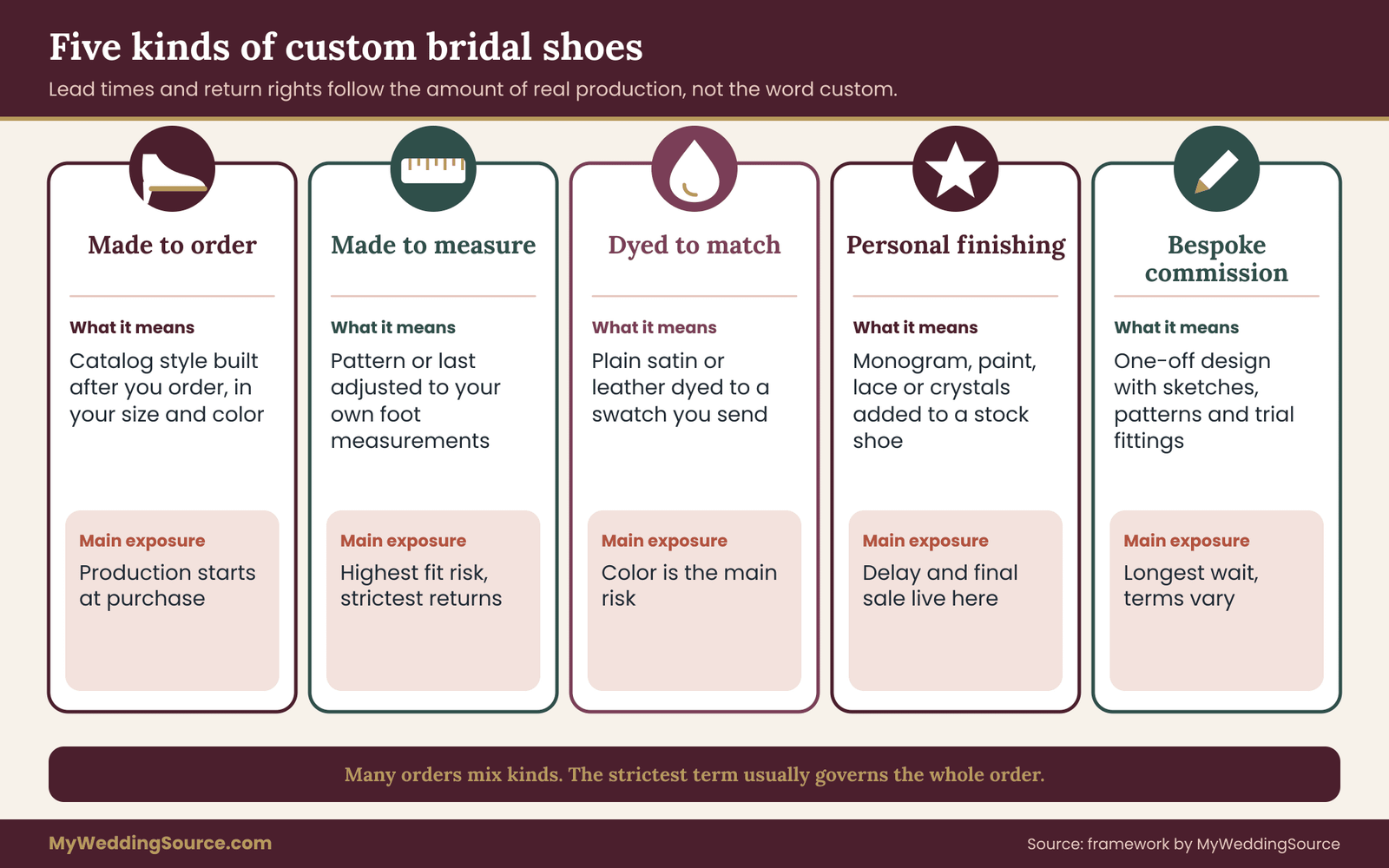
Many orders mix kinds. A made-to-order shoe in a dyed color with a monogram is three kinds at once, and the strictest term among them tends to govern the whole order. When a shop says “custom, so all sales are final,” it usually means the final-sale rule attaches at the first moment any of the three kinds of work begins.
Why lead times and return rules belong in one decision
Most couples ask the lead-time question and the return question separately, if they ask either. The vendor answers each one reasonably. Production takes six to ten weeks, says the product page. Custom items are final sale, says the policy page. Each statement is true and acceptable alone. Together they describe a situation where you pay, wait most of two months, receive custom bridal shoes you cannot return, and discover the fit problem on the one stretch of calendar where there is no time left to remake anything.
So the two facts have to be read together. A long lead time with a generous remake policy can be safe. A short lead time with strict final-sale terms can be risky if the pair arrives late. The safest combination is a quoted timeline with margin and a written remedy for fit or color errors, and the riskiest is a vague timeline with a silent policy.
Think of it as two clocks that start on the same day. The production clock counts the weeks until the shoes are in your hands. The rights clock counts how long you keep the ability to change, cancel, return or dispute. They rarely run at the same speed. The production clock is long, while the rights clock is often shortest at the very start, because many shops lock the design within a few days of payment.
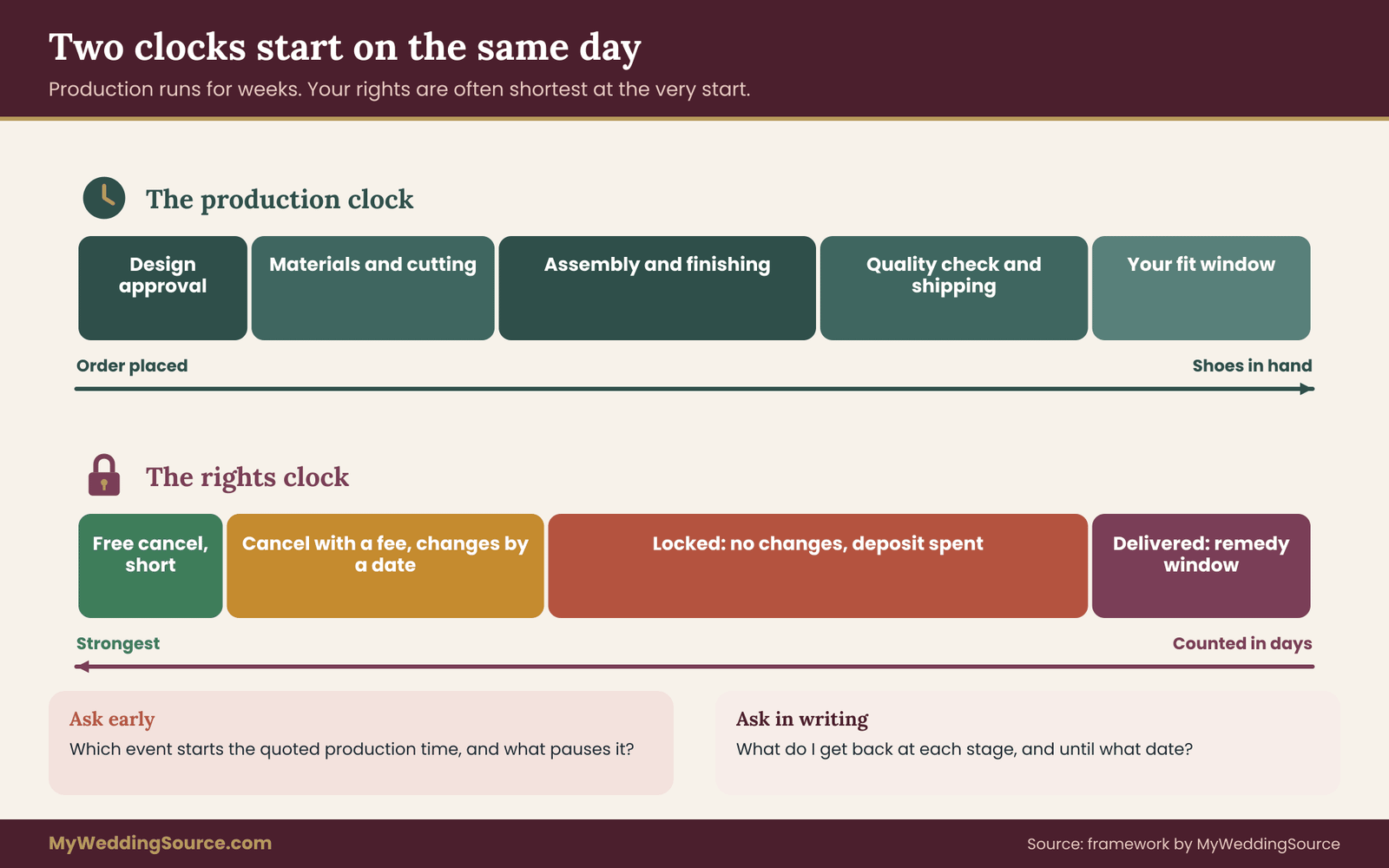
This framework is the thread through the rest of the article. Each later section either adds time to the production clock, adds an item to the rights clock or helps you decide whether custom bridal shoes are worth the exposure.
Why wedding timing makes custom bridal shoes riskier than other custom items
A custom candle or a custom mug can arrive late and still be useful. A pair of wedding shoes has one use date, and everything around it is already fixed: the dress hem was pinned to a specific heel height, the photographer has the portrait schedule, and the ceremony will not move for a late parcel. That fixed date gives custom bridal shoes a different risk profile from ordinary custom goods, in three ways.
The deadline cannot slide. If a pair arrives ten days late for a casual event, you shrug. For a wedding, ten days can consume the entire break-in period or the whole alteration window. The dress alterations schedule in the wedding dress fit and alterations guide assumes you know the final heel height at the last fitting. A late pair can hold up that fitting, which holds up the hem, which can hold up the dress pickup.
The fit tolerance is small. Dress shoes are worn for hours standing, walking and sometimes dancing. A pair that is a quarter size off or slightly narrow at the ball can feel acceptable for ten minutes and painful by the cocktail hour. Because you may not discover the problem until you do a proper wear test, the discovery tends to happen after the return window has closed.
The pair is hard to replace on short notice. Ready-to-wear alternatives exist, but matching a heel height, a shade of ivory and a hem length in a hurry is harder than it sounds. That is why a backup pair belongs in the plan from the start, and a later section shows how to choose and price one.
None of this means you should avoid made-to-order work. For many people custom bridal shoes solve a real problem: an unusual width, a specific color the shops do not stock, a heel height that a standard line does not make, or a design with personal meaning. It means you should enter the order with the timeline and the exit terms in front of you, not discover them afterward.
Before you start: the four numbers to collect
Every calculation in the following sections uses four numbers. Gather them before you contact a single maker, because they decide which vendors are even worth a conversation.
Your wedding date. It sounds obvious, but use the date of the earliest event where you need the shoes, which may be a rehearsal dinner or a photo session, not the ceremony itself. If the engagement or welcome portraits happen earlier, the shoes may need to be in hand weeks sooner.
Your final dress fitting date. The last alteration appointment is when the hem is set. If you want that appointment to happen in the shoes you will wear, the shoes must arrive before it. Ask your seamstress for the date and write it down.
Your break-in window. Decide how many weeks of wear-testing you want. A common personal choice is a few weeks of short indoor sessions, but the right number depends on your feet, the heel height and how long you will stand. Pick a number you can defend, and treat it as a block of calendar that nothing else may use.
Your maximum exposure. This is the amount of money you would be willing to lose if custom bridal shoes arrive unusable and cannot be refunded. Be honest about it. Some people will tolerate a modest deposit being lost and not a full balance. Others are fine with the whole sum. Knowing your number lets you judge whether a vendor’s payment schedule is acceptable.
With these four numbers on a page, the conversation about custom bridal shoes becomes a set of specific questions rather than a vague search for reassurance.
Building the calendar for custom bridal shoes, backward from the wedding date
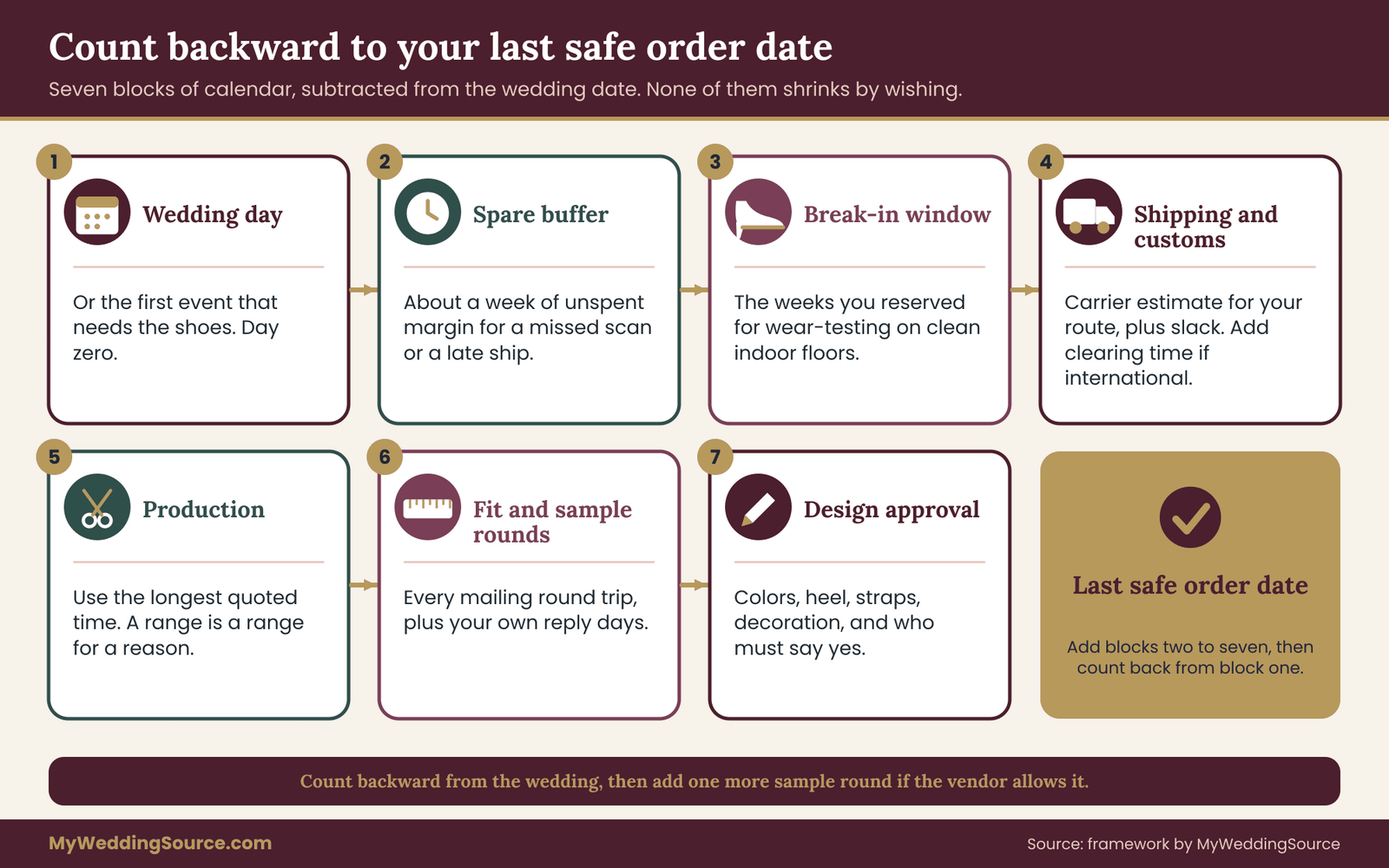
The method for custom bridal shoes is simple arithmetic, and the discipline is in choosing honest inputs. Start at the wedding date and walk backward one block at a time. Each block is a stretch of calendar that cannot be shortened by wishing, so you subtract it rather than hope it shrinks. The last block you reach is your last safe order date: the latest day you can pay and still arrive at the wedding with every block intact.
Here is the order of the blocks, from the wedding backward.
Block one: the wedding itself, or the first event that needs the shoes. This is day zero.
Block two: a small spare buffer. One week of unspent margin protects against a missed courier scan, a weather delay or a vendor who ships a day late. If that sounds generous, remember that the buffer is the only item on the list you can lose without penalty.
Block three: your break-in window. The weeks you reserved for wear-testing sit directly in front of the buffer. Shoes that arrive inside this window can still be worn on the day, but without the testing you wanted.
Block four: shipping and customs. Use the carrier’s transit estimate for the exact route, add two or three days of slack, and for an international order add a clearing allowance. The carrier and the customs authority, not the maker, control that last part.
Block five: production, at the vendor’s longest quote. If the shop says six to ten weeks, subtract ten. A quote is a range because real orders vary; planning on the low end means the plan only works when everything goes right.
Block six: fit and sample rounds. Each round trip of measurements, a trial shoe or a color swatch has its own mailing time and your own response time. Count every round the vendor requires, plus one more if the vendor allows.
Block seven: design approval and your own decision time. Colors, heel height, strap length and decoration need your answers, and you may need a few days to get them from a seamstress or a family member who has a say.
Add the blocks for your custom bridal shoes. Count back from the wedding date. The date you land on is the last safe order date.
A worked example with invented numbers
Take a couple with a Saturday wedding and a dress fitting three weeks before it. They want a dyed-to-match pair with a small monogram. The numbers below are illustrative, not typical figures from any maker.
The break-in window is four weeks and the spare buffer is one week. Shipping within the country is quoted at five days, and the couple adds three days of slack, which makes eight days, or about one week and a day. The vendor quotes six to ten weeks for production, so ten weeks goes on the calendar. There is one sample round of eight days, and the couple allows a week for design approval and swatch mailing.
Add them: one week buffer, four weeks break-in, one and a bit weeks shipping, ten weeks production, a bit more than one week for the sample round and one week for approval. The total is roughly seventeen to eighteen weeks. The last safe order date is therefore about eighteen weeks before the wedding.
Now compare it with the “shortcut” version. A couple who plans on the low end of the quote, skips the buffer and forgets the sample round arrives at roughly ten weeks. Both couples order the same custom bridal shoes. Only one of them has room for a problem.
The difference between the two answers, about eight weeks, is the amount of margin the calendar needs before an ordinary delay turns into an emergency. The sensible conclusion is not that everyone ordering custom bridal shoes must start four months out. It is that you should know which version of the calendar you are living in, and spend that margin knowingly.
Where the weeks go in made-to-order custom bridal shoes
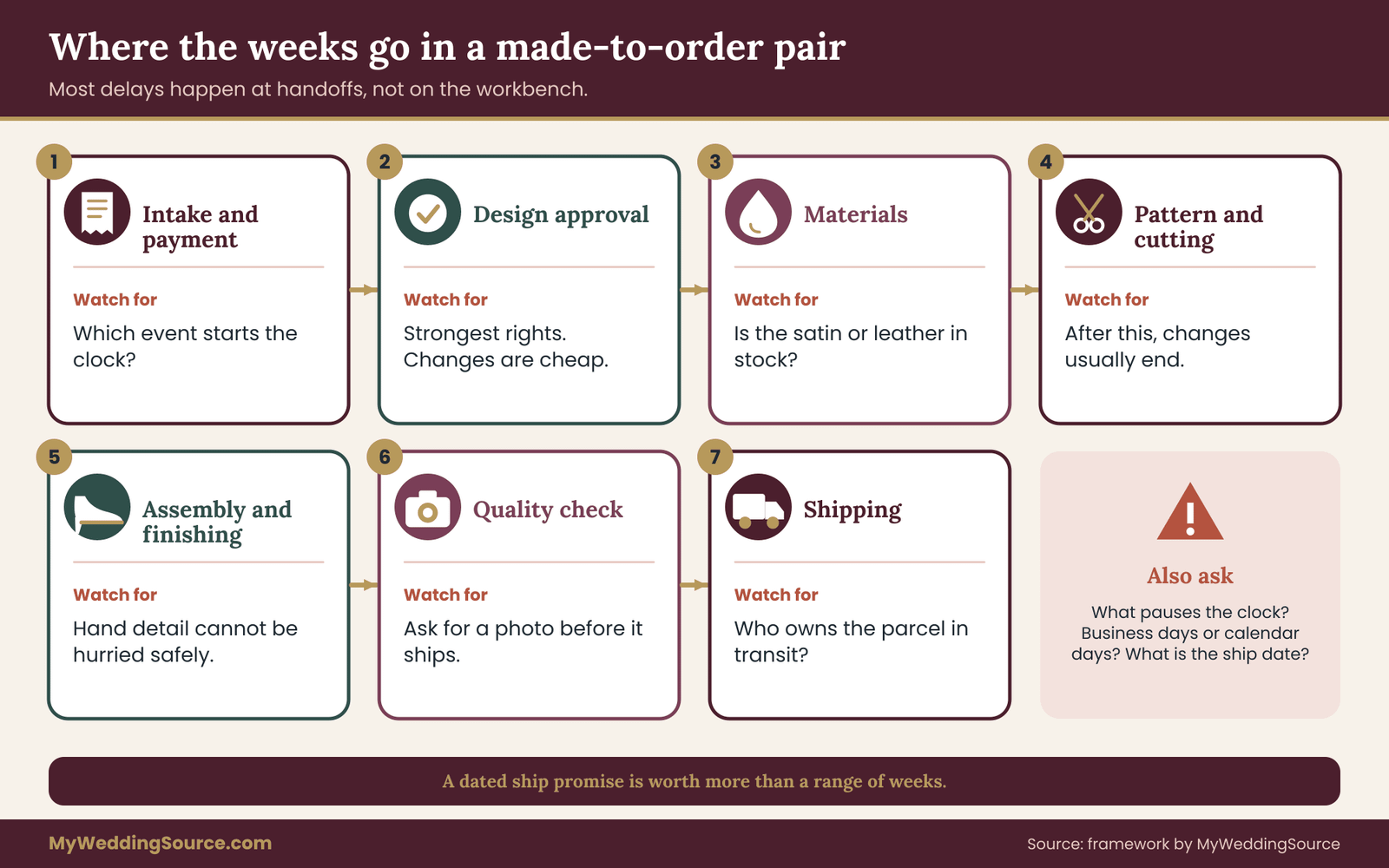
Knowing the stages helps you ask better questions about custom bridal shoes, because most delays happen at handoffs, not on the workbench. A typical order for custom bridal shoes passes through the following stages, though not every maker uses all of them.
Intake and payment. The shop confirms the design, size and color and takes a deposit or full payment. The most important question here is what event actually starts the production clock. Some makers count from the day of payment. Others count from the day they receive your last measurement, a signed approval or a fabric swatch. A quote of eight weeks from approval is a very different promise from eight weeks from payment, and the gap can be weeks long if you are slow to respond.
Design approval. Many makers send a sketch, mockup or photo of materials before cutting. This stage gives you the strongest rights, because changes are cheap before material is cut. It also gives the vendor an easy defense later: you approved the proof, so the shoe matches what you approved.
Materials sourcing. If the satin, leather, lace or crystals are not in stock, the clock waits for them. Ask whether the materials are on hand. A shop that dyes to match may have to source a particular shade of satin, and the supplier’s lead time becomes yours.
Pattern, last and cutting. For made-to-measure and bespoke work, the maker builds or adjusts the form the shoe is made on. For catalog styles in a custom size, this stage is short. It is also the stage after which most makers refuse changes, because material has been cut.
Assembly and finishing. Uppers are stitched, soles attached and decoration applied. Hand-applied detail is slow and cannot be rushed without risk, which is why a plain dyed shoe can often be made faster than a heavily embellished one.
Quality check and packing. The maker inspects and photographs the pair. Ask whether photos are sent before shipping. A photo cannot prove fit, but it can catch a wrong color, a misaligned monogram or a flawed finish while the shoes are still in the shop and a fix costs days rather than weeks.
Shipping and delivery. The pair travels in the carrier’s network. The vendor’s responsibility often ends when the carrier accepts the parcel, depending on the terms. You should know whether the shoes ship with tracking and signature, and who pays if the parcel is lost.
What starts the clock, and what stops it
Two small questions prevent most timeline disputes. First: “Which event starts the production time you quoted?” The answer should be a specific event, such as the day your payment clears, the day a signed approval is returned or the day the last measurement arrives. Second: “What stops or pauses the clock?” Pauses can come from slow customer replies, a failed color match, a supplier shortage or a holiday closure. A fair shop will say plainly which delays are yours and which are its own.
Write both answers down. In an email thread this takes one short message, and the reply becomes part of your record. If the shop later says the clock paused for a reason you never agreed to, you have the written version to point to.
Rush options and what they cost besides money
Many makers of custom bridal shoes sell a rush option. Before paying for it, ask three things. Does the rush fee shorten production, shipping or both? Does the rush change the return or remake terms, since a shop that skips a fit step to hurry may also remove the remedy?
And does the rush have a cutoff date, after which it cannot be added? A rush fee is a good purchase when it moves a safe date earlier. It is a poor purchase when it only compresses a process that already had no margin, because a hurried pair with no remake option has less room for error, not more.
Calendar traps that quietly add weeks
A few seasonal and structural traps appear repeatedly when people order custom bridal shoes. Shops close or slow down around major holidays, and wedding season is a busy period for makers who serve many couples at once.
A maker may add orders faster than it can build them, so the quote you receive in January may be shorter than the real queue in April. Make the shop state the date, not just the number of weeks: “Your pair will ship by this date” is a promise you can hold on to, while “six to ten weeks” is an estimate.
Customs and cross-border shipping are a second trap. A pair of custom bridal shoes made abroad may sit with customs for reasons unrelated to the vendor, and some carriers hold parcels for duties or paperwork. The agency responsible for imports is U.S. Customs and Border Protection, and its site explains how the process works and what information a parcel needs. Treat any international order for custom bridal shoes as carrying more uncertainty than a domestic one and add time to match.
The third trap is your own approval time. A vendor who sends a proof on a Monday and hears back the following Thursday has lost three days that the vendor will not make up. Decide in advance who will approve the proof and how quickly they can respond. If a parent or a bridesmaid has opinions, ask for them before the proof arrives, not after.
What return restrictions on custom bridal shoes actually mean
“Final sale” is the phrase everyone notices, but return restrictions come in more shapes than yes or no. When you compare vendors of custom bridal shoes, sort each policy into one of the following patterns, because two shops that both say “limited returns” can mean very different things.
No returns of any kind. The sale is final the moment you pay or the moment production starts. Some vendors still fix their own mistakes under this heading, and some do not. The policy page rarely says which.
Remake only. The shop will not refund, but it will build a replacement if the error is its own or, in some cases, if the shoes do not fit. A remake is only as useful as its timing: a replacement that takes ten weeks is worthless if the wedding is in six.
Repair or adjustment only. Many shops will stretch, re-heel, re-strap or re-dye. Adjustments are fast and cheap compared with remakes, and for minor fit issues they are often the better remedy. Ask whether the adjustment is free, who pays shipping both ways and how long it takes.
Store credit only. You get value back, but only inside that shop. For one-use wedding shoes this has limited worth unless the shop also sells something you will use.
Partial refund after costs. The vendor refunds what it has not yet spent. This pattern is common when you cancel in the middle of production, and the amount usually depends on how far along the work is. Ask how the vendor calculates the share and whether the calculation is written in the agreement.
Full refund before work begins. Some shops allow free cancellation until they cut material, which can be a few days or a few weeks. This window is valuable and short, and it often ends the moment you approve the design.
Return of the base shoe only. On dyed-to-match or decorated orders, the undecorated stock shoe may be returnable until dyeing starts, while the finished pair is not.
Alongside the pattern, read the conditions. A return window may begin at delivery or at shipment. A pair may need to be unworn, which is a vague word for shoes that must be tried only on a clean carpet. The shop may require the original box, tissue and tags, a return authorization number before shipping and the use of a trackable label. Each condition is a way for an otherwise acceptable return to fail, so decide beforehand how you will meet each one.
Costs hiding in the return terms
Four costs hide in a policy that looks generous. The first is return shipping, which can be expensive for a tracked, insured international parcel. The second is a restocking or cancellation fee, which may be a percentage of the order. The third is the non-refundable deposit, often described as the cost of reserving a slot or purchasing materials.
The fourth is currency: if you paid in another currency, the refund may differ from the original charge once exchange rates and payment fees apply. None of these makes a policy for custom bridal shoes unfair, but each belongs on the comparison sheet next to the headline price.
The return-rights ledger: five stages, five questions
A policy page for custom bridal shoes describes the rules in general. A ledger describes your rights at each moment of your own order, and that is what you need. Build one for each maker of custom bridal shoes you are seriously considering. It takes ten minutes and a short email.
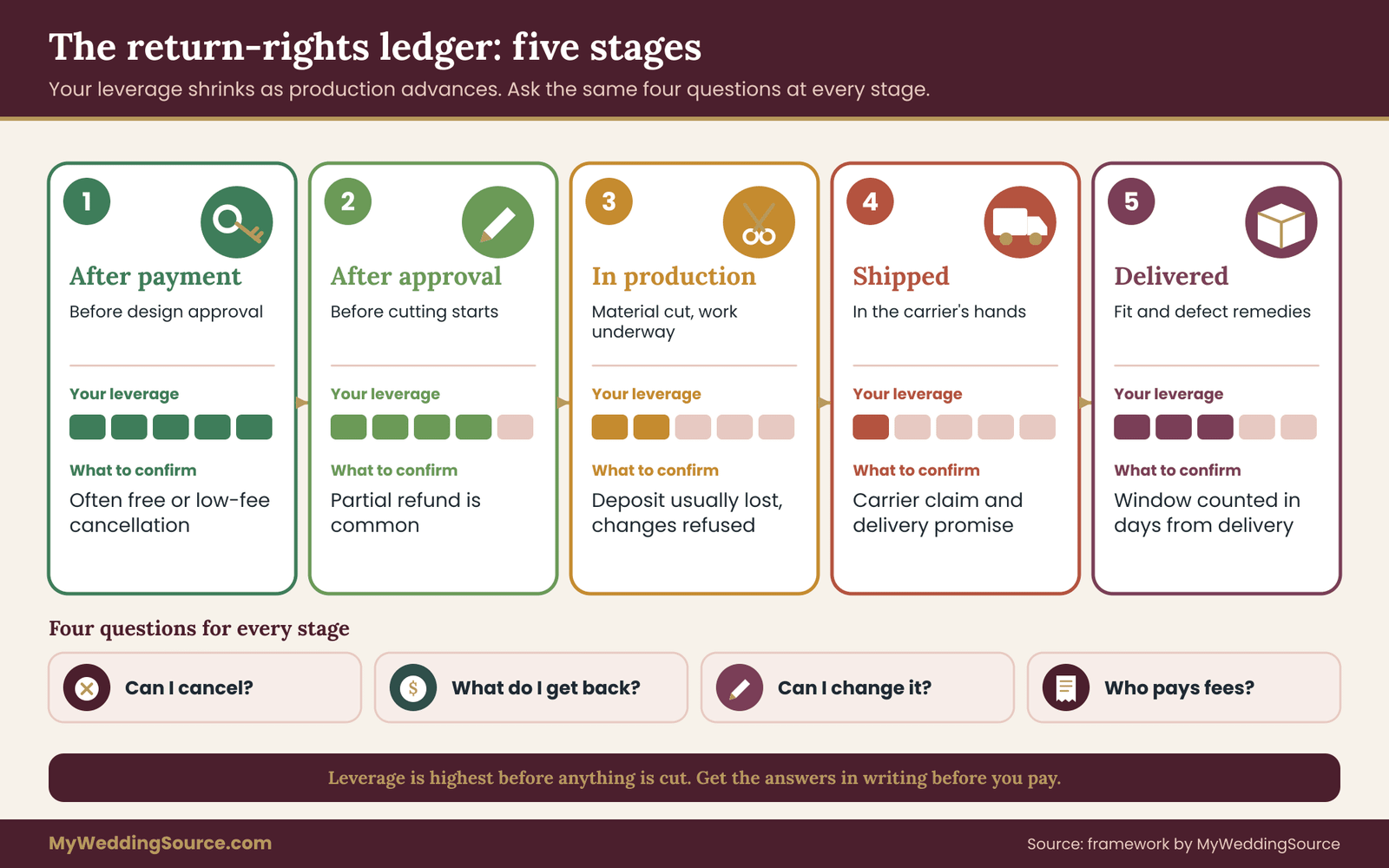
Divide the life of the order into five stages and ask the same four questions at each stage: Can I cancel? What do I get back? Can I change the order? Who pays shipping or fees? The stages are as follows.
Stage one, after payment and before design approval. This is the strongest position you will ever have. Material has not been cut. Many shops allow cancellation with a small fee, and some allow it free. Ask for the amount in writing.
Stage two, after approval and before cutting. The proof is signed, so the shop has your agreement on the design, but the work has not started. A partial refund is common. Changes may be possible for a fee, and asking for them costs nothing.
Stage three, in production. Cancellation usually means losing the deposit and possibly more. Changes are normally refused, apart from small decoration tweaks. This is the stage where a delay hurts most, because you can neither leave nor speed things up.
Stage four, shipped and in transit. The shop has done its work. Remedies now concern the carrier, insurance and the delivery promise. Ask who files a claim if the parcel is lost or damaged.
Stage five, delivered. This is where the fit and color remedies live: the return, exchange, adjustment or remake rights. Note the window in days and the date it starts, and put the end date on your calendar the day the parcel arrives.
How to fill in the ledger
Write the five stages on a page, one beneath another, and leave four short answers beside each. Send the vendor one email containing the five stages and the four questions, and ask them to answer each line. Many shops respond with a paragraph. A paragraph is acceptable if it answers the questions; mark each answer as written, verbal or silent in your own notes.
Do not rely on the policy page alone. A page may say “custom items are final sale” while the shop’s actual practice allows a remake for its own errors. The reverse can also happen: a friendly page may promise “easy returns” for the standard line but exclude custom work in a footnote. The email answer is the one to keep.
Reading the answers
After the ledger is filled in, three signals matter. First, look for the earliest stage where you lose the right to leave. If that stage arrives within days of payment, treat the deposit as spent money and decide whether you could live with losing it. Second, look for the first stage with a written remedy for a wrong or poorly fitting pair.
If there is none, you are choosing between a more standard product and a calculated risk. Third, look for silent cells. A silent answer on shipping loss or on delay is not a no; it is an unknown, and unknowns are expensive when the date cannot move.
Protections that sit outside the vendor’s policy
A vendor’s policy is not the only rule that applies to an order for custom bridal shoes. A few general protections exist alongside it. They vary by situation, and they are not substitutes for clear terms, but they are worth knowing before you pay.
Delivery promises for online and phone orders. The Federal Trade Commission enforces a rule covering merchandise ordered by mail, internet or phone. As the FTC describes it, a seller must have a reasonable basis for the shipping time it states, and if it cannot ship on time it must tell you and give you the choice to cancel for a refund.
The rule has details and exceptions, so read the FTC’s own guidance for the current wording. The practical lesson for anyone buying custom bridal shoes is to keep any stated shipping date from the checkout page or the order confirmation, because that statement can matter later.
Return policies are mostly set by the seller. FTC consumer guidance notes that, in general, stores decide their own return policies, and many sellers sell some items as final if they say so before the purchase. That is why the pre-payment email matters: a restriction disclosed before you pay is much harder to challenge than one you never saw.
Card payments and billing errors. If you pay by credit card, federal billing rules give you a way to dispute certain charges, and the Consumer Financial Protection Bureau explains how and within what time. Disputes generally require written notice within a limited window after the statement that shows the charge, so a long production time can use up the window if you wait to complain.
Ask your card issuer how its own dispute process treats custom goods that never arrive or do not match the order. Card terms differ, and a dispute is a last step, not a first one.
State rules and small claims. Consumer protection laws differ by state, and your state attorney general’s office can tell you what applies. A deposit dispute with a small maker is usually a conversation first and a payment dispute second. Formal claims are rarely worth the effort for a single pair of shoes, which is another reason to settle the terms before paying.
Defects versus fit
A common source of confusion with custom bridal shoes is the difference between a defective pair and an ill-fitting one. A defect is a flaw in the work: a loose sole, a crooked monogram, glue marks, a heel that is not level or a color that does not match the approved proof. A fit problem is a pair that is built as ordered but feels wrong on your foot.
Vendors of custom bridal shoes treat the two differently. Most accept responsibility for defects even under a final-sale policy, because the shop did not deliver what it agreed to deliver. Fit problems are more contested, since the shop may argue that your measurements or approval caused the issue. That is why measurements, the fitting protocol and the proof approval matter so much, and the next sections return to them.
Document the arrival
On the day the parcel arrives, treat the unboxing as the start of a record. Photograph the outer box and the label before opening it. Photograph the shoes from the side, top, back and sole, in daylight, beside the approved proof or swatch. Check heel height and both shoes for symmetry.
Try them on a clean carpet only, with the hosiery and insoles you plan to wear, and do not walk outdoors or on hard flooring. Then message the vendor the same day with any concern. If the pair is fine, a one-line acknowledgment closes the loop. If it is not, the vendor receives the problem inside the return window and not after it.
The customization rights checklist for vendor approval
The ledger tells you when you can leave an order for custom bridal shoes. The checklist tells you what the vendor has promised to do while you stay.
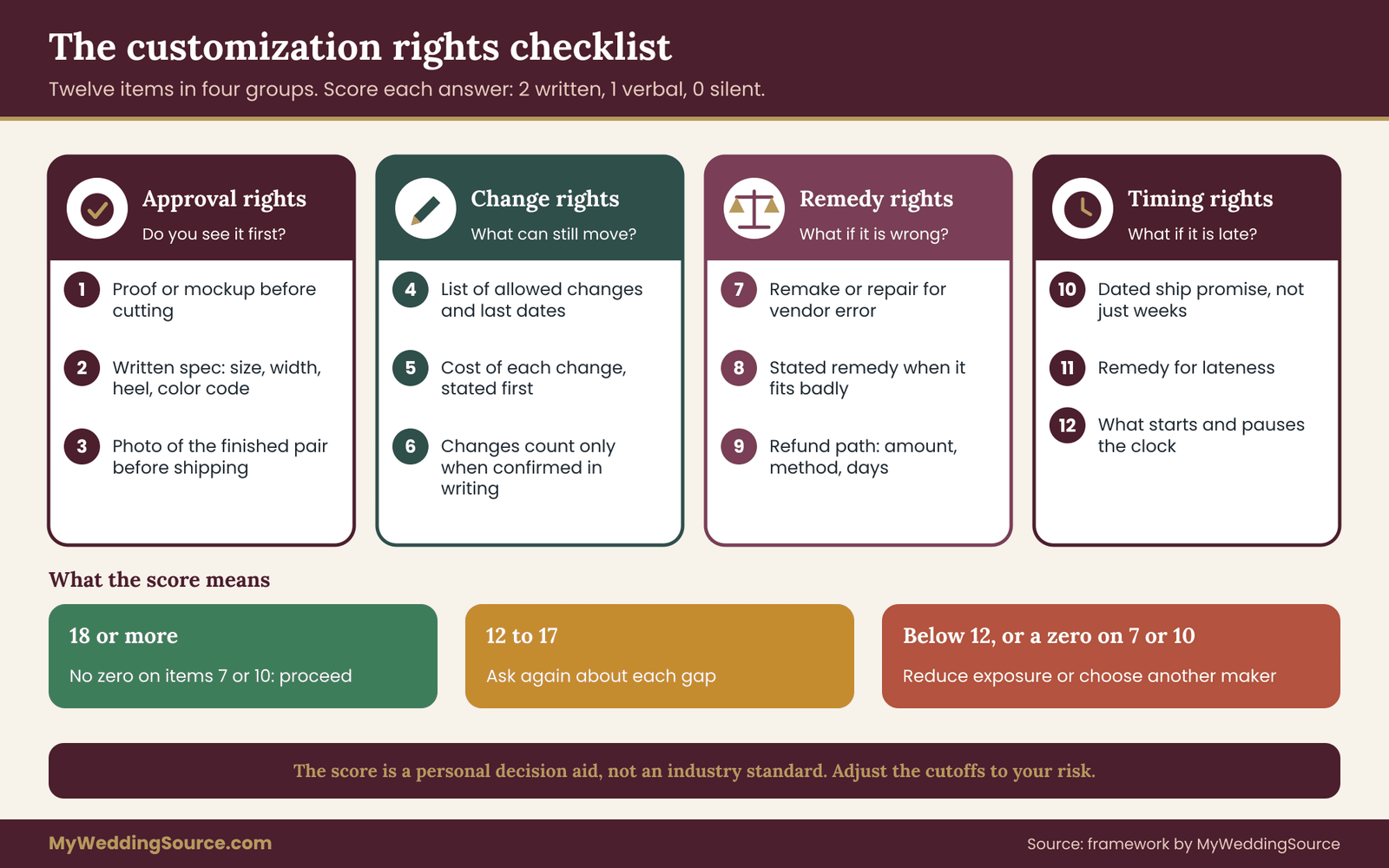
It is the original tool in this guide, and it exists because orders for custom bridal shoes fail in a small number of predictable ways: the design drifts from what you approved, the change you needed is refused, the remedy for an error does not exist or the date slips with no consequence. Each failure maps to one group of rights, and each group has three items.
Approval rights: do you see it before it is final?
- A proof, sketch, mockup or material photo before any cutting begins.
- A written specification sheet that names the size, width, heel height, material, color code or swatch reference, and decoration.
- A photo of the finished pair before it ships.
Change rights: what can still move?
- A list of what you may change after approval, such as strap length, decoration placement or a monogram, and the last day each change is allowed.
- The cost of each permitted change, stated before you ask for it.
- A rule that changes count only when confirmed in writing by the shop, so a chat message is not lost.
Remedy rights: what happens when something is wrong?
- A remake or repair, at the shop’s cost, when the pair does not match the approved specification.
- A stated remedy when the pair matches the specification but does not fit, even if the remedy is only an adjustment or a discounted remake.
- A refund path with an amount, a method and a number of days for the money to return.
Timing rights: what happens when it is late?
- A dated ship promise, not only a range of weeks.
- A stated remedy for lateness, such as cancellation with a full refund after a certain date, a rush at the shop’s cost or a partial credit.
- A plain statement of what starts the clock and what pauses it.
How to score a vendor
For each of the twelve items, mark how the vendor answered. Give two points for an answer in writing, one for an answer given by phone or chat that the vendor has not confirmed in writing and zero for silence or a refusal. The maximum is twenty-four.
This is a personal decision aid, not an industry standard, and the cutoffs below are judgment calls you can adjust to your own tolerance for risk.
- Eighteen or more, with no zero in items seven or ten: the terms are solid enough to proceed. Keep the written answers with your order confirmation.
- Twelve to seventeen: the vendor may be fine, but gaps exist. Send one more email asking about each gap. Many makers fill in a missing item when asked politely; a shop that fills three or four gaps in a single reply is a good sign.
- Below twelve, or a zero in item seven or ten: the exposure is too open. Either reduce the exposure, for example by choosing a standard pair with a small modification, or choose another maker.
Items seven and ten are singled out because they matter most. Without a remedy for an error you cannot recover from a mistake, and without a dated ship promise you cannot hold anyone to the timeline. A maker of custom bridal shoes can be strong in every other group and still be a poor fit for a fixed wedding date if one of those two cells is empty.
Why the checklist works better than reading reviews
Reviews of makers of custom bridal shoes are useful for spotting patterns, such as repeated reports of late shipping or unresponsive owners, but they have limits. They describe other people’s orders, which may not have been made to a fixed date.
They rarely mention what the policy said, only how the buyer felt, and they can be mixed with unrelated products. Treat reviews as a reason to ask a particular question, not as a substitute for an answer. The checklist moves the evidence from what strangers say to what the vendor has actually committed to for your order.
Confirm that the business selling custom bridal shoes is real before you spend time on a long exchange. The wedding vendor due diligence checklist on this site covers the basics: a verifiable business name and address, working contact details, a way to reach a person and payment methods that offer dispute rights.
A maker who only accepts payment methods that cannot be reversed is a different risk from one who takes a credit card, and the Federal Trade Commission’s consumer pages list payment types that are hard to recover as a warning sign.
Questions to ask the vendor, with plain scripts
Questions about custom bridal shoes work best when they are short, specific and in writing. Here are the ones that carry the most weight, each with a script you can adapt. Copy the structure, not the exact words, and keep your tone friendly; most makers are small businesses who appreciate a customer who reads the terms.
On timing.
“I am planning around a wedding on a fixed date. For my order, what is the date you expect to ship, and what event starts the production time you quoted? If something delays the shoes, what are my options?”
This single message covers items ten, eleven and twelve. A good reply gives a date, names the start event and describes a remedy.
On the proof.
“Before cutting, will you send a proof or a written specification for me to approve, and a photo of the finished pair before shipping? If the pair differs from the approved proof, what do you do?”
This covers items one, two, three and seven. It also shows you whether the vendor has a quality step, since a shop that cannot send a photo before shipping is a shop with less internal checking.
On change rights.
“After I approve the design, which details can still change and until what date? Is there a fee? How should I request a change so it is confirmed?”
On fit.
“I will give you these measurements. If the pair is made to them and still does not fit, what remedy do you offer, and how long does it take? If I need an adjustment, who pays shipping?”
Note the phrase “I will give you these measurements.” Making the measurements explicit puts responsibility where it belongs, and it prompts the shop to say whether it can verify them.
On refunds.
“If I cancel at each stage, before approval, after approval, during production and after shipping, what do I get back and when? Would you list it in your order confirmation?”
On rush.
“If I add a rush option, does it change the return or remake terms, and what is the cutoff date for adding it?”
Reading the reply
Replies tell you as much through tone and structure as through content. A reply that answers each question in order, uses dates and avoids vague promises is a good sign. A reply that says only “we do our best” or “don’t worry, it always works out” has answered nothing. Reply once more asking for the specific missing item, and if the second answer is also vague, record the item as silent and score accordingly.
Do not read a polite refusal as a bad sign. Some makers will not offer a fit remedy for made-to-measure shoes because the foot measurements come from the customer. That is a defensible position, and it simply changes your decision: you may choose to add a professional foot measurement, order a sample or reduce the custom element.
Protecting the money while you wait
Payment structure is part of the rights picture for custom bridal shoes. Where the vendor allows a choice, pay the smallest deposit that secures the slot, and pay the balance after you have seen the pre-shipping photo. Use a payment method that comes with dispute rights, such as a credit card, and avoid methods that are difficult to reverse.
Keep every receipt and the order confirmation. If a maker asks for the full amount up front, ask whether the policy says why, and whether a staged payment is possible. A small shop often agrees to two payments for a first-time customer who asks clearly. If it does not, the full payment simply raises your maximum exposure, and the checklist score should reflect that.
Finally, save the signed or emailed agreement for your custom bridal shoes where you can find it. The wedding vendor contract guide explains what a clear agreement contains, and the same logic applies to a small order: names, dates, amounts, scope and remedies in one place.
Reading the order agreement for custom bridal shoes, clause by clause
Many small makers of custom bridal shoes do not send a formal contract. You get an order confirmation, a policy page and an email thread. Together those are the agreement, so read all three as one document. If something important is only in the email thread, ask the shop to restate it in the order confirmation. Here are the clauses that matter in an order for custom bridal shoes, in the order they usually appear, with what to look for in each.
Parties and scope. The agreement should name the business, the order number and exactly what is being made: style, size, width, heel height, material, color reference and decoration. If the description is only a product title, add the details yourself in a reply and ask the shop to confirm them. A precise description of your custom bridal shoes is what you will compare the pair against when it arrives.
Price and payment schedule. Check the total, the deposit, the date the balance is due and what the price includes. Look for taxes, duties, shipping, insurance and any fee for changes. A price that excludes import duties can change the cost of an overseas order after the fact.
Production and ship dates. Look for a date or a range, and for the event that starts it. If the agreement says “approximately,” ask what the longest realistic date is. This clause supports item ten on the checklist.
Delay. Many agreements say nothing about delay. Some say the shop is not responsible for delays. A fair clause gives you a way out after a stated number of days, with a refund. If there is none, treat the order as higher risk and increase your own buffer.
Changes and cancellation. Check the last day for changes and the cancellation terms for each stage, matching the ledger you built. Confirm that cancellation refunds are stated as an amount or a formula.
Remedies for error. Look for the words “remake,” “repair,” “adjust” or “refund.” Look also for exclusions, such as “not responsible for fit” or “customer-supplied measurements.” Exclusions are not unreasonable by themselves, but they decide what you can ask for.
Shipping and risk of loss. Find out who owns the parcel while it is in transit, who files a claim for loss or damage and whether the parcel is insured and signed for. If the agreement is silent, ask.
Events outside the shop’s control. A clause often excuses delays from natural events, supply problems or carrier failures. Such clauses are common. The practical question is what you can do when one applies, such as cancel and get your money back after an agreed number of days.
Limits on liability. Many agreements cap the shop’s liability at the amount you paid. That is normal for small orders, and it tells you the maximum you can recover. It also confirms that your exposure is the order value, and it explains why you should not add other costs to the shoe order, such as an expensive alteration timed to depend on the pair arriving.
How notices are given. Check how the shop wants requests sent, since a change request made through a social media message might not count. Use the channel named in the agreement and save a copy.
Red flags worth pausing for
Several patterns suggest you should slow down. The shop refuses to give any date. The shop changes the stated price or terms after you pay. The shop asks you to use a payment method that cannot be reversed. The policy page and the email answers contradict each other.
The shop will not name its location or provide a contact method other than a messaging app. None of these proves bad faith, but each is a reason to request clarity before more money moves, and to lean toward a less custom option when the answers remain thin.
Fit approval for custom bridal shoes: measurements, samples and the first wear test
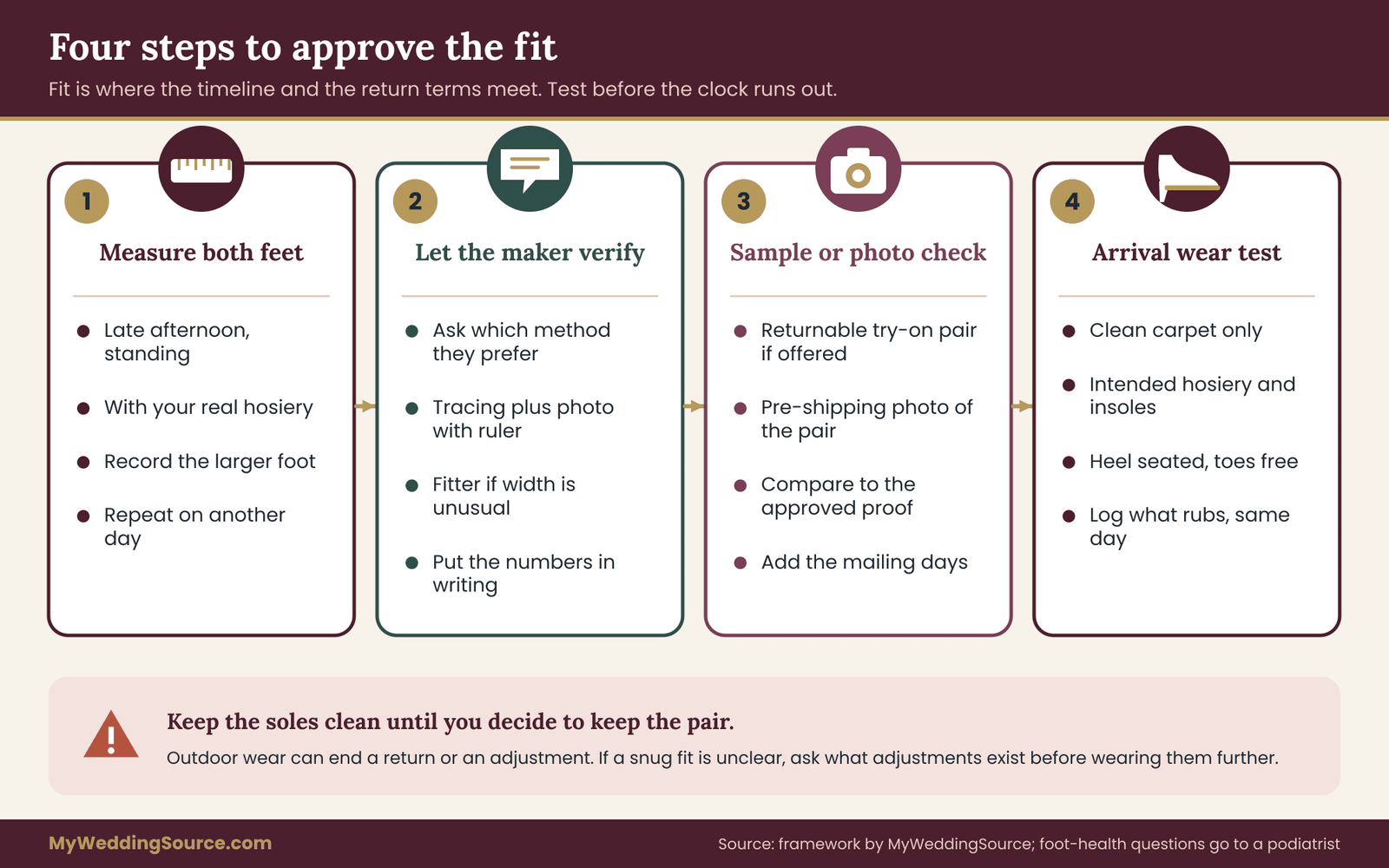
Fit is the point where timeline and returns meet, because custom bridal shoes that do not fit are the scenario that exposes both. A sound fit process reduces that risk before any production of custom bridal shoes begins. The process has four steps, and each step has a measurable check.
Step one: measure both feet under realistic conditions. Feet change through the day and with conditions, and many people find their feet are largest in the evening or after long standing or warm weather. Measure in the late afternoon or evening, standing, while wearing the hosiery you intend to wear.
Record length, width at the widest part of the ball and, when the maker asks for it, the instep height and ankle size. Measure both feet, since they are often different, and write down the larger one. Repeat on a different day. If the two sets of numbers disagree, take a third and ask the maker how to treat the variation.
Step two: measure in a way the maker can verify. Ask which method the shop prefers: a printed foot template, a tracing, a photo against a ruler or a fitting at a local shoe shop. A maker who asks for a traced outline and a photo is building a check into the process. A maker who asks only for a shoe size from a different brand has less information to work with.
If you have an unusual width or a foot condition, consider having a trained fitter measure you. The American Podiatric Medical Association publishes foot-health information and can point you to qualified podiatrists, which is the right route when you have pain, a medical foot condition or a question beyond fit. Nothing in this guide replaces advice for your own feet.
Step three: use a sample or fit shoe where one exists. Some makers send a fit sample in a stock style, or sell a returnable try-on pair in the same last. A sample adds a mailing round to the calendar, and it may cost money, but it replaces a guess with a test.
If the maker offers it, weigh the added days against the risk. When the last safe order date is comfortable, a sample is an inexpensive insurance step. When the date is tight, ask whether a measurement call or video check could replace it.
Step four: do a controlled first wear test on arrival. When the pair arrives, check it at home, on a clean carpet, with your intended hosiery and insoles. Stand for a few minutes. Walk indoors for a short stretch.
Check whether the heel stays seated, whether the toes have space to spread, whether the arch feels supported and whether the straps sit where you expected. Record what you feel at each point. Heels slip, pinch and rub in specific spots, and a short log makes the problem concrete when you describe it to the maker.
What counts as a fit problem worth raising
With custom bridal shoes, a little stiffness in new leather is normal and often eases with careful, short wear. A pair that is clearly too short, too narrow or too loose is different, and so is a heel height that does not match the specification. Raise those immediately.
For ambiguous cases, such as a snug fit that might ease with wear, ask the maker what adjustments exist before you wear the pair any further, because outdoor wear can void a return or adjustment. A good rule is to keep the soles clean until you have decided to keep the pair, and to avoid tracking dirt, since a worn sole can end every remedy at once.
Match the fit step to the stage of the order
Fit work for custom bridal shoes belongs in the same places on the ledger and calendar. Take measurements before the order is approved, verify them with the maker before cutting, get a sample or photo check before shipping when possible and do the wear test on arrival, inside the return window.
If one of those steps is missing, either add it or write down the risk you are accepting. That written line is not a gloomy note. It is the item you will check first if a problem appears, and knowing it in advance shortens the decision.
Heel height, the dress and the final fitting
Heel height on custom bridal shoes affects the dress hem, the posture in the gown and the feel of the whole day. Confirm the heel height in the written specification and verify it with a ruler on arrival, measured on a flat surface from the floor to the point where the heel meets the shoe at the back. A difference of even a small amount can shift the hem, which is why the alterations appointment depends on the final pair.
Ask your seamstress whether she wants to see the real shoes or a stand-in of the same height, and give her the date by which the pair will arrive. If the real pair will not arrive until after the final fitting, buy an inexpensive stand-in pair with the same heel height and use it for the fitting, so the hem is right whichever pair you end up wearing.
A worked example: comparing two makers of custom bridal shoes
The following story about ordering custom bridal shoes is invented to show the method end to end. The names, prices and dates are illustrative, not drawn from any real maker or order.
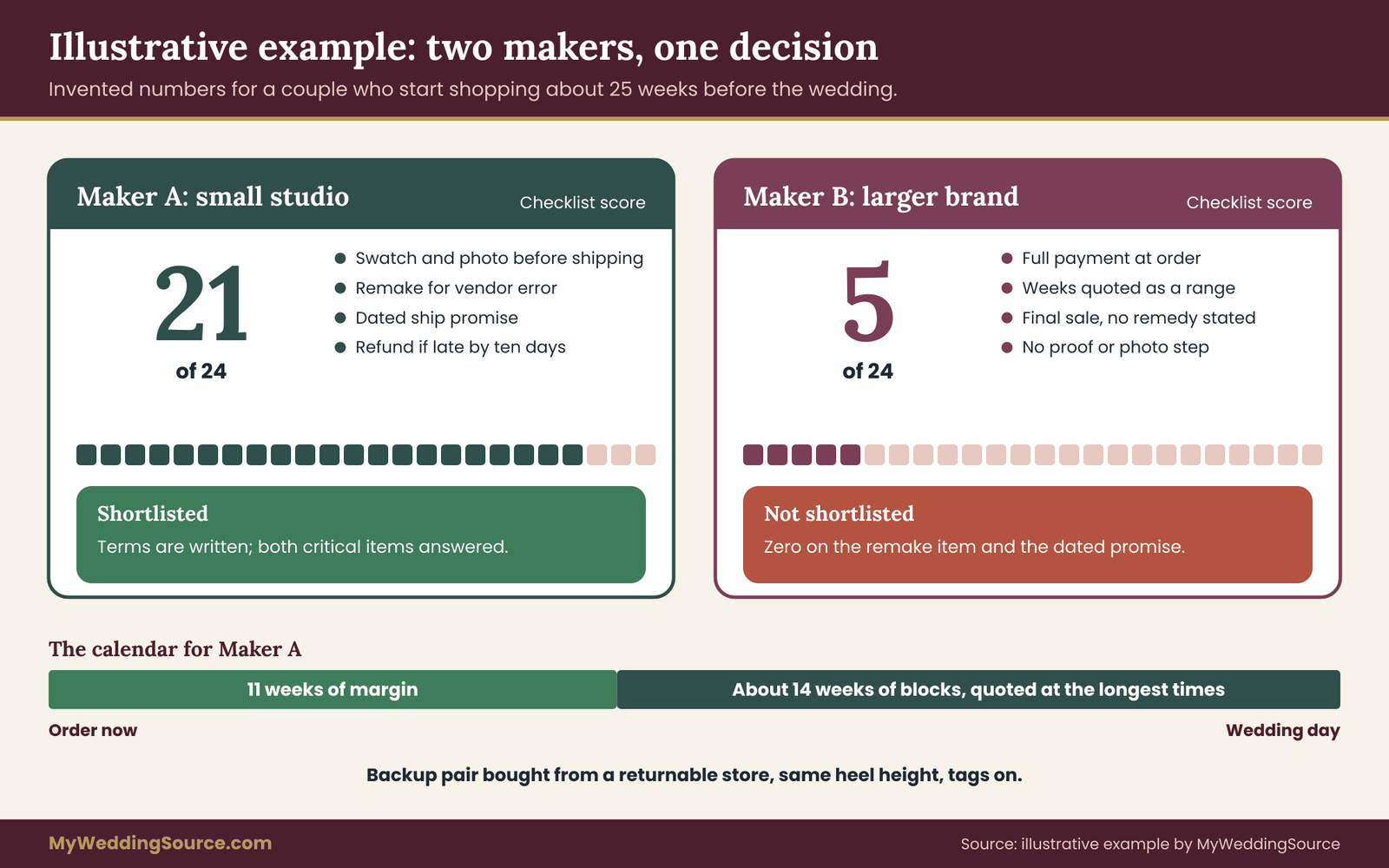
Priya and Marcus are marrying on a Saturday in late September. Priya wants custom bridal shoes: satin pumps dyed to match a sage green sash, with a block heel of a specific height. Her feet are narrow, and standard sizes slip at the heel. She starts shopping in early March, about twenty-five weeks before the wedding. Her seamstress will do the final dress fitting four weeks before the wedding.
Step one: collect the four numbers. The date is the Saturday, and the first event needing shoes is the rehearsal dinner two days earlier, which she decides not to treat as a hard date because she can wear backups. The final fitting is four weeks out. She wants a three-week break-in window. Her maximum exposure is the deposit and a small part of the balance, about a third of the total.
Step two: ask the same questions of two makers. Maker A is a small studio that dyes and finishes catalog pumps. Maker B is a larger online brand with a made-to-measure line. Priya sends each maker of custom bridal shoes the five-stage ledger email and the twelve checklist items.
Maker A replies within a day. The deposit is one quarter of the total, the balance is due after a photo of the finished pair. The shop will send a swatch photo of the dyed satin before cutting and a pre-shipping photo. Production is quoted at five to seven weeks from the day the swatch is approved. A change to the dye color is free before dyeing and not allowed after.
If the pair does not match the approved swatch, the shop remakes it at its own cost. A fit problem on a standard size is handled by one free adjustment; a remake for fit is offered at half price. The shop will state a ship date when the swatch is approved, and it offers a cancellation with full refund if the pair has not shipped ten days after that date.
Maker B replies in four days. Payment in full is due at the order. Production is quoted as “six to twelve weeks.” The policy page says custom items are final sale. The reply does not mention proofs, a pre-shipping photo or a remedy for delay. When Priya asks a follow-up, Maker B says its team “does its best to meet every date.”
Step three: score each. Maker A earns written answers on ten items, a verbal answer on one and a refusal on the fit-remake item, which it partly answers with the half-price offer. Priya scores it twenty-one of twenty-four, with no zeros on items seven and ten. Maker B earns two written items, one verbal and nine silent. Its score is five, with zeros on both critical items.
Step four: compute the calendar. For Maker A, Priya subtracts seven weeks of production, a sample round of about a week, five days of shipping plus three of slack, a one-week buffer, a three-week break-in and a week for swatch approval. That totals roughly fourteen weeks. The last safe order date is fourteen weeks out, and she is at twenty-five. The margin is eleven weeks, enough to absorb one remake of the fit if needed, since a remake adds roughly a production cycle.
Step five: compute the exposure. The deposit is about a quarter of the order. If she cancels after the swatch is approved, the shop keeps part of it. She can accept that, because it is below her one-third limit.
Step six: decide on a backup. She buys a returnable, inexpensive pair with the same heel height and a neutral color, from a store with a generous return policy, to use as her fitting stand-in and as a backup. She keeps the tags on and wears them only on a clean carpet.
Maker B does not make her shortlist. The shoes might have been excellent. The reason is that its terms leave both critical cells empty, and she cannot afford a surprise on a fixed date.
What this example shows
Three things stand out about buying custom bridal shoes. The comparison did not depend on which shoe was prettier or which brand was famous. It depended on two clear questions about timing and remedy. The second is that a written ledger turned a vague feeling of “this seems fine” into a number she could compare.
The third is that the calendar showed she had margin, which let her choose the careful option without paying for a rush. Had she started at ten weeks out, the same checklist would have pointed toward a standard pair with a small modification, and that would have been the right outcome too.
When not to buy custom bridal shoes: alternatives compared
Buying custom bridal shoes is a means, not a goal. If a standard pair solves the real need, the safer, faster and cheaper option usually wins. Here are the main alternatives, compared in prose on the factors this guide has used: lead time, return flexibility, fit risk and cost logic. None of the comparisons uses a fixed number, because makers and shops vary widely; use them to decide which questions to ask.
Ready-to-wear in stock. The pair is on a shelf, and you can try it. Lead time is days. Returns follow the store’s policy, which for unworn shoes is often generous. Fit risk is the lowest because you can try several sizes. The trade-off is limited choice in color, width and detail.
Ready-to-wear with a cobbler adaptation. You buy a stock pair and a local cobbler or seamstress dyes, re-straps, adds elastic, shortens a heel or attaches decoration. Lead time is short and local, and the base shoe can be returned before alteration. After modification the shoe is yours. This route works well for small changes, and a local professional can often explain what is feasible while you wait, so decisions are quick and dates are clear.
Made-to-order from a catalog style. You choose a style, size and color, and the shop builds it. Lead time is moderate, returns are often limited and fit risk is moderate because the pattern is proven but the individual pair is new. The advantage is a wider range of colors and sizes than a store stocks.
Dye-to-match service. A neutral pair is dyed to a swatch. Lead time is moderate and depends on the dyer’s schedule. The base pair is often returnable before dyeing. The big risk is color, so insist on a swatch test on a fabric scrap of the same satin and view it in the light where it will be seen. Colors often look different in daylight than under indoor bulbs.
Made-to-measure. The maker builds to your measurements. Lead time is long, fit risk is moderate to high unless the maker offers a sample or fitting, and returns are the strictest. The advantage is the best chance of a precise fit for an unusual foot. This route needs the most calendar and the clearest remedy terms.
Bespoke commission. A designer or cobbler creates a one-off design with fittings. Lead time is the longest, and terms vary individually. The cost is usually highest. It suits people who want custom bridal shoes with a particular design and who have the time, and who will accept that the agreement is the main protection.
Rental or borrowed shoes. Some shops rent formal shoes, and a family member may lend a pair. These offer low commitment and clear return dates, although fit and cleanliness need care, and options are limited.
A decision rule for choosing among them
Use the margin on your calendar as the first filter. If your last safe order date has already passed for made-to-measure custom bridal shoes, drop it. If it falls within two weeks of today, choose a route with a returnable base or a local fix. If you have wide margin, you can afford the longer routes, provided the checklist score is good.
Use your exposure number as the second filter. When the amount you could lose is more than you are comfortable with, move to a route with a returnable base. When it is small, a more custom route is a reasonable gamble.
Use the third filter, the reason for choosing custom bridal shoes. If the reason is a precise color, choose dye-to-match with a swatch test. If it is an unusual width, choose made-to-measure with a fitting. If it is a sentimental detail, such as a monogram or a charm, choose a standard shoe and add the detail afterward, so the shoe remains returnable and the detail is the only irreversible part. This approach often provides the same emotional result with a fraction of the risk.
The backup pair rule
For any route to custom bridal shoes with limited returns, own a backup. The backup does not need to match perfectly. It needs the same heel height, a comfortable fit and a neutral tone that works under the dress hem. Buy it from a seller with an easy return policy, keep the tags and wear it only indoors until custom bridal shoes are confirmed.
If the custom pair arrives and works, return the backup. If it does not, the backup keeps the day on track, and the cost was a returnable purchase rather than a lost pair. The point of a backup is that it converts an emergency into a small inconvenience.
Edge cases and what to do when something goes wrong with custom bridal shoes
Even a well-checked order can wobble. The aim is not to avoid every problem. It is to decide in advance what each problem triggers, so you act on a rule instead of a mood. These are the situations that come up most often.
The pair is running late. Set a trigger date before you order. The trigger date is the day when the remaining weeks equal the remaining shipping time plus your minimum wear-test window. Reaching it without a shipped parcel means the backup pair becomes the plan and custom bridal shoes become a bonus.
Write the date on your calendar and tell the maker you are watching it. Then ask the shop for a firm ship date and for the delay remedy in your agreement. If the shop offers cancellation with a refund after a stated number of days, check whether that day has arrived.
The color is off. Compare the shoes with the approved swatch or proof in daylight, then in the light of the venue if you know it. Photograph both side by side. A real mismatch against an approved proof is a vendor error under most agreements and usually earns a remake or credit. A shade difference caused by lighting is harder to claim, which is why the swatch step before dyeing matters so much. Raise it on the day of arrival, politely and with photos.
The pair is damaged in transit. Photograph the box and the contents before moving anything. Keep the packaging. Contact the maker and the carrier the same day, because the claim process usually has a short window and often needs the original box. The carrier’s own site explains claims; for U.S. mail, the Postal Service site describes how its claims work. If the maker insured the parcel, ask who files.
The measurements were wrong. If the pair matches the specification and the specification used your numbers, the maker may call it a customer error. Ask what adjustment exists, such as a stretch, a strap move or an insole, before talking about a remake. A professional shoe repair shop can sometimes adjust width or strap length in days, which is faster than any remake, though it may end the maker’s remedies, so check with the maker first.
The maker stops responding. Wait a business day or two, then send one clear message listing the order number, the date and the question. Try every contact method on the order confirmation. If there is still no reply after the period in your agreement, move to the formal steps: the cancellation clause, your card issuer’s dispute process and, if needed, your state attorney general’s consumer office. Keep each message and each date. This is also the moment to trigger the backup.
The maker closes or disappears. Small makers can stop trading. If you paid by credit card, ask the issuer what dispute rights apply. Do not spend money on a rescue purchase until you know whether the original pair exists. This is another reason to pay a small deposit and keep the balance for after the pre-shipping photo.
The dress or the heel plan changes. If you change the dress, the hem or the heel height after ordering, the shoe specification may no longer fit. Contact the maker immediately and ask what change is still possible and at what cost. If nothing is possible, the order may be a sunk cost, and the backup pair becomes the real shoe. This is why the specification should be final before you order and why the dress alteration schedule matters.
The wedding date moves. Contact the maker as soon as the new date is known. A later date often helps, since production has more room, while an earlier date can make the whole order unsafe. Ask whether the production slot and the deposit carry over. The wedding vendor timeline page on this site helps you see which vendors a date change touches, and the wedding cash flow planning guide helps with deposits that may need to move.
International orders. A pair made abroad adds duties, taxes, customs paperwork and a return shipment that may cost more than the shoes. Check with the carrier and with U.S. Customs and Border Protection about what applies to your parcel, and ask the maker who pays duties. Treat the stated return policy for international orders with extra caution, since the practical cost of a return may make it unusable even when it is allowed.
Spelling and monogram errors. Names and dates on decoration are among the most common causes of an irreversible mistake. Proofread the exact text, including punctuation and spacing, and have a second person check it before approving. A typo in an approved proof is usually the customer’s responsibility, while a typo introduced after approval is the maker’s.
A second pair for the reception. Some people buy custom bridal shoes for the ceremony and a comfortable standard pair for dancing. That pairing lowers the pressure on custom bridal shoes, since you do not need them to survive five hours. It also reduces the risk of damage to a pair you cannot replace.
Keep one shoe file
All of these situations with custom bridal shoes get easier when the paperwork is in one place. Create a single folder, paper or digital, for the order. Include the order confirmation, the ledger email and reply, the checklist with scores, the approved proof and swatch photos, the written specification, payment receipts, tracking numbers, delivery photos and every message about changes.
A clear file turns a dispute from an argument about memory into a comparison of documents. The wedding vendor purchase order checklist shows the same habit applied to larger orders, from scope agreement to final acceptance.
Your next steps
You can finish the groundwork in a few evenings. Take them in this order.
- Write down the four numbers: the wedding date or first event, the final fitting date, your break-in window and your maximum exposure.
- Work out your last safe order date by counting back through the seven blocks, using the longest quoted production time.
- Pick the kind of work custom bridal shoes actually need, and check whether a standard pair with a small change would do the job.
- Send each short-listed maker the ledger email and the twelve checklist items, and ask for a dated ship promise.
- Score each reply, and drop any maker with a zero on the remake item or the dated ship promise.
- Measure both feet in the evening, twice, with your hosiery, and confirm the method the maker prefers.
- Pay the smallest deposit you can, by a method with dispute rights, and keep the balance until you have seen the pre-shipping photo.
- Buy a returnable backup pair with the same heel height, and set a trigger date for using it.
- Open one folder for the order and save every message, receipt and photo in it.
- Put the return-window end date on your calendar the day the shoes arrive.
For the wider picture of how shoes, jewelry, veil and wraps fit together on the day, return to the full wedding day accessories planning guide on this site, and use the wedding vendor contract page when you want a plain checklist of what any written agreement should state.
FAQ
How long do custom bridal shoes take to make?
It depends on the maker, the kind of work and the season, so no single number is reliable. A dyed stock shoe usually takes less time than a made-to-measure pair, and a bespoke commission takes the longest. Ask for a ship date and the event that starts the clock, then plan on the longest quoted time plus shipping, your break-in window and a spare week.
Can I return custom bridal shoes if they do not fit?
Often not for a refund. Many makers treat custom bridal shoes as final sale once production starts, but some offer an adjustment, a remake or a partial credit for fit problems. Ask what remedy exists for a pair that matches the specification and still does not fit, and get the answer in writing before you pay.
What is the difference between a defect and a fit problem?
With custom bridal shoes, a defect is a flaw in the work, such as a loose sole, an uneven heel or a color that differs from the approved proof. A fit problem is a pair built as ordered that feels wrong on your foot. Makers usually accept responsibility for defects and treat fit problems case by case, depending on who supplied the measurements.
How much should I pay up front?
Pay the smallest deposit that secures your slot, and ask whether the balance can wait until you have seen a photo of the finished pair. Use a payment method that offers dispute rights, such as a credit card. A maker who needs full payment at order may have a good reason, but it raises your exposure and should lower your confidence score.
Should I buy a backup pair?
Yes, when custom bridal shoes have limited returns. Buy a returnable pair with the same heel height and a neutral color, keep the tags on and wear it only indoors on a clean carpet. If custom bridal shoes arrive and work, return the backup. If they are late or wrong, the backup keeps the day on track.
What if the shoes are late and the wedding is close?
Use your trigger date. Once the remaining time equals shipping plus your minimum wear-test window, move to the backup pair and treat custom bridal shoes as a bonus. Ask the maker for a firm ship date and the delay remedy in your agreement. If it allows cancellation with a refund after a stated number of days, check whether that day has arrived.
Do consumer protection rules cover custom bridal shoes?
Some general rules apply to custom bridal shoes, but they vary by situation and by state. The Federal Trade Commission has rules on delivery promises for online orders, and your credit card issuer has a dispute process with time limits. Sellers mostly set their own return policies. Check the agency pages listed below and your state attorney general for current details.
Is it worth going custom for a wedding?
Buying custom bridal shoes can be worth it, when you have a real need, such as an unusual width, a specific color or a heel height stores do not stock, and you have enough calendar for a remake. When time is tight or the reason is a detail, a standard pair with a local alteration is often safer and nearly as personal. Use the checklist score and your exposure number to decide.
Sources
- American Podiatric Medical Association – foot-health information and a way to find a podiatrist.
- Federal Trade Commission – business guidance on the Mail, Internet, or Telephone Order Merchandise Rule.
- FTC Consumer Advice – consumer guidance on return policies, online orders and payment methods.
- Consumer Financial Protection Bureau – how credit card billing disputes work and their time limits.
- U.S. Customs and Border Protection – rules and procedures for imported parcels and duties.
- U.S. Postal Service – shipping, tracking, insurance and claims for mailed parcels.
- USA.gov – federal consumer information and links to state consumer offices.
- National Association of Attorneys General – directory for finding your state attorney general.
- UPS – carrier information on shipping, customs and damage claims.