
A farewell coffee is a short, hosted coffee and pastry service on the morning after a wedding, built around a drop-in window instead of a seated meal. This guide gives you a method for the part that usually goes wrong: when guests arrive, how many cups and pastries to order, how many pour points you need, and how to run the clock so people are fed, thanked and on the road on time.
Plan a farewell coffee backward from your guests’ departure times, not forward from your own wake-up time. Set a drop-in window of about two hours, sort households into early, middle and late arrivals, and assume each guest stays a set number of minutes. Multiply guests by the share who drink coffee, by cups each, then add a buffer. Add pour points until the queue at your busiest quarter hour stays short, and write a run sheet with refresh times. Ask the vendor to confirm every number in writing.
Most couples picture a farewell coffee as a table with an urn and a tray of croissants. That picture is fine, and it is also where the trouble starts, because a table is not a plan. A table does not tell you whether forty people will walk in over ten minutes or over two hours. It does not tell you whether the dispenser holds enough for the busiest half hour, whether the line will block the lobby, or whether the last pastry will be gone before the guests who have the longest drive arrive.
This guide treats the farewell coffee as a small service system with four moving parts: a window, a headcount curve, a supply of cups and food, and a number of places where people can serve themselves or be served. Once you can describe those four parts in a few numbers, a vendor can quote it, a venue can approve it and a helper can run it without asking you a single question.
The guide assumes you have already decided to offer something light the morning after. Whether to host a morning-after event at all is a separate decision with its own guide on this site, and the question of a full seated meal is a different problem again. Here the answer is already “coffee and pastries, no meal,” and the work is making that small event run well.
A note on scope. This is general planning information, not legal, tax or financial advice, and venue rules, local food-handling requirements and vendor terms differ by place, so confirm specifics with the venue, the vendor and the agencies named in the sources.
The guide moves in the order you will need it. First comes what a farewell coffee is and who it serves. Then the timing model, the quantity math, stations and space, the formats you can choose between, pastries and food safety, vendor questions and costs, and finally edge cases and a run sheet. If you are still sorting out the wider weekend, the wedding planning checklist shows where a morning-after item sits among everything else you are tracking.
What a farewell coffee is and who it serves
A farewell coffee is a hosted drop-in. Guests come when it suits their schedule, take a drink and something small to eat, talk with you and each other for a while, and leave. There is no seating chart, no plated course, no toast and no fixed start for a meal. The host, usually the couple or their families, pays for the service and sets the window.
That “drop-in” feature is the whole point. A seated brunch asks everyone to arrive at one time and stay until the food is done. A farewell coffee asks only that the door is open between two clock times. It respects the reality that some guests are leaving for a flight at ten, some are sleeping until nine, and some will want to stay for an hour because they will not see you again for a year.
The three jobs a farewell coffee does well
Used for the right reasons, a farewell coffee does three things better than a meal.
It gives a last conversation without a time commitment. A guest can spend fifteen minutes with you and leave. At a seated meal, leaving early feels rude, so people who need to go skip the meal altogether and you do not see them at all.
It absorbs the check-out rush. Hotels have a check-out time, and guests are often packed and looking for something to do before the car or shuttle arrives. A coffee service in or near the lobby gives that dead half hour a purpose and a warm drink.
It feeds people lightly before travel. Many guests do not want a large breakfast before a flight or a long drive. Coffee and a pastry cover the basic need, and a guest can take a second pastry in a napkin without anyone minding.
What a farewell coffee cannot do
It will not feed hungry people. Guests who skipped dinner, who dance until late, or who have been drinking will want protein and substance. A coffee-and-pastry service works because most guests are lightly hungry and mostly want a warm drink and a goodbye. If you know that a large share of your guests will arrive hungry, the plan needs more food, and you may be better off with a different format.
It will not replace a toast or a group moment. A drop-in never has everyone in the room at once, so do not plan a speech. If you want a thank-you moment, keep it to a short sentence to whoever is standing nearby, or send a written note afterward.
It will not run itself. A coffee service that seems effortless is usually the result of someone watching the dispenser, restocking the cups and wiping the milk station. Part of this guide is deciding who that someone is.
The numbers that define your farewell coffee
Before any vendor call, write down five numbers. They are the spine of everything that follows.
- Window start and end. For example, 8:30 to 10:30.
- Expected attendees. Adults and children counted separately.
- Arrival shape. How many arrive in each half hour.
- Dwell time. How many minutes a typical guest stays.
- Hot-drink share. What fraction will drink coffee, and what fraction will want tea, hot chocolate or something cold.
None of these needs to be exact. They need to be written down, because a vendor can only quote against stated numbers, and you can only revise numbers you have written. Part of the value of this method is that every figure is an assumption you can change when new information arrives, such as a flight change or a group that decides to leave early.
Why a coffee service is easier to get wrong than it looks
Coffee has a rhythm that catering for a seated meal does not. A pot or dispenser has a fixed amount in it. It runs down at a rate that depends on how many people come at once. A fresh batch takes time to brew or to be delivered. A shortage in the middle of the busiest quarter hour is visible to every guest, and it is hard to fix quickly.
Pastry works the other way. It does not run down evenly. The first guests tend to take the pieces that look best, and the later guests get what is left. If the tray is a single mix of items, the later guests may find only one flavor, or none that fits their diet. Stocking and replenishing in smaller batches over the window avoids this, and the quantity section later in this guide shows how to split a pastry order across the window.
Because both items depend on when people arrive, the first job is to understand your guests’ departure plans. That is the next part of the method.
Reading the guest departure map
The departure map is a list of every household or travel party and the time at which each one needs to be gone. It is the single most useful document for a farewell coffee, and it takes about thirty minutes to build.
Build the list in three passes
Start with the guests you know are staying nearby, either at the main hotel or in rentals. For each household, write the check-out time, the transport they plan to use, and the time they must leave to make a flight, train or drive. You may already have most of this from room block records or from the travel questions on your response cards.
Next, add local guests who are not traveling. These guests have the most flexibility, so they tend to arrive later and stay longer. Mark them as “flexible” and leave the time blank. Do not assume they will skip the coffee; some of them will come precisely because they are not rushed.
Finally, add the people you will see before anything else: your parents, your wedding party and any relatives hosting guests at their homes. If they are in your family home, they may not need a time at all, but they may be the people you will rely on to restock cups.
Turn departure times into latest arrival times
For each travel party, subtract three things from the departure time: the travel time to the airport or the road, the time they need for last-minute packing and checking out, and a buffer. The result is the latest moment at which they can still be at the farewell coffee.
A family leaving for an airport at 10:00 might need to check out at 9:30 and pack by 9:00. Their latest arrival at a coffee service in the lobby is about 8:45, and they will probably stay only fifteen minutes. A family driving four hours with children who can leave at noon might arrive at 10:00 and stay until 11:00. A single guest with a late afternoon flight may arrive at any time.
This is where many couples discover that a “9:00 to 11:00” window leaves their furthest-traveling guests unable to attend, because the guests who most need a goodbye must leave before the service has really started. If that is the case, either shift the window earlier or accept that early leavers will drop in at the very start and take a drink to go.
Sort households into three arrival groups
Once you have a latest arrival time for each household, sort them into three groups.
Early arrivals have a latest arrival time in the first part of your window. They will come right at the start, stay briefly and leave. They are the group that most needs a drink to go, and the group most likely to be annoyed by a queue.
Middle arrivals can come at any time and will tend to arrive when they are ready, after waking and packing. This is usually the largest group, and it creates your busiest half hour.
Late arrivals can stay until the end of the window. They include local guests, the wedding party and people with afternoon travel. They are the group that makes the last half hour worthwhile, and the group most likely to find an empty tray if you do not plan a final refresh.
Count the households in each group. Then count the people, adults and children. You now have the beginnings of an arrival curve, which the next part of this guide turns into a window, a start time and a service plan.
Check the map against your invitation list
One last check is worth doing. Compare the people on your departure map to the people you actually plan to invite to the farewell coffee. If you are inviting only out-of-town guests, the map is nearly complete. If you are inviting everyone, the local guests and the wedding party will increase the late group. If you are inviting the wedding party and families only, the early group may be small.
Be honest about who you are inviting. A farewell coffee with an unclear invitation list is the easiest kind to over-order for, because every guess about attendance is a guess about a social decision you have not made. Decide the list first, then count. The wedding guest care planning guide on this site covers how to think about looking after guests across the whole weekend, including those who arrive tired or travel alone.
Farewell coffee timing: building the drop-in window
The window is the span of clock time in which the farewell coffee is open. Everything else, including cups, staff and cost, is sized against it. A window that is too long wastes labor and leaves stale pastries; one that is too short forces a crowd into a single half hour and creates the queue you were trying to avoid.
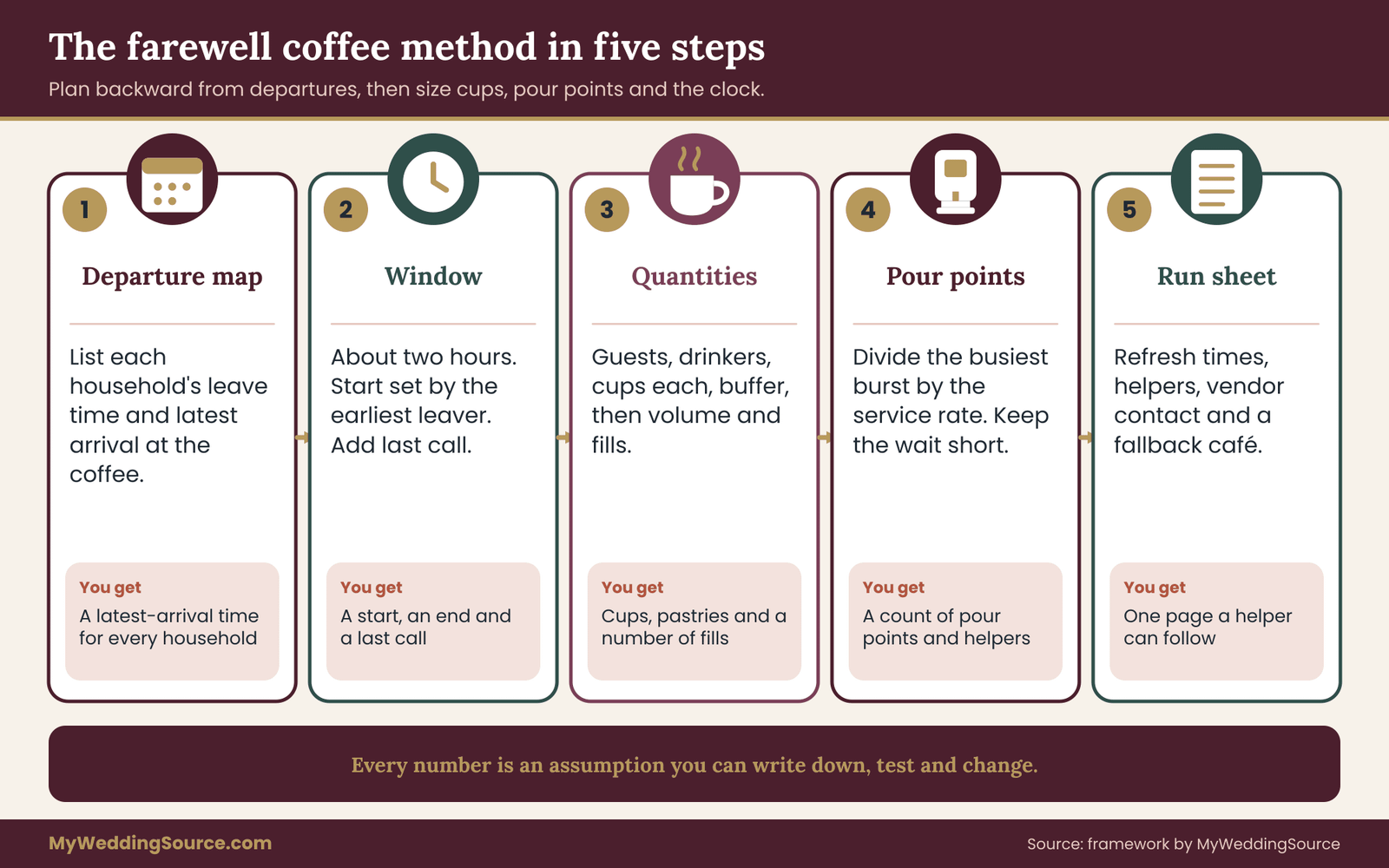
The farewell coffee method below has five steps. They are shown as a flow in the first figure, and each one is covered in this guide.
Step one: set the window length
For most weddings, a drop-in farewell coffee works best at roughly two hours. That is long enough for early leavers and late risers to both find it open, and short enough that one helper can stay alert. A window of ninety minutes can work for a small group in a single hotel. A window of three hours is usually a sign that you are really planning a brunch, and the cost and labor start to look like one.
Treat the length as a decision with a trade-off. A longer window spreads the crowd thinner, which shortens queues and lowers the peak. It also raises the labor cost, increases the number of pastry refreshes and makes the host feel on duty for longer. A shorter window concentrates the crowd, which helps the couple conserve energy but raises the peak load on every other number.
Step two: anchor the start to the earliest departure
The start time should be set by the earliest latest-arrival from the departure map, not by a round number. If the first household leaves for an airport at 9:30 and needs to be checked out by 9:00, a start at 8:00 gives them a comfortable thirty minutes. A start at 9:00 gives them nothing. Check the airline’s and the Transportation Security Administration’s guidance on arriving early for screening before you decide how long a household can stay at the farewell coffee.
If one or two travel parties cannot be accommodated without making the window absurdly early, make a quiet exception for them rather than moving everyone. You can ask the vendor or the hotel to put out a small “early bag” of two drinks and pastries at 7:30 for those households, or hand them a pair of to-go cups the night before. Do not shift the whole service to suit three people unless those three people matter a great deal to you.
Step three: sketch the arrival curve
Divide the window into half-hour blocks. For each block, write how many guests you expect to arrive. Use the three arrival groups from the departure map to place them: early arrivals in the first block, middle arrivals in the second and third, late arrivals across the last two.
Three shapes are common.
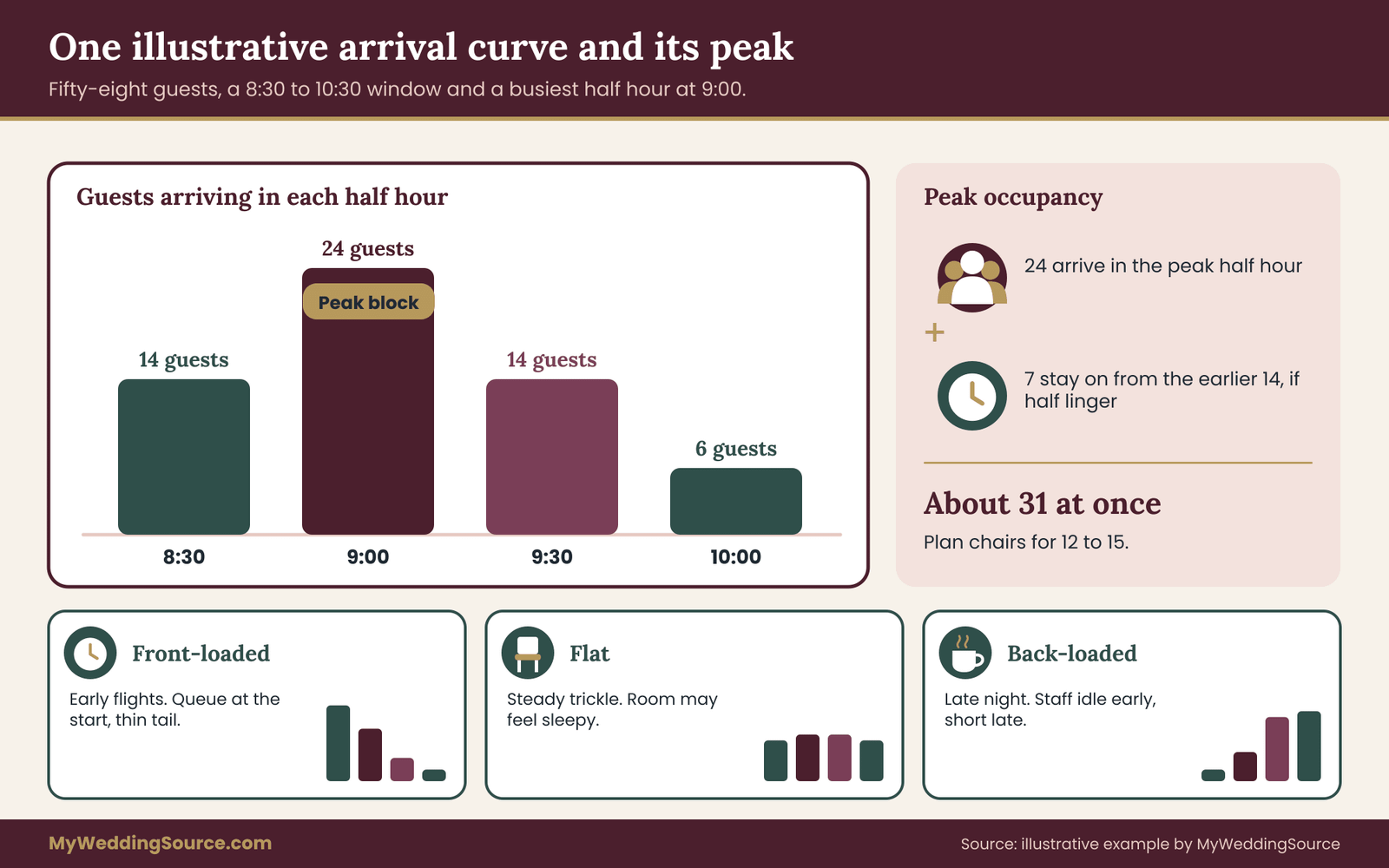
Front-loaded. Many guests have early flights or long drives. Most arrive in the first hour and the tail is thin. The risk is a queue at the start and a half-empty room at the end.
Flat. Guests are mostly staying in town for the day. They arrive steadily and stay a while. The risk is that the room never fills and the service feels sleepy, which is a social problem rather than a supply problem.
Back-loaded. The wedding ended very late and most guests sleep in. They arrive in the second hour. The risk is that the staff and vendor are standing idle early and running short late.
Most real windows are a blend. The point of sketching the shape is to find the peak half hour, because that is the block that determines how many pour points and how much coffee you need.
Step four: estimate dwell time
Dwell time is how long a typical guest stays at the farewell coffee after arriving. At a farewell coffee it is short compared to a meal, and it varies a great deal by guest. Early leavers might stay ten minutes. Middle arrivals might stay thirty. Late arrivals who have nowhere to be might stay an hour.
Use a single average for planning, and write down why you chose it. Thirty minutes is a reasonable starting assumption for a mixed group, but treat it as a guess. If your guest list is full of relatives who rarely see each other, dwell time will run longer. If it is mostly friends heading to airports, it will run shorter.
The planning rule connecting arrivals and dwell time is simple. The number of people in the room at a given moment is roughly the number who arrived during the previous dwell period and have not yet left. If twenty-four guests arrive in the peak half hour and the average stay is thirty minutes, about twenty-four of them are in the room at once at the end of that block, plus whoever from earlier blocks is still lingering. That sum is your peak occupancy.
Step five: add last call and refresh points
Mark two kinds of time on the window. The first is refresh points, the moments when fresh pastry comes out and the dispensers are checked and topped up. For a two-hour window, a refresh at the thirty-minute mark and another at the ninety-minute mark is usually enough. The second is last call, an announcement or a sign at about fifteen minutes before the end, so that the final trickle of guests is not surprised by clearing.
Put last call for the farewell coffee on the printed schedule you give the vendor, because a vendor who has not been told when to stop will either stop too early or keep staff on the clock. A quiet, courteous last call keeps the end of the farewell coffee from turning into an awkward lingering.
A worked example: the Brooks-Lindgren weekend
The following example is invented, and its numbers are illustrative assumptions, not statistics. It shows how the pieces fit together, and later parts of this guide use the same couple.
The couple is hosting a farewell coffee in the lobby lounge of the hotel where most of their guests are staying. They have fifty-two adults and six children confirmed. Their departure map gives them fourteen guests who must be gone by 9:30, twenty-four who will leave between 10:00 and noon, and fourteen who are local or flexible, with six of those likely to arrive after 10:00.
They choose a window of 8:30 to 10:30. Their arrival curve, in half-hour blocks, looks like this.
- 8:30 to 9:00: fourteen guests arrive, mostly early leavers.
- 9:00 to 9:30: twenty-four guests arrive, the busiest block.
- 9:30 to 10:00: fourteen guests arrive.
- 10:00 to 10:30: six guests arrive, local and flexible.
With an average dwell time of thirty minutes, the room peaks just after 9:30. Twenty-four people arrived in the busiest block, and the couple assumes about half of the earlier fourteen are still talking, which adds seven. Peak occupancy is about thirty-one. The couple will plan chairs and standing space for about that number, not for fifty-eight.
They also notice something useful. The earliest block is small but the most time-pressured. Those fourteen people have the least slack, so the couple asks the hotel to start the service at 8:15, with the coffee already hot and a few pastries out before the first guest arrives. The cost of opening the farewell coffee fifteen minutes early is small. The cost of a line of nervous travelers at 8:45 is higher.
Where the host fits in the window
The couple do not need to stand at the door for two hours. A common mistake is treating the farewell coffee as a receiving line, which brings back the same crush of arrivals you are trying to avoid. A better plan is for the couple to arrive about fifteen minutes after the window opens, move around the room rather than stand in one place, and make a point of speaking first to the early guests, since they have the least time.
If the couple would prefer a quieter morning, a parent or a wedding party member can host the early part of the window and the couple can join at the peak. Say so plainly on the invitation, so that guests who see the couple arrive later do not assume they have missed something.
Coordinating the window with other morning events
A farewell coffee does not happen in isolation. The hotel has a check-out time, a shuttle may run on a fixed schedule, a breakfast service may be competing for the same lobby space, and the wedding photographer or the florist may be arriving to collect items. Write these on a single page, in clock order, and look for conflicts.
The shared timeline in the wedding vendor timeline guide is a good model for this. It lays out how vendor arrivals, load-in and load-out fit into the same day, and the same discipline applies to the morning after. A florist who arrives at 9:00 to collect arrangements while forty guests are in the lobby is a small logistics problem that is much easier to solve on paper than in person.
Choosing between a fixed end and a soft end
Some couples want a hard stop. Others like a soft end, where the formal service closes but the space stays open for lingering. Both are fine, and the choice affects the vendor quote.
A hard stop means the vendor clears and leaves at the end time. That keeps labor predictable and gives your farewell coffee a clean finish. A soft end means a person stays on, perhaps a family member, and the vendor leaves the dispenser and a final supply of cups. That is cheaper in labor but requires someone you trust to be responsible for the space. Decide which you want before you ask for a quote, and say so in writing.
Timing checks before you move on
Before you size the quantities, confirm four things. The window start protects your earliest leavers. Your peak half hour is identified. Your average dwell time is written down with the reason. And refresh points and last call are on the page. If any of these is missing, the numbers in the next part will not mean much.
Farewell coffee quantities: cups, pastries and a sensible buffer
Quantities are where couples planning a farewell coffee either over-order out of nerves or under-order out of optimism. The aim is not a perfect number, because no one can predict how many cups a particular group will drink. The aim is a number you can explain, that a vendor can check against its own experience, and that leaves a safety margin where running out would show.
Every figure in this part of the farewell coffee plan is an assumption. None of it is a statistic about how much coffee guests drink. Your vendor or hotel catering team will have its own rules of thumb from running many similar services, and a good practice is to calculate your own number first, then ask what the vendor would suggest and compare. If the two are far apart, find out why before you pay for either.
The quantity chain
Think of farewell coffee quantities as a chain of five links, each one feeding the next.
- Attendees. The adults and children you expect to come to the farewell coffee, not the number you invited.
- Drinkers. The share of attendees who will have coffee, the share who will have tea or another hot drink, and the share who will have nothing hot.
- Cups each. How many servings each kind of drinker will take over the whole window.
- Buffer. Extra for uneven arrivals, spills, second cups and refills that never get used.
- Volume. Cups multiplied by the serving size, then divided by the size of the vendor’s vessels to give a number of fills.
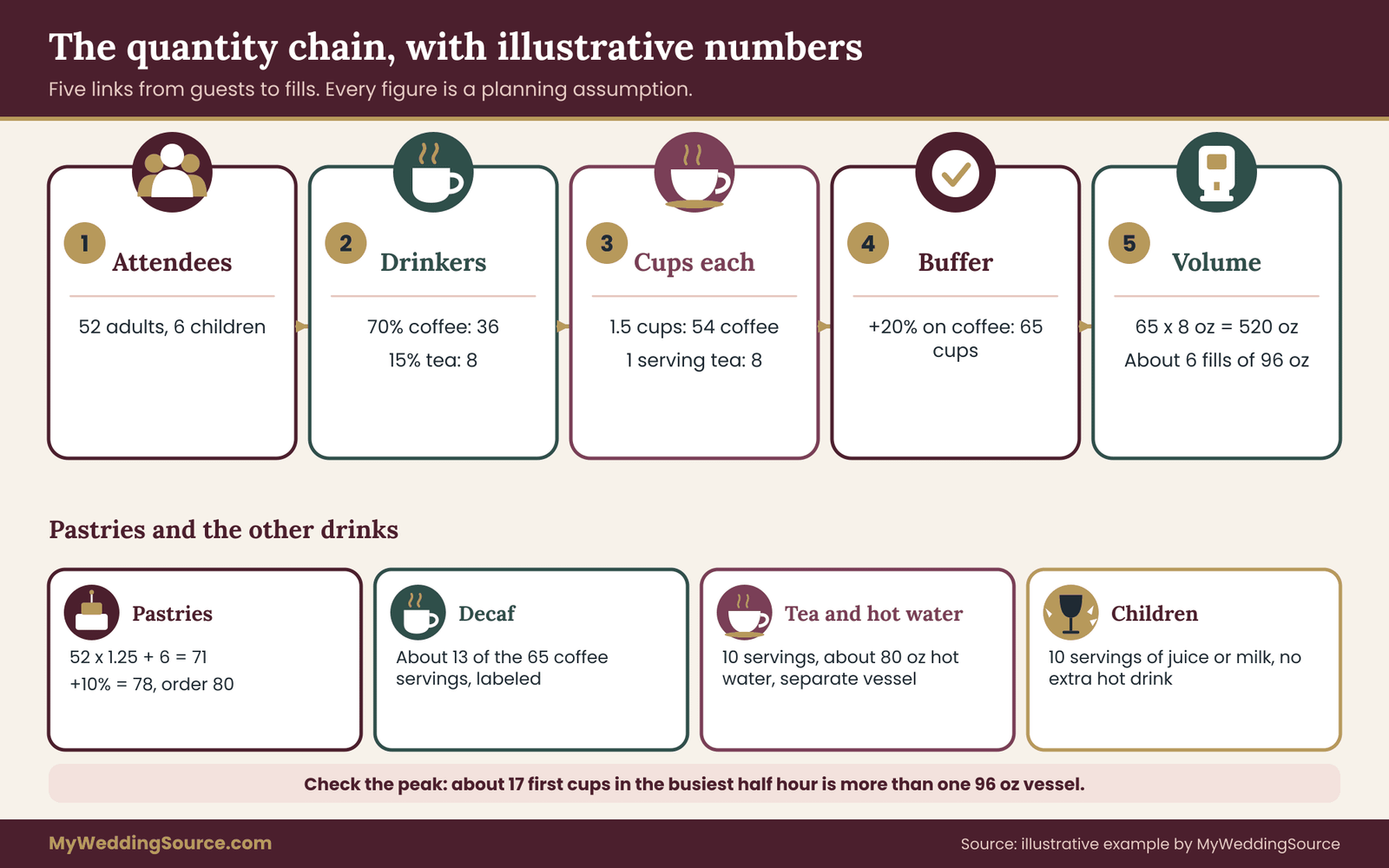
The figure below shows the farewell coffee chain with the Brooks-Lindgren numbers.
Link one: attendees
Count adults and children separately. Children drink less coffee and eat different food, and a large group of children can change the pastry order and the cold drink order more than the coffee order.
Use attendance, not invitations, for a farewell coffee. If you invite fifty-eight people and expect most of them, plan for the number you actually expect, and write the reasoning. A reasonable approach is to count households who have confirmed they will be in town the morning after, then discount the ones with a flight before the window. If you are unsure, plan for the expected number and set a small buffer rather than planning for everyone.
Link two: drinkers
Not everyone who comes to a farewell coffee will want coffee. Some will want tea, some hot chocolate, some juice, some nothing at all. Split your attendees into rough shares and write the shares down, not as facts but as planning assumptions.
In the example, the couple assumes that seventy percent of adults will have coffee and fifteen percent will have tea or another hot drink. That gives thirty-six coffee drinkers and eight tea drinkers out of fifty-two adults, with the remaining eight taking juice, water or nothing. The six children are counted in their own line.
These shares are guesses. If you know your guests, adjust them. A group of friends who all work early shifts may lean toward coffee. A group with many older relatives may lean toward tea and decaf. A wedding party that stayed up until the last song may drink more coffee than a group of quiet guests. When you do not know, ask the vendor what share it normally assumes and decide whether your group is similar.
Link three: cups each
Over a two-hour farewell coffee, a coffee drinker may take one cup or two. A guest who arrives in a rush will take one and leave. A guest who lingers will often take a second. Use a number between one and two for coffee drinkers, and write it down.
The example uses one and a half cups per coffee drinker, which comes to fifty-four cups of coffee. Tea drinkers take one serving each. Children are assumed to take one and a half servings of juice or hot chocolate.
Cup size matters more than most couples expect. A serving of eight fluid ounces is a common baseline for a small hot cup, but vendors and hotels use cups from six ounces to sixteen. If guests are given a twelve-ounce cup, the number of refills falls, but the volume per guest rises. Ask the vendor what size of cup it provides and how many servings it counts per dispenser, because the vendor’s serving count and your serving count have to use the same cup size.
Link four: the buffer
A buffer is a percentage added on top of the base number. Its purpose is to cover the things you cannot predict: a bigger crowd than expected, a cluster of second cups, a spill, a guest who takes two cups to go for the road.
The example adds twenty percent to the coffee number, which takes fifty-four cups to sixty-five. That is a planning choice, not a rule. A larger buffer is sensible when attendance is uncertain, when the window is short and guests arrive in a burst, or when running out would be hard to fix, as in a venue far from any coffee shop. A smaller buffer is sensible when the group is small, the headcount firm, and a replacement could be delivered quickly.
Do not apply a large buffer to pastries without thinking. Coffee that is not poured can sometimes be reduced or returned, depending on the vendor, while pastries that are not eaten become waste. A smaller buffer on pastries, with a plan to put out a second tray only if needed, is often wiser.
Link five: volume and fills
Multiply the cups by the serving size. Sixty-five servings of eight ounces is five hundred twenty fluid ounces. If the vendor’s dispenser holds ninety-six fluid ounces, which is an assumption for this example and not a standard, that is about five and a half fills, so the plan calls for six.
Fills matter at a farewell coffee because a dispenser that runs empty needs time to be replaced or brewed, and that time lands in front of guests. Ask the vendor how a refill works. Is it a fresh insulated carafe swapped in? Is it brewed on site, and if so, how long does it take? Is a second dispenser kept ready? The answers determine whether you need a spare vessel at the peak.
Check the farewell coffee peak against the volume. In the example, twenty-four guests arrive in the peak half hour, and about seventy percent of them want coffee. That is about seventeen first cups in thirty minutes, which is roughly one hundred thirty-six fluid ounces. That is more than one dispenser of ninety-six ounces. So the peak alone needs a second vessel to be open or ready, even though the total volume across the window is modest.
Decaf, tea and the other drinks
Decide the split between regular and decaf before you order your farewell coffee supplies. A common plan is to offer decaf as a smaller share of the coffee, clearly labeled, so that guests who avoid caffeine are not left with nothing. In the example, thirteen of the sixty-five coffee servings are decaf, about a fifth, and the couple notes that this is a guess.
Tea is simpler to provision because it is mostly hot water and bags. The example plans ten servings, which is eight tea drinkers plus a small buffer, and about eighty fluid ounces of hot water. Ask the vendor whether hot water comes from a dedicated vessel. A dispenser that has held coffee should not be used for tea, because the flavor carries.
For children, a cold option is often more useful than hot chocolate. A small pitcher of juice or milk, or individually sized cartons, solves the problem without adding a hot drink to a space with small children moving around. Ten servings covers the example.
Milk, sugar and the small supplies
These small items are easy to forget at a farewell coffee and visible when missing. Ask the vendor for its standard ratio of milk or creamer to coffee, and compare that with your drinkers. Include at least one non-dairy option, labeled, and sweetener choices beyond sugar. Stir sticks, lids, sleeves and napkins should be counted too. For a service with to-go cups, lids and sleeves must match the cups in the order, which is a common place for mismatches.
For napkins and small plates, think about the pastry rather than the drink. A guest holding a hot cup and a croissant needs a free hand for a napkin. If the pastries are sticky or flaky, plan more napkins than seems necessary.
Pastry quantities
Pastry is the second half of the farewell coffee quantity plan. The example uses one and a quarter pieces per adult and one piece per child. That gives sixty-five for adults and six for children, which is seventy-one. A ten percent buffer brings it to seventy-eight, and the couple rounds up to eighty.
Do not order eighty of the same pastry. Split the order across three or four types, one of which should be suitable for as many dietary needs as the vendor can safely provide. The example splits eighty into about thirty small croissants or similar laminated pastries, twenty loaf slices or muffins, sixteen fruit and yogurt cups, and fourteen items that are free of the most common allergens as labeled by the vendor. The exact split is the couple’s choice, and it will change with the vendor’s menu.
Then split the order across the window. Put out about half at the start, a quarter at the first refresh point and the remainder at the second, with the vendor holding the extra in a covered, labeled container. This keeps the table looking fresh and prevents the early block from taking the best pieces.
Check your numbers three ways
Before you send numbers to a vendor, test them.
First, compare the total cups to the peak. Does the volume handle the busiest half hour without a refill delay? Second, compare the pastry count to the headcount. If you have more than two pastries per person in total, check why. Third, compare your numbers to the vendor’s rule of thumb. A difference of ten or fifteen percent is a conversation, not a problem. A difference of fifty percent needs an explanation from one of you.
Write the final farewell coffee numbers, assumptions and reasoning into a single page. That page is the document you will share with the vendor, and it is the one you will use to adjust if attendance changes the night before.
Stations, space and queues at your farewell coffee
Once you know how much coffee and food you need and when people arrive, the next question is how guests get it at your farewell coffee. This is the part of a farewell coffee that people notice most and plan least. A good table layout feels invisible. A poor one produces a knot of people at the dispenser, a puddle by the milk and a line that backs into the lobby.
The central idea is the pour point: any place where one guest at a time can get a hot drink. A single dispenser with one spout is one pour point. A staffed counter with one person pouring is one pour point. A two-sided table with a carafe at each end is two. The number of pour points, combined with how fast each one serves, sets how long guests wait.
A simple queue calculation for a farewell coffee
You do not need queueing theory to size pour points. You need three numbers and one decision.
The first number is the peak burst: how many guests who want a hot drink arrive in a short stretch of the busiest block. Arrivals are rarely smooth. Guests leave the elevator together, a shuttle drops six at once, or a family walks in as one group. A fair assumption is that a third to a half of the peak half hour can show up within ten minutes. The second number is the service rate of a pour point, in guests per minute. The third is the number of pour points.
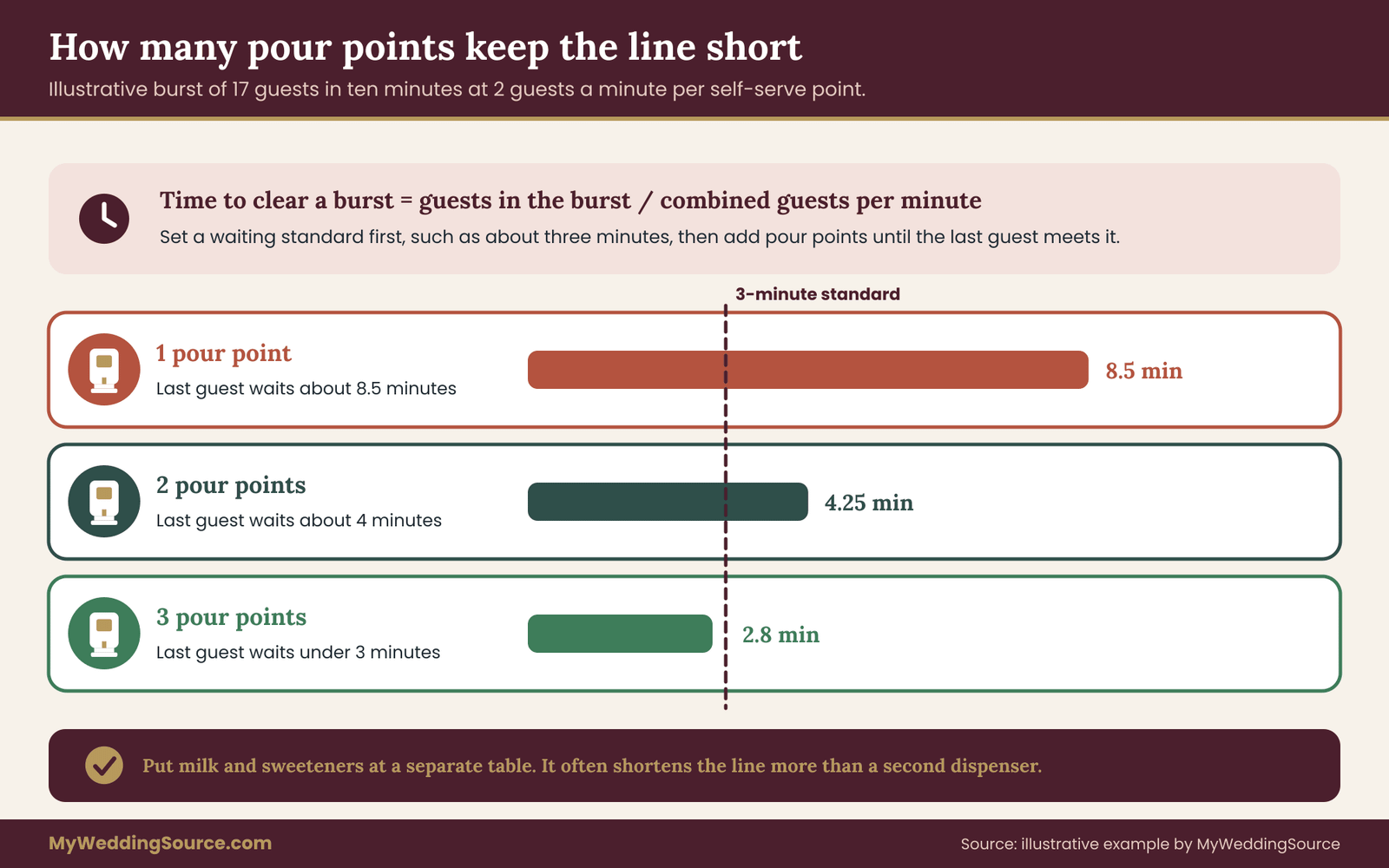
The decision is your waiting standard: how long the last guest in a burst should wait. A reasonable standard for a casual coffee is about three minutes. People will stand in line for a few minutes in a hotel lobby without complaint. A wait of eight or ten minutes feels like poor service, and for a guest with a car waiting it feels worse.
Time to clear a burst is the number of guests divided by the combined service rate of all pour points. For self-serve, a guest might take about thirty seconds at a carafe, which is two guests a minute, though you should test this with your own cups and spout. A staffed pour might run closer to one guest a minute because the staff member also adds milk, answers questions and hands over the cup. Treat both as assumptions to test at a tasting or with the vendor.
Applying it to the example
In the Brooks-Lindgren example, about seventeen guests want a first coffee in the peak half hour. Suppose they cluster so that all seventeen arrive in ten minutes, which is a pessimistic assumption.
With one self-serve pour point at two guests a minute, the burst takes about eight and a half minutes to clear. The last guest waits nearly nine minutes. With two pour points at the same rate, it takes about four and a quarter minutes. With three, it takes under three minutes.
The couple has a waiting standard of about three minutes for a burst they consider unlikely, and a standard of closer to five for the likelier, more spread-out case. Two coffee pour points meet the second and nearly meet the first. They add a third, separate point for hot water and tea, which has the extra benefit of drawing the tea drinkers off the coffee line. Their total is three pour points and one separate station for milk and sweeteners.
If the vendor offers only a single staffed pour point, the couple has two choices. They can ask for a second station or helper, or they can reduce the burst by staggering the arrivals, for instance by asking the early leavers to come at the start and the others a little later. The first costs money. The second costs only a line on the invitation, but it works only if guests follow it.
Self-serve or attended
Self-serve is cheaper and faster per guest, and it fits a casual lobby farewell coffee. It has two weaknesses. Guests make mistakes, such as pouring too much, leaving cups half full or spilling, and someone has to clean up. And with self-serve there is no one to notice that decaf has run out or that the cream has warmed.
An attended station adds a person to pour, restock and wipe. That person is also a point of contact for questions about ingredients. For a farewell coffee of more than about forty guests, many couples find that one attendant who floats between the pour points is worth the cost, even when the dispensers are self-serve. The attendant’s real job is to keep the station tidy and stocked, not to serve every cup.
Whichever you choose, name the person responsible for each station before the day. If the answer is “the vendor,” confirm in writing that the vendor’s staff will be present for the full window and will restock, not just deliver and leave.
Where each station goes
Farewell coffee layout is a matter of flow. A few rules work in most rooms.
Put the drink station away from the door. If the coffee is directly inside the entrance, every arriving guest stops there and blocks the next. Place it a few steps into the room so guests move past the entrance, and so the line forms along a wall rather than across the doorway.
Separate the pour point from the dressing station. Milk, sweeteners, stir sticks and lids should sit at a different table or the far end of the same one. Guests who are only adding milk should not stand where the next guest is pouring. This single change often shortens the line more than adding a dispenser.
Put pastries on a different surface from the drinks. A guest holding a cup cannot easily take a pastry, so a pastry table works best when it is near but not adjacent to the drinks. Two separate lines move faster than one combined line.
Give guests a place to put things down. A few small tables or high-tops near the stations let a guest set down a plate while adding milk. Without them, guests balance everything and spill.
Place the to-go zone by the exit. Lids, sleeves and a stack of to-go cups belong near the way out. Early leavers can grab a cup on the way past the door, and they should not have to push back through the crowd.
Seating and standing
A farewell coffee is mostly a standing event, but it needs seats. A common planning approach is to provide seating for roughly a third to half of peak occupancy, with the rest standing. In the example, peak occupancy is about thirty-one, so the couple sets out seats for about twelve to fifteen, including a few that are easy to rise from for older guests.
Mix the seating. A couple of low sofas or armchairs invite longer conversations. A few chairs near tables suit people with plates. Some tall tables encourage standing and short stays. If the lobby already has furniture, use it and add only what is missing.
Accessibility and comfort
Guests with mobility needs, low vision, or sensory sensitivities should be able to use the farewell coffee without asking for help. The ADA information pages from the Department of Justice explain a venue’s obligations around accessible routes and counter heights, and the venue can tell you what it already provides. Your own checks are simpler: Is there a clear path to the stations at least as wide as a wheelchair? Can a guest reach the cups, lids and milk from a seated position? Are items placed so that a person with one free hand can manage?
Label items clearly in large, high-contrast print. Decaf, regular, oat milk, dairy milk and tea should each have a small sign. If any of your guests use a screen reader or have low vision, a short spoken description from the attendant is a kind addition. The accessible wedding venue red flags guide on this site lists common barriers that are easy to miss until the day.
Keeping the space clean and safe
A farewell coffee means hot drinks, crowds and spills. Put a few clearly marked trash and recycling bins near the exit and near the stations, and have a helper do a quick sweep every fifteen minutes. A small stack of towels or a roll of paper towels at each station saves the vendor from improvising.
Keep hot dispensers and carafes toward the back of the table and away from the edge, especially when children are present. Position cords so that no one can trip on them. If the farewell coffee is outdoors on a patio or lawn, add a wind plan, because napkins, lids and light cups move easily, and a plan for cold hands, since hot cups are welcome when it is chilly.
Reading the flow of people
A good way to check your farewell coffee plan is to walk it in your head, or better, on the actual floor. Stand at the entrance and trace the path of an early leaver in a hurry. They come in, take a cup, add milk, grab a pastry, say hello to you and leave. Where do they stop? Where do they cross another guest’s path? Now trace a slower guest. They arrive, pour, take milk, find a seat and talk. Where do they sit?
If the two paths cross at one table, move a station. The guide to reception guest flow on this site covers the same idea for the evening itself: the best layouts keep the fast movers and the slow movers out of each other’s way.
Choosing the number of staff
Farewell coffee staffing follows from the stations. A reasonable plan has one person per attended pour point, one floater who restocks and cleans, and one person who watches the pastries and the dietary labels. For a small farewell coffee, one vendor attendant and one family helper may cover all three roles. For a larger one, ask the vendor how many staff it normally sends for a window of your length and headcount, and compare that with your own station plan.
Never assume a family member will be free to work. Parents, siblings and the wedding party are also saying goodbye, and the most likely outcome of “someone will keep an eye on it” is that no one does. If you need unpaid help, ask a specific person to handle a specific task for a specific block of time, and thank them in advance.
Comparing farewell coffee formats
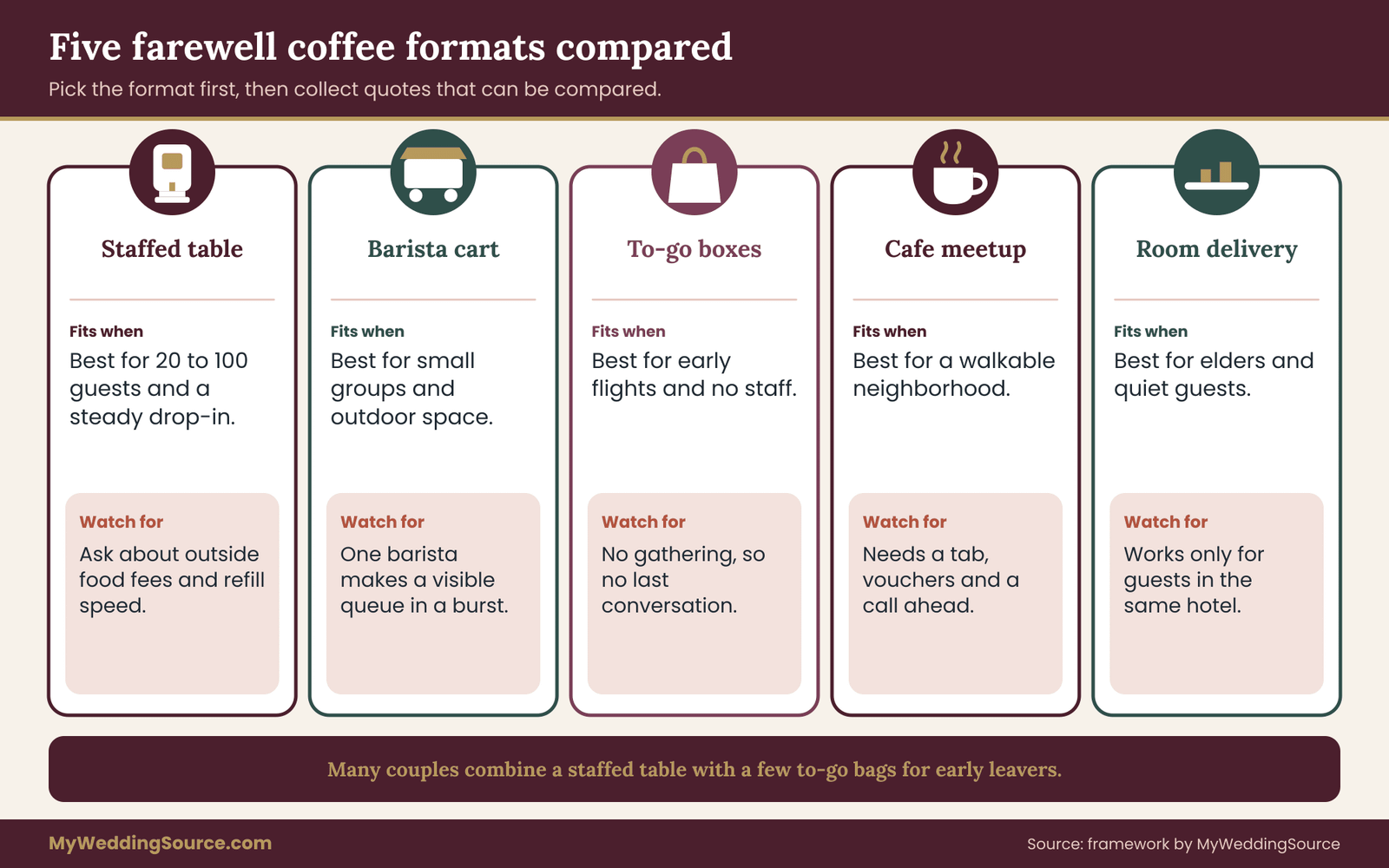
“Coffee and pastries” can mean five quite different things for a farewell coffee, and each one changes the timing, the staffing and the cost. Choosing the farewell coffee format before you collect quotes keeps you from comparing a lobby urn with a mobile espresso cart as if they were the same product.
The figure below sets out the main formats. Each is described in more detail afterward.
Format one: a staffed coffee table in the venue or hotel
This is the classic farewell coffee. The hotel’s catering team or an outside caterer sets up dispensers, cups, pastries and a dressing station in a lobby, a meeting room or a corner of the breakfast space. It works for groups of about twenty to a hundred, handles a steady drop-in well and is the easiest to quote. Its weakness is that the quality of the coffee depends on the vessel and the brewing, and a poorly held dispenser can taste flat by the end of the window.
Choose this format when you have a fixed space, a mid-sized crowd and a wish for a low-effort host experience. Ask the venue whether outside food and drink are allowed in its space, since some hotels require you to buy from their catering department.
Format two: a mobile coffee cart or barista
A barista at your farewell coffee, pulling espresso drinks, adds charm and fits a group that likes lattes and cappuccinos. The trade-off is speed. Each drink is made to order, so a single barista may serve far fewer guests per minute than a row of dispensers. The queue calculation from the previous part applies directly, and for a burst of a dozen guests a single barista will create a visible wait.
Choose this format for a smaller group, a flat or back-loaded arrival curve, or an outdoor setting with room for a cart. Ask whether the cart brings a second person, how many drinks per hour the vendor commits to serving, and whether it can offer a pre-batched drip option to absorb the early rush.
Format three: to-go boxes and bags
For a farewell coffee with many early flights, a to-go format can serve people who have no time to stand in a room. A bakery or café supplies insulated boxes of coffee, cups, lids and a pastry bag for each household, and you leave them at the front desk or in a lounge for guests to pick up. There is no staffing and no queue. There is also no gathering, which means no last conversation.
This works best as a supplement to a farewell coffee. Put out a few to-go bags for the earliest leavers and run a small staffed service for everyone else. It is also a fallback when a venue does not allow an on-site service at all.
Format four: a coffee shop meetup
Some couples hold the farewell coffee at a nearby café, tell guests where and when, and offer to cover a drink for each person. This relieves you of setup and cleanup. It requires a plan for payment, such as a tab with the café, prepaid vouchers or a set of gift cards, and it requires that the café can handle a group arriving over two hours. Call ahead, because many cafés will not hold a tab or reserve space without notice.
Choose it for a small group in a walkable neighborhood. It is a poor fit when many guests have limited mobility, when the weather is bad, or when the café is already busy on weekend mornings.
Format five: in-room delivery
A tray or bag outside each room, or a small amount delivered at a chosen time, handles guests who prefer not to socialize or who are not ready to leave their rooms. It is cheaper than staffing but depends on the hotel’s room service or housekeeping, and it works only for guests in the same hotel. Consider it as an add-on for the wedding party or older relatives rather than a replacement for a shared service.
A four-question chooser
You can pick a format with four questions, answered in order.
- Is a last conversation important? If yes, choose a shared space (formats one, two or four) rather than to-go or in-room delivery.
- How sharp is the burst? If many guests will arrive at once, choose dispensers or a to-go supplement over a single barista.
- How much staff and space do you have? If you have neither, choose a cafe meetup or a vendor package that includes delivery and attendants.
- How much of the effort do you want to carry yourselves? If you want none, choose a vendor that sets up, attends, restocks and removes everything.
Many weddings land on a hybrid farewell coffee: a staffed table for the main window plus a small to-go supply for early leavers. That combination often costs little more than either alone, because the to-go items come from the same order. For menu thinking beyond coffee, the wedding menu planning guide on this site shows how food decisions across the weekend fit together.
Comparing formats without being misled by price
Farewell coffee formats are priced in different units. A hotel quotes per person or per gallon. A cart quotes per hour plus a minimum. A bakery quotes per box. To compare, convert each quote into the same three figures: the cost per attending guest, the number of pour points it provides, and the staff hours included. Later parts of this guide show how to do that. For now, remember that the cheapest quote is often the one that leaves out staff, delivery or cups.
Pastries, allergens and food safety at a farewell coffee
A light farewell coffee menu does not mean a light responsibility. Pastries and dairy products are exactly the kinds of food that can cause allergic reactions or spoil if mishandled, and a farewell coffee often sits out for two hours. The steps here are not complicated, and the agencies that publish the rules are named in the sources.
Choosing the pastries
Pick a small range of farewell coffee pastries that covers different tastes and diets rather than a large range of items you cannot label. A good mix has one buttery item, one that is fruit-based, one plain and one that avoids the most common allergens as documented by the baker. Keep the items simple enough that a vendor can tell you exactly what is in each one.
Where the pastries come from matters. A hotel kitchen, a local bakery and a grocery store each have different labeling practices. Ask for a written ingredient list and an allergen list for every item, and ask how the baker prevents cross-contact. If a vendor cannot tell you what is in a pastry, do not serve it.
The allergens to ask about
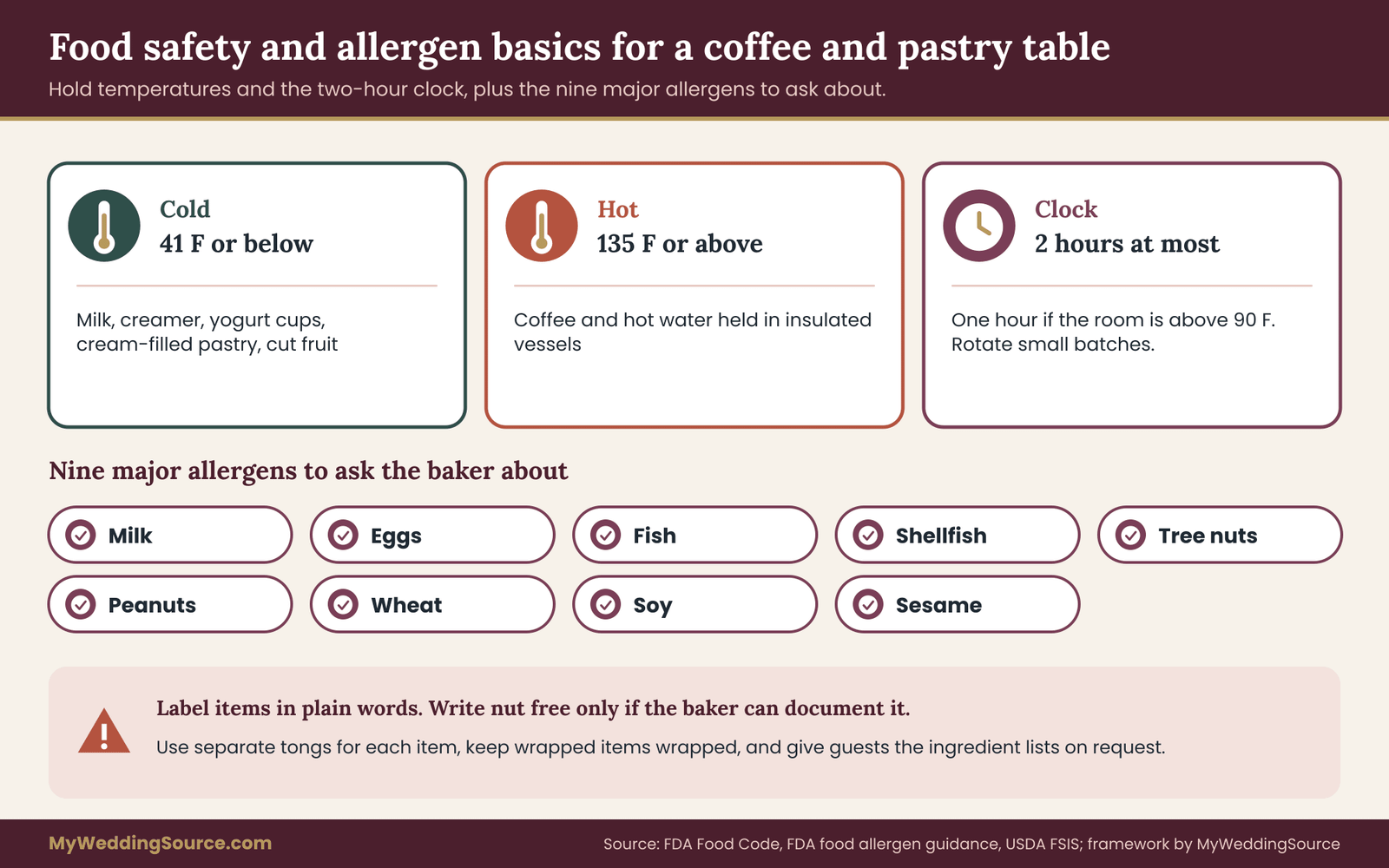
The U.S. Food and Drug Administration lists nine major food allergens: milk, eggs, fish, crustacean shellfish, tree nuts, peanuts, wheat, soy and sesame. Pastries often contain several of these at once. Milk, eggs and wheat are in most baked goods, and nuts and sesame show up in toppings, fillings and flours.
Put a small label at each item that names the main allergens in plain words. Do not write “nut free” unless the baker can document it, including that it is made in a way that avoids cross-contact. A kitchen that handles nuts for other items cannot honestly claim zero risk, and a guest with a serious allergy deserves the accurate answer.
The National Institute of Allergy and Infectious Diseases explains why even a small exposure can be a problem for some people. The practical lesson for a host is to use separate tongs or serving tools for each item, keep individually wrapped allergen-friendly items in their packaging, and make the ingredient lists available on request. If a guest tells you about an allergy ahead of time, tell the vendor and put the item aside before the window opens.
Keeping cold things cold and hot things hot
Coffee is a hot drink and milk is a cold ingredient. Both have safe ranges. The FDA Food Code, which many state and local health departments use as a model, sets the cold holding limit at 41 degrees Fahrenheit or below and the hot holding limit at 135 degrees Fahrenheit or above. Your vendor should know these numbers. A dispenser that keeps coffee hot is usually fine, but a pitcher of milk sitting on a warm table is not.
Ask the vendor how milk, creamer and any dairy-filled or cream-topped pastries and fruit and yogurt cups will be kept cold. A shallow tray over ice, a small refrigerated unit or a plan to bring items out in small batches are common answers. The USDA Food Safety and Inspection Service advises that perishable food should not sit out for more than two hours, or one hour when the room is above 90 degrees Fahrenheit, so a two-hour window right at that limit is a reason to rotate small batches.
Handling and hygiene
Use tongs or paper to handle pastries, and ask the vendor to confirm that staff wash hands and use gloves or utensils according to local rules. The Centers for Disease Control and Prevention provides plain guidance on handwashing, which applies equally to a helper pouring coffee. If you are using family or friends as helpers, give them a short task list and ask them to wash their hands before handling food. Provide hand sanitizer near the pastries as a courtesy, while remembering that sanitizer does not replace washing.
For a venue or vendor license, local health departments set the rules, and requirements differ for a licensed caterer and a private party. Ask the vendor whether it holds the permits required where you are, and ask the venue whether its own license covers an outside vendor. If you are serving food at a private home or at a venue that does not require a licensed vendor, the same hold times still apply.
Caffeine and gentler options
Offer decaf and non-caffeinated options at the farewell coffee, and label them clearly. The FDA notes that decaffeinated coffee is not entirely free of caffeine, so guests who avoid it for medical reasons may want to check with a doctor. The FDA also gives a general figure for how much caffeine most healthy adults can consume in a day without harmful effects, which you can find on its consumer page. As a host, you are not responsible for monitoring anyone’s intake. You are responsible for labeling clearly and offering alternatives.
Consider guests who are pregnant, young or sensitive to caffeine, and make sure there is a warm non-caffeinated option other than hot water. Herbal tea, steamed milk or warm apple cider all work, depending on the season and the allergen list.
Leftovers
Perishable farewell coffee leftovers that have sat out beyond the safe window should be discarded, not packed up. Pastries that were covered and kept in a dry container can usually be saved, but ask the vendor for its policy. If you want to donate extra food, many food rescue organizations accept only food that has been held under certain conditions, so decide ahead and confirm with them. Do not send leftover cream-filled items home with guests, even if they ask.
Vendor questions and cost logic for a farewell coffee
A farewell coffee is a small order, and small orders get less attention than large ones. A vendor who is thinking about a three-hundred-person dinner may give you a quick quote and a vague plan. The way around that is to bring a one-page brief, with your window, headcount, arrival curve and quantities, and to ask questions that can only be answered with specifics.
The questions below are grouped by the way a service can go wrong. Take the farewell coffee list to a hotel catering manager, a caterer or a café, and write down the answers.
Questions about numbers and capacity
- What serving size do you count per cup, and how many servings does each dispenser or carafe hold?
- How do you refill during service, and how long does a refill take?
- How many pour points will be open at the start, and can a second open at the peak?
- How many staff will be present for the whole window, and what does each one do?
- How many drinks per hour can a barista serve, if the format involves a barista?
- Is the quote based on my attendance estimate, on cups or on a time block?
Questions about food and safety
- Can you give me a written ingredient and allergen list for each pastry?
- How do you prevent cross-contact between items that contain common allergens?
- How will milk, creamer and dairy-filled items be kept cold, and how long are they out?
- Do you hold the permits required for the place where the service will happen?
- What is your policy on leftovers?
Questions about setup and the venue
- What time will you arrive, and what time will you finish clearing?
- What do you need from the venue, such as tables, power or a water source?
- Does the venue allow outside food and beverage, and does it charge a fee for an outside vendor?
- Who is responsible for trash, recycling and cleaning the space after the service?
- What happens if the venue changes the room at the last minute?
Questions about the contract
- What is the minimum order, and what is the cutoff for a final headcount?
- What happens if my attendance is lower or higher than the final count?
- What is the policy on cancellation, postponement and weather?
- What is the remedy if the vendor is late or short on supplies?
- Are service charges, gratuity, delivery, equipment rental and tax listed separately?
- May I see sample photos of a similar setup, and may I have a tasting of the coffee?
Ask the venue or hotel, too
If the farewell coffee takes place at a hotel, the hotel is both a venue and possibly a vendor. Ask what it charges for use of the lobby or a meeting room, whether the space is shared with other guests at that hour, and whether its staff will block off the area.
A hotel may also have a check-out rush that sends a different crowd through the same space. The guest hotels guide for budgets and mobility on this site explains how to coordinate with a hotel on room blocks and guest needs, which applies to the morning-after plan as well.
Cost logic for a farewell coffee
A farewell coffee should cost less than a meal, but it is easy to lose that advantage through extras. The way to keep control is to price it in a consistent way and to convert every quote into the same few figures.
The cost formula
A complete farewell coffee has up to seven cost lines.
- Beverages. Per person, per cup or per time block.
- Pastries and food. Per piece or per person.
- Staff. Attendants, setup and breakdown, usually per hour with a minimum.
- Equipment. Dispensers, cups, linens, signs, tables and chairs, whether supplied or rented.
- Delivery and setup fees. Often separate from the product.
- Service charge, gratuity and tax. Applied to some or all of the lines above.
- Contingency. A small reserve for last-minute changes.
Add up your farewell coffee costs, then divide by the number of guests who actually attend. That per-attending-guest figure is the number to compare across vendors and against your budget. It is also the number to share if a family member offers to cover the cost.
An invented comparison
The following quotes are invented, and the prices are placeholders to show the arithmetic, not a market guide. Replace them with real quotes.
Quote A is from a hotel for a lobby farewell coffee. It charges eight dollars per adult and four dollars per child, with a twenty-two percent service charge, and includes dispensers, cups, pastries and one attendant for the window. For the example’s fifty-two adults and six children, the subtotal is 440 dollars. The service charge adds 96.80, bringing the total to 536.80 before any tax. Divided by fifty-eight guests, that is about 9.26 dollars per attending guest.
Quote B is from a mobile coffee cart. It charges 400 dollars for two hours, including up to sixty drinks, plus four dollars for each additional drink and a 75 dollar delivery and setup fee. The cart does not supply pastries, so the couple orders eighty from a bakery at 3.25 dollars each, which is 260 dollars. The example needs about eighty-five drinks, so twenty-five are over the limit, which adds 100 dollars. The total is 835 dollars, or about 14.40 dollars per attending guest.
On the page, Quote B looked like the more appealing and more personal farewell coffee option. Once converted, it costs about fifty-five percent more per guest. It also has a single pour point, and the queue calculation from the stations part shows that a burst of seventeen guests at about one drink a minute leaves the last person waiting about seventeen minutes.
The couple can still choose Quote B, but they would be doing it for charm, with the cost and the queue in view, and they might ask for a second barista or a pre-batched drip option.
Hidden costs to check
Several farewell coffee items commonly appear late. A minimum charge, which applies when your headcount is low. A fee for outside food or a cake-cutting-style fee for bringing pastries from your own bakery. A charge for glass, ceramic or branded items. Extra labor for staying later than the contracted time. A fee for trash removal. A separate delivery charge for a vendor who is only a few blocks away.
Service charges and gratuity are often confused. A service charge is a mandatory fee set by the vendor, and in some cases it goes to the business rather than to staff. Gratuity is a tip. Ask what the service charge covers and whether staff receive it, so that you do not double up by tipping on top of something that is already meant to cover labor.
Who pays, and when
Decide who is covering the farewell coffee before you sign. A parent might pay for the farewell coffee as a gift, in which case the vendor’s invoice and the contract need to name the right person. If it comes out of the wedding budget, put it on its own line, so that it does not disappear into “miscellaneous.” The wedding budget guide on this site explains how to set up categories and track what has been paid.
Check the payment schedule too. A small order may require full payment at booking, or a deposit with the balance due on the day. If you are paying with a card, keep the receipt and the contract together, and confirm the final headcount date, since that is when many vendors lock the number you will be charged for.
Measurable checks you can use
A farewell coffee plan is easier to trust when you can check it. Four measurable checks work well for a farewell coffee.
- The peak check. Total drinks in the busiest half hour compared with the volume your pour points can supply in that time.
- The queue check. Guests in a burst divided by the combined service rate of the pour points, compared with your waiting standard.
- The per-guest cost check. Total cost divided by attending guests, compared across quotes.
- The leftover check. At the end of the day, count unused cups and pastries and note the number. If you are ever hosting another farewell coffee, or helping a friend plan one, this is real evidence rather than a guess.
None of these takes more than a few minutes, and together they turn a casual table into a planned farewell coffee.
A short written order
When you have chosen a vendor, ask for a one-page farewell coffee order that restates the window, headcount, quantities, pour points, staff, setup and clear times, allergen information, service charges and the final-count deadline. Compare it line by line with your own brief. Small mismatches, such as a service ending at ten when you wanted ten-thirty, are much easier to correct a week ahead than on the morning.
Edge cases that change a farewell coffee plan
A farewell coffee plan that works on paper still meets real mornings. These are the situations that most often force a change, with a decision rule for each. The goal is not to prepare for every possibility but to know in advance what you would do, so that you are not deciding while guests are standing in line.
The wedding ended very late
If the reception ran past one in the morning, many guests will not be ready until much later than you planned. The arrival curve shifts toward the second hour, and the early block may be nearly empty.
The rule is to keep the start time for the guests who genuinely must leave early, even if that means a small service in the first thirty minutes, and to extend the end by thirty minutes if the vendor and the venue allow it. Do not move the whole farewell coffee window later unless you have checked it against the departure map, because the guests with the earliest flights have not changed their flights.
Attendance is much lower than expected
When far fewer people respond than you expected, the instinct is to cancel the farewell coffee. Consider shrinking instead. A farewell coffee for twelve can be a single carafe, a small pastry box and a corner table, and the vendor may accept a lower headcount until the final-count deadline. Review the minimum order. If the minimum is higher than the cost of the smaller service you want, a café meetup or a set of to-go boxes may be the better fit.
Attendance is much higher than expected
If guests bring unexpected companions, or families who were not on the list turn up, the first response is to stay generous. Keep a reserve in the plan, such as a spare vessel and an extra box of pastries, for this reason. If the crowd really does outrun the supply, tell the vendor immediately and ask for a rapid refill. A host who says calmly that more is on the way is more reassuring than one who quietly hides an empty tray.
The vendor is late or does not arrive
Write the vendor’s phone number and the day-of contact on your run sheet, and call fifteen minutes after the expected arrival, not later. Have a fallback in mind before you need it. Options include a nearby café that can fill a large order on short notice, a grocery store with a coffee service and baked goods, or the hotel’s own café or breakfast space. Identify one fallback the day before, and save its address and opening hours. This costs nothing to prepare and removes most of the panic.
A dispenser fails or runs out
Know which of your helpers can reach the spare vessel and swap it in. If the vendor brought a single dispenser, ask it to keep a second carafe or a thermal pitcher on hand. When a refill will take ten minutes, put out tea and hot water, and tell guests how long the wait will be. Guests accept a short wait more easily when they are told the reason.
Weather and temperature
On a cold morning, hot drinks go quickly, and the first cups disappear. On a hot morning, offer iced coffee or cold brew, plus water, and think about shade and the cold chain for milk. In rain, check how guests get from the hotel to the service, and whether umbrella storage is needed. If the farewell coffee is outdoors, a plan for moving it inside, and a clear decision time for making the call, belongs in the vendor order.
A guest with a serious allergy
Speak directly with the guest or their companion if they contacted you. Tell them exactly what is available and what you cannot confirm. If the vendor cannot confirm that a pastry is free of their allergen, suggest they bring their own food or choose a drink only. A kind and honest answer is better than a pastry labeled with a hope.
Children and quiet guests
Children are happiest with something to eat and something to do, such as a crayon and paper at a nearby table. Keep hot beverages away from small hands. Some guests, including shy relatives and those recovering from a long day, may prefer to take a cup and sit apart. A couple of out-of-the-way chairs is a gentle accommodation and costs nothing.
Guests who are fasting or avoiding certain foods
Some guests avoid food or drink at certain hours for religious or health reasons. Do not push. A simple line, “Please come by even if you only want to say goodbye,” lets them attend without feeling they have to take anything. If you know of guests with specific dietary practices, ask the vendor for items that fit, or ask the guests what would be useful.
A shared lobby and other events
If the farewell coffee takes place in a space other hotel guests also use, you may have to share it with a tour group, a business meeting or a check-out line. Ask the hotel to rope off or sign the area, and set the stations against a wall so that other guests can pass. Be ready for a few strangers to ask whether the coffee is public. A small sign, “Reserved for wedding guests until ten-thirty,” works better than a conversation.
Guests who want to bring coffee to their rooms
Some guests, particularly parents and elders, will want a cup upstairs. Keep a small supply of lidded cups and sleeves for this. A guest who leaves with a cup is not a loss; it is the farewell coffee doing its job.
A run sheet for the farewell coffee morning
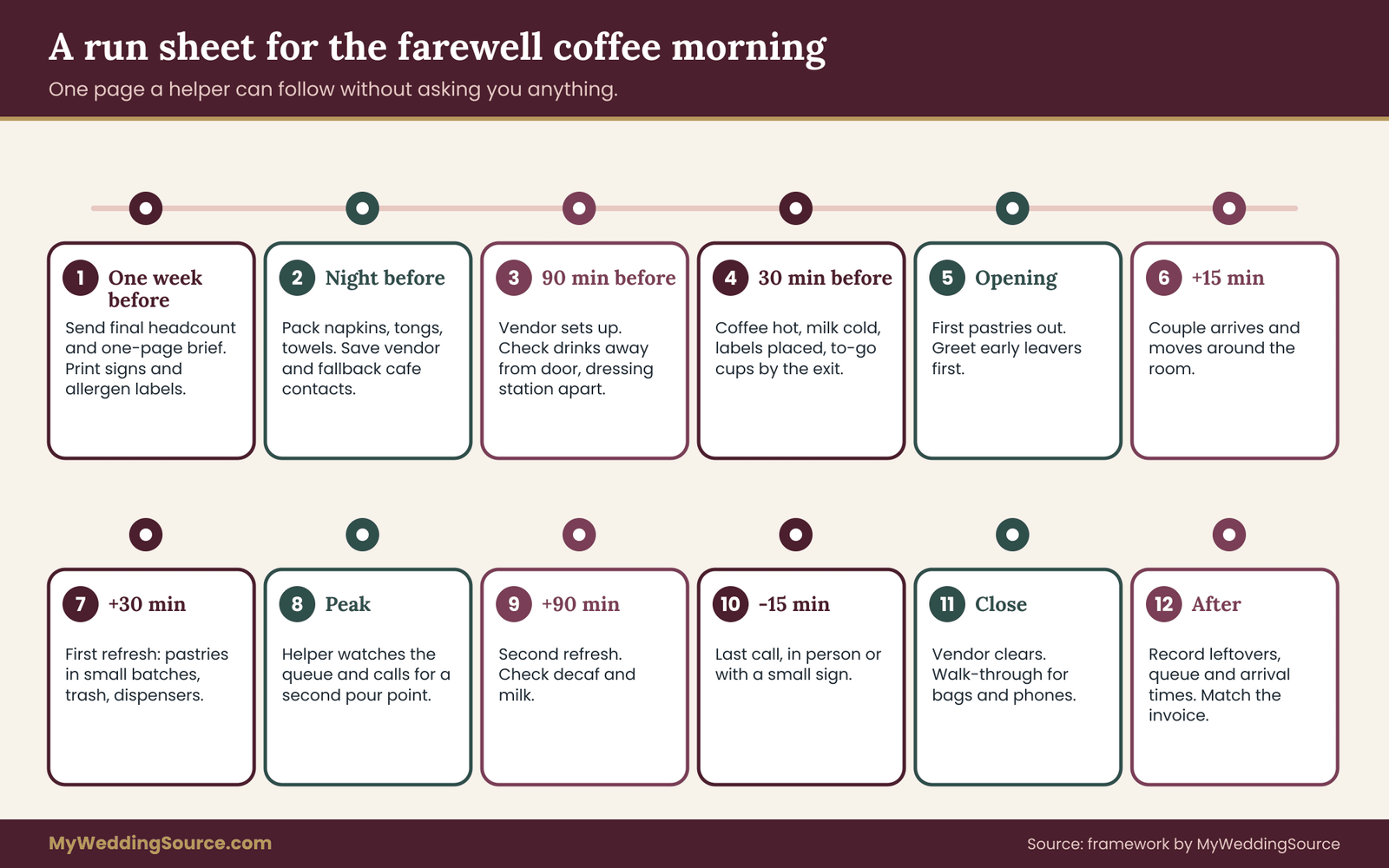
A farewell coffee run sheet is a one-page schedule that a helper can follow without asking you anything. It lists what happens, when, who does it and what to do if it goes wrong. For a farewell coffee it can be short.
The week before
Confirm the final headcount and send it to the vendor before the deadline. Send the vendor your one-page brief again, with any changes. Confirm the space, tables, power and trash arrangements with the venue. Print signs for decaf, regular, tea and milk options, and allergen labels for each pastry. Name your helper or helpers and share the run sheet with them.
This is also a good time to look at the rest of the weekend. The wedding planning checklist can serve as a full list of the other morning-after tasks, from check-out to returns, so the coffee is not the only thing that has an owner.
The night before
Pack the items you are responsible for, such as signs, napkins, a spare pair of tongs, hand sanitizer, a roll of paper towels and a small trash bag. Confirm the vendor’s arrival time by message. Put the vendor’s number, the fallback café’s address and the hotel contact on the run sheet. Tell your parents or helper where to find you and who has authority to make a small decision, such as approving a refill, without calling you.
The morning, in order
- Ninety minutes before opening: The vendor arrives and sets up. A helper checks the layout against your plan, in particular the position of the drink station away from the door and the dressing station apart from the pour point.
- Thirty minutes before opening: Coffee is brewed and held hot. Milk and dairy-filled items are on ice or in a cold unit. Labels are placed. The early leavers’ to-go cups are ready near the exit.
- Opening: The first pastries are out. A helper or the vendor greets early guests and points them to the stations.
- Fifteen minutes after opening: The couple arrives, as agreed, and begins moving around the room, speaking first to the guests with the least time.
- Thirty minutes after opening: First refresh. Pastries are replenished in small batches, the dispensers are checked and trash is emptied.
- Peak: A helper stands near the stations to watch the queue, and calls the vendor if a second pour point is needed.
- Ninety minutes after opening: Second refresh and a check of decaf and milk levels.
- Fifteen minutes before closing: Last call, in person or with a small sign.
- Closing: Vendor clears. A helper makes sure no one has left a bag, a jacket or a phone, then does a final walk-through.
The wedding vendor timeline pairs well with this sheet when other vendors, such as a florist or a rental company, are collecting items the same morning, because it keeps arrivals and load-out from overlapping with your guests.
After the service
Take a few minutes for a short record. Note the number of unused cups and pastries, the time the first and last guests arrived, any queue that formed and anything that ran short. Ask the vendor for a final invoice that matches the written order, and keep the receipt. Send a short thank-you to anyone who helped. If you have a moment, write down one thing you would change, which is a small piece of evidence that costs nothing and might help a friend later.
Your next steps
You do not need to plan the whole farewell coffee at once. Work through these in order, and each step makes the next one easier.
- Build the departure map. List each household, their departure time and the latest time they can arrive at the farewell coffee.
- Set the farewell coffee window. Choose a start that protects your earliest leavers and a length of about two hours.
- Sketch the arrival curve. Count guests in half-hour blocks and find the peak.
- Run the quantity chain. Attendees, drinkers, cups each, buffer, volume, then pastries.
- Size the pour points. Use the queue calculation and your own waiting standard.
- Choose a format and collect two quotes. Convert each to a cost per attending guest.
- Write the one-page brief and the run sheet. Share them with the vendor and your helpers, and confirm the final headcount deadline.
FAQ
What is a wedding farewell coffee?
A wedding farewell coffee is a short, hosted coffee and pastry service on the morning after the wedding. Guests drop in during a set window, take a drink and something small to eat, say goodbye and leave. It has no seating chart, no plated meal and no toasts. It works well for guests who are traveling and want a last conversation without committing to a full brunch.
How long should a farewell coffee last?
About two hours suits most weddings. That is long enough for early leavers and late risers to both attend, and short enough for one helper to stay attentive. Ninety minutes can work for a small group in one hotel. A window of three hours begins to look like a brunch in labor and cost. Set the start by your earliest departure and add a last call about fifteen minutes before the end.
How much coffee should I order for a farewell coffee?
Multiply the adults you expect by the share who drink coffee, then by cups each, which is often between one and two, then add a buffer of about ten to twenty percent. Convert the cups to fluid ounces using the vendor’s cup size. Compare your figure with the vendor’s own rule of thumb, and check that the volume covers your busiest half hour, not only the total.
How many pastries per guest are enough?
A common starting point is about one to one and a quarter pieces per adult and one per child, with a small buffer of around ten percent. Treat it as an assumption and ask your vendor what it normally suggests. Split the order across several types, including one suitable for common dietary needs, and put the pastries out in batches so the table stays fresh and later guests still have choices.
How do I avoid a long line at a farewell coffee?
Add pour points until the queue in your busiest ten minutes stays short. Divide the guests in that burst by the combined serving rate of your pour points, and compare it with your waiting standard, such as three minutes. Place the milk and sweeteners at a separate station, keep the drinks away from the door, and consider a separate point for tea and hot water.
Do I need a vendor for a farewell coffee, or can family handle it?
Either can work for a small group. Family can handle a modest service if one person is assigned to each task, such as restocking, watching food temperature and cleaning. A vendor helps when the crowd is larger, when food safety rules apply, or when no one in the family wants to work that morning. Whichever you choose, name the person responsible for each station before the day.
How do I handle allergies at a coffee and pastry service?
Ask the vendor for written ingredient and allergen lists, label each item with its main allergens in plain words, and use separate tongs for each item. Do not claim an item is free of an allergen unless the baker can document it. If a guest has told you about a serious allergy, tell the vendor ahead of time and speak with the guest about what you can and cannot confirm.
What if guests have to leave before the farewell coffee starts?
Offer a simple to-go option. Leave lidded cups and a pastry bag at the front desk the night before, or ask the vendor to open a small early station. Send those guests a short note thanking them and saying you will miss them at the coffee. A to-go bag is a good supplement, though it does not replace a conversation, so a call or message later also works.
Sources
- FDA Food Code, U.S. Food and Drug Administration
- Food allergies, U.S. Food and Drug Administration
- Spilling the beans: how much caffeine is too much?, U.S. Food and Drug Administration
- Food safety, U.S. Department of Agriculture Food Safety and Inspection Service
- Food safety information for consumers, FoodSafety.gov
- Clean hands, Centers for Disease Control and Prevention
- Food allergy, National Institute of Allergy and Infectious Diseases
- Americans with Disabilities Act information, U.S. Department of Justice
- Travel and security screening, Transportation Security Administration