
A recipe card shower asks each guest for one handwritten recipe instead of a gift, so the couple ends up with a shared family cookbook and nobody has to shop, spend or compare. This guide gives you invitation wording, a card template and a collection routine that keep the recipe card shower relaxed for guests and useful for the couple.
A recipe card shower works when the invitation says three things plainly: what to bring (one recipe card), what to leave at home (gifts, unless the guest truly wants to), and how to take part from far away (a photo or a typed card by a set date). Use a simple eight-field card so every recipe is usable, collect cards in two or three ways, and let the host fill gaps so no guest feels singled out. Keep the finished cards in a box, a binder or a book, and check each one for allergen notes and credit.
Showers have a reputation for quietly turning into shopping events. A guest gets an invitation, checks the registry, wonders what the going price is, and then wonders whether a smaller gift will look cheap beside everyone else’s. The recipe card shower is a shower format built to remove that whole chain of thought. The “gift” is a recipe card, and a recipe card costs a stamp or nothing at all.
That sounds simple, and in a way it is. But a recipe card shower can still go wrong in small, predictable ways. The invitation can say “no gifts” so vaguely that guests bring them anyway. Cards can arrive in a dozen shapes, half of them missing the serving size or the oven temperature. A guest who never cooks can feel stranded. A recipe copied from a cookbook can raise questions the host did not expect. And a pile of loose cards can end up in a drawer within a month, which defeats the point.
This guide stays on that one format. It does not cover how to plan every kind of bridal or wedding shower, or how to word invitations for mixed groups of guests. For those, the site has separate guides, and the wedding invitation etiquette page covers the general rules of wording, timing and who the invitation comes from.
What you will find here is narrower: an original invitation template, an original card collection template, a way to compare this recipe card shower format with other low-pressure ones, questions to ask a printer, a worked example with invented people, and the edge cases that trip hosts up.
A note on scope. This is general hosting information, not legal, tax or financial advice. Customs about showers differ by region, family and community, and recipes can carry personal or cultural meaning, so treat the wording in this guide as a starting point and adjust it to the people you are inviting.
What a recipe card shower is, and what it is not
A recipe card shower is a pre-wedding gathering where the shared activity is collecting recipes. Each guest contributes a recipe, usually on a card, sometimes with a short note about why it matters to them. The couple receives the whole collection, either as the cards themselves or as something made from them.
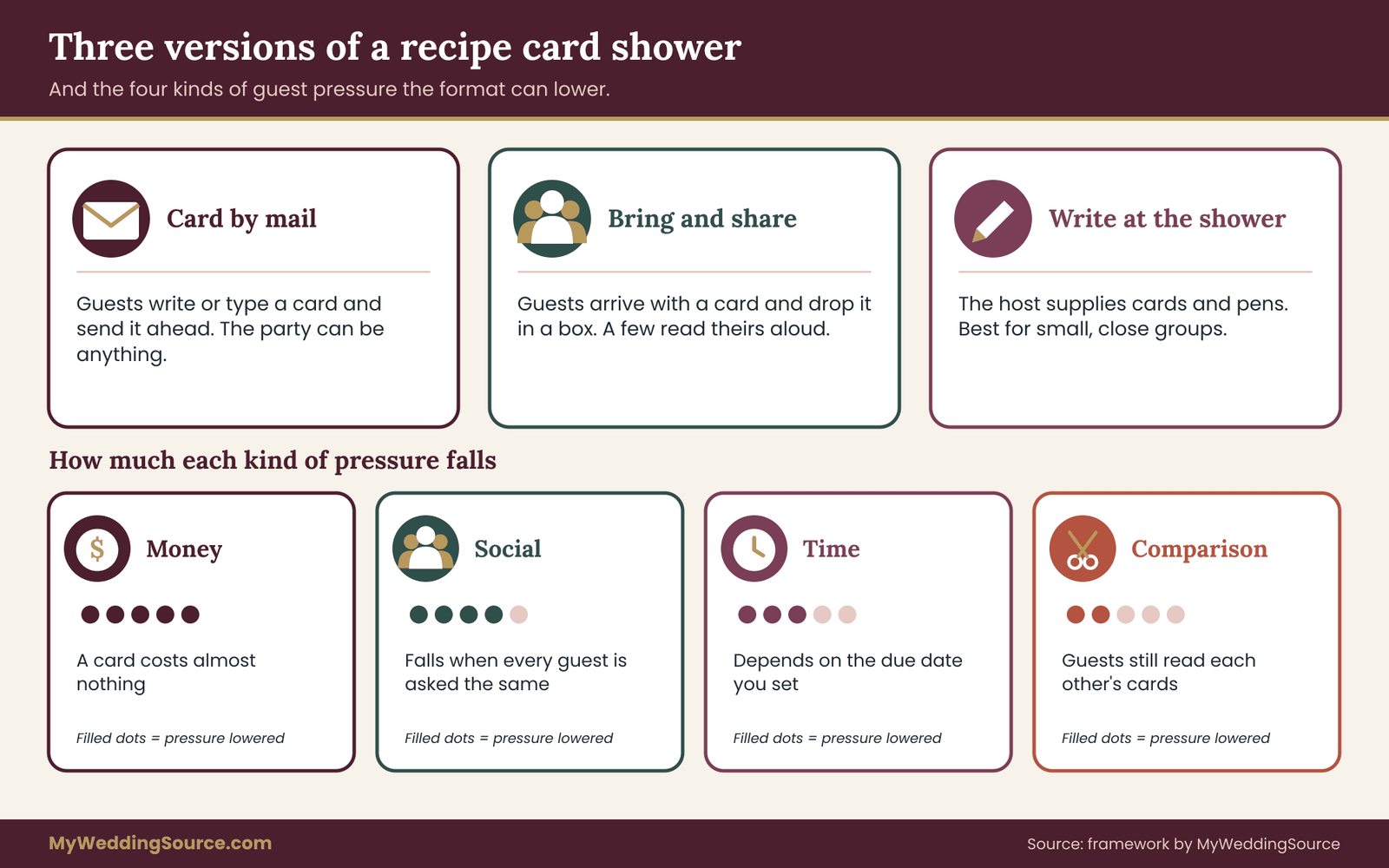
There are three common versions of the recipe card shower, and they ask different things of guests.
The card-in-the-mail version. Guests write or type a card and send it ahead of time. The gathering itself can be anything: a brunch, a backyard lunch, a video call. The cards are presented at the event or opened later.
The bring-and-share version. Guests arrive with a card in hand. There is usually a table where cards are dropped into a box, and the host might invite a few guests to read their recipe aloud or say a line about it.
The write-at-the-shower version. The host supplies blank cards, pens and a simple prompt, and guests write a card during the party. This version works best for small groups where people know the couple well, because it asks people to produce something on the spot.
Many hosts blend the first two. Guests who live nearby bring cards; guests who live far away mail or email them. The template later in this guide is built so all three versions produce cards that look and read alike.
What a recipe card shower is not: it is not a registry in disguise, it is not a potluck, and it is not a cooking contest. It is also not a way to ask guests to do more work than a gift would have taken. If the invitation makes the recipe feel like homework, the recipe card shower format has failed. The Quick answer above is the whole test: one card, no gift expected, a clear way to take part from far away.
Why the format appeals to hosts and guests
The appeal is mostly about cost and comparison. A card costs almost nothing, which means a guest on a tight budget and a guest with plenty of money are doing exactly the same thing. There is no visible price tag, so there is nothing to compare. That is the core reason a recipe card shower reads as gentler than a gift shower.
There is a second appeal that is easy to miss. A recipe is personal. A guest who hands over a recipe is handing over a small piece of their own kitchen, and the couple gets something that cannot be bought: the aunt’s holiday soup, the college roommate’s burnt-edge cookies, the neighbor’s weeknight rice. A well-run recipe card shower gives people a reason to say something kind or funny about each other in writing, and that part tends to be remembered long after a toaster would have been forgotten.
There is a third appeal for the couple. A collection of recipes is useful in the most ordinary sense. It gets used in a kitchen. It can also be kept, reprinted, passed to children and read in years when other keepsakes have been boxed away.
Where the format can still create pressure
A fair account of this format includes its weak points, because a host who sees them in advance can plan around them.
First, guests who do not cook. A guest who eats takeout most nights may feel they have nothing to offer. The fix is permission: the invitation should say that a recipe can be as simple as a sandwich, a drink, a snack plate or a store-bought shortcut written down honestly.
Second, guests who cook very well. A confident cook may produce a three-page, twelve-step recipe and feel judged next to a guest who sends two lines. The card size and the eight-field template described later keep the contribution a similar size for everyone.
Third, guests who have difficulty writing by hand, who have low vision, who write in a different language from the couple, or who are uncomfortable sharing a family recipe that carries cultural weight. Each of these is covered in the edge cases section, and none of them is a reason to drop the recipe card shower format.
Fourth, guests who bring a gift anyway. Some people cannot arrive empty-handed, and some invitations from relatives are read as a polite formality. Your invitation wording can reduce this, but it cannot remove it, and the host should decide in advance how to handle a surprise gift without making anyone feel scolded.
Finally, the couple themselves. A recipe card shower only works as a no-pressure event if the couple are comfortable with it. If the couple would privately prefer gifts, or if their families will expect them, say so early to the host. A shower that quietly contradicts the couple’s wishes helps no one.
How a recipe card shower reduces gift pressure, and where it cannot
The word pressure covers several different things, and it helps to separate them. A guest might feel financial pressure (what can I afford), social pressure (what will others bring), time pressure (when do I have to shop), and comparison pressure (will mine look small). A recipe card shower reduces all four, but not equally.
Financial pressure falls the most. A card costs almost nothing, and the template in this guide specifically avoids asking for anything that has to be bought. Even so, a host who adds a printed book, a stamped envelope or a recipe box to the plan has added a cost, and that cost should land on the host, not the guests.
Social pressure falls when the ask is uniform. If every invited guest is asked for the same thing, nobody stands out. It rises when the host creates tiers, for example by asking close friends for a recipe plus a small gift and everyone else for a recipe only. Avoid tiers in the invitation itself.
Time pressure depends on the due date. A card due in two weeks asks for an evening. A card due in two days asks for a scramble. The timeline later in this guide suggests a collection window of several weeks, with a gentle reminder, and an explicit statement that late cards are welcome and will be added to the collection.
Comparison pressure is the one the recipe card shower format cannot fully remove, because people will still read each other’s cards. The host controls this in three ways: by keeping cards the same physical size, by not ranking or praising cards publicly, and by treating a two-line card exactly like a long one.
The gift question underneath
Underneath the format sits a plain question: do you want guests to bring gifts or not? There are really three honest answers, and each calls for different wording.
The first answer is “please do not bring gifts.” This is the cleanest and the hardest to pull off, because some guests will still bring something. It needs a clear sentence and a calm plan for what to do when a gift appears.
The second answer is “gifts are not expected, but guests who want to are welcome to.” This is the most common real-world position. It accepts that some guests want to give and removes the sense of obligation from the others. The wording must not hint at a registry or a price.
The third answer is “the recipe card is the gift.” This frames the card itself as the offering. It works well when the couple wants the cookbook as their main shower keepsake, and it makes the card feel valued rather than like a consolation.
Pick one of these three before writing the invitation. Mixing them is how hosts end up with a card that says “no gifts please” and a footer that links to a registry. The second article on the site that helps here is the guide to wedding registry ideas, which explains registry options for couples who want to guide gift-giving separately from the shower.
What the host should settle before sending anything
Before the first invitation goes out, a host benefits from settling five points with the couple. These take about twenty minutes in a single conversation, and they prevent most of the confusion later.
Who is the cookbook for, and in what form? A box of cards, a binder, a printed book and a shared digital file all need different card sizes and collection choices, so decide the end form first.
What is the gift position among the three listed above?
Who pays for the materials, such as blank cards, postage, printing or a recipe box? The answer should be the host, the couple or a small group of hosts, never the guests.
Who is allowed to see the recipes before the couple? Some couples want a surprise. Others are happy to see cards as they arrive.
What is the due date for cards, and what happens to late ones?
Write the answers in a short note and share it with every co-host. The rest of this guide assumes you have those five answers.
The invitation wording template for a recipe card shower
The invitation is where a recipe card shower succeeds or fails. Guests decide how much pressure they feel in the first ten seconds of reading it. A good invitation answers three questions without being asked: what do I bring, what should I not bring, and what do I do if I cannot come.
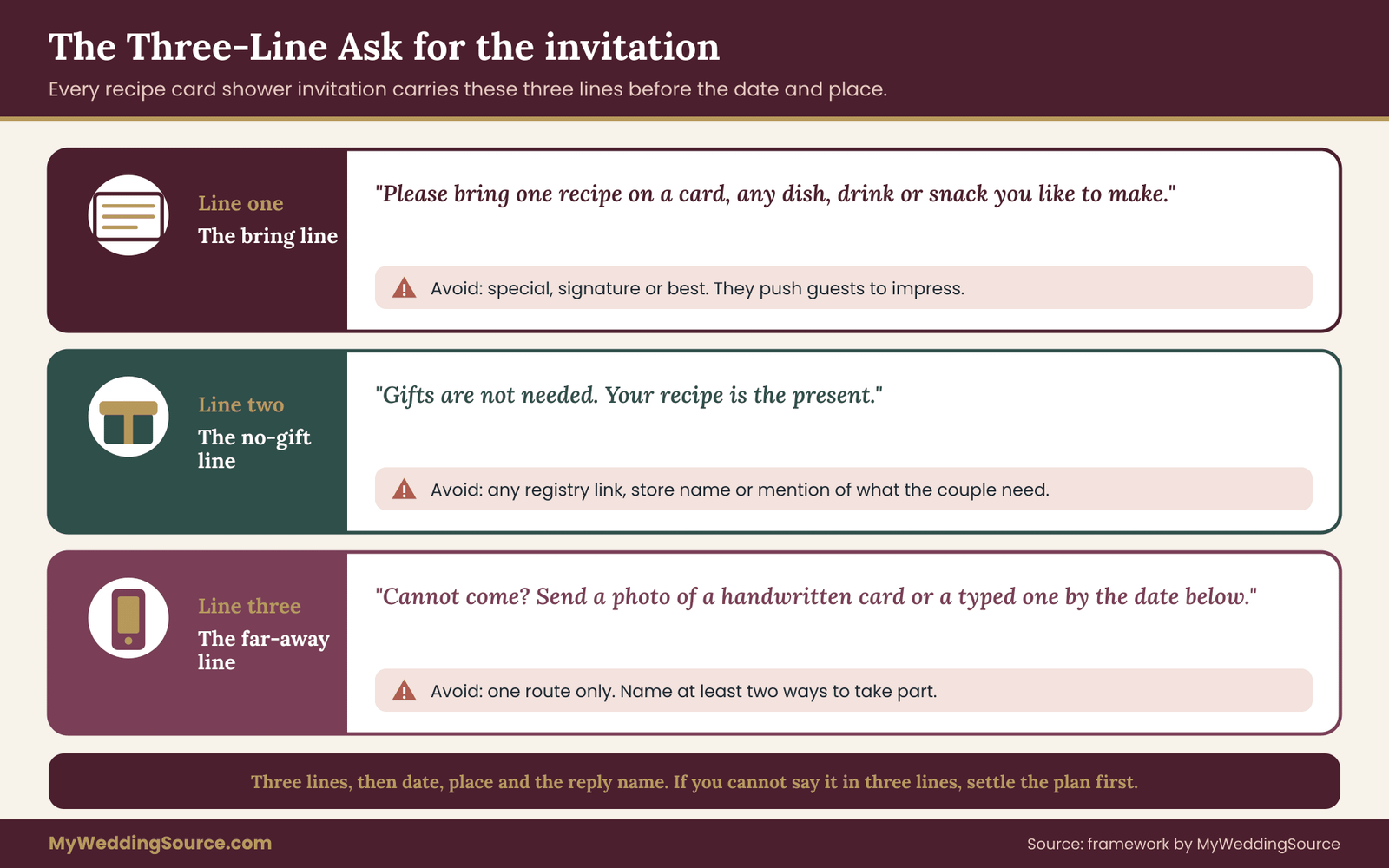
That gives the template its shape, which this guide calls the Three-Line Ask. Every invitation for a recipe card shower carries three plain lines, in this order, and then the usual details of date, place and reply.
Line one: the bring line. It names the one thing guests are asked to bring, and sets its size. For example: “Please bring one recipe on a card, any dish, drink or snack you like to make.”
Line two: the leave-at-home line. It states the gift position. For example: “Gifts are not needed. Your recipe is the present.”
Line three: the far-away line. It tells guests who cannot attend, and guests who prefer not to write by hand, how to take part. For example: “Cannot come? Send a photo of a handwritten card or a typed one by the date below, and we will add it to the collection.”
Three lines is not a rule of nature. It is a discipline. If you cannot say what you want in three lines, the plan behind the shower is not settled yet, and returning to the five points in the previous section will help more than rewording.
Sample invitation: warm and informal
This version suits a recipe card shower for friends, coworkers and most family groups.
Join us to celebrate Maya before her wedding. Bring one recipe on a card, anything you like to cook, drink or snack on, and she will have a cookbook made of everyone who loves her. No gifts, please. Your recipe is the present. If you cannot join us, send a photo or typed card by March 1 and we will add it. Brunch on Saturday, March 15, at noon at the Hartley house. Reply to Dana by March 1.
Notice what the example does not say. It does not name a registry. It does not describe what the couple needs for their kitchen. It does not ask guests to “just bring a small something.” It does not tell guests which recipe types are preferred, because a preference for a type of recipe is a quiet way of grading contributions.
Sample invitation: more formal
For a recipe card shower hosted by relatives or in a more traditional setting, the same three lines can be written in a quieter register.
Mrs. Elena Hartley and Ms. Dana Hartley request the pleasure of your company at a recipe shower in honor of Maya Okonkwo and her fiancé, Samuel Reed. Guests are invited to bring one favorite recipe, handwritten on the enclosed card. Gifts are not expected. Guests unable to attend may return the card by post or send a typed copy by the date below.
Here the enclosed card does a lot of work. A printed or blank card inside the envelope turns line one into an object. People complete tasks that arrive in their hands far more reliably than tasks described in a paragraph, though that is a common-sense observation, not a statistic. If you are printing invitations, the wedding invitation printing guide explains proofing and quantities in more depth, and the same habits apply to a small shower insert.
Sample invitation: digital or text
A digital invitation for a recipe card shower can be shorter, and it can link to a form or a shared folder where cards are collected. A short text-style version:
Dana here. We are collecting recipes for Maya and Samuel’s cookbook. Send me one recipe, any dish or drink, by March 1: a photo of a handwritten card, or typed into the form I will send. No gifts, please. The recipe is the gift. Brunch on March 15 if you can make it.
A digital invitation also raises a privacy question. If the form collects phone numbers or emails, say who will see them and how they will be used. Keep contact details in one private list and delete the form data once the book is finished.
Sample invitation: the recipe card is the gift
When the couple want the cookbook as their main shower keepsake, wording that treats the card as the present makes it feel less like a consolation prize.
Instead of a gift, we are asking each guest for something only you can give: a recipe you make, in your own words, on the card enclosed. Maya and Samuel will keep every one.
This version is the warmest, and it carries a small risk. It sets a high expectation for the card. If you use it, the card template later in this guide matters more, because it lets guests meet the expectation with eight short answers rather than an essay.
Sample invitation: gifts welcome but not expected
When the couple or their families will want to give anyway, a softer line states the position truthfully.
Gifts are not expected. If you would like to give something, a card with your recipe is more than enough.
This phrasing is honest about the fact that some guests will give. It does not tell them they must not. Be careful not to follow it with registry information. If the couple wants guests to know about a registry, it is better to leave that to the wedding website or to word of mouth than to attach it to a shower invitation that has just said gifts are not expected.
The pressure audit: five checks before you send
Before sending, read the recipe card shower invitation as a nervous guest would. The pressure audit has five checks, and each is a plain question.
Check one: does anything in the invitation say or imply what a good contribution looks like? Words such as “special,” “signature,” “best” and “favorite” can push guests to impress. “Any recipe you make” does the opposite. A favorite recipe is fine as a prompt if you also say that a simple one counts.
Check two: does the invitation mention money, stores or a registry? Even a hint, such as “the couple are setting up their first kitchen,” can read as a gift prompt. Remove it unless you want gifts.
Check three: is there a deadline, and is it the only deadline? One date, with a note that late cards are welcome, is gentle. Several dates, such as one for the reply and another for the card and another for a photo, create bookkeeping for guests.
Check four: does it work if the guest cannot write by hand or cannot attend? The far-away line should name at least two ways to take part, so that a person who cannot do one has another.
Check five: does it avoid assuming the guest’s gender, family structure or cooking role? Invitations for a shower sometimes assume the guest will be a woman who cooks. A recipe card shower can be coed, and many guests cook, and the wording “any recipe you make” is neutral. The principle is simple: describe the task, not the guest.
Five yeses, and you can send.
Words to avoid and words to prefer
A few small word choices carry more weight than the sentences around them. Use them as a quick reference when editing.
Instead of “recipe contest” or “recipe competition,” say “recipe collection.” A contest implies winners.
Instead of “family secret recipe,” say “a recipe you make.” A request for secrets makes people uneasy about sharing something private.
Instead of “please bring a small gift,” say “gifts are not needed.” The first sentence is a request wearing a disguise.
Instead of “must be handwritten,” say “handwritten or typed.” Handwriting is charming, and it is also a barrier for some guests.
Instead of “RSVP with your recipe,” say “reply to Dana by March 1, and send your card by the same date if you can.” Combining the reply and the contribution makes a missed card feel like a missed invitation.
Placing the line about late cards
Many hosts forget to say that late cards are welcome. It is one sentence, and it removes the main source of anxiety for procrastinators. A usable line is: “Cards that arrive after the party will still go into the book.”
A related line handles guests who want to contribute after seeing others’ cards: “You are welcome to send a second recipe.” This is optional, and a host who expects a printed book with a fixed page count may prefer to leave it out.
Co-hosts and the single voice
When a recipe card shower has several hosts, a common failure is that each host sends a slightly different message. One says no gifts, another mentions the registry, a third adds a deadline. Agree on one master wording, put it in a shared note, and have every host send exactly that text. If a host is tempted to add personal remarks, a separate message is fine, but the gift line should never vary.
A note on translating the invitation
If a significant part of the guest list reads another language more comfortably, translate the three lines rather than the whole invitation. A guest reading a short text in their own language can handle the rest. Ask a fluent friend to check the translation, and keep the bring line extremely literal, since idioms about “favorite dishes” do not always carry across.
Timing the invitation
A recipe card shower can use a slightly longer lead time than a gift shower, because the guest needs time to find or write a recipe, and sometimes to ask a relative for it. Several weeks before the event is a reasonable window for an invitation that asks for a card, with a reminder about halfway through. Guests who live abroad or who will need to request a recipe from an older relative may need more. The timeline figure later in this guide spreads the tasks across eight weeks and shows where each message fits.
The card collection template for a recipe card shower
An invitation gets guests to take part. The card decides whether what comes back is usable. Without a shared structure, a recipe card shower collects a strange mix: a photo of a stained index card with half the quantities missing, a long email, a phone screenshot, a recipe that says “add flour until it feels right.” The couple then has a collection that is charming to read and impossible to cook from.
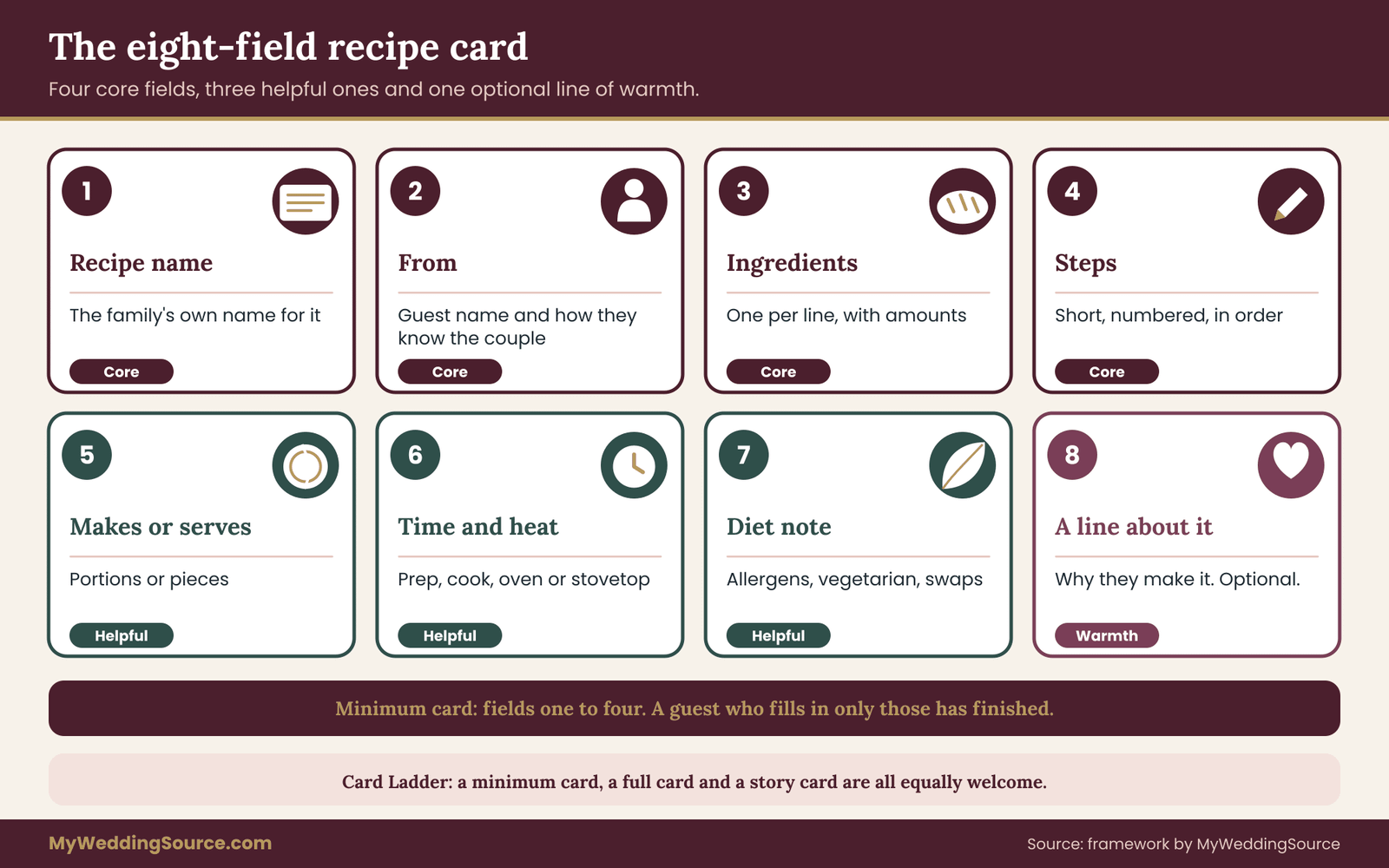
The fix is a card template with a small number of fields, each with a clear job. The template here has eight. Four are core, three are helpful, and one is purely for warmth.
Core fields
- Recipe name. What the dish is called in the guest’s family, even if it is an unusual name. A recipe called “Aunt Rosa’s Tuesday Beans” should stay that way.
- From. The guest’s name and how they know the couple, such as “Priya, Maya’s college roommate.” Without this line, a future reader cannot tell who a card came from, and the point of the book is partly that it answers that question.
- Ingredients with amounts. A list, one ingredient per line, with a quantity. “A handful” and “to taste” are allowed for seasonings, but the main ingredients need numbers.
- Steps. Short, numbered, in the order of cooking. Three to eight steps is typical. A step that says “bake until done” should say how a cook can tell.
Helpful fields
- Makes or serves. How many portions, or how many pieces, so the couple can scale the dish.
- Time and temperature. Prep time, cook time and any oven or stovetop setting. These are the details a cook looks for first.
- Allergen and diet note. A single line such as “Contains wheat, eggs and milk,” or “Vegetarian,” or “Easy to make gluten-free with rice flour.” This is a safety line, and the section on edge cases explains why it matters.
Warmth field
- A line about it. One or two sentences: why the guest makes this, when, for whom. This field is optional, and the guest should be told so. It is also the field people tend to enjoy most.
Why eight fields and not more
A template with fifteen fields turns a gift into a form. A template with three fields produces cards that cannot be cooked from. Eight sits between those. It also fits on a standard recipe card, which matters, because a card that must be continued on the back or on a second card feels like a bigger task than a single card.
If you want to lower the effort further, offer a minimum card. A guest who fills in only recipe name, from, ingredients and steps has completed the card, and the host can add serves and time later if the guest is happy to be asked. This is the Card Ladder: a minimum card, a full card and a story card, each welcome, none ranked above another. State the ladder in the guide you send, not in the invitation, so the invitation stays short.
Card sizes and what they mean for the end product
The physical size of the card affects both the guest’s effort and the final collection. The sizes below are common in stationery and recipe boxes, but check the dimensions of the actual cards and box you buy, because sizes vary by maker.
A 3 by 5 inch card is the smallest common size. It is quick to fill in, and it suits short recipes, but it forces tiny handwriting and cannot hold a long ingredient list. It suits drinks, sauces and snacks.
A 4 by 6 inch card is the most practical for a recipe card shower. It holds an ingredient list and steps in readable handwriting, fits most recipe boxes sold for it, and scans well.
A 5 by 7 inch card gives space for a story line and larger handwriting. It suits guests with low vision or arthritis, and it fits many photo frames, though it will not fit a standard 4 by 6 recipe box.
If you plan a printed book, the card size matters less, because cards will be scanned or retyped. If you plan to keep the cards as objects, pick the size first and buy a box or binder that fits.
The guest guide: one page, sent with the invitation
Alongside the invitation, send a one-page guide to the card. It should be short enough to read in under a minute. It repeats the eight fields as plain prompts, notes which are optional, and gives three sentences about how cards will be used. It might read, in the host’s voice:
Thank you for sharing a recipe. Use the card enclosed or copy the fields below into an email. Please include amounts, because Maya and Samuel will cook from this. If you are unsure of an amount, estimate and say so. We will keep your card exactly as you write it. If we need to ask a question, we will contact you before anything is printed.
The last promise is important. Guests who worry that their card will be edited or rewritten for a book are less likely to share a family recipe. Tell them you will only fix typos, and will ask before changing anything else.
A sample finished card, with invented content
To show the template at work, here is an invented card. It is not a real recipe from a real person, and the quantities are only illustrative.
Recipe name: Sunday Tomato Rice From: Priya, Maya’s college roommate Makes: 4 servings Time: 10 minutes prep, 25 minutes cooking, stovetop Ingredients: 1 cup long-grain rice; 1 can (14 ounces) diced tomatoes; 1 cup water; 1 small onion, chopped; 2 tablespoons oil; 1 teaspoon salt; pinch of cumin Steps: 1. Warm the oil in a pot and cook the onion until soft. 2. Stir in the rice and cumin for one minute. 3. Add tomatoes, water and salt, and bring to a boil. 4.
Cover, lower the heat and cook until the rice is tender and the water is absorbed. 5. Rest five minutes, then fluff. Diet note: Vegan; no common allergens in the listed ingredients. A line about it: We made this every Sunday in the dorm kitchen, and it still tastes like exams.
Everything on the card is checkable. A future cook can make it, and a future reader can tell who it is from and why it matters.
Adding photos and handwriting
Some guests will want to include a photo of the dish or of themselves cooking. This is a pleasant bonus, but it should be optional and it needs a rule about consent when other people appear. A guest who includes a photo of a child or a friend should be sure that person is comfortable with it being printed in a book that others will see.
Handwriting is also worth saving. Ask for a scan of handwritten cards, even if you transcribe the text for readability. A transcription captures the recipe; a scan captures the person. If the final product is a printed book, a page can carry both: the typed recipe, and a small image of the original handwriting.
Standardizing without erasing
A host or an editor helping compile the cards faces a real tension. Standardizing units and wording makes recipes easier to follow. Rewriting them erases the voice that made the card worth having. A workable rule is this: fix typos, add missing units in brackets, and leave everything else. If “bake until it smells right” is the guest’s line, keep it, and consider adding a bracketed guide such as “usually about 30 minutes” after checking with the guest.
Credit and sources for recipes that are not the guest’s own
Many guests will send a recipe they found in a cookbook, on a website or in a magazine. This is common, and it deserves a plain answer. In the United States, a list of ingredients and basic cooking directions is generally treated differently from the creative text, photographs or substantial commentary around a recipe, and the U.S. Copyright Office publishes general information on what copyright does and does not cover.
If you plan to print a book, particularly one you will sell or give to many people, ask guests to say where a recipe came from and to write it in their own words. For a private keepsake that stays among family, the stakes are different, but crediting the source remains good practice and costs a line on the card.
An easy form of credit is “Adapted from” plus the name of the book or site. If a guest says only that a recipe came from the internet, ask whether they remember where, and add what they tell you.
Safety notes on shared recipes
A cookbook becomes a set of instructions people will follow in their kitchens, so a few safety checks are worth the effort. The U.S. Department of Agriculture publishes safe minimum internal temperatures for meat, poultry, seafood and leftovers, and a short check of any recipe that cooks these foods against those guidelines is sensible before you print.
Recipes involving home canning, raw eggs, undercooked meats or fermentation deserve extra care, and a host who is not sure can flag the recipe and ask the guest to confirm their method, or can add a note to follow current guidance from the USDA or a local extension service.
You are not auditing anyone’s cooking. You are checking that a printed recipe does not teach an unsafe habit by accident.
Collecting cards before the recipe card shower
A recipe card shower has two deadlines that are easy to confuse: the day of the recipe card shower and the day the last card arrives. They are not the same, and the better hosts separate them in their planning. The party is a social event. The collection is a small project. A gentle project schedule keeps the recipe card shower relaxed.
Choose two or three ways to collect, not one
Guests differ in how they prefer to send things, so offer more than one route. Each route has trade-offs.
Paper cards by post or by hand. Best for guests who like writing and for older relatives. Include a stamped, addressed envelope in the invitation if the host is paying for postage, which keeps the cost off the guest. Check current postage rates and size rules with the United States Postal Service, because a stiff card in a thin envelope can be handled differently from an ordinary letter.
Photo or scan by text or email. Best for guests who write the card by hand but live far away. Ask for a flat, well-lit photo taken from directly above, with the whole card in frame. A host can tell guests that a phone’s built-in document scanner works well.
An online form. Best for guests who prefer typing, and for hosts who want consistent fields. A form that mirrors the eight fields produces cards that line up on the page. The host should say where the form data lives and who can see it, and should keep it limited to what the cards need.
Voice or video. Some guests, particularly older relatives or those who find writing difficult, may prefer to say the recipe aloud. A host can transcribe it onto a card and read it back to the guest for approval. This is a thoughtful option to offer quietly rather than advertise.
Offering at least a paper route and a digital route covers most guest groups. Offering all four is generous but can multiply the host’s work.
A collection timeline that spreads the work
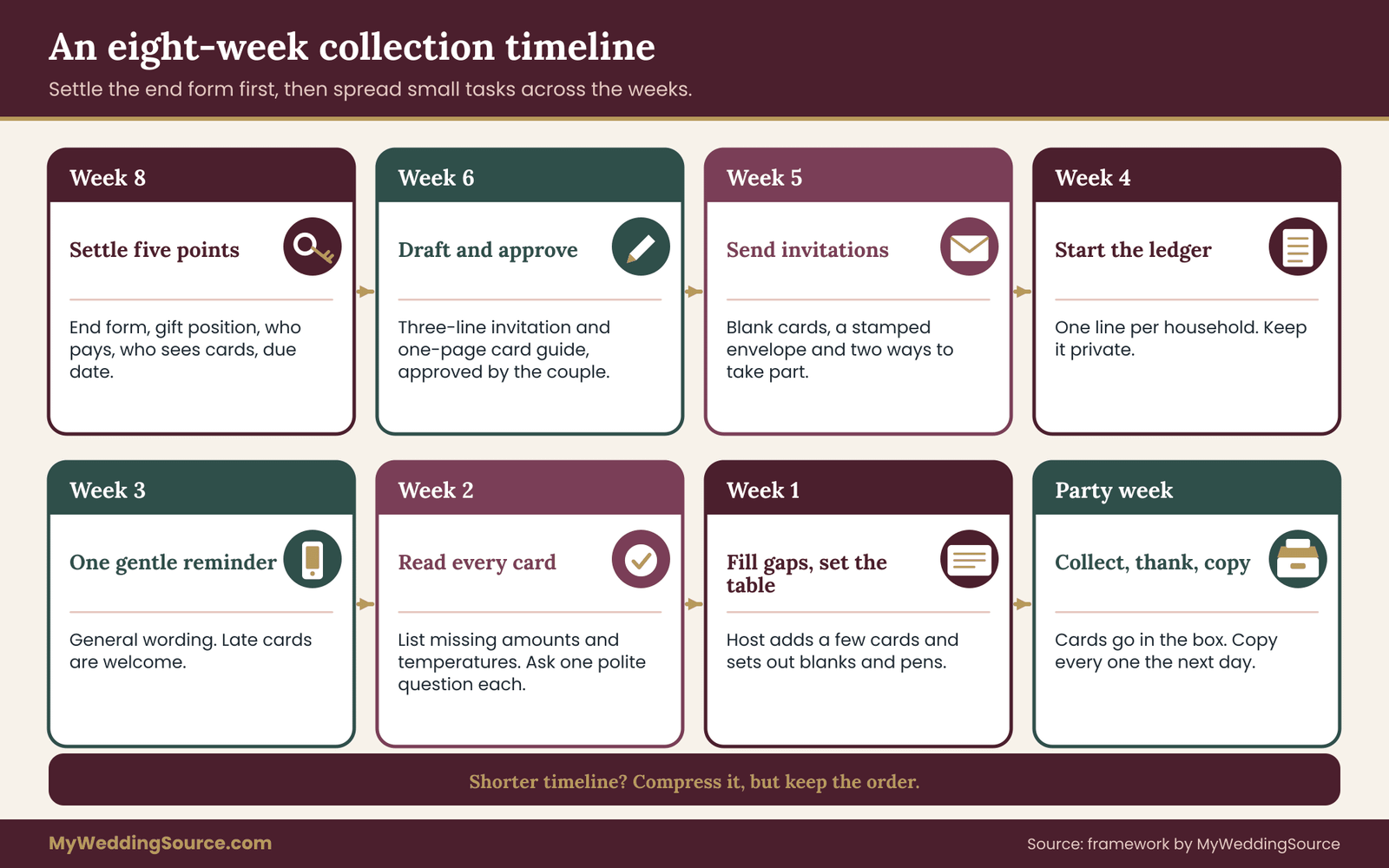
A recipe card shower has plenty of time inside it, and a simple eight-week sequence keeps each step small. The figure above summarizes it. In prose, the sequence runs like this.
Around eight weeks before the recipe card shower, the host settles the five points described earlier: end form, gift position, who pays for materials, who sees cards, and due date. Six weeks out, the host drafts the three-line invitation and the one-page guest guide, and has the couple approve both. Five weeks out, invitations and blank cards go out. Four weeks out, the host starts the collection ledger described below.
Three weeks out, a friendly reminder goes to guests who have not replied. Two weeks out, the host checks that cards in hand are readable and starts a short list of guests who might need help. One week out, the host fills any gaps with their own cards and prepares the display. Party week, the host brings everything together.
If your timeline is shorter, compress it, but keep the order. The order matters because decisions about the end form, such as card size and box, have to come before cards go out.
The collection ledger
A host who collects more than a dozen cards benefits from a simple ledger. This is a one-page list, on paper or in a spreadsheet, with a line for each invited household. The columns, described here in prose rather than as a grid, are: the guest’s name, whether they replied, how they plan to send the card, whether the card has arrived, whether it needs a follow-up question, and whether the guest is happy to have their name printed.
The ledger does three jobs. It shows at a glance who has not yet sent a card, so the host can send a warm nudge. It records any follow-up questions, so a missing oven temperature is not forgotten. And it records consent to print names, which matters if the cards will become a book.
Keep the ledger private. It is a host’s working document, not something to share with the couple or other guests. A ledger shown to the room turns a gentle collection into a roll call.
Reminders that do not nag
A reminder works when it is easy to answer and does not shame. Two reminders are usually enough, and no guest should receive more than three messages from the host about a card.
The first reminder, around the halfway point, can be general: “A note to say cards are coming in. There is still time, and even a short one is welcome.” The second, about a week before the recipe card shower, can be more specific for guests who have replied yes but not sent a card: “Quick reminder, we would love your card by Friday, and if you would like to send it after the party, that is fine too.”
Avoid the phrase “just a reminder that we are still missing yours.” It tells a guest they are the problem.
What to say when a guest asks “What should I make?”
Guests will ask. A host who has an answer ready spares the guest a stressful decision.
Offer three prompts, no more. A dish the guest makes when someone is sick or sad. A dish the guest makes when they have almost no time. A dish the guest makes for a crowd. These prompts are open enough to suit most cooks and specific enough to unstick a blank page. They also produce a useful cookbook, with comfort recipes, quick recipes and crowd recipes.
For a guest who says “I do not cook,” the answer is: “A drink counts. A snack counts. Instructions for how you make your morning coffee count. The couple would like to hear from you.”
Filling the gaps without making anyone feel replaced
At some point, a host will find that a few invited guests will not send a card. That is fine. A recipe card shower does not need a card from every guest. What it needs is a collection that feels full, and a host who stays calm.
The host can add cards from people who could not attend and might never have been asked: a grandparent who does not use email, a couple’s old neighbor, a mentor. The host can also add a few cards of their own. Do not label these as fillers. They are simply part of the collection.
What the host should not do is chase a guest more than twice, or contact the guest’s relatives to pressure them. If a guest has not sent a card by the shower, they may be too busy, may not cook, may feel shy about their handwriting, or may simply have forgotten. The warm response is an open door: “No worries at all, cards will still be welcome after the party.”
Running the recipe card shower itself
The gathering is where the collection becomes a shared moment. A recipe card shower is a gentle event. It does not need games, prizes or a program with a dozen items. It needs a table for the cards, something good to eat, and a few moments where people say something about the recipes.
The card table
The card table is the visual center. It has a box, a basket or a tray where guests drop their cards, a small sign that tells people what to do, and a few blank cards and pens for guests who forgot theirs. A guest who arrives without a card should feel welcome to write one on the spot, or to say they will send it later. The sign might read: “Cards go in the box. No card yet? Blank ones are here, or send it later.”
A tray or card stand that displays some cards upright invites browsing. Guests like to read each other’s cards. If you display cards, think about privacy: a card that includes a personal story the guest wrote for the couple may not be meant for everyone. The guest guide can say whether cards will be displayed.
Letting guests read a card aloud, without making it mandatory
Hearing a recipe and the story behind it is often the best part of a recipe card shower. But being asked to speak can feel like pressure. A better pattern is to invite volunteers. The host says, “If anyone would like to read their card, we would love to hear it,” and then waits. Often one or two guests will start, and others follow.
Two details help. First, ask a close friend of the couple beforehand if they would be willing to go first, because the first reader sets the tone. Second, keep each reading short, about a minute, so the event does not stretch.
Food that matches the format
The menu does not need to match the recipes, but some hosts like to serve one or two dishes from the cards, with the guest’s name on a small label. This is a lovely touch if the guests are happy to be named. A guest who sent a recipe and then sees it served feels seen.
If you serve a dish from a card, treat allergens carefully. A host who cooks a guest’s recipe should check the ingredients against the needs of the people attending, and should label the dish clearly. The Food and Drug Administration publishes information on the major food allergens, and that list is a useful reference for labels.
A moment for the couple
The couple do not need to give a speech, but a few words of thanks are welcome. A sentence like “Thank you, we cannot wait to cook from this” is enough. A guest of honor who is uncomfortable speaking can instead pass around a card with a thank-you note, or the host can say a few words on the couple’s behalf.
Handling the unexpected gift
Despite clear wording, some guests will bring gifts. The way a host reacts shapes how everyone feels. The best response is a warm thank-you and no comment on the instructions. A host should not say “we said no gifts,” and the couple should not look embarrassed. A guest who brings a gift is usually acting out of habit or affection.
Practical steps: have a quiet place, such as a side table, where gifts can be set down without ceremony. Do not open gifts during the party unless the couple wants to; opening one gift in front of guests who brought none recreates the very comparison the recipe card shower format was designed to avoid. Add the giver’s name to a private list so the couple can write a thank-you note.
Closing the party
End by telling guests what happens next: the cards will be kept and made into something, and the couple will share the result. This reassures guests that their card matters. If a printed book is coming, say roughly when. If you do not know, say “later this year” and keep the promise when the time comes.
How a recipe card shower compares with other low-pressure formats
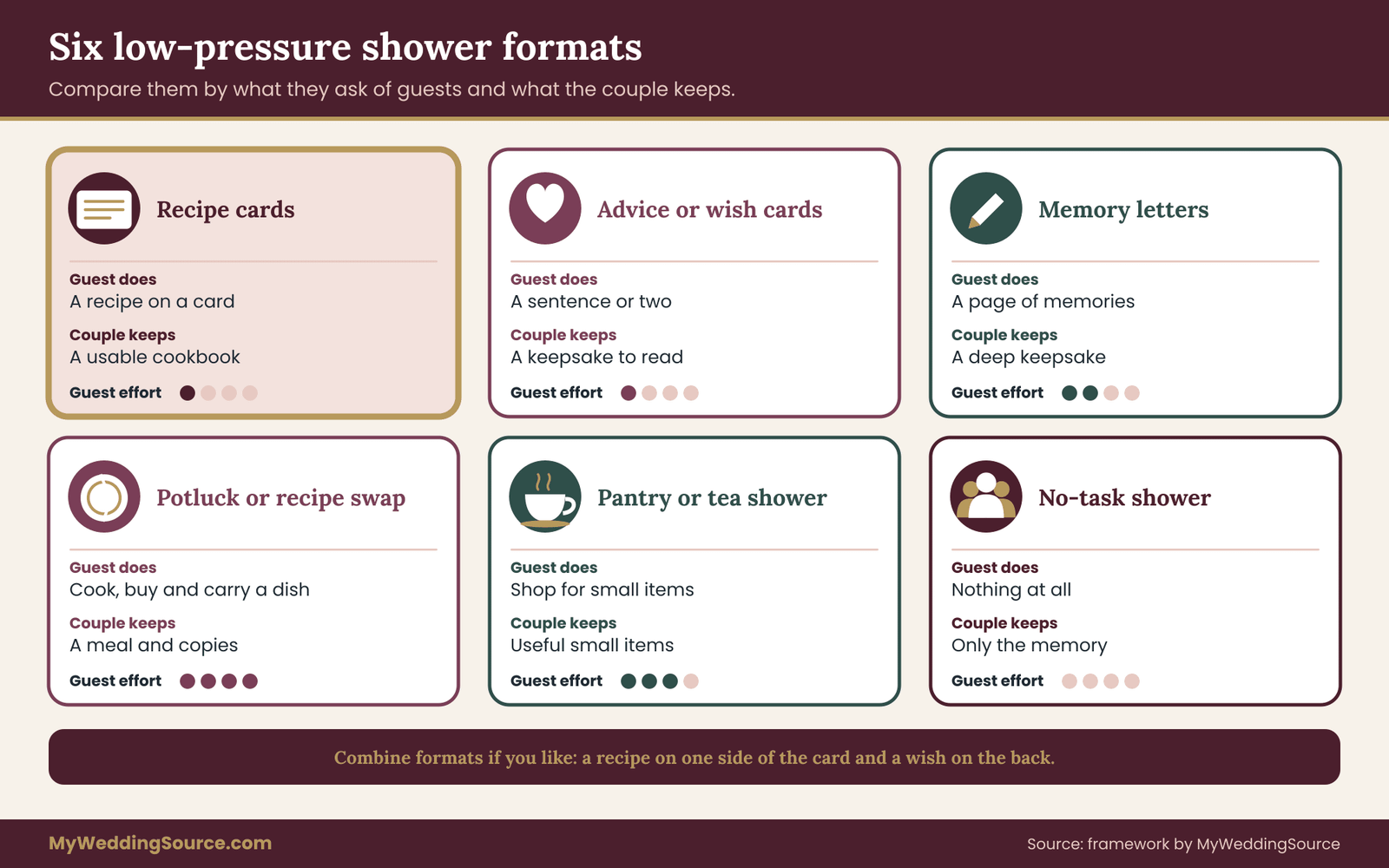
A recipe card shower is one of several ways to hold a shower without asking guests to buy things. Comparing it honestly with the others helps a host decide whether it is the right fit, and helps avoid choosing it for the wrong reasons. The comparisons below are in prose, because the right choice depends on the couple and the guests, not on a score.
Advice or wish cards
In this format, each guest writes a short note of advice, a wish or a memory for the couple. It asks for less than a recipe: a sentence or two. It suits groups where many guests are not confident cooks, and it works for couples who rarely cook. Its weakness is that notes of advice can drift into unsolicited marital instruction, which not every couple enjoys, and the result is a keepsake that is lovely to read but not useful in daily life.
Compared with a recipe card shower, advice cards have a lower barrier and a lower practical value. A host can combine them by giving each guest a card with a recipe on one side and a wish on the back.
A memory book or letter collection
Here guests write a longer letter or a page of memories, sometimes with photos. This format is rich and emotional, and it is also the most demanding of guests. A person who is not close to the couple may struggle to know what to write. The recipe card shower is gentler, because a recipe gives the guest something concrete to say.
A potluck or recipe swap shower
In a potluck, guests bring a dish. In a recipe swap, guests bring a dish and copies of the recipe for others. Both ask guests to cook, buy ingredients and transport food, which is more cost and effort than a card. They also raise food safety questions about transporting and holding dishes. A recipe card shower can still include food, prepared by the host, without asking guests to bring it.
If the group is eager to cook together, a hybrid works: a host-provided meal and a card from each guest. Keep it a hybrid only if cooking is something guests want, not something they feel they are expected to do.
A pantry, tea or kitchen-supplies shower
These are themed gift showers, and they are gentler than a registry-based shower because the items are small. They still ask guests to shop. If the aim is to remove spending, they do not meet it, though they reduce it.
A donation-in-lieu shower
Some couples ask guests to make a donation to a charity in place of gifts. This removes the gift but adds a financial request, and some guests feel uneasy about being directed toward a particular cause. If the couple choose this, the invitation should make the donation clearly optional. It is a different decision from a recipe card shower and deserves its own guide.
A no-gift, no-task shower
The simplest option is a shower where guests bring nothing at all, and the recipe card shower is the event. This is the lowest pressure of all. Its weakness is that it gives the couple no keepsake from the gathering. A recipe card shower sits one step above it: still very low pressure, and with something to keep.
A three-question way to choose
When a host cannot decide, three questions help.
Question one: do most guests cook, or at least eat food they could describe? If yes, a recipe card shower is natural. If many guests are far from cooking, choose advice cards or a no-task shower, or combine them with the recipe-or-wish card described above.
Question two: will the couple use the cookbook? If the couple cook at home, or plan to, the cards will be used. If they rarely cook, the cards become a keepsake only, and the couple should know that before the host puts effort into it.
Question three: can the host take on the compile step? Collecting is easy. Turning cards into a box, binder or book takes hours and some skill. If no one can do it, pick a format with no compile step, or choose the simplest end form: a box of the cards as they arrive.
Three yeses make the recipe card shower a strong choice. One or two noes suggest a variation or a different format.
When a recipe card shower is the wrong choice
A few situations call for a different format. If the guest list includes many people who do not read or write the language of the cards and cannot easily ask a relative for help, the recipe card shower format can exclude them. If the couple have asked guests specifically for contributions to a goal, such as a honeymoon fund, a recipe card shower can feel mismatched.
If the shower is run by a workplace and many attendees barely know the couple, a personal recipe may feel too intimate, and a light group card might be more comfortable.
It is also the wrong choice if the real motivation is to avoid gifts while still expecting them. A host who plans a recipe card shower and quietly hopes everyone will bring a present has chosen the wrong format. The recipe card shower format works because the card is genuinely sufficient.
Cost logic: what a recipe card shower costs the host, and nobody else
The recipe card shower format’s central promise is that guests spend almost nothing. That promise is only honest if the host understands where the costs go. None of the numbers here are statistics. They are the kinds of costs involved, with prompts for working out your own.
Blank cards and pens. If you supply cards, count how many you need: one per invited household, plus a margin for mistakes and extras. Ask guests to take two, so a card that goes wrong can be redone.
Envelopes and postage. If you mail cards to guests, add return postage. Check current prices on the Postal Service website, since rates change. A cheaper approach is to send the invitation by email and ask for a photo of the card.
A box, binder or book. A box for 4 by 6 cards is typically the least expensive end form. A binder with sheet protectors costs more, and a printed book costs the most and depends on page count and print method. The printer questions in the next section help compare quotes.
Printing. If you print a book, the cost depends on page count, size, binding, paper, color, quantity and turnaround. Ask for a written quote.
Food and drink for the party. This is the same as any shower and is not specific to the recipe card shower format.
The host’s time. Collecting, scanning, retyping and designing a book take hours. If a host will not have the time, pay attention to the end form, because a simple box takes far less time than a designed book.
A useful habit is to write the whole budget on one page, with a line for each of these costs, and to share it with the couple and any co-hosts before spending. The wedding budget guide explains how to keep wedding-related spending visible, and the same idea works at the scale of a shower. Agree up front who pays for what. If the couple’s families or friends are splitting costs, decide before buying anything.
Keeping the cost off guests, in practice
There are a few practical ways to keep the promise.
Supply the cards. A guest who must buy recipe cards has already been asked to spend.
Provide postage if you ask for mailed cards.
Do not ask guests to chip in for the book, even softly. A message such as “if anyone wants to contribute to printing” can produce the same discomfort as a gift request. If the host or the couple want to offer guests a copy of the finished book, that is a generous touch, but it should be an offer from the host.
Accept low-tech contributions. A photo taken on a phone is enough, and no one should feel they must buy a scanner.
Measurable checks for a calm collection
A recipe card shower benefits from a few checks you can actually count. These are not targets to chase; they are signals that the collection is on track.
At four weeks out, how many invited households have replied? If fewer than about half have answered, send a gentle general reminder.
At two weeks out, how many cards are in hand compared with the number of yes replies? A gap is normal. Use it to decide who needs a friendly nudge.
At one week out, can every card in hand be read and cooked from? Read each one against the eight fields and list what is missing. Questions to guests should go out now, not on party day.
At party day, is there at least one card for every household that will attend, counting host fill-in cards? This is a comfort check, not a rule. It simply means that no guest feels they were the only one who contributed nothing.
After the party, are all cards logged, scanned or photographed, and stored somewhere safe? This is the check that most hosts skip, and the one that matters most.
A number-based habit can also help with the end form. If you plan a book, count the cards and estimate pages: how many recipes fit on a page, and how many pages you want to print. That estimate gives you something concrete to bring to a printer.
Vendor and printer questions for a recipe card shower cookbook
Not every recipe card shower involves a vendor. A box of original cards needs nothing more than a box. But many hosts want a bound book, laminated cards or an engraved box, and then a printer or maker enters the picture. The questions below are written for a small, one-off job, which is what most hosts have.
They apply whether you use a local print shop, an online book service or a craft maker. The site’s vendor due diligence checklist covers how to vet a business in general; this section is specific to a small cookbook.
Ask for answers in writing, by email or on the quote, and keep them with your ledger.
Questions about the file
What file formats does the printer accept, and at what resolution should scans be supplied? Printers differ, and a photo taken on a phone may or may not be enough for a clear page. Ask for a spec sheet or a template.
Do you offer a proof before printing? A proof can be a PDF or a physical copy, and the two can look different. Ask which you get and whether it costs extra.
How are corrections handled after the proof is approved? Many printers treat approval as final. Read the policy, then read the proof word by word.
Who owns the files, and what happens to them after the job? A cookbook contains personal recipes and names. Ask whether the printer keeps your files, for how long, and whether they are used for anything other than your order. A short, plain answer is the right answer.
Questions about the product
What binding options are offered, and which lies flat on a counter? A cookbook is used with messy hands, and a book that closes on itself is frustrating. Ask about lay-flat or spiral binding, and what each means for page count.
What paper weight and finish are available? Heavier paper and a matte or coated finish resist splashes better than thin paper. Ask to see a sample page or a sample book.
Is color extra, and is it worth it? A black-and-white book is cheaper and perfectly readable. Color matters mainly if you include photos of dishes or scans of handwriting.
What is the minimum order, and what does each additional copy cost? A host might want one copy for the couple and a few for family. Ask for the price of one, five and ten, and compare, since pricing structures differ.
Questions about time and money
What is the turnaround from approved proof to delivery, and what happens if it is late? A shower gift book that arrives after the wedding is a missed moment. Ask for a date in writing.
What does shipping cost, and is the cost on the quote? Total cost is what matters, not the headline price.
What is the refund or reprint policy if the book arrives damaged or misprinted? Ask what counts as an error on the printer’s side and what counts as an error on yours.
What payment terms apply? A small job might be paid in full upfront. If so, pay by a method that offers some protection, and keep the receipt. The Federal Trade Commission publishes consumer guidance on checking a business and on payment protection, which is worth a few minutes.
Questions for a box or card maker
If you plan to buy or commission a recipe box, ask what the interior dimensions are, since a 4 by 6 box may be labeled loosely. Ask what finish the wood has and whether it is intended to sit in a kitchen. Ask whether dividers or tabs are included. For engraved items, ask for a proof of the engraving text, and check spelling and spacing carefully, especially of names.
If you want cards laminated, ask whether the laminate is flat or textured and whether the card can still be written on afterward. Laminated cards are wipeable, but a laminated card cannot be corrected, so fix errors first.
When you do not need a vendor at all
A plain box of cards, or a binder with clear sleeves and a table of contents printed at home, needs no vendor and works well. A host who feels the vendor path is more trouble than it is worth should choose it without guilt. A recipe card shower succeeds by what is on the cards, not by the quality of the binding.
Compiling and keeping the cards after the recipe card shower
The party ends and the cards remain. Compiling is where a recipe card shower either becomes a lasting keepsake or fades into a drawer. The steps below turn a heap of cards into something the couple can use, in an order that protects the originals.
Step one: log and copy before anything else
On the day after the recipe card shower, lay out every card and record each one in the ledger. Then copy each card before doing anything else: scan it, or photograph it flat in good light. The original card is irreplaceable, and a copy protects it from spills, loss and the edits that follow. Save copies in two places, such as a computer folder and a cloud or external drive.
Step two: read each card as a cook would
Go through every recipe with the eight fields in mind. Make a short list per card of what is missing: an amount, a temperature, a serving size, an allergen line. Group the list by guest, then ask each guest one polite question at a time. Most guests are delighted to be asked, because it shows the recipe is going to be used.
Step three: test before you print
Before printing a book, cook at least a few of the recipes, especially ones with unusual methods or no clear amounts. A recipe that fails when tested may only need a small clarification, such as the pan size. If you cannot test every card, a sensible rule is to test any card where a step is vague, where timing depends on equipment, or where the recipe uses raw or undercooked ingredients. Tell guests, kindly, that you are testing; most are pleased.
Step four: decide the order
Cards can be ordered in several ways, and the choice shapes how the book feels. By course (starters, mains, sides, desserts, drinks) is the most practical for cooking. By guest is the most personal, and it works well for a short collection. By occasion (weeknight, holiday, comfort, crowd) is friendly and unusual. Many hosts use the course order and add an index by contributor, so both ways of looking are covered.
Step five: add the small things that make it usable
A table of contents, a contributor list, and a short note from the host and the couple make the collection feel finished. An allergen index, a page that lists which recipes contain common allergens, is a thoughtful addition for a household that cooks for guests with allergies. A credit line for any adapted recipe respects the original author.
Leave blank pages or cards at the end. The couple will add their own, and a collection that invites additions keeps growing.
Step six: choose the form that fits how it will be used
Three forms cover most needs, and a fourth is a digital supplement.
A box of original cards. This is the simplest, keeps each guest’s handwriting and costs the least. Cards in a kitchen will get splashed, so it works best if the couple copy favorite recipes onto cooking cards and keep the originals safe.
A binder with sleeves. Clear sleeves protect cards and let the couple add pages. It is easy to make at home. It takes more shelf space than a box.
A printed, bound book. It looks the most finished and is easy to give copies of. It costs the most and cannot easily be changed once printed, so it suits a collection that is complete.
A digital collection. A shared folder or document keeps scans and typed text searchable, and is a good backup. It should supplement, not replace, a physical keepsake.
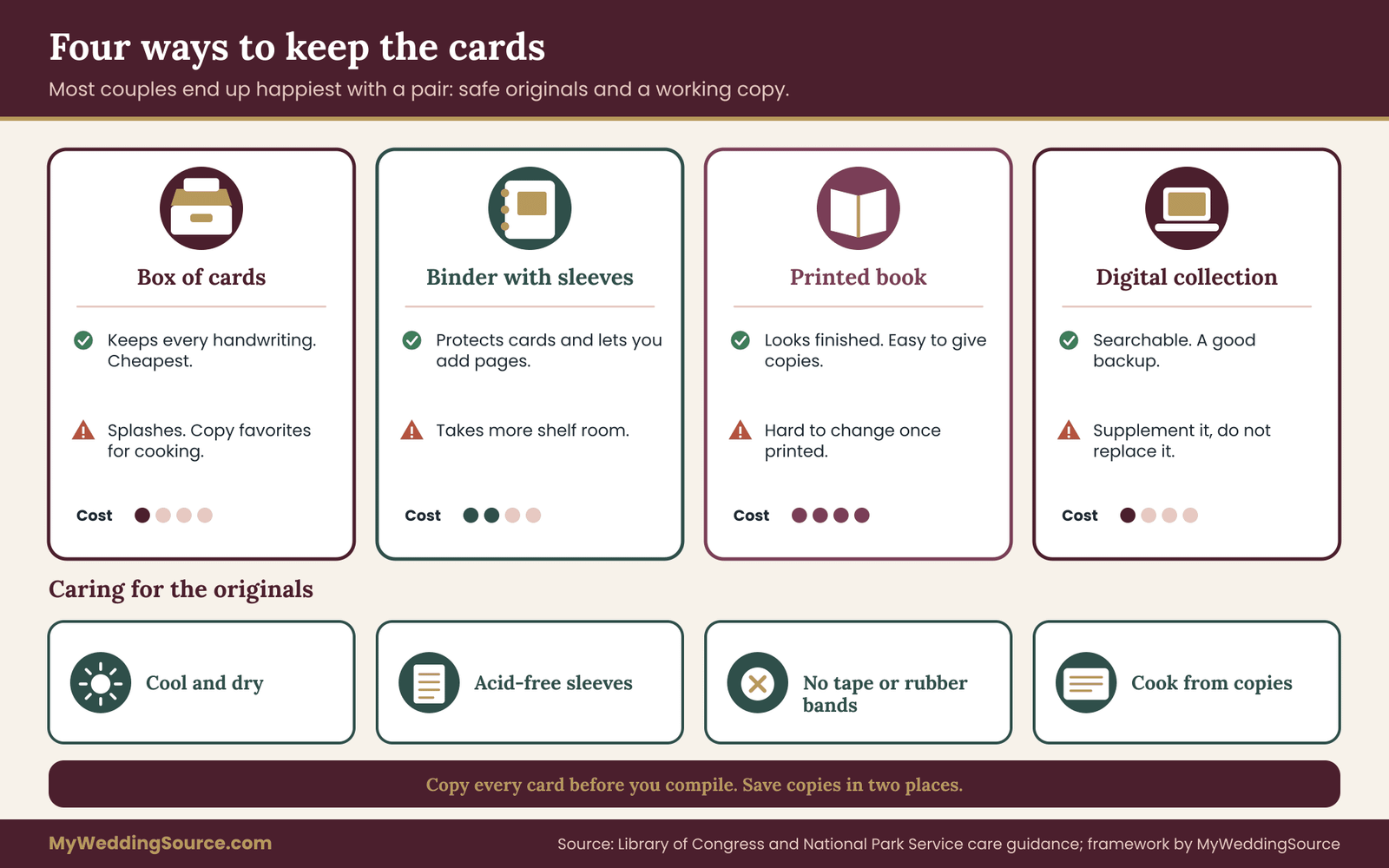
Most couples end up happiest with a pair: the original cards kept safe, and a working copy, in a binder or a book, for the kitchen.
Caring for the originals
Paper keeps well when it is treated with a little care. Conservation guidance from the Library of Congress and the National Park Service recommends storing paper documents in a cool, dry place away from direct sunlight, and using acid-free folders or sleeves for items you want to last. Avoid sticky tape, which yellows and leaves residue, and avoid rubber bands and metal paper clips that can stain. Do not store in an attic or a damp basement. Handle cards by the edges when you can.
If the cards will be used in the kitchen, use copies. The originals, especially those in a relative’s handwriting, may become the most treasured things in the collection.
Sharing the result with guests
Guests who contributed usually like to see what became of their card. A host can send a short thank-you with a scan of the guest’s own card, or a copy of the book if the budget allows. If you do not want to share the whole collection, share the guest’s page. Check first that every contributor agreed to be printed, using the ledger. Anyone who said no, or did not say, gets left out or asked.
Thank-you notes belong to the couple, and a handwritten note that mentions the specific recipe, such as “we made your tomato rice on our first Sunday in the new place,” is better than a general one. A single sentence is enough.
Edge cases that change how you run a recipe card shower
The recipe card shower format is forgiving, but certain situations come up often enough that a host should have an answer ready. None of these is a reason to cancel. Each is a small adjustment.
The guest who says they cannot cook
Give permission, in writing and in person. A drink, a snack, a sandwich or a store-bought shortcut written down honestly all count. Some of the most-used cards in a household cookbook are three-ingredient snacks. If the guest still feels stuck, offer the alternative of a short note of advice on a card of the same size, so they appear in the collection in a form they are comfortable with.
The guest with low vision, arthritis or difficulty writing
Offer large-print cards or a typed form, and a voice option, where the guest says the recipe and the host writes it down and reads it back. The Americans with Disabilities Act applies to certain public places and services rather than private parties, but its spirit, which is to provide more than one way to take part, is a good rule for any host. Do not single the guest out. Offer these options to everyone in the guide, so no one has to ask.
The recipe in another language
A guest may prefer to write in their first language, and a recipe in the language of a grandparent is a treasure. Keep the original and, with the guest’s help, add a translation underneath. Ask the guest to check the translation, since ingredient names and measures do not always translate neatly. In the printed book, show both. If no one can translate, include the original anyway, with a note that a translation can be added later.
The family recipe with cultural or religious weight
Some recipes belong to a community as much as to a person: festival dishes, ceremonial foods, recipes tied to dietary laws or fasting. A guest may be glad to share one, or may feel uneasy about it appearing in a printed book. Ask, and accept a no. If a guest shares it, record its context in their words rather than your own, and avoid describing a tradition in a way the guest did not. A line such as “Shared by Amara, as made for her family’s holiday table” is accurate and respectful.
The recipe of someone who has died
Guests sometimes send a recipe from a late parent or grandparent, often in the original handwriting. This can be the most meaningful card in the collection and a tender moment for the sender. Handle the original with care, scan it quickly and return it if the guest sent the actual card. Ask how they would like the person credited. Avoid commenting in public unless the guest does so first.
The guest with allergies or dietary restrictions
Two situations arise. A guest with a restriction may send a recipe that fits their diet, and that is simply part of the collection. A host cooking from a card for a guest with an allergy must check ingredients carefully. The FDA lists the major food allergens, and a label on a serving dish helps everyone. The allergen line on the card exists for this reason, and for the couple’s own kitchen later.
The guest who sends many recipes
One guest sends eight. It is generous, and it can unbalance a book. Ask the guest to choose their favorite two or three, or offer to put the rest in a bonus section or the digital copy. Thank them warmly. Never turn away a card in a way that feels like rejection.
Two guests send the same recipe
It happens, particularly for family dishes. Keep both. Differences in how two people make the same dish are among the best parts of a family cookbook, and a short line such as “Compare with Aunt Rosa’s version” turns a duplicate into a conversation.
The couple already live together, or are marrying again
A couple who already have a full kitchen do not need starter equipment, which is one more reason the recipe card shower suits them. The recipe card shower format also suits a second marriage, where guests may be unsure what to give. If one partner has children, consider inviting a card from the children, such as a sandwich or a snack, with a photo if they like. Ask the parent first.
The shower is hosted by a workplace
Coworkers may know the couple less well. A recipe can feel too personal, and some colleagues may worry about their contribution being judged. Offer the card as optional, with a lighter prompt, such as “a recipe you make, any kind,” and consider a shared card rather than individual ones. Make sure no one is expected to take part.
Guests who live far away or abroad
Allow extra time and offer digital routes. Postage across borders is slow and can cost more, so email or message photos are often best. Time zones affect any call-based event, and a recipe card shower held on video can have a “send your card during the call” moment.
Cards that arrive damaged, unreadable or not at all
If a card is smudged or torn, ask the guest for a new photo. If one is lost in the mail, say so kindly and ask for a copy. Never suggest the guest was careless. A copy in an email costs them a minute.
A guest asks to withdraw their recipe
Honor it at once, with thanks. The ledger should record it, and the card should be returned or destroyed as the guest prefers. A collection built on goodwill is worth more than one built on completeness.
Large and small groups
A very small collection, for instance under ten cards, feels best as a box with a few blank cards left over. A very large collection, for example several dozen cards, usually justifies a book, because a box becomes unwieldy. These are rules of thumb, not requirements, and the couple’s own preference decides.
A worked example: the Hartley, Okonkwo and Reed recipe card shower
The following example is invented. The people, numbers and events are illustrative, and they are not drawn from any real shower. They show how the pieces of this guide fit together.
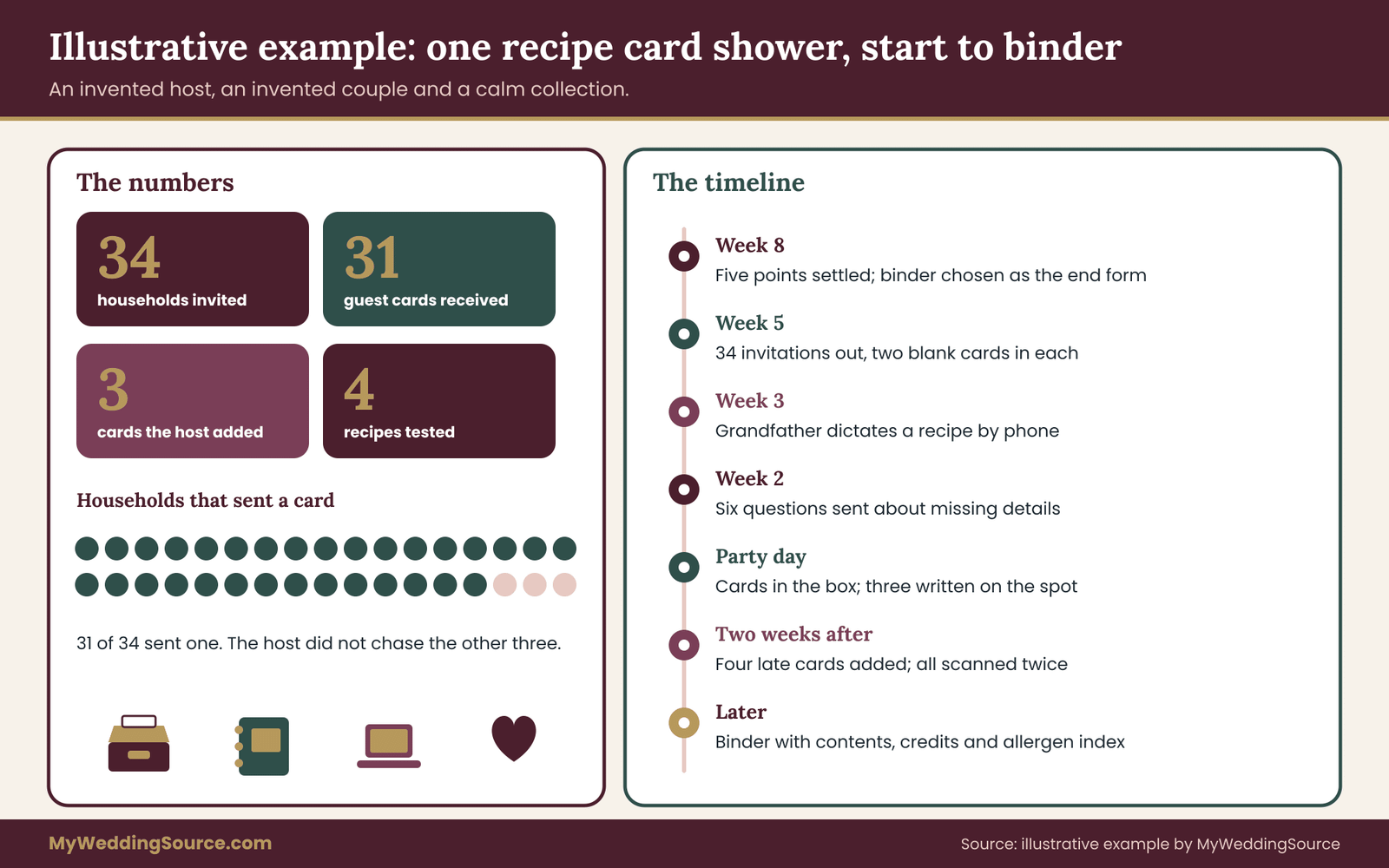
Dana Hartley is hosting a shower for her cousin Maya Okonkwo, who is marrying Samuel Reed. Maya and Samuel already live together and have a well-stocked kitchen. Maya told Dana she would hate to see guests spend money on a shower. Dana suggests a recipe card shower, and Maya agrees, on one condition: nobody should feel they have to cook something impressive.
Week eight. Dana and Maya settle the five points. The end form is a binder with sleeves and, if the collection is large enough, a printed copy. The gift position is “the recipe is the present,” with a line that gifts are not needed. Dana pays for cards, envelopes and postage, and agrees to split the cost of printing with Maya’s mother. Maya is happy to see cards as they arrive. The due date is one week before the recipe card shower, with late cards welcome.
Week six. Dana writes the three-line invitation and the guest guide. She chooses 4 by 6 cards. She runs the pressure audit and removes the phrase “your favorite recipe,” replacing it with “any recipe you make.” She adds a far-away line that offers photos, typed cards by email or a short call with her to say the recipe aloud.
Week five. Thirty-four households receive invitations, each with two blank cards and a stamped envelope. Digital invitations go to guests overseas.
Week four. Dana starts the ledger. Eleven households have replied.
Week three. A general reminder goes out. Dana notices that Maya’s grandfather, who does not use email, has not responded, and she calls him. He dictates a recipe for fried plantains, and she writes it on a card and reads it back.
Week two. Twenty-two households have said they will attend, and twelve guest cards are in hand, including the grandfather’s. Dana reads each one and makes a list of questions. Four lack an oven temperature, one has no amounts, and one says “a bit of everything.” She messages those guests, one polite question each.
Week one. Three more cards arrive, which makes fifteen. Dana adds three cards of her own, a drink, a salad dressing and a Sunday soup, and labels them as hers. She sets up the card table with blank cards for anyone who forgets.
Party day. Twenty-four guests attend, a few of them bringing a partner or a parent. Fifteen cards go into the box, nine more have arrived from guests far away, and three guests write a card on the spot. Maya’s college friend Priya reads her tomato rice card aloud, and two others follow. Two guests bring small gifts. Dana thanks them warmly, puts the gifts on a side table and notes the names. Maya thanks everyone in two sentences.
After the recipe card shower. Four more cards arrive over the next two weeks. The final count is thirty-one guest cards and Dana’s three, so thirty-four in all. Three invited households never sent a card, and Dana does not chase them. She scans every card, saves copies in two places and cooks four of the recipes before assembling a binder with a contents page, a contributor list and an allergen index. Maya and Samuel receive the binder at a small dinner for the family.
The example is ordinary on purpose. No step in it needed money from guests, and each step was small. The recipe card shower format worked because the three-line ask was clear, the card was simple, the ledger kept track, and the host stayed calm when cards were late or missing.
Common mistakes with a recipe card shower
A few errors account for most of the trouble. Each can be avoided with a little forethought.
Mixing gift positions. An invitation that says “no gifts” and a message that mentions a registry confuses guests and undermines the recipe card shower format. Pick one position and keep it.
Asking for too much. Requiring a story, a photo, a handwritten original and a favorite dish turns a card into a project. Keep one required thing, the recipe, and make everything else optional.
Collecting without copying. Cards arrive, someone puts them in a pile and a spill or a move loses them. Copy first.
Rewriting voices. Over-editing makes the book tidy and lifeless. Fix errors, keep the language.
Ignoring safety and credit. A recipe that teaches unsafe cooking, or copies a published recipe without credit, can cause problems for a book that will be shared.
Showing the ledger. The ledger is private. A shower where people are called out for missing cards is not a gentle shower.
Letting the compile step drift. Many cookbooks fail not at the party but in the months afterward. Put a date on the calendar for finishing the binder or book, ideally before the wedding, and tell the couple.
Where this fits among your other wedding tasks
A recipe card shower is a small project inside a larger wedding year. The wedding planning checklist shows where pre-wedding gatherings sit among the other tasks, and the wedding etiquette guide covers wider questions of hosting and gratitude. If the cookbook idea appeals to the couple and the families cook for large gatherings, the guide to wedding menu planning shows how a favorite family dish can also inform the wedding menu, though that is a separate decision from the shower.
Your next steps
Start with the five points: end form, gift position, who pays, who sees the cards and the due date. Write them in a short note and share it with every co-host and with the couple. Then write the three lines of the invitation, run the pressure audit, and make a one-page card guide with the eight fields.
Buy or print cards in one size, set up the ledger, and send invitations several weeks ahead with at least two ways to take part. Offer a gentle reminder, fill gaps with your own cards, and run the party as a calm gathering with a card table. Afterward, copy every card before doing anything else, check each one for missing details, and choose the box, binder or book that fits the couple.
A recipe card shower costs guests very little, and with a clear invitation and a simple card it gives the couple something they will use for years.
For the broader decisions behind the invitation, such as wording, timing and tone, see the wedding invitation etiquette page, and for gift guidance on the couple’s side, the wedding registry ideas guide.
FAQ
What exactly is a recipe card shower?
A recipe card shower is a pre-wedding gathering where each guest contributes a recipe, usually on a card, instead of bringing a gift. The couple receives the collection as a box of cards, a binder or a printed book. The format keeps the cost to guests close to zero and gives the couple something they can cook from and keep.
How do we word the invitation so guests do not feel they must bring gifts?
Use three short lines. First, name what to bring: one recipe on a card. Second, state the gift position plainly, such as “gifts are not needed; your recipe is the present.” Third, explain how to take part from far away. Leave out registry details and any mention of what the couple needs, since those can read as gift prompts.
What if a guest does not cook?
Tell guests in advance that a recipe can be a drink, a snack, a sandwich or a shortcut written down honestly. Offer an alternative of a short note of advice on a card of the same size. The aim is for every guest to appear in the collection in a way that feels comfortable, not to test their cooking.
What should be on each recipe card?
Eight fields work well: recipe name, the guest’s name and how they know the couple, ingredients with amounts, steps, servings, time and temperature, an allergen or diet note, and one optional line about the recipe. A guest who fills in only the first four has completed a usable card, and the host can ask for the rest later.
How do we handle guests who live far away?
Offer more than one route: a photo of a handwritten card, a typed card by email or an online form, or a short call where the host writes down the recipe and reads it back. Provide postage if you ask for mailed cards. Allow extra time for guests abroad, and say that late cards are welcome.
Is it acceptable to include recipes copied from cookbooks or websites?
Ask guests to credit the source and to write the method in their own words. In the United States, the Copyright Office explains that a simple list of ingredients is treated differently from creative text and photos around a recipe. For a private keepsake the stakes are low, and for a printed book shared widely a credit line and rewording are wise.
What do we do if guests bring gifts anyway?
Thank them warmly and say nothing about the invitation. Set gifts on a side table, record the giver’s name privately for thank-you notes, and avoid opening gifts at the party unless the couple wants to. Opening a few in front of others recreates the comparison the format was meant to avoid.
How should we keep the cards safe afterward?
Copy every card by scan or flat photo before doing anything else, and save copies in two places. Store the originals in acid-free sleeves or a box in a cool, dry spot, away from sunlight and kitchen splashes. Use copies for cooking, and keep the originals, especially handwritten cards from older relatives, for the long term.
Sources
- Wedding and shower etiquette, The Knot
- Food allergies, U.S. Food and Drug Administration
- Safe minimum internal temperature chart, U.S. Department of Agriculture Food Safety and Inspection Service
- Food safety information, FoodSafety.gov
- Copyright in general, U.S. Copyright Office
- Price list and mailing standards, United States Postal Service
- Introduction to the ADA, U.S. Department of Justice ADA.gov
- Caring for your family treasures, Library of Congress
- Conserve O Gram series, National Park Service Museum Management Program
- Consumer advice on shopping and paying safely, Federal Trade Commission