
A hotel breakfast the morning after a wedding is a small catering event with a real headcount, a real contract and a real deadline. This guide shows how to turn your room block into a defensible hotel breakfast count, write a one-page brief for the hotel, compare the formats on offer, and keep the bill close to what you expected.
Start from the rooms guests actually booked, not from the invitation list. Convert rooms to people, subtract everyone leaving before hotel breakfast, add the few local guests you invite, then apply a show-up rate to get a low, expected and high count. Commit to the low number, ask the hotel to set up for the expected number, and keep the high number as the most you will ever order. Put all of it on a one-page brief for the hotel before the commitment date.
Most couples treat the Sunday-morning meal as an afterthought. The reception ran late, the planning energy is gone, and the thought is simply “we will figure out breakfast with the hotel.” Then the hotel asks for a final number, a per-person price and a signature, and nobody has a number. If you keep your tasks in the wedding planning checklist, this belongs on the list the day the block is signed.
A guess made under that pressure tends to be either far too high, so you pay for food nobody eats, or far too low, so the buffet is bare by half past nine.
The fix is not complicated. It is an estimate built from information you already have: your room block pickup list, your guest list and RSVP data, and your travel details. This article calls the method the Three-Count Method, and it ends in a document you can hand to the hotel, the Meeting Space Brief. Both are explained step by step, with a worked example using invented numbers.
A note on scope. This is general planning information, not legal, tax or financial advice, and every hotel sets its own contract terms, so confirm each rule in your own paperwork.
What a hotel breakfast covers after a wedding
In this guide, a hotel breakfast means any morning meal the couple or their hosts arrange at or through the hotel where wedding guests are staying, on the day after the wedding. It can be a buffet in a meeting room, a reserved block of tables in the hotel restaurant, a tab at the restaurant with a spending cap, a coffee-and-pastry table in the lobby, or simply the hotel breakfast already included in the room rate.
It is different from a farewell brunch in one important way. A farewell brunch is a decision about hosting: whether the couple wants a late-morning gathering at all, who is invited, and what it signals. If you are still deciding that, the farewell brunch guide on this site works through it. A hotel breakfast is a logistics question that arrives after the decision, or sometimes without any decision at all, because guests will eat somewhere regardless. The question is only whether the couple organizes it, pays for it, or leaves it to the guests.
That is why the first move is not to book anything. It is to find out how many people will be in the building, awake and hungry, between the hotel’s opening hour and checkout. That number depends on the room block more than on anything else.
Three things a hotel breakfast is not
It is not a second reception. Guests have just spent a long evening in formal clothes, and most want coffee, food and a quiet goodbye. A program, speeches or a photo schedule turns an easy morning into an obligation.
It is not automatically free for the couple to skip. If your contract with the hotel includes a food and beverage minimum, a meeting room that is only free when you spend a set amount, or a block that includes hotel breakfast for registered guests, then a Sunday meal may already be built into your costs. Check the contract before spending anything new.
It is not a guest-list expansion. Local guests who did not sleep at the hotel, family friends who drove in, and vendors who stayed late can all show up by default if the invitation is vague. Every extra person is a plate. Decide in advance who is invited and say so plainly.
The three numbers every hotel breakfast needs
Hotel catering departments ask for the same few figures, in roughly this order: a date and a time window, an expected count, a guarantee count, and a payment arrangement. The expected count is your honest estimate. The guarantee is the number you commit to pay for even if fewer people come. The payment arrangement says who is billed and on which account.
Most of the confusion in this area comes from mixing these up. Couples hear “we need a count” and give the optimistic expected number as the guarantee. A good plan separates them on purpose, because the guarantee is a financial commitment and the expected count is a forecast.
Why the hotel breakfast is easier to underestimate than the reception
A wedding dinner has a seated count, because each guest has an RSVP and a place card. A hotel breakfast has no such anchor. Nobody assigns seats, most guests are not formally invited, and people decide that morning. That is why the hotel breakfast count behaves more like a forecast than a headcount, and why it rewards the layered approach in this guide. The reception count is a fact. The hotel breakfast count is a judgment you can improve with better inputs.
How room blocks shape the hotel breakfast count
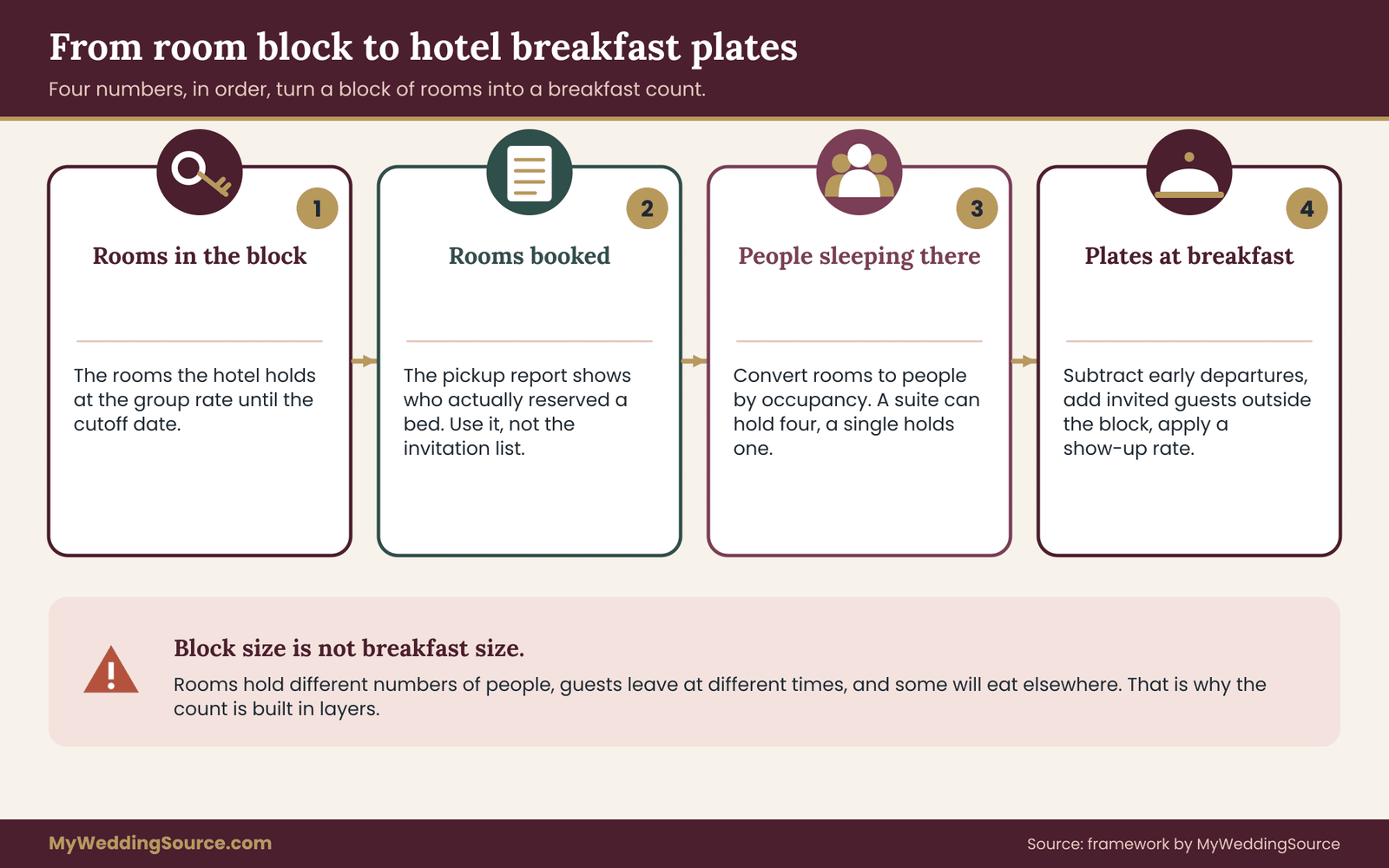
A room block is a set of rooms the hotel holds at a negotiated rate for your guests, usually with a cutoff date after which unbooked rooms return to general sale. The block matters for hotel breakfast because it is the only list that tells you, in advance and by name, who will sleep in the building on Saturday night.
Consider what the block tells you that an invitation list does not. An invitation list shows who was asked. An RSVP list shows who said yes. The pickup list, the record of rooms actually reserved under your block, shows who has paid for or committed to a bed. Guests who book a room at the hotel are the most reliable hotel breakfast attendees, because they are already there and the meal is on the way to the lobby.
For a deeper treatment of how to structure the block itself, including rate tiers and mobility needs, the guide to coordinating wedding guest hotels across budgets and mobility needs covers the lodging side. Here we only need the part that feeds the count.
Reading a pickup report for hotel breakfast purposes
Ask the hotel group sales contact for the pickup report. It usually lists each reservation name, arrival date, departure date, room type and number of guests. Four columns matter.
The arrival date tells you who is present Friday and who arrives only on the wedding day. It does not change the Sunday count by itself, but it shows who traveled and may be tired.
The departure date is the key column. A guest departing Sunday is a possible hotel breakfast guest. A guest departing Saturday night, or leaving at four in the morning for a flight, is not. Anyone departing Monday or later is still around and probably hungry.
The occupancy column, when the hotel provides it, tells you how many people each reservation covers. If it only lists the booker, you will need to estimate occupancy from room type, which is less reliable. A king room often means a couple. Two double beds often means a family or two friends sharing. Treat these as starting guesses, not facts.
The booker name lets you match reservations against your own guest list and RSVP data, which is how you find the people the hotel cannot tell you about, such as plus-ones, children and relatives staying in the same room.
Why block size and hotel breakfast size diverge
A block of fifty rooms does not mean fifty breakfasts, and it does not mean a hundred either. Several things pull the numbers apart.
Rooms hold different numbers of people. A reservation for one room can be one person or five. Guests leave at different times, so the Sunday count is a slice of the block, not the whole block. Some guests will eat elsewhere, for reasons of diet, habit, a family tradition, or a meeting with relatives at a restaurant they chose weeks ago. And some people outside the block, such as the parents of the couple staying with friends, will join.
For that reason, no single multiplier converts rooms into plates. The method in the next section builds the count in layers so each assumption is visible and can be corrected as real information arrives.
The cutoff date as an information event
The room block cutoff is usually the first moment you learn how many rooms guests really booked. Before the cutoff, the pickup count is partial and still rising. After it, the hotel releases unsold rooms, and the picture is mostly settled.
Plan your first rough hotel breakfast estimate for the cutoff date, not before. If the hotel breakfast commitment date falls before the cutoff, which sometimes happens when a hotel pairs catering with a strict group deadline, tell the sales contact that your estimate will be a range until the cutoff and ask whether the guarantee can be set after it. Many hotels will agree when asked early and politely. Almost none will agree when asked the week before.
Late bookers matter too. Guests who reserve after the cutoff pay the public rate, may not appear in your pickup report at all, and can still show up at hotel breakfast. Ask guests to tell you when they book outside the block, and ask the hotel whether the report shows those reservations as group members or as individuals.
What hotels count as a guest
Hotels often track hotel breakfast by headcount at the door, by room number on a list at the entrance, or by plated orders. If the meal is limited to hotel guests only, the host may be asked to supply a room-number list or hand out simple cards. If the meal is open, the count is the number of people through the door. Knowing which approach the hotel will use shapes how you invite people and how you handle gate-crashing in the best possible sense: relatives and friends who were not in the block.
The Three-Count Method for a hotel breakfast headcount
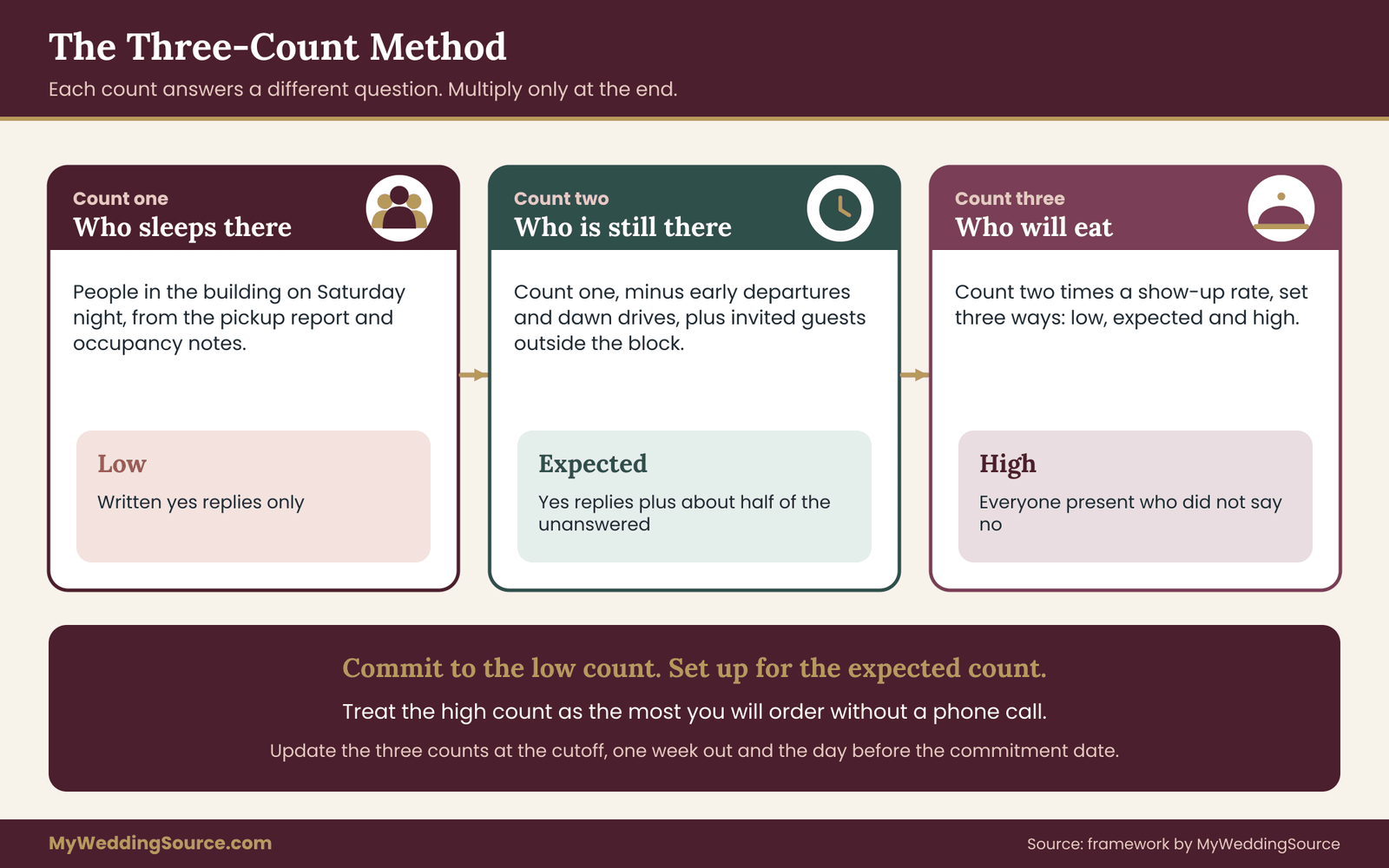
The Three-Count Method turns the pickup report and your own guest data into a low, expected and high count. It has three counts and one adjustment. Each count answers a different question, and you only multiply at the very end.
Count one: who sleeps there. This is the number of people, not rooms, staying at the hotel on Saturday night. Start with the pickup report. Convert each reservation to people using occupancy data, a note from the guest, or your own knowledge. A reservation for a couple is two. A family room may be four. When you do not know, write down your assumption next to the row so you can correct it later.
Count two: who is still there at hotel breakfast. From count one, subtract everyone who will not be in the building when food is served. That includes guests with early flights, guests leaving for a long drive before the restaurant opens, and anyone who told you they are checking out at dawn. Then add the people who are present but not in the block: the couple’s parents staying with the couple, the wedding party in a suite booked outside the block, relatives in a different hotel who you chose to invite.
Count three: who will actually eat. This is the show-up count, and it is the hardest. It applies a show-up rate to count two. The rate depends on how the meal is offered. A specific invitation with a time and a place gets a higher rate than a loose “we’ll be in the lobby around nine.” A meal that is free to guests gets a higher rate than one where they pay. A meal right after a very late night gets a lower rate in the first hour and a higher one in the second.
The adjustment: low, expected, high. Rather than one show-up rate, use three. A low rate gives the number you are confident will come, an expected rate gives the middle estimate, and a high rate gives the number you would see if nearly everyone shows. The three together are what the hotel needs, and the gap between them tells you how much risk the guarantee carries.
Where the show-up rates come from
There is no honest universal figure here, and you should be wary of any article that gives one as fact. Show-up behavior depends on your guests, your timing and the way you invite them. So the rates have to come from sources you can check.
The best source is the hotel’s own catering coordinator. They have seen many group breakfasts in that building and can tell you, in general terms, how groups at that property tend to behave. Ask something like: “For a group breakfast the morning after a Saturday wedding, how do hosts usually set their guarantee compared with their expected count?” The answer will not be a promise, but it is informed by the property.
The second source is your own behavior data. If you ran an RSVP question on your wedding website, the yes answers are your upper bound. If you offered the Friday welcome event and tracked attendance, the ratio of yes answers to actual attendees at that event shows how your particular guests follow through. That ratio is a better starting point than any generic percentage, because it describes these people.
The third source is a small test. Send a short message to hotel guests two weeks before the wedding asking them to reply yes or no to hotel breakfast. A reply of yes is a stronger signal than an unanswered invitation. A reply of no is useful too. If a quarter of the room list does not answer, you know the uncertainty sits there, and your low and high counts should reflect it.
Setting the three rates in practice
Use plain, round rates that you can explain. A common approach is to set the low rate near the share of guests who answered yes in writing, the expected rate a little above that to cover people who forgot to reply but will come, and the high rate near the full count-two number, since not everyone present is going to say no.
Write the rates and their reasons next to each other. “Low: only the yes replies. Expected: the yes replies plus about half of the unanswered. High: everyone present.” Notes like this make the count easy to defend and easy to update. If a guest asks why you ordered a certain number, you can explain in a sentence. If the hotel asks, the notes show you thought about it.
Avoid anchoring on the full guest list. A common error is to take the number of invited wedding guests, apply a percentage, and call it done. That skips the room block, which is the best data you have, and it includes people who live nearby and will go home. The block-based count is almost always tighter.
Common mistakes in a hotel breakfast count
Four mistakes show up repeatedly. The first is counting invited guests instead of sleeping guests, which inflates the hotel breakfast count by every local attendee. The second is counting rooms as people, which ignores that family suites and single rooms hold very different numbers. The third is treating a silent guest as a yes. The fourth is setting the guarantee at the expected number, which turns a forecast into a commitment. Keep the three counts separate on your sheet, and check the hotel breakfast guarantee against the low count before you sign.
Handling people who are not in the block
Some hotel breakfast attendees never appear in the pickup report, and ignoring them is how counts go wrong in the other direction.
The wedding party and close family. If they stay in a suite booked on a separate reservation, or at the couple’s own expense, they may not be in the block. Add them by name to count two.
Local guests. If you invite local friends and relatives to the Sunday meal (the wedding guest list guide helps you decide who counts as a core guest), add them as a separate line, and note how you invited them. A casual mention at the reception is a weaker signal than a written invitation with a response.
Vendors. Some couples feed a photographer or a band who stayed late, or a coordinator who is on site the next morning. If so, count them. If not, say clearly to the hotel and to the vendors that they are not included.
Children. Children often eat less, and many hotels price them differently or free below a set age. List children separately by age band so the hotel can price them correctly and the kitchen can prepare appropriate portions. The count of adults and the count of children both belong on the brief.
A simple sheet for the three counts
You do not need software. A single page with five columns works: the reservation name, the number of people, the departure time, the dietary needs, and a note. Add a total row for each count. Keep the sheet in a shared folder so the other partner, the wedding coordinator and the person handling the hotel can all see the same figures. A shared calendar is useful for the dates; for the numbers, a plain shared sheet is enough.
Update the sheet at three points: at the room block cutoff, one week before the wedding, and the day before the commitment date. After each update, note the date and what changed. By the third update, the low and high counts should be close together. If they are not, the uncertainty is about guests, not arithmetic, and the right response is to ask guests directly, not to guess.
A worked example from 55 rooms to a hotel breakfast guarantee
The numbers below are invented to show the arithmetic. They are not averages, not benchmarks and not predictions for your wedding. Your own pickup report, replies and hotel terms replace every figure.
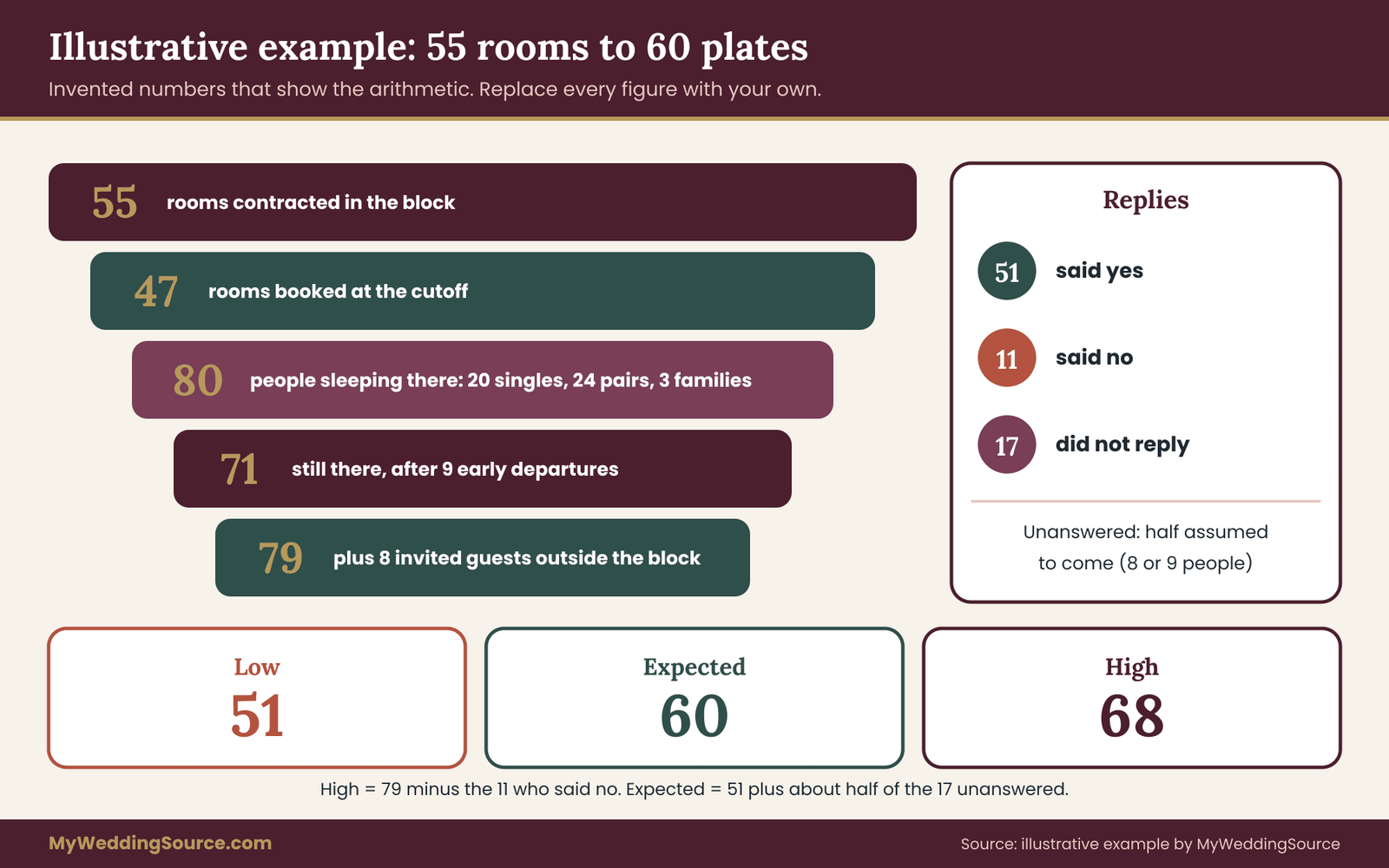
Imagine a couple with 150 invited guests and 128 expected at the wedding. They contract a block of 55 rooms at a downtown hotel. At the cutoff date, 47 rooms are booked. The hotel’s pickup report and the couple’s notes give the following.
Twenty rooms hold one guest each. Twenty-four rooms hold two guests each. Three rooms hold four guests each, all families with children. That makes 20 plus 48 plus 12, or 80 people sleeping at the hotel on Saturday night. That is count one: 80.
Now subtract the people who are not there at hotel breakfast. Four rooms, with a total of seven guests, have flights that leave before the restaurant opens. Two more guests are driving home at dawn to relieve a babysitter. That removes nine people, leaving 71.
Then add people outside the block who are invited: the couple’s two sets of parents staying in a suite booked separately, which is four people, and the two attendants staying with them, who add two more. A local aunt and uncle are invited by written note, so two more. That adds eight, giving 79. This is count two: 79.
The couple invited hotel guests by name with a written note and a time, and gave an RSVP request two weeks before the wedding. Fifty-one people replied yes. Eleven replied no. Seventeen did not reply.
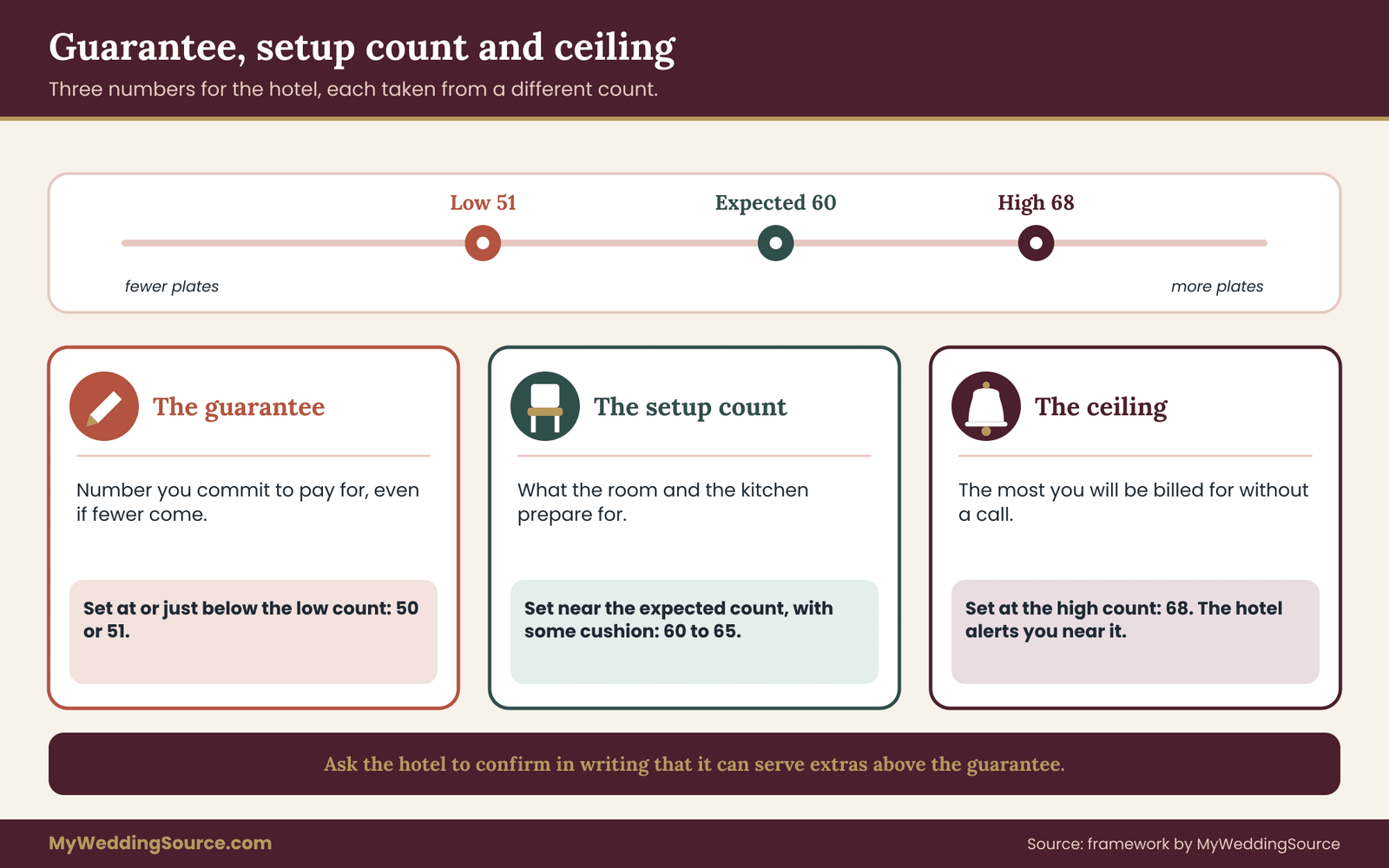
Using the three rates, the couple sets them this way. Low: only the written yes replies, 51 people. Expected: the yes replies plus about half of the unanswered, which is 51 plus 8 or 9, so 60. High: everyone in count two who did not say no, which is 79 minus the 11 who declined, or 68.
So count three: low 51, expected 60, high 68.
Turning the counts into three decisions
The couple now has three decisions, and each uses a different number.
The guarantee. This is the number they commit to pay for. They choose a figure at or just below the low count, because the cost of a small shortfall in commitment is much smaller than the cost of paying for unused plates. Here that is 51, or round to 50 for simplicity.
The setup count. This is what they ask the hotel to prepare tables and chairs for, and what the kitchen plans food for. They choose near the expected count and the top of a sensible range, so 60 to 65, because a seat and a plate that nobody uses cost the hotel little, while a full room with no chairs creates a poor experience.
The ceiling. This is the most they will agree to be billed for without a call. They choose the high count of 68, tell the hotel that anything above it needs their approval, and ask the hotel to alert them if the door count nears it.
Checking the example against cost
Cost logic is easier to see with an assumed price. Suppose, for arithmetic only, that the hotel quotes a flat price per adult for a buffet. If the guarantee is 50 and the actual count is 60, the couple pays for 60 under most hotel terms, since extra guests above the guarantee are billed at the same rate.
If the guarantee is 50 and only 45 come, they still pay for 50. So the cost of too low a guarantee is usually small or zero when the kitchen can serve extras, while the cost of too high a guarantee is the price of every empty place.
That asymmetry is the heart of the method. When you are unsure, commit to the lower number and set up for the higher one, as long as the hotel confirms in writing that it can serve extras above the guarantee up to the ceiling. If the hotel cannot, because food is portioned in advance or the room is small, the calculation changes, and the questions in a later section help you find out.
What the example leaves out
The example does not include taxes, service charges, gratuity or room rental, which vary by hotel and sometimes by city. It does not include dietary changes, which can shift the plated count. And it treats the 17 unanswered guests as one group, when in practice you would follow up with a text and update the counts as answers arrive.
It also uses the couple’s own replies as the main signal. If you did not collect replies, the method still works, but your low and high counts will be farther apart, and the guarantee should be set closer to the low end.
Hotel breakfast formats compared
Once you have a count, the next question is what kind of meal to offer. Hotels typically present a handful of formats, and each suits a different count, budget and mood. Compare them by four measures: what the host pays, how much control the host has, how well the format absorbs a surprise in headcount, and how it feels to guests.
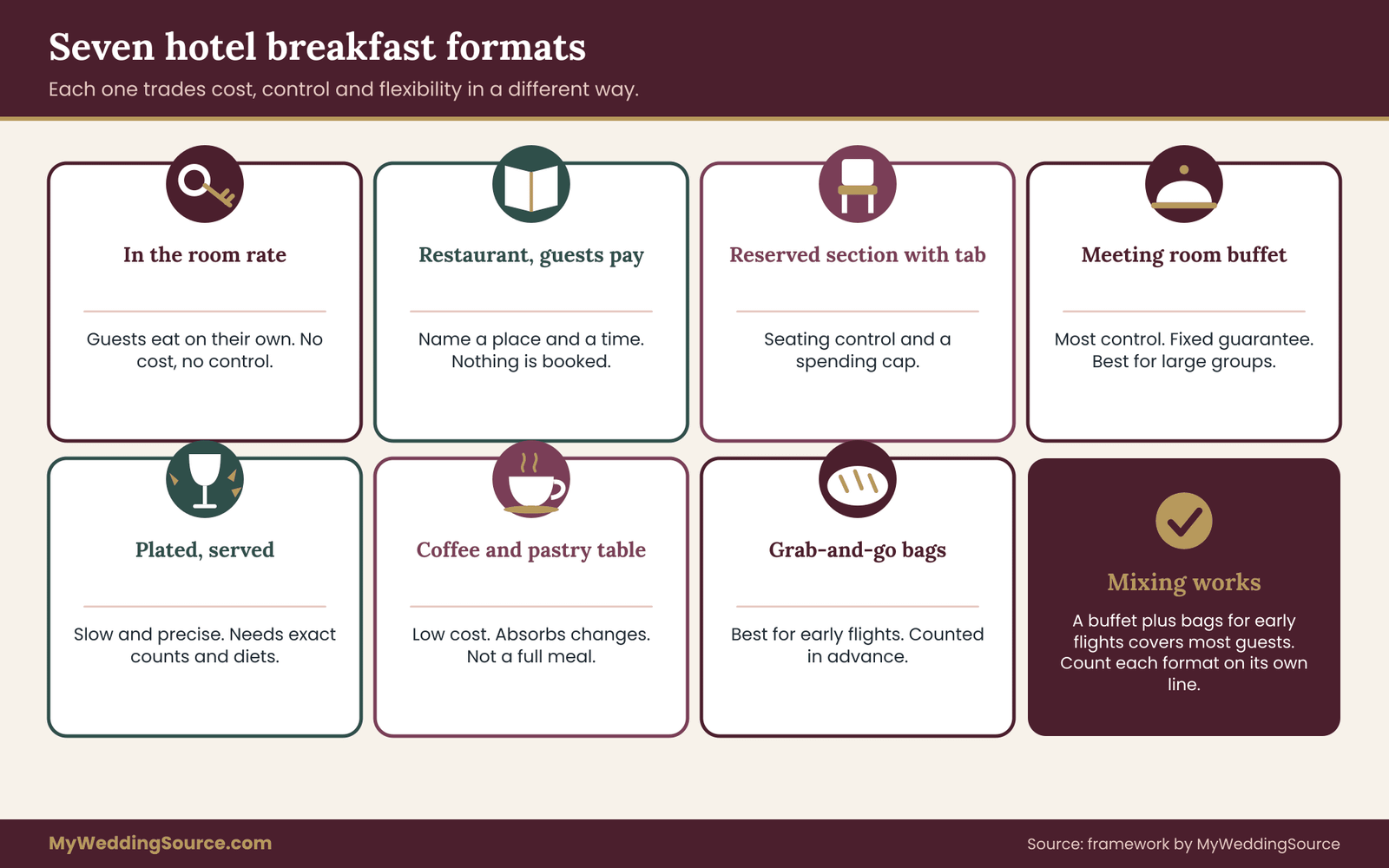
The hotel breakfast already in the room rate. Some hotels include a basic breakfast with every room. If yours does, the couple spends nothing extra, and the question becomes whether to gather guests anyway. The format absorbs changes in headcount perfectly, because each guest handles their own meal. The cost is lost control. Guests scatter across the dining room and you cannot make sure families sit together or that the wedding party has a table. Read the fine print about hotel breakfast hours and whether the offer covers children and extra occupants.
The restaurant, with guests paying their own way. The couple tells guests where the hotel restaurant is and what time people plan to meet. Nothing is booked, nothing is reserved and nothing is billed. This is the lightest option. It works when most guests would eat at the hotel anyway and the couple’s goal is only to be in the same room for a while. The risk is a long wait if sixty people arrive at once at a restaurant staffed for twenty.
A reserved section of the restaurant with a tab. The couple asks the hotel to reserve tables for a window and to bill the couple’s master account up to a cap, or to bill guests individually for anything above it. This gives some seating control and a fixed ceiling, while using the hotel’s existing kitchen and staff.
The count matters less to the hotel, because there is no buffet to prepare, but it still matters for table reservations. The catch is that servers have to track who is on the tab, which works best with a short, clear rule such as “hotel breakfast and coffee, no alcohol, no room service.”
A buffet in a meeting room. The hotel sets up a private room with a buffet or stations at a set price per person. This is the most common format for a large group. It gives the most control, because you can arrange tables, hang a sign and make a toast if you want one. It also carries the most financial risk, because the guarantee is a fixed commitment and the room may have a rental fee or a food and beverage minimum. It is the format where the Three-Count Method pays for itself.
A plated or served hotel breakfast. Servers bring set dishes to seated guests. This is slower and more expensive than a buffet, and it demands an accurate count and dietary information in advance, because the kitchen plates to the order. It suits small groups, formal families and cultural preferences where a seated meal is expected. It rarely suits sixty guests who want to eat at different times.
A hospitality table with coffee and pastries. A table in the lobby or a meeting room with coffee, tea, juice, pastries and fruit, open for a window of an hour or two. It costs less per person, absorbs count changes well, and asks nothing of guests except to walk by. It does not feel like a meal, so guests who want a hot breakfast will leave to find one. It is a good fit for a smaller group or as a supplement.
Grab-and-go bags. Guests collect a bag at the front desk with a breakfast item, a drink and a note of thanks. This is the format that suits guests with early flights and tight timelines, and it can be paired with any other option. It is also the one that needs the most careful counting, because the bags are made in advance.
Choosing by headcount and mood
A simple rule of thumb helps narrow the field. Think of three zones, and treat the boundaries as soft.
With a small expected count, such as twenty or fewer, a reserved section of the restaurant or a hospitality table is usually enough. A private room is likely to feel empty and cost more than it adds.
With a medium count, roughly twenty to sixty, a buffet in a small meeting room or a reserved restaurant section with a tab are both reasonable. The deciding factor is whether the hotel can serve extras above the guarantee at the same price.
With a larger count, above sixty or so, a buffet in a meeting room, ideally with two serving lines or stations, is usually necessary to avoid a long queue. Grab-and-go bags can handle the early departures, so the sit-down meal is shorter.
These ranges are starting points, not rules. A hotel with a large, fast restaurant may serve eighty guests more easily than a small hotel serves thirty.
When a hotel breakfast is not worth hosting
Sometimes the best hotel breakfast is the one you do not host. If most guests are local, if the block is small, if the room-rate breakfast is good, or if the couple leaves early for a honeymoon, a hosted hotel breakfast adds cost and work for little gain. Say so kindly, point guests to the restaurant, and put the saved money elsewhere. Declining to host a hotel breakfast is a legitimate choice, not a failure of hospitality.
Combining formats
Formats can be mixed, and mixing often beats picking one. A buffet for the main window, plus grab-and-go bags for early flights, plus a note that the room-rate breakfast is also available for guests who prefer to eat alone, covers most preferences without much extra cost.
When combining, count each format separately. A guest who takes a bag is not also at the buffet, so the buffet count drops by one. If your guests are split across price tiers, the notes on hotel options for different budgets and mobility needs show how to keep each group on its own line. Keeping a separate line for each format on your sheet prevents double counting.
Matching the hotel breakfast to the style of the weekend
A relaxed backyard wedding rarely calls for a formal plated hotel breakfast. A black-tie evening at a city hotel may invite a more polished morning, perhaps a seated hotel breakfast for family and a hospitality table for everyone else. Match the hotel breakfast to the mood of the weekend rather than to whatever the hotel lists first. Guests remember an easy morning more than an elaborate one, and an elaborate hotel breakfast that runs long can crowd out the goodbyes people came for.
The cost of control
Control is the thing you pay for in this decision. Each step from “guests handle it” to “the couple arranges everything” buys more control over seating, timing and mood, and it adds financial commitment and work. It is reasonable to want less control. A calm morning where guests eat when they like and hug the couple goodbye in the lobby is a fine outcome, and often a more relaxed one.
It is equally reasonable to want more. If grandparents travel a long way and will sit and eat slowly, a reserved table with a quiet corner may matter more than saving money. The method does not decide for you. It makes the trade-off visible so the choice is deliberate.
Writing the Meeting Space Brief
The Meeting Space Brief is a one-page document that goes to the hotel’s catering or events contact. It states what you need, in a fixed order, so nothing is lost across emails and phone calls. The brief is the second half of the original method in this guide, and it is the thing most couples never write. They answer questions as they come, and by the end nobody remembers what was agreed.
A good brief does three jobs. It tells the hotel what the event is. It records the numbers and deadlines in one place. And it gives the hotel a clear list of what is and is not included, so the final bill holds no surprises.
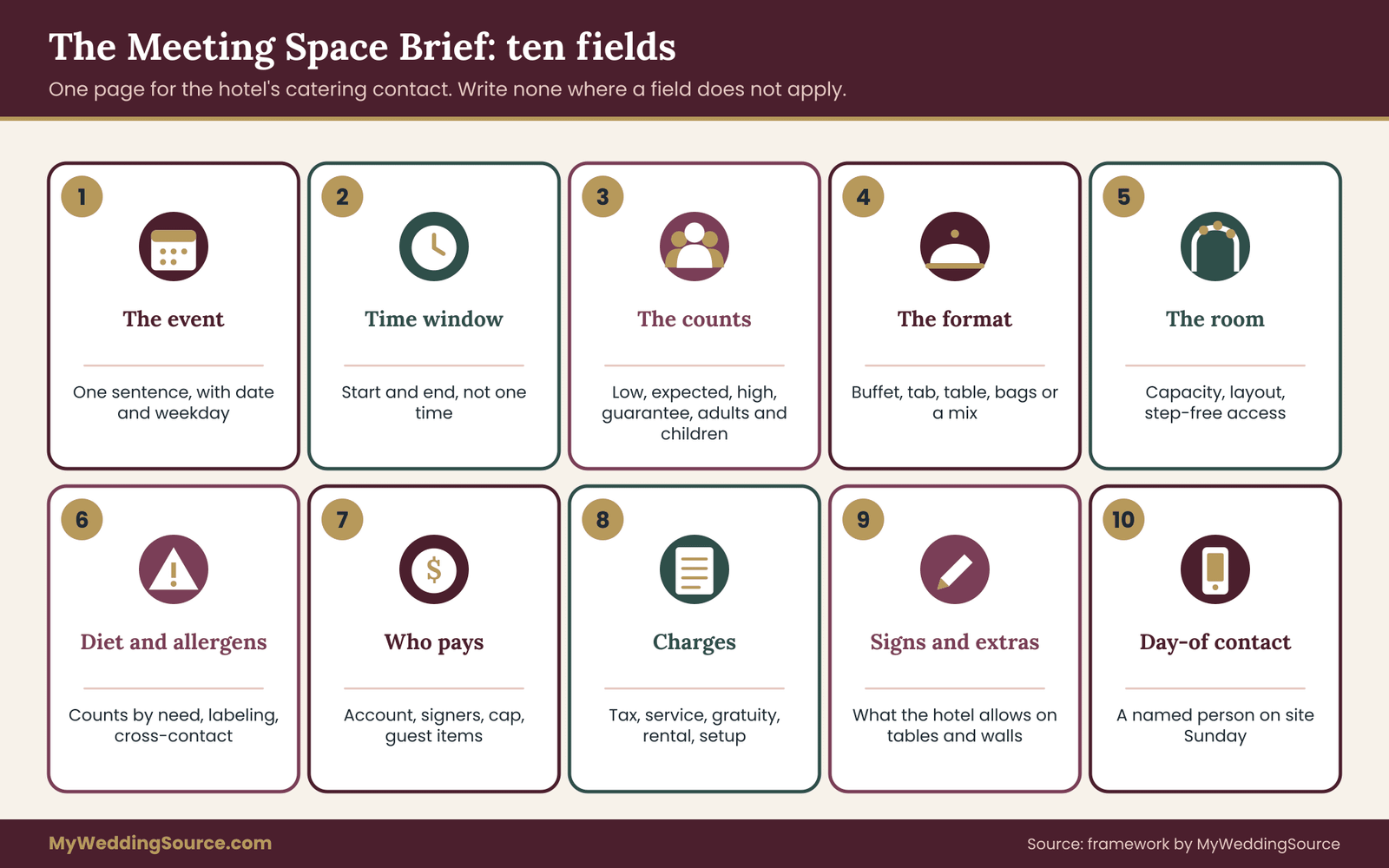
The ten fields
One: the event. A single sentence. “Informal morning-after breakfast for wedding guests staying at the hotel, hosted by the couple.” Include the date and the day of the week. A wrong date is more common than people expect when the wedding spans a late night.
Two: the time window. Give a start and end time, not a single time. “Doors open at eight-thirty and food service ends at ten-thirty.” A window absorbs late sleepers. A single time creates a rush.
Three: the counts. List low, expected and high, plus the guarantee you are proposing. Add the number of adults and children separately, with child age bands. State the date on which you will confirm the final guarantee.
Four: the format. Buffet, stations, plated, hospitality table, reserved restaurant section, or a combination. If you want grab-and-go bags for early departures, say how many and when guests collect them.
Five: the room. The room name or the kind of space, the seating style, and any special needs such as a quiet corner, a table near an exit for a guest who uses a mobility aid, or space for a stroller. Ask the hotel for the room’s posted capacity and keep your count well within it.
Six: dietary and allergen information. List each need by category and count, such as vegetarian, vegan, gluten-free, nut allergy or dairy allergy. Note who will be at the hotel breakfast and whether the hotel will label dishes. Ask the kitchen how it handles shared surfaces for allergen requests.
Seven: who pays and how. Name the account holder, the master account or credit card, the authorized signers, and whether guests may add their own items. If there is a spending cap, write it as a number and say what happens when it is reached.
Eight: charges and extras. List what is included in the per-person price and what is not: taxes, service charge, gratuity, room rental, setup fees, audio or visual equipment, signage and anything else the hotel lists. Ask for each as a line item.
Nine: signage and décor. Whether you may place a welcome sign, a menu card, a small table of photographs or a guest book, and what the hotel allows on its walls and tables. A sign at the lobby entrance helps guests find the room. A tape-on-the-wall sign may not be allowed.
Ten: the day-of contact. One person on site on Sunday morning who can solve problems, plus a phone number the hotel can reach. The group sales manager who signed the contract may not be on duty on Sunday, so ask who is.
Keeping the brief to one page
Resist the urge to add everything. If a field has no content, write “none” so the hotel knows you considered it. If the brief runs past one page, the hotel will skim it, and the details at the bottom are the ones that matter most. A cramped single page is better than three pages of detail.
Send the brief as the attachment to a short email, and ask the hotel to reply with a confirmation of each field. Keep the confirmation with the brief. If anything changes, send a new version with a new date at the top, and ask the hotel to confirm the new one.
Matching the brief to the contract
The brief is not a contract. It is a statement of what you expect, and the hotel’s banquet event order or catering agreement is the contract. Compare them carefully. Differences between the two are exactly where problems start. A brief that says the room is included while the contract adds a rental fee is a conversation to have before you sign, not after.
If your hotel uses a banquet event order, a one-page sheet listing the date, times, counts, menu, room, charges and signatures, read it line by line against the brief. Ask for corrections in writing. If the hotel wants a signature on the same day it sends the order, ask for a day to review it. A short delay is normal, and a hotel that pressures you to sign without reading is a reason to slow down.
Vendor questions, costs and guarantees for a hotel breakfast
Hotels sell group meals through a catering or events department, and the terms are written in the hotel’s favor unless you ask. The questions below are not adversarial. They are the questions a careful host asks of any vendor, and a competent coordinator answers them in a few minutes. Put the answers in writing, ideally on the banquet event order itself.
Hotel catering teams answer these questions daily. Asking about the hotel breakfast guarantee and fees in your first call shows that you are organized, and it usually gets a more useful reply.
Questions about the guarantee
When is the guarantee due, and what is the exact cutoff? Hotels set it as a number of days or business days before the event. For a Sunday event, that can fall on a weekday before the wedding, so find out the actual calendar date and time of day. Ask whether weekends and holidays count.
Can the guarantee go down, and by how much? Some hotels allow a reduction up to a point and charge for the original number after it. Others treat the guarantee as locked. If it can be lowered, ask for the date and the percentage allowed.
What happens above the guarantee? Ask whether the kitchen prepares food for a set percentage above the guarantee, whether extra guests are billed at the same price, and whether there is a maximum. A hotel that prepares for a small cushion above the guarantee lets you commit low and still feed everyone.
What happens below the guarantee? In most agreements you pay for the guarantee even if fewer people come. Confirm it, and ask whether the unused portion can be applied to anything else, such as a credit toward the master account.
Questions about the room and the contract
Is there a meeting room fee, and is it waived at a spending level? Hotels often waive rental if the food and beverage total reaches a minimum. Ask for the minimum as a number, and ask whether it includes tax and service charge or counts only the food.
Does the room block carry any catering obligation? Some group contracts tie the room rate to catering spend or require the group to hold a function at the property. Read the clause on attrition and the one on food and beverage together. If a hotel breakfast is expected, the hotel should say so in the contract, not in conversation.
What is the room’s posted capacity, and how is it set up? Ask for the capacity in a buffet layout and a seated layout. Rooms that hold a hundred people at a reception can hold far fewer when buffet lines, a coffee station and tables must fit. The fire code sets the maximum, and the hotel will know the number. A fire marshal or the local fire department is the authority if anyone wants to check it.
Who else is using the space? A neighboring meeting room with a conference or another party can bring noise, queues at the coffee station and competition for staff. Ask what else is booked on Sunday morning.
Questions about service and food
What hours does the kitchen serve, and when does the room open for setup? A meal that starts at eight-thirty may need the room unlocked an hour earlier. If the hotel holds the room for another event the night before, ask when it will be cleared.
What does the per-person price include? Coffee, tea, juice and water are sometimes included and sometimes charged separately. Refills and a second round of the hot items may be limited. Ask what the buffet contains and what happens if a dish runs out.
How are dietary needs handled? Ask how the kitchen labels dishes, how it prevents cross-contact for allergens, and whether guests with allergies can speak to a chef or manager. Guidance on food allergens from the Food and Drug Administration and on safe food handling from the U.S. government’s foodsafety.gov is the standard reference if you want to understand what a kitchen should be doing. Ask for the kitchen’s answer in writing for any serious allergy.
How are leftover food and cake handled? If wedding cake or Saturday leftovers are brought to the hotel breakfast, ask whether the hotel permits outside food, whether it charges a cake-cutting or handling fee, and how it stores and labels food brought from the wedding. Many hotels refuse outside food entirely for food safety reasons.
Questions about money
What is the total, line by line? Ask for the per-person price, the tax rate, the service charge, any gratuity, room rental, setup, equipment and any other fee. Add them up and divide by the guarantee to see the real cost per plate. That number is often noticeably higher than the quoted per-person price.
What is the service charge, and does it go to staff? Hotels use different words for fees and tips. Ask whether the service charge is taxable and whether it replaces a tip. The distinction matters for the final total, and for a separate tip if one is expected.
How and when is payment taken? Ask whether a deposit is due, whether the balance is charged to your master account or card on the day, and when you receive the final bill. Ask for the bill in writing before it is charged.
Can the charge be split? If two families are sharing the bill, ask whether the hotel can split the invoice between two cards. Doing this ahead of time avoids a scene at the front desk.
Pulling the cost together
A rough way to compare hotel breakfast options is to compute a cost per plate that includes everything. For the buffet, add the per-person price, taxes, service charge, room rental if any, and any extras, then divide by the number of plates you expect to pay for, which is at least the guarantee. For a tab, use the cap divided by the expected count. For a hospitality table, use the quoted price for the group.
An example of the arithmetic, with invented numbers. A buffet is quoted at a flat price per adult, and a service charge and tax are added on top. The room is free at that spending level. If the all-in price per plate is higher than the quoted price by a visible margin, the couple compares it with a reserved restaurant section where guests are billed for what they order. The point is not to find the cheapest option, but to see the real figure before a signature.
The wedding budget guide explains how to hold a contingency for items like this, and a short line in your budget for the Sunday meal makes it easier to say yes or no without guessing. Many couples already hold a reserve for last-minute costs. The cost of an extra twenty plates is the sort of thing the reserve is for.
Reading the hotel breakfast order clause by clause
Read the order in this sequence: the date and room, the guarantee, the price and fees, the cancellation terms and the signature block. A hotel breakfast order is short, usually a page or two, so this takes ten minutes. Mark anything that differs from your brief. If the cancellation terms for the hotel breakfast are stricter than those for the room block, note the date after which the hotel breakfast can no longer be cancelled without a charge, and put it on the calendar beside the guarantee date.
Who pays: couple, parents or guests
Hosting arrangements differ. Some couples pay for the whole meal. Some families, especially parents of the couple, host it as a gift. Some groups treat it as a casual gathering where each person pays for their own plate. None of these is wrong, but the arrangement must be clear before guests arrive.
If the couple or a family hosts, say so in the invitation and tell the hotel who the billing contact is. If guests pay, say so as well, and ask the hotel whether it can provide individual checks. If you are hosting a limited group, such as the wedding party and immediate family, tell the hotel so staff do not offer the tab to everyone who walks in. A card at the door that reads “this table is hosted” is a gentle way to tell staff and guests.
Whatever the arrangement, put it in writing in the brief, in the hotel’s order and in the message to the person paying. A short email that says “the hotel breakfast is hosted by the couple’s parents, billed to the card ending in the last four digits on the order” prevents a charge dispute later. For disputes about charges that remain, the Consumer Financial Protection Bureau explains the process for disputing credit card billing errors, and the general rule is to act quickly and in writing.
Telling guests about the hotel breakfast
Even the best-planned hotel breakfast fails if guests do not know about it, or know about it in the wrong way. The aim is to give each guest the information they need, at the moment they need it, in the form they will actually read.
The core facts are short. What: hotel breakfast, and whether it is hosted or pay-your-own. When: the start and end time. Where: the room name and how to find it. Who: all hotel guests, or a specific group. And what to do: reply by a date if you plan to come, or collect a bag at the front desk if you are leaving early.
Choosing the channel
A single channel is rarely enough, because guests read different things. Use at least two.
The wedding website. A short section titled “Sunday morning” with the facts above, plus a link or a form to say yes or no. The website is where guests look for logistics before they travel, so it carries the main information. The RSVP etiquette guide covers how to ask for responses without making guests feel pressured, and the same principles apply to a secondary question such as hotel breakfast.
A printed card in the welcome bag or at check-in. A small card with the same facts, left at the front desk or placed in each welcome bag, reaches guests who skipped the website. If you work with the front desk, ask whether it can hand a card to every guest in your block at check-in. A friendly note from the hotel staff carries more weight than a stack of cards on a table.
A text message the evening before. A short text on Saturday afternoon or in the morning reminds guests who made a plan and helps those who forgot. Keep it to two lines: the time and the room. For a larger group, a broadcast message through a group chat or a simple texting tool is fine, provided guests agreed to receive messages.
The reception itself. A mention at the end of the night, by the couple, by the person giving the last toast, or by the DJ, reaches almost everyone. Keep it brief and invite, rather than instruct.
What the front desk can do
Front desk staff meet every guest at check-in, which makes them useful messengers for the hotel breakfast. Ask whether they will hand out your card, point guests to the room and answer simple questions about the hotel breakfast time. Give them the key facts on a single sheet so they do not have to guess. A front desk that knows the plan can also tell you, the evening before, how many early check-outs have been requested, which sharpens your last hotel breakfast count.
What to write
Write the invitation the way you would tell a friend. “We’ll be at breakfast in the Garden Room from 8:30 to 10:30 on Sunday. Come when you wake up, eat what you like, and say goodbye before you go. Let us know if you’ll join us so the hotel can prepare.” That sentence tells the guest the time, the place, the casual tone and the request for a reply.
Avoid the vague “join us for hotel breakfast” with no time or place, which leaves guests guessing. Avoid the over-formal invitation that makes a casual meal sound mandatory. And avoid mentioning cost in a way that makes guests feel pressured to pay or to decline. If guests pay, say so once, plainly. “Breakfast is on your own tab” is enough.
Asking for a reply
The reply request is what feeds count three, so make it easy. A yes-or-no link, a reply to a text, or a checkbox on the website all work. Ask for the number of people, including children, and any dietary needs. Set a reply date at least a few days before the guarantee date, so you have time to follow up.
Following up is acceptable, and kind. Send one reminder to guests who have not replied, one week before the guarantee date. A short message such as “We’re finalizing hotel breakfast numbers on Thursday, could you let us know if you’ll join?” is polite and clear. Do not send more than one reminder. After that, set the count with the information you have and plan for the people who do not reply.
Early departures and late sleepers
Guests who leave early should have an option, even a small one. A grab-and-go bag, a coffee at the front desk or simply a note that the room-rate breakfast opens at six all work. Telling an early traveler “there’s a bag waiting for you at the desk” is warm and costs little.
Late sleepers need a window wide enough to cover them. If the meal ends at ten and checkout is at eleven, guests who wake at ten-fifteen are out of luck. A window that ends close to checkout, or a note that coffee and pastries remain available, helps. Ask the hotel whether the window can run a little longer if the room is not booked after.
Accessibility and comfort
Think about how each guest gets to the room and how they move around it. Ask the hotel about step-free access, elevator access from guest floors to the meeting room, and the layout of the buffet. A buffet line can be difficult for a guest who uses a wheelchair, a cane or a walker, or who has low vision.
Ask whether staff can assist with plates, and whether there are seats near the buffet. The ADA website, run by the U.S. Department of Justice, offers general information on accessibility obligations for businesses, and the hotel can explain what its property provides.
For guests with infants and toddlers, ask for high chairs and a space where a stroller does not block the aisle. For guests who are tired after the wedding, a few seats with a quiet view are as useful as a hot dish.
The week-by-week path to the Sunday hotel breakfast
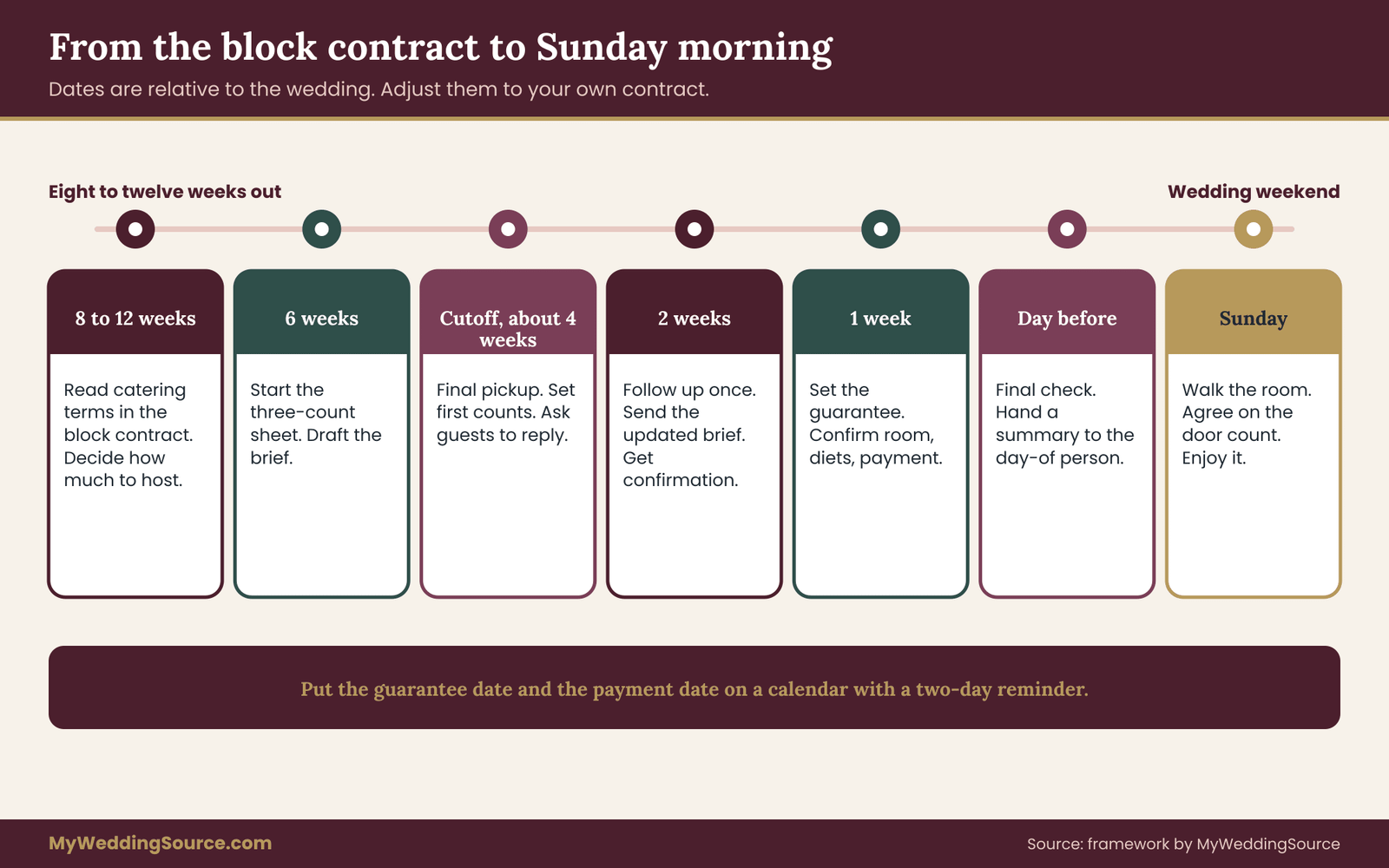
The Three-Count Method fits into a calendar. Dates below are relative to the wedding day and assume a hotel block with a cutoff roughly a month before the wedding. Adjust them to your contract.
Eight to twelve weeks before. Read the room block contract for catering terms. Ask the hotel what meeting space and hotel breakfast formats it offers for a Sunday morning, and what the minimums are. Decide whether you want to host anything at all. If the answer is no, say so and move on, but tell guests where to eat.
Six weeks before. Start the three-count sheet with the pickup report to date. Draft the Meeting Space Brief, even if numbers are blank. Ask the hotel for a draft banquet event order based on the brief.
At the cutoff, about four weeks before. Update the sheet with the final pickup. Convert rooms to people, subtract early departures, add known extras. Set the first low, expected and high counts. Send the website update and ask guests to reply.
Two weeks before. Review replies. Follow up with those who have not answered. Update the brief with revised counts and send it to the hotel. Ask the hotel to confirm each field.
One week before. Set the guarantee, taking the commitment date into account. Confirm the room, the time, the setup, the dietary list and the payment arrangement. Print the sign, if you are using one, and confirm what the hotel allows.
The day before. Check the final numbers against the sheet, confirm the day-of contact, and hand a written summary to the person who will be at the hotel on Sunday, whether that is a family member, a coordinator or a friend.
Sunday morning. Arrive a little before the doors open. Greet the hotel contact, walk the room, check the signs and the dietary labels, and agree on how the door count will be tracked. Then step back and enjoy the meal.
What to record about the hotel breakfast
Write down the final door count, the guarantee, the expected count and the gap between them, plus a line on what surprised you. These notes show how your guests really behaved at the hotel breakfast, which helps relatives planning a similar weekend and belongs in the records you keep after the wedding. A hotel breakfast is a small event, and a small record is enough: five lines in a shared note.
After the meal
Ask the hotel for the final count and the itemized bill the same day, or as soon as it is ready. Compare it to the order. Note any difference and ask about it politely while the event is fresh. Keep the bill, the order and the brief together with your other wedding records. A short thank-you note to the catering contact is a kind finishing touch.
Edge cases and shifting counts for a hotel breakfast
Real weddings rarely match a clean example. The cases below come up often enough to prepare for, and each has a simple rule that keeps the hotel breakfast on track. They are decision rules, not rules of law, so adjust them to your contract.
Guests spread across two hotels
When the block is split between two properties, the hotel breakfast usually belongs to one of them, which means guests at the other must travel to eat. Decide which hotel hosts, and count only the guests who will make the trip. Guests at the second property are a lower show-up group, because the effort of getting there is higher.
A shuttle changes this. If a shuttle already runs between the properties and the venue, add a Sunday run and say so on the card. If there is no shuttle, consider a hospitality table or grab-and-go bags at the second hotel instead of asking people to cross town. Treat each property as its own count, and keep two lines on your sheet.
The hotel has no private meeting space
Small hotels often lack a meeting room, or the only space is booked. Options include a reserved section of the restaurant, a lobby table, or a nearby cafe that agrees to a group booking. The restaurant section works best when you can name a window and a cap, and the cafe works when it can prepare for a known number. In either case, send the brief anyway, adapting the room field to the space on offer, so the numbers and the payment arrangement are still on paper.
The restaurant is closed or limited on Sunday
Some hotel restaurants open late, close for private events or serve a reduced menu on Sunday. Ask in the first conversation, not the last. If the restaurant is closed, the choices are a catered meeting room, an outside vendor that the hotel permits, or a room-rate breakfast delivered in bags. An outside vendor needs the hotel’s approval, a certificate of insurance in many cases, and a plan for setup and cleanup, which is more work than most couples want on Sunday morning.
A late reception and a slow morning
If the reception ran until late and the departure window is tight, a hotel breakfast at nine may be too early for half of the guests and too late for the other half. Offer a wide window and a light format. Coffee and pastries from eight to eleven absorb both groups better than a hot buffet at nine. Ask the hotel whether a longer window raises the price. Many price by the person rather than by the hour, which makes a longer window free.
An early wedding, with Sunday travel
When a wedding ends in the afternoon, guests may leave Sunday morning for flights, and the hotel breakfast count drops sharply. Use the pickup report’s departure column carefully, and ask guests about their flights in the reply form. For guests who fly out early, a bag at the front desk and a note of thanks is often the entire hotel breakfast, and it is a good one. The Transportation Security Administration publishes guidance on arriving early for flights, which is useful context for guests deciding how early to leave.
Guests in vacation rentals or with family
Some guests stay in a rental, or with relatives, and never appear in the pickup report. If you want them at hotel breakfast, they are in count two by invitation, not by the block, and their show-up rate depends on distance. A person staying twenty minutes away is less likely to come than one staying upstairs. Ask them directly, and keep them on the same sheet as the rest of your guest list notes. If you do not invite them, tell them kindly where to find coffee, so they do not feel left out.
A guest list that grows
The most common change is growth, through late bookings, a plus-one whose invitation arrives late, or relatives who decide to attend at the last minute. Growth is manageable when the guarantee is low and the setup count has room. It becomes a problem when the room is nearly full.
Use a trigger rule. If the confirmed count for the day exceeds the setup count by a set amount, for example by five plates, call the hotel the day before and ask whether it can add capacity. If the count exceeds the ceiling, either approve the increase or tell the extra guests the hotel breakfast is pay-your-own. Choose the rule in advance, so the decision does not fall to whoever is standing at the door.
A count that shrinks
Shrinking is the harder direction financially. A storm, a family illness, a cancelled flight or an unexpectedly small turnout leaves the host holding a guarantee. The defense is the low guarantee, set at the beginning. If the count drops anyway, call the hotel as early as possible. Hotels vary in whether they allow a reduction. Some will, especially if they can fill the room or reduce food purchases. Some will not. A polite request often gets a better response than a demand, and a note of the change in writing keeps the record clean.
Illustrative arithmetic: if the guarantee is 50 and 40 people come, the couple pays for 50 under a firm guarantee, so there are ten unused plates. A guarantee of 40 would have avoided that. The lower number would only have cost more if more than 40 people had come and the hotel could not serve extras, which is a question you ask before you sign.
Severe weather and travel disruption
Winter storms, hurricanes and flight cancellations can change the whole weekend. Some guests will stay an extra night, some will not arrive at all, and some will skip the hotel breakfast to get on the road. Check the hotel’s policy on cancelling or changing events for weather, and whether a force majeure clause applies. The wedding planning checklist is a handy place to keep the contact details of the people who can decide quickly if the forecast turns, and the same is true for your hotel breakfast contact.
Dietary, cultural and religious needs
Some guests will observe a religious fast, a dietary law or a cultural custom that affects what they eat in the morning. Ask in the reply form, not at the buffet. If a meaningful number of guests need a particular menu, mention it to the hotel early, because the kitchen may need to source ingredients or prepare dishes separately.
A mix of hot and cold items, plain fruit and bread, and a few options that fit common restrictions is enough for most groups. The wedding menu planning guide goes deeper on building menus for different diets, and the same logic applies to a morning buffet in miniature.
For serious food allergies, do not rely on a label at a buffet. Ask the kitchen to prepare a separate plate for the guest or ask the guest to speak to a manager. A buffet shares spoons and surfaces, and cross-contact is a known risk. The foodsafety.gov site and the Food and Drug Administration publish general information on allergens and food handling, and the hotel’s answer should match that basic standard.
Children and the very young
Children eat at odd times and in odd amounts. A family of four may count as two adults and two children on the brief, and the price may differ. Ask whether the hotel offers a children’s price and what age it applies to. Provide something simple, such as fruit, cereal or toast, and a place to sit. A tired child at a buffet line is a poor combination, so a seat near the food helps.
What to do when the hotel makes a mistake
Hotels make errors too. The room is booked for the wrong date, the count on the order is wrong, or the buffet is thinner than described. Stay calm, use the brief and the order, and ask the day-of contact to fix it on the spot. Afterward, write to the hotel with the facts, what was agreed, what happened and what you request. Most hotels respond to a clear, polite message with a partial refund or a credit. Keep every email.
A plain script for the first email
Here is a way to open the conversation. “We are arranging a hotel breakfast on Sunday morning for guests staying in our block. We expect between fifty and seventy people. Could you send the terms for a hotel breakfast in a meeting room, including the guarantee date and whether extras above the guarantee can be served?” That message names the event, the range and the two facts that matter most. It also shows the hotel that you understand what a guarantee is.
A final check before you commit to the hotel breakfast
Before signing the banquet event order, run through a short list. Each item takes a minute, and together they catch most problems.
First, the counts. Is the guarantee at or near the low count, and does it have a date and a time? Is the setup count near the expected count? Is the ceiling written down?
Second, the room. Is the capacity enough for the setup count with buffet lines and tables? Is the room accessible from the guest floors? Has the hotel confirmed nothing else is booked next to it?
Third, the money. Is every fee listed? Is the all-in price per plate calculated? Is the payer named, and is the payment method clear?
Fourth, the guests. Do they know the time, the room and the cost? Is there a reply date and a follow-up plan? Do early leavers have an option?
Fifth, the contact. Is there a named person at the hotel on Sunday, and a named person on your side?
If any answer is unclear, ask the hotel before signing. A small amount of friction now saves a larger amount later.
Your next steps
Work through these in order. Each one is small, and the early ones cost nothing.
- Open your room block contract and mark the cutoff date, the attrition clause, any catering or food and beverage minimum, and the meeting room terms.
- Ask the hotel’s group sales contact for the current pickup report, and ask who handles catering on the hotel side.
- Decide how much hosting you want: nothing, a tab, a hospitality table, a buffet or a combination. Say it aloud to your partner before you contact the hotel.
- Start the three-count sheet. Count one first, from the pickup report, then count two, then your low, expected and high rates.
- Draft the Meeting Space Brief with all ten fields, writing “none” where a field does not apply.
- Add a Sunday section to your wedding website and a short card for the welcome bag, with a reply date before the guarantee date.
- Put the guarantee date, the final-count date and the payment date on your calendar with a reminder two days ahead of each.
- After the hotel breakfast, compare the final bill with the order, file both with your other wedding records, and send a short thank-you to the catering contact.
If you are still deciding whether to host a Sunday meal at all, spend an evening on that question first, and use this guide only if the answer is yes. Either way, tell guests where coffee is.
FAQ
How many people should I count for a hotel breakfast after the wedding?
Start with the people who are sleeping at the hotel on Saturday night, taken from your room block pickup report. Subtract guests leaving before hotel breakfast, add invited guests who are not in the block, then apply a low, expected and high show-up rate. Commit to the low count, ask the hotel to set up for the expected count, and treat the high count as your ceiling.
Does a hotel room block include hotel breakfast?
Not automatically. Some room rates include a basic breakfast for registered guests, and some group contracts add catering terms, but many blocks include neither. Read the contract for any line about hotel breakfast, food and beverage minimums or meeting room fees, and ask the group sales contact to confirm in writing what the rate covers, including whether children and extra occupants are included.
What is a catering guarantee, and when is it due?
A guarantee is the number of guests you commit to pay for, even if fewer come. Hotels usually set the due date a number of days or business days before the event, which for a Sunday meal may fall on a weekday before the wedding. Ask for the exact calendar date and time, whether it can be lowered, and what happens to guests above it.
Is it better to host a buffet or let guests order from the restaurant?
It depends on your count and your wish for control. A buffet in a meeting room gives you control over seating and timing but carries a fixed commitment. A reserved restaurant section with a tab keeps a ceiling on cost and uses the existing kitchen. Guests ordering on their own is the lightest option and carries no commitment. Compare the all-in price per plate before choosing.
What should go in a meeting space brief for the hotel?
Include the event description and date, the time window, the low, expected and high counts with the proposed guarantee, the format, the room and seating needs, dietary and allergen counts, who pays and how, all charges and extras, signage permissions, and a named day-of contact. One page is enough. Ask the hotel to confirm each field in writing and keep the reply with your records.
How do I handle guests who book outside the room block?
Ask guests to tell you when they book elsewhere, and ask the hotel whether its report shows those reservations. Guests staying at a different property or a rental are included only by invitation, so add them to your count two by name and note how they were invited. Their show-up rate is usually lower, because they have to travel to reach the meal.
What if fewer guests come than I expected?
You pay for the guarantee under most hotel terms, so the best protection is setting it low at the start. If the count drops before the event, call the hotel as early as possible and ask whether a reduction is allowed, and by how much. Confirm any change in writing. If you pay for unused plates, ask whether the credit can apply to anything else on your account.
Who pays for the day-after breakfast?
There is no single rule. Couples, parents or other relatives sometimes host, and in other cases each guest pays for their own plate. Whatever you choose, state it clearly on the invitation, on the hotel order and in the message to the person paying, and name one billing contact. Clear wording prevents most disputes at the front desk and on the final bill.
Sources
- Food and Drug Administration, food allergen and food safety information
- FoodSafety.gov, safe food handling guidance from U.S. agencies
- U.S. Department of Agriculture Food Safety and Inspection Service
- Centers for Disease Control and Prevention, food safety
- ADA.gov, U.S. Department of Justice accessibility information
- Consumer Financial Protection Bureau, credit card billing disputes
- Federal Trade Commission, consumer advice on fees and pricing
- Transportation Security Administration, airport travel information
- National Fire Protection Association, occupancy and life safety codes
- U.S. Fire Administration, fire safety information