

Cake flavor pairings are the combinations of cake, filling and frosting you choose for each tier, and the best ones are picked with a score sheet and a headcount rather than a gut feeling at the bakery. This guide shows how to find out what your guests like, score every candidate fairly, and divide the flavors across tiers so each group gets a slice it will actually eat.
Sort your guests into five or six preference groups first (classic, chocolate, fruit and light, less sweet, adventurous, and guests with allergy needs). At the tasting, score every pairing from one to five on flavor, balance, texture, how well it holds up and how clearly the bakery can state its ingredients. Drop anything with a one. Then convert each group’s headcount into slices and assign the winning cake flavor pairings to tiers and kitchen cake so the numbers match. Confirm the final choices, ingredient lists and allergen handling in writing before you pay a deposit.
Most couples choose their cake flavor pairings the way they choose a restaurant for a group: they argue a little, settle on whatever nobody objects to, and hope. That works until the cake is cut and the line for the plain vanilla tier runs out while the experimental pistachio tier sits half eaten. The problem is rarely the bakery. It is that nobody turned guest preferences into numbers before the order was placed.
This guide treats cake flavor pairings as a small decision project with four parts. First you describe your guests honestly. Then you taste candidates with a score sheet so that opinions become comparable. Then you allocate flavors to tiers and kitchen cake using real slice counts. Finally you verify the details with the bakery in writing. None of this requires special talent, and most of it fits into two evenings and one tasting appointment.
A note on scope. This is general planning information, not legal, tax, medical or food-safety advice, and a bakery’s own policies, ingredients and kitchen practices always come first. Where a rule or a risk matters, the article points you to the agency or the person who can confirm it for your situation.
What wedding cake flavor pairings actually decide
A flavor pairing is more than a flavor name. When a bakery lists “lemon raspberry,” that is shorthand for at least three choices: the cake crumb (lemon), the filling (raspberry), and usually a frosting (vanilla buttercream, cream cheese, Swiss meringue or something else). Change any one of the three and the slice tastes like a different dessert. A lemon cake with a very sweet frosting reads as sugar. The same cake with a tart curd and a light meringue reads as fresh.
That is why cake flavor pairings deserve attention even if you are not a food person. A tier is a promise to a specific number of people. If the promise is vague, the slice is a gamble, and a gamble multiplied by a hundred and fifty guests produces a few unhappy plates that you will never hear about but that guests will remember.
The pairing also drives practical outcomes that have nothing to do with taste:
Cost. Specialty fillings, imported chocolate, fresh fruit and nut pastes usually add to the per-slice price at many bakeries. Some bakeries charge a flat fee per flavor, others charge by tier. Your quote tells you which, and the pairing decisions you make change the total.
Stability. A cake that is delicious in a cool shop can sag, weep or slide in a warm tent. Cream-based fillings, fresh fruit and soft frostings behave differently from firm ganache or stable buttercream. Your guide to wedding cake timeline planning covers delivery and setup in full; here the point is that flavor choices carry stability consequences you should hear about before you commit.
Safety and labeling. Nuts, dairy, eggs, wheat, soy and other common allergens show up inside fillings and frostings more often than in plain cake, and a pairing that looks harmless on a menu card can hide the one ingredient a guest must avoid.
Serving flexibility. If one tier is the only chocolate option and chocolate lovers outnumber it, the cake runs short of what people want even when the total number of slices is correct.

Before you can choose cake flavor pairings, you need to know who is eating them. The infographic above shows the six kinds of guests that most guest lists contain. You do not need a spreadsheet to use it. You need to be honest about which of those six groups actually appear in your crowd and roughly how many people sit in each. The next sections do that work, then turn it into a plan.
Why one flavor rarely fits every guest
It is tempting to look for a single crowd-pleasing flavor and put the whole cake in it. Vanilla is the usual answer, and it is a reasonable one. The trouble is that “reasonable” and “memorable” are different goals, and a single flavor also fails the guests whose needs are not about preference at all.
Think about who actually attends. A typical guest list for a wedding includes older relatives who want something not too sweet, friends who will eat anything chocolate, children who will pick off the frosting, a few people who dislike fruit in desserts, one or two who avoid certain ingredients for health or religious reasons, and a handful who are happy to try something unusual.
Those people do not map onto one flavor. Offering several well-chosen cake flavor pairings is not indulgence. It is the same logic as offering a vegetarian entrée: you accept that your crowd is mixed and you cover the range cheaply.
There is a second reason to avoid a single flavor. Taste fatigue and expectations differ at weddings. Guests have usually eaten a full dinner, and they approach the cake with a sweet tooth that varies a great deal. A heavy chocolate cake with a rich filling is a lovely finish for some guests and too much for others. When the cake offers one light option and one rich option, guests self-sort without any effort from you.
There is also a limit in the other direction. Too many cake flavor pairings is its own failure. A cake with six flavors across three tiers, four fillings and two frostings is hard to label, hard to serve and expensive. The goal of this guide is a deliberate middle: enough variety to cover your real groups, few enough cake flavor pairings that every one can be explained on a small card and cut by a server who has never seen your cake before.
A good rule of thumb for the number of distinct flavors is to start from the number of real preference groups in your guest list and then merge. Six groups rarely need six cakes. Fruit and light can often share a pairing with classic if the filling is chosen well. Less sweet and adventurous sometimes combine in a single spiced or citrus option.
Allergy needs usually require a separate, carefully handled item rather than a separate tier of the main cake. By the time you merge, most couples land on three or four cake flavor pairings, which is a manageable number for a bakery and for a serving team.
What you will need before you start
You do not need much, and gathering it first prevents the tasting from turning into a vague afternoon of eating cake.
A rough guest count. An estimate is enough at this stage. You are working in proportions, and the exact final headcount will come later. If your guest list is still moving, the wedding guest list guide helps you settle the structure first.
What you know about dietary needs. Check your RSVP data or your own notes. Any guest who has told you about an allergy, a religious dietary rule or a medical restriction goes on a separate list. These are requirements, and they get their own section later in this guide.
Your bakery shortlist. If you are still comparing bakeries, the wedding vendor due diligence checklist lists what to verify before you book. Cake flavor pairings are bakery-specific. A bakery that makes its own fillings from scratch offers very different options from one that works from a catalog of fillings. You will ask different questions of each.
A budget range for cake. If you have not set one, the wedding budget page explains how to build the categories. Knowing a cake range early keeps you from falling for a filling that doubles the price.
Two or three hours and one willing taster. You will want a second set of taste buds, ideally someone whose opinions differ from yours.
With those in hand, the next job is to describe your guests in a way that actually helps you choose cake flavor pairings, because a pairing is only good relative to the people who will eat it.
Map your guests into preference groups
The mapping step takes about twenty minutes and saves most of the arguments that come later. You are not surveying anyone. You are sorting the people on your list into groups by what they are likely to want from a slice of cake, and then counting.
Open your guest list and go through it by household. For each household, ask one question: what would these people most likely pick from a dessert table if the options were unlabeled? Write down a group, not a name. Six groups cover almost every list.
Classic. Vanilla, almond-free vanilla, white cake, lemon, simple buttercream. These guests want cake that tastes like wedding cake. This group is often the largest and includes many older relatives and many children.
Chocolate. People who will always take the chocolate option when there is one. Chocolate lovers are loyal, and they notice when there is none. In many guest lists this is the second-largest group.
Fruit and light. Guests who prefer lemon, raspberry, strawberry, orange or passion fruit, often with a lighter frosting. They tend to dislike heavy sweetness and often say they “do not really like cake.”
Less sweet and spiced. Carrot, olive oil, coffee, spice, cardamom, brown butter, tea-infused cake and anything with a savory edge. Guests in this group may be older, may be from food traditions that favor less sugar, or may simply have a more grown-up palate.
Adventurous. Friends and relatives who want something they have not had before: pistachio and rose, matcha, black sesame, tres leches, coconut and lime, dulce de leche. They will happily eat the unusual tier, and they will be disappointed if everything is safe.
Allergy and dietary needs. Not a taste group at all. These guests need a specific ingredient avoided, or need a cake that meets a religious or health rule. They are counted separately because their slice is a requirement, and a bakery’s ability to meet it depends on the bakery’s kitchen rather than on flavor.
The mapping is a judgment call, and it is fine for some households to straddle groups. Put them in the group that matters most for the slice. A couple who loves both chocolate and lemon can be tagged to whichever you think wins at midnight with a full stomach.
Once every household is tagged, add up the heads, because the headcount by group is what turns cake flavor pairings from opinions into a plan. Do not worry about precision. A count that is off by three or four people will not change your plan, and the final guest count will refine it later.
A useful sanity check is to look at the proportions rather than the raw numbers. If classic and chocolate together are well over half your list, your cake should lean toward those two. If fruit, less sweet and adventurous together approach half the list, a plain vanilla and plain chocolate cake will leave a lot of people politely eating around the frosting. The shape of your crowd, not the trend in a magazine, decides the cake flavor pairings that make sense.
Two practical points keep the mapping honest. First, do not tag guests by what you would like them to want. Your grandmother may be classic even if you love a daring cake. Second, ask a sibling or a close friend to check your tags for the guests they know better than you do. Parents’ friends and colleagues are the groups most likely to be mislabeled, and a few corrections can shift the allocation noticeably.
A tasting score sheet for cake flavor pairings
Choosing cake flavor pairings at a tasting is a pleasant event, and that is the problem. After three or four samples most people remember the first and the last and little in between. A score sheet makes the middle count. It does not remove taste from the decision. It records your reaction in a form you can compare later, with the person beside you scoring independently.
The sheet is small. For each pairing you taste, score five things from one to five. A one means a clear problem, a three means acceptable, and a five means you would be glad to serve it.
Flavor. Does it taste good by itself? Ignore the story on the menu card. Score the bite in your mouth. A pairing that sounds exciting but tastes of nothing in particular earns a two, whatever the description says.
Balance. Do the cake, filling and frosting work together, or does one overwhelm the others? Check sweetness first. Check acidity second: a bright filling can rescue a rich frosting, and a rich filling can bury a delicate cake. If you finish a bite wanting water, balance is low.
Texture and moisture. Is the crumb moist but not wet, and does the filling hold its shape on the fork? Ask the baker how the sample was stored. A slice that was refrigerated overnight and brought to room temperature tells you more about wedding day than one cut from the case five minutes ago.
Holding. Will this pairing survive transport, a warm room and a long reception? You cannot judge this by eating it, so ask the baker directly and score their answer, not your guess. A confident, specific answer about stability earns a four or five. A vague answer earns a two.
Clarity. Can the bakery state exactly what is in it, including every ingredient in the filling and frosting, and can they say how it is made and handled? A pairing that the baker describes well scores high. A pairing the baker cannot fully describe scores a one, however good it tastes, because you cannot serve what you cannot explain to a guest who asks.
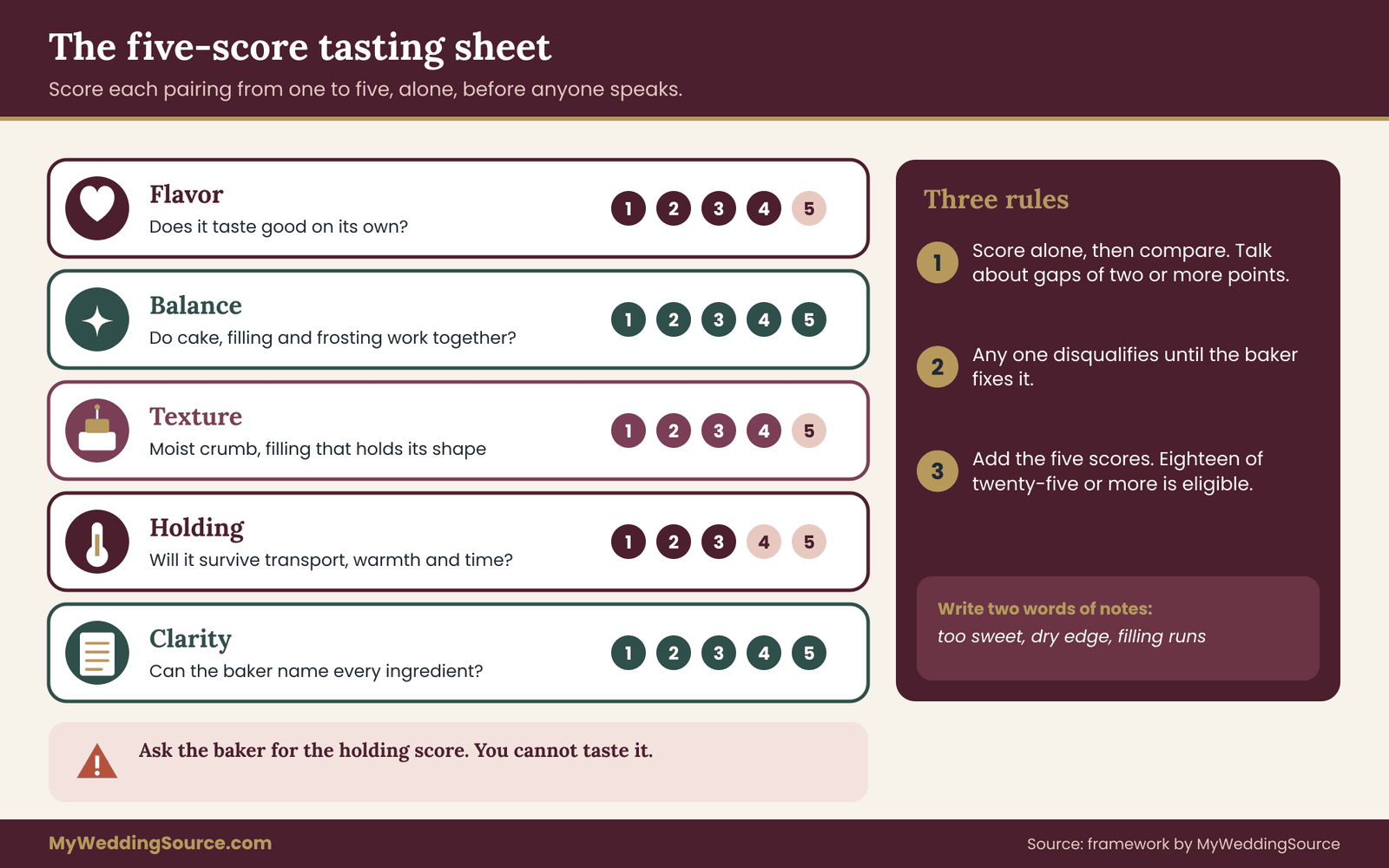
Three rules make the sheet work.
Score alone, then compare. Each taster writes numbers before anyone speaks. When people score aloud, the loudest opinion wins and the sheet turns into a vote. Afterward, compare the numbers and talk about any gap of two points or more. Those gaps are the useful part.
Any one disqualifies until fixed. If a pairing earns a one in any category, it is out for now. A one in flavor means it tastes bad. A one in holding means it will fail on the day. A one in clarity means you cannot get a straight answer. The pairing can return if the bakery fixes the problem, for example by changing the filling to something more stable, but it does not stay on the list as is.
Total, then check the spread. Add the five scores for a total out of twenty-five. A total of eighteen or higher makes a pairing eligible. Below that, it needs a reason to stay. The total is only a first filter. A pairing with a twenty-three and one with an eighteen are both eligible, and the allocation step decides where each belongs.
A short scoring note for each sample is worth the effort. Two words are enough: “too sweet,” “dry edge,” “great with coffee,” “filling runs.” In a month, when you are comparing three bakeries, the notes matter more than the numbers.
Reading a completed score sheet
Numbers only help if you know what to do with them. Here is how a finished sheet might look for three candidate cake flavor pairings, with invented scores and notes for illustration.
The first candidate is a vanilla cake with raspberry filling and a light buttercream. Two tasters score it 23 and 24. The notes say “bright filling, not too sweet” and “crumb a little dry at the edge.” The edge comment is worth a question to the baker, since a dry edge on a sample can mean the slice sat too long or that the cake needs more moisture.
The baker explains that the sample was cut the day before and offers a fresh slice. The second taste raises the flavor score, and the pairing stays on the list.
The second candidate is a chocolate cake with salted caramel filling. Scores are 21 and 17. The gap of four points is the useful part. The lower taster wrote “filling too salty and sticky.” The higher taster wrote “love it.” When two people differ that much, the question about these cake flavor pairings is no longer which taster is right. It is which guest group the pairing serves.
If the chocolate group in your guest list is large and includes people who like bold flavors, the pairing may earn a place in the kitchen cake, where a smaller allocation limits the risk. If the group is mostly older relatives who prefer plain chocolate, the pairing is a poor fit regardless of the total.
The third candidate is a coconut and lime cake with a coconut cream filling. Scores are 20 and 21, with a two in holding because the baker says the filling is not stable above room temperature. Your venue is a tent in summer, so the pairing waits for a different filling. The baker offers a cooked coconut custard, and a second tasting is booked for that variation alone.
Three habits keep this process honest. Write the score before you discuss it. Treat a gap of two or more points as a question about the guest group, not an argument about taste. And keep a short list of cake flavor pairings “waiting for a fix,” because a good baker can often solve a stability or balance problem with a small change.
How many cake flavor pairings to taste, and in what order
Bakeries differ, but a tasting commonly includes a limited number of samples, and some charge a fee that may be credited toward an order. Ask when you book. That fee and the number of samples are also reasons to arrive with a short list rather than a hundred ideas.
Decide in advance on six to eight candidate cake flavor pairings, chosen from your guest groups. A reasonable spread is two for classic, two for chocolate, one fruit, one less sweet or spiced, and one adventurous. If the bakery has a signature flavor you have not considered, add it as a ninth, because bakers know which of their cake flavor pairings are stable and reliably good.
Taste lighter flavors before richer ones, and cleanse between samples with water or plain crackers rather than coffee. Fatigue sets in after about six bites for most people, so score each sample as soon as you eat it rather than waiting until the end. If your tasting includes cake only, ask to taste fillings and frostings separately as well, because the mix is what you are buying and the parts explain why a combination works or fails.
Do not taste a frosting you will not order. If the bakery uses a specific frosting for every wedding cake and you dislike it, find that out first, because it changes which bakery is even on the list. If your venue is outdoors or the room runs warm, ask the baker how each frosting behaves on a hot day before you taste, since that can change which frostings are worth sampling at all.
Finally, keep notes about the bakery’s answers as carefully as your scores. A flavor that earns a twenty-two but comes with a baker who is unclear about allergens, delivery or substitutions is a risk. The sheet records the cake. Your notes record the baker.
Judging cake, filling and frosting together
Good cake flavor pairings follow a few patterns that have nothing to do with trends. Once you can see the patterns, you can read a bakery’s menu and predict which combinations will work, and you can ask better questions when you cannot predict.
Contrast works better than repetition. A sweet cake with a sweet filling and a sweet frosting is three versions of the same note. A vanilla cake with a tart fruit filling and a mild frosting gives the palate somewhere to go. Think in terms of one rich element, one bright element and one neutral element, and make sure no single layer carries all the sugar.
Match intensity. A delicate almond or lemon crumb disappears under a heavy chocolate ganache. A dense, dark chocolate cake can carry a strong coffee or salted caramel filling but will flatten a light berry compote. Pair strong with strong and gentle with gentle, and use the filling as the bridge when you want to mix.
Mind the moisture. Fillings add water or fat to a cake. Fresh fruit, jam, curd and cream all behave differently over hours. A fruit filling that is cooked down, like a preserve, usually holds well. Fresh sliced fruit and whipped cream give a lovely first impression and can weep by the time the cake has stood through photos. Ask the baker which fillings they make in the shop and which they buy, and how each performs after standing.
Think about the frosting’s job. Frosting protects the cake from drying out, supports the structure, and carries a good share of the flavor. Different frostings have different temperature limits and different sweetness. The choice of frosting affects both taste and stability, so make it before you finalize the filling rather than after.
Texture should vary. A soft crumb with a smooth filling and a smooth frosting can feel monotonous. A soft cake with a cream filling and a thin crunchy layer, such as toasted crumb or a chocolate shell, adds interest. Texture elements also hold up differently, and bakers can tell you which ones last on a tiered cake. The filling should never be so loose that it presses out when a tier above it sits on top.

Here are several families of cake flavor pairings that tend to work for mixed guest lists, described as patterns rather than recipes. Your bakery may name or build them differently.
Vanilla bean with raspberry and a light buttercream. A classic that reaches both the classic and fruit groups. The raspberry brings acidity that cuts through sweet frosting, and the vanilla is familiar enough for children.
Chocolate with a vanilla or coffee filling. Chocolate cake alone can feel heavy. A lighter filling in a contrasting flavor keeps the slice from becoming too much on a full stomach.
Lemon with a berry or curd filling and a stable meringue-style or cream cheese frosting. Bright and fresh, and a good home for the fruit-and-light group. Ask about stability if the day will be warm.
Spice, carrot or olive oil cake with a lightly sweetened cream cheese or citrus frosting. A strong candidate for the less sweet group. These cakes stay moist and tend to improve with a little time.
Almond or pistachio with a floral or fruit note, such as cherry or rose. The adventurous group’s pick. Because these use nuts, they usually become a separate decision when allergies are involved, a point the next section covers.
Coconut and lime, or passion fruit. Tropical pairings suit summer receptions. Check how the filling holds in warm weather.
Tres leches-style or milk-soaked cakes. Very moist and well loved in many traditions, but they behave differently from standard tiered cakes and need a conversation with the baker about structure before you order one for a stacked display.
These families of cake flavor pairings are not recommendations to order. They are examples of how to describe what you want. If you can say to a baker, “We need one light and fruity tier for people who do not love sweet cake, with a filling that stays stable for about four hours in a warm tent,” you will get a more useful reply than “we like lemon.”
Red flags when reading a bakery menu
You can learn a lot about a bakery’s cake flavor pairings before you taste anything. A few patterns on a menu or in an email deserve a follow-up question.
A menu that lists flavors but never lists fillings or frostings leaves you guessing about two of the three parts. Ask for the full breakdown, and treat a baker who cannot provide one as a clarity problem.
A long menu with a dozen unusual flavors and no mention of how they are made suggests a kitchen working from catalogs or mixes. That is not automatically bad, since some catalog fillings are consistent and well made. It does mean the baker may not be able to adjust a filling or explain its ingredients, so your clarity scores will depend on what the supplier publishes.
A promise that every flavor is available in any dietary version is a flag. A bakery can make a gluten-free or nut-free cake only if its kitchen, suppliers and process allow it. Ask for the process rather than the promise.
A menu with seasonal or limited fillings needs a date check. If the filling you love is available only in certain months, ask what the bakery uses at other times, and whether the substitute is a different product.
Pricing that depends on the filling is normal. Pricing that is not explained is not. If a flavor carries a surcharge, ask what drives it, since the answer helps you decide whether the pairing is worth it and where in the cake it belongs.
Finally, pay attention to how the bakery talks about guests with restrictions. A baker who asks you good questions about allergies, severity and serving setup is likely to handle them carefully. A baker who treats the subject as a nuisance is telling you what your guests might experience.
Dietary needs come before preferences
Everything above is about taste, and about how cake flavor pairings read on the tongue. This section is about safety, and it follows a different logic. A taste preference is something you balance against other things. An allergy or a dietary requirement is a constraint that decides what is possible before taste enters the discussion.
Start with a list. Collect the needs of your invited guests from RSVPs, from family, and from the couple’s own knowledge. For each guest, note what must be avoided and whether the need is an allergy, an intolerance, a medical restriction or a religious or ethical rule. Do not guess at severity. If you do not know how serious an allergy is, ask the guest or a close relative, and treat the answer as the one that sets the plan.
In the United States, federal food labeling law names a set of major food allergens. The Food and Drug Administration maintains the current list and explains the rules for labeled foods, and you can check it at the FDA’s food allergy information. Your bakery has its own obligations and practices, and a custom cake sold from a local bakery may be handled differently from a packaged product.
Do not assume that a wedding cake carries a label. Ask the baker for the full ingredient list for each cake, filling and frosting, and ask what else is made in the same kitchen and how the equipment is cleaned.
Three principles guide how dietary needs and cake flavor pairings fit together.
A separate item beats a modified tier. For a guest with a serious allergy, the safest arrangement is usually a separately made and separately handled slice or small cake, not a section of the main cake with a different filling. Cross-contact can happen anywhere in a kitchen, and a tier that looks the same as its neighbors is not the same in terms of risk. The same reasoning applies to plant-based cakes, nut-free cakes and gluten-free cakes: the recipe is only half the question, and the kitchen is the other half.
The baker decides what the kitchen can do, and you accept or look elsewhere. If a baker says they cannot make a nut-free cake in a kitchen that uses nuts every day, that is an honest answer, and it tells you either to choose a bakery with a dedicated approach or to source the allergy-safe dessert separately. Pressuring a baker to promise something the kitchen cannot support is the wrong response.
Label everything. A small card for each cake flavor listing the main ingredients and the major allergens present helps guests decide for themselves, and it reduces the number of times a server has to guess. Servers cannot answer detailed ingredient questions unless the information is in front of them.
Medical and religious dietary needs deserve the same respect as allergies even when the stakes differ. A guest who follows a halal, kosher, vegetarian or vegan diet, or who has celiac disease, needs an accurate answer, not a hopeful one. The planning logic is identical: gather the need, ask the baker what is truly possible, make a separate item if necessary, and label it.
If you are building the rest of the menu at the same time, the wedding menu planning guide shows how dessert fits into a dinner that already covers a range of dietary needs. Dessert is the last course, and guests who have already navigated a restricted dinner often feel more anxious about it, so a clear, labeled option matters.
Finally, a reminder that the list of needs belongs in the contract conversation as well as in your notes. When the allergen and ingredient details are in writing, a baker has the same information on the day as you had at the tasting, whoever picks up the order.
Multi-tier allocation of cake flavor pairings
Allocation is the step most couples skip when they pick cake flavor pairings, and it is the step that decides whether the cake matches the crowd. You have a list of eligible cake flavor pairings with scores. You have guest groups with headcounts. Now you connect them by serving count, so that each group has enough slices of something it wants.
The mechanics are short. Allocation of cake flavor pairings has five steps.
Step one: convert guests into slices. Estimate how many guests will actually eat cake. Almost everyone takes a slice at a wedding, but a few skip dessert, a few take two, and some portion goes to the couple’s own keepsake. Use your bakery’s own serving chart for what each tier size yields, because slice size differs between bakeries and between “wedding” and “party” slices.
The guide to planning cake production from final headcount explains the serving math and the final headcount reconciliation in detail, so this guide leaves that to it and works with the numbers you get from the bakery.
Step two: decide what the tiers are. A tiered display cake and a kitchen cake are two different tools. Display tiers are what guests see and what you photograph. A kitchen cake, which is a sheet cake or extra tiers made in matching or different flavors and cut out of sight, supplies most of the slices at many weddings. This matters for flavor, because a kitchen cake is the cheapest way to add a flavor option without adding another visible tier. It also means a display tier does not have to carry the whole crowd.
Step three: reserve the keepsake tier. If you plan to keep the top tier for an anniversary, decide that first and subtract its servings from the guest total. That tier is for you, and it is the one place where flavor can be entirely personal. Ask the bakery how they recommend storing and freezing it, since some cake flavor pairings keep much better than others over time, and ask whether the filling you want survives freezing at all.
Step four: assign pairings to headcount. Take your groups from largest to smallest and give each a pairing that scores well. The largest group should get the largest tier or the largest share of the kitchen cake. Fit the groups together so that every group has at least as many slices as its headcount, with some slack. Where two groups can share a pairing without a loss, merge them. Where a group has a requirement rather than a preference, give it its own separately handled item.
Step five: check the slack. Add the slices you have assigned and compare them to the total. Then check each pairing against the group it serves. If chocolate lovers number forty and the chocolate pairing yields twenty-four, you have a shortfall. Either move some chocolate to the kitchen cake or accept that some chocolate lovers will take their second choice. Plan for a small cushion in the most popular pairing because that is the one that runs out.
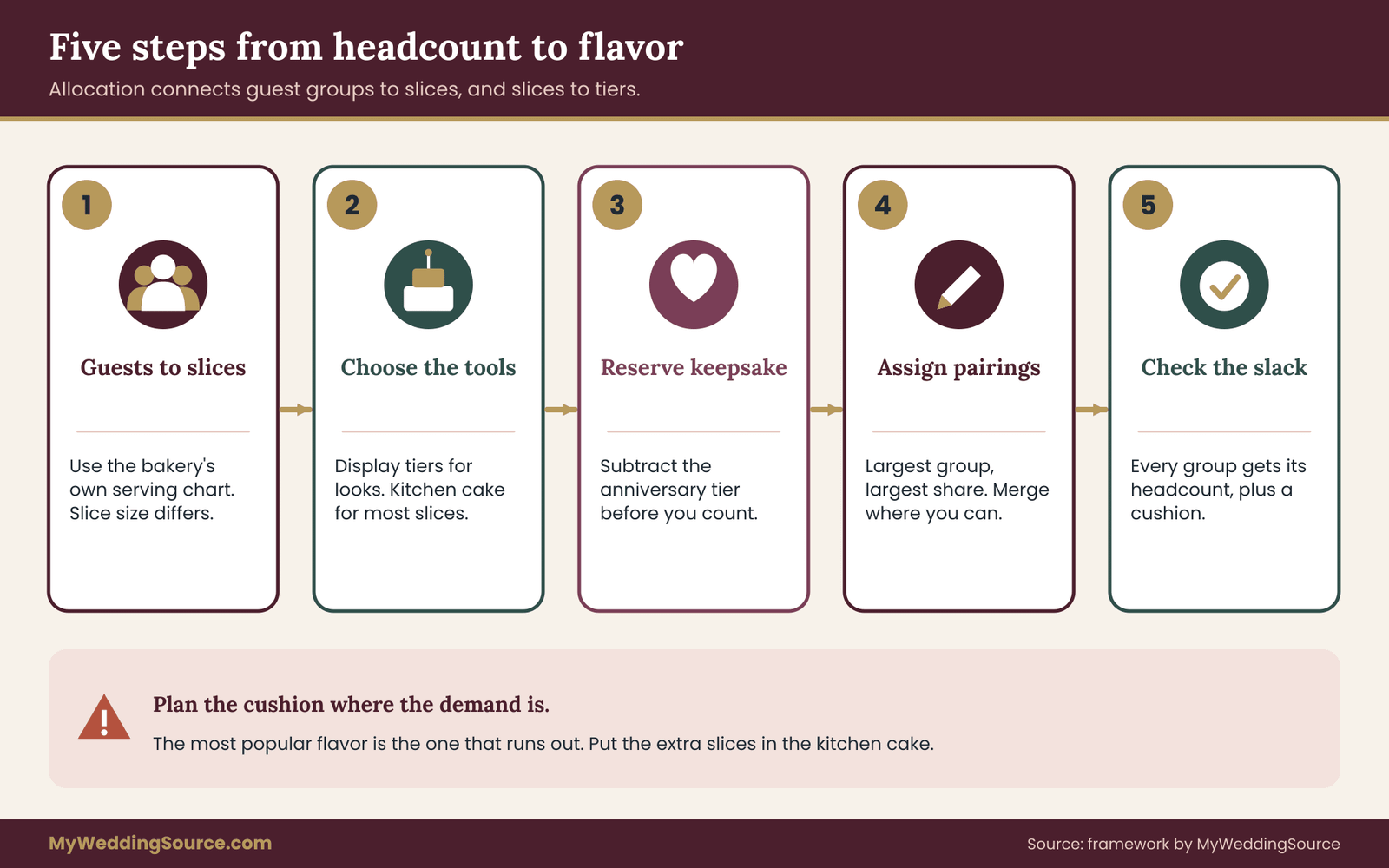
Several rules of thumb keep the allocation sensible.
Put the most popular flavor in the largest tier, and the boldest flavor in the smallest. The largest tier will be cut for the most people. A bold or unusual pairing in a small tier gets noticed by the adventurous group without leaving the rest short.
Avoid a tier that no group wants. If a tier exists only for symmetry, it will be cut and not eaten. A tier with no matching group should be reassigned to whatever group is closest.
Keep the bottom tier friendly. The bottom tier in a stacked cake carries the most weight, supports everything above it, and is usually the largest. Its filling and frosting should be stable. That tends to favor the less delicate cake flavor pairings, so a tart fruit curd or a loose cream might belong higher up or in a kitchen cake.
Put a clear card next to each flavor. A server who can say “this tier is lemon with raspberry, this one is chocolate” can direct guests in seconds. If everything looks alike, guests take whatever is closest, and your allocation falls apart.
Do not allocate allergy-safe items to a tier. Handle them separately, as described above, and count them against the total as individual slices.
A last point on how many different cake flavor pairings the allocation can bear. As a general approach, a display cake with three tiers and a kitchen cake with two or three flavors is already four to six flavors in total, and that is plenty. If the allocation produces more than that, merge groups until it does not. The goal of allocating cake flavor pairings is coverage, not novelty.
A worked example of cake flavor pairings for 150 guests
The following example is invented to show the method. The couple, the numbers and the bakery quote are hypothetical, and your bakery’s serving chart and prices will differ. Use the logic, not the figures.
Jordan and Priya are planning a wedding for about 150 guests, and they expect about 140 of them to eat cake. They keep the top tier for their first anniversary. Their bakery’s chart, supplied with the quote, says a 6-inch tier yields 12 slices, an 8-inch tier yields 24 and a 10-inch tier yields 40. They plan a three-tier display cake and a kitchen cake.
Step one: the groups. After going through the guest list household by household, they count 56 guests in the classic group (including the children), 40 in chocolate, 22 in fruit and light, 14 in the less sweet and spiced group, and 8 who have allergy needs that the bakery must handle separately. That adds up to 140. They had one adventurous friend group of about six people, but they decide to fold it into the less sweet group because both want something less standard.
Step two: the scores. At the tasting they and Priya’s sister score eight cake flavor pairings. Vanilla bean with raspberry and vanilla buttercream earns a 23, 22 and 24, and the sister’s lower scores are in balance, not flavor. Chocolate cake with a vanilla bean ganache earns 21, 22 and 20. A lemon cake with lemon curd and a cream cheese frosting scores 19, 24 and 20, with a one in holding from the baker, who says the curd tends to soften in warm rooms.
By the rule, that pairing is out until the baker proposes a more stable filling. A spiced carrot cake with orange cream cheese frosting scores 20, 21 and 22. A pistachio and cherry pairing earns strong flavor scores from both tasters, but the baker cannot say how the pistachio paste is handled, so clarity earns a one for now. It stays off the list until the baker can answer in writing.
Step three: the allocation. Jordan and Priya assign the cake flavor pairings as follows.
The 6-inch top tier, 12 slices, is reserved for the couple and set aside for the anniversary. They choose the one they both scored highest, vanilla bean with raspberry, because they know it freezes well according to the baker.
The 10-inch bottom tier, 40 slices, is vanilla bean with raspberry and vanilla buttercream. It serves classic and fruit guests and is the stable choice for the base.
The 8-inch middle tier, 24 slices, is chocolate with vanilla bean ganache, for the chocolate group.
The kitchen cake, 76 slices, is split. Thirty-eight slices are vanilla bean with raspberry, the rest of the classic and fruit group (56 plus 22 is 78, less the 40 in the bottom tier). Sixteen slices are chocolate, the remaining chocolate lovers (40 less the 24 in the middle tier). Fourteen slices are the spiced carrot cake for the less sweet group. Eight slices are a separately made allergy-safe cake, made to the bakery’s allergen procedure and labeled.
The total is 24 plus 40 plus 76, which is 140 guest slices, plus the 12 kept by the couple.
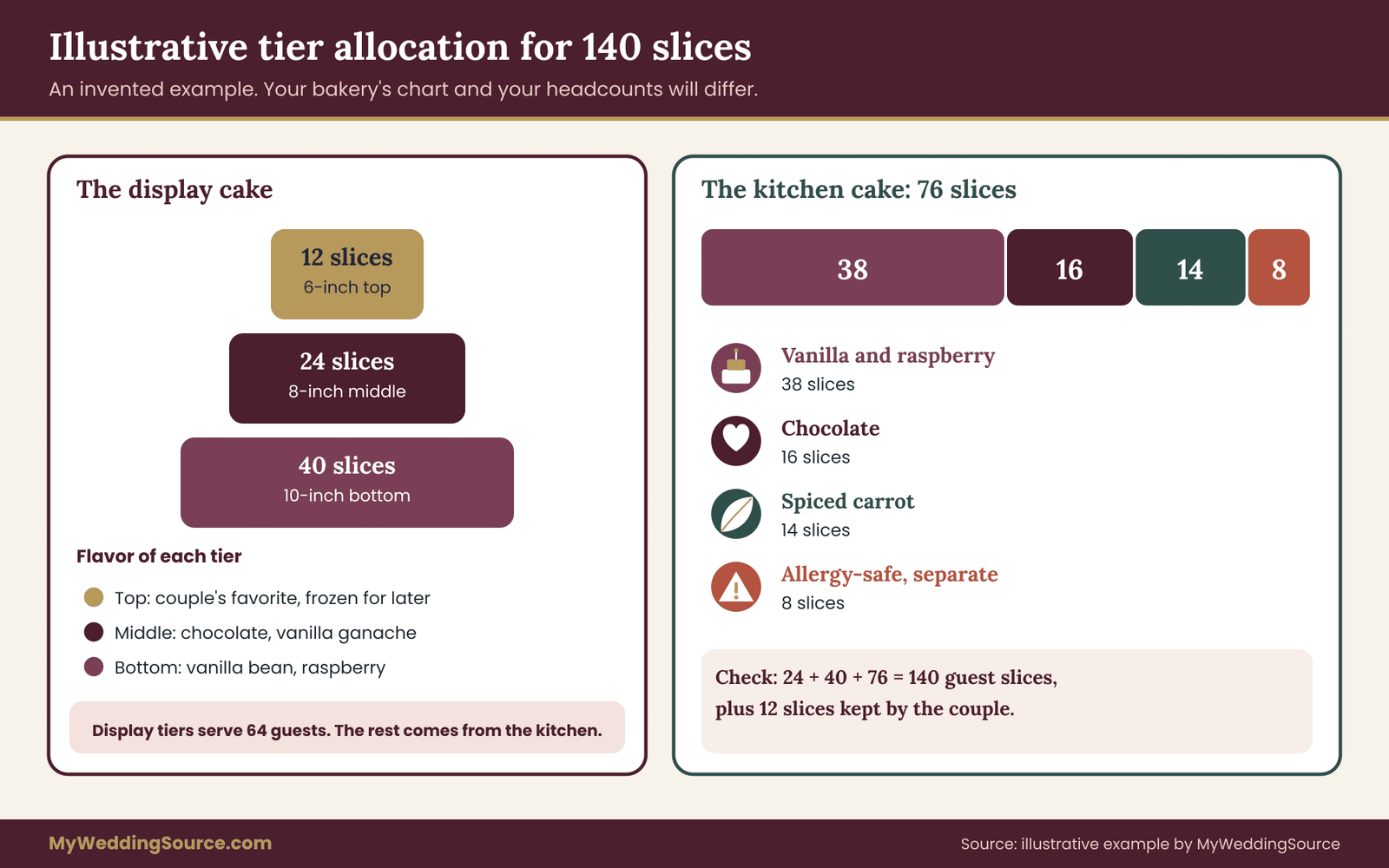
Step four: the check. Each group has at least its headcount. Chocolate has exactly its headcount, which makes it the group most likely to run short if more guests choose chocolate than expected. They ask the bakery whether the kitchen cake can add a few extra chocolate slices, and they agree to a small increase in the final order. They also add small cards for each flavor, and they ask the baker to write the labels.
The example shows two things. First, no group is forgotten, and the cake still looks like one cake from the front. Second, the allocation did not need an unusual number of flavors. Four cake flavor pairings, one of them handled separately, covered five groups.
Run the same steps with your own numbers, and expect your result to look different. A guest list with more children, an older crowd or a heavily dietary-restricted group will push the allocation differently, and so will a bakery that prices by flavor.
Two crowds, two allocations
The same method produces different plans for different guest lists. Here are two short variations on the earlier example, with the same invented bakery chart and the same 140 guest slices, to show how the crowd shapes the result. All numbers remain hypothetical.
An older, traditional crowd. Suppose the groups come out at 70 classic, 20 chocolate, 18 less sweet and spiced, 24 fruit and light, and 8 with allergy needs. Classic is now half the list, and chocolate is small. The 10-inch bottom tier of 40 slices goes to vanilla bean with raspberry. The 8-inch tier of 24 slices becomes a lemon or citrus pairing for the fruit and light group, assuming the baker offers a stable filling.
The kitchen cake of 76 slices splits into 30 more vanilla and raspberry, 20 chocolate, 18 spiced carrot or olive oil, and 8 allergy-safe. That is 76 in total, and chocolate gets exactly its headcount from the kitchen cake alone, so the display cake carries no chocolate. Some couples would be uncomfortable with that, and a small chocolate display tier is a design decision, not a headcount one.
A younger, dessert-focused crowd. Suppose the groups come out at 36 classic, 50 chocolate, 20 adventurous or less sweet, 26 fruit and light, and 8 allergy needs. Now chocolate is the largest group, and the cake flavor pairings should reflect that. The bottom tier of 40 slices becomes chocolate with a vanilla or coffee filling. The middle tier of 24 slices becomes vanilla bean with raspberry.
The kitchen cake of 76 slices then covers the remaining 38 classic and fruit guests with more vanilla bean and raspberry, 10 more chocolate, 20 for the adventurous group in one bolder pairing, and 8 allergy-safe slices. You will almost always need to shift a few slices like this, and the kitchen cake is where you do it.
The comparison shows why copying someone else’s cake flavor pairings rarely works. A cake that suits a crowd of mixed ages and a strong chocolate preference is a poor fit for a crowd of traditional tastes, even when the guest counts match.
When the headcount of a group is uncertain
Sometimes you cannot tell how many guests belong to a group, especially for guests you do not know well. In that case, avoid false precision. Give each uncertain group a range, assign the low end to the display cake and hold the high end as a flexible allocation in the kitchen cake. Ask the bakery how late you can adjust the kitchen cake split. If the answer is two or three weeks before the wedding, you can refine the numbers once most RSVPs arrive.
A rule that helps with uncertainty: never let the allocation for any group fall below its confirmed headcount, but let the allocation for a group of unknown size follow the cushion you hold in the kitchen cake. The cushion is not waste. It is the place where wrong guesses land without anyone going without. This habit is the most practical part of allocating cake flavor pairings, because guest lists keep moving until the last week.
What to say at the tasting and what to confirm in writing
A tasting of cake flavor pairings is also an interview. The baker is selling a product and also making promises about it, and the promises are the part you will rely on at the reception. The conversation below is simple enough to run from memory, and the questions are ordered so that the most important ones come early, before the sugar sets in.
Open with your headcount and your groups. Say the plain version: “We expect about a hundred and fifty guests. Most like classic or chocolate, a fair number want something light and fruity, and a few need an allergy-safe option.” A baker who hears that can recommend cake flavor pairings that suit your crowd rather than the ones in the shop window.
Ask for each pairing as three parts. “What is the cake, what is the filling, and what is the frosting?” Write all three down. If the baker uses a single word for the whole combination, ask for the breakdown. You will need the parts for the contract.
Ask about stability for your setting. Tell the baker where and when the cake will be served. “The reception is outdoors in late afternoon, and the cake will stand for about three hours before cutting. Which of these fillings and frostings would you keep, and which would you change?” Good bakers answer specifically. This is the question that most often turns a score of five in flavor into a one in holding.
Ask about the kitchen. “What else is made in the same kitchen, and how do you handle cross-contact?” For any guest with an allergy, ask: “Can you make a separate cake for a guest who must avoid this ingredient, and what does your process look like?” Listen for a process, not a reassurance. A baker who describes cleaning, separate tools and separate storage is giving you information. A baker who says “it will be fine” is not.
Ask what can be substituted. Many couples find a flavor they love and later learn that one ingredient causes a problem. Ask: “If we need to change the filling later, how late can we do that, and does it change the price?”
Ask what changes the price. Some bakeries charge per tier, others per flavor, others per slice with flavor surcharges. Ask for the cost of each pairing you scored well, not only the total. That lets you trade a pairing for a less expensive one without being surprised.
Ask about labels and cards. “Can you provide small cards for each flavor with main ingredients and major allergens?” Bakeries differ in what they offer, and some will include a card at no extra cost.
Ask how the top tier should be stored. If you plan to keep it, ask whether the pairing you chose keeps well and how the bakery recommends packaging it.

After the tasting, send a short summary of the cake flavor pairings by email: “Thank you for the tasting. We are leaning toward these cake flavor pairings: vanilla bean with raspberry filling and vanilla buttercream, chocolate with vanilla ganache, spiced carrot with orange cream cheese frosting. Please confirm the ingredients, the allergen handling for the allergy-safe cake and the price for each.” That message gives the baker a chance to correct a misunderstanding and gives you a record.
What belongs in writing
Whatever your bakery’s contract looks like, the details that matter for flavor should appear in it or in an attached order form. The general principles of vendor contracts are covered in the wedding vendor contract guide. For cake flavor pairings, check that these items are written down:
The exact cake, filling and frosting for each tier and for the kitchen cake. Not “chocolate” but “chocolate cake with vanilla bean ganache filling and vanilla buttercream.”
The number of servings for each flavor and the basis for the count, including slice size.
The allergen handling for any separate item, in the baker’s own words, with the baker’s name or the bakery’s order record attached.
The deadline for changing flavors and the cost of changing them after that date.
What happens if the bakery cannot deliver a flavor, for example because an ingredient is unavailable. A reasonable clause says the bakery will contact you in time and offer a substitute of equal quality, and that you can approve it.
Any commitment about labels, and who places them.
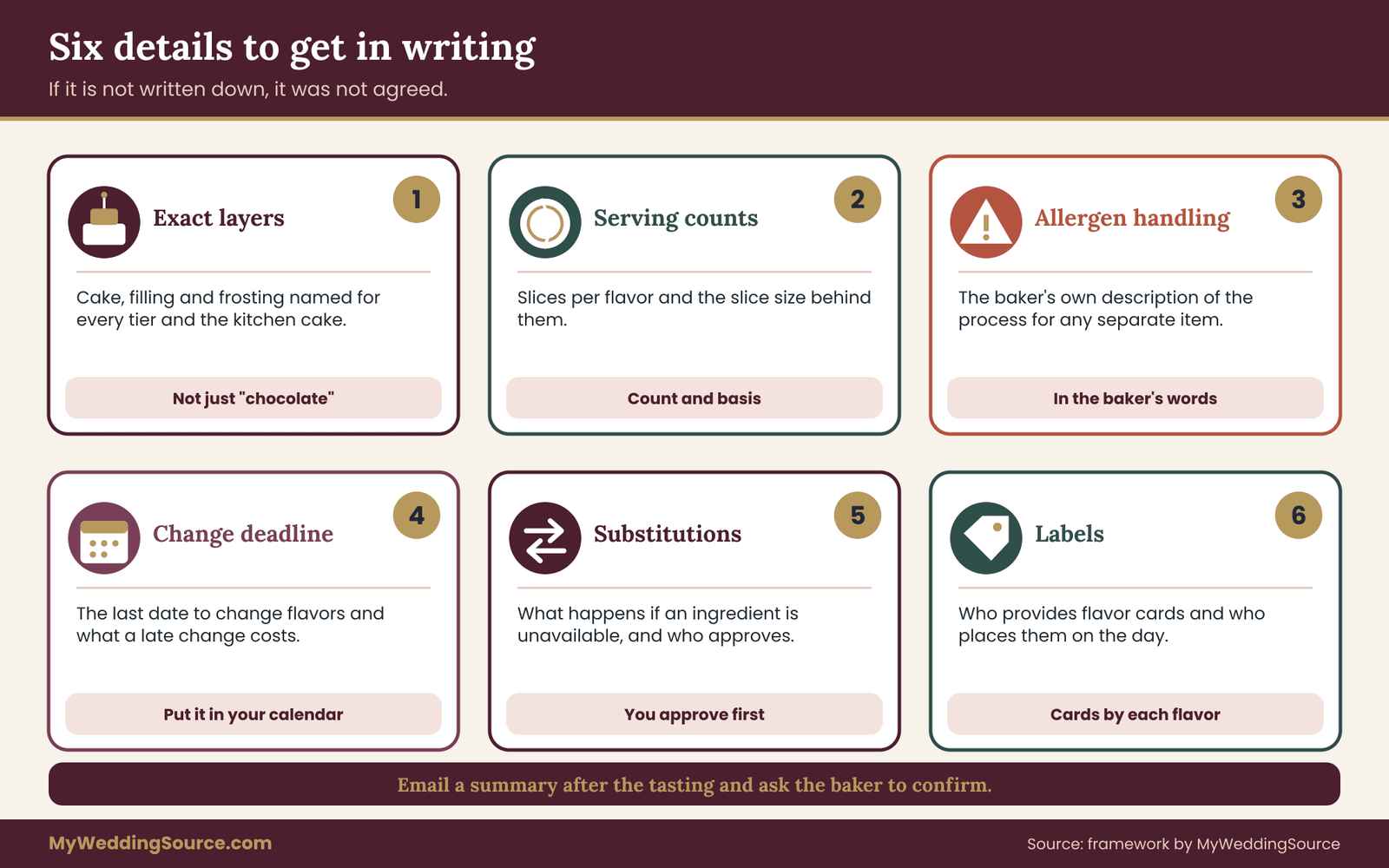
Most of these items cost the baker nothing to write down, and a baker who is reluctant to put details on paper has told you something about how the day may go.
Pairings that hold up in heat, time and service
Cake flavor pairings play out in a real room, and a pairing that earns a twenty-three at a cool tasting can have a very different life on a warm afternoon. This section lists what to think through before you lock the choice. It does not replace your baker’s judgment, but it helps you ask better questions.
Temperature. Warm rooms soften buttercream, loosen curd and cream, and make some fillings slide. Cool rooms firm buttercream and can make cake feel dense. Ask the baker which of your chosen cake flavor pairings handle the temperature range of your venue. For food safety, certain fillings made with dairy, eggs or cream need to be kept at safe temperatures, and the guidance of the Food and Drug Administration, the Department of Agriculture’s Food Safety and Inspection Service and the multi-agency FoodSafety.gov site explains the general rules for how long perishable food can stand at room temperature.
Your bakery follows its own food-safety plan, which is regulated locally, so ask them what they do and for how long a given filling can sit out.
Time. A cake cut at the end of the evening has stood longer than one cut after dinner. If your timeline places cake cutting late, choose cake flavor pairings that tolerate standing. Moist cakes with stable fillings, such as carrot, olive oil, or chocolate with ganache, hold well. A fresh-cream filling, by contrast, is a gamble at the end of a long night.
Transport. The pairing travels from the bakery to the venue in a vehicle, in pieces or assembled, and the bumps matter. Ask how the cake will be delivered and how each tier is supported. The structural side, including dowels and boards, belongs to the bakery’s design and is outside the scope of this guide. The point here is to ask whether any pairing on your list is a transport risk.
Service. Someone has to cut the cake, and some cake flavor pairings cut cleanly while others fall apart. A very soft crumb with a loose filling is hard to serve neatly, and the servers will cut larger, messier slices that reduce your serving count. Ask whether your cake flavor pairings can be sliced cleanly and whether the kitchen cake is cut in the kitchen or at the table.
Plating. If the cake is plated and served with sauces, fruit or ice cream, the combination changes. A very sweet cake with sweet ice cream and a sweet sauce is too much. A plain cake can carry a sauce well. If dessert service is part of your reception plan, a cake and other desserts can share the job of covering preferences, and the reception guest flow guide shows where cake cutting and dessert service fit in the evening.
Season and ingredients. Fresh fruit cake flavor pairings depend on the season. A strawberry filling in winter is a different product from one in June, and the bakery may use frozen or preserved fruit. Ask how the filling is made and whether the flavor changes with the season. A pairing built on preserved fruit tends to be more consistent and may hold better.
The rest of the dessert table. If you serve other sweets, the cake does not have to cover every preference. A guest who dislikes chocolate may take a fruit tart. A dessert bar can relieve the cake of one group, which changes your allocation. The reverse also holds: a heavy dessert table lets the cake be simpler.
In short, stable and familiar cake flavor pairings in a hot tent beat an impressive one that collapses. When in doubt, move the delicate pairing indoors to the kitchen cake or choose a firmer filling, and keep the display cake straightforward.
Labels, servers and leftovers on the day
The best allocation of cake flavor pairings fails if nobody on the day knows it. The people cutting the cake are often catering staff who have never met you or your baker, and they work fast. Three small habits protect the plan.
First, give the catering manager or the venue coordinator a one-page cake sheet ahead of time. It lists each tier and each kitchen cake by flavor, the number of slices in each, the location of the allergy-safe cake, and who is responsible for it. A short sheet is more likely to be read than a long email. Keep the language plain: “Bottom tier: vanilla bean with raspberry. Middle tier: chocolate. Kitchen cake: vanilla, chocolate, carrot. The small labeled box holds the allergy-safe slices; please serve those first and with a clean knife.”
Second, ask the baker or a trusted helper to place the flavor cards. A card on the display table and a card on the kitchen counter let servers answer a guest in a few words. If a guest asks about an ingredient, the server should be able to point to the card or ask the catering manager, rather than guess. A server who guesses about an allergen is a risk for the guest and for you.
Third, decide where leftovers go. The kitchen cake often produces extra slices, and the display cake may be partly uncut. Ask the caterer and the venue what they allow, and arrange for someone to box slices for guests who want to take one home or for relatives who could not attend.
Label boxes with the flavor, because a leftover chocolate slice and a leftover carrot slice look similar in a box and different to someone with an allergy. Keep the allergy-safe slices separate from the rest, in their own container, from the moment they are cut.
Reviewing what worked
After the wedding, spend ten minutes reviewing your cake flavor pairings and writing down which flavors ran out first, which were left over and what guests said. Nobody else will do this, and it turns your cake into useful information if you are planning an anniversary dinner, a vow renewal or helping a sibling plan their wedding.
It also tells you whether your guest groups were mapped well. If the chocolate ran out and the lemon sat untouched, your mapping underestimated chocolate lovers. That note, in a file with your contracts and receipts, is a small gift to your future selves and to anyone you advise.
Resolving disagreements over cake flavor pairings
Even with a score sheet and a headcount, cake flavor pairings can turn into a family discussion. Someone’s mother wants the flavor from her own wedding. One partner loves a tier the other finds sickly. A friend who bakes offers to make “something simple” and expects it to be on the table. These situations are normal, and they have workable answers that do not require anyone to win.
When the two of you disagree
Use the score sheet as the neutral party. If you each scored independently, you already have numbers. Where the totals agree, the choice is easy. Where they differ by two points or more in a category, talk about that category only. Often the disagreement is about balance or sweetness, and a different filling solves it.
If the scores are far apart overall, divide the decision by tier. The couple’s keepsake tier belongs to the two of you, so each can pick a favorite for it if you are willing to have two small flavors in one tier, or you can alternate. The big display tier follows the guest groups and the numbers. A good agreement sounds like this: “You choose the keepsake flavor, I choose the filling for the middle tier, and the bottom tier follows the headcount.” Nobody loses, and the guests still get what they need.
Another useful approach is the one-veto rule. Each partner may veto up to two cake flavor pairings without giving a reason. A veto removes the pairing from the list. After that, the sheet decides among what is left. This respects real aversions, such as a strong dislike of coconut or coffee, without turning every taste difference into a negotiation.
When family wants a say
Families often care about cake flavor pairings because it is the most traditional food at a wedding. A parent may want a specific recipe, a grandmother may ask for a flavor tied to a family memory, and an in-law may offer to pay for a flavor upgrade. Treat these as inputs, and place them where they do the least harm and the most good.
The kitchen cake is the natural home for a family request. It is the part of the cake that supplies the most slices, it is cut out of sight, and it can add a flavor without changing the display. A grandmother’s flavor can be a small allocation of fourteen or twenty slices, labeled with a card, and nobody has to explain why the tier design changed.
If a relative offers a homemade cake, treat it with care. A homemade cake served at a reception raises questions about food safety, ingredients and venue or caterer rules, and many venues and caterers have policies about outside food. Ask your venue and caterer first, and ask the relative to provide a full ingredient list. If it is served as a gift on a separate table, label it clearly, and do not rely on it as the allergy-safe option.
A script that keeps the relationship warm and the plan clear: “We would love to include your recipe. Our venue has rules about outside food, so I am checking with them first. Could you send me the full ingredient list so we can label it?”
For a request you cannot fit, a short, kind answer works better than a long explanation. “We have set the flavors with the bakery based on our guest list, and the order is in. We would love to have your recipe at the anniversary dinner instead.” That is honest and leaves the door open.
When tastes and traditions differ
Guest lists that include several cultural backgrounds often include different expectations about wedding sweets. Some communities serve fruit cake, rich dense cakes or soaked cakes, others favor light sponge cakes, and many weddings feature other desserts alongside or instead of cake. Ask a relative who knows the tradition what the dessert is expected to be and when it is served. Do not guess, and do not assume that a cake with a familiar name is the same cake your relatives have in mind.
If cake is only one part of a larger dessert tradition, give the cake a defined role. The cake may be a visual centerpiece that is cut and shared in small portions, while the main sweet course is something else. In that case, the allocation of cake flavor pairings changes. Smaller slices from fewer flavors may be enough, and the budget may shift toward the other sweets.
When the budget pushes back
Cake flavor pairings can add cost in ways that are easy to miss. Imported chocolate, nut pastes, specialty extracts, fresh fruit and custom fillings may each raise the price. Rather than cutting the number of flavors at random, rank them by what each costs and what each adds.
Ask the baker for the per-slice or per-tier difference between your preferred filling and a standard one, and compare it to the benefit. A better filling in the bottom tier might cost more than a better filling in the kitchen cake, because the bottom tier is bigger. If a filling is both expensive and loved by only a small group, move it to the kitchen cake in a small quantity or drop it. If a pairing is both loved by a large group and affordable, it should get the largest allocation.
There are cheaper ways to add variety than another cake flavor. A small dessert table, a cookie table or a seasonal fruit display can serve guests who do not love cake. This may also reduce the number of cake slices you need. For the broader view of where cake sits among your other tasks, the wedding planning checklist is a useful companion.
When the headcount changes
Guest counts move, and your cake flavor pairings have to move with them. A cancellation, a plus-one, a late RSVP or a family addition can change the total after the flavors are locked. The allocation makes changes easier to handle, because the kitchen cake is the flexible part. Ask the bakery when the final count is due and whether they can adjust kitchen cake servings by flavor after that date.
If a group grows, add to that group’s kitchen cake allocation. If a group shrinks, reduce it. Avoid changing the display tiers, since that affects the design. And keep an eye on the cushion in your most popular pairing, because a small increase in guests who love chocolate can use up the cushion quickly. A change of ten guests may mean only a few slices in a given flavor, and that is a small adjustment when the plan is clear.
When someone is not eating cake at all
Some guests will skip dessert, whether out of preference, health or fasting, and some will take a slice home. It is not worth planning around them individually, but it explains why a small cushion in the total, rather than a large one, is usually enough. If your list includes a large group that is likely to skip cake, such as a group observing a fast on the day, mention it to the bakery so the final servings reflect it.
Rather than guessing at percentages, rely on your own knowledge of the guests and the bakery’s advice.
Your next steps
Here is a short sequence for choosing cake flavor pairings that you can follow from today. Each step has a clear finish, so you know when it is done.
Step one: map your guests. Go through the guest list by household, tag each household with one of the six groups, count each group and record any allergy or dietary needs separately. Ask a sibling or friend to check the tags for guests you know less well.
Step two: set the bakery questions. Write down your venue, serving time and temperature range, your headcount and your groups, and the questions from the tasting script. Send the headcount and a short list of the cake flavor pairings you want to try before the appointment, so the baker can prepare.
Step three: taste with a score sheet. Print or copy the five categories, score each pairing alone, compare, and apply the rule that any one disqualifies until fixed. Keep notes on the baker’s answers.
Step four: allocate. Convert the groups into slices using the bakery’s serving chart, assign the strongest cake flavor pairings to tiers and kitchen cake, set aside the keepsake tier if you want one, and handle allergy needs as separate items. Check that every group has enough, with a cushion in the most popular flavor.
Step five: confirm in writing. Email the baker a summary of the chosen cake flavor pairings, the ingredients, the allergen handling, the serving counts and the change deadline. Ask for the contract or order form to match.
Step six: prepare the day. Write the one-page cake sheet for the caterer, arrange the flavor cards, and decide who handles the allergy-safe cake and leftovers.
If a step stalls, go back to the headcount. Most cake flavor pairings decisions that feel stuck are really unanswered questions about who is coming and what they will eat, and the guest groups answer them.
Put the decisions on one page. After step five, write a single record with the chosen cake flavor pairings, the serving count for each, the allergen notes, the bakery’s answers about stability, the change deadline and the name of the person responsible on the day. Keep it with your contracts and send a copy to whoever will manage the cake on the wedding day.
A single page listing the final cake flavor pairings is easier to check than a chain of emails, and it protects you if someone else has to handle a pickup or a delivery. The same habit of keeping records in one place is useful for every vendor.
FAQ
How many cake flavor pairings should a wedding cake have?
Most weddings are well served by three or four cake flavor pairings, counting the display tiers and any kitchen cake, plus a separately handled item if a guest has an allergy. More than that increases cost, complicates labeling and makes serving harder. Start from your real guest groups and merge groups that can share a pairing. If your list is mostly classic and chocolate, two or three flavors may be plenty.
Should every tier be a different flavor?
No. Tiers should follow your headcount, not symmetry. A common approach is to put the most popular pairing in the largest tier, use a second flavor for the next group and hold the boldest flavor for a small tier or the kitchen cake. Two tiers may share a flavor, and the kitchen cake can supply additional options out of sight without changing how the display looks.
Which cake flavor pairings are safe if I don’t know my guests’ tastes?
Familiar pairings with a contrast tend to work for mixed groups: vanilla with a berry filling and light buttercream, and chocolate with a lighter vanilla or coffee filling. Add one less sweet option, such as carrot or citrus, if you can. Taste is subjective, so use a short score sheet at the tasting, and ask your baker which cake flavor pairings they find most reliable for large events.
How do I handle guests with allergies when choosing cake flavors?
Treat allergies as requirements, not as cake flavor pairings to negotiate. Collect the details from guests, then ask the baker for full ingredient lists and an explanation of how the kitchen handles cross-contact. For serious allergies, a separately made and labeled item is usually safer than modifying a tier. If the bakery cannot support a requirement, choose another bakery or another dessert source for that guest.
Can I mix a rich flavor and a light flavor in the same cake?
Yes, and mixing rich and light cake flavor pairings often helps. A rich chocolate tier next to a light lemon or vanilla and berry tier gives guests a choice after a full dinner. Think about the order of the tiers for stability too: firmer fillings suit the bottom tier, which carries the weight, and more delicate fillings may suit higher tiers or the kitchen cake. Your baker can advise on the structure.
What if my partner and I disagree on cake flavor pairings?
Score the cake flavor pairings separately, compare the numbers and discuss only the categories where you differ by two points or more. You can also divide the decision: one of you picks the keepsake tier, the other picks a filling, and the headcount decides the rest. A simple veto rule, where each person may remove two cake flavor pairings without explanation, also reduces friction.
Do cake flavor pairings change the price?
Often they do. Imported chocolate, nut pastes, fresh fruit and custom fillings can raise the cost, and some bakeries charge per flavor or per tier. Ask for the price of each pairing you scored well, so you can swap an expensive one for a similar one. Prices differ widely between bakeries, so rely on your own quote rather than a general figure.
When should I finalize cake flavor pairings with the bakery?
Many bakeries book months ahead and set a deadline for flavor changes. Ask for that date when you book and put it in your calendar. Finalize your cake flavor pairings after tasting and allocation, and confirm the ingredients and allergen handling in writing. The final guest count usually comes later and mainly changes the kitchen cake servings, not the flavors.
Sources
- Food safety information for consumers and caregivers, FoodSafety.gov
- Food allergies, U.S. Food and Drug Administration
- Food safety and handling guidance, USDA Food Safety and Inspection Service
- Food safety, Centers for Disease Control and Prevention
- Food allergy, National Institute of Allergy and Infectious Diseases
- FoodData Central, U.S. Department of Agriculture
- Food safety training and certification, ServSafe
- Local health departments, National Association of County and City Health Officials