
A ring exchange without a ring bearer works the same way as one with a bearer, as long as someone is clearly in charge of the rings at every moment between the jeweler and the altar. This guide shows who can hold the rings, how to hand them over without a pause, and how to rehearse the whole ring exchange on one small card.
For a calm ring exchange with no ring bearer, treat the rings as a chain of custody with six links: pickup, storage at home, transport on the wedding day, holding at the venue, the ring exchange handoff at the ceremony, and the return afterward. Name one holder and one backup for every link. Choose a holder who is reliable, calm and already standing near the front, such as the best man, the maid of honor or a close friend. Put the rings in a closed container, rehearse the exact handoff once with the real box, and write the cue on the ceremony cue sheet.
Plenty of couples skip the ring bearer. The child is nervous, the couple has no young relative, the aisle is short, or the ceremony is small enough that a bearer would feel like a costume. Skipping the bearer is easy, and a ring exchange without one can be just as graceful. What gets forgotten is the job the bearer quietly did: carrying two small, expensive objects from one place to another, then putting them into the right hands at the right second.
If nobody is assigned to that job, it falls to whoever happens to be nearby, and the ring exchange becomes the one part of the ceremony that depends on luck. The rings end up in a pocket nobody checked, in a bag that went to the wrong room, or in the photographer’s styling kit for a flat-lay shot that ran long. Almost every ring story that couples tell later comes down to one missing sentence: “who has them right now?”
This guide answers that sentence in advance. It covers who should hold the rings, how to pack and carry them, what the officiant says and does, how to run a two-minute rehearsal with a handoff card, what to do when something goes wrong, and which facts to confirm with your jeweler, insurer, officiant and venue. It is written for a ceremony of any size and any tradition, and it assumes you are the couple or a person helping one.
A note on scope. This is general planning information and not legal, tax or financial advice. Whether rings are part of your ceremony is a personal choice, and the rules for the license and for who may officiate depend on your state and country, so confirm those details with the issuing office.
What a ring exchange without a ring bearer has to cover
Start by listing what a ring bearer actually does, because a replacement plan has to cover each item. There are five jobs hiding inside that one small role.
Carrying. The bearer moves the rings from the back of the ceremony space to the front, usually on a pillow or in a box. Without a bearer, someone else has to make that trip, or the rings have to already be at the front.
Timing. The bearer arrives at a known point in the processional, so the rings show up before the ceremony needs them. Without a bearer, the arrival time is invented by whoever carries the rings.
Holding in public. Guests see the rings and the officiant can point to them in the script. Without a bearer, the rings may be invisible until the exact second the ring exchange starts, which is fine, but it means the handoff is the only visible moment.
Handoff. At the cue, the bearer or the best man gives the rings to the officiant or the couple. Without a bearer, the ring exchange handoff has to be planned as a separate small action.
Backup. In the worst case, a bearer who freezes can be rescued by an adult standing nearby. Without a bearer, you need to decide who the rescuer is before there is anything to rescue.
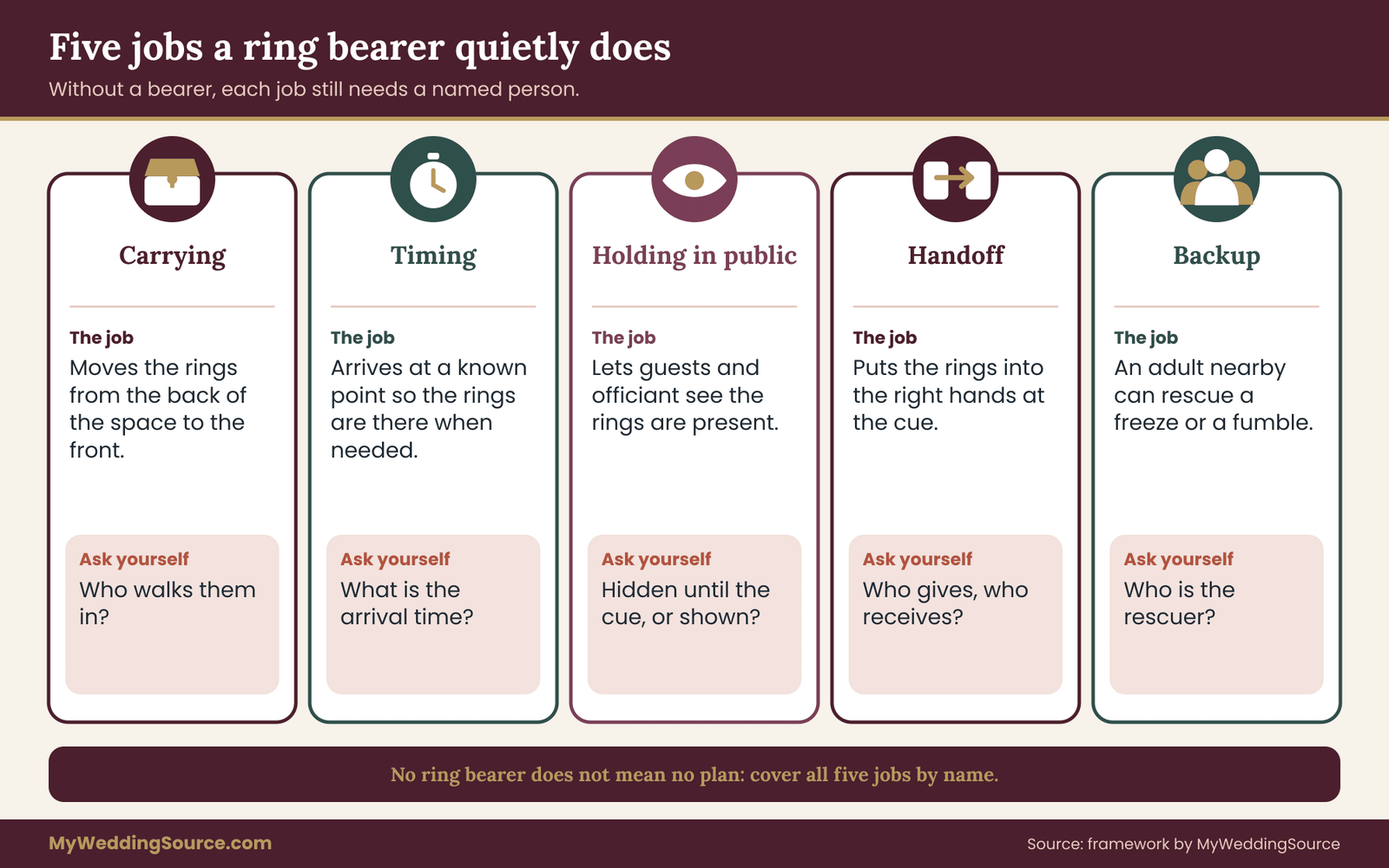
Seen this way, the question “who holds the rings” is only one of five. The better question is how each of the five jobs gets done by named people, in a fixed order, with a backup. That is a ring custody chain, and the next section describes it.
Why couples skip the ring bearer, and what changes
There is no single reason, and the reason affects the plan. A couple with no children in the family simply has nobody to ask. A couple with a very small guest list may think a bearer is too formal. A couple holding the ceremony outdoors may worry about wind, uneven ground and a child carrying something valuable across grass. A couple who has seen a ring bearer drop a pillow may prefer the control of an adult.
Each reason points to a slightly different holder. If the reason is wind or terrain, the rings should stay in a closed container with a lid, held by an adult who is already standing still. If the reason is a small ceremony, the officiant or the partners themselves can hold the rings from the start. If the reason is formality, a quiet handoff from a friend works better than anything ceremonial. The sections that follow show how to pick among these without overcomplicating the day.
The two quiet failure points in any ring exchange
Two moments cause most ring trouble, and neither happens at the altar. The first is the gap between the jeweler and the wedding morning, when the rings are in an unlabeled bag in a car or a drawer. The second is the gap between the room where the couple dresses and the place where the ceremony happens, when the rings travel with a person who then gets pulled into hair, photos or a toast. A good plan puts most of its attention on those two gaps and keeps the altar part short.
You can place the whole ring exchange inside your other ceremony paperwork. The ceremony cue sheet guide explains how to write a one-page call sheet with a named owner and backup for each action, and the ring handoff is one of the lines on that page. Everything in this article is designed to produce that one line and a small card behind it.
The ring custody chain: six links from jeweler to fingers
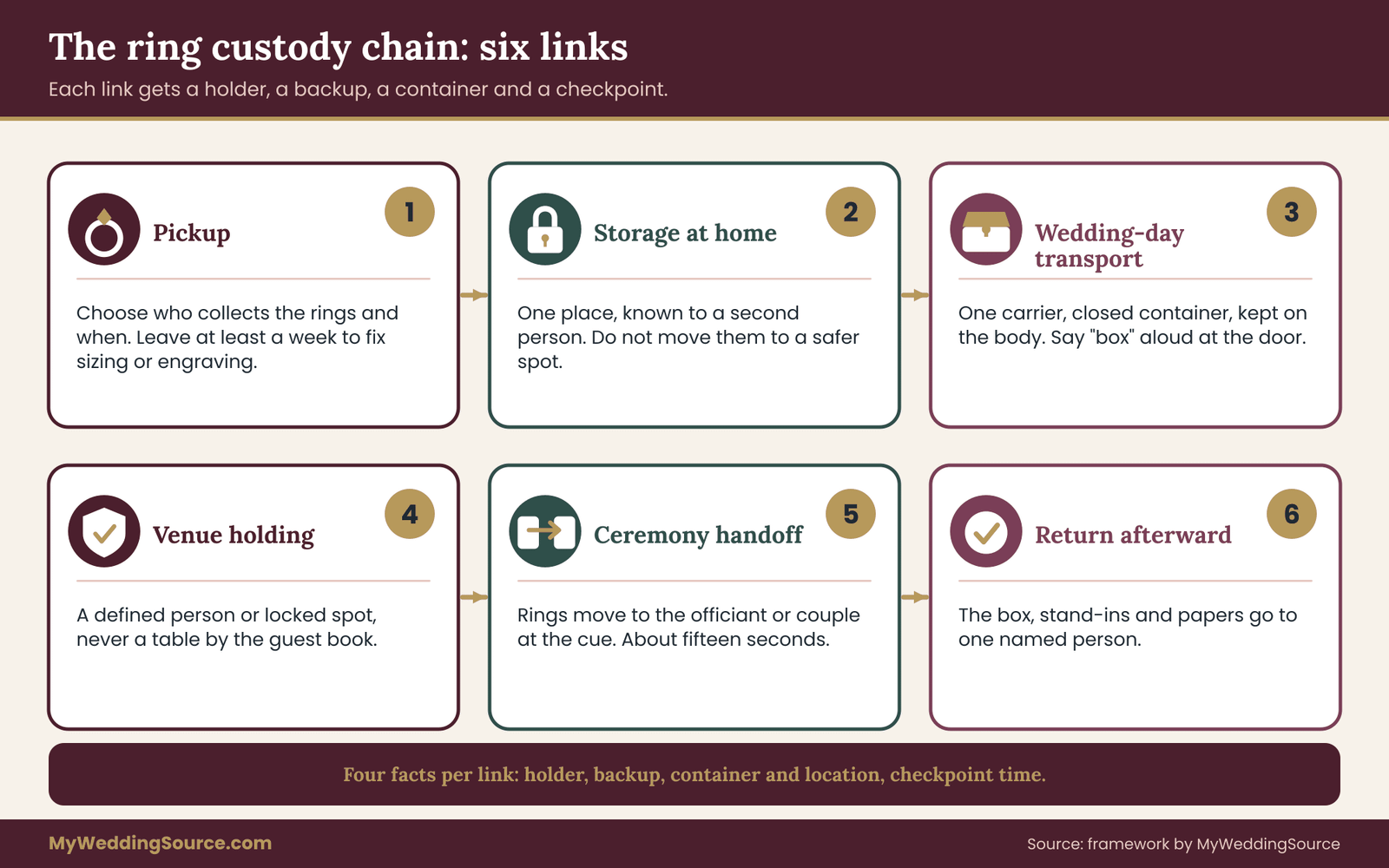
The custody chain is the original framework of this guide. It treats the rings like any other valuable item that moves between people: at every link, one named person is responsible, one named person is the backup, the rings sit in a known container, and there is a time when somebody confirms that the rings are where they should be. The chain has six links.
Link one: pickup. The rings leave the jeweler or the shop. Decide who collects them, when, and whether the pickup happens early enough to fix a sizing or engraving problem. A pickup the afternoon before the wedding leaves no room to correct anything.
Link two: storage at home. Between pickup and the wedding day, the rings live somewhere. Choose one place, tell one other person where it is, and avoid the habit of moving them “to a safer spot” without telling anyone. Most lost rings are lost by moving them.
Link three: wedding-day transport. The rings travel from the home, hotel or getting-ready room to the venue. This is the link most often left to chance. One person carries them, in a closed container, and the container goes into a bag or pocket that stays on that person’s body.
Link four: holding at the venue. After arrival, the rings need a safe holding point until the ceremony. That may be the same person, a locked room, or the coordinator’s secure box. The point is a defined location with a defined person, not a table by the guest book.
Link five: the ceremony handoff. The rings move from the holder to the officiant or the couple at the cue. This is the visible moment, and it should take about fifteen seconds.
Link six: return after the ring exchange. Once the rings are on fingers, any ring box, pouch or backup needs a place to go. If the empty box sits on a chair, it gets lost, and so do the backup rings or the receipts that traveled with it.
The four facts for every link
For each link, write four facts on a single line, and the whole chain fits on a small card.
- Holder. One name. Not “the groomsmen” or “the family.”
- Backup. A second name, and the backup knows they are the backup.
- Container and location. For example, “gray box, inside the holder’s jacket pocket.”
- Checkpoint. The time at which the holder confirms the rings are present, such as “ten minutes before guests are seated.”
This is not a heavy document. Six lines, four facts each, about fifty words in total. The value is not the paper but the act of choosing names. When a couple writes “holder: Sam, backup: Priya,” a vague worry becomes two people who have agreed to a small task.
How the chain changes when the couple holds their own rings
Some couples prefer to keep their own rings, each partner holding the other’s. That is a legitimate choice, and the chain still applies, with one change: the holder of each ring is the partner who will place it, and the backup is a friend who knows where the spare container is. The risk in this pattern is that each partner is busy with hair, clothes and nerves, so the rings travel in pockets that are changed during dressing. If you choose this pattern, add one more checkpoint after the last change of clothes.
A simple test of the chain
Ask yourself a question at each link: “If the holder disappeared into a bathroom for fifteen minutes, who would know where the rings are?” If the answer is a name, the link is sound. If the answer is “I guess we would find them,” the link needs a backup. The test takes less than a minute and finds the weak link in almost every ring exchange plan.
The next section looks at the choice most people worry about first, which is the holder, and gives decision rules rather than a list of favorites.
Choosing who holds the rings for the ring exchange
There is no universally correct holder for a ring exchange. There are better and worse matches between a person and the link they are asked to cover. Use the rules below to choose, and write down the reason, because the reason is what helps you replace someone who drops out.
Four qualities of a good holder
A good holder has four qualities, and they matter in this order.
Reliable. The person shows up on time and does not lose things. This sounds obvious, yet couples regularly hand the rings to their most fun friend, and the most fun friend is rarely the most careful.
Calm. A ring exchange puts a small object in a very quiet room with a hundred people watching. The holder should be someone whose hands stay steady when the room goes silent.
Near the front. The shortest handoff is the best handoff. A holder who already stands beside the officiant or the partner needs no walk, no passing along a row and no awkward reach.
Available all day. A person who is also giving a reading, running the guest book, driving a grandparent and wrangling a toddler cannot also guard the rings. Choose someone whose other jobs are light.
The common holders, compared in prose
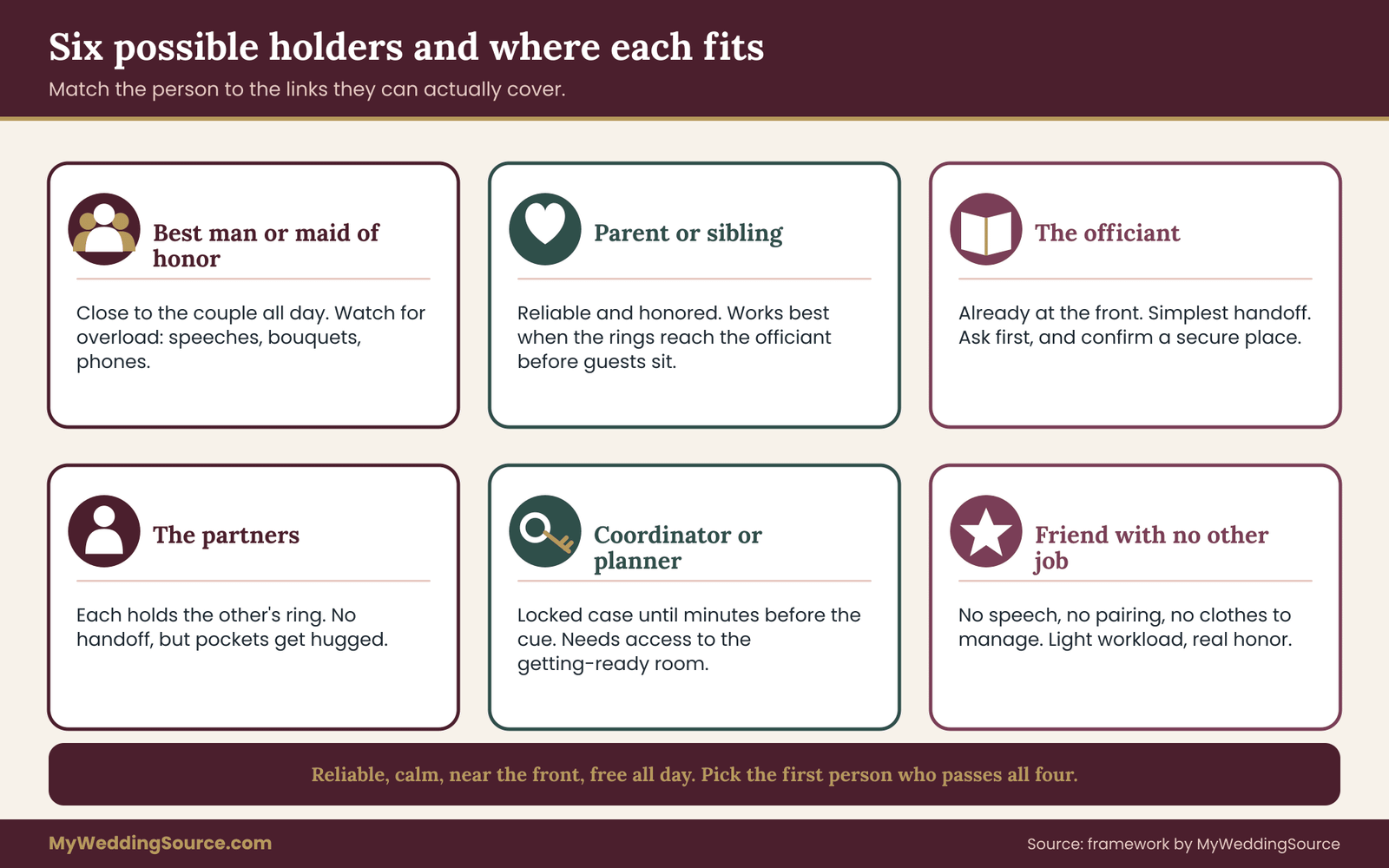
The best man or maid of honor. The most common choice, and for good reason. Both usually stand close to the couple, and both are expected to stay near them all day. The risk is overload: this person is often also carrying a speech, a bouquet, a phone, a veil and the couple’s emotional weather. If you choose this holder, make sure they have a pocket or a small bag dedicated to the rings and nothing else.
A parent or sibling. A parent is often the most reliable person in the room, and being asked to hold the rings can be a quiet way to include them. The trade-off is position. A parent who sits in the first row has to stand, walk and hand something across, and that is a visible movement that can feel awkward in a short ceremony. It works well when the ring exchange handoff happens before the ceremony starts and the officiant already holds the rings.
The officiant. In many ceremonies the officiant takes the rings at the start and keeps them until the ring exchange. This is the simplest ring exchange of all, because the person who needs the rings is already holding them. The things to confirm are whether your officiant is willing, whether they have a secure place for the rings during the processional, and whether they are standing in a spot where a dropped ring would not roll into a gap. Our guide to officiant requirements covers what an officiant must do legally. Holding rings is a courtesy, not a requirement.
The partners themselves. Each partner holds the other’s ring, usually in a jacket or dress pocket, a small pouch tied under the bouquet, or a ring on a thin cord. This removes every handoff, since the person who will place the ring already has it. The cost is stress: partners are already managing nerves, and a pocket is a poor place for a tiny object once someone hugs them forty times.
The coordinator or planner. If you have a day-of coordinator, the rings can stay in a locked case until a few minutes before the ceremony and then go to the officiant. This is the most controlled option and costs nothing extra if the coordinator is already on the clock. It works only if the coordinator is allowed to enter the getting-ready rooms and has a fixed time to collect the rings.
A friend with no other job. A guest asked to be “keeper of the rings” can be ideal. They have no speech, no pairing in the processional and no clothing to manage. They carry the box, stand near the front and hand it over. The honor is real, and the workload is small.
Who should not hold the rings in a ring exchange
Two groups are poor choices for this job, even though they are well meaning. A young child is the first. A child can carry a decorative pillow with ribbons, but the actual rings are better kept elsewhere, which is why many couples with children use a ring bearer for show and an adult for custody. The second group is anyone who will drink heavily before the ceremony, travel in from far away on the same day, or manage a job that cannot pause. An exhausted holder is not a negligent one, but they are a riskier one.
A third category is a person who is not at the venue until the last minute. If a friend arrives twenty minutes before the ceremony, they cannot cover link four. They may still be the backup for the ceremony link, provided they are told early.
A decision rule that settles most debates
When couples disagree about the holder, a simple rule resolves it. Put the three most likely holders on a list, then answer two questions for each: “Will this person be within ten steps of the officiant for the final hour before the ceremony?” and “Would we be comfortable if this person were five minutes late?” The first holder that answers yes to both is the primary. The second becomes the backup. If nobody passes the first question, the officiant or the coordinator takes the rings, and the problem disappears.
Talking to the person you pick
Ask the holder directly, and be specific about the job. A vague “can you keep an eye on the rings?” leaves the person guessing about how much responsibility they have accepted. A clear ask sounds like this:
“Would you hold our rings from the moment we get to the venue until the officiant takes them? You would have the box in your pocket.”
If they say yes, tell them three things: where the rings will be handed to them, the time of the checkpoint, and who the backup is. Offer them the option of saying no, because a person who says yes out of embarrassment is the person who loses the box.
Naming the backup without causing offense
Some holders feel insulted by the idea of a backup. A neutral way to frame it is that every part of the ceremony has a backup, from the music to the microphone, and the rings are not special. When the cue sheet shows a backup beside every item, nobody reads one name as a lack of trust. The backup can hold a spare container or a photo of the rings with a close-up of the sizing, which is useful if a ring has to be found.
When the holder is also in the processional
A frequent complication is that the best man or maid of honor must walk down the aisle and stand in line, which means the rings travel with them for the entire processional. That is fine if the container is secure and the pocket has a closure. A zipped pocket or an inside jacket pocket is better than an open side pocket.
If the holder is wearing a dress with no pockets, a small pouch tied to a bouquet handle or tucked into a wrist corsage works, but only if the pouch has been tested with a real movement: raise the arms, sit, stand and hug. If it fails any of the four, choose another carrying method.
How the choice affects the ceremony
The holder shapes what the ring exchange looks like. When the officiant holds the rings, the moment is quiet and the officiant simply picks up the box and offers it. When a best man holds them, the moment has a small beat, since the best man steps forward, opens the box and offers it, and the guests see it as a ritual.
When the partners hold their own rings, the moment becomes more intimate and slower, since each partner reaches for a pocket. None of these is better than another. Choose the one that matches the mood of the ring exchange you want, then build the card around it.
A short example of the reasoning
Imagine a couple in an outdoor ceremony with a short aisle and a best man who will also deliver a toast. The best man is reliable and calm, and stands near the front, but is likely to be pulled into photos and greetings. The couple decides that the best man will hold the rings until the ceremony begins, then hand the box to the officiant during the last guest seating.
The officiant holds the box on a small table at the front, in a closed case, until the cue. The backup is the officiant’s assistant, who watches the table. Each link has a person, each person has a backup, and the ring exchange has only one visible handoff. That is the pattern to aim for, whatever names you use.
The next section moves from people to objects: what the rings travel in, and how to keep them from rolling away.
Containers, pockets and carrying methods for a ring exchange
Once you know who holds the rings, decide what the rings sit in. The container matters more than people expect, because it controls three risks: loss, movement and exposure. A good container is closed, snug, easy to open with one hand, and easy to identify at a glance.
What the container has to do
It closes. Rings should not be in an open dish, a loose pillow or a napkin. A lid, a flap or a zipper means a small bump does not turn into a lost ring.
It holds the rings still. A box that lets the rings slide around makes noise and can scratch a stone or an engraving. Foam slots, a fabric roll or a small padded pouch keep each ring in place.
It opens easily. At the ring exchange handoff, the holder needs to open the container with one hand while keeping eye contact with the officiant. A tight clasp that requires two thumbs is a bad design for a ring exchange.
It is recognizable. A plain black box looks like every other black box in the room. Give the container a ribbon, a color or a small tag so it is easy to find on a table full of bags.
The common containers
A ring box with a lid. The classic choice. Choose one with a snap or magnet closure and slots for two rings. Test the opening one-handed before the day. If the rings came from the jeweler in a branded box, that box is often fine, but it may have a tight lid designed for a shop counter.
A fabric pouch with a drawstring. Light, quiet and easy to carry in a pocket. The risk is that the rings can slide to the bottom and tangle with a chain or a loose thread. Use a pouch with a lining, or put each ring in a smaller sleeve inside it.
A ring pillow without a bearer. Some couples keep the pillow as a visual element but let an adult hold it, or set it on a small table at the front with the rings inside a hidden pocket. The pillow is decoration. The rings should not be loose on the surface. Tie them with a ribbon that releases with a single pull, and test the knot.
A small dish or tray with a cover. Works for a very quiet, indoor setting where the officiant holds the tray. In a breezy or crowded space, it is a poor choice.
A cord or ribbon on the bouquet. Some people tie the rings to the stem of a bouquet or to a wrist corsage. It frees the pockets, but a ring tied to flowers has a way of ending up behind a bridesmaid’s elbow. If you use this method, use a hidden knot and decide who cuts or unties the ring.
A pocket in clothing. Simple and cheap. Use a button or zip pocket, never a loose side pocket, and avoid a trouser pocket that will be sat on.
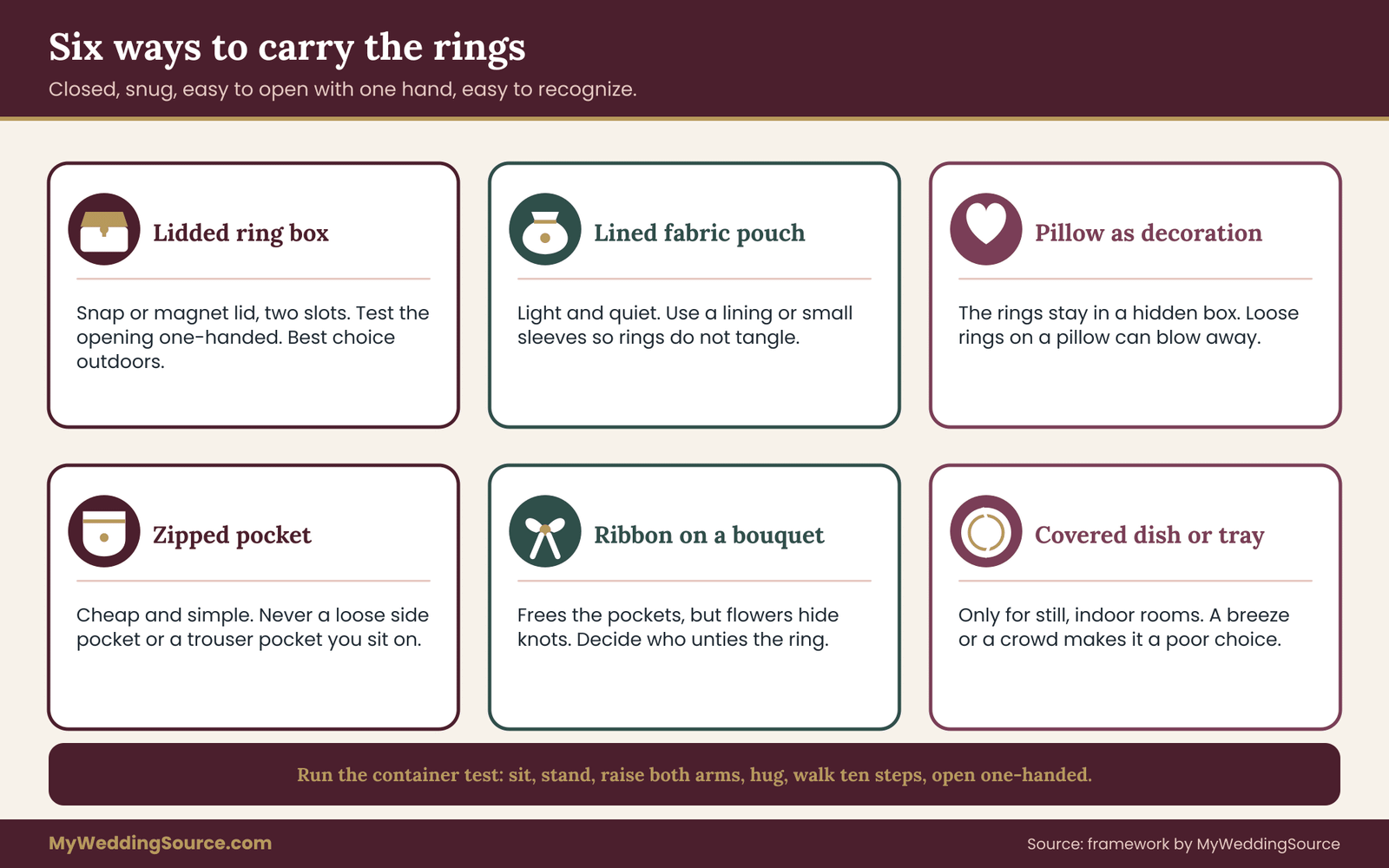
The container test
Before the wedding, run a ten-second container test, and do it with the real box and a pair of stand-in items of the same size, such as two plain bands or two heavy washers if the real rings are not yet in hand. Hold the container in the pocket where it will live. Sit down. Stand up. Raise both arms. Hug someone. Walk ten steps at the pace of the processional. Open it with one hand while standing. If the container opens, shifts or presses into the body during any of these movements, change the container or the pocket.
This sounds like a tiny detail, but a ring exchange is made of tiny details. It is the detail that prevents a stressed holder from dropping a ring at the exact moment of the ring exchange. A container that works in a hand is not the same as a container that works in a pocket during a hug.
Wind, grass and floors under the ring exchange
The surface under the ceremony changes the plan. On grass, a dropped ring may vanish; on wood or stone it rolls; on carpet it may land softly but is hard to see. If the ring exchange happens outdoors, hold the rings closed until the last second, and place a small cloth or a flat tray under the handoff so a dropped ring lands in a known place. If the space has a grate, a gap or a raised stage, tell the officiant and holder where the gap is.
Wind raises a different issue. A ring pillow with loose ribbons can flip and release the rings. A fabric pouch can flutter open. A box with a lid stays closed and is the best choice for any open-air ceremony. If you love the look of a pillow, keep the rings in a box hidden behind it, and let the pillow be for show.
Sun is also worth a thought. A black box left on a chair in direct sunlight can get hot enough to be uncomfortable to hold, and a ring box in a hot car is not good for adhesives, foam or some gem treatments. Keep the container in the shade or in a bag.
Keeping the rings visible to you, not to everyone
There is a case for letting the guests see the rings before the ring exchange, perhaps in a photograph or a short mention in the script. There is also a case for keeping them out of sight until the moment, which reduces the number of people who might touch or ask to see them.
Decide on purpose. If friends and family are likely to ask to look at the rings during the cocktail hour or in the getting-ready room, assign a gatekeeper, usually the holder, who says “after the ceremony.” A ring passed around a room is a ring out of custody.
Special concerns for the rings in a ring exchange
Some rings need extra attention.
Heirlooms. A family ring may be fragile, old or irreplaceable. Treat it with the highest care: carry it in a rigid box, keep a clear photograph of it, and consider whether a stand-in ring should be used for the ceremony and the real ring placed later. Many couples feel this takes away from the moment. Others feel it removes a stress. Either is fine if you choose on purpose.
Rings with stones. Prongs catch on fabric. A ring dropped into a pocket with a lace lining or a veil can snag. Use a box rather than a pouch, and keep the ring away from lace and tulle.
Rings that do not yet fit. Fingers swell in heat, with salt and with nerves. If either ring is a snug fit, ask the jeweler about sizing on the day and keep a plan for a ring that will not slide on. The section on things going off script covers this.
Engraved rings. If the inside text is part of the ceremony, for example the officiant reads it, make sure the holder knows which ring is which. Tiny labels or a note in the box prevent a swap.
Tungsten, titanium and silicone bands. Some materials are chosen for work or sport. They are tougher than gold in daily use, but they can be hard to remove in an emergency, and some cannot be resized. If a partner wears a silicone band for hobby or work reasons, mention it to the officiant so the script does not assume a metal band.
Photographs of the rings before the ceremony
Photographers often ask for the rings to take a detail shot, usually during the getting-ready period. This is one of the quietest custody gaps in the day. The rings leave the holder, go to a photographer, rest on a dress, a shoe or a flower, and come back, sometimes through a third person. It is a fine request.
Handle it with a small rule: the rings go to the photographer only when the holder is present and the photographer returns them to the holder, not to a table. Ask the photographer for ring detail shots in a fixed window, ideally before the ceremony cue sheet’s holding time, and write that window on the card.
If the photographer is offering a ring shot after the ceremony, the rings are on fingers, which is the safest place for them.
Having a decoy for guests
Some couples place a decorative ring box or a replica on a display table. It looks lovely and takes the pressure off the real rings. If you do this, mark it clearly and make sure no one confuses it with the real container. A decoy that looks identical to the real box creates its own confusion on a busy day. Use a different color or a visible tag, and tell the holder which is which.
Spare rings, stand-ins and the emergency fallback
A backup plan for a missing ring starts before anything goes missing. Decide what the couple would do if a ring were lost: use plain stand-in bands from a low-cost shop, borrow a ring from a family member for the ceremony only, or continue the ceremony and exchange rings later. Store a pair of simple stand-ins with the holder’s backup. A stand-in is not a symbol of failure. It is a way to keep the moment going, and many couples treat the “real” exchange as something that can happen again in private.
Where the container goes between cue and cake
The chain has a sixth link, the return. After the ring exchange, the box is empty or nearly so. Decide where it goes. A spare container can be a keepsake, a prop for the next photo or a piece of equipment that goes back to the jeweler. The simplest rule is that the holder keeps the box until the end of the cocktail hour and then gives it to the person who will take the couple’s valuables home. That person is on the card too.
With people and containers settled, the next step is the ceremony itself: what the officiant says, how the ring exchange handoff sounds, and how the ring exchange fits into a short script.
The ring exchange handoff at the altar: placement, wording and cue
The handoff is the one visible link in the custody chain. It should be short, calm and boring. Guests should barely notice it, and the couple should not have to think about it. Three decisions shape it: where the ring exchange sits in the order of the ceremony, who says what, and which cue starts the handoff.
Where the ring exchange sits in the order
In most ceremonies, the ring exchange follows the vows and comes before the pronouncement and the kiss. Some traditions place it elsewhere, and some couples add a reading, a blessing or a ritual in between. The step-by-step guide to a wedding ceremony shows the common orders, and the right place for your own ring exchange is wherever your script puts it. What matters for the handoff is the line that comes immediately before it, because that line becomes the cue.
Typical cue lines include the officiant saying that the couple will now exchange rings, the end of the vows, or a short pause after a reading. Pick a cue that is easy to hear and cannot be mistaken for something else. If the vows end quietly, the officiant’s first sentence about the rings is a clearer signal than the last word of the vows.
Four handoff patterns
There are four common ways to get the rings from custody to fingers. Choose one on purpose.
Pattern A: the officiant already holds the rings. The officiant has the rings from the start, on a small table, in a pocket of the robe or in their folder. At the cue, the officiant opens the box and offers a ring to each partner as the script goes. There is no moving person, no handoff to rehearse, and no extra step. This is the lowest-risk pattern.
Pattern B: the holder steps forward at the cue. The best man or friend stands at the side or the front row. When the officiant says, “May we have the rings,” the holder steps in, opens the box and offers it to the officiant or to each partner. This feels traditional, and it makes the holder a part of the ceremony. It needs a clear cue and about six steps of clear walking room.
Pattern C: the partners hold each other’s rings. Each partner takes a ring from a pocket or pouch at the cue and holds it up. This is intimate and fast. It carries the stress of fumbling in a pocket.
Pattern D: the rings are brought forward at a planned moment. A friend or parent carries the box to the officiant during a reading or a song, hands it over, and returns to their seat. The ring exchange itself then follows pattern A. This is useful when a reading or a song gives natural cover for the movement.
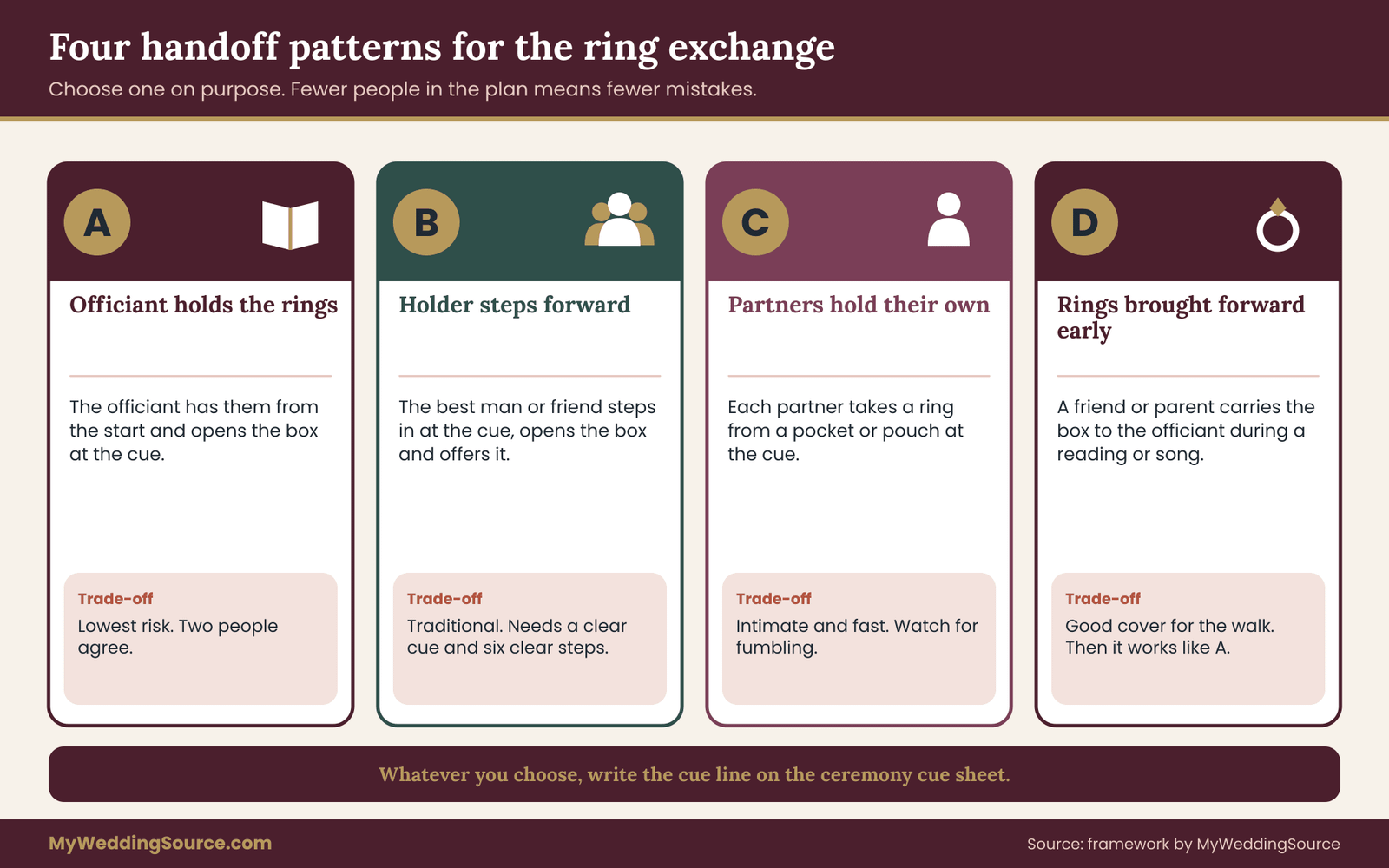
Choosing a pattern also determines how many people have to know the plan. Pattern A needs two people to agree: the officiant and the holder who gave them the rings. Pattern B needs three. Fewer people means fewer mistakes, so lean toward A or D when you are unsure.
Wording for the officiant
The officiant’s words do two jobs: they tell the couple what is happening, and they give the holder a clear signal. A short, plain line works better than a long one. Here are three examples in different tones. Adapt them freely.
“Rings are a symbol of the promise you have just made. May I have the rings, please?”
“Please take the rings now, and place one on your partner’s finger as you say the words.”
“The rings are with me. [Name], take this ring and repeat after me.”
The last example works for pattern A, since the officiant already has the rings. The first works for pattern B, since it includes a question the holder can answer by stepping forward. If your ceremony is non-religious, our non-religious ceremony script shows how a ring exchange fits inside a short secular outline.
What to say to the holder
The holder does not need a script, but they need a signal. Two phrases work well. The first is a clear question from the officiant, such as “May we have the rings?” The second is a nonverbal cue: the officiant turns toward the holder and extends a hand. Agree on one. Because guests hear the officiant, a silent cue has the advantage of not interrupting the ceremony. A spoken cue has the advantage of being obvious to a nervous holder. Pick the one that suits the holder’s temperament.
The fifteen-second handoff
A smooth handoff has four beats, and they can all be written on the cue sheet line.
- Step. The holder takes the steps needed to reach the officiant, never more than six.
- Open. The holder opens the container, without looking at the guests, and turns it so the rings face the officiant.
- Offer. The officiant takes the ring or the couple takes it from the box, in the order the script gives.
- Withdraw. The holder steps back to the starting position, with the box closed or empty, and stays there until the ceremony ends.
The fourth beat is often forgotten. A holder who stands awkwardly at the front with an open box is a visual distraction in the photos. A clear instruction to step back, written on the card, solves it.
Which ring goes first
Many couples exchange rings in a fixed order, and that order should match the container. If the box has two slots, mark which is which, and decide who receives the first ring. If the officiant hands each ring to the partner, the officiant should know which is for whom, because a ring placed in the wrong hand is a small, awkward pause. A tiny sticker, a tag or a different slot position avoids the problem. If the rings are engraved, the officiant should avoid reading the engraving aloud unless you have asked.
Wording that helps and wording to avoid
The ring exchange is a calm moment, and the words around it should keep it that way. Avoid jokes that put the holder on the spot, such as “I hope he did not lose them.” Some holders will laugh, but a few are already nervous, and a joke raises the pressure. Avoid lines that make the ring exchange sound like a test, and avoid any request to check the rings aloud, such as “please confirm the rings are here.” If a check is needed, the officiant can do it quietly before the processional starts.
Because some guests are far from the front, a visible small gesture helps them understand what is happening. The couple can hold up the ring for a second before placing it, or the officiant can pause. This is a choice, not a requirement.
Hands, gloves and bouquets
A handoff can fail for a physical reason. A partner holding a bouquet has no free hand, a partner wearing gloves cannot slip on a ring, and a partner with a cast or a bandage may need help. Plan for hands. The partner with a bouquet gives it to the maid of honor or the attendant before the ring exchange, and the cue sheet should show who takes it.
Long gloves can be removed in advance, or the ring can be placed over the glove, which is not recommended for a ring that will stay on. If a partner has a medical condition affecting the hands, tell the officiant, and consider a different handoff pattern, such as placing the ring in the palm and letting the partner move it.
The cue sheet line
Here is a sample line for a cue sheet, in the plain language that suits a call sheet:
“Ring exchange: after vows. Officiant asks for the rings. Best man steps forward, opens box, offers to officiant, steps back. Backup: officiant’s assistant holds spare stand-in bands.”
A line like this fits in one row of a one-page document, and the person who calls cues knows what to listen for. If you are building a longer plan, the guide to ceremony cue sheets shows how to lay out the call sheet so each line has an owner and a backup.
A note on the audience and the photographer
Guests can be asked to stay seated during the ring exchange, so nobody walks in front of the holder. The photographer and videographer should know the cue and the position of the holder, so they do not step into the path. If the ceremony is livestreamed, a close shot of the ring exchange is common. Tell the videographer where the rings will be and when the box will open. A short note on the cue sheet is enough.
Timing the handoff with the music
If music plays during the ring exchange, agree on the timing. A soft instrumental under the ring exchange can cover small noises, such as a box opening. If the music stops at the cue, the room goes quiet, which is lovely but makes every small sound louder. Neither is wrong. Ask the musician or the sound operator which they prefer, and write the decision on the sheet.
Next comes the card that ties everything together: the rehearsal handoff card, and the two-minute run that tests it.
The rehearsal handoff card for your ring exchange
The rehearsal handoff card is a one-page, half-page or index-card summary of the ring exchange. It is the second original piece of this guide, and it turns the chain from an idea into a rehearsed action. You fill it in once, hand a copy to the holder, the backup and the officiant, and use it at the rehearsal.
What goes on the card
The card has three zones. Keep it short enough to read in ten seconds.
Zone one: the chain. Six lines, one for each link, with the holder, backup, container and checkpoint written in a few words. For example: “Day-of transport. Holder: Sam. Backup: Priya. Gray box, inside jacket pocket. Checkpoint: leaving the hotel.”
Zone two: the ring exchange handoff. Four short lines: the cue, the pattern (A, B, C or D), the steps the holder takes, and where the holder stands afterward.
Zone three: the fallback. Three lines: what to do if a ring is missing, what to do if a ring does not fit, and who decides. The answer to “who decides” should be one name, usually the officiant or the coordinator, not the couple, who should not have to make logistics decisions at the altar.
Writing the card in plain language
Use short phrases, not paragraphs. A card with long text will not be read at the moment it matters. Underline names, because the eye looks for names first. Print it large enough to read at arm’s length. Give a copy to each person named on it, and keep one in the couple’s emergency kit. A phone photo of the card is a useful extra, as long as it is not the only copy.
Running the two-minute rehearsal
The ring exchange is the one part of a rehearsal that many couples skip, because the rings are not yet available or the group is tired. A two-minute drill is enough, and you can do it with stand-ins. Follow these steps.
- Place everyone. The officiant, the couple, the holder and the backup stand where they will stand on the day.
- Give the holder the container. Use the real box if you have it, or a similar box with two stand-in objects.
- Run from the cue. The officiant gives the cue line. The holder steps, opens, offers and steps back.
- Time it. Use a phone stopwatch. The handoff should take about fifteen seconds. If it takes more than thirty, find the slow step.
- Switch. Repeat with the backup as the holder, so the backup has done it once.
- Fix one thing. Choose one small improvement, such as moving the holder’s starting position, and run it again.
That is all. The point of the drill is not perfection but familiarity, so the real moment feels like the second time. People who have done a movement once under low stakes are much better at repeating it under high stakes.

Questions the ring exchange rehearsal should answer
A good rehearsal answers a short list of questions, and each answer goes on the card.
- Can the holder reach the officiant in six steps without crossing the couple’s line of sight?
- Does the container open in one hand, and where does the lid go?
- Does the officiant know which ring is for whom?
- Where does the holder stand once the box is empty?
- If the holder is absent, can the backup do this unprompted?
- Does the photographer know where to stand?
If any answer is “I am not sure,” treat it as a decision to make now, not a surprise to meet later.
If you cannot rehearse
Many weddings have no formal rehearsal, because the venue is booked, the guests arrive late or the ceremony is small. In that case, hold a one-minute huddle before the ceremony. The couple, the officiant, the holder and the backup gather near the front, and the officiant reads the ring exchange handoff line from the card. The holder points to where they will stand. The backup says the word “ready.” This replaces a full run and takes less time than a photograph.
Who keeps the card
Give one copy to the holder, one to the backup, one to the officiant and one to the person calling cues. If you work with a coordinator, the coordinator keeps one. Remove the couple from the list of card holders on the day, because the point of the card is to take work off their shoulders. The couple keeps a copy before the wedding for planning and discards it afterward, or keeps it as a small memento.
Where the card fits with other documents
The card is a close cousin of the call sheet. If you already use a ceremony cue sheet, the card replaces the ring line with a link to the details. If you use a vendor timeline, the checkpoint times from the card go on it, such as the time the rings leave the getting-ready room. This avoids two documents saying different things.
A worked example: a small outdoor ceremony with no ring bearer
The following example is invented, and its names and details are illustrative only. It shows how the chain, the holder choice and the card work together in a realistic setting.
The situation
Maya and Dev are marrying in a garden on a Saturday in late spring. About ninety guests will sit on folding chairs on a lawn. There are no young relatives in the wedding party, so they decided against a ring bearer. The officiant is a family friend, Ms. Okafor, who will stand beneath a small arch. The best man is Dev’s brother Arun, and the maid of honor is Maya’s friend Leah. A day-of coordinator, Jo, runs the cue sheet.
The decisions
Holder choice. The couple considered Arun, Leah and Ms. Okafor. Arun is reliable but will also give a toast, and he is likely to be pulled into photos. Leah is calm but has a bouquet and a reading. Ms. Okafor is already at the front, has a folder with a zipped inner pocket and agreed to hold the rings.
Pattern. They chose pattern D. Arun will hold the rings from the wedding morning until twenty minutes before the ceremony. Then he will hand the box to Ms. Okafor in the quiet minutes before guests are seated. Ms. Okafor will keep the rings in her folder and open the box at the cue. There is no walking handoff.
Container. A small wooden box with a magnet lid, chosen because the lawn is breezy. Each ring sits in its own slot, marked with a small colored dot: green for Maya’s ring and gold for Dev’s. The box lives in Arun’s inside jacket pocket. Jo carries a spare pair of plain stand-in bands in a small pouch.
Photographs. The photographer will take detail shots of the rings during the getting-ready window, with Arun present. Arun gets the rings back and closes the box after each shot.
The chain, as written on the card
- Pickup: Maya, two weeks before, to leave time for sizing. Backup: Dev.
- Storage: Maya’s hall closet, top shelf, inside a labeled shoebox. Dev knows where.
- Transport: Arun, jacket pocket, from the hotel. Checkpoint at the hotel door, Arun says “box” aloud.
- Holding at the venue: Arun until twenty minutes before the ceremony, then Ms. Okafor. Backup: Jo.
- Handoff: Ms. Okafor opens the box on the cue. Backup: Jo gives the stand-ins if the box is missing.
- Return: after the ring exchange, Ms. Okafor hands the empty box to Arun, who keeps it until the end of the cocktail hour.
What happens on the day
The pickup went well. Two weeks earlier, Maya’s ring turned out to be slightly tight, and the jeweler resized it in time. That correction would have been impossible the day before the wedding. On the wedding day, the photographer asks for the rings at ten in the morning, and Arun walks with the box to the photo area. Because the card says the rings return to the holder, the photographer hands the box back to Arun, not to a chair.
At the venue, the checkpoint at the twenty-minute mark goes smoothly. Arun gives the box to Ms. Okafor, who zips it into her folder and says, “Got it.” The coordinator logs the time. The ceremony starts, the vows are read, and at the cue line the officiant opens the folder. The handoff to the couple takes about twelve seconds. The ring exchange is the quietest part of the whole ceremony.
What the example shows
The decision was boring. Nothing about the plan was clever. It put the rings with the person who was already at the front, and it left a window for the jeweler to fix a problem.
The weak links got the attention. The couple spent their effort on pickup timing and the photographer window, not on the altar.
The backups were specific. Jo’s stand-in bands were in a pouch, in a named location. If the box had gone missing, there was something to do immediately.
The rehearsal found one change. At the rehearsal the day before, Ms. Okafor noticed that the arch had a narrow base and that a dropped ring might roll off the step. The couple moved the officiant’s position by two feet, which put the ring exchange on a flat part of the lawn. A rehearsal with real positions found a problem that no checklist would have caught.
Adjusting the example to your own ring exchange
Change the names, the pattern and the holder, and keep the structure. If your ceremony is indoors, the surface matters less and the container matters less, but the transport and the checkpoint matter just as much. If your ceremony is large, you may want a coordinator or a second person at the front. If your ceremony is tiny, the officiant or the couple may hold the rings throughout and the card shrinks to three lines. The chain and the card scale up and down without losing their purpose.
The next section deals with what happens when a plan meets a real day, including the cases that nobody plans for.
When the ring exchange goes off script
No plan removes every problem. A good plan makes each problem small and gives someone the authority to solve it. This section covers the cases that come up most often, with a short decision rule for each. In every case, the officiant or the coordinator makes the call, and the couple is told the result rather than asked to solve it.
A ring is missing before the ceremony
Stop and run the chain backward. Ask the last holder where they last saw the box, then the previous holder, and look in that place first. Most missing rings are in a jacket, a bag or a room that someone changed out of. Have two people search, not ten, because a crowd moves things. Set a time limit, for example ten minutes before the start. If the ring is not found, move to the fallback: stand-in bands, a borrowed ring, or a ceremony that proceeds with one ring and a promise to exchange later.
The couple should not be the searchers. Their job is to be calm and dressed. Give the search to the holder, the backup and the coordinator.
A ring is dropped during the ring exchange
If a ring falls, the person who dropped it does not chase it. The officiant says something simple, such as “Take your time,” and the nearest person retrieves it. Guests will wait. Ceremonies recover from this in seconds, and many couples say they love the story afterward. The plan helps by placing the ring exchange on a flat surface and by asking the officiant to stand where a ring cannot roll away. On a lawn, a small cloth under the hands is enough. On a stage with gaps, the officiant can ask the holder to stand beside the gap.
A ring does not fit
Fingers swell with heat, salt, travel and excitement. A ring that fit at the jeweler may be tight on the day. The rule is to never force a ring. If it stops at the knuckle, place it where it stops, say the words and fix it afterward. Cold water, a little soap and patience work better than pressure. A ring that has to be cut off is an emergency and should be handled by a jeweler or a medical professional, not by a guest. A plan that includes a sizing check two weeks before the wedding avoids most of this.
The rings arrive late, or the wrong rings arrive
If a jeweler delivers late, the pickup link needs a buffer, which is why the card places pickup at least a week before. If the wrong ring is delivered, such as the wrong size or engraving, the buffer allows a replacement. If the delay cannot be fixed, use stand-ins for the ceremony and exchange the real rings later.
The legal marriage does not depend on rings, and the ring exchange is a personal tradition, not a requirement for a valid ceremony in most places. Ask your officiant or check with the issuing office if you are unsure about the rules where you live.
The holder is late, ill or absent
This is exactly why the backup exists. If the holder cannot attend, the backup takes over, and the holder’s card is passed to them. The practical difficulty is that the rings may be with the absent person. Reduce the risk by moving the rings to the venue early, ideally into the officiant’s or coordinator’s hands, rather than relying on a person who is traveling that morning.
The ceremony is outdoors and the weather changes
A sudden rain or wind shift pushes the ceremony to another space, and the rings should not be forgotten in the move. Add the rings to the weather plan: the holder keeps the rings closed and dry, and the officiant adjusts position when the ceremony moves. A zipped pocket or a lidded box is better than an open dish. Our venue walkthrough guide helps you check ahead for a backup space where the ring exchange would still work.
When the ring exchange uses different rings
Some couples do not exchange matching rings. One partner may wear a ring and the other may not, one may have a ring that is not ready, or the partners may exchange a different token such as a bracelet, a cord or a keepsake. The chain still works. Treat the object as the item in custody and keep the ring exchange handoff pattern. If only one ring is exchanged, the officiant should adjust the script so nobody waits for a second ring. Telling the officiant in advance prevents a visible pause.
Cultural and religious customs
Many traditions include ring or token exchanges, blessings over the rings, or other rites that may move the rings through more hands. If your ceremony includes a blessing, a religious leader may need to hold the rings, or family members may need to touch them. Treat each of these as an added link in the chain, and add a name, a backup and a checkpoint.
If the ceremony blends traditions, our guide to interfaith ceremony planning explains how to assign ownership of each ritual, and the ring custody chain fits inside that structure. Ask the person who leads the tradition what they expect, and do not guess.
A child or a pet is part of the ceremony
If you do have a child or a pet in the procession, the real rings should not be in their hands. Use a decorative stand-in, such as an empty pillow or a box with plastic rings, while an adult holds the real ones. This is a widely used pattern because it lets the child take part without risk. If your plan is no bearer at all, you do not need the stand-in, and the rest of the plan stands.
The ring exchange is shortened or skipped
Sometimes a ceremony runs late, a thunderstorm arrives or a guest has a medical need, and the ceremony is shortened. The ring exchange is one of the things couples most often want to keep, because it is short and meaningful. Decide ahead of time whether it stays in a shortened ceremony, and tell the officiant. If the ring exchange will be shifted to a private moment, the chain continues, and the rings stay with the holder until then.
Photos and video of a nervous moment
If a ring drops or a ring does not fit, a photographer might capture the moment. Ask the photographer in advance how they handle awkward moments. Most professionals are discreet, and the couple can tell them whether a particular shot should be kept or skipped. A short note on the card, such as “photographer: wait for the placing, not the fumble,” is enough.
After the ring exchange
Once the rings are on fingers, the job turns from custody to care. Take the ring box and any spare items to the person named for the return link. If you have stand-in bands, collect them. If the rings came with receipts, appraisals or care cards, put them in an envelope and give them to the person who will keep your documents. Many couples lose the appraisal paper within a week of the wedding because it traveled in a box that then went into a bag.

A final point about problems: most of them are small and are solved by calm people with a plan. The goal is not a flawless ring exchange but one in which a problem does not become a crisis. If the card says who decides and who searches, the couple can keep their attention where it belongs.
Checking the facts with your jeweler, insurer, officiant and venue
A custody plan is only as strong as the facts it rests on. Several of those facts are not mine or yours to guess, so confirm them with the people and agencies who set them. This section lists the checks, who to ask and what to ask. It also states plainly what this plan cannot do.
The jeweler
Ask the jeweler for a pickup date at least one to two weeks before the wedding, so there is time for fixes. Ask whether sizing or engraving can be corrected after delivery, how long it takes and whether it costs extra. Ask for a written description of each ring, with the metal, the size and any engraving, and keep it with the card.
If the rings are made to order, ask for a written delivery date and ask what happens if it slips. Confirm what the store’s return, repair and resizing policies are, because they vary by store. The Federal Trade Commission publishes general consumer guidance on jewelry claims and on marketing terms, which is useful if a description seems vague.
Insurance and appraisal
Rings are valuable, and the period between pickup and the wedding is a time when a loss would hurt. Check whether your renter’s or homeowner’s policy covers the rings, whether the coverage has a limit for jewelry, and whether it covers loss as well as theft. Some policies require a separate rider or a written appraisal. A state insurance regulator or the National Association of Insurance Commissioners provides consumer information about how policies work, and your own insurer can tell you what yours covers.
Do not assume the policy covers a lost ring until you have asked. If you buy wedding event insurance, read how it treats jewelry, since many policies exclude it or cap it.
Travel with the rings
If a ring travels by air, check the Transportation Security Administration guidance on carrying valuables, and consider carrying the rings in a personal bag rather than checked luggage. If the rings cross an international border, the U.S. Customs and Border Protection explains what to declare when carrying items of value, and rules differ by country. If the rings are mailed, the postal service offers insured and tracked options with stated limits, so confirm the limit before you ship an item worth more than that.
The officiant
Confirm that the officiant is comfortable holding the rings or the box, and ask where they will stand and what they carry. Confirm the cue line, and send them the card. Separately, confirm the rules that make the marriage legal, including who may officiate and how the signed license is filed.
The government portal for marriage license information at usa.gov points to the issuing offices for each state, and our guide to officiant requirements explains the usual duties. The ring exchange is not what makes a marriage legal, so a missing ring does not affect the paperwork, but a missing license does.
The venue
Ask whether the venue has any rules that affect the rings: restrictions on bringing a box into a space, security procedures, a locked room for valuables, or rules for outdoor ceremonies. Ask whether the venue has a safe or a locked office. If the ceremony space has gaps, steps or grates, ask for a walk-through at the actual position of the officiant. The walkthrough is when you find the small step that a ring could roll off.
The photographer and the coordinator
Ask the photographer when they would like the ring shots and agree on a custody rule: rings go to the photographer from the holder and return to the holder. Ask the coordinator whether they will hold a spare container and stand-ins, and whether they are allowed into the getting-ready rooms. If you have a livestream, ask the video team about the shot of the ring exchange.
What this plan cannot do
A few limits are worth stating plainly.
It cannot replace insurance. A chain of custody lowers the chance of a loss, but it does not repay one.
It cannot settle legal questions. Whether your ceremony is valid, who may officiate and how to file the license are decided by your jurisdiction, and the rules change. Use the issuing office as your source.
It cannot control other people. A holder can be ill, a guest can be careless, and a pet can be a pet. The plan reduces the chance of trouble and gives you a response when trouble comes.
It cannot decide what the ring exchange means to you. Some couples want a formal moment with a bearer, a bow and a blessing. Some want a quiet exchange in a pocket. Either choice is fine, and the plan only helps it go smoothly.
It is built for general use. If your ceremony has unusual features, such as a venue with strict security, a blended tradition with several rites or a very large ring collection, adapt the chain and ask the person who knows the setting best.
Your next steps for a calm ring exchange
You do not need to do all of this at once. Here is an order that fits a normal planning calendar, with the heavy work early and the light work close to the day.
Several weeks before the wedding. Decide which handoff pattern fits your ceremony, and pick a holder and a backup using the four qualities of reliable, calm, near the front and available. Ask them directly and give them the choice of saying no. Tell your officiant about the plan, and ask whether they are comfortable holding the rings or the box.
At least two weeks before. Pick up the rings, and try them on. Ask the jeweler about sizing, engraving and what can be fixed. Check your insurance for jewelry coverage and ask about a rider if needed. Choose a container and run the ten-second container test with stand-ins. If you also plan other accessories, the wedding day accessories guide covers how to pack and back up small items in the same way.
One week before. Fill in the rehearsal handoff card with the six links, the ring exchange handoff and the fallback. Print copies for the holder, the backup, the officiant and the cue caller. Confirm the photographer’s ring-shot window and the custody rule. Put a pair of plain stand-in bands in a pouch with the backup.
At the rehearsal. Run the two-minute drill from the cue, once with the holder and once with the backup. Time it, find one thing to fix and fix it. If you have no rehearsal, plan a short huddle before the ceremony instead.
On the wedding day. Hold the checkpoints. The holder says aloud, “Rings are with me,” at each one, and the coordinator or a friend notes the time. Give the rings to the officiant at the agreed time, and watch for the cue.
Afterward. Collect the box, the stand-ins and any receipts or care cards. Put them with your other papers. If you are building an archive, the wedding planning checklist is a good place to track the final tasks.
If you do only three things, make them these. Name a holder and a backup for every link. Rehearse the handoff once with the real box. Write the cue on a single line of the ceremony sheet. Those three moves cover most of what can go wrong with a ring exchange.
FAQ
Who should hold the rings if there is no ring bearer?
Choose someone reliable, calm, close to the front and free of other big jobs, such as the best man, the maid of honor, a close friend or the officiant. Name a backup too. If you cannot decide, the officiant or a day-of coordinator is often the simplest holder, because they are already at the front and already responsible for the schedule.
Can the officiant hold the rings during the ceremony?
Yes, many officiants do, and it makes the ring exchange simple, since the person who needs the rings already has them. Ask first, because holding rings is a courtesy and not a legal duty. Confirm where the officiant will keep them during the processional, and agree on a cue line so everyone knows when the box will open.
Should the couple hold their own rings?
It is a legitimate choice. Each partner holds the other’s ring and takes it from a pocket or pouch at the cue, which removes the ring exchange handoff. The cost is that both partners are busy and nervous, and a pocket is a poor place for a small object during hugs. If you choose it, add a checkpoint after the last change of clothes and name a backup who has stand-ins.
What if a ring is dropped or does not fit during the ceremony?
Stay calm and keep the pace gentle. If a ring drops, the nearest person retrieves it while the officiant waits. If it does not fit, place it where it stops, finish the words and sort out the fit later. Never force a ring. A sizing check a couple of weeks before the wedding prevents most fit problems.
Do we need a ring pillow if there is no bearer?
No. A pillow is decoration. If you like the look, set it on a table or let an adult hold it, and keep the real rings in a closed box or pocket. Loose rings tied to a pillow can be blown or knocked off, especially outdoors. A lidded box is a safer choice for any open-air ceremony.
When should we rehearse the ring exchange?
Rehearse at the main ceremony rehearsal, using the real box or a close match, and time the handoff. It should take about fifteen seconds. If you have no rehearsal, hold a one-minute huddle at the front before the ceremony, where the officiant reads the cue and the holder shows where they will stand. Even one run makes the real moment easier.
Is the ring exchange required for the marriage to be legal?
In most places the legal marriage depends on the license, the ceremony requirements and the filing, not on rings. The exchange of rings is a personal and cultural tradition. Rules differ by state and country, so confirm the requirements with the office that issues the license, such as through the official government marriage license page, and ask your officiant if you are unsure.
Does the ring exchange need insurance or an appraisal?
It is worth checking. Ask your insurer whether your policy covers loss, not only theft, and whether a rider or written appraisal is needed for rings. Event insurance often limits or excludes jewelry. Coverage varies by policy and state, so ask your insurer for the specifics and keep the jeweler’s written description with your papers.
Sources
- USAGov: Marriage licenses and certificates
- Transportation Security Administration
- U.S. Customs and Border Protection
- Federal Trade Commission: consumer guidance on jewelry
- National Association of Insurance Commissioners: consumer information
- Gemological Institute of America
- United States Postal Service
- ADA.gov: Americans with Disabilities Act information
- National Weather Service