
To decline wedding advice without starting a debate, you need two short replies and a plan for what happens afterward, not a better argument. This guide gives you a two-response boundary ladder, a follow-up protocol and a set of plain scripts, so that parents, in-laws, friends and strangers can offer opinions while you keep making the decisions.
Sort each suggestion first: is it new information, a matter of taste, a tradition, or pressure? Then use the ladder. Response one is a warm close: thank the person, state the decision in one sentence, and stop. Response two is a firm repeat: the same sentence, shorter, with a redirect to something they can help with. After the second answer, run the follow-up protocol: write it down, park the topic, give it a single review window, and hand off the conversation if it keeps returning. You can decline wedding advice kindly and still listen when the advice is about safety, access or a legal requirement.
Wedding advice arrives early and often. It comes from a mother who has opinions about the guest list, an aunt who thinks the ceremony is too short, a friend who read an article about centerpieces, a coworker who got married in a barn and now believes in barns, and a stranger in a comment thread who has never seen your venue. Most of it is meant kindly. A lot of it is not useful. Very little of it comes with an easy way to say no, which is why so many couples struggle to decline wedding advice without a fight.
The usual advice about this is “set boundaries,” which is correct and not much help at the moment a relative says, “I really think you should reconsider the Saturday date.” The moment needs words. It also needs something that happens after the words, because the real cost of unsolicited suggestions is rarely the first one. It is the fourth, the same one again, delivered after you already answered.
So this article is built around the second and the fourth, not the first, because that is where it gets hard to decline wedding advice and stay warm.
You will get a way to sort advice quickly, a ladder with exactly two responses, and a follow-up protocol for the days after you say no. It is deliberately narrow. It is about replying to advice that you did not ask for. It is not a system for dividing authority over the whole wedding, which the guide on wedding decision rights covers in depth, and it is not a guide to what to do when a relative wants to hire the vendors.
A note on scope. This is general information, not legal, tax or financial advice. Families differ, and nothing here replaces the judgment you have about your own people. Where a rule matters, such as a marriage license requirement or a venue policy, the article points you to the office or business that sets it, so you can confirm the current version yourself.
Why you may need to decline wedding advice on purpose
It sounds simple to decline wedding advice until you try it with someone you love. The difficulty is not a lack of words. It is that the situation pulls in several directions at once, and each of them nudges you toward the wrong reply.
First, advice often arrives wearing affection. A relative who suggests a different venue is usually also saying, “I want this to go well for you.” If you answer only the suggestion, you can seem to reject the affection. If you answer only the affection, you seem to accept the suggestion. A good reply, one that lets you decline wedding advice and keep the warmth, has to do both jobs without letting either one swallow the other.
Second, a wedding is public and shared in a way that most personal decisions are not. Many people feel they have a small stake in it, and a small stake feels like a small right to comment. They may be right that they have a stake. They are wrong that it comes with a vote. Keeping those apart is most of the work.
Third, an unanswered suggestion looks like an open question. If you say, “We’ll think about it,” the person hears a promise to consider, and they will check back. If you explain your reasons in detail, they hear an invitation to rebut each reason. Both replies, which feel polite in the moment, produce the debate you were trying to avoid.
That is why it helps to decide ahead of time that you will decline wedding advice on purpose, in a specific way, rather than improvising each time. Improvising is how a thirty-second remark turns into a forty-minute phone call.
What “endless debate” usually looks like
It helps to recognize the pattern, because the pattern tells you where to intervene. Most endless debates over wedding suggestions follow a similar shape.
A suggestion is made. You give a reason for saying no. The person addresses the reason, not the decision: “But the parking is not actually a problem if you use the side lot.” You supply another reason. They address that one. After a few rounds you are no longer discussing the suggestion. You are defending your own judgment, and the person is auditing it.
The trap is the reasons. Every reason you give is a handle the other person can grab. A reason can be argued with. A decision, stated without a reason, cannot be argued with in the same way, though it can be ignored or repeated against. That is where the second response in the ladder comes in. It is built for the person who heard the first answer and asked again.
Three kinds of people who offer advice
Not everyone who offers advice wants the same thing, and the same script does not fit all three.
The first is the sharer. This person is offering an opinion because they have one and they like you. They will accept a warm no and move on. They may offer again later about something else, but they are not trying to win.
The second is the campaigner. This person has a view they want you to adopt, and they keep returning to it. A friendly no does not end the campaign. They are not necessarily unkind. They may be anxious, or attached to a tradition, or hurt that their own wedding was different. They need a firm second answer and a boundary around the topic.
The third is the proxy. This person delivers someone else’s advice: “Your mother mentioned she was worried about the seating.” They create a channel around the person who actually holds the opinion. They need to be thanked, answered briefly and not treated as the decision-maker, with the real conversation redirected to the source.
You do not need to diagnose people perfectly. A rough guess is enough, and the ladder works for all three. The follow-up protocol is where the campaigner and the proxy get most of their attention.
What this guide leaves to other pages
Plenty of nearby topics deserve their own pages and get only a mention here. If the question is how the two of you divide authority in general, how to set a veto, or how to schedule input windows for family across the whole wedding, the longer guide on sharing family input is the place for it.
If the pressure is about whom to invite, the pages on the guest list and on invitation etiquette cover the specifics, and the family photo list page helps when the pushing is about who stands where in pictures. This article stays on the reply itself: how to decline wedding advice when it arrives, what to say when it comes back, and what to do between conversations.
Sort the advice before you answer
You can decline wedding advice more calmly when you know what kind of advice you are answering. A quick sort takes under a minute and prevents two opposite mistakes: declining something you should have heard, and debating something you should have closed.
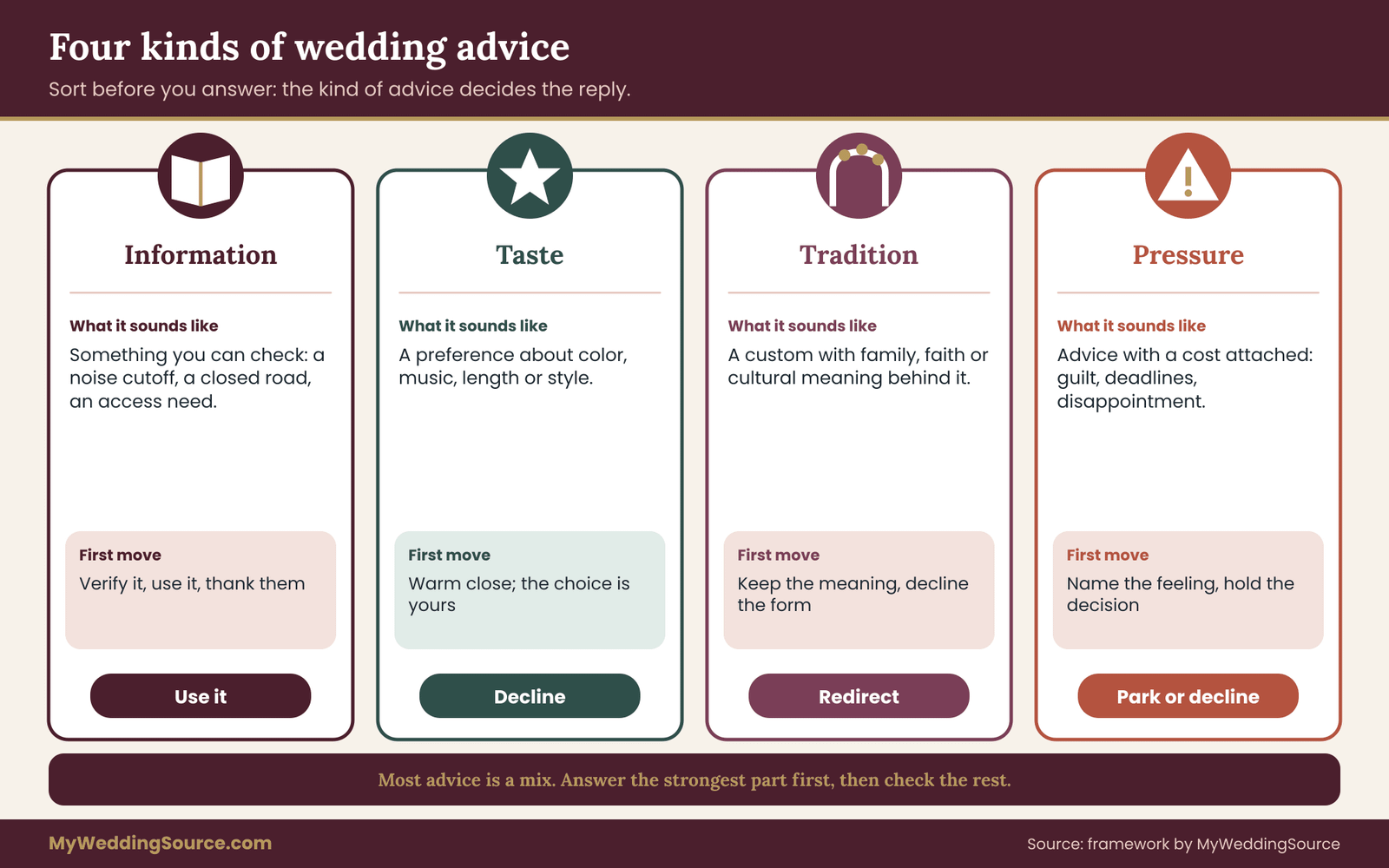
Ask four questions, in this order.
Is it information? Information is something you can check and might not know: the venue has a noise cutoff, a certain flower is toxic to pets, a bridge is closed on the weekend of your wedding, a guest uses a wheelchair. Information is worth hearing even when it is delivered clumsily. Your job is to verify it, not to fend it off.
Is it taste? Taste is a preference about how things should look, sound or feel: a different color, a longer reception, a different dress. There is no fact to verify. The only question is whether it matches what you two want, and you are the only ones who can answer that. Taste is the largest category of unsolicited advice and the one where you can decline wedding advice with the least risk.
Is it tradition? A tradition is a practice with a history, from a family, a faith or a culture, and the person suggesting it often has feelings about it. Traditions deserve a more careful answer than taste, because “no” can feel like a rejection of a whole inheritance. You can decline a tradition and still honor the intent behind it, and the section on guilt, tears and tradition covers how.
Is it pressure? Pressure is advice with a cost attached: “Everyone will be disappointed,” “Your grandmother may not come,” “After everything we have done.” The suggestion matters less than the consequence implied. Pressure calls for a calm reply that addresses the implied cost without accepting it as an argument.
Most pieces of advice are a mixture. A comment like “You should serve a proper meal, not appetizers, because older guests will go hungry” combines taste with a real concern about guest comfort. Sort by the strongest element, then check whether another element deserves a separate answer. In the example, the guest comfort point is information, and you may want to confirm how much food your plan provides at the hours you chose. The preference for a “proper meal” is taste, and you can decline it.
Four outcomes: use it, park it, decline it, redirect it
Once you have sorted, there are four things you can do with a suggestion. Choose one on purpose.
Use it. If the information is correct and helpful, act on it and thank the person specifically. Being known as someone who takes useful tips makes it easier to decline the rest, because your “no” carries more weight when people see that you do listen.
Park it. If you are unsure, say when you will decide and keep the promise. “We are deciding the music in March, so we will look at your idea then” is a clear answer. “We’ll think about it” is not, because it has no date and no owner.
Decline it. If the suggestion does not fit, use the ladder from the next section to decline wedding advice kindly. Most taste and tradition suggestions end up here.
Redirect it. If the suggestion points to a need you can meet differently, such as a relative who wants to feel involved, answer the need rather than the idea. The section on different sources of advice gives examples.
A common error is to use the wrong outcome because it feels kinder. Parking a suggestion you have already decided against is not kind. It sets a trap in which the person returns in March and you have to say no a second time, with less grace, because you let them hope. If you know the answer is no, say no.
The two-response ladder in one page
The ladder is a small structure with a big purpose: it makes sure you have decided what you will say before you are standing in someone’s kitchen. It has two rungs, and then a protocol that takes over. If you only remember one idea from this guide on how to decline wedding advice, make it this one.

Rung one, the warm close. You receive the suggestion, thank the person for the thought, state your decision in one sentence, and stop. You do not argue, justify or offer a conditional maybe. The goal is a friendly full stop.
Rung two, the firm repeat. If the person raises the same suggestion again, you say the same sentence again, shorter, and add a redirect to something they can do or discuss. The goal is to show that repetition does not change the answer, without raising your voice or adding new reasons.
Then the follow-up protocol. If the topic comes back a third time, you stop climbing. A third reply on the same rung is the debate you were avoiding. Instead, you move to the protocol: record the exchange, park the topic, schedule a single review window if one is honest, and hand the conversation to the right person if the pressure is coming through a go-between.
Two rungs may seem like too few to decline wedding advice reliably. The point of the limit is that more rungs invite escalation. A ladder with five steps tells everyone that you will answer a suggestion five times, and some people will take you up on it. With two rungs and a protocol, the third conversation is a different kind of conversation, and both of you can feel the change.
What makes a response count as a response
A reply counts as a rung only if it does three things, whichever words you pick to decline wedding advice. It has to be kind in tone, it has to be clear in content, and it has to be closed in form. Kind means no sarcasm, no sighing, no “as I already said.” Clear means the person could repeat your decision accurately to someone else. Closed means the last sentence does not end with a question mark or an open door.
You can test a draft with a simple check. Read it as if you were the person who offered the advice and ask three things. Do I feel thanked? Do I know what they decided? Can I tell whether they want to talk about it more? If the last answer is yes, rewrite it. Replies like “I don’t know, maybe, what do you think?” feel gentle to say and are exhausting to receive, because they request participation in a decision that has already been made.
Why the ladder works better than a long explanation
A long explanation looks like the respectful way to decline wedding advice. It seems to say, “I take your idea seriously enough to explain.” In practice it hands the other person several new things to respond to, and each of them can be argued. A short, kind decision gives them one thing to respond to, and the only thing they can say is “okay” or “I disagree.” Neither of those requires you to say anything more.
There is also a quiet benefit: consistency. If your answer to a relative today is the same sentence you will use next month, the relative learns that the answer is stable. Unstable answers, the kind that shift with each person’s mood or the last conversation, teach people that persistence pays. Stable ones teach them that it does not, and that is the lesson that eventually ends the debate. A couple who decide to decline wedding advice this way are not being cold. They are being predictable, and predictability is a kindness to people who otherwise have to guess.
Response one: the warm close
The first response is where most of the relationship is protected. Done well, it lets the person leave the conversation feeling heard and the topic feel finished. Done badly, it creates the next three conversations. When you decline wedding advice for the first time, you are also setting the pattern for every time after.
The three parts of a warm close
A warm close has three parts, and each is one short sentence, so you can decline wedding advice in the time it takes to pass a plate.
Thank. Name the thought, not the idea. “Thank you for thinking about the ceremony.” This is true even when you dislike the idea, because the person did spend time thinking about your wedding. Do not thank them for the idea itself, since that suggests you are accepting it.
Decide. State the decision in plain words, in the first person plural when there are two of you. “We are keeping the ceremony at four o’clock.” Avoid softeners such as “we’re kind of leaning toward” or “we might.” If you have not decided, you are not at this rung yet, and you should park the suggestion instead.
Close. End without a question and without a reason. “We’re happy with it.” Or simply stop. If a silence follows, let it sit for a moment. Silence after a clear, kind sentence is not an insult. It is a pause in which the person can nod.
Put together, the pattern sounds like this:
“Thank you for thinking about the seating. We’ve decided to keep the long tables, and we’re happy with that.”
It is short enough to say while someone is still holding the serving spoon.
Examples across common topics
The same three parts adapt to almost any topic you may need to decline wedding advice about. Here are several, with the topic changed and the structure left alone.
For a venue suggestion: “Thank you for looking at other places. We’ve chosen the garden and we’re excited about it.”
For a menu change: “Thank you for the menu ideas. We’re staying with the dinner we picked, and we’re glad you’ll be there to eat it.”
For a guest-list nudge: “Thank you for thinking of your friends. The list is set, and we’re glad you’ll be with us.”
For a dress opinion: “Thank you for saying what you think. I’ve chosen the dress, and I feel great in it.”
For a date: “Thank you for raising the date. It’s settled, and the invitations go out soon.”
For an unrequested role: “Thank you for offering to do the toast. We’ve planned who speaks, and we’ll let you know if anything changes.”
Notice that none of these include a reason. The reasons exist, and you probably have good ones. They are not part of the reply. If the person asks why, the answer belongs to the next rung, and it is not a reason either.
Words and phrases to leave out of rung one
Some phrases feel gentle and cause trouble when you decline wedding advice. Leave out “I’ll think about it” when you will not. Leave out “maybe” unless a real decision window exists. Leave out “I’m sorry, but,” since an apology for a decision invites a discussion about whether the decision was a mistake. Leave out “we can’t,” because “can’t” implies a constraint that someone may try to solve for you: “Of course you can, I’ll cover the cost.” “We’re not going to” or “we’ve decided” belongs to you in a way that “can’t” does not.
Leave out comparisons to other people’s weddings. “Our friends didn’t do that” starts a contest about whose wedding is the model. And leave out any criticism of the idea itself. “That wouldn’t work” is a claim about the idea, and the person who proposed it will want to defend it. “We’ve decided” is a claim about your choice, and nobody else can defend it for you.
Tone and delivery
The content is only half of rung one when you decline wedding advice. The other half is how it sounds. A decision delivered in a flat, tired voice reads as irritation. A decision delivered quickly, with a smile that is not quite real, reads as dismissal. Aim for the tone you would use to tell a neighbor that you already have a plumber: pleasant, unhurried, and final.
In person, soften with a small physical cue, such as a nod and a smile, and then do something with your hands: pick up your glass, move to the next item on the table. A person who sees you move on is more likely to move on with you. On the phone, a slower pace and a slightly warmer voice carry the same cue. In writing, which the channel section covers, brevity does the work.
What to do if the person agrees quickly
Many sharers will say “Of course, no problem,” and that is the end of it. Do not undo that with further explanation. A common reflex is to keep talking to make sure they are not hurt: “I really do love the idea, it’s just that…” Stop at the close. If you sense that feelings were hurt, handle that separately, later, with a call or a small gesture. Do not reopen the decision to repair the mood, because reopening is what makes the mood worse the next time.
If you notice that you want to keep talking, a useful trick is to move to a different subject that matters to them: ask about their travel plans, a recipe they like, or the relative they are bringing. A change of topic is not rude after a complete answer. It tells the person that the relationship continues, which was the point of being warm in the first place.
Response two: the firm repeat
Sooner or later someone will bring the same suggestion back. It may be the next day or the next month. It may be phrased as a new idea, as a question, or as a worry. The second response is how you decline wedding advice that you have already declined, without turning it into an argument and without pretending the first answer did not happen.
Recognizing a repeat
A repeat is not always obvious when you decline wedding advice from the same person twice. People rarely say, “I am asking again.” They say, “I was just wondering whether you had looked at the other room,” or “My friend mentioned the same venue,” or “Have you two talked any more about the date?” The test is simple. If the subject is the same and the decision is the same, it is a repeat, whatever the wording.
Some repeats are not what they seem. A person who asks, “Did you hear back from the florist?” is asking for news, not reopening a choice. A person who says, “I saw something that reminded me of what you wanted” has not necessarily returned to a debate. Before you answer, check whether they are asking about the decision or about something near it. Treating every comment as a campaign creates the tension you are trying to avoid.
The three moves of the firm repeat
The firm repeat has the same shape as the warm close when you decline wedding advice a second time, with two changes: it is shorter, and it adds a redirect.
Say the same sentence. Use the words you used before, or nearly. The repetition is the message. “We’ve decided to keep the long tables.” Do not look for a new way to say it. A new phrasing sounds like a new position.
Acknowledge the repeat gently. One short clause is enough: “I know we’ve talked about this.” It tells the person you remember, you are not annoyed, and you are not going to relitigate. It does not apologize.
Redirect. Offer a real alternative that fits the person. If they care about the food, ask them to taste the cake. If they care about the guest list, ask them to write the addresses for their own side. If they care about tradition, ask them to explain it to you in detail and consider where it might fit. The redirect should be something you would actually welcome. A fake redirect creates a different kind of trouble later.
In sequence, it sounds like this:
“I know we’ve talked about this, and we’re keeping the long tables. I would love your help with the welcome toast, though, if you’d like to think about it.”
The redirect has to be honest. Only offer the toast if you would be glad to have it. Otherwise, offer something smaller that you would be glad to receive, such as a ride for an elderly guest or a call to check on the rental delivery.
What not to add
The temptation at rung two, when you decline wedding advice again, is to raise the stakes or to add a justification that did not exist at rung one. Both are mistakes.
Do not add a new reason. If you said nothing at rung one, you do not owe an argument at rung two. If you gave a reason at rung one, do not supply a second, stronger reason. It signals that the first was not enough and that persistence is working.
Do not escalate emotion. A sigh or “We’ve been over this” tells the person that they have done something wrong. They may then defend themselves, and the topic changes from the wedding to their behavior. Keep the voice the same as rung one, or slightly slower.
Do not threaten consequences. “If you keep bringing this up, I won’t want to talk about the wedding” is a statement about the relationship, and it hands the person a way to feel wronged. If you need to limit the topic, do it through the follow-up protocol, which sets the limit in a calm, planned way.
The short version of the repeat
Some people reach the same point several times in one conversation. When that happens, use a very short form: “We’ve decided. How is your week going?” It sounds abrupt on paper. Spoken with a smile, it is a normal way to move on. The change of subject gives the other person something to say that is not a debate, and most people take it.
How to decline wedding advice in person, by text and in group chats
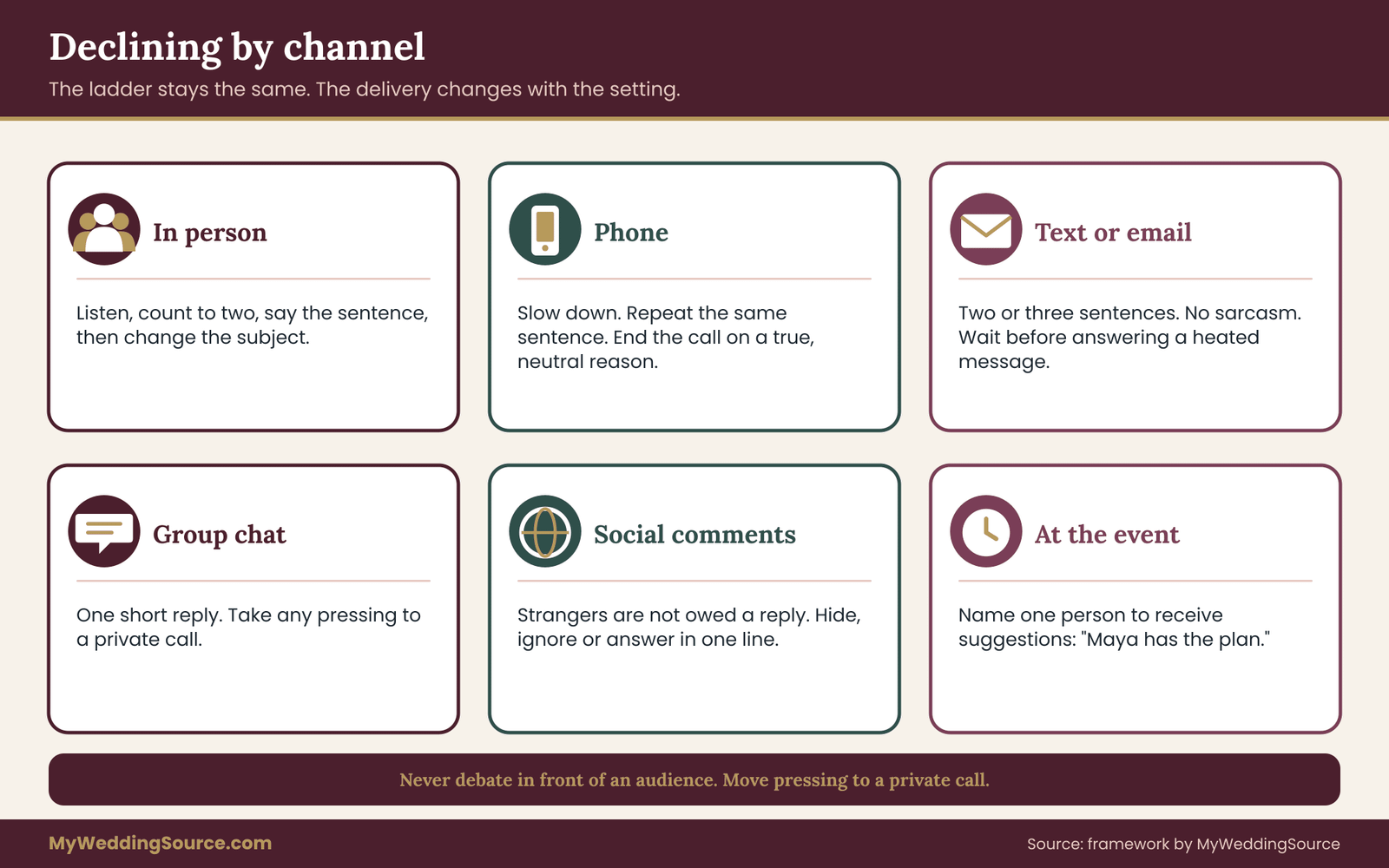
The ladder stays the same across channels, but the delivery changes when you decline wedding advice, because each channel has its own way of failing. A warm close that works at a dinner table can read as cold in a text, and a text-length reply can sound curt on the phone.
In person
Face-to-face is the easiest channel for warmth when you decline wedding advice, and the hardest for brevity. Tone, expression and a gentle pause do half the work, but a live conversation also tempts you to keep talking to fill the silence.
Have the first sentence ready and say it before the person finishes their pitch if you can. Interrupting is rude, but waiting for a full pitch and then replying with a single sentence feels like a door closing. A middle path is to listen to the suggestion, count to two, and then give your reply. The count gives the person a sense of being heard and lets you resist an automatic defense.
If the suggestion arrives at a gathering, such as a family dinner, do not answer it at length in front of the whole table. Use the warm close and offer to talk about something else. If the person is persistent, a quiet “Let’s catch up on that another time” is not a promise to discuss it. It is a way to avoid a public contest, and you should follow it with a different topic and not with a scheduled talk about the same idea.
On the phone
A phone call removes the visual cues and makes interruptions easy, which matters when you decline wedding advice by phone. Slow your pace. Say the decision once, clearly. If the person talks over you, wait for a gap and repeat the same sentence. You do not need to raise your voice. Repetition at a steady volume works better than volume.
A phone call also makes it easy to be trapped. If you are being drawn into a debate, end the call using a reason that is true and not about the topic: “I have to get to dinner, thank you for calling.” Do not make the reason about the debate, because that makes the end of the call part of the argument.
By text and email
Writing is the channel where you can control the wording most precisely when you decline wedding advice, and also where tone is most easily misread. Keep the same three parts, in a message of two or three sentences. Skip emojis that might seem sarcastic, and skip a long preamble. A short, kind message looks calm. A long one looks defensive.
“Thank you for sending the venue links. We’ve settled on the garden and we’re looking forward to it. How is the new job going?”
Never try to decline wedding advice in a heated message sent right away. If a text from a relative makes your stomach tighten, wait until you can write without edge. A delay of a few hours is normal. If someone asks why you have not answered, say you were busy and give the answer now.
When a text thread begins to grow, with each message adding a new point, move it to a call or an in-person talk only if you intend to offer something other than a debate. If you move it only to argue, you have just changed the venue of the argument. Otherwise, keep your replies short and stop replying after your second answer. The protocol in the next section covers what to do with a thread that will not end.
In group chats
A group chat adds an audience when you decline wedding advice. A suggestion in a group chat is visible to everyone, and a decline is too. This can help, because the answer is on record, and it can hurt, because people feel they have to save face.
Do not debate in a group chat. Use rung one in the chat, in one message, without sarcasm: “Thank you, everyone. The date is set.” If someone presses, offer to speak by phone with that person alone, and be honest about the purpose of the call: to say again that the decision stands and to ask how you can include them. Then use rung two on the phone, not in front of the group.
If the chat is a wedding party chat that has become a place for opinions, you can reset it with a short note that sets a purpose: “This chat is for logistics, so I’ll keep ideas for the planning notes.” A note like this does not need to name anyone. It changes what the chat is for.
Social media comments and strangers
Strangers online who comment on a public post about your wedding are not owed a reply, so you rarely need to decline wedding advice from them in words. A person who writes “You should have chosen a different color” does not have a stake in your wedding, and a reply gives them a conversation. You can ignore the comment, hide it or delete it, and none of those is rude. If you want to say something, a short, friendly line is enough, and then you can leave the thread alone.
Relatives who comment on your posts are a different case. Treat their comments as a conversation in public and use the same warm close, kept to a sentence. If a relative’s comment embarrasses you, reply with a calm line and talk privately, because a public reply to a public suggestion tends to invite the rest of the family into the discussion.
The follow-up protocol after the second answer
When you have had to decline wedding advice twice, a third conversation on the same topic means something has changed. The person may be anxious, may not believe you, may be carrying someone else’s message, or may simply be in the habit of repeating. More of the same reply is not the right response. The protocol is a short list of actions that move the situation off the ladder and into a calmer pattern. It is the part of how to decline wedding advice that most guides leave out.

The protocol has four moves: log it, park it, window it and hand it off. You will not always need all four. Use as many as the situation calls for, in this order.
Move one: log it
Each time you decline wedding advice twice or more, write down the suggestion, the date, who raised it, what you said and how it ended. It takes two minutes. A shared note on your phone or a page in a notebook is enough. The log does three things.
It stops you doubting yourself. After a third conversation it is easy to wonder whether you were unreasonable. A dated entry shows what was said and what you said, and often it shows that you were calmer and clearer than it felt.
It makes the pattern visible. If the same person raises the same topic five times in a month, you will see it. That helps you decide whether the person needs a different kind of answer.
It gives your partner the same information. If one of you talks to a relative and the other does not, the log keeps both of you on the same page. Nobody has to guess what was said.
The log is not a weapon. Do not quote it to the relative, and do not use it as proof in an argument. It is for you.
Move two: park it
Parking means giving the topic a place to wait that is not your next conversation. There are two honest ways to park.
The first is a calendar park. If you will really reconsider at a specific time, say so and write it down: “We decide the music in March, so we’ll look at your idea then.” This works only if the decision is truly open. If it is already closed, a calendar park is a small lie, and it will cost you trust when March arrives.
The second is a topic park. If the decision is closed, you can still limit the conversation: “We’ve decided, so let’s save our wedding time for the parts we can still change.” This tells the person where the wedding conversation can go and where it cannot. It also gives them something to do with their input.
A good park is specific, short and said once. If you must repeat it, you are not parking. You are climbing the ladder again.
Move three: window it
A window is a single, scheduled moment, after you decline wedding advice twice, when the person can say everything they want about the topic, and you listen. It works in the situations where the repeated suggestion is a sign that the person has not felt heard. You are not reopening the decision. You are giving the person a place to be heard, in exchange for letting the topic rest afterward.
A window should be short, perhaps twenty minutes, and it should have a clear shape. Say at the start: “I want to hear what you think about the ceremony. I can listen for twenty minutes, and I’ll tell you at the end whether anything changes.” Then listen without defending. At the end, say what you heard, and say whether anything changes. Often the honest answer is no, and you can say so kindly: “Thank you for explaining it so fully. We are keeping the plan. I will let you know if that changes.”
Windows are not for everyone. They suit people who are anxious, attached or hurt, and they do not suit people who treat every conversation as a negotiation. For a campaigner who enjoys the contest, a window is another round. Use it only when you think the person wants to be heard more than they want to win.
The window also needs an honest limit. If you offer a window and the person uses it to repeat the same arguments for an hour, you can end it on time. “I have to stop here. Thank you for telling me all of it.” Then stop.
Move four: hand it off
Handing it off means moving the conversation to a person who is better placed to have it. There are three common handoffs.
To your partner. If the relative is your partner’s parent, your partner should be the one to speak to them. A suggestion that comes through you, and gets a decline from you, is easily received as the in-law blocking the family. A suggestion that gets a decline from the son or daughter is received as the family’s own business. The next section covers how to arrange this.
To the source. If a go-between brings someone else’s opinion, thank them and return the conversation to the source. “Thank you for passing that on. I’ll talk with your mother directly.” You are not scolding the messenger. You are making the path shorter.
To a neutral third person. If a conflict has become tense and neither of you can speak calmly, a trusted neutral person can help: a long-standing friend of the family, a faith leader or a professional mediator. That is not a failure. It is a sensible step when a relationship matters more than a wedding detail.
What the protocol looks like over time
A typical use of the protocol, after you decline wedding advice twice, takes a few weeks. Suppose a relative has raised the same idea three times. You write down the third conversation, then choose a park: topic or calendar. A few days later you offer a window if it fits. If the idea comes back after that, you hand the conversation to the right person and keep your replies to a single sentence.
Notice what the protocol does not include. It does not include a lecture on respect, a formal letter or an ultimatum. Those are not forbidden, and sometimes a situation does call for firmer measures. They are rarely needed, and they are much more likely to be needed if you skip the earlier steps.
Share the work: partners, roles and who speaks
A boundary that only one of you holds is fragile, and so is any plan to decline wedding advice that only one partner supports. If one partner declines and the other quietly agrees with the relative, the relative will go to the partner who agrees. This is not malice. It is how people find the path of least resistance. Before the ladder meets the family, the two of you need to be on the same rung.
Agree on the decisions, not the scripts
You do not need to agree on every word. You need to agree on the decisions that are closed, the ones that are open, and the ones that belong to one of you alone. Sit down for half an hour and write three short lists: what is decided, what is still open, and what each of you will not change. Ideally this list is a single page you can both read.
When the two of you have this list, any suggestion can be sorted quickly. “Closed” means rung one. “Open” means park with a date. “Not changeable” means rung one, and a hand-off if pressure continues. If you disagree on where something belongs, resolve that between yourselves before you answer anyone. A decision made in front of a relative under pressure is rarely a good one.
If the larger question is who has authority over which parts of the wedding, the guide on couples and families sharing input sets out a longer framework. The ladder works inside whatever framework you pick.
Each partner speaks to their own family
A sensible default is that each of you handles your own relatives when you decline wedding advice. A parent can hear “we’ve decided” from their own child more easily than from a future in-law, and it protects the in-law from becoming the object of resentment. Exceptions are fine, but agree on them first. If your partner’s mother always texts you, for example, you might agree that you will reply once with a warm close and then pass the thread to your partner.
Use “we” when you decline wedding advice, whichever of you is speaking. “We’ve decided” is a statement of a shared position. “I’ve decided” invites the relative to wonder whether the other partner agrees, and they may go and ask. If the decision is yours alone, as a dress might be, say so plainly: “I’ve chosen the dress.” It is clear and cannot be argued by the other partner.
When your partner softens
Sometimes one partner is more willing to give way, because they love the relative, or dislike conflict, or genuinely see merit. That is normal. The danger is a silent softening, where your partner tells the relative “maybe” and you find out later.
Ask your partner what they are trying to protect. It could be peace, the relative’s feelings, or an idea they like. Then say what you are trying to protect. If the two answers can both be met, you have a solution. If they cannot, decide which of you carries more weight on that particular question, and honor it. What you must avoid is a pattern where you both pretend to agree. It is better to say, “I disagree, and I’ll go along with this one,” than to quietly resent it later.
Scripts for partners backing each other up
When your partner is in the middle of a decision to decline wedding advice and a relative turns to you for a different answer, the shortest useful line is: “I agree with what they said.” It is kind, it is clear and it ends the attempt to split you.
If your partner has declined and the relative asks you privately, “Surely you’d like it?”, answer warmly and consistently: “We’ve talked about it, and we’re both happy with the plan.” Do not reveal that you had a different private view, and do not use the conversation to relitigate with your partner in front of the relative. If you do have a disagreement, raise it with your partner afterward.
A last point: do not use your partner as an excuse. “My partner won’t let me” turns a shared decision into a restriction, and it makes your partner the villain in a story they did not agree to. If the decision is shared, say “we.” If it is your own, say “I.”
How to decline wedding advice from different people
The ladder is the same for everyone you need to decline wedding advice from, but the redirect, the tone and the follow-up protocol shift with the relationship. A parent, a grandparent and a coworker all offer opinions for different reasons, and a good reply speaks to the reason.

Parents
Parents tend to have the longest history with the idea of your wedding. Some have imagined it for decades. Some are paying for part of it. Some carry their own memories of a wedding that went differently than they hoped. Their advice often has feeling behind it, and sometimes a sense of ownership.
With parents, the warm close does the most work when you decline wedding advice if it names the feeling: “I know you care about this. We’ve decided on the smaller guest list, and we’re glad you’re part of it.” The redirect should match their need to be involved. A parent who wants to be consulted can be asked for a family story to include in the program. A parent who wants a role can be given a clearly defined task, such as greeting guests or hosting a rehearsal gathering.
If a parent is contributing money, the situation gets more complicated, because the advice can feel like a condition. Keep the two conversations separate: the one about the decision and the one about the money. Ask for any conditions to be stated clearly and in advance. The guide on decision rights and input windows covers money and decision rights in detail, and the wedding budget guide is useful when you need to see which costs are tied to which contributions.
In-laws and future in-laws
Advice from a partner’s family has a different weight. You may not yet know their habits, and they may not know yours. The risk is that a decline from you is read as a verdict on their family.
Let your partner decline wedding advice from their own family when you can. If you have to answer, keep the reply extra warm and keep it brief. “Thank you for the idea. We’ve decided, and we’re looking forward to having you there.” Avoid anything that could sound like a comparison of families, such as “In my family we always…” Also avoid asking your partner to translate. A conversation that goes through your partner every time can make you seem invisible.
For long-standing tradition, such as a religious or cultural ritual, take extra care. The section on guilt, tears and tradition below covers ways to decline the specific form while respecting what it means.
Grandparents
Older relatives often suggest things from a lifetime of attending weddings, and they often speak with an authority that is hard to refuse. They also tend to be the people whose opinions you most want to honor. Learning to decline wedding advice from a grandparent with grace matters more than winning the point.
Consider whether the advice contains a need you can meet. A grandparent who says the ceremony should be shorter may be worried about sitting for a long time. A seat with arm rests, a cushion and water within reach may solve the real problem, while the ceremony stays as planned. A grandparent who objects to the menu may want something they can eat. Ask them, privately, what would make the day comfortable.
A warm close, delivered gently and perhaps with a hand on the arm, is usually enough. If you are asked again, rung two can be as simple as: “We’ve decided, Grandma, and I want you to have the best seat in the house.”
Siblings and close friends
Siblings and close friends feel entitled to be blunt, and often they are. They may also be right more often than other advisers, because they know you well. Treat their suggestions as information first, and decline only after you have actually considered them.
When you decline wedding advice from a friend, you can be more direct than with older relatives. “I hear you, and I’m still going with the first dress” is natural between friends. If a friend keeps pressing, a friendly but unambiguous “I love you, and this one is decided” will often work. Friends are more likely to accept a firm line without taking it as rejection, because the relationship has other grounds.
Friends who are recently married can be the hardest case. They have a clear and recent memory of what worked for them, and they may treat it as the template. A kind way to decline is to acknowledge their experience and mark the difference: “That sounds like it worked beautifully for you. We’re doing it differently, and we’re happy with that.”
The wedding party
Members of the wedding party have a special position. They are doing a job for you, and they are also guests with opinions. They may offer advice because they want the day to go well, or because the planning is taking more of their time than they expected.
Separate their roles. When the advice is about their own job, such as what they will wear or when they will arrive, treat it as information and respond to it in detail. When the advice is about decisions that belong to you, use the ladder to decline wedding advice. And create a channel for ideas that is not the group chat, such as a monthly check-in, so that suggestions have somewhere to go before they become pressure.
Coworkers, neighbors and acquaintances
People who are not close to you offer advice because it is a common social script. They are not usually invested in what you do. To decline wedding advice from an acquaintance, a short, friendly sentence is enough: “Thanks, we have a plan we like.” Do not explain. Do not feel that you have to defend your choices to someone who has no stake in them. If they persist, a smile and a change of subject is a complete reply.
When the advice comes with a sales pitch, such as a friend of a friend who works in event rentals, the same principle applies. Thank them and keep your vendor choices in the usual process. If you want help comparing quotes or reading terms, the guide to the vendor contract explains what to look for before you sign.
Vendors who offer extras
Vendors can also offer advice, and some of it is useful: an experienced venue coordinator may know that a certain timeline is tight. Some of it is a sales offer in disguise. A planner or a florist who says, “Most couples add a second arrangement for the head table,” is describing an add-on, not a rule.
The same ladder works to decline wedding advice from a vendor, with a business flavor: “Thank you for the suggestion. We’re staying with the package as written.” If the vendor presses, rung two is the same sentence, shorter, with a question that moves to the next item: “We’re keeping the package as written. What do you need from us for the timeline?” If a vendor continues to apply pressure after two answers, keep the replies in writing and consider whether this is the right vendor.
When advice carries guilt, tears or a family tradition
Some advice is easy to decline because it is only an opinion. Some comes with a heavy emotional load, and the way you decline wedding advice needs a bit more care. These are the cases where people most often give in against their own judgment, and then resent it.
Guilt
Guilt-laden advice usually sounds like a statement of sadness: “I just always pictured it differently.” Or a statement of sacrifice: “After all we did to make that day possible.” It is not an argument. It is a feeling, and you can respond to the feeling without agreeing to the request.
A useful reply acknowledges the feeling in one sentence and then holds the decision: “I can hear that this matters a lot to you. We’re keeping the plan, and I would like to find another way to include you.” Say it slowly. Do not rush to fix the sadness by changing the decision, because the sadness will not end there. It will move to the next decision.
It is also fair to let the person be sad. Adults can be disappointed about a wedding detail and still love you. You are not required to prevent every disappointment. You are required to treat the person with respect while it happens.
Tears and visible distress
When a relative cries, the instinct is to repair. Stay with the person. Offer a tissue and a moment. You can say, “I’m sorry this is hard.” That is different from “I’m sorry, we’ll change it.” Do not reverse a decision in the middle of a tearful conversation, because a decision made to end distress rarely holds, and the next person will learn that tears work.
If distress is intense or seems out of proportion, it may reflect something else going on in the person’s life. A gentle question, “Is something else weighing on you?”, can open a different conversation. If someone seems to be in crisis, encourage them to reach out to a trusted person or a professional resource, and do not try to carry it yourself.
Tradition
Traditions are the hardest to decline because they are not only about preference. They connect people to ancestors, faith and identity. If a relative insists that you must follow a specific custom, ask yourself whether you want to include it in some form. You may find that part of it fits and part does not.
If the answer is a full no and you must decline wedding advice that rests on a tradition, it helps to separate the form from the meaning. You can say, “We’re not doing the full ritual, and the thing we want to keep from it is the blessing from the family.” Then invite the relative to help shape that part. If you are not sure what a custom means, ask. People who feel heard about a tradition are more likely to accept a different version of it.
Some traditions have strong religious or cultural authority within a family, and an outsider cannot judge them. The guidance in this article cannot tell you which traditions to follow. It can help you say what you have decided, kindly. For broader etiquette questions, the wedding etiquette guide offers general starting points.
Hard cases when the ladder is not enough
Most people stop after you decline wedding advice once or twice. A few situations do not. They are worth thinking through in advance, because they are the ones where people drift into resentful compliance or a family quarrel that outlasts the wedding.
The person goes around you
Sometimes a relative accepts your answer to your face and then acts on the suggestion anyway. They call the caterer to ask about the menu, they send the venue a note about the seating, or they tell other guests the plan has changed. This is a different problem from repeated advice. You decline wedding advice in words, and the person answers with actions, not talk.
Start by finding out what has happened. Ask the vendor or the guests what was said, without accusing anyone. Then reply to the relative once, calmly, about the action: “I heard that you called the venue about the layout. We’ve decided on the layout, and I’d like all changes to come through us.” This is a boundary about process, not about the idea, and it is easier to hold. Tell the vendor in writing who may make changes, and consider the terms in the vendor contract about who is authorized to approve them.
If it happens again, move quickly to the protocol’s last move. A conversation with a neutral third person present, or a firm note that the vendor will take instructions only from the two of you, can end it. You are not punishing anyone. You are protecting a process that has to be reliable.
Advice that arrives through other people
A proxy says, “Your aunt is upset about the seating.” You were not in the conversation, and you now have to respond to a feeling you cannot verify. It is another chance to decline wedding advice, this time at one remove. Thank the messenger, and do not take responsibility for the aunt’s feelings through them. “Thank you for telling me. I’ll call her this week.” Then call, and use rung one directly, in a calm and warm way. The direct conversation is almost always shorter than the chain of messages.
If a relative uses proxies all the time, you can say, kindly, that you would like to hear things first-hand. “If something is on your mind about the wedding, I would love to hear it from you.” This tells them there is a direct route and lowers the temperature.
The decision was right for them, wrong for you
Now and then, a suggestion you declined turns out to have been good. A guest mentions that the walk from the parking lot was long and a relative had said so months ago. This happens, and the best response is a plain one. Say so. “You were right about the walk. Thank you for pointing it out.” Then fix what you can.
Being willing to say this is also a reason to decline wedding advice with a warm rather than a stiff tone. If you have been gracious about the no, you can be gracious about the yes later. The person who was right will likely be generous about it, because you did not make them feel foolish when they were not.
The suggestion you took and regret
Sometimes you take a suggestion to keep the peace and regret it. The cleanest repair is early and plain. Go to the person, say that you thought about it and want to go back to the original plan, and offer a replacement role if the change causes disappointment. The longer you wait, the more others will have planned around the change. If the change is costly or the vendor has already acted, check the vendor’s change terms before you promise anything. A regretted decision is still a decision, and sometimes the right move is to keep it and decide next time.
Advice at the event itself
Advice does not stop when the wedding starts, and neither does the need to decline wedding advice gracefully. A relative may suggest that the cake be cut earlier, or tell the photographer to take another picture. On the day, there is no room for a ladder. Appoint one person, a coordinator, a planner or a trusted friend, to receive suggestions on your behalf. Tell the relatives beforehand: “On the day, please pass anything to Maya, and she’ll handle it.” Then you can say, “Maya has the plan,” and enjoy your day. The venue and vendors should know who that person is.
When the pressure is not ordinary
Most situations where you decline wedding advice involve ordinary friction.
A smaller number of situations are not. A relative who threatens you, who tries to control who you see, who takes or withholds money to force a choice, or who leaves you afraid of what will happen if you say no, is not a case for scripts. If you feel unsafe, contact local emergency services. For support with controlling or abusive behavior, the National Domestic Violence Hotline offers confidential help. If you feel overwhelmed to the point that you cannot function, a trusted person, a clinician or a crisis line such as 988 in the United States can help.
For painful but non-dangerous conflicts, a mediator or counselor can help the family speak without turning it into a contest. That is a legitimate cost of a wedding budget, and it is often worth more than another venue visit. The ladder is for ordinary disagreement, the everyday kind in which you decline wedding advice and the relationship carries on. It cannot repair what needs a different kind of help.
A worked example: five weeks, one suggestion that keeps returning
This example is invented, for illustration only. It shows how one couple might decline wedding advice over five weeks. It follows a made-up couple, Priya and Tomas, who have chosen a four o’clock outdoor ceremony and a plated dinner. Tomas’s mother, Elena, believes the ceremony should be moved indoors to avoid the chance of rain and the dinner replaced by a buffet. The names and details are not drawn from a real family.
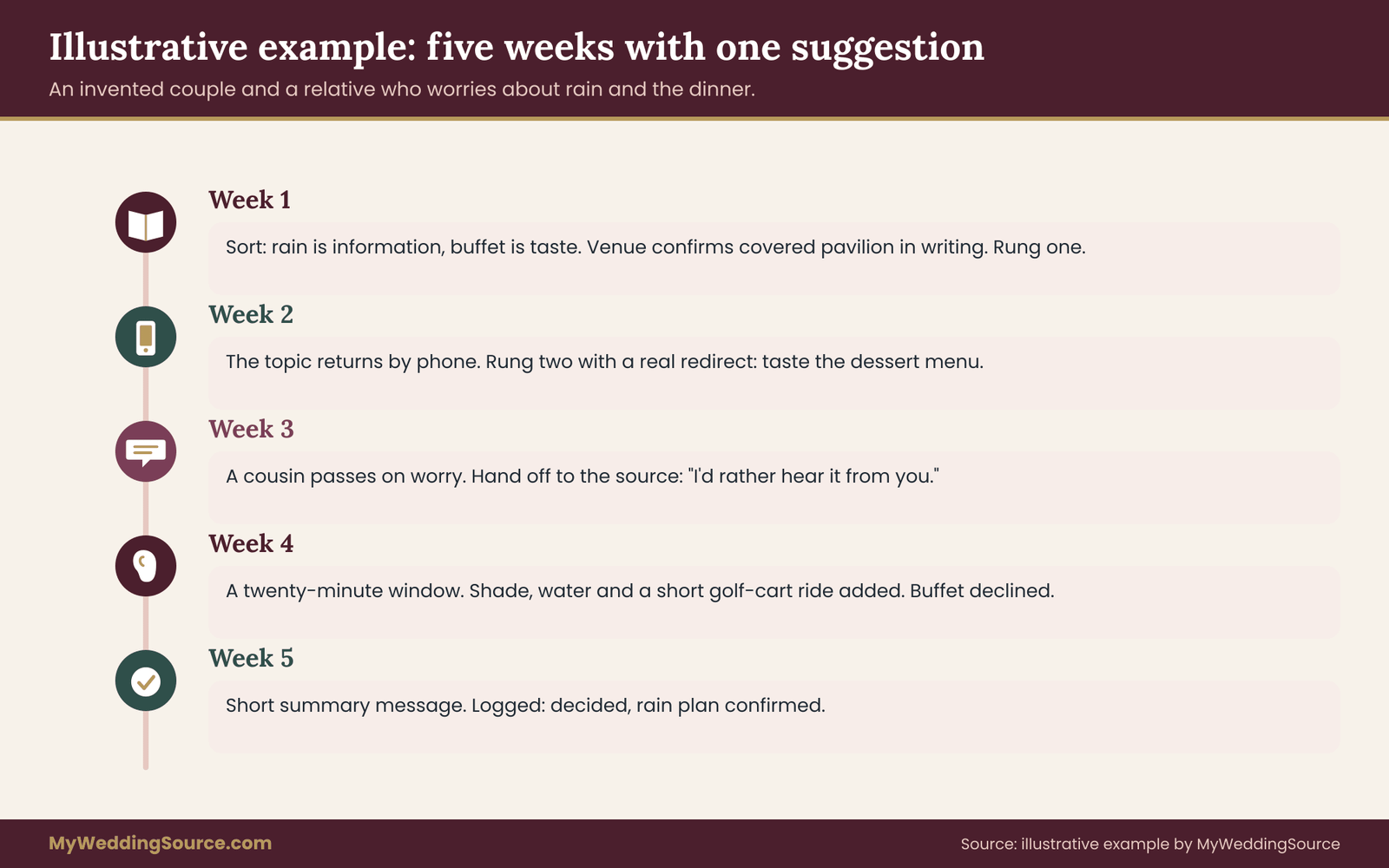
Week one: sorting. Elena raises the rain concern at a family dinner. Priya and Tomas sort it later. The rain point is information, since there is a real chance of weather, and the venue’s rain plan can be verified. The buffet suggestion is taste. They check the venue contract for the weather plan, find that a covered pavilion is included, and confirm that with the venue coordinator in writing. That deals with the information. The taste question remains.
Week one, at dinner. Tomas answers rung one to decline wedding advice about the rain: “Thank you for thinking about the weather. We’ve confirmed the pavilion is our backup, and we’re keeping the outdoor ceremony. We’re glad you’ll be there.” Note that this reply gives the verified fact and then closes. There is no argument about whether rain is likely.
Week two: the repeat. Elena calls Priya. She is anxious about the buffet and the weather. Priya recognizes a repeat. She uses rung two: “I know we’ve talked about this, and we’re keeping the plated dinner. Would you like to taste the dessert menu with us?” The redirect is an honest invitation. Elena accepts.
Week three: the proxy. A cousin tells Tomas that his mother is worried and has not slept. Tomas thanks the cousin and calls Elena directly: “I heard you’re worried. I’d rather hear it from you.” This opens a conversation in which Elena says she is afraid that guests will be uncomfortable. That is the real concern, and it was never about a buffet.
Week four: the window. Priya and Tomas offer a window: “We would like to hear everything you are concerned about, for twenty minutes, and then tell you what we’re doing.” Elena names her worries: older guests in the heat, the length of the ceremony, the walk. Several are good points. They add shade and water near the seating, a shorter walk with a golf cart for two guests, and a printed note about the pavilion backup. They decline the buffet and the indoor ceremony, and they say so clearly.
Week five: closing the loop. Tomas writes a short message summarizing what changed and what did not. Elena replies that she feels better. The topic is parked in a shared note with a line: “Decided. Rain plan confirmed with the venue.”
What the example shows
Three things stand out in how the couple chose to decline wedding advice. First, sorting separated a real, verifiable concern from a preference, and the real concern was handled with facts instead of argument. Second, the ladder made the repeat predictable: the same decision, a shorter sentence and a genuine redirect. Third, the protocol did its work when the topic came back through a cousin. The couple moved from replying to listening, and the honest window revealed that the worry underneath the advice was comfort, which they could address without giving up the plan.
Not every family will go this way. Some campaigns continue after the window, and some relatives will remain unhappy. The example does not promise a result. It shows a process that keeps your decisions yours and keeps the person in the room.
Keeping the relationship while you decline wedding advice
The point of choosing to decline wedding advice this way is not to win a series of small contests. It is to reach the wedding day with your decisions intact and your relationships in good repair. A few habits make that more likely.
Give people something real to do
People who feel useful offer fewer opinions. Before the suggestions start, or as soon as you notice a pattern, offer jobs with clear edges. A relative can host a rehearsal gathering, gather old photographs, plan a welcome bag, drive a guest who needs a ride, or write a short toast. Make the job specific, give it an end date and say what it does not include. A vague role, such as “help with the flowers,” invites opinions about the flowers. A defined one, such as “pick up the arrangements at noon and bring them to the venue,” does not.
Offering a job is not a bribe or a way to buy silence. It treats the interest behind the advice as real and gives it a place to go. If you offer a role and the person uses it to reopen decisions, return to the ladder, and do not hand over a second role.
Close the loop after a hard exchange
After a tense moment when you had to decline wedding advice, a small repair matters more than a perfect script. A short note or call within a day or two does it: “Thank you for talking with me. I know the ceremony matters to you, and I’m glad you care.” You do not have to reopen anything. You are showing that the relationship is bigger than the disagreement.
If you said something sharply, say so. “I was short with you on the phone, and I’m sorry about my tone.” Apologizing for tone is not the same as reversing a decision, and it is the one apology that does not weaken a boundary.
Credit good advice, in public
When a suggestion helps, thank the person by name, including in front of others. “Elena’s idea about shade near the seating made a real difference.” It costs nothing, and it shows the family that useful input is welcome, which makes the point that the ladder is about the unhelpful kind. People who have been credited once are more willing to accept a no later.
Let some things go
Not every suggestion needs a decision or a reply. A passing remark about flowers can be met with a smile and nothing else. Saving the ladder for matters that actually need it makes it stronger. If you tried to decline wedding advice every time someone said something, you would be exhausted by June, and the people around you would feel monitored. A quiet nod is also a response, and often the best one.
Limits of this approach, and what to verify
This guide offers a method to decline wedding advice in ordinary disagreement. It has limits, and it helps to be plain about them.
It is not universal. Families, faiths and cultures differ widely in how directly people speak, how much a parent’s view counts and what counts as respectful. A reply that sounds warm in one household sounds cold in another. Adjust the wording to your family and keep the structure: thank, decide, close, repeat once, then change the pattern. If your family has a respected elder, a faith leader or a customary way of settling disagreements, use that route when it fits.
It does not replace professional help. Scripts are not a treatment for anxiety, a mediator for a serious family rift or protection from someone who is controlling or unsafe. If the problem is larger than a wedding, the ladder is the wrong tool, and it is sensible to say so and seek the right one.
It is not a license to decline wedding advice that is useful. Part of the point of sorting is that some advice should be taken. When the suggestion concerns safety, access or a rule, verify it with the source, not with the person who raised it.
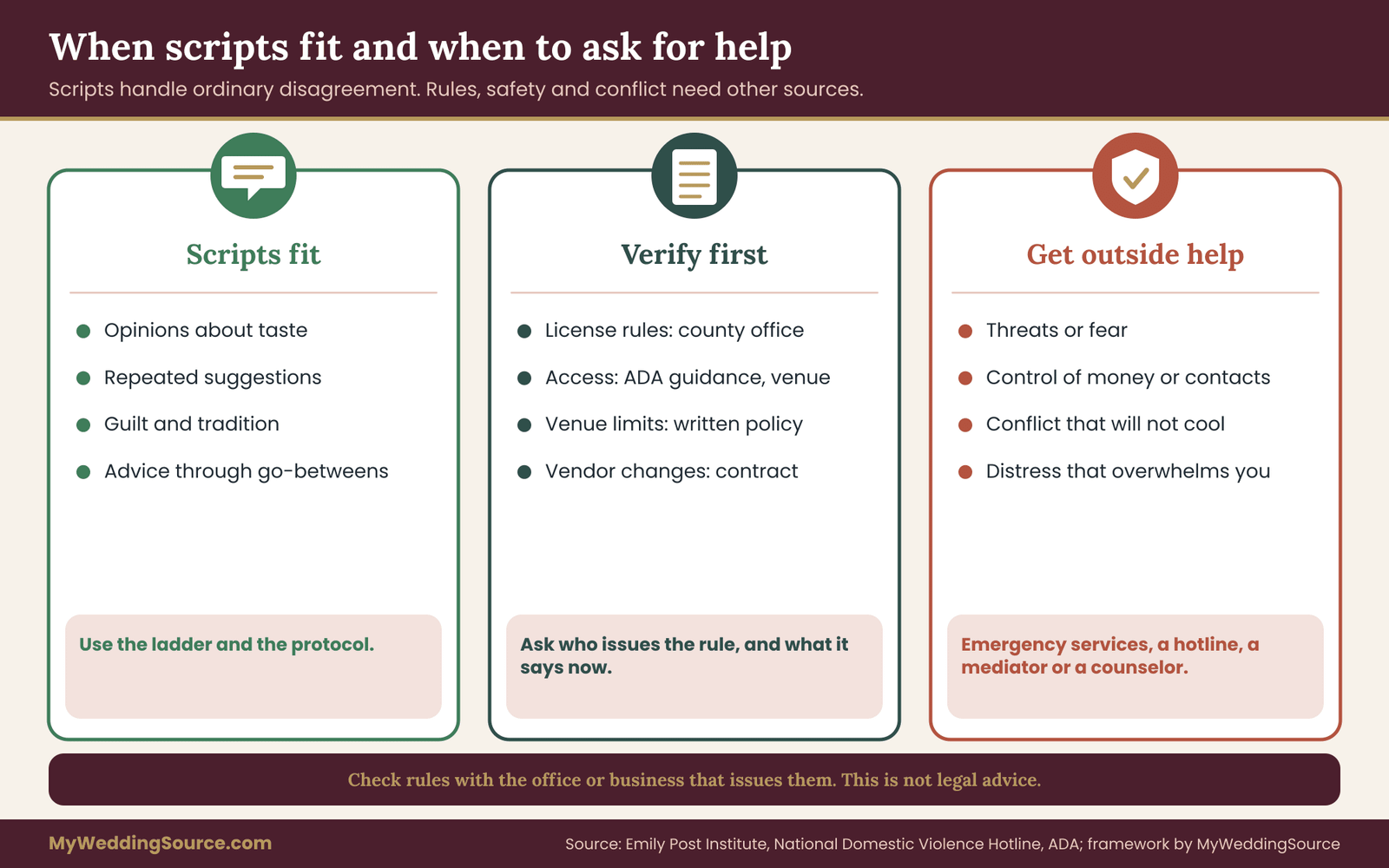
A few examples of what to verify. If a relative says the marriage license rules require something, check with the office that issues licenses in your county or state, which you can find through the government’s official directory at USA.gov. If a guest points out that a venue lacks step-free access, review the venue’s own accessibility information and the guidance published by the ADA National Network and the Department of Justice, and ask the venue in writing.
If a relative warns about a food allergy, ask the guest directly, and consider guidance from a food safety or allergy organization. If someone says the venue “never allows” candles, the venue’s written policy answers it, not the memory of the person who attended an event there. If a vendor says a change will cost more, the vendor’s contract and written terms decide it.
In each case, the question you ask is the same: who issues this rule, and what do they say now? Rules and fees change, and this article cannot tell you what they are today. For anything that could affect legal status, safety or money, confirm it with the agency or business that is responsible.
A note on etiquette sources
Etiquette guidance, such as the material published by the Emily Post Institute, can help when you are unsure how to decline wedding advice that touches on custom. Treat it as a reference, not a rulebook. Customs vary by region and family, and no etiquette authority can tell you what your own family will accept. When an expert view and your family’s view differ, you decide which matters more in the specific case.
Your next steps
Take one evening this week and do three things so you can decline wedding advice with confidence. First, sit down with your partner and write the three short lists: what is decided, what is open, and what neither of you will change. Second, write your rung one sentence for the two or three topics that come up most often, using the thank, decide and close pattern. Say each sentence out loud once, so it sounds like you. Third, start a shared log with one entry for the suggestion that is causing the most friction now, including the date and what you said.
Then take the conversations one at a time, and decline wedding advice only after you sort it. Sort first. Use rung one. If the topic returns, use rung two with a real redirect. If it returns again, move to the protocol: park it, window it and hand it off if you need to. You do not need everyone to agree. You need them to hear a kind, consistent answer, to know where their input can go, and to see that the answer does not change with pressure. That is how you decline wedding advice and keep the people who gave it.
FAQ
How do I decline wedding advice from my mother without hurting her?
Start with thanks for the thought, state the decision in one sentence and stop. Then offer a real role that fits what she cares about, such as hosting a gathering, collecting family photographs or choosing a reading. A parent who feels involved usually pushes less. If she brings it up again, repeat the same sentence in fewer words and ask about something you would welcome her help with.
What should I say when someone keeps repeating the same suggestion?
To decline wedding advice that keeps returning, use the firm repeat. Say the same sentence you said before, acknowledge that you have talked about it, and add a redirect to something you actually want help with. Do not add a new reason. If the topic returns a third time, switch to the follow-up steps: write it down, park the topic, offer one short listening window, and hand the conversation to the right person.
Do I have to give a reason when I decline?
No, you do not need a reason to decline wedding advice. A reason gives the other person something to argue with, and the discussion becomes about the reason rather than the decision. “We’ve decided” is complete. If you want to share a reason because you think it will help, share one, keep it brief and do not add more when it is challenged. Reasons are a gift to the listener, not a debt.
What if my partner disagrees with how I reply to family?
Talk it through in private and do not argue in front of the relative. Ask what each of you is trying to protect. Agree on which decisions are closed, which are open and which belong to one of you. In the moment, back each other with a short line such as “I agree with what they said.” Resolve any disagreement afterward, together.
How do I tell useful advice from pressure?
Ask whether it is information you can check, a matter of taste, a tradition or pressure with a cost attached. Information is worth verifying even when it is delivered badly. Taste and tradition are yours to decide. Pressure is best answered by acknowledging the feeling and holding the decision. Many suggestions mix these, so look for the strongest part first.
What if someone cries or gets angry when I say no?
Stay calm and stay present as you decline wedding advice. Acknowledge the feeling with “I can see this is hard,” and do not reverse the decision to end the distress, because a change made under tears rarely lasts. Let the person be disappointed. If the reaction seems out of proportion, ask gently whether something else is going on, and follow up with a kind note within a day or two.
Should I decline wedding advice that comes from vendors?
Treat vendor advice as information and as a possible sales offer. Experienced vendors may know that a timeline is tight, which is worth checking. Add-ons are optional, and you can decline them with the same warm close. Keep any changes in writing and make sure the vendor knows who may approve them. If the pressure continues after two answers, reconsider the vendor.
When should I get outside help with family pressure?
Get help if a relative threatens you, tries to control your contacts or money, or leaves you afraid of saying no. In an emergency, contact local emergency services. For support with controlling behavior, the National Domestic Violence Hotline can help. For painful but non-dangerous conflict, a mediator, counselor or trusted community leader can help the family talk without a contest.
Sources
- Etiquette advice and guidance, The Emily Post Institute
- Mediation and conflict resolution resources, Association for Conflict Resolution
- Get help: support for abuse and controlling behavior, National Domestic Violence Hotline
- 988 Suicide and Crisis Lifeline, U.S. Department of Health and Human Services
- Stress, communication and relationships resources, American Psychological Association
- Americans with Disabilities Act information, U.S. Department of Justice
- Consumer advice and complaint guidance, Federal Trade Commission
- Food safety and food allergy information, Centers for Disease Control and Prevention
- Find government offices and services, USA.gov