
Wedding cake placement is the choice of where the cake stands from delivery until the last slice is served, and it decides whether the cake stays cool, upright and untouched. This guide gives you a six-check survey of sunlight, wind, vents, heat, traffic and the table itself, so you can compare candidate wedding cake placements and pick one with evidence.
Walk the room at the time of day the cake will actually stand there, not at the venue tour hour. Check six things at each candidate spot: direct sun, moving air, nearby vents and doors, heat sources and crowds, foot traffic, and the table and floor. Take a thermometer reading at cake height three times: at setup, mid-event and before the cutting. Rule out any spot with direct sun or a vent blowing on it. Choose the calmest of what remains, and agree on it in writing with your baker and venue.
A wedding cake spends more time standing still than almost anything else you pay for on the day. It arrives, it is assembled, and then it waits, often for several hours, while guests arrive, eat, dance and mingle around it. During that wait the room does things to it. A window pours afternoon sun across one side. An air vent cycles on and dries the frosting. A tent flap lifts in a gust. A server rolls a cart past and clips the table leg. None of these events is dramatic, and each one has ruined a cake somewhere.
The good news is that nearly all of this is predictable. Sun moves on a schedule. Vents are fixed in the ceiling. Doors open where doors open. Foot traffic follows the path between the bar, the buffet and the dance floor. If you look at the room with those four forces in mind, wedding cake placement stops being a matter of taste and becomes a short, repeatable survey.
This article is written for the couple, planner or family member who will be standing in a venue asking, “Where should the cake go?” It covers the wedding cake placement survey itself, how to read each hazard, how to score and compare spots, a worked example with invented numbers, what to ask the venue and the baker, and what to do when the best wedding cake placement is not available. Whether the cake is a three-tier buttercream, a naked cake or a small cutting cake with sheet cake in the kitchen, the logic is the same.
A note on scope. This is general information, not legal, tax or financial advice. Cake recipes, temperature limits, structural assembly and serving counts are decisions for your baker and your local food-safety rules, so use this guide to ask better questions rather than to overrule them. For the broader sequence from final headcount to cutting, see the wedding cake timeline on this site. This guide stays on one narrower question, the spot.
What wedding cake placement has to solve
Wedding cake placement sounds like a décor question. Where does the cake look best? Where do the photographers want it? Where does it fit the room’s focal point? Those are fair questions, and the survey in this guide answers them last. Placement has to solve four practical problems first, because a beautiful spot that damages the cake is not a good spot.
Temperature. Most wedding cakes are built from materials that behave badly when warm: buttercream softens, ganache sweats, fondant can bead with moisture, whipped fillings and fresh dairy turn into a food-safety question. Warmth comes from the sun, from lights, from crowds and from kitchens, and it arrives unevenly. One side of a cake can be in shade while the other sits in a sunbeam.
Air. Moving air dries the surface of buttercream and crusts it, lifts decorations such as fresh flowers and sugar pieces, and can tip a light topper. Wind outdoors is the obvious case. Indoors, the culprit is usually the HVAC system, which can push a steady stream across a table without anyone noticing, because people standing nearby feel only a mild breeze.
Contact. Guests bump tables. Children reach for decoration. Servers carrying trays turn tight corners. Good wedding cake placement puts the cake where nobody has a reason to pass within arm’s reach, and where the table itself will not shift if someone leans on it.
Stability. A tiered cake is tall, narrow and heavy for its size. A table that wobbles, a floor that slopes, or carpet over an uneven subfloor puts stress on every tier. The cake can lean slowly over hours without anyone seeing it happen.
A good wedding cake placement answers all four at once. That is harder than it sounds, because the sunniest window might have the best photographs, and the quietest corner might sit under a supply vent. The wedding cake placement survey exists to make those trade-offs visible before the day, while you can still move things.
Why this decision is usually made too late
In many weddings wedding cake placement gets settled in the last two weeks, almost by default. The venue coordinator suggests “the usual spot,” the floor plan shows a small rectangle labeled “cake,” and everyone moves on. The usual spot is not always bad. It is just rarely checked against the day’s actual sun angle, the actual HVAC settings or the actual guest path.
There is also a timing trap. Venue tours and walkthroughs often happen at midday on a weekday, in a room that is empty, with the lights on a default setting and no tent sides, rentals or crowd. A spot that feels calm and cool at that hour can be a very different place at five in the evening with two hundred people in it and the sun low through the west windows. Part of good wedding cake placement is simply correcting for that gap.
Who decides, and who needs to agree
Three parties each hold a piece of the decision. The venue controls the room: where tables may go, which outlets and vents exist, and which spots are off limits for fire-code or access reasons. The baker controls the cake: what temperature range it tolerates, how long it can stand out, and how it should be set up. You, or your planner, control the guest experience: sightlines, photography and the flow of the evening.
Wedding cake placement goes wrong when only one party decides. A venue picks a spot without knowing the cake is buttercream. A baker approves a spot without knowing a vent sits above it. A couple picks a spot for the photos without knowing it is the path the caterer will use. The survey described below produces a one-page record that all three can read, and it is the simplest way to bring them into the same conversation. If your venue has not already walked you through access routes and measurements, the venue technical walkthrough guide covers that groundwork.
The six checks behind wedding cake placement
The framework in this guide is a site survey with six checks. You run the same six checks at every candidate spot, record what you find in plain words, and then compare. The point is not to produce a number. The point is to notice the things you would otherwise miss, and to be able to explain your choice to a baker or a venue in one minute.
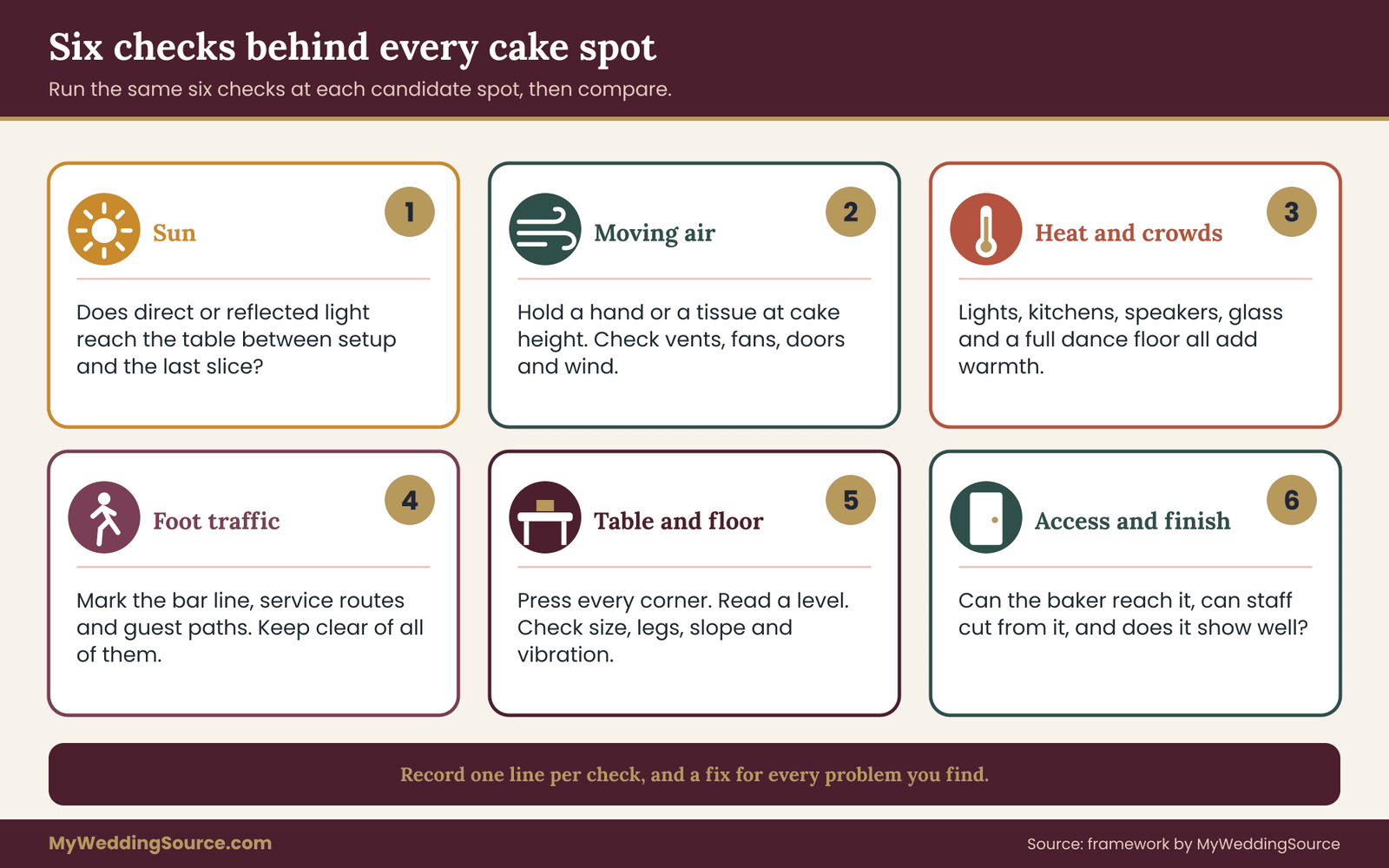
Check one: sun. Does direct sunlight touch the table or the cake at any time between setup and the final slice? This includes light through windows, glass doors, skylights and open tent sides, and it includes reflected light off water, glass or a light floor. Sun is the check most often failed, and it is also the easiest to reason about in advance, because the sun’s path is predictable.
Check two: moving air. Is there a breeze, a draft or a vent stream at cake height? You are looking for air that you can feel on your hand when you hold it where the cake will be. Outdoors this means wind and gaps in tent walls. Indoors it means supply vents, return vents, ceiling fans, portable fans and doors that open to the outside.
Check three: heat and crowds. What gives off warmth nearby? Stage lights, uplighting, candles, heat lamps, kitchen pass-throughs, chafing dishes and equipment such as DJ speakers all count. So do people. A packed dance floor or a crowded bar warms a corner of a room more than most people expect.
Check four: traffic. Who passes this spot, how often, and how close? Look at the routes between the entrance, the bar, the buffet or service stations, the restrooms and the dance floor. A cake needs a quiet edge, not a crossroads.
Check five: table and floor. Is the surface level, firm and large enough? Does the table rock when you press a corner? Is the floor tile, wood, carpet or grass, and does it slope? Can the cake be rolled or carried in without bumps?
Check six: access and finish. Can the baker reach the spot with the cake, and can the room’s staff cut and serve from it? Is there power if you need lighting or a refrigerated display? Does the spot read well in photographs and from the seats?
Checks one through five are about risk to the cake in any wedding cake placement. Check six is about whether the spot works as a working part of the event. You can accept a minor weakness on check six more easily than on any of the first five, and you will see why in the decision rules later.
Recording what you find
Keep the notes short, since wedding cake placement notes only need to be readable by the baker and the venue. For each spot, write one line per check, using words like “sun from 4:30 to sunset through west window,” “supply vent 6 feet overhead, feels cool on hand,” “bar queue passes within 4 feet,” “table rocks slightly, needs shims.” If you have a phone, take one photo of the spot and one photo showing the nearest vent, window or door. Those two photos often settle an argument faster than a paragraph.
You do not need a special form. A page with the spot’s name at the top and six lines under it is enough. The wedding planning checklist on this site is a good place to note the date you plan to run this wedding cake placement survey, since it should happen well before the final week.
The one tool worth buying
A small digital thermometer with a probe or a clear display costs little and changes the wedding cake placement survey. Your hand is a poor instrument for deciding whether a table is two degrees too warm, and it is no help in comparing two spots twenty minutes apart. A reading taken at cake height, in the same position each time, gives you something to put in the notes and something to show the baker.
If you cannot buy one, ask the baker or the caterer to bring a thermometer to the walkthrough. Many have one already because they use them for food holding.
Keep one more habit in mind as you read the sections that follow. Whenever you find a wedding cake placement problem, note what could fix it, not only what is wrong. A sunny window can be solved with a shade, a vent with a baffle or a table move, and a busy path with a rope line or a different angle. The wedding cake placement survey is not a test that spots pass or fail. It is a way of finding which problems are cheap to fix and which are not.
Sunlight and wedding cake placement: reading the room through the day
Sun is the hazard that surprises couples most in wedding cake placement, because it changes while you are not looking. A spot that is shaded at the noon tour can be in full light at six o’clock. Sunlight does three things to a cake: it warms the surface directly, it warms the air and table around it, and it fades or discolors some colorings and fresh flowers over hours.
Any wedding cake placement plan has to account for all three, and the way to do that is to map where the light falls during the whole window the cake will be standing, not at one moment.
Know your window of exposure
Start wedding cake placement by writing down the hours that matter. The cake is usually delivered and set up two to four hours before guests arrive, stands through the ceremony and cocktail hour, and is cut during the reception, often late in the evening. That window can run from early afternoon to after dark. For a spring or summer wedding in the evening, the sun is low during the final part of that window, which is exactly when light enters through west-facing glass at a shallow angle and reaches deep into a room.
Then look at the date. Sunrise and sunset times, and the angle of the sun, depend on the date and location. The National Weather Service and other agencies publish sunrise and sunset times, and a weather app on your phone will give you the same for your wedding date. Write down the sunset time. If the cake will be cut within two hours of sunset, treat any window facing west as a risk, even if it looks harmless in the morning.

Find the windows, doors and openings
For wedding cake placement, walk the room and list every opening that can let in direct light: windows, French doors, glass walls, skylights, clerestory windows, open garage-style doors, tent sides rolled up, and gaps in curtains. For each, note which direction it faces. If you do not know the compass directions, use a phone compass or ask the coordinator which wall is the west wall.
Pay attention to reflected light too. A pool, a lake, a glass facade across the courtyard or a polished floor can throw bright light onto a surface that looks shaded from the window. Light that bounces is weaker than direct sun, but a cake that sits for hours at the edge of a bright patch of floor can still warm unevenly.
Do not forget artificial light that mimics sun. Large uplights, lit signs and display cases with spotlights add heat on a smaller scale. That is covered in the heat section, but notice it as you walk.
Do the sun check at the right hour
If your tour time does not match the event, you need a second visit, or at least a second look. Here are the options, from best to least good.
Visit at the event hour. If your wedding is at five in the evening, go at five in the evening on a day close to the date. This is the best option and the one that makes the wedding cake placement survey reliable. It also lets you take the thermometer readings described later.
Visit at a nearby hour and project. If you can only visit at noon, sketch where the light is falling then, and estimate where it will be later. Sunlight moves roughly in the same direction through the afternoon, so a patch of light on the east side of the room at noon will be on the west side by evening. If a window faces west, assume it will reach the room’s interior as the sun drops.
Ask the venue. Coordinators who run events in a room every week usually know which window “gets the sun” and which corner is the cool one. Ask directly: “In the hours between three and eight on a clear day, where does the sun come into this room?” Treat their answer as a lead to confirm, not a substitute for looking.
Use a photo record. If the venue has photos from past events at the same time of year, look at the light in them. You can often see long shadows or glare on the walls. Venues may share galleries, and the photographers who have worked there may be willing to describe the room.
What shade has to look like
A spot is shaded, for this wedding cake placement survey, when no direct sun touches the table or the cake at any time between setup and cutting, and when the nearest bright patch is far enough away that you do not feel warmth from it on your hand at cake height. Both conditions matter. A table that sits in shade but beside a sunlit wall can still run warm.
Outdoor shade needs even more care. Trees move their shade as the sun travels. A canopy or tent provides consistent shade, but tent fabric absorbs heat and can radiate it down, and a tent with closed sides can be hotter than open shade. Light-colored tents reflect more heat than dark ones. If you are using a tent, stand inside at the hour of the event and notice the air. A cake in a tent that traps midday heat needs a different plan than a cake in an air-conditioned room.
For outdoor wedding cake placement, if the venue has a covered porch or a roofed pavilion, note which side of it faces the sun at the relevant hour. Roof overhangs shade the side beneath them for a while, but the shade line travels.
Strategies when the best spot has some sun
Sometimes the spot you like for every other reason catches light for part of the window. You have several options, and each has a cost.
Shorten the exposure. If the sun reaches the spot only before 4:30 and the cake is not due until 5:30, the cake may not need to be there during the bright period. Ask the baker whether the cake can be set up later, or stored in a cooler spot until then. This works only if the delivery and setup plan allows it. The sequence between baker delivery and venue setup is part of the wider production schedule.
Block the light. Window film, a blackout panel, a drape that the venue permits, a free-standing screen, an umbrella or a floral arch can shade a patch of table. Always ask the venue before attaching anything to windows or walls. Even with permission, check that the shade does not trap heat around the cake or create a new obstruction.
Move the table. Even two or three feet can take a cake out of a sunbeam. Draw the beam’s edge on your floor plan and keep the table well inside the shade, not at the edge, because the edge moves.
Change the cake’s schedule. In an extreme case, a cake that must stand in a bright room can be displayed for a shorter time. Some couples choose to cut early in the reception, or to display a smaller decorative cake while the full cake stays in a cooler room. This is a conversation with the baker, because it changes the plan for serving.
Pick another spot. Often the right wedding cake placement is a less perfect spot that is calm and cool. A cake that is seen from across the room in good light on a shaded table photographs well, and nothing about it needs apologizing for.
Sun and the cake itself
Different cakes tolerate sun differently, and this is a good reason to have the baker in the conversation. Buttercreams vary in how they hold shape at warm temperatures, depending on their fat content and recipe. Ganache and fondant react differently to temperature and humidity. Fresh fruit, whipped cream and custard fillings are more sensitive again, and they raise food-safety questions as well as appearance ones, covered in the next sections. Sugar flowers, edible gold and some colorings can fade or soften. Fresh flowers wilt.
None of that needs to be memorized. Ask the baker one question at the walkthrough or by email: “If this cake stands in a room that is warm for an hour, what should we expect and what is your limit?” Their answer sets the margin you are working with. A baker who tells you the cake can safely stand out for three hours in a cool, shaded room is giving you a design target for your survey, and one who says “keep it under two hours and out of any sun” is telling you the survey matters even more.
Sun and the photographs
Photographers like light, and many will point to the sunny window as the best backdrop. Take that seriously as an input, then separate the two goals. A cake can be photographed in a sunny spot briefly, for a few minutes of portraits, and then moved or left in shade. Many couples stage the cake in a calm spot all evening and carry it, or bring the couple to it, for the cutting.
Others cut the cake beside a window only after the sun has gone. The photographer’s needs can be met without leaving the cake in a heat source for hours. The photography section later in this guide returns to this trade-off.
A short sun script
If you are not sure what to ask the venue, use this. It is plain, it is specific, and it gets a useful answer.
“On our date, the cake table will stand from about two until ten at night. Which windows or doors bring direct sun into the room during those hours, and which spot is shaded all through that time?”
Write down the answer and the name of the person who gave it. Then check it yourself at the event hour if you can.
What to record for the sun check
For each candidate spot, write down the time the first direct light reaches the spot, the time the last light leaves it, which openings the light comes through, and whether any reflected light reaches the table. Add a line on what could fix it, such as “west window, light from 5:15 to sunset, drape or move table 3 feet north.” That line is the real output of this check. It turns a vague worry into a specific, solvable item, and it is the first line of every wedding cake placement worksheet.
Wind and open air: outdoor wedding cake placement
Outdoor weddings add the most variables to wedding cake placement, and wind is the one that surprises people after sun. A cake is a tall object with a light top, and even a moderate breeze can do three things: dry the surface, lift or topple decorations, and push dust, pollen and insects onto the frosting. Strong gusts can move a table or tip a stand. The goal is not to find a perfectly still spot, which rarely exists outdoors, but to find the most sheltered one and to plan for the days when the wind is worse than expected.
Learn how wind behaves at the site
Wind is local, and it shapes wedding cake placement more than the forecast suggests. A field can be breezy while the courtyard beside it is still, because buildings, walls, hedges and slopes redirect air. Stand at each candidate spot and notice what the air does. Hold a light scarf or a strip of paper, or simply watch nearby flags, leaves and tent fabric. Notice whether the movement is steady or gusty, and whether it changes direction.
Three patterns are worth knowing.
Funnels. Air accelerates when it is squeezed between two buildings, along a corridor or through a gap in a hedge or tent. A spot at the narrow end of a passage can be windier than open ground nearby.
Open exposure. A spot at the top of a slope, on a deck, by a lake or on a field’s edge takes whatever the weather brings with nothing to slow it.
Shelter and eddies. The lee side of a wall, hedge or dense tree line is usually calmer. Right beside a corner of a building, however, the wind can swirl, so stand a little distance away from the corner rather than right against it.
Ask the venue which direction the prevailing wind comes from on that site at the time of year, and which area is “the sheltered one.” They often know the answer from experience. Then check the forecast closer to the date, since the forecast is a better guide to the day itself than any general pattern. The National Weather Service at weather.gov publishes forecasts, including wind speeds and gusts for most U.S. locations.
Wind and the cake: what actually goes wrong
Wind causes problems at several scales. At the smallest, it dries buttercream and fondant surfaces, creating a crust or a dull look and sometimes cracking. In the middle, it lifts light decorations: fresh flowers, ribbons, sugar flowers on wires, paper or acrylic toppers and anything the baker has added as a loose element. At the largest, a strong gust can move a table, rock a stand or, in the worst case, topple a tall cake.
A tall slender tier is more exposed than a short wide one. A cake with a heavy topper has a higher center of gravity. A cake on a small round table in an open area is more vulnerable than one on a heavy rectangular table against a wall. The baker will have views on the structure and on how to handle outdoor conditions, so ask them how much wind the design can tolerate, in plain terms: “At what wind would you want the cake moved inside?”
Shelter options
If the cake must be outdoors, there are several ways to give it shelter. None of them needs to be elaborate.
Place it inside a tent, pavilion or gazebo. A structure with a roof and at least two solid sides blocks most wind and all direct sun. Check the sides: tent sides that roll up for ventilation also let air through. A tent with open sides on all four faces can funnel wind more than open ground.
Use the lee of a building or wall. A spot a few feet from a wall on the downwind side, but not tight against a corner, is often the calmest outdoor spot.
Add a windscreen. A decorative screen, lattice, hedge planter, or a draped panel can break the wind. It should be heavy enough or well anchored so that it does not become a hazard itself. Ask the venue and rental company what they permit and supply.
Weigh down the table. A heavy table, such as a rented banquet table with legs locked, resists movement much better than a light folding or cocktail table. A stable base matters more than a pretty one. The rental guide on this site, the wedding rental planning checklist, covers table types and what to confirm with the rental company.
Keep the cake indoors until the last stage. For many outdoor weddings, the best wedding cake placement is not outdoors at all. The cake stays in a cool indoor room until shortly before the cutting, is carried out or displayed briefly, and returns indoors afterward. If your venue has an indoor room, ask whether the cake can wait there.
The heat that comes with open air
Outdoors, wind and heat travel together, and both belong in your wedding cake placement notes. Warm wind carries heat, and a table in a gust of hot air may warm faster than one in still shade. A breeze across a shaded table does not remove the need to check temperature. On a hot day, the combination of direct sun, warm air and a table surface heated by the sun can bring a cake to its limit quickly.
The U.S. government’s food-safety guidance at foodsafety.gov says perishable food should not stay out more than two hours, and no more than one hour when the temperature is above 90°F. Whether your cake counts as perishable depends on its fillings and frosting, which is why the baker’s judgment is the one that counts. But the timing rule is a useful reference when you decide how long the cake can stand outside.
If the forecast says very hot, treat outdoor display as a short event, not an all-evening arrangement. Plan the cutting earlier, display a smaller cake, or move the main cake into air conditioning and bring it out only for photos.
A wind decision rule
Here is a simple rule you can use at the wedding cake placement survey, and again on the morning of the wedding.
- If the site is sheltered on at least two sides and the wind is light, the cake can stand there with a heavy table and a baker-approved design.
- If the site is open and the wind is light but variable, move the cake into a tent or the lee of a structure, and remove light, loose decorations until the cutting.
- If gusts are strong enough to move chairs, flutter tent walls hard or knock over signs, the cake does not stay outside. Move it indoors, and agree beforehand who makes that call.
The point of the third rule is to name the decision-maker in advance. On the day, nobody wants to debate. Write the name of the person with authority, usually the planner, the venue coordinator or the baker, on the plan, along with the trigger: “If the wind topples a sign or the tent walls start to lift, the cake goes inside.”
Insects, dust and debris
Outdoors, the air also carries things. Flying insects are attracted to sugar and fruit and are drawn quickly to a standing cake. Pollen, dust and leaf debris can settle on frosting. If the cake must stand outside for any period, a clean cake dome or a covered display helps, and so does keeping the cake away from trees dropping seeds, flowers shedding petals, and areas near trash or food stations that draw insects. Ask the baker whether a cover is appropriate for the design, since some finishes should not be covered.
HVAC vents, fans and doors: indoor wedding cake placement
Inside, the main moving air comes from the building’s heating, ventilation and air conditioning system. It is easy to overlook, because the air feels like part of the room, and because it can be an advantage or a problem depending on where the cake stands. A cool room is helpful for a cake. A direct stream of air blowing across it is not. Good indoor wedding cake placement keeps the cake in cool air that is not moving fast across its surface.
Find the vents and the way they behave
Look up. Supply vents, which push conditioned air into the room, are usually in the ceiling or high on walls, and in some rooms in the floor. Return vents pull air back and are often larger grilles with less visible airflow. A vent may be square, linear, round or a long slot, and some have adjustable louvers. Ask the venue which are supply and which are return, since you cannot always tell by looking.
At each candidate spot, do three things.
Hold up your hand or a strip of tissue. Stand where the cake will be and hold it at cake height, then at the height of the top tier. Notice whether the air is moving, in what direction and how cold it feels. A gentle drift is usually fine. A steady stream that makes the tissue flutter is not.
Look for the vent’s reach. A ceiling vent throws air outward and down in a pattern, and the air tends to reach farther than people expect. A vent twelve feet away can still affect a table in its path. A vent directly above is often the worst, because the stream falls straight onto the cake.
Ask about the cycle. Systems turn on and off. A vent that is quiet when you visit may start up later when the room warms with people. The thermostat setting, the zone control and the venue’s plan for event hours all matter. Ask: “On the day, how will the system be set during the event, and who controls it?”

Why vents are harder on cakes than they look
A steady current of cool, dry air has a drying effect. Buttercream forms a crust and can crack where it dries. Fondant can dry and develop surface lines. Flowers wilt faster. A stream aimed at one side of the cake dries that side more than the rest, so the cake can end up looking uneven. Meanwhile, if the air is cold enough, it can chill part of the cake while the rest of the room is warm, which is its own kind of unevenness.
The opposite problem exists too. A room with weak ventilation or a failing air conditioner, or a room that is packed with people, can become warm. Heat in a crowded room is covered in the heat section. For now, keep in mind that a cooler room is only an advantage if the cake is in the cool part of it, not under the strongest vent and not in a dead spot where air barely moves.
Fans, doors and portable equipment
Beyond the ceiling vents, look for other sources of air movement that affect wedding cake placement. Ceiling fans can swirl air across a table. Portable fans and tent coolers, common at outdoor or warehouse venues, can blow directly onto a table. Doors that open to the outside, especially a main entrance or a service door, let in drafts and outdoor air every time they open, and the effect can be strongest at the beginning and end of the event when guests arrive and leave. Doors to a kitchen can bring warm air into the room.
Check each door’s swing and its likely use. A door that is closed all evening is a minor factor. A door that staff and guests use constantly is a major one. A cake table placed in a gust path near a door is hit by cold or hot air with each opening.
Fixes that are usually available
If your best spot is under or near a vent, you may be able to fix it. Possible options include asking the venue to adjust or close a louver, direct the airflow elsewhere, use a baffle or deflector, or set the system differently during the event. Some venues can place a temporary cover over a vent. Others cannot change anything, particularly in older buildings or rooms with central systems.
Ask the venue before you change anything yourself, and do not tape or cover a vent without permission. A blocked vent can affect the room’s heating and cooling and, in some cases, safety systems. If the venue says no, move the table. The distance you need depends on the vent’s reach, but a good starting rule is to keep the cake out of the direct path and as far to the side as you can, then test with your hand or tissue again.
For indoor wedding cake placement in an unfamiliar room, one test is worth repeating on the day. Before the cake is set, stand at the exact spot for a full minute with your hand held at cake height. If you feel air moving steadily, say so before the cake arrives, not after.
Heat sources, crowds and traffic around wedding cake placement
Sun and air get the attention in most wedding cake placement advice, but the warmth in a room usually comes from many small sources that add up, and the spot you choose has neighbors you may not have thought about. This section covers the heat sources to look for, the way a crowd changes a room, and the traffic patterns that put a cake at risk of being bumped. Both belong to the wedding cake placement survey because both can change between the empty walkthrough and the crowded evening.
The heat sources to look for
Walk the room with the question, “What here gives off heat, and how far from the cake is it?” The list is longer than most couples expect.
Lighting. Stage lights, spotlights, pin spots and some decorative fixtures run hot, especially when aimed at a table. Uplighting is usually cooler, but it is worth checking by hand if a unit sits beside the spot. If a lighting designer is part of your team, ask them where each fixture will be aimed and whether any light will fall on the cake table. A cake spotlit for photographs is a cake sitting under a heat lamp.
Candles and open flame. Candles on the cake table or on nearby tables add small amounts of heat, and flame adds a fire risk next to frosting, flowers and paper. Many venues have rules about candles. Ask what is allowed, and keep flame away from the cake.
Food service equipment. Chafing dishes, carving stations, warming ovens, heat lamps and coffee stations are heat sources. A dessert display placed beside a hot buffet will warm up. The kitchen pass-through, where staff move food between the kitchen and the room, can also be warm.
Sound and video equipment. DJ gear, amplifiers, projectors and screens give off heat. A cake on a table beside a speaker stack or a booth may be next to a warm electronic corner.
Windows and glass. Even in shade, a large window or glass wall can radiate heat on a warm day. A table directly against glass is often warmer than one a few feet away.
People. A room that was comfortable when empty can warm considerably when full of guests, since each person gives off heat. The effect is strongest near the dance floor, the bar and the entrance. A cake near the dance floor stands where the room is warmest in the evening, which is also when it may be cut.
Test with your hand and a thermometer
For each spot, hold your hand near the cake position and notice whether you feel warmth from any direction. Then take a thermometer reading at cake height, in the center of the spot, away from direct contact with the table surface. Record the time. If you can visit during an event or a rehearsal with the lights on and people in the room, even better. If not, ask the venue about typical room temperatures during events, and ask whether the system keeps the room at a steady setting.
If the reading is above what your baker considers safe for the cake, or the room warms notably as the day goes on, mark the spot as “caution” and list what could reduce it: move the table away from the heat source, change the lighting aim, or relocate the cake to a cooler part of the room.
What crowds do to a room
Crowds change a room in four ways that affect the cake. They add heat, as noted. They raise humidity from breath, which can make some finishes sweat. They increase movement, which makes bumps more likely. And they change where air goes, because large groups block airflow and change which vents reach which areas.
For that reason, the survey is only partly complete when taken in an empty room. If you can, ask the venue about a similar event they ran, and ask what the room was like at the peak. Venue coordinators often have a good sense of which corners get hot, stuffy or crowded. And plan to take a second reading during the event on the day, which a planner, coordinator or a friend with a thermometer can do. It takes thirty seconds and tells you whether the cake needs to be moved.
Foot traffic and bump risk
A cake is not safe simply because nobody intends to touch it. Accidents come from people passing at the wrong moment: a server turning with a tray, a child running, a guest stepping back to take a photo, someone leaning on the table to talk. Wedding cake placement needs distance from the places where people move fast or gather.
Map the traffic as you would for a floor plan. Mark the entrance, the bar, the buffet or service stations, the restrooms, the dance floor, the DJ, the head table, the exits and the service door to the kitchen. Then draw the likely paths between them. The cake should not be on any of those paths.
If you need a framework for the movement of guests more broadly, the wedding reception guest flow guide covers entry, seating, food and exit. For this wedding cake placement survey, focus on a narrower question: how close does the traffic pass the cake, and how often?
A traffic test you can run in the room
Stand at the candidate spot and imagine the evening in four moments: guests arriving, the cocktail hour, dinner service and the dance. In each moment, ask who is walking where. Then check the following.
Clearance. Is there at least a few feet of clear floor on every side, enough that a person can pass without brushing the table? If the cake is against a wall, is the open side the one facing guests?
Dead ends versus crossroads. A spot in an alcove or at the end of a room, away from the main flow, is usually safer than a spot between two high-traffic points.
Queue paths. Bars and buffets generate lines that stretch and bend. A cake beside the bar queue will be bumped by the line, and a cake beside the buffet will have people backing into it. Look at where the line would form, not where the bar is.
Service routes. Staff carry trays and carts along fixed routes. Ask the venue where servers enter and exit, and keep the cake off those routes. A cart moves quickly and does not turn easily.
Children and reach. If children are attending, a low table at their eye level is a temptation. Put the cake where a small hand will not reach it easily, or consider a barrier such as a rope, a plant or a sign.
Photo crowds. Guests and photographers gather to take pictures of the cake and of the cutting. Allow room for a small crowd, and for the photographer to move. A cake in a tight corner with no space around it is hard to photograph and easy to bump during the cutting.
Ways to protect a cake without hiding it
If your preferred wedding cake placement has some traffic, you may be able to reduce the risk without moving the cake. A low barrier, such as a floral arrangement, a decorative screen, a rope on stanchions or a line of plants, can mark a keep-clear zone. A sign that says “please do not touch” is mild protection, but it helps with children and curious guests.
A staff member or a designated friend can be asked to keep an eye on the cake during high-traffic moments. These are small steps, and they are worth stating on the plan so that someone owns them.
In a venue with a tight floor plan, you may also have to choose which risk to accept. A spot near the dance floor is warm and bumpy but central. A spot at the edge of the room is quieter but far from the action. In these cases, the decision rules later in this guide help you pick the lesser risk, and the backup section explains how to move the cake when the room changes.
The question of who stands near the cake
One more traffic point is people-based. Where do the couple, the photographer and the person cutting stand for the cutting? Is there room for them to approach the cake from the front? If the cake is against a wall, or surrounded by tables, the cutting becomes awkward. Leave room at the front for the couple, a photographer and a server with a knife, plates and a cart. That is covered further in the photo and cutting section.
For now, remember the principle that connects every check in this section. The cake should stand in a place where the room’s energy, whether heat, air or people, passes by it rather than through it. Good wedding cake placement is mostly the art of finding a calm edge in a busy room, and the wedding cake placement survey is how you find it with evidence rather than a guess.
Table, floor and power: the physical side of wedding cake placement
After the environment comes the hardware. The best spot in the room is no help if the table is too small, the floor slopes, or the nearest outlet is forty feet away. These checks matter to wedding cake placement as much as sun and vents, and they are also the ones most easily fixed with a phone call. This section covers the table, the floor, power, access and the supporting items that make wedding cake placement work in practice.
The table: size, strength and stability
The cake table has to hold a heavy, tall object, plus whatever else goes with it: a cake knife, plates, napkins, a cake stand or board, a cake topper if separate, a few decorations and sometimes a small flower arrangement. Ask your baker the footprint of the cake, including the board and the stand, and its weight. A tiered cake can be heavier than people guess, since cake, filling, frosting, boards and supports all add up. Get the number from the baker, not from a guess.
Then check the table. These points matter.
Size. The table surface should be larger than the cake’s base, with room around it for the knife and plates. A rule of thumb is enough room that nothing hangs over the edge and the cake is not close enough to the rim to be knocked off with a sleeve. Your baker can give you a more exact figure.
Strength. A banquet table or a sturdy rectangular table is a good choice. A small round cocktail table, a light folding table or a decorative table with thin legs may be fine for a small cake and risky for a tall one. If the table is rented, confirm its type with the rental company. The rental guide on this site explains what to ask.
Stability. Press down on each corner and the center of the table. Push gently from the side. A table that rocks, flexes or slides is a problem. Check that legs are fully extended and locked, and that casters, if any, are locked.
Height. The table should be at a height where the couple can cut the cake without stretching, and where guests can see it. Tall cakes on high tables can be hard to cut and hard to photograph. Ask your baker and photographer what height works.
Cover. A tablecloth, runner or skirting hides the table, but cloth can also catch on a cake stand, slide under a board or give the cake a slightly unstable base. Many bakers prefer a smooth, taut cover, and some prefer the cake board to sit directly on a firm surface. Ask what your baker wants.
The floor: level, firm and rollable
A cake table on an uneven floor rocks. The floor under the table can slope slightly without being obvious, especially in older buildings, outdoor patios, decks, garden paths and tent floors. Place a small level, or a level app on a phone, on the table surface and read it. If the bubble moves off center, the surface is not level.
Look at the floor type. Hard floors such as tile or wood are generally stable but can be slippery and show every vibration from footsteps nearby. Carpet over a subfloor can hide an uneven surface. Grass is soft, uneven and can sink under a table leg, especially after rain. Gravel shifts. Decking has gaps and flexes. Temporary tent flooring varies, and some of it moves underfoot.
If the floor is uneven or soft, the fix may be shims under table legs, a plywood or rubber mat under the table, a different table with adjustable feet, or a different location. Ask the baker and the venue what is appropriate, and make sure any shim stays hidden and secure.
Also notice vibration. A floor near the dance floor, the DJ speakers or the main walking path can shake with every step or beat. Vibration can shift a cake slowly, and it affects tall tiers most. A spot with a firm, still floor, away from bass and from stage movement, is better.
The route to the spot
The cake has to reach the spot. It may be carried in a box, rolled on a cart or moved on a board, and the route matters as much as the spot. Check the path from the vehicle or the kitchen to the table. Look for steps, curbs, thresholds, ramps, elevators, narrow doors, turns, slopes, gravel and carpet edges. Measure doorway widths if the baker’s equipment is wide. Measure access routes at the walkthrough, and ask the venue about every door and threshold on the way.
If the cake is assembled on site, the baker may need extra room around the table, and extra time. If it arrives assembled, the route needs to be smooth and short. Many bakers prefer a delivery route with no stairs and a minimum of doors. Ask them. They will say what they need, and the answer may change your preferred spot.
Power and light
Power is an easy item to forget until the day. You may need an outlet for a small display light, a refrigerated display case, a fan or lighting that the photographer wants. Check where the nearest outlet is, whether the circuit is shared with major equipment, and whether the cord can be routed safely without crossing a walking path. A cord stretched across the floor is both a trip hazard and a threat to the table. Cord covers and taped routes can help, but only with the venue’s permission.
If your cake needs refrigeration or a cold display, ask the baker, caterer and venue early. Not every venue has space in a walk-in cooler, and not every cooler is clean, dry or cold enough for cake storage. Where a cooler is available, a plan to hold the cake there until close to the cutting is one of the strongest ways to protect it. It also changes what the display spot needs to be like, because the cake is out for less time.
Access for service and cutting
Whoever cuts and serves the cake needs access. The cutting is usually done by the couple for the photo and then continued by the caterer or the baker’s staff in the kitchen or at a service table. Make sure there is a plan for where the cake goes after the first cut: whether it is carried to the kitchen, cut at the table, or served from a side station.
A spot far from the kitchen means a long carry with a cake, plates and utensils, which adds risk of a bump or a delay. A spot too close to the kitchen door means traffic.
Rules and permissions
Venues have rules that limit wedding cake placement and where a cake table can go. Common examples include fire exits that must stay clear, minimum aisle widths for accessibility, required spacing from sprinklers and heaters, rules about candles and open flame, rules about tape or adhesive on walls and floors, and limits on what can be moved. The Americans with Disabilities Act sets accessibility standards for public spaces, and the ADA website at ada.gov explains the principles, including the need to keep routes open and usable.
Fire codes, summarized by organizations such as the National Fire Protection Association at nfpa.org, require exits and aisles to remain clear. Your venue knows its local rules, so ask the venue directly, and do not assume that a spot that looks fine is allowed.
If you need to move furniture, remove a sign, adjust a vent or shift a table, get the answer in writing, even if it is a one-line email. The point is to avoid a surprise on the day when someone says the table has to move.
Running a wedding cake placement survey: three passes and a thermometer
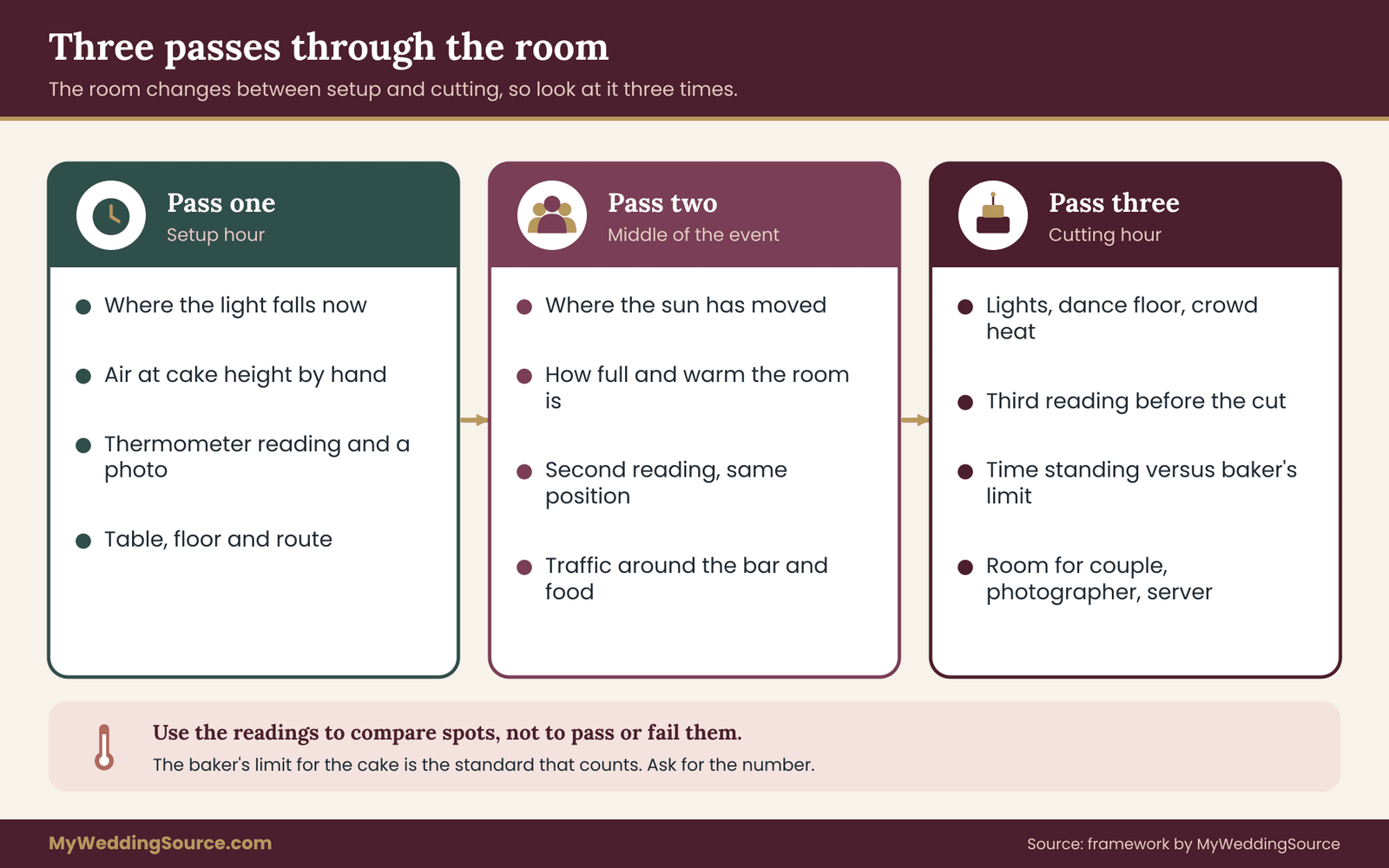
Now put the six checks together into a process. This is the heart of the guide, and it is designed to be done in about an hour at the venue, with a second short visit if possible. It uses three passes, because the room changes during the day and the wedding cake placement survey needs to catch that.
Before you go
Gather what you need. Bring a phone with a camera, compass and level app, a small digital thermometer, a tape measure, a notebook or a notes app and a floor plan if the venue gave you one. Bring the baker’s basic specifications if you have them: the cake’s footprint, height, weight and temperature limits. If you do not have them yet, ask the baker for rough numbers before the visit.
Pick two or three candidate wedding cake placements in advance for the survey. The venue coordinator can suggest them, and you can add one of your own. Having a shortlist keeps the visit focused. Label them on a floor plan as A, B and C, or by names such as “west alcove,” “by the stage” and “near the foyer.”
Pass one: the setup hour
Visit when the cake will be delivered and set up. At each spot, note the light, the air at cake height by hand, the temperature, the nearest vent and door, the heat sources, the traffic pattern at this hour and the table and floor condition. Take a thermometer reading and a photo, and write one line per check.
Pass two: the middle of the event
Visit at the hour of the cocktail hour or dinner, ideally during an event of a similar size if the venue can arrange a look. If that is not possible, estimate what changes: the sun has moved, the room is fuller and warmer, the lights are on, the doors are in use. Take a second reading. If you can only visit once, use the venue’s description of what the room is like at that hour, and mark the notes “estimated.”
Pass three: the cutting hour
The cutting usually happens late in the evening, often after dinner. At that point, the room may be at its warmest and fullest, the sun is down or low, the lighting has changed and the dance floor may be busy. Take a third reading if you can, or estimate. Ask the baker how long the cake can safely stand before this moment, and compare that to the time between setup and cutting.
What the three readings tell you
Compare the readings across the three passes and across the spots. If one spot is steady and the others drift upward, the steady spot is a strong candidate. If a spot is cool at setup and warm at the cutting, ask whether the cake can arrive later or be held cold. If all spots are similar, the choice falls to the other checks.
In wedding cake placement, do not treat the thermometer as a pass-fail instrument unless the baker gives you a number. Use it for comparison and for conversation. The baker’s limit is the standard that counts, and that limit depends on the cake.
Turning notes into a decision
After the visit, sort each spot into one of three groups. These rules are the core of the survey.
Go: no direct sun at any point, no vent or draft at cake height, no heat source within arm’s reach, traffic passes at a distance, the table and floor are stable, and the route works. A go spot is ready to propose to the baker and the venue.
Caution: one problem exists that has a known, cheap fix, such as a vent that can be adjusted, a table that needs shims, a short period of sun that a shade can block or a light that can be re-aimed. A caution spot is acceptable if the fix is agreed in writing and someone owns it.
No-go: direct sun for a long period, a vent blowing straight on the cake, a spot in a main traffic path, an unstable table or floor that cannot be fixed, or a heat source that cannot be moved. A no-go spot is out, however good it looks.
Choose the go spot for your wedding cake placement. If there is none, choose the caution spot with the cheapest fix and the clearest owner. If there are only no-go spots, widen the search or change the plan, for example by holding the cake in a cooler room until the cutting.

Keep the wedding cake placement survey proportional
None of this needs to feel heavy. For a small wedding in a familiar room with a mid-sized cake, the whole survey might take twenty minutes: a look at the windows, a hand test at the vents, a glance at the traffic and a press on the table. For a large outdoor event with a tall cake in July, it deserves more time. Match the wedding cake placement effort to the risk, and spend it where the room is least familiar. The structure remains the same, and it lets you explain your choice calmly to anyone who asks.
A worked example of wedding cake placement: three spots, one choice
Here is the wedding cake placement survey applied to an invented wedding. The couple, the room and every reading below are made up for illustration, and the temperatures are not data from any real venue. The point is to show how the notes turn into a decision, not to suggest numbers you should expect.
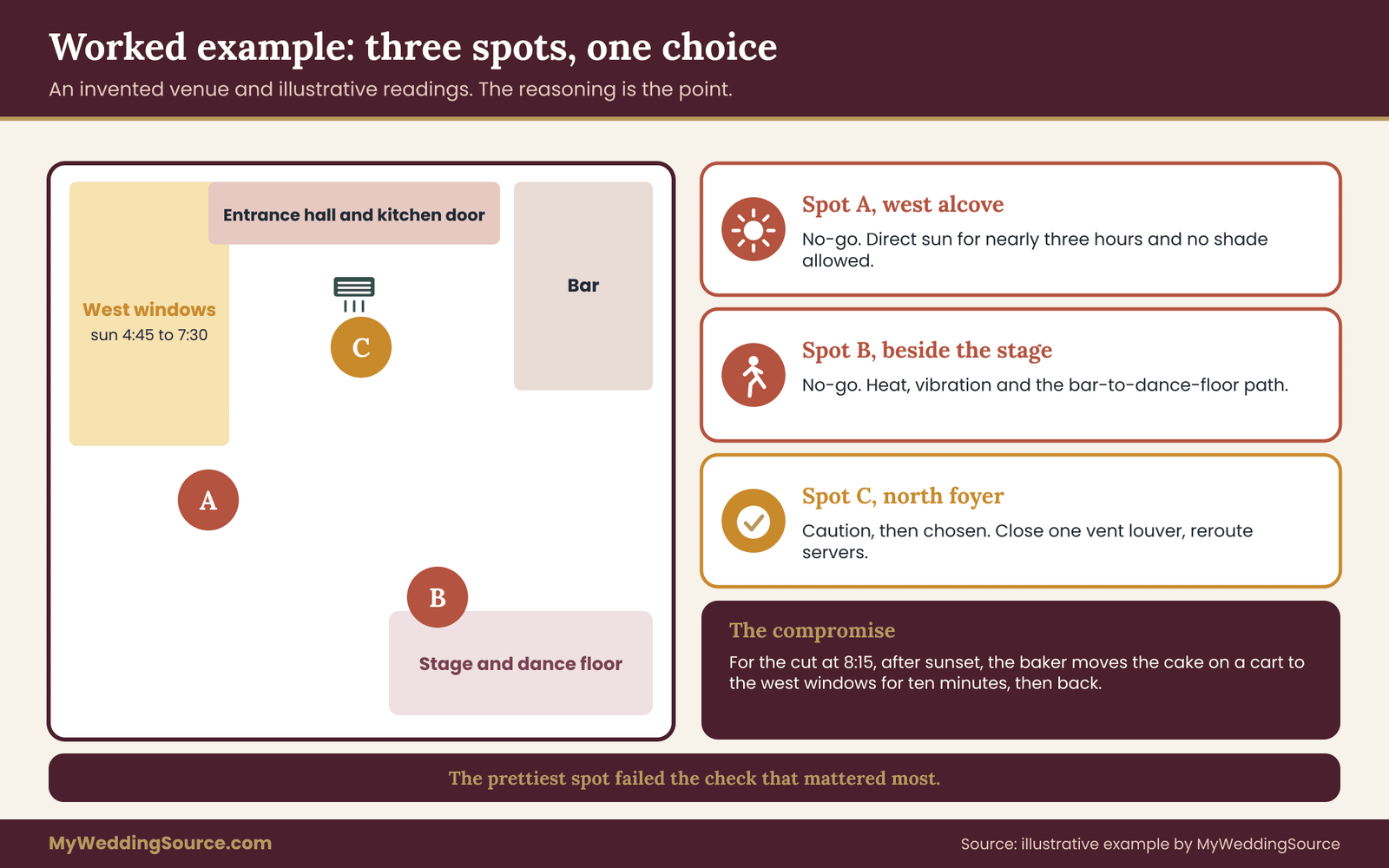
The situation. A couple is holding a reception for 120 guests in a converted warehouse venue on a late-summer Saturday. Guests arrive at 4:30, dinner starts at 6:00, and the cake is due to be cut at about 8:15. Sunset is around 7:30. The cake is a three-tier buttercream with a fresh-flower topper, delivered fully assembled at 2:30. The venue has tall west-facing windows, a stage and dance floor at the south end, a bar along the east wall, and a kitchen door at the north end.
The baker has said the cake should stand no more than three hours at room temperature and should stay out of direct light. The venue coordinator has suggested three spots.
The three candidate wedding cake placements
Spot A, the west alcove. A recessed corner between two tall west windows. It looks beautiful and the photographer likes it.
Spot B, beside the stage. A wall space near the dance floor, with a good sightline from most seats.
Spot C, the north foyer end. A wide space near the entrance hall, away from the bar and the dance floor, but near the kitchen door.
What the survey found
For each spot, the couple and the planner ran the six checks over three passes, using a thermometer at cake height. The readings below are illustrative.
Spot A. Sun: the west windows send direct light across the alcove from about 4:45 until sunset at 7:30. That covers most of the time the cake would stand. Air: no vent nearby, still air. Heat: a large window radiates warmth, and the thermometer read a few degrees warmer than the room average at the second pass.
Traffic: quiet, a dead end. Table and floor: a sturdy banquet table, level floor. Access: a long carry from the kitchen. Verdict: sun for nearly three hours is a no-go for a buttercream cake unless the window is covered, and the venue does not allow film or drapes there.
Spot B. Sun: none, shaded by the stage. Air: no direct vent, but the stage speakers sit within a few feet. Heat: the stage lights and speakers add warmth, and the dance floor is the warmest part of the room by evening. Reading at the third pass was the highest of the three spots. Traffic: the path from the bar to the dance floor passes within three feet.
Table and floor: the floor near the stage vibrates when music plays at volume. Verdict: no sun, but heat, vibration and traffic add up to a no-go for the whole evening, though it could work as a short display for the cutting.
Spot C. Sun: none, the entrance hall faces north. Air: a supply vent in the ceiling about eight feet away. When the couple held tissue at cake height, it moved slightly, a gentle drift rather than a stream. The venue can close one louver. Heat: no equipment nearby, and the kitchen door is on the far side of the hall. Readings were the lowest and steadiest of the three. Traffic: the entrance door is used by guests at the start and end, so guests pass at a distance of about ten feet, but the main flow of the evening goes elsewhere.
The kitchen door is close, and servers use it. Table and floor: tile floor, level, a banquet table with locked legs. Access: short carry from the kitchen, flat route, no steps. Verdict: caution, with two fixes: close the louver on the nearby vent, and ask servers to use the far side of the doorway.
The decision
The couple chose Spot C, with the louver fix and a keep-clear marker. The reasoning, in order, was this. Spot A failed on sun, which is hard to fix and long in duration. Spot B failed on a combination of heat, vibration and traffic, and none of those was easy to fix. Spot C had two small issues, both cheap to fix and both with owners: the venue coordinator would close the louver, and the caterer’s lead would instruct servers on the route.
They also made a trade-off. Spot C was not the photographer’s first choice, because the foyer lacks a dramatic backdrop. The photographer suggested a compromise: for the cutting at 8:15, when the sun was gone, the couple would carry the cake on its board with the baker’s help to a position in front of the west windows for about ten minutes, then return it. The baker agreed that a short move on a flat route was fine for this design, and that the cake would be placed on a rolling cart for the move.
What the worked example shows
Three lessons stand out, and they apply beyond this invented venue.
First, the best-looking spot failed the check that mattered most. It is common for the most photogenic location in a room to be the one with sun, glass and heat. Treat appearance as a tiebreaker, not the starting point.
Second, a spot with a small, fixable problem can beat a spot with no obvious problem that you have not checked. Spot C had a vent, and the wedding cake placement survey found it. If nobody had held up a piece of tissue, the cake would have stood in a steady draft for three hours, and nobody would have known why the surface looked dry.
Third, the wedding cake placement decision was recorded, with names. The louver fix had an owner. The server route had an owner. The baker’s limit was written. On the day, nobody needed to remember the survey, because the plan was written. That habit is what turns a good wedding cake placement from luck into a plan.
A variation: what if there had been no good spot
Suppose Spot C had also failed, for example because a heater under the vent could not be turned off. The couple would then have three alternatives. They could widen the search and look at other corners. They could keep the cake in a cooler room, such as the kitchen’s cold storage or a quiet cool side room, until shortly before the cutting, then bring it out for a short display and the cutting.
Or they could ask the baker whether a smaller display cake, with the serving cake kept in the kitchen, would work. Any of these is a legitimate plan, and the wedding cake placement survey tells you why you need it. Where the cake sits is only one of the levers. When is the other.
Photos, sightlines and the cutting moment
Once a spot passes the risk checks for wedding cake placement, the last job is making it work for the people who will see it. Wedding cake placement is partly about protection and partly about presentation, and the two can coexist if you sequence them.
Sightlines and the guest view
In wedding cake placement, a cake that nobody can see is a wasted cake. Check where guests will sit and where they will stand. From the seats, does the cake appear in view, even at a distance? Is it visible from the entrance, or at least from the dance floor edge? You do not need the cake at the center of the room. A cake that glows in a lit alcove can be seen across a room and still be safe.
At the same time, avoid putting the cake where it blocks something else, such as a door, an aisle, a sign or the view to the head table. A cake that obstructs flow will be moved by someone at an inconvenient moment.
Working with the photographer
Photographers care about light, background and space. Ask yours three questions: where would you like the cutting photographed, how much space do you need around the cake, and what light is available at that hour? If their preferred backdrop conflicts with a survey result, such as sun or a vent, explain the constraint and ask for alternatives. Most photographers have worked around this problem before and can suggest a staging that gives them the shot without leaving the cake in a hot window for hours.
Possible solutions include a short move for the cutting, as in the example, a photo-ready backdrop placed behind the cake in the calm spot, a lighting setup that uses reflectors rather than room lights, or timing the cutting after sunset when the windows are no longer a problem. Another approach is to photograph the cake in its calm spot with the couple, then hold a staged “second cut” for photos in front of a nicer backdrop with a decorative or dummy tier. If you have an arrangement like that, tell the baker, since they may need to supply it.
For guidance on shaping the photography side of the day, the shot list and style conversations belong with your photographer. This guide covers only the cake’s side of it.
The cutting itself
The cutting usually involves a handful of people: the couple, a photographer, possibly a videographer, a server or baker’s representative and a crowd of guests. Leave room. The couple stand at the front, so the front must be open. The photographer needs space to move at least to the side. A server needs a spot for plates and for the knife. The cake table should not be pressed against a wall with chairs on the open side.
Also plan the sequence. The couple make the first cut. The cake then goes to the kitchen or a service table for cutting and plating. Who moves it, how, and along what route? If the cake is cut at the table, where do the plates go, and where do the leftovers go? For a smoother handoff, ask the caterer or baker to describe their plan, and check it against your spot. A spot that is ideal for display but awkward for service may need a quick plan to move the cake for slicing.
A few small details at the table
Leave room for the knife and server, and plan where they rest. If the cake has a top tier saved for an anniversary, say so to the baker, who will have a plan for boxing it. Keep decorations on the table modest: small flowers or a sign are fine, but candles, confetti and loose items add risk. Ask whoever is setting the table to check that nothing hangs over the edge or touches the cake.
Talking to the venue and the baker about wedding cake placement
The wedding cake placement survey is a tool for conversation. It works best if you share it early with the venue and the baker, in plain words, and ask for their agreement in writing. This section gives you what to ask and how.
What to ask the venue
Prepare a short list, and send it by email so the answers are written.
- Which spots in the room are permitted for a cake table, and which are not, for fire, access or other reasons?
- Where are the supply and return vents, and can any be adjusted or closed during the event? Who controls the thermostat that day?
- Which windows and doors bring direct sun during our event hours, and are shades, drapes or film available?
- Is there a cooler, refrigerator or cool room where the cake can wait, and when can the baker use it?
- Where are the nearest outlets, and what are the rules on cords and lighting?
- What is the route for delivery, and are there steps, thresholds or narrow doors?
- What is the backup plan if the weather or room conditions change on the day?
Email makes the answers clear and gives you something to refer to. If a coordinator answers by phone, send a follow-up: “Thanks for the call. To confirm, the west windows bring sun until sunset and the north foyer is the shaded spot.”
What to ask the baker
Ask the baker for the information that sets your limits and for their sign-off on the chosen spot.
- What is the safe time window for this cake at room temperature, and how does that change if the room is warm?
- Which parts of the cake, such as fillings or frosting, are the most sensitive to heat?
- What conditions would you want the cake moved or served early?
- What table size, strength and height do you need?
- Do you want to see the spot, or review photos of it, before delivery?
- Who is on site at delivery and setup, and who decides if the spot is not acceptable when you arrive?
If the baker does not have a policy, ask them to note their requirements in the contract or an email. The wedding vendor contract guide explains what vendor agreements usually cover and how to confirm details in writing.
Putting it on one page
After you have chosen a spot, write a short wedding cake placement sheet. It is a single page that everyone can read. Include the spot’s name or location, the time the cake arrives, the time it is cut, the baker’s limits, the fixes agreed and who owns each, the table and cover requirements, the route, the contact numbers of the baker, the venue coordinator and your own day-of contact, and the trigger for moving the cake. Send it to the baker, the venue, the caterer and the planner a week before.
A page like this helps when staff change. The person who set the room on Tuesday may not be the person who runs the event on Saturday. The sheet carries your decisions across that handoff.
What if the venue pushes back
Sometimes a venue says wedding cake placement is fixed at the standard place, period. That is their right, and they may have reasons you do not see. Ask politely for the reasons. Share your survey findings and ask whether a modest change would work, such as moving the table a few feet, closing a louver or using a different spot for the first hour.
If the answer is still no, document the concern and discuss with the baker what mitigation is possible, such as arriving later, a shorter display time or a cooler holding spot. The decision may be out of your hands, but the survey still helps you reduce the risk.
Backup plans, moving the cake and the limits of a survey
Even a careful survey meets a surprise on the day. The sun is earlier than expected, the air conditioning fails, rain pushes the reception under a tent, or the guest count grows and the room is rearranged. A plan for wedding cake placement is not finished until it says what happens when the first choice stops working.
Decide the triggers in advance
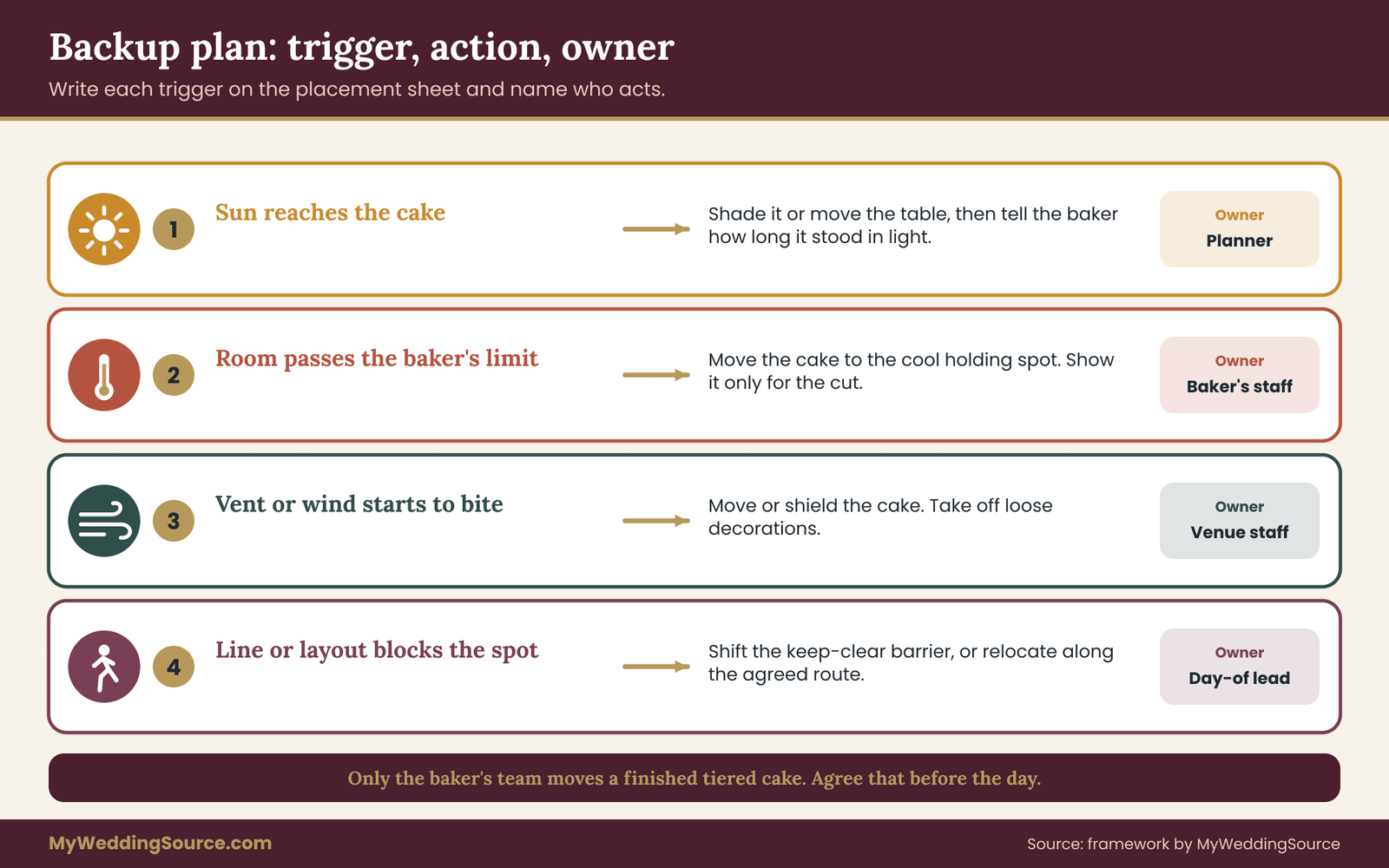
A wedding cake placement backup plan is only useful if someone can act on it quickly. Write three or four triggers and the action for each, on the placement sheet.
- Sun arrives where it should not. If direct light touches the cake, shade it with an agreed screen or move the table, and call the baker if the cake has already stood in light for a while.
- The room warms. If the thermometer at cake height passes the baker’s limit, or the room feels warm and stuffy, move the cake to the cool holding spot and display it only for the cutting.
- Air or wind changes. If a vent starts blowing on the cake or wind lifts decorations, move the cake or shield it.
- Traffic changes. If a line forms near the cake or the layout shifts, move the barrier, or relocate the cake along the agreed route.
Name the person who makes each call and the person who moves the cake. A baker’s representative or the venue’s staff usually should do the actual moving, since a tiered cake is delicate and the baker knows how to handle it.
Moving a finished cake
Moving a tiered cake is a job for the baker or someone they have trained, not for a friend with good intentions. If the wedding cake placement survey suggests the cake may need to move, ask the baker about it in advance. Some designs can be moved fully assembled on a rolling cart or a flat, rigid board. Others need to be separated into tiers and reassembled. Some cannot be moved at all once finished, in which case the first placement has to be right.
If a move is likely, check the route again: flat floor, wide doors, no thresholds or small steps, no carpet edges. Plan for two people at minimum, and keep the route clear of guests. Cover or protect the cake during the move if the baker advises it. Do not move the cake in the middle of a crowded event unless it is an emergency.
A cool holding spot
Many wedding cake placement problems disappear if the cake waits somewhere cool and calm until close to the cutting. A walk-in cooler in the caterer’s kitchen, a cool back room or a refrigerated space may serve, if the baker approves and if the cooler is clean and suitable. The cake is then displayed for a short, planned period. The trade-off is that guests see the cake less, and someone has to carry it. For hot-weather weddings, outdoor events and cakes with sensitive fillings, this trade is usually worth considering.
Weather and venue changes
If the event is outdoors, prepare a rain plan that includes wedding cake placement. A tent changes the heat, the airflow and the traffic. The indoor room may have a different vent layout. When the plan changes, run the survey again, in miniature, at the new site. Even five minutes with a thermometer and a hand test is better than none. The barn wedding venues guide covers the outdoor and semi-outdoor setting, where wind, heat and open doors are especially relevant.
If a venue changes the room layout after you chose a spot, for instance adding tables for more guests, recheck the traffic and clearance. A layout that was calm with 100 chairs may become a corridor with 140.
Fitting the wedding cake placement survey into the schedule
The wedding cake placement survey belongs early, and the confirmation belongs late. Run the survey once the venue is booked and the baker is hired, in the months before the wedding, so any fix has time. Confirm the spot and the placement sheet about a week before, and review it on the morning of the wedding. The wedding vendor timeline lays out when vendors usually need information, and the broader sequence from final headcount to cutting is covered in the full cake production plan on this site.
On the day, assign one person to check the cake’s spot at setup: look for sun, feel for air, take a reading, press the table. That person is also the one who watches the cake during the evening and calls the baker if anything changes.
What this wedding cake placement survey does not do
A site survey for wedding cake placement is a way to compare spots and ask better questions. It has limits, and you should know them.
It does not replace the baker’s judgment. Temperature limits, safe holding times, structure, assembly, allergens and serving counts depend on the cake, and they require the bakery’s approval. If the baker’s rule differs from anything in this guide, follow the baker’s rule.
It does not replace local food-safety rules or your venue’s policies. Requirements vary by location and venue. The U.S. government’s food-safety site at foodsafety.gov, the Food Safety and Inspection Service at fsis.usda.gov, and the Food and Drug Administration at fda.gov explain general principles for handling food, and your local health department can answer questions about local rules.
It does not predict the weather, the guest count or the mood of a crowd. It reduces the number of surprises, and it gives you a plan for the rest.
It does not guarantee an outcome. A cake can still be affected by something nobody foresaw. What the wedding cake placement survey gives you is a record that you looked carefully, a plan for when the room changes and a calmer day.
A closing note on proportion
Wedding cake placement is one item in a long day, and it is not worth anxiety. If your cake is a small one, your room is cool and calm, and your baker is experienced, the survey may take twenty minutes and you will move on. If you are planning a tall cake in a hot outdoor setting, it is worth an hour or two. In both cases, the goal is the same: a cake that stands quietly in a calm part of the room until the moment it is cut.
Your next steps
Start with three actions this week. First, ask your baker for the cake’s footprint, weight, safe time at room temperature and the conditions they want to avoid. Second, ask your venue for a shortlist of two or three possible spots, along with the vent, window, door and outlet details for each. Third, book a visit at the hour the cake will stand, with a thermometer, a level and a notebook.
At the visit, run the six checks at each spot across the three passes, write one line per check and sort each spot into go, caution or no-go. Choose the calmest go spot, or the caution spot with the cheapest fix, and write a one-page placement sheet with names, fixes and triggers. Send it to the baker, the venue, the caterer and your planner a week before the wedding.
On the day, have one person check the spot at setup and again before the cutting. With that in place, your wedding cake placement is a decision you can explain, and the cake can do its job without anyone worrying about it.
FAQ
How far should a wedding cake be from a window?
There is no single distance, because the question is whether direct or reflected sun reaches the cake during the hours it stands. A cake several feet from a window can be fine on the shaded side of a building and warm on the sunny side. Check the window’s direction, note when light enters for your wedding cake placement, and rely on a hand test and thermometer at the event hour.
Can a wedding cake sit under an air vent?
It is best avoided in wedding cake placement. A steady stream of air dries frosting, can crust the surface and may chill one side of the cake. If the only workable spot is under or near a vent, ask the venue whether the louver can be closed or redirected, and test the airflow with your hand at cake height. If it cannot be fixed, move the table.
Is outdoor wedding cake placement a bad idea?
Not always, but it needs more planning. Sun, wind, insects and heat all come with open air. A shaded, sheltered spot with a heavy table can work in mild weather. In hot or windy conditions, many couples keep the cake in a cool indoor room until shortly before the cutting. Ask your baker how much wind and heat the design can handle.
What temperature should the cake room be?
The right range depends on the cake, so ask your baker for a number and for the longest time the cake can stand at room temperature. Foodsafety.gov advises that perishable food should not sit out more than two hours, or one hour above 90°F. Use a thermometer at cake height to compare spots and to check the room during the event.
Should wedding cake placement be near the dance floor?
Usually not. Dance floors are warm, crowded and sometimes vibrate with music, which raises heat, bump and stability risks. A spot with a clear view of the dance floor but some distance from it often works better. If you want the cake near the action for photos, consider a short display at the cutting and a calmer spot the rest of the evening.
Who decides wedding cake placement?
Three parties share the wedding cake placement decision. The venue controls where tables may stand and what rules apply, the baker controls what the cake can tolerate, and you or your planner control the guest experience. Share your survey notes with all three, agree on a spot in writing, and name a person who can make a change on the day.
What if the venue limits our wedding cake placement?
Ask for the reasons behind their wedding cake placement rule, share your findings, and ask for small adjustments, such as moving the table a few feet or closing one vent louver. If the answer is still no, discuss with your baker how to reduce the risk: delivering later, a shorter display, or holding the cake in a cooler room until the cutting. Keep the exchange in writing.
Do I need a thermometer for the wedding cake placement survey?
It is not required, but it helps. A small digital thermometer lets you compare spots and see how the room changes between setup and the cutting, which your hand cannot do reliably. The baker’s limit is the standard that matters, so use the readings as evidence for a conversation, and ask the baker or caterer to bring one if you do not have your own.
Sources
- Food safety guidance, FoodSafety.gov
- Food Safety and Inspection Service, U.S. Department of Agriculture
- Food, U.S. Food and Drug Administration
- Food safety, Centers for Disease Control and Prevention
- Americans with Disabilities Act information, ADA.gov
- National Fire Protection Association
- National Weather Service forecasts
- Energy Saver, heating and cooling, U.S. Department of Energy