

A religious reading request usually arrives as one sentence, “We would like a passage read at the ceremony,” and it carries far more than a piece of text. This guide gives couples a calm way to sort out what the family member is really asking for, what the two of you actually want, and which of several workable answers sits between a full yes and a plain no.
Do not answer the passage first. Agree between the two of you on your own limits, then separate the value behind the request (honor, belonging, blessing, continuity) from the format it could take (which text, who reads, when, how long, with what introduction). Offer the value in a format that fits your ceremony. If the answer has to be no, say it early, kindly, in person, and name what you can offer instead. Then confirm the details with your officiant and venue.
Weddings gather people who hold different beliefs and expectations, a theme that also runs through general wedding etiquette, and most families manage that without a scene. A religious reading is one of the places where it gets tight. Perhaps a grandmother has asked for a psalm. Perhaps a parent would like a passage from their tradition read before the vows, and one of you does not practice that tradition, or practices a different one, or practices none and does not want the ceremony to say otherwise. The request is rarely hostile. It is usually loving, a little anxious, and attached to something that matters to the person asking.
That combination is what makes it hard. If the request were rude, you could decline it. Because it is sincere, any answer feels like a verdict on the person. The method in this guide aims to take most of that weight off the conversation, so that you can say yes, yes in part, or no without turning the passage into a referendum on the family.
A note on scope. This is general planning information, not legal, religious or counseling advice. Rules for who may officiate and what a ceremony must include differ by state and by faith community, and they change, so confirm the current version with your officiant, your venue and the office that issues your marriage license.
Why a religious reading request feels so heavy
Before choosing a response, it helps to understand why a single reading can raise the temperature of a whole planning season. Three things are usually happening at once, and they are worth naming separately.
The first is that a religious reading is public. A request about the flowers is private until the day. A religious reading is spoken aloud in front of everyone you invited, so the content, the speaker and the framing all become statements the guests will hear. Both of you will be standing there while it is read. That is why a passage you would not mind seeing in a drawer can feel very different when it is attached to your vows.
The second is that the request often stands in for something larger. A parent who asks for a prayer may not be asking about theology at all. They may be asking whether they still belong in your life now that you are forming a household of your own. A grandparent who wants a verse from the family’s tradition may be asking whether the thread will continue. If you answer only the text, the larger question goes unanswered, and it tends to come back as a second request.
The third is that the decision is shared, and the two of you may not feel the same way. One partner may be comfortable with a short religious reading as a gift to a relative. The other may feel it misstates who they are. If you meet the family before you have met each other on this point, the family will find the gap, and the conversation will stall.
None of this means the request is a problem to be defended against. It means the religious reading deserves the same planning attention you would give any other part of the ceremony that other people will hear. If you want the broader picture of how couples and relatives can share input without losing control, the guide on wedding decision rights covers the general principles. This article stays with one narrow situation: a religious reading you would rather not include.
What “a religious reading” can mean in practice
The phrase covers a wide range, and it helps to be exact about what was actually requested before you react to it. A religious reading might be any of the following.
A short scripture or sacred-text passage read by a relative, often chosen because it is on love, covenant or companionship. A longer liturgical text, such as a traditional blessing, that has a set form and sometimes a set order. A prayer led by a clergy member or a relative, which differs from a religious reading because it addresses a deity directly and often invites guests to join. A poem or hymn text with religious language in it but a literary origin. A ritual act accompanied by words, such as a blessing over wine or a candle lighting, where the spoken part is one piece of a larger action.
These are not the same ask. A two-sentence verse read by a cousin is a smaller request than a ten-minute liturgy, and a religious reading that stays silent about belief is a smaller request than one that asks guests to stand and respond. When someone says “we would like a religious reading,” your first job is to find out which one they mean. Ask for the passage, the length, who would read it and where they imagine it fitting. Do this out of curiosity, not suspicion. People often describe the idea in a sentence and have a much smaller version in mind than you fear.
Some people use “religious reading” to include material that is only loosely religious, such as a well-known passage about love that originated in a sacred text but is read at many weddings without any faith framing. Others mean the opposite: they want the religious reading specifically because it is unmistakably from their tradition. Knowing which is which changes your options. A passage that most guests would hear as a general reflection on love can often be placed in a non-religious ceremony without strain. A passage whose whole point is its source cannot.
The request, the person and the relationship are three different things
A habit that helps throughout this guide is keeping three questions apart. What exactly is being asked for? Who is asking, and what do they usually mean when they ask for things? And what is your relationship with this person outside of the wedding?
You can decline the specific religious reading without diminishing the person or the relationship. You can accept the person’s concern fully while changing the format. And you can keep a firm limit on the ceremony while being generous everywhere else in the weekend. Couples who run these together tend to feel that a no to the passage is a no to the person, and then they either give in or get defensive. Couples who keep them apart usually find that the room for a good answer is larger than it first looked.
Whose ceremony is it, and who gets a say
There is no universal rule about whose preferences prevail, and the honest answer varies by family and by who is paying for what. Some families treat a wedding as a communal event in which elders have a recognized role. Others treat it as the couple’s statement. Most sit somewhere in between. Money can complicate matters, though it does not settle the question, and it is worth deciding in advance whether a contribution buys input on logistics, on the guest list, on ceremony content, or on nothing in particular.
What you can control is how you respond. You can acknowledge that the person has a stake, that the ceremony is a shared occasion, and that the final call on its content belongs to the two of you. Those statements can all be true together. Saying them aloud, in a warm voice, early, is one of the more effective ways to keep a request from becoming a contest.
The guide on interfaith ceremony planning is a useful companion if the request touches a difference between your own traditions, since that situation adds a second layer of ritual ownership. The rest of this article assumes the question is about a family member’s request, not a disagreement between the two of you about religion in general.
Check your own position first: three questions for the two of you
The most common mistake in this situation is answering the relative before the two of you have answered each other. Once you have said “let us think about it,” set aside an hour, with no phone calls in the background, and work through three questions. Each of you should answer them separately first, in writing if possible, and only then compare.
Question one: what is my actual objection? There is a big difference between “I do not want any religious language in my ceremony,” “I do not want this particular tradition’s language because it implies things I do not believe,” “I am fine with the content but not with the length,” and “I am fine with it in principle but I do not like who is reading it.” Write the objection in one sentence. If you cannot, you may be reacting to the pressure, not the passage.
Question two: what would I be comfortable with, if the request were framed differently? Many people discover that their no is narrower than they assumed. They would accept the religious reading if it were shorter, or placed before the ceremony begins, or introduced as a gift from a relative, or read in the original language with an English summary in the program. Write down every variant you could live with, even grudgingly.
Question three: what is the cost to me and to the relationship if I say no, and if I say yes? Be honest about both columns. A yes that you resent will not stay private, and a no that deeply hurts someone you love may be one you want to deliver with more care or more alternatives. Neither is automatically right. The point is to choose with the costs in view.
After you compare, you will land in one of three places. You may both be fine with some version of the religious reading. You may both be firmly against it. Or you may differ. Each has a different next step, and the three layers in the next section are designed to help with all three.
If you differ, treat that as the first problem and the relative’s request as the second. Agree on a shared answer before anyone else hears it. A useful rule is that the partner who feels more strongly gets to set the outer limit, and the partner who feels less strongly gets to shape how the answer is delivered, since they are often the one with the better relationship to the person asking.

The value, format and frame method for a religious reading
Here is the working method for the rest of the guide. Any request for a religious reading can be broken into three layers, and each layer can be negotiated separately. Most conflicts happen because everyone is arguing about one layer while thinking about another.
The value is the reason the person wants the religious reading. It is usually something like honor for a deceased relative, continuity with a tradition, a blessing on the marriage, a sense of belonging, relief from worry about your spiritual wellbeing, or a wish to be included in a role. The value is rarely negotiable in the sense that it can be argued away, and it does not need to be. You can agree that it matters.
The format is the concrete shape the request takes: which text, which translation or language, who reads it, how long it runs, where in the ceremony it falls, whether guests are asked to join, and whether it is read at the ceremony at all. Formats are very flexible. The same value can be carried by many different formats, which is why this layer is where most of the room is.
The frame is how the religious reading is introduced and understood by the rest of the room. A passage read with no explanation sounds like a statement by the couple. The same passage introduced as “a religious reading chosen by the groom’s grandmother” sounds like a gift from her. The frame decides whose voice the guests hear, and it is almost always something you can change without touching the text.
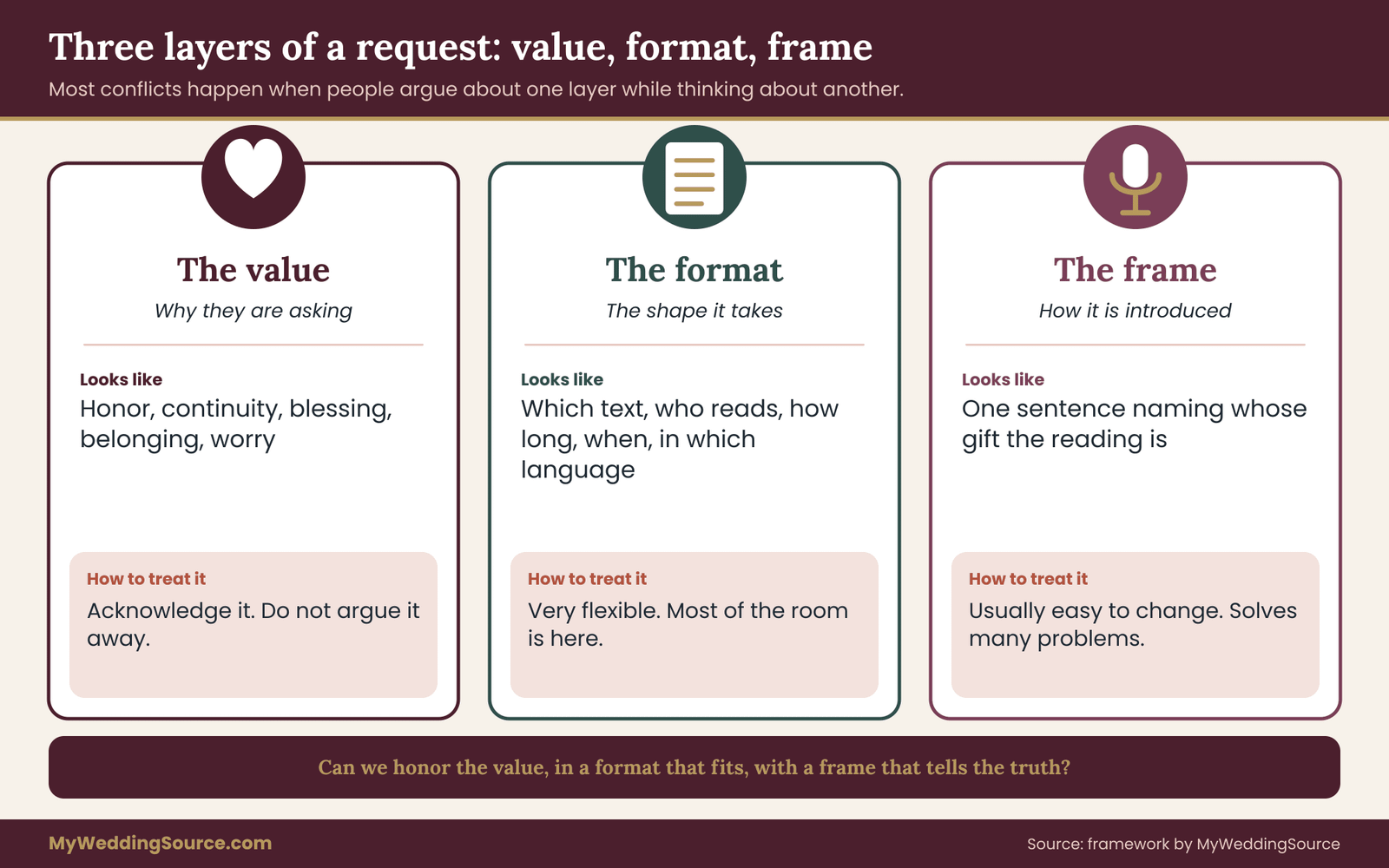
The method works because it replaces a yes-or-no question about a passage with a three-part question: can we honor this value, in a format that fits, with a frame that tells the truth about whose idea it was? That question has many more answers than yes and no, and some of them will satisfy everyone.
Why the passage is the wrong place to start
When a request lands, the instinct is to open the text and judge it. Is it too religious? Does it mention a deity? Does it say something about marriage that we do not hold? That judgment matters, but if you start there you will tend to argue about the content, and the other person will tend to defend the content, and both of you will miss the actual stake. Start with the value, because it tells you what a good answer has to accomplish. Then work outward to format and frame, and only at the end test the specific passage against your limits.
A practical way to make this shift is to change the first question you ask. Instead of “which reading do you want,” try “what would it mean to you to have a religious reading in the ceremony?” The first invites a title. The second invites a reason. Reasons give you something to work with.
Fixed points and flexible points
Before you meet the family, sort your own limits into two lists. The fixed list holds the things you will not change: perhaps the ceremony will not include prayer that asks guests to join, or no reading will claim that your marriage requires belief you do not hold, or the total ceremony will stay under a certain length. The flexible list holds everything else, such as the choice of reader, the translation, the placement, the introduction and the length of the passage.
Keep the fixed list short. A list of ten fixed points is not a limit, it is a script for refusal, and relatives will feel it. Two or three real limits are easier to explain and easier to respect. The flexible list should be long, because each item on it is a thing you can offer, and offers are what make a conversation feel like collaboration.
If you find your fixed list is long, check whether some items are really preferences. A preference is something you would like but could trade. A limit is something that would make you feel dishonest or unwell during the ceremony. The second kind deserves protection. The first kind is currency.
A conversation guide: separating the value from the format
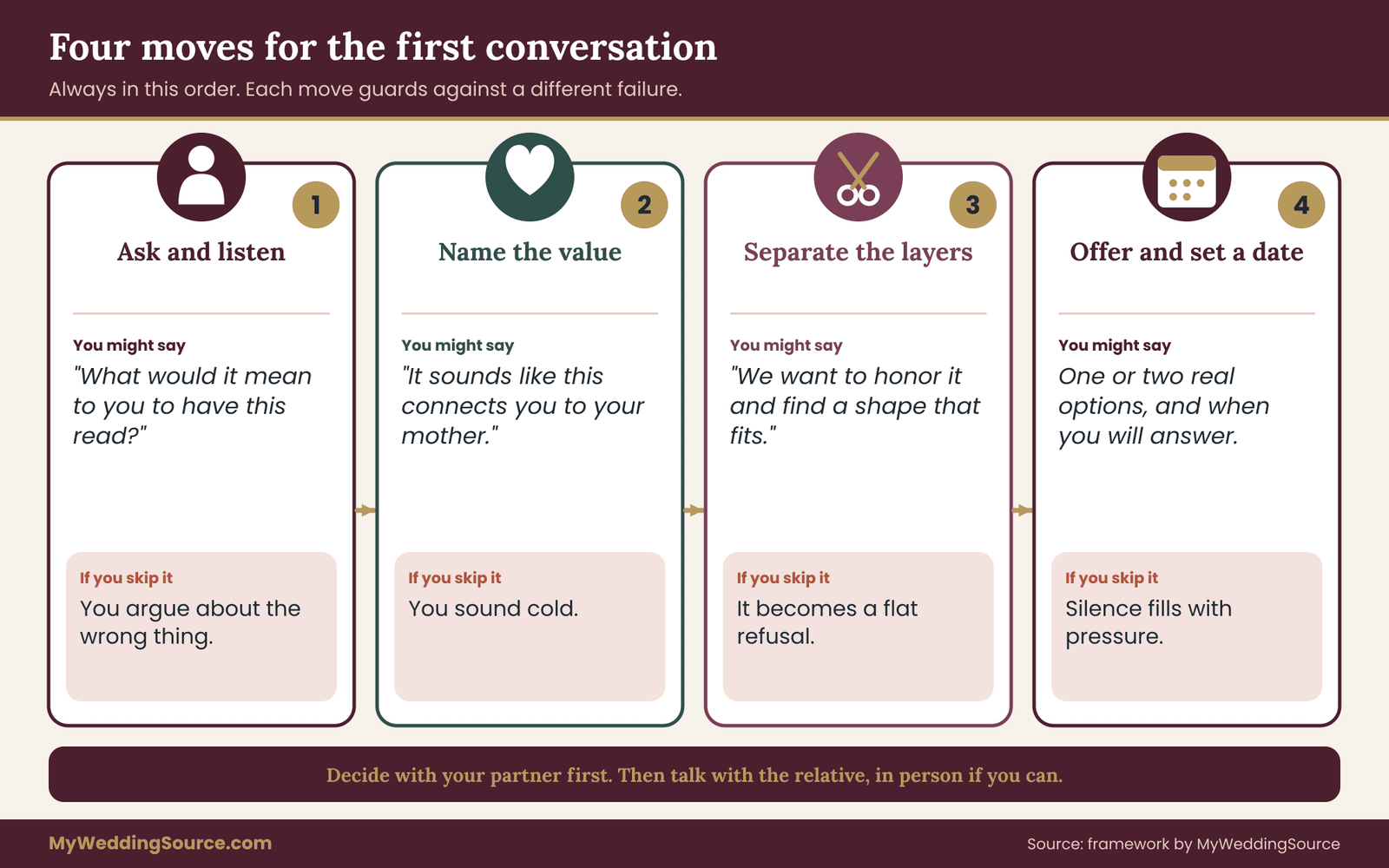
This section is the discussion guide at the center of the method. It is written for the first real conversation with the person who asked, and it assumes you have already agreed with your partner on the fixed and flexible lists. It has four moves, always in this order.
Move one: ask and listen. Invite the person to explain what the religious reading means to them. Resist the urge to respond to each point. You are collecting the value, and people tend to say the real reason about two minutes in, after the stated reason. Questions that open this up include asking which passage they had in mind and why that one, whether it was read at their own wedding or at a family event, and what they imagine the moment looking like. Listen for words such as “always,” “tradition,” “worry,” “blessing” and “our family.” They point to the value.
Move two: name the value back. In your own words, say what you heard. “It sounds like this passage connects you to your mother, and you would like her to be part of the day.” This is not agreement to the request. It is agreement that the reason is real. People who feel heard about the reason are much more willing to discuss the format, because the thing they most wanted has already been acknowledged.
Move three: separate the layers out loud. Say, in a friendly way, that you want to honor what it means and also find a version that works for the ceremony you are planning. Then describe the flexible pieces: who might read, how long it might be, where it might fit. You are shifting the conversation from the passage to the shape of the gift, and you are signaling that there are options.
Move four: offer a specific option and a time to respond. Do not leave it open-ended. Offer one or two concrete versions, say what you are not able to do, and say when you will have a final answer. A date matters. An open question can sit for weeks and gather pressure.
What each move protects
Each of the four moves guards against a specific failure. Asking and listening guards against responding to a request you have misread. Naming the value guards against the feeling that you dismissed the person. Separating the layers guards against a binary fight. Offering a specific option and a time guards against drift, where nothing is decided and the days before the wedding fill up with hints.
If you are tempted to skip a move, notice which one. People who skip the first tend to argue about the wrong thing. People who skip the second tend to sound cold. People who skip the third present a flat refusal. People who skip the fourth leave the person waiting, which can feel worse than a clear no.
Words to avoid in the first conversation
A few phrases make things harder even when the intention is kind. “We do not want anything too religious” sounds like a judgment on the person’s faith, not a statement about the ceremony. “It is our day” is true but tends to land as a closed door. “Everyone will think” attributes opinions to guests you have not asked. “We cannot because of my partner” places your partner in the role of the obstacle, which is unfair to them and unhelpful to you.
Better is to speak in terms of the ceremony you are building. “We are keeping the ceremony short and mostly in our own words” is a statement about the format, not about the person. “We would love to find a way for your religious reading to be part of the weekend” is an invitation, not a ruling. When you can, use “we” and describe what the ceremony is, not what it refuses to be.
The seven values behind most requests
Over many weddings, a handful of reasons come up again and again. You do not need to guess; you can ask. But it helps to know the likely candidates, because each points to a different kind of offer.
Honor for someone who has died points toward a format that names the relative: a religious reading in their memory, a candle, a line in the program. Continuity with a tradition points toward a format that visibly includes something from it, even if briefly.
Blessing, meaning the wish for divine favor on the marriage, points toward a private blessing or a short prayer from the relative that is framed as theirs. Belonging, meaning a wish to have a role in the ceremony, points toward a speaking part, which may not need to be religious.
Worry about your spiritual wellbeing is the hardest to address with format and is better met with reassurance and time. Pride in a faith community points toward including that community in a way that does not depend on the ceremony content. And habit, meaning “it is just what we do at weddings,” often dissolves when you explain the ceremony you have planned.
Read the list as a set of hypotheses to test, not a diagnosis. The person in front of you may hold two or three at once, and the one they state first is not always the one that drives the request.

The ladder of answers between yes and no
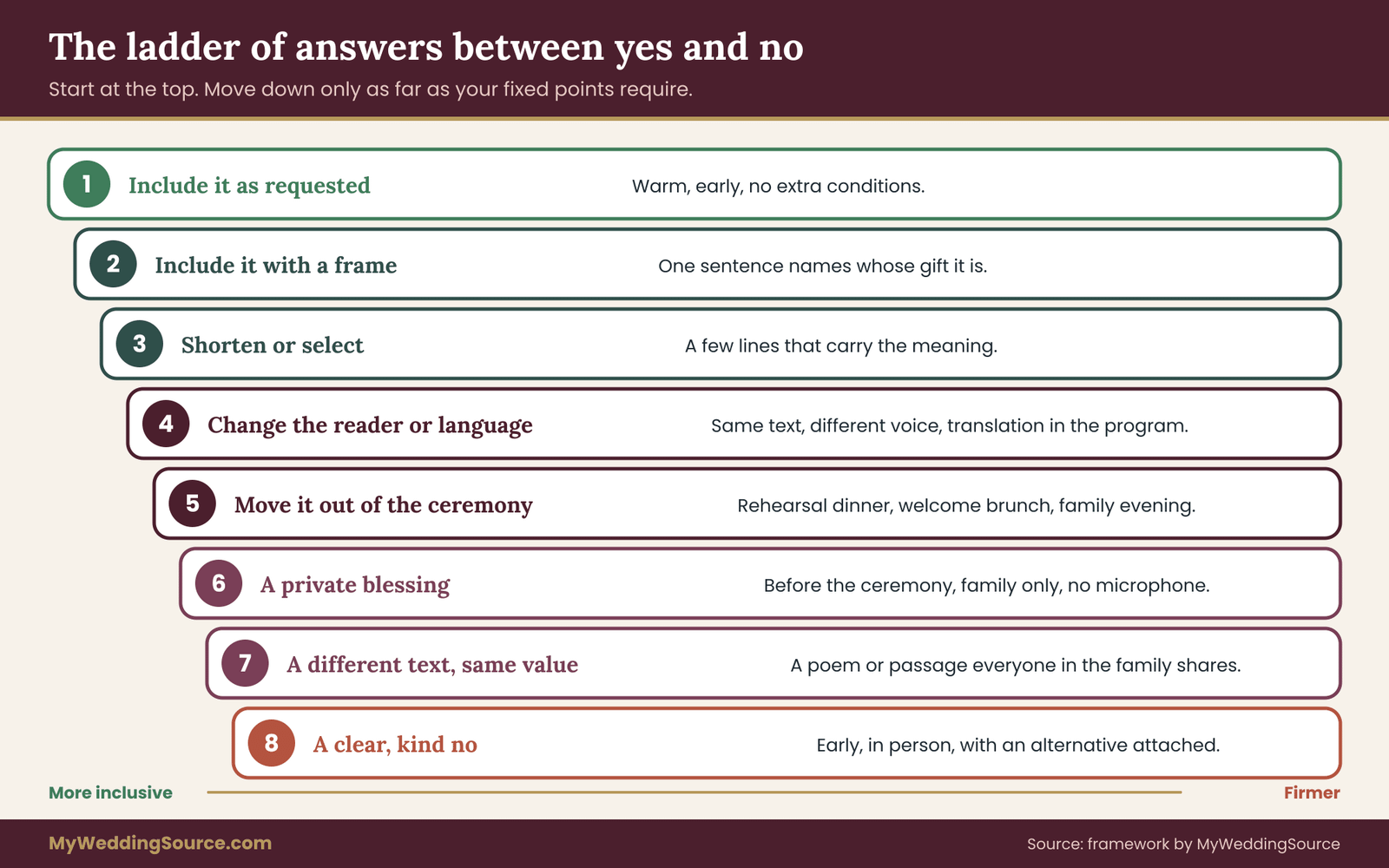
Most couples imagine two doors: include the religious reading as requested, or refuse it. In practice there is a ladder with several rungs, and the right answer is usually somewhere in the middle. Each rung below keeps the value and changes the format, the frame, or both. They are ordered from the most inclusive to the least, so you can start at the top and move down only as far as your limits require.
Rung one: include it as requested. If you are comfortable with the passage, the reader and the length, say yes warmly and early. Do not add conditions out of habit. A full yes is a perfectly good answer, and some couples who dreaded the conversation find, once they have named their limits, that the request sits inside them.
Rung two: include it with a frame. Keep the text, but tell the room whose gift it is. The officiant or the reader introduces it with a single sentence, such as “This passage was chosen by the groom’s grandmother, who has read it at every family wedding.” The religious reading stays, and the guests hear it as a relative’s contribution and not as the couple’s creed. This rung solves more problems than any other, because the discomfort is often about attribution.
Rung three: shorten or select. Ask whether a few lines would carry the meaning. Many longer passages have a natural excerpt that holds the central image. A relative who proposed a full chapter often accepts a verse or two when you explain that the ceremony runs about fifteen minutes. Offer this as a way to give the passage room to land, not as a cut.
Rung four: change the reader or the language. A religious reading in the tradition’s original language, followed by an English version printed in the program, can feel more ceremonial and less doctrinal to some listeners. A religious reading by a child or a younger cousin may soften the tone for guests who would otherwise hear the passage as instruction. Either change keeps the text and shifts how it is heard.
Rung five: move it out of the ceremony. The religious reading can open the rehearsal dinner, begin the welcome brunch, or be spoken at a family gathering the evening before. The relative still has a public, meaningful moment, and the ceremony stays within your limits. This is often the best answer when the ceremony itself is tightly planned, and it should be offered as a place of honor, not a consolation.
Rung six: a private blessing. Before the ceremony, in a quiet room, the relative reads the passage or offers a blessing for the two of you only. No guests, no program, no microphone. It meets the value of blessing completely and costs the ceremony nothing. Many people find this the most moving option, and it works especially well when the main worry is the relative’s own sense that the marriage has been blessed.
Rung seven: a different text with the same value. If the passage itself is the obstacle, offer another that carries the same meaning. A non-sacred reading about commitment, a poem the relative loves, or a passage from a source your whole family shares can meet the value of “something of ours in the ceremony” without the content you cannot accept. The guide to non-religious ceremony scripts shows how reading slots can be filled without any faith content, which helps if you are building the alternative from scratch, and the Christian ceremony script guide shows where readings usually sit in a traditional order.
Rung eight: a clear, kind no. Some requests cannot be fitted anywhere without breaking one of your fixed points. Then the right answer is a short, early no with an alternative attached. The later section on declining covers how to say it.
How to move down the ladder without losing the person
The ladder is a tool for you, not a script to read aloud. When you speak with the relative, do not announce rungs. Offer one or two options that fit and let the conversation breathe. The main discipline is to start with the rung that gives the most and move down only when you must. Couples who open at rung eight, because it is the safest, tend to produce the conflict they feared. Couples who open at rung two or three often find they never need to go lower.
It also helps to decide in advance which rungs are fully off the table for you. If rung one is impossible, do not offer it as a bluff and then retract it. Offering what you cannot deliver damages trust more than any no.
When the rungs overlap
Real answers often combine rungs. A common blend is rung two and rung three: a short excerpt, introduced as the grandmother’s choice. Another is rung five and rung six: a religious reading at the rehearsal dinner and a private blessing before the ceremony. Do not feel that you must choose one rung exclusively. The ladder is a menu, and the best answers tend to use two items from it.
One check on combinations is to count the cumulative effect on the ceremony. If you add a framed religious reading, a prayer from the officiant, a blessing over a cup and a hymn, you may have built a religious service by accumulation, even though each request seemed small. Keep a running total of ceremony minutes and of how many religious elements there are, and compare it with what you wanted at the start. That running total is easier to discuss with your partner than a vague feeling that it is getting away from you.
Who is asking: how the request changes with the person
The same words from a different person call for different answers. A grandmother’s request, a parent’s, an in-law’s, a sibling’s and an officiant’s each carry different expectations, and the response that works for one can backfire with another. These are patterns, not rules, and individual people will surprise you.
A grandparent or an elder
Requests from grandparents often carry the value of continuity and, sometimes, a quiet awareness that time is limited. The stakes are rarely about doctrine. They are about whether the person will see something of their world in the ceremony. This is the situation where rungs two, five and six tend to work best, because they honor the elder in a visible and personal way without handing them control over the ceremony.
It is worth asking the grandparent about their own wedding or about a family occasion where the passage was read. Stories are both a gift and a source of information about what they want. Often the heart of the request is a memory, and a version of the religious reading that touches the memory will satisfy it.
Be careful about delegating this conversation. A message relayed through a parent can lose its warmth and gain an edge. If at all possible, one of you should sit with the grandparent in person or by video, with enough time that no one feels rushed.
A parent
A parent’s request is more likely to mix several values at once: honor for their own tradition, concern for your wellbeing, and sometimes their standing in a faith community whose members will be present. Parents may also be paying for part of the day, which can make the request feel like a condition even when it was not meant as one.
With parents, the first step is separating the request from any financial or authority question. Say clearly that you value their input and want the ceremony to feel like theirs too, then describe the fixed points as features of the ceremony you have designed. If a parent is likely to read the refusal as a rejection of their faith, spend more time on the value and on the alternatives. A parent offered a meaningful role, such as introducing the passage or hosting the rehearsal dinner blessing, often needs less from the ceremony text.
An in-law or your partner’s family
When the request comes from your partner’s family, the person with the closer relationship should lead the conversation, and the other should stay supportive but quieter. This is not about hiding disagreement. It is about avoiding the pattern in which a relative feels that someone outside the family is overruling their own child.
If you are the one outside that family’s tradition, say what you can say honestly. “I do not practice, but I understand why this matters to you, and I want to find a place for it” is both true and generous. Avoid claiming more openness than you feel. Relatives can tell, and a half-hearted yes tends to resurface as resentment later.
A sibling or a close friend
Requests from peers tend to be about their own role or about what they believe the two of you would want. A sibling who wants to read a religious passage may simply want a speaking part and to give you something personal. Ask what drew them to the text, and be ready to offer a different reading if the role is the real prize.
A friend who pushes for a religious reading on faith grounds is a slightly different case. They may feel responsible for your spiritual life. You can thank them for caring and say that the ceremony is set, which is usually enough. If it is not, treat the situation like any other boundary: clear, brief, repeated calmly.
The officiant
Officiants sit in an unusual position. A clergy member may require certain content as part of presiding, and some will decline to officiate if elements are removed. A civil officiant or friend who is ordained online will usually follow your lead, but may have their own comfort level. Whether the request is yours or a relative’s, the officiant needs to know early, because it affects the script, the timing and, in some cases, their willingness to take part.
Treat the officiant as a collaborator in the process, not a gatekeeper. The guide to officiant requirements explains how to check who can legally solemnize a marriage where you live and what to ask about content before you book.
Scripts for a religious reading conversation
Words matter most when emotions are close to the surface, and many people freeze at the exact moment they most need a sentence. The scripts below are starting points, not lines to recite. Change them until they sound like you, and keep the structure: acknowledge the value, state the ceremony, make an offer, set a time.
Saying yes with a frame
“Thank you for asking. We would love to have your passage in the ceremony. Our officiant will introduce it as your choice, so everyone knows it comes from you, and we would like it to run about a minute. Could you send us the lines you have in mind by the end of the month?”
The pieces to notice: a clear yes, an honest statement of the frame, a length, and a date. Nothing is hidden, and the religious reading is placed inside the ceremony with its source named.
Saying yes in part
“We have been thinking about what that passage means to you, and we want to find a place for it. The ceremony itself is going to be short and in our own words, so we would like to ask if you would read it at the rehearsal dinner, where we can give it the time it deserves. We would be honored to have you open the evening that way.”
This version does not apologize for the limit. It states the shape of the ceremony as a fact, then presents the alternative as a place of honor. If the relative needs a moment, give them one. Few people accept an alternative in the same breath they hear it, and that is fine.
Saying no, early and kindly
“We have talked it through, and we are not able to include a religious reading in the ceremony. This is a decision we made together, and it is not a judgment about your faith or about how much it matters to you. We did want to tell you directly and early. We would love to find another way for you to be part of the day, and we would like to hear your ideas.”
Keep the no to one or two sentences. A long justification invites rebuttal, because every reason offered becomes a point to argue. The reasons that matter are the ones that explain you, not the ones that defend the decision. Also notice that the last line asks for the person’s ideas. A no that comes with a question can open a second conversation about what the person actually needs.
When the relative pushes back
“I can hear how much this matters, and I am not going to change the answer on the ceremony. What I can do is [the alternative]. If there is a version of that you would like better, tell me and I will think about it.”
The key is to hold the limit without repeating the argument. Say the same thing in the same calm tone, and offer again what you can. Repetition without escalation is the most reliable tool you have. It tells the person that the limit is stable, and that the door to the alternative is still open.
When the request arrives through someone else
If an aunt tells you that your grandmother “is hoping for a religious reading,” you are hearing a message at second hand, which means that tone and detail may have changed. Respond with warmth and a question: “Thank you for telling me. I would like to hear from her directly. Could we call her this week?” That avoids negotiating through a relay and puts the real conversation where it belongs.
When you are the one outside the tradition
“I want to be honest about where I stand. I do not share the faith behind that passage, and I would feel odd standing next to it as though I did. I would be glad for it to be read as your gift to us, introduced that way, and I would like it to be brief. Would that work?”
This statement does not criticize the tradition, and it does not pretend to feelings you do not have. It also leaves a clear route to yes, which is the frame and the length. People tend to respond better to honest limits than to polite evasion.
In person, by phone or in writing
Choose the medium to match the weight. A first conversation about something this personal belongs in person or by voice. Text is a poor medium for tone, and a request that began with a spoken sentence should not be answered with a typed paragraph. Once you have talked, a short written follow-up is useful. It records what you agreed, gives the person something to refer to, and avoids the later disagreement about what was said.
A good written follow-up has three lines: what you decided, what you can offer, and the date by which details are needed. It should not restate the argument. If you are unsure how it will land, read it aloud and ask whether you would say it that way across a table.
Timing: when to raise it and when to answer
Raise the question as soon as you know a request is coming, and answer within a week or two of hearing it. Delay serves no one. Relatives who do not get an answer tend to fill the silence with hope, and a late no is harder to hear than an early one. On the other side, do not answer in the heat of the first reaction. A reasonable pattern is to say “thank you, we will think about it and come back to you by a certain date,” then use that time to talk with your partner and, if needed, with your officiant.
If the ceremony script is already printed or the program is at the printer, tell the relative that plainly, since changes cost real money. The guide to ceremony cue sheets is a good reference for how a late addition affects timing, readers and the order of the processional.
A worked example, step by step
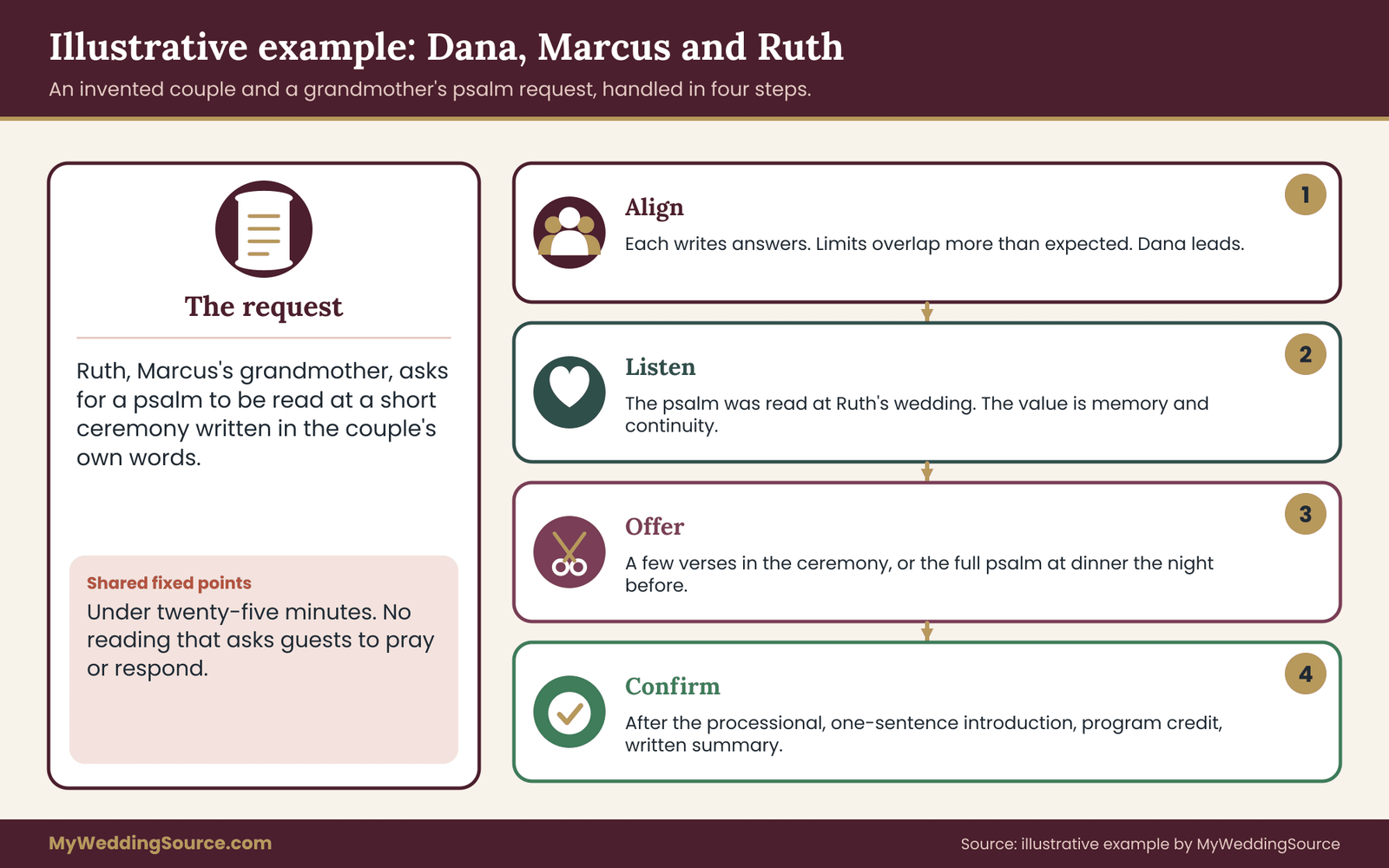
The example below is invented. The names and details are illustrative, chosen to show the method in motion, and do not describe any real couple.
The situation
Dana and Marcus are planning a small ceremony of about twenty minutes, written mostly in their own words and led by a friend who is a licensed officiant. Dana grew up in a faith community and no longer practices. Marcus has never practiced any religion. Marcus’s grandmother, Ruth, has asked that a psalm be read during the ceremony. She has attended services every week of her adult life. She has not been told the ceremony will be non-religious.
Dana is open to a short religious reading as a gift to Ruth. Marcus is uneasy; he feels a religious reading in the middle of the vows would misrepresent them to guests. Neither has said this to the other plainly yet.
Step one: the two of them align
Before replying to Ruth, Dana and Marcus each wrote answers to the three questions from earlier. Marcus’s objection turned out to be narrow: he did not want a religious reading that implied the marriage rested on belief. Dana’s comfort was conditional too: she would accept a religious reading only if it was clearly Ruth’s gift. They discovered that their limits overlapped more than they had expected. Their shared fixed points were short: the ceremony would stay under twenty-five minutes, and no reading would ask guests to pray or respond.
They also listed flexible points: the choice of psalm, the reader, the placement, the introduction and the length. They agreed that Dana, who knew Ruth better, would lead the conversation.
Step two: ask and listen
Dana visited Ruth with no agenda except to listen. She asked why this psalm. Ruth explained that it had been read at her own wedding and at her late husband’s funeral, and that she had hoped to hear it once more in a family setting. The value was continuity and memory, joined to a wish to feel that her husband was part of the day.
This changed what a good answer would look like. Ruth did not need a sermon or an endorsement of her faith. She needed the psalm spoken in the family’s presence, with her husband’s name nearby.
Step three: name the value and offer a shape
Dana told Ruth what she had heard: that the psalm connected her to her husband and to her own wedding, and that she wanted it to be part of the day. Then she described the ceremony as short and in their own words, and offered two options. In the first, Ruth would read the first few verses during the ceremony, introduced by the officiant as her choice in memory of her husband. In the second, she would read the full psalm at the family dinner the night before.
Ruth chose the ceremony option, with the shorter excerpt, and asked if she could read it herself. Dana said yes, and then added that she would like the officiant to say one sentence of introduction.
Step four: confirm the details
Dana and Marcus asked their officiant to place the religious reading right after the processional, before the vows, so it would feel like a welcome and not a doctrinal frame for the promises. The officiant drafted the introduction: “Marcus’s grandmother Ruth has asked to read a psalm that was read at her own wedding. We are glad to have it.” The program listed it as “A reading chosen by Ruth.” The religious reading ran about forty seconds.
They sent Ruth a short written summary of what was agreed, with the verses, the placement and the date by which she should confirm the translation. Ruth wrote back that she would use the translation printed in her own family copy and would bring it to the rehearsal.
What happened, and what could have gone differently
On the day, Ruth read the verses from her family copy, slowly. The officiant’s one-sentence introduction took ten seconds. Guests from several backgrounds heard a relative’s contribution to the ceremony and not a statement from the couple. Marcus said afterward that what he had dreaded was the feeling of being claimed by a tradition, and that the introduction removed it. Dana said that Ruth’s face during the religious reading was something she would remember.
Notice what the couple did not do. They did not debate whether the psalm was too religious. They did not appeal to the fact that the day was theirs. They did not give Ruth a long explanation of their own beliefs. Each of those would have been reasonable on its own terms, and each would have moved the conversation away from what Ruth needed.
It is also worth imagining the branches where things went another way, since your situation may resemble one of them more than the main line.
If Ruth had asked for the full psalm instead of a few verses, Dana and Marcus would have moved down the ladder: the full psalm at the dinner the night before, plus the short excerpt in the ceremony. If Ruth had insisted that the ceremony include a prayer from a pastor in her own church, they would have reached a fixed point and said a kind, clear no to that element, while keeping the religious reading and the dinner.
If Ruth had been unwell and unable to read, they would have asked a cousin to read it in her presence, and sent her a recording. In each branch the method is the same: value first, then format, then frame, then the specific text.
Practical details when you include a religious reading
Once you have said yes, whether fully or in part, the work shifts from persuasion to production. A religious reading that is agreed in principle and unmanaged in practice can still cause trouble on the day. These are the details worth settling in writing.
Choosing the exact text and translation
Sacred texts exist in many translations, and the wording differs, sometimes a lot. A relative who says “the psalm” may have a specific familiar translation in mind, and may be disappointed by a modern paraphrase that reads differently. Ask which version, and ask for a copy of the actual lines. Then read them yourselves, aloud, at the pace the reader will use.
Reading aloud is not optional. A passage that looks gentle on the page can contain a line that sounds harsh, exclusionary or unexpectedly specific when spoken. If you find a line you cannot accept, you can propose an excerpt that stops before it. People are often willing to shorten a passage when they realize a particular sentence sits badly with the room, and have not considered it themselves.
Length and placement
Decide the length in seconds, not in verses. Read the final text aloud with a timer and add a little time for the reader to walk up and settle. If a ceremony is planned around twenty minutes, an additional minute or two is rarely an issue. Five extra minutes is a different matter, because it changes the pacing and the guests’ patience, especially outdoors or in heat.
Placement changes how a religious reading is heard. Before the processional, it reads as a gathering or a welcome. Right after the processional, it feels like an invocation. Between the opening words and the vows, it can feel like a framing of the vows, which is a strong placement and worth choosing only if you are comfortable with it. After the vows or ring exchange, it reads as a blessing. Toward the end, it can serve as a closing thought. If your main concern is that the religious reading will color how guests hear your promises, put it early or very late.
The reader
The best reader is not necessarily the person who asked. A relative who feels nervous about speaking may be happier to have a trusted voice read on their behalf, while still being named in the program. On the other hand, many people who ask for a religious reading want to read it themselves, and the act of reading is part of the gift. Ask them. If they will read, offer a copy of the final text in large print, and invite them to the rehearsal to practice with the microphone, since a person’s first time at a microphone is a poor moment to be improvising.
If the reader is elderly or has a disability, think about access. Will they need a stool or a lectern at a particular height? A sound check? Someone to guide them to the front? A religious reading by a person who feels at ease is a gift. A religious reading by someone struggling with logistics is a worry for everyone.
The introduction and the program
If you have chosen a frame, write the one or two sentences exactly. Give them to the officiant on paper. A sentence improvised on the day can slide into a longer comment than you meant. The introduction should name the person, state that the religious reading is their choice or gift, and stop. It should not apologize, explain your beliefs or add commentary on the text.
The program is another place where framing happens. Listing “Reading chosen by Ruth” is clear and warm. Listing “Prayer” or “Blessing” without a name may signal more than you intend. If the text is long, you may print only the title or the first line, with the full text omitted. If the religious reading is in a language many guests do not speak, print a translation or a summary alongside it, so that no one feels excluded.
Permissions, copyright and attribution
Some modern translations of religious texts are protected by copyright, and their publishers have guidelines about how much may be quoted and how the source should be credited. Reading a short passage aloud at a private ceremony is rarely an issue, but printing it in a program or posting it online can fall under the publisher’s terms. The U.S. Copyright Office explains the basics of copyright and fair use, and the publisher’s own permissions page is the place to check for a specific translation.
If this sounds like more effort than the situation deserves, choose a translation that is in the public domain, or print only the citation and not the text.
Guests who may not want to participate
A religious reading is not the same as a prayer, but some guests will feel pressure to stand, bow their heads or respond if others around them do. If your ceremony includes a religious reading that has an expected response, such as a communal “amen,” tell guests in the program what is optional. A short line such as “Guests are welcome to join or simply listen” removes discomfort for people who do not share the tradition, and for people who are anxious about doing the wrong thing. It also protects the relative from the feeling that their tradition is being watched for mistakes.
If you do not want guests to be asked to join, say that to the reader as well, and to the officiant, so no one adds a prompt on the day. A reader who is moved by the moment can invite the room to join without having planned to. A kind reminder at the rehearsal is enough.
A short checklist in prose
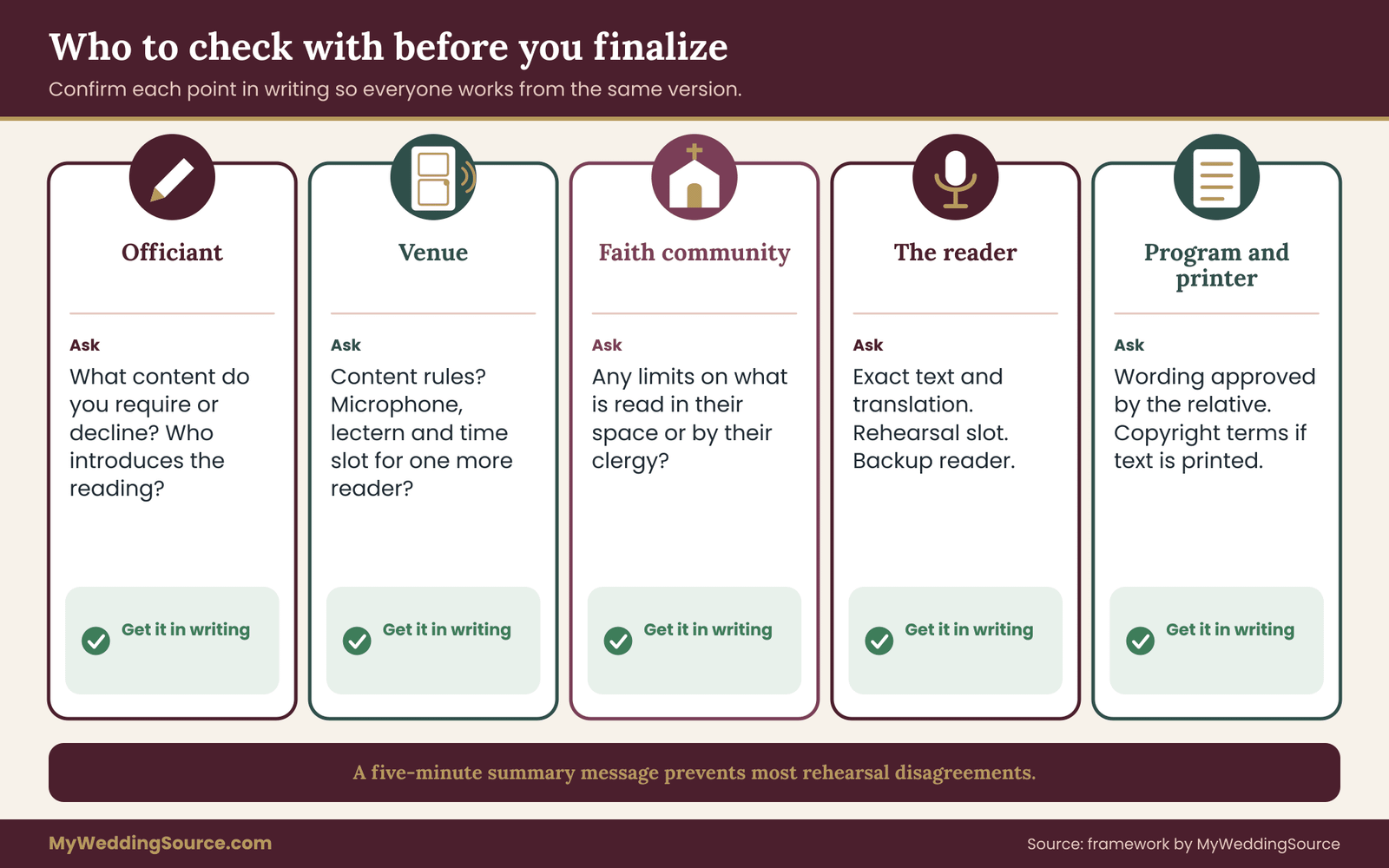
Pulling the details together, here is what to have in hand before the program goes to print. You want the exact text, in a specific translation, read aloud and timed. You want the reader’s name, a rehearsal slot and a backup reader. You want the placement agreed with the officiant. You want the introduction in writing, and the program wording approved by the relative who asked. And you want a confirmation, by message, that everyone has seen the same version.
That last item is more valuable than it sounds. Many of the disagreements that appear at the rehearsal come from two people remembering different agreements. A message that says “here is what we decided” is a small piece of insurance that takes five minutes to write.
How a religious reading request interacts with the rest of the ceremony
A religious reading does not live alone. It sits in a sequence, and it changes how the elements around it are heard. Before you finalize the answer, walk through the whole ceremony in order and place the religious reading in it. The guide to the order of a wedding ceremony lays out the usual sequence if you want a reference to compare against.
Ask how the religious reading will sound after the processional music and before the officiant’s welcome. Ask whether it duplicates a theme in your own vows or contradicts one. Ask whether it creates an expectation of other religious elements later, such as a closing prayer or a blessing, that you have not planned. And ask what the ceremony feels like as a whole, since a ceremony with one carefully chosen reading and nothing else religious can feel balanced, while one with several small additions can feel like a service you did not intend to hold.
When you say no to a religious reading, and when the conversation stalls
Some requests cannot be placed anywhere. The passage conflicts with a fixed point, the relative will accept only the full version, or the ceremony is already as long as you want it to be. A no is allowed. The aim is to deliver it so that the relationship comes through intact, and to know what to do when the first no does not end the conversation.
Deliver the no yourselves, early, and in person if possible
A no that arrives through a third party, or by text, or three weeks before the wedding after weeks of silence, does more damage than the decision itself. Whoever has the closer relationship should speak, and the other should be present or visibly in agreement. Say it early enough that the person has time to absorb it and make other plans for how they want to take part in the weekend. That might be one conversation or two.
State the decision in the first minute, not the tenth. People who sense a refusal coming often sit through a long lead-in waiting for it, and hear nothing else. A short opening such as “We wanted to tell you in person that we are not going to include a religious reading in the ceremony” takes thirty seconds and puts the hard part behind both of you.
Give a reason that is about you, not about them
A no framed as a statement about the ceremony is easier to hear than one that implies a judgment of the tradition. “We are keeping the ceremony in our own words and short” is a fact about the ceremony. “We do not believe in that” is a statement about belief, and invites debate. If the real reason involves belief, you can say so plainly, without criticizing: “Neither of us practices, and we want the ceremony to say what is true for us.” That sentence is honest, it is not an attack, and it is hard to argue with.
You do not have to supply a long justification, and you should not offer reasons you do not hold. A reason that sounds like an excuse (“the venue does not allow it”) when it is really a preference tends to be discovered, and the discovery costs more than the honest answer would have.
Offer something specific in the same conversation
A bare no leaves a gap. An alternative fills it. Offer one or two options from the lower rungs of the ladder, such as a religious reading at the rehearsal dinner, a private blessing before the ceremony, a role in the program, or a seat of honor. If the person is silent or unsure, tell them you will hold the offer open and ask them to think about it.
Be careful to offer something you actually want to receive. A consolation offered without enthusiasm sounds like one. If you would not be glad to have the rehearsal dinner reading, do not offer it. Choose an offer you would honestly welcome.
What to do if the request comes back
Some relatives, after a no, will bring the topic up again, sometimes through another family member, sometimes in a joke, sometimes with a new argument. This is common and does not mean the first conversation failed. It usually means the person is still processing, or that the underlying value has not been met.
Respond the first time with the same warmth and the same answer. If the request returns, listen for whether a new value has appeared, and consider whether a different offer would meet it. If it returns a third time, it has become a boundary question and not a ceremony question. At that point you may want to say, calmly, “We have decided, and we would like to stop going back over it so we can enjoy the planning together.” Say it once, and then keep your behavior consistent: no new debates, no leaving the door ajar by accident.
When the pressure comes through guilt or through the family
Pressure sometimes shows up as statements about what the family elders will think, what the community expects, or what the relative will say to others. These are real social costs, and it is not unreasonable to feel them. It is also reasonable to decide that the ceremony will not be shaped by them.
You can acknowledge the concern without accepting the premise. “I understand that people may have opinions, and I am sorry that makes this harder for you. We have decided what is right for our ceremony, and I would be glad to talk with you about how to explain it.” Offering to help the relative with their own conversations, for example by agreeing on a sentence they can use, often reduces the pressure more than any argument.
If the pressure turns into threats, such as refusing to attend, withdrawing money or exclusion from the family, the situation has moved beyond a disagreement about a religious reading. This guide is not a substitute for professional help. A family mediator, a counselor or a trusted clergy member from a tradition the family respects can sometimes talk through a conflict more effectively than the people inside it. The American Psychological Association and the Association for Conflict Resolution both list how to find qualified practitioners. If anyone feels unsafe, the priority is safety and not the ceremony.
Bringing in a neutral third party
A neutral person can help when you and the relative keep returning to the same impasse. This might be the officiant, a respected relative who is not directly involved, or a professional mediator. The role is not to decide, but to help each side hear the other and to propose options neither had thought of.
Before bringing someone in, ask the relative whether they would welcome it. A third party invited without consent can feel like an ambush. If the relative agrees, give the person a short, fair summary of both views, shared with the relative first. A good summary can fit in three or four sentences, and describes the value, the limits and the options already tried.
Deciding when the answer is final
At some point, you have heard the person, offered what you can, and held your limit. The conversation will not end with agreement. You can still decide that it is finished. Tell your partner, so you are aligned (the broader shared input without losing control principles apply here too). Tell the officiant, so the script is locked. And tell the relative, once, kindly, that the plan is set. Then stop reopening it yourselves. Part of what keeps a settled question alive is a couple who keep apologizing for it.
Keep the door open for a repaired relationship, and for the offer you made. A relative who is hurt at the start often comes around by the day, particularly if the alternative you offered is sincere. And if they do not, the wedding can still be a good day. A no that you gave with care is not a failure of the relationship, even when it is painful.
Verifying details with your officiant, venue and faith community
The requests discussed so far are matters between you and your family. Some parts of the answer depend on other parties, and it is better to check them than to assume. This section is about what to confirm, with whom, and what to do when the answer limits your options.
The officiant
Your officiant’s role differs depending on who they are and what they believe. A clergy member from a particular tradition may have required elements, such as a specific form of vows or a statement of faith, and may be unwilling to omit or add content outside their tradition’s rules. A civil officiant typically has more flexibility, but still must follow the legal requirements for solemnizing a marriage in your state. A friend who is ordained online may have their own limits on what they are comfortable reading.
Ask early, in writing: what content do you require, what content will you decline, and how do you prefer a request from a family member to be handled? If a requested religious reading will be read by someone other than the officiant, ask whether they are comfortable introducing it. If you have not yet chosen an officiant, you can use this as a selection question. The earlier guide to officiant requirements covers the legal side, and the official government pages for your state’s marriage license process confirm who may solemnize a marriage. USAGov points to the state offices that issue licenses and explain their rules.
The venue
If the ceremony is held at a place of worship, the community may have rules about what can be read, who can read it and what the ceremony must include. If it is at a secular venue, such as a garden, a hall or a hotel, the rules are usually about logistics, such as sound equipment, timing and noise, and rarely about content. Some venues that are owned by religious organizations have content policies even for rented spaces, so ask directly instead of assuming.
Also ask about practical matters that a religious reading can affect. If you add a reader, do you need an additional microphone? Is there a lectern? Will a long reading push the ceremony into the time slot of the next event? A request to add one minute is trivial for most venues, but venues with tight turnovers may care.
The faith community
If the family member belongs to a tradition with its own clergy, consider whether that clergy member could help. In some cases a family’s minister, priest, rabbi, imam or other leader will have a view on what is appropriate in an interfaith or non-religious ceremony, and may be able to reassure the relative that a shorter or reframed reading is acceptable within the tradition. In others, they will not. Do not assume either, and do not ask in a way that sounds like seeking permission. You are seeking information, and the relative may be the best person to ask.
If your own faith community is involved, the same applies in reverse. Some traditions place limits on what may be read in their space or by their clergy, and learning that two months earlier is much better than learning it at the rehearsal. The guide to interfaith ceremony planning discusses how to establish ritual ownership when more than one tradition is present.
What official sources can and cannot tell you
Official sources can tell you who may solemnize a marriage in your state, what the license requires and how the signed license is returned. They generally do not tell you what to say in a ceremony. Etiquette sources, such as the Emily Post Institute, offer general guidance on handling family expectations, but they are advice, not rules. Where an etiquette suggestion conflicts with your own values or your officiant’s requirements, the latter wins.
Be wary of any source that claims universal rules for family conflict. Families differ, traditions differ and the same sentence can be warm in one household and cold in another. The most reliable guidance is local: the officiant who will perform your ceremony, the venue that will host it and the family member you are speaking to.
Limits of this guide
This guide offers a framework for conversation, not a prediction of how a particular relative will respond. It cannot tell you what your tradition permits, what your state requires or whether a particular passage is suitable for your ceremony. It also cannot replace professional help when a family conflict is severe. What it can do is give you a structure that tends to lower the temperature, and a set of options that treat everyone with respect. When your situation is outside the range of ordinary disagreement, seek help from someone qualified.
After the decision: protecting the day and the relationship
A decision made in March can unravel at the rehearsal in June. Most of the risk comes from three sources: people who remember the agreement differently, last-minute additions from well-meaning relatives, and strong emotions on the day. A little structure in the final weeks keeps the agreement intact.
Lock the script and share it
Once the ceremony script is final, send it to the officiant, the readers and the two or three people most likely to be asked questions by relatives. Include the religious reading, its placement, its length and the introduction. The point is not to invite edits but to make sure everyone is working from the same page. If you have a cue sheet for the ceremony, the religious reading and its introduction belong on it as a numbered item with a name and a time, just like the processional.
If a relative has asked for something that was declined, it helps for the officiant and the rehearsal coordinator to know. They can then redirect a spontaneous request on the day, such as “could Aunt Carol say a quick prayer at the end?”, without having to make a decision at the microphone.
Handle the rehearsal with care
The rehearsal is where small questions surface. A reader may ask to change a line. A relative may arrive with a different translation. Someone may ask whether guests will be invited to respond. Have a calm answer ready for each, and have a single person, ideally the officiant or a coordinator, who answers on your behalf, so you are not negotiating while standing in the aisle.
If the reader brings a different version than agreed, compare it with the approved text and decide quickly. If the difference is a word or two, accept it. If it adds a line you did not approve, say so kindly and ask them to use the agreed version. Do it in private, not in front of the whole family, and thank them for the effort.
The day itself
Do not try to supervise the religious reading on the day. Brief the reader, thank them and let go. If you have asked someone to stand in as a point of contact, such as a coordinator or a trusted friend, route any last-minute questions to them. A couple who is fielding a family conversation fifteen minutes before the processional is a couple who is not present for their own wedding.
If something unexpected happens, such as a reader who adds a sentence or invites guests to join in prayer, take it as it comes. A guest who feels pressure may feel awkward for a moment. The ceremony continues, and most guests take such moments in stride. You are allowed to feel a flicker of irritation and still move on. If the departure was significant, there will be time afterward to discuss it with the person.
Seat and acknowledge the person who asked
One of the simplest ways to honor the value behind a request, even when the format was limited, is to give the relative a visible place of honor. That might be a seat in the front row, a mention in the program, a photograph with you, or a moment during the reception when you thank them. When a request was declined, these gestures matter more, because they tell the person that the relationship is secure even though the passage was not included.
Consider writing a short note afterward, thanking the person for what they contributed and, if appropriate, for their understanding. This is not an apology. It is an acknowledgment that the relationship continued past the decision.
If it did not go smoothly
Sometimes, despite good planning, a relative is hurt, or a guest comments, or a religious reading lands differently than you hoped. Give it a few days before responding. Then reach out, in person if possible, and focus on the relationship and not on rehashing the ceremony. You might say that you noticed they seemed upset, that you care about how they felt, and that you would like to talk when they are ready.
Do not relitigate the decision. You can acknowledge a feeling without reopening the question. “I am sorry that was hard for you” is not an admission that you were wrong. It is a recognition that the person was affected.
Keep a short note for yourselves of what you learned. If you have other family decisions ahead, such as holiday traditions, naming ceremonies, or a future child’s upbringing, the process you used here is a template. Values first, then format, then frame, and one clear answer with a date.
Your next steps
Start with the two of you. Set aside an hour this week to answer the three questions separately and then together, and write down your fixed points and your flexible points. Keep the fixed list to two or three items. Then ask the person who made the request what the religious reading means to them, and listen before you offer anything.
After that, choose the highest rung of the ladder that fits your limits and offer it with a frame and a date. Confirm the details with your officiant and venue, put the religious reading on the ceremony cue sheet with its length and its introduction, and send the relative a short written summary of what you agreed. If the answer has to be no, say it early, say it kindly and attach an alternative you would be glad to give.
FAQ
Do we have to include a religious reading just because a parent or grandparent asks?
No. The ceremony belongs to the two of you, and a request is a request. That said, many couples find a way to honor the value behind it, through a short framed reading, a religious reading at another event or a private blessing. Decide with your partner first, then respond to the relative with a clear answer and a date.
What if my partner and I disagree about whether to include the reading?
Resolve that before answering anyone else. Each of you writes down your objection and what you could accept, then you compare. Usually the partner with the stronger limit sets the outer boundary, and the other shapes how the answer is delivered. If you cannot agree, a neutral third party, such as a counselor or your officiant, can help.
How do we say no without offending the person?
Say it early, in person, in the first minute of the conversation, and frame it as a fact about your ceremony, not a judgment of their faith. Acknowledge what the religious reading means to them, then offer a specific alternative, such as a religious reading at the rehearsal dinner or a private blessing. Keep the explanation short, since long reasons invite rebuttal.
Can a religious reading be read in a non-religious ceremony?
Yes, if you are comfortable with it. Many couples include a short religious reading from a relative, introduced as that person’s choice, without making the ceremony religious overall. The introduction matters most, because it tells guests whose gift the religious reading is. If the content is a problem, offer a different text with a similar meaning.
Does our officiant have to agree to include it?
Often yes, because the officiant presides over the ceremony and may have their own limits. Clergy may require or exclude certain content under their tradition, while civil officiants usually have more flexibility. Ask in writing, early, what they will include and what they will decline. Confirm the legal requirements for solemnizing a marriage with your state’s marriage license office.
What if a relative reads something different on the day?
Prevent it with a written agreement on the exact text, a rehearsal and a single point of contact. If it happens anyway, let the ceremony continue and address it afterward, privately and kindly. A short written summary of what was agreed, sent weeks earlier, makes any follow-up conversation much easier because everyone can see what was said.
Should we offer a reading at another event instead?
It can work well when the ceremony is tightly planned. The rehearsal dinner, a welcome brunch or a family gathering gives the relative a public moment without changing the ceremony. Present it as a place of honor and not a consolation, and offer it only if you would be glad to host it. Let the relative decide if it suits them.
When should we get outside help with a family disagreement?
When the conversation repeats without progress, when the relationship is suffering, or when the disagreement includes threats, withdrawal of support or exclusion. A family mediator, a counselor or a trusted clergy member can help. If anyone feels unsafe, safety comes first and the ceremony second. Professional organizations can help you find qualified practitioners in your area.
Sources
- Emily Post Institute, etiquette guidance
- How to get a copy of a marriage certificate or a marriage license, USAGov
- National Conference of State Legislatures
- Religion research, Pew Research Center
- U.S. Copyright Office
- American Psychological Association
- Association for Conflict Resolution
- American Bar Association
- Library of Congress