
A film photography add-on is a defined slice of your wedding coverage that your photographer shoots on film instead of, or alongside, digital. This guide explains what to ask for, how to count rolls, how long the lab work takes, what happens if a roll fails, and which deliverables to write into the contract before you pay a deposit.
Treat a film photography add-on as a short brief, not a vibe. Write down what role film plays (extra flavor, a main look, or a few key scenes), which moments go on film, how many rolls and which format, who pays for processing and scans, the date the scans are due, and what digital backup runs alongside. Ask for the film files, the negatives and the usage rights in writing. Then confirm the plan with your photographer and the lab, since film adds steps that digital does not.
Film has come back into wedding photography for ordinary reasons. Some couples like the soft color and grain. Some like that a roll of film forces a photographer to slow down and choose. Some simply grew up with photo albums full of prints and want that feel in their own. Whatever the reason for choosing a film photography add-on, the moment you say “we would like some film” to a photographer, a handful of practical questions appear that digital shooting never raised. How many rolls is “some”? Who develops them? When will you see anything? What if a roll comes back blank?
This is where a film photography add-on gets misunderstood. On a vendor page it often looks like one line: “film coverage, add $X.” Behind that one line sits a small production process with a camera, a stock of film, a lab, a scanner, an editor and a shipping box. Each step can be done well or badly, and each has a date and a cost. If you only agree to the line, you are leaving all the other steps to chance.
The goal here is to give you a way to make the decisions behind a film photography add-on in an evening, in plain language, and to put them on paper. You do not need to know f-stops or emulsions. You need to know which questions to ask and what a good answer sounds like.
A note on scope. This is general information, not legal, tax or financial advice. Contract terms, copyright and consumer protections differ by state and by vendor, and they change. Where a rule matters, this guide points you to the agency or the vendor that publishes it, so you can confirm the current version yourself.
What a film photography add-on is, and what it is not
A film photography add-on is an optional package, priced separately from your base photography package, in which some or all of your wedding images are captured on photographic film. The photographer sends the exposed film to a lab, the lab develops it, and the images are scanned into digital files that you receive in a gallery. In some versions you also receive the physical negatives or prints.
That definition leaves out a lot, and the gaps are where couples get surprised. Three separate arrangements all get called “film photography add-ons,” and they behave very differently.
Film as an accent. Your photographer shoots most of the day digitally and brings a film camera for a few chosen scenes, such as portraits or details. You receive a small set of film scans mixed into a mostly digital gallery. This is the lowest-risk and lowest-cost version.
Film as a co-lead. Film and digital share the day, often with the photographer carrying two bodies, or with a second photographer shooting the other medium. The gallery blends both, and the film portion is large enough to feel like a real part of the story.
Film as the primary medium. Nearly everything is shot on film, with a digital camera held in reserve for low light and for insurance. This is the most demanding version, because the result depends on exposure choices made without a preview screen and on a lab pipeline that takes weeks.
Most of this guide helps you choose among those three. The right choice depends less on taste than on your timeline, your venue’s light, and how much uncertainty you are comfortable with.
What a film photography add-on is not
It is not a filter. Digital images can be edited to look like film, and many photographers do exactly that. That is a legitimate style choice, but it is a different product with a different price and no lab steps. If a package says “film look,” ask whether it means real film or an editing preset. Neither answer is wrong. They just shouldn’t be priced as if they were the same thing.
It is not a guarantee of a certain look either. Film behaves differently depending on the stock, the lab and the scanner. Two photographers using the same camera and the same film can deliver noticeably different color because the scanner settings differ. When you look at a portfolio, you are looking at a lab pipeline as much as a photographer.
It is also not the same as a table of disposable cameras. Guest cameras are a separate idea with their own handling, and they come up later in this guide. A professional add-on means a trained person is choosing every frame.
Why a film photography add-on deserves its own planning
Digital coverage fails quietly and recoverably. A bad frame is deleted, another is taken a second later, and the photographer sees the result on the back of the camera. Film coverage fails later and less visibly, which is the central planning problem of a film photography add-on. An underexposed roll is discovered at the lab, days after the wedding, when nothing can be reshot. A package that handles that possibility in writing costs you almost nothing extra. A package that ignores it can cost you images you cannot replace.
That asymmetry is the main reason this topic is worth an article of its own, and it is why backup coverage and delivery dates appear in the title. The rest of the planning, such as choosing moments and counting rolls, is mostly craft. The part you control as the client is the paperwork and the questions.
How this fits with the rest of your photography planning
A film photography add-on sits inside a larger set of photography decisions. Your base package, shot list and timeline come first, and your family photo list usually decides how much of the day is formal and how much is documentary. Guest privacy and image use matter too, and the guide to wedding photography consent covers guest boundaries and posting rules in depth. This article assumes those basics are handled and focuses only on what film changes.
If you have not yet chosen a photographer, finish that decision first. A film photography add-on is something you negotiate with a photographer who already shoots film well, not something you bolt onto any package. The final section of this guide includes a short list of verification questions to use during those conversations.
The three lanes idea for a film photography add-on
One way to keep the whole subject in your head is to think in lanes. In the film lane are the frames you want on film. In the digital lane are the frames that must be captured digitally because of light, speed or importance. In the safety lane are the digital frames that duplicate key film moments, so that nothing irreplaceable depends on one roll. Every decision in this guide is a choice about what goes into each lane and what each lane costs.
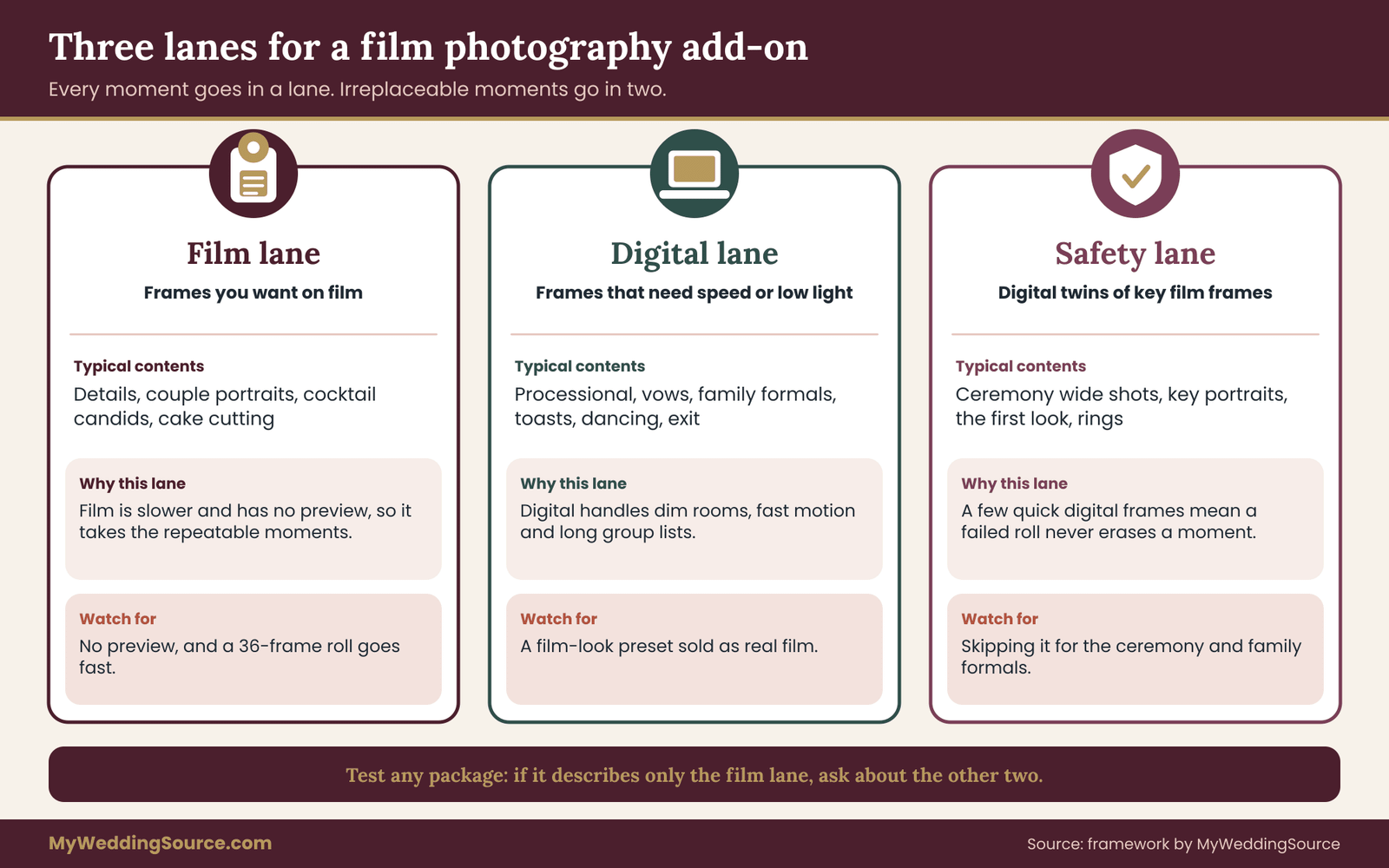
The lanes also give you a quick test of any vendor’s film photography add-on package. If a package describes only the film lane, ask about the other two. If it describes all three, you are likely dealing with someone who has been through the process before.
The six-line brief for a film photography add-on
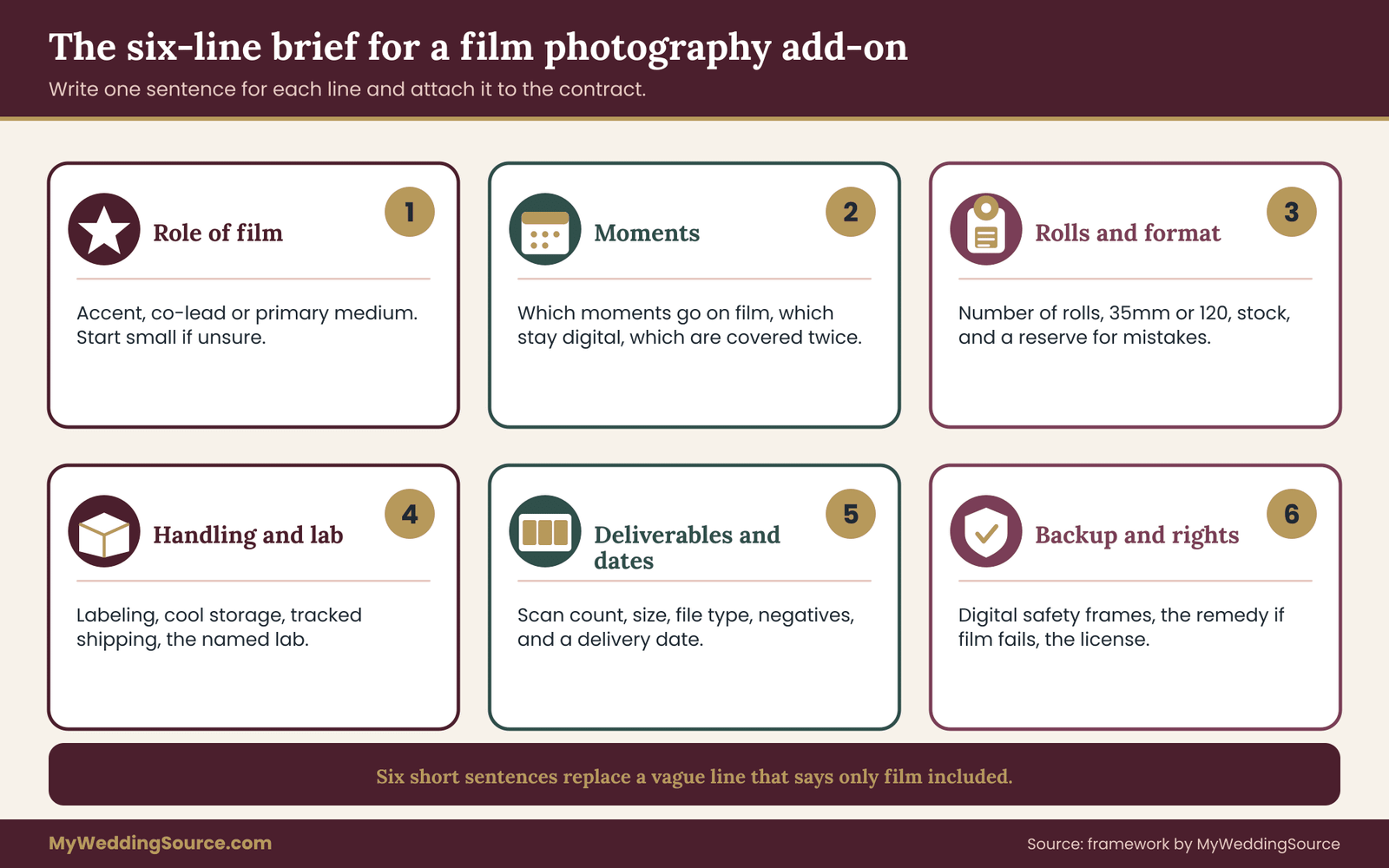
Photographers who shoot film well usually already have a process for a film photography add-on. What they may not have is your version of it written down in one place. The six-line brief below is meant to be sent to your photographer as a short email or filled in together on a call. It turns a vague wish into something both sides can check later.
Keep each line to a sentence or two. If a line takes a paragraph, the plan is not clear yet. You can copy the structure as it is.
Line one: the role of film
Start with the role, because every other line depends on it. Say whether film is an accent, a co-lead or the primary medium, using the three arrangements from the previous section. A simple way to say it is: “We would like film to cover the portraits and the ceremony, with digital for the reception and as a backup for the ceremony.”
If you are unsure, choose accent first. You can always add rolls later if the photographer has capacity, but you cannot easily reduce a film-heavy plan once the photographer has rented gear, bought stock and booked lab time. Starting small also lets you judge the lab’s delivery before you commit more of the day to it.
Line two: the moments for the film photography add-on
Name the moments that go on film and the moments that stay digital. Section three of this guide goes through the decision rules in detail. For the brief, a short list is enough: for example “getting-ready details, couple portraits, ceremony wide shots, cake cutting” on film and “processional, first dance, open dancing, exit” on digital.
The reason to write this down is that photographers make a hundred small calls during a wedding. When two moments compete for attention, the brief tells them which camera wins. Without it, they will decide on the spot, and their choice may not match yours.
Line three: rolls, format and stock for the film photography add-on
Give the photographer room to choose the stock, since they know their lab and their light meter, but ask them to state what they plan to use. A usable answer looks like: “About twelve rolls of 35mm color negative and four rolls of 120 black and white, with six extra rolls held in reserve.” You do not need to evaluate the stock. You do need a number, a format and a reserve, so that the price can be compared and the plan can be checked after the wedding.
The next two sections explain how those numbers are worked out. For the brief, the important point is that “unlimited film” is not a real plan. Film is a consumable with a unit cost, and a photographer who promises unlimited rolls is either absorbing the cost, shooting very few frames per roll, or not describing the plan honestly.
Line four: handling and processing
State who handles the film from the camera to the lab. Ask which lab will develop it, whether the same lab will scan it, and how the rolls are stored between the wedding and the shipping day. This is the line most couples skip, and it is the line where most film problems start. Heat, humidity, airport screening and lost parcels are all handling issues, and none of them is visible in a portfolio.
A reasonable written answer might be: “Exposed rolls are labeled, kept in a cool bag, and shipped to the lab within three business days using tracked and insured shipping. The lab develops and scans.”
Line five: deliverables and dates
Write the output you expect. How many scanned images, at what size and file type, with what level of editing, by what date? Do you also receive the negatives? Are prints included, or only digital files? Section seven lists every deliverable worth asking about. For the brief, a single line will do: “Full-resolution scans of all keepers, a web gallery within eight weeks of the wedding, and the negatives returned to us.”
Put the date in. A date turns a promise into something you can follow up on. If a photographer will not name a date, ask for a range and a reason. Film turnaround does vary, but the variation can be explained.
Line six: backup and rights
The last line covers what happens if something goes wrong and who owns what. Ask for a short statement on how the key film moments are duplicated digitally, and what the photographer offers if a roll is lost or unusable. Then ask what license you receive for the film files and whether the negatives belong to you.
Rights are easy to skip because they feel legal and distant. They are also the most common source of friction later, when you want to print a large canvas or share a photo with a magazine or a venue. Confirm them while everyone is still friendly.
A short script you can adapt
If you prefer to say it than write it, here is a way to open the conversation without sounding like a lawyer: “We are interested in a film photography add-on, and I would like to make sure we understand how it works. Could we go through six things together: what film covers, which moments, how many rolls, who develops and scans, when we receive the images, and what happens if a roll does not turn out?”
Most professionals will appreciate the clarity. A photographer who bristles at those questions is telling you something useful before you have signed anything.
What a good answer sounds like
Good answers are specific. They name a lab, a number of rolls, a delivery window and a fallback. They admit what can go wrong without drama. For example: “Film is forgiving about exposure but less forgiving about low light, so I will switch to digital for the reception, and I shoot a few digital frames next to the key film frames, so you are covered if a roll fails.”
Weak answers are vague or promotional. They lean on words like “authentic” and “timeless” and say little about process. A heavy emphasis on mood with no mention of rolls, labs or dates is a sign that the details have not been worked out, or that they are being kept from you.
Matching the film photography add-on brief to the contract
A brief is not a contract. Once you and your photographer agree on the six lines, ask that the agreed text be attached to or summarized in the contract. If the contract says only “film coverage included” and the brief lives in an email thread, the contract is what counts if there is a disagreement. Your vendor contract review guide explains how to read the clauses that surround this one, such as deposits, cancellations and liability.
When the plan changes
Weddings change, and so should the brief for your film photography add-on. If your ceremony moves indoors, your timeline slips or your guest list doubles, revisit line two and line three. A ceremony in a dim church needs more digital coverage than the same ceremony in an open garden, and the roll count may rise or fall. Send the photographer a short updated note and keep their reply with your records.
Do the same if the photographer’s availability changes. A film photography add-on that depended on a second shooter who has since left needs an honest conversation about who now covers which lane. Treat it like any other change to a vendor’s scope: write it down, price it, confirm it.
Common mistakes with a film photography add-on brief
Several errors come up repeatedly. Couples ask for “all film” without understanding the light limits of their venue. They agree to a price without checking whether processing and scanning are included. They never ask for a delivery date. They assume the negatives come with the scans. They forget that a film photography add-on adds a second set of dates to an already busy timeline. All of these are fixable by a single email, ideally sent before the deposit is paid.
The next section moves from the brief to the practical question that decides the most: which parts of your day are well suited to film, and which are not.
Choosing which moments go to film, and where film struggles
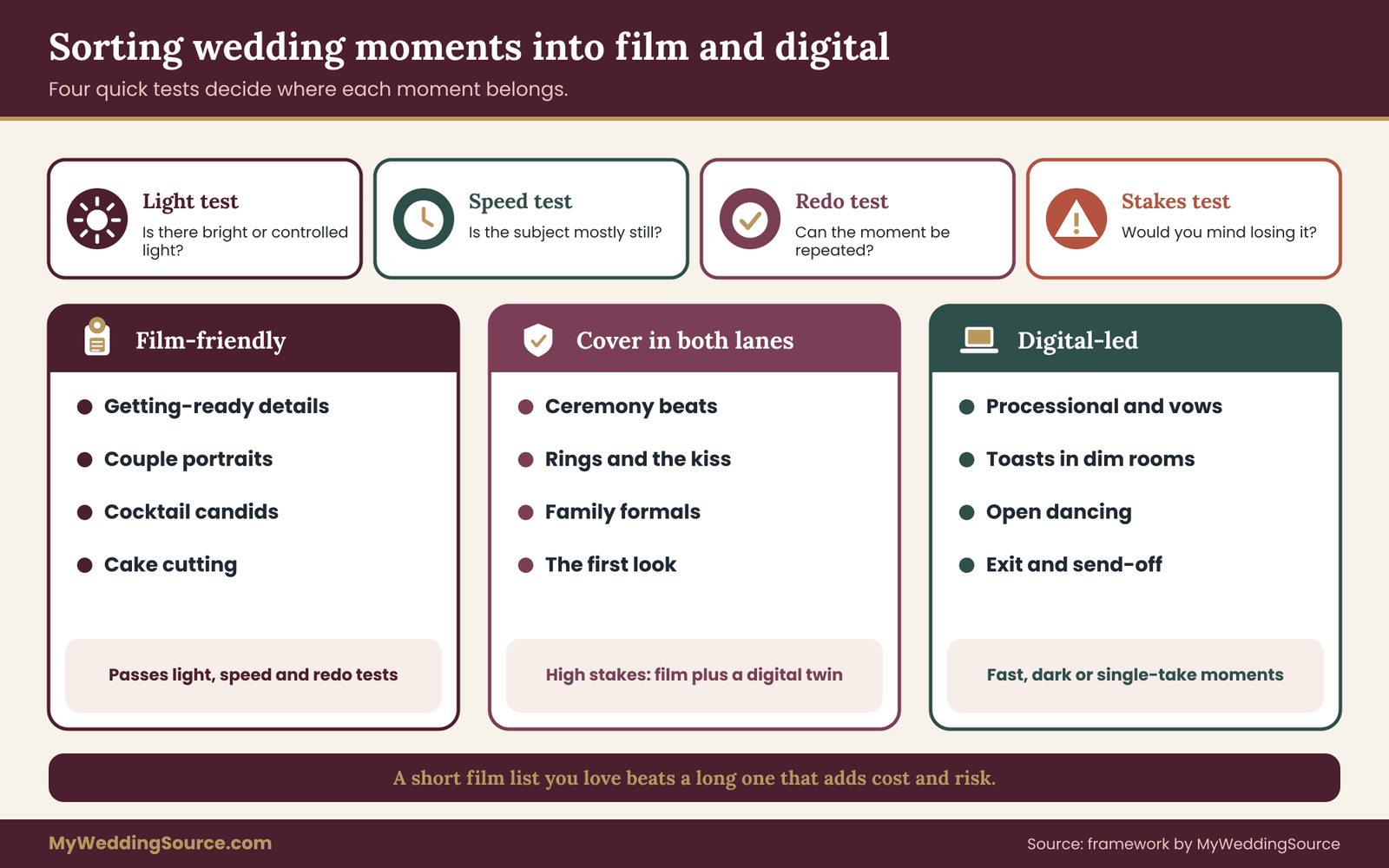
The second line of the brief asks for a list of moments. This section gives you a way to sort them for a film photography add-on without needing technical knowledge. It uses four plain tests, and any moment that passes all four is a good candidate for film.
The four tests
The light test. Is there plenty of natural light, or controlled light the photographer can add? Film needs more light than a modern digital sensor does, especially color negative film in the common speeds. Bright outdoor scenes, open shade, windows with daylight and well-lit spaces suit film. Candlelit rooms, deep shade and dark reception halls do not, unless the photographer plans to use flash.
The speed test. Is the subject mostly still, or moving quickly? A couple standing by a window, a bouquet on a table or a portrait in a garden are slow subjects. A flower girl running down an aisle, a dance floor in full swing or a bubble send-off are fast. Film can capture fast subjects, but it takes more frames, and each frame costs money you do not see until the lab bill arrives.
The redo test. Can the moment be repeated if something goes wrong? Portraits can be retaken in a few minutes. Details can be placed again. A ceremony kiss, a toast or a parent’s reaction happens once. The less repeatable the moment, the more it needs a digital safety frame next to the film frame.
The stakes test. How much would you mind if this single moment did not come out? Be honest. If the answer is “a great deal,” that moment belongs in the safety lane, with digital coverage regardless of what else happens.
A moment that passes the light, speed and redo tests, and where a failure would be tolerable, is a strong film candidate. A moment that fails two or more should stay digital or be covered in both.
A walk through the day
Here is how those tests tend to play out across a typical wedding day. Your own venue and schedule will change the answers, which is why the brief is written per wedding and not per photographer.
Getting ready. Details such as rings, shoes, invitations and the dress on a hanger are slow, repeatable and usually shot near a window. They are good film territory, and they are a gentle way to start a film photography add-on because the cost of any one missed frame is low.
First look and couple portraits. These pass nearly every test. The photographer controls the time, the place and the pose, can meter carefully and can retake a frame. Many film-leaning couples start here and stop here, and that is a perfectly reasonable add-on.
Family formals. Group shots need consistent exposure and speed. A big group with many faces is stressful on film because a blink or an unready relative means another frame and sometimes another roll. Your family photo list helps decide how many groups there are. A short list can go on film. A long list is usually safer digital, with perhaps a few film frames of the immediate family.
The ceremony. This is the central stakes question. Ceremonies are single-take events, often in mixed light, with rules from the venue or officiant about flash and movement. A photographer may shoot the processional and the kiss on both film and digital, and leave the quieter wide shots to film alone. Many couples decide that film belongs on the ceremony only if a digital frame duplicates every key beat.
Cocktail hour. Candid moments with guests are good for film if the light is decent and the photographer moves slowly. If the cocktail hour is in a dim lobby or inside a bar, digital will cope better.
Reception entrances, toasts and speeches. Speeches are fairly still but the room is often dim. A photographer shooting film here needs flash or faster film, and flash during speeches can distract the speaker. Many photographers shoot the toast on digital and use film for reactions near a window or lamp.
Cake cutting. Short, repeatable and well lit by the room, it is a good film moment.
First dance and open dancing. This is the hardest film territory, because of low light, movement and flash. Photographers who love film often use direct flash on film for energetic dance-floor frames, and the look can be wonderful. It also uses rolls quickly. If you care about dance-floor coverage, ask how much digital will run alongside.
Exit and send-off. Dark, fast and unrepeatable. It is normally digital, and a film frame or two before the exit is a bonus.
Using the walk-through to build lane lists for your film photography add-on
Take a sheet of paper and write three headings: film lane, digital lane, safety lane. Move each moment into the lane that matches the tests. Your first draft will probably put too much into film. That is normal, and it comes from picturing the best-case version of the day. Move things out until the film lane contains only moments you would still love if they were the only film frames from the day.
Be generous with the safety lane for the ceremony and the family formals. Those are the places where couples most often feel regret, because they are the shots relatives expect to see.
Black and white versus color
Some couples add a black-and-white roll or two to a color plan. Black-and-white film is usually more forgiving in tricky light, and it handles mixed lighting without the color casts that appear in color images. Ask your photographer which they prefer for which moments. A small black-and-white allocation for portraits and candids is a common, low-cost way to add variety.
If you want some images in black and white, remember that a digital file can be converted afterward, and that a film black-and-white image is a different thing, with its own grain and tones. Ask to see examples of both from the same photographer, so you can decide whether the difference matters to you.
The limits of a film photography add-on at weddings
A film photography add-on has honest limits, and a trustworthy photographer will tell you what they are.
No preview. On a digital camera, the photographer can look at a frame and fix a problem. On film, the result is a surprise, sometimes a few days later. Experienced film photographers rely on light meters and habit, and they get very consistent results, but no one is perfect on a day with fast-changing light.
Limited frames per roll. A roll of 35mm film is commonly sold as 24 or 36 exposures, and 120 medium format film yields far fewer frames per roll depending on the camera. When a roll runs out during an important moment, the photographer has to reload, and the gap can be a few seconds. That is why the safety lane matters during a ceremony.
Low-light constraints. Film comes in different speeds, and faster film is grainier. You can push film in processing to gain sensitivity, but the lab must be told in advance, and the result has a different look. Venues with candles, string lights only or very dim rooms are the places where a film photography add-on is most likely to disappoint. Flash helps, and some venues restrict it during the ceremony.
Venue and officiant rules. Some houses of worship and venues limit flash or ask photographers to stay at a distance. Check these rules early, because the light problem remains even where a quiet camera is allowed. Ask your venue about their photography rules, and share them with your photographer.
Travel and weather. Heat, humidity and long hours in a car can age film. A destination wedding adds airport screening and the risk of lost bags. The turnaround section covers these in more detail.
When a film photography add-on is the wrong choice
There are weddings where a film photography add-on is not a good fit, and saying so is better than forcing it.
If your ceremony is in a dark venue with no flash allowed and you want every frame to be sharp, digital is safer. If your budget is tight and you would have to cut the number of hours of coverage to afford film, usually hours matter more. If your timeline is so compressed that the photographer needs every minute to be moving, the slower rhythm of film may not fit. And if you need photos within a few days, for example for a news announcement or an immigration application, film turnaround may not meet your needs.
None of these are failures. They are trade-offs you can see before you sign. A thoughtful photographer will tell you honestly, and may suggest a smaller film photography add-on, such as portraits only, that preserves the main benefit with less risk.
Editing your film photography add-on list
After you have sorted the moments, read the film lane once more and delete any item you are only including to look film-friendly. A short list of film moments that you love is better than a long list that adds cost and risk. The roll budget for your film photography add-on in the next section depends on the length of that list, and every moment you remove makes the plan simpler and cheaper.
Rolls, formats and what a film photography add-on costs
Line three of the brief asks for rolls, format and stock. This section explains the arithmetic so you can read a quote and tell whether the numbers make sense. No special knowledge is needed, only a calculator.
Film formats in plain language
Film comes in a few sizes, and the size determines how many pictures fit on one roll.
35mm is the familiar small format. Rolls are commonly sold as 24 or 36 exposures. It is compact and quick to shoot, which suits candid moments, details and walking portraits.
120 medium format is a larger film in a roll that holds fewer frames. The number depends on the camera: roughly 15 or 16 frames on a 645 camera, 12 on a square 6×6 camera, 10 on a 6×7 camera, and 8 on a 6×9. The larger negatives show finer detail and a different depth, and many portrait photographers prefer them. The trade-off is that each roll covers fewer frames, so the cost per frame is higher and rolls need changing more often.
Large format and instant film exist too, but they are slow, specialized and uncommon in wedding add-ons. If a photographer offers them, treat them as a separate artistic extra and ask separately how they are priced and delivered.
When a vendor says “ten rolls,” always ask “of which format?” Ten rolls of 35mm and ten rolls of 120 are very different numbers of pictures.
Stock, speed and what they mean for you
A film stock is the type of film: color negative, black and white, or slide film (also called reversal). Color negative is the common choice for weddings because it tolerates a range of exposure and is easy for labs to scan. Black and white has its own look and is often added for portraits. Slide film produces a positive image and is much less forgiving of exposure mistakes, so it is a niche choice.
Speed is shown as an ISO number. A lower number needs more light and has finer grain. A higher number works in dimmer light and looks grainier. You do not have to pick, but you should know that a photographer’s choice of speed is tied to your venue’s light, which is one more reason to share your venue and your timeline early. A photographer who plans a dark winter reception will pick differently from one planning a sunny garden party.
If a photographer mentions “pushing” film, they mean asking the lab to develop it as if it had been exposed at a higher speed, so it can be used in dimmer light. It works, but it changes contrast and grain, and the lab must be told before processing. Ask whether pushing is planned and whether it is included in the price.
The roll budget formula for a film photography add-on
Counting rolls is a short chain of steps. Here is the logic, in words.
- List the film moments from your lane list and estimate how many final images, or keepers, you hope to receive from each one.
- Apply a shooting ratio. Photographers do not get a keeper from every frame. Portraits might need two frames per keeper, candid moments three or more, and group shots more again. Ask the photographer for their own ratio, because it depends on their style and the subject. The ratio times the keepers gives the frames needed.
- Add the frames up across all moments.
- Divide by frames per roll for the chosen format, and round up. A fraction of a roll still takes a whole roll.
- Add a reserve for mistakes, weather, a roll that must be abandoned, or extra frames for moments that run long. Photographers differ on how much spare film they carry, so ask what they plan.
A short example makes it concrete. Say you want about thirty portrait keepers on a 645 camera, and the photographer expects two frames per keeper. That is sixty frames. A 645 roll holds about fifteen, so sixty frames is four rolls. A reserve of one extra roll gives five. If the same portraits were shot on 6×7, with ten frames per roll, you would need six rolls plus a reserve. The format choice alone changes the roll count by a third.
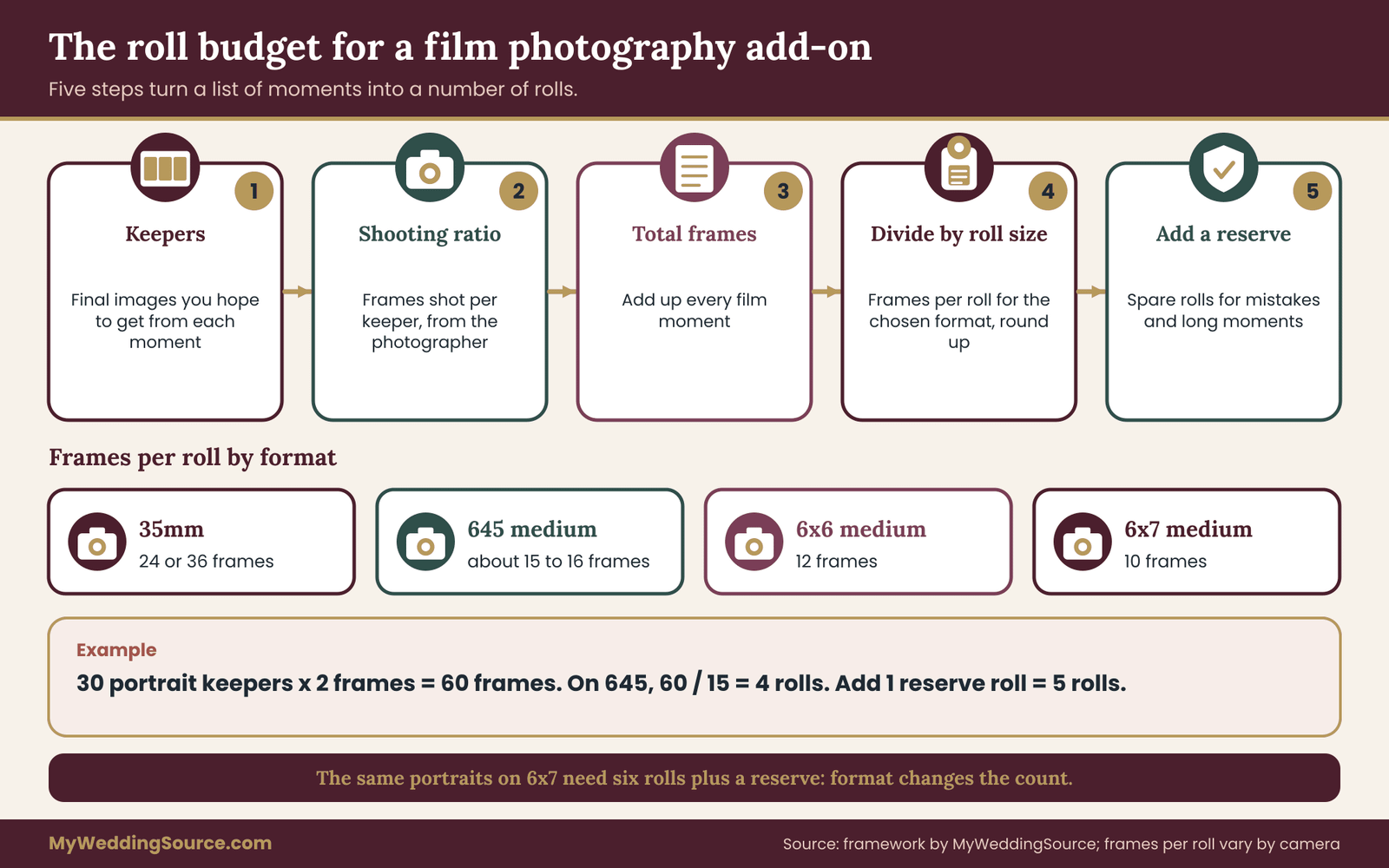
None of these numbers are universal. They are an illustration of the method. What matters is that your photographer can walk you through their own version in a few minutes. A photographer who cannot explain how they arrived at their roll count may not have thought it through.
Why a roll count is not the same as an image count
Couples often compare film and digital by image count, and the comparison can mislead. A digital package might say “400 edited images,” because digital frames are free to take and cheap to cull. A film package might say “12 rolls,” which could produce around 400 frames in 35mm, but fewer keepers, because film photographers shoot more deliberately and rarely fire off bursts.
Judge the film portion of a gallery by the quality and variety of the portfolio, not by a count. Ask to see a complete film gallery from a past wedding, not just a highlight reel, so you can see how many frames are strong, how consistent the color is and how the story reads from start to finish.
What goes into the price of a film photography add-on
A film photography add-on has costs that digital does not. Knowing them lets you read an itemized quote and compare vendors fairly.
Film stock. The raw film itself is a per-roll cost, and it varies by format and type.
Processing. The lab develops each roll, usually at a per-roll fee, and may charge more for pushed film or special handling.
Scanning. The lab or the photographer scans the negatives into digital files. Scan prices are often per roll, and resolution, file type and color correction can change the price.
Shipping and insurance. Tracked, insured shipping to and from the lab has a cost, and it is more important than it sounds because exposed film is irreplaceable.
Equipment. A film camera, lenses, flash and light meter may be separate from the digital kit, and a second body can mean extra rental or wear.
Photographer time. Shooting film is slower, and the photographer spends time loading, metering, labeling and managing rolls. Editing film scans is also part of the job, though it is often lighter than a full digital edit.
Negatives and prints. Returning negatives, scanning to higher resolution and ordering prints are usually separate line items.
Ask for the film photography add-on to be itemized, or at least split into three parts: the photographer’s fee, the film and lab costs, and optional deliverables. A single number is fine for budgeting, but an itemized quote helps you see what changes if you adjust the plan.
Common pricing models for a film photography add-on, compared in prose
Photographers price film photography add-ons in a few ways, and each shifts risk in a different direction.
A flat fee that includes a set number of rolls, processing and scanning. This is the simplest to budget. The risk is hidden limits: ask what happens if more rolls are needed, and whether the flat fee covers pushed film or lost rolls.
A flat fee for the photographer’s time plus film and lab costs billed at cost. This is transparent, and your final cost follows the actual rolls used. The risk is a surprise bill, so ask for a cap or an estimate with a ceiling.
A per-roll price. Each roll shot, developed and scanned has a fixed price, so cost grows with use. It rewards a tight shot list and punishes a loose one, which is useful if you agree on the roll count in advance.
A higher base package that includes film. Some photographers who mainly shoot film build it into their pricing and offer digital as the add-on instead. In that case the question flips: ask what the digital backup costs and how much of it is included.
However a film photography add-on is priced, ask three things. Does the price include processing and scanning? Is there a cap or a maximum number of rolls? What is the cost if the photographer needs extra rolls because the day runs long or because a roll is damaged?
Fitting a film photography add-on into the budget
A film photography add-on competes with other priorities, such as more coverage hours, a second shooter or an album. Decide where it sits in your priorities before you receive a quote. The wedding budget guide explains how to rank categories and set caps, and the same logic applies here: if you have to choose between two extra hours of digital coverage and a film photography add-on, ask which you would regret not having.
A useful check is to price the plan three ways: no film, a small film photography add-on, and a larger one. Seeing the three numbers side by side often makes the right size obvious. Many couples find the middle option, such as portraits and details on film, delivers most of the feeling for a modest share of the cost.
Cost traps in a film photography add-on quote
Several traps show up in quotes. “Film included” with no number of rolls. “Scans” with no resolution. “Negatives available” at an extra fee that is not stated. Travel costs for the film equipment at a destination wedding. A lab fee for pushed film that is separate from regular processing. A rush fee for faster turnaround. None of these are dishonest, but each can turn a reasonable quote into a larger bill if you do not ask.
The easiest defense is the written brief from the previous section, with a rolls-and-format line that the quote must match. If the quote and the brief differ, ask which one governs.
Turnaround: from last frame to finished gallery
Digital galleries can arrive within days. A film photography add-on adds steps, and each step has a person, a queue and a date. Understanding the chain helps you ask for a realistic delivery date and spot a delay early.
The chain behind a film photography add-on, step by step
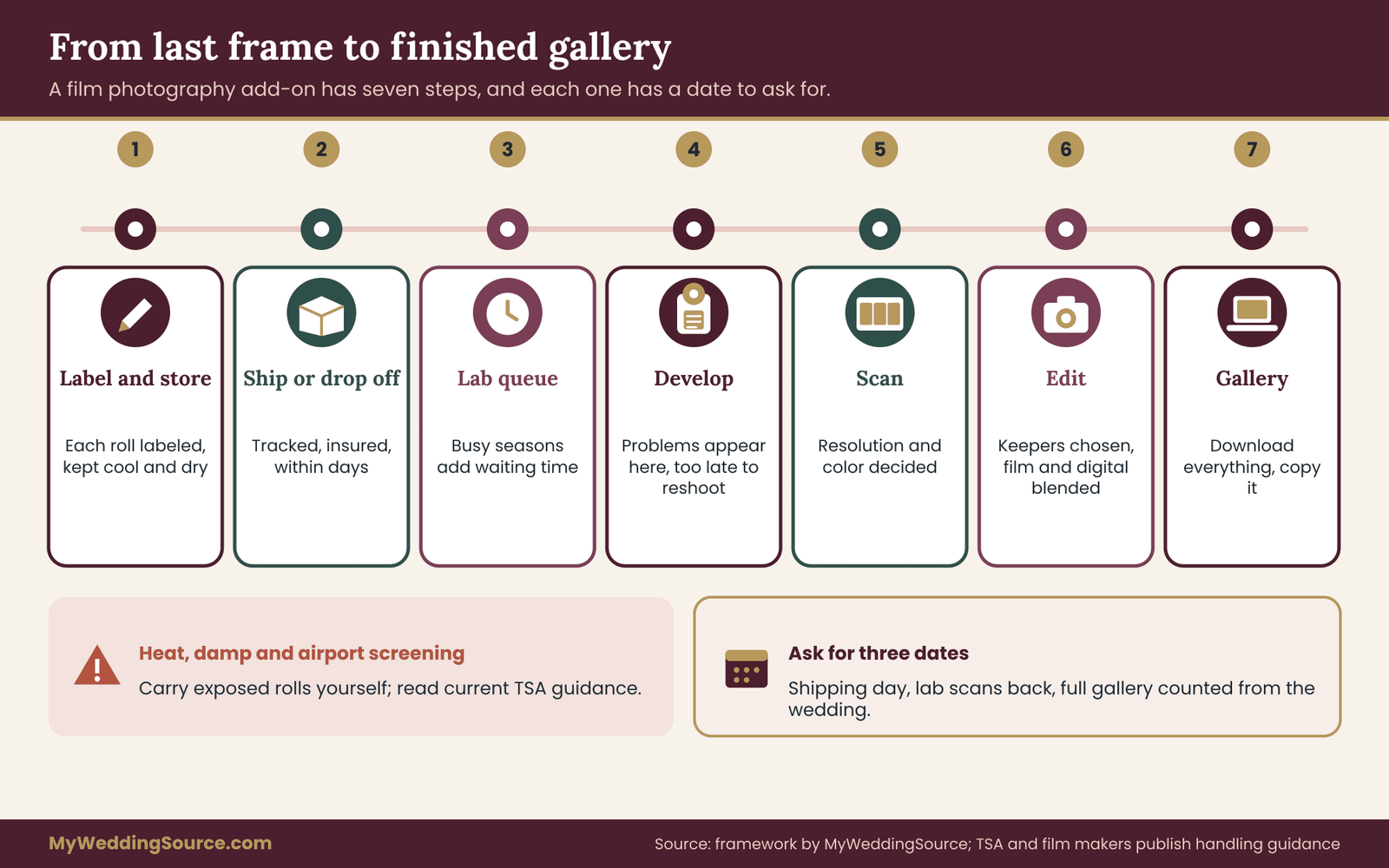
Step one: the end of the day. The photographer finishes the last roll, labels each one with your names, the date and the order it was shot, and stores it somewhere cool and dry. Good photographers keep exposed film in a bag with them, not in a hot car or a checked suitcase.
Step two: shipping or drop-off. The rolls travel to the lab. Some photographers use a local lab and hand-deliver, while others ship to a specialist lab in another city. Shipping is usually tracked and insured. Some photographers batch several weddings into one shipment to reduce costs, which can add days.
Step three: the lab queue. The lab receives the rolls and puts them into a queue. Waits grow in busy seasons, because many photographers send their wedding rolls on the same Mondays. Ask your photographer whether the lab publishes a turnaround estimate and when it expects the rolls to arrive.
Step four: development. The film is developed. This part is quick compared with the rest, but a problem found here, such as an unexposed roll, cannot be reversed.
Step five: scanning. Each negative is scanned. The lab may do a standard scan, or the photographer may scan the negatives themselves. Scanning decisions affect color, contrast and file size, and good labs offer consistent profiles. Higher-resolution scans take longer.
Step six: review and editing. The photographer receives the scans, chooses the keepers, adjusts them lightly and may add digital images from the same day. The edit of a mixed gallery takes time and attention.
Step seven: gallery delivery. You receive an online gallery or a download link. Prints, albums or physical negatives, if included, follow later.
Seen this way, a delivery window of several weeks is not a sign of poor service. It is the sum of steps that each take days. What you can ask for is clarity and a date.
How to ask for a date that means something
A vague answer such as “a few weeks” is hard to hold anyone to. Better is to ask three questions.
First: “When do you ship the rolls after the wedding?” This tells you how long the photographer holds them.
Second: “How long does your lab usually take from receipt to scans?” The answer shows the lab queue.
Third: “When will we receive the full film gallery, counted from the wedding date?” A date counted from a known start, such as the wedding day, is easier to track than one counted from the day the lab receives the rolls.
Write the answer into the brief and the contract. A reasonable sentence is: “Film scans will be delivered within a stated number of weeks after the wedding, subject to lab delays that the photographer will report to the couple promptly.” The key idea is a stated period plus a duty to tell you if it will slip.
Planning around the wait for your film photography add-on
Film turnaround affects other plans. If you want to include your wedding photos in thank-you cards, a newspaper announcement or a holiday card, build in the waiting time. Many couples request a small set of digital preview images within a few days, taken from the digital lane, so that they have something to share while the film is at the lab. Ask your photographer whether this is included.
If a name-change, immigration or other administrative process needs proof of your marriage, remember that photographs are not the legal document. The marriage certificate is, and it comes from the office that records the marriage, not from your photographer. Your wedding vendor timeline can show where the film dates sit beside other vendor deadlines, such as final headcounts and payments, so nothing is forgotten in the weeks after the wedding.
Rush options
Some labs offer faster processing for an additional fee, and some photographers can prioritize a particular roll, for example a portrait set you want for an anniversary gift. Rush options are real but not free, and they do not remove the other steps. Ask what a rush option covers and whether it is promised or “best effort.”
Storage and travel before the lab
The days between the wedding and the lab matter more than most couples realize. Film is sensitive to heat and humidity, and long exposure to either can shift color or add fog. A photographer who knows what they are doing keeps rolls cool and dry, and ships promptly. Film makers publish storage guidance for their products, and preservation bodies such as the Library of Congress and the National Archives publish general advice on keeping photographic materials in stable, cool and dry conditions.
Travel adds a few more risks. If the wedding is a destination event, ask how the film travels. Airport security equipment can affect film, and the Transportation Security Administration publishes guidance about carrying photographic film and asking for a hand inspection. Rules and equipment can change, so the safest approach is to read the current guidance from the agency, plan to carry exposed rolls in a bag the photographer keeps with them, and allow extra time at security. Another option is to use a local lab at the destination, though that changes the lab and the look, so discuss it in advance.
When the date slips
Delays happen. A lab backlog, a shipping problem or an illness can push the date. What matters is how it is handled.
If the date is approaching and you have heard nothing, send a short, polite message asking for a status update and the new estimate. Keep a copy. If the delay is the lab’s, ask whether the photographer can share the tracking number, and whether any images can be delivered in stages. Many photographers will release the first batch of scans as soon as they arrive.
If the delay continues past the written date without explanation, refer to the contract and ask what remedy it provides. Many contracts promise “best efforts” and do not set penalties, so the practical tools are a calm request and, if needed, a conversation about partial refunds or additional deliverables. Escalate only after you have asked politely and given a reasonable reply window.
Backup coverage: what happens when film fails
Film is not fragile in the sense of breaking easily. It is unforgiving in the sense that most problems appear after the moment is gone. Backup coverage for a film photography add-on is the set of choices that make sure a single failure does not erase an important part of your day.
The common ways a film photography add-on fails
Knowing the list of failures helps you ask the right questions.
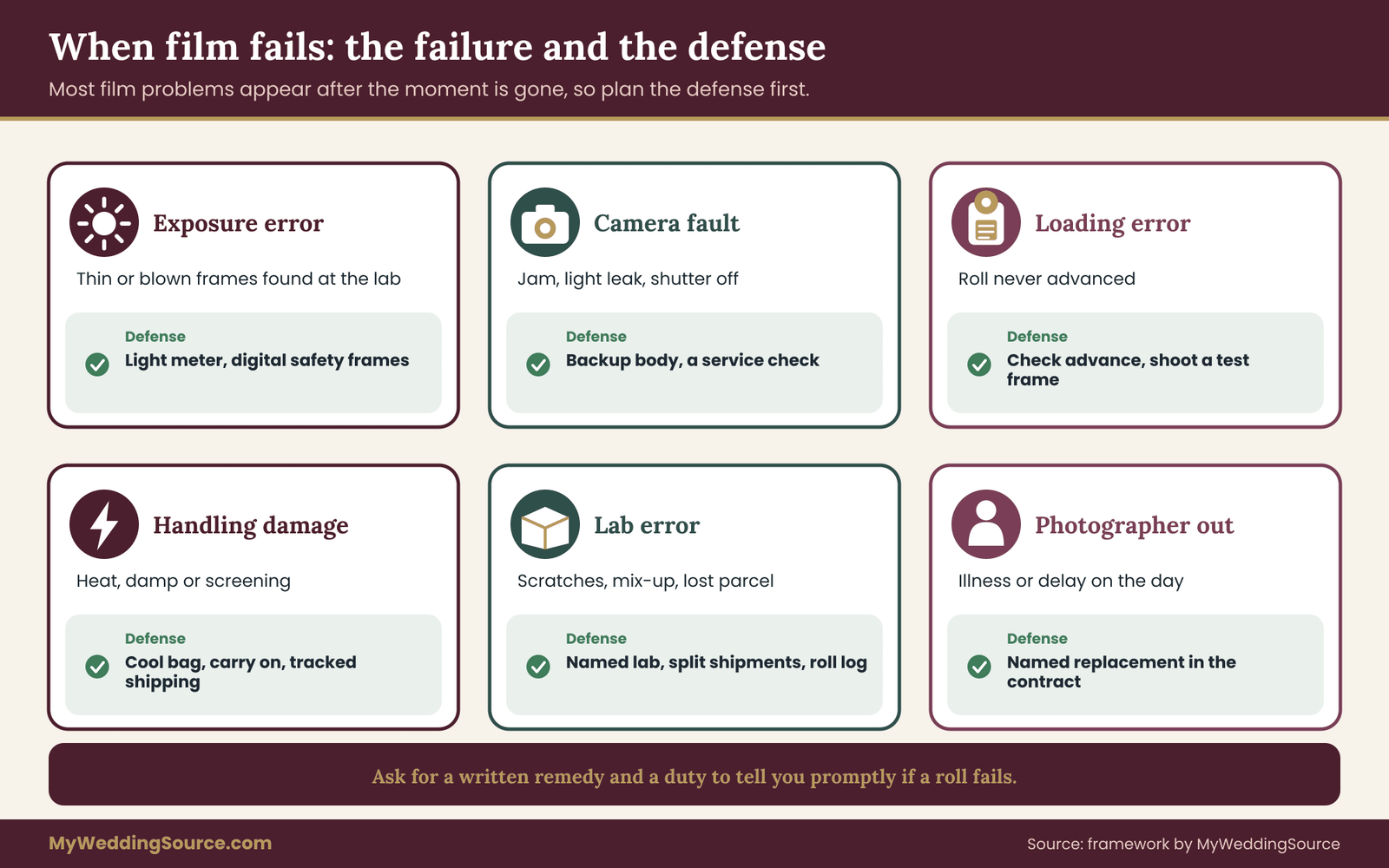
Exposure errors. Underexposed film looks thin and grainy, and badly overexposed film can lose detail. Color negative handles some overexposure well, which is one reason it is popular for weddings, but it is less forgiving in the other direction.
Camera problems. A film camera can jam, fail to advance, have a light leak, or have a shutter that is out of calibration. Mechanical cameras are reliable when serviced, but they age.
Loading errors. A roll that is not loaded correctly may not advance, so the photographer thinks they are shooting when they are not. Experienced photographers check, but mistakes happen.
Handling problems. Heat, moisture, screening equipment and rough handling can damage rolls before processing.
Lab errors. Scratches, wrong development settings, mixed-up rolls, lost parcels and scanner mistakes are rare at good labs, but not impossible.
Human factors. A photographer can be ill, injured or delayed, which affects the whole day, not only the film.
The safety lane in practice for a film photography add-on
The safety lane from the first section is the main defense. It means the photographer captures a digital frame, or several, for each key film moment. These frames can be quick and simple, since the film frame is the artistic one. The aim is only that if a roll fails, the moment still exists.
Ask the photographer to tell you which moments they plan to cover in both lanes. For most couples, the list includes the ceremony beats, the rings, the kiss, the first look, key group shots and a few portraits. The more irreplaceable the moment, the stronger the case for duplicates.
Backup can take other forms. A second photographer who shoots digital throughout is a straightforward cover. A backup camera body for each medium helps against equipment failure. A written plan for what happens if the photographer cannot attend, such as a named replacement, is part of the broader vendor contract. Your wedding day digital operations plan covers how files and permissions are protected on the day, and the same ideas apply to the digital half of a film plan.
What the photographer should do about the film itself
Ask how they guard the film between the camera and the lab. Good answers include labeling every roll as it is shot, never mixing exposed and unexposed rolls, keeping exposed rolls in a dedicated bag, and shipping with tracking and insurance. Ask whether they keep a log of rolls so that a missing roll is noticed immediately.
Another good practice is spreading risk across several rolls, with one lab shipment per day or per batch, instead of putting every roll in a single parcel. A parcel that holds an entire wedding is a single point of failure.
What the contract should say about a film photography add-on
A film photography add-on makes contract language about failure more important than usual. Look for three things.
First, a statement of what happens if film images cannot be delivered because of the photographer’s error, the lab’s error or loss in shipping. The usual remedy offered is a refund of the film portion of the fee, sometimes with a portrait session as a replacement. Ask what is offered, and whether the film fee and the lab fees are both refundable.
Second, a limit of liability. Photography contracts often limit the photographer’s liability to the fees paid. This is standard, but you should know it is there. It means that the safety lane, not the remedy, is your real protection for irreplaceable moments.
Third, a duty to disclose. A good clause says the photographer will tell you promptly if a problem is found, such as a failed roll. Early notice can allow a retake of portraits or a replacement session while memories and outfits are still fresh.
Do not expect a contract to compensate you for the loss of a moment, since the loss cannot be priced. Use the contract to make failures visible and the remedy fair, and use the safety lane to prevent the most painful ones.
A simple self-check on the film photography add-on before the wedding
A week before the wedding, send your photographer a short note asking for three confirmations: the lane list, the roll count and format, and the plan for shipping. A reply of a few lines is enough. You are not auditing them. You are making sure the plan you agreed in January is still the plan in the week before the wedding, and that the photographer has had a reason to think it through once more.
Deliverables checklist for a film photography add-on: scans, negatives, prints and rights
Line five of the brief asks what you receive. This section lists every deliverable worth asking about, in the order you are likely to meet them. Use it as a checklist when you read a quote, and tick off each item as the contract confirms it.
The scans
Scans are the heart of a film photography add-on, since they are what most couples will actually see, share and print. A vague promise of “film scans” leaves several open questions.
Count. Is it every usable frame, or a selected set? If the photographer chooses the keepers, ask roughly how many to expect per roll, and whether you can see the rejected frames.
Resolution and size. Scans can be delivered at a size suited to web viewing and small prints, or at a much higher resolution suited to large prints. Ask which one is included, and what it costs to upgrade selected images. If you plan a large canvas or album spread, say so at the start.
File type. Common choices are JPEG for ordinary use and TIFF for maximum quality and further editing. Many couples are fine with high-quality JPEG files, but ask what you will get.
Color and editing. Ask whether the scans are delivered as the lab produced them or with the photographer’s color adjustments. A lab scan can differ from the photographer’s edit, and neither is wrong. What matters is that you know which you are receiving, and that the look in the portfolio matches the look in your gallery.
Cropping. Film frames have their own proportions. A scan may include the film border, and a crop may change the framing. If you plan to print in a specific size, ask whether the files can be cropped to it.
Black and white. If some rolls are black and white, ask whether the scans are true black and white or color scans converted afterwards. Both are common, and the difference is subtle but real.
The gallery
Ask how the images are delivered. An online gallery is typical, and a good one lets you download in full resolution, share selectively and view on a phone. Ask three practical questions: how long does the gallery remain online, is download included for everyone you share the link with, and can the photographer provide a download of everything in a single archive.
Gallery expiry is the quiet trap. Some galleries are removed after a year or less, and a link that works today may not work in three years. Plan to download everything once you receive it and keep copies in several places. The guide to organizing wedding records after the event walks through backup copies and retention for photos, and it is worth following for the digital half of a film delivery.
The negatives in a film photography add-on
Developed negatives are physical objects, and they are the original of every scan. Who owns and keeps them is a question many couples forget to ask.
There are three common arrangements. The photographer may keep the negatives and archive them for a stated number of years, offering rescans on request. The photographer may return the negatives to you with the delivery. Or the negatives may be kept by the lab or the photographer without a stated plan, which is the version to avoid.
Returning the negatives gives you a physical archive and a chance to rescan in the future, since scanning technology improves. It also gives you the job of storing them well. Cool, dry, dark and flat storage in archival sleeves is the usual advice, and the Library of Congress and the National Archives publish guidance for family collections. If you prefer the photographer to keep them, ask how long, where, and whether you can get them on request.
If the negatives matter to you, ask for the sentence in writing: “Negatives will be returned to the couple within a stated period after delivery of the scans,” or “The photographer will retain negatives for a stated number of years and will provide rescans on request.”
Prints, contact sheets and albums
Some film photography add-ons include prints, a set of small prints made by the lab, or a contact sheet that shows every frame. These are lovely extras, and they cost extra. Ask whether prints are included, what size, what paper and how many. Ask whether reprint orders go through the photographer or directly through a lab, and whether the files are licensed for printing at a lab of your choice.
An album that mixes film and digital frames needs one more question: which images are in it, and who chooses. Many couples want to approve the layout. Say so, and ask how many revision rounds are included.
Usage rights and copyright for a film photography add-on
This is the least glamorous part of the list, and the one with the most long-term effect. In the United States, copyright in a photograph generally belongs to the person who made it, from the moment it is created, unless it is transferred in a signed written agreement. The U.S. Copyright Office explains this in its public guidance. In practice, that means the photographer normally owns the copyright in your wedding images, and you receive a license to use them.
A good contract spells out the license. Look for these points.
Personal use. You should be free to print, display, share with family and post on personal social media. Ask for the wording to say so plainly.
Printing and reproduction. Ask whether you may print at any lab and make as many copies as you like for personal use, and whether there are restrictions on commercial reproduction, such as using an image on a product you sell.
The photographer’s use. Photographers usually reserve the right to use images in their portfolio and marketing. If you do not want certain images, or any images, published, ask to limit it in the contract. This matters most for photos of guests and children.
Third-party use. If a magazine, blog or venue asks to use your photos, ask who must approve and whether a credit is required.
Film-specific points. Ask whether the license covers the negatives and the scans equally, and whether it includes later rescans. Some photographers license the images and treat the physical negatives as separate objects.
The Copyright Office publishes general guidance on ownership and on works created by contractors. For wording in your contract, a lawyer in your state can review the actual terms. This guide cannot do that for you, and a vendor’s template is not a legal ruling.
Guests, children and consent
Film images from a film photography add-on are no different from digital images when it comes to the people in them. Guests and children appear in the frame, and some may have reasons to avoid being photographed or posted. Contextual consent is the safest way to think about it: a guest at a wedding generally expects to be photographed in that setting, and that does not mean they expect their image to be used in advertising or shared widely online.
Before the wedding, decide with your photographer how guest preferences will be handled, for example a short list of people or groups to leave out of published images. The guide to guest privacy and image use explains forms, shot-exclusion briefs and takedown steps. They apply to film scans as they do to digital files, with one extra detail: negatives and scans may be kept for years, so ask how the photographer handles a later request to remove an image from a portfolio.
The film photography add-on deliverables checklist in one list
For quick use, here are the items to confirm, written as prompts rather than a table.
- The number or range of scans, and who chooses them
- Scan resolution, file type and whether color work has been done
- Where and how the gallery is hosted, for how long, and whether downloads are included
- The delivery date, counted from the wedding, and the duty to report delays
- Whether the negatives are returned or kept, and for how long
- Prints, contact sheets or albums included, and who approves the layout
- The license for personal use, printing and sharing
- The photographer’s portfolio and marketing use, and any limits you set
- The handling of guest and child images, and of later removal requests
- The remedy if film images cannot be delivered

Verifying the photographer, the lab and the contract
You can check a film photography add-on the way you check any vendor, with a few additions. This section gives a short process, a few scripts and a way to separate marketing from real information.
Look at full galleries, not highlights, before you book a film photography add-on
A highlight reel shows the best frames. A full gallery shows the work. Ask to see a complete film gallery from a recent wedding with a similar venue to yours: outdoor light if yours is outdoors, a dim room if yours is dim. Check the consistency of color from frame to frame, the sharpness, how the film frames sit beside the digital ones and how the story reads. If every film image looks identical in tone, ask whether a preset has been applied.
Ask about the lab behind the film photography add-on
The lab shapes the look as much as the photographer does. Ask which lab they use, how long they have used it, whether the lab also scans, and whether they have ever had a lost or damaged roll. A photographer who answers with a name and a short story is more reassuring than one who says “the best lab.” If the lab is unusual or foreign, ask about shipping and customs.
Ask about backup gear and people
Ask whether they carry a second film camera and a digital backup, whether they have a replacement photographer in case of illness, and how they handle equipment failure. This is a standard vendor question and good photographers have ready answers.
Ask for references, and ask them well
Past couples who had film coverage can tell you things a portfolio cannot: how clear the communication was, whether the date was met, how the scans compared with the samples. When you speak to a past client, ask about timing and communication, not only about the pictures.
Check the film photography add-on paperwork
Compare the written quote, the brief and the contract. Look for the details above: rolls, format, lab, dates, deliverables, remedy and license. Insurance is another point. Many venues require vendors to carry liability coverage, and photographers may carry equipment cover too. Ask what they have, and whether a certificate can be provided to your venue.
The vendor due diligence checklist lists general checks that apply to any vendor, including business registration, reviews, insurance and payment terms. Use it alongside the film photography add-on questions here.
Payments and protection
Think about how you will pay. Deposits and final payments are normal, and the schedule belongs in the contract. If you pay by credit card, the Consumer Financial Protection Bureau explains how to dispute a charge, and the time limits for doing so are short. Keep your receipts and your written agreement together, so that you have what you need if a problem arises.
Scripts for the film photography add-on questions
Some of the questions in this guide feel blunt. These sentences keep them friendly.
“We love the look of your film work and want to make sure we plan it well. Could you walk us through where the rolls go after the wedding and when we would see the first scans?”
“We would like to be sure we are covered if a roll does not turn out. How do you usually handle that, and what does the contract say?”
“Could we add a line to the contract saying how long the gallery stays online and whether the negatives come back to us?”
A professional who has done this before will not be offended. If their answers are thoughtful and specific, you have learned something good. If the answers are evasive, you have learned something else.
Official and vendor sources
For facts that change, go to the source. The U.S. Copyright Office explains copyright ownership and licensing. The Transportation Security Administration publishes current guidance on traveling with photographic film. Film manufacturers publish storage and handling advice for their products. Your photographer and lab publish their own terms, turnaround estimates and shipping policies. Any specific number, fee or rule in a quote or a policy should be checked against the current version, and anything unclear should be asked in writing.
A worked example: one couple’s film photography add-on
The following example is invented to show the method from start to finish. The couple, the venue and the numbers are illustrative, and your own plan will differ. Call them Nadia and Owen. They are marrying on a Saturday in October with 120 guests, an afternoon ceremony in a garden pavilion and an evening reception in a rented hall with moderate lighting. They hired a photographer for eight hours who offers a film photography add-on, and they would like film to feel like part of the story without risking the key moments.
Step one: the role of the film photography add-on
Nadia and Owen read the three arrangements and chose film as a co-lead for the first half of the day and an accent for the second. Their brief line one reads: “Film covers getting-ready details, couple portraits, ceremony wide shots, cocktail candids and the cake cutting. Digital covers the processional, vows, kiss, family formals, toasts, dancing and exit, and duplicates the ceremony wide shots.”
Step two: the lanes
They wrote three lists after running the four tests on each moment.
The film lane held details, portraits, ceremony wide frames from the back of the pavilion, cocktail candids and the cake cutting. All of them passed the light and redo tests, or were low-stakes.
The digital lane held the processional, the vows, the kiss, the family formals, the toasts, the dancing and the exit. These failed the speed, the redo or the light test, or all three.
The safety lane held digital frames of the ceremony wide shots and the portraits, taken a moment before or after the film frames. The photographer suggested it, and Nadia and Owen agreed it would cost them nothing in time.
Their family list had eleven groups, so the photographer proposed film for the two immediate-family groups only and digital for the rest.
Step three: the roll budget
Using the method from the roll budget section, they and the photographer estimated frames for each film moment.
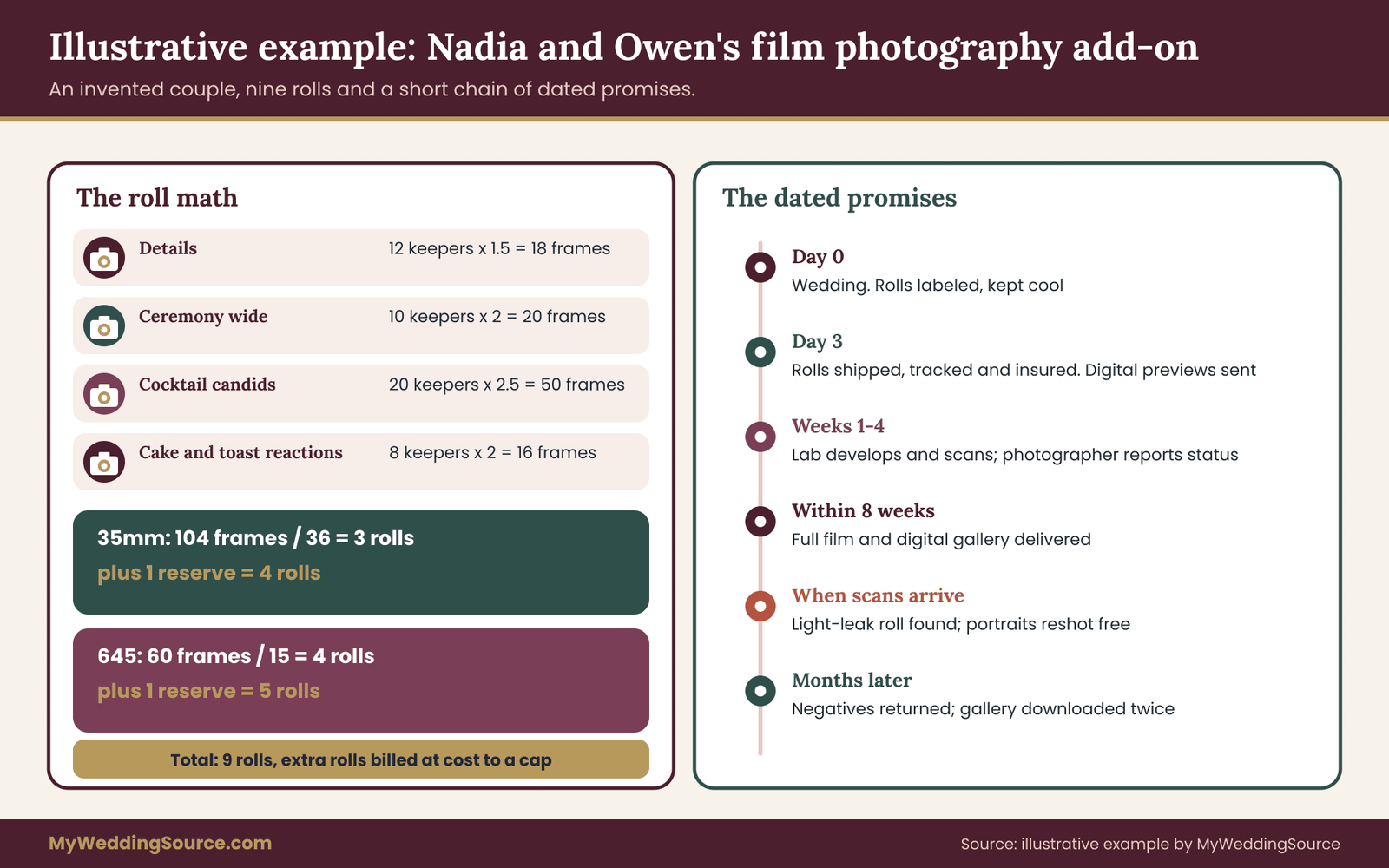
For the 35mm color negative film: details, about 12 keepers at 1.5 frames each, so 18 frames. Ceremony wide shots, about 10 keepers at 2 frames each, so 20 frames. Cocktail candids, about 20 keepers at 2.5 frames each, so 50 frames. Cake cutting and toast reactions, about 8 keepers at 2 frames each, so 16 frames. That is 104 frames. With 36 exposures per roll, 104 frames is 2.9 rolls, so 3 rolls. They added 1 roll of reserve, for a total of 4 rolls of 35mm.
For the 645 medium format color negative film: about 30 portrait keepers at 2 frames each, so 60 frames. With about 15 frames per roll, that is 4 rolls, plus 1 reserve roll, for a total of 5.
So the film photography add-on plan came to 9 rolls: 4 of 35mm and 5 of 645, including the reserve. The photographer confirmed the number and noted that any extra rolls used would be billed at cost, up to a cap that they set together.
Step four: price logic for the film photography add-on, without prices
They asked for the film photography add-on to be itemized into three parts: the photographer’s fee for the extra work, the film and lab costs, and the optional deliverables. They compared the version with the rolls above against a smaller version with portraits only, and a larger one that added film to the dance floor with flash. The portraits-only plan cost less but dropped the candids, which they liked. The larger plan roughly doubled the roll count and still left the low-light dancing at risk. They chose the middle plan.
They also asked whether processing and scanning were included in the film photography add-on price. The answer was yes for standard processing and scans, and no for pushed film, which the photographer said they would not need for this plan. That was written in the brief.
Step five: the turnaround brief
The photographer wrote the following into the contract summary: rolls labeled and kept in a cool bag, shipped within three business days to a named lab by tracked and insured parcel, scans back from the lab within the lab’s stated window, and the full gallery of film and digital images delivered within eight weeks of the wedding. A small set of digital previews would arrive within three days.
If the lab fell behind, the photographer would write to Nadia and Owen promptly with a new date and release the first scans in stages.
Step six: deliverables and rights
The couple requested and received: high-quality JPEG scans of every keeper, with a larger scan available for chosen images; negatives returned within a few months after delivery; an online gallery that stays up for at least a year with an archive download; a personal-use license that covers printing at any lab; and a clause limiting the photographer’s marketing use of images with children. They also asked the photographer to leave out two guests who had asked not to appear in published images, using the approach from the guide to guest privacy.
What happened
The wedding and the film photography add-on went to plan. The light in the pavilion was good through the ceremony, and the portrait session ran in open shade. The photographer changed rolls during the cocktail hour and labeled each roll in order.
When the film came back, one 645 roll showed a light leak across several frames. The photographer reported it within a day of seeing the scans, and a second look at the digital safety frames showed that the affected portraits had been duplicated. The two missing portraits were reshot during a short session two weeks later, at no charge, as the contract’s remedy provided. Nadia and Owen lost nothing that mattered.
What this example shows about a film photography add-on
Three things made the difference. The first was the lane list, which meant no irreplaceable moment depended on one roll. The second was the written delivery date and the duty to report problems, which turned an unpleasant surprise into a short note. The third was the clause that named a remedy, which made the reshoot an ordinary request and not an argument.
None of this film photography add-on planning required technical knowledge. It required a short brief and a photographer who was willing to answer plain questions. If you adapt the example, change the numbers to match your own day, and have your photographer redo the arithmetic with their own shooting ratios.
Your next steps
Start with the brief for your film photography add-on. Copy the six lines into an email to your photographer and fill in what you know: the role of film, the moments, the rolls and format, the handling, the deliverables and dates, and the backup and rights. Ask them to fill in the rest.
Then sort your moments into the three lanes, and be generous with the safety lane for the ceremony and the family formals. Ask for a full film gallery from a recent wedding, the name of the lab and a written delivery date. Ask to see the clause that covers lost or unusable film, and ask what the license includes.
A week before the wedding, send a short confirmation of the lanes, the roll count and the shipping plan. After the wedding, download every file as soon as the gallery arrives, store the negatives flat, cool and dry if they come to you, and keep your paperwork together. If something goes wrong, write to your photographer promptly and calmly, with the contract in hand.
FAQ
What is a film photography add-on for a wedding?
It is an optional package, priced separately from your base photography package, in which part of your wedding is shot on photographic film. The film is developed by a lab and scanned into digital files that you receive in a gallery. It can be a small accent, a shared role with digital, or the main way the day is captured, so always ask which version is being offered.
How many rolls of film should we ask for?
There is no single number, because it depends on the moments you choose, the format and the photographer’s shooting ratio. Work it out in steps: estimate keepers, apply the ratio, add up the frames, divide by frames per roll, round up and add a reserve. Ask your photographer to show their own version of that arithmetic, and put the final roll count in writing.
How long does it take to get film wedding photos back?
It takes longer than digital because the rolls must be shipped, queued, developed, scanned and edited. The time varies by photographer and lab, and by the season. Ask for a written delivery date counted from the wedding day, and ask what happens if the lab runs late. Many couples also request a few digital previews within days so they have something to share while waiting.
Do we get the negatives?
Not automatically. Some photographers return the negatives, some keep and archive them for a stated period, and some do not say. Ask before you sign, and write the answer into the contract. If you receive them, keep them flat, cool, dry and dark in archival sleeves, and consider storing the scans in several places too.
What if a roll of film fails or comes back blank?
That is why backup coverage exists. Ask the photographer to duplicate key moments digitally, such as the ceremony and the family formals, so that a failed roll does not erase them. Check the contract for the remedy if film images cannot be delivered, which is often a refund of the film fee or a replacement portrait session, and for a duty to tell you promptly.
Is film worth it for a dark or candlelit venue?
Often not, unless the photographer plans to use flash or faster film. Film needs more light than a modern digital camera, and dim rooms can lead to grainy or underexposed frames. A common compromise is to shoot portraits and daylight moments on film and keep the dim reception on digital. Share your venue photos and timeline with the photographer and ask for an honest recommendation.
Who owns the copyright to film wedding photos?
In the United States, copyright generally belongs to the person who creates the image unless it is transferred in a signed written agreement, so your photographer normally owns the copyright and you receive a license. Check that the license covers personal printing and sharing, and that it covers negatives and scans. The U.S. Copyright Office publishes guidance, and a lawyer can review your actual contract.
Should we use disposable cameras for guests as well?
They can be fun, but they are a separate plan from a professional film photography add-on. Someone must collect and develop the cameras, the images may be uneven, and guests or children may appear in photos that were never meant for sharing. Decide who develops them, who sees the results, and how guest privacy is handled, as you would for any guest-made photos.
Sources
- What is copyright?, U.S. Copyright Office
- Works made for hire, Circular 30, U.S. Copyright Office
- Copyright basics and frequently asked questions, U.S. Copyright Office
- Travel and security screening, Transportation Security Administration
- Personal archiving: preserving your digital memories, Library of Congress
- Preserving family archives, National Archives and Records Administration
- How do I dispute a charge on my credit card bill?, Consumer Financial Protection Bureau
- Consumer advice, Federal Trade Commission
- Kodak, film manufacturer product and storage information
- Image Permanence Institute, Rochester Institute of Technology