
Wedding backdrops are the one decor element that every photo, every sightline, and every vendor contract touches, so the useful questions are not “which style?” but “what must it fit, what is it for, what will it really cost installed, and will it stay standing?”
Quick answer
Choose wedding backdrops in this order: the place it must fit, the job it has to do, the materials the venue allows, the installed price, and the plan for wind, weight, and substitutions. Measure the space first, ask the venue for its written decor and fire rules, and give every piece one job (guide, frame, soften, photograph, or personalize). Compare quotes by what is delivered, hung, anchored, and removed, not by the photo. Fabric that hangs in a public building usually has to be flame resistant, and freestanding walls outdoors need ballast or anchors that match the wind, so ask for both in writing.
Most couples meet wedding backdrops as images: a wall of greenery, a draped arch, a sparkling sequin panel behind a cake table. The images do not show the thing that decides whether the choice works, which is the room, the sun, the wind, the ceiling, the load limits, the installer, and the person who has to take it down at midnight. This guide works from the room outward. It is built for the four places people actually ask about, which are the ceremony, the sweetheart table or head table, the photo booth or photo wall, and drapery that changes how a room feels, and it ends with the structural and safety questions that most decor articles skip.
We are not selling a style or a vendor. The method works for a garden, a ballroom, a barn, a courthouse lunch, or a restaurant buyout. If you are still deciding on the larger design, our wedding decor guide covers the room-wide plan, and this page picks up one piece of it in much more detail. For the rest of the plan, the wedding planning checklist shows where decor decisions sit among the others.
A note on evidence. Where a number comes from The Knot, Zola, a fire marshal, or a vendor guide, we name it and say what it covers. Where we do arithmetic, we label it an estimate. Where we offer a scenario, we say it is illustrative. Nothing here is legal, safety-engineering, or financial advice. Fire codes and venue rules differ by place, and your venue, fire marshal, and contract have the final word.
Start with the room, table, body, or object that wedding backdrops must fit
The most common wedding backdrops mistake is choosing the look first and discovering the constraints later. A tall, dramatic installation that photographs well in an inspiration image can disappear against a high ceiling, collide with a sprinkler head, block a window, or tip over in a breeze. Starting with the thing the design must fit gives you a short list of wedding backdrops that will actually work, and it makes every conversation with a vendor more precise.
Measure the physical constraints before choosing a look
Measurements turn a vague wish for wedding backdrops into a brief a vendor can quote. They take about an hour with a tape measure, a phone, and a friend, and they are the cheapest insurance in the whole project. A vendor who sees real dimensions can tell you quickly whether an idea is possible, what it needs, and whether it will look right in the space.
Record dimensions, sightlines, heat, wind, and access
Start with the spot itself. Record the width and depth of the area where the structure would stand, the ceiling height if it is indoors, and the height of any beam, light, or sprinkler line above it. Note what is behind the spot, because wedding backdrops frame whatever is there: a wall, a window, a parking lot, a pond, a stack of stored chairs.
Then stand where guests will sit and look. Sightlines matter more than most couples expect. Among wedding backdrops, one that is eight feet wide can look generous from the front row and tiny from the back of a large room. Ask someone to stand where the couple will stand, and see if the structure still reads from the farthest seat. If it does not, make it taller, move it, or simplify what surrounds it so the structure carries the focus.
Add the conditions that move. For outdoor spots, note where the sun sits at the time of the ceremony, whether the area is in shade, whether the ground is grass, gravel, or pavement, and which direction the wind usually blows. Visit at the same time of day as your event if you can. For indoor spots, check vents and doors, since an air-conditioning vent can move lightweight drapery all day.
Finally, record access. How wide is the doorway the pieces must pass through, how far is the nearest loading area, is there an elevator, and are there steps? A freestanding arch that does not fit through a door in one piece will arrive in sections, which means more labor and more places for something to go wrong. Our wedding timeline guide can help you work out when delivery and setup should happen.
Identify venue rules that override inspiration
Venue rules outrank everything on your mood board, including the wedding backdrops you love most. Ask for the venue’s written decor policy before you commit to any of your wedding backdrops, and read it for these items: whether anything may be attached to walls, ceilings, or trees; whether stakes may go into the lawn; whether candles or open flame are allowed; whether confetti, petals, or fog effects are allowed; what hours vendors can enter and leave; whether the venue requires approved or insured vendors; and whether it charges a fee for hanging anything.
Two kinds of rule matter more than the rest. The first is physical attachment. Many venues forbid nails, tape, or adhesives on historic walls, and many do not allow rigging from ceilings or beams without an approved installer. The second is fire safety, which we cover in detail below. Both can change a design completely, and they are far easier to handle on paper in month one than on the morning of the wedding.
If the venue has a preferred vendor list, ask whether you must use those vendors for installations. Some venues require it for rigging or electrical work. Ask, too, what happens if the venue does not approve a piece. A written answer protects both your design and your deposit.
Choose the design function in the wedding backdrops decision
Every structure you add needs a reason. Wedding backdrops are expensive per square foot compared with most decor, because they combine materials, labor, delivery, and often engineering. If a piece has no job, it is a candidate for removal, and the savings can go where they do more good.
Decide whether the element guides, frames, softens, photographs, or personalizes
We use five functions for decor, and they work well for wedding backdrops. A backdrop that guides tells guests where to look, such as an arch at the end of an aisle or a sign beside the entrance. One that frames gives the couple a defined place to stand and gives photographers a clean edge to compose against. One that softens takes the edge off a hard room, such as a long concrete wall draped in fabric. One that photographs exists mainly to appear in images, such as a photo wall or a styled cake table. One that personalizes says something about the couple, such as a monogram, a family quilt, or an installation made from materials that mean something to you.
Most successful wedding backdrops do one or two of these well. A ceremony arch usually guides and frames. A fabric wall behind a head table usually softens and frames. A photo booth backdrop photographs and sometimes personalizes. If you cannot name the job, the piece is probably decoration for its own sake, and that is a reasonable thing to want, but it should be a conscious choice with a budget attached.
Write the job next to each piece in your plan. That one line helps in a vendor meeting, because you can say “this needs to frame us against a bland wall, and it will be photographed from the aisle” instead of “we want something romantic.” Vendors can respond to the first sentence with specifics.
Remove decorative elements with no job
Once each piece has a job, look for the ones that do not. A common example among wedding backdrops is a ceremony piece in a setting that is already beautiful. The Knot’s guide to ceremony arch alternatives notes that outdoor ceremonies can use a venue’s own exterior features, such as a door or ivy-covered wall, and that indoor settings can use simple options like a mantel or a framed object. If the setting is strong, a small gesture may be enough, and the money you save can go to lighting, which does more work than most structures.
Another example is a second or third of the wedding backdrops in the same room. A ceremony arch that is carried to the reception, a sweetheart table wall, and a photo wall can easily compete. Decide which one is the main picture, and let the others be simpler. Reusing a ceremony piece at the reception is often more effective than buying a second one, if your venue’s schedule allows a safe move. Ask whether the staff or your decor vendor can do the transfer during cocktail hour, and who is responsible for it.
Finally, consider the guest experience. A beautiful structure that blocks the view of the couple from half the seats, or one that forces guests to walk around it to find their table, has a negative job. Remove or relocate it.
Match wedding backdrops to the ceremony, the sweetheart table, the photo booth, and the drapery
Different places ask different things of wedding backdrops. A ceremony structure is viewed from one direction by seated guests and has to survive weather. A sweetheart table wall is viewed all evening, close up, in changing light. A photo booth backdrop is viewed by a camera at a fixed distance and has to work for groups of different sizes. Drapery changes the room itself and brings fire-code rules that apply to almost any fabric hung in a public building.
Ceremony backdrops: arbors, arches, walls, and no structure at all
The ceremony is the shortest part of the day and the most photographed. That is why ceremony wedding backdrops attract so much spending, and why it is worth asking what they must accomplish before choosing one.
Arbors, arches, and freestanding walls
An arbor is typically wood or metal and often dressed with greenery and flowers, while an arch can be made from nearly anything, according to The Knot’s outdoor arch guide. Both stand on the ground, and the practical difference is the setting and the stability. The Knot’s guide says outdoor arbors generally need to be secured, either bolted into the ground or weighted with sandbags, rocks, or heavy planters, while arches, which are often used indoors, raise fewer wind concerns.
The Knot’s guide also suggests sizing the structure so that it comfortably fits the couple and officiant, and adding two to three feet on each side so more of the background shows. That is a useful rule of thumb, and our own illustration later in this guide follows it. The same guide gives general estimates of about $150 to $600 to rent an arbor, with higher prices for larger or higher-quality structures, and notes that some vendors include drapery or garland while others charge for them separately. Those are estimates from one publication, not quotes, and your local rental market may differ.
Freestanding walls, such as a boxwood or plant wall, a macrame hanging, or a framed panel, behave differently from arches. They present a large flat surface to the wind, which makes ballast and anchoring a bigger issue outdoors, and they cover more of whatever is behind them. They suit settings where you want a clean, controlled picture, such as a bland room or a view you do not want in the photos.
When the setting is the backdrop
Sometimes the best of all wedding backdrops is the setting itself. A tree, a garden, a window, a lake view, or a handsome wall already frames the couple. In that case, wedding backdrops might be limited to a small piece, such as flowers at the base of a tree, aisle markers, or fabric hung from existing hooks that the venue has approved. Our guide to garden wedding venues can help you think through an outdoor space before you decide how much to add.
Position matters as much as the object. Put the couple so that the sun is not directly in their faces or directly behind them, and so that the visual line behind them is calm: no signs, no vehicles, no bright objects at head height. A photographer can tell you quickly if your plan will work. Our wedding ceremony guide covers the other ceremony elements that sit around the backdrop, and our wedding photographer shot list helps you decide what the camera needs to see.
Sweetheart table and reception backdrops
Reception wedding backdrops are seen for hours, usually at dinner, often lit by candles or a few warm lights. It has to work close up, in changing light, and in the background of many casual photos from guests.
Behind the sweetheart or head table
A sweetheart table, which seats just the couple, or a head table, which seats the wedding party, benefits from a visual anchor, because it is the one place everyone looks at, from every seat, across a room. A fabric wall, a floral installation, a mirror, or a simple string of lights can anchor it. The best choice depends on the room. In a large, dark ballroom, light does more than fabric. In a plain room with a blank wall, fabric or greenery may do the most.
Scale wedding backdrops to the table, not the room. A good rule is to make the structure wider than the table by at least a foot or two on each side, so the table sits inside the picture, and tall enough that the couple’s heads sit well within the frame when seated. That is an editorial guideline, not a rule, and the right proportions depend on the room. Test it by standing the tape measure up behind the table position and looking from the farthest guest table.
Keep the sightlines for the room clean. One of the easiest ways to get a head table backdrop is to move a ceremony piece during cocktail hour. If you do this, ask the venue about timing, because a move during a tight cocktail hour can disrupt service.
Cake tables, dessert walls, and signage
Cake tables and dessert displays are smaller than head tables but are photographed heavily. Small wedding backdrops, such as a fabric panel or framed mirror, help them stand out. Keep anything flammable away from candles, and keep walking routes clear. The 2010 ADA Standards set a minimum clear width of 36 inches for walking surfaces on accessible routes, and while a private wedding is not a regulated facility in the same way, it is a practical benchmark for guest paths. Include chairs that are pulled out when you measure.
Signs and monograms are a special case. A large neon or lighted sign adds a bright point that cameras register well, but it needs power, a safe cable path, and a position where it will not be blocked, as The Knot’s alternatives guide notes in its advice to keep a neon sign in clear view. Ask about power and cable routes early, since a sign that has no outlet nearby becomes a cable problem.
Photo booth backdrops and photo walls
Among wedding backdrops, a photo wall is the one designed for a camera that moves around, often a phone, and for groups of changing size. The right design depends on how many people will stand in front of it and how much space is behind them.
Size the wall to the group, not the room
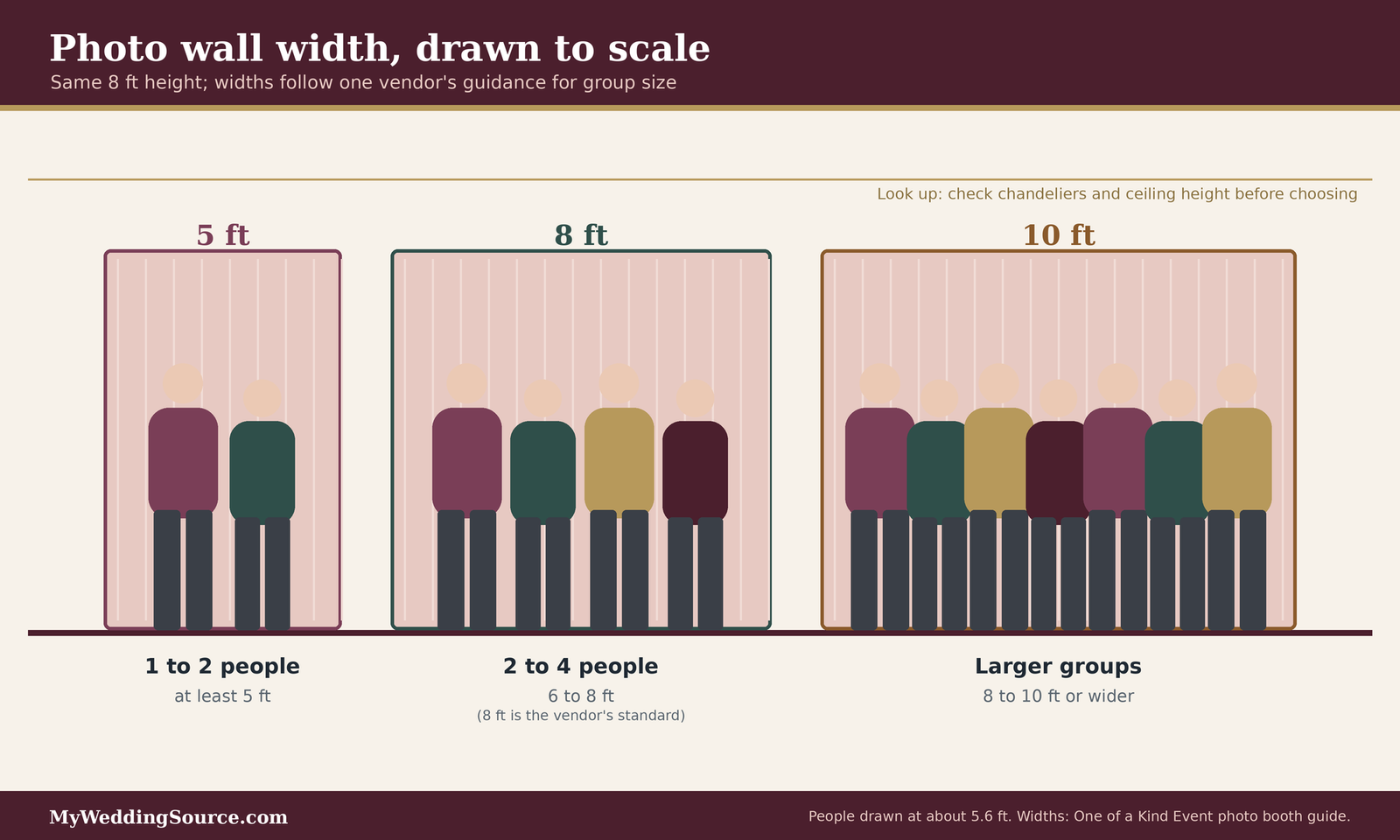
One photo booth guide, from the event business One of a Kind Event, recommends a backdrop at least 5 feet wide for one or two people, 6 to 8 feet wide for small groups of two to four, and 8 to 10 feet or wider for larger groups. It treats 8 by 8 feet as the standard size for most events. Those are one vendor’s recommendations, but they match common sense: a group has to fit in the frame with some margin, and a backdrop that is too narrow shows the room around it.
Our estimate for most weddings is that 8 feet wide works for a couple, a family, or a group of friends at a once-through photo wall, and that 10 feet or more is worth considering if guests will take group photos in large numbers. The right choice also depends on the ceiling. The same vendor notes that an 8-foot backdrop typically clears chandeliers and low ceilings, which is a reminder to look up before you decide on height.
Choose a surface that holds up to a camera at close range
Close-range phone cameras show everything. Wrinkles, seams, rippling fabric, and uneven lighting are all visible, and a surface with a strong pattern or a shiny finish may flash or glare. Matte, simple surfaces tend to photograph more forgivingly. Greenery walls and fabric panels work well when they are full and evenly lit. Sequin or metallic panels sparkle in person and can create hot spots when flash hits them.
Think about where the photographer and guests will stand when they photograph your wedding backdrops. Give guests enough distance from the wall to avoid casting shadows on it, and light the wall from the front or sides, not from behind. A short test with a phone at the venue before you commit saves many unhappy surprises. Ask your photographer or booth vendor what they need, since they may bring their own lights.
If you are hiring a photo booth company, ask whether they supply the backdrop, whether it can be customized, and who is responsible for setup and removal. Some companies include several backdrop options, while others charge for each.
Drapery, fabric walls, and ceiling treatments
Fabric changes a room faster than almost anything, and fabric wedding backdrops are among the most popular. It can hide a plain wall, soften a hard space, create a sense of enclosure, and give photographs a smooth background. It is also the category where venue rules and fire codes matter most.
Where fabric works and where it fights the room
Fabric works best where there is a plain surface to cover, a defined area to enclose, or a transition to soften. It works less well in rooms with strong architecture you would be hiding, in windy outdoor spots, and near heat sources such as lamps and candles. Heavy fabric needs strong hanging points. Light fabric moves in air currents and can drift toward candles or into guest paths.
A fabric wall behind a head table typically uses a frame with fabric stretched across or hung from it. A draped ceiling uses fabric or lights hung from the structure above, which is a bigger job and usually requires an experienced installer and the venue’s permission. Ask whether the venue has existing hanging points for wedding backdrops that are rated for the load, and who is allowed to use them.
Wrinkles, steaming, and fit
Fabric looks best when it is smooth or deliberately gathered. Wrinkles from packing often need steaming on site, which takes time and power. Ask your vendor whether they steam on site, how long it takes, and how much time they need in the room. Fabric also needs the right width and fullness. Fabric that is gathered looks fuller than fabric pulled flat, and how full is a matter of taste and budget, since more fullness means more yardage. We suggest asking the vendor for a sample at the actual fullness you plan to use, hung in a similar light.
Build the composition from scale, color, texture, and repetition for wedding backdrops
Once you know what the structure must fit and where it goes, you can design it. Composition is not mystical. It is a set of choices about size, color, texture, and repetition, and each one can be tested before you spend money. The goal for wedding backdrops is a picture that reads clearly from the farthest seat, holds up in photographs, and does not fight what is around it.
Set one focal point and supporting elements
Wedding backdrops work because the eye lands in one place. When too many elements compete, the picture looks busy, and the couple, who are supposed to be the focus, get lost.
Use proportion rather than item count
A common mistake is to add things until the structure looks full: another garland, another flower cluster, another lantern. A better approach is to choose the proportion first. A large piece with a clear shape usually reads better than many small pieces. For example, a single tall frame covered in greenery usually creates a stronger picture than the same greenery spread across three small stands.
A simple check is to take a photo of the space from the back row and squint at it, or shrink the photo to the size of a postage stamp. If the focal point is still obvious, the proportions work. If the picture turns into a cluster of tiny objects, simplify.
We use a rough proportion for ceremony wedding backdrops: the structure should be at least as wide as the couple, officiant, and a couple of feet on each side, which echoes The Knot’s two-to-three-feet guidance, and tall enough that it extends well above the couple’s heads. How much taller depends on the room and the camera angle, which is why measurement and a test photo matter more than a formula.
Control height and negative space
Negative space, the empty area around wedding backdrops, gives the eye a place to rest and keeps the picture from feeling crowded. Wedding backdrops pushed against a wall, with no space around them, look flat. Those with some breathing room look intentional.
Height is the other lever. Tall structures draw the eye upward, which suits high ceilings and large rooms. In a low room, a tall structure can look cramped, and heavy hanging pieces can come close to the heads of tall guests. Check clearance above and around the structure, and remember that photographers may need space to step back.
Color, texture, and repetition
Color and texture do much of the work in wedding backdrops, and they interact with everything near them: your clothing, the walls, the flowers, and the light.
Choose color relationships that survive photographs
Color looks different on camera than in person. White and ivory can read as blue or yellow under certain lights. Very dark backgrounds can swallow the couple if they are wearing dark clothing, and very light backdrops can wash out a white dress. A mid-tone or textured background tends to give more separation. The best test is a sample photographed in the real room at the real time of day.
Think of color in three layers: the dominant color, the supporting color, and an accent. Most wedding backdrops work best with one dominant color and one or two supporting colors, with accents used sparingly. That is an editorial guideline. Your own palette, the season, and the venue will matter more, and our guide to seasonal wedding flowers can help you choose materials that are in season and affordable in your month.
Use texture and repetition for depth
Texture gives a flat surface depth: the weave of fabric, the leaves of a plant wall, the grain of wood, the shine of a mirror. When color is simple, texture carries the design. Repetition, such as a row of the same lantern or a line of identical panels, creates rhythm and makes a design feel deliberate even when each piece is simple.
Use repetition for cost control in wedding backdrops, too. Repeating a modest element is often cheaper than creating many unique elements, and it reads as a deliberate design. A repeated element can also be reused: panels from the ceremony can line the reception wall, for example.
Test the design under real lighting and camera conditions
Light changes everything. Wedding backdrops that look rich at noon can look flat in the evening, and a design that glows at dusk can look dull in the sun. Testing under real conditions is the single most useful step, and it costs almost nothing.
Check daytime and evening appearance
To test your wedding backdrops, visit the site at the time of your ceremony and again at the time of your reception, if you can. Note where the sun falls, which surfaces glare, and how bright the room is. Bring samples of your fabric, flowers, or panels if the vendor will lend them. Hold them in the actual location, and look from the guest and photographer positions.
Direct sun behind a backdrop can turn it into a silhouette and flatten its color. Direct sun on the couple’s faces causes squinting. Shade or soft light generally gives photographers more control. If your ceremony is outdoors, ask your photographer where they would put the couple, and consider adjusting the time of day if the light is a problem. Our wedding photography guide is a good companion when you talk with your photographer about light and timing.
In the evening, the key question is how the backdrop will be lit. A structure that relies on daylight may need accent lights, and lighting that is aimed badly creates shadows on faces. Ask your lighting or decor vendor to place a test light, and look at it on a phone screen, since phone screens show what most guests will share.
Photograph samples from guest and photographer angles
Take photos of the mock-up from at least three positions: the front row, the back row, and where the photographer will likely stand. Look at the pictures instead of the space, because cameras compress depth and exaggerate contrast. Check whether anything distracting appears behind the structure, such as exit signs, wires, or bright windows.
Ask the photographer to review your plan. They can tell you whether a backdrop is too close to a wall, whether window light will be behind guests, and whether the structure will block their movement. Treat their input as part of the design.
Plan structural safety before the finish for wedding backdrops
Beauty is the part everyone sees, and safety is the part that decides whether the day goes smoothly. Wedding backdrops are structures, even when they are made of fabric and flowers. It has weight, it presents a surface to the wind, it may hang from something, and it stands near people and sometimes near candles. This section covers the three risks that come up most often: fire rules for fabric and decorations, wind and weight outdoors, and what happens overhead and along guest paths. None of this replaces your venue’s rules, your vendor’s engineering, or your local fire marshal, and we are not engineers.
Fabric, foam, and fire rules for hanging decor
Fire codes are written by local authorities, and they vary. What follows is how published guidance from fire officials describes the common pattern, which is a starting point for questions, not a statement of what applies at your venue.
What flame resistant means for hanging fabric
Public buildings, including many wedding venues, generally require decorative fabric to resist flame spread. The Maine Office of State Fire Marshal says decorative fabrics and films, draperies, curtains, and similar furnishings must be flame resistant, shown by testing under a standard called NFPA 701. The City of Charleston Fire Department’s bulletin, which summarizes Section 807 of the 2021 International Fire Code, says curtains, draperies, and hangings suspended from walls or ceilings must meet NFPA 701 criteria, that test documentation or certification labels for flame-resistant materials should be kept on site, and that material whose resistance you cannot verify should not be used.
That matters for wedding backdrops because many decorative fabrics are sold without any flame rating, and some are treated with a coating that wears off. The Charleston bulletin adds that coatings in existing buildings must be maintained so they remain effective in use. A fabric vendor or rental company that supplies drapery for events should know whether its fabric carries a rating, or can be treated, and should be able to show you paperwork. Ask for it in writing, and ask the venue whether it wants to see it before the event.
Two further details come from the same sources. The Charleston bulletin says NFPA 701-compliant decorations may cover no more than 10 percent of the wall or ceiling area they are attached to, and that noncombustible decorations have no quantity limit. That is one city’s summary of one code section, so your venue may differ. Still, it shows why a design that drapes an entire ballroom ceiling may need an approval your design for a single arch will not.
A third point is about how fabric is attached. A fabric supplier’s technical sheet explains that decorative drapery falls under the NFPA 701 vertical flame test, while fabric that is glued or otherwise fastened to a permanent wall is treated as a building material and is judged by a different test, a horizontal tunnel test used for interior finishes. In plain terms, hanging fabric and gluing fabric to a wall are different questions with different tests, and you should tell the venue exactly which one you plan to do.
Foam, natural materials, exits, and candles
Fabric is not the only item on the list. The Charleston bulletin says exposed foam plastic decorations, or materials that contain unprotected foam plastic, must be tested to a standard called UL 1975 or NFPA 289, with documentation submitted for review and approval before use. The Maine fire marshal’s guidance, written for exposition facilities, says foam plastics used as decorative objects such as signs and murals must meet a heat release limit under UL 1975, and that natural decorative materials such as hay, straw, moss, split bamboo, and wood chips must be flame-retardant treated to the satisfaction of the local authority, or limited to small amounts. Those are fire-marshal rules for specific building types, so they are not universal, but they make a practical point: foam letters, hay bale walls, and moss panels deserve a question before you order them.
Two items apply to wedding backdrops nearly everywhere. Decorations may not block exits, egress paths, exit signs, or emergency lights, which both the Charleston and Maine guidance state in their own words. Plan wedding backdrops so that no sign, arch, or curtain hides an exit sign or narrows an exit path, and so that fabric does not hang across a door. If a design needs an exit sign covered or moved, the answer is almost always no.
Candles and open flame are the other common issue with wedding backdrops. If you plan candlelight near a fabric backdrop, ask the venue about its flame policy, and consider flameless candles near anything that hangs. Our wedding table settings guide covers candles at the table, and the same venue conversation can cover both. If you want more reassurance about cancellations or damage, our wedding insurance guide explains what that coverage generally does and does not address.
Wind, weight, and anchoring outdoors
Wind is the risk couples underestimate most. Wedding backdrops that look heavy in a rental yard can act like a sail in a breeze. The goal of anchoring is to keep the structure standing and to keep it from hurting anyone if it fails.
Ballast, bases, and stakes
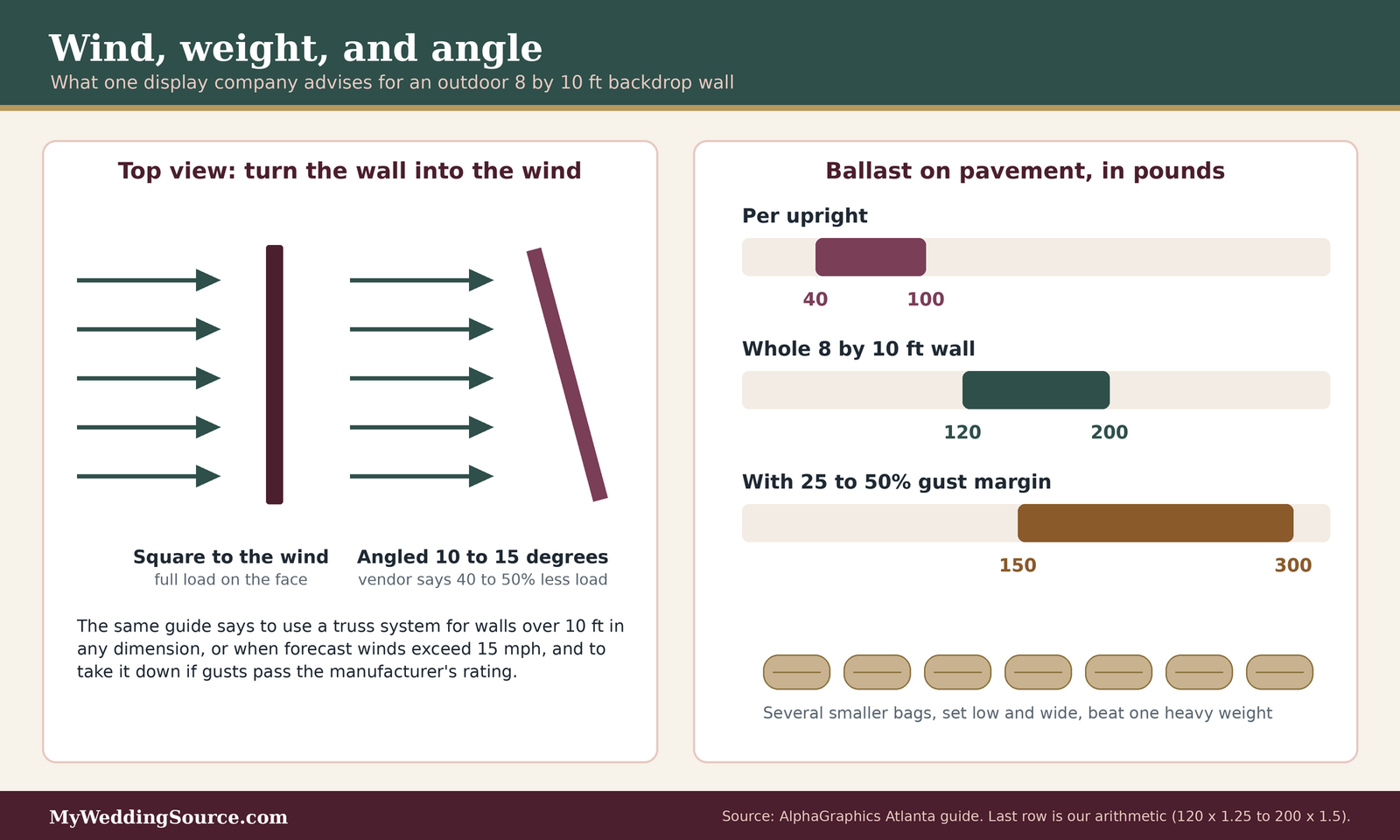
Guidance on ballast comes mostly from event-signage and display companies, which handle large flat walls every week. One printing company’s guide for outdoor event backdrops says that on concrete or paved surfaces you should plan roughly 40 to 100 pounds per upright, depending on the wall size and wind exposure, and that a typical 8-by-10-foot backdrop needs about 120 to 200 pounds of distributed ballast, with a further 25 to 50 percent margin for gusty conditions. It recommends several smaller sandbags set low and wide instead of one heavy weight, and double-bagging where stakes are not allowed. For grass, it recommends spiral auger stakes where the venue allows them, always backed by sandbags, because stakes can pull out under sustained load, and it notes that parks may require permission for stakes.
Those are one vendor’s figures for display walls, not engineering specifications for a floral arch, and the right ballast for your structure depends on its shape, height, and surface area. The Knot’s arch guide gives the same direction in simpler terms: outdoor arbors generally need to be bolted into the ground or weighted with sandbags, rocks, or heavy planters. Use the numbers as a sanity check. If your florist says a tall, solid wall will stand on two small bases, ask how, and what wind rating the structure has. A good vendor will answer the question with a number or a method, not reassurance.
If your venue is a lawn, ask whether stakes are allowed before you rely on them. Underground irrigation lines and utilities are real risks, and the venue will know where they are. If stakes are not allowed, plan for weighted bases and a lower, more open design.
Reading the forecast and deciding when to take it down
Two rules of thumb from the same printing guide are useful. It suggests a truss system for walls more than 10 feet in any dimension, or when forecast winds exceed 15 miles per hour, and says to follow the manufacturer’s wind ratings and dismantle the setup if gusts on site exceed them. It also suggests angling a backdrop 10 to 15 degrees from the prevailing wind, which it says can cut wind loads by 40 to 50 percent, and notes that an 8-by-8-foot wall faces about 30 percent less wind force than a 10-by-10. Those are the guide’s claims, and we cannot independently confirm the percentages, so treat them as a reason to consider orientation and size, not as exact values.
For context on how strong wind can be, the National Weather Service notes that sustained winds of about 40 to 50 miles per hour can cause isolated wind damage, and that high winds can blow objects around and threaten safety. A wedding rarely sees such winds, but gusts that topple a lightly weighted wall are far lower, and forecasts for gusts matter more than average wind speed.
Decide your threshold for outdoor wedding backdrops before the day. Write down, with your vendor, the gust speed at which the structure comes down or moves indoors, who makes the call, and where it goes. Couples in a hurry to start a ceremony are bad judges of wind, and a calm pre-agreed rule removes the argument. Choose open designs when wind is likely: a frame with fabric that has gaps, an arch that lets air pass, or a low arrangement on the ground. Our garden wedding venues guide is useful when you are considering exposed outdoor sites, and the same instinct applies at the beach, where wind is a constant companion.
Overhead hanging, guest paths, and cables
The third risk is what happens above and beside the structure. A beautiful hanging installation is a weight over people’s heads. A neon sign is a cable across a floor.
Hanging points and rigging
Ask the venue where things may hang and what the hanging points can hold. Ceilings, beams, tent poles, and trees are not interchangeable, and many venues forbid attaching to any of them without an approved installer. If your design hangs anything heavy or large overhead, ask who supplies the hardware, who installs it, whether the installer carries insurance, and whether the venue must approve the plan. These are questions for a professional. Do not improvise rigging, and do not hang from a tent or tree unless the tent company or an arborist has said it is acceptable.
For lighter pieces, such as fabric hung from existing hooks or a freestanding frame with fabric, the main concerns are the weight and the stability of the frame, and whether the hooks are approved for the purpose. Ask your vendor what the piece weighs, since you may need that number for the venue.
Aisles, cables, and accessibility
Guest paths must stay clear of wedding backdrops and their bases. The 2010 ADA Standards say the clear width of walking surfaces on an accessible route is 36 inches minimum, with narrow exceptions for short lengths. A private wedding is not necessarily subject to those standards in the same way a public facility is, so use the number as a practical benchmark, and ask the venue about accessibility. Check that no base, sandbag, cable, or fabric hem sticks into the path, and that anything near a path is stable enough to survive a guest bumping into it. Tape or cover cables where people walk, and keep power cords out of the aisle.
Think about who needs the path. A wheelchair user, a guest with a walker, a grandparent using a cane, and a bridesmaid in heels all depend on a clear route, and a backdrop with a wide base can quietly narrow a doorway. Walk the route with a tape measure after the wedding backdrops are placed, not before.
Price the installed design rather than the Pinterest image for wedding backdrops
The image on a mood board has no price attached to labor, delivery, hardware, or removal. A quote does. Comparing quotes for wedding backdrops fairly means turning each into the same list of what is delivered, built, safe, and removed, so that the cheapest headline does not become the most expensive outcome.
Include labor, mechanics, delivery, rentals, teardown, and damage risk
Installed wedding backdrops have layers. A florist’s quote might list flowers and a frame, while a rental company’s quote might list a structure and nothing else, and a venue might add a labor fee on top. The honest price of wedding backdrops is the sum of all of them.
Separate reusable inventory from consumed materials
Reusable inventory is what returns to a vendor: arches, frames, stands, panels, fabric, lights, and bases. Consumed materials stay with you or are thrown out: fresh flowers, greenery, foam, adhesives, and printed pieces. Reusable items are usually rented, and consumed items are usually bought, and mixing the two in your head leads to wrong comparisons. A quote that is high on rentals and low on flowers is not directly comparable to one that is the reverse until you list each.
This also affects what happens after the wedding. Rentals need return by a deadline, and damage may be charged. Consumed items may be taken home, donated, or discarded, and you need to decide who does it. The Knot’s arbor guide frames renting as the more sustainable choice because rentals are reused, while buying costs more upfront but leaves you a structure you can use in a yard or garden afterward. The better answer depends on whether you would actually use it again.
Flag venue labor and fire-code requirements
Some costs belong to the venue, not the vendor. Examples to ask about are an installation or rigging fee, a required insured installer, extra setup time, an after-hours fee, a damage deposit, and the cost of a flame-retardant treatment or certificate if your fabric lacks one. Ask the venue to list these in writing. Compare them against what each vendor says it covers, since a vendor may assume the venue handles something the venue assumes the vendor handles.
Add the cost of the fire-code step for your wedding backdrops when it applies. If your fabric needs a certificate or treatment, ask the vendor who provides it and whether it is included in the price. If the venue needs a document for a foam or fabric item, ask how far ahead it needs it.
Read published cost figures carefully
Published averages help you see a plausible range. They do not tell you what a specific backdrop costs, because the surveys define their categories differently and none of them isolates backdrops.
What the surveys do and do not say
The Knot’s 2026 Real Weddings Study, which covers couples married in 2025 and reports a sample of 10,474 U.S. couples, says floral design and decor together make up about 9 percent of the total budget, inclusive of floral and non-floral elements, against an average total cost of $34,200. Our own arithmetic puts nine percent of $34,200 at about $3,080, which is an estimate and not a figure The Knot reports. The Knot’s flower article, from the same study, reports a national average of $2,800 for flowers, which covers bouquets, boutonnieres, wedding party flowers, and floral centerpieces, with a lower quartile of $900, a median of $1,900, and an upper quartile of $4,800. Zola’s 2026 Wedding Cost Index reports an average of $6,345 for flowers and decor, with a typical range of $5,100 to $7,600, and mentions elaborate installations such as arches among the things that can push the number up.
Notice what these figures do not say. None isolates a backdrop. The Knot’s flower number excludes most structures and lighting. Its decor category includes lighting, candles, signage, and table displays. Zola’s category is broader still, and the surveys differ in methods and respondents, so the numbers should not be compared as though they were the same measurement. For wedding backdrops specifically, the Knot’s flower article quotes a Portland florist who says a simple arbor floral piece can start at a few hundred dollars and run to several thousand, depending on how much of the structure is covered, which is one professional’s range and not a survey. The Knot’s arbor guide gives general rental estimates of about $150 to $600. Together these sources suggest a wide range, which is exactly why you should ask for itemized quotes.
Normalize two quotes into one comparison
Quote normalization is the single most useful technique in this article. For each quote, fill in the same rows: design and materials, rental of structure, delivery, setup labor, teardown and pickup, venue fees, flame-retardant paperwork, substitution rules, and damage responsibility. Mark any row the vendor did not address as unknown, and ask. Then add the rows to get an installed total for each.

The picture above shows an illustrative scenario, not market data, and the dollar amounts are invented round numbers to show the method. Imagine two quotes for a ceremony backdrop for a ballroom. Vendor A quotes $2,300 and says it includes design, flowers, a rented frame, delivery, setup, and teardown. Vendor B quotes $1,650 for flowers and a frame, and its fine print adds $250 for delivery, $350 for setup and teardown labor, and a $200 fee the venue charges for an insured installer, which brings it to $2,450. In this example the cheaper headline costs more. In another example it would not, and the point is the method, not the result.
What the published numbers say, and what they do not
The Knot (2026 study, couples married in 2025): floral design and decor about 9% of the budget, against an average total of $34,200, which is roughly $3,080 by our estimate. The Knot’s flower average is $2,800, and a florist it quotes puts a simple arbor floral piece at a few hundred to several thousand dollars. The Knot’s arbor guide gives general rental estimates of $150 to $600. Zola’s 2026 index reports $6,345 for flowers and decor. These are survey averages and general estimates, not quotes. None of them is a price for your backdrop. Use them to check whether a quote is in a plausible range, then ask each vendor to itemize.
Use one standard set of installed-cost rows
The table below is a template, not a price list. Every row should be filled in with a dollar amount or marked as included or not applicable.
How to use the installed-cost table
Ask each vendor to complete the same rows, and fill in the venue rows yourself. If a vendor will not itemize, ask for a scope summary, and treat a refusal as information. The rows below also double as a checklist for contract review.
| Cost row | What it covers | Who usually supplies it | Ask |
|---|---|---|---|
| Design and materials | Flowers, greenery, fabric, printed pieces consumed on the day | Florist or decor vendor | What is consumed and what returns |
| Structure rental | Arch, frame, panels, stands, bases | Rental company or decor vendor | Dimensions, weight, wind rating |
| Delivery | Transport to and from the site | Vendor | Window, fees, access limits |
| Setup labor | Building, hanging, anchoring | Vendor or venue-approved installer | Hours needed, crew size |
| Teardown and pickup | Removal and return | Vendor | Time, who clears debris |
| Venue fees | Rigging, insured installer, after-hours | Venue | Written list |
| Fire-code paperwork | Flame-resistance certificate or treatment | Fabric supplier or vendor | Cost, who files it |
| Substitution plan | Approved alternatives and price effect | Vendor and you | Approval rule in contract |
| Damage and loss | Rental damage, deposit | Vendor and venue | Who pays, what counts as damage |
Use the template to protect your budget
Add the filled-in rows and compare totals, then test the result against your plan. Our wedding budget calculator can help you see how the total fits among the other categories, and the wedding decor guide explains how to decide where decor money should go.
Create a substitution plan before market or weather changes force one
Substitutions in wedding backdrops are normal. Flowers are not always available in the color you want, a fabric may be back-ordered, and rain may move a ceremony. The question is whether you decide the rules or the vendor does at the last minute.
Define acceptable color, flower, and material substitutions
Before you sign, write down what is acceptable. For flowers, name the colors that must stay and the ones that may move, and name any flower you want to avoid. For fabric, specify the color range and the minimum quality, including the flame-resistance requirement if the venue asks for one. For structures, specify the minimum size and the material. Ask the vendor to send photos of any substitution for approval when time allows, and to tell you the price effect.
Seasonal choice reduces risk for wedding backdrops that use fresh materials. Our seasonal wedding flowers guide helps you pick materials that are more likely to be available at a reasonable price in your month.
Plan the weather branch too. Decide with your vendor what the backdrop becomes if wind or rain makes the original unworkable: a lower design, an indoor version, or a different position. Write who decides and by what time, and what it costs.
Require approval rules in the contract
The Wisconsin Department of Agriculture, Trade and Consumer Protection’s wedding consumer guide advises getting every term in writing, including costs, delivery dates, refund and exchange policies, and who is responsible for mistakes or breakage, and it says to confirm what a florist would offer if a product is unavailable and whether it costs extra. That advice transfers directly to wedding backdrops. Ask for a sample contract, never sign a blank one, and check that it lists the design, the quantities, the setup and teardown times, the substitution rule, the total, what is included, and the cancellation terms.
The same guide notes that deposits can be large and advises putting down as little as possible and considering a credit card, which may offer help if problems arise. This is general consumer education, not legal advice. For anything unusual, such as a custom build or a large deposit, consider asking a lawyer to review the contract.
Put it together with a matrix, a scenario, and a timeline for wedding backdrops
The sections above give you the parts. This one shows how they fit together, so you can make the decision, check it, and schedule it. Nothing here is a requirement. It is a way to keep the plan honest.
Compare the options in one design matrix
A matrix keeps you from choosing by photograph. Each row below is a common type among wedding backdrops, and each column is a constraint you have measured or asked about. The entries are our editorial judgments from the sources above and from general design practice, not test results, so replace them with what you learn at your venue.
Read the design matrix
| Option | Scale and sightline | Typical materials | Lighting | Venue and safety questions | Guest impact |
|---|---|---|---|---|---|
| Ceremony arbor or arch | Sized to couple and officiant plus a few feet each side | Wood, metal, flowers, greenery, fabric | Backlight flattens it; side or front light is kinder | Anchoring, ground stakes, wind rating | Strong focal point; check aisle width |
| Freestanding wall (plant, panel, macrame) | Wide and flat; reads from far away | Faux or fresh greenery, fabric, wood | Even front light; avoid glare | Wind load, ballast, foam or natural-material rules | Can hide a view; blocks light behind it |
| Draped fabric wall | Stretches to fill a plain wall | Flame-resistant fabric, frame | Soft light; shows wrinkles | Flame-resistance proof, hanging points, exits | Softens room; may affect acoustics |
| Sweetheart table backdrop | Wider than the table by a foot or two | Fabric, flowers, mirror, lights | Warm accent light; candles near fabric need care | Candle policy, exits, cable paths | Seen from every seat; must not block service |
| Photo booth wall | 5 ft for one or two people, 8 ft or more for groups (vendor guidance) | Fabric, greenery, panels, matte surfaces | Front light; avoid flash glare on shiny panels | Stable base, ceiling height, power | Creates a queue; place away from exits |
| Hanging installation | Overhead; scale to ceiling | Fabric, florals, lights | Lit from below or behind | Rigging approval, load limits, insured installer | Sits over people; needs a clear zone |
Read across a row before you read down a column. A row with a venue question you cannot answer is not ready to buy. A row with several guest-impact problems may need to move to a different place in the room.
Use the matrix with your venue and your vendors
Bring the matrix of wedding backdrops to the venue walk-through and the vendor meeting. Ask the venue to fill in the “venue and safety” column in writing, and ask each vendor to fill in the “scale,” “materials,” and “lighting” columns for their proposed design. If a row is blank, you have found the next question to ask.
The matrix also helps you cut. If two wedding backdrops compete for the same job, keep the one with the fewest open questions. A simple design that is approved and anchored is worth more than a dramatic one that might be refused on the morning of the wedding.
A worked scenario: one ceremony, one rain plan, one budget
This scenario is illustrative. The couple, the venue, and the numbers are invented to show how the method behaves, and they are not a case study or a recommendation.
The setup and the first decision
Imagine a couple planning a 110-guest wedding with an outdoor garden ceremony and a ballroom reception. They fall in love with a large floral wall they saw online. At the garden, they measure the lawn spot, find the lawn faces west, and see that the sun will be low and in the guests’ eyes at the planned hour. They also learn from the venue that stakes are not allowed on the lawn, and that the ballroom requires fabric to be flame resistant.
Using the method, they assign a job: the ceremony piece must frame them against a plain hedge, and be seen from the back row. They decide against the large wall, since it would need heavy ballast in an exposed spot and would block the one good view. Instead they choose a simple arch with a modest floral piece on one side. They ask the florist about a wind rating, request weighted bases, and plan to move the piece to the ballroom for the head table.
What the method changes
Three things change because they measured first. They move the ceremony forward in the schedule so the sun is behind the guests. They ask the florist for a quote that includes the rain plan, the move, and the setup in the ballroom, and normalize it against a second quote. And they ask the venue for the fire-safety expectations in writing, which prompts the decor vendor to supply a certificate for the fabric.
The result is a smaller, safer, more photogenic design, and the money saved on the large wall goes to lighting at the reception. Another couple in another venue would reach a different answer, and that is the point. The method does not pick a style. It removes the choices that will not work.
A timeline for wedding backdrops
The months below are our suggestions, and they should flex with your date, your venue, and the lead times your vendors give you. Our wedding planning checklist can hold these items alongside the rest of your plan.
From venue booking to final design
Once your venue is booked, ask for the written decor policy and walk the space with a tape measure. Write the job for each backdrop, and choose a short list of designs. Ask vendors for itemized quotes and normalize them. Many vendors fill their calendars well ahead, so book the ones with limited availability once the venue, date, and budget are settled, and ask each vendor for its own deadlines for counts, designs, and payments.
Confirm the venue’s fire and attachment rules for wedding backdrops in writing before you sign with a decor vendor. Get a sample of any fabric, and photograph it in the venue’s light. Ask about the weather branch, and agree on a wind threshold for any outdoor structure.
The final weeks and the day
In the final weeks, confirm delivery and setup windows, power, and access with the venue and each vendor. Share your plan with the photographer. Confirm who is responsible for moving a piece, who has the certificates, and who takes the structure down. Assign a trusted person to be the contact on the day, so you are not answering questions in a dress.
On the day, the contact person walks the backdrop at setup, checks the anchors and the paths, confirms exit signs are visible, and checks the forecast against the agreed threshold. At the end, they make sure rentals are ready for pickup and personal items go home with someone. Our wedding timeline guide shows how to place these tasks in the larger schedule, and it helps to add teardown as its own line.
Take these questions to the venue walk-through and the vendor meeting, ask for the answers in writing, and keep them with your contract.
Questions to ask before you book wedding backdrops
- What are the exact dimensions, weight, and wind rating of the structure, and what does it need to stay standing?
- Is the fabric flame resistant, and can you show me the certificate or label?
- What does the venue allow: stakes, attachments to walls or ceilings, candles, and outside installers?
- Who delivers, builds, anchors, and takes down the piece, and what does each step cost?
- What is returned and what is consumed, and what happens if a rental is damaged?
- What substitutions are allowed, and who approves them?
- What happens to the design if it rains or the wind picks up, and who decides?
- Does the quote include the venue’s fees, and can I see them in writing?
FAQ: wedding backdrops
Planning and choosing
Do I need a ceremony backdrop at all?
Not always. If the setting already frames you, such as a garden, a view, or a handsome wall, a small gesture may be enough. Wedding backdrops earn their cost when what is behind you is distracting or plain. Decide the job first, and spend the savings on lighting if the structure has no job.
How wide should a photo booth backdrop be?
One event company recommends at least 5 feet wide for one or two people, 6 to 8 feet for small groups, and 8 to 10 feet or more for larger groups, with 8 by 8 feet as its standard. Check the ceiling height before you choose, and ask your booth vendor what size it supplies and what it needs for lighting.
Cost and contracts
How much do wedding backdrops cost?
There is no single price. The Knot’s general estimate to rent an arbor is about $150 to $600, and a florist it quotes says a simple arbor floral piece can start at a few hundred dollars and reach several thousand. Those are estimates, not quotes. Ask each vendor for an itemized total covering delivery, setup, teardown, and venue fees.
What should a backdrop contract include?
Get the design, the dimensions, the quantities, the setup and teardown times, the total price and what it covers, the substitution rule, who is responsible for damage, and the cancellation terms in writing. Wisconsin’s consumer guide advises against signing a blank contract. For unusual or expensive builds, consider having a lawyer review it.
Safety and rules
Does fabric for a wedding backdrop need to be flame resistant?
Often, yes. Fire officials in Maine and Charleston describe decorative fabrics, curtains, and hangings in public buildings as needing to meet a flame-resistance test called NFPA 701, with documentation kept on site. Rules differ by place, so ask your venue and your fabric supplier what applies, and ask for a certificate or label in writing.
How do I keep an outdoor backdrop from blowing over?
Match the base and ballast to the structure and the wind. One display company suggests 40 to 100 pounds per upright on pavement and about 120 to 200 pounds for an 8 by 10 foot wall, plus a gust margin. Ask your vendor for a wind rating, agree on a takedown threshold, and choose an open design if wind is likely.
Timing and logistics
When should I book wedding backdrop vendors?
Book once your venue, date, and budget are set, especially for vendors with limited availability, and ask each one for its deadlines for counts, designs, and payments. Confirm the venue’s fire and attachment rules before you sign. Add the deadlines to your calendar, since a missed date can narrow your options or raise the price.
Can I reuse my ceremony backdrop at the reception?
Often yes, and it can save money. Ask the venue and your decor vendor whether the piece can be moved safely during cocktail hour, who does it, and whether the quote covers the labor. Check that the new spot has the same anchoring, exit clearance, and lighting that the piece needs, and that the move will not disrupt service.
Your next steps
Measure and decide
Walk the space with a tape measure
Record the dimensions, the ceiling height, the sun, the wind, the ground, and the access. Ask the venue for its written decor and fire rules. Our wedding decor guide can help you set the room-wide plan around the pieces you choose.
Give each piece one job
Write guide, frame, soften, photograph, or personalize next to every one of your wedding backdrops. Cut or simplify any piece without a job, and check the plan against our wedding budget calculator so the money follows what matters.
Compare and protect
Normalize every quote
Ask each vendor to quote the same rows, add the venue’s fees, and compare the installed totals. Get the substitution rule, the wind threshold, and the flame-resistance paperwork in writing. If you are building a smaller celebration, our small wedding planning guide shows how to scale the rest of the plan.
Test, photograph, and schedule
Photograph a sample in the real light, ask your photographer to review the plan, and add deadlines to your wedding planning checklist. A rule to end on: if you cannot say what a piece among your wedding backdrops is for, who installs it, how it stays up, and who removes it, you are not ready to buy it.
Sources & methodology
How we built this guide
What we relied on
This guide combines current U.S. wedding-spending surveys from The Knot and Zola, published guidance from fire officials in Maine and Charleston, South Carolina, a fabric supplier’s technical sheet on flame tests, the U.S. Access Board’s accessibility standards, the National Weather Service, a state consumer guide on wedding contracts, and vendor guides on backdrop sizing, arbor rental, and outdoor ballast. Where a statement comes from a vendor or publisher, we say so, because their advice reflects what they sell. The $3,080 figure and the quote-normalization scenario are our own arithmetic and illustration, and they are estimates and examples, not market data.
What we did not do
We did not test structures, measure wind loads, inspect venues, or interview installers. We are not engineers, fire officials, or lawyers, and nothing here is safety-engineering, legal, or financial advice. Fire codes, venue rules, and contract law differ by place, so confirm what applies to you with your venue, your local fire marshal, and a professional where the stakes are high.
Source list
Surveys, government, and public-safety sources
- The Knot, How much do wedding flowers cost (Real Weddings Study, 2026 edition, couples married in 2025): https://www.theknot.com/content/average-cost-wedding-flowers
- The Knot, Wedding budget breakdown (Real Weddings Study): https://www.theknot.com/content/how-to-save-and-splurge-on-the-wedding
- Zola, Average cost of weddings in 2026: https://www.zola.com/expert-advice/how-much-does-a-wedding-cost
- City of Charleston Fire Department, Fire Marshal Division, Information Bulletin on decorations (summarizing 2021 International Fire Code Section 807): https://charleston-sc.gov/DocumentCenter/View/11626
- Maine Department of Public Safety, Office of State Fire Marshal, Special provisions for exposition facilities: https://www.maine.gov/dps/fmo/inspections-plans-review/exposition
- U.S. Access Board, 2010 ADA Standards, Chapter 4 accessible routes: https://www.access-board.gov/ada/chapter/ch04/
- National Weather Service, Wind safety: https://www.weather.gov/safety/wind
- Wisconsin Department of Agriculture, Trade and Consumer Protection, Weddings consumer guide: https://datcp.wi.gov/Documents/Wedding219.pdf
Publisher, vendor, and supplier sources
- The Knot, Outdoor wedding arch ideas (arbor sizing, anchoring, and rental estimates): https://www.theknot.com/content/outdoor-wedding-arch-ideas
- The Knot, Creative alternatives to a traditional ceremony arch: https://www.theknot.com/content/wedding-ceremony-arch-alternatives
- AlphaGraphics Atlanta, Outdoor event backdrops that don’t tip in the wind: https://www.alphagraphics.com/us-georgia-atlanta-us592/blog/blog-list/2025/08/outdoor-events-backdrops-that-don-t-tip-in-the-wind
- One of a Kind Event, Photo booth backdrop size guide: https://www.myoneofakindevent.com/blog/photo-booth-backdrop-size/
- Rose Brand, NFPA 701 vs. NFPA 255 tests: https://www.rosebrand.com/downloads/5-701-vs-255-test.pdf