
Outdoor wedding heat management is the work of keeping guests, the wedding party and vendors safe and reasonably comfortable when a ceremony or reception happens in warm weather. This guide covers shade, water, cooling stations, timeline changes and a heat decision flowchart with named owners and clock times, so the call is made early and calmly instead of at the moment someone feels dizzy.
::: {.mws-callout} Quick answer: Good wedding heat management rests on four levers: shade, water, air and time. Walk the site at the hour of the ceremony and mark where the sun actually falls. Give every guest a place to sit in shade and a free drink within easy reach. Provide at least one cooler place to retreat to, and confirm who pays for and powers it.
Shorten or move the parts of the day that sit in full sun. Then assign one owner to each decision, and set clock times for when the forecast gets checked and what each result triggers. :::
Heat rarely ruins a wedding in a dramatic way. It works quietly. The ceremony starts twenty minutes late, the guests in the last rows are fanning themselves with programs, the officiant speaks a little faster than planned, and by the cocktail hour half the older relatives have drifted indoors and are not coming back out.
Nobody planned for any of that, and nobody was assigned to notice it. By dinner a few people are tired, a couple of them feel unwell, and the couple finds out afterward that two guests left early because they were uncomfortable and did not want to say so.
The good news is that heat is one of the most predictable problems a wedding faces. You know the date months ahead. You can see the site in person. Forecasts get sharper as the day gets closer, and the sun follows a path you can look up. What goes wrong is usually not the weather itself. It is the gap between the moment someone could have decided something and the moment someone actually did.
A tent that could have been added a week earlier is unavailable on the day. A water order that could have doubled by phone at noon is not placed until four. A ceremony that could have started at five o’clock starts at three because nobody owned the question.
That gap is what this guide to wedding heat management is built to close. It is not a list of gadgets. It is a way to decide what to prepare, who decides, and when, with enough detail that you can hand parts of it to a planner, a venue manager, a caterer or a trusted friend.
A note on scope. This is general planning information, not medical, legal or safety advice, and it does not replace the rules of your venue, your local fire authority or your vendors’ contracts. Where a rule or number matters, the guide points you to the agency or the vendor who owns it, so you can confirm the current version yourself.
What outdoor wedding heat management covers
People often picture wedding heat management as a table of bottled water and a basket of paper fans. That is one small part. A complete approach to outdoor wedding heat management covers six areas, and each one answers a different question.
Exposure. How much direct sun does each part of the day involve, and for how long? This is about the ceremony seating, the cocktail area, the photo locations and the walking routes between them.
Hydration. Can every guest, vendor and member of the wedding party get a cold drink within a minute or two of wanting one, without asking anyone and without paying?
Cooling. Where can a person who is already too warm go to cool down, and what is there when they arrive?
Schedule. Which events happen at which hour, and which of them could move earlier, later or indoors if the forecast turns?
Decisions. Who watches the forecast, who is allowed to change the plan, who tells the guests, and by what time?
Response. If someone shows signs of heat illness, who notices, who acts, and who calls emergency services?
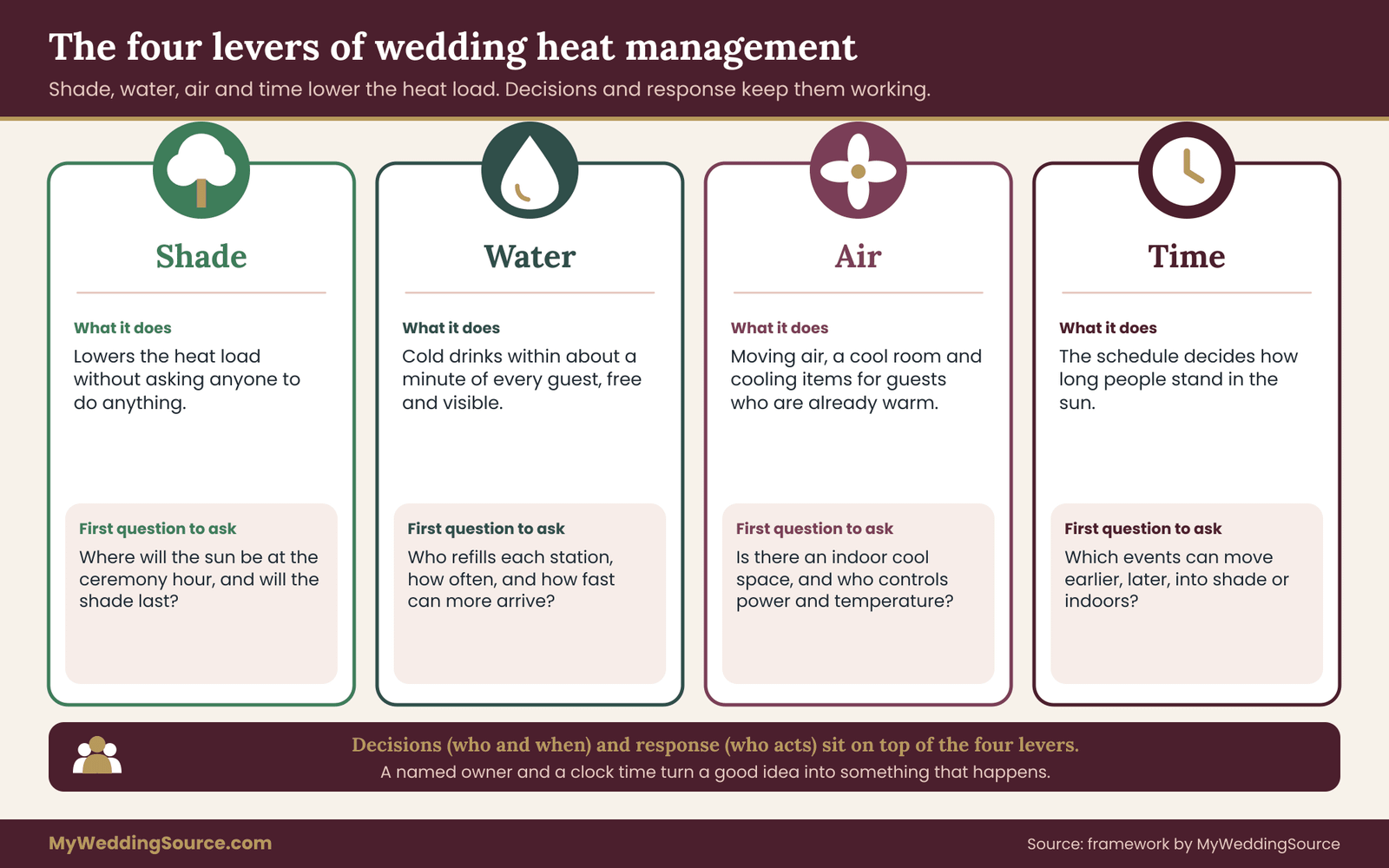
These areas overlap, but they are not interchangeable. A couple can buy excellent fans and still end up with a dangerous afternoon if the ceremony is scheduled for the hottest hour on an exposed lawn. A couple can pick a perfect shaded site and still have trouble if the water runs out. The four levers in the illustration above, shade, water, air and time, are the practical tools. The decisions and the response sit on top of them and decide whether the tools of wedding heat management actually get used.
What this guide leaves to other guides
Warm weather is only one of the weather problems an outdoor wedding can meet. Storms, lightning, high wind and heavy rain call for a different kind of decision, because they can require everyone to move or stop. If thunderstorms are in the forecast, your thinking belongs in a separate storm plan with its own triggers. This guide stays with wedding heat management, and with the long, slow discomfort and real health risk that warm days can bring even when the sky is clear.
The broader work of choosing and comparing sites lives in the wedding venues guide. If you are still deciding between sites, read that first, then come back here to test how each one handles an afternoon of sun. Heat is a good tiebreaker. A site with mature trees, a covered pavilion or a cool indoor room nearby has built-in advantages that cost nothing on the day.
Wedding heat management is a safety topic, not only a comfort topic
It helps to be honest about why this matters. Warm discomfort is annoying, but heat illness is a medical problem. The Centers for Disease Control and Prevention explains that heat can cause illness ranging from cramps and heat exhaustion to heat stroke, which is a medical emergency. The people most likely to be affected at a wedding are not mysterious. They are older relatives, small children, pregnant guests, people on certain medications, anyone who has been drinking alcohol in the sun, and members of the wedding party standing still in formal layers.
You do not need to be alarmed, and you do not need to cancel anything. You need to treat the first few hours of the afternoon as a period with a real, manageable risk, and to put a few ordinary protections in place. That is what the rest of this guide on outdoor wedding heat management describes.
Reading the forecast for wedding heat management
Everything downstream depends on how you read the weather, so it is worth getting this part right. Most couples look at one number, the predicted high, and decide whether it feels hot. That misses most of what matters.
Temperature is only the starting point
The National Weather Service uses the heat index to describe how hot it feels when humidity is combined with air temperature. High humidity slows the evaporation of sweat, which is how the body cools itself, so a humid day at a moderate temperature can be harder on guests than a dry day at a higher one.
The NWS also notes that heat index values are calculated for shady conditions, and that standing in direct sun can make the conditions feel worse than the published number. That detail matters at a wedding, because your ceremony lawn may have no shade at all.
So read two things, not one: the forecast temperature and the forecast heat index, ideally for the specific hours of the event rather than the daily high. A forecast that says the high is reached at three o’clock tells you very little about a five o’clock ceremony. The hourly view tells you more.
Watches, warnings and advisories
The National Weather Service issues heat-related alerts through its local forecast offices, and the criteria for those alerts vary by region, because people in different climates are adapted to different norms. An advisory in one city might describe conditions that are routine in another. The practical consequence is simple. Do not decide by comparing the number to a number you heard once. Check what the local office is saying for your location, using the NWS heat safety pages and your local forecast on weather.gov.
The NWS has also developed a HeatRisk tool that shows the level of heat concern for a location over the coming days, using color-coded categories that consider how unusual the heat is for the time of year and the possible effects on people. It is a useful companion to the standard forecast, particularly for early-season heat, when the same temperature does more harm because people have not yet adjusted to it. Look at it a week out, then again three days out.
The site has its own weather
The forecast describes a region. Your site is a few acres inside it, and a few features change what guests experience.
Pavement, gravel, packed dirt and rooftop surfaces absorb heat and give it back, which makes a parking lot or a terrace noticeably warmer than a lawn nearby. Water can cool the air a little in dry climates and make it feel stickier in humid ones. A site on a hill may get wind that helps, or none at all. A sheltered garden with high walls may block the breeze and trap warm air. Light-colored decking, reflective glass and white gravel can throw extra heat toward guests standing near them.
None of this requires measurement. It only requires attention. When you visit, notice where you feel hot and where you feel relief, and write it down. The next section explains how to turn that into a map.
Dates and the season
If you are still choosing a date, the calendar matters more than any gadget. Late spring and early autumn can be pleasant in many places and punishing in others, and a date that is comfortable most years can still fall in a heat wave. If your date is already set, assume the hottest plausible day, not the average one, and plan for that. If the day is milder, you will have spent a little extra effort. If it is hot, you will be ready.
For guidance on how date choices interact with guest travel and vendor availability, a guide to choosing a date around guest availability and travel takes a broader view than this one.
A simple forecast habit for wedding heat management
You do not need to refresh the forecast hourly for weeks. A short routine is enough. A week out, check the extended forecast and the HeatRisk view and make a note of the trend. Three days out, check again and read the hourly heat index for the event hours. The day before, check the evening forecast and talk to your planner or coordinator.
On the day, check at a fixed time in the morning and again about four hours before the ceremony. The decision flowchart later in this guide turns that habit into a wedding heat management schedule with owners, so you are not carrying it alone.
Keep a written note of each check: the date, the time, the source, and what it said. This sounds fussy, but it settles disagreements. When a parent says it never looked that hot, the note shows what the forecast was when the decision was made.
Who feels the heat first: risk groups in wedding heat management
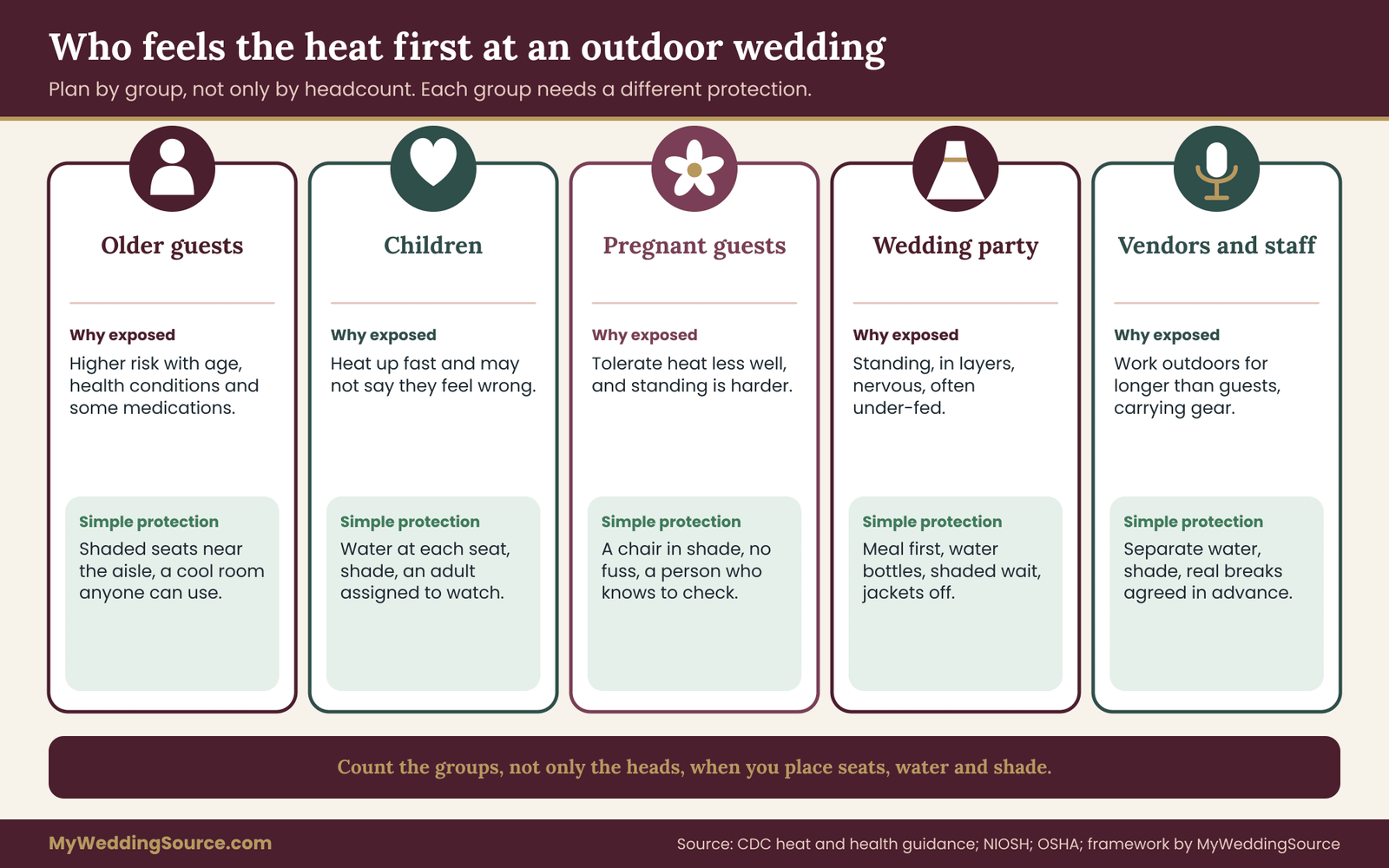
A wedding gathers an unusually wide mix of people into one exposed place for several hours, and most of them are dressed for photographs rather than for weather. Thinking in groups helps you decide where to put your wedding heat management effort.
Older relatives and guests with health conditions
The CDC lists adults aged 65 and older among the people at higher risk from heat, partly because the body’s ability to adjust to temperature changes can decline with age, and partly because chronic conditions and some medications affect how people respond to heat. You cannot know every guest’s medical situation, and you should not ask.
What you can do, as part of wedding heat management, is make the safe choices easy and non-embarrassing for everyone: shaded seats near the front and near the exits, a cool place that anyone can use without explaining why, and a ceremony short enough that nobody is stuck in the sun for long.
Seat placement matters more than most couples expect. Guests with mobility limits often sit near the aisle or at the back so they can leave without a fuss, but the back rows of an open lawn can be the farthest from any shade. If your site has a mix of shaded and sunny areas, reserve the shaded seats first for guests who may need them, and mark them with a quiet, unremarkable sign or have an usher offer them.
The guide to wedding guest care planning covers the broader work of supporting older relatives and children, including seating, rest and quiet space.
Children and babies
Young children heat up faster than adults, cannot always tell you they feel wrong, and may keep playing until they are suddenly unwell. Babies cannot tell you at all. The CDC advises that children should never be left in a parked vehicle, even for a short time, because the temperature inside climbs quickly. That is worth a plain line in your guest communication if guests will be shuttling between a ceremony and a reception.
In wedding heat management for families, shade for the children’s table, a water bottle at each child’s seat, and a parent or relative assigned to watch them keep the problem small. A cool, indoor space with a few quiet activities also gives overheated children somewhere to land without ending the afternoon for their parents.
Pregnant guests and the pregnant couple
Pregnancy changes how people tolerate heat, and standing for a long ceremony can add to the strain. If a member of the wedding party is pregnant, the simplest accommodation is a chair near the ceremony site, a plan for a shaded rest between photos, and a person who has been told, not asked, to keep an eye out. Offer a seat to pregnant guests without making a show of it.
The wedding party
The people at the front of a wedding are often the most exposed. They are standing, not sitting. They are in formal clothing, sometimes in layers, sometimes in dark colors, sometimes in synthetic fabrics that hold heat. They have been up since early morning, may not have eaten much, and are often nervous. The couple’s photographs usually take place in the middle of the afternoon, because the light looks good, and that can be the hottest, most draining period of the day.
Simple wedding heat management steps help. Ask the wedding party to eat a real meal before the ceremony and to carry a water bottle. Give them a shaded place to wait before the processional, with chairs. Let the groomsmen remove jackets between the ceremony and the photographs. Build ten-minute breaks into the photo schedule so nobody stands in the sun for an hour straight. If you are choosing fabrics, remember that lightweight, breathable materials make a bigger difference than any cooling accessory.
Vendors and staff
This group is the one couples forget. Musicians, caterers’ servers, photographers, bartenders, tent crews and rental staff work outdoors, often for longer than the guests, and often carrying equipment. The National Institute for Occupational Safety and Health and the Occupational Safety and Health Administration both publish guidance on heat and outdoor work, and it exists because the risk is real. Employers are responsible for their workers, but a couple who includes vendors in wedding heat management gets better service and fewer problems.
Ask each vendor what they do to protect their staff in warm weather, and offer to help where it is cheap: a shaded place for the band to wait, a cold water cooler for staff away from the guest stations, a real break for the photographer that does not cost you coverage because you agreed on it in advance. Put agreements like these in writing, as the vendor section later in this guide explains, so a heat day does not become a dispute about overtime or missing coverage.
Why groups beat a single guest count
A simple rule of wedding heat management follows from all of this. When you plan seating, water and cooling, count the groups, not only the heads. A guest list of one hundred with fifteen older relatives, eight children, a pregnant bridesmaid and a band of five has different needs from a guest list of one hundred made up of friends in their twenties and thirties. Neither list is better. They just need different amounts of shade, different seat placement, and different attention.
Shade for wedding heat management: audit your site, then choose the cover
Shade is the strongest tool in outdoor wedding heat management, because it lowers the heat load without asking anyone to do anything. It is also the one that is hardest to fix late. So begin with an audit of what shade you already have.
The sun-path walk
For wedding heat management, visit the site at the hour of the ceremony, on a day that is as close to the wedding day as you can manage, and walk it with a notebook or phone. Note which parts are in shade, which are in sun, and where each of them will be at the start of the ceremony, an hour later and at the cocktail hour. Sun moves. A tree that shades the ceremony site at three may leave it fully exposed by five.
If you cannot visit at the right hour, use a free sun-path tool or the sunrise and sunset times for your date, and look at the direction the site faces. Remember that the low sun of late afternoon comes in sideways, and a tree line that blocks the high midday sun may do nothing against the angled light of five or six o’clock. Seats facing west may put guests staring into the sun. A ceremony that ends with the couple facing the sun is great for photographs and difficult for the guests facing the other way.
Mark five zones
Walk and mark five zones for wedding heat management, because these are where guests spend the day: the arrival and parking walk, the ceremony seating, the photo locations, the cocktail area, and the dinner and dance area. For each, write down three things. Is it shaded at the planned time? Will the shade last for the full event window, or will the sun move? And how far is it from the nearest cool, indoor space?
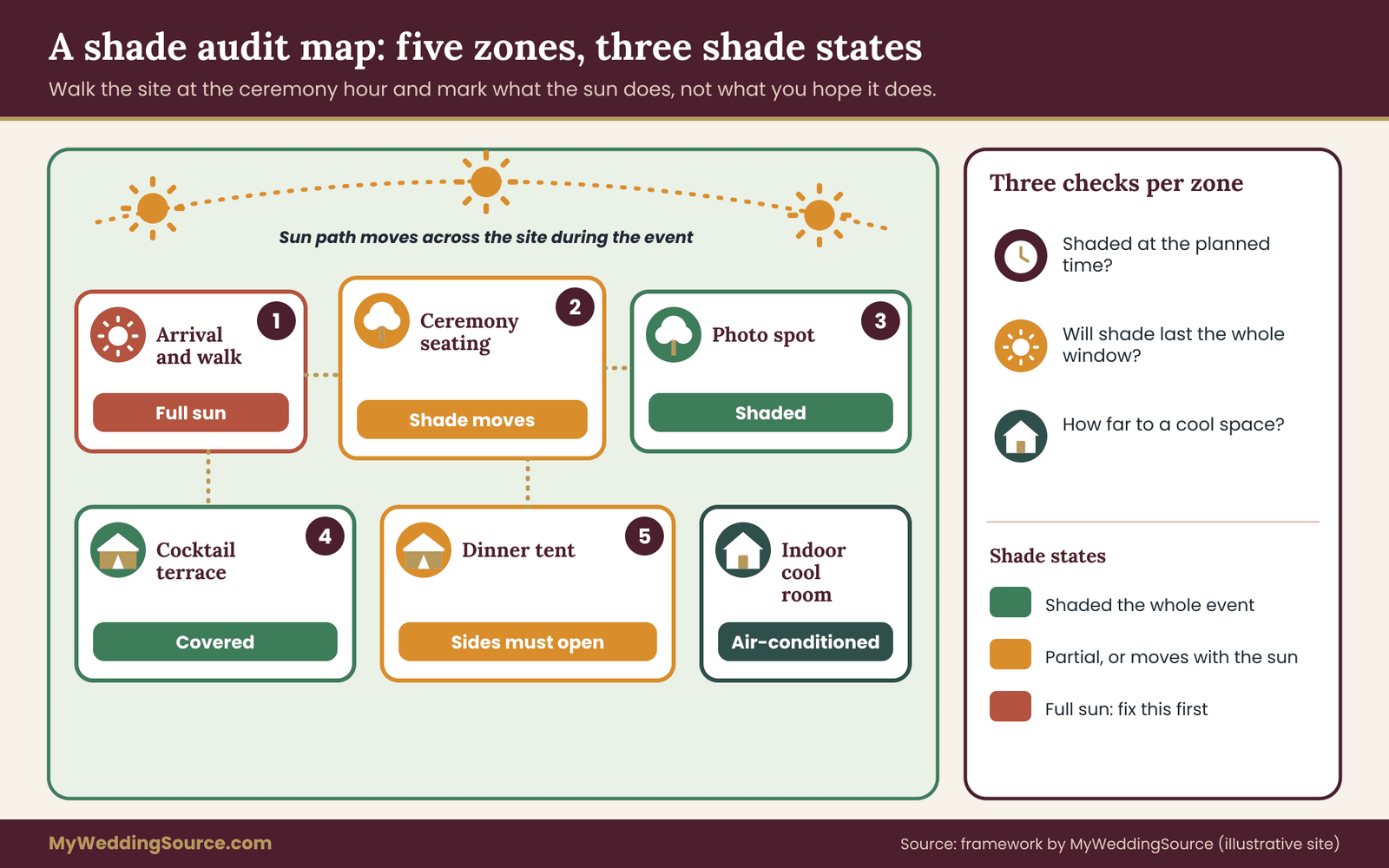
The illustration shows how a site map looks once the zones are marked. The point is not to produce a beautiful diagram. It is to find the places where a guest will spend more than a few minutes in full sun, so you can fix those places first.
The three kinds of shade
Shade in wedding heat management comes from three sources, and each behaves differently.
Natural shade comes from trees and buildings. It costs nothing, it is cooler than any fabric because leaves also release moisture, and it is usually the most pleasant. Its limits are that it moves with the sun, it may drop branches in a storm, and it may not cover as many seats as you need. Ask the venue about the condition of the trees. A site that cannot confirm that its trees are maintained is not one to put a hundred guests under without checking.
Structure shade comes from a pergola, a covered pavilion, a porch, a barn overhang or a permanent pavilion. It is predictable, it is usually part of the venue price, and it often comes with power and sometimes with fans. If you are comparing sites, covered and semi-covered spaces such as barns often handle warm weather better than open lawns, though barns can trap heat too.
Rented shade comes from tents, canopies, pop-up shelters, sail shades and large umbrellas. It is flexible and can be placed exactly where you need it, but it costs money, takes time to install, needs space, and is bound by permits and safety rules.
What to ask before you rent shade
Tents are the most common rented shade, and the most misunderstood. A tent keeps the sun off, but a closed tent on a hot day can be hotter inside than the lawn outside, because the fabric traps warm air and the sun heats the roof. The same tent with the sides rolled up and a breeze can be pleasant. So the real question is not “do we have a tent” but “can the air move through it.”
Ask the rental company about the ventilation of the tent they propose: whether the sidewalls can be opened or removed, whether the tent has a clear or translucent roof (which lets in more heat), and whether they offer cooling equipment for tents and who installs it. Ask about the fabric color and weight. Ask what the tent is rated for in wind, because open sides and a wind gust interact, and ask what happens if conditions change on the day. Ask about the lead time for orders, and how late you can add a second tent if the forecast worsens.
Permits and safety rules matter here as well. Many local authorities require permits for tents of a certain size, inspections, and fire safety measures such as flame-resistant fabric certification. Do not guess, and do not rely on a general rule you have read. Ask the venue and the tent company what the local fire authority requires, and who pulls the permit.
The United States Fire Administration publishes general fire safety guidance, but your local fire marshal’s office decides what applies to your tent. This guide gives no installation or rigging instructions, and you should not attempt any yourself. Tent installation, anchoring and anything electrical belongs to the rental company’s trained crew and, where power is involved, to a licensed professional.
Shade for the ceremony seating
Make a shade decision about the ceremony before anything else in your wedding heat management work, because it is the part of the day with the most people sitting still. There are four basic options.
A naturally shaded ceremony site is the best and simplest solution if the shade will cover the seats for the whole time. A covered structure is the next best. A tent over the seating is the third, and works best with open sides. A fourth option is to leave the seating in the sun and manage the exposure by shortening the ceremony, moving it to the hour when the site is shaded, or giving guests personal shade such as paper fans and, if the venue allows it, umbrellas.
Whichever you choose, apply the same test. Walk to the last row at the planned start time, sit down and wait five minutes. If you would be uncomfortable, a guest will be too.
Shade for the walk between places
The walk is often missed. Guests may leave a cool car, cross a parking lot, walk along a sunny path and arrive at the ceremony site already warm. A shaded drop-off, a short cart ride for guests who need it, and a few umbrellas or a covered walkway make the arrival easier and cost little. The guide to the wedding venue technical walkthrough shows how to measure routes, access points and distances during a site visit, which is the same visit where you do your sun-path walk.
Rentals and the money logic
Shade costs money in any wedding heat management budget, and there is a way to think about it that avoids both overspending and underspending. Compare the cost of the shade you are considering with the cost of the other ways to solve the same problem, and with the cost of the problem itself.
A tent over the ceremony seating may look expensive next to a few umbrellas. But if the alternative is moving the ceremony to a hotter or colder hour, or shortening an event you value, the tent may be the cheaper choice. On the other hand, if the venue already has a shaded pavilion, the tent buys little.
Ask for itemized quotes so you can see what the shade, the sidewalls, the flooring and the cooling equipment each cost, and what happens to the price if you change your mind. The wedding rental planning checklist is a good companion for collecting and comparing those quotes in one place.
Water: planning hydration so it actually reaches people
Most couples order drinks. Fewer plan how a drink gets from a cooler to a thirsty person standing at the back of the ceremony. The difference is where the work lies. Good hydration in wedding heat management is a matter of placement, supply, refill speed and visibility, and the beverage list is the smallest piece of it.
The one-minute rule
Here is a simple test that works for any site. From any place a guest might stand or sit, a free cold drink should be reachable in about a minute, without asking anyone, without leaving the event, and without paying. If a guest has to find a bartender, wait in a line, and then pay or explain themselves, the rule fails. In outdoor wedding heat management, a rule that is easy to test is better than a clever one that is not.
Apply the test to five moments: arrival, the wait before the ceremony, the ceremony itself, the cocktail hour and the dance floor. Each has a different failure. At arrival, guests come from hot cars and need water before anything else. Before the ceremony, they wait in whatever shade there is. During the ceremony, they cannot get up, so water must come to them. During cocktails, the bar lines are long and alcohol is the main offering. On the dance floor, people are active and sweating and forget to drink.
Where to put water
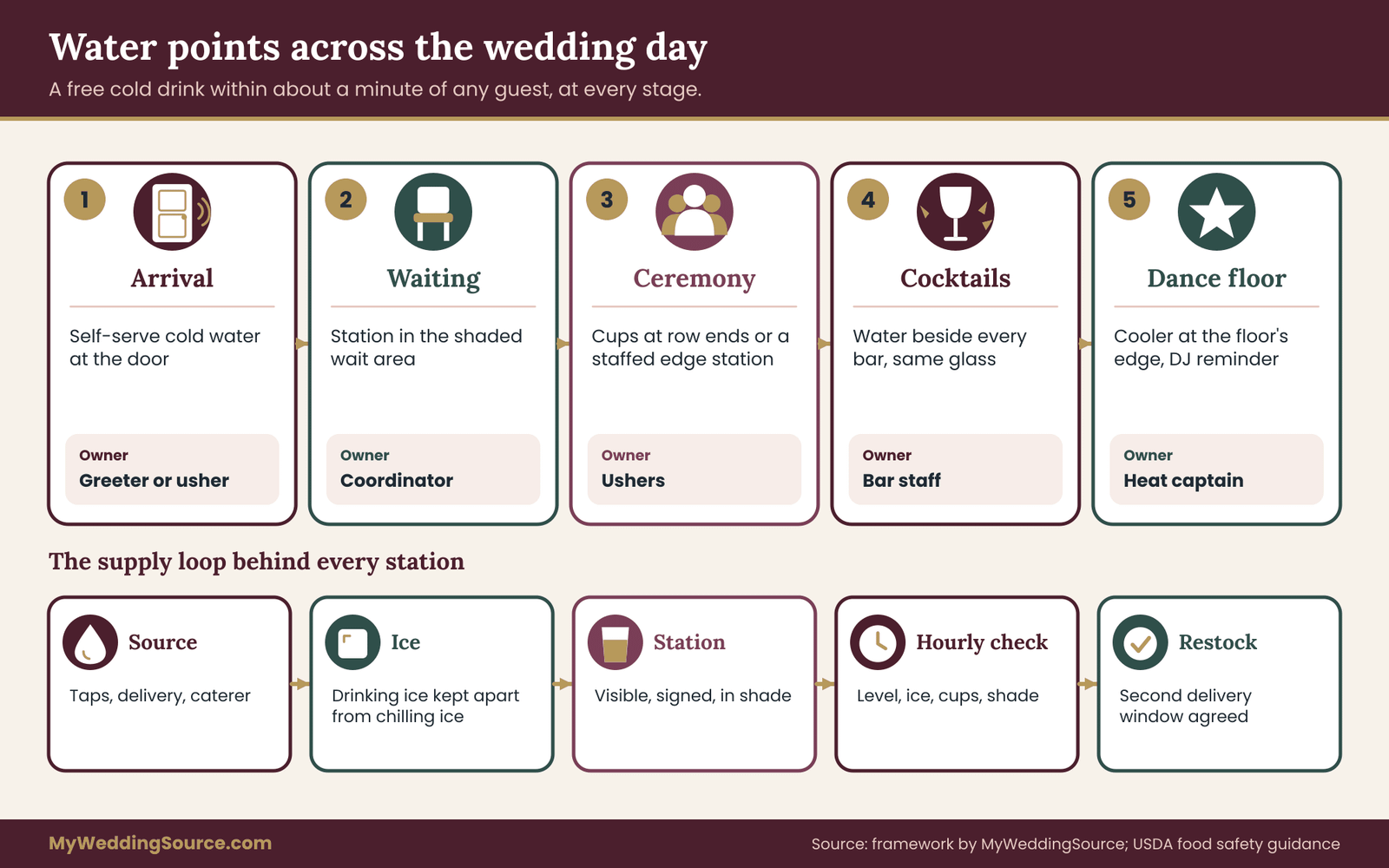
The illustration above maps a typical wedding heat management water plan onto the day, and the placement follows from the five moments. Put a self-serve water point at the arrival, at the shaded waiting area, at the edge of the ceremony seating, at the cocktail area and at the dance floor. Add a small station near the restrooms, because people drink more when they have a reason to stop there. Add one for vendors, away from the guest stations, so staff are not taking water from the guests’ supply or going without.
For the ceremony itself, you have three choices. Staff or volunteers can walk the aisles with water before the ceremony starts. Small bottles or cups can sit on a chair or table at the end of each row. Or a station at the edge of the seating can be staffed, with a sign. The first choice works when the guest count is modest, the second when the ceremony is long, and the third when the layout is complicated. If the ceremony is short and shaded, the water can wait until just after.
Supply logic without made-up numbers
Couples often ask how much water they need for wedding heat management. You will find numbers online, and most of them come with no explanation of the assumptions. A better method is to ask the people who supply the drinks to do the arithmetic with you, using the facts of your event: the guest count, the expected temperature, the hours of the event, how many of the hours are in sun, and how much of the drinking will be alcoholic or sugary.
Then add a margin that fits your risk. If the forecast is mild and shaded, a standard allowance is probably fine. If the forecast is hot and the site is exposed, ask for a larger allowance, and ask whether the supplier can deliver more on short notice. The most valuable question is not how much to order but how much more can arrive, and how fast, if the forecast gets worse. A caterer who can send another delivery by midafternoon is worth more than one who ordered twice as much at the start and has no way to add more.
Cups, bottles and dispensers
Each format has tradeoffs. Beverage dispensers with a spigot are efficient and look pretty, but they run out fast, can leak, and attract insects in warm weather. Bottled water is simple and reliable, produces waste and needs a place to recycle. Pitchers are quick but need refilling and attention. Refillable personal bottles given as a favor reduce waste and let guests keep water with them, but only work if there are places to refill them.
For wedding heat management on a hot day, think about speed and reliability first and appearance second. Whatever you choose, put the water where people can see it. Drinks hidden behind a bar are not part of the plan. Small, clear signs, such as “Cold water, please help yourself,” remove the hesitation that makes some guests reluctant to take something that looks like part of the décor.
Ice, and the two kinds of ice
Ice is both a cooling tool and a food safety issue in wedding heat management. Drinking ice, which goes into cups, should be clean, handled with a scoop, and kept separate from ice used to chill bottles, which sits in coolers and may have been handled by many hands. Mixing the two causes problems. Ask the caterer or bar service which ice they use for what and how they keep the two apart.
Ice melts fast in the sun, so plan its supply the way you plan water: ask the vendor how much arrives, when, and whether more can be delivered. Keep coolers in shade and covered. A cooler in direct sun loses ice much faster than one in the shade of a table.
Food safety in the heat
Wedding heat management includes food, because the same heat that makes guests uncomfortable makes food unsafe sooner. The United States Department of Agriculture advises that perishable food should not sit out for more than two hours, and for only one hour when the air temperature is above 90 degrees Fahrenheit. Those limits apply to the food on the buffet, the cheese board, the dessert table and the cake.
Ask the caterer how they hold hot and cold foods outdoors, and what they do on very hot days. The wedding cocktail hour guide explains how to plan appetizers and service so that food does not sit out longer than it should.
Alcohol, caffeine and the guest who is not drinking water
Alcohol can add to dehydration, and guests who are drinking in the sun often feel fine until they do not. Very sugary drinks do little to help either. This is not a reason to avoid serving drinks. It is a reason to place water next to every bar, serve it in the same kind of glass, and offer a lighter option early in the afternoon, such as a drink with ice and fruit, so that guests have something appealing that is not alcoholic.
The guide to wedding bar service planning covers staffing, timing and choices at the bar. For wedding heat management, the one addition worth making is an agreement with the bar staff that they will offer water with every order and report any guest who seems unwell. Bartenders see more guests up close than almost anyone else at the party, and they are well placed to notice trouble early.
A water point that does not depend on one person
Hydration plans in wedding heat management fail when they depend on a single volunteer who gets pulled away. Give each station an owner, a backup and a time to check. Write down who refills, from where, and how often. If the refill source is a spigot or a supply truck, confirm that the venue allows access and that the route is clear. Put a second supply of water somewhere other than the main bar, so that if the bar is crowded or understaffed, guests are not cut off.
Cooling stations for wedding heat management: fans, misters, cool rooms and power
In wedding heat management, a cooling station is a place or a device that lowers a guest’s temperature, and there are many types. They vary widely in effect and in the problems they bring, so it helps to look at them honestly, one by one.
The cool room
The most effective cooling station in wedding heat management is not a gadget but a space: an air-conditioned room, a shaded porch, a covered lobby, a cool lounge inside the venue, or a vehicle with the air conditioning running. A guest who goes inside for fifteen minutes comes back refreshed, and the room costs almost nothing if the venue already has it.
Ask the venue three things. Is there an air-conditioned indoor space that guests may use during the event? Who controls the thermostat, and will it be on? And how many people may use the space at one time? That last question has a legal answer that depends on the room and on local fire rules, so ask the venue or the fire authority.
Do not use a number you read online. Set the room up with chairs, cold water, a few paper fans and a sign that tells guests it is there, and tell your coordinator and ushers so they can quietly direct people to it.
Fans
Fans move air, and moving air helps a person feel cooler as sweat evaporates. But a fan does not lower the temperature of the air, and in very hot, humid air it may do little. A fan blowing hot air across a person at the top of a dangerous heat index offers comfort rather than protection.
Handheld paper fans are inexpensive, give the guest control, and double as programs and favors. Standing or tower fans work well in a tent with open sides or in a covered pavilion, but need a safe power source and a safe place for cords. Large industrial fans in tents are common and are usually set up by the rental company. In all cases, keep cords out of walkways, and leave the electrical work to the venue or a professional.
Misters and evaporative cooling
Misting fans and misting systems cool by evaporating water, and they work best in hot, dry air. In humid air, evaporation is slow, the mist settles on people and surfaces, and the result can be damp guests and slippery floors without much cooling. If your region is humid, ask for evidence before paying for misting, such as a rental company’s experience with similar conditions, and consider whether spending the money on shade or on a cool room would help more.
Misters also need water and power, can wet formal clothing and electronics, and need a safe place for runoff. They are not the first choice for a dance floor. They may suit a cocktail area, a waiting area or a patio.
Cooling towels, hats and personal items
Small items help individual guests: cold damp towels, hand towels in a cooler, hats, sunglasses, sunscreen, insect repellent where relevant, and a few umbrellas for sun. A basket with a few of these items near the ceremony site and the cool room costs little. Offer them without comment. The point is that a guest who feels too warm has something close at hand and does not have to ask.
Sunscreen is not decoration. The CDC advises protecting skin from sunburn, which makes it harder for the body to cool itself, and a bottle at the welcome table is one of the few heat items that also protects health in the long term.
Power: the part you do not improvise
Fans, misters, lighting and cooling equipment all need electricity, and a wedding can ask for more than a venue’s outdoor outlets can deliver. Overloaded circuits, extension cords across lawns and improvised generator connections are fire and shock hazards. The rule for wedding heat management in this guide is plain: do not design or build electrical setups yourself, and do not accept a vendor’s improvisation without the venue’s approval.
Ask the venue what power is available where, what the circuit limits are, and who is approved to connect equipment. Ask the tent or rental company whether their equipment comes with its own supply and who runs it. If a generator is needed, ask who provides it, who operates it, where it will be placed, and what the venue’s rules are about fuel and noise. For anything unclear, ask the venue to put the answer in writing, and consider asking a licensed electrician to review the plan. That is not an upsell. It is how serious events handle power.
Which cooling station suits which situation
Pairing tools to conditions saves money in wedding heat management. In dry heat, shade plus misting or evaporative cooling can work well. In humid heat, shade plus airflow plus a cool room is more reliable. In heat that is both extreme and prolonged, no outdoor device will do the job of an air-conditioned space, and the right decision may be to shorten the outdoor part of the day or move it. That is a schedule decision, which the next section takes up.
Rebuilding the timeline around the sun
Shade and water reduce the heat load. In wedding heat management, the schedule decides how much heat the guests have to carry in the first place. Moving a single event by an hour can do more than any amount of equipment, and it costs little if you decide early.
Sun curve first, events second
Most wedding timelines are built from the inside out, which ignores wedding heat management: the ceremony is at four because the venue offered four, the photographs follow, then cocktails, then dinner. For a hot date, reverse it. Start with the sun. On a typical summer day the strongest heat arrives after the middle of the day and lingers into the late afternoon, and it fades slowly in the evening, especially on pavement and in enclosed spaces.
Your region may differ, and your forecast tells you more than a general rule, but the shape is usually the same: a rise, a long plateau and a slow decline.
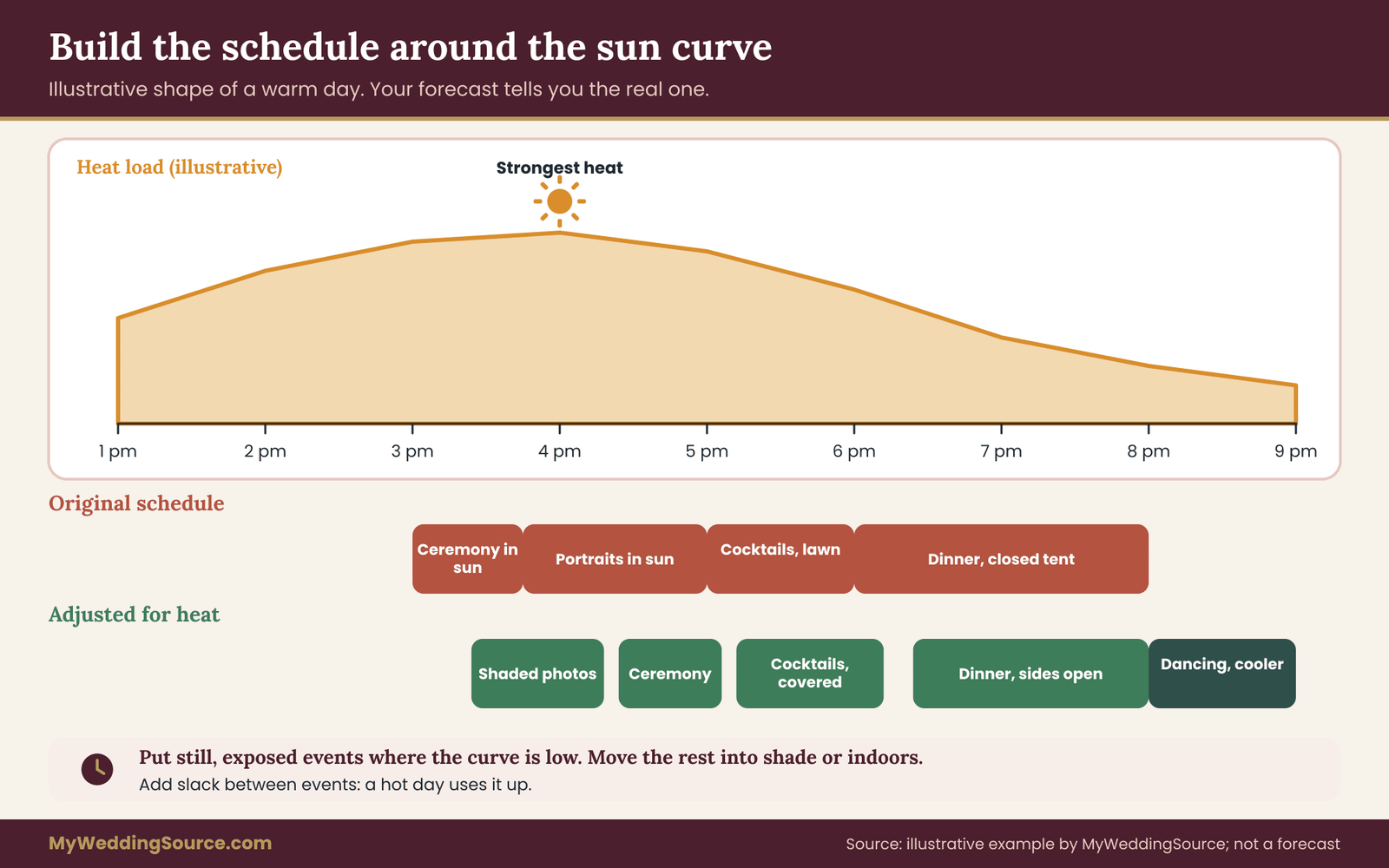
The illustration lays that curve beside a sample schedule. The useful wedding heat management habit it shows is simple. Place the events that keep guests still and exposed, the arrival wait and the ceremony, where the curve is lowest, and place the events that can move indoors or into shade, such as cocktails and dinner, where it is highest.
The ceremony hour
The ceremony is the part of the day with the most people sitting still in the sun, so its start time has the most effect on wedding heat management. You have four ways to adjust it.
Move it later. A ceremony that ends as the sun lowers is cooler, softer for photographs and easier on the guests. But a late ceremony pushes everything else back, which means dinner is later, children are tired and vendors work longer. It also moves the day toward the hours when insects and darkness arrive, so check the sunset time and the lighting plan.
Move it earlier. A morning or early-afternoon ceremony avoids the late-afternoon peak in many places. It also gives the couple a longer day to enjoy the reception. But it may sit near the middle of the day, when the sun is high and direct, and the shade of trees is shortest.
Shorten it. A ceremony that runs twenty minutes puts less strain on everyone than one that runs fifty. Readings, extra music, long unity rituals and a long homily all add minutes. Ask the officiant whether the ceremony can be tightened on a hot day. Timing each element on a cue sheet helps, and the question to ask is which elements the couple would miss least if time became tight.
Move it into shade or indoors. If a shaded or indoor alternative exists, the cleanest decision may be to hold the ceremony there and keep the outdoor setting for photographs or the cocktail hour.
Cutting the arrival wait
Guests often arrive thirty minutes early and wait. If the arrival area is in sun, that wait is the longest exposure of the day for many of them. Fix this directly. Tell guests the real arrival time, which should be fifteen to twenty minutes before the start. Open the shaded seating or the cool room early.
Offer water at the door. Hold the seating and the ceremony on time, because a delayed start extends the wait for everyone. A late start has many causes, but a hot day makes each minute count, so tell the wedding party and the photographer that the start time is firm.
The photograph schedule
Portraits are the hidden wedding heat management problem of a wedding day. The couple, the family and the wedding party stand in the open, in formal clothes, often at the hottest time, for a long period. Several fixes are available.
Do the family and wedding party photographs in shade or indoors. A good photographer will know where shade falls and will appreciate being asked early. Take the couple’s portraits at the time that suits both light and heat, which often is the last hour before sunset. Hold a first look before the ceremony if that suits the couple, because it moves some of the photographs to a cooler time of day.
Build breaks into the list, ten minutes each hour with water and a seat. And shorten the family list, or divide it into groups that can be photographed while the rest of the guests are in the shade at cocktails. The guide to the wedding vendor timeline explains how to build a master schedule that vendors can follow, which helps when an hour has to move.
Cocktail hour and dinner
The cocktail hour is a natural place to bring people in from the sun, because it is flexible. Move it to a shaded terrace, a covered area or an indoor lobby, even if the original plan was a sunny lawn. Offer cold, light food, and keep the hot appetizers in the kitchen until the air cools, or serve them in the shade and shorter batches. The wedding reception guest flow guide shows how people move through the day, which helps when you are rerouting guests from the sun to the shade.
For dinner, tent or indoor seating is safer on a hot day. If dinner has to be outdoors in the open, consider an earlier dinner, a short buffet line in shade and the sun’s angle on each table. Seat older guests and families with children in the coolest, most comfortable spots, and mention it quietly to the staff.
The dance floor
Dancing is the most active part of the day and the part of wedding heat management where overheating is easiest to miss, because guests are enjoying themselves. Move the dance to a tent with open sides, an indoor room or an evening hour when the air has cooled. Make sure water is on the floor’s edge, and tell the DJ or band to remind guests to drink. A simple line over the microphone, said in a friendly way, works better than a rule.
Build in slack
A tight schedule leaves no room to react, and wedding heat management needs room. On a hot day, add slack between events: ten minutes after the ceremony, fifteen between photographs and cocktails, and a buffer before dinner. Slack costs a little time on a normal day. On a hot day, it is where the schedule absorbs a delayed shuttle, an unwell guest or a station that needs more ice.
The wedding heat management flowchart: owners, timestamps and triggers
Everything so far is preparation. The wedding heat management flowchart is how you use it. It answers four questions that a hot wedding raises: what do we check, when do we check it, who decides, and what does each result trigger?
Why owners and timestamps
Most wedding heat management failures are not caused by bad decisions. They are caused by decisions that nobody owned or that arrived too late. A decision with a name and a clock time next to it gets made. A decision labeled “we will see how it looks” often does not.
The wedding heat management flowchart has two parts. The first is a ladder of four heat levels, each with a rough meaning and a standing set of actions. The second is a timeline of checkpoints, from a week before to the end of the event, each with an owner and a decision.
The four levels
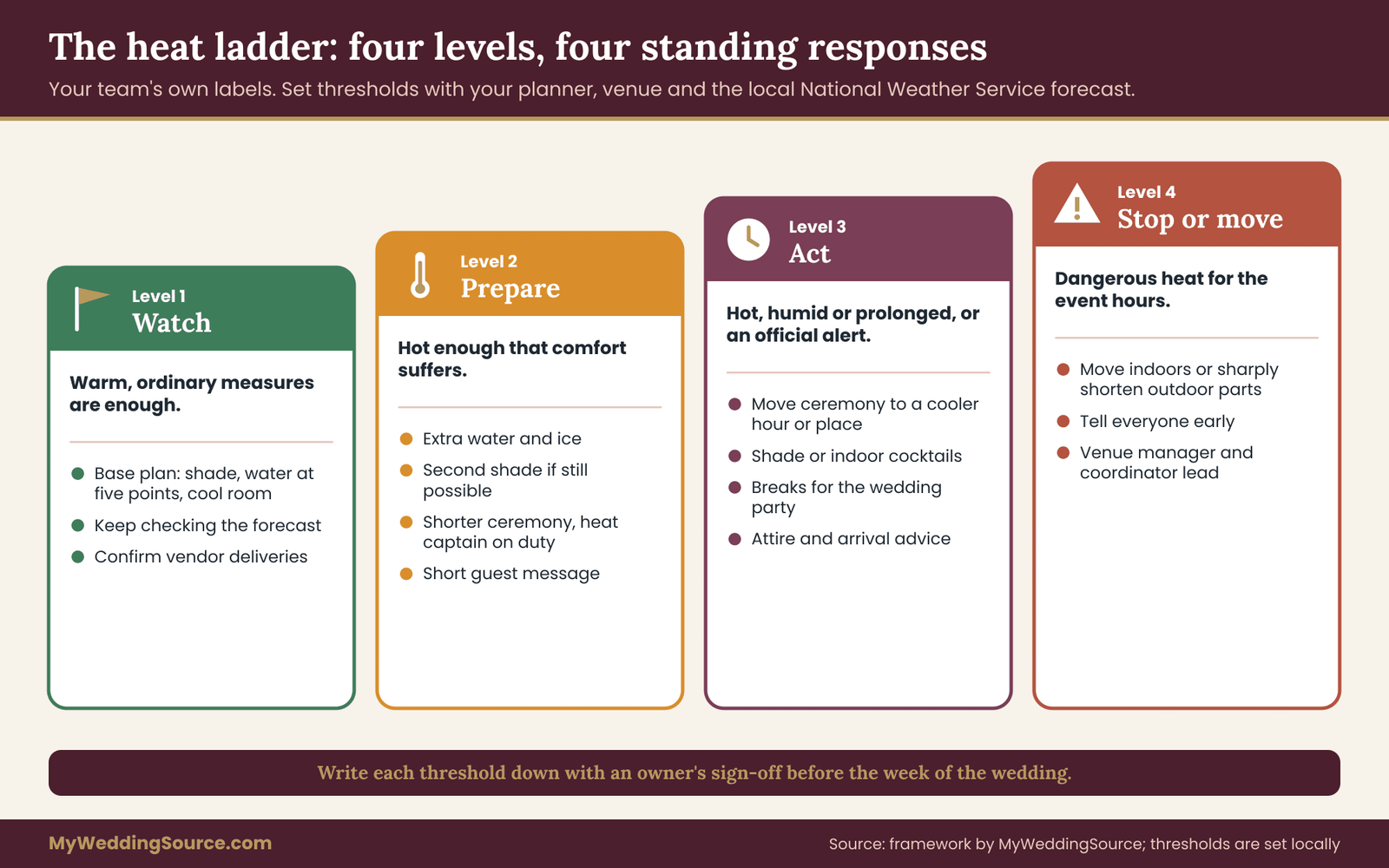
The ladder in the illustration uses four plain wedding heat management levels. They are not official categories, and you should set the thresholds with your planner, your venue and the National Weather Service forecast for your area. The names are there so the team can say “we are at level three” and mean the same thing.
Level one: Watch. The forecast looks warm, but ordinary measures will do. You are running the base plan: shade where possible, water at five points, a cool room available. The action is to keep checking and to confirm the vendors’ deliveries.
Level two: Prepare. The forecast is hot enough that comfort will suffer and some guests may be at risk. You add measures: extra water and ice, a second shade structure if one is still possible, a shorter ceremony, an earlier arrival of the cool room’s setup, a heat captain on duty and a short message to the guests.
Level three: Act. The forecast shows hot, humid or prolonged heat, or an official advisory is in place for your area. You change the schedule: move the ceremony to a cooler hour or place, shift photographs, move the cocktail hour into shade or indoors, and give the wedding party breaks. Guests get clear attire and arrival advice.
Level four: Stop or move. The forecast or an official alert indicates dangerous heat for the event hours, or conditions on the day turn out worse than expected. You move the event indoors, shorten the outdoor parts sharply, or postpone the outdoor parts to a later hour, and you tell everyone. This level should be rare, and it is the reason the other three exist: the earlier levels keep you from arriving here unprepared.
Setting your thresholds
Thresholds for wedding heat management are local. A heat index that sends one city into advisories is ordinary in another. So, set your levels using three inputs: the heat index forecast for the event hours, any watch, warning or advisory the local National Weather Service office has issued, and the HeatRisk category for your location. Then add what you know about your guests. A crowd of older relatives and small children moves the thresholds down. A group of healthy adults who live in a hot region moves them up, but only a little, because the event is long.
Write the wedding heat management thresholds down, and have the owner sign off. For example: “When the forecast heat index for the ceremony hour reaches the level the local office calls an advisory, we move to level three.” Fill in the real numbers with the planner and the venue, not from this page.
The checkpoint timeline
The second half of the wedding heat management flowchart is a series of checkpoints. Each has a clock time, an owner and a decision. The times below are a starting point, and you should adjust them to your event.
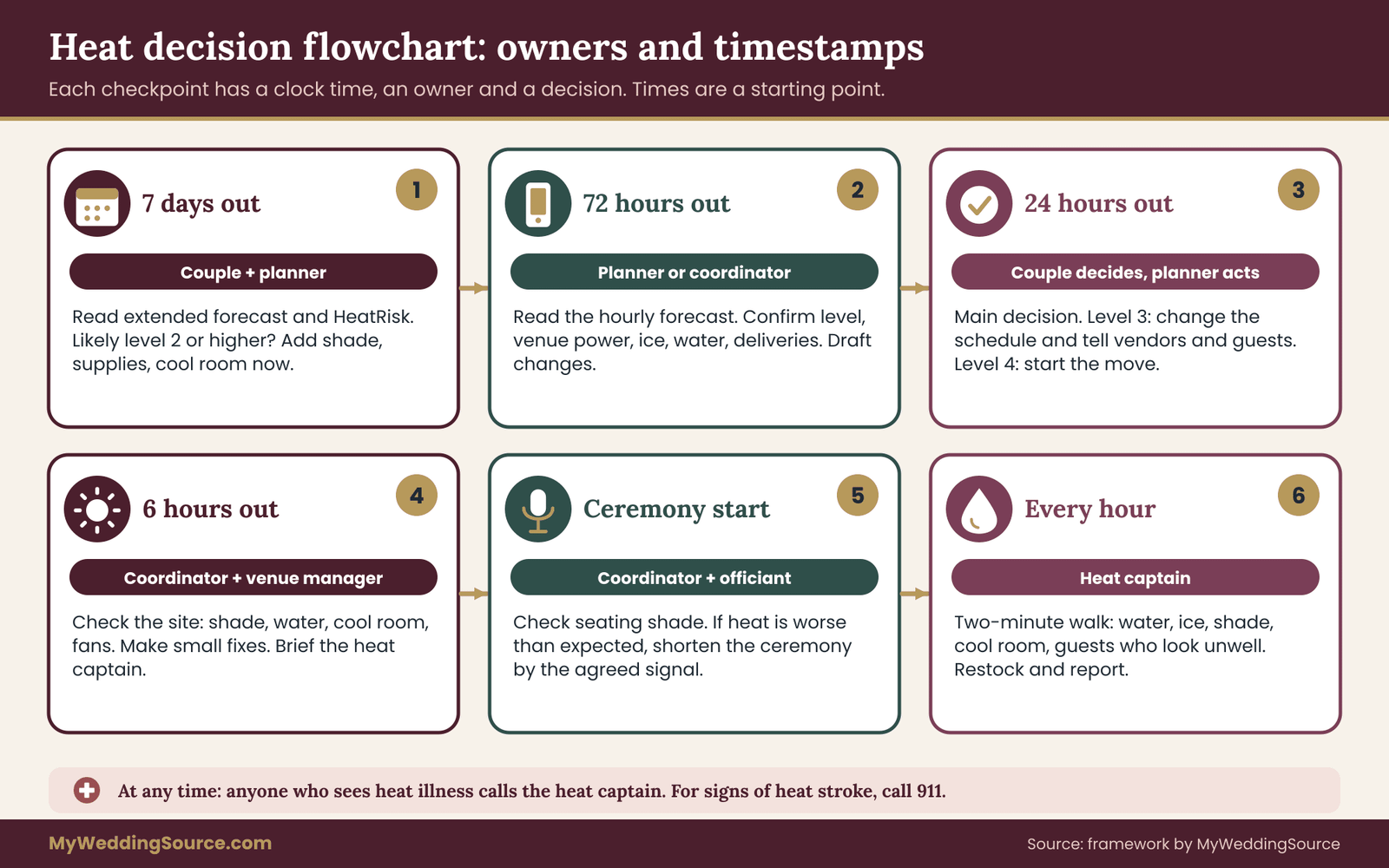
Seven days out. Owner: the couple, with the planner. Read the extended forecast and the HeatRisk view. Decide whether your wedding heat management is likely to reach level two or above. If so, this is the last comfortable moment to add shade, order extra supplies and reserve the cool room. Ask the tent company about a second tent while it is still easy. Tell your vendors that you are watching the weather.
Seventy-two hours out. Owner: the planner or day-of coordinator. Read the hourly forecast. Confirm the level. Call the venue to confirm the cool room, the power, the water access and the delivery times. Confirm the caterer’s ice and water supply and the extra delivery window. If the level is three or higher, draft the schedule change and the guest message, but do not send it yet unless the change is certain.
Twenty-four hours out. Owner: the couple makes the call; the planner carries it out. This is the main decision point of wedding heat management. If the level is three, change the schedule now, tell the vendors and send the guest message. If the level is four, begin the move. Vendors who work to a schedule need a day to adjust, and guests need a day to change their clothes, their travel and their plans. Changes made at this point are manageable. Changes made six hours out are expensive and stressful.
Six hours out. Owner: the day-of coordinator, with the venue manager. Read the morning forecast and check conditions on site. Is the shade where you expected it? Are the water stations stocked? Is the cool room cold? Are the fans running? Is the heat captain briefed? This is the checkpoint for small adjustments: more ice, extra chairs in shade, a shorter ceremony, a text to the wedding party about water and jackets.
Ceremony start. Owner: the coordinator, with the officiant. Check the conditions on the seating. Is anyone in the sun who should not be? Is the shade holding? If the heat is worse than expected, the coordinator can ask the officiant to cut readings or shorten the ceremony. Agree this possibility in advance, and agree the signal.
Every hour during the event. Owner: the heat captain. A short walk through each station: water level, ice, shade, the cool room, and the guests. This is a two-minute walk, repeated. It catches the cooler that ran out, the shade that moved and the guest who is sitting too quietly.
At the first sign of illness. Owner: whoever sees it, then the heat captain. The response section below explains what to do. The flowchart’s rule is that anyone can start it, and nobody needs permission.
The heat captain
The role of heat captain deserves a few words, because it is the piece of wedding heat management most weddings lack. A heat captain is a person assigned to watch the heat on the day. They are not a medical professional unless they happen to be one, and they should not be asked to play the role of one. Their job is to do the hourly walk, restock water and ice, steer guests to shade and the cool room, notice anyone who seems unwell, and call for help when needed.
Choose someone calm, observant and not in the wedding party: the day-of coordinator, a venue staff member, a reliable friend, or a hired person. Brief them on the plan, give them the list of stations and the contact details of the venue manager, the caterer and the coordinator. Give them a lanyard or a visible item, so guests and staff can find them. Make sure they eat, drink and rest as well. A heat captain who is exhausted by hour five helps nobody.
Who can change the plan
A short list of authority removes arguments about wedding heat management on the day. The couple decides whether the event moves, shortens or continues. The coordinator or planner carries out the decision and speaks to vendors. The venue manager decides what the venue allows: power, indoor space and access. The officiant agrees to the ceremony changes. Any person who sees a guest in distress can call for help without waiting.
If a parent or relative pushes back on a decision, the written thresholds and the log of forecast checks do the talking. They show that the decision came from an agreed rule and not from a mood. This matters most when the weather forces a change that a relative dislikes.
Telling guests, and responding when someone is ill
What guests need to know and when
Guest communication in wedding heat management does three jobs. It prepares people to dress and travel for the weather, it tells them what is available, and it changes plans when conditions change. Each job has its own timing.
On the website and invitation: the base message. Say that the ceremony is outdoors and that guests should dress for the weather. Mention shade, water and a cool indoor space if you have them. Keep it factual and calm: “The ceremony is outdoors. Water will be available throughout, and there is an air-conditioned lounge indoors.” A line like that tells guests what to expect without alarming anyone.
Three to seven days out: the attire and arrival message. If the forecast is warm, send a short message about light clothing, hats, sunscreen, comfortable shoes and the arrival time. A friendly note reduces last-minute calls.
Twenty-four hours out: the change message, if needed. If the schedule moves, say what changed, the new times, and what to do. Keep it short, specific and early. Use one clear message through every channel guests actually use, such as text, the wedding website and a note at the welcome table.
On the day: the reminder. A text or a sign at arrival: where the water is, where the shade is, and where the cool room is.
Sample wording
Here are three short examples. Adjust them to your voice.
“Our ceremony is outdoors, and it may be warm. Please wear light clothing and bring sunglasses or a hat. Cold water will be available at every stage of the day, and there is a cool, indoor space if you want a break.”
“Because the forecast is hot, we have moved the ceremony to five o’clock, when the lawn is shaded. Please plan to arrive by a quarter to five. Everything else follows about an hour later than the schedule you saw.”
“If you feel too warm at any point, please step into the lounge or find any member of our team. You will not interrupt anything, and we would much rather you did.”
The last note is the most important. Guests often hold back because they do not want to make a scene. Giving them explicit permission to step away removes the main barrier.
Dress guidance without a lecture
Attire advice in wedding heat management can be gentle. Say “light colors and breathable fabrics are a good idea” rather than a long list. For a formal dress code, say what is relaxed: jackets can come off after the ceremony, shoes for grass are fine, and a hat is welcome. For the wedding party, make the same choices on their behalf, because they are the most exposed.
Recognizing heat illness
You do not need medical training to notice the basics in wedding heat management, and the CDC publishes plain descriptions. Heat exhaustion can involve heavy sweating, cold or clammy skin, a fast or weak pulse, nausea or vomiting, muscle cramps, tiredness, dizziness, headache and fainting. Heat stroke is more serious and can involve a very high body temperature, hot skin that may be red, dry or damp, a fast and strong pulse, confusion, headache, dizziness, nausea and loss of consciousness.
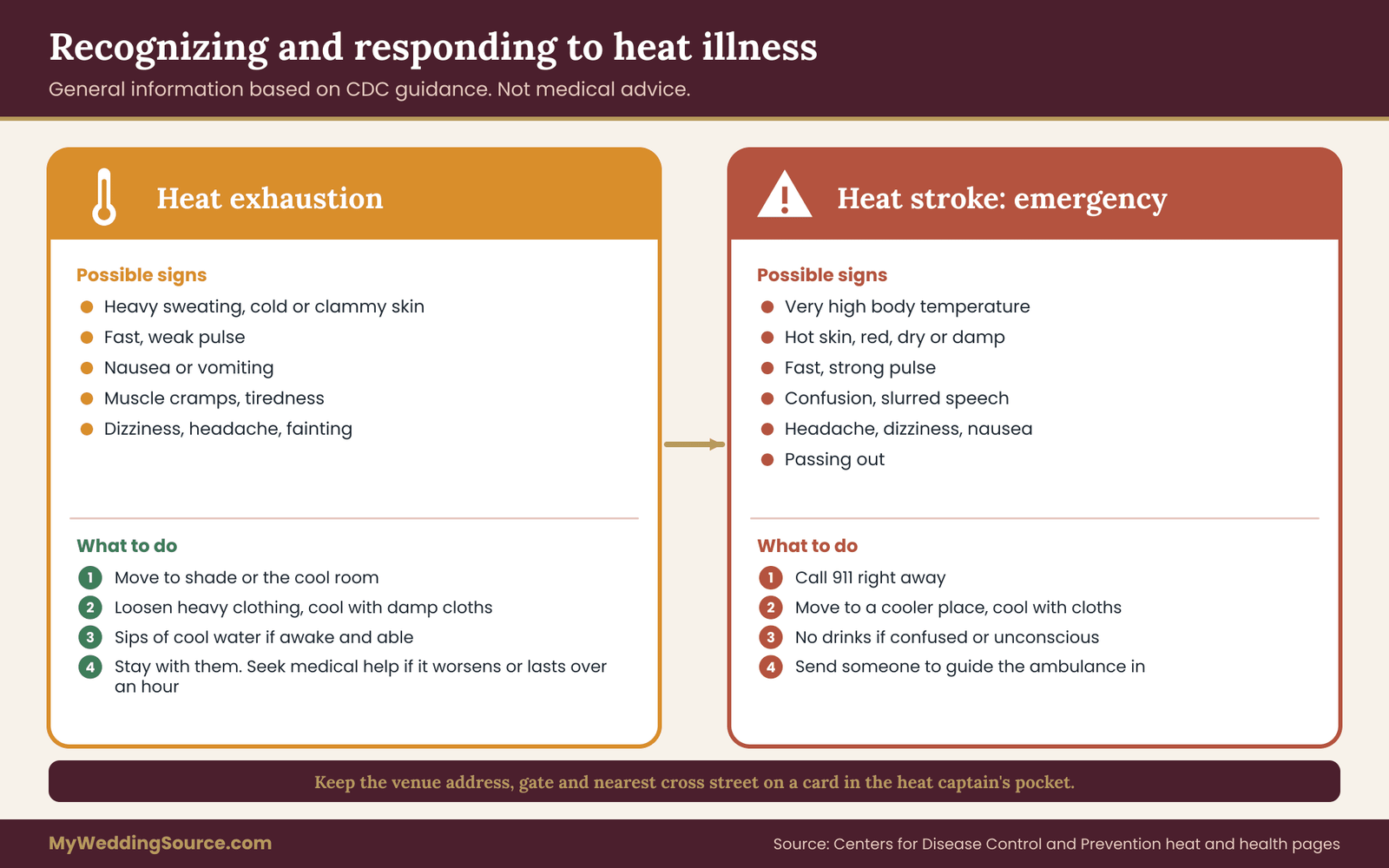
What to do
The wedding heat management response depends on the signs, and the CDC advice is straightforward.
For signs of heat exhaustion, move the person to a cooler place, such as the shade or the cool room. Loosen or remove tight or heavy clothing. Cool them with damp cloths or a cool shower or bath if available. Give them sips of cool water if they are awake and able to swallow. Stay with them and watch. The CDC advises getting medical help if symptoms get worse or last longer than an hour.
For signs of heat stroke, call 911 right away. Do not wait to see whether it improves. While waiting, move the person to a cooler place, cool them with cloths or other means, and do not give them anything to drink if they are confused or unconscious. Send someone to the entrance to guide the ambulance.
This section gives general information, not medical advice. Your heat captain and the venue’s staff should know the address, the gate or entrance to use, and the nearest cross street, so that anyone calling can give them. Put that information on a card in the heat captain’s pocket.
After an incident
If someone becomes ill, the couple does not need to stop everything. Move the person, hand the situation to the heat captain and the coordinator, and keep the party going if it is safe. Afterward, the coordinator should write down what happened, when, who helped and what the venue’s contacts did. It is useful for the venue and the vendors, and for the couple if an insurer asks about it.
Vendors, venues and contracts: the questions that settle heat problems
Most of what makes wedding heat management work comes from other people: the venue, the caterer, the tent company, the photographer, the band. A clear conversation with each of them, early, is worth more than any purchase. The questions below are written to be copied into an email.
Questions for the venue
Start wedding heat management with the venue, because it controls the site, the power and the indoor space. If you are still comparing sites, the guide to comparing wedding venues can help you set up a fair comparison, and heat belongs on your scorecard.
- Which areas of the site are shaded at the time of our ceremony, and for how long?
- Is there an air-conditioned indoor space guests can use during the event, and who controls the temperature?
- What power is available outdoors, where, and who may connect equipment?
- May we add shade structures, fans or misting equipment, and what permits or approvals are required?
- Where can water and ice be stored and refilled, and what access do vendors have to taps?
- If the forecast turns hot, what is the process and deadline for moving a part of the event indoors?
- What are your rules about generators, fuel and noise?
- Do you have a written policy for extreme heat, and who makes the call at the venue?
Ask the last question even if you expect a vague answer. A venue that has thought about it will say so, and a venue that has not will tell you something too.
Questions for the tent and rental company
- Can the sides open or be removed, and what ventilation does the tent offer?
- What colors and fabrics are available, and does the roof let light through?
- What cooling equipment do you provide, who installs it, and what does it need in the way of power?
- What is your wind and weather policy, and what happens if conditions change on the day?
- What is the latest we can add or change an order, and what is the cost?
- Who obtains permits and inspections, and what documents will you give us?
Questions for the caterer and bar
- How do you keep hot and cold food at safe temperatures outdoors on a very hot day?
- How much water and ice will you provide, and how fast can more arrive?
- Can the bar offer water with every order and tell us if a guest seems unwell?
- Will your staff have shade, water and breaks, and how does that affect service?
- If we move the cocktail hour or dinner, how much notice do you need?
Questions for the photographer, band and officiant
- Can the portrait schedule use shaded locations and include short breaks?
- If we shift the ceremony, what happens to coverage and fees?
- Will your equipment be protected from the heat, and do you need a place to rest?
- Can the ceremony be shortened on the day if the coordinator asks?
- Will you remind guests to drink water when you speak or play?
Put it in writing
Verbal promises disappear when the person who made them is busy. A short email, a clause in the contract or a line in the schedule gives everyone the same version. The wedding vendor contract guide explains what to look for in vendor agreements and how to ask for changes. For wedding heat management, the useful items are the deadline for adding or changing equipment, who is responsible for each piece, the cost of changes, what happens if the venue or the vendor cancels because of heat, and the conditions under which a schedule change can be made without penalty.
Be careful about promises that depend on weather. Many contracts allow vendors to move or cancel in extreme conditions, or they decline responsibility for guest comfort. If a clause seems to exclude the problem you care about, ask about it plainly. You may not be able to change it, but you will know where you stand.
Insurance and liability
Event insurance, the venue’s own coverage and vendor liability policies are separate things, and what each covers differs. Do not assume that a policy covers a heat-related change, a cancellation or an injury. Ask the insurer in writing what is covered, and ask the venue what coverage it carries. Details vary by policy and by state, so rely on the documents and a licensed insurance professional, not on this guide.
Costs without guesswork
Wedding heat management comes down to weighing a handful of costs: a tent or second tent, cooling equipment, extra water and ice, extra staff, a changed schedule, and perhaps a heat captain. There is a way to think through them without making up numbers.
First, ask for itemized quotes so that each piece has a price. Second, rank the pieces by how much they reduce risk for the most guests: shade and a cool room usually come first, extra water and a heat captain are inexpensive and effective, and gadgets come later. Third, compare each piece with what happens if you skip it. Skipping a second tent may mean moving the cocktail hour indoors.
Skipping extra ice may mean a midafternoon run to a store. Fourth, set aside a small reserve for the day, because on a hot day the cost you cannot predict is usually ice, water or an extra hour of staff. Be honest about which items you are buying to reduce risk and which you are buying to look good in photographs.
Edge cases and common mistakes in wedding heat management
A good wedding heat management plan meets conditions it did not expect. These are the situations that most often break one, with a way to handle each.
Humid heat
In humid air, sweat does not evaporate well, so the body cools poorly, fans help less and misting makes things damp. The measures that work best are shade, airflow, a cool room and a shorter schedule. If your location is humid, give the cool room more weight in your wedding heat management and give misting less.
Heat and poor air quality
Smoke from wildfires or other sources can make outdoor air unhealthy, and it can arrive on a hot day. Check the AirNow site for the air quality forecast near your venue. If the air is poor, an indoor option matters more, and the cool room becomes a clean-air room as well. Decisions about air quality belong on the same checkpoint timeline as heat.
A hot night
Some heat waves do not break after sunset. Pavement and buildings release heat for hours, and an evening dance outdoors may still be hot. Look at the overnight forecast as well as the afternoon one, and do not assume the evening will be comfortable.
A site with no shade at all
Open fields, beaches, rooftops and docks may have no natural shade, and the sun will be on the guests all day. In that case, the schedule and rented shade carry the plan. Choose the coolest hour, bring in a tent or large shade structures, shorten the outdoor parts, and make sure the cool room is close, even if that means a shuttle. A site like this can still work, but wedding heat management there needs the full set of measures and an early decision.
Power failure
Heat days raise demand on the electrical grid, and venues sometimes lose power. If your wedding heat management depends on fans, misters or air conditioning, ask what happens if the power goes out. The backup might be shade, water and a quieter schedule, or a different indoor space. A backup that depends on the same power source is not a backup.
A forecast that changes on the day
Sometimes the forecast is mild at twenty-four hours and hot at six. The checkpoint timeline for wedding heat management covers this, but the decision is hard because everything is already in motion. The practical answer is to make the small changes that cost little: more ice, a shorter ceremony, extra shade seating, a cool room opened early, a heat captain on duty. Larger changes need an owner and a rule written in advance.
Guests who will not accept help
Some guests will refuse water, decline to leave the sun and insist they are fine. You cannot force anyone. Offer once, make it easy, and tell the heat captain, who can check again later. If a guest looks unwell, the rules for recognizing heat illness apply no matter what the guest says.
Pets and service animals
Animals feel heat as well, and pavement can burn paws. If a dog is part of the day, plan shade, water and a rest place, and consider whether it needs to be there for the whole event. Service animals need the same shade and water as their handlers.
Common mistakes
Planning for the average day. The forecast is a range, and the event happens on one day. Build your wedding heat management for the hot end.
Buying equipment before deciding the schedule. A fan cannot fix a ceremony at the hottest hour of an exposed lawn.
Treating the cool room as a bonus. For many guests it is the main protection. Staff it, sign it and tell people.
Hiding the water. Water behind a bar is not part of the plan. Put it where guests can see and reach it.
Leaving vendors out. The people who work for you in the heat are part of wedding heat management.
Having no owner. A task that belongs to everyone belongs to no one. Give each decision a name and a time.
Waiting too long. The cheapest moment to change a plan is the earliest. The sooner you act, the more options you keep.
A worked example: a hot Saturday in September
The following example is invented, to show how the pieces of wedding heat management fit together. The couple, the venue and the numbers are made up for illustration, and your own situation will differ.
Maya and Daniel are marrying at a garden venue with a lawn, a row of mature trees on one side, a covered terrace and an indoor lounge with air conditioning. They have ninety guests, including a dozen older relatives, six children and a band of four. The ceremony was planned for three o’clock on the lawn, with cocktails on the lawn at four, and dinner in a tent at six.
Ten days out
The couple reads the extended forecast and sees a warm spell building. Their planner, Priya, checks the HeatRisk view for the venue’s county and notes the trend. They agree that the base wedding heat management plan is level one, but that level two is likely. Priya asks the tent company whether a second tent for cocktails could still be added, and the answer is yes, until forty-eight hours before the event. Priya puts the deadline in her calendar and writes it on the checkpoint sheet.
Seven days out
The forecast holds. The couple decides to order the second tent with open sides, and to reserve the indoor lounge for the whole afternoon. Priya calls the caterer and asks about ice and water. The caterer says that more can be delivered at noon on the day if requested by ten in the morning. Priya writes that down, with the caterer’s name and the time.
The couple also visits the venue at three o’clock on a weekday and does the sun-path walk. The trees shade the north half of the lawn until about four, and the ceremony site, on the south half, is in full sun. Maya sits in the last row for five minutes and decides it is too hot.
Seventy-two hours out
The hourly forecast shows the heat peaking in the late afternoon and easing after six. The couple and Priya set the level at three. They decide to move the ceremony to the shaded north half of the lawn, which also means a different aisle and a new chair layout, and to start at half past four, when the trees shade the whole area. Cocktails will move to the covered terrace, and the second tent will cover the overflow. Dinner stays in the main tent with its sides open.
Daniel talks to the officiant, who agrees to cut one reading and keep the ceremony near twenty minutes. The photographer agrees to take family and wedding-party photographs in the shade of the trees at three-thirty, with a ten-minute break halfway through, and the couple’s portraits after dinner at golden hour.
Twenty-four hours out
Priya sends the guest message: the new start time, the new location on the lawn, the water and the lounge, and a note about light clothing. She also tells the venue, the band and the caterer. The venue confirms that the lounge thermostat will be set low from noon. The caterer adds a second ice delivery.
Priya assigns a heat captain: Elena, a venue staff member Priya has worked with. They walk the site together, mark the five water points, and test the signs. Elena writes down the venue address, the gate to use for an ambulance and the nearest cross street on a card.
The day
At ten in the morning, Priya checks the forecast and finds it a little warmer than expected. She asks the caterer for the noon delivery, and sets out extra chairs in the shade. At noon the lounge is cold, and water is at every station. At three-thirty the family photographs begin in the shade. A groomsman looks flushed, and Elena takes him to the lounge for ten minutes and a glass of cold water. He returns and feels fine.
At four-fifteen, guests begin to arrive. Water is offered at the door. The shaded seating is open, and ushers offer the front rows to older guests. The ceremony starts at four-thirty and takes about twenty minutes. Afterward, guests head to the terrace. The bartenders offer water with every drink. Elena walks the stations every hour, restocks ice twice, and moves a water cooler to the dance floor’s edge when the band starts.
What this example shows
Nothing in the example of wedding heat management was expensive or unusual. The couple made the same choices any couple could make: a sun-path walk, a ceremony in natural shade at a cooler hour, a shortened program, a cool room, water at five points, a second tent for flexibility and one person watching. The decisions were made early, they were assigned to named people, and each had a time. When the forecast turned warm, the plan did not need to change, because it was built for warm.
Your next steps
Start wedding heat management with the site. Visit at the hour of your ceremony, walk the five zones and mark where the sun falls. Then ask the venue the eight questions in the vendor section and put the answers in writing. Choose your shade and your cool room before you choose anything else.
Next, write your four levels with real thresholds from your local National Weather Service forecast, and assign an owner to each checkpoint, from seven days out to the last hour of the event. Name a heat captain. Write the guest messages in advance, so that if you need them, you only have to fill in the time.
Finally, keep the plan short. One page with the levels, the checkpoints, the owners and the key phone numbers is enough, and it is the page you will actually use. Share it with your planner, your venue and the people who will be there. With a calm, early plan, wedding heat management is mostly a quiet set of small decisions, and the day itself can be about the wedding.
FAQ
How hot is too hot for an outdoor wedding?
There is no single number. Danger depends on humidity, direct sun, how long people are outside, and who is attending. Use the National Weather Service forecast and any heat alert for your area, and set your own thresholds with your venue and planner. If the heat index is high for the event hours, move the outdoor parts to a cooler hour, a shaded area or indoors.
How much shade do we need for outdoor wedding heat management?
Aim for shade over every guest seat at the ceremony time and the time the sun will move to. Walk the site at that hour and sit in the last row for five minutes. If you would be uncomfortable, add shade, move the seating or change the time. Shade over the waiting area and walking routes matters too.
Is a tent a good solution for wedding heat management?
It can be, but a closed tent can be hotter than the lawn outside. Choose a tent with sides that open, ask about ventilation and cooling equipment, and confirm who handles permits and installation. A tent is best paired with airflow and a cool indoor space. Leave installation and any electrical work to the rental company’s trained crew.
How much water should we provide?
Ask your caterer or bar service to calculate it from your guest count, the forecast, the hours of the event and how many hours are in the sun. More important than the starting amount is how fast more can arrive. Put free cold water at arrival, the ceremony, cocktails, the dance floor and restrooms, within about a minute of any guest.
Do misters and fans really help wedding heat management?
Fans help because moving air speeds the evaporation of sweat, but they do not lower air temperature. Misters work best in hot, dry air and can leave guests damp in humid weather. Neither replaces shade, water or a cool room. Power for either should be approved by the venue and connected by qualified people, not improvised.
What are the signs of heat illness at a wedding?
The CDC lists heavy sweating, cold or clammy skin, dizziness, nausea, headache, cramps and fainting as signs of heat exhaustion. Heat stroke can bring confusion, hot skin and loss of consciousness, and needs a call to 911 immediately. Move the person to a cooler place, cool them with damp cloths, and give sips of water only if they are alert.
Who should be in charge of wedding heat management on the day?
Name a heat captain who is not in the wedding party, such as the coordinator, a venue staff member or a trusted friend. They check water, ice, shade and the cool room each hour, watch for guests who seem unwell, and call for help. The couple makes any decision to change the schedule, and the coordinator carries it out.
When should we decide to change the schedule or move indoors?
In wedding heat management, decide as early as you can, ideally by twenty-four hours before the wedding, because vendors and guests need time to adjust. Set the thresholds in advance with your planner and venue, check the forecast at fixed times, and write down each check. If conditions get worse on the day, make the small changes first, and move indoors if safety requires it.
Sources
- Weather safety, National Weather Service
- Heat safety, National Weather Service
- HeatRisk, National Weather Service Weather Prediction Center
- Heat and your health, Centers for Disease Control and Prevention
- Heat stress, National Institute for Occupational Safety and Health
- Heat exposure, Occupational Safety and Health Administration
- Heat.gov, National Integrated Heat Health Information System
- AirNow, U.S. Environmental Protection Agency
- Fire safety guidance, United States Fire Administration
- Food safety, U.S. Department of Health and Human Services and USDA