
To preserve wedding suit pieces for future formal events, you do not need a museum box. You need a short, dated routine: inspect the suit within days, choose one cleaning route that fits the fabric, keep any tailoring reversible, and store it on the right hanger in the right closet. This guide gives you a care calendar, a worked case and the conditions where the plan fails.
Treat the suit as a garment you will wear again, not a relic. Within three days, empty the pockets, map every stain you can find, and air the jacket. Within two weeks, have it cleaned once by a cleaner who has seen the stain map. Hang it on a wide, shaped hanger in a breathable cover, away from heat and damp. Check it at six months and at one year. Three weeks before the next formal event, press it, fit-test it and replace anything that has aged.
Most advice about wedding clothes is written about the dress. The suit gets a paragraph, usually something like “have it dry cleaned and hang it up.” That is not wrong, but it leaves out almost every decision that matters when you want to preserve wedding suit jackets and trousers for later. Which stains show up late? How often is too often for cleaning? What happens when the waist changes in two years? Where in a house does a wool jacket actually stay safe?
This guide fills that gap, one stop at a time, so you can preserve wedding suit pieces without guessing. It is written for anyone who wore a suit at a wedding, whether you were marrying, standing up beside someone, or planning to wear a rented or bought suit again at a later event.
It sits on the after-the-wedding side of the timeline. If you are still choosing fabric or still waiting for the final fitting, the earlier decisions are covered elsewhere on the site, and the wedding dress fit and alterations guide shows how tailoring decisions are usually organized before the event.
A note on scope. This is general information, not legal, tax or financial advice. Fabric damage, cleaning results and resale outcomes vary, so nothing here promises a particular result. Where a fact depends on a manufacturer, a cleaner or an agency, the guide points you to that source so you can confirm it yourself.
What it means to preserve wedding suit pieces
The word “preserve” covers three quite different goals, and mixing them up leads to wasted money. Museums preserve garments so they survive for centuries. That means acid-free tissue, flat or specially padded storage, controlled humidity and no wearing at all. Most people who ask how to preserve wedding suit pieces want something much simpler: a suit that is clean, undamaged and ready to wear again at the next funeral, gala, interview, christening or wedding.
Those are different jobs, and a plan to preserve wedding suit fabric for years of wear looks quite different from a museum plan. The museum approach would make a suit very hard to wear in a hurry. The everyday approach would not protect a suit for fifty years. This guide is built around the everyday goal, with a clear note on where it shifts if you want to keep the suit as a keepsake.
Start by naming your goal in one sentence, before you try to preserve wedding suit details of any kind. “I will wear this suit to formal events for the next five to ten years.” Or: “I want to keep the jacket as a keepsake and probably never wear it again.” Or: “I might sell it, but not for a year.” Each sentence leads to a different routine, and you can change your mind later, which is why the routine below stays flexible.
The four paths for a wedding suit
After the wedding, a suit goes down one of four paths. Naming them early saves you from drifting.
Wear. The suit goes back into regular rotation. Regular wearing is itself a way to preserve wedding suit condition, because a worn suit gets looked at. You clean it as needed, hang it where you can reach it and treat the next formal event as a normal outing. This is the path most of this guide supports.
Rest. You will not wear it for a while, maybe years, but you expect to. The suit needs a cleaner start and more careful storage, because soil that sits on wool for a year does more harm than soil that is cleaned out next week.
Rework. You will change the suit. Perhaps the waist needs adjusting, the trousers need hemming for different shoes, or you want to turn it into a daily-wear piece by changing the buttons. Rework decisions are about what a tailor can safely undo later.
Release. You will sell it, pass it on, donate it or return it. Rented suits go back; owned suits may be resold or donated. Release also needs preparation, because a clean, documented suit is easier to place.
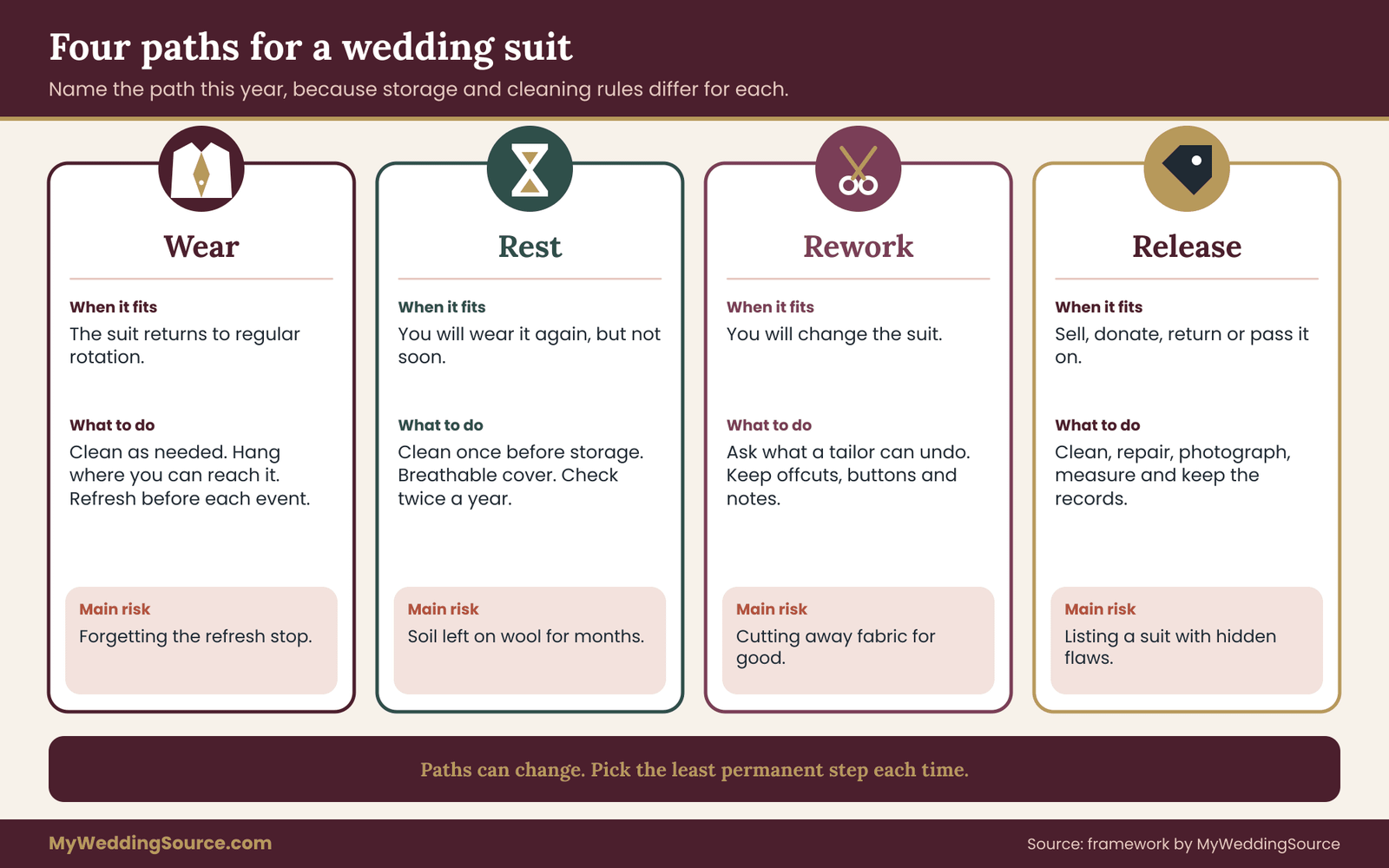
These paths are not permanent, and you can preserve wedding suit options by choosing the least permanent step each time. A suit can rest for two years and then be reworked for a wedding abroad. The point is to know which path you are on this quarter, because the storage and cleaning rules differ.
The care calendar in one view
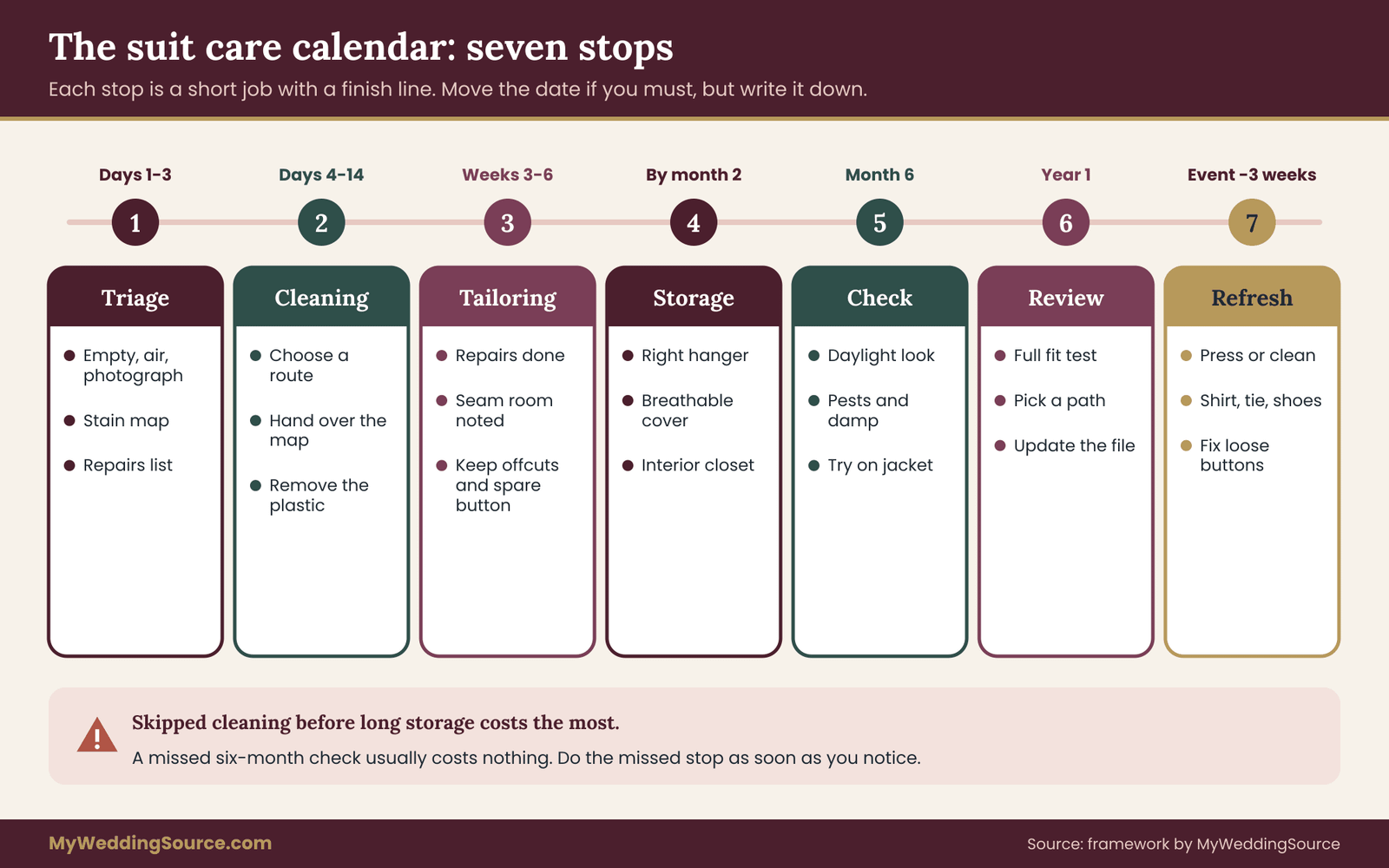
The calendar used throughout this guide has seven stops. Each one is a short job with a clear finish line, so you never have to remember a vague promise to “take care of the suit.”
Stop one is triage, in the first three days. Stop two is the cleaning decision, in the first two weeks. Stop three is the tailoring decision, in the first month. Stop four is the storage setup, finished by the end of month two. Stop five is the six-month check. Stop six is the one-year review and fit test. Stop seven is the refresh, starting three weeks before any future formal event.
Later sections take each stop in turn, and each one shows what to do to preserve wedding suit quality at that point. The infographic near the end of the guide puts them on a single line so you can print or photograph it.
Who this guide is for, and who it is not for
To preserve wedding suit fabrics well, this guide assumes a conventional wool or wool-blend suit, which is by far the most common wedding suit fabric in the United States. It also covers linen, cotton, velvet, polyester blends and tuxedos in the sections where they differ. It does not cover garments with sewn-in beadwork, antique fabrics or anything with historic value.
If you are caring for an inherited suit from the nineteenth century or a ceremonial garment with religious or cultural significance, a textile conservator can assess it in person, and the American Institute for Conservation maintains a directory in its public listings.
It also does not replace the label inside the jacket. Federal rules generally require clothing to carry permanent care instructions, and the Federal Trade Commission publishes the rule behind them. If your cleaner or this guide disagrees with that label, the label wins, or you ask the maker why not.
The first 72 hours: triage before anyone cleans anything
The fastest way to harm a suit, and to fail to preserve wedding suit fibers, is to treat it as already clean. Wedding suits look fine at the end of the night, because the damage is mostly invisible. Sugar from cake and cocktails is nearly colorless when it dries. Perspiration, makeup, hair products and a day of body heat leave soil that does not show until it yellows or attracts insects. Triage is simply a way of finding that soil before it sets.
To preserve wedding suit condition at this stage, you do not need tools beyond a bright lamp, a clean white towel and a phone camera. The goal is to leave the suit hanging in good condition and a written note of what you found. That note will matter in a few days when a cleaner asks what happened.
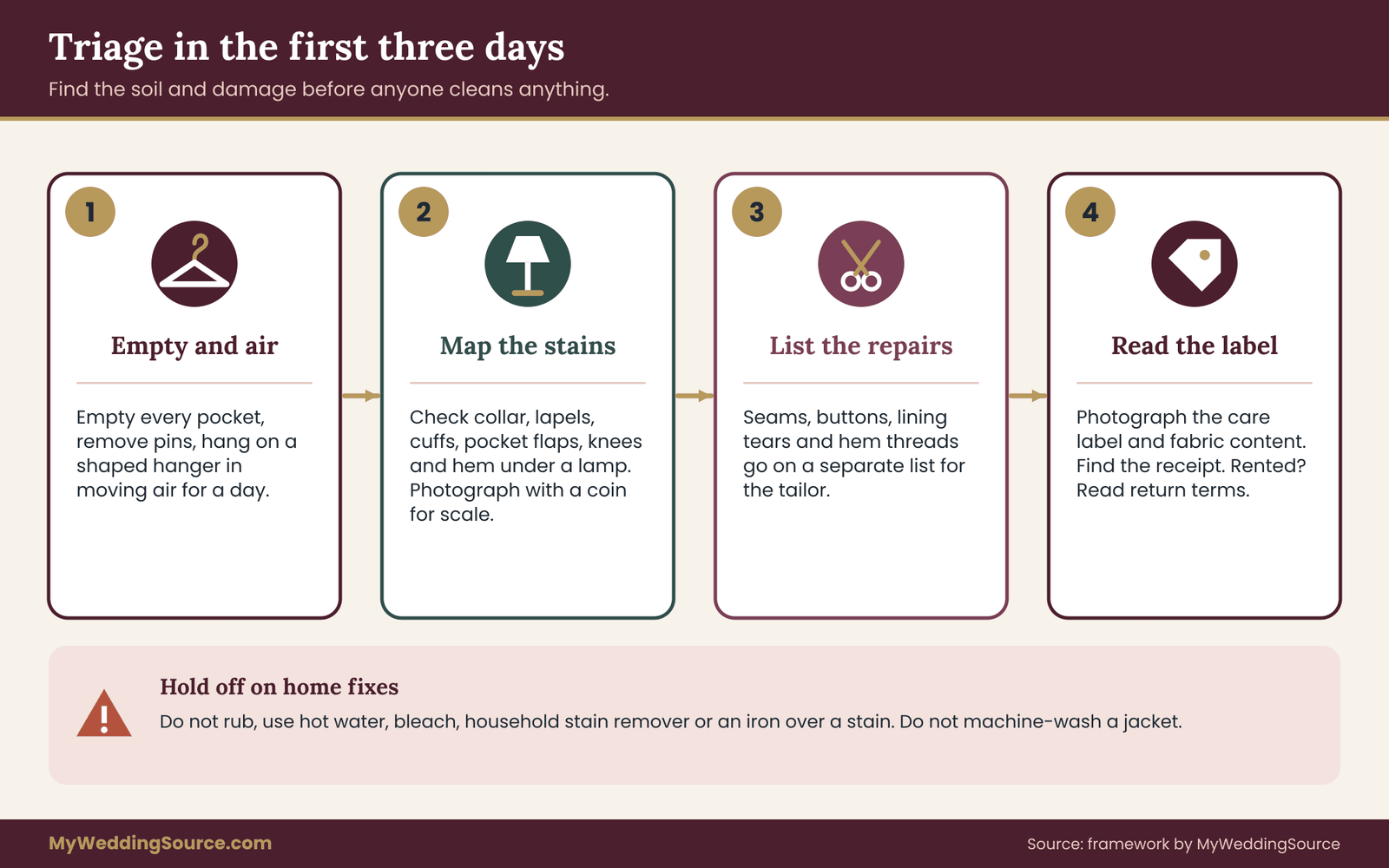
Step one: empty, air and hang
Empty every pocket, including the ticket pocket, the inside chest pocket and the watch pocket in the trousers. Remove pocket squares, boutonniere pins, name tags, confetti, folded vows, lip balm and anything with wax or dye. Pins in particular can leave rust marks if they stay in damp wool, so take them out and check the lapel for a small hole or stain.
Then hang the jacket and trousers on a hanger that supports the shoulders, in a room with moving air and no direct sun. Leave them for a day. This is not cleaning. It lets perspiration moisture leave the fibers and lets the lining dry out, which reduces odor and the chance of mildew in a closed bag.
A common mistake is putting a damp jacket straight into a plastic garment bag from the venue. Moisture trapped against wool can mark the fabric and encourage mildew in warm weather. Airing first costs nothing.
Step two: map the stains
The stain map is the most useful document in this process. With the suit hanging under a bright, low-angle light, work slowly from collar to hem and then trousers from waist to cuff. Look for shiny spots, slightly darker patches, stiffness, tide lines, white powder marks and any smell that is not just the room.
Check the places that always collect trouble: the inside of the collar, where makeup and sweat meet; the lapel edge, where hugs happen; the front of the jacket near the pocket flaps, where drinks spill; the sleeve cuffs and the inner elbows; the seat and knees of the trousers; the hem, where grass, mud and dancefloor residue gather.
Photograph each mark with a coin or a pen next to it for scale. Write a short line for each: where it is, what you think it is, whether anyone saw it happen, and whether you have tried anything on it. Do not try anything on it yet.
“The mark is on the left lapel, near the buttonhole. Red wine, about an hour old when blotted.”
A note like this is what a good cleaner wants to see. It turns a guess into a lead.
Step three: note the damage that is not a stain
Triage also finds damage that cleaning cannot fix, and a plan to preserve wedding suit seams has to include it. Look at the seams at the underarms, the crotch and the back of the trousers, where stress concentrates during dancing. Check buttons for loose threads. Look at the lining for a small tear, especially along the vent and at the pocket mouths. Look at the hem for a dropped stitch. Check the lapel roll and the shoulder pads for any bulge that appeared in the day.
Write these down on the same page as the stain map, in a separate list titled “repairs.” You will hand that list to a tailor, not a cleaner. Mixing the two is a common reason a repair request gets lost.
Step four: check the label, then the paperwork
Open the jacket and find the care label, usually sewn into the inside side seam. Photograph it. Also find the fabric content label if it is separate. Wool, wool blends, polyester, viscose, cotton, linen and silk all behave differently in cleaning, and the label tells you which one you have.
Then look for the paperwork: the receipt, any alteration invoice, the tailor’s contact details, and any note from a rental shop if the suit was rented. If you rented, stop here and read the return terms before doing anything else, because many rental shops clean returns themselves and charge extra if a customer sends the garment to an outside cleaner first. The wedding rental planning checklist explains how rental return terms are normally tracked, and the next sections assume the suit is yours.
The triage list is now in hand, and the next stop on the way to preserve wedding suit pieces is the cleaner. The next question is how soon the suit has to reach a cleaner, and the honest answer is “sooner than feels necessary, but not in a panic.”
Why timing matters more than technique when you preserve wedding suit fabric
Cleaning methods have not changed much in decades, which helps anyone trying to preserve wedding suit wool, and a competent cleaner can handle most of what a wedding does to wool. What changes the outcome is the clock. Soil that is a day old is mostly sitting on the surface.
Soil that is a month old has dried, oxidized, bonded and often changed color. A pale sugar stain left alone can darken into a brown mark under the heat of a pressing iron or a dryer. Perspiration salts can weaken fibers and leave a stiff ring around the underarm lining.
A moth or carpet beetle problem works on the same timetable. These insects are drawn to wool that carries food residue, skin oils or sweat. A suit that goes into a closed closet unclean is a better target than one that goes in clean. That is the main reason people who want to preserve wedding suit jackets for years clean them once before storage, even if the jacket looks fine.
There is also a trade-off, and it deserves a plain statement for anyone who wants to preserve wedding suit fabric over many years. Every professional cleaning is a small stress on the garment. Solvents, heat, pressing and handling all wear fabric slightly. So the aim is not to clean often. The aim is to clean once, properly, at the right moment, then store the suit so that it rarely needs cleaning again.
The three clocks
Think of three clocks running at once after the wedding.
The stain clock starts the moment a spill happens. Ask yourself which marks are sugary, greasy, protein-based or colored, because those age differently. Sugar and alcohol marks should reach a cleaner within days. Grease marks from a dinner plate can usually wait a little longer. Mud and grass dry and can be brushed once fully dry.
The fiber clock starts with perspiration and humidity. If the wedding was in summer heat, or if the suit was worn through a long day and night, the fiber clock is running faster. Hanging the suit in moving air stops it from accelerating but does not reverse it.
The return clock applies if the suit is rented or if the seller or the maker offers any kind of service window. Rental return dates, a tailor’s warranty period and a cleaner’s pickup schedule can all be shorter than you think.
A useful rule is to book the cleaning within a week and have the suit at the cleaner within two. That gives you time to do triage properly and to talk to the cleaner, without letting the stain clock run for a month.
What not to do first
The urge to fix a stain yourself is strong, and it is the biggest threat to efforts to preserve wedding suit fabric at home, and most of the harm in garment care comes from that urge. A short list of things to hold off on follows.
Do not rub. Rubbing pushes soil deeper into wool and can felt the surface into a shiny patch. Blot only, with a clean white cloth, and only on a fresh spill.
Do not use hot water on an unknown stain. Heat sets many stains, including egg, blood and protein-based marks.
Do not use household stain removers or bleach on wool, silk or any blend with a wool component. Many are alkaline and damage wool fibers.
Do not iron over a stain. Heat can make it permanent.
Do not wash a structured jacket in a home machine. A jacket has canvas, padding and lining that react differently to water, and the shape often does not come back.
None of this means you cannot do anything to preserve wedding suit condition. It means the first move is to hold still and call a cleaner with your map.
Choose a cleaning route that fits the fabric and the stain
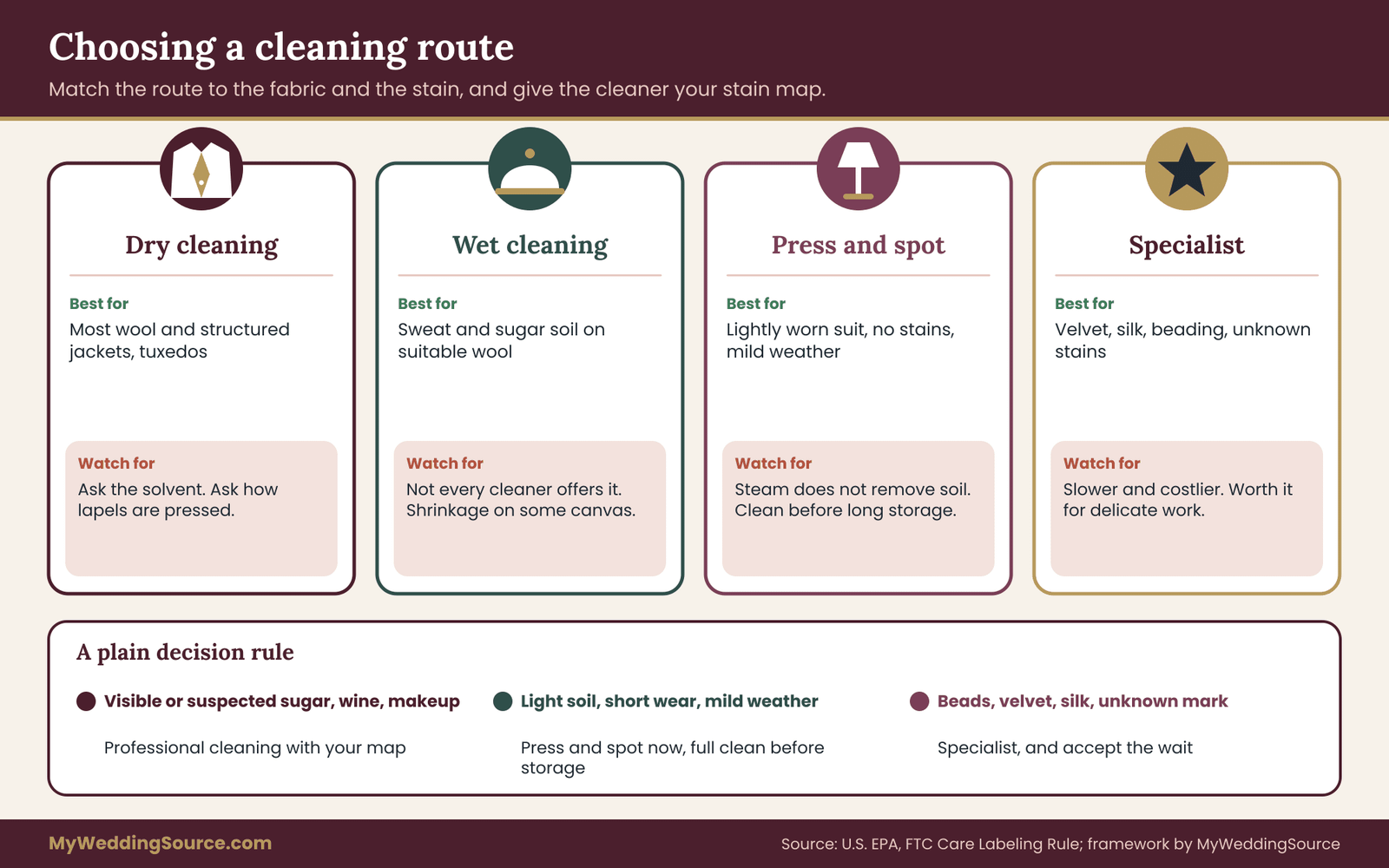
There are four realistic routes for cleaning a wedding suit after the event, and each affects how well you preserve wedding suit finishes such as lapel edges. They differ in cost, risk and how much control you keep. None is best for every suit, so the section below compares them in plain language and gives a decision rule at the end.
Route one: conventional dry cleaning
This is what most people mean by “dry clean only.” The garment is cleaned in a solvent, not water, and then pressed. It handles most wool, wool blends and structured jackets well, and it is the default for good reason. It can also be the right choice for tuxedos and for fabrics that react badly to water.
The risks are small but real. Some solvents are harsher than others, so ask which solvent the cleaner uses. Some cleaners use a standard process for every garment and do not read your stain map unless you hand it over. Some will press the suit too hard and flatten lapel edges, which is why a good cleaner asks about the lapel roll before pressing.
The Environmental Protection Agency publishes information on dry cleaning solvents and worker and consumer exposure, and it is a reasonable place to read before you ask a cleaner about their process.
Route two: professional wet cleaning
Some people who want to preserve wedding suit lining and canvas choose wet cleaning. It uses water, specially chosen detergents and carefully controlled machines and drying. It is not the same as washing at home. Some cleaners offer it as a gentler option for wool and for suits with sweat soil, because water removes salt-based and sugar-based soil better than solvent does.
Not every cleaner offers it, and not every suit suits it. Highly structured garments with a lot of canvas, certain linings and some cheap blends can shrink or lose shape. If a cleaner offers wet cleaning, ask whether they have done it on jackets with a floating canvas, and ask what they will do if the suit does not pass their own inspection first.
Route three: spot treatment and steam only
If the suit has no visible stains and no strong odor, you may not need full cleaning right away. A professional press and spot treatment, or careful use of a garment steamer at home, can refresh a lightly worn suit. This route works best for a suit that was worn for a few hours, in cool weather, by someone who did not spill anything.
The limits matter if you want to preserve wedding suit fabric for the long term. Steam does not remove soil. It relaxes wrinkles and freshens odor to a degree. It does nothing for dried sugar or body oils, which are exactly what attracts insects. If you choose this route, plan a full cleaning before long-term storage.
Route four: a specialist cleaner
Some cleaners that help people preserve wedding suit pieces with delicate details specialize in couture, formalwear, vintage garments or very delicate fabrics such as silk, mohair and velvet. A specialist is slower and more expensive, and they are worth it when the suit has hand-sewn details, beading, delicate lining or a stain you cannot identify. Most suits do not need one.
If you suspect you need a specialist, the shop or tailor that made it is often a good place to start. Ask them where they send garments that need special care.
A decision rule for the route
Here is a plain rule you can use with any suit.
If the suit has visible or suspected sugar, wine or makeup stains, choose professional cleaning and give the cleaner your stain map. Between dry cleaning and wet cleaning, ask which they recommend for your fabric, and pick the one that the cleaner will describe clearly.
If the suit has only light soil and was worn for a short time in mild weather, choose a professional press and a spot check, and plan the full cleaning before the suit goes into long storage.
If the suit has beading, hand embroidery, velvet, silk or any unusual construction, choose a specialist and accept the cost and the waiting time.
If you cannot tell which case you are in, treat it as the first case. The cost of one extra cleaning is small compared with a permanent mark.
Questions to ask the cleaner
A good conversation takes five minutes and prevents most mistakes that undermine an attempt to preserve wedding suit finishes. These questions are enough.
Which cleaning method and solvent do you plan to use on this fabric? Will you spot-treat the marks I mapped before cleaning, and will you tell me if any cannot be removed? How do you press the lapels and the jacket body, and do you use a shaped form? Do you use plastic covers on finished garments, and if so, can you return it without one? What is your policy if the garment is damaged in cleaning, and is it in writing?
“Could you look at my stain map before you quote? I would like the marked spots treated first.”
Keep the cleaner’s answers, along with the ticket and receipt, in your suit file. If anything goes wrong later, those notes are your evidence, and the wedding records after the event guide explains a simple way to store receipts and vendor notes together.
Tailoring after the wedding: keep every change reversible
Alterations are where a wedding suit most often loses its future, so tailoring choices decide how well you preserve wedding suit options. A suit fitted perfectly for one day can be hard to wear in three years if the tailor used up all the spare fabric. The goal after the wedding is the opposite of the goal before it. Before the event, you want the tightest clean fit. Afterward, you want to protect the choices you may need later.
If your suit was altered for the wedding, and you intend to preserve wedding suit fit for later, ask the tailor for the leftover information while it is fresh. That means the original measurements, the amount taken in at each seam, how much seam allowance remains, and the hem and cuff depth. Most tailors can tell you in a minute if you ask while the file is open, and almost none can later.
What a tailor can usually undo, and what they cannot
Seam allowances give tailors room to let a suit out, which is why they matter when you preserve wedding suit proportions. Waist and seat adjustments in the back of the trousers and jacket are often reversible by a small amount, if the original cut left extra fabric inside and if the fabric has not been cut off. Sleeve length is usually adjustable at the cuff. Trouser hems are easiest when the original hem was left deep and when the old fold line does not show.
Some changes are close to permanent and work against any effort to preserve wedding suit structure. Cutting off excess fabric from a seam cannot be reversed. Reshaping shoulders or collars is a major job, and in some cases not possible without damaging the structure. Shortening a jacket body is almost always permanent, and so is taking in the chest of a suit with a floating canvas beyond a modest amount. Darts in the front, sleeve pitch changes and re-cutting lapels are specialist work.
If you think your weight or build may change, a pregnancy in the family, a fitness plan, a medical treatment, or simply aging, ask the tailor before the wedding or soon after what room is left. Do not assume. The after-wedding stage is the last cheap chance to learn that the suit has none.
Rules that preserve wedding suit options for later
These rules protect the suit’s future whatever the next event turns out to be.
To preserve wedding suit repair options, ask for any trimmed fabric to be saved, or at least for notes on how much was removed. A small offcut also helps a future tailor match the fabric if a repair is needed.
Ask for pins and chalk marks to be removed, and for basting threads to be pulled. Leaving them inside invites rust or visible marks.
Choose to hem trousers for the shoes you will wear most, not only for the wedding shoes. If the wedding shoes had thicker soles, the hem may be a touch too short for ordinary dress shoes.
Keep the extra buttons. Good suits often come with a spare, sewn inside the jacket or in a small bag. Put it in your suit file or in the jacket’s inner pocket, not in a drawer where it will vanish.
Avoid adding new permanent details, such as monograms inside the jacket or a custom lining, unless you are certain you want them for good. A monogram can make resale harder, though it can also make a keepsake more meaningful. You decide, but choose consciously.
When to book the post-wedding tailor visit
Do not rush the visit, because a rushed alteration can undo your plan to preserve wedding suit proportions. Book it for a few weeks after the wedding, when you have cleaned the suit and tried it on a normal day. A clean, pressed suit shows the true fit. A freshly pressed jacket can hang differently from one that has been worn for ten hours.
The visit has a short agenda: repair the damage on your triage list, check the hem and fit for normal wear, ask what room is left in the seams, and write down the answers. If you will not wear the suit for a while, ask whether any small repairs should be done now, because a loose button or a small lining tear often becomes a larger repair while the suit sits.
The wedding vendor contract guide covers how to read a vendor agreement. If your tailor offered free adjustments after the event, the contract or invoice should say for how long, and this is the moment to use that offer.
Keep tailoring records with the suit
Notes are the cheapest way to preserve wedding suit knowledge. A single sheet of paper with the tailor’s name, date, measurements and the amount of room left in the seams is worth more than most keepsakes. Fold it and keep it in the suit file, and keep a photo on your phone. Years later a different tailor will thank you.
Storage that works: hanger, cover, closet and climate
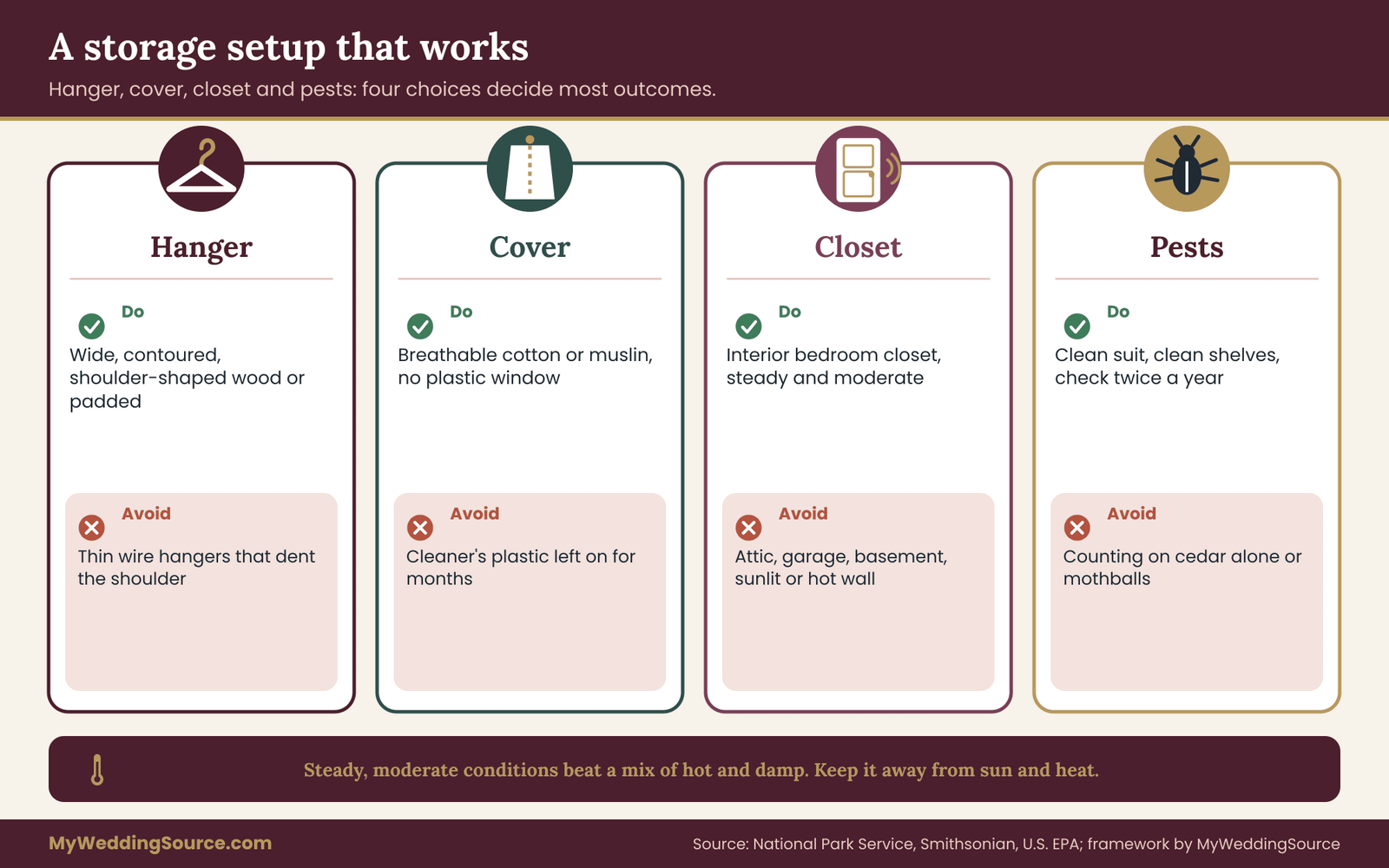
Storage is where most efforts to preserve wedding suit jackets fail quietly. The suit goes into a closet and nothing seems to happen, until a shoulder bump appears, a crease will not press out, or a small hole shows up in the sleeve. Almost all of it traces back to four things: the hanger, the cover, the closet and the climate.
The hanger
A suit jacket needs a hanger that matches its shoulders, and it is the first purchase if you want to preserve wedding suit shape. A thin wire hanger from a cleaner pulls the shoulder seam down and leaves a dent that can become permanent in structured wool. A wide, contoured wooden or padded hanger supports the shoulder line and keeps the jacket’s shape.
Choose a hanger about as wide as the shoulders of the jacket, not much narrower. Trousers can hang from a clamp hanger by the hem or be folded over a padded bar, although some wool trousers are best hung from the cuff with clips that do not leave a mark. A cheap hanger is easily replaced, and a distorted shoulder is not.
If space is very tight, a jacket that is hung loosely and not crammed between others holds its shape better than a jacket that is squeezed. Give the suit at least a little room on each side so the air can move and the sleeves do not crush.
The cover
Plastic from the cleaner is not meant for storage, and it works against anyone trying to preserve wedding suit fabric. It traps moisture, may off-gas chemicals, and over time can yellow and stick to fabric. Remove it when you bring the suit home.
A breathable cover is the better choice. Cotton or unbleached muslin garment bags allow air to move while keeping dust off. Look for one without a plastic window. Museum conservation guidance generally favors breathable, inert materials for storing textiles, and the National Park Service and the Smithsonian both publish textile care guidance that points the same way. Their pages are listed in the Sources section.
Do not wrap the suit in tissue as if it were a gown unless you are preparing a long-term keepsake. Folded tissue can create crease lines. If you do use it, choose acid-free, unbuffered tissue for wool and silk, and refold it periodically.
The closet
The best place to preserve wedding suit pieces is the part of your home where the temperature and humidity are steady and where you spend time. That usually means an interior bedroom closet, not an attic, a garage, a basement or a closet on an outside wall.
Attics get hot, and heat speeds the aging of fibers and glues. Basements are often damp, which invites mildew. Garages carry fumes and swings in temperature. Exterior walls can be cold and damp in some climates. A bedroom closet with a door that closes well, no leaking pipes nearby and no direct sun is usually the right answer.
Keep the suit off the floor. Do not store shoes or damp items beside it. Do not place it next to a heater, a radiator or a vent that blows hot air. Avoid hanging it where sunlight can reach the fabric even through a window, because light fades dyes and weakens some fibers.
The climate
You do not need a controlled vault. You need a space that is not extreme. Moderate temperatures and steady, moderate humidity are good for wool and linen. Large swings are worse than a mediocre steady average.
If you live in a humid climate, a small dehumidifier or a moisture absorber in the closet can help, but do not let it touch the garment. If you live somewhere very dry, a wool suit will usually be fine, but static and dust may be bigger issues. A simple, inexpensive thermometer and hygrometer on the closet shelf lets you check conditions without guessing.
Pests
Moths, carpet beetles and silverfish are the most common threats to a stored suit, and any plan to preserve wedding suit wool has to deal with them. They tend to enter through the room, not the suit. The best defense is a clean suit, a closed breathable bag and a clean closet.
Cedar blocks and lavender sachets are common household choices. They may help freshen the air and have been used for generations, but they are not a guarantee, and cedar oils lose strength over time. Mothballs and similar products are pesticides. Their labels carry directions and warnings, and the Environmental Protection Agency publishes consumer information on using them safely. For most households, the safest approach is to skip them and rely on cleanliness and a regular check.
To preserve wedding suit fabric over the years, check the suit twice a year for small holes, fine webbing, pale grains that look like sand, or tiny cast skins. If you find signs, isolate the suit, take it to a cleaner and look at the closet shelves as well.
The care calendar: from the first week to the first anniversary
The calendar is the original tool in this guide to preserve wedding suit pieces, and it is deliberately plain. Each stop has an owner, a short job and a finish line. If you cannot finish a stop, write down why and move the date, instead of letting it dissolve. Most efforts to preserve wedding suit fabric fail from forgotten steps, not from bad ones.
Stop one: triage, days one to three
To preserve wedding suit condition from the start, the finish line is this: the suit is empty, aired, photographed, and you hold a written stain map and a repairs list. Owner: the person who wore the suit, with a second person to check the photographs.
If you are traveling after the wedding, do the airing and the photographs on the first morning, then pack the suit in a breathable bag, not a sealed one. Do the written map when you return, from the photographs, within the same week.
Stop two: the cleaning decision, days four to fourteen
Finish line: the suit has been cleaned by a method you chose, you have the ticket, and the cleaner has your stain map. If you chose the press-only route, the finish line is a note that says “full cleaning before long storage, due by” and a date.
Collect the suit within a day or two of it being ready. Do not leave it at the cleaner for weeks, and do not leave it in the cleaner’s plastic. Check it at the counter: pockets, lapels, buttons and the stains you mapped.
Stop three: the tailoring decision, weeks three to six
To preserve wedding suit fit, the finish line is this: any repairs are done, you know how much room is left in the seams, and the notes are in the file. If you want changes for daily wear, you have a quote and a sample of what the tailor can reverse.
Stop four: storage setup, by the end of month two
Finish line: the suit hangs on the right hanger in a breathable cover, in an interior closet, with a note on the file for the next check date. Spare buttons, offcuts and tailoring notes are in a small envelope or folder with the suit.
Before you hang it, give it a final brush, a small habit that helps preserve wedding suit wool. A soft garment brush, used with the nap, removes surface dust that could otherwise attract pests. Do this once, gently, and avoid stiff brushes that raise the nap.
Stop five: the six-month check
Finish line: you have looked at the suit in daylight, checked for pests and damp, tried the jacket on, and confirmed the fit in the shoulders and waist. Put the date in a calendar with a reminder, not in your head.
The six-month check is short, and it is the cheapest way to preserve wedding suit fabric from slow damage. Take the suit out of the bag, shake it lightly, check the closet corners and the hanger. Let it hang in moving air for an hour. If anything smells musty or looks off, deal with it now.
Stop six: the one-year review and fit test
Finish line: you have decided which path the suit is on this year, wear, rest, rework or release, and you have updated the file.
The fit test deserves honesty, because a suit that no longer fits is hard to preserve wedding suit style in any useful way. Put on the full outfit: shirt, trousers, jacket, the shoes you will wear. Move your arms, sit down, button the jacket. If the fit is no longer right, either book the tailor now while you have time, or decide that the suit goes on the release path.
Holding a suit that no longer fits for years is a common way to waste hanger space and money.
Stop seven: the refresh, three weeks before the next event
To preserve wedding suit looks for the next occasion, the finish line is this: the suit is pressed, the fit is confirmed, the accessories are ready and any dry cleaning is back in the closet with days to spare. This is the stop most people skip, and it is why many arrive at a second formal event with a creased jacket and a shirt that no longer fits.
Three weeks before the event, take the suit out and try it on. A week later, send it for pressing or cleaning if needed. Check the shirt collar, the tie, the pocket square, the belt and the shoes. If a button is loose, repair it now.
For small refreshes, a good steamer and a clothes brush can do a lot between professional cleanings. For heavy wrinkles in structured wool, professional pressing is safer. The wedding day accessories planning guide describes how to build a backup kit for events, and the same kit works for a second formal outing.
What if you miss a stop
A missed stop is not a disaster for those who preserve wedding suit pieces, but some are more costly than others. but some are more costly than others. A missed six-month check usually costs nothing. A skipped cleaning before long storage can cost the suit. If you notice you missed something, do the stop as soon as you notice, and note the date.
A worked case: one suit, two years, three decisions
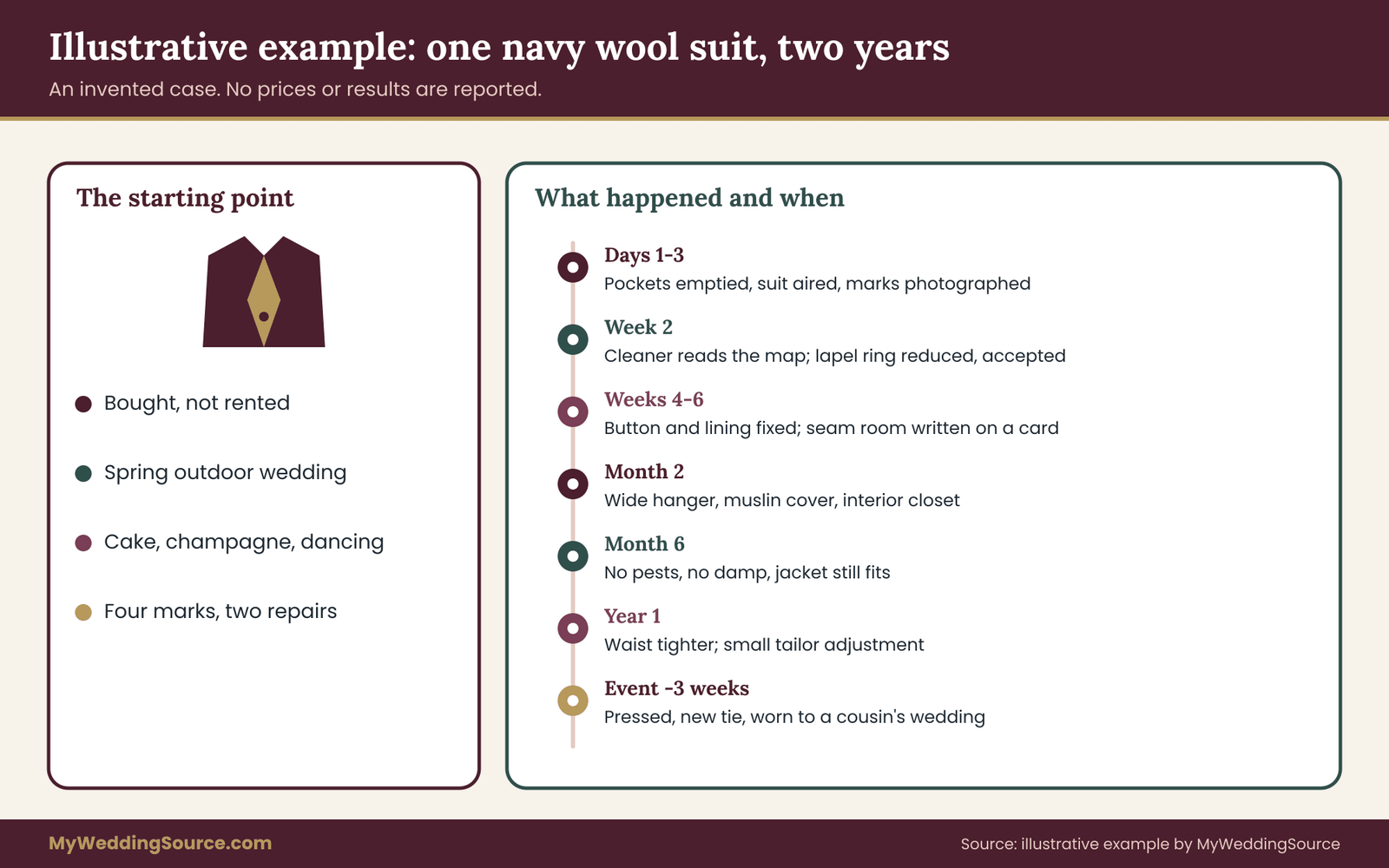
This example is invented to show how the calendar helps preserve wedding suit pieces in practice. It is not a case study and no real people or results are reported. Prices and cleaning outcomes are deliberately left out, because they vary by place and by supplier.
Daniel wore a navy wool suit at a spring outdoor wedding where he was the groom. The suit was bought, not rented. The day was warm. There was cake, champagne, dancing and a few hours of hugging relatives with perfume and makeup.
Days one to three
Daniel emptied the pockets and found a boutonniere pin, a folded card with his vows and a bit of confetti. He hung the suit in a spare room by an open window for a day. On day two his sister helped him photograph the jacket and trousers under a lamp.
They found four marks, the sort anyone trying to preserve wedding suit pieces would want to record. A pale, slightly stiff patch on the left lapel, probably champagne or cake. A gray smudge on the right cuff, likely from a table. Two small, darker spots near the right pocket flap. A grass stain on the left knee from the photos. They also found a loose button and a small lining seam that had split along the vent.
Daniel wrote each in a short note. He did not touch any of them.
Week two: the cleaning decision
He called two cleaners. The first said they could dry clean it in two days and quoted a price over the phone. The second asked him to bring the suit in, read his notes, looked at the lapel under a light and offered to pre-treat the marks before cleaning. Daniel chose the second. He asked how the jacket would be pressed, a small question that helps preserve wedding suit lapels, and they said they would use a shaped form and not press the lapel edge flat.
The suit came back after a few days. Daniel checked the marks at the counter. The cuff and the knee were clean. The lapel patch was reduced but a faint ring was still visible in strong light. The cleaner said that it might fade with a second treatment but that repeated cleaning would stress the fabric. Daniel chose to leave it. He took the suit out of the plastic cover at home.
Weeks four to six: tailoring
At the tailor, Daniel got the lining seam and the button fixed. He asked how much room was left in the waist and seat, and the tailor wrote it on a card: a small amount at the waist, more in the seat. The trouser hem had been cut a little short for ordinary shoes, so the tailor said the hem could be let down slightly but not by much.
Daniel decided to leave the hem alone and wear shoes with a thinner sole at future events. He kept the spare button and the card.
Month two: storage
He bought a wide wooden hanger and a muslin cover. He put the suit in a bedroom closet on an interior wall, away from the window and the radiator. He wrote a short note on the file: “Six-month check: end of November. One-year fit test: next April.”
Six months and one year
At six months, Daniel found no pests and no musty smell. He tried on the jacket and it was fine. At one year, he tried the full outfit. The waist was a little tighter than at the wedding. He took the suit back to the tailor, who said there was still room for a small adjustment. Daniel decided to wear the suit to a cousin’s formal wedding that autumn.
Three weeks before the event, he pressed the shirt and had the suit professionally pressed. He found that the tie had a small snag and bought a new one. The suit looked fine on the day, and the lapel ring did not show in photographs.
What the example shows
The example shows three things about how to preserve wedding suit pieces over two years. First, the stain map made the cleaning conversation shorter and better. Second, the tailor’s note about seam room let Daniel decide about the waist without guessing. Third, the refresh stop caught the tie snag before it became a problem on the day.
It also shows what the calendar cannot do. It cannot remove every mark. It cannot grow seam allowance. It cannot make a suit fit again after a large change in size. Those limits are covered in the section on when the plan fails.
The rest of the outfit: shirt, tie, shoes, belt and pocket squares
A suit is only part of what you wore, and anyone who wants to preserve wedding suit outfits as a whole has to remember that the other pieces age on different schedules. A jacket can last decades. A cotton shirt may be worn out in a few years. A silk tie can mark from a single drop of water. If you want to wear the suit again, think of the outfit as a small kit and care for each piece by its material.
Shirts
To preserve wedding suit shirts, start by remembering that the wedding shirt is the piece closest to the skin, so it carries the most perspiration, deodorant residue and collar soil. Wash or launder it soon after the wedding, following the label. If it is a dress shirt with a stiff collar, check the collar stays and remove them before washing if the shirt has removable ones.
Do not store a shirt that has been worn, even once, without cleaning it. Body oils turn yellow in storage, and the yellowing often cannot be reversed. If you want to keep the shirt, launder it, dry it fully, and store it folded or on a hanger in a breathable cover, not in plastic.
A shirt that no longer fits is easy to replace, but check the collar and sleeve length against the suit before the next event. A collar that has shrunk or a cuff that is too short makes a good suit look wrong.
Ties, bow ties and pocket squares
Silk ties and pocket squares are the most fragile parts of the outfit, and the hardest to preserve wedding suit accessories around. They can be stained by water, perspiration and oils. Most should be cleaned by a professional, and many cleaners will tell you honestly if the item is not worth cleaning.
Store ties unknotted, either hung from a tie rack or loosely rolled in a drawer. A tie left knotted keeps its crease and wears at the fold. Keep them away from direct light, which fades silk.
If the tie or pocket square was part of a matching set that you want to keep as a memento, label the item with the date and the occasion in a small tag or in your file. You will not remember in ten years which tie was which.
Shoes and belt
Shoes are often forgotten. After the wedding, wipe off dirt and grass, let the shoes dry away from heat, and polish leather. Insert shoe trees or crumpled paper to hold the shape. Store them in a cloth bag, not in a closed plastic box.
A leather belt can crack if stored coiled and tight. Hang it by the buckle or roll it loosely.
If the wedding shoes were bought for the event, check the soles. Leather soles worn on a dancefloor or rough ground may need resoling before the next formal event, and a cobbler can do it in a few days.
Cufflinks, tie bars and small metal items
Metal accessories can tarnish or stain fabric. Wipe them clean and store them in a small box with a soft lining. Do not store them in the same pocket as the suit, because the metal can rub or mark.
Keeping the outfit together
To preserve wedding suit sets as a whole, keep a short list in the suit file with the pieces you used: jacket, trousers, shirt, tie, pocket square, belt, shoes, cufflinks, socks. A list helps you rebuild the outfit at the next event, or sell or donate it as a set. The wedding etiquette guide is a useful companion if you are deciding whether to wear the same suit to another couple’s wedding, which is generally fine for a guest as long as it suits the dress code.
Fabric differences when you preserve wedding suit materials
The advice above fits a typical wool suit, but you should preserve wedding suit fabrics according to what they are. Other fabrics behave differently, and the care plan should adjust. Always start from the care label, because makers choose labels to match the actual construction.
Wool and wool blends
Wool is forgiving and resilient, which makes it the easiest fabric to preserve wedding suit wear with. It recovers from wrinkles with hanging and steam, and it handles occasional cleaning well. It is also what clothes moths eat, so cleanliness and storage matter most here. Worsted wool, the smooth kind used in many business suits, handles pressing well. Flannel and tweed are softer and bulkier and need more care in pressing.
A wool and polyester blend is usually more wrinkle resistant and slightly harder to damage in cleaning, but it can shine under high heat. Press with a cloth between the iron and the fabric, and keep the temperature moderate.
Linen and cotton
Linen wrinkles by nature and often looks better for it. For long storage, linen and cotton suits are best cleaned and stored dry, because damp fabric can mildew. Linen is less attractive to moths than wool, but it can be harmed by moisture and by sunlight. Avoid hanging it where it can sit in humidity. Choosing linen is a separate decision, and this guide covers only what happens afterward.
Velvet and corduroy
Velvet and similar pile fabrics are easily crushed. Hang them, do not fold them, and avoid pressing on the front of the pile. Steam from the back or hold the garment over steam. Many velvet jackets need a specialist cleaner. Choosing the fabric is a separate decision, and the care described here begins once the event is done.
Silk, mohair and delicate blends
Silk and mohair blends are lightweight and have a sheen that does not forgive rough treatment. Sweat, water and heat can all mark them. If the suit contains silk, ask a cleaner with experience in delicate fabrics, and avoid steaming at home without a test.
Polyester and synthetic suits
Synthetic suits resist moths and many stains, but they hold odor and can melt or shine under a hot iron. Clean according to the label, and avoid high heat. Polyester suits often store well in breathable covers and need less frequent checks, though the six-month check is still sensible.
Tuxedos
A tuxedo adds satin or grosgrain facings on the lapels and a stripe on the trousers. These details can show wear and need gentle pressing. Cleaners often press the lapel facings with care and a pressing cloth. If you own your tuxedo, treat it as you would a wool suit. If you rented it, return it as the shop directs.
Waistcoats and vests
Waistcoats are lined, often silk or a silk-like fabric. Check the back adjuster and the buttons. Hang them on a shaped hanger, not folded. Many cleaners treat them as part of the suit, which can make cleaning uneven if the vest was not part of the set.
Dyed, embellished or patterned fabrics
If any part of the suit is embroidered, appliqued, printed or beaded, treat it as a specialist case. Test for color transfer if the garment has bold dyes. Never rub. Take it to a cleaner who handles formal and decorative garments.
A quick fabric rule
When you are unsure how to preserve wedding suit fabrics of any kind, the safer choice is to do less: do not iron, do not steam, do not wash at home, and ask a specialist. The extra cost of one cautious visit is usually smaller than the cost of a replacement.
Wear again, rework or release: planning for the next formal event
Eventually every wedding suit meets a choice, even if you have done everything right to preserve wedding suit pieces. The suit might go back into the wardrobe for good, or it might be changed, passed on or sold. This section helps you decide without sentiment pulling you in two directions, and then walks through the refresh routine for the next event.
A simple test for wear-again
Ask four questions, in this order, before you decide to preserve wedding suit pieces for more years. Does the suit fit now, without alteration beyond a small hem or cuff change? Is the style one you would still choose, or does it read as tied to a specific year? Is the fabric suitable for the events you actually attend, such as evening events, daytime weddings, funerals, interviews and holiday parties? Is the condition good enough that a cleaner and a tailor could make it look fresh?
If all four answers are yes, the suit goes on the wear path and you plan the refresh before the next event. If one is no, think about whether a small fix changes it. If two or more are no, release or rework is more honest than hanging it in the closet for another decade.
A navy or charcoal wool suit in a classic cut is usually the easiest to wear again, because it works for many occasions and does not date quickly. A bold color, a strong pattern or a trend-driven cut is harder to wear and easier to remember, which can be a good reason to keep it as a keepsake and not a working suit.
Wearing the same suit to someone else’s wedding
For a guest, wearing the suit you wore at your own wedding is generally fine, and it is a practical way to preserve wedding suit value. Nobody is tracking it, and most guests would read it as a sign that you value good clothes. The caution is about dress code.
A dark suit may be right for an evening black-tie-optional wedding. A heavy wool suit may be wrong for a summer beach ceremony. Pick the suit for the event, not the other way around. A different shirt, tie and pocket square change the look considerably.
If you are unsure what a dress code asks for, the wedding etiquette guide covers the usual conventions, and the couple’s invitation or website is the final word.
The refresh routine, step by step
Use the same routine for every future formal event to preserve wedding suit quality. Three weeks before, take the suit out, try it on and check the fit. Two weeks before, decide whether it needs cleaning or only pressing. If it needs cleaning, send it now, not the week of the event.
One week before, collect it, inspect it and hang it in moving air. Three days before, check the shirt, tie, shoes and belt. The day before, lay the outfit out, steam any last wrinkles and check the pockets.
If the next event is far away, a suit that was cleaned a year ago and stored well often needs only a press. If you notice any odor, any mark you did not see before, or any sign of insects, treat it as a cleaning case.
The refresh routine also tells you what to buy. A new tie, a fresh shirt and a shoe polish cost little, and they often make the suit look newer than any intervention on the jacket. Set a small refresh budget in advance, and the wedding budget page shows one way to track a category like this against what you actually spent.
Rework: giving the suit a second life
Some suits are better changed than stored, and rework can preserve wedding suit fabric that would otherwise sit unused. A formal suit can become daily wear by swapping fancy buttons for plain ones, by shortening the trousers a little, or by wearing it with a casual shirt and no tie. A tailor can often make a suit less formal without damaging it. The reverse is much harder, so go slowly.
Other kinds of rework are more serious. Turning a suit into separate pieces, such as a blazer and trousers, can work well if the fabric and cut allow it. A tailor can tell you whether the jacket would look right with other trousers and whether the trousers would work as standalone pieces. Re-cutting the suit for a different body is a large job, and it is rarely worth it unless the fabric is exceptional.
For the question of how tailoring decisions usually fit into a wardrobe, the wedding dress fit and alterations guide explains how fitters think about seams, hems and what can be reversed, and the principles carry over to suits even though the garments differ.
Release: selling, donating or returning
If the suit no longer belongs in your life, you can still preserve wedding suit value for the next owner. A clean, documented suit is easier to place. Prepare it the same way as for storage: clean it, repair it, take clear photographs and keep your records. That includes the care label, the fabric content and the measurements, which buyers and charities often ask about.
Selling. Online resale sites and local consignment shops take suits, but wedding suits sell for different prices depending on brand, condition, size and style. Do not expect any particular result. Measure the garment flat, photograph it in daylight and describe flaws honestly. A suit in an unusual size or a strong color can take a long time to sell.
Donating. Charities that accept formalwear can put a clean suit to good use. Some programs focus on job interview clothing. Ask what they accept and whether they provide a receipt. If you plan to claim a tax deduction, the Internal Revenue Service publishes rules about donating clothing and the condition required, and a tax professional can answer questions about your own situation. Keep the receipt in your records.
Returning. A rented suit goes back on the date and in the condition set in your rental terms. Do not send it to a separate cleaner first unless the rental shop has told you to. Keep your receipt and the shop’s return confirmation.
Passing on. A sibling, a child or a friend may want it, and that is often the happiest ending. Make sure the person knows the care history and whether any tailoring is reversible.
Keepsake options if you will not wear it again
A suit can be kept as a keepsake without taking up a whole closet, and a partial approach can preserve wedding suit memories cheaply. Some people keep the jacket and release the trousers. Others keep a swatch, the boutonniere, the tie or the pocket square, and release the rest. A framed piece of fabric from the inside of the jacket, taken by a tailor with care, can be a quiet reminder.
If you do keep the whole suit, store it as a long-term piece: cleaned, in a breathable cover, in a calm closet, with a reminder to check it yearly. For a smaller keepsake, wrap the item in acid-free tissue and keep it in a box with air holes, away from heat and damp.
Records that follow the suit
A short file is the simplest way to preserve wedding suit history, and it helps whoever handles it next, whether that is you in ten years or someone you pass it to. It should hold the receipt, the care label photo, the tailor’s note on seam room, the date of last cleaning and any spare buttons. If you are already organizing other wedding papers, the same folder works for the suit file, and the wedding planning checklist is a useful reference for the final tasks around wedding clothing.
When the plan to preserve wedding suit pieces fails
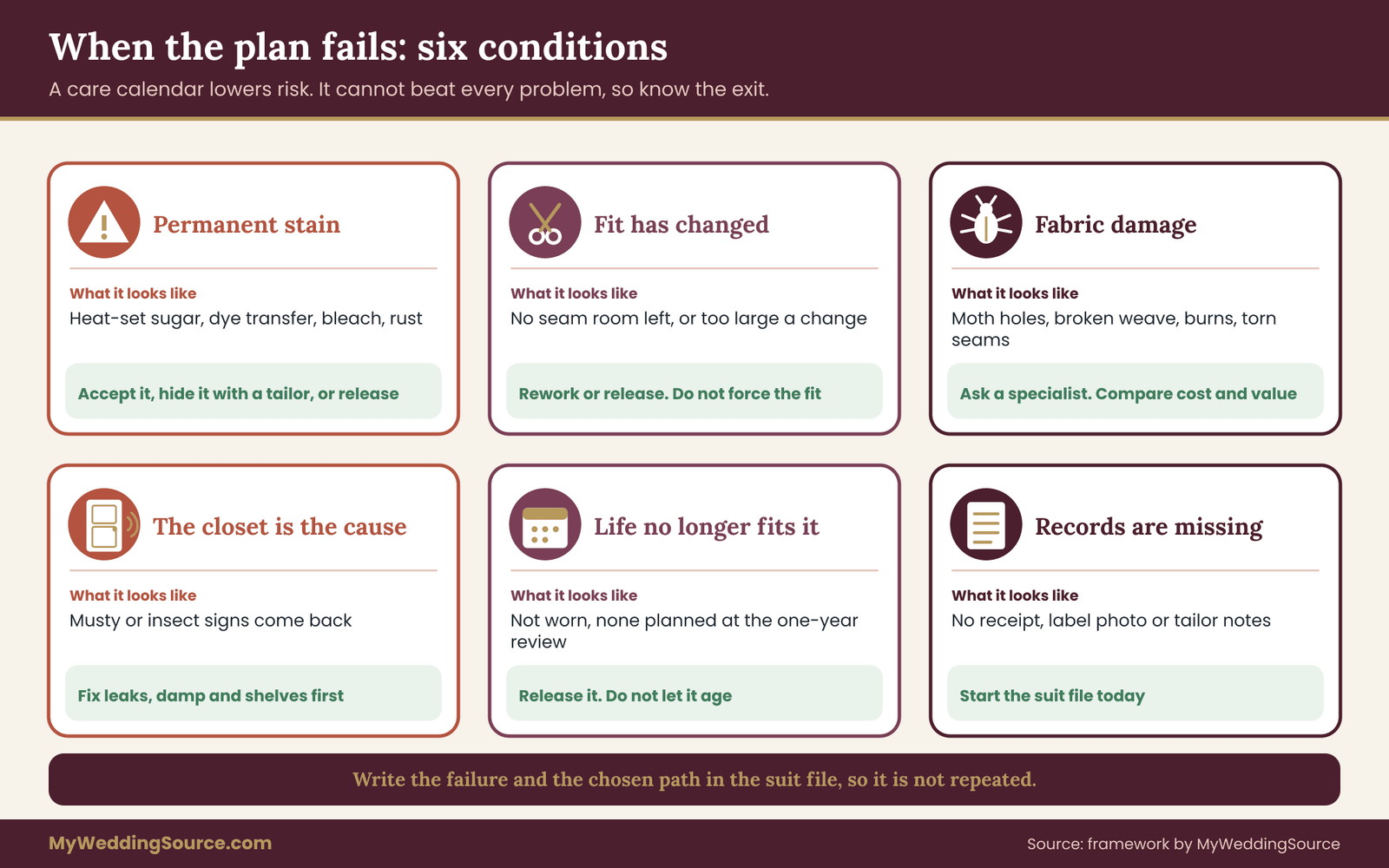
A care calendar is a tool, not a promise, and it cannot always preserve wedding suit pieces against every problem. It lowers risk and it organizes decisions, but it cannot beat every problem. Knowing in advance when the plan fails is useful, because it tells you when to stop trying and choose a different path.
Failure condition one: the stain is permanent
Some stains do not come out, whatever you do to preserve wedding suit fabric. Dried sugar that was pressed with heat, dye transfer from a bold fabric, bleach, rust and some oil-based marks can all be permanent. A good cleaner will tell you honestly, and a better one will tell you before they start.
If a mark is permanent, decide whether it is acceptable, whether a tailor can hide it with a minor change such as moving a pocket flap, or whether the suit moves to the release path.
Failure condition two: the fit has changed too much
A suit that was fitted closely may not suit a body that has changed, and no routine to preserve wedding suit fit can fix that. If the tailor says there is no room, there is no room. Taking a suit out beyond the available fabric is not possible, and forcing a closer fit usually looks worse than a new suit. Treat this as a clear signal and move to the release or rework path.
Failure condition three: damage in the fabric itself
Even a careful effort to preserve wedding suit fabric cannot repair moth holes, pulled threads that have broken the weave, burn marks and torn seams in a place without spare fabric are structural problems. Invisible mending exists, but it is slow and costly, and results vary. Ask a specialist before spending, and compare the cost with the value you place on the suit.
Failure condition four: the closet is the problem
If a suit comes out of storage musty, mildewed or with signs of insects, the issue may be the space and not the suit. A cleaner can treat the suit, but if you put it back in the same closet, the problem returns. Fix the cause: check for leaks, reduce humidity, clean the shelves and review what else is stored there.
Failure condition five: the suit is no longer suitable for your events
Sometimes a suit simply no longer fits a life, and there is no need to preserve wedding suit pieces you will never wear. Workplaces change, dress codes relax, the family’s events shift. A suit you never wear takes up space and quietly ages. If the one-year review shows you have not worn it and do not expect to, release it.
Failure condition six: the suit was rented or borrowed
Rented suits are not yours to preserve. If you have a rented suit and want one like it, buying a new or used one is a separate decision. The wedding rental planning checklist is useful if you are still managing return deadlines and damage terms for any rented items from the wedding.
Failure condition seven: the records are missing
Without the tailor’s notes, the receipt and the care label, a suit’s future depends on guesswork. Missing records are a small failure, and an easy one to fix going forward. Start the file now, even if the suit is already in the closet.
What to do when you hit a failure
To preserve wedding suit pieces sensibly, name the failure, decide whether it is fixable at a price you accept, and then choose a path. A written line in the suit file such as “stain permanent, moved to rest, no further treatment” avoids a repeat conversation later. Failure is useful information. It tells you the suit’s real condition, which is better than an optimistic guess.
Your next steps
To preserve wedding suit pieces from here on, pick the stop on the calendar that matches where you are today, and do only that stop.
If the wedding was within the past week, empty the pockets, air the suit, photograph it under a lamp and write the stain map and the repairs list. Do not clean anything yet.
If it was within the past month, choose a cleaner, take your map and ask the five questions. Collect the suit promptly and remove the plastic cover.
If it was longer ago and the suit is in the closet, take it out today. Check for odor, pests and fit. Decide which path it is on this year, wear, rest, rework or release, and write the date of the next check.
If an event is coming, start the refresh routine three weeks ahead and book any pressing or tailoring now.
Whatever stop you are at, start the suit file: receipt, care label photo, tailor’s notes, spare button, cleaner’s ticket.
FAQ
How soon after the wedding should I clean the suit?
Book the cleaning within about a week and get the suit to the cleaner within two weeks. Sugar, drink and perspiration marks set over time, and some darken when heated. Do the triage first so the cleaner gets a stain map. If you are traveling, air the suit and pack it in a breathable bag, then clean it on your return.
Should I dry clean the suit before storing it?
Usually yes, once, if you want to preserve wedding suit fabric for years. Soil from food, drinks and perspiration attracts moths and can yellow or weaken fibers during long storage. A professional clean before storage lowers that risk. Avoid cleaning more often than needed, because each cleaning stresses the fabric. If the suit was worn briefly and has no marks, a professional press may be enough for now.
Is a plastic garment bag safe for storage?
Not for long periods if you want to preserve wedding suit fabric. Plastic from the cleaner traps moisture and can yellow, stick to fabric or release chemicals over time. Take the suit out of it when you get home and use a breathable cotton or muslin cover instead. Choose one without a plastic window, and leave a little room so the jacket is not crushed.
Which hanger is best for a wedding suit?
A wide, contoured wooden or padded hanger that matches the jacket’s shoulders is the first thing to buy to preserve wedding suit shape. Thin wire hangers dent the shoulder seam and can leave permanent marks in structured wool. Trousers can hang from a clamp by the hem or lie over a padded bar. Give the suit space in the closet so the air moves and the sleeves are not crushed.
Do cedar blocks or mothballs protect a stored suit?
Cedar and lavender can freshen a closet and are commonly used, but they are not a guarantee against moths. Mothballs are pesticides with label directions and warnings, and the EPA publishes consumer information about them. Most people do better relying on a clean suit, a closed breathable bag, a clean closet and a twice-yearly inspection.
Where is the best place in a home to store a suit?
An interior bedroom closet with steady temperature and moderate humidity is usually best. Avoid attics, garages, basements and closets on exterior walls, because heat, damp and swings in conditions harm fabric. Keep the suit away from sunlight, radiators and vents. A small thermometer and hygrometer on the shelf lets you check conditions without guessing.
Can a tailor let the suit out later?
Sometimes, by a small amount. It depends on how much seam allowance was left and whether the tailor trimmed fabric during the original fitting. Ask the tailor right after the wedding how much room remains and write it down. Large changes in size are often impossible, and cutting excess fabric away cannot be undone. A specialist can assess a particular suit in person.
Should I keep the suit or sell it?
Use the four-question test: does it fit now, does the style still suit you, is the fabric right for your events, and is the condition good enough to freshen. If yes to all, keep it and plan the refresh. If two or more answers are no, selling, donating or passing it on is usually kinder to the suit and to your closet. Do not expect any particular resale price.
Sources
- Smithsonian Institution: museum conservation and textile care resources
- National Park Service: Museum Management Program, Conserve O Gram series
- Library of Congress: Preservation and care of collections
- American Institute for Conservation: find a conservator and care guidance
- Canadian Conservation Institute: caring for textiles and heritage objects
- Federal Trade Commission: Care Labeling Rule for clothing and textiles
- U.S. Environmental Protection Agency: dry cleaning and pesticide label information
- Internal Revenue Service: charitable contributions and donated clothing
- USA.gov: consumer complaints and protection