
Lawn protection for a backyard wedding means deciding, before the first rental truck arrives, which parts of your grass and garden will carry weight, which will carry only footsteps, and which will be fenced off, then choosing a temporary surface and a restoration schedule for each. This guide gives you a zone-by-zone checklist, one worked example and clear stop rules.
Treat lawn protection as a load problem. Sort the yard into foot-traffic, cart-traffic, wheeled-load and heavy-load zones, then match each zone to the lightest surface that handles it: nothing, a mulch path, ground mats, interlocking panels or a trackway. Keep covers on the grass for the shortest time you can, turn off sprinklers and call 811 before anything is staked, fence the garden beds, and set a rain trigger in advance. Finish with a written restoration plan that runs for six weeks after the event.
A lawn looks tough until two hundred pounds of rental chairs, a catering cart and a hundred and twenty pairs of shoes cross it in the same afternoon. Grass is a living surface with a shallow root system, and it takes damage in ways that do not show up until several days later. Yellow rectangles appear where a dance floor sat.
Ruts stay where a delivery cart turned. A sprinkler head cracks under a table leg. None of this is dramatic, but all of it can turn a pleasant wedding into a landscaping bill and an uncomfortable conversation with a landlord, a neighbor or your own parents.
This article is about one narrow job, lawn protection through a single event at a home: keeping the ground in good shape through a single event at a home. It does not cover whether you can host at your property, how to handle utilities or what the neighbors will tolerate. For those questions, the site has a separate guide to choosing and judging wedding venues, and the planning pages on this site cover home-hosting limits in broader terms.
Rental quantities and quotes belong in a separate rental quotes and quantities checklist. Here the question is narrower: what goes on the grass, what stays off it, and what you do afterward. Good lawn protection answers all three.
A note on scope. This is general planning information, not legal, insurance, horticultural or landscaping advice. Soil, climate, grass species, local ordinances and rental company rules vary a great deal, so confirm anything that matters with your local cooperative extension office, your city or county, your landlord or homeowners association and your rental provider.
What lawn protection for a wedding actually covers
People use the phrase loosely, so it helps to say what is inside it. Lawn protection, as used here, is the set of decisions that determine how much damage the turf, the soil under it, the garden beds, the trees and the irrigation system take during setup, the event and teardown. It has four parts.
The first part of lawn protection is prevention: keeping loads and traffic off areas that cannot take them. The second is distribution: spreading unavoidable loads over larger areas with mats, panels, plywood or flooring so that no single point presses hard. The third is timing: limiting how long covers, tents and equipment stay on the grass. The fourth is recovery: what you do in the days and weeks afterward to bring the grass and soil back.
Most home weddings skip the first and fourth parts of lawn protection and rely only on the second. A couple rents a tent, orders a dance floor and assumes the floor “protects the grass.” Often it does not, or not for long. A solid floor blocks light and traps heat and moisture against the blades, and the same floor concentrates the weight of a crowd on a few supports. Lawn protection is a plan, not a product.
It also helps to be honest about the goal. You are not trying to keep a lawn perfect. You are trying to keep it in a condition where it recovers without replacement. Grass that is flattened, yellowed and a little torn usually comes back if the soil underneath was not compacted into a hard layer and the crown of the plant was not killed. Soil that is churned to mud and then dries into ruts is far harder to fix. Decisions that protect the soil matter more than decisions that protect the blades.
Finally, lawn protection is a shared job. The rental company, the caterer, the tent crew, the florist, the band and the guests each affect the ground, and each one follows instructions that you or a coordinator gave them. If nobody gave instructions, each one follows the shortest path from the driveway to the work. That path is usually straight across the lawn.
A helpful way to hold the whole subject in mind is to think of the yard as having a budget of stress. Every plan spends some of it. Foot traffic spends a little, wheeled carts spend more, a tent spends a lot in a small area, and rain multiplies everything. A good lawn protection plan spends the budget deliberately, in the places where damage is easiest to repair or least visible, and refuses to spend it where recovery is slow.
How a lawn actually gets damaged at a wedding
Knowing the damage mechanisms makes the surface choices later in this guide easier to follow. There are five that matter for a one-day event, and they combine.
Compaction. Soil is mostly pore space, the tiny gaps that hold air and water for the roots. Repeated or heavy pressure squeezes those gaps closed. Compacted soil sheds water, resists root growth and stays hard long after the event. Compaction is worst when the ground is wet, because wet soil gives way more easily and then sets as it dries. A dry lawn can tolerate a crowd far better than a damp one, and this single fact drives most of the rain advice in a later section.
Wear and tearing. Blades are crushed, broken or torn from the crown by foot and wheel traffic, high heels, table legs and pivoting carts. Wear is concentrated along the shortest routes between two points, such as the gate to the tent or the kitchen door to the bar. These paths show first and recover slowest because they take repeated hits.
Light and heat deprivation. Anything solid that sits on grass for more than a short time blocks sunlight and traps warmth and humidity. Under tent flooring, black plastic or dense mats, the blades can bleach or scorch, and mold and fungal problems become more likely in damp weather. The longer the cover stays, and the hotter and sunnier the season, the worse this gets. Even breathable products have limits.
Waterlogging and ruts. If the ground is saturated, wheels cut ruts that bring up subsoil and leave a rough surface. Rain on the day of setup or teardown is the usual trigger, but an overwatered lawn or a leaking irrigation line can do the same on a sunny weekend.
Spills, chemicals and debris. Grease, wine, melted candle wax, fuel from generators, fire-pit ash, cleaning solutions and de-icing or deodorizing products can burn or poison turf and soil in small patches. Cigarette butts, confetti, glitter and wire are a separate nuisance. They do less harm to the grass than to mowers and to pets that eat them.
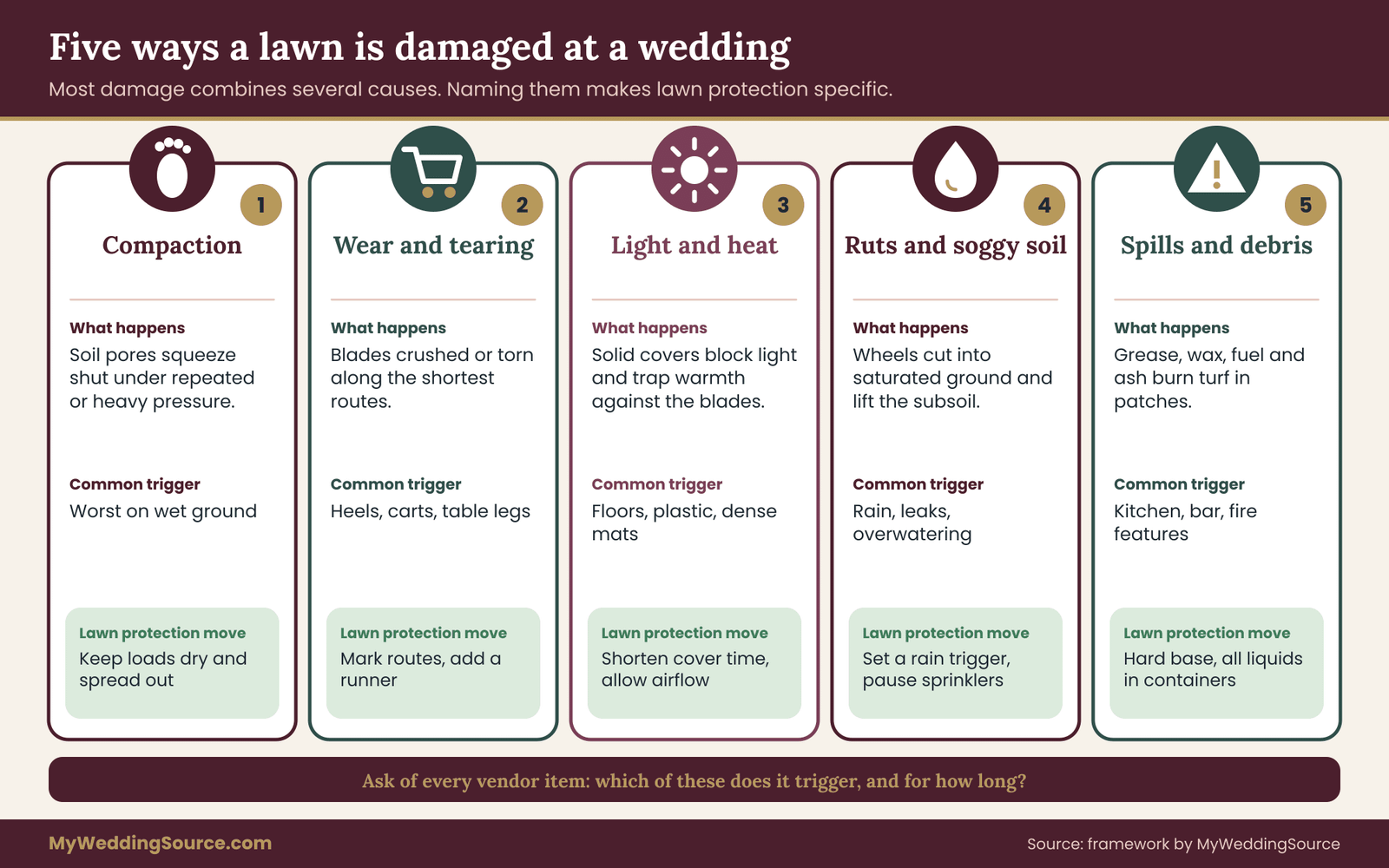
These five do not act separately. A damp lawn, a heavy cart and a tent floor left down for three days will produce compaction, ruts and light deprivation together, and the result looks like “the lawn died” even though each cause was modest. A useful lawn protection habit is to ask, for each item on the vendor list, which of the five it triggers and how long it will last.
A delivery cart for fifteen minutes triggers wear and, if the ground is wet, ruts. A dance floor for thirty hours triggers light deprivation and compaction under the supports. A tent with stakes for two days triggers piercing and heat. Listing them this way turns a vague worry about the grass into a short, workable lawn protection list of specific risks.
One more point: some damage is out of sight. Irrigation lines, sprinkler heads, shallow drains, cable runs and buried utilities sit only a few inches below the surface in many yards, and stakes, forklifts and heavy rental trucks can crush or puncture them. A broken sprinkler line may not show until the next watering cycle floods a corner of the lawn. The next section covers how to find these before anyone drives a stake, because lawn protection starts below the surface.
Read your yard before building a lawn protection plan
The most useful hour of any lawn protection effort is a walk around the yard, with a notebook, before you book a single rental. Do it once in daylight and, if the event runs into the evening, once at dusk. The point is to turn your yard into a short list of lawn protection facts that every vendor can act on. If your venue-style walk-through habits are rusty, the guide to a venue technical walkthrough shows how professionals measure and note access routes, and the same discipline works at home.
Start with the ground itself. Walk the lawn after a normal watering cycle and again after a dry spell. Note where water pools, where the ground feels spongy, where it is rock hard and where it slopes. A slope matters because mats and flooring slide on wet grass and because water running downhill carries mud onto whatever is below.
Pooling spots are the first to rut, so they are poor places for carts, tents or a dance floor. Hard, dry, bare patches are often already compacted and will not get much worse, which sometimes makes them the best place for a heavy load.
Look at the grass. Is the lawn thick or thin, one species or a patchwork, shaded or full sun? A thick, well-watered lawn in full sun recovers fastest. A thin lawn under trees recovers slowest, because the grass there was already struggling for light. If you do not know the species, a local cooperative extension office, reachable through the land-grant university system that the U.S. Department of Agriculture supports, can tell you what grows in your area and how it handles stress. Many offices answer homeowner questions for free.
Map the sprinklers. Walk the property while the irrigation system runs a short test, and flag every head with a small stake or a flag. Photograph the layout with your phone and mark the shutoff valve and the controller. Heads sit just below or at the grass surface and are easy to crack with a table leg, a trolley wheel or a tent stake. If you rely on an automatic system, you also need to decide when to turn it off, which section seven covers.
Check for buried utilities. Before anyone drives a tent stake or digs a post hole, call 811, the national call-before-you-dig number, or use the online request on the 811 site. Utility locators mark gas, electric, water and telecom lines for free in most areas, and they need advance notice that varies by state.
Request the marking well ahead of the event, not the week of it. Private lines, such as a garden lighting circuit, a well pipe or a lawn-irrigation lateral, are usually not marked by the public locators, so ask the person who installed them or find the as-built drawings if you have them.
Notice the roots. Walk the drip line of every large tree, which is the circle on the ground under its outer branches. Tree roots extend roughly that far and often farther, and most of the fine feeding roots sit in the top foot or so of soil. Heavy loads, repeated traffic, digging and stakes inside that circle can damage a tree slowly. Mark the drip lines on your sketch and treat them as protected zones unless an arborist tells you otherwise.
Find the septic area and other soft spots. If the property has a septic system, its drain field is a buried network that should not carry heavy loads. The guide on this site about septic systems and large home weddings covers the larger sanitation questions. For lawn protection, the rule is simple: keep tents, vehicles and heavy flooring off the field, and ask the septic service or county records where it sits.
Locate garden beds and sensitive plantings. Mark vegetable beds, perennial borders, new plantings, roses, hedges, raised planters, ponds and any plant you would be upset to lose. Note which ones are close to the likely walking routes. The beds that sit along the shortest path from the driveway to the tent are the ones that will be trampled, so fence them or move the path.
Record fixed hard surfaces. A driveway, patio, walkway, deck or paved side yard is the cheapest lawn protection you own. Every cart, pallet and delivery that can use hard surface for most of its trip is a load you have taken off the grass. Measure the hard-surface routes, check the width for carts, and note any steps or thresholds that a cart cannot climb.
Finish the walk by drawing a simple lawn protection sketch. It does not need to be accurate to the inch. It needs to show the house, the gates, the hard surfaces, the sprinkler heads, the shutoff, the trees and their drip lines, the beds, the slopes, the pooling spots and the 811 marks. Photograph it and share it with every vendor who will set foot in the yard. Vendors who see a lawn protection sketch with protected zones will usually follow it. Vendors who only hear “be careful with the lawn” will not.
Sort the yard by load: the four-class lawn protection ladder
The framework this guide uses for lawn protection is a ladder of four load classes. It is deliberately simple, because the people carrying the loads are rental crews and caterers who will not read a long document. Each class gets one surface response, one time limit and one restoration rule. You apply the lawn protection ladder zone by zone, not to the yard as a whole.
Class one is foot traffic. Guests walking, standing and sitting on chairs set directly on grass. The load per square foot is small, and most healthy lawns handle one day of it without surface treatment, provided the ground is dry. Chairs concentrate weight on four small feet, and high heels concentrate a person’s weight on a very small point, so the real worry in this class is wear and aeration holes rather than compaction.
The usual response is to leave the grass bare, mark one or two main routes and, for the ceremony aisle and any entry choke point, lay a runner, a strip of mats or a mulch path. Time limit: the length of the event, plus an hour or so either side. Lawn protection at this level is mostly about routes and manners.
Class two is cart traffic. Hand trucks, folding-table carts, drink coolers on wheels, bakery carts and a florist’s dollies. These are light wheeled loads that move often along the same lines. A cart with small hard wheels cuts into wet or soft turf, and a loaded cart can weigh several hundred pounds.
The usual response is a defined cart route over hard surface where possible, and where it must cross grass, a line of mats, a plywood runner or a narrow trackway. Time limit: only during setup and teardown, and only when the ground is dry enough that a cart leaves no visible track.
Class three is wheeled and standing loads. Anything with weight and a footprint: a dance floor, a staging platform, a buffet table with chafing fuel, a food truck, a generator, a portable toilet trailer, a photo booth. Loads in this class stay put or move slowly. They compact the soil under supports and block light. The usual response is a ground-spreading surface under the load, such as interlocking panels, heavy-duty mats or boards, and the shortest feasible cover time. Where possible, shift the load off the grass to the driveway or patio.
Class four is heavy vehicles and structures. Delivery trucks, forklifts, a large tent with a stake grid and ballast, a trailer. The weight of a loaded rental truck far exceeds what turf can carry, and a single pass on a wet lawn can leave ruts a foot deep. The usual response is to keep these off the lawn entirely.
Trucks stay on the street or driveway, and goods are carried in by hand or cart. If a tent has to go up on grass, plan for the stakes or ballast, call 811, and get a written rental company procedure for the site.
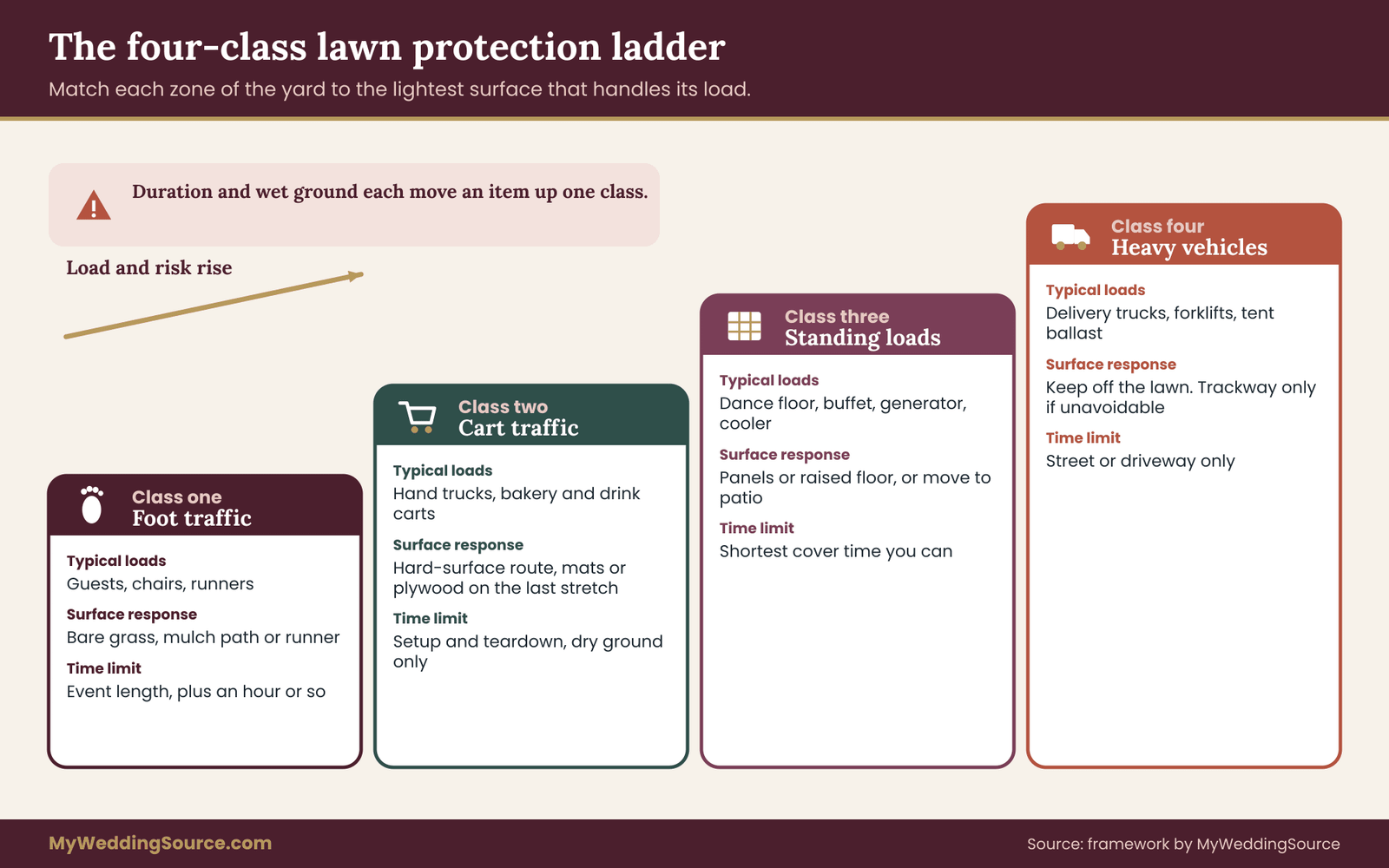
The lawn protection ladder has two practical uses. First, it forces a location decision before a surface decision. If three class-three loads fall on your best lawn, that tells you to move at least one of them before you spend anything on flooring. Second, it gives your vendors a one-line instruction: “Class four stays off the grass, class two uses the marked route, class three goes on panels.” People follow plain rules that fit on a sticky note.
To assign classes, list every item and every vehicle that will enter the yard, from the first delivery to the last pickup. Write next to each one a rough weight, how many times it will cross the lawn and how long it will sit. If you do not know a weight, ask the vendor.
Rental companies publish dimensions and weights for tables, tents and floors, and caterers know what their equipment weighs. A sentence in an email such as “Please send the weight and wheel type for each cart and the footprint of each piece” is enough.
Two rules of thumb help with borderline items. The first is that duration moves an item up a class: a class-two cart that must stay overnight on one spot behaves like a class-three load. The second is that wetness moves everything up a class: on a saturated lawn, even ordinary foot traffic can behave like cart traffic, and ordinary carts behave like trucks. That is why the rain trigger in the water section is part of lawn protection, not an extra.
A short worked sentence shows the idea. If the cart route is twelve feet from the gate to the tent and the lawn is dry, a runner may be enough. If the same route is forty feet, crosses a slope and the forecast is damp, mats or a hard-surface detour belong in the lawn protection plan. Length, slope and wetness are the three variables that move a route up or down the ladder, and you can see all three on your sketch.
Do not try to make the lawn protection ladder perfect. Its job is to make the big decisions visible. A yard with a long driveway, a patio and a dry lawn may end up with nothing on the grass but chairs and a runner. A yard with no hard surface, a slope and two trees may need panels, a trackway and a smaller guest count. The ladder tells you which of those two yards you have, and how much lawn protection each one needs.
Temporary surfaces compared: what each one protects and what it costs the grass
There is no single best temporary surface for lawn protection. Each one trades protection against grass health, cost, appearance, setup time and safety. The comparison below is in prose rather than a ranking, because the right choice depends on the load class, the season and how long the surface will stay down. For rental pricing, ask local providers for written quotes and weights. Prices vary widely by region and season, so none are given here.
Bare grass. Cheapest and kindest to the lawn for foot traffic. Healthy, dry turf handles one day of seated guests. The drawbacks are wet-weather failure, heel punctures and the possibility of mud at entrances. Bare grass is the lightest form of lawn protection and suits class one in dry conditions, and it is the right answer more often than people expect. Spending money on flooring that is not needed can do more harm to lawn protection than leaving the grass alone, since covers bring light deprivation.
Mulch or wood-chip paths. A path of clean wood chips or shredded bark, laid on a landscape fabric or directly on grass for the day, spreads load and gives a stable, forgiving surface for heels and wheelchairs if it is compacted and thin. It reads as a garden path and looks natural. The drawbacks are that loose chips shift under a cart, cannot be laid in a rainstorm and must be removed completely afterward, because chips left on turf smother it and tint the soil.
Use fresh chips from a landscape supplier and ask about delivery by tarp rather than by dump. For lawn protection on light routes, mulch is best for class-one routes and short class-two runs, and is poor for narrow wheeled loads.
Ground mats and rolled grass-protection mesh. These are rigid or semi-rigid sheets with openings that let grass grow through and bear light loads without a solid surface. They keep blades alive better than solid covers because light and air reach the turf. They do slip when wet, edges curl, and they need stakes or interlocking edges. They suit class one and class two, including ceremony aisles and cart routes, over several days in mild weather.
Heavy-duty interlocking panels. Plastic or composite panels, usually in square sections that lock together. They spread weight widely, resist vehicle loads in many models and give a firm walking surface. The grid or pattern reduces compaction compared with a solid sheet. They are bulky, they require more crew and truck space, and they leave a pattern in the grass if left too long.
They suit class three, such as under a dance floor or a buffet line, and some versions handle class four when installed per the maker’s instructions. Ask the rental company for the weight rating in writing and stick to it.
Plywood sheets. Large sheets of exterior-grade plywood are an inexpensive way to span a cart route or protect a corner where deliveries turn. Plywood is heavy, slippery when wet and can splinter, and its edges are a trip hazard unless taped or covered. Plywood blocks light entirely and absorbs water, so leave it down for hours, not days. It is a short-term class-two and class-three fix, best on dry ground.
Trackway and roll-out road. Interlocking trackway is built for vehicles. It carries class-four loads on soft ground and is a standard solution for temporary access on lawns. It is also expensive, needs installation by the supplier and may be oversized for a home event. If you must bring a truck across a lawn, trackway is the one surface to ask about. Most home weddings should instead keep trucks on the street and use hand trucks.
Event flooring and dance floors over grass. Rental companies offer leveling subfloors, platform floors and tent flooring systems. A proper system lifts the floor on adjustable supports, which gives a flat surface and a gap for airflow, but the supports each carry a concentrated load, and the floor blocks sun and traps heat. The key variables are the number of days on the grass and the weather.
A floor that goes down the morning of the event and comes up that night does far less harm than one that sits for a week. Ask whether the system allows airflow under it, and tell the company about sprinkler heads in the footprint.
Carpet, turf-style runners and aisle cloths. These are mainly decorative. A fabric aisle runner over grass protects heels and dresses from mud on a short, flat path. It slips on wet grass unless pinned, and pins pierce roots and irrigation lines, so use only short staples at the edges, or ask the florist for weighted anchors. A runner is cosmetic protection for the people, not for the lawn.
Rubber or foam mats for specific hot spots. For the gate, the bar line or the kitchen door, rubber mats with grip are quick to lay, and they handle wheels. Rubber is a quick lawn protection fix, but it warms in the sun, so it can scorch grass under it on hot afternoons.
Hard-surface alternatives. A patio, driveway or paved side yard may replace a lawn use entirely. Moving the bar, the buffet or the band to hard surface solves the problem more cheaply than any mat.

The pattern across these options is consistent. The lighter the load, the lighter the surface should be. The shorter the cover time, the more solid it can be. And the lawn protection value of any surface shrinks quickly as days pass, so the first question to ask a rental company is not “what do you recommend” but “how long will it be down, and what do you do for airflow and drainage.” If a vendor cannot answer, ask for a different product.
To choose among them, run each zone through four questions in order. What load class is it? What will the weather probably be? How many hours will the cover sit? And what is the fallback if it rains? A dance floor zone of class three, forecast dry, down for thirty hours with a rain plan of “move to the patio” calls for panels or a raised floor with airflow.
A ceremony aisle of class one, down for six hours, calls for mulch or a runner. A cart route of class two, down for two days, calls for mats or plywood if dry, and for a hard-surface detour if wet.
Garden beds, trees and plantings: lawn protection beyond the grass
The lawn gets most of the attention, but the garden usually costs more to replace. A mature shrub, a rose border or a vegetable bed represents years of growth, and some of it cannot be bought back at any price. Lawn protection for the garden side of the yard is mainly about boundaries, not surfaces.
Fence the beds, even lightly. A low barrier tells guests where not to step. Options include a line of rope on short stakes, temporary garden fencing, a row of potted plants or planters, or a simple string border with a few signs. For children and pets, the barrier needs to be higher and visible.
For lawn protection around plants, place the barrier a foot or two beyond the plants, not at the edge, since leaves and flowers spread beyond the stem. Remove stakes by hand and avoid driving them into soil near roots or irrigation lines.
Redirect the path. People walk where the ground invites them. If a flower bed lies on the natural line between the patio and the tent, they will cross it. Rearrange chairs, tables or a hedge of potted plants so that the easiest route is a different one. A mulch path or a line of stepping stones across the lawn is better than a rope that people want to step over.
Protect tree roots. Keep tents, stakes, parked vehicles and heavy equipment out of the drip line, and keep foot traffic light there. If chairs must sit under a tree for shade, spread them thinly and consider a few feet of mulch to cushion the ground. Do not pile ice, dump drink water or leave generators under the canopy.
If a rare or old tree stands in the yard, a certified arborist can advise on what to avoid. The International Society of Arboriculture runs a public directory of certified arborists, and a short phone call is usually enough.
Think about low and soft plants. Ground covers, new seedlings, sod patches and shallow-rooted perennials tolerate little foot traffic. If a reseeded patch is less than a few months old, treat it like a garden bed and keep it fenced. Newly laid sod, in particular, needs time to root before it takes any weight.
Use potted plants as the display, not the beds. A florist can bring pots and urns for the ceremony and reception. Moving plants into place is lower risk than asking guests to admire a bed from a narrow gap. Pots also give you removable decoration if a bed is not at its best on the date.
Check for pesticides and treatments. If you treat the lawn with weed killers, grub control or fertilizer, read the label for re-entry intervals, which tell you how long to keep people and pets off after application, and schedule the treatment so that it is finished well before the event. The U.S. Environmental Protection Agency publishes pesticide label guidance for homeowners, and your local extension office can suggest timing. Skip optional treatments in the week before the event. Guests sit, kneel and let children play on the grass.
Respect pollinators and wildlife. A few bees on a flowering border are not a problem, but guests with severe allergies, young children and people with a fear of stings may need a calm route that avoids the border. A buzzing hedge next to the cocktail hour can be a nuisance. Plan the route and the seating accordingly, and let guests with known allergies know which areas to avoid.
Plan for pets and wildlife. Dogs dig, cats shred plants, and wildlife such as deer or rabbits treat a freshly watered garden as a buffet. If dogs will attend, the guide on this site about pets at weddings covers comfort and handling. For the garden, keep dogs out of beds with a barrier and a handler. Keep a separate area for dog relief that is easy to clean and away from guest seating.
Take photographs. Record the state of lawn and beds with dated photos the week before the event, from several angles, with a measuring tape or a clear landmark in the frame. These photos serve three lawn protection uses: they guide the restoration, they settle any argument with a landlord or a neighbor and they give an insurer or a rental company a fair baseline if a claim comes up. Store them with your other event records.
A garden also gives you a decision rule for lawn protection that is easy to remember: if you would not replace it, fence it. Roses, a young tree, a bed of bulbs and a vegetable patch all pass that test. Plain lawn passes the opposite test, since it can be repaired. Spend your fencing and your attention on the things that are slow or impossible to replace, and let the grass take the ordinary wear.
One last idea for the garden is to make a feature of it. A path of stepping stones, a corner with seating beside a border or a lantern-lit bed becomes a place guests admire from a respectful distance, instead of a hazard. A garden that is visibly part of the lawn protection plan is easier to protect than one that is just hoped into surviving.
Water, rain and sprinklers: the timing side of lawn protection
Water decides more lawn protection outcomes than any product. A dry lawn forgives nearly everything in this guide. A wet one forgives almost nothing. Three water questions need answers well before the event: what the irrigation system does, what the weather is likely to do and what you will do when the two combine.
Sprinklers and irrigation. Automatic systems run on a schedule that nobody remembers on the morning of a wedding. A head that pops up during cocktail hour, or a zone that floods the tent corner overnight, is a classic embarrassment. Decide in advance when the system goes off and who turns it off. A common pattern is to pause watering for a day or two before the event so the surface is firm, then resume a gentler schedule afterward.
Do not let the lawn become stressed and dry for a week either, because drought-stressed grass recovers more slowly. The EPA WaterSense program publishes homeowner guidance on irrigation scheduling and smart controllers, and your water utility may have local watering rules that limit what you can change. Check them before shutting anything off for a long stretch.
Mark the shutoff valve and the controller in your sketch and write the exact steps on a card. If a different person will handle it on the day, hand them the card. Test that the “off” or “rain delay” setting works well before the event, not that morning.
Forecast and the trigger. Pick a rain trigger in advance, and write it down. A lawn protection trigger is a plain rule that converts a forecast into a decision, so nobody has to argue at six in the morning. It might read: “If the forecast for setup day or event day shows steady rain, or the lawn is visibly soft on the squish test, class-four loads stay off the grass, plywood and mats come out only on the cart routes, and the dance floor moves to the patio.” Define the squish test too.
Walk the area in ordinary shoes. If your foot leaves a deep print that fills with water, or the soil sticks to the sole, the lawn is too wet for wheeled loads.
The National Weather Service publishes forecasts and hourly outlooks for any U.S. location at weather.gov. Check it a week out, three days out and the day before, and note both rainfall chances and the amount, since a light morning shower on dry soil is very different from an inch on already wet soil. If thunderstorms are possible, the tent plan changes for safety reasons too, and the rental company’s weather policy will set the limits for the structure. Ask for that policy in writing.
Wet-weather moves, in order of cost. The cheapest lawn protection response is to change the schedule: deliver and set up earlier or later in the day when the ground is firmer. The next is to switch to hard surfaces: park, load and cook on the driveway, and carry items by hand. The third is to add protection: mats and panels along the routes, plywood at the turn points and a clean mulch path from the gate to the tent.
The most expensive is to change the plan, by moving the reception to a hard-surface area or an indoor backup, or by reducing the load in the yard.
An honest lawn protection weather plan also names the point of no return. A dance floor is sensible to build outdoors if the forecast improves, but once a tent is staked and the floor is laid, reversing costs money and more damage. Set a decision time, such as noon the day before, after which the plan stands unless conditions are severe. Share it with the rental company so the crew knows when the call will come.
After rain. If rain arrives after the event or during teardown, the temptation is to rush heavy equipment off the lawn. Resist it where possible. Wheeled loads on soft ground do the worst damage in the first few hours. A truck that waits until the next morning, when the ground has partly dried, does less harm than one that drives in through mud. If teardown cannot wait, move everything by hand to the hard surface and carry the heavy items on a team lift.
Also drain standing water from tent edges and low spots. Water that sits on grass for more than a day or two invites disease and kills roots, and a shallow trench or a few buckets of removal can save the turf.
Tents, stakes, rentals and vendor responsibilities
Most lawn damage comes from third parties acting on instructions that nobody wrote down. The fix is to put lawn protection in writing, in each vendor’s scope, and to confirm it in the same way you confirm delivery windows.
Tent installation. Tent companies drive stakes, set ballast or both. Stakes pierce soil, may hit utility lines, and leave holes, and ballast such as water barrels or concrete blocks concentrates weight in a few places. Ask the company how it handles lawn protection when it installs on turf, what the stake length is and how it handles irrigation lines. Share your sprinkler sketch and the 811 marks.
Ask them to mark and avoid heads, and to repair or report any damage they cause. Ask whether the company offers staking alternatives, such as ballast on pads, for a lawn you want to keep intact. Ask how long the structure will stay and whether the floor goes down the day before.
Local building or fire departments sometimes regulate tents above certain sizes, and some require a permit or a flame-retardant label. Check the rules with your city or county, and ask the tent company whether it handles permits. Do not assume a rental company knows your local ordinance.
Rental delivery and pickup. Rental trucks are heavy and drivers are paid to be fast. Give each rental company a one-page site instruction: where to park, which gate to use, which route to take over hard surface, where to stage the items and what to avoid. Name a person on your side who will meet each delivery. Ask the company for the delivery window in writing and for the pickup window, since an overnight pickup after a late event may mean a crew working in darkness near sprinkler heads.
For a broader view of rental decisions, such as quantity, damage waivers and contract terms, the wedding rental planning checklist covers how to compare quotes and read terms. For lawn protection, you add three extra lines to that conversation: how the company treats grass damage, what it requires for installation on turf and what the pickup procedure is.
Caterers and food service. A caterer using a home yard brings carts, coolers, a generator or food truck, and sometimes open flame. Class-two and class-three loads concentrate in the kitchen area. Place the prep tent or cooking area on hard surface if you can. Ask where grease and wastewater will go. Caterers should never dump grease, wash water or ice melt onto the lawn or into the garden. The rule is simple and worth stating in writing: all liquids leave in containers.
Contract language. Your vendor agreements should mention lawn protection. A short lawn protection clause is usually enough: the vendor will follow the site instructions, will keep vehicles off the lawn, will report any damage before leaving, and will be responsible for damage caused by its crew. The wedding vendor contract guide explains what to look for in terms and liability language. Many rental companies include a standard damage clause that lists what they will charge for. Read it, and ask whether turf repair is covered or excluded.
Written confirmations. Use a short email to each vendor that restates the lawn protection instructions and the contact person on the day. A reply that says “received” counts as a record. Keep these emails with your other event paperwork. If a dispute arises over a rut or a broken sprinkler, a dated instruction is the difference between a reasonable conversation and a stalemate. The vendor due diligence checklist lists the questions that reveal how a company handles problems before you sign.
What to say. Most people dislike giving instructions to professionals, so a script helps.
For a rental company: “We want lawn protection to be part of the delivery plan. Trucks stay on the driveway, and we will have someone at the gate. Please tell us the weight of each piece and how long the floor stays down.” For a caterer: “Carts use the patio route, nothing liquid goes on the grass, and we need your generator on the driveway side.” For a band: “Please load in through the side gate and set up on the mats, not the beds.”
The tone is friendly and specific, and the lawn protection rules sound like ordinary site rules, not suspicion.
Insurance and permission. Check who is responsible if a guest or vendor damages the property, and whether the event affects your policy. If you rent the home, or live under a homeowners association, ask the landlord or board for written permission and ask about their rules on tents, stakes, signage and parking on lawns. The Insurance Information Institute offers consumer explanations of homeowners and event coverage, and your agent can answer questions about your policy. A one-day event policy, where offered, has its own terms, so read what it covers for grounds.
A site lead. Name one person, not the couple, to act as the lawn protection lead on the day. This person holds the site sketch, the sprinkler card, the squish test rule and the authority to say “not today” to a delivery. The couple should be taking photographs, not arguing with a driver about a cart route.
The temporary surface and restoration checklist
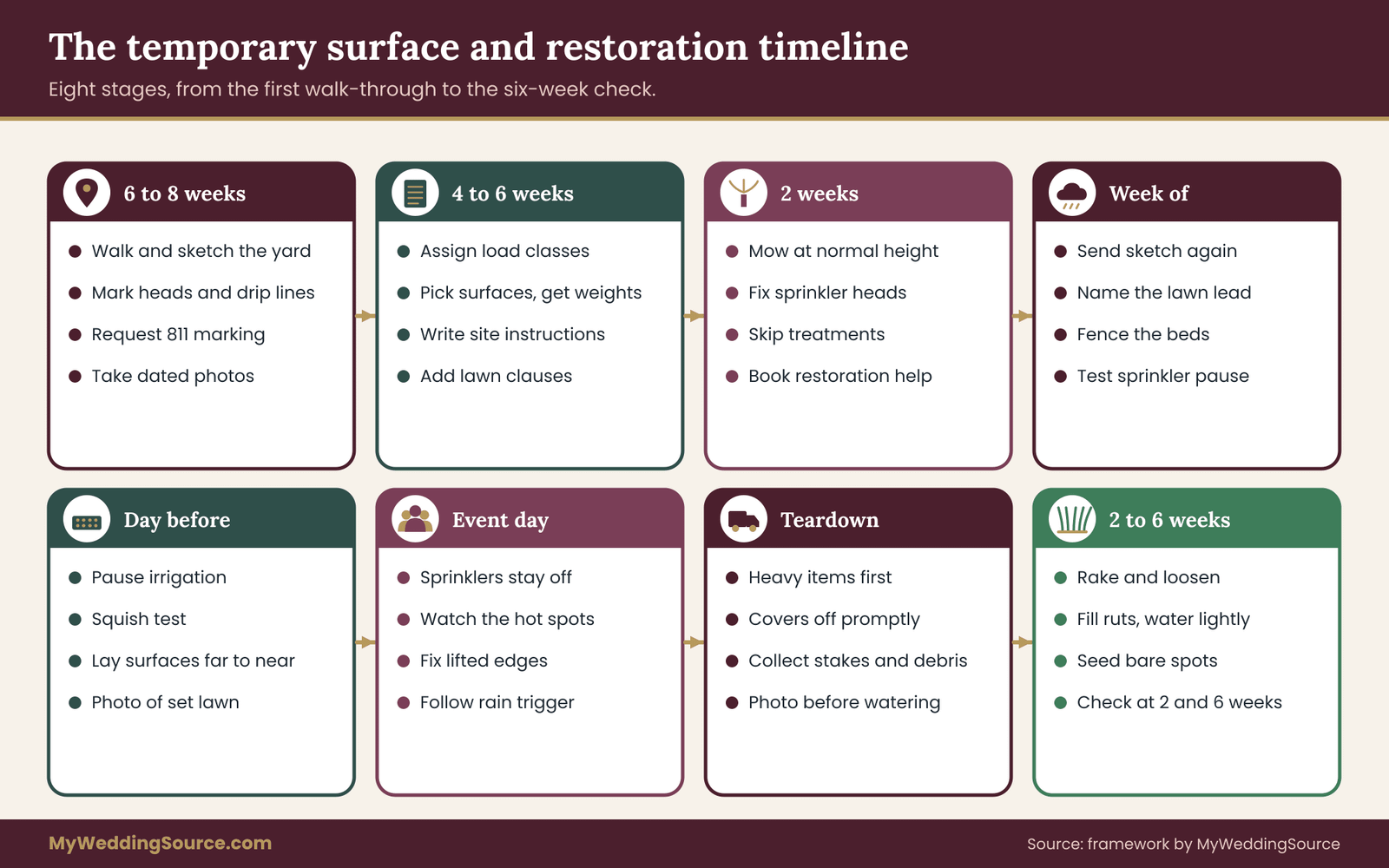
This is the core of the guide: one lawn protection checklist, arranged by time, that you can copy into a notes app and assign to people. Each stage has a purpose and a short list of actions. Adjust the dates to your own timeline, because the right lead time depends on how big the event is and how fast your local utilities respond.
Six to eight weeks before: survey and decide. Walk the yard, draw the sketch, mark sprinkler heads, drip lines, beds and slopes. Request 811 marking if you expect to stake a tent or dig. Ask your extension office about your grass and the best week for fertilizer or overseeding, if either is useful. Photograph the lawn and beds from several angles with a date. List every vendor who will enter the yard. Decide the guest count and the layout with the ladder in mind. Get written permission from a landlord or association if needed.
Four to six weeks before: assign loads and write instructions. Assign each item to a load class. Decide which loads move to hard surface. Pick a surface for each remaining zone and request quotes, including weights, cover times and the pickup plan. Draft a one-page site instruction for vendors, with the gate, the route, the parking and the lawn rules. Add lawn clauses to contracts. Confirm the tent company’s staking method and whether it has seen your sketch.
Two weeks before: fix the ground. Mow at your normal height, not shorter, since very short grass is weaker. Avoid weed treatments and heavy fertilizer in the final stretch. Repair any visible bare patches early so they have time to fill in. Check sprinkler heads for leaks or damage and fix them. Confirm the 811 markings have been done and not painted over. Book a restoration helper, such as a landscaper or a handy relative, for the week after the event.
One week before: confirm and rehearse. Send the site instruction and the sketch to every vendor again. Name your lawn lead. Review the forecast and the rain trigger. Place barriers or planters around garden beds. Put up signs where needed. Test the sprinkler pause and write the steps on a card. Prepare a small kit: extra stakes and flags, plywood or mats for the turn points, a broom, buckets, a tarp, gloves, grass seed and a bag of compost or topsoil for small repairs.
Two to three days before: reduce stress. Pause irrigation so the ground firms up, within the limits of local watering rules and grass health. Cut the grass at the planned height one last time, and avoid mowing within a day of the event if the ground is wet. Stage the mats, runners and panels in a dry spot near the drop-off point, not on the lawn. Walk the sketch with the lawn lead.
Day before: set up with discipline. Install the surfaces for class-three and class-four zones, working from the farthest point back to the entrance so that nobody has to cross finished work. Keep trucks on the street or driveway. Have a person at the gate to guide each delivery. Do the squish test in the morning. If it fails, apply the wet-weather plan. Install tents and floors with the tent company’s crew, and keep every other trade out of the way while they work. Take a few dated photographs of the set lawn.
Event day: protect and watch. Open and close garden barriers. Keep the sprinklers off. Keep a person near the gate and the aisle to straighten mats and pick up anything loose. Watch the surface under high-traffic points, such as the bar, the restrooms and the entry. If a mat shifts or a panel lifts, fix it at once, because lifted edges are trip hazards as well as lawn hazards. If rain starts, follow the trigger.
Teardown night or next morning: remove in reverse. Take the heavy items off first and the light ones last. Remove vehicles only on dry ground, or carry by hand. Pull up flooring and mats as soon as the event allows, because every extra hour under cover costs grass. For lawn protection and safety, collect every stake, staple, zip tie, bit of ribbon, candle remnant and piece of confetti. Sweep paths. Photograph the lawn as the covers come off, before any watering or cleanup, to document what happened.
Within two days: first aid for the lawn. Rake or brush matted grass gently so that blades stand up and air reaches the soil. Water lightly so that the soil is moist but not saturated, and keep the first watering short. Loosen compacted spots with a garden fork or a core aerator, which a rental store may supply, and top-dress with a thin layer of compost or topsoil where ruts formed. Fill holes from stakes. Seed bare patches if the season suits.
Two to six weeks: recover. Keep traffic off repaired spots. Resume a normal mowing schedule at the usual height, and avoid cutting more than a third of the blade at once. Fertilize only if your extension office advises it for your grass and season. Check lawn protection results at two weeks, then at six. If patches are not recovering, overseed and aerate in the best planting window for your region, and keep them watered according to the seed’s instructions. Compare with your before photos and decide whether the lawn is back.
Close the file. Write down what worked, what failed and what it cost. File the photos, the vendor instructions and any repair receipts with your other event records. If a vendor caused damage, send a polite written note with photos, within the time stated in the contract.
For small events, here is a short version of the lawn protection checklist that fits on a card: survey and sketch, call 811, assign load classes, move what you can to hard surface, set the rain trigger, pause the sprinklers, protect the beds, take before photos, remove covers promptly, rake and water lightly, check at two and six weeks.
A few notes on how to use this lawn protection checklist. First, do not assign the whole lawn protection list to the couple. The final two weeks before a wedding are already full. Give the sprinkler card, the mats and the cleanup to someone dependable, since lawn protection is a team job, and tell them what authority they have.
Second, adjust the order for your yard. A yard with only a few chairs on dry grass can condense the list into one afternoon of preparation and a weekend of recovery. A yard with a tent, a dance floor and a food truck needs every step.
Third, treat photos as part of lawn protection rather than a nice extra. The before photos make the restoration measurable. The after photos make a conversation with a landlord, a rental company or an insurer factual. And the six-week photos tell you when to stop worrying.
A worked case: the Delgado backyard
The following example is invented to show how the ladder and the lawn protection checklist work together. The people, the yard and the numbers are illustrative. They are not a real case, a study or a measurement, and your yard will differ.
The setup. Marisol and Andre Delgado plan an afternoon wedding for about eighty guests at her parents’ home. The yard has a long driveway along the left side, a concrete patio behind the house, a lawn of mixed grasses sloping gently toward the back fence, two large maples near the left fence, a rose border along the right fence and a vegetable bed near the garage.
An automatic sprinkler system waters the lawn at dawn. The wedding is in early autumn. The family plans a rented tent for dinner, a dance floor, a caterer working from the patio, a florist, a rental company for chairs and tables and a small band.
The walk-through. Marisol’s father walks the yard with a notebook and flags twenty-two sprinkler heads. The lawn drains well along the left but pools near the lower right corner after rain. He notes that the maples’ drip lines cover much of the left side and that the vegetable bed sits right beside the driveway gate. He calls 811 and requests marking for the tent stake locations. He asks a cooperative extension office what grass he has and when it grows best. He photographs everything.
The ladder. He lists loads. The chairs, about eighty, are class one. The caterer’s carts, the florist’s dollies and the rental company’s hand trucks are class two. The dance floor, the buffet, the generator for the band and a portable cooler are class three. The tent crew’s truck and the rental delivery truck are class four.
The decisions. The family makes six lawn protection choices that follow from the ladder.
- All trucks stay on the driveway. Everything else comes in by hand truck down the driveway and across the patio, which is class-two travel on hard surface. Only the last forty feet to the tent crosses grass.
- That last stretch gets a line of interlocking mats, because the lawn is firm and dry in the forecast, and the cart route turns away from the lower right corner where water pools.
- The buffet and the cooler move onto the patio, which removes two class-three loads from the grass.
- The dance floor stays on the lawn, but the family asks the tent company for a floor system with airflow, installed on the morning of the day before and removed the morning after the wedding. The floor footprint avoids the maple drip lines and the three sprinkler heads, which are capped by the landscaper for the weekend.
- The ceremony aisle is a mulch path from the patio steps to a simple arch. Chairs stand on bare grass and are spaced so the weight is not concentrated near the rose border. A short rope and a row of potted plants keep guests out of the roses and the vegetable bed.
- Sprinklers are paused for forty-eight hours before the event, and a card on the controller lists the steps. The rain trigger says: steady rain on setup day moves the dance floor to the patio and cancels the mulch path in favor of plywood on the cart route.
The weather. The forecast shows a chance of showers the day before. On setup morning, the squish test fails along the lower right. The lawn lead redirects the cart route along the left side and puts two sheets of plywood at the turn onto the lawn. The mats stay in their stack until the afternoon when the ground firms up. The tent crew installs on schedule, and the dance floor goes down once the rain stops.
The cost logic. The family pays for lawn protection where it matters: they pay for panels, mulch and a floor with airflow. They save on the buffet by using the patio, and on the landscaper by doing the sprinkler capping themselves after a short lesson. They do not pay for trackway, because trucks never touch the lawn. They treat each lawn protection choice as a trade: moving the buffet cost them a more crowded patio and a slightly worse photograph, and saved a class-three load on grass.
The aftermath. The next morning, the crew lifts the floor. The grass underneath is pale and flattened, a patch near the edge of the floor is sodden, and four small ruts appear along the turn. The family brushes up the grass, loosens the ruts with a fork, fills them with a mix of compost and topsoil, waters lightly and fences the worst patch for two weeks.
Within three weeks the pale area has greened, and the ruts have filled. A small patch near the rose border needs reseeding. They compare with the before photos, note that the damage was limited to the floor footprint and the turn, and record what they would do differently: place a mat at the turn from the start.
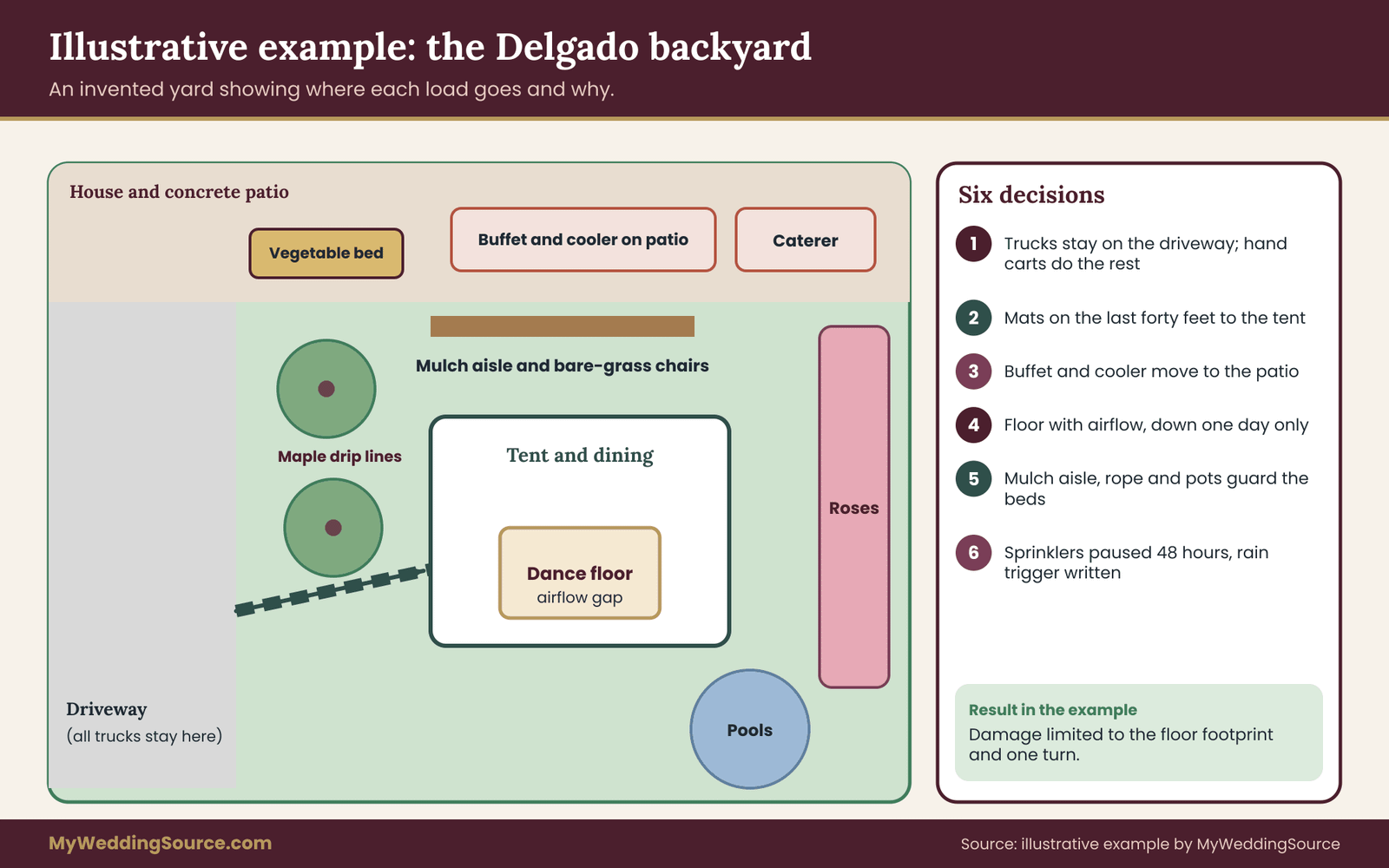
The lesson of this lawn protection example is not that the Delgados were lucky. They spent the yard’s stress budget on purpose. They moved what could move, spread what could not and shortened every cover. And because they wrote the plan down, a rainy morning cost them a few sheets of plywood, not an argument.
Guest movement, comfort and cleanup on grass
A lawn that survives the event but leaves guests slipping, stuck or sunburned is not a success. Lawn protection and guest comfort pull in similar directions, and a few design choices serve both.
Routes. Guests tend to arrive at the same moment and leave at several. Give them one clear, firm route from the parking area or the drop-off point to the ceremony and the reception. Mark it with lanterns, signs or a mulch strip, so the main wear goes where you planned. For lawn protection, keep the route away from garden beds, sprinkler heads and low spots.
The site’s guide to reception guest flow covers the layout of entry, seating, food and exit inside the event itself. For lawn protection, the point is that people follow the easiest line, and the easiest line should be one the lawn can take.
Heels, canes and wheels. High, thin heels sink into soft turf and leave holes, and they are uncomfortable for the wearer. Offer guests a note on the invitation or the website: the ceremony is on grass, and flat shoes or block heels are easier. Some couples place a basket of heel protectors at the entrance, which is a small cost for a lot of comfort. Guests who use wheelchairs, walkers or canes need a firm, level path, and a mulch path that is compacted thin or a row of mats works better than loose gravel.
The Americans with Disabilities Act does not apply to a private home in the same way as to public venues, but the access guidance published at ada.gov is a useful standard for route width, slope and surface when you plan for guests with mobility needs. Check that the route reaches the restroom and the food as well as the seating.
Shade and heat. A lawn in full sun is hot, and a guest standing on grass for an hour needs shade and water. Place shade structures and seating where heat builds up, but remember that every structure on grass is another cover. For lawn protection under shade, choose shade that moves with the sun or umbrellas on bases that do not need stakes. Provide water stations on hard surface, since overflow is easier to handle there.
Chairs and tables. Chair feet sink in wet turf. For ceremony seating, rows of chairs may need a line of narrow boards or runner mats under the feet in soft areas, or a decision to hold the ceremony on the patio. For reception tables, adjust the layout so that each table sits on a firm patch and no leg lands on a sprinkler head. Move tables slightly between the end of dinner and the dancing to spread the wear, if the layout allows.
Candles, fire and heat. Open flames, fire pits, sparklers, floating lanterns and heaters pose a lawn protection risk as well as a fire risk. Hot wax, ash and embers burn grass and leave dead patches. Use a hard base under any fire feature, such as a stone or metal pad, and follow local burn rules and the venue’s insurance terms. Many local fire departments publish guidance for open flames at gatherings. The U.S. Consumer Product Safety Commission publishes safety information on heaters and other products that you can read before you rent equipment.
Food and drink. Spills on grass are common. Red wine, sugar and fat can encourage insects and stain. Set bar stations, dessert tables and the coffee service on hard surface or on mats, and keep a bucket and a hose or jug handy for dilution rinses. Do not wash grease, grill residue or chemical cleaners into the lawn. If you rent a portable grill, keep it on a non-flammable base off the turf.
Waste on grass. Trash cans in the wrong place get tipped, and litter blows across the lawn. Place bins on hard surface along the route, label them and empty them before they overflow. Small wedding items such as confetti, glitter, paper streamers, balloons and ribbons are a persistent nuisance. They scatter, they are hard to rake and they harm birds, pets and mowers.
Choose biodegradable petals, dried flowers or birdseed only if local rules allow it, and plan to collect what falls. The guide on wedding waste reduction covers audits from catering to cleanup, and for the lawn the useful habit is to sweep the whole yard in daylight the next morning, bed by bed, with a bag and a magnet for stray stakes and metal.
Pets. If animals attend, give them a defined, shaded area that is not the lawn the guests use, and clean it right away. Dog waste in grass that guests walk across is unpleasant, and urine can burn small patches.
Children. Children run in a straight line toward anything interesting. Give them a game area on a durable, clear part of the lawn, away from beds, and keep the sprinkler heads capped or flagged.

When to stop, what it costs and when to choose a different surface
Lawn protection is a set of trade-offs, and the honest part of any lawn protection plan is knowing when it stops being worth it. This section gives you stop rules, a way to think about cost without invented figures and alternatives to the lawn itself.
A decision rule. When two lawn protection options seem equal, choose the one that is easier to reverse. A mat that lifts in a minute is better than a trench that needs refilling. A plan that moves a load to the patio is better than one that adds a product to the grass. Reversibility is the quiet virtue of good lawn protection, because weddings change at the last minute and a plan that can change with them is a plan that survives.
Failure conditions. A lawn protection plan fails when the conditions it assumed no longer hold. Write down the conditions in advance and agree on what happens when they appear. These are the ones worth naming.
- The ground is saturated. If the squish test fails across the working area and rain continues, class-three and class-four loads do not go on the grass. They move to hard surface, wait or are canceled.
- A cover has stayed down too long. If a floor, mat or tarp has been on the grass past the time the supplier recommended, or past the point where the blades under it have turned pale, take it up and give the lawn light and air.
- Surfaces move. If mats shift, panels separate, plywood slides or a runner bunches, it is both a trip hazard and a source of tearing. Fix it at once or remove it.
- Irrigation is damaged. If a head is cracked or a line is hit, shut off the water to that zone and call the landscaper or the plumber. Do not let a leak run through the night.
- A tree or bed is under threat. If equipment is entering a protected drip line or a barrier is being ignored, stop the work and move the item.
- A vendor will not follow the plan. If a driver insists on crossing the lawn, ask for a supervisor and decline the delivery if you must. Your written instructions are your authority.
- The forecast changes the safety picture. Lightning, high winds and heat are safety issues first and lawn issues second. Follow the rental company’s weather policy and the advice of local officials.
Cost logic without invented numbers. The total cost of lawn protection has four parts: surfaces and rentals, labor to install and remove them, the cost of restoring the grass and the cost of the risk you do not control. You cannot compare these accurately without quotes, so ask for them. A few principles help you compare quotes sensibly.
First, protection costs scale with area and time. Covering a ten-foot-wide aisle is cheap compared with covering a whole tent footprint. Cutting the footprint, by using hard surface for service areas and a smaller dance floor, often saves more than negotiating the unit price.
Second, restoration is usually cheaper than replacement, but only if the soil is intact. A rut that is filled and reseeded costs a weekend. A compacted, scalped yard that needs new sod and grading costs a landscaper and weeks. Money spent on lawn protection that keeps the soil from being churned is money well spent.
Third, a damage deposit or a rental company’s turf clause is a cost you may never see, but you should know its terms. Ask what the company charges for repair and how it decides. A company that offers a fixed turf fee or a clear process is easier to work with than one that sends a surprise bill.
Fourth, your own time has a price. Plans that require a relative to carry plywood at midnight are free only on paper. If a feature adds many hours of labor, consider a simpler layout or hire help.
For the wider financial picture, the wedding budget guide shows how to set categories, and you can add lawn protection and restoration as a small line within the venue or rental category so that it does not vanish into contingency.
Alternatives to using the lawn. Sometimes the best lawn protection plan is to use less grass. Consider these in order of how much they change the event.
- Move service functions to hard surface. Bar, buffet, band, restrooms and cooking can usually sit on a patio, driveway or garage, and that alone removes most class-three loads.
- Shrink the footprint. A smaller guest count or a tighter layout means a smaller tent, a smaller floor and fewer chairs on grass.
- Split the event. A ceremony on the lawn and a reception at another site removes heavy loads, and works well if a nearby hall or restaurant is available. The wedding venue guide covers how to compare venue options and their constraints.
- Reschedule or change the season. Dry months and dormant seasons are easier on turf. Winter grass tolerates traffic differently from summer grass, and frozen ground bears weight, but thawing ground turns soft quickly.
- Rent a hard-surface space for the messy parts. A parking pad, a nearby lot with permission or a friend’s driveway may serve as a staging area.
- Skip the lawn event. If the yard is too small, too soft or too fragile, you may decide a different venue is kinder to your lawn, your guests and your nerves.
The honest lawn protection question to ask at the end is whether the yard can carry the event you want, not whether you can force it to. If the answer is “only with a lot of money and risk,” a different layout or venue is not a defeat. It is lawn protection working.

Your next steps
You do not need to do all of the lawn protection in this guide at once. Start with the steps that cost nothing and shape every later decision, then move outward as the date gets closer.
- Walk and sketch. Spend one hour in the yard with a notebook. Draw the house, gates, hard surfaces, sprinkler heads, trees and their drip lines, beds, slopes and pooling spots. Take dated photos.
- Call 811 and your extension office. Request utility marking if anything will be staked or dug, and ask what grass you have and how it handles stress.
- List every load and give it a class. Use the four-class ladder, and move every load you can to hard surface before you buy a single mat.
- Pick a surface for each remaining zone. Ask each rental company for weights, cover times, airflow and the pickup plan in writing.
- Write one page of lawn protection instructions. Include the gate, the route, parking, the rain trigger and the lawn lead’s name and number. Add a lawn clause to each vendor agreement.
- Set the rain trigger and the sprinkler card. Decide who turns the system off, when and how, and what happens if the squish test fails.
- Book the restoration help. Reserve a person for the day after and the weeks after the event, and schedule the two-week and six-week photos.
If you are still deciding whether the property suits the event at all, read the venue guide on this site first, and then come back to this plan with a clearer idea of what the yard must carry.
FAQ
How long can a dance floor or tent flooring stay on grass?
Shorter is better. Many grass species show pale or bleached blades after a few days under a solid cover, and the effect grows with heat, humidity and sunlight blocked. Ask the supplier how long its product is meant to stay down and whether it allows airflow. Install it the day before and remove it the morning after whenever the schedule allows.
Should I turn off the sprinklers before the wedding?
Usually yes, for a day or two before the event, so the ground is firm and no head pops up during the reception. Do not leave a lawn dry for a long stretch, since drought stress slows recovery. Check local watering rules, write down the shutoff steps, test them early and restart a gentle schedule right after teardown.
Do I need to call 811 for a tent stake?
If stakes go into the ground, call 811 or use its online request before anyone drives one. Locators mark public utility lines for free in most areas, and they need advance notice that varies by state. Private lines, such as irrigation or garden lighting, are often not marked, so show the tent crew your own sketch of those.
What is the cheapest way to protect a lawn for a small wedding?
Keep loads off the grass. Park and unload on the driveway, put the bar and buffet on a patio, walk carts over hard surface and leave seated guests on bare, dry turf. Add a short mulch or mat path where needed. Moving loads costs almost nothing, while covering large areas can cost far more.
Will mats or panels kill the grass underneath?
Not necessarily, but any cover can stress turf if it stays long, especially in heat. Open-grid mats and panels let more light and air reach the blades than solid sheets or plywood. Dry ground, short cover time and prompt removal make the difference. Plan a light rake, a short watering and a check two weeks later.
What should I do if it rains on setup day?
Follow the trigger you set in advance. Keep trucks off the lawn, switch to hand carts on hard surfaces, use plywood or mats at turn points, delay heavy work until the ground firms up and move major loads to the patio if you can. Do the squish test before each stage, and decide whether to proceed.
How do I repair ruts and bare patches after the event?
Brush matted grass upright, loosen compacted spots with a fork or core aerator, fill ruts with a thin layer of compost or topsoil and water lightly. Seed bare patches in your grass’s best growing season and keep traffic off. Check at two and six weeks. Your local extension office can advise on timing and seed type.
Who pays if a vendor damages my lawn or sprinkler system?
It depends on the contract and on who caused the damage, so put the answer in writing before the event. Ask each vendor to follow your site instructions and report damage before leaving, and keep dated before-and-after photos. If you rent the property or belong to an association, check your own obligations to the owner or board as well.
Sources
- USA.gov: central directory for finding local, state and federal government offices and consumer information.
- 811 Call Before You Dig: the national call-before-you-dig service for utility line marking before any digging or staking.
- U.S. Environmental Protection Agency, WaterSense: homeowner guidance on outdoor water use and irrigation controllers.
- U.S. Environmental Protection Agency, Pesticides: label guidance and safe-use information for lawn and garden treatments.
- National Weather Service: official forecasts, hourly outlooks and severe-weather alerts.
- USDA National Institute of Food and Agriculture: the federal agency behind the cooperative extension system that offers local lawn and soil advice.
- USDA Natural Resources Conservation Service: soil information and resources on compaction and drainage.
- ADA.gov, U.S. Department of Justice: accessibility guidance on route width, slope and surfaces.
- U.S. Consumer Product Safety Commission: safety information on heaters, fire features and other consumer products.
- Insurance Information Institute: consumer explanations of homeowners coverage and event liability.