
A boat wedding photographer works on a surface that moves, in light that bounces off water, with salt, spray and a hard rail within reach of every expensive lens. This guide gives you a deck movement and gear protection briefing you can write on one page, hand to the captain and the boat wedding photographer, and use to decide which moments to shoot underway and which to move to the dock.
Stabilization helps with a shaking camera, not with a swaying bride. Ask your boat wedding photographer to rate each moment of the day green, amber or red for motion, set a shutter speed floor for each, wear a tethered camera on a cross-body strap, avoid lens changes on deck, and carry a second body. Agree in advance with the captain where the boat wedding photographer may stand, and write down the conditions under which shooting stops and the photographs move to the dock.
A wedding on a boat is a different job for the camera than a wedding in a ballroom, even when the guest count and the dress are the same. The floor is never fully still. The best light often arrives low across the water, which is also when the wind tends to rise and the deck gets wet. Moving around the vessel is limited by rails, stairs, ropes and rules that exist for good reasons.
None of this means a boat wedding cannot be photographed beautifully. It means the planning has to include things a land wedding never raises: how much the deck moves in each part of the day, who is allowed where, what happens to a camera that slips off a shoulder, and what the photographer does when the water gets rougher than the forecast said.
This article is about that planning. It is written for couples who have already booked, or are about to book, a boat for part of the wedding day and need to make decisions about photography on board. If you are still choosing the vessel, the wedding venues guide covers the wider questions of capacity, cost and fit. Here the vessel is a given and the question is how the pictures get made safely.
A note on scope. This is general planning information, not legal, safety or insurance advice. Vessel rules, passenger capacity, weather limits and equipment requirements are set by the vessel operator, the captain and the authorities for your waters, so confirm the details that apply to your boat with them directly.
What a boat wedding photographer is up against
A photographer shooting on land deals with light, people and time. On a boat, a fourth force joins them: the vessel itself. Understanding that force in plain terms is the first step toward a sensible plan, because every later decision in this guide, from shutter speed to shoe choice, traces back to it.
The deck is never completely still
Even at the dock, a boat responds to wind, wakes from passing vessels and the weight of people walking from one side to the other. A gentle movement that a guest barely notices can still shift a long exposure by enough to blur a photograph. Underway, the movement has more layers. There is the slow rise and fall of the hull over swells, the sideways lean when the boat turns, the vibration of the engine, and the small jolts when a wake crosses the bow.
What matters for photography is that these movements are not random from the boat wedding photographer’s point of view. They repeat, and a person who watches for a minute can usually feel the rhythm. A skilled boat wedding photographer learns that rhythm quickly and times the shutter to the quiet part of each cycle. That is a technique, and it can be taught, but it works only while the movement stays within a range that a human body can absorb. Beyond that range, the right answer is to stop, not to try harder.
Light on water behaves differently
Water throws light back at the people standing near it. At midday, that gives a bright, hard fill from below that can wash out faces and flatten the dress. In the late afternoon, the same effect can be flattering, with a warm glow under the chin and on the veil. Early evening brings glare along the surface and a sky that is much brighter than the people in the foreground.
For the camera, this creates a wide range between the brightest and darkest parts of the frame. The boat wedding photographer has to decide whether to protect the sky, protect the faces, or use light on the subjects to balance them. On a moving deck, the options are narrower, because a flash on a stand is a hazard and a long exposure to bring up the shadows is impossible. The plan for light and the plan for motion have to be made together.
Space, rails and rules shape every angle
Photographers like to move. They crouch, step back, climb a step for a higher view, and shoot from behind the group when a moment is happening. On a boat, many of those moves are restricted. Passenger vessels commonly limit access to the bow, the upper deck, the wheelhouse and the engine area. Rails are a safety feature, not a photographic prop. Stairs can be steep, and wet decks are slippery.
The captain is responsible for the vessel and everyone aboard, and the captain’s instructions come before any shot list. A photographer who has agreed to this in advance causes no friction. One who finds out in the middle of the ceremony that the best position is off limits may take a risk that nobody planned for. This is why the briefing in this guide starts with the vessel’s rules and builds the photography plan inside them.
Why equipment needs its own plan
Cameras and lenses are built to be handled gently on stable ground. A boat adds three particular threats. The first is water: spray, rain, a splash from a wake or a drink knocked over a bag. The second is salt, which dries on glass and metal and can cause corrosion and smearing that does not wipe away easily. The third is the drop, because a camera that slips on a rocking deck can go overboard or hit hard steel with no soft landing.
Weather-sealed cameras reduce risk but do not remove it. Sealing is a resistance rating, not a promise, and no manufacturer sells a standard camera and lens as safe for being dropped in the sea. A boat wedding photographer who treats a splash as a normal event, and who has a routine for dry storage, wiping and backup, is likely to come home with the files and the gear intact. The gear protection half of the briefing covers this routine in detail.
Three kinds of motion: vessel, subject, and photographer
When a photograph from a boat comes out blurred, the cause is almost always one of three kinds of motion, and each kind has a different fix. Treating them separately saves a great deal of trial and error, and it gives you a way to talk with your photographer without needing technical vocabulary.
Vessel motion
Vessel motion is the movement of the boat itself. It affects the photographer and, depending on where the subjects stand, the subjects as well. If the boat wedding photographer and the couple stand on the same deck, they move together, and the relative movement between them can be smaller than the movement of the boat against the horizon. This surprises people. Two people standing a few feet apart on a rocking deck are both being carried along, so a quick photograph of one by the other may look sharp even when the background is tilting.
What does not survive is a long exposure, because the whole frame moves during it. It is also the reason a tripod set on deck tends to disappoint: the tripod is fixed to the deck, the deck is moving, and the camera and the lens are being shaken by every small movement while the shutter is open. Vessel motion is the reason for a shutter speed floor, a habit of bracing the body, and a decision to avoid slow shutter effects until the vessel is stopped.
Subject motion
Subject motion is how the people in the photograph move: a bride walking, a groom turning, a child running, an officiant raising a hand. This is the same issue photographers face on land, but a rocking deck changes how people move. They sway, they take shorter steps, they grab a rail, they laugh and shift their weight. A person who would stand perfectly still on a lawn may constantly adjust on a boat.
Stabilization built into a camera or lens does nothing for subject motion. A photograph can be perfectly steady and still show a blurred face if the person moved while the shutter was open. The fix is a faster shutter speed, which is covered in the settings section. It also helps to pose people so they have something to hold, such as a rail, each other’s hands or a bouquet, because a person with a stable stance moves less.
Photographer motion
Photographer motion is the movement of the person holding the camera. This is where stabilization, bracing and stance matter most. A photographer who stands upright with locked knees, arms out and elbows away from the body is tilting like a pole. One who bends the knees, tucks the elbows, leans lightly against a fixed object, and breathes out before pressing the shutter holds a far steadier camera.
Some photographers add a monopod as a brace. Used carefully, it can steady a heavy lens, though it is also one more object that can trip someone or slide on a wet deck, so its use should be agreed with the captain and kept to quiet moments. The point is that photographer motion is the part you can reduce most through habits, so it is where a good boat wedding photographer spends the first effort.
A quick way to diagnose a blurred frame
When you review your photographs and find some that are blurred, a short test sorts the cause. If everything in the frame is blurred in the same direction, including the horizon and the rail, the camera moved. That is vessel or photographer motion. If the background is sharp but the people are smeared, the subjects moved. If the sharp area is behind the people, focus missed. Each result points to a different fix, and it is more useful to know which one you are seeing than to say the photographs are “not sharp.”
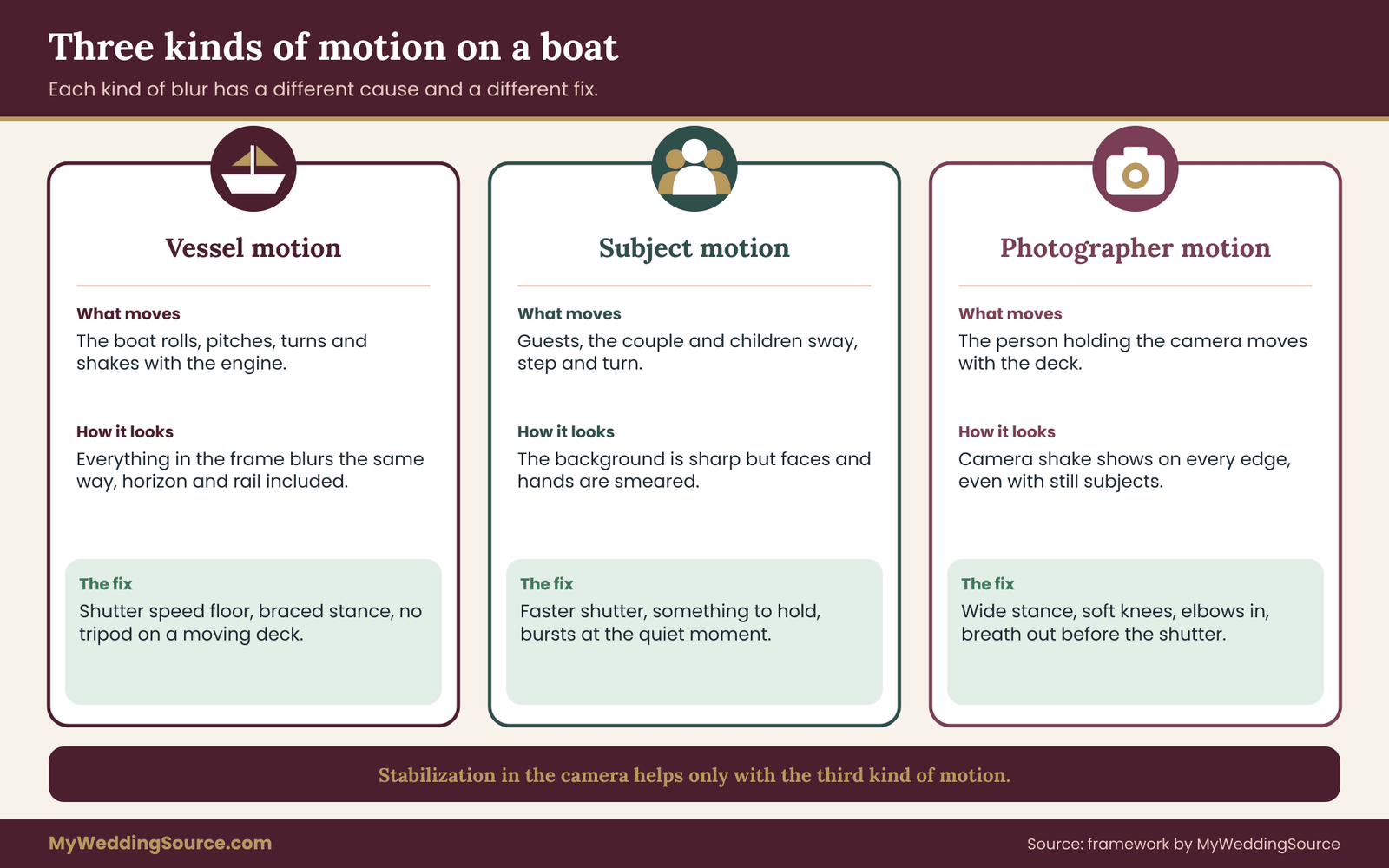
This three-part view is the base of the deck movement and gear protection briefing. Every row in the briefing asks the same three questions about a moment of the day: how much will the vessel move, how much will the subjects move, and how steady can the boat wedding photographer be? The next section turns those questions into a one-page document you can actually use.
The deck movement and gear protection briefing
The briefing is a single page, built in four blocks, that your boat wedding photographer, the captain and one person on your side all read before boarding. It does not replace a photography contract or the vessel operator’s own safety briefing. Its job is narrower: to make the movement and the equipment risks visible, assign a rating to each part of the day, and settle in advance who decides what when conditions change.
The page works because it is short and because every line is a decision, not a description. A long document that nobody reads protects nothing. If a block cannot be filled in, that gap is itself useful information, because it points to a question for the operator or the photographer that should be answered before the wedding day.
Block one: vessel facts
The first block records what the vessel allows. Fill it in from the operator, not from assumptions. It should name the captain or the crew member who will be the boat wedding photographer’s contact on the day, the areas of the deck that are open to the boat wedding photographer, the areas that are closed, and whether tripods, monopods, light stands, flashes, drones and large bags are allowed. It should also state the boarding time for vendors, and the time by which the final go or no-go decision on weather will be made.
Two items in this block surprise couples most often. The first is whether the photographer and any assistant count toward the vessel’s passenger or crew numbers. Operators handle this differently, and the answer can affect your guest count, so ask. The second is where cameras and bags can be stored while the boat wedding photographer is not shooting. A dry, secured place that is not the open deck is worth more than any gadget.
Block two: the motion rating for each moment
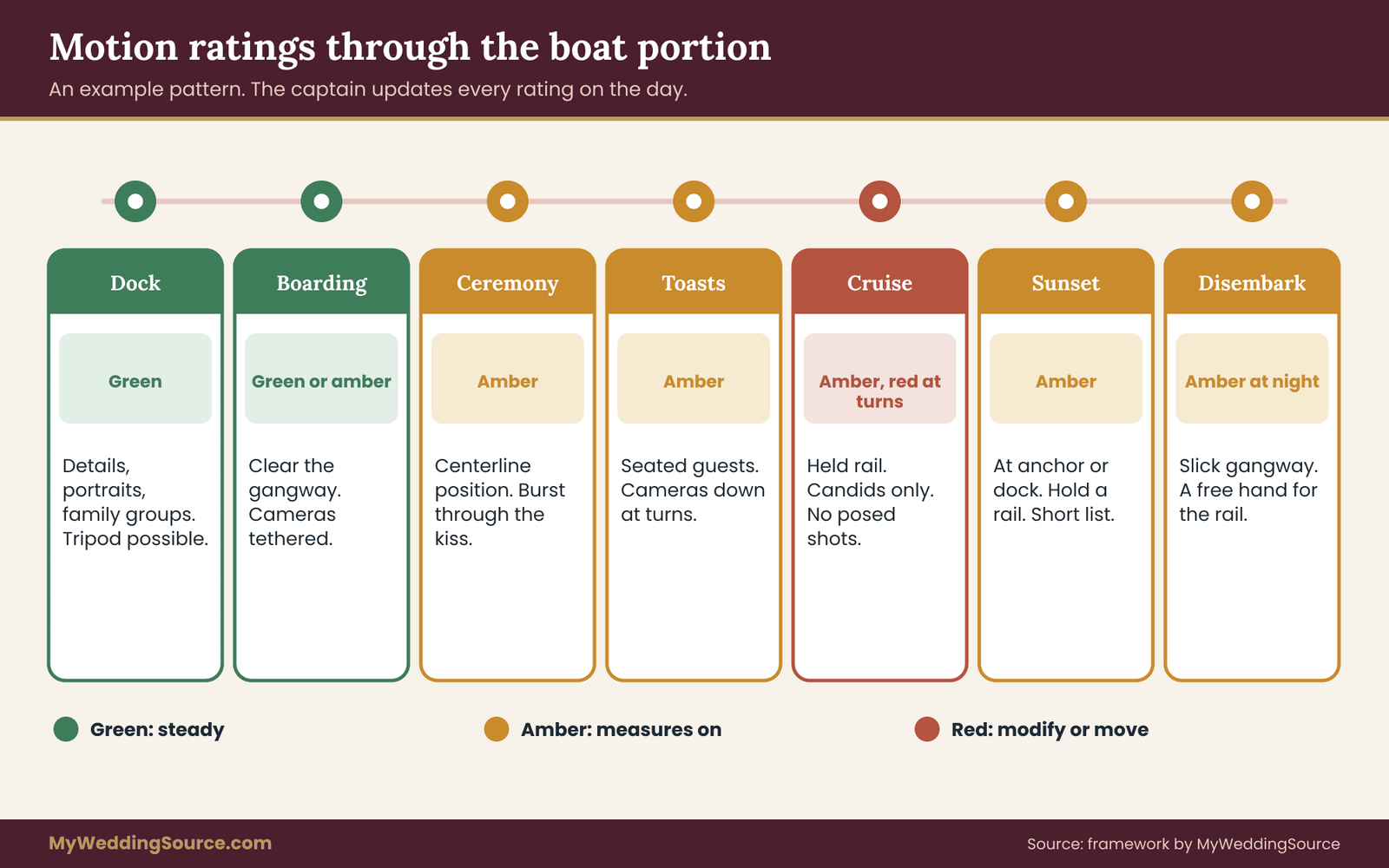
This block is the core. Divide the boat portion of the day into moments, such as boarding, the ceremony, the toasts, the cruise, sunset portraits and disembarking. Give each one a color rating based on how much the vessel is expected to move.
Green means the vessel is at the dock or at anchor in calm water and the deck is steady. The boat wedding photographer works close to a normal routine, with a tripod only if the operator allows it.
Amber means the vessel is underway in steady conditions or at anchor with a noticeable swell. The photographer uses the shutter speed floor from the settings section, keeps a braced stance, stays tethered and does not change lenses.
Red means turning, crossing wakes, spray over the deck, a wet or crowded deck in motion, or conditions that make standing without a hold uncertain. In red, the boat wedding photographer holds a rail or sits, shoots only what can be done from that position, or puts the camera away and waits.
The ratings are plans, not predictions. The captain updates them on the day, based on the real water. The value of writing them down early is that you discover which moments you were counting on that are actually red. A first dance on an upper deck while the boat is underway is one example. Finding that out in the planning stage leaves time to move it.
Block three: gear protection
The third block lists what protects the equipment. At minimum, it names how each camera is attached to the boat wedding photographer, where spare gear lives, how lenses are protected from spray, what is done after any splash, and what backup exists if a camera is lost or damaged. These items are covered in detail later, so on the page they are simply a checklist. What matters is that someone has decided each of them.
A good block three also records the photographer’s own insurance and the vessel operator’s rules on liability for personal equipment, because the question of who pays when a camera goes over the rail is better answered before it happens. The wedding vendor contract guide is a useful companion for the written terms, and the boat wedding photographer’s contract should say what happens if the shoot has to be cut short for safety.
Block four: stop conditions and fallbacks
The last block states the conditions that pause or end shooting on board and the fallback for each. A pause might be a heavy wake, a squall, or the captain’s instruction to everyone to sit down. An end might be lightning in the area, sea conditions that make the deck unsafe or a medical situation. For each, the page says what happens to the photographs, usually a move to the dock, a short shoot on shore after the cruise or a different location altogether.
Write a single sentence for each condition and name who calls it. The best rule is the simplest: the captain can call any pause, and the boat wedding photographer can call any pause on their own equipment or footing, and neither has to explain. That removes the pressure to keep shooting in order to look cooperative.

Using the briefing in practice
Send the page to the captain and the photographer about two weeks before the wedding, with a request for corrections. Make a second pass the day before, using the weather forecast. On the day, a designated person, often a coordinator or a trusted friend, carries a copy and is the point of contact between the boat wedding photographer and the crew. If you have no coordinator, give the job to someone calm who will not be in the wedding party.
The briefing also helps in a conversation about price. When a photographer sees that the boat portion has several red moments and a strict deck, they may suggest a second shooter, extra time at the dock or a change in the order of events. Those are legitimate costs of the work. Compare them with the alternative: a wedding where the pictures from the boat are mostly blurred because nobody planned for the movement.
Choosing a boat wedding photographer who has worked on the water
Hiring decisions for a boat wedding are not very different from other photographer choices, with one addition: you are looking for evidence that the person has dealt with motion, space limits and equipment risk before. A beautiful portfolio from lawns and ballrooms says little about that. Your goal is to ask questions that show how someone works, not to demand credentials that do not exist.
The broader process of vetting a vendor, including references, insurance and communication, is covered by the wedding vendor due diligence checklist. This section adds the questions that are specific to the water.
Ask to see work from moving vessels
Ask for a gallery from a wedding or event on a boat, not just a single hero image. Look at the sharpness of faces across a whole series, the horizon in each frame and how the boat wedding photographer handled bright sky against dark faces. A gallery full of tilted horizons is not a disqualifier, because they can be corrected in editing, but it tells you whether the photographer notices them.
If the boat wedding photographer has not worked on a boat before, that is not automatic grounds for saying no. Ask about comparable conditions: ferries, piers in wind, open decks, rooftops in gusts, moving vehicles. Then check whether they are willing to join a short site visit and use the briefing. Someone who is honest about being new and willing to prepare is often a safer choice than someone who is confident and unprepared.
Questions that reveal the routine
A handful of questions give you a lot of information. How do you attach your camera to your body on a deck? What do you do when spray reaches the lens? Do you carry a second body, and what is on it? How do you decide when to stop shooting? How do you handle the sun’s glare on the water? Have you ever lost or damaged equipment on or near water, and what changed afterward?
Listen for specific answers. A photographer who says they use a cross-body strap or a harness, keep lenses capped between shots, carry a microfiber cloth and a dry bag, and treat any splash as a reason to wipe and check is describing a routine. A photographer who says “I never have problems” is describing a hope. The goal is not to catch anyone out. It is to hear whether there is a process.
Insurance and equipment replacement
Ask whether the boat wedding photographer carries equipment insurance and liability insurance, and whether the policy covers work on a boat. Some policies exclude water-based work or require a rider, and the answer is rarely obvious. Ask for a certificate if the vessel operator requires one. Many marinas and charter companies do ask vendors for proof of coverage, and it is easier to learn that two weeks ahead than at the gangway.
Also ask what happens if a camera fails or is lost. A professional should be able to describe how they continue shooting, which usually means a second body, a spare lens covering the main focal lengths, and cards that are written in two slots. If a single body is the entire plan, that is a risk to note, and you may decide to cover it with a second shooter or a shorter boat session.
A second shooter, or a second kind of coverage
On a boat, a second photographer can be useful for reasons beyond coverage. Two people can take positions on opposite sides of the deck, which matters when movement is limited. One can stay with the couple while the other covers guests. If one has to stop because of spray or footing, the other may be able to continue from a protected spot.
A second shooter also increases the number of people aboard, which may affect capacity and cost, so raise it early with the operator. If the budget does not allow for it, a trusted guest with a phone can help capture candids, provided your photographer agrees and the rules around image use in the wedding photography consent guide are respected.
Red flags during the conversation
Be careful with a photographer who promises specific results on the water, who dismisses concerns about gear, who wants to bring a large amount of equipment onto a small deck, or who suggests using a drone from a moving vessel without checking the rules. Drone use involves federal aviation requirements and the operator’s permission, and flying from a moving boat adds hazards that few wedding plans can safely manage.
Equally, be cautious of someone who treats every question as a problem. A good boat wedding photographer is comfortable with limits. They talk about what they will do within the rules, they accept the captain’s authority without complaint and they care about the quality of the picture without being willing to take a risk for it. That mix of skill and restraint is what you are paying for.
Stabilization: what helps a boat wedding photographer and what does not
Stabilization is the most misunderstood topic in this whole subject. Couples often hear that modern cameras have stabilization built in and conclude that a boat is no longer a problem. Photographers sometimes hear the opposite and assume that nothing works on a moving deck. Neither is right. Each tool corrects a particular kind of movement, within limits, and the plan works only when the tool matches the movement it is meant to fix.
Built-in stabilization in the camera and lens
Many current cameras have in-body stabilization, which moves the sensor to counter small shakes, and many lenses have their own optical stabilization. Together they allow a handheld shot at a slower shutter speed than would otherwise be sharp. They are designed mainly for the small, quick tremors of a human hand.
A boat deck produces a different kind of movement: slower, larger and rhythmic. Stabilization can soften some of it, but it can also be overwhelmed when the deck lurches. And it never helps with a moving subject. A person who turns her head during a half-second exposure is blurred no matter how steady the camera is. For that reason, a boat wedding photographer treats built-in stabilization as a helpful margin and not as the foundation of the technique.
Check the manual for modes. Some lenses have a setting for panning that ignores movement in one direction, and some systems have an “active” mode designed for walking or vehicles. A photographer who has tested these on a moving platform before your wedding knows which one works. If a photographer has never tested them, suggest a half hour on a ferry or at the dock before the event.
Tripods and monopods on a moving deck
A tripod is the classic answer to camera shake, and on a boat it is often the wrong one. A tripod holds the camera still relative to the deck, and the deck is the thing that is moving. A long lens on a tripod on a rocking deck can shake more than the same lens handheld, because the person is no longer absorbing the movement with their knees and hips. Tripod legs also create a trip hazard, take up space guests need and can slide on a wet surface.
There are a few cases where a tripod or a monopod makes sense: a stable dock before departure, an anchored boat in still water, a quiet moment during a long exposure of the vessel at dusk, or a heavy telephoto from a fixed position. Even then, it should be agreed with the captain, kept out of walkways and never left standing unattended. In most boat sessions, the safest plan is to leave tripods on shore and rely on a braced body and a faster shutter.
Motorized stabilizers and gimbals
Motorized gimbals are popular for video. They keep the camera level against the movement of the person carrying them. On a boat, they behave unpredictably. The motion sensors can read the vessel’s movement as the operator’s movement and respond in ways that look odd on the footage, and the extra weight and long arm make it harder to hold a firm stance. Operators also tend to dislike the bulk of the rig on a crowded deck.
If a videographer plans to use one, ask for a test on the same type of vessel, and decide whether they will use it only in the amber and green moments. Video from a boat often looks best when it accepts a small amount of natural sway and uses a steady stance and a wide lens, because a gentle movement matches what guests felt. Over-stabilized footage can look disconnected from the setting.
The body is the main stabilizer
The tool that works best, and that costs nothing, is the photographer’s own body. Feet apart a little wider than the shoulders. Knees soft, not locked. Elbows tucked into the ribs. The camera held close to the face, with the lens supported from beneath by the left hand. A slow breath out before the shutter. This stance acts as a suspension system, with the legs absorbing the vertical rhythm of the deck and the arms acting as a stable shelf.
A boat wedding photographer can add support from fixed objects. Leaning a hip against a bulkhead, bracing an elbow on a rail, or sitting on a bench with elbows on knees all remove a degree of freedom. This must be done only where the object is solid and where the position does not block the passage of guests or crew. If the only solid object is a rail that the captain wants clear, the boat wedding photographer finds another stance.
Timing the shutter to the motion
Because vessel movement repeats, there is a technique for timing. The roll of the boat has moments of change of direction at the top and the bottom of each cycle, when the movement is slowest. A photographer who watches the horizon through the viewfinder and presses the shutter at the end of the swing gets a sharper frame than one who shoots at random.
Burst mode makes this easier. Taking three or four frames in quick succession and choosing the sharpest later is a standard habit on a moving platform. The cost is more files to review, which is a small price for a ceremony kiss or a ring exchange. Ask the boat wedding photographer how they plan to cull burst sequences and how that affects the delivery date.
Camera settings and technique when the deck moves
Settings on a moving boat follow a simple priority: protect the shutter speed first, accept more noise before accepting more blur, and keep the focus system working hard. The following ranges are common starting points, not rules. Your photographer will adjust them to the lens, the light and the sea state, and nothing here replaces testing on the day.
Set a shutter speed floor
A shutter speed floor is the slowest speed the photographer allows on deck. A rule of thumb on land says to keep the shutter at least as fast as one divided by the focal length of the lens. On a moving deck, many photographers go two or three times faster than that rule, because the vessel adds movement that the rule did not account for. For a person walking or turning, a faster speed still is typical, and for children or dancing, faster again.
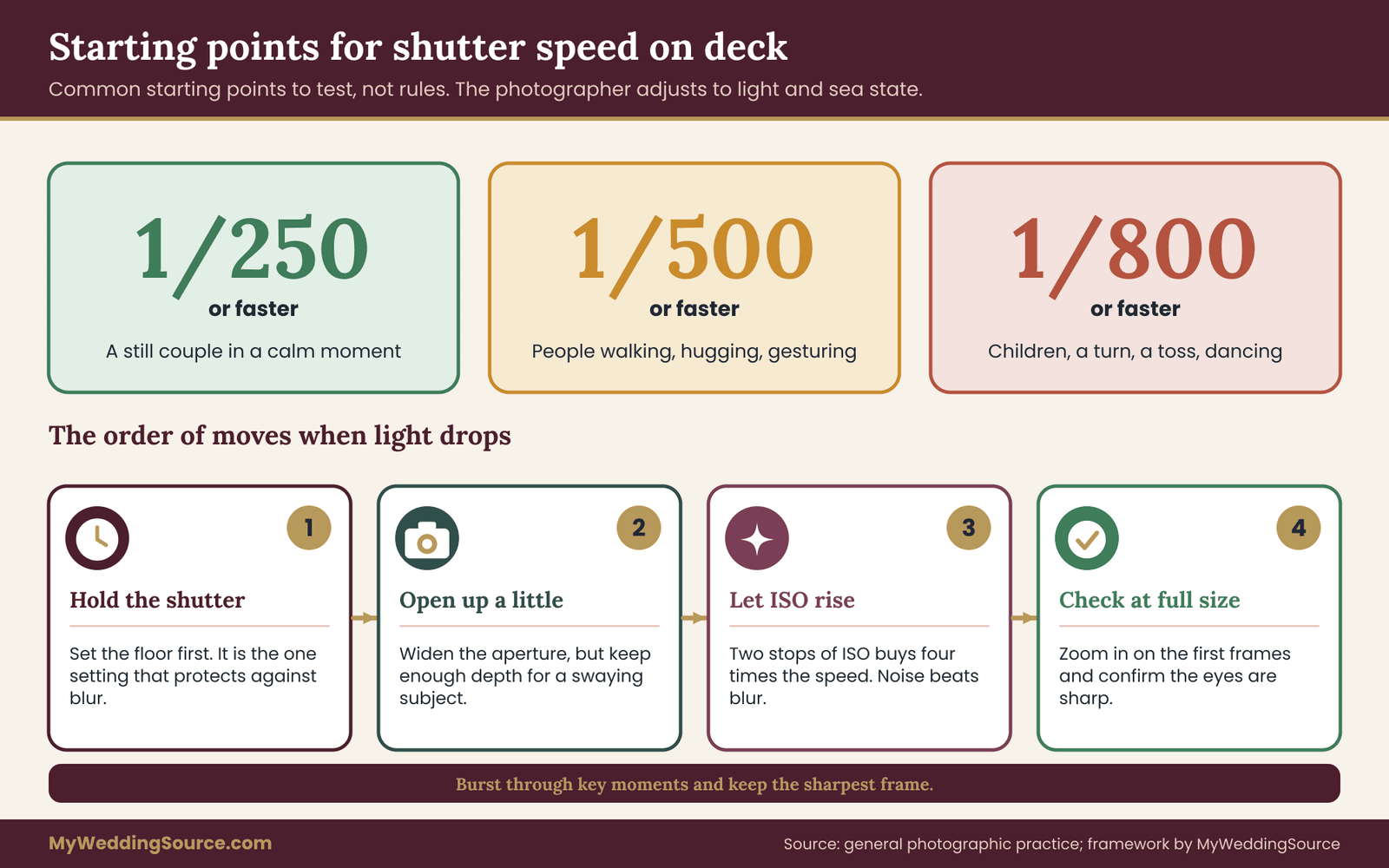
As a rough guide for planning, a still couple in a calm moment might be shot at around one over two hundred and fifty of a second or faster. People walking, moving hands or hugging call for around one over five hundred. Children, a fast turn, a toss or a dance usually need one over eight hundred or faster. These are starting points for a conversation, not a script. Having the floor written on the briefing page helps everyone understand why the boat wedding photographer is not using a slow, dreamy exposure on the boat.
Raise the sensitivity before slowing the shutter
When light drops, the camera has three ways to compensate: open the aperture, raise the sensitivity (ISO) or slow the shutter. On a boat, the shutter is the one to protect, so the first moves are the aperture and the ISO. A worked example shows the trade. Suppose the meter suggests one over a hundred and twenty-five at a moderate ISO in the evening. That is too slow for a swaying deck. Raising the ISO by two stops gives four times the speed, bringing the shutter to about one over five hundred, at the cost of more noise.
Modern cameras handle noise well, and software can reduce it further. A slightly grainy sharp photograph is nearly always better than a clean blurred one. A boat wedding photographer who sets an automatic ISO with a ceiling, and a shutter speed floor in the same menu, gets the camera to do this arithmetic by itself and can focus on the people.
Aperture and depth of field
Wide apertures give a pleasing separation from the background and let in more light, but they also make the focus plane thin. On a moving deck, the distance between the camera and the subject changes slightly with every swell. A very thin plane means that the eyes can drift out of focus between the moment of focus and the moment of exposure.
For this reason, many photographers working on the water close down a little from the widest setting for group shots and moving subjects, and keep the widest settings for portraits at the dock or at anchor. A moderate aperture also gives more tolerance when the horizon is part of the frame. This is a trade, and the boat wedding photographer decides it moment by moment.
Autofocus, burst and file settings
Continuous autofocus with subject tracking, or eye detection where the camera has it, gives the best chance of keeping faces sharp while the boat moves. Back-button focus, which separates focusing from the shutter button, lets the photographer track a face and press when the deck is quietest. A silent or electronic shutter helps during the ceremony, but it can show distortion in fast pans or under flickering lights, so many photographers use it only for quiet moments.
Record raw files if the camera supports it, because the extra latitude helps with the bright sky and the tilt corrections described later. Write to two cards at once if the camera has two slots, so that a damaged card does not erase a ceremony. Offload to a drive at the first chance, and not on the boat. The wedding day digital contingency plan guide explains how to handle files and permissions on the wedding day, and the same ideas apply to how a photographer protects the data from your day on the water.
Lenses and focal lengths that suit a deck
Space is tight on most vessels, and a heavy lens is difficult to hold steady. Many photographers lean on a pair of lenses: a moderate wide-angle zoom for close work and group shots, and a short telephoto for detail across the deck. Very long lenses are hard to brace and tend to magnify every movement, so they are used sparingly.
Prime lenses, which are lighter and open wide, are useful at the dock or in the evening, but swapping between them on deck is a risk. That is why the briefing calls for two bodies, each with a lens mounted, so that the boat wedding photographer changes cameras rather than lenses. A camera over each shoulder is safer than a bag open on a bench, provided both are tethered.
Keeping the horizon level
The horizon is the first thing a viewer checks, and on a boat it is also the thing most likely to be tilted, because the vessel heels in the wind and the boat wedding photographer leans with it. An electronic level or a grid in the viewfinder helps. In editing, tilted frames can be rotated by a small amount, which crops the edges slightly.
Ask the photographer whether they plan to correct tilt in every photograph or only in the ones that need it, and whether their delivered crop leaves room around the couple for that correction. A photographer who frames a little loosely when the deck is moving gives themselves room to straighten the horizon without cutting off a veil or a hand.
Light, glare and exposure on the water
Light is the reason most couples want pictures on a boat, and it is also the source of a second set of problems. Water acts like a large, moving mirror, and the sky above it is usually much brighter than the people in front of it. Handling the contrast well is part of the work of any boat wedding photographer, and it needs to be planned alongside the movement, because the tools that solve contrast on land are limited on deck.
Know where the sun will be
Before the wedding, work out the direction of the sun at each moment of the boat portion, using a sun-position app or the sunrise and sunset times for your date and location. Combine that with the vessel’s route or mooring direction. A ceremony on the stern with the sun behind the guests gives the couple soft, front-lit faces. The same ceremony with the sun behind the couple turns them into silhouettes unless the boat wedding photographer adds light or exposes for them and lets the sky burn out.
Neither choice is wrong. Backlit images with a bright rim of light can be beautiful. The point is to decide it on purpose. If the boat’s heading during the ceremony can be changed, even by turning the vessel at anchor or choosing which side the couple stands on, ask the captain whether that is possible. Small changes in position cost nothing and may spare you a long argument with the sun.
Glare, reflections and filters
Reflected light from the water is polarized, which means a polarizing filter can cut some of it, reduce surface glare and deepen the sky. It is one of the few filters that earns space in a boat bag. It also costs about a stop or two of light, which matters when the shutter floor is already forcing a higher ISO, so photographers use it selectively, mostly for scenic frames and not for fast moments.
Neutral density filters, which darken the whole scene, serve a different purpose, mostly slow-shutter effects. Those are for a still boat and a steady setup, not for a rolling deck. A lens hood is more useful than either, since it shades the front element from stray light and also offers a modest bit of protection from splashes and knocks.
Exposing for faces
On a bright water scene, the camera’s average metering tends to be fooled by the sky and can leave faces too dark. Photographers handle this with spot or face-weighted metering, a small amount of positive exposure compensation, or by checking the histogram after the first frames. Because of the shutter floor and the aperture limits discussed earlier, the extra exposure usually comes from ISO.
A practical approach for the couple is to schedule important portraits at a time when the sun is lower and softer, and to place them in open shade created by a canopy, a cabin wall or the boat itself. Open shade next to the water gives gentle light on skin with a bright, clean background. It also gives the boat wedding photographer a more forgiving exposure.
Flash on a boat
Flash can fill faces in backlight and helps in the dark after sunset. On a boat, there are two cautions. A light on a stand is a hazard in wind and on a moving deck, and many operators will not allow it. An off-camera assistant holding a light needs space and a stable stance. The simplest option is an on-camera flash, bounced or diffused, or a small light held by a second shooter.
There is also a courtesy rule. Bright flash toward the helm can disturb the captain’s view at dusk, and some vessels have restrictions on lighting in navigation areas after dark. Ask before bringing any flash, and avoid pointing lights at the wheelhouse. Evening light on the water has its own limits, so the captain’s rules on lighting take priority over any plan in the shot list.
Reading the sky, and the forecast
Cloud cover changes everything. A thin overcast gives a soft, even light that suits portraits and avoids harsh reflections. A broken sky gives drama and patches of sun that move across the deck faster than the photographer can adjust. Rain is a different matter, and it is a gear issue as much as a light issue.
Forecasts for the water are different from forecasts for the land, and the U.S. National Weather Service issues marine forecasts that include wind, wave height and warnings. They are worth reading with the captain the day before, as the wave height and the wind decide how much the vessel will move, which in turn decides how many amber and red moments the day will have.
Gear protection: spray, salt, drops, and loss
Gear protection is the second half of the briefing. It is not about being timid with equipment. It is about assuming that something will go wrong at some point and making sure that when it does, the cost is a wipe-down, not a loss. Most of the measures cost little, and most of them are habits the boat wedding photographer should already have.
Tether everything that can fall
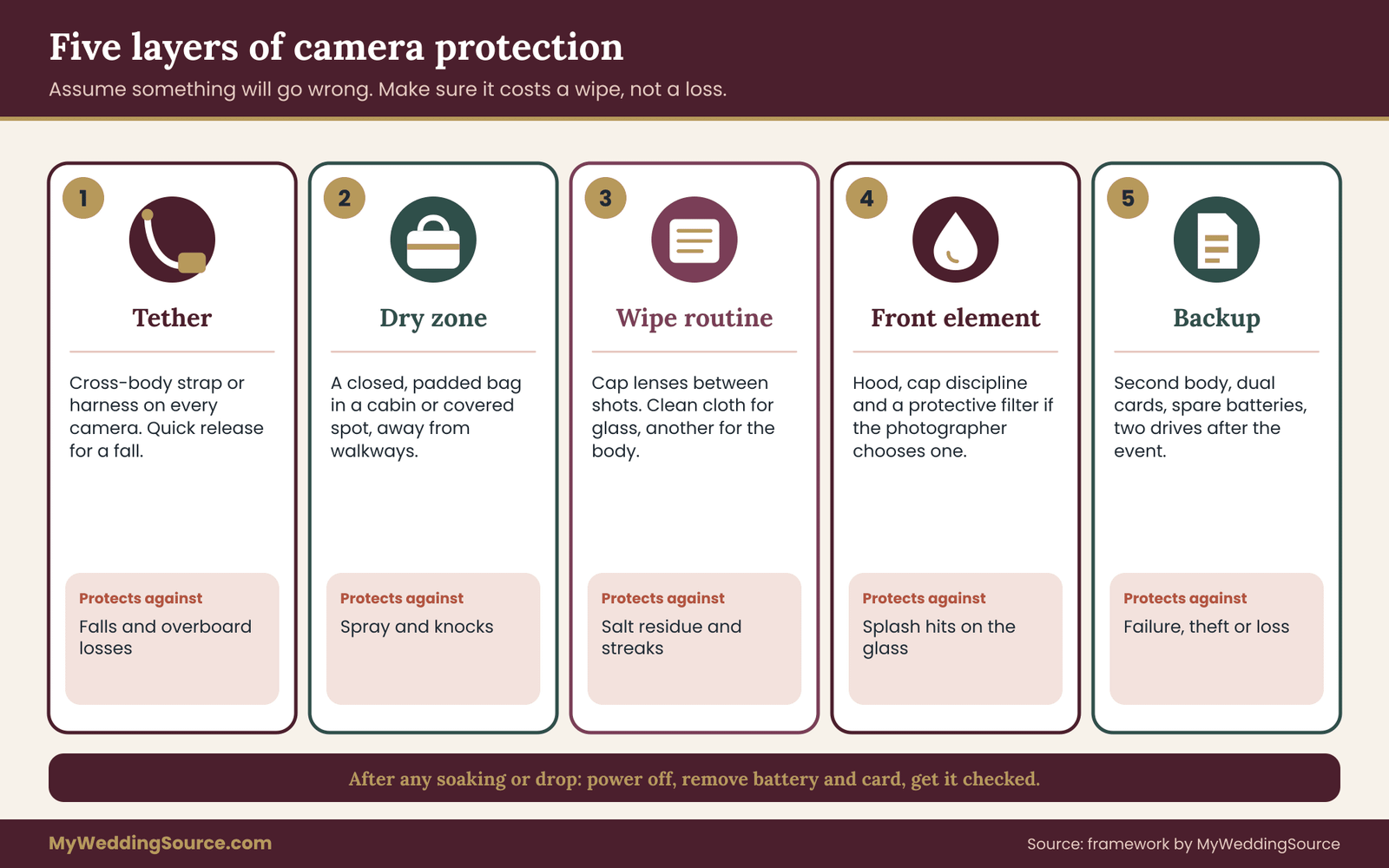
The most serious equipment loss on a boat is a camera that goes overboard or onto a hard deck. The fix is a secure attachment. A cross-body strap, a shoulder harness or a belt-mounted clip keeps the camera attached to the boat wedding photographer’s body and away from the rail when the hands are busy. Wrist straps alone are weaker, because a hand can be pulled away from the camera with one stumble.
There is a safety balance. A tether can also catch on a rail or a cleat, and a person who falls with a heavy camera attached can be pulled by it. For that reason, many photographers prefer a strap with a quick-release feature. The aim is that the camera stays with the photographer under normal conditions and can be shed in a fall. Ask the boat wedding photographer how their system behaves in those two cases.
Small items need tethers too: lens caps, filters, memory card cases, a phone used as a remote. Anything that can roll off a bench can be lost. Lanyards, pouches with closures and a small tray with a lip are simple, inexpensive protection.
Keep a dry zone
Choose, in advance, a dry place on the boat where gear is stored when it is not in use. It should be out of walkways and away from the edge, ideally inside a cabin or under cover. A padded bag with a rain cover, or a small hard case with foam, protects against both water and knocks. A dry bag, the kind used by paddlers, is useful for extras like batteries, cards and cloths.
Never set a camera bag on an open deck seat in spray, and never leave a lens uncapped on a bench. The boat wedding photographer who returns the gear to the dry zone between moments, and who builds this into the routine, rarely suffers from the sudden dunking that damages lenses. Agree the location with the captain and mention it on the briefing page, so that crew members do not move or sit on the bag.
Splash and salt routine
Salt water leaves residue as it dries. On a lens, it can streak and, with repeated exposure, damage coatings. On a camera body, it can find its way into buttons and dials. The routine is straightforward. Cap lenses between shots. Keep a clean microfiber cloth for glass and a second for the body. If spray lands on the front element, wipe the water away promptly with a clean cloth, using a gentle touch, and do not drag a gritty film across the glass.
At the end of the day, wipe the exterior with a cloth lightly dampened with fresh water, wipe it dry and let the gear air out before sealing it in a case. Check the manufacturer’s care instructions for cleaning methods, because they vary. If gear has been soaked or dropped in the water, power it off, remove the battery and card, and seek a repair assessment, since turning it on again can cause further damage.
Protect the lens front
Many photographers fit a clear protective filter on each lens for work near water, so that a splash or a knock hits the filter and not the front element. Others prefer not to add another glass surface because of reflections or sharpness. Either approach is a choice for the photographer, and the briefing only needs to say that the front element has a plan. A hood, a cap discipline and a cloth are the common parts of it.
Heat, cold and the battery
A boat in sun can become hot, and a black camera in direct light can heat up, especially in video mode. A boat in the evening can turn cold, and batteries lose capacity in the cold. Extra batteries kept in a pocket close to the body, a shade cover and a habit of storing cameras out of direct sun when not in use all help. A small thing: some photographers also carry a hand towel on the strap to wipe the camera and to dry their hands before touching any controls.
Backup: bodies, cards and data
The backup plan has three layers. The first is a second camera body, so that a failure or a splash does not end the shoot. The second is dual card recording and spare cards, so that a card failure does not erase the ceremony. The third is data handling after the event: copy the files to two separate drives before the end of the day, and keep one drive in a different bag from the cards.
The boat wedding photographer should also know what to do if the gear is lost. A short list helps: which camera and lens are the priority, which phone can serve as an emergency camera, and which friend or second shooter can step in. The aim is that no single piece of equipment can end the coverage of the ceremony.
A word on cost and trade-offs
Every item in this section costs something. A second body, spare cards, a dry bag, a harness and a repair-minded insurance policy all add to the price of a boat wedding photographer, and some of that cost shows up in the quote. That is a fair price for being able to deliver the ceremony photographs on a rocking boat. If a quote looks low and the boat wedding photographer has no plan for backup, the saving is likely to be borrowed from risk, not from efficiency.
Working with the captain and crew: deck rules for photography
The captain and crew are the other half of any boat wedding photographer’s team, even though they are not hired for photography. They know how the vessel behaves, they know which positions are safe and they have the authority to change the plan. A photographer who treats them as partners gets better access, better warnings and better pictures. One who treats them as obstacles tends to get none of those.
Start with a conversation, not a list of demands
Contact the operator early and explain that there will be a photographer on board, possibly with an assistant, and that you would like a short call among the three of you. Share the briefing page as a draft and ask for corrections. This approach respects the operator’s expertise and shows that you take the rules seriously. It also surfaces issues like restricted areas and capacity counts while there is still time to adjust.
Ask the operator some direct questions. Which areas are open to the photographer? Are there places where nobody should stand while the vessel is moving? Does the vessel have a policy on equipment, such as tripods or flash? When will the weather decision be made, and who makes it? Who is the contact on the day? Write the answers into block one of the briefing.
Learn the crew’s signals
On a working vessel, crew members communicate in short phrases and hand signals. A photographer may hear “hold on,” “sit down” or “clear the bow” without further explanation. The right response is to comply first and ask afterward. Agree before the day that a call from the captain or the mate pauses everything, including a shot that is only half finished.
Agree on a quiet signal that the boat wedding photographer can use as well. A raised hand to the designated contact can mean “I need a moment,” such as when spray has reached the lens or footing feels uncertain. Because neither side has to explain, the signal costs nothing and prevents a slow slide into a risky position. It also supports the sentence in block four that either party can call a pause.
Positions that usually work, and positions that usually do not
Every vessel is different, so treat the following as questions to ask and not as facts. Positions near the centerline of the vessel tend to move less than positions at the bow or stern, because the vessel pitches and rolls about its middle. A photographer who stays near the middle, with a hand on a fixed support, may hold a steadier camera than one at the edge.
Positions that tend to be off limits include the bow rail while underway, the upper deck while the vessel is turning, the wheelhouse door and ladders. The aisle between seats can be a good working space during a ceremony at anchor, but it is also the passage that crew may need in an emergency, so the boat wedding photographer keeps it clear. Ask the captain to show the actual spots on the deck during the site visit, and take photos of them for the briefing.
Life jackets, rails and personal safety
Vessels carry life jackets for the passengers, and the captain’s briefing explains where they are and when they should be worn. Photographers need the same briefing as everyone else and should follow it. The U.S. Coast Guard publishes boating safety information and describes the equipment that vessels carry, and the captain is the person to ask about what applies to your vessel and your waters.
A photographer who is working near the edge, or on a moving deck, may be asked to wear a life jacket. A slim, inflatable type may be worn over clothing and may be less cumbersome, but the final decision belongs to the captain. If a photographer objects to wearing one, that is a red flag, not a negotiation. You do not want to explain later why you asked a person to take a risk for a picture.
Alcohol, attention and footing
A wedding includes drinks. On a moving boat, a few drinks affect balance and attention for guests and vendors alike. Many operators have rules about alcohol service and about who may drink, and those rules vary. The photographer’s job calls for balance and attention, so a sensible agreement is that the boat wedding photographer and any assistant do not drink until the work on board is done, and that crew members are not offered alcohol at all.
For guests, the same logic applies near the rails. Remind the wedding party to avoid leaning on the rail for a photograph, standing on benches or stepping back from the group without looking. A calm announcement from the captain at the start of the cruise is more effective than a late warning from the boat wedding photographer. If you are working with a coordinator, ask them to carry the message so that the photographer does not become the person who tells everyone to be careful.
Accessibility and boarding
Photography also affects boarding. Some guests use mobility devices, and the gangway, steps and doors may limit their movement. A photographer who plans to shoot the boarding moments should work from a position that does not block the way, and the schedule should leave time for people who need it. The Americans with Disabilities Act and the operator’s own policies shape what a vessel can offer, so ask the operator what is available, and avoid assumptions.
Think about the boat wedding photographer’s own movement too. A person carrying two cameras, a bag and perhaps an assistant’s gear needs a free hand on the gangway. Agree on a way to load the equipment, such as handing bags across in a specific order or using a crew member to help, so that the boat wedding photographer does not make a risky step with full arms.
Technical walk-through at the vessel
If the operator allows it, schedule a visit with the photographer to the boat while it is docked, ideally at the same time of day as the wedding. A visit like this, similar in spirit to the venue technical walkthrough, turns assumptions into measurements. The boat wedding photographer can test positions, check the light, find where the dry zone will be and learn how the deck feels. The operator can mark the restricted areas and confirm the rules.
If a visit is not possible, ask for photographs of the deck from several positions and a simple sketch of the layout. Many operators already have a layout, since they plan capacity and seating. With it in hand, the boat wedding photographer can draw a plan of positions for each moment on the day.
A moment-by-moment plan for photographing the boat portion
With the vessel facts, the ratings and the gear protection in place, the next step is a sequence. The sequence runs from the moment the first vendor arrives to the moment the last guest steps off. For each moment, the plan states the expected motion rating, the photographer’s position, the main shots and the fallback. What follows is a general pattern you can adapt to your own schedule.
Before boarding: the dock
At the dock, the vessel is usually at its steadiest, and the light is predictable. This is where the boat wedding photographer can take time for details: the boat’s name, the decorations, the shoes, the rings and the couple’s portraits with the vessel behind them. A tripod and extra lenses are easier to manage here, and lens changes can happen on solid ground.
Use the dock to get the pictures that need patience. Portraits of the couple, family groups, and the most important photographs you cannot risk on the water can be made before departure. The wedding family photo list is a good tool for deciding which groups to shoot ashore so that the time on the boat can be used for the moments that need the vessel itself.
Boarding
Boarding is a moment of movement for everyone. The gangway may slope, and guests carry bags, gifts and drinks. The boat wedding photographer should hold back until the first group is aboard, then take a position from which the whole queue is visible but the passage is clear. This is a green or amber moment, depending on the water and the wind. Keep the cameras on tethers and the bag in the dry zone.
The ceremony
For many couples, the ceremony is the most important moment on the boat. Decide whether it takes place at the dock, at anchor, or underway. A ceremony while underway brings an amber or red rating almost by definition, because of engine noise, wind and motion. A ceremony at anchor in a sheltered spot is usually amber at worst. A ceremony at the dock before departure is green.
The photographer needs a spot with a clear view of the couple’s faces and the officiant, without blocking the guests’ view, and the plan should say which side. Two positions often work: one at the front quarter facing the couple and one at the back for the aisle and the guests. If there is a second shooter, they take the second spot. The wedding ceremony step-by-step outline helps in listing the moments that need coverage: processional, vows, rings, kiss and recessional.
Toasts and the cruise
During toasts, the vessel is typically at its most settled, whether at anchor or moving slowly. Guests are seated, so the boat wedding photographer can work at a lower height with fewer obstacles. It is a good time for photographs of reactions and details. If the boat will turn or change speed after the toasts, the captain can say when, and the boat wedding photographer can put the cameras away at those moments.
While the boat cruises, the photographer can work from a braced position, using the faster shutter speeds, and concentrate on candids and views from the deck. Avoid asking the couple to move around the deck for posed shots while the vessel is underway. Save elaborate poses for a time when the boat is at anchor or back at the dock.
Sunset portraits
Sunset is the moment everyone wants, and it often falls during the most unpredictable part of the day. The light changes every minute, the wind may rise, and the temperature drops. Plan sunset portraits at the dock, at anchor or in a sheltered spot, and keep a shorter, simpler plan for underway. The captain can often arrange for the vessel to hold position for ten minutes if asked in advance.
Have a clear order for the portraits, the most important first. Use a hand hold or a rail for the couple’s stability, and ask the boat wedding photographer to avoid positions that bring the couple close to the edge. A small gesture that helps: give the bride’s dress a chance to settle, because wind on the water can fill a skirt and pull her off balance.
Disembarking and the afterglow
At the end, the guests step off, tired and happy, and the light has usually gone. A photographer who still has energy can capture departures, the hug at the gangway and the last look at the vessel. The same safety care applies, because gangways are slick at night and people are less alert. Keep the gear tethered, and make sure the boat wedding photographer has a hand free for the rail.
A worked case: an evening charter with sixty guests
The following example is invented for illustration. It does not describe a real couple, vessel or event, and the numbers are chosen only to show how the briefing turns into decisions. Use it as a pattern, not as a standard. Your own vessel, route and photographer will change every figure.
The setting
Imagine a couple holding a ceremony and a short cruise on a chartered passenger vessel in late summer. Sixty guests are aboard. The plan is to board at the dock in late afternoon, hold the ceremony at anchor in a sheltered cove, serve a meal and toasts during a slow cruise, anchor again for sunset portraits, and return to the dock after dark. The couple has hired one primary photographer and one second shooter, who will be sharing the boat’s two open decks with the guests.
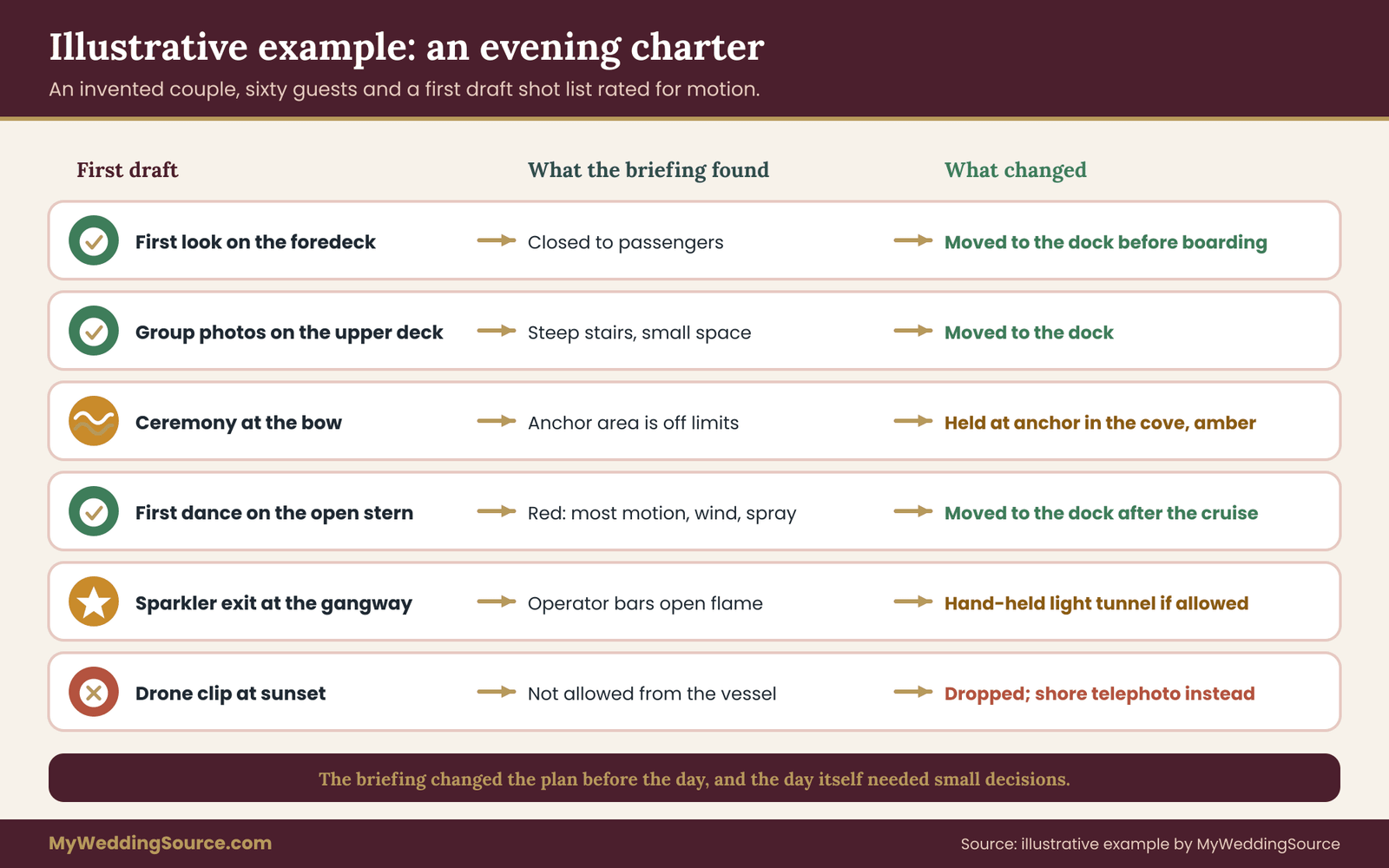
The couple’s first draft of the shot list includes a first look on the foredeck, a ceremony at the bow, group photographs on the upper deck, a first dance on the open stern while the boat moves, a sparkler exit from the gangway and a drone clip of the vessel at sunset. It is an ambitious list, and it reads well on paper. The briefing is what shows which parts of it work.
Filling in block one
The call with the operator produces the vessel facts. The foredeck is closed to passengers while underway, and the bow is closed even at anchor because of the anchor handling area. The upper deck is open but limited to a smaller number of people, and the stairs are steep. Tripods and light stands are not allowed. Flash is allowed on the main deck but not toward the wheelhouse. Drones are not allowed from the vessel. The weather decision will be made two hours before boarding, by the captain, with the couple’s coordinator informed.
The operator also confirms that the photographer and the second shooter count among the people on board for the purposes of capacity, so the couple reduces the guest list by two seats. That is an uncomfortable discovery, but a better one two weeks before the wedding than at the gangway.
Block two: rating the moments
The captain and the boat wedding photographer go through each moment on the schedule. Boarding at the dock is green. The ceremony at anchor in the cove is amber, because swell enters the cove even on a calm day.
Toasts during the slow cruise are amber with red patches when the boat turns. Sunset portraits at anchor are amber. The first dance on the stern while underway is red: the stern moves the most, the deck is open to wind and spray, and a crowd would be dancing on a moving surface. The upper deck groups while underway are also red because of the stairs and the limited space.
With ratings in hand, the couple changes several items. The first look moves to the dock before boarding, where the boat wedding photographer can use a tripod and take time. Group photographs move to the dock as well.
The first dance is moved to the dock after the cruise, on a stable surface, with the boat as the backdrop. The sparkler exit is dropped because of the operator’s rules on open flame, and replaced with a hand-held light tunnel at the gangway, if the operator agrees. The drone clip is dropped. A short sequence from shore may replace it, as described in the alternatives section.
Block three: gear decisions
The primary photographer plans two bodies, each with a mounted lens: a wide-to-short-telephoto zoom on one and a fast prime on the other, both on quick-release cross-body straps. The second shooter has one body with a wide zoom and a small flash. Spare lenses and cards stay in a padded bag in a cabin that the captain designates as the dry zone. Microfiber cloths go in a jacket pocket. After each amber moment, the photographer checks the front element and the strap clips.
For the files, both bodies write to two cards. After disembarking, the files are copied to two drives before the photographers go home, and the drives travel separately. The primary photographer’s insurance is checked by the operator, and a certificate is shared by email before the wedding.
Block four: stop conditions and fallbacks
The group writes the stop conditions into the page. If the forecast on the day shows conditions that the captain judges too rough, the cruise portion is shortened or moved to the dock, and the ceremony takes place at the dock with the boat as backdrop.
If spray reaches the main deck during the cruise, the photographers put the cameras in the dry zone until the captain says it is clear. If lightning is seen in the area, everyone goes inside and nobody photographs from the deck. If the second shooter feels unwell, they sit and rest, and the primary continues alone.
The day, in rough sequence
On the day, the captain’s review of the forecast shows a light breeze and a small chop that is a little more than expected in the open water outside the cove. The cruise is shortened a little, and the plan for the open water becomes red for the stern. The ceremony in the cove goes ahead as an amber moment. During it, the boat wedding photographer works from the centerline of the deck, using a shutter speed floor of about one over five hundred for processional and vows, and a burst through the kiss.
During the cruise, the captain turns the vessel twice, and the coordinator warns the photographers just before each turn. Both cameras go to the hips and the photographers hold a rail. One splash reaches the second shooter’s lens. A cloth takes it off, and a note is made to check the front element again at the dock. Sunset portraits at anchor take eight minutes, with the couple holding hands and a rail, and the boat wedding photographer works with the sun low and the boat facing it.
What the example shows
The example shows several things at once. The briefing changed the plan before the day, at no cost to the couple except the loss of two ideas that were unsafe or against the rules. The photographs that needed stability were made on solid ground. The ones that needed the boat were made at moments when it was steady. And the decisions on the day were small, because the larger ones had been made earlier.
It also shows the limits of the approach. Not every moment on a boat can be improved by planning. If the sea is rough, the deck is still rough. The briefing does not remove the sea, but it ensures that you meet it with a plan, a tethered camera and a place for the cameras to go. That, rather than any single piece of equipment, is what makes a boat wedding photographer dependable.
When a boat wedding photographer should stop: failure conditions and alternatives
Every plan needs a way to fail well. For boat photography, that means deciding in advance what makes the on-board shoot stop, what takes its place and who decides. These conditions are easier to agree on when the day is calm than when you are standing on a wet deck with a sunset ticking away. Writing them down protects the people, the equipment and the relationship between you and the vendors.
Conditions that should stop shooting on deck
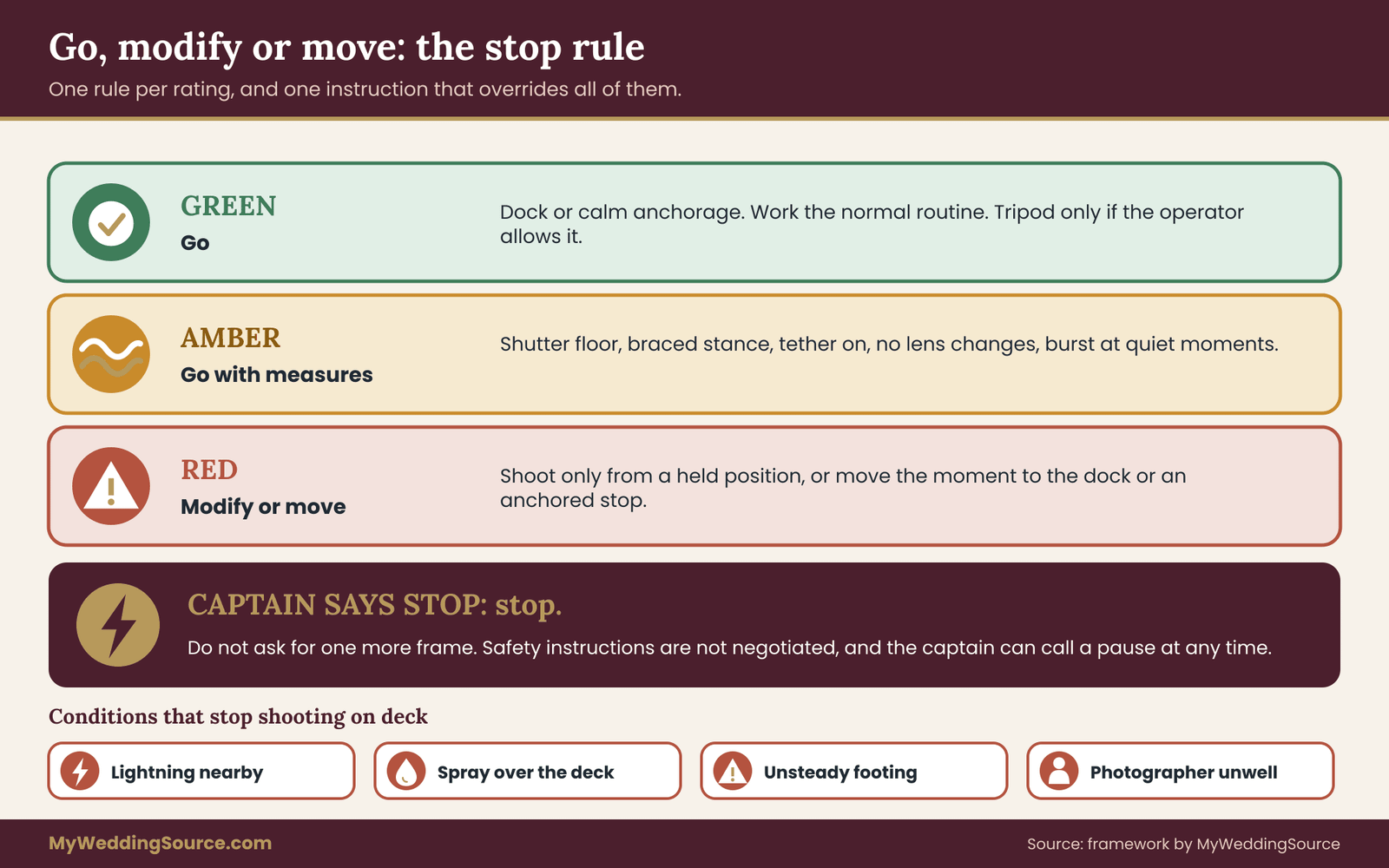
Some conditions are clear. Lightning in the area calls for everyone to go inside and for cameras to go away. A vessel instruction to sit or to clear the deck stops all photography on that deck. Heavy spray over the working area, a deck that is wet and moving enough that standing without a hold feels uncertain, or a photographer who is feeling unwell or unsteady also pause the work.
Other conditions are matters for the captain’s judgment. If the National Weather Service issues a marine warning or advisory for your waters, such as a small craft advisory, talk to the captain about whether the cruise itself should go ahead, and whether the photographic plan needs to change. The Coast Guard and the weather service publish information to help boaters understand these notices, and the captain is the right person to interpret them for your vessel.
Conditions that should change the plan, not stop it
Some changes are smaller. A stiffer breeze than forecast might move the ceremony to the cove or the dock. A late departure might shorten the time before sunset, in which case the sunset portraits take priority over the cruise candids. A second shooter who cannot go on board may be replaced by an additional dock session. The briefing should say which moments are most important to you, so that these trades do not have to be argued on the spot.
A useful way to prioritize is to sort the shot list into three groups: the photographs you cannot do without, the ones you want, and the ones that would be nice. When conditions get worse, the photographer drops the third group first and the second group next. Because you wrote the groups in advance, nobody has to guess what you would have chosen. Share the sort with the captain as well, because it helps them understand where a short pause would cost the most.
Alternatives to shooting on the moving boat
When the movement is too much, there are real alternatives, and several of them produce photographs that are as good as, or better than, what would have been possible on the water.
Dock portraits with the boat behind. The vessel looks as good as it does on the water, the light is the same, and the footing is stable. A tripod is possible. This is often the best option for the couple’s portraits and family groups.
Anchored stops. A cruise that includes one or two stops at anchor gives the boat wedding photographer stable windows for the most important moments. It means the ceremony, the toasts or the portraits are timed for those stops, and the moving sections are used for candids.
Shore photographer for the departure. A second photographer on shore with a telephoto lens can capture the vessel leaving the dock and returning, with guests waving. Make sure the shore location is open to the public or permitted, and keep in mind that some marinas have rules about photography on their property.
A marina or waterfront stop after the cruise. The couple can step off for ten minutes for sunset portraits on a dock or a pier, then return to the party. This often gives the best light with the steadiest footing.
Chase boats. Some couples ask about a second boat carrying the boat wedding photographer. This brings its own risks and rules, including two vessels operating near each other and a camera operator on a small, moving platform. It usually requires a licensed operator and the main vessel’s captain to agree, and many will say no. Treat it as an exception.
How to decide: the go, modify or move rule
For any moment on the briefing, you can use a simple three-way rule. If the expected motion rating is green, go. If it is amber, go with the amber measures: shutter floor, braced stance, tether, no lens changes. If it is red, modify or move: shoot only from a held position, or move the moment to the dock or an anchored stop. Apply the rule at each stage, and update it as the captain updates the rating.
The rule has one exception that overrides everything: if the captain says stop, you stop. Do not ask for one more frame. Safety instructions do not come with a negotiation, and a photographer who respects them is a photographer you want.
Documenting decisions and learning from them
Keep brief notes on the day, such as the time, the condition and the decision. A coordinator can do this in a phone note in a few seconds per entry. The notes help you if you need to discuss a shortened shoot with the photographer or the operator after the event, and they explain why certain photographs were made at the dock. They are also useful if you plan a second event on a boat, such as an anniversary cruise.
Check the contract before the day for what happens when a shoot is shortened for safety. Many photographers charge by time, and some include a clause for conditions beyond their control. A fair outcome is usually the one agreed in advance, and it is the kind of detail that the wedding vendor due diligence checklist encourages you to confirm in writing. If the boat portion is the heart of your wedding, return to the wedding venues guide when you weigh vessel options against dock and shore settings.
Your next steps
Work through these in order. Each step is small, and together they turn the ideas in this guide into a plan your boat wedding photographer and your captain can both sign off on.
- Get the vessel facts. Call the operator and ask which deck areas are open, which are closed, what equipment is allowed, whether vendors count toward capacity, when the weather decision is made and who the day-of contact is.
- List the moments on the boat. Write each one in order, from boarding to disembarking, and give it a green, amber or red motion rating with the captain’s help.
- Move what cannot be risked. Decide which portraits, family groups and key moments will happen at the dock or at an anchored stop, and which will happen underway.
- Share the briefing page. Send the one-page draft to the boat wedding photographer and the captain about two weeks ahead, and ask for corrections.
- Confirm the gear plan. Ask about two bodies, tethers, dry storage, spare cards, insurance and the boat wedding photographer’s routine after a splash.
- Agree the stop conditions. Write who can call a pause, which conditions end shooting on deck and what replaces it.
- Check the forecast the day before. Read the marine forecast with the captain and update the ratings.
- Name a day-of contact. Give a calm person a copy of the page, and tell the photographer who they are.
FAQ
Do I need a special boat wedding photographer, or can my regular photographer do it?
A regular photographer can work on a boat if they prepare and accept the vessel’s rules. The key is experience with movement and a willingness to use a brace stance, a faster shutter, a tethered camera and a second body. Ask about comparable work, schedule a site visit, and share the briefing page. If they dismiss the concerns, consider a photographer who has worked on the water.
Is image stabilization enough to get sharp photos on a moving boat?
No. Stabilization in the camera or lens helps with small shakes from the boat wedding photographer’s hands. It does not stop a person from blurring when they move, and it can be overwhelmed by large deck movement. Sharp photographs on a boat come from a faster shutter speed, a braced stance, good timing and moments chosen for steadier conditions. Stabilization is a useful margin on top of those habits.
Can a tripod be used on a wedding boat?
Sometimes, but rarely underway. A tripod is fixed to the deck, and the deck is moving, so it can make shake worse. It can also trip guests and slide on wet surfaces. Many operators do not allow tripods or light stands. A tripod works best at the dock or at anchor in calm water, and only after the captain agrees on where it can stand.
How do photographers protect cameras from salt water?
They keep lenses capped between shots, use a hood, store spare gear in a dry bag or closed case, and wipe spray off the glass quickly with a clean microfiber cloth. After the event, they wipe the exterior with a cloth lightly dampened with fresh water and dry it. If a camera is soaked, they power it off, remove the battery and seek a repair assessment.
Should the boat wedding photographer wear a life jacket?
Follow the captain’s instruction. The captain is responsible for everyone on board and knows the vessel and the water. Many operators brief passengers and crew on life jackets, and the Coast Guard publishes boating safety guidance. A photographer working near an edge or on a moving deck may be asked to wear one. A refusal to follow the rule is a warning sign.
Can a drone photograph the boat at sunset?
Rarely from the vessel. Drones are subject to federal aviation rules, the operator must agree, and launching or landing on a moving boat adds hazards. Many operators prohibit it. If you want aerial images, ask whether a licensed operator can fly from shore or a permitted location, and check the Federal Aviation Administration’s current rules and any local limits before booking.
What happens to the photos if the weather turns bad?
Plan this in advance. The briefing lists the fallback for each moment, usually a move to the dock, an anchored stop or a shore session. Check the photographer’s contract for what happens when the shoot is shortened for safety, and agree how the time is handled. Keep notes on the day so any decision can be explained afterward.
How many photographers should cover a boat wedding?
One experienced photographer can cover a small boat wedding, but a second shooter adds backup and coverage when movement is limited. Two people can take positions on opposite sides of the deck, and one can continue if the other must stop. Ask the operator whether vendors count toward capacity, and weigh the cost against the value of redundancy.
Sources
- U.S. Coast Guard: official information on vessel safety, passenger vessel rules and Coast Guard services.
- U.S. Coast Guard Boating Safety Division: boating safety guidance and life jacket information for recreational boaters.
- Coast Guard Navigation Center: notices, navigation rules and maritime safety information.
- National Weather Service marine forecasts: marine forecasts, wind and wave information, and small craft advisories.
- NOAA: weather, ocean and coastal information from the National Oceanic and Atmospheric Administration.
- Federal Aviation Administration, drones: current federal rules for unmanned aircraft.
- ADA.gov: Americans with Disabilities Act guidance on access and accommodations.
- CISA: guidance on protecting and backing up digital data.
- Library of Congress, personal digital archiving: guidance on preserving digital photographs and files.
- Federal Trade Commission: consumer protection information on advertising and vendor practices.