
A joint speech is one wedding toast delivered by two best men who share a single microphone slot, a single time limit and a single audience, and the whole craft is in the handoffs between them. This guide gives you a two-speaker handoff method and a microphone cue script, then walks through a worked case, the alternatives, and the conditions under which the format fails.
Treat the joint speech as one speech with two voices, not two speeches stapled together. Give each speaker a job (frame, story, toast) instead of an equal share of minutes. Write each handoff as a three-part seam: a closing line, a physical cue, and a microphone action. Decide in advance who holds the microphone, who holds the glass, and who says the final toast. Budget one combined time, subtract the handoff seconds first, and rehearse the full sequence out loud with the real microphone setup at least three times.
Two best men is a good problem to have. It usually means a groom with two oldest friends, a brother and a college roommate, or two people who both did the work of the role and neither should be left out. The couple is happy, the friends are happy, and then somebody asks the question nobody has answered: who actually stands up, and what do they say?
The usual answer is “we will split it,” and that is where a joint speech starts to go wrong. Splitting a draft down the middle gives you two half-speeches with two openings, two jokes about the same weekend in 2014, and an awkward moment in the middle when one man hands over the microphone as if passing a hot dish. Guests can feel the seam. They do not know why it feels off, but the room shifts in its chairs.
This article is about that seam, and about everything that makes it clean. It does not teach you how to write a funny story or how to tell a good one; it assumes you have material. It deals with the structure two speakers need that one speaker does not: division of jobs, handoff lines, microphone logistics, timing that adds up, and a plan for what happens when one of you freezes or the microphone dies.
The broader question of who speaks at a reception, in what order, and for how long overall belongs to the toast and reception-schedule side of the site, and the wedding reception guest flow guide covers where speeches sit in the evening. This page stays inside the joint speech itself.
A note on scope. This is general guidance for a spoken toast, not legal, tax or financial advice, and it cannot replace what the couple, the emcee, the DJ or the venue tell you about the actual schedule and sound equipment. When a rule outside your control matters, such as a venue sound limit or a quotation under copyright, the article points you to the office that sets it.
Why a joint speech is a different job from two speeches
A single best man has one problem: hold a room for a few minutes. Two best men have that problem plus a coordination problem, and the coordination problem is the one that usually breaks the speech. A joint speech has more places where it can fail, because every handoff is a moment when the audience’s attention is released and has to be caught again.
Think of it as a relay. In a relay race the runners are not judged on how fast each one runs in isolation. The race is won or lost in the exchange zone, where a baton is passed at speed. A joint speech works the same way. Each of you can be a perfectly good speaker, and the result can still land badly if the exchange is slow, unclear, or unrehearsed.
There are three things a joint speech has to do that a solo speech never does.
First, it has to establish two people as one unit. The audience needs to understand within the first fifteen seconds why two men are standing there, how they know the groom, and why they are talking together. If that is unclear, guests spend the first minute puzzling over it instead of listening.
Second, it has to keep one voice. Two speakers will naturally have two styles, and that is fine, but the joint speech needs a single arc: one thread, one tone, one destination. A speech in which the first speaker is sentimental and the second is doing stand-up reads as two different events.
Third, it has to manage a shared physical object. The microphone is the real constraint. It is usually one handheld, sometimes a stand, occasionally two. Where it is, who holds it, and how it moves between you is a piece of choreography, and choreography needs rehearsal.
The cost of getting it wrong is small but visible
None of this is high stakes in the way a contract or a permit is. Nobody is harmed if the handoff is clumsy. The cost is the room’s attention, and a wedding toast runs on attention. A joint speech that stumbles on a handoff does not end the evening, but it can drain the moment you were trying to build, and the couple, who asked you to do this, feel it more than anyone.
There is also a quieter cost. When two friends who care about the groom are not coordinated, one of them often ends up feeling that the other took the better material or the better spot. That resentment is avoidable, and a clear division of jobs, agreed before drafting, prevents most of it. The method in this article is as much about protecting the friendship between the two speakers as about protecting the audience’s patience.
Who this format suits
A joint speech works well when both men have a real, separate connection to the groom and the stories do not overlap. It works when the two speakers are comfortable with each other, because they will be reading each other’s body language in front of a crowd. It works when the schedule gives you enough room for a slightly longer slot than a solo speech would need, since handoffs cost seconds.
It works less well when one of you is much more nervous than the other and the nervous one would rather not speak at all. In that case a lopsided split, where one person carries most of the words and the other handles the toast, can be kinder than forcing equal airtime. Later sections cover that alternative and several others, because the format that looks fairest on paper is not always the one that serves the room.
What a joint speech should and should not try to do
The first decision is scope. A joint speech has the same job as any best man toast: honor the groom, include the partner, and finish with a toast the room can join. The difference is that the scope has to fit two people, and it is tempting to inflate it. Two speakers feel like they have twice the material, so they try to do twice as much.
Resist that. Two voices do not make the room’s patience longer. If the venue and the couple suggest a toast of about four minutes from a best man, then a pair of best men giving a joint speech should plan to land somewhere between four and six minutes, not eight. A few extra minutes can be justified by the handoffs and by the second voice. Double the length cannot.
A useful rule is that the joint speech should feel like it has one story too few, not one too many. If you are debating whether to include a third anecdote, leave it out. The audience will remember one funny story and one sincere moment. They will not remember the fourth anecdote, but they will remember being glad the joint speech ended on time.
What the speech is for
Write down, in one sentence, what the audience should feel at the end. For a joint speech there is a version of that sentence that only works with two people: “The groom has two friends who have known him in different decades, and both of them think he got it right.” That is a reason for two voices to exist. If you cannot find a sentence like that, the case for a joint speech is weak, and you should read the alternatives section before committing.
What stays out
Some content is risky in any wedding speech and riskier in a joint speech, because there are now two people who might misjudge a line. Stories about the groom’s past relationships, details of a bachelor weekend that the partner or a grandparent would not want to hear, jokes about money or family disputes, and anything that depends on knowing a secret the partner does not know should stay out. The wedding etiquette guide covers the broader social rules of a reception; for a joint speech, the test is simple. If either speaker hesitates when reading a line aloud to the other, cut it.
A joint speech has an extra safeguard that a solo speech lacks. Each of you is the other’s first audience. Use that. Read every line to your partner and watch their face. A wince is data.
The three questions to settle before writing a word
Before either of you drafts anything, agree on three things in a single conversation.
Who is the lead? Even in a partnership, one voice opens and one voice closes. That does not mean one is more important. It means someone owns the first microphone moment and someone owns the toast, and the audience needs that clarity. Decide it by who is more comfortable starting cold and who is more comfortable finishing warm.
What is the single thread? Pick one idea that runs through both halves: how the groom met each of you, a habit he has that both of you noticed, a place that mattered. A thread is what turns two speeches into one.
What is the total time? Ask the couple or the emcee for the slot. If nobody has given you one, ask. Everything else in this guide hangs on a number, and a number you guessed at is the most common cause of a speech that runs long. For this page, treat the number as given and spend it carefully. ## Dividing a joint speech by job instead of by minutes
The most common way to divide a joint speech is by time. Two speakers, four minutes, two minutes each. It feels fair, and it is nearly always the wrong tool, because minutes do not tell you what anyone should say. Two equal blocks of two minutes produce two self-contained speeches, each with its own beginning, middle and end, and the audience sits through two openings and two closings.
A better division is by job. A toast, solo or joint, does three separate things, and those three things can be assigned to different people. Call them the frame, the story and the turn.
The frame opens the speech. It greets the room, says who the speakers are and how they know the groom, and sets the tone. It is short, usually well under a minute, and it has to be delivered with confidence because it is the first impression.
The story is the body. It is the anecdote or pair of anecdotes that show who the groom is. It takes the most time and carries the most risk, because it contains the jokes and the sincerity.
The turn is the pivot from the groom to the couple, followed by the toast itself. It addresses the partner, says what the speakers have seen in the relationship, and ends with the glass raised. It is short, and it is the moment the room is most likely to respond.
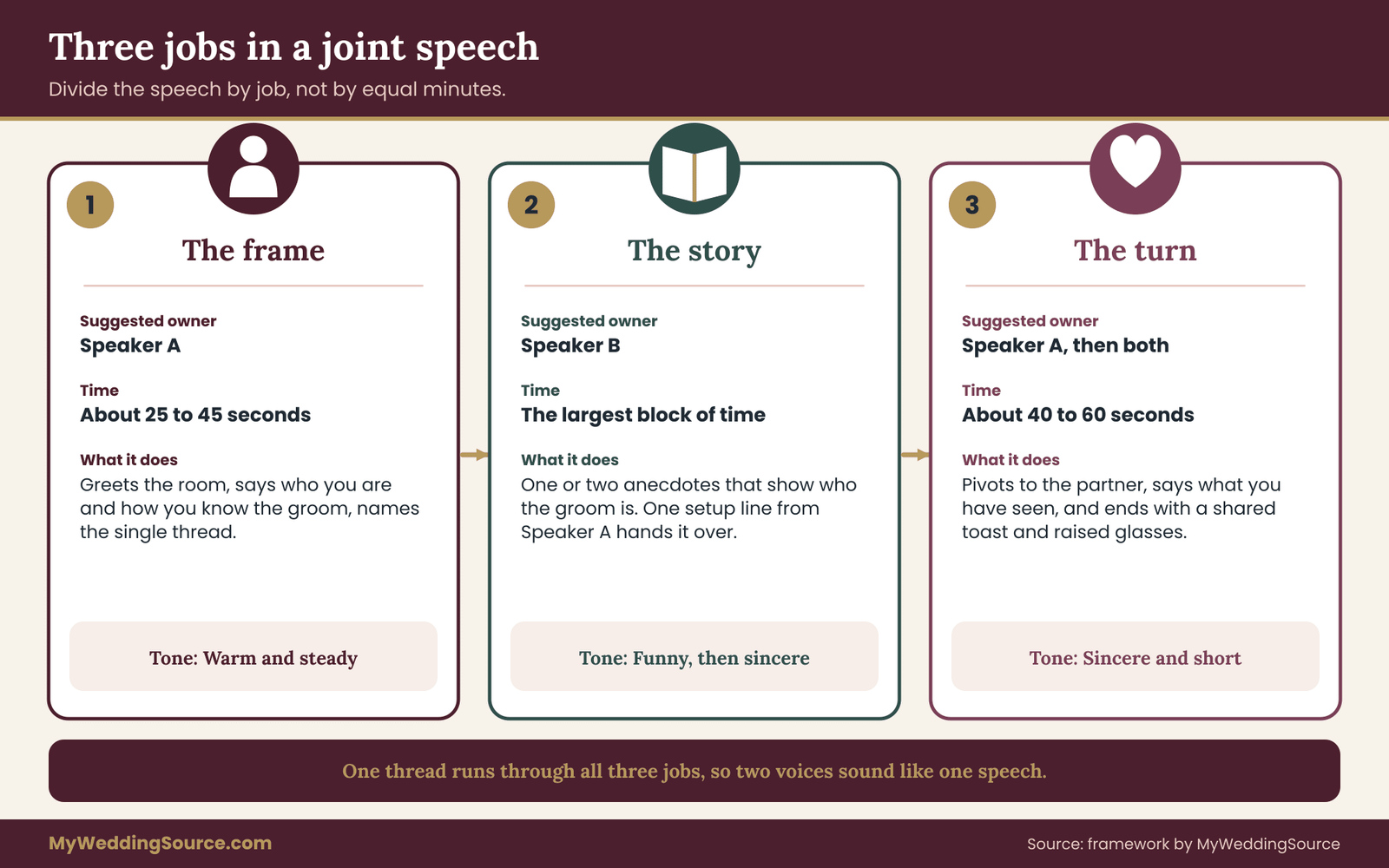
Dividing by these jobs rather than by minutes has a practical benefit. The jobs have different demands, and people have different strengths. The speaker who is strongest at warm, steady delivery should probably take the frame and the turn. The speaker who is the better storyteller should take the story, even if that means they speak for the largest block of time. The result is unequal airtime and equal contribution, which is what the audience actually perceives.
Two ways to assign the jobs
There are two common assignments, and each suits a different pair.
In the first, Speaker A takes the frame, Speaker B takes the story, and Speaker A returns for the turn. The advantage is that Speaker A bookends the joint speech, which gives it a consistent voice at the edges and lets Speaker B do one long, uninterrupted piece. The disadvantage is that Speaker A must handle two microphone moments, and Speaker B gets one.
In the second, Speaker A takes the frame and the first story, Speaker B takes a second story and the turn. The advantage is that both speakers tell a story, which suits two friends who each have material the other lacks. The disadvantage is a handoff in the middle of the body, which is the hardest place to make a seam invisible.
Neither is correct. Choose the one that fits what you actually have. If only one of you has a strong story, use the first assignment. If you each have a story that complements the other’s, use the second, and invest extra rehearsal time in the middle handoff.
Stories that can be shared and stories that cannot
Some stories are two-person stories. If you and the other best man were both on the trip, both in the apartment, both at the event, the story could be told by either of you, or by both. These are the stories that make a joint speech distinctive, because they let you interrupt, correct or complete each other in a way a solo speaker cannot.
Use that sparingly. A shared story told in alternating lines can be charming for ninety seconds and wearing after three minutes. The risk is that it turns into banter, and banter that the speakers enjoy is not always banter the room enjoys. If you want to try it, build a fixed structure, not an improvisation: Speaker A sets up, Speaker B delivers the turn of the story, Speaker A adds the last detail. Rehearse it until the lines are automatic.
Other stories are one-person stories. If only one of you was there, only that one should tell it. The other speaker can set it up with a single line, which also works as a handoff: “There is a story only Marcus can tell, because I was not in the car.” That sentence does three things at once. It tells the audience why the speaker is changing, it creates a small laugh or a pause, and it moves the microphone.
A single voice across two speakers
The hardest part of a joint speech is not the handoff. It is the consistency of voice. A guest who has never met either speaker will form a picture of the groom from what they hear, and that picture needs to be coherent. If one speaker describes the groom as a careful planner and the other describes the same man as perpetually late, the room will read it as either a joke or a mistake. Settle the facts in advance.
Agree on a short list of shared vocabulary, including how you refer to the groom. Do you use his full name, his nickname, or his surname? Do you call the partner by name? Pick one convention and use it throughout. Switching between “Daniel” and “Danny” in different halves is a small thing that makes a speech feel unrehearsed.
Agree on tone. If one of you plans a light, teasing approach and the other plans something more serious, either aim for a blend or assign the tones to the jobs. The frame can be light, the story can be funny, and the turn can be sincere. That is one voice, moving through three registers, and the audience follows the movement naturally. It becomes a problem only when the two speakers are doing different things in the same register at the same time.
Equal credit without equal time
A concern that comes up in nearly every pair is fairness. One speaker worries about speaking less. The other worries about carrying more. Both concerns are legitimate, and they are best handled by naming them early and making the division visible.
One practical approach is to count contributions in terms of what the audience will remember. If Speaker B tells the main story and Speaker A does the frame and the toast, Speaker A will be seen both at the start and at the climax, and Speaker B will be remembered for the centerpiece. That is a fair division even if the minutes are unequal.
If this does not satisfy one of you, do not force it. Consider the alternative formats covered later, including separate short speeches that are timed to fit one slot. The goal is a good toast and a friendship that survives it, in that order, and neither is helped by a split that someone privately resents.
What to put on the page
At the end of this step, each of you should be able to write the following in a few lines. Who opens. Who tells which story. Who turns to the couple. Who says the toast. What the single thread is. What tone each section takes. That page is not the joint speech. It is the contract between the two of you, and it belongs beside the couple’s own cue sheet habits, where every moment has a named owner, and it is far easier to change at this stage than at the rehearsal.
A short example of what such a page can look like, using invented names, is below, and the worked case later in this article builds on it.
- Frame (about forty-five seconds): Speaker A, warm, introduces both of them and the thread.
- Story (about two and a half minutes): Speaker B, funny, one story from the groom’s twenties, with a single setup line from Speaker A.
- Turn and toast (about one minute): Speaker A addresses the partner, Speaker B joins for the final line and the glass.
Notice that the toast itself is shared. Having both speakers deliver the last line, together or in sequence, gives a joint speech a distinctive ending that a solo speech cannot match, and it also signals to the room that the speech is over. The next section covers how to build the handoffs that hold this structure together.
A check before moving on
Read the page aloud to each other and ask three questions. Does each of us have a role the audience will understand without being told? Is there one thread? Is there at least one moment where both of us are visibly part of the joint speech? If the answer to any of these is no, adjust the division before writing the text. Fixing a division takes ten minutes. Fixing a finished draft built on the wrong division takes an evening.
Common patterns worth avoiding at this stage include giving one speaker only the thank-you to the hosts, which can read as a consolation role; giving one speaker only the toast, with no earlier presence in the speech, which makes the entrance feel abrupt; and splitting the story itself in half, so that neither speaker finishes a thought.
A better test of fairness than counting minutes is to ask whether each speaker has at least one moment where the room is listening only to them, and at least one moment where their partner’s presence helps. If both conditions hold, the division works, and the next step is to design the handoffs that connect it. ## The seam: how to build a handoff that the room does not notice
A handoff is the moment one speaker stops and the other starts. In a joint speech it is the single most visible piece of coordination, and it decides whether the speech feels like a team or like two people taking turns. A good handoff takes about five to eight seconds. A bad one takes fifteen and feels like thirty.
Break each handoff into three parts, and write all three down. Call the whole thing a seam.
The closing line. The last sentence of the outgoing speaker. It should end a thought, not trail off, and it should point toward the next speaker without naming a task. A line that ends on a clear beat gives the audience a moment to laugh or react, and that reaction time is useful: it covers the physical exchange.
The physical cue. What the outgoing speaker does with their body. A turn toward the partner, a short nod, a step to the side, a gesture with the free hand. The cue tells the incoming speaker that the moment has arrived, and it tells the audience where to look next.
The microphone action. What happens to the microphone. It is handed over, it is left on a stand, or the incoming speaker steps into a second microphone’s range. This is the part most pairs leave to chance, and it is the part that produces most of the awkwardness.

Why each part needs its own planning
It is easy to plan only the words. The closing line feels like the whole handoff because it is the only part that sounds like writing. But the closing line without a physical cue leaves the incoming speaker uncertain whether to start, and a physical cue without a microphone plan leaves both speakers fumbling.
Each part covers a different failure. The closing line prevents a flat, confusing end. The physical cue prevents the “Is it my turn?” pause. The microphone action prevents the clatter, the feedback squeal, or the quiet moment where the incoming speaker begins to talk before they have the microphone near their mouth.
Writing closing lines that work
A closing line should do one of three things. It can land a joke, it can land a sincere beat, or it can name the next speaker’s contribution. Each has its place.
A joke closing works when the story has built to a punch. The laugh covers the handoff, and the incoming speaker can start when the laughter dips. The risk is that the laugh is bigger or smaller than expected. Practice with the pause: the outgoing speaker holds still until the reaction passes, and the incoming speaker waits for the outgoing speaker to move.
A sincere closing works when the joint speech is moving from humor to feeling. It usually calls for a slower handoff, with a visible beat of silence. The incoming speaker should not rush. A short pause before the first word tells the room that the register has changed.
A naming closing works when the incoming speaker is about to tell a story the outgoing speaker could not. A line such as “That is where I have to stop, because the next part belongs to Marcus” makes the transition feel natural and gives the incoming speaker a small spotlight. Use it once; repeated use sounds like a routine.
Avoid closing lines that ask a question of the other speaker unless you have rehearsed the answer. “Marcus, do you remember that night?” invites an improvised reply, and an improvised reply is the fastest way to lose control of timing. If you want the effect, write the reply.
Physical cues that do not look staged
Wedding guests are not critics of stagecraft, but they notice when two people stand like statues. A joint speech benefits from a little natural movement. The outgoing speaker finishes the closing line while facing the audience, then turns toward the incoming speaker. This turn is the cue. It takes about a second and it moves the room’s attention from one man to the other.
The incoming speaker, who has been standing slightly to the side and a half step back, then steps forward. The step is the signal that the handoff is happening. Both movements are small, and both are easier to do than to describe, which is why they must be rehearsed.
Place yourselves deliberately. If you will be standing side by side, the speaker who is not talking should stand with the glass in the hand away from the audience and the free hand relaxed. Avoid hands in pockets, arms crossed, and scrolling a phone. The silent speaker is still part of the picture, and the guests are looking at them as much as at the person talking. A visible expression of attention, such as a smile or a nod at a punchline, is a small gift to the speaker and to the room.
The pause that hides the exchange
Every handoff needs a pause, and the pause should be planned, not accidental. A short pause after the closing line lets the audience react. A short pause after the exchange lets the incoming speaker find their first word. Together these pauses can account for three to five seconds of a six-second handoff.
A rule of thumb: the outgoing speaker should not pass the microphone until the audience’s reaction begins to fall. The incoming speaker should not speak until the microphone is in position. If both rules are followed, the handoff feels unhurried, even though it takes less than ten seconds.
What to do when the seam breaks
Even with rehearsal, a seam can break. The laugh runs long, the microphone slips, or one speaker loses the thread. The recovery is simple if you have agreed on it in advance. Choose a rescue phrase that either speaker can use to restart. It can be as plain as “Let me pick that up.” The point is that either of you can say it without embarrassment, and the other knows what it means.
A separate agreement covers silence. If the incoming speaker does not start within three seconds, the outgoing speaker, who still has the microphone, repeats the cue line or says the incoming speaker’s name. This is not a failure. It is a safeguard, and it works only if both of you know it exists.
The microphone cue script for a joint speech
The microphone is the physical backbone of a joint speech, and it is where an otherwise good plan most often falls apart. The setup determines how the handoffs work. Before writing the cue script, find out which setup you will have.
The common setups are a single handheld microphone, a handheld microphone on a stand, two handheld microphones, a lavalier or headset microphone worn by one speaker, or a podium microphone on a fixed stand. Ask the DJ, band, emcee or venue audio contact which one will be at the speech, and ask early. Do not assume. The setup might be decided by the venue and might differ from the one used at the ceremony.

One handheld microphone passed between speakers
This is the most common setup and the one this article’s cue script assumes by default. The advantages are simplicity and low cost. The disadvantages are the physical exchange and the temptation to hold the microphone too far from the mouth after a handoff.
The cue script for a single handheld has four beats. The outgoing speaker finishes the closing line with the microphone held at the mouth. The outgoing speaker lowers the microphone to chest height, which is the visible signal that they are done, and turns toward the incoming speaker. The incoming speaker steps forward, takes the microphone with the hand nearer the outgoing speaker, and brings it to the mouth. The outgoing speaker steps back. Only then does the incoming speaker begin.
Hold a handheld about a hand’s width below the mouth, angled slightly toward it, and keep that distance when you take it from someone else. People tend to grip the head of the microphone, which can cause feedback in some setups, so hold the handle. Ask the audio person to show you how the microphone sounds at that distance, and to set the level before the joint speech, not during it.
A stand, with the microphone left in place
If the microphone is on a stand, the physical exchange disappears, and the handoff becomes a matter of stepping into position. This can be an advantage for a pair who find passing awkward. The disadvantage is height. Two speakers of different heights need a stand that adjusts, and adjustment in the middle of a speech is a visible interruption.
Agree on a height before the joint speech and mark it mentally, or have the audio contact set it to the shorter speaker, with the taller speaker leaning slightly. Rehearse the step in and the step out. A frequent error is for the outgoing speaker to remain at the stand while the incoming speaker waits at the side. The outgoing speaker should step back and slightly away as soon as the closing line is done.
Two microphones
Two handheld microphones, one for each speaker, remove the exchange entirely. Each speaker holds their own and brings it up when it is their turn. The handoff then relies on the closing line and the physical cue alone.
This is the smoothest setup for a speech with frequent short exchanges, such as the shared-story structure described earlier. It also has a risk: two live microphones close together can cause feedback. Ask the audio contact whether the second microphone will be muted until needed, and who will unmute it. Do not hold a live microphone while standing in front of a speaker.
A worn microphone for one speaker only
If one speaker has a lavalier or headset microphone and the other does not, you have an imbalance. The worn microphone speaker is always live, which can be useful, but the other speaker needs a way to be heard. Ask whether the venue can supply a second microphone. If it cannot, consider assigning the longer sections to the speaker with the worn microphone, and keeping the other speaker’s role short and close to the first speaker.
Avoid any setup in which a speaker is sometimes amplified and sometimes not. The abrupt drop in volume is jarring, and the audience will strain to hear.
The cue script as a line-by-line document
Write the cue script as a short document, not as a feeling. It should list each handoff in order, with three columns of information given in plain sentences: what the outgoing speaker says last, what each person does with body and microphone, and who adjusts or unmutes anything. Put the script on a single page, and give a copy to the emcee, DJ or audio contact so that they know the plan.
An example handoff entry, written in prose, might read: after the closing line about the borrowed truck, Speaker A lowers the microphone to chest height and turns to Speaker B; Speaker B steps forward, takes the microphone by the handle, raises it, and says the first line; Speaker A steps back one pace and picks up the glass. Notice that every step is a verb. That is what makes it usable in rehearsal.
The page also names a rescue phrase, a three-second silence rule, and the person who will help if the microphone fails. That is the minimum cue script, and the next section shows how to fit the time budget around it. ## Time budget: how long a joint speech can run
Time is the other hard constraint, and a joint speech spends it differently from a solo toast. In a solo speech almost every second is content. In a joint speech, some seconds are overhead: handoffs, the two-person greeting, the shared toast. If you plan as if overhead were free, the speech will run long by exactly that amount.
Start with the slot you were given. If the couple or emcee said “about five minutes,” treat five minutes as the ceiling and aim for four and a half. If nobody gave you a number, ask for one, and if you still cannot get one, plan for four to five minutes and be ready to cut. Guests are seated, fed or waiting to be fed, and a joint speech is the sort of item that is judged by whether it ended when it seemed it should.
The method has four steps, and it fits on a napkin.
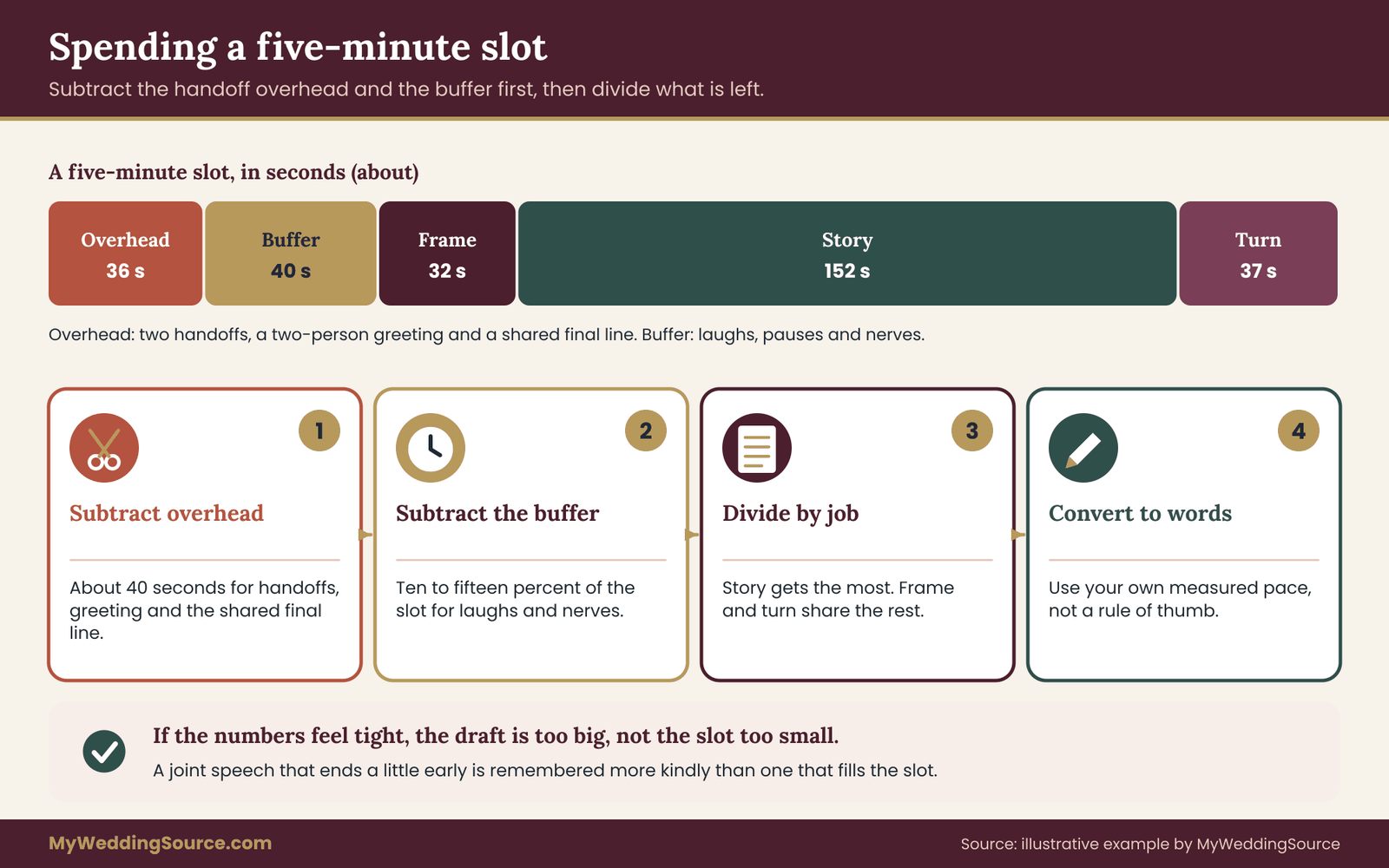
Step one: subtract the overhead. Count the handoffs and give each about eight seconds. Two handoffs cost sixteen seconds. Add about ten seconds for the greeting that introduces two speakers and about ten more for the shared final line. Overhead for a typical joint speech is therefore about forty seconds.
Step two: subtract the safety buffer. Laughs, pauses and nerves add time that no draft shows. A reasonable buffer is ten to fifteen percent of the slot. In a five-minute slot, that is thirty to forty-five seconds.
Step three: divide what is left among the three jobs. In a five-minute slot, minus forty seconds of overhead and forty seconds of buffer, you have about three minutes and twenty seconds of spoken content. Give the story the largest share, the frame and the turn the rest.
Step four: convert time to words. Measure your own speaking pace by recording yourself reading a paragraph, and count the words per minute. Many people speak at a conversational pace somewhere in the range of 120 to 150 words per minute, and a toast delivered with pauses runs slower. Use your own number, not a rule of thumb, and treat the conversion as a budget, not a target to hit exactly.
A worked time budget
Take an invented slot of five minutes. The pair measures their combined pace at about 130 words per minute during a trial read with pauses. Overhead, as above, is about forty seconds, and the buffer is forty seconds. That leaves about three minutes twenty of content, or about 430 words in total.
Split by job, the frame gets about 55 words, which is roughly twenty-five seconds. The story gets about 290 words, which is a little over two minutes. The turn and toast get about 85 words, which is about forty seconds. Those numbers are small. They look small because a toast is short, and because a joint speech spends part of its slot on the handoffs that make it work.
If those numbers feel tight, that is a signal about the draft, not about the slot. A tight budget forces the question of what the joint speech is really about, and the answer usually points to one story, not two.
How the split changes when the slot is different
A shorter slot, say three minutes, usually means the joint speech should drop to one story and a very short frame. The overhead remains about forty seconds, so the content budget is small. If the slot is under three minutes, a joint speech may not be the right format at all, and one speaker with the other joining for the toast is better.
A longer slot, say seven minutes, does not mean you should use seven minutes. It means you have the room for a second story and a slightly fuller turn. Even then, leave the buffer, and consider ending early. A joint speech that ends a minute ahead of the slot is remembered more kindly than one that fills it exactly.
Where the clock lives
Agree on who watches the time. Both speakers will be busy, and the one who is not speaking is better placed. A small watch face or a phone held low and checked only at agreed moments will do. Set two checkpoints: the end of the frame and the start of the turn. If you are more than thirty seconds behind at the second checkpoint, shorten the turn, not the toast.
The silent speaker can also manage the pace by simple signs. A raised glass at waist height can mean “wrap up.” Agree on the sign in rehearsal and use it only once. A hand on the shoulder in mid-speech reads as an interruption, so avoid it.
Writing one draft in two voices
Once the budget exists, write the speech. The most reliable method for a pair is to write one document, not two.
Open a single shared document and fill in the frame, story and turn in order. The person with the strongest hand at each job drafts it first. The other person edits. This keeps the tone coherent and surfaces overlap early. If you each draft your half separately and merge later, you will spend an evening removing the duplicate jokes and mismatched names.
Write for the ear, not the page. Spoken sentences are shorter than written ones, and they repeat key words. A sentence you can say in one breath is a good sentence for a toast. Read each line aloud as you write it, and cut any phrase that makes you stumble.
Include the handoffs as written lines. Mark them in the draft with a bold label such as Handoff one, and write the closing line, the physical cue and the microphone action in brackets beside it. That way the draft and the cue script are the same document, and nothing is lost between them.
Cutting without leaving a scar
Cutting is easier in a joint speech than in a solo one because you have a second reader. The rule is to cut from the story first, then the frame, and to protect the turn. If you remove a sentence from the middle of a story, check that the setup and the punchline still connect. Read the cut version aloud to confirm.
Do not cut handoff lines to save time. They are the least expensive seconds in the joint speech, because they do work that nothing else does. If you must save seconds, trim a story detail that does not set up the punchline.
The one-page version
At the end of drafting, make a single sheet with the full text, three bold handoff markers, and the time marks at each checkpoint. Print it in a large font. Do not rely on a phone screen, which can lock, dim or buzz with a notification mid-speech. A printed page folded once and held low is the usual safeguard, and a second copy goes with the other speaker.
Tell the emcee and DJ the final length and the order of speakers. They will announce you, hand you the microphone, and cue the music or the room, so they need the same information you do. If your joint speech is going to follow another toast, check whether the overall order works with the reception flow the couple has planned, since a long speech placed right before dinner service or a dance can change the evening’s pacing.
A short template for the handoff card
Some pairs find it helpful to keep a pocket card with a few lines of text. A handoff card for a joint speech can hold: the closing line for each handoff, the first line of the incoming speaker, the rescue phrase, the toast wording, and the sign for wrapping up. Five or six lines, in large type, small enough to hold with the glass.
The card is not a script. It is a safeguard for the moments when adrenaline wipes the page. It also gives the silent speaker something to look at if they lose track of where the speech is, so that the silent speaker is not a passenger. With the card, the draft and the budget in place, you are ready for a worked case that puts the pieces together. ## A worked case: a five-minute joint speech for two best men
The following example is invented. The names, the stories and the numbers are made up to show how the method works, and nothing in it is a real couple or a real speech. Its purpose is to show the decisions in order.
Imagine a groom named Theo. His two best men are Dev, a college roommate, and Marcus, his younger brother. The couple, Theo and Ines, are having a seated dinner for about eighty guests. The emcee has said the best man slot is about five minutes, after the main course and before dessert. The venue provides one wireless handheld microphone and a second on a stand near the head table.
Step one: the division of jobs
Dev and Marcus meet over coffee and settle the page. Dev is the more relaxed speaker and has known Theo since their first year of college. Marcus is more reserved but has the best story, from a road trip the two brothers took before Marcus’s own graduation. They choose the first assignment from earlier: Dev takes the frame, Marcus takes the story, and Dev returns for the turn and the toast, with Marcus joining at the final line.
The single thread is Theo’s habit of arriving early to everything and being quietly annoyed by people who do not. It runs through the frame, the road-trip story and the turn, and it ends on Ines, who the pair agree is the first person Theo has ever been late for.
Step two: the budget
The slot is five minutes. Overhead is two handoffs at about eight seconds, a ten-second greeting, and a ten-second final line, which makes about thirty-six seconds. The buffer is forty seconds. That leaves about three minutes and forty seconds of content. At their measured pace of about 130 words per minute, that is about 480 words. They set the frame at 70 words, the story at 330 and the turn at 80.
Step three: the microphone plan
They ask the DJ about the setup and learn that the handheld will be live and the stand microphone will be off unless asked for. They choose the handheld, passed once. Dev opens with it. At the first handoff, Dev lowers it to chest height and turns. Marcus steps forward, takes it by the handle, and begins. At the second handoff, the reverse. For the final line, the DJ is asked to bring up the stand microphone so both can speak at the same moment without passing the handheld at all.

Step four: the cue script, in prose
Here is the cue script, written the way the pair carries it on a single card.
The speech opens with Dev at the handheld. He greets the room, says that he and Marcus have known Theo for different parts of his life, one for the college part and one for the whole thing, and mentions the early-arrival habit in a single sentence. His last line before the first handoff is a setup: “There is a story about that habit that only one person here can tell, because he was in the car.”
Handoff one. Dev lowers the microphone to chest height and turns toward Marcus. Marcus steps forward half a pace, takes the microphone by the handle with his left hand, raises it, and waits for the small laugh to dip before starting. Dev steps back, holds his glass in the hand away from the audience, and watches Marcus.
Marcus tells the road-trip story: the two brothers set off hours early for a rental pickup, arrive at a closed office, and sit in a parking lot until it opens. The punchline is that Theo had already called ahead, twice, to confirm the opening hour. Marcus ends the story on a sincere note, saying that he has never seen Theo wait for anything so patiently as he waited for Ines. That is the closing line, and it works as both a laugh and a turn.
Handoff two. Marcus lowers the microphone to chest height, turns to Dev, and holds out the handle. Dev takes it, brings it up, and begins the turn: he speaks to Ines, says what the two friends have seen change in Theo, and asks the room to stand.
Final line. The DJ brings up the stand microphone. Dev and Marcus stand side by side, glasses raised, and each takes half of the toast: Dev says “To Theo and Ines,” and Marcus adds “May you always be early to each other.” The room answers, and the joint speech ends at about four minutes forty.
Step five: what the rehearsals changed
The pair rehearse three times. The first run takes five minutes and forty seconds, which is too long. The shared draft shows that the road-trip story has a long preamble about the rental company, so they cut it to one sentence. The second run takes five minutes and ten. They notice that the first handoff has a dead second: Marcus is waiting for Dev to finish turning, and Dev is waiting for Marcus to step forward. They fix it by having Marcus take the first step as Dev says the last word of the closing line.
The third run takes four minutes and forty seconds, and the microphone handoff feels automatic. They also practise the rescue phrase twice and agree that if either loses the thread, the other says, “Let me pick that up.” They do not need it on the day, but both know it is there.
What the case shows
The case is deliberately ordinary. Nothing in it relies on a clever device. It relies on a division by job, a single thread, a budget that subtracts overhead first, a microphone plan agreed with the DJ, and three timed rehearsals. A joint speech that does all of that is more likely to hold together than one that depends on charm, and charm is unreliable in front of eighty people.
It also shows the cost. The pair spent roughly two evenings on drafting and rehearsal that one speaker could have skipped. That is the trade-off of the format. The reward is a speech with two voices, and the price is coordination.
Alternatives when a joint speech is not the right shape
A joint speech is one option among several, and it is not always the best. Before committing, consider the alternatives, because choosing a better format early is cheaper than rescuing a poor one later.
Lead and closer
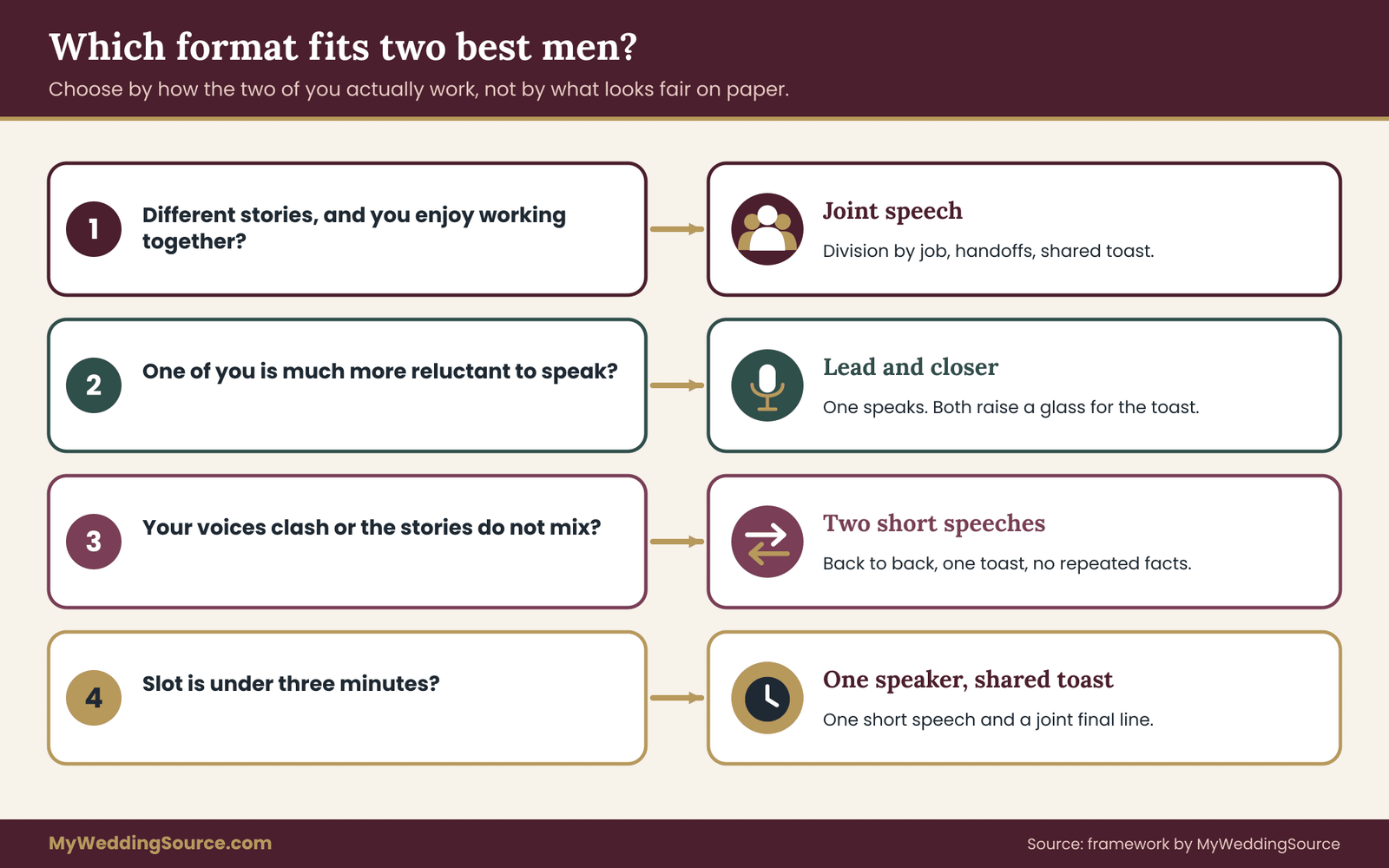
One best man gives most of the joint speech, and the other joins for the toast only. This is the simplest alternative, and it suits a pair where one speaker is far more comfortable than the other. The quiet partner still has a visible role at the moment the room is most attentive, and nobody is forced to speak at length.
The trade-off is that one voice dominates. If the second best man feels left out, give them a single sentence at the start, such as a thank-you or the first line of the toast. The structure stays simple, and the role is real.
Two short speeches back to back
Each best man gives a separate speech of two to three minutes, with a clean break between them. This suits a pair whose stories have little in common, or whose voices are too different to blend. Each speaker can write alone, and no handoff has to be choreographed.
The risk is repetition, with two openings and two closings. Reduce it by agreeing that the first speaker does not give the toast and the second speaker does, and by agreeing in advance on which facts each of you will mention, so that the same anecdote does not appear twice. The combined time should still fit the slot the couple gave for the role.
One speaker, one slide or recording
If one of you is truly unwilling to speak, a recorded message from that person, or a short written note read by the other, can carry their voice. This needs more planning than it seems, since it involves audio equipment and a technician, and it carries the same failure risks as any recorded item. The wedding day digital contingency plan covers what to do if recorded or screen-based pieces fail on the day.
Split across the evening
Some pairs prefer to appear at different points in the evening. One speaks at dinner, and the other takes a toast at the cocktail hour or later at the reception. This reduces the pressure on each, and it uses time that might otherwise go unused. It also scatters the group’s attention, so confirm the order with the emcee and the couple, and check how it fits the wedding cocktail hour plan if you want a short, informal toast there.
How to choose
Use a simple test. If both best men have a real, different story and enjoy working with each other, a joint speech is a good fit. If one is much more reluctant, choose lead and closer. If the voices clash, choose two short speeches. If time is very tight, choose one speaker and a shared toast. The decision is not a verdict on the friendship. It is a choice about how to use a small amount of the room’s time. ## Failure conditions: when a joint speech goes wrong and what to do
A plan is only useful if it names the ways it can break. A joint speech has a short list of failure conditions, and each has a practical answer you can agree on before the day. Treat this section as the one to read the night before.
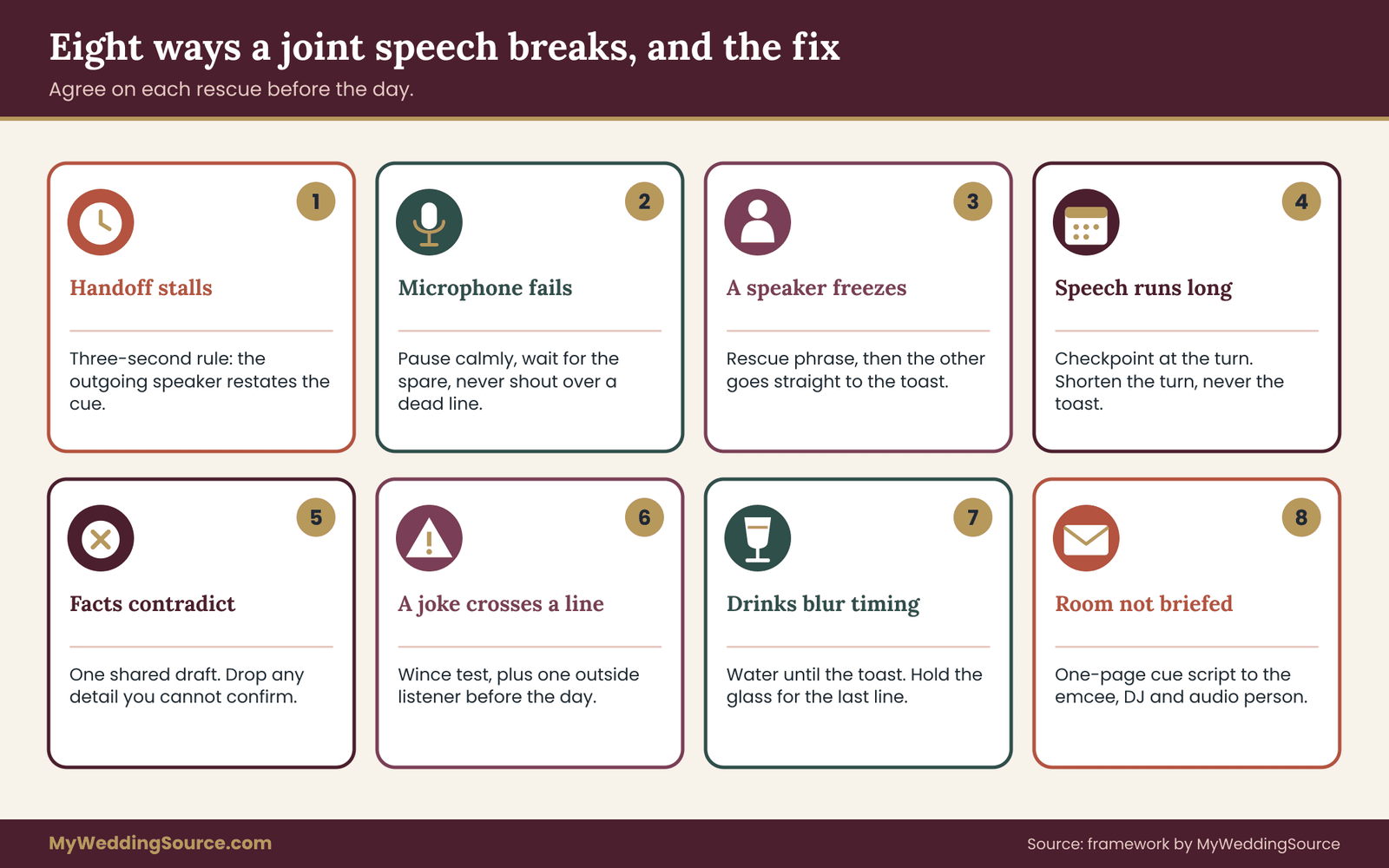
Failure one: the handoff stalls
Both speakers wait for the other. The microphone is lowered, the turn is made, and nobody starts. The audience sits in a silence that feels long even when it is short.
The fix is the three-second rule from the cue script. If the incoming speaker has not started three seconds after the microphone arrives, the outgoing speaker, who is still close, says the first words of the incoming speaker’s section or simply repeats the setup line. Better still, prevent the stall by assigning the first step to the incoming speaker, who moves as the outgoing speaker says the final word.
Failure two: the microphone dies, squeals or cuts out
A dead battery, a muted channel or a feedback squeal can interrupt any speech. In a joint speech there is a second speaker who can help, which is an advantage.
Before the speech, ask the audio contact where the spare microphone is, and who will swap it. If the microphone fails mid-speech, stop, smile, and wait for the replacement without trying to speak over a dead line. A short, calm pause costs ten seconds. A shouted speech to eighty people costs the room’s ease. The silent speaker should watch for the audio person’s signal and point to them if needed, which gives the joint speech a natural bridge back.
If feedback squeals when two live microphones are close, step apart and lower the one that is not in use. Ask the audio person before the speech which speakers are in front and where not to stand.
Failure three: one speaker freezes
Stage fright can strike a person who rehearsed well. The signs are a long pause, a repeated phrase, or a fixed stare. The other speaker is the safety net.
Agree on the rescue phrase and on what follows it. A good rescue is brief and kind: the silent speaker says, “Let me add something here,” and offers one sentence that returns the thread to the story. The frozen speaker can then rejoin. Do not make a joke at the other speaker’s expense. The room will be on their side, and it will respect the rescue.
Also agree on a fallback ending. If one of you cannot continue, the other goes straight to the toast. Know the toast line by heart, because it is the one piece you can deliver on any day, in any state. The couple will not mind a shorter speech that ends warmly.
Failure four: the joint speech runs long
Laughs run long, a story takes a detour, or a speaker remembers something that was not in the draft. A joint speech has more places to expand, and so more risk.
Use the checkpoints from the time budget. If you reach the start of the turn thirty seconds behind, cut the turn to a single sentence and go to the toast. Cutting the toast is the wrong cut. The silent speaker’s wrap-up sign, a glass raised to waist height, should be treated as an instruction, not a suggestion.
Never add a new story on the day. The most reliable predictor of an overlong toast is a last-minute addition that was not rehearsed and has no handoff.
Failure five: the two speakers contradict each other
One of you says the trip was in June, the other says it was in May. One says the groom’s car was blue. Small contradictions make the speech feel unrehearsed and sometimes start a mild argument in the middle of the toast.
Prevent this by writing one draft, as described earlier, and by checking facts in the shared document. For any story told by one speaker, the other should read it as a fact-check. If you cannot agree on a detail, drop it. A story rarely needs a date or a color.
Failure six: the content crosses a line
Two people can misjudge a joke together. A story that seemed harmless in the apartment sounds different in a room with grandparents, the partner’s family and a manager from work. This is the most serious failure because it cannot be undone.
Use the wince test from earlier, and add a second check. Ask a trusted person who is not speaking, such as another friend or a family member, to hear the joint speech once before the day. Ask them to flag anything that could embarrass the groom, the partner or a guest. For wider guidance on family boundaries and what not to say, the wedding etiquette resource is a useful companion.
Failure seven: alcohol changes the plan
Wedding speeches often take place after the guests, and the speakers, have been drinking. A drink or two may relax a speaker, and more will blur timing and judgment. The CDC publishes general information on alcohol and health, and the practical point is simple: speakers should limit their intake until after the toast. Hold your glass for the final line, but pour water or something mild earlier.
Failure eight: the plan is not shared with the people who run the room
The emcee announces only one name. The DJ starts a song during the second handoff. The audio person has muted the second microphone. These failures cost nothing to prevent and a great deal to repair.
Give a one-page copy of the cue script to the emcee, DJ and audio contact. Tell them the order of speakers, the length, the microphone plan and the signal for the final line. Ask them to announce both names. A two-minute conversation before dinner is worth more than any amount of rehearsal on the microphone handoff.
Rehearsal: three runs that make the joint speech reliable
Rehearsal is where the seams are tested. A joint speech needs more rehearsal than a solo one, not because it is harder to say, but because it has more moving parts. Three runs, each with a different purpose, are enough for most pairs.
Run one: the read-through. Sit together and read the full speech aloud, with the handoff lines, without moving. Time it. This run finds the overlong parts, the clumsy sentences and the contradictions. Edit the shared draft after it.
Run two: the walk-through. Stand up, with a stand-in for the microphone such as a hairbrush or a rolled sheet of paper, and perform the full sequence with the physical cues. Practise the turn, the step, the take and the step back. Time it again. This run finds the dead seconds and the places where one of you is not sure what to do with your hands.
Run three: the dress rehearsal. Use the real microphone if you can, or one that behaves like it. Many venues and DJs will allow a brief test, often at setup before guests arrive. Stand where you will stand, with the glass, the card and the shoes you will be wearing. Record it on a phone and watch it once. Seeing yourself from outside is uncomfortable and useful.
Rehearsing the failures
A fourth, shorter run is worth doing for the pair that tends to worry. Practise the rescue phrase, the three-second rule, and the move to the final toast. It takes about five minutes, and it turns a vague fear into a known routine. The silent speaker should also practise the wrap-up sign.
Where to rehearse
Choose a room that is not your living room if you can, because a larger space makes you speak at the right volume. A garage, a park or an empty hall will do. Speak to an imaginary back row. If someone is willing to play the audience, ask them for one reaction and one note, and no more. Too many opinions blur the plan.
How much is enough
Three full runs over a week or two, with a day between each, is a reasonable baseline. More runs give diminishing returns, and the last run should not be the night before, when nerves are highest. If the pair is short of time, do the walk-through and the dress rehearsal, and skip the extras.
The goal is not to memorize the speech word for word. The goal is to know the structure, the handoffs and the ending so well that the words follow. If you know the first line of each section and the toast by heart, you can recover from nearly any slip, and the card in your pocket does the rest. ## Day-of coordination for a joint speech
Everything above comes together on the day, and most of the day-of work is conversation with the people who run the room. A joint speech touches the emcee, the DJ or band, the audio person, the catering lead and the couple. A short check with each, before guests sit down, is the best use of ten minutes.
Start with the emcee or the person who will introduce you. Confirm the order, the names and the pronunciation of both. Ask them to say both names in the introduction so that guests understand a pair is coming up. Confirm the time of the speech and what comes before and after it. If the joint speech follows another toast or sits next to a dance or a cake cutting, the wedding vendor timeline is the document that holds those handoffs together, and the emcee will usually have a copy.
Then speak to the audio person. Ask which microphone you will have, whether it is on, where the spare is and who will deliver it. Ask for a quick level check. Say your first line, not a joke, into the microphone and ask whether the level suits both speakers, since two voices rarely sit at the same volume. Ask where the speaker is pointed, so you do not stand in front of it.
Where to stand and where to sit
Think about the picture the room sees. A head table, a stage or the open floor in front of the couple are all common places for a speech. If the speakers are at the head table, decide in advance whether you will stand there or step out. A step out gives you more room for the handoff, and it puts you in the audience’s sightline.
If your seating is fixed, the wedding seating chart guide explains how reception tables are laid out, and it is worth asking where best men are placed, since a seat that is hard to leave quickly makes an awkward start. Sit near the path to the microphone and the middle of the room, and keep the spare card in a jacket pocket, not on the table.
Standing order matters for the photos and for the audience. Decide which side each of you will stand on and keep it the whole time. The speaker holding the microphone usually stands nearer the couple, and the silent speaker stands slightly back.
Access and comfort
Some guests may rely on amplified sound, on lip reading or on a sign language interpreter. If the couple has arranged an interpreter, ask where they will stand and whether they need your text in advance. Speak slowly and face the room, and pause after jokes to give an interpreter time to catch up. The ADA National Network and the Americans with Disabilities Act resources at ada.gov set out the rights of people with disabilities in public venues; for a private wedding, the couple and venue decide what to provide, and a short question to the couple is the practical step.
Volume is also a comfort issue. A speaker who is too loud near a speaker stack can hurt nearby ears, and one who is too quiet strains the room. The audio person controls the level, and your job is to hold the microphone at a steady distance. NIOSH, part of the CDC, publishes general guidance on noise exposure, which is useful background for anyone on the audio side.
The last ten minutes before the joint speech
Do a small routine. Drink water. Check the card and the second copy. Confirm the microphone is where it should be. Stand together once, quietly, and say the first lines under your breath. Agree on the wrap-up sign. Walk to the spot. Many speakers find that a slow breath out before the first word does more than any trick.
Silence your phones and put them in a pocket you will not touch. A phone buzzing against a microphone is a small disaster, and a phone held in the glass hand is a distraction in photographs.
Material that is not yours: quotes, lyrics and borrowed lines
Toasts often reach for a famous quote, a song lyric or a line from a film. For a private spoken toast, brief quoting is a common practice, and in the United States copyright law does not forbid every use of someone else’s words. The U.S. Copyright Office explains the basics of copyright and the fair use doctrine on its website, and the safest habit is to keep quotations short, say whose they are, and avoid reading long passages aloud.
Two further cautions apply to a joint speech. First, do not copy a published or online speech, even partly. Beyond the rights question, the room can tell, and a borrowed speech lacks the stories that make a toast yours. Templates and examples are useful for structure, but the words should be your own. Second, if the toast will be filmed, recorded or streamed, material you quote may be used in a way you did not plan for. Ask the videographer how the speech will be used. For a recorded or streamed wedding, the question is the couple’s to decide, and it is best asked before the day.
A joint speech has an extra duty here. If one speaker brings a quote, the other should check it. Misquoted lines and wrongly credited sayings are common, and two sets of eyes catch more. If you cannot confirm the source, either drop the quote or present it as something you heard, not as a fact.
Your next steps
This week, do three things. First, agree between you who opens, who tells which story and who gives the toast, and write the division on one page. Second, ask the couple or emcee for the exact slot and the order of speakers, and ask the audio contact what microphone you will have. Third, open one shared draft and write the frame, the story and the turn in that order, with each handoff as a written line.
Then schedule three rehearsals across the next two weeks and put a copy of the cue script in the hands of the emcee and DJ. The method is small. A division of jobs, a seam at each handoff, a microphone plan, a time budget that subtracts overhead, and a short list of rescues will carry a joint speech through most rooms. For how the joint speech fits into the evening, return to the reception flow and cue-sheet guides on this site, such as the ceremony cue sheet article, and let the couple’s schedule set the final clock.
FAQ
Is a joint speech from two best men a good idea?
It works when both men have separate stories and are comfortable working together. It works less well when one is very reluctant or the stories overlap heavily. A joint speech costs extra coordination, so weigh that against the reward. If the fit is doubtful, a lead-and-closer format, where one speaks and both toast, is simpler and still gives each man a visible role.
How long should a joint speech by two best men be?
Ask the couple or emcee for the slot, then plan to finish slightly under it. As a rough guide, a pair can take a few minutes more than one best man, because of handoffs, but not double. Subtract about forty seconds of overhead and a safety buffer before dividing the remaining time between the frame, the story and the turn.
Who should speak first in a joint speech?
Choose the speaker who is more comfortable starting cold, because the first thirty seconds set the tone. That person usually gives the frame and often returns for the turn. The other speaker takes the story or the largest block. Neither is more important, and the audience will read the structure as deliberate if you open with a short line explaining who you both are.
How do two best men share one microphone?
Use a four-beat handoff: the outgoing speaker finishes the closing line, lowers the microphone to chest height and turns; the incoming speaker steps forward and takes it by the handle; the outgoing speaker steps back; then the new speaker begins. If the venue can supply a second microphone or a stand, ask for it and confirm who unmutes it.
What if one best man gets nervous or freezes?
Agree on a rescue phrase beforehand, such as “Let me add something here,” and a fallback in which the other speaker goes straight to the toast. A short pause is normal and the room will wait. Having a printed card and knowing the first line of each section also helps. Rehearse the rescue once so it feels familiar, not like an emergency.
Should both best men give the final toast?
It is a good option, and it gives a joint speech a distinctive ending. Either both speak the final line together, or each says half of it. Practice the exact wording and the glass raise, and confirm with the DJ that no music begins until the room has answered. If one speaker is uneasy, let one man say it while the other raises his glass.
Can we use quotes or song lyrics in a joint speech?
Short quotes, credited to their source, are common in private spoken toasts, and the U.S. Copyright Office explains copyright and fair use on its website. Keep quotes brief and verify the wording and the source. Do not read long passages, and do not copy another person’s published speech. If the toast is recorded or streamed, check with the couple and the videographer.
What should we tell the emcee, DJ and audio person?
Tell them the order of speakers, both names and their pronunciation, the length, the microphone plan and the signal that the toast is about to start. Give them a one-page copy of the cue script. Ask where the spare microphone is, whether the second microphone will be muted, and that no music starts until the final toast has been answered.
Sources
- U.S. Copyright Office, copyright basics and registration information
- U.S. Copyright Office, fair use overview
- Federal Communications Commission, wireless microphone and equipment information
- Occupational Safety and Health Administration, workplace safety guidance on cords and trip hazards
- ADA.gov, Americans with Disabilities Act information and technical assistance
- National Institute on Deafness and Other Communication Disorders, voice, speech and hearing information
- Centers for Disease Control and Prevention, alcohol and public health
- National Institute for Occupational Safety and Health, noise and hearing loss prevention
- Library of Congress, research guides and reference resources
- Toastmasters International, public speaking resources