
A dress seller who lists a wedding gown online is making a set of factual promises to a stranger: this is the dress in the photos, it is the size I say, the flaws are the ones I disclosed, and it will arrive as described. This guide gives you a listing specification and a verification checklist so that each promise is written down, checked and backed by evidence before the first buyer messages you.
Before you post, build a one-page listing spec with five blocks: identity, measurements, condition, terms and proof. Measure the dress flat and on a form, photograph every flaw in daylight, and write the return and payment terms yourself. Compare selling paths by net proceeds, not headline price. Then verify every buyer: payment confirmed in your own account, matching name and address, and no request to move off the platform. Ship tracked and insured, and keep the evidence for at least as long as the buyer can open a dispute.
Selling a gown online sounds simple for any dress seller. You take some photos, write a few sentences and wait. In practice the sale fails in predictable places. The measurements were taken once and never checked. A stain that looked like nothing under the hallway light shows up in the buyer’s window. A buyer claims the dress was not as described, and the dress seller has no photos that prove otherwise. Or the payment “confirmation” turns out to be a forged email, and the dress is already in the mail.
None of these failures requires bad luck. Each one comes from a missing record, and a missing record is cheap to fix before the listing goes live. That is the whole idea of this article: treat the sale as a small documented transaction rather than a casual post.
A note on scope. This is general consumer information, not legal, tax or financial advice, and platform rules, fees and tax reporting thresholds change, so confirm current terms with the platform and the issuing agency before you rely on any figure.
This guide focuses on the online sale itself. It does not repeat how to decide whether to clean, preserve or keep the gown, which the site’s guide to wedding dress fit and alterations touches on from the fit side, and it does not try to tell you what price your dress will fetch. Prices depend on the designer, the season, the condition and the market on the day you list, and no article can responsibly promise a number.
What a dress seller promises when listing online
When you hand a dress to a buyer across a counter, the buyer can touch the fabric, try on the dress and walk away. Online, the listing does all of that work. The buyer relies on your words, your measurements and your photos, and then pays for something they have never held. That reliance is what makes your listing a set of promises, whether or not you meant it that way.
Think of the promises in four groups. The first is identity: what the dress is, who made it and where it came from. The second is fit: the numbers a buyer needs to decide whether it can work on their body. The third is condition: what has happened to the fabric, the seams and the beading, including everything you would rather not mention. The fourth is delivery: when it ships, how it is packed, and what happens if it does not match.
A careful dress seller writes each group down before listing. A careless dress seller leaves some of them implied, and implied promises are the ones that turn into disputes. If your listing says “excellent condition” and the hem has a gray band, the buyer reads that as a promise and you read it as an opinion. The gap between those two readings is where refunds, bad reviews and chargebacks come from.
There is also a quieter reason to be thorough: the buyer is almost never in a hurry once they find a dress that fits their date and budget, but they are very good at noticing absence. A listing without a label photo, without a hollow-to-hem measurement or without a clear stated return policy tells a buyer that the dress seller either does not know or does not want to say.
Serious buyers move on, and the remaining inquiries tend to come from people who care less about the answers, which includes the people running scams. A complete listing is therefore also a filter. It attracts buyers who read and repels many who do not.
Finally, consider what you want from the sale. For most people it is a combination of getting a fair amount back, having the dress go to someone who will wear it, and being finished within a reasonable time. Those goals compete, and every dress seller has to rank them. A rock-bottom price sells fast but may feel like a loss.
A high price with thin documentation sits for months and then sells to the least careful buyer. Decide in advance which goal wins when they conflict, and write it down. A dress seller who has a floor price and a deadline makes calmer decisions at every later step.
The three kinds of reader your listing must satisfy
Your listing is read by three people at once. The buyer wants to know whether the dress will fit and look as promised. The platform’s review process, if it has one, looks for prohibited claims, mismatched photos and signs of fraud. And a dispute handler, who may read the listing months later, looks for what you actually said and what you could prove.
Write for the third reader and the first two are usually satisfied too, which is the habit of a careful dress seller. A dispute handler cannot ask you what you meant, so every important statement has to stand on its own, with a number, a photo or a date behind it.
The listing spec sheet every dress seller needs
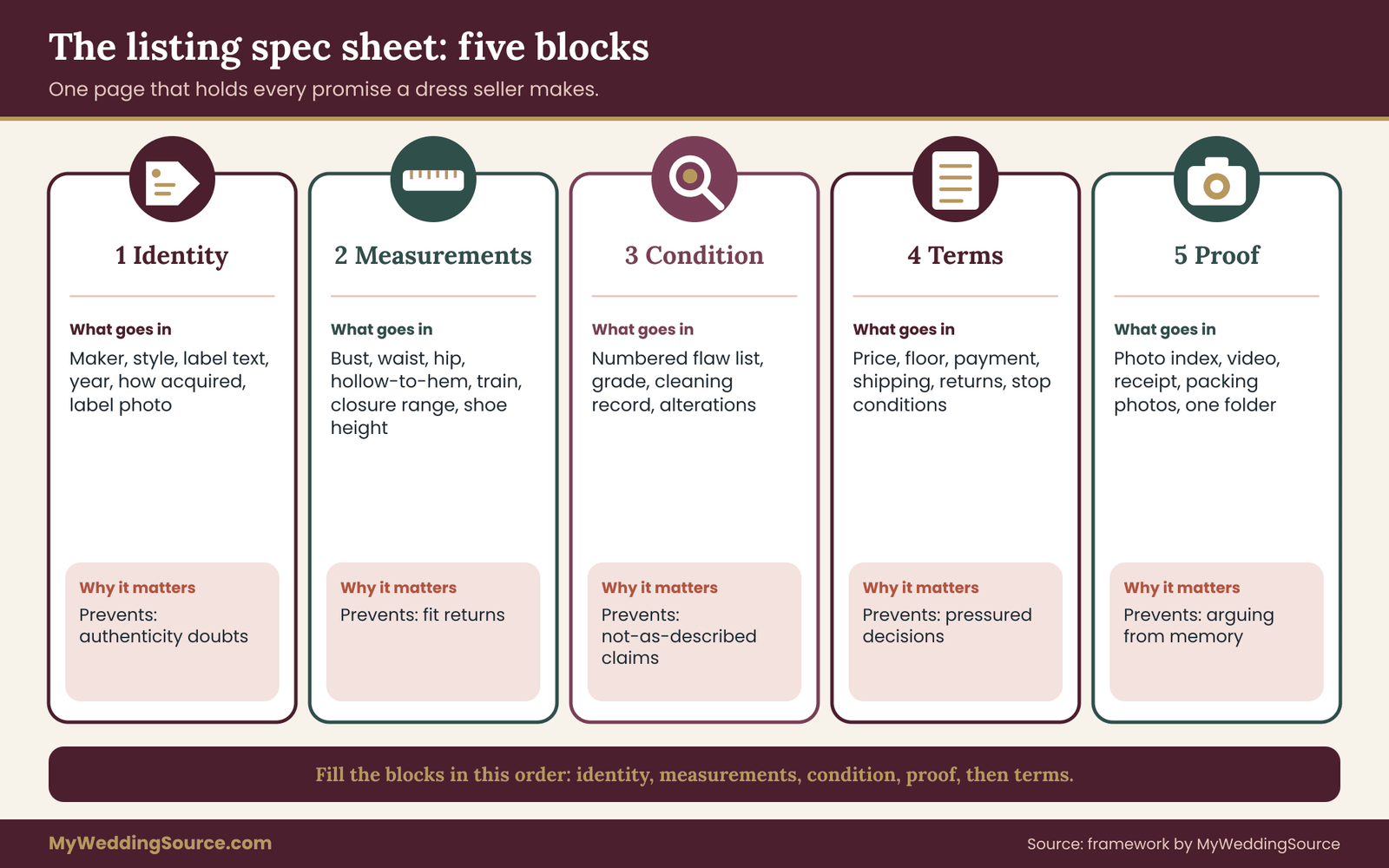
The framework in this guide is a single page you complete before posting anything. Call it the listing spec sheet. It has five blocks, and it doubles as your verification record later because it holds everything you promised in one place.
Block one, identity. Designer or maker, style name or number, label text, year of purchase or approximate model year, whether the dress is new-with-tags, worn once, or altered, and how you acquired it. Include a photo of the interior label and of any care tag. If you cannot find the style number, say so rather than guessing.
Block two, measurements. Bust, waist, hip and hollow-to-hem, each taken with the method described later in this guide, plus the corset or zipper closure range, the train length, any built-in cups or boning, and the height of the shoes you wore when the hem was set. Record whether each number was taken flat or on a form.
Block three, condition. A written inventory of every flaw: stains, marks, snags, missing beads, hem wear, odor, color shift, repairs and alterations. Beside each entry goes a photo number. If you have the dress cleaned before listing, record the date, the cleaner and what the cleaner said they did and did not treat.
Block four, terms. Your asking price and floor, accepted payment methods, shipping method and who pays, handling time, whether you accept returns and under what conditions, and how long the listing stays open. Write these as sentences a stranger could follow.
Block five, proof. An index of the photos, the receipt or proof of purchase if you still have one, a short video of the dress turning in daylight, and a folder where all of it lives. This block is what you will open if a buyer later says something about the dress is wrong.
Notice what the sheet does not contain: marketing language. A dress seller who wants warmth can add it to the first line of the listing, never to the sheet. There is no place for “stunning” or “dream” on it. Those words can go in the listing’s opening line if you like, but they carry no weight in a dispute. The five blocks are what carry weight.
How to fill the sheet in order
Do the blocks in the order identity, measurements, condition, proof, then terms. Terms come last on purpose. Once you have measured and photographed honestly, you know what you are really selling, and your price and return policy will follow from that. Many a dress seller does it backward: they pick a price from a screenshot of a similar listing, then try to write a condition description that justifies it. That path produces vague language because the facts are being bent to fit the number.
Plan on two or three evenings for the first pass. The measuring and photographing take the longest because they depend on daylight and a second person. The writing is quick once the facts are on the sheet. If you rush the early blocks, you will pay for it in buyer questions you cannot answer and, occasionally, in a returned dress.
Why one sheet beats scattered notes
A dress seller who keeps the details in a phone note, a camera roll and three message threads tends to contradict themselves. The listing says 42 inches at the hip, a reply says 41, and the label says a size the buyer assumed meant 42. When a dispute arrives, you are comparing your own inconsistent statements.
A single sheet gives the dress seller one source of truth. Every answer you give a buyer comes from it, and if you discover a mistake, you correct the sheet first and then the listing, and you tell any interested buyer about the change in writing.
Store the sheet and its supporting files together. If you already follow a records habit from the wedding, the same folder logic described in the guide to organizing wedding records after the event works well here: one folder, one index, and a copy somewhere other than the device you used to take the photos. A sale record is small, but a dress seller may need it long after the dress has left home.
Identity and provenance: what the dress seller can prove
Identity sounds like the easy block, because you know which dress it is. But buyers do not know, and counterfeit or misattributed gowns are a real feature of online resale. A buyer searching a designer name wants to be sure the label is real and the style is what you say. The dress seller’s task is to supply evidence, not assurances.
Start with the interior label. Photograph it flat, in daylight, close enough that the printed text is readable, and do the same for any care tag and any numbered production tag sewn inside the bodice or along a seam. Do not crop out the text to hide a store name; buyers read that as hiding something. If the label has faded or been removed during alterations, say so plainly and explain how you know the designer, for example “purchased from a named boutique, receipt available.”
Next, the style. Designers use style names, numbers or both, and the same silhouette can appear in several seasons with small changes. If you have the original receipt, order confirmation or fitting paperwork, those documents are your best identity evidence. A dress seller who can show a dated receipt with the style number has answered most authenticity questions before they are asked. Redact your address, payment details and anything else private, but leave the style, date and shop name visible.
If there is no paperwork, a dress seller can still describe the dress accurately without overclaiming. Write “label reads X, style number not visible” rather than “authentic X gown.” The first statement is true whatever the label turns out to mean. The second is a claim you cannot support, and if a buyer’s own authentication later disagrees, your listing becomes the problem.
Do not borrow marketing language you cannot back up
Many listings copy phrases from the original designer’s page: “hand-beaded French lace,” “silk crepe,” “Italian tulle.” If the dress seller’s notes say the fabric content is unknown, do not paste a fiber claim from a website. Fabric content is something the care tag or maker’s materials state. Read the tag and report it. If the tag lists polyester and the website says silk, the tag wins in a dispute. Where you do not know, say “fiber content not listed on the tag I have.” That sentence is boring and very safe.
The same caution applies to words like “vintage,” “couture,” “custom” and “one of a kind.” Each implies facts about origin and production. Use them only if the dress seller can document them. A gown made by a seamstress for you is custom in the ordinary sense, but if the buyer expects a designer’s atelier, the word misleads. Describe what happened: “made to order by a local seamstress from a commercial pattern, never mass-produced.” Plain facts hold up better than prestige words.
Record the dress’s history in three lines
Buyers like a short history because it signals care. Write three lines: when and where you bought it, what happened between purchase and wedding (alterations, bustle added, hem shortened), and what has happened since (worn once, cleaned on a given date, stored in a box or hanging). Keep the tone neutral. You are not telling a love story; you are giving a chain of custody.
If the dress was cleaned, name the type of cleaning and whether the cleaner flagged anything they could not treat. If it was preserved in a sealed box, say whether the box has been opened. A sealed preservation box that you open and photograph for the listing changes the storage condition, and honest disclosure says that.
Identity red flags in your own listing
Run a quick self-check before posting. Does the listing name the designer in a way the label supports? Does the style name match across the title, the description and the photos? Is the year plausible given when you bought it? Do the photos show the same dress throughout, with the same train length, bustle points and any custom changes?
Inconsistent identity details are exactly what automated and human reviewers look for when sorting scams from honest listings, and a mismatch can get a post removed or flagged even when you did nothing wrong.
One more point. A dress seller who bought the gown from someone else should be clear about being a second owner. You cannot attest to its history before you got it. Say what you know and mark the rest unknown.
Measurements a dress seller can defend
Measurements are the part of the listing most likely to cause a returned dress, and the part where a few careful minutes saves the most trouble. Label sizes are not reliable between designers and, for wedding gowns specifically, they often run differently from street sizes. A buyer comparing a “size 8” gown to their usual size 8 can be off by several inches. Buyers have their own measuring routines; here the question is how the dress seller records numbers a buyer can trust.
Measure the dress, not the person who wore it
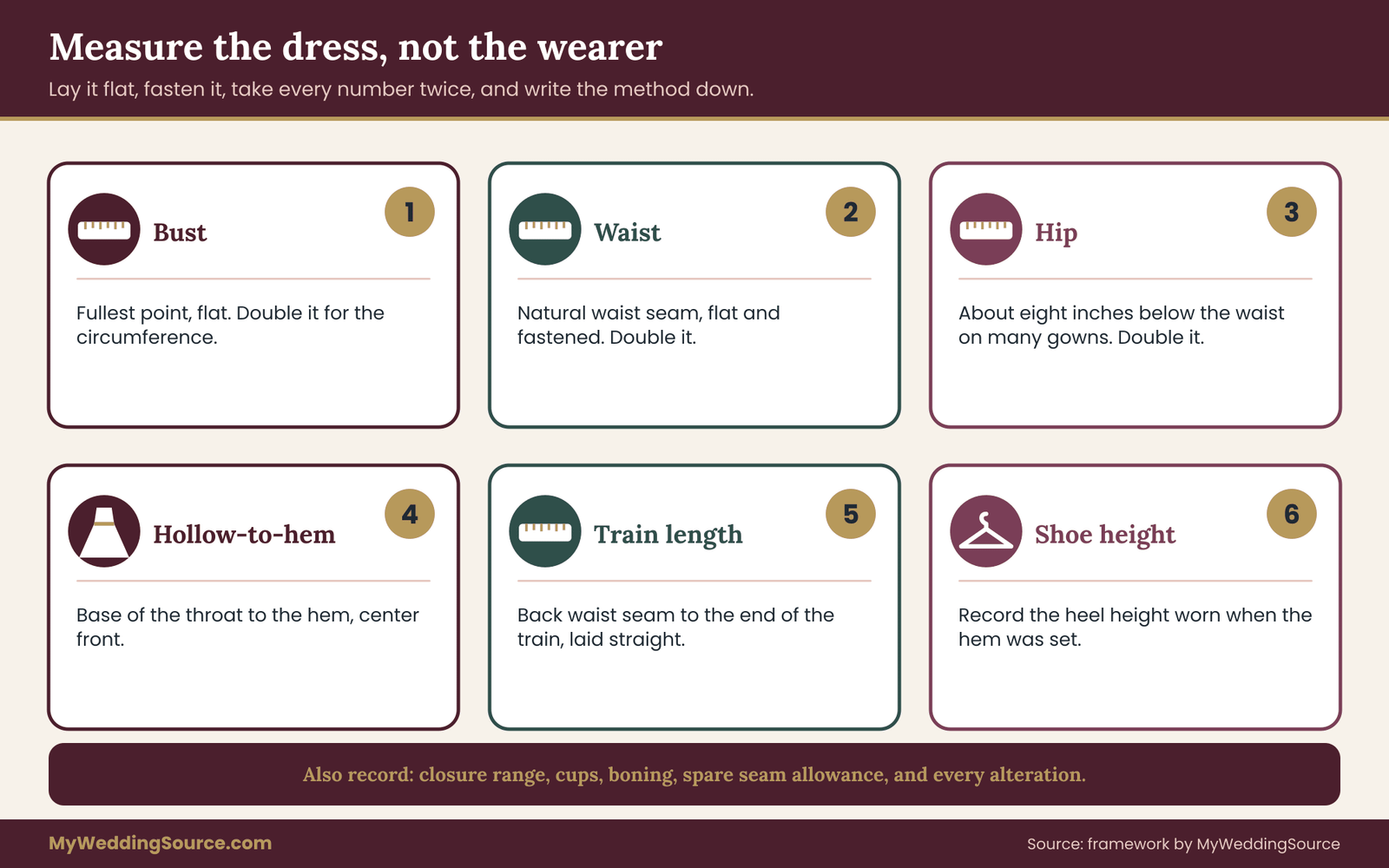
Your own body measurements at the wedding are interesting but not the point. The buyer needs the garment’s dimensions. Lay the dress flat on a clean sheet, fasten it as it would be worn, and measure each point once the fabric lies smooth without pulling.
Take the bust across the fullest part, then double the flat reading to get the circumference. Do the same at the natural waist and at the hip line, which for many gowns is about eight inches below the waist but varies by silhouette. If the bodice has a corset back, record the closed measurement and the open range, and note how much gap a typical lacing leaves. For zip-back dresses, say how much room the zipper and any internal seam allowance leave for alteration, but only if you have checked.
Then measure length. Hollow-to-hem runs from the hollow at the base of the throat to the hem, down the center front. If the dress has a train, measure the extra length from the back waist seam to the end of the train separately. Record the shoe height you wore, because a hem set for a three-inch heel will pool on a buyer in flats. This single note prevents more fit disappointment than any other line in the listing.
Record how the numbers were taken
Two sellers can measure the same bust and report numbers two inches apart if one pulled the tape tight and the other laid it loosely. Write the method into the sheet: “measured flat, buttoned or zipped, tape lying on the fabric, doubled for circumference, no stretching.” A buyer who knows the dress seller’s method can interpret the numbers, and a dispute handler can see you were consistent.
Take every measurement twice, on different days if you can, and use the second pass to catch mistakes. If the two readings differ by more than half an inch, measure a third time and investigate why. Common causes are a twisted tape, a dress that shifted on the sheet, or stretch in bias-cut fabric after hanging.
For stretch fabrics, note both the resting and the comfortably stretched reading, and describe the stretch honestly. Do not say “fits sizes 6 to 12” because that is a claim about bodies, not about the dress. Say “bust 36 inches at rest, stretches to about 39 without strain.” The buyer decides what that means for them.
Add the fit facts a tape measure misses
Several features change fit without changing the numbers. Built-in cups: are they sewn in, removable or absent, and what cup size do they suit? Boning: is the bodice structured enough that the waist cannot be let out? Seam allowance: is there fabric to let out at the side seams, and how much, according to your own inspection or a seamstress’s note?
Alterations already made: if the bodice was taken in, the original size cannot be restored, and you should say so. If the hem was shortened, the buyer needs to know it cannot be lengthened.
This is where the dress seller’s honesty matters most, because alterations are permanent facts about the garment that a buyer cannot see in photos. Name each one. The site’s guide to wedding dress fit and alterations explains why some changes are reversible and others are not, and a buyer who understands that will ask exactly these questions.
A short script for buyers who ask for a different number
Buyers will ask for measurements you did not list, such as underbust, shoulder width or the distance from armhole to waist. A dress seller should answer only when the measurement is possible. A good reply is: “I can measure that tomorrow in daylight and send a photo of the tape against the dress.” That response gives the buyer evidence, not a guess, and it adds a timestamped photo to your proof folder.
Decline requests that ask you to judge fit on a specific body: “Would this work on someone five foot four with a long torso?” You cannot answer that. A kind and accurate reply is: “I can give you every measurement of the dress, and you or a seamstress can compare them to yours.” It keeps you from making a promise you cannot keep.
When your numbers and the label disagree
Sometimes the label says a size and your measurements say another. A dress seller should report both and not reconcile them. The buyer can sort out the difference, and your honesty about the mismatch protects you if the dress arrives and a buyer’s friend measures it. Describe the label size as “label size” and the measured numbers as “measured.” A dress seller should never write “true to size” for a bridal gown. It is a phrase with no consistent meaning across designers, and it invites a dispute you cannot win.
Condition grades and honest flaw disclosure
Condition is where listings go wrong most often, and the reason is mostly psychology. You know the dress. You remember the day. The small stain near the hem feels like part of the story, not a defect. A buyer sees only a list of statements and a set of photos, and every omission reads as a surprise. Disclosing flaws is not a sacrifice for a dress seller. It is the cheapest dispute prevention a dress seller has.
Use a simple internal grading scale, and define it
Words like “excellent” and “good” mean different things to different people, so every dress seller should define a scale and publish the definitions in the listing. Here is one that works for wedding gowns, using plain language rather than industry jargon.
New with tags. Never worn, never altered, original tags attached. This applies to sample sales, cancelled orders and ordered-but-unworn gowns. If any tag is missing, it is not this grade.
Worn once, clean. Worn for a single event, no visible marks in daylight, hem clean to the eye, no odor, no missing beads or snags beyond a count you can state. Professionally cleaned or not, you say which.
Worn once, minor wear. Small, specific, photographed flaws: a few missing beads, a light gray edge on the hem, a faint mark that did not come out in cleaning. The flaws are listed one by one.
Worn once, visible wear. Marks, stains, snags or repairs a buyer will see without looking for them. Priced and described accordingly, and a good candidate for a buyer who plans to alter or redesign.
Whatever words you choose, tie each grade to a written definition inside the listing. “Condition: worn once, minor wear (see numbered flaw list below)” tells a buyer where to look. “Condition: excellent” tells them nothing a dispute handler can use.
Inventory every flaw, then photograph each one
Go over the dress inch by inch with a daylight source and a second person. Check the underarms, the inner bodice where makeup and deodorant touch, the waistline where hands and sashes rub, the hem and train where the dress meets the ground, the zipper and closure area, the lace edges, and the lining. Look at the dress inside out as well. Stains often show up better on the inside lining than on the face fabric.
Write each flaw as a short sentence with a location, a size and a type: “Gray scuff, about two inches, left side of hem, approximately four inches from the side seam.” Give the flaw a number and a matching photo number. If a buyer later says the hem was dirty, the dress seller points to flaw number three and photo seven, taken before shipping. Specificity wins disputes for the dress seller.
Include smell. Odor is difficult to prove either way, but it is a common complaint with stored gowns, and buyers do ask. Say what you smell: “neutral,” “faint cedar from storage,” “none detected after airing for a week.” If you stored the dress in a closet with scented products, say so. If you cannot judge, because you have lived with the dress for a year, ask a friend to smell it and report their impression, or say “I may be used to it.”
What cleaning does and does not claim
Cleaning before listing is a decision with trade-offs, a call that depends on the fabric, the stain and the cost. For the listing, what matters is accuracy. If the dress was professionally cleaned, record the cleaner’s name, the date, and any written note about untreated areas. Say “cleaned on date, cleaner noted a remaining mark at the hem.” Do not write “like new after cleaning” unless a reasonable person would agree on seeing it.
A dress seller who did not clean the dress should say “not cleaned since the wedding” and describe what a buyer should expect. Some buyers prefer to arrange their own cleaning. Others do not want to handle it. Either way, the buyer needs the fact. A dress seller who says “uncleaned” and prices accordingly usually fares better than one who says “cleaned” without a receipt.
A dress seller should avoid home treatments before listing unless the fabric is well understood. A rushed stain treatment can leave a ring or damage beads and lace, and then you have a new flaw and a worse conversation. When in doubt, photograph the dress as it is and disclose.
Alterations and repairs belong in the same list
Treat every alteration as a condition fact. Bustle points, a taken-in bodice, a shortened hem, added straps, a hand-stitched repair: each goes on the list with a photo from the inside and the outside. Repairs deserve special care, because a hidden repair that a buyer discovers is the single quickest way to turn a happy sale into a dispute. If you hand-sewed a bead back on, say so. It is a small thing, and saying it makes you sound like someone who looks after the dress.
Photos that make a dress seller credible
Photos are the dress seller’s strongest evidence and your most persuasive material, and they should be treated like exhibits. The goal is not glamour. It is a set of images that lets a stranger inspect the dress without being in the room.
Light, background and consistency
Shoot in daylight, by a window with indirect light or outdoors in open shade. Avoid direct sun, which flattens texture and washes out ivory and champagne shades, and avoid warm indoor bulbs, which turn white fabric yellow. Turn off filters and any automatic beauty or color enhancement your phone applies. Use a plain, neutral background, such as a pale wall or a clean sheet, so that colors are not bounced onto the fabric.
Keep the same setup for every photo so that color stays consistent from the first image to the last. If a buyer sees a bright white dress in the main photo and a cream dress in the close-up, they will assume one of them is misleading. Where the dress has a true color that is hard to capture, such as a blush or a pale champagne, include one photo with a plain white sheet of paper beside the fabric so the buyer can judge the shade.
A shot list that answers questions before they are asked
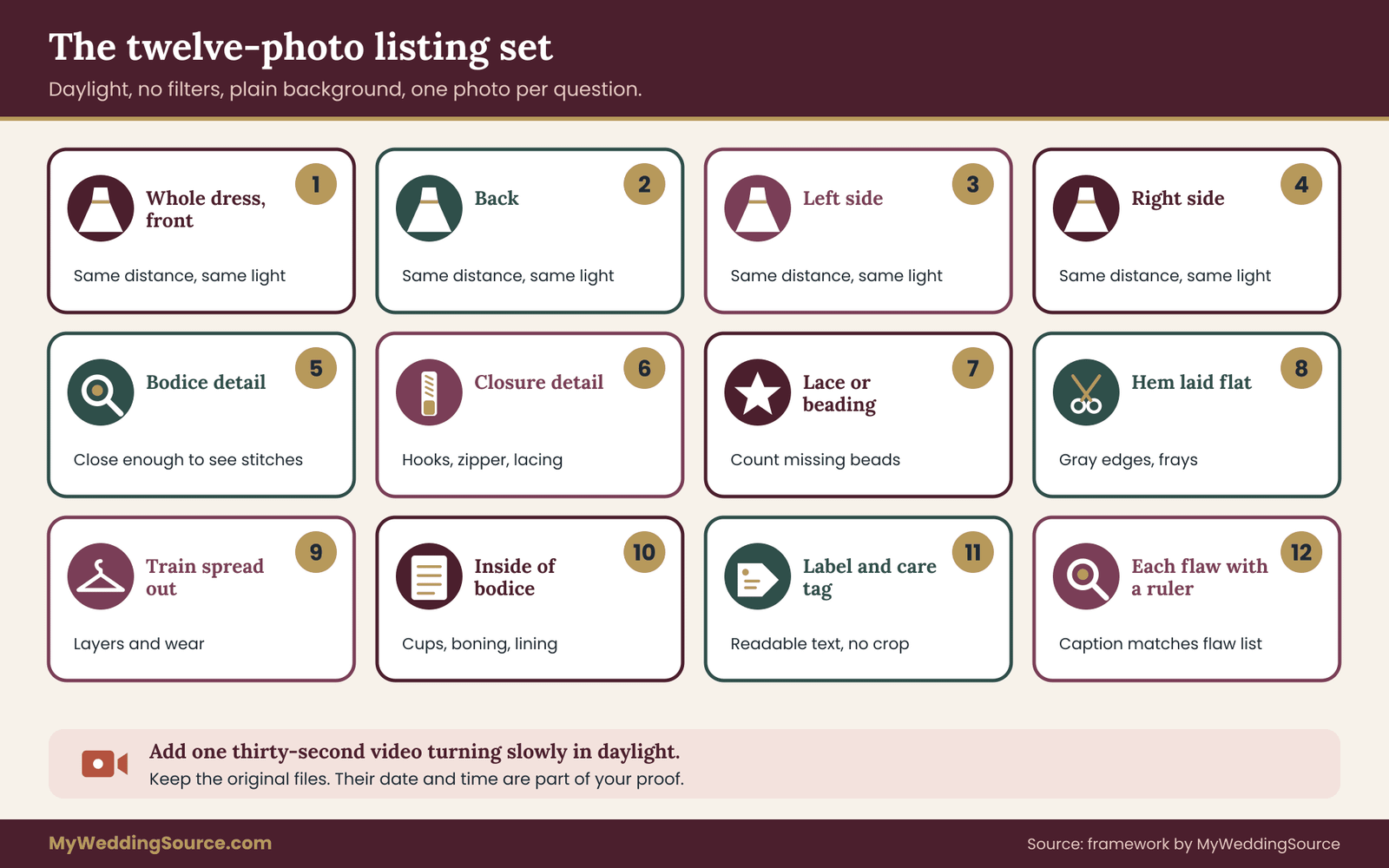
Plan on at least a dozen photos. The first is the whole dress, front, on a form or a hanger with a clean background. Then back, left side and right side, at the same distance. Then a detail of the bodice, a detail of the closure, a detail of the lace or beading, the hem laid flat, the train spread out, and the interior of the bodice including any cups or boning.
Then the label, the care tag and any tags. Finally, one photo for every flaw on your list, each with a ruler or a coin in frame for scale.
Number the photos to match the flaw list. In the listing, add a short caption to each image, such as “Photo 9, hem, left side, scuff.” Those captions will save you many questions and also create a clean record.
Photos you should not post
Do not use stock photos from the designer’s website or from another seller. Aside from the problem of misleading buyers, many platforms prohibit it, and it is a pattern fraudsters use. Do not post photos of yourself in the dress where your face, your venue or your wedding date make you identifiable if you would rather keep those private; crop or choose different images.
Wedding photos can show the dress well, but they are professionally lit and edited, so label them clearly as “wedding day photo, professional editing” and do not make them your only visuals. Never edit photos to hide a flaw, even lightly. If you retouched a gallery photo for any reason, do not use it as evidence of condition.
If your photographer took the wedding photos, check your contract before using them in a public listing. Some photographers retain copyright and set rules on use. This is a good reason to rely mainly on your own photos.
Add one short video
For a dress seller, a thirty-second video of the dress turning slowly on a form, in daylight, with no cuts, answers several suspicions at once. It proves the dress exists, shows how fabric moves and catches light, and makes the condition harder to misrepresent. Save the original file with its date and time metadata in your proof folder. If a buyer later claims the dress arrived different, the video and your packing photos form a before-and-after record.
Do not narrate promises in the video. Let the footage show the dress, and keep your written statements in the listing where they can be quoted precisely. Remove anything personal in the background, such as mail, framed photos, or a visible street number. A dress seller’s home is not part of the sale, and scammers do read backgrounds.
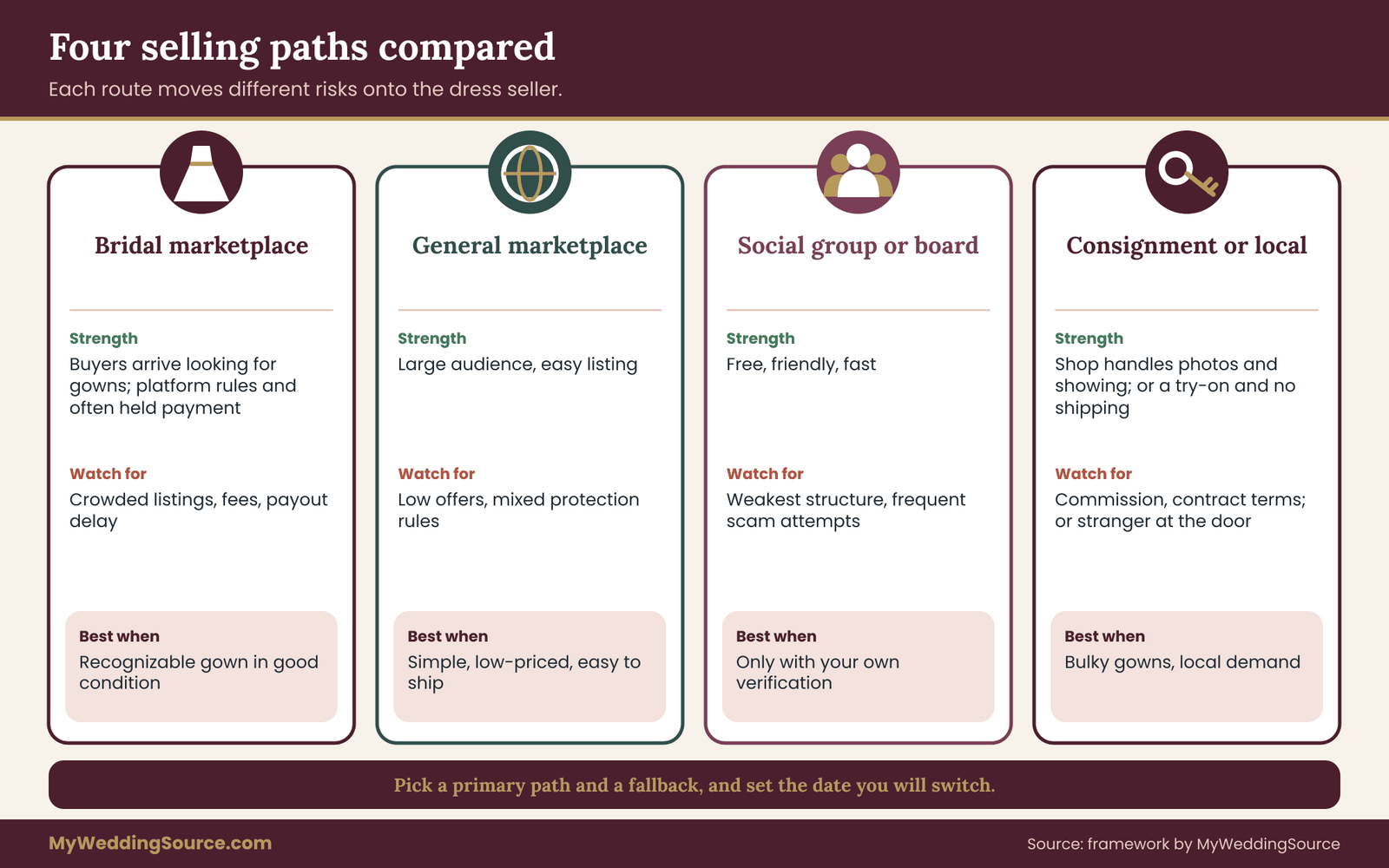
Where a dress seller sells determines who sees the dress, what you pay, how fraud shows up and what protection you have if something goes wrong. Instead of ranking venues, which would require current market data and fee schedules this article cannot verify, compare the paths by their structure. Each of the four common routes has a different set of trade-offs, and your listing spec sheet works on all of them.
Dedicated bridal resale marketplaces
These are sites built for used wedding gowns. Buyers arrive already looking for a dress, the categories and filters match how brides search, and the platform often has rules for photos, descriptions and messaging. Many hold payment until delivery is confirmed, which reduces some fraud but adds a delay before you are paid. Fees vary and change, so read the current fee page and seller terms before you list. Look for the commission rate, any listing or promotion charge, payment processing fees and the rules on shipping labels and returns.
The strength of this path is audience and structure. The weakness for a dress seller is competition: your gown sits among many similar ones, and a plain listing will not stand out. A complete spec sheet is your advantage here, because buyers on these sites compare listings side by side and tend to reward the ones that answer questions without being asked.
General online marketplaces
General marketplaces reach a far larger audience but put your dress next to everything else. Buyers are less specialized, which can mean more low offers and more questions about shipping and sizing. Protection depends on the platform: some offer seller and buyer protection programs with specific rules, others leave transactions largely between the two parties. Read how the platform defines “item not as described,” what evidence it asks for, and how long a buyer has to open a claim.
On a general marketplace, a dress seller should be especially strict about keeping every message inside the platform. Off-platform conversations remove the platform’s protection and are a common step in fraud. If a buyer asks to continue by text or email, the safest answer is a polite no, which the verification checklist later in this guide scripts.
Social media groups and local listing boards
Groups organized around bridal resale are popular because they feel friendly and cost nothing to post. They also have the weakest structure. Payment is usually arranged between individuals, protections are limited to whatever the payment method offers, and scam attempts are frequent because posters are public and often in a hurry. Group rules vary, and administrators cannot verify anyone.
A dress seller who uses this path must supply the structure. Insist on a payment method with dispute rights for the buyer’s protection and a record for yours, ship tracked and insured, and keep the listing’s wording identical to your spec sheet. Be wary of buyers who have new accounts, empty profiles or pressure you to move fast. Many honest buyers exist in these groups, but the ratio of surprises is higher, and you carry more of the burden of verification.
Consignment and local sales
A bridal consignment shop sells the dress for you, usually for a share of the sale price, and handles photos, showing and payment. Terms differ: contract length, commission, who pays for cleaning, what happens to unsold dresses, and whether the shop can mark down the price without asking you. Read the consignment agreement in full and keep a copy. If you go this route, your spec sheet still helps, because it gives the shop an accurate record and a basis for their description.
A local sale by in-person handover removes shipping risk and lets the buyer try the dress on. It also puts a stranger in your home or at a meeting point. Choose a public, well-lit place, bring another person, and agree on the payment method in advance. Do not accept a check you cannot verify, and be cautious with payment apps where a buyer can reverse the transfer later.
A local sale still deserves the same written terms: what the buyer has seen, what they have agreed to, and that the sale is final or not.
A decision rule for choosing
Use a simple rule instead of chasing the biggest audience. If the dress is a recognizable designer gown in good condition and you have time, a dedicated bridal marketplace usually fits. If it is simple, easy to ship and priced low, a general marketplace is workable. If you want convenience and can accept a smaller share, consignment is straightforward. If you want to avoid shipping altogether and live in an area with active local demand, a local sale works.
Each dress seller should choose a primary path and a fallback, set a date at which you switch, and note both on the spec sheet. A dress seller who lists in three places at once risks selling twice, and untangling that costs more than the extra exposure earns.
When selling online is the wrong choice
Online resale suits a gown that is easy to describe and ship, in a size and style many buyers search for. Not every dress fits that description, and a thoughtful dress seller knows when to choose another route. These are the common cases.
If the dress has significant damage that you cannot photograph clearly or describe fairly, a local seamstress, redesign or donation may suit better than a sale that will generate disputes. If the dress is very large, heavily beaded or hard to pack, shipping cost and damage risk can erase the gain, and a local buyer or consignment shop may be a better fit.
If it is an antique or heirloom item, an appraiser or a textile conservator can advise on handling and value before you list. The Smithsonian Institution publishes general information about caring for textiles that can help you understand when professional input is wise.
If you are unsure whether you want to sell at all, wait. The dress costs nothing to keep while you decide, and a rushed sale can end in regret. Some couples preserve the gown, some pass it to family, some redesign it into another garment. The site’s guide to wedding dress fit and alterations explains how alteration choices affect what a dress can become, and its after-wedding sections give a wider frame for keep, preserve or sell.
A quick test for the dress seller before listing
A dress seller should ask four questions. Can I describe every flaw and photograph it? Can I measure the dress in a way a buyer can verify? Can I pack and ship it for a cost that leaves a reasonable net? Am I willing to follow the stop conditions even if a buyer seems perfect? If any answer is no, fix it or choose a different path. The test takes a minute and it can save weeks.
Timing and patience for the dress seller
A dress seller often feels pressure to sell quickly, especially while the wedding memories are fresh and storage space is tight. A dress seller should resist that when the pressure comes from anything but your own plans. A listing that sits for a few weeks has cost you nothing. A rushed deal accepted from the first persuasive message often has the most red flags.
Set a review date, usually a few weeks after listing, at which you decide whether to adjust the price, improve the photos, change platforms or stop. Use the same sheet each time and note what you changed.
Fees and net proceeds for a dress seller
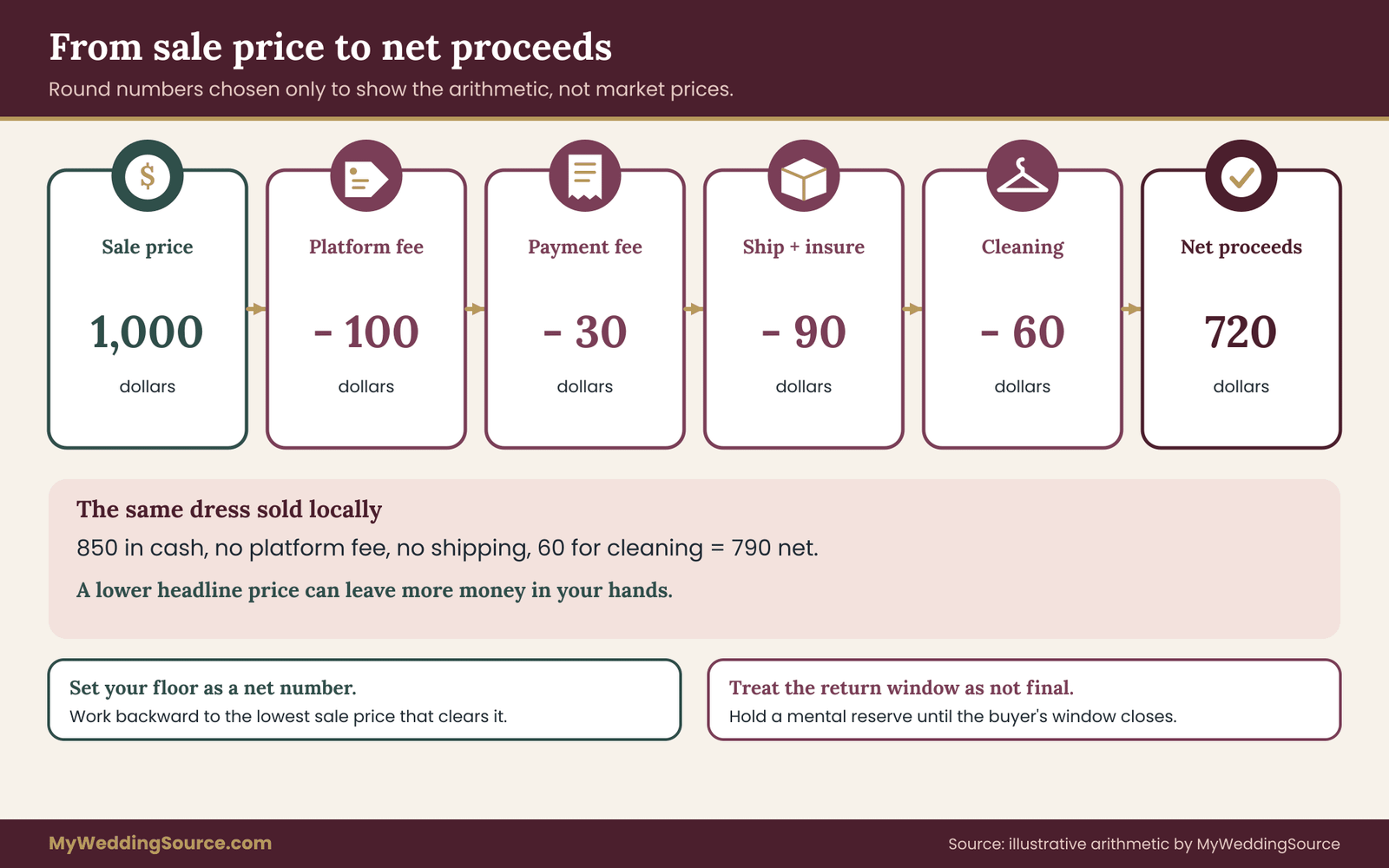
A sale price is not what a dress seller receives. Fees, shipping, insurance and cleaning all come out of it, and some arrive after the sale. For the dress seller, the practical measure is net proceeds, the amount that reaches your account after every cost. Compare paths on net proceeds, and write the calculation on your spec sheet before you accept an offer, so a pressured moment does not rewrite the math.
The cost lines to expect
Not every platform charges every item, and amounts change, so list the ones that apply to your route and fill in the current numbers from the platform’s own pages.
Platform commission or listing fee. Some platforms take a percentage of the sale, some charge to list, and some do both. The terms are on their fee page.
Payment processing. If the platform or a payment service handles the transaction, a processing fee often applies, sometimes a percentage plus a fixed amount. Check whether it is taken from you or added for the buyer.
Shipping and packaging. A wedding gown is bulky. Ask a carrier for current rates by weight and box size, and include a sturdy box, tissue and tape. Decide who pays: if the buyer pays, the listing should say so.
Insurance and signature confirmation. Carriers sell declared-value coverage with limits and conditions, so read the carrier’s terms. Insurance is a cost, but it also matters in a loss claim.
Cleaning or repair. If you clean or repair before listing, that cost belongs in the calculation, and you should ask whether it is likely to change the price enough to be worth it.
Returns. If you accept returns, you may pay return shipping or refund the sale in full. Plan for that possibility when pricing.
A formula you can fill in
Write it this way on the sheet: net proceeds equal sale price, minus platform fee, minus payment fee, minus shipping you pay, minus insurance, minus cleaning or repair, minus any return risk reserve. The last item is not a charge but a mental allowance. If you think there is a real chance of a return, treat the first week or two after delivery as not final money.
To see how the formula behaves, use round numbers chosen only for arithmetic, not as a market claim. Suppose a dress sells for 1,000 dollars, a platform takes ten percent, payment processing takes three percent, shipping and insurance cost 90 dollars together, and you paid 60 dollars to clean it. The deductions are 100, 30, 90 and 60, which total 280, leaving 720.
If you had a local buyer paying 850 in cash with no fees and no shipping but still the 60 cleaning cost, you would receive 790. The lower sale price netted more. Real fees will differ; the lesson is that a lower headline number can win.
Accepting offers with your floor in mind
A dress seller should set a floor price that is a net number, not a sale price. Work backward from the platform’s fee structure to the lowest sale price that clears your floor. When a buyer offers less, you can answer quickly and calmly, because the math is already done. A dress seller should not negotiate by message with a buyer who has not asked a single question about the dress; a low offer with no questions deserves a short, polite counter or no reply.
Tax and records
For a private dress seller, selling a personal item often does not create taxable income if you sell at a loss, but rules depend on your situation, and reporting thresholds for payment platforms have changed over time. The Internal Revenue Service publishes current guidance on selling personal items, and the platform will state whether it reports your sales.
Keep the receipt for what you paid for the dress, the sale record and the payout statement together. If you are unsure whether anything applies to you, ask a qualified tax professional; this article cannot answer that for you.
The cash-flow side of a sale can matter too. If the proceeds are part of paying down a wedding balance or funding a honeymoon, the timing of payout, hold periods and the return window all change when money is really available. The guide to wedding cash-flow planning explains how to treat uncertain incoming money as a later, smaller line instead of counting it early.
Fraud risks aimed at the online dress seller
Most conversations about online fraud focus on buyers being cheated. A dress seller is a target too, and the scams are well documented by consumer agencies. A wedding gown is an attractive item: high value, easy to ship, and often sold by someone who is busy and emotional. The patterns below recur in federal consumer guidance, and knowing them in advance makes them easy to spot.
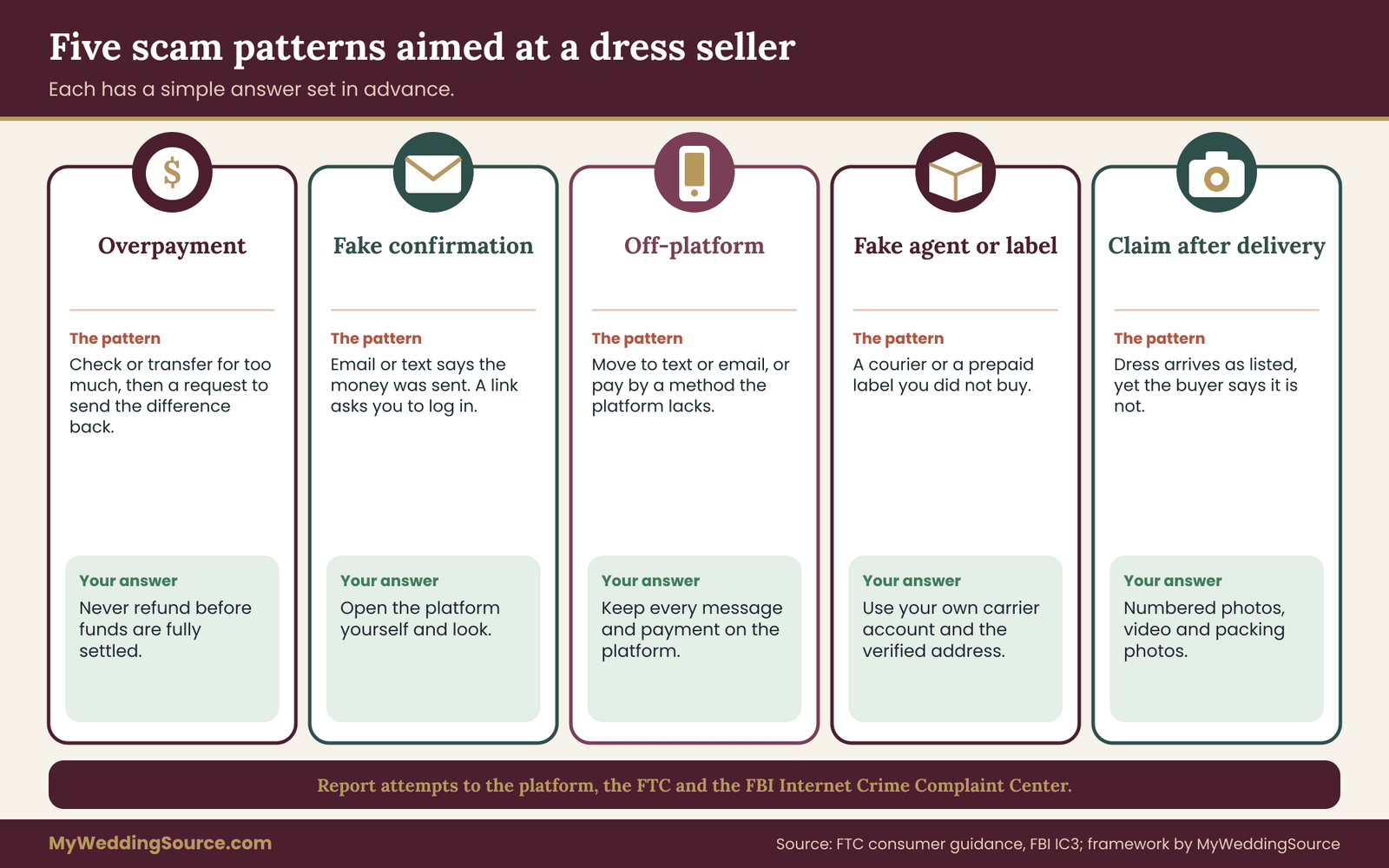
The overpayment scam
A buyer agrees to your price, then sends a payment for more than the amount, by check, money order or a transfer. They say it was a mistake, or that the extra covers a shipping agent, and ask you to send the difference back. Days later the original payment fails or is reversed, and you have refunded real money against a payment that never existed.
Banks may make funds available before a check is fully verified, so a deposit that shows in your account does not mean the check is good. The Federal Trade Commission explains this pattern on its consumer site.
The dress seller’s defense is a rule set in advance: never refund an overpayment before the funds are fully settled, and never send money to anyone to “balance” a transaction. If a buyer overpays, cancel the transaction through the platform, or ask the buyer to send the correct amount, and wait.
Fake payment confirmations
A scammer sends an email or text that looks like it came from the platform or a payment service, saying the money has been sent and will be released after you ship. The message can copy logos and wording closely. A dress seller should not ship because of a message. Open the platform or payment app yourself, by typing the address or using your own bookmark, and check whether the funds appear in your account. If they do not, the message was not real, whatever it said.
Treat links in messages with suspicion even when they appear to come from a friend or from the platform. A link can lead to a page designed to capture your login. If a message asks you to log in to “confirm” a payment, go to the site directly instead.
Requests to move off the platform
A buyer who wants to switch to email, text or a messaging app, or to pay by a method the platform does not support, is asking you to give up the platform’s records and protections. Honest buyers sometimes ask innocently, so a dress seller’s calm reply works: “I keep everything on the platform so both of us are covered.
Happy to answer any question here.” If the buyer insists, that is information. The same applies to unusual payment methods. Federal consumer guidance warns about requests for gift cards, wire transfers, cryptocurrency and payment apps used with strangers, because these are hard or impossible to reverse.
Shipping scams and fake agents
Some scammers say they are traveling, serving overseas or buying as a gift, and arrange for an “agent” to collect the dress, or send a shipping label of their own for you to use. A label you did not buy can lead to a package that is not insured and cannot be tracked to a real address.
Use your own carrier account and send the dress only to the address on the verified order, with tracking and, for a high-value gown, a signature requirement. If the shipping address differs from the buyer’s billing or profile address, treat it as a reason to pause and verify, not a reason to hurry.
Claims after delivery
Not every fraud attempt happens before the sale. A buyer can receive a dress that matches the listing and still claim it does not, hoping for a refund and a free gown, or swap in a different item and ship that back. The dress seller’s best protection is evidence: the numbered photo set, the video, the flaw list, the packing photos and, for high-value dresses, a unique detail photographed before shipping, such as the interior tag with a small, discreet mark you recorded.
If a return is requested, inspect the dress on arrival, photograph it in daylight and compare it with your records before refunding.
Impersonation and listing theft
Fraudsters also copy real listings, including yours, and post them elsewhere at a lower price to collect payments from buyers for a dress they do not own. If a buyer writes to say they saw your dress for sale at another price or on another site, take it seriously. Search for your photos, report the copy to the platform, and say in your own listing that the dress is only sold through the account named there. This is one more reason to keep your original files with their metadata.
Where to report
If you are targeted, report the attempt to the platform first, because it can act on the account. In the United States, the FTC accepts reports of fraud, and the FBI’s Internet Crime Complaint Center takes reports of internet-enabled crime. If you paid or shared account information, contact your bank or payment provider quickly. Keep every message and screenshot. You do not need to be sure it is a scam to report it; a report is a record.
The verification checklist before you ship
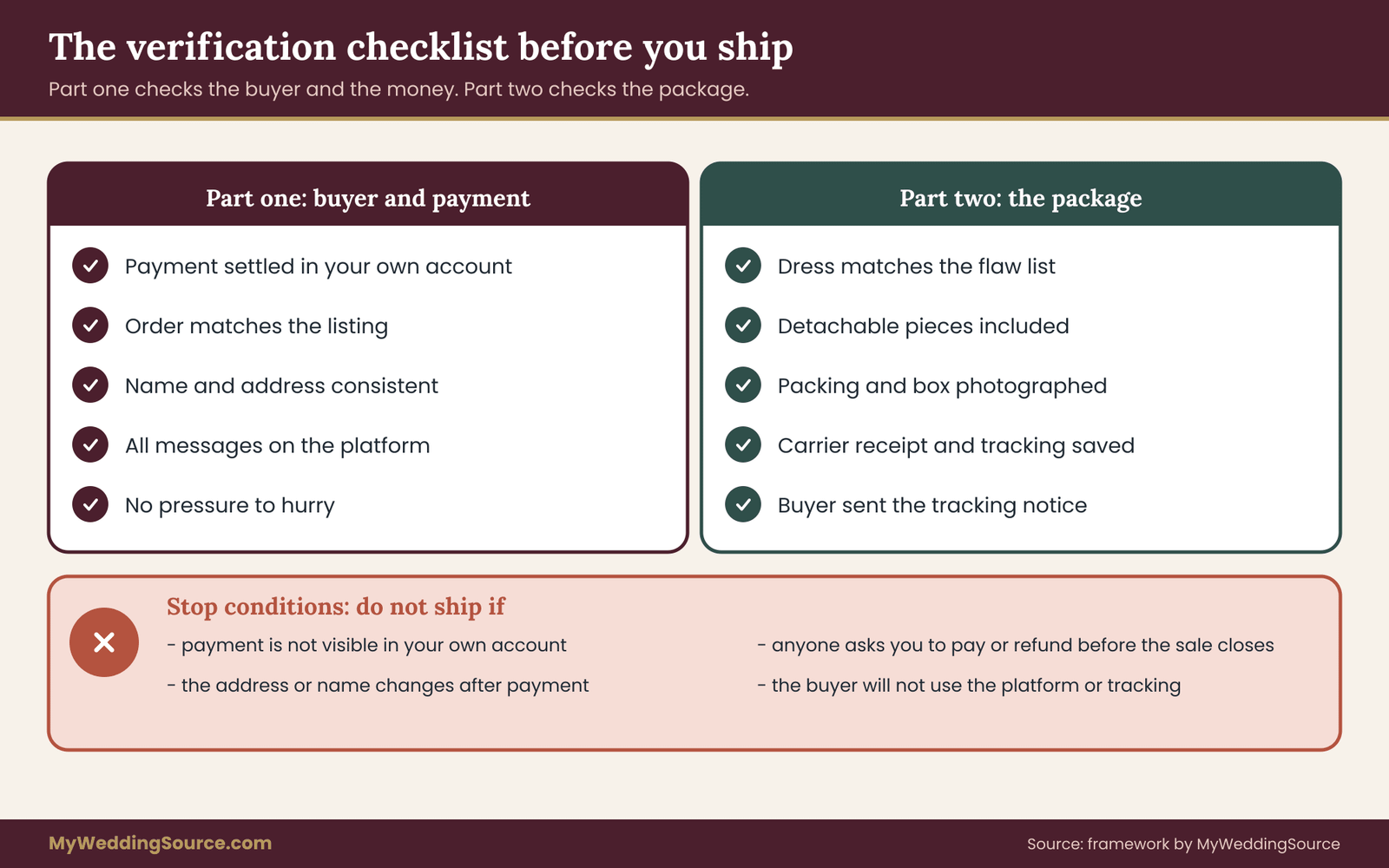
Everything above comes down to a repeatable check you run before the dress leaves your house. The checklist has two parts: verify the buyer and the payment, then verify the package. A dress seller should run it every time, including for the friendly buyer who has been polite for a week. Politeness is not verification.
Part one: verify the buyer and the payment
Payment is settled in your own account. Open the platform or payment service directly and confirm the funds are available to you, not pending and not shown only in a message. If the platform holds payment until delivery, confirm the hold appears there and that the order status says the buyer paid.
The order matches the listing. The item, price and terms on the order are the same as your spec sheet. If the buyer changed the price, shipping method or return terms in a message, correct the order or decline.
The name and address are consistent. The shipping name should match the buyer’s account name, or the difference should have an explanation you accept. A gift to another person is plausible; an address that changes after payment is not.
All conversation is on-platform. Messages that moved off the platform stop the check until you can put the facts back in a record. Screenshot anything you need to keep.
No pressure is present. A buyer who insists you ship today, skip tracking or avoid photos of the package is applying pressure. Pause the sale.
Part two: verify the package
The dress matches the sheet. Lay it out and compare it with your flaw list and photos one last time. Confirm bustle points, hooks and any detachable pieces are with the dress, because forgotten belts and sleeves are a common complaint.
Packing is photographed. Take photos of the dress folded, wrapped and boxed, and of the box sealed with the label visible.
Carrier details are recorded. Tracking number, declared value, insurance and signature requirement go on the sheet, along with the weight and dimensions the carrier recorded.
The buyer has the shipping notice. Send tracking through the platform, with the delivery window and what to do on arrival.
Failure conditions: when to stop
The checklist is only useful if it can say no. Define stop conditions in advance and treat them as final. Stop and do not ship if payment cannot be confirmed in your own account, if the buyer asks you to pay or refund anyone before the sale closes, if the address or name changes after payment without a clear reason, if the buyer will not communicate through the platform, or if the buyer asks for a shipping method that avoids tracking.
Stopping a sale is unpleasant for any dress seller. Shipping a dress to a scammer is worse, and the dress is gone for good.
Every dress seller should write the stop conditions on the sheet in their own words. When the pressure arrives, you do not have to decide whether you are being unfair; you simply read the list. A dress seller who commits to the rule before the first message avoids most of the doubt that scammers rely on.
A script for declining politely
A dress seller can decline without accusing anyone. Try: “I’m sorry, I can only complete sales through the platform, with payment confirmed in my account before I ship. If that doesn’t work for you, I understand.” The sentence is short, honest and hard to argue with. Honest buyers usually accept it. Scammers usually disappear, which is the result you want.
For a dress seller wanting another vetting model, the site’s vendor due diligence checklist shows the same habit applied to wedding vendors: ask for verifiable evidence, check identity through an independent channel, and refuse to be rushed. Those habits transfer directly to a private sale.
Packing, shipping and returns
A dress seller’s work does not finish at the sale. For the dress seller, packing and shipping are where fabric gets damaged, and where a good transaction can still become a claim. The principles are simple: protect the fabric, document the condition, and use a method that leaves a trail.
Packing the dress
A wedding gown is bulky and delicate. Check that it is dry, clean to the extent you have disclosed, and free of anything that can transfer, such as a loose dye from a sash or a damp hem. Fold it as gently as you can, keeping the beaded and lace areas on the inside of folds where they will not rub against the box, and put clean, acid-free tissue between layers if you have it.
The Smithsonian Institution’s conservation pages offer general guidance on textile handling that applies here: avoid anything that traps moisture, avoid sharp creases where you can, and avoid contact with materials that stain or degrade fabric.
Use a new or clean box that is large enough to avoid forcing the dress, sturdy enough to survive stacking, and sealed well at all seams. A garment bag inside the box protects against dust and spills. Avoid wrapping the dress in a way that would be hard for the buyer to unwrap without tearing, and include any detachable pieces in a labelled bag. If rain or a delay might soak the package, a protective outer layer is cheap insurance.
Do not put cash, notes with personal data or anything unrelated inside. Include only a short printed note with the order number and your return address, or follow the platform’s rules on packing slips.
Choosing a carrier and service
A dress seller should use a tracked service and declare the value you actually expect to recover, with insurance if offered. Read the carrier’s coverage terms rather than assuming “insured” means a full refund: carriers set limits, exclusions and documentation requirements for claims, and the rules differ between services. A signature requirement is worth the small extra cost for a high-value gown, because it creates a record of who received it.
The United States Postal Service and the major private carriers publish current rates and coverage terms on their sites, and you should check them on the day you ship.
Dress sellers do better shipping from a counter, not a drop box, so you receive a receipt with a scan on the day. Photograph the receipt and the label before you leave. If the carrier weighs and measures the package, make sure the figures on the receipt match what you entered.
Return terms you can actually keep
A dress seller should decide before listing whether to accept returns, and write the answer in the listing. Three honest options exist. You can accept returns for items not as described, with the buyer paying return shipping for a change of mind. You can accept returns only when the dress differs from the listing in a material way. Or you can sell as final with a thorough description, accepting that some buyers will pass because of it. The dress seller should choose what is livable and stay consistent.
For a return window, platforms often impose their own rules, and a general marketplace may override your terms. Read them. If you accept a return, say who pays the shipping, how quickly you will refund after receipt and what condition the dress must be in. A buyer who has altered, worn or cleaned the dress has changed it, and the listing should say that returns require the dress to be in the condition it left your hands, unaltered and unworn. State that in neutral language, not as an accusation.
When a return reaches the dress seller, photograph the unopened package and the opened one, compare the dress with your records, and note any difference in writing the same day. If you agree it matches the original condition, refund as promised. If it does not, contact the platform or the buyer with your photos, and follow the dispute process in the platform’s rules.
Documenting delivery
Track the package until delivery and save the confirmation. Message the buyer once the package arrives, asking them to inspect the dress and tell you within the platform’s window if something is wrong. Many problems surface in the first day or two, and an early message gives you the chance to fix a misunderstanding while the buyer is still friendly.
Keep your whole proof folder for at least as long as the longest dispute window you know of, and longer if your payment method or platform allows claims later. A year is a reasonable habit; the platform’s own terms govern.
A worked case from listing to payout
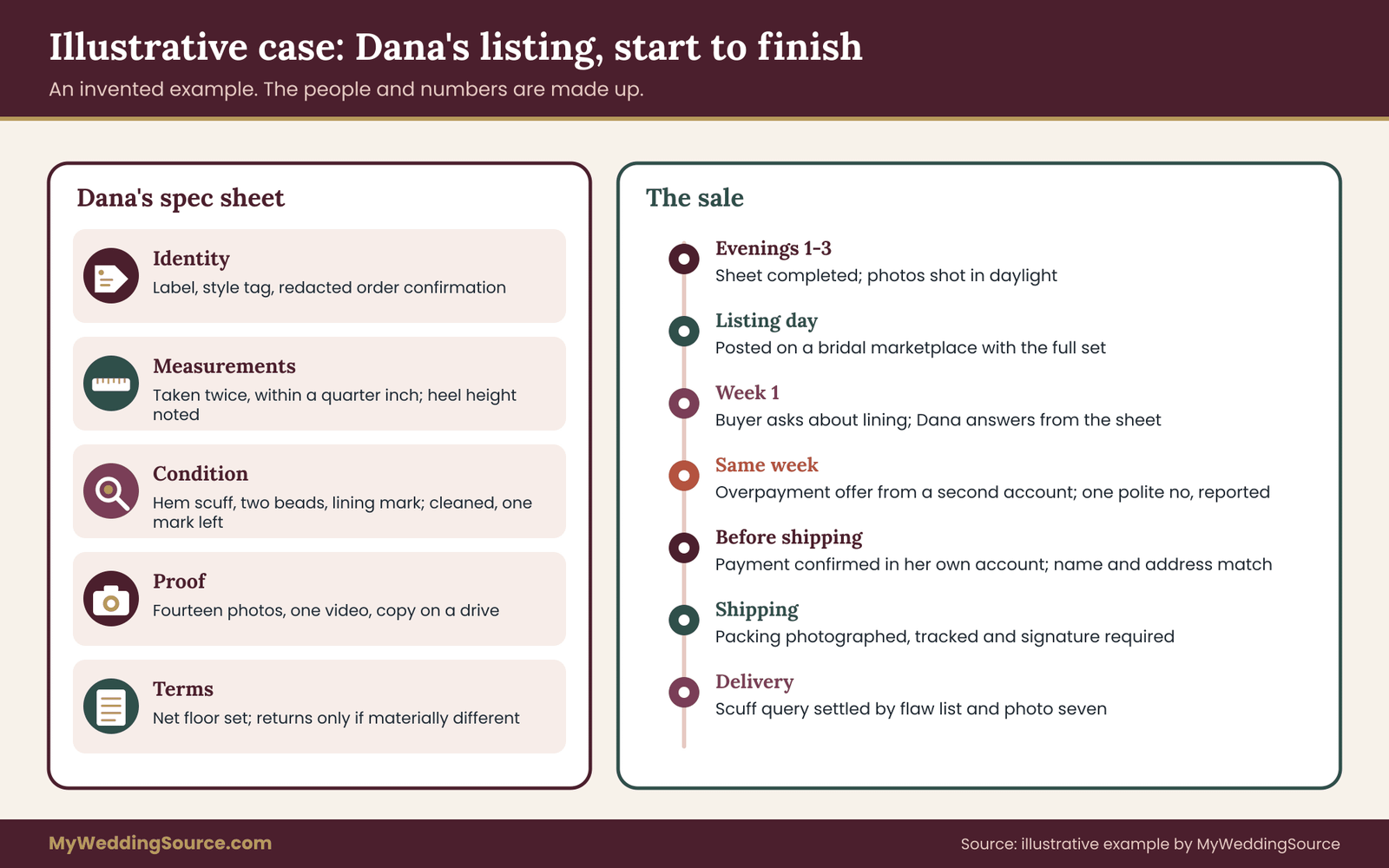
The following example is invented for illustration. The dress, the people and the numbers are made up and do not describe any real sale or market price. Its purpose is to show the spec sheet and checklist working together.
The dress and the sheet
Dana is a first-time dress seller with an ivory crepe gown with a lace overlay, worn once for a spring wedding. She completes the five blocks over three evenings.
For identity, she photographs the interior label and finds a style number printed on a small tag near the side seam. She still has the order confirmation from the boutique and redacts her address and card details. She writes: “Label and style number photographed; order confirmation available on request with personal details removed.”
For measurements, she lays the dress on a sheet, zips it, and measures bust, waist and hip twice. The readings agree within a quarter inch. She measures hollow-to-hem and notes that her heels were three inches. She notes that the bodice has sewn-in cups and boning, that the side seams hold about an inch of spare fabric on each side, and that the hem was shortened by the boutique’s seamstress.
For condition, she goes over the dress in daylight with a friend. They find a gray scuff at the hem about two inches long, two missing seed beads near the waist, and a faint mark on the inner lining at the left underarm. She had the dress cleaned the week after the wedding and kept the receipt, which says the cleaner treated the hem and could not fully remove one mark. She grades the dress “worn once, minor wear” and writes three numbered flaws, each with a photo.
For proof, she shoots fourteen photos and a thirty-second video, names the files by number, and saves them in one folder with a copy on an external drive.
For terms, she sets her floor as a net number. She looks up the current fee page for the platform and calculates the lowest sale price that meets it. She decides to accept returns only if the dress materially differs from the listing, with the buyer paying return shipping otherwise. She notes the carrier, declared value and signature requirement.
The verification in action
A buyer, whom we will call Priya, messages with two sensible questions about the hollow-to-hem and the lining. Dana answers from the sheet and sends a photo of the tape. Priya buys through the platform.
Meanwhile a second message arrives from another account offering slightly more than the asking price, asking Dana to hold the dress and pay by check, with an extra amount for “the courier.” Dana, as a careful dress seller, recognizes the overpayment pattern, replies once that she only sells on the platform, and does not reply again. She reports the account.
Before shipping to Priya, Dana opens the platform directly and confirms the payment is held and shows as paid. The name and address on the order match Priya’s account. She checks the dress against the sheet, photographs it folded and boxed, ships with tracking and a signature requirement, and records the carrier receipt.
What went right and what could still go wrong
When the dress arrives, Priya says the hem scuff looks a little larger than she expected. Dana points to the flaw list, photo seven and the ruler in the image. The numbers match, and Priya keeps the dress. Had the scuff been larger than disclosed, Dana would have owed an adjustment or a return.
The example is neat on purpose. Real sales are messier for every dress seller: a buyer disappears, a carrier delays, a platform’s rules change. The point is that each step leaves a record, so when something unexpected happens the dress seller is reconstructing facts rather than arguing from memory.
Re-checking the sheet after the sale
Once the sale closes, update the sheet with what actually happened: the final sale price, the fees taken, the payout date and any issues. That record helps with taxes, helps if the buyer returns later, and gives you a head start if you ever sell something similar. If you used a platform’s messaging, export or screenshot the key exchanges. Then move the folder into your long-term records, using the same system you use for other wedding papers.
Your next steps
Work through these in order, and stop at any point where you find a gap.
First, open a folder and start the listing spec sheet with its five blocks. Fill in identity, then measurements taken twice, then the condition inventory with numbered flaws.
Second, photograph the dress in daylight with consistent light and a plain background, adding a short video and one photo per flaw. Save the originals in your proof folder.
Third, pick a primary selling path and a fallback, read each one’s current fee and seller terms, and write the net proceeds formula and your floor price on the sheet.
Fourth, write the stop conditions and the return policy in your own words, and keep them where you can see them during conversations.
Fifth, before shipping, run the verification checklist, pack and photograph the dress, use a tracked and insured service and keep the receipt. After delivery, update the sheet and file it with your other wedding papers, as described in the guide to organizing wedding records after the event.
If your sale is part of a larger post-wedding clean-up, the wedding budget page is a useful place to record what the sale brought in, and a wedding planning checklist can help you keep the remaining after-wedding tasks in order.
FAQ
How long should a dress seller keep the photos and records after the sale?
Keep the proof folder at least as long as the longest dispute window that applies to your platform or payment method, and a year is a sensible habit. Check the platform’s terms for claim deadlines. The folder is small, and it contains the flaw list, numbered photos, packing photos, carrier receipt and message screenshots, which are exactly what a claim review looks at.
Should a dress seller clean the gown before listing it?
It depends on the fabric, the marks and the cost. Cleaning can remove some stains, but it cannot be undone and may not fix everything. If you clean, keep the receipt and the cleaner’s notes and disclose what remains. If you do not, say the dress is uncleaned and describe the marks honestly. Either approach works when the description matches the dress.
What measurements matter most in a listing?
Bust, waist and hip circumference taken flat and doubled, hollow-to-hem length, and the shoe height used when the hem was set. Add the train length, the closure range and facts about cups, boning and spare seam allowance. State how you measured. Avoid claims such as “true to size,” which mean different things across designers and cannot be checked by a buyer.
Is it safe to accept a check or an overpayment from a buyer?
No. A common scam sends a check for too much and asks you to return the difference before the check fails. Funds that appear in your account may not be final. Never refund an overpayment until the money is fully settled, and prefer payment methods through the platform where funds are visible in your own account before you ship.
Can I move the conversation off the platform if the buyer asks?
It is safest not to. Keeping messages and payment inside the platform preserves records and protections, and off-platform requests are a frequent step in fraud. A short, polite reply that you only sell through the platform is enough. Honest buyers usually accept it, and a buyer who will not is giving you useful information.
How should I ship a wedding gown?
Pack it dry and clean to the extent disclosed, with soft folds and tissue between layers, in a sturdy box inside a protective bag. Use a tracked service with declared value and consider a signature requirement. Photograph the packing and the sealed box, and keep the carrier receipt. Read the carrier’s current coverage terms, since limits and exclusions apply.
What if the buyer says the dress was not as described?
Compare their claim with your flaw list, numbered photos and video. If the issue matches something you disclosed, share the evidence politely. If the dress differs from your listing, follow your stated return terms and the platform’s process. Inspect and photograph any returned dress the same day before refunding, and keep the exchange on the platform.
Do I owe taxes on a dress I sell?
It depends on your situation, including what you paid and what you sold it for, and platform reporting rules have changed over time. The Internal Revenue Service publishes current guidance on selling personal items, and a qualified tax professional can answer questions about your own case. Keep the purchase receipt, the sale record and the payout statement together.
Sources
- Federal Trade Commission: official consumer protection agency of the United States, including guidance on overpayment scams and fraud reporting.
- FTC Consumer Advice: plain-language advice on scams, payment methods and online selling.
- Internet Crime Complaint Center (FBI): where to report internet-enabled fraud.
- Consumer Financial Protection Bureau: information on payment disputes, bank deposits and consumer financial products.
- Internal Revenue Service: current guidance on selling personal property and reporting thresholds.
- Smithsonian Institution: general information on textile conservation and care.
- USA.gov: government directory for consumer complaint and fraud reporting resources.
- United States Postal Service: current shipping services, insurance and tracking terms.
- FedEx: current service, declared value and claims terms.
- UPS: current service, declared value and claims terms.