

A wedding photographer no show is the moment the person you hired to capture the day does not arrive, cannot be reached, and cannot say when they will. This guide gives you a first-hour response order, a priority photo salvage checklist, a way to keep records while it happens, and honest limits for what can still be saved.
Treat the first sixty minutes as three jobs in a fixed order: confirm what is happening, protect the moments that cannot be repeated, and write everything down. Assign one calm person (not the couple) to call the photographer, the backup contacts in your contract, and one or two replacement options. Rank the day’s moments by whether they can be re-created later. Save the photographer’s messages, call logs and payment proofs as you go, because they decide any refund or claim afterward.
Most advice about vendors that fail focuses on the days after the wedding: the refund letter, the review, the dispute. A wedding photographer no show is different because the clock is running while you are still in your outfit. The ceremony may be ninety minutes away. Hair and makeup are in progress. Nobody has time to read a contract and nobody should be deciding things in tears.
What helps most is a short list written in advance and a person who has read it. This article is built to be that list. It is also built for the harder case, where you read it afterward, after the day has gone sideways, and want to know what to document and what can still be recovered.
A note on scope. This is general planning information, not legal, tax or financial advice. Contract terms, small-claims rules and payment-dispute windows differ by state, card issuer and vendor, so confirm the current version with the agency or company involved before you act.
What a wedding photographer no show actually looks like
The phrase covers several different situations, and the right response depends on which one you are in. Sorting them takes two minutes and saves hours.
The first is the plain no show. The start time on the timeline passes, the photographer is not at the venue, and calls go to voicemail. Nothing has been communicated. This is the version most people picture when they think of a wedding photographer no show.
The second is a delayed arrival that looks like a wedding photographer no show for the first twenty minutes. Traffic, a venue that was changed, a flat tire, a closed road or a parking mix-up can all produce the same silence. The photographer is on the way but their phone is in a bag. A calm confirmation step, covered later, separates this from the first case.
The third is the day-of cancellation. The photographer calls or texts that morning to say they are ill, have an emergency or have double-booked. You at least know. The work becomes finding coverage and documenting the cancellation.
The fourth is the partial no show. The lead photographer sends an associate, or arrives but leaves early, or shows up without the second shooter you paid for. Not every wedding photographer no show is total. Parts of this guide apply, especially the documentation steps.
The fifth is the invisible no show, where the photographer is present but the work is lost: memory cards are corrupted, the camera fails, files are not delivered. You do not learn this on the day, but the recordkeeping habits still matter, and any later dispute over missing work begins with the contract.
Why the response order matters more than speed in a wedding photographer no show
Panic produces speed. Speed in the wrong order produces expensive mistakes: a stranger hired at triple the going rate, a cancelled contract with no paper trail, a guest with a phone pushed into a role they did not want, a partner who spends the hour on the phone instead of getting ready.
The order used in this guide is simple. Confirm first, so you do not replace a photographer who is ten minutes away. Protect second, so the shots that cannot be repeated are covered by someone. Record third, so that whatever happens next, your position is clear. These three overlap in practice, but they should be assigned to different people.

Who should lead the response
Not the couple. This is the single most useful decision you can make before the wedding. The couple’s job on the wedding morning is to get dressed, eat something and be present. A wedding photographer no show is a logistics problem, and logistics belong to the planner, a coordinator, a parent with a steady voice, a maid of honor or a best man who is good on the phone.
If you have a day-of coordinator, they already know this is part of the work. If you do not, name a response lead in your timeline document, give them the photographer’s contact details and the contract, and tell the wedding party who it is. The wedding planning checklist already suggests assigning day-of roles; this is one more role to attach to a named person.
For a wedding photographer no show, a response lead needs four things in a phone note or a printed page: the photographer’s mobile number and any studio number, the backup contact listed in the contract, the contract’s cancellation and substitution clause, and the timeline showing which moments come first. Nothing else is required to start.
What this guide does not cover
This guide is about the photographer. It does not walk through a videographer failure, a DJ no show or a broken livestream, although the documentation habits transfer. For technology that fails during the event itself, the guide on a digital contingency plan covers the wider set of backups, and the decisions about who may photograph guests and what they may post sit in the guide on photography consent.
It also does not promise that every missing moment can be recovered. Some cannot. The vows, the first look and the surprise on a grandparent’s face happen once. With any wedding photographer no show, the honest goal is to cover as many of those as possible with imperfect tools, keep your options open for the rest, and keep your records clean so you can recover money and, if appropriate, accountability.
The first sixty minutes: a calm response order
The hour of a wedding photographer no show starts when the agreed arrival time passes with no photographer. Some photographers arrive early and some arrive at the listed minute, so check your timeline. If hair, makeup and detail photos were scheduled for a morning start, that is the clock. If the first photography task is the ceremony, the clock is later and you have more room.
Here is the sequence for a wedding photographer no show, written so that anyone on your team can follow it.
Minutes one to ten: confirm and call
The response lead calls the photographer’s mobile number twice, ten minutes apart if the first call is unanswered, and sends one short text. The text should be neutral and complete: the venue name, the address, the time, and a request for an immediate reply with an arrival estimate. Do not write anything angry. This message may be read aloud later, and a clean record serves you better than a satisfying one.
Next, the lead tries the studio or business line, if there is one, and the backup contact named in the contract, such as an associate, a studio manager or a partner. Many established photographers have someone who watches the schedule. If the contract does not list one, check the email signature on the booking emails.
At the same time, someone else checks the obvious logistics. Was the arrival time changed in an email? Is the photographer at a different entrance, a different address or a different building with a similar name? A few no shows turn out to be a loading-zone mix-up, and a phone call to the venue’s front desk takes one minute.
Minutes ten to twenty: set a decision point for the wedding photographer no show
If there is still no answer, the lead sets a decision point aloud: “If we have not heard from the photographer by this time, we start the backup plan.” The time should be tied to the first photograph that cannot be skipped. In practice, it is usually between twenty and forty minutes after the missed arrival, and never later than ninety minutes before the ceremony.
Picking a decision point for a wedding photographer no show in advance sounds rigid, but it protects the couple from an hour of “any minute now.” It also protects the photographer relationship if the delay was innocent, because you can say honestly that you waited as long as the timeline allowed.
Keep the decision point on a sticky note or in a shared message. The record of when you called and when you decided is part of your documentation, and the time stamps matter.
Minutes twenty to forty: start parallel work
Once the decision point passes, three things happen at once. The lead contacts replacement options, covered in the section on alternatives. A second person gathers every guest-owned camera or capable phone they can find and designates who will cover which moment. A third person starts the evidence log, a simple running note with times, calls, messages and who said what.
The couple stays out of this unless they want to be involved. If they do, give them one task, such as approving a replacement choice by text. The point is to keep the morning as intact as possible.

Minutes forty to sixty: lock in coverage and tell the team
By the end of the hour of a wedding photographer no show you want a decision, even a partial one. Perhaps a replacement photographer is on the way for the ceremony and portraits. Perhaps a talented guest has agreed to cover getting ready. Perhaps no professional is available and the plan is guests plus a booked portrait session within the week.
Tell the wedding party, the venue coordinator and the other vendors in a single short message so everyone works from the same facts. The planner or coordinator should also adjust the timeline to give the replacement time to arrive, because the first photographer’s schedule may no longer fit.
Finally, send the original photographer one more message. Keep it factual: that you have not been able to reach them, that you are arranging coverage at your own expense under protest, and that you will follow up in writing. That sentence may matter later, and it avoids waiving anything by silence. The contract summary in the guide to vendor contracts explains why those clauses matter.
The priority photo salvage checklist for a wedding photographer no show
When a wedding photographer no show happens, you cannot cover everything. You can cover the right things. This is the part of the guide that is meant to be printed, so it is written as a working method rather than a general idea.
The method has one question at its center: can this moment be re-created later? Every item on a wedding photo shot list falls into one of three tiers by that test, and the tiers tell you where limited people and limited cameras should go.
Tier one: moments that cannot be repeated
Tier one is anything that happens once, in real time, with people who will not be arranged again. The processional. The vows and ring exchange. The first kiss. The recessional. A parent’s reaction to the first look. A toast that cannot be performed twice. The cake cutting if it is part of a surprise. A grandparent’s dance.
These get the best available camera operator, the best position and, if possible, two people. If one competent person is available, they should be at the ceremony, not at getting-ready. A tier-one miss in a wedding photographer no show cannot be repaired by a later session, so this tier gets covered first, even if it means everything else is thinner.
Do not forget audio. A phone propped on a stand and recording the ceremony costs nothing and gives you the vows even if the images are mediocre. The wedding officiant’s microphone, if there is one, may be able to record as well, but ask first.
Tier two: moments that can be partly re-created
Tier two is what a photographer would normally spend the middle of the day on: the couple’s portraits, the wedding party portraits, family groups, the details such as rings, flowers, shoes, invitations and the venue décor. These matter, and some of them can be rebuilt.
Portraits of the couple can be done in a session within a few weeks, ideally in the same outfits if they are preserved, or in a styled session at a later date. Wedding party and family groups can be gathered at the reception, using a pre-made list. The wedding family photo list is exactly the kind of document that lets a non-professional run this efficiently.
Details are often the easiest to recover. Flowers wilt, but a quick set of photographs shortly after arrival is possible, and the stationery, rings and décor can be photographed on a table later. Tell someone to do it before the venue is cleared.
Tier three: nice to have
Tier three is candid material that adds richness but is not essential: guests mingling, children on the dance floor, the band, the decorations in use. Guests take these photos anyway. The task here is only to collect them afterward, which is covered in the later section on rebuilding the album.

Turning the tiers into assignments
Once you have the tiers, the response lead assigns each tier-one moment to a named person with a named device. The assignment is concrete: “Dana, you stand at the end of the second row of chairs with your phone on video, starting when the music changes.” Vague instructions produce vague photos.
For each assignment, three details matter. The first is position. The best position for the ceremony is near the front, but off to one side, out of the line of sight of guests and not in the aisle. The second is the device settings: video mode versus still, landscape orientation, enough storage, and a charged battery or a charger within reach. The third is the handoff: after the ceremony, where does the person send their files, and to whom.
Do not assign a tier-one moment to someone who is also in the wedding party. A bridesmaid cannot photograph the vows while standing at the altar. People inside the ceremony are tier-one subjects, not tier-one operators.
The one-page salvage sheet
The response lead should have a page, or a phone note, with the following: the three tiers listed by time, a column of names next to each tier-one item, and a short line for each of the devices and storage details. It should also include the delivery address for the files, which is a shared album or folder that is created before the ceremony.
A shared album is worth setting up in the first hour of a wedding photographer no show, because it saves the end-of-night scramble. Most photo apps let you create an album where invited people can add photos. Check the settings so that everyone can contribute but only the couple or a designated person can delete. Post the link where guests will see it, such as a small sign or a message from the officiant.
What to do about lighting and quality
Guest phones can take good photos in daylight and poor photos in a dim ballroom. A salvage plan should accept that and compensate. Outdoor ceremonies in good light are the easiest to cover with phones. Indoor receptions with low light are hard. If you are in the second situation, put more weight on video, which tolerates low light better than stills, and ask for the DJ or venue to raise a little ambient light during the key moments if they can.
Turn off flash for guests during the ceremony, but allow it at the reception. Flash from a dozen phones during the vows reads as a strobe in the final video, and your replacement photographer will not thank you.
Ask guests to hold their phones horizontally for video. Vertical video is fine for social posts and bad for most keepsake uses. A quick line from the officiant or a sign at the entrance does this without drama.
What a salvage plan cannot do after a wedding photographer no show
A salvage plan produces coverage, not artistry. It will not match the work in the photographer’s portfolio, and it is better for everyone if the couple expects that. The goal is a complete record of what happened, with a few strong images, and a path to a later portrait session that can supply the polished images.
If you set the expectation honestly after a wedding photographer no show, then every good photo is a bonus and the day is not judged against a standard it was never going to meet. That reframing is one of the most useful things a response lead can say to the couple.
Finding emergency coverage for a wedding photographer no show
Beyond guests with phones, five sources of replacement coverage are realistic. Each has a different speed, a different risk and a different cost structure, and none is the right answer for every wedding.
Option one: the photographer’s own backup
Many professional photographers keep a contractual or informal backup for a wedding photographer no show: an associate, a second shooter, a colleague who covers emergencies. If your contract names one, this is the first call after the photographer. The advantage is that the backup may already know the venue and the style. The risk is that backup arrangements are not always real, so confirm that a person has accepted before you tell the couple help is coming.
If the photographer is ill and has activated a colleague, that is the contract working as intended. Get the colleague’s name, number and estimated arrival in writing. If the colleague is a surprise to you, ask whether they have the shot list and who owns the images afterward.
Option two: a local photographer on short notice
Local photographers sometimes have an open date, a cancellation or a willingness to cover a half day. Contact three at once by phone and text rather than one at a time, and give each the same short message: date, venue, hours needed, and the fact that the original photographer has not shown. Expect to pay more for short notice, and expect that availability on a peak Saturday is thin.
Ask for the basics before agreeing: price in writing, hours covered, who owns the images, delivery timeline, and whether they carry insurance. Hiring a stranger on a wedding photographer no show morning is still hiring a vendor, so the usual vetting questions apply in a compressed form.
A hurried hire is still a hire. Get a one-paragraph agreement by email before they start: hours, fee, deliverables, delivery date, and image rights. It takes five minutes and protects both of you.
Option three: a student or emerging photographer
Photography programs and local camera clubs sometimes have members who shoot events. A student can be a good solution for ceremony coverage and portraits at a lower rate. The risks are experience in low light and the pace of a wedding day. Be direct about the scope and avoid asking for more than they have done before.
Ask to see recent event work, even a handful of images, and ask what camera and lenses they will bring. If the answer is a phone only, you are in the guest-photographer category and should plan accordingly.
Option four: a talented guest, with consent
A guest who owns a good camera and enjoys photography can take on the role. This works best when the guest is asked early and privately, given a defined scope, and released from the role if they would rather be a guest. Pay them or thank them meaningfully, and do not expect professional output.
Be careful about role confusion. A guest who is also a close family member will be pulled into group photos and forget to take them. Pick someone peripheral enough to stay behind the lens: a cousin, a friend of the family, a colleague.
Option five: a hybrid with a scheduled session
The fifth option is to cover the day with guests and a hired helper for key moments, then schedule a professional portrait session in the following weeks. This is often the most economical and the least stressful, and it recovers the portraits that are tier-two moments. It does nothing for tier one, which is why the guest plan must be strong.

Choosing among the options in ten minutes
A simple rule helps in a wedding photographer no show. If a professional is available within the hour and the price is acceptable, take them for the ceremony and portraits. If one is available only for part of the day, use them for tier one and tier two portraits. If none is available, run the guest plan and book the session. If the cost of a replacement is out of reach, do not borrow against the wedding to cover it. A strong guest plan plus a later session is a legitimate outcome.
Whatever you choose after the wedding photographer no show, tell the original photographer in writing that you are arranging coverage. Keep every price quote and agreement. These are the items that support a later request for reimbursement, covered in the recordkeeping and refund sections.
Briefing a replacement after a wedding photographer no show
After a wedding photographer no show, a replacement photographer, whether professional or a guest, walks into a wedding they know nothing about. Your job is to make the first ten minutes useful. The briefing should be short enough to read standing up and specific enough to prevent the three common mistakes: missing a key moment, photographing the wrong people, and delivering files to nowhere.
The ten-minute briefing sheet for a wedding photographer no show
Print or text a single page with six parts. The first is the timeline, trimmed to the moments that matter, with clock times. The second is the tier-one list, in order, with positions. The third is the people list: the couple, parents, grandparents, the wedding party and anyone with a special role, with a name and a short description of how to recognize them.
The fourth part is the family group list. If you prepared one, it can be handed over unchanged. If not, the response lead should write down the five or six groups that matter most. Keeping the groups short enough to run in twenty minutes is what matters.
The fifth part is the do-not list: restricted areas, guests who prefer not to be photographed, children whose images should not be shared, and any religious or cultural rules about when photography is allowed. The sixth is delivery: where the files go, by when, and who has access.
What a new photographer will ask
Expect four questions, and have the answers ready. Where is the light good? Where can I stand during the ceremony? Who is in charge of the family groups? Who do I talk to if something changes? The response lead answers the last one, and should be the single point of contact.
If the venue has rules about vendor positions, flash use or access to certain rooms, pass these on. A replacement who unknowingly breaks a venue rule creates a new problem. The planner’s or venue coordinator’s quick word at arrival helps.
If the ceremony includes a religious or cultural tradition, brief the new photographer on its flow. The ceremony cue sheet guide is useful here, because a cue sheet lists in order what happens and when, which is what a stranger needs to anticipate moments.
Briefing a guest photographer differently
A guest photographer needs less jargon and more reassurance. Give them the tier-one list and one or two positions. Tell them you do not expect miracles. Ask them to take plenty of photos rather than few, to hold the phone or camera steady, and to avoid stepping into the aisle.
Remind them that they are allowed to enjoy the wedding. If a guest takes on a role and then feels trapped by it, the photos will show it. Offer to relieve them after the ceremony or after the first dance, and ask someone else to take the next shift.
A short agreement for any hired replacement
For a paid replacement, write a short agreement before they begin. It should say the date, the hours, the fee, how and when it will be paid, the deliverables, the delivery date and who owns the images or the license to use them. It should say whether the replacement will deliver edited images, unedited images or both.
Send this by email so there is a time-stamped record, and ask for a reply that says “agreed.” A text message is acceptable in an emergency, but an email is better. Keep it in the same folder as the original contract. The guide to wedding records after the event explains how to store these documents so you can find them in a year.
Do not sign away the right to claim reimbursement from the original photographer. A replacement agreement is between you and the replacement. It does not affect your rights under the first contract.
Documenting the wedding photographer no show as it happens
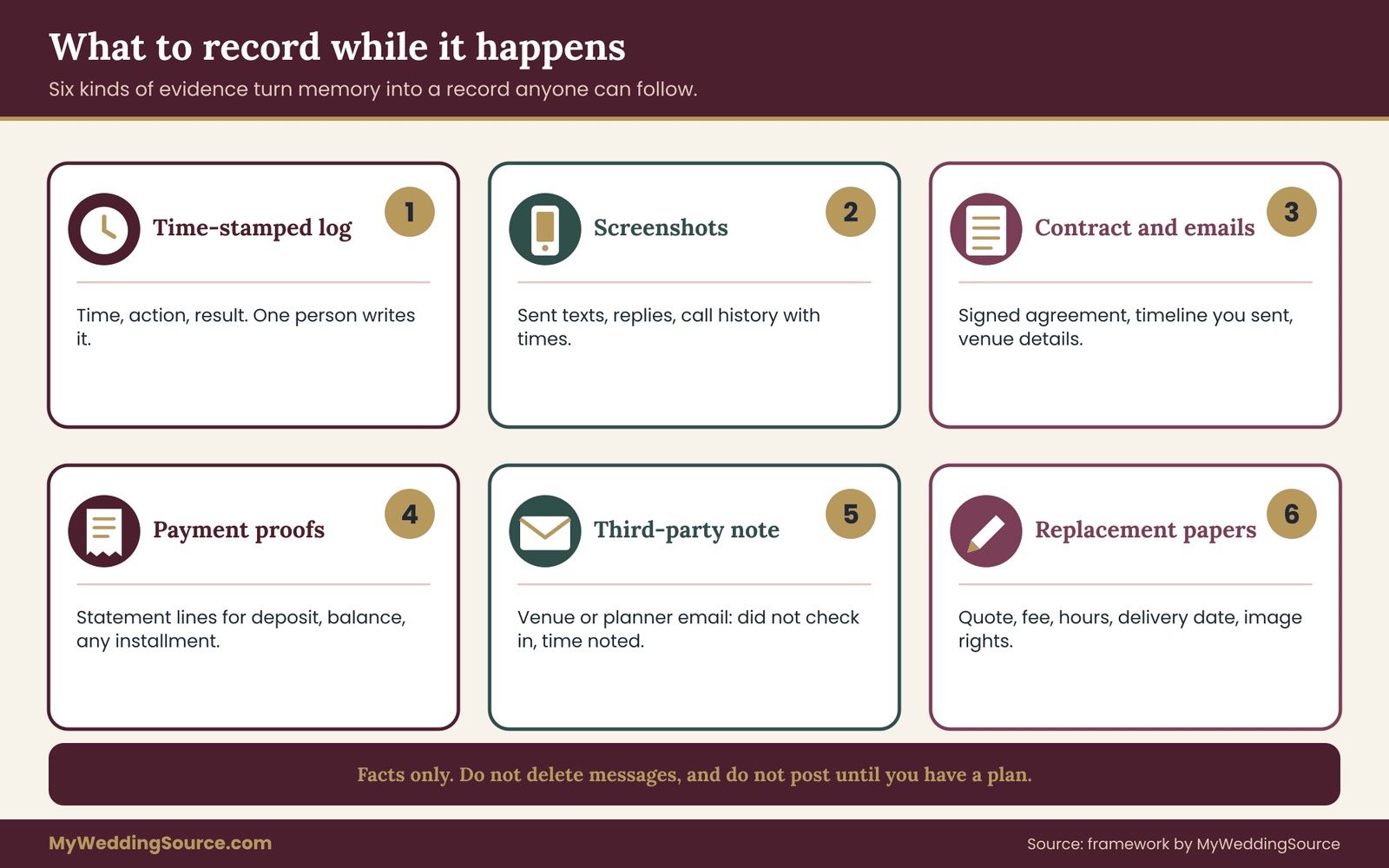
Documentation of a wedding photographer no show is the part people skip, and the part they regret skipping. A clean record turns an argument about memory into a conversation about facts. It also makes any later request to a card issuer, the photographer, an insurer or a small-claims court much simpler.
You do not need special software. You need a single running note, kept by one person, and a few habits.
The running evidence log
The wedding photographer no show log is a simple list in a phone note or a shared document. Each line has a time, an action and a result. For example: “10:05, called photographer’s mobile, no answer, left voicemail.” “10:15, texted venue address and asked for arrival time.” “10:40, called studio backup contact, spoke to the assistant, no information.” Keep the entries plain and factual.
Log your own decisions as well. “10:50, decision point reached, started replacement search.” “11:05, three photographers contacted.” “11:25, replacement agreed, fee confirmed by email.” These entries show that you acted reasonably and promptly, which matters if reimbursement becomes a question.
One person writes the log. If the response lead is also making calls, the log keeper can be a second person sitting nearby. Do not try to reconstruct it from memory at midnight.
Screenshots, call logs and messages for a wedding photographer no show
Take screenshots of your sent texts and any replies. Screenshots of call logs showing the number called, the time and the length of the call are useful. If the photographer replies with an excuse, a delay or an apology, screenshot that as well. If the reply is silence, the silence is part of the record.
Save voicemail messages, and be careful with recording a call. Recording rules differ by state, and some states require every party to agree. Do not record a call unless you know the rule where you are. A written log and screenshots serve nearly as well.
Keep the original email thread, especially the signed contract, the timeline you sent the photographer, any change of venue or time, and the payment confirmations. If you have not already put them in a single folder, do it in the next few days.
Photographs of the situation itself
If it is safe and natural to do so, take a photo of the empty position where the photographer should have been, or of the timeline posted on a wall showing the scheduled start. A photo with a time stamp is a quiet piece of evidence. Do not stage anything or take photos of people who have not agreed to be photographed.
Ask the venue coordinator, planner or another vendor to note the time and confirm that the photographer did not check in. A short email afterward from the coordinator saying “the photographer did not arrive by 11:00 and could not be reached” is strong, neutral evidence from someone with no stake in the outcome.
Payment records
Gather proof of every payment to the photographer: the deposit receipt, the retainer confirmation, any installment, and the final balance if it was paid. A bank or card statement line is better than an invoice alone. Note whether payment was by card, check, bank transfer or a payment app, because the dispute options differ.
The Consumer Financial Protection Bureau explains that a card billing error generally has to be reported in writing within sixty days of the statement that shows it. Check the current rule with your card issuer, and note the date of the statement that carries the charge. A simple dated list of every payment makes those deadlines easy to see.
What not to put in the record of a wedding photographer no show
Keep the wedding photographer no show log to facts. Do not write guesses about why the photographer did not come. Do not write insults. Do not post about it online until you have decided your plan, because public comments can complicate a dispute and may contradict what you later tell a card issuer. If you plan to write a review, draft it privately and wait for the situation to settle.
Avoid deleting anything. If you realize you wrote something unhelpful in a text, leave it. Deleting messages can look worse than the message itself.
Contract and money steps after a wedding photographer no show
The day passes, the couple is married, and the next week brings the question of money. A wedding photographer no show raises three separate questions: what the contract says, what you paid, and what it cost you to cope. Keep them separate, because they follow different rules and different timelines.
Read the contract in this order after a wedding photographer no show
Open the signed agreement and look for six clauses, in this order. First, the services clause: what was promised, on what date, for how many hours and at what location. Second, the cancellation and substitution clause: what the photographer must do if they cannot attend, including whether they must find a replacement of similar skill.
Third, the payment clause: what is a deposit, what is a retainer, what is refundable and when the balance is due. Fourth, the liability limitation clause, which often says the photographer’s liability is capped at the amount you paid. Fifth, the force majeure clause, which lists events outside anyone’s control and sometimes includes illness. Sixth, the dispute clause, which may require mediation or arbitration, or fix the state whose courts apply.
The guide to the wedding vendor contract explains the standard clauses in plain language. For a wedding photographer no show, the services clause and the substitution clause usually decide the first question, which is whether the photographer breached the agreement.
Deposit and retainer are not always the same
Some contracts call the first payment a retainer and describe it as non-refundable because it reserves the date. Others call it a deposit that applies toward the total and may be refundable under certain conditions. The difference matters. A non-refundable retainer for a date that the photographer then failed to serve is not necessarily the photographer’s to keep.
This is the point where a general guide has to stop. Whether a retainer must be returned after a failure to appear depends on the contract wording and your state’s law. A consumer protection office or an attorney can tell you how those terms apply where you live.
Calculate what you actually lost
Make a short list of the costs that follow directly from the wedding photographer no show. Include the full amount paid to the original photographer, the price of any replacement, the cost of any rebooked session, and any direct expense such as travel for a replacement or an additional hour of venue time. Leave out feelings and general disappointment, which are real but not recoverable in the way a bill is.
Use the evidence log and receipts to support each figure. If your replacement was more expensive than the original contract, the difference is the figure most likely to be discussed. If you did not hire a replacement, the claim is usually the refund of what you paid, not an estimate of what coverage might have cost.
The first written request after a wedding photographer no show
Within a few days, send the photographer a written request. Keep it calm and short. State the date and venue, the contract date, what was agreed and what happened. State what you are asking for: a refund of the amount paid, or reimbursement of replacement costs, or both. Give a reasonable date for a reply, such as ten business days.
Attach or list the contract, the payment proofs and your evidence log summary. Do not threaten. A short, professional request often gets a response, and it creates a dated record that you tried to resolve things directly. Many photographers who miss a wedding for a real emergency will refund in full when asked fairly, and some will offer to help with a replacement session.
If the photographer replies, keep the reply. If they offer a partial refund or a credit toward a future session, think before accepting, and do not sign a release until you understand what you are giving up.
Card payments and the sixty-day window
If you paid by credit card for a wedding photographer no show, you may have dispute rights under federal billing rules. The Consumer Financial Protection Bureau explains that disputes for billing errors generally must be made in writing within sixty days of the statement showing the charge. A service that was paid for and not provided is the kind of problem a dispute can address, though the card issuer decides each case.
Because the window is counted from the statement date, not the wedding date, check which statement carried the charge. If the deposit was paid a year earlier, the window for that charge may have closed, and the balance payment may be the one still open. Contact the card issuer and ask what they need and by when.
Debit cards, bank transfers and payment apps have different rules, and some have shorter windows or fewer protections. Check the terms of the account you used. The point is to read them in the first week, not the third month.
Event insurance and vendor insurance
If you bought wedding event insurance, read the policy for a wedding photographer no show for vendor non-appearance or cancellation coverage. Some policies cover a vendor’s failure to show up, some cover only specified causes, and some exclude it. Call the insurer promptly, because claim notice deadlines are short. Policies differ, so ask the insurer what documents they require.
Professional photographers sometimes carry liability insurance, but that generally covers injury and property damage, not a failure to appear. A certificate of insurance shows what the photographer carries. The certificate tells you what coverage exists, and it does not promise that a claim will be paid.
When to consider small claims or mediation
If the photographer behind the wedding photographer no show does not respond, or refuses, and the sum is meaningful, small-claims court is designed for disputes of this size without a lawyer. Each state sets its own limit, filing fees and rules. USA.gov directs readers to state court and consumer resources, and your state attorney general’s consumer office can explain what applies locally.
Before filing, confirm that you have the photographer’s correct legal name and address, which may be a business name on the contract, and make one last written request. A short list of the evidence you hold, in date order, is the core of a small-claims case. Mediation, sometimes offered by local courts or consumer organizations, can resolve a dispute without a hearing.
What to write in a review
A review of a wedding photographer no show can wait. If you choose to write one, stick to verified facts: what the contract said, what happened on the day, what you did, and how the vendor responded. Avoid speculation about motives. Avoid naming anyone other than the business. A calm factual review is more useful to future couples and safer for you than an angry one.
The Federal Trade Commission has guidance on consumer reviews, and platforms have their own rules about content. If the photographer replies with a refund or an apology, update the review. If they ask you to remove a review in exchange for a refund, understand what you are agreeing to before you do it.
Tax and budget notes
Wedding expenses are personal in most cases, but keep your records neat anyway. A refund after a wedding photographer no show changes your budget and any cash-flow plan, so update your spreadsheet as soon as money moves. If a payment was made through a gift fund or by a parent, note who should receive any refund. Money from a parent’s card may need to go back to the parent, not into the couple’s account, and your contract may name the payer.
When in doubt, ask a tax professional about anything that affects your return. This guide does not give tax advice, and rules change.
A worked wedding photographer no show case: the Delgado wedding, from missed call to filed record
The following wedding photographer no show case is invented to show the method. It is not a real wedding and it is not a report of what a real photographer did. The names, times and choices are illustrative, and a real situation will differ. Its purpose is to show how the steps fit together under pressure.
The setup
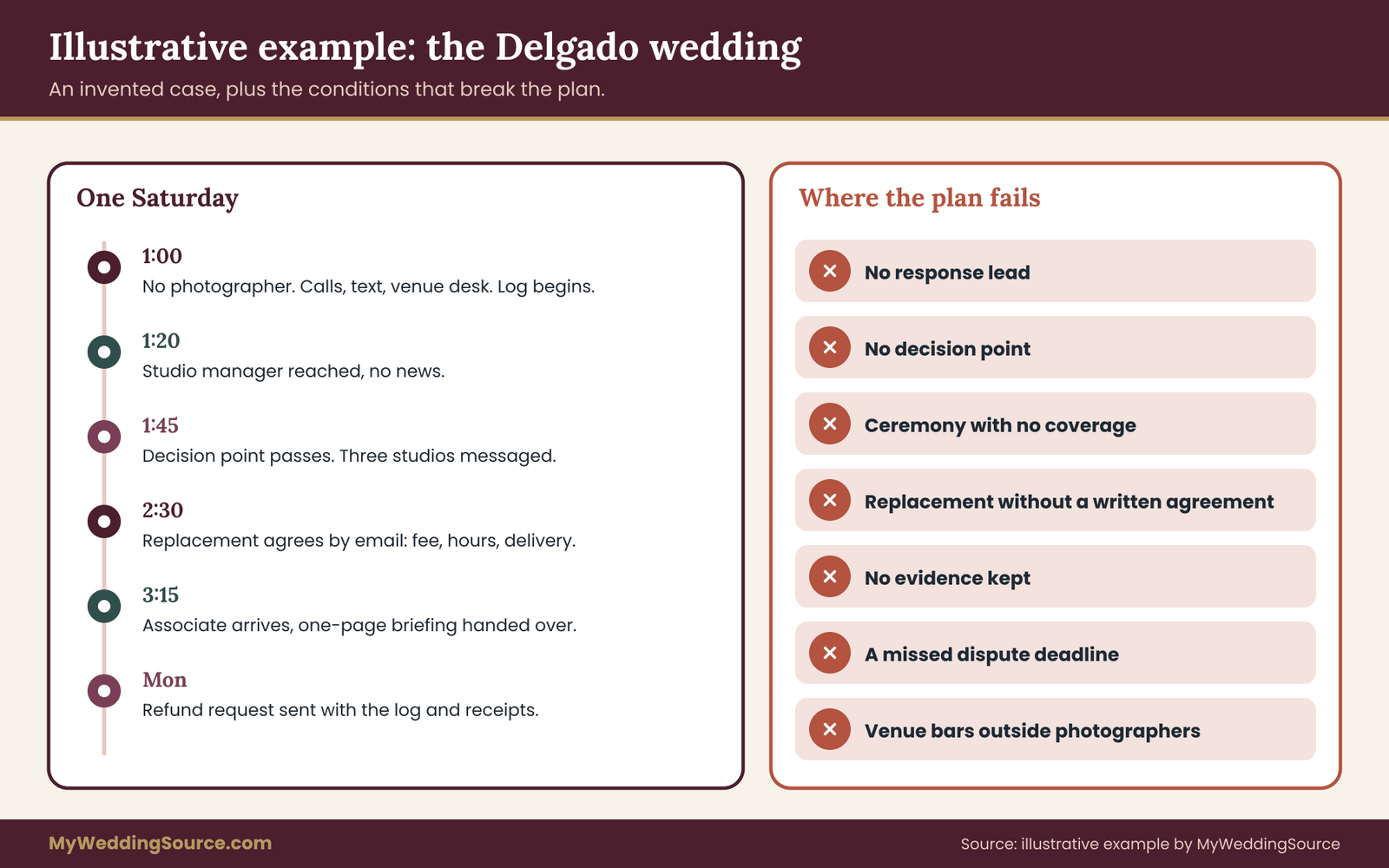
Marisol and Andrés Delgado are marrying on a Saturday at a garden venue. The ceremony is at four in the afternoon. The photographer’s contract calls for arrival at one for details and getting-ready photos at the venue’s bridal suite, portraits at five, and coverage until nine. A friend, Priya, is the response lead, and she holds a printed page with the photographer’s numbers, the contract’s substitution clause, and the tier list.
The contract names an associate as a backup, a studio manager named in the booking emails. The couple has a shared album link prepared and printed on a small sign at the guest book table. They have also asked their cousin Tomás, who photographs as a hobby, to help with tier-two portraits if needed.
One o’clock: the first sign of a wedding photographer no show
At one, the photographer has not arrived. Priya calls the mobile number and gets voicemail. She texts the address and a request for an arrival time. The log keeper, a bridesmaid named Lena who is not in the early getting-ready photos, begins a note: “1:00, photographer not at venue. 1:03, called mobile, voicemail. 1:05, text sent.”
Priya also asks the venue coordinator whether any photographer has checked in. The coordinator says no and notes the time. At 1:15 Priya calls again. At 1:20 she calls the studio manager, who answers and says the photographer’s schedule shows the wedding but that nobody has heard from them since the previous evening. The manager promises to try other numbers.
Half past one: the decision point
The Delgados’ tier-one moments begin at four. The tier-two portraits are at five. The tier-three details can wait. Priya had set the decision point at 1:45, which is more than two hours before the ceremony. At 1:45 there is still no word, so the backup plan begins.
Priya sends the three-photographer message she wrote in advance to three local studios, with the date, venue, hours and the line “the original photographer has not arrived.” She asks for replies by two-thirty. She also tells the couple, by a short message to Andrés’s best man, that coverage is being arranged and that the morning should continue as planned.
Meanwhile, Tomás agrees to photograph the getting-ready scenes with his own camera. Lena notes his agreement. Priya sets up two phones on tripods for the ceremony as a baseline and assigns two guests to hold backup phones on video from the left and right of the aisle.
Two-thirty: the replacement
One studio replies that they have an associate free until seven. The fee is higher than the original contract, which Priya records. She asks for the fee, hours, deliverables and delivery date in one email. The associate answers “agreed” within ten minutes and reports an arrival time of 3:15.
The agreement is short. It names the date, the hours of three-fifteen to seven, the fee, a promise of edited images within three weeks, and the license for personal use. Priya saves it in the same folder as the original contract. She tells the couple the news at the end of the getting-ready photos, so it does not interrupt anything.
At 3:15 the associate arrives and Priya hands over the one-page briefing: the tier-one list with positions, the family groups, the do-not list, the delivery link and her phone number. The associate asks where the light is good and where to stand. Priya answers both and introduces them to the venue coordinator.

What the evening produced
The ceremony is covered by the associate, with the tripod phones and guest video as backup. Portraits at five run twenty minutes, using the Delgados’ written family-group list. The associate stays until seven, so the later reception coverage is partial: the dances and cake cutting are covered by guests, and the shared album fills with photos.
The Delgados do not get everything. The getting-ready morning has only Tomás’s photos. The details, such as the stationery and flowers, are photographed by Lena in a short window. The reception is light on professional images. They accept this and plan a portrait session for the following month.
The record
That night, Lena sends the log to Priya, who adds the screenshots and the signed replacement agreement. She asks the venue coordinator for a short email confirming that the original photographer did not check in. The coordinator sends it the next morning.
On Monday, Marisol, now rested, reviews the contract, finds the substitution clause and sees that the photographer was required to provide a qualified replacement if unable to attend. She calculates the amount paid, the replacement fee and the later portrait session cost, and writes a calm email to the photographer asking for a refund of the amount paid and reimbursement of the replacement fee, with a ten-business-day reply date.
The email lists attachments in date order: the contract, the payment receipts, the log, the screenshots, the venue coordinator’s email and the replacement agreement. Marisol also checks her card statement date and notes that the deposit and balance were paid by credit card, in case she needs to dispute.
What the wedding photographer no show case shows
First, the person who led was not the couple. Second, the decision point was set in advance and used. Third, the tier list meant that coverage was concentrated on what could not be repeated. Fourth, the replacement was hired with a written agreement, not a handshake. Fifth, the log and the third-party email turned a stressful day into an organized claim.
It also shows limits. The Delgados did not recover the getting-ready photographs in professional quality. They did not know whether the photographer would pay. They spent time and money on a problem they did not cause. A good response lowers the damage; it does not erase it.
How the same wedding photographer no show could have gone worse
Imagine the same wedding photographer no show with three differences. The decision point was never set, so Priya waited until 2:45 because the studio manager kept saying “any minute.” The replacement search then began at the busiest hour, and no professional was free. The couple would have relied on guests and a later session.
Or imagine the response lead had no list and no log. The couple would have spent the morning on the phone, and Marisol’s Monday email would have said “I think we called around noon.” The photographer’s reply might dispute the time and the contract, and nothing in her records would answer back.
Or imagine the contract had no substitution clause and a liability cap equal to the deposit. Even then, the log and the documents would support a request for the deposit and perhaps a card dispute. The record matters most when the contract is weak.
Rebuilding the album after a wedding photographer no show
Once the wedding is over and the first messages about the wedding photographer no show are sent, the task turns to what you do have and what you still can get. This is the recovery stage, and it runs for weeks. It is quieter than the day itself, and it gives you more control.
Gather everything in one place after the wedding photographer no show
Start by collecting every photo and video from the day. Ask guests to add to the shared album, and send a friendly reminder a few days later with the link. Ask the wedding party, parents and any guest who is known to photograph. Ask the venue, the planner and the other vendors whether they took images they can share. A florist, a DJ or a cake maker often photographs their own work.
Download the files in original quality, not the compressed versions sent through messaging apps. Messaging apps shrink images and strip information such as the time the photo was taken. Ask people to share through an album, a cloud folder or a file transfer link instead of sending photos one by one in a text thread.
Make a first backup the same week. The guide on wedding records after the event describes a three-copy habit, and the Library of Congress offers personal digital archiving guidance that explains why one copy is not enough.
Sort and label, then identify the gaps
Sort the images by moment: getting ready, ceremony, portraits, cocktail hour, reception, dances, send-off. Within a day or two you will see where the holes are. Compare the sorted folders against your tier list. If tier one is covered by video and photos, you are in a good position. If a moment is missing, note it and think about whether it can be re-created.
Label the best images with a short note about who took them. A guest who took the best ceremony photo should get a thank-you and, if you plan to print it, a request for permission. A person who takes a photo generally owns the copyright to it, so ask before you publish or sell anything. The U.S. Copyright Office explains the basics of who owns a photograph.
Re-creation sessions after a wedding photographer no show
A session after the wedding is the most useful way to recover tier-two moments. Book a photographer for a portrait session in the weeks after the wedding, if the outfits are in good condition, or plan a dressed session at a later date such as an anniversary. Outfits can be cleaned and pressed, and bouquets can be re-created with a florist’s help.
Do not try to re-create tier-one moments in front of a camera as though they were the real thing. A staged kiss and a staged exchange of rings can be charming as portraits, but they do not replace the real moment. If you want a keepsake, ask the officiant or a friend to read the vows again at the session and call it what it is, a keepsake.
Choose the photographer for the session with the same care as for the wedding. Check their work, ask for a written agreement, confirm who owns the images, and ask for a delivery date. The questions in the vendor due diligence guide apply, though the stakes are lower.
Asking the original photographer for what exists
If the original photographer partly worked, for example by arriving late or leaving early, ask for every image captured and for the original files, not only edited favorites. If the photographer has images from your engagement session or any pre-wedding shoot, ask for those too. Do not assume the contract is void; deliverables already completed may still be yours.
Request the files in writing with a reasonable deadline. If the photographer is unresponsive, include the request in the same record as your refund request. Keep the tone neutral.
Using a printed album or story format
Once the images are collected, you can decide how to present them. A modest album that mixes professional and guest photos tells the story honestly. A caption such as “photo by Tomás” credits the source and invites memories. Some couples find the guest-sourced album more personal than a polished one, and that can be a gentle way to see what happened.
If you made a video of the ceremony, add titles or a short voiceover rather than trying to hide the angle. Honest framing tends to age better than an attempt to fake professional coverage.
Talking about it: the couple, the guests and the vendor
Recovery from a wedding photographer no show includes the people involved. A wedding photographer no show affects the couple, the family and the other vendors, and each deserves a short, clear message.
Telling the couple, and when
The response lead should decide how much to tell the couple and when. A good rule is to tell them what they need to decide and what they need to know to relax. That might mean a short message that coverage is being arranged and the schedule is intact. Extra detail can wait until after the ceremony, unless the couple asks.
If the couple wants to know everything immediately, tell them everything, calmly. Do not hide facts they have a right to know. But do not hand them the problem. Hand them the plan.
Telling the guests about a wedding photographer no show
Most guests do not need to know. A short note to the wedding party and the people holding cameras is enough. If you have set up a shared album, a short sign inviting guests to contribute is natural and does not draw attention to the problem.
Avoid announcing the situation to the room. A dramatic announcement turns a vendor failure into a topic of conversation and puts pressure on guests to produce photos. A quiet invitation to share photos works better and feels friendlier.
Telling the other vendors
The venue coordinator, planner, DJ and any videographer should know that photography has changed. They may need to adjust the timeline, share their own images or step aside for a replacement. A one-line message to each, from the response lead, is enough.
If a videographer is present, ask whether they can capture extra angles of key moments. A videographer is already positioned to catch the ceremony, and their footage can supply stills. Check the contract about how those files are shared.
Talking to family who hired or recommended the photographer
Sometimes a parent or friend recommended the photographer, or paid for them. This can make the conversation tender. Keep it factual and non-blaming. “The photographer did not arrive and we are handling it” is enough. The money question may involve more than one person, so decide who will talk to the vendor about it.
Whoever paid should know where the refund will go. Tell them early if you plan to ask for repayment of their share.
Looking after yourselves
The week after a wedding is already emotional. A wedding photographer no show adds a layer of disappointment that is easy to underestimate. Allow time to be upset. Then pick one small thing to do, such as scheduling the portrait session or sending the refund request, and let the rest wait.
You may find that the day itself was lovely and the photographs are a smaller part of it than you feared. That is common. The photographs matter, and the day mattered more.
Keeping the claim from taking over
Some couples find that pursuing a refund becomes a project that dominates their first months of marriage. Set limits. Decide who will handle it, how much time each week it deserves, and what outcome you will accept. A fair refund and a clean file are a good outcome. A long battle for a larger sum may not be worth the energy.
Designate a date, such as thirty days after sending the request, to decide on the next step. If you decide to escalate, take one step at a time: a card dispute, a consumer protection complaint, a mediation request, or small claims. If you decide to stop, close the file and note the date so you can find it later.
When the plan fails: conditions that break a wedding photographer no show response
No response to a wedding photographer no show works every time. It helps to know in advance where this one is weakest, so that you can strengthen those points or accept them. These are the failure conditions most likely to appear.
The first failure condition is no response lead. If the couple is the only person managing the problem, the plan fails by exhaustion. The cure is to name someone before the wedding, even if it is only a friend with a clear head.
The second is no decision point. Waiting is the most common error. A silent photographer is not necessarily a late one, but the timeline does not wait. If nobody says “at this time we begin,” the replacement search starts too late, and the people who might have been free are already booked.
The third is a ceremony with no coverage at all. If no guest is assigned and no phone is recording, a tier-one moment disappears. Even a weak recording is better than none. Treat the ceremony as the single non-negotiable item.
The fourth is a replacement without a written agreement. A handshake hire can end in a dispute over fees, delivery dates or who owns the images. Five minutes of email prevents most of that.
The fifth is evidence that was never kept. If you cannot show when you called, what you were told and what you paid, a refund request becomes a disagreement about recollection. A simple log solves this.
The sixth is a missed deadline. A billing-dispute window, an insurance notice period or a small-claims limit can pass while you are recovering. Put the dates on a calendar in the first week, and treat them as fixed.
The seventh is a venue rule that blocks outside photographers. Some venues require approved vendors, charge fees for outside photographers or limit access. Ask the venue’s coordinator immediately, because a replacement who is refused entry helps nobody. The venue’s contract, which you may already have in your records, may list the rule.
The eighth is a destination or remote wedding, where local replacements are scarce and travel is costly. In that case guest coverage and a post-trip session become the realistic plan, and the planning should start earlier.
The ninth is a photographer who is present but unprepared: no memory cards, a broken camera, no backup lens. The same principles apply, with a faster decision point, because the photographer is on site and the failure is discovered by observation. If it happens, switch to the salvage plan and record what you saw.
The tenth is a dispute you cannot win. If the contract is clear that the deposit is non-refundable, the photographer is out of business, or the sum is below the point where a claim is worth the time, you may recover little or nothing. Say so to yourselves early. The goal then becomes closing the matter and keeping the lesson.
How to know the wedding photographer no show plan is working
There are quick tests. By the end of the first hour, can the response lead say who is covering the ceremony? Is there a shared album link? Is there a log with at least five time-stamped lines? Is there a person assigned to call the replacement options? If the answer to any is no, fix that first.
After the day, test the record. Could a stranger read your folder and understand what happened? Is the contract there? Are the payments there? Is the log there? A reasonable test is to ask a friend to read it and say what they think happened. If they get it right, the record is working.
Preventing a wedding photographer no show before it happens
You cannot remove the risk of a wedding photographer no show, but you can reduce it and shrink the damage. Most of the work is in the booking and the weeks before the wedding.
Choose and contract with a wedding photographer no show in mind
When you hire, ask directly what happens if the photographer cannot attend. Ask whether they have a named backup, whether the backup has worked from their style, and how fast a replacement can arrive. Look for a substitution clause in the contract and a statement of how the deposit is treated if the photographer cannot perform. The guide on wedding vendor contracts lists what a complete agreement should cover.
Ask about studio size. A solo photographer is a single point of failure, and a studio with several associates is not. Neither is better in every way, but the question tells you what plan exists.
Ask whether the photographer will deliver files from a second shooter and whether they carry equipment backups such as a second camera body and extra cards. A photographer who answers confidently and specifically is usually well prepared.
Build the confirmation rhythm
Confirm the photographer in writing at three points: about a month before, one week before, and the day before. Each message restates the date, address, arrival time and the contact person on the day. A confirmation that gets no reply is a warning, and you have time to act.
Send the timeline and venue details at least a week ahead, and include parking and entrance instructions. Many “no shows” are really navigation problems. Share the mobile number of the response lead, and confirm that the photographer has it.
The wedding vendor timeline guide shows when each vendor confirmation should happen, and a short line for the photographer fits into that sequence. Add the photographer’s arrival time to the planner’s master timeline, with a check-in call at the arrival time.
Prepare the wedding photographer no show kit in advance
Before the wedding, prepare four items: the one-page salvage sheet, the replacement briefing sheet, the shared album, and the evidence log template. A few minutes of preparation means that, if something goes wrong, you are filling in blanks, not creating documents under pressure.
Prepare the family group list and the tier list, and make sure the response lead has them. Prepare a short message to send to three local photographers, with blanks for the date, venue and hours. Save the message as a note.
Identify, now, the guests who photograph well and might be willing to help. Ask them privately, not as a favor on the morning. A friend who knows they may be called is ready; a friend who learns at ten that morning is not.
Consider a second layer of coverage
Some couples guard against a wedding photographer no show by booking a second shooter or a videographer, partly for the added coverage and partly for redundancy. This costs more and adds another person to the timeline. It also means that a single failure does not wipe out the record. If the budget allows, a second layer is the most direct protection.
If it does not, use cheaper layers: a small tripod phone setup at the ceremony, a shared album with a clear invitation, and a request to the DJ or officiant to record audio. These cost almost nothing and protect tier one.
Keep your own records from the start, before any wedding photographer no show
Keep the contract, the payment proofs and the confirmation emails in one place from the beginning. If something goes wrong, your records are already organized. If nothing goes wrong, you have lost nothing. The wedding planning checklist is a sound place to track vendor tasks alongside everything else.
Pay by a method that gives you recourse, such as a credit card where the vendor accepts it, and read the vendor’s payment terms before agreeing. Note any surcharge, since a vendor may charge for card use. Keep deposit receipts. The point is not to expect failure, but to keep your options.
Your next steps
Here is a short wedding photographer no show sequence you can complete this week, before the wedding or after one.
If your wedding is ahead, pick a response lead and tell them. Read your photographer’s contract for the substitution and payment clauses. Send a confirmation message with the arrival time and the response lead’s number. Make the one-page salvage sheet and the briefing sheet. Create the shared album. Ask two guests if they would take tier-one video in an emergency.
If a wedding photographer no show has already happened, write the log from your screenshots and messages while your memory is fresh. Collect the contract, payments and any replacement agreement in one folder. Check the card statement dates and note the sixty-day window. Send a short written request to the photographer with a reply date. Gather all guest photos. Book a portrait session if you want one.
In both cases, decide one outcome you would accept and one date by which you will review. That keeps the matter contained and moves you to the part of the marriage that comes next.
FAQ
What should I do first if my wedding photographer does not show up?
Confirm before you replace. Call and text the photographer, then call the backup contact named in your contract and the venue’s front desk. Have someone else write a running log with times. Set a decision point tied to your first unrepeatable moment. If you hear nothing by then, start the replacement search while the couple stays out of the logistics.
How long should I wait before assuming a wedding photographer no show?
There is no universal rule, so tie the wait to your timeline. Many couples choose twenty to forty minutes after the agreed arrival, and never later than about ninety minutes before the ceremony. Decide the time in advance and write it down. Waiting longer rarely helps, because replacements are booked while you hesitate and the ceremony cannot move.
Which photos matter most in a wedding photographer no show?
Put limited coverage on moments that cannot be repeated: the processional, vows, ring exchange, first kiss and recessional. Portraits and family groups can partly be recreated in a later session. Candids from guests can be collected afterward. Assign each unrepeatable moment to a named person with a named device, and record audio as a backup.
Can I get my money back after a wedding photographer no show?
Often there is a path, but it depends on the contract, how you paid and your state’s law. Read the services, substitution, payment and liability clauses. Send a calm written request with your records. If you paid by credit card, ask the issuer about dispute options, because the window is usually counted from the statement date.
Should I hire an expensive replacement after a wedding photographer no show?
Not at any price. Compare the cost to the value of tier-one coverage and to what a strong guest plan plus a later portrait session would give you. Do not borrow against the wedding to cover a rush fee. If you hire, get the fee, hours, deliverables, delivery date and image rights in writing before the person starts shooting.
Is it legal to record my call with the photographer?
It depends on your state, and some states require every party to a call to agree. Do not record unless you know the rule where you and the photographer are located. A written log, screenshots of texts and call histories, and saved voicemails usually serve as well, and they carry no legal risk.
Does insurance cover a wedding photographer no show?
Not necessarily, and some policies exclude it. If you have an event policy, read the sections on vendor non-appearance and cancellation, and ask the insurer what causes are covered and what notice they require. Claim notice deadlines are often short, so contact them within days. Insurance is one tool, not a substitute for a clear contract.
When should I write a review of the photographer?
Wait until the situation has settled and you have decided on your next step. Stick to facts you can document: what the contract said, what happened and how the vendor responded. Avoid guesses about motives and any personal attacks. Update the review if the vendor resolves the matter, and understand any agreement before you trade a review for a refund.
Sources
- Ready.gov: Make a plan – emergency planning basics from the U.S. Department of Homeland Security and FEMA.
- Consumer Financial Protection Bureau – credit card billing error and dispute guidance.
- Federal Trade Commission: Consumer Advice – guidance on paying for services, refunds and online reviews.
- USA.gov: Consumer Complaints – directory of state and local consumer protection and court resources.
- Library of Congress: Digital Preservation – personal digital archiving guidance for photo backup.
- Cybersecurity and Infrastructure Security Agency – guidance on protecting and backing up personal data.
- U.S. Copyright Office – who owns a photograph and how permissions work.
- Better Business Bureau – business profiles and complaint filing for consumer disputes.
- U.S. Small Business Administration – background on business contracts and vendor obligations.
- National Association of Insurance Commissioners – state insurance regulators and consumer information.