

To sell centerpieces locally and come out ahead, you need three things in place before the first listing goes up: proof that the pieces are yours to sell, a plan to sell centerpieces in sensible lots, a price that reflects what a neighbor will actually pay, and a condition record honest enough that nobody argues at the curb. This guide gives you a one-page bundle sheet, a breakage disclosure, and a pickup routine built for glass, ceramic, metal and wood table pieces.
Confirm which centerpieces you own outright, then group them into lots a buyer can understand in one glance. Photograph each lot in daylight, including every flaw. Write the breakage disclosure before the price. Set an asking price, a floor price and a date after which the lot goes to donation instead. Offer porch or public pickup only, take payment before the items leave your hands, and keep a one-line record of each sale.
To sell centerpieces after a wedding sounds simple. Put the vases on a marketplace, wait for messages, hand them over. In practice the sale tends to go wrong in small, predictable ways. A buyer arrives for “twelve” holders and finds nine because three were already promised to a cousin. A glass bowl chips in a trunk and the buyer wants money back. A florist reminds you that the footed urns were rented, not purchased. Each of these is avoidable with ten minutes of preparation, and the people who sell centerpieces smoothly tend to do that preparation first.
This article is narrower than a general guide to what to do with leftover decor. If you are still deciding between keeping, selling, donating or returning, the broader thinking on that choice lives in the site’s guide to a realistic wedding waste reduction audit. Here the decision is already made. You want to sell centerpieces to people nearby, and you want the process to be quick, fair and low-drama.
A note on scope. This is general information, not legal, tax or financial advice. Marketplace rules, local sales rules and tax treatment differ by place and change over time, so where a rule matters this guide points you to the agency or platform that publishes the current version.
Before you sell centerpieces: confirm what is actually yours
The first mistake people make when they sell centerpieces is assuming that everything on the reception tables belongs to you. Weddings are assembled from several ownership streams, and only one of them is yours to sell.
Bought and paid for by you. Items you purchased directly, such as votive holders from a craft store, thrifted vases, wooden risers you built or lanterns ordered online. These are yours. You may sell centerpieces you bought, and the receipt, if you kept it, helps you describe them.
Rented. Anything on a rental contract goes back to the rental company, even if it looks like part of your design and even if the company has not chased you yet. Candelabras, mirror tiles, cylinder vases and charger plates are commonly rented. Selling a rented item can lead to a damage or replacement charge and, in the worst case, a dispute that follows you into a review. The site’s rental planning checklist covers return timing in detail.
Included with a vendor package. Florists often supply the containers for arrangements and expect them back, or they price the containers into the flowers and let you keep them. Which one applies is written in the contract or the proposal. If it is not written anywhere, ask. Do not guess.
Borrowed or gifted. A grandmother’s silver bowls, a friend’s lanterns, a venue’s house candle holders. These are not for sale. Return them with thanks and, if damaged, a clear conversation.

The ownership audit in ten minutes
Do the audit once, in writing, before you sell centerpieces or take any photographs. Walk through the room if the pieces are still staged, or through the boxes if they are packed. For every distinct type of centerpiece, write a single line: what it is, how many, where it came from and what document proves it.
Then sort each line into one of four outcomes. “Mine, sell” goes onto your list. “Rented, return” goes onto the return list with its deadline. “Vendor, confirm” gets a short email. “Borrowed, return” gets a thank-you and a delivery date.
The “vendor, confirm” group is the one people skip, and it is where surprises live. A short message works well:
“Hi, thank you for the beautiful arrangements. Before we sell any of the containers, could you confirm which vases and holders were included in our purchase and which you need back?”
If the vendor answers that you may keep everything, ask them to say so in writing, even in a one-line reply. That sentence is your proof if a buyer, a venue or the vendor ever asks. Your contract is the usual place such terms appear, and the guide to the wedding vendor contract explains which clauses cover returned equipment and what is considered a deliverable.
What never goes into a local listing
Some centerpiece components should not be sold at all, however pretty they look.
Fresh and preserved flowers belong to a different timeline entirely. They fade within days, they can carry allergens or pest issues, and buyers expect florists’ prices for them. Give them away on the day, compost them, or place them on a porch with a “free” note. The rule is simple: if it was a living stem, it is not part of the lot.
Candles that have burned, open food items, anything with a venue’s logo, and any item you cannot clean properly stay out. So does anything with a safety issue that you cannot describe plainly, such as a cracked glass hurricane with a sharp edge. Disclosure helps with a small chip. It does not fix a hazard.
Why sell centerpieces locally instead of shipping them
Centerpieces are an awkward product for national marketplaces. They are fragile, bulky for their value, and expensive to pack. A box of glass vases that sold for a modest sum can cost nearly as much to ship, and every broken piece becomes a claim, a refund and a bad review.
Local sale changes the math in your favor when you sell centerpieces.
No packaging cost, no transit damage. The buyer carries the pieces from your hands to their car. Breakage on the way is the buyer’s risk after handoff, and you can say so in your listing.
Buyers who already want the thing. People who search for vases and candle holders locally are often planning their own event, a shower, a birthday party, a restaurant table or a home refresh. They want bundles because buying fifteen matching pieces one at a time is slow.
Faster cash, shorter timeline. A local lot can close within days. A shipped lot needs a label, a pickup or drop-off, tracking and a delivery window.
Easier trust. Meeting a neighbor builds more confidence than a distant stranger. It also lets the buyer inspect the pieces and agree to the condition in person, which is the most reliable protection against later disagreement.
There is a trade. Local selling is slower to reach people with a specific, unusual taste, and it puts you into direct contact with strangers. A few simple habits cover the safety side, and the pickup section later in this guide lays them out.
When shipping might still make sense
Shipping makes sense in a narrow set of cases. The pieces are small, light and valuable, such as a handful of brass candlesticks. Or they are distinctive enough that nobody nearby will want them. Or your area is small and no local buyer has appeared after two weeks.
Even then, most couples do better to try the local route first, then drop the price or donate, rather than pay to pack glass. The rest of this guide assumes local pickup and treats shipping as an exception.
What this sale is worth
Set expectations early. Secondhand centerpieces are a small-money category. You will not recover what you spent on a styled table, and you should not plan the household budget around the proceeds. The reasons to sell centerpieces are practical: it clears your storage space, it keeps usable objects out of the trash, and it returns a little cash. The wider wedding budget guide is the place to account for the total cost of decor; the resale proceeds are a small final line, not a plan.
That mindset helps with pricing, which comes later. A couple who treats the sale as a way to move things on usually sells everything in a week. A couple who tries to recover the original cost often sells nothing and ends up donating the same pieces a month later, after the storage has already cost them space and patience.
The timeline that keeps a sale from dragging on
Decor decisions age badly. The longer boxes sit in a hallway, the more likely they are to be knocked, mixed up or ignored. A short, fixed timeline keeps the effort to sell centerpieces contained.
Days one to three after the wedding: collect every centerpiece, run the ownership audit, return what is rented, and give away any flowers.
Days four to seven: wash, sort into lots, photograph and write the bundle sheet. This is the working week of the sale, when you prepare to sell centerpieces rather than just talk about it.
Days eight to fourteen: list, answer messages and schedule pickups. Most interested buyers reply within the first few days; a lot that has not drawn a serious message in the first week is probably priced too high or photographed poorly.
Day fifteen to twenty-one: drop the price once, then set a final date. Anything unsold on that date moves to a donation or a swap group.
This schedule is a default, not a rule. A couple who is leaving on a honeymoon the day after the wedding should shift all of it later, and say so in the listing: “Pickup available from the second weekend of the month.” A buyer who knows the date can plan around it.
The bundle sheet: the one-page worksheet to sell centerpieces as lots
A bundle sheet is a single page, one per lot, that you fill in before writing any listing so you can sell centerpieces without improvising. It forces every decision a buyer will ask about into your hands first, so that the listing, the photographs and the pickup conversation all say the same thing. It also gives you something to refer back to when a message arrives asking, “Does it come with the candles?”
The sheet has twelve fields. You can keep it as a note on your phone, a page in a notebook or a spreadsheet row. The format does not matter. The habit does.
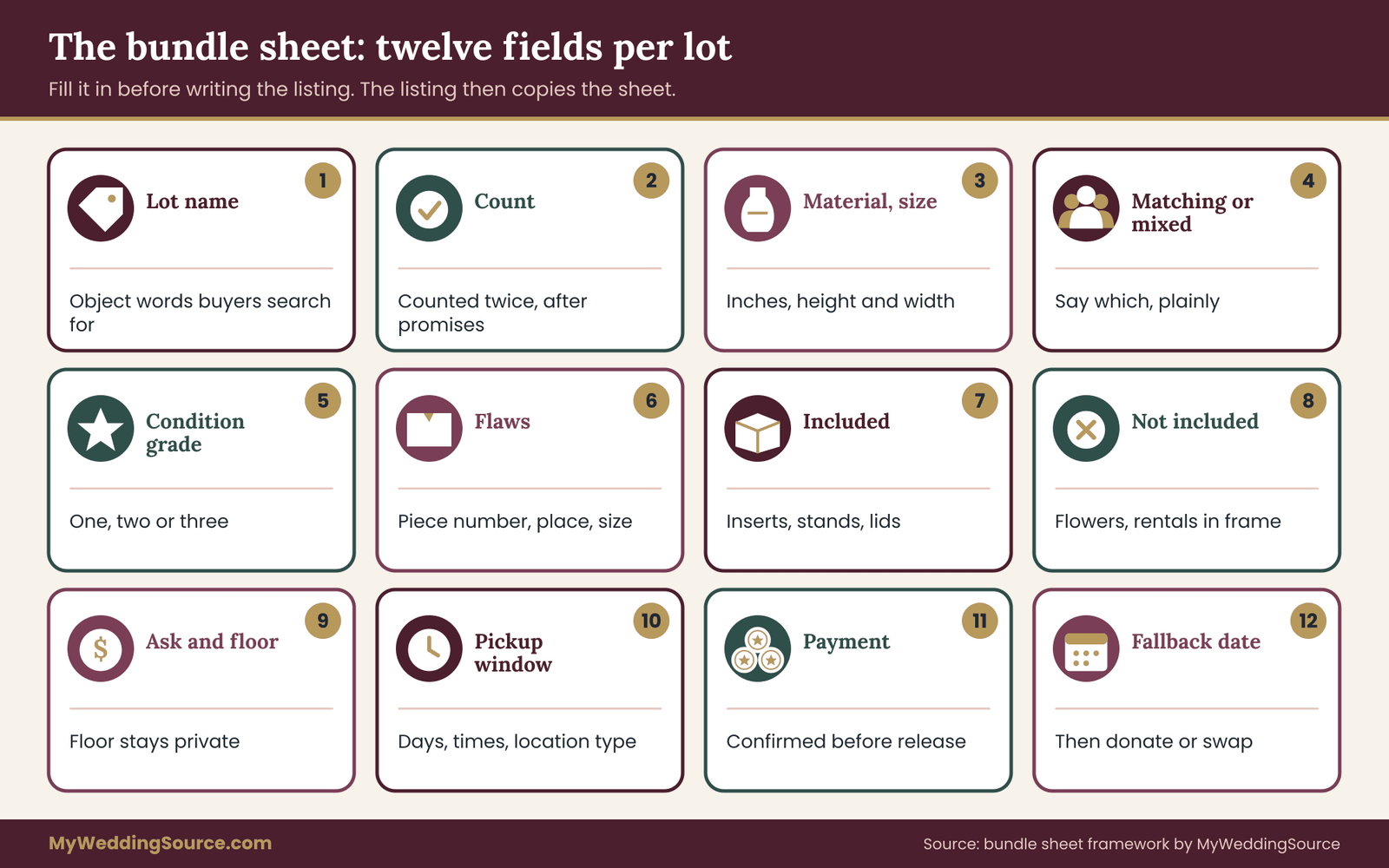
The twelve fields
1. Lot name. A plain, searchable name: “Mercury glass votive holders, set of fourteen.” Skip the poetry. Buyers search for object words, not wedding words.
2. Count. The exact number in the lot, counted twice. If any piece is missing or already promised, the count on the sheet is the count after that.
3. Material and size. Glass, ceramic, brass, wood, mirror, acrylic, fabric. Measure height and widest diameter in inches. A buyer who plans to fit eight pieces on a table wants numbers, not adjectives.
4. Matching or mixed. State whether pieces are identical or only similar. Thrifted vases that “go together” are not the same as a factory set, and buyers should know which they are getting. Name colors in plain words; the site’s guide to choosing a wedding color palette can help you find terms buyers actually use.
5. Condition grade. Use the three-grade ladder in the next section. One grade per piece when they differ, one grade for the lot when they do not.
6. Known flaws and breakage. Every chip, crack, stain, scratch, glue repair, rust spot or missing part, one line each, with the piece number. This is the breakage disclosure, and it gets its own section below.
7. What is included. Candle inserts, wicks, mirror bases, risers, battery tea lights, stands, lids. Be explicit about what comes with the lot and what does not.
8. What is not included. Flowers, greenery, rental pieces in the photo, table linens, signs. People photograph the whole table and then forget that the photo shows more than the lot.
9. Asking price and floor price. The next major section explains how to set both. Write the floor on the sheet and keep it private.
10. Pickup window. Days and times, location type (porch, curb, public lot) and any dates when you are unavailable.
11. Payment method. Cash at handoff or an instant transfer that you can confirm before the items leave your hands. Decide this before the first message so you do not negotiate it under pressure.
12. Fallback date. The date after which an unsold lot goes to donation, a swap group or the return pile. Writing it down turns a vague “we will see” into a decision you already made.
Why lots beat single pieces
To sell centerpieces one vase at a time can look like better value, since each piece fetches its own price. In practice it multiplies your work. Each sale needs its own message thread, its own pickup and its own payment. Fourteen holders become fourteen small transactions with fourteen chances to be stood up.
A lot concentrates that work, which is why it is easier to sell centerpieces as sets. It also matches how buyers shop. A person planning a shower needs ten matching pieces, not one. A restaurant needs enough for every table. Selling the matching set as a single lot is the clearest way to sell centerpieces to people who need a full table, and it attracts exactly the people who have a use for the set.
There is a middle path. Sell the main set as a lot and keep a small “odds and ends” lot for singles, pairs and mismatched pieces. This protects the value of the matched set while still moving the leftovers.
How to group pieces into lots
When you sell centerpieces, group by what a buyer would use together, not by how the pieces sat on your tables. A useful rule is to ask, “What event could this lot dress, start to finish?”
A lot that covers one reception’s tables works well: twelve votive holders and twelve small bud vases may sell better as two lots than one mixed lot, because buyers usually want one or the other. A lot that mixes sizes within one style, such as three heights of the same cylinder vase, works as a tall-and-low set for someone planning staggered tables.
Do not combine unrelated pieces just to hit a round number when you sell centerpieces. A lot of six brass candlesticks plus four ceramic bowls reads as clutter, and the buyer who wants candlesticks must pay for bowls. Two lots, each clearly described, sell faster than one confusing one.
Keep the lot size practical for a car, since most people who buy local lots arrive in an ordinary car. A buyer should be able to carry a lot in two trips from the curb to the trunk. If a lot needs a van, say so in the listing.
A short example of a filled sheet
Here is the sheet for one lot, written in prose so you can see the thinking. The lot is an invented illustration, not a real sale.
Lot name: Clear glass cylinder vases, set of ten.
Count: ten, counted twice. Material and size: glass, nine inches tall, four inches across. Matching: identical, bought together. Condition grade: two, one has a small chip on the rim. Known flaws: vase seven has a rim chip about the size of a grain of rice; vase four has a faint scratch on the side. Included: ten vases, no flowers, no water. Not included: the mirror tiles in the photo, which are rented.
Asking price and floor: chosen using the three-number method. Pickup: porch, Saturday and Sunday afternoons. Payment: cash or confirmed transfer. Fallback: donation to a local charity shop on the twenty-first day.
Notice what the sheet does. It makes the listing nearly write itself, it separates your property from the rented mirror tiles, and it gives you a firm exit date. Most of the work of selling centerpieces is deciding these things once so you do not decide them again in a text thread.
Keeping the sheet and the sale consistent
The sheet is the source of truth. Copy the listing text from it, not the other way around. If a buyer asks a question the sheet does not answer, answer it and add the answer to the sheet. If you change the price, change the sheet.
That discipline matters most when you run several lots at once. Three listings, six messages and two pickups can blur together. A glance at the sheets tells you which lot has been promised to whom, what the floor is and when the fallback date falls. It also helps if your partner is handling some of the handoffs, because both of you work from the same page.
Condition grades: a three-step ladder buyers understand
Words like “great condition” and “gently used” mean different things to different people, so they cause arguments. Use a short ladder instead and define it in your listing.
Grade one: display ready. No chips, cracks, stains or repairs. Normal handling marks only. Candle wax, tape residue and adhesive have been removed. You would put this on your own table tomorrow.
Grade two: minor flaws, fully usable. Small chips on a rim or base that do not affect use, light scratches, faint cloudiness in glass, a tiny dent in metal, a small glue repair that is stable. Each flaw is listed and photographed.
Grade three: usable with work. Obvious wear, rust that needs cleaning, a missing lid, a crack that does not leak but is visible, finish loss. These sell as craft or project pieces, and the price should say so.
Anything below grade three, such as a crack that leaks, a sharp chip on a drinking-edge or a wobbling base that tips easily, is not a sale item. It goes to recycling or disposal. Selling a piece that could injure the buyer is not a matter of disclosure; it is a matter of not handing over a hazard.
The ladder helps you sell centerpieces because it is short and because every grade comes with a duty to list what is wrong. A buyer reading “grade two, flaws listed below” knows what to expect, and you know exactly what to write. When the pieces in one lot differ, grade each piece by number and say so: “pieces one to eight are grade one, pieces nine and ten are grade two.”
Cleaning before you grade
Clean first, grade second, whenever you sell centerpieces. A vase that looks cloudy may only have hard-water film. A holder with wax in the base may be grade one once the wax is gone.
For glass, warm water and mild dish soap handle most dirt, and a soft cloth dried right away prevents spots. Wax can be lifted by chilling the piece until the wax shrinks and pops loose, then wiping the residue. For brass and metal, dry cloths and gentle cleaners are safer than abrasives, and any finish that rubs off on the cloth should be noted rather than scrubbed further. Wood pieces need only a damp cloth and time to dry.
Avoid soaking anything that has glued parts, painted finishes or felt bases. If a cleaning step could make a flaw worse, skip it and disclose the flaw instead. A buyer prefers an honestly dusty piece to one you damaged while scrubbing.
Pricing when you sell centerpieces: the three-number method
Pricing is where couples who sell centerpieces either leave the lot unsold or give it away for a fraction of its value. The pattern is the same each time. They anchor on what they paid, feel stuck, and either hold the price too high or drop it far below what a buyer would pay. A better approach uses three numbers, set in a fixed order, each answering a different question.
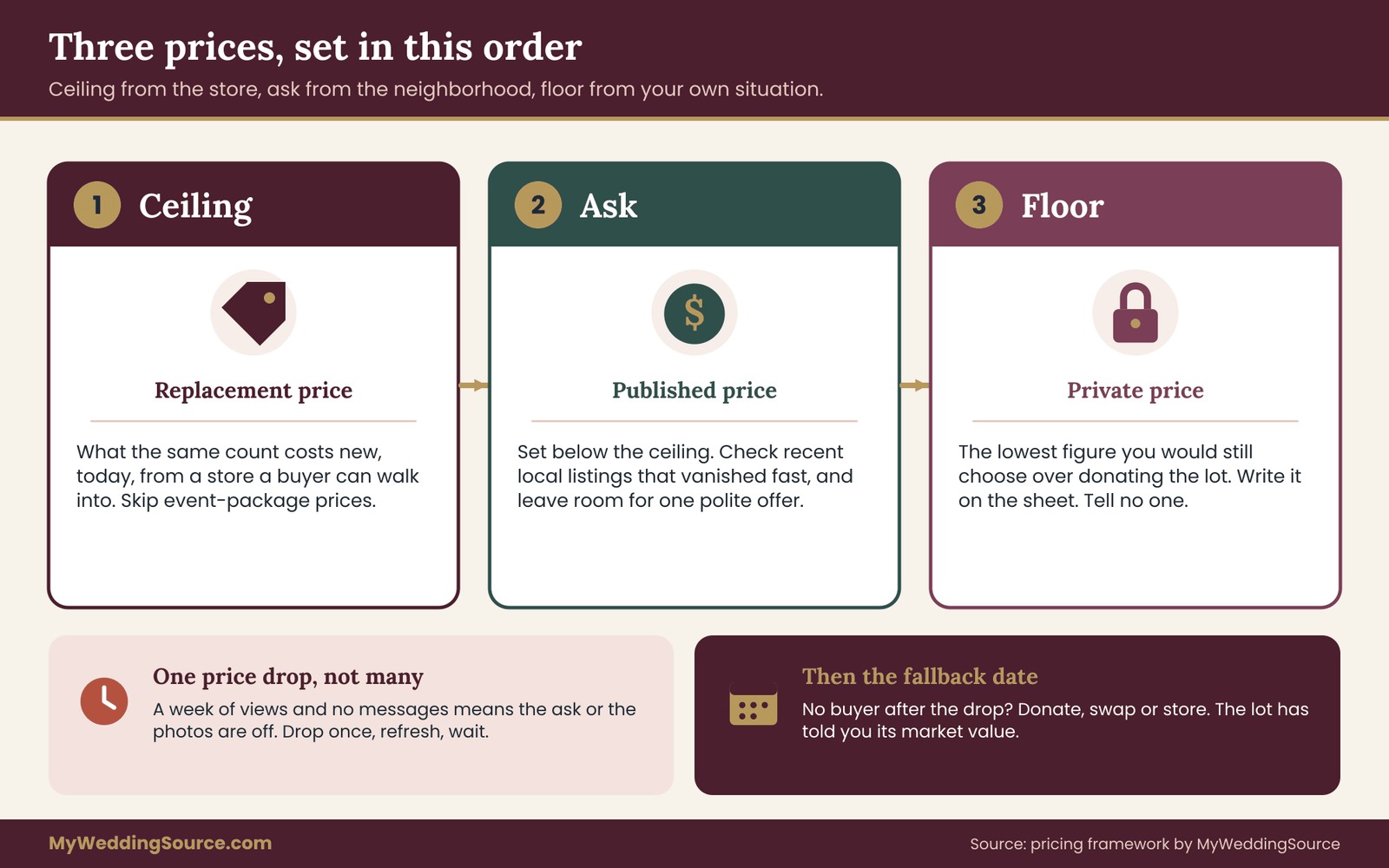
Number one: the replacement price
To sell centerpieces at a fair price, start with what a buyer would pay to get something like it new today, from a store they can walk into. This is not what you paid; prices and styles shift. Check two or three current retail listings for similar items, local if possible, and write down the lowest reasonable figure for the same count.
The replacement price is the ceiling. When you sell centerpieces, almost no one will pay more for used than new, even if yours had a nicer finish. If you cannot find a comparable new item, the piece is unusual, and you can price by what comparable secondhand listings in your area ask instead.
Do not use inflated “wedding” listings as comparables. A vendor who sells the same vase for an event rental or a styled package is charging for service, not for the object. Compare plain retail, thrift and craft shop prices.
Number two: the local ask
The ask is the price you publish. Think of it as a share of the replacement price that reflects age, condition, matching and convenience. A grade one matched set in a popular style can sit close to the top of that range. A grade two lot with flaws sits lower. Grade three sits lower still.
There is no formula that fits every market, and an invented percentage would only pretend to be certain. Instead, anchor the ask with three checks.
First, look at local sold or recently listed comparables, if the platform shows them. Asking prices that never sell tell you nothing; items that disappeared from a listing within days tell you what the market accepted.
Second, ask whether the price is comfortable for a casual buyer. If paying more than a few trips’ worth of spending money for a lot of vases makes a shopper hesitate, the lot may be pitched at the wrong person.
Third, build in negotiation room. Many local buyers expect to haggle. If your floor is a certain amount, publish a slightly higher ask so a polite offer can land near the floor and both sides feel they got a fair deal. Do not inflate the ask so far that it scares serious buyers away before they message.
Number three: the floor
The floor is the lowest price you will accept, the one you write on the sheet and tell nobody. It is the price at which you would still rather sell than donate, store or carry the lot back inside.
Setting the floor means weighing a few costs honestly. Your time to answer messages and hold a pickup is not free. Space is not free either; a lot taking up a closet corner has a cost if you are moving, hosting or tight on room. The donation alternative is not free of effort, but it removes the haggling and may come with a receipt, a point the failure-conditions section below returns to.
For many lots the honest floor ends up lower than people expect, because the alternative to selling is not a better sale later. It is a drive to a donation center. That is a good reason to sell centerpieces at a modest price rather than hold out.
A simple order of operations
Use the three numbers in order. Check the replacement price, set the ask below it with room to move, and write the floor. Then publish the ask, and treat the floor as a private decision. If a buyer offers below the floor, you can decline politely or counter, and you do not need to explain the floor.
Here is how a first reply to a low offer might read:
“Thanks for the offer. I can’t go that low on a matched set, but I can do a bit better than the listing if you can pick up this weekend.”
That sentence names a trade, a small discount for a fast pickup, which is usually worth more to you than a few extra dollars.
Price drops and the two-week rule
If you sell centerpieces, plan one price drop. If a lot has been live for a week with several views but no messages, the ask is too high or the photographs are not working. Lower the price once, to a level between the original ask and the floor, and refresh the listing so it returns to the top of local feeds.
Avoid a slow slide of tiny reductions. They teach watchers to wait and give you nothing in return. One clear drop, announced in the listing, reads as an honest adjustment.
If nothing moves after the drop, the market has answered. Move to the fallback date. Many couples find that the lot they thought was worth a modest sum finds no buyer at all, and a donation is the better outcome.
Bundling and discounts
Offering a modest bundle discount can help you sell centerpieces in pairs of lots. A buyer who takes two lots in one trip saves you a second pickup, and that saving is real. A short line in your reply does the job: “If you take both lots, I can take a little off the total.” Keep the discount small and decide it in advance.
Resist the urge to throw in unrelated extras to close a deal. Free items still need to be described, and an undisclosed extra can cause trouble if it turns out to be someone else’s property. If you want to give a bonus item, make sure it belongs to you, and add it to the sheet.
Worked pricing logic without invented numbers
To see the method in motion, take the earlier example of ten clear glass cylinder vases. Suppose a nearby craft store lists a similar vase individually. Multiply the lowest listed price by ten to get the replacement price for the lot. That number is the ceiling.
Next, check local listings for similar sets. If nearby sellers list ten comparable vases at a visible price and some have already disappeared, the ones that left show what buyers accept. Place your ask just above the typical accepted figure, since one vase has a small chip and you will list it as grade two.
Then decide the floor. You might ask what you would accept to avoid driving the vases to a charity shop, and arrive at a figure a little below the typical accepted price. The three numbers are now written down: a ceiling from the store, an ask from local sales, and a private floor from your own situation.
None of this requires a calculator. It requires looking at real prices on the day you list, not trusting a number you remember from the wedding planning stage. Prices change, and any specific figure in an article would be out of date before it was read.
When the lot is worth more as singles
Occasionally, when you sell centerpieces, a single piece is worth far more than the lot average, such as a good brass candelabra, a signed ceramic piece or a real antique. Pull it out of the bundle and list it alone. A buyer who wants the standout does not mind paying for it, and the rest of the lot sells more easily without the odd piece skewing its price.
If you suspect an item has real value, do a quick check before listing. Look for maker’s marks on the bottom, compare against completed listings for the same marking, and consider asking a local consignment or antique shop for an opinion. Do not guess high, and do not guess low. A short, honest “I am not sure of the age or maker” in the listing protects you either way.
What to do about sales tax and platform fees
Most local sales of used household goods between individuals do not involve you collecting sales tax, but rules differ by state and by how often and how much you sell. Your tax authority publishes the current rules, and the IRS publishes guidance on how income from selling personal items is treated. The final section of this guide covers records and points to the sources; for pricing purposes, treat any platform fee as part of your floor. A listing that charges a selling fee reduces what you keep, so check the fee before you choose a platform.
A quick sanity check before you publish
Read your three numbers aloud. The ceiling should be what a new equivalent costs. The ask should be lower and comfortable for a casual buyer. The floor should be a figure you would be happy with if the first buyer said yes immediately. If any of the three makes you wince, adjust it now, because the version you resent is the one you will struggle to hold when a real buyer arrives.
Pricing is the part of the process that feels most personal when you sell centerpieces, because the objects carry memories. Try to separate the two. The sentimental value stays with you, in photographs and in the pieces you decide to keep. The price on the lot is about what a stranger needs. If one centerpiece matters too much to sell, take it off the sheet. Keeping a few favorites is a legitimate choice, and it often makes it easier to price the rest.
Condition photos that help you sell centerpieces without disputes
Photographs do two jobs at once. They persuade a buyer to message you, and they form the record of what you promised. A buyer who saw a chip in the listing cannot claim at pickup that you hid it. A buyer who did not see one can, and the photograph you did not take is the one you needed.
You do not need a camera or a studio to sell centerpieces well. A phone, a window and a plain surface are enough.
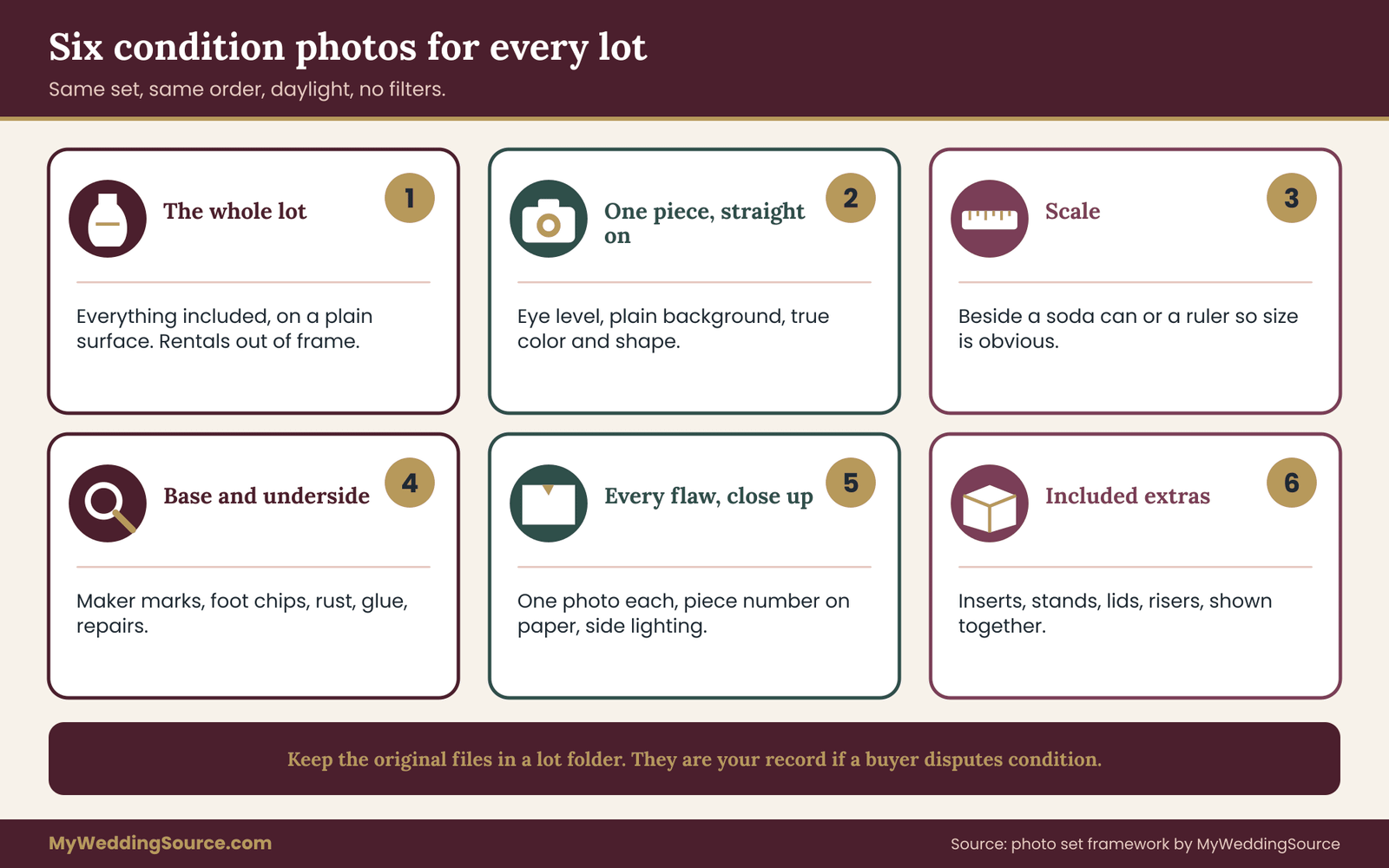
The six-shot set for every lot
Take the same six photographs for each lot you sell, in the same order. The consistency makes listings easy to compare and makes your own record easy to read.
Shot one: the whole lot together. Everything in the lot, spread on a plain table or the floor, with no extra items. This is the lead photo. If a rented or borrowed item is nearby, move it out of frame.
Shot two: one piece, straight on. A single piece at eye level against a plain background. It shows the true shape and color without distraction.
Shot three: scale. The piece beside a familiar object, such as a standard soda can or a ruler held against it. A buyer who cannot judge size will ask, and this answers the question before it comes.
Shot four: the base and the underside. Turn a piece over. Bottoms hold maker’s marks, chips on the foot, rust and glue. This is where hidden flaws live and where buyers look first if they are careful.
Shot five: every flaw, close up. One photograph per flaw, with the piece number on a scrap of paper in the frame. Light the chip from the side so the edge shows. If you have three flaws, that is three photographs.
Shot six: the included extras. Candle inserts, stands, lids, risers, anything that comes with the lot. A buyer sees at a glance what they are getting.
Light, background and honesty
To sell centerpieces with honest photographs, shoot near a window in daylight, in the middle of the day if you can, with no direct sun on the piece. Direct sun creates glare on glass and hides cloudiness. Overhead room lights cast yellow light that changes the apparent color of white and clear pieces.
Use a plain, light, matte surface: a bedsheet, a sheet of poster board or a clean table. Avoid patterned linens that tempt a buyer to think the pattern is part of the lot.
Do not filter, brighten, sharpen or retouch when you sell centerpieces. Editing that changes color or hides marks turns a photograph into a claim you cannot support. A buyer who arrives to find a duller piece than the photo promised feels misled, even if every word of the description is accurate. If your phone applies automatic enhancement, turn it off for these shots.
Photograph glass against a dark background when you want to show clarity, and against a light one when you want to show chips. If you have time, take both. A chip is often invisible against a bright window and obvious against a dark cloth.
Keep the originals
Save the original files in a folder named for the lot, a small habit that makes it easier to sell centerpieces again later. Do not delete them when the listing sells. If a buyer reports damage after pickup, these photographs, along with the timestamp, show what was handed over. That is useful for you and fair to the buyer, who can see that the piece matched the record.
It is also good record-keeping for the household. The site’s guide to organizing wedding records after the event explains how to keep sale records together with receipts and contracts, and a lot folder with photographs and a one-line sale note fits neatly into that system.
The breakage disclosure: the part of the sheet buyers remember
A breakage disclosure is a plain list of everything that is wrong with the lot, written before the listing goes live. It is the most protective thing you can add to a sale, and it is rarely done well. Most people who sell centerpieces write “minor wear” and move on. A good disclosure is specific, short and complete.

The four levels of disclosure
Organize the disclosure by how easy each problem is to see. This helps you remember what to include and helps the buyer know what to expect.
Level one: visible flaws. Anything a buyer can see in the photographs at a glance. Chips, cracks, stains, scratches, dents, color differences. Write the piece number, the location and the approximate size. “Vase four: chip on the rim, about the size of a grain of rice.”
Level two: hidden flaws. Anything that shows only on close inspection or from the underside. A hairline crack inside a bowl, a rough foot, glue repairs, interior cloudiness that clears in some light. These are the flaws most likely to cause trouble because they are the ones a buyer finds at home.
Level three: functional limits. Anything about how the piece works. A holder that fits a taper candle but not a pillar, a lid that sticks, a vase that is not watertight, a lantern with no latch. Mention the limit, not only the flaw.
Level four: missing or substituted parts. Missing lids, replacement bases, parts from another set, a stand that does not match. This is the level people forget because they stopped noticing it.
Going through the four levels in order produces a short, honest list. It rarely takes more than five minutes per lot.
Writing the disclosure in plain words
Use sentences a stranger can picture. Avoid trade words like “patina” or “character” unless you explain them. Avoid vague words like “minor,” “small” or “slight” without a size or location.
Here is what a clear disclosure for the invented glass vase lot might read like:
“Ten glass cylinder vases, nine inches tall. Vase seven has a rim chip about the size of a grain of rice, not sharp but noticeable. Vase four has a faint scratch on one side. All ten hold water. No lids. Sold as pictured.”
It is five short sentences. Every flaw has a piece number, a location and a size. It states what the lot does and does not include. It says the lot is sold as pictured, which sets the standard for the sale.
The as-is line and what it can and cannot do
Many sellers add “sold as is.” That line tells the buyer you are not offering a warranty or a return. It is a reasonable, common statement for local secondhand sales. But it is not a shield for dishonesty. If you knew about a flaw and did not disclose it, the line does not undo that, and some places treat a hidden defect differently from a visible one. For the rules in your area, check your state attorney general’s consumer pages or the federal consumer protection pages listed in the sources.
The practical point is simple: disclose first, then add “as is.” The disclosure makes the line fair. Without the disclosure, the line looks like a way to avoid responsibility.
Safety flaws are different
Some problems are not about price or honesty. They are about harm. A chipped glass rim that could cut a mouth, a cracked piece that could split in someone’s hand, a candle holder with a loose base that could tip, or a lantern with exposed sharp metal belong in a different category. Do not sell these, even with disclosure. Wrap and dispose of them according to your local waste rules, or ask your municipal waste authority how to handle broken glass.
The broken-glass rule matters at pickup too. Wrap each piece, and keep a small box of packing material by the door so a buyer can carry glass safely. A buyer who cuts a hand at your doorstep is a problem no listing can solve.
Putting the photographs and disclosure together
In the listing, put the lead photograph first, the disclosure text in the first few lines of the description, and the flaw photographs next. Do not bury the disclosure under a story about the wedding. A buyer who has to scroll to find the flaws will assume you hoped they would not.
Number the photographs in the description. “Photo five shows the chip on vase seven” ties the claim to the image. This also makes the conversation after a message shorter, since you can point to the photo number rather than re-explaining.
When a buyer asks for more photographs, send them. A buyer who is willing to ask is a serious buyer. If someone asks for fifteen extra angles and a video call for a lot of fairly priced vases, you can politely say the listing photographs are the record and the pieces can be inspected in person at pickup.
Why the disclosure also protects the sale price
Couples often fear that listing flaws will push buyers away. The effect is usually the reverse. A listing with specific flaws reads as trustworthy, and a trustworthy listing draws more messages at a firmer price. A buyer who sees “chip on vase seven, photo five” feels informed. A buyer who sees “great condition” and then finds a chip feels cheated, and wants a discount for the inconvenience.
Honest disclosure is also the fastest way to sell centerpieces in lots. It moves the conversation from “what’s wrong with it?” to “when can I pick it up?” and trims days from the process. The lots that sit longest tend to be the ones with thin descriptions and photographs that skip the flaws.
Where to sell centerpieces locally: comparing the main routes
Local selling is not one channel, and the route you pick to sell centerpieces matters. It is several, each with a different audience, speed and level of effort. The right choice depends on how many lots you have, how quickly you want them gone and how comfortable you are meeting strangers. Platform rules and fees change, so check each platform’s current policies before you list. The sources at the end of this guide link to the main ones.
Community marketplace apps and classified sites
The large local marketplaces are where most people sell centerpieces, because they reach the most people for the least effort. Listings are usually free for individuals, buyers search by object and area, and messaging is built in. The trade is volume: you will receive messages that go nowhere, offers far below the ask and requests that you hold an item for days.
These platforms suit anyone who plans to sell centerpieces as matched lots of common styles, such as clear vases, mason jars, lanterns and wooden slices. They suit couples who can respond within a few hours, since a slow reply loses a buyer who has already messaged three other sellers.
Read the platform’s rules on what can be listed and how payment may be handled. Some limit certain categories, and some steer buyers toward on-platform payment for shipped items. For a local cash sale, the main thing to watch is your own safety habits, covered below.
Neighborhood networks
Neighborhood-based networks and community groups often work better for bulky, low-value decor because the buyer is truly nearby and the pickup is short. A neighbor three streets away is more likely to show up on time than a stranger across town.
The audience is narrower and the price expectations lower for anyone who wants to sell centerpieces there. These groups often lean toward free-to-good-home exchanges. If your goal is to clear space quickly and the proceeds are secondary, a very modest price or a “pay what you like” offer can move a lot in a day.
Check the group’s rules before posting. Many restrict commercial-looking listings, and a wedding lot can be read as business if you list many items at once. A short, personal description helps: “Wedding decor we no longer need.”
Reuse and give-away groups
Reuse networks, where members give items away rather than sell, are the opposite end of the price scale. They work well for grade three pieces, odds and ends and leftover supplies. They do not suit lots you hoped to sell, because members expect free.
Treat these groups as the tail end of your timeline, not the head, when you sell centerpieces. After the fallback date, a post that says “free, porch pickup, glass vases, first come” often clears a lot in an afternoon, and the donation receipt you give up is usually worth less than the days saved.
Consignment and resale shops
A local consignment shop, a vintage dealer or a home-decor resale store takes the work out of the sale in exchange for a share of the price. They choose what they accept, set their own prices and pay you after items sell, often weeks later.
This route suits better pieces: brass, mirrored items, good ceramics, anything that photographs well on a shelf. It does not suit bulk lots of ordinary glass, which these shops generally decline because the margin is thin.
Call before you visit. Ask what they take, how long they hold items, what percentage they keep and whether you can retrieve unsold pieces. Write down their answers, because terms differ and verbal terms are easy to forget. Then bring a clean, sorted box, with each lot photographed beforehand so you can show what you are leaving.
Wedding-specific resale groups and local event networks
Some areas have community groups for couples planning events, and they are a natural place to sell centerpieces, since these can be the best match for your lot. Buyers are looking for exactly this kind of decor, they understand the vocabulary, and they will often take whole table sets.
The limit is availability. Not every area has an active group, and a group that exists may be quiet. If you find one, share the lot there first, with the same photographs and disclosure, before opening the listing more widely.
A sensible order is to start with the wedding-specific group for three to four days, move to a general marketplace if nothing happens, and use reuse groups after the fallback date. This sequence keeps the best buyers at the front of the line.
Sellers’ pitfalls on every route
A few mistakes appear on every platform.
Cross-posting without tracking. Listing the same lot in four places and then forgetting one leads to two buyers arriving for the same vases. If you cross-post, keep a note of where each lot is listed, and mark the sheet “sold” and remove every listing the moment a buyer is confirmed.
Holding items without a deposit. A buyer who says “hold it until Friday” has bought nothing. A reasonable position is to hold an item for the length of time they confirm a specific pickup time, and no longer.
Letting the wedding story take over. Buyers do not need your story. A short line is enough, and the specific words that sell are “set of fourteen,” “nine inches tall” and “porch pickup this weekend.”
A short comparison in words
For speed on common items, a general marketplace usually wins. For nearby, low-effort handoffs, a neighborhood network works well. For better pieces and no work, a consignment shop pays slowly but cleanly. For targeted buyers who know what they want, a wedding group is the best first stop. For leftover pieces, a reuse group finishes the job.
Most couples who sell centerpieces use two of these routes in sequence, not all five. Pick the first by lot value and the second by your timeline.
Writing the listing and handling messages
A good listing to sell centerpieces is short and answers the questions buyers ask most. It uses the bundle sheet word for word, in this order: lot name and count, size and material, condition grade, flaws with photo numbers, what is and is not included, price, pickup details.
A listing template in prose
The title carries the count and the object, because buyers who want to buy centerpieces search by object: “Clear glass cylinder vases, set of ten, nine inches.” Avoid exclamation marks, all-capitals and phrases like “perfect for your special day.” Buyers filter by object.
The first lines of the description state the grade and the flaws. The next lines list included and excluded items. Then the price, then pickup days and times, then payment method. Finish with the fallback date if you like: “Listing ends on the twentieth; unsold items go to donation.”
A line such as “Price is firm for matched sets, lower for single pieces” can set expectations before the haggling starts. Say only what you mean. If you are willing to negotiate, say “reasonable offers considered.”
Replies that keep the conversation short
Most messages you get when you sell centerpieces fall into a few types. Having a ready reply for each saves time and keeps your tone steady.
For “Is it still available?”, reply with a direct yes and a pickup option: “Yes, still available. I can do Saturday afternoon or Sunday morning, porch pickup.”
For “Can you hold it?”, reply with a condition: “I can hold it until Saturday at noon if you confirm a pickup time.” If they do not confirm, the hold ends.
For “Will you take less?”, use the earlier two-sentence reply, or “The price is firm on the set but I can do a little off if you take both lots.”
For “Can you ship it?”, reply with a fixed answer: “Local pickup only, since the glass is fragile.” This is true, it protects you, and it filters out buyers who wanted something else.
For “Can you deliver?”, decide ahead of time. If you are willing, set a fee and a distance. If not, say pickup only.
Questions that signal a serious buyer
A buyer who asks about size, count, what is included or pickup time is likely to buy centerpieces from you. A buyer who asks “what’s your lowest?” before saying anything else may be testing the floor, and you can respond with the ask and a polite line.
Be wary of questions that skip the pieces entirely: requests to move the conversation to another app, offers to pay more than the ask and arrange a courier, or messages that read like a template. These are signs of a scam pattern, and the FTC publishes current guidance on recognizing them. If a message feels off, stop replying and report it on the platform.
Screening buyers without being rude
Screening does not mean treating every buyer as a threat, even when you sell centerpieces to strangers. It means a few quiet habits. Use the platform’s messaging for the first exchanges, so there is a record. Confirm the time and the pieces by message before pickup. Note the buyer’s name as it appears on the platform.
If a buyer is vague about timing, offers odd payment terms or presses for your home address before confirming interest, you can end the exchange. “I’ll pass for now” is polite and complete.
Closing the thread cleanly
When a pickup is confirmed, send a last message with the lot name, the count, the price, the pickup time and place, and the payment method. This takes thirty seconds and makes surprises less likely. After pickup, mark the listing sold, delete other postings and add a one-line note to your sale record: date, lot, price, payment method. If you sell centerpieces in several lots, this note is what keeps the books straight.
Pickup day: handoff, packing and payment when you sell centerpieces
The listing gets the buyer to your door, and pickup is where you actually close the sale. The pickup decides whether the sale ends well. Fragile objects, a stranger and cash in hand are three separate things that can go wrong, and each has a simple fix.

Choose the handoff location
You have three reasonable options, ordered from most to least convenient.
Porch or curb pickup. The lot sits outside, wrapped, with the buyer’s name on a note. You are not present, the buyer collects, and payment is made beforehand by a transfer you can confirm. This works well for low-value lots and for buyers you have messaged enough to trust. It does not work for cash payment.
Doorstep handoff. You meet the buyer at your door, hand over the lot, take payment and the sale is done in two minutes. Keep the lot packed and near the door so the buyer never needs to come inside. Let someone else in the household know the time and the buyer’s first name.
Public meeting place. A well-lit lot outside a busy store, a community center or a police-station exchange area, if your area has one. This suits valuable lots and any case where you feel uneasy. Many local police departments publish exchange locations for online sales.
Pick the location before you confirm the time, as you would for any plan to sell centerpieces in person, and say it in your message. Do not let a buyer change the location at the last minute to something less public. “I can only do porch or the grocery store lot” is a complete answer.
Pack the lot before the buyer arrives
Packing at the door under a buyer’s gaze invites mistakes and rushing, so pack ahead whenever you sell centerpieces. Pack the night before.
Wrap each glass or ceramic piece in paper or a clean cloth. Newsprint works, though it can leave ink on light pieces, so plain packing paper is better. Stack pieces in sturdy boxes with crumpled paper in the gaps, with the heaviest pieces on the bottom and the rim-chipped pieces on top so they do not take a load.
Label the box lid with the lot name and count. This is useful for the buyer, and it lets you check the count again when you load it. If a lot is two boxes, number them.
If you are selling mirror tiles or framed pieces, tape the glass and carry it flat. Wrap candle holders with their inserts in place if the insert is part of the sale, so nothing rattles.
Do not accept the buyer’s offer to “just toss them in the trunk loose.” Politely hand over a box. You are not responsible after handoff, but nobody wants a pile of broken vases on a driveway.
The count at handoff
Count the pieces aloud with the buyer present. “Ten vases, as listed.” Show the flaws you disclosed, in particular vase seven with the rim chip. Let the buyer look.
This step does two jobs. It confirms the count and the condition against the record, and it reminds the buyer that you disclosed the flaws. If a buyer wants to inspect the underside of each piece, let them. The photographs said it would look like this, and the buyer decides whether it still does.
If the buyer notices a flaw you missed, this is where you want to find out. Offer a small adjustment if the flaw matters, and add the flaw to your own notes. Honest correction at the curb costs less than a dispute later.
Payment: settle before the lot leaves your hands
Payment for any lot should be confirmed before the items leave your hands, in a way you can verify.
Cash is the most direct option for a doorstep or public meeting. Count it before the buyer takes the box. If the amount is large, a public place near a bank is sensible.
Payment apps work too, but verify the money has actually arrived in your account, not merely that the buyer’s screen shows “sent.” Screenshots of a pending payment are not payment. Ask the buyer to send the payment while standing there and check your own account. If the payment is delayed, wait.
Do not accept overpayments, checks or requests to refund a difference by a different method. These are common patterns in payment scams, and the FTC’s consumer pages describe them in detail.
If the buyer asks to pay later, the sale is not complete. Say “I’ll hold it until the payment arrives” and keep the lot.
If the buyer does not show
Some do not, and anyone who plans to sell centerpieces should expect a no-show now and then. Give a buyer a short grace period, say fifteen minutes, then send one message: “Still planning to come? I’ll wait until the half hour.” After that, the slot is open for the next person. Do not chase.
Keep a short waiting list: the second and third people who messaged. A lot that falls through on Saturday can sell on Sunday if you have the name ready. If a buyer repeatedly fails to appear, say once that you will move to the next person, and do.
Safety habits in four lines
Meet in daylight. Do not give your address until pickup is confirmed. Tell someone the time and place. Leave if a buyer’s behavior changes, whatever you have already agreed. None of this is dramatic, and almost all pickups are uneventful. The habits cost nothing and cover the rare case.
After pickup: close the loop
Mark the listing sold and delete other postings, so the effort to sell centerpieces ends cleanly. Update the sheet with the sale date, the price and the payment method. Move the photographs into the lot folder. If any piece was returned or the buyer reported a problem, note that too.
If a buyer messages later to report damage, reply politely and refer to the photographs and the disclosure. You can express regret without offering a refund when the piece matched its description and left your hands in the condition documented. A short, steady reply usually ends the conversation. If the buyer’s complaint is that a flaw was not disclosed and it is in fact absent from your list, consider whether a modest partial refund is the fair and fast way to close it.
A worked case: fourteen votive holders, one weekend, no drama
The following example is invented to show how to sell centerpieces from the first audit to the last pickup. The names and the prices are illustrations, not data, and your numbers will differ.
Maya and Daniel finish their wedding on a Saturday. By Monday they have run the ownership audit. They own fourteen mercury glass votive holders, bought together from a home-decor store, and twelve clear cylinder vases. They also hold eight brass candlesticks that belonged to Daniel’s aunt, which they will return, and six mirror tiles rented from the venue, which they have already scheduled for return.
On Tuesday they sort the owned pieces into three lots: the fourteen votive holders, ten of the twelve cylinder vases, and a small odds-and-ends lot containing two cylinder vases and a few mismatched candle holders. They wash everything, check the underside of each piece and grade them. Holders one to twelve are grade one. Holders thirteen and fourteen have a worn silvering patch on the inside, which they describe as grade two.
On Wednesday they photograph each lot in the six-shot set by the kitchen window and write the disclosure. They then use the three-number method. For the votive holders they check a home store’s listing for the same style, find a new price for a single holder, and multiply by fourteen for the ceiling. They look at three local listings for similar mercury glass sets, notice that two sets disappeared within a few days, and set the ask slightly under those. Their floor is lower, the figure they would take to avoid carrying the box to a donation drop.
On Thursday they list the three lots in a local wedding group and a general marketplace. They write the ask, mention porch pickup on the weekend and note that unsold items go to donation on the twenty-first day. By Friday evening, the votive holders have drawn four messages. One buyer asks whether the holders come with candles. Daniel replies from the sheet: no candles, no inserts, holders only.
On Saturday a buyer collects the votive holders at the doorstep. The lot is boxed, counted aloud and the two worn-silver holders are pointed out. The buyer pays by transfer, Maya checks her account, and the box goes. On Sunday a second buyer takes the cylinder vases, one rim-chipped vase included at a reduced price they had agreed to in the listing.
The odds-and-ends lot draws no messages for a week. Maya lowers the ask once, refreshes the listing and waits. On the twenty-first day, with nothing sold, she posts it in a reuse group as free for porch pickup and it is gone by evening. The whole sale takes about three weeks, most of which is waiting. The work took roughly five evenings.
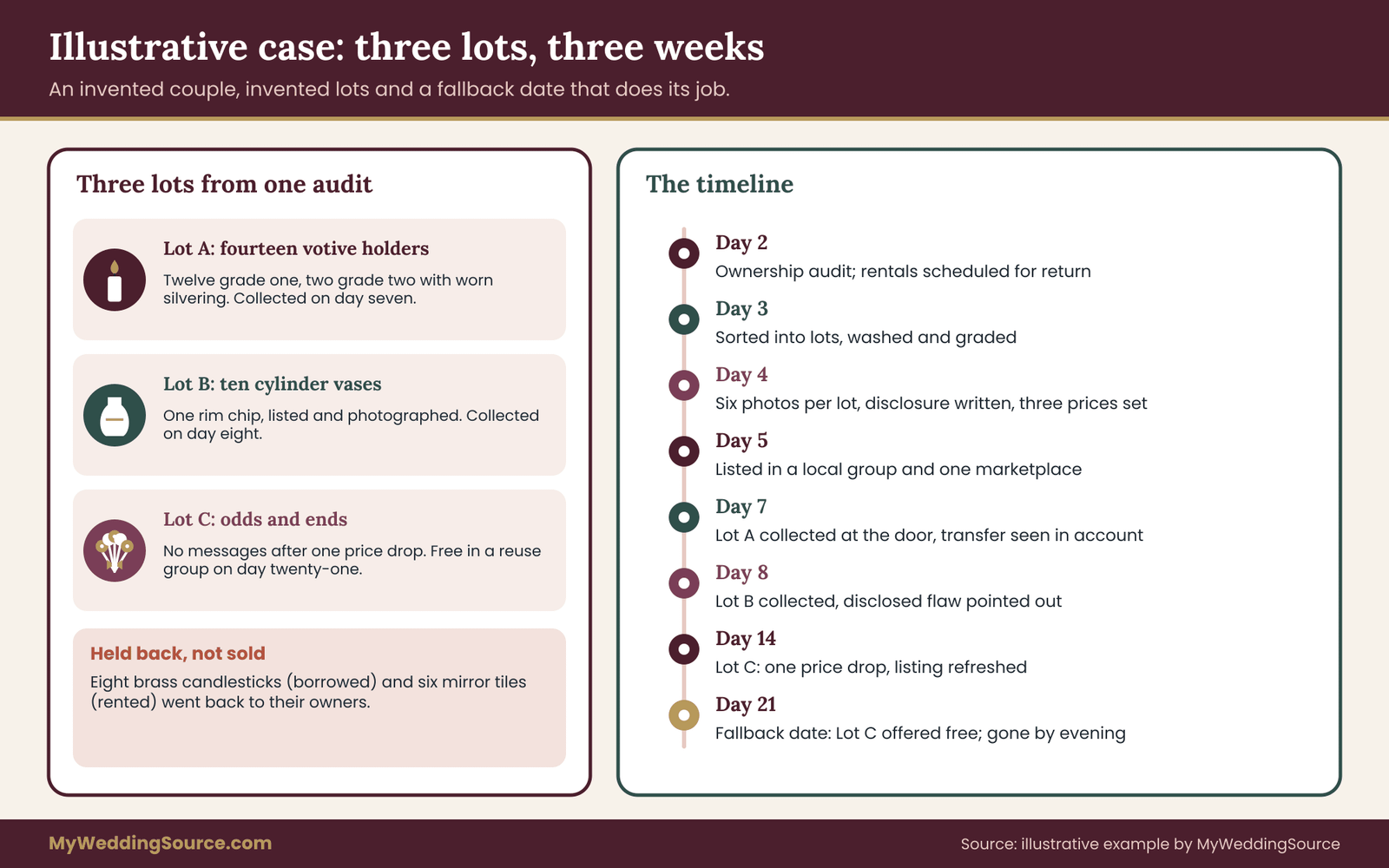
What the example shows
Three features of how Maya and Daniel sell centerpieces matter more than the numbers. First, the ownership audit caught the aunt’s candlesticks and the rented tiles before they could be listed. Second, lots reduced the work to three transactions. Third, the fallback date did its job: the lot that would not sell did not linger, and the pieces found a home the same day Maya let go of the price.
A second point is less obvious. The best-selling lot was not the cheapest. The votive holders sold fast because the listing was specific, the photographs showed the worn patch openly and the pickup was easy. A lower price might have attracted more messages, but would not have closed the sale faster.
Adapting the case to your situation
If you sell centerpieces as one large lot, skip the odds-and-ends step. If you have several small lots in different materials, consider a single weekend “decor sale” at your door, with all lots displayed and a short sign. A multi-lot visit saves buyers trips and lets them choose.
If you are leaving town after the wedding, shorten the timeline and rely on a trusted friend or relative who can run the pickups, with your sheet in their hands. Give them the floor prices, the fallback date and the payment rules. A short handoff note avoids confusion, and a single line in your records for each payment keeps the proceeds easy to trace afterward.
When not to sell centerpieces: failure conditions and better alternatives
An attempt to sell centerpieces that should not happen is worse than a sale that fails. The conditions below are the points at which you stop, step back and choose another route. Treat them as tripwires you check at the beginning and again at the fallback date.
Stop conditions before you list
Ownership is unclear. If you cannot say with certainty that a piece is yours, do not list it. A vendor reply in writing settles the question; silence does not.
The piece is a safety risk. Cracked glass that could split, sharp chips on a drinking or handling edge, loose bases, damaged wiring on any lighted piece. Dispose of it responsibly.
The cost to sell centerpieces exceeds the proceeds. If a lot would sell for less than the time and fuel needed to hand it over, skip it. A single vase worth a few dollars is not worth an hour of messages. Add it to the donation pile.
The pieces are personal. If a centerpiece carries a family connection, such as a grandmother’s bowl used for the occasion, the money is not what matters. Keep it, or return it to its owner.
You cannot clean or inspect it. Items stuck in dried wax, glued to a base or covered in residue you cannot remove need honest grade-three treatment or a different route.
Stop conditions during the sale
No messages after the price drop. If a lot has had one price drop and a week of views without a serious message, the market is telling you something. Move to the fallback.
The buyer pressures you. Rushing, changing the plan, pushing for your address or a different payment method are all reasons to end the exchange. There is always another buyer or another route.
A hidden flaw appears. If you find a crack or a chip that you missed, stop, correct the listing and notify any buyer who has already messaged. Update the photographs. It is better to relist than to hand over something that does not match the record.
Payment does not arrive. The lot stays with you. Do not release items on a promise.
The alternatives, in plain terms
If you decide not to sell centerpieces, several other paths are available, and each suits a different situation.
Donate. Charity shops, community theaters, schools, senior centers and event-supply charities often accept decor. Call first, since each organization has its own rules on what it takes. A donation receipt may be useful for your records, and the tax treatment depends on the organization and on your own situation, so check the IRS for current guidance. The site’s guide to wedding waste reduction covers the bigger picture of keeping usable items out of the trash.
Return. Anything rented, any item a vendor allows you to return and any purchase still inside a return window should go back. A return is cleaner than a resale, and it is usually the only legal option for rented items. The rental planning checklist explains the return timing.
Swap or give away. Reuse groups and neighborhood networks place items quickly with people who want them. This suits grade three pieces and leftovers.
Repurpose at home. Vases hold kitchen herbs, votive holders sit on shelves, wood slices become trivets. Keeping a few pieces costs nothing and clears the decision.
Hold for a future event. If you expect to host a shower, anniversary dinner or family party within the year, keep the lot. Storing is cheap if the pieces are packed and labeled, and the money saved on future decor often exceeds what you would get from a sale.
Recycle. Clean, undamaged glass goes into curbside glass recycling where it is accepted, and metal goes to scrap or metal recycling. The EPA has general guidance on reducing and recycling household materials, and your local waste authority sets the specific rules.
Comparing the choices
The best alternative to sell centerpieces depends on what matters most. If you want money, sell centerpieces or consign them. If you want space cleared quickly, give away or donate. If you want the item to find a good home, donate or swap. If you want the least effort, return rented items, donate the rest and be done. If you may need the pieces again, keep them.
A common mistake when deciding whether to sell centerpieces is to choose by habit, such as listing everything for sale because it feels productive. A short pause at the fallback date to ask “What do I actually want from these pieces?” gives a cleaner answer.
Splitting a mixed inventory
Real inventories are mixed. A typical couple might have a lot of matching glass, a few better pieces and a pile of odds and ends. A sensible split is to sell centerpieces made of matched glass locally, consign or list singly the better pieces, donate the remainder and keep one or two favorites. This keeps each lot on the route best suited to it.
Do the split once, at the start, on the bundle sheets, before you sell centerpieces. Each sheet has a fallback line; use it to assign the second route in advance so you are not making fresh decisions when you are tired.
Records, taxes and the two-week close-out
When the last lot has gone, a short close-out keeps the project to sell centerpieces from nagging you months later.
A one-line sale record
For each sale, write a single line: date, lot name, count, price, payment method, buyer’s platform name. Keep it with the lot folder. This is enough for most households and fits neatly into the wider approach in the guide on organizing wedding records, which explains where such records belong.
Keep the original photographs and the listing text from every effort to sell centerpieces. If a question about the sale comes up, these show what was promised and what was delivered.
Taxes: a careful, short note
Money from used household items sold for less than you paid is generally not income, but rules depend on the item, the price and your situation. Some payment platforms have reporting rules for sellers, and thresholds can change from year to year. The IRS publishes current guidance on the sale of personal property and on payment-app reporting, and your state tax agency covers sales tax. Check those pages rather than relying on a general article, and speak with a qualified tax professional if your sales are large or frequent.
For most couples who sell centerpieces in a few lots, the proceeds are small, but the habit of keeping a one-line record helps if a question ever arises.
Where the proceeds go
Decide in advance where the money lands when you sell centerpieces. A common option is to put it toward a specific, small item, such as a thank-you gift or the cost of returns and shipping. Another is to move it into your general account and log it as a one-time inflow. Either way, avoid letting small sums disappear into everyday spending, since the point of tracking them is to know how the sale actually went.
The two-week review
Two weeks after the last pickup, take ten minutes to review. Did every lot find a route, or did you sell centerpieces only in part? Are any items still in the hallway? Did you remember to remove old listings? Did any buyer raise a concern you should note for next time?
If something is still sitting there, apply the fallback. The goal is a clear space and a closed file, not a perfect return.
Your next steps
- Before you sell centerpieces, run the ownership audit and sort each piece into mine, rented, vendor or borrowed. Send one short email to the vendor if anything is unclear.
- Clean the pieces that are yours, grade them with the three-step ladder and set aside anything unsafe.
- Group the pieces you will sell centerpieces from into lots and fill in a bundle sheet for each, including the fallback date.
- Take the six-shot photograph set for every lot in daylight, with close-ups of every flaw, and write the breakage disclosure in four levels.
- Use the three-number method to set the replacement price, the ask and the private floor.
- List the lots on one or two routes to sell centerpieces, starting with the one that fits your lot best, and prepare your standard replies.
- Pack each lot the night before, choose the handoff location, confirm payment before release and record each sale in a single line.
- At the fallback date, move unsold lots to donation, a swap group or storage, and run the two-week review.
FAQ
Is it worth the effort to sell centerpieces after a wedding?
It depends on the lot. Matched sets of common vases and holders usually find buyers quickly and recover a modest sum. Mixed odds and ends rarely repay the time. Set a floor, a fallback date and a limit on effort, and anything that falls below your own threshold goes to donation instead.
How do I price used wedding centerpieces?
Check what a comparable new item costs today, then look at what similar secondhand lots recently sold for near you. Set an asking price below the new price with a little room to negotiate, and decide a private floor. Avoid anchoring on what you paid, because tastes and prices change.
Should I sell centerpieces in lots or as single pieces?
Lots are usually better when you sell centerpieces. Buyers want sets of matching pieces, and one transaction saves you repeated messages and pickups. Pull out any single piece that is clearly more valuable and list it separately. Keep a small lot of leftovers so mismatched pieces still have a route.
What should a breakage disclosure include?
List every visible flaw, hidden flaw, functional limit and missing part, each tied to a piece number with a location and approximate size. Add what is included and not included, and say the lot is sold as pictured. Specific wording protects you and reassures buyers more than general phrases like minor wear.
Is it safe to meet buyers at home?
Many couples who sell centerpieces do it without problems, using habits that lower risk: daylight, porch or doorstep handoff, a second person informed, and no address shared before the pickup is confirmed. If you feel uneasy, use a busy public place. Confirm payment before the items leave your hands.
Can I sell rented or vendor-owned items?
No. Rented items belong to the rental company and go back on the agreed date. Vendor containers may or may not be yours, so check the contract or ask in writing. If ownership is unclear, do not list the piece. Selling something that is not yours can lead to charges and disputes.
What if a buyer says a piece was damaged after pickup?
Reply politely and refer to your listing photographs and disclosure. If the piece matched the description when it left your hands, you can express regret without refunding. If the damage reflects a flaw you failed to disclose, a modest partial refund is usually the quickest and fairest way to close the matter.
What should I do if nobody wants the centerpieces?
If you cannot sell centerpieces at first, lower the price once, refresh the listing and wait a few days. If there is still no interest by your fallback date, donate the lot after calling to confirm the organization accepts it, offer it free in a reuse group, or store it for a future event. A lot that will not sell has told you its market value.
Sources
- U.S. Environmental Protection Agency: reducing and reusing materials
- Federal Trade Commission
- FTC Consumer Advice: how to recognize and avoid scams
- Internal Revenue Service: personal property sales and charitable donations
- U.S. Consumer Product Safety Commission
- USAGov: consumer protection and state consumer offices
- Facebook Commerce Policies
- Craigslist: avoiding scams
- Nextdoor Help Center
- The Buy Nothing Project