
This vow renewal guide helps a married couple choose how to renew their vows: privately, with family, or as a hosted event. It gives you a six-question format selector, a worked case, a ceremony outline for each format, ideas for meaningful moments, a guest budget method and the conditions under which each plan fails.
Decide the reason for renewing first, then the format, then the venue. Score six questions (witnesses, speaking comfort, spending, planning time, number of moments and guest travel) to see whether a private, family or hosted renewal fits. Keep the ceremony short, build it around one or two moments that mean something to both of you, and price the day as a fixed cost plus a per-guest cost. A renewal does not replace your legal marriage, so there is no license to file and nothing to correct on paper.
A vow renewal is the easiest kind of ceremony to over-plan and the easiest to under-think. There is no legal requirement, no template that everyone follows and no deadline set by a government office. That freedom is the appeal. It is also why couples drift into a format by accident: a restaurant booking turns into a forty-person party, or a quiet idea for two grows an invitation list because one parent asked.
This vow renewal guide takes a different order of work. It starts with why you want to renew, uses that reason to choose a format, and only then deals with venue, guests, money and vendors. In this vow renewal guide each step is a decision with a rule you can apply, so two people with different instincts can reach one answer without a long argument.
A note on scope. This is general planning information, not legal, tax, financial or religious advice. Where a rule matters in this vow renewal guide, such as venue policies, a faith community’s customs or how to obtain a copy of your marriage certificate, the guide points you to the body that decides it so you can confirm the current version yourself.
What this vow renewal guide covers and what it leaves out
A renewal is a ceremony in which two people who are already married say, again and in front of chosen witnesses or in private, that they would choose each other today. It can mark an anniversary, a recovery from a hard stretch, a move, a family milestone, or nothing more than a wish to do it properly now that you know what you are promising.
What it is not matters just as much. A renewal does not create, change or repair your legal status. You do not need a marriage license for it, and nobody files a record afterward. If you want a copy of your marriage certificate for any reason, the place to start is the federal guide to obtaining a marriage certificate from USAGov (listed in the sources), which points you to the state or county office that holds the record. That is an administrative matter, separate from anything you do at a renewal.
This vow renewal guide also does not cover the first wedding. If you are still planning an original ceremony, the site’s guide to the wedding ceremony step by step walks through the order of events from processional to recessional, and much of its logic carries over to a renewal in a smaller form. The vow renewal guide here has a narrower focus: the choice of format, the moments worth including, the guest list and the money.
Three kinds of people tend to pick up a vow renewal guide. Some want a private moment and are unsure whether it counts if nobody watches. Some want family present but dread the logistics of a party. Some want a real event with invited guests and need a way to keep the budget from running away. The selector in this vow renewal guide serves all three, and it deliberately treats “private” as a complete answer rather than a smaller version of a “proper” event.
How to use this guide with a partner
With this vow renewal guide open between you, read the second section together, then score the selector separately before comparing. Separate scoring matters. Couples often discover that one person pictured a table of six and the other pictured a tent. Finding that out on paper costs nothing, while finding it out after a deposit costs money and goodwill.
Write your answers down rather than saying them aloud. A spoken answer tends to bend toward the partner’s, and a written answer shows where you really differ. Using the vow renewal guide’s scale, if your scores land within two points of each other, you are probably aligned. If they differ by five or more, treat that gap as the first thing to discuss, and do not move on to venues yet.
Why couples renew, and why the reason chooses the format
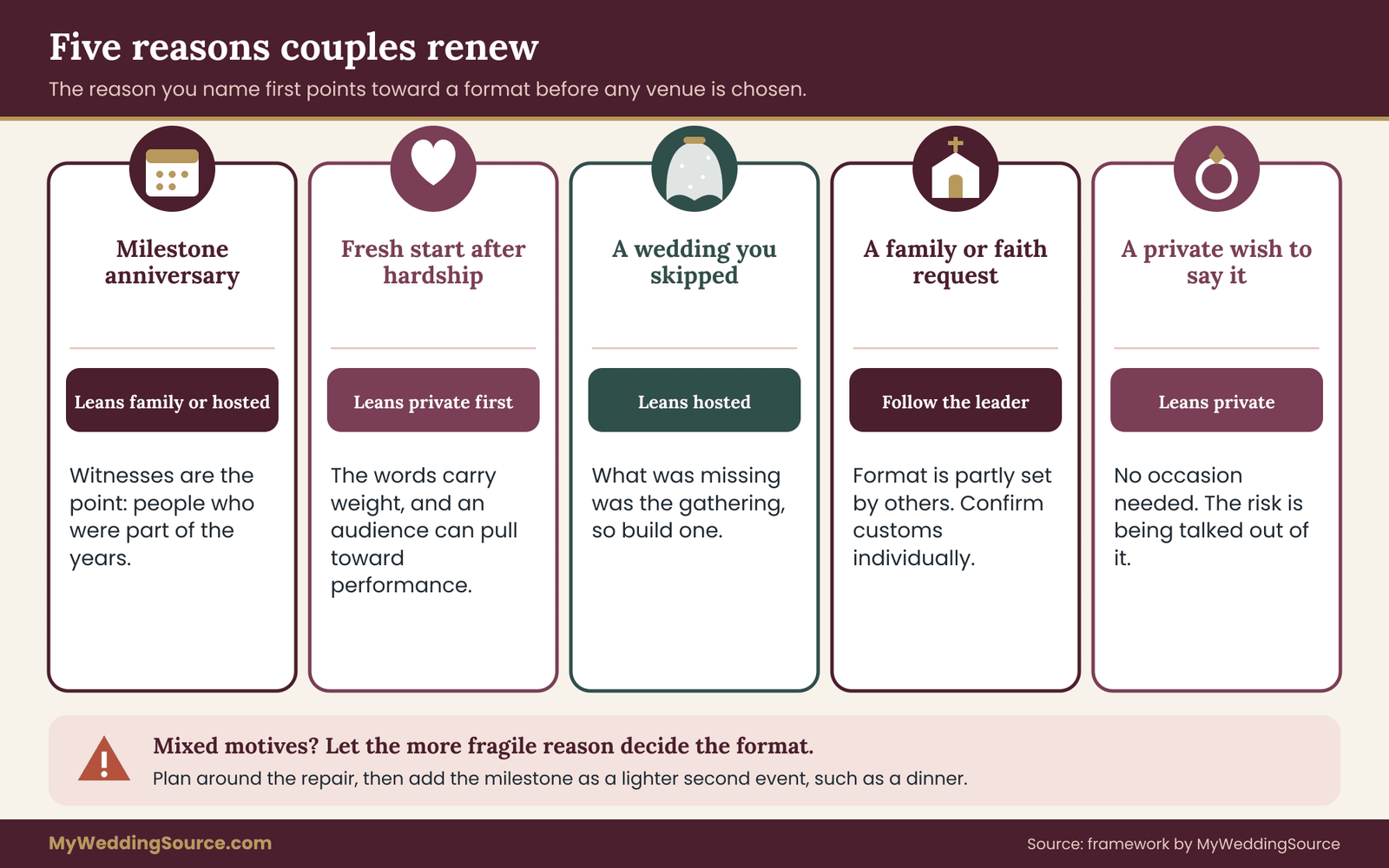
Most renewals are driven by one of five motives. Naming yours is the single most useful step in this vow renewal guide, because each motive points toward a different format and a different set of moments.
A milestone anniversary. The marriage reached a number that feels worth marking. The wish is usually to celebrate with people who have been part of the years. This motive leans toward a family or hosted format, because witnesses are the point.
A fresh start after hardship. The marriage went through illness, a separation, a loss, a financial shock or a period of distance, and you want to say plainly that you are choosing each other again. This motive often leans private first. The words carry weight, and an audience can pull the speaker toward performance. If this is your reason, decide how much of the writing is meant for the room before you draft anything.
A wedding you did not get to have. Some couples married quickly at a courthouse, during a move, or under circumstances that left no room for ceremony. A renewal lets them have the occasion they skipped. This motive can go in any direction, but it often leans toward a hosted event, because the missing piece was the gathering.
A cultural, religious or family request. A faith community offers a blessing, a relative asks for a ceremony, or a tradition marks decade anniversaries. Here the format is partly set by someone else, and the job is to keep your own meaning inside it. Always confirm the customs with the person who leads the ceremony rather than assuming.
A private wish to say it out loud. There is no occasion, only the desire. This motive fits a private format almost every time, and the main risk is that it gets talked out of existence by well-meaning questions about why you would bother.
Mixed motives are normal
Many couples have two reasons. A twentieth anniversary and a recovery from a difficult year can sit in the same plan. When motives pull in opposite directions, the rule in this vow renewal guide is to let the more fragile one decide. If one reason is a milestone and the other is a delicate emotional repair, plan the format around the repair and add the milestone as a separate, lighter event, such as a dinner afterward. That order protects the part that is hard to redo.
Test the reason with one sentence
Each partner completes this sentence on paper: “The moment I want to remember from this day is ______.” If the two sentences describe the same kind of moment, such as a hand held while speaking, you have a shared center. If one describes saying words to each other and the other describes everyone laughing at a long table, you have two valid goals that may need two parts to the day.
That is not a problem. It is useful information, and the format selector later in this vow renewal guide is built to handle it.
What the reason rules out
Sometimes the reason removes options in a vow renewal guide plan. If your motive is a quiet recommitment, a hosted event with a printed program works against it. If your motive is to thank people who supported you, a private elopement-style moment leaves the gratitude undelivered. Keeping a short list of “this plan would fail the reason” keeps later choices honest, and the final section of this vow renewal guide returns to that list when it describes failure conditions.
The three formats in this vow renewal guide: private, family and hosted
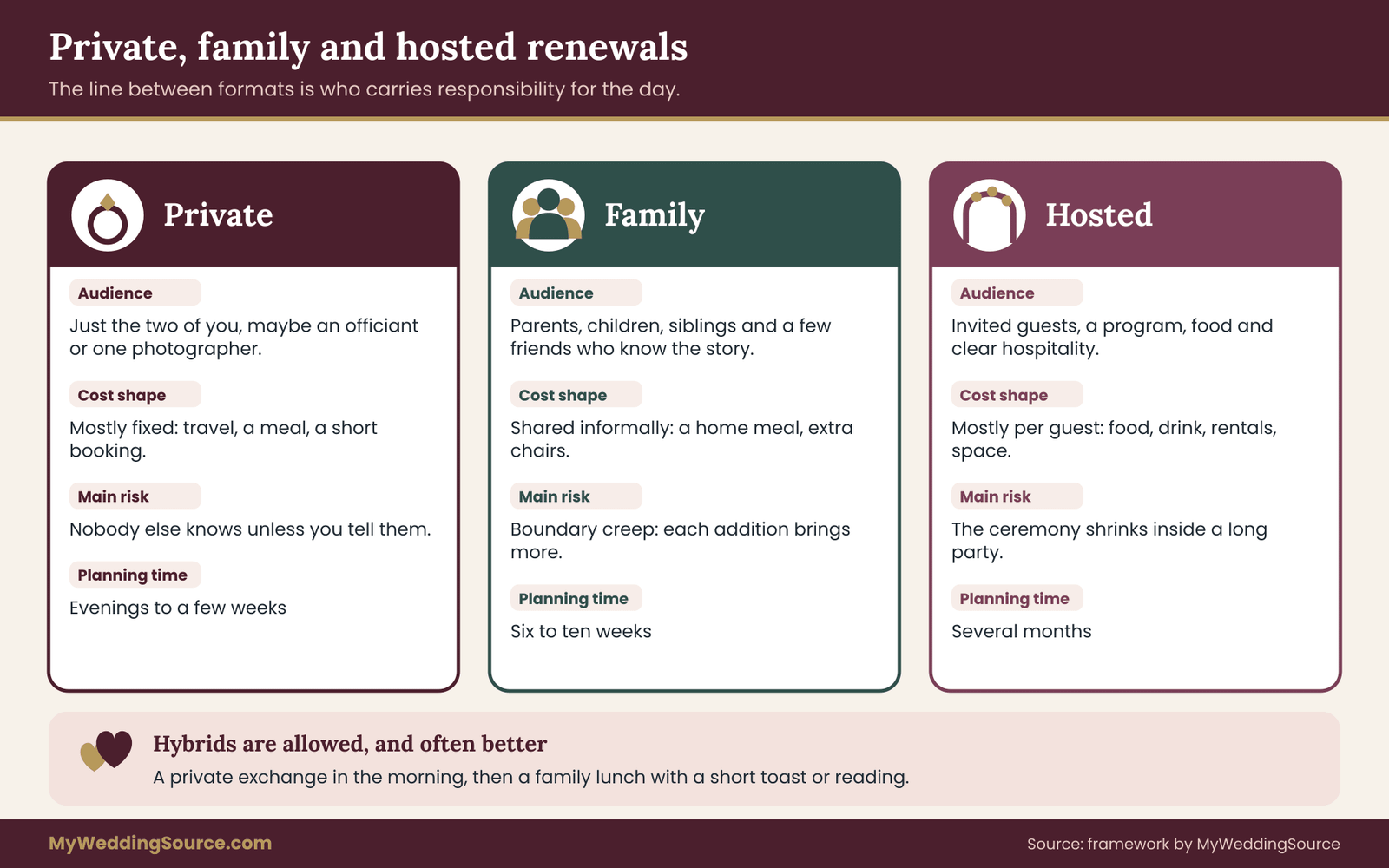
The selector in this vow renewal guide needs three clear options, and the dividing line between them is not the number of guests. It is who carries responsibility for the day. In a private renewal, nobody but the two of you carries it. In a family renewal, a small circle shares it informally. In a hosted renewal, you are the host, and guests expect to be looked after.
Private renewal. The two of you, with or without an officiant, a photographer or a single witness. It can happen at home, on a trail, in a quiet room, at the place you met, or on a trip. Planning is measured in evenings, not months. The cost is mostly travel, a meal and perhaps a photographer’s time. The weakness is that nobody else knows it happened unless you tell them, so decide in advance how and when you will share it.
Family renewal. Typically parents, children, siblings and a few friends who know the whole story, in a home, a backyard, a restaurant’s private room or a relative’s garden. The guest list is the people you would call in an emergency. The weakness is boundary creep: each person added brings a plus-one, a cousin or an opinion, and a family renewal can swell into an unplanned hosted event without anyone deciding it should.
Hosted renewal. An event with invited guests, a defined start time, a program, food and some form of hospitality, whether that is a reception hall or a rented park shelter. This is the format that most resembles a wedding and carries most of its logistics: seating, accessibility, vendors, timing and a budget that scales with headcount. The weakness is that the ceremony can shrink to a small part of a long party.
What changes between formats
Three things change as you move from private to hosted, and they change together. The first, and the one every vow renewal guide should flag, is the audience’s role. In a private renewal there is no audience, only a counterpart. In a family renewal the audience is also participants, since a daughter may read and a parent may stand beside you. In a hosted renewal some guests are simply spectators, and you owe them clear information and a comfortable seat.
The second is the cost structure. Private costs are mostly fixed. Hosted costs are mostly per guest. This matters for the budget method later in the vow renewal guide, because a per-guest cost can be controlled by the guest list while a fixed cost cannot.
The third is reversibility. A private renewal can be repeated, expanded or shared later with a family dinner. A hosted renewal with deposits and contracts is hard to shrink once booked. If you are unsure, begin at the less committed end and add rather than subtract.
Hybrids are allowed, and often better
The three labels are anchors, not cages. A frequent and sensible hybrid is a private exchange of words in the morning, followed by a family lunch where you share a short toast, a reading or a photograph. The private part protects what is fragile. The shared part gives people a place in the day. The vow renewal guide selector flags when a hybrid is the best answer, and the worked case later in this vow renewal guide uses one.
A note on size labels
Avoid defining the formats by exact counts. Whether a family renewal has eight people or thirty depends on your family. What defines it is that the host’s work stays informal: no assigned seating chart, no program printed for strangers, no vendors beyond perhaps a photographer. When you find yourself needing a seating chart or a formal timeline, you have moved into the hosted format, and you should plan like it.
The six-question format selector
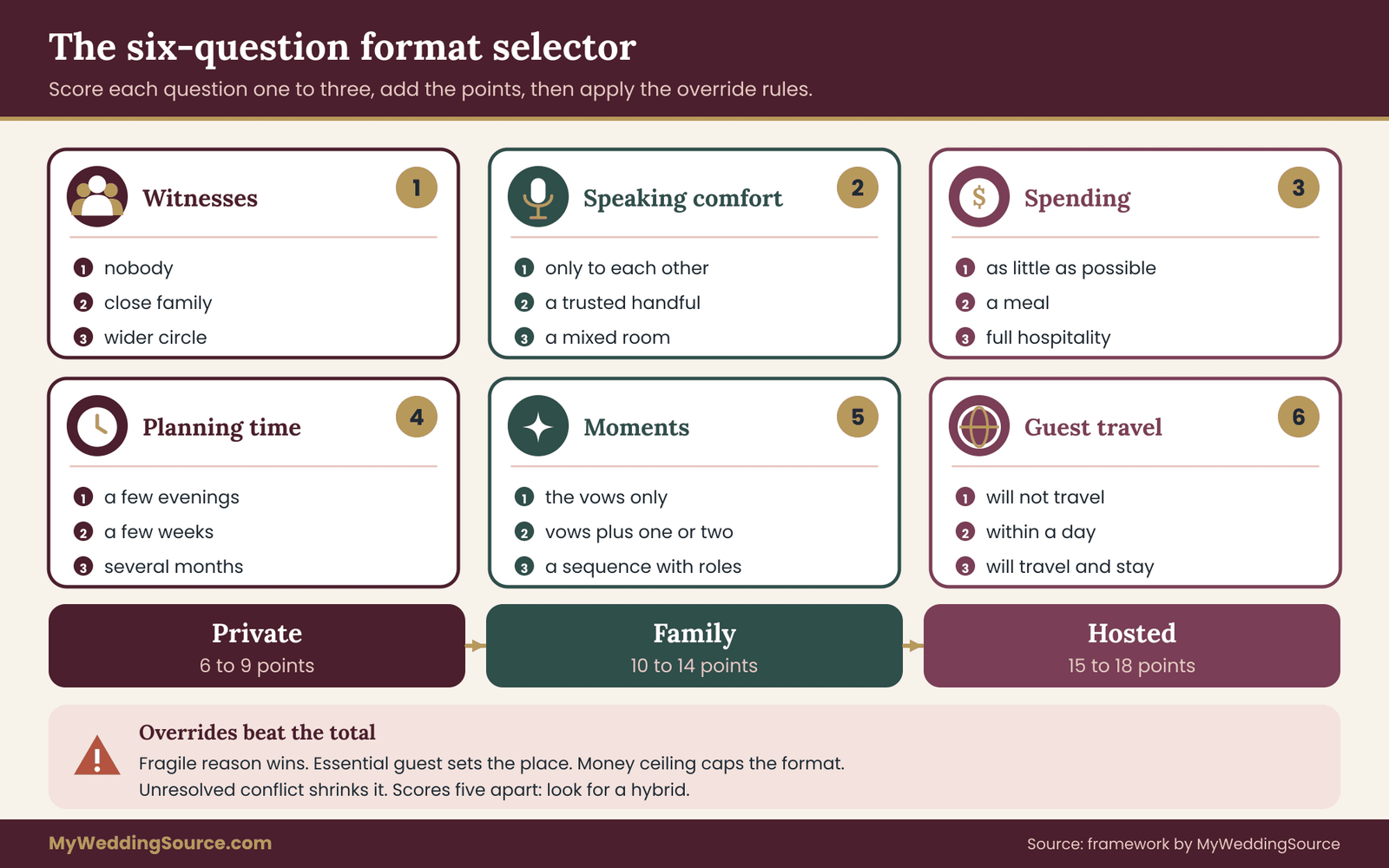
The selector is the core tool of this vow renewal guide. It has six questions. Each is answered on a three-point scale, where one points toward private, two toward family and three toward hosted. Add the six scores for a total between six and eighteen. Then apply the override rules, which matter more than the arithmetic.
Question one: who needs to witness this? A score of one means nobody does; an officiant or no one at all is enough. A score of two means your children, parents, siblings and perhaps a close friend or two. A score of three means a wider circle, including friends, colleagues or community members whose presence is part of the meaning.
Question two: how do you feel about speaking in front of others? One means you would rather say it only to each other. Two means you are comfortable with a handful of people who love you. Three means you can speak in a room of mixed company without it changing what you say. Be honest. A renewal is a bad place to practice public speaking for the first time.
Question three: how much do you want to spend beyond the ceremony itself? One means as little as possible. Two means a meal and some thoughtful details. Three means you are comfortable funding full hospitality for guests, including food, drink, space and perhaps rentals.
Question four: how much planning time and energy do you have? One means a few evenings. Two means a few weeks of steady effort. Three means several months and a willingness to manage vendors, replies and logistics.
Question five: how many distinct moments do you want? One means a single moment, usually the vows. Two means the vows plus one or two others, such as a ring exchange and a reading. Three means a sequence with several roles, such as children’s participation, a toast, music and a shared ritual.
Question six: how far will the people who matter be willing to travel? One means they will not or cannot, or the place is deeply personal and remote. Two means they can come by car within a day. Three means they will travel, possibly stay overnight, and you are able to support that with lodging information.
Reading the total
A total of six to nine points toward a private renewal. Ten to fourteen points toward a family renewal. Fifteen to eighteen points toward a hosted renewal. The bands in this vow renewal guide are a starting suggestion, not a verdict, and the next part of this vow renewal guide explains why.
Override rules
Apply these override rules from the vow renewal guide before accepting the total.
Override one: the fragile reason wins. If your reason is repair after hardship, or either partner dreads being watched, cap the format at family and consider private first, even if the total says hosted.
Override two: the essential person. If one person’s presence is non-negotiable and they cannot travel or cannot attend a large event, build the format around them. A grandparent in a care facility may turn a hosted plan into a family plan held at their location.
Override three: the money ceiling. If question three scores one, the format cannot exceed family, whatever else you scored. A ceiling you cannot afford is not a preference; it is a constraint.
Override four: the unresolved conflict. If the guest list would include someone whose presence would make either of you tense, that is a reason to shrink the format or to add a private element, not to hope it goes well.
Override five: split scores. If one partner’s total is at least five points above the other’s, do not average. Instead, look for a hybrid, such as a private exchange followed by a family gathering, and score again with the hybrid in mind.
Why six questions and not more
Longer quizzes feel thorough but blur the signal. These six cover the six levers that really change the plan: audience, speaking comfort, money, time, structure and distance. Anything else, such as venue style or season, is a detail that follows from the format, and details are easier to settle once the format is fixed.
What to do when the total sits on a boundary
A total of nine or ten is common when you use a vow renewal guide like this one. Do not argue about which side it belongs on. Instead, take the format with the lower commitment and add one element from the higher one: a family renewal with a short private exchange before the guests arrive, or a private renewal followed by a casual meal with two relatives.
This approach keeps the plan reversible and lets you test how it feels before adding more. A boundary total is also a good reason to reread the earlier part of this vow renewal guide on motives, because the reason usually tips it.
Keep the scores for later
Save your six answers from the vow renewal guide. When the plan starts to grow, return to them. If you scored a question as one and find yourself adding a feature that belongs to a three, you are drifting, and the selector has just told you so. That is its second job: not only choosing the format, but flagging when a plan has quietly left its brief.
A worked case in this vow renewal guide: an invented couple chooses a format
The following vow renewal guide example is invented to show the method. The people, numbers and choices are illustrative, not a real couple and not a claim about what couples usually do.
Priya and Tom have been married for twenty years. They married at a county office with two witnesses and went to lunch. A few years ago Tom had a long illness, and the family came through it. Priya’s mother has asked, more than once, whether they might “do something”. Their two teenagers think it sounds embarrassing and have said they will come anyway.
Each partner scored the vow renewal guide selector separately.
Priya’s scores. Witnesses: two (children and her mother). Speaking: one (she dislikes being watched while she is emotional). Spending: two (a meal is fine). Planning time: two. Moments: two (vows plus a short reading). Travel: two (her mother lives within a day’s drive). Total: eleven.
Tom’s scores. Witnesses: three (he wants the friends who helped during his illness). Speaking: three (he would happily talk). Spending: two. Planning time: two. Moments: three (he wants the children to take part). Travel: two. Total: fifteen.
The totals are four points apart, which is within the range where compromise is workable, but the individual answers show where the real difference lies. It is not size or cost. It is how public the emotional part should be.
Applying the overrides
Override one applies: the reason is partly a recovery from illness, and one partner dreads being watched. That caps the format at family and points to a private element. Override two applies too, since Priya’s mother is the person who asked and cannot travel far. The format is family, with a hybrid.
The plan they reach
They choose a private exchange of vows early on a Saturday morning, just the two of them and a photographer for twenty minutes, in the garden of the county building where they married. Then a family lunch at home, eighteen people, with a short reading by their daughter and a toast by their son, who negotiated for a “no speeches over two minutes” rule.
Tom’s friends are invited to lunch rather than to a ceremony, which gives him the room full of people he wanted without putting Priya on display during the vows.
No invitation lists a program. No seating chart exists; the table is long. The day has a single paid vendor, the photographer, and one rented item, extra chairs.
What the case shows
Notice what the selector did here. It did not pick the “right” number. It exposed a disagreement about audience, and it produced a structure in which each partner gets what they asked for without a veto. That is the typical value of a vow renewal guide selector: not a score, but a conversation that ends in a design.
The failure check for this plan
Before booking, Priya and Tom write down the conditions under which the plan would fail. First, if the morning exchange runs long and the lunch guests arrive to a house not ready. Second, if Priya’s mother objects to missing the vows and turns the lunch into a negotiation. Third, if the weather forces the garden exchange indoors, where it loses its meaning.
For each, they write one fix: a buffer of ninety minutes, a conversation with the mother in advance with an offer to read the vows aloud at lunch, and a backup in the county building’s lobby or in their own living room.
This habit of naming failure conditions before commitment is central to this vow renewal guide, and the last section returns to it.

Building the ceremony: structure, length and order
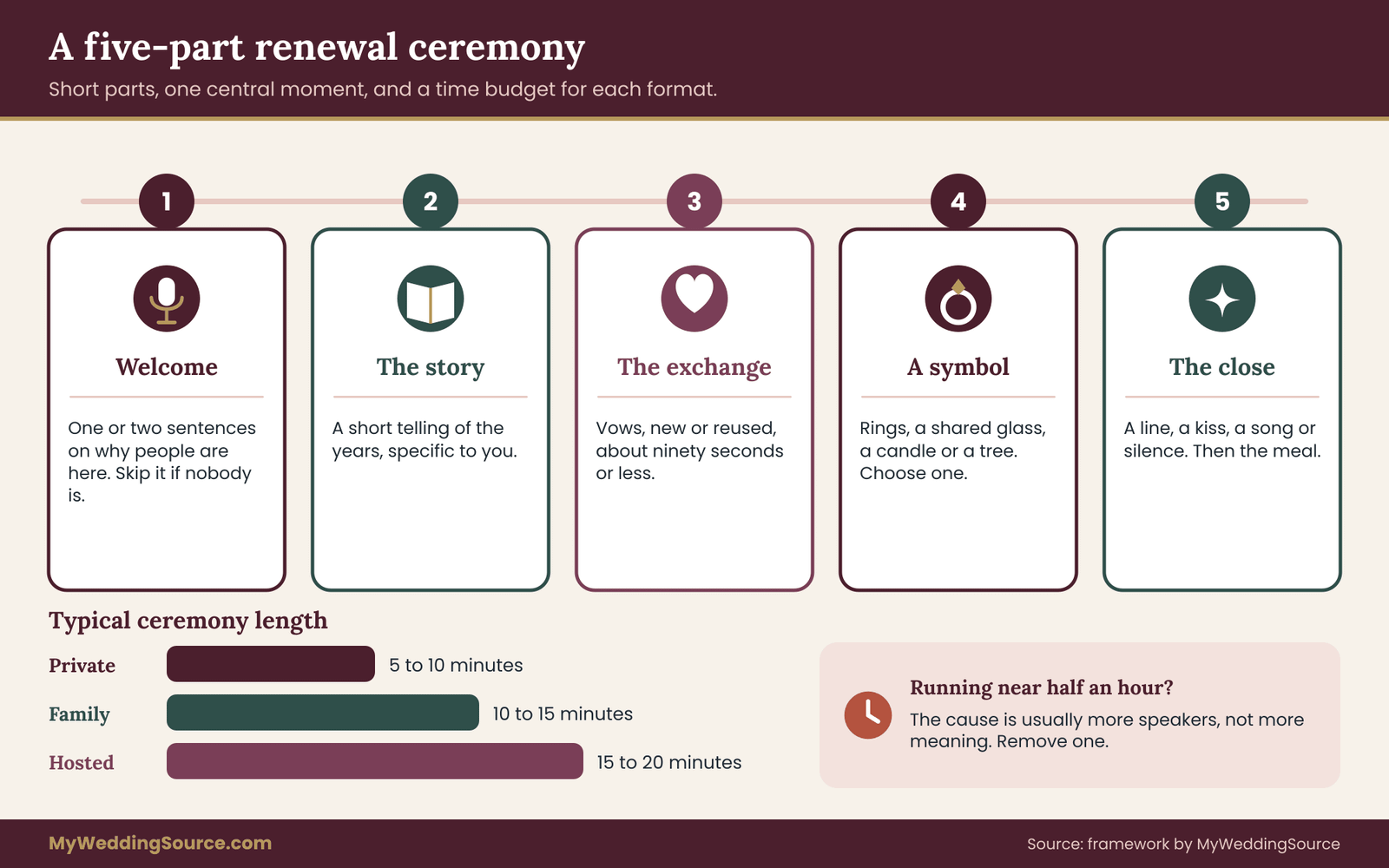
Whatever the format in your vow renewal guide plan, a renewal ceremony needs only a few parts. The mistake many couples make is to copy the full structure of a wedding. A renewal with a processional, a long welcome, three readings, a unity ritual, a ring ceremony, a kiss and a recessional can run over half an hour, and it will feel like a second wedding. A shorter structure lets the central moment breathe.
A five-part outline that works at any size
One: a welcome. One or two sentences that say why people are gathered. If nobody is present, skip it. For guests, this is where you say that nothing will be asked of them except attention.
Two: the story. A short passage, spoken by you, an officiant or a family member, that names the years. It can be as plain as “we have been married for this long, and here is one thing we learned.” This replaces the traditional charge to the couple and does more work, because it is specific to you.
Three: the exchange. The vows themselves, new or reused, spoken to each other. Length matters here. Timing a vow aloud is the most reliable test, and a rule of thumb is that a vow that takes more than about ninety seconds to say tends to drift from the point.
Four: a symbol or action. A ring exchange, a shared glass, a candle, a hand-tying, a planted tree. Choose one. Two begin to look like decoration.
Five: a close. A line, a kiss, a song, or silence. Then lunch, dinner or a walk.
Time budgets by format
A private renewal can fit the whole outline into five to ten minutes, and some couples use only parts three and four. A family renewal runs well at ten to fifteen minutes, with a few spoken contributions. A hosted renewal typically needs fifteen to twenty minutes, because arrival, seating and a clear start are part of it, but it rarely benefits from going beyond that. If a hosted ceremony starts to approach thirty minutes, the likely cause is more speakers, not more meaning, and removing one speaker usually fixes it.
Who leads it
You do not need an officiant to renew vows, since there is no legal act to witness. You can lead it yourselves, ask a friend or family member, or hire a professional. The question is practical, not legal. Someone must keep time, cue the next moment and handle the unexpected. In a private format, you can manage it.
In a hosted format, a leader who is not one of the couple is a real help, because you will be busy being emotional. The site’s guide to officiant requirements explains what an officiant does for a wedding, and the practical roles carry over even though the legal ones do not.
If a faith community is involved, speak with the person who leads the ceremony before you plan anything. Some traditions have formal blessings for married couples, specific wording, or restrictions on what may happen in a worship space. Confirm each of these individually; do not assume they match another tradition’s.
A cue sheet, even for a small event
A one-page cue sheet is useful at any scale, and a vow renewal guide plan is no exception. List the start time, who speaks, who holds the rings or the object, the music cues and who signals the end. The site’s article on a wedding ceremony cue sheet shows the structure in detail. For a family renewal, a handwritten version taped inside a cupboard door works. For a hosted renewal, give a copy to anyone who has a role, and to any vendor who needs to know when the ceremony ends.
Planning timeline by format
In a vow renewal guide plan, the time needed differs more than most couples expect. A private renewal can be planned in a few weeks, and the main lead time is travel or the photographer’s calendar. A family renewal usually benefits from six to ten weeks, mainly to find a date that suits the key people. A hosted renewal benefits from several months, since venues and vendors book up and guests need notice, especially if travel is involved. Treat these as planning ranges rather than rules, and check each vendor’s actual availability.
The one-page ceremony brief
Whatever the format, write a one-page vow renewal guide brief that both partners sign off on. It should state the reason in one sentence, the format, the order of the five parts, the moments chosen, who leads, the guest list ceiling and the budget ceiling. When a new idea arrives, test it against the brief.
If it does not serve the reason, it is a candidate for removal, however charming it sounds. This single page is the most reliable defense against drift that this vow renewal guide offers, and it takes about twenty minutes to write.
Meaningful moments to choose from in a vow renewal guide
A wedding comes with a catalog of expected moments. A renewal does not, which is both its advantage and its trap. Without defaults, couples either include nothing or include everything they have ever seen. The better approach is to pick one or two moments that connect to the reason you gave and treat everything else as optional.
Below are moments from this vow renewal guide that suit a renewal, grouped by the job each does. Choose from one or two groups, not all of them.
Moments that look back. A short telling of how you met, spoken by a child, a friend or yourselves. A table of photographs from different years, with a line on each. Reading the first letter or message either of you wrote the other, if you kept it and both agree. These work best in family and hosted formats, where someone else is present to receive the memory.
Moments that look forward. A letter to be opened on a later anniversary. A pair of notes sealed in a box. A tree or plant that will keep growing. These suit every format, including private, because they require no audience.
Moments that include others. Children reading, handing over rings or speaking a sentence about what they have seen. A parent or sibling giving a blessing. A friend who supported you in a hard period saying one thing. In the vow renewal guide’s family format, this is often the central idea, and it needs a rule: invite, never assign. Anyone who does not want to speak should be able to decline without comment.
Moments that honor the absent. A candle, an empty chair, a photograph or a few quiet words for people who would have been there. These can be moving or heavy, depending on timing. Place them before the vows, not after, so the tone of the exchange is not interrupted.
Moments that mark the change. A ring exchange with new rings or the same rings moved to a different hand; a symbolic object such as a shared cup; a spoken sentence about what is different now. Because a renewal is not a legal act, the symbol does not have to include any legal element.
Choosing one center for your vow renewal guide plan
Pick one moment as the center of the event and make everything else serve it. If the center is the vows, the other moments should be short and should not compete with them. If the center is the children’s participation, then the vows can be briefer. A ceremony with two centers feels indecisive, and guests can tell.
Moments that often backfire
In any vow renewal guide, some ideas photograph well and play badly in person.
Surprise participation. Calling on a guest to speak without warning. Even confident people can freeze, and a person who is grieving may find it painful. Ask in advance, give a topic and a time limit, and accept a no.
Replaying the first wedding. Copying the processional, the first dance and the cake cutting can feel hollow if the reason for renewing is not nostalgia. If you want the first dance, do it because you want the dance.
Long retrospective slideshows. A slideshow of forty photographs turns a ceremony into a screening. Limit to a dozen images or put the rest on a table.
Public confession. Vows that disclose private difficulties in front of people who were not part of them. A renewal after hardship can name the hardship in general terms without recounting details. The test is simple: would this line still feel right if a coworker heard it?
Forced symbolism. Rituals borrowed from a tradition that is not yours, without understanding or permission. If you want to include a custom from a culture or faith, ask someone from that community what it means and whether it is appropriate for a renewal.
Matching moments to formats
In a private renewal, favor moments that look forward and moments that mark the change; there is nobody to include. In a family renewal, favor moments that include others and one that looks back. In a hosted renewal, favor a single included moment plus the vows, and let the meal and the conversation do the rest.
Vows and readings for a renewal: reuse, rewrite or write new
Vows are where many couples using a vow renewal guide feel the most pressure. The pressure is easier to manage when you separate three choices: whether to reuse the original words, rewrite them, or write new ones.
Reuse the original vows
Saying the same words again, aware of what they now mean, can be powerful, especially if those words were traditional or short. The advantage is that nothing has to be drafted. The risk is that some original vows no longer fit, such as promises about circumstances that have changed. If you reuse, read them aloud once together before the day. Mark any line that sounds different now, and decide whether to keep, adjust or say a short sentence of context first.
Rewrite lightly
A middle path keeps the structure of the original and changes a few lines to reflect what you have learned. This works well when the first vows were conventional and you want them to sound like you. Keep the changes small, such as three or four lines, so the original shape is recognizable.
Write new vows
Writing new vows works best when both partners have a clear reason and enough time. The site’s worksheet on writing vows together describes a joint method, and the same logic works at renewal: decide what you are promising, name one specific memory and end with a present-tense promise rather than a prediction. Avoid promising feelings, since feelings change; promise actions and attention, since those are in your control.
A practical test for any vow is to say it aloud, once, with a stopwatch. If it runs beyond about ninety seconds, cut. If it only makes sense to the two of you, that is fine in a private format and a problem in a hosted one, where an inside reference can leave guests out. In a family format, you can often add one sentence of context and keep the line.
Spoken or exchanged privately
You can also write your vows and swap them as letters. This suits couples who find spoken vows hard and keeps the contents private. The ceremony then consists of the exchange, a few quiet minutes of reading, and an embrace. Guests, if present, learn what happened from the way the room goes quiet. It is an unusual choice, but it can be the most honest one.
Readings and who chooses them
Readings add a voice other than yours. For a renewal, one reading is plenty, and it should be short, a minute or less. Choose something that fits the reason. Poems and prose are common, and a passage from your own tradition is also appropriate if you want one. If a reading is under copyright, check whether you need permission for reproduction in a printed program; reading it aloud in a private ceremony is generally less of an issue, but a printed or recorded version is a different question.
The U.S. Copyright Office explains the basics, and the sources list at the end points to it.
For a faith-based renewal, the person who leads the ceremony may specify or restrict the readings. Ask early.
Children and their vows
If you have children, decide whether they take part as readers, as witnesses or not at all. Younger children can hand over an object or hold a sign; older ones can read a sentence they wrote. Avoid asking children to promise anything on your behalf or to comment on the marriage’s difficulties. Their role is to be present and, if they wish, to say something warm. If a child declines, say so lightly and move on.
Interpreter or translated vows
If a close family member does not speak the language you will use, consider a translated line or a printed translation. A short sentence in each language means more than a long translation read slowly. Ask a fluent speaker to review the wording before the day, rather than relying on a translation tool for emotional language.
Keep a record, if you wish
Some couples record their vows privately, on a phone or a small recorder, and keep the file. If you do, decide in advance where it will live, who can access it and what happens if one of you later wishes to remove it. The recording is often the one thing that survives, so treat it with the same care as a photograph, and keep copies in more than one place.
A final check for the vow renewal guide’s drafts
Before the day, each partner reads their vows to a neutral listener or into a recorder and listens back. Ask three questions. Is there any sentence that would embarrass me in ten years? Is there any sentence that the other person might hear as a complaint? Does it sound like me? Cutting a sentence is easier before the day than after, and a cautious edit does not make a vow less sincere.
Guest list and invitations in a vow renewal guide
The guest list is where a vow renewal guide plan either stays what you planned or turns into something else. Because there are no wedding-style conventions, every inclusion is a decision, and every exclusion can sting. The way through is to set rules before names.
Set the vow renewal guide list by rule, not by person
Choose a rule that defines who is in. Examples: immediate family and the people who were present at the first wedding; people who were part of the hard period you are marking; people you would have at your home for dinner this month. A rule is easier to defend than a decision about each person, because “the rule is immediate family” does not point at anyone.
Then set a ceiling and keep it. For a family renewal, the ceiling is the number of people your home or chosen room holds comfortably at a table, not a number from a rulebook. For a hosted renewal, the ceiling comes from the budget method in the next section. The site’s general guidance on building a guest list explains how tiers and cuts work, and the same tiering logic scales down to a renewal.
Plus-ones and children
Decide early whether partners of guests are included, and apply the rule evenly. If a relative’s new partner is invited, a cousin’s long-term partner should be too. For children, say so plainly on the invitation: if the event is adults-only, state it kindly. If children are welcome, remember that a quiet ceremony and a long meal require a plan for them, such as a quiet activity bag and a seat near the exit.
What a renewal invitation needs to say
An invitation for a renewal can be short, and a vow renewal guide should say so. It needs the date, the time the ceremony begins, the place, whether a meal follows, whether children are included, a reply date and a name to contact. Keep the tone close to how you speak. It does not need formal wording.
Three phrases are worth including because they prevent common misunderstandings.
First, say what the occasion is. “We are renewing our vows after twenty years of marriage” tells guests what kind of day to expect, and it signals that this is not a first wedding.
Second, say what you are not asking. “Your presence is the gift. Please do not bring presents” is a clear statement that removes pressure. If you do not want gifts, say so plainly, and if you would welcome something specific, such as a handwritten note or a photograph, say that instead. Some couples choose a donation in lieu; if so, name one organization rather than a list.
Third, say what is optional. If a ceremony is short and a meal follows, guests who are tired can arrive for the meal. State the times for each part.
How to ask someone to take part
If you are asking someone to read, speak or hold something, do it in person or by phone, not in a group message. Name the exact job, how long it takes and the date by which they can change their mind. “We would love you to read a short poem, about a minute, at the start. You can say no, and you can change your mind until the week before.” That wording makes it easy to decline gracefully.
Handling the uninvited request
Someone will ask to come. Prepare one sentence in advance, as this vow renewal guide recommends. “We are keeping this small, and we are so glad you are thinking of us” is warm and does not invite negotiation. If the request comes from a parent, treat it as a conversation rather than an announcement: acknowledge what the person wants, and say what you can offer instead, such as a visit afterward or a photograph.
RSVPs and the last-week count
Ask for replies by a set date and follow up with one gentle message. The site’s guide to RSVP etiquette covers wording and follow-up; for a smaller event, a phone call is often quicker than a card. Confirm dietary needs and mobility needs in the same message, and note them in a single place you can read at the venue.
Accessibility basics for any guest list
Older relatives and guests with limited mobility are often the very people a renewal is meant to include. Check the route from parking to seating, the number of steps, the availability of seats with arms, and the nearest accessible restroom. The ADA website offers federal accessibility information, and the CDC publishes guidance on preventing falls among older adults, both listed in the sources. Ask guests privately what would help rather than assuming.
Guest budgets: fixed cost, per-guest cost and a ceiling
The word budget in a vow renewal guide needs care, because no honest figure can be given without knowing your region, your date and your choices. Instead of prices, this section gives a method that works with any prices you gather from real quotes.
Split costs into two kinds in your vow renewal guide budget
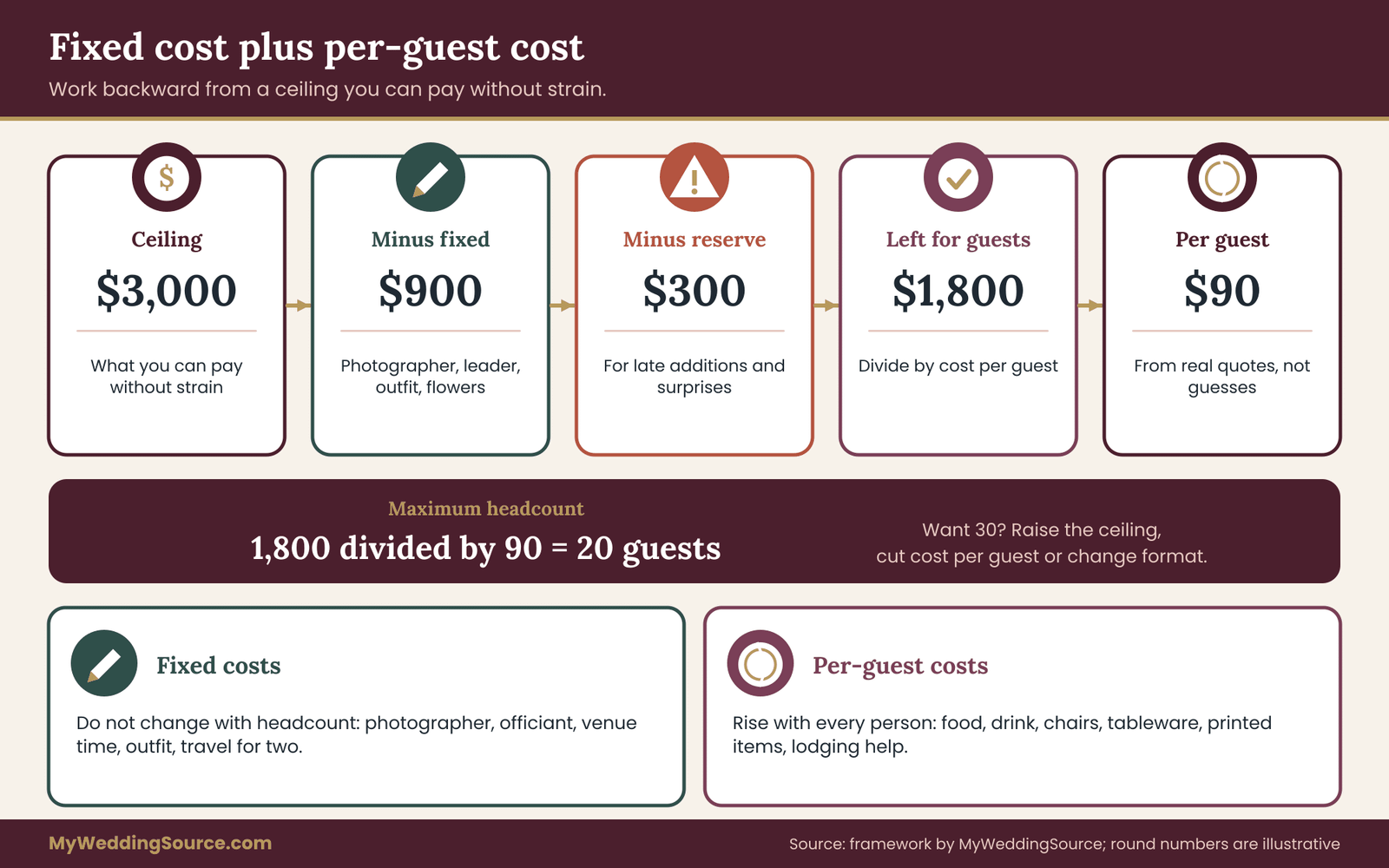
Fixed costs do not change with the number of guests. A photographer’s time, an officiant’s fee, a venue rental for a set period, flowers for the ceremony spot, a new outfit and travel for the two of you are examples.
Per-guest costs rise with each additional person. Food, drink, plated or buffet service per head, rental chairs and tableware, favors, printed items and, in some cases, lodging support are examples.
Your total is roughly the fixed costs plus the per-guest costs multiplied by the headcount, plus a reserve. A private renewal has almost no per-guest costs. A hosted renewal can have per-guest costs that outweigh the fixed ones.
Work backward from the ceiling
Set a ceiling you can pay without strain, using funds you already have. Subtract the fixed costs from it, subtract a reserve, and divide what remains by your best estimate of the per-guest cost. The result is the maximum headcount your budget supports. That number should override a guest list built from feelings.
An illustration, using round numbers that are made up for the example and are not market prices. Suppose the ceiling is three thousand dollars, fixed costs are nine hundred, and the reserve is three hundred. That leaves eighteen hundred. If the per-guest cost from your quotes comes to ninety dollars, the maximum headcount is twenty. If you want thirty guests, you must either raise the ceiling, lower the per-guest cost or accept a different format.
Ways to reduce per-guest costs
You can change the meal type, the time of day or the venue. A late-morning ceremony followed by a lunch or brunch generally involves a simpler menu than an evening dinner. A dessert-and-coffee reception after the ceremony is lighter still. Hosting at home or in a relative’s garden removes venue rental but adds rental of chairs, tables and sometimes restrooms, so compare line by line.
Provide a limited drink menu rather than an open bar. The site’s discussion of wedding budgets explains categories and tracking, and the same discipline applies at a smaller scale.
Ways to reduce fixed costs
A shorter photographer booking, a smaller flower plan built around one focal point, a borrowed or previously owned outfit and a friend leading the ceremony all reduce fixed costs. Be careful with the last one: a friend who leads must prepare, so offer a script and a rehearsal rather than a surprise assignment.
Guest costs that are easy to forget
Include parking or transportation if the place is hard to reach, a rain plan, tipping and service charges where they apply, a plan for guests with dietary needs and a small amount for last-minute additions. Count the cost of any guest you are helping to travel, including lodging or a ride. If you are contributing to a relative’s travel, agree the amount before the invitation is sent, and keep the arrangement private.
Who pays
Traditionally, the couple pays for their own renewal, and some couples are offered contributions by relatives. Accept help only when it comes without conditions about the guest list or the format. If a relative offers to host, decide whether the event remains yours; a host often feels entitled to invite people. Agree on the guest list in writing before accepting money, in plain language, and keep the note with your records.
Track spending as you go in your vow renewal guide budget
Open a simple sheet with columns for item, vendor, quote, deposit, balance and due date. Update it at each payment, and compare the running total against the ceiling every time. If a vendor requires a deposit, read the cancellation terms before paying and note the date after which the deposit is not refundable. For vendor payment rules, the Federal Trade Commission’s consumer information site is a reliable general source, and it appears in the sources list.
The decision rule in this vow renewal guide for money
If the cost per guest exceeds what you are comfortable with, reduce the number of guests before reducing the quality of the ceremony. Guests are the part of the budget that is least tied to the meaning of the day. A ceremony with fewer people and good attention usually satisfies the reason better than a crowded one with compromises everywhere.
Check this against the guest-care ideas in the site’s article on guest care planning when the guest list includes older or traveling relatives, since care for guests is the cost most often underestimated.
Venue, officiant, vendors and paperwork for a renewal
Once the format is set in the vow renewal guide, the practical questions are narrower than they were for the first wedding. Many renewals need no venue contract and no vendors at all. For those that do, the checks below prevent the most common surprises.
Choosing a place by format
For a private renewal, the best place is one that means something and needs no booking. Public parks, trails, beaches and viewpoints often have rules about gatherings, amplified sound, decorations and photography, and some require a permit even for small groups. National park units and other federal lands publish their rules, and the National Park Service website explains how special use permits work. Check with the land manager for the specific site, because rules differ from place to place and over time.
For a family renewal, a home or a relative’s garden removes venue fees, but check local rules on noise, parking and temporary structures if you plan to use a tent. A restaurant’s private room can work well, because food, seating and cleanup are covered. Ask about the minimum spend, the room’s time limit and whether outside decorations are allowed.
For a hosted renewal, ask the venue for its written policies on capacity, vendors, hours, insurance, cancellation and rain. Visit at the time of day you plan to hold the ceremony, because light, noise and crowds differ. The site’s guide to wedding ceremony cue sheets and the broader planning guidance on the site help you turn the answers into a schedule. If the venue supplies a coordinator, ask what they will and will not handle on the day.
Questions to ask any venue
Is the space available for the full time we need, including setup and cleanup? What is the maximum capacity, seated and standing? What is the rain or heat plan? Are there restrictions on candles, confetti, music or alcohol? Are there steps, slopes or long walks between parking and seating? What is the cancellation and refund policy, in writing? Get the answers in an email and keep it, because verbal assurances disappear.
Officiant or leader
As noted earlier, a renewal does not need a licensed officiant. You may still want one for the craft: someone who writes a warm, brief script, keeps time and holds the room. If you hire a professional, ask what they charge, how many meetings are included, whether they will adapt a script for a renewal rather than a wedding and what happens if they are unable to attend.
If a religious leader is involved, ask whether the community has its own form for a renewal and whether the space is available for it.
Photography and video
Photography is the vendor most renewals actually hire. A short booking is enough for most formats: twenty minutes for a private exchange, an hour for a family event. Ask whether the photographer has worked at small ceremonies, how they handle a quiet moment without disturbing it and how long the delivery takes. Confirm in writing what you receive, in what format and for how long the gallery stays online, since expiry dates are easy to miss.
If you want the ceremony recorded, consider whether a phone on a stand and a small clip-on microphone serve the purpose better than a professional video team. Decide who owns and holds the files, and whether guests may post photographs. The site’s piece on photography consent is aimed at weddings, but the logic of telling guests the rules up front applies equally here.
Drones, music and amplification
If someone proposes a drone, the Federal Aviation Administration publishes rules for flying unmanned aircraft, including where they are restricted, and local rules may add to them. Check before promising shots from above. For music, recorded songs played at a private gathering are one matter; a public or commercial setting is another, and venues sometimes hold their own licenses. Ask the venue what applies, and choose music with a clear plan for who controls the playlist and volume.
Food and drink
Food safety is easy to overlook at home or outdoors. The federal government’s food safety site explains safe holding temperatures and handling, which matter if food sits out through a ceremony. Ask any caterer about allergens in writing, and label dishes for guests. If you are serving alcohol, check venue rules and consider non-alcoholic options that are as thoughtful as the rest of the menu.
Contracts and deposits
Read each contract before paying. Look for the cancellation terms, the refund schedule, what is included, the last date for headcount changes and who is responsible for damage. Ask for a written confirmation of the date and time. If something is unclear, ask for a change in writing, not a verbal promise. The Federal Trade Commission’s consumer site explains common practices around deposits and disputes.
Paperwork you do and do not need
You do not need a marriage license. Nothing is filed with a government office.
The renewal does not change your legal name, status or any record. If you plan to name an officiant or announce the renewal in a newspaper or online, those are your choices. If, however, you discover that your original marriage record contains an error, or you cannot find your certificate, that is a separate administrative task: the state or county office that holds the record handles requests, and the federal government’s page on marriage certificates and the CDC’s guide to vital records offices point you to the right office.
Keep a small folder for the renewal with your brief, quotes, contracts, receipts, the cue sheet and the final guest list. It takes ten minutes to set up and prevents a search later.
A working checklist for each format
The checklists below turn the vow renewal guide’s choice into concrete tasks. They are written in prose so you can adapt them, and each one lists only what that format truly needs.
Checklist for a private renewal. Choose the place and the date, then check whether the place has rules or requires a permit. Decide whether anyone will be present, even a single witness. Draft the vows and time them aloud. Pick the one symbol, if any, and bring it. If a photographer is joining, agree on the start time, the meeting spot and what you want captured.
Decide how you will share the news afterward, and with whom, before the day, so the question does not arrive in the middle of it. A private plan built with this vow renewal guide usually needs only a few of these steps, and that is a sign it is working.
Checklist for a family renewal. Confirm the date with the people who matter most before anyone else. Set the guest rule and the ceiling. Choose a place with enough seats and an accessible route. Write the one-page brief and share it. Ask each participant, in person, to take on a small role, with the limits stated. Order or borrow chairs, plan the meal and check for allergies.
Decide who will keep time on the day. Plan a short rain or heat backup. In a family format, the vow renewal guide rule of thumb is that no single task should fall to one relative alone, because a renewal is meant to be enjoyed by the people planning it.
Checklist for a hosted renewal. Set the budget ceiling and compute the maximum headcount first. Shortlist venues and request written policies. Send a save-the-date if guests must travel, and an invitation with the occasion, the times and the gift line. Book only the vendors you need, with written terms. Build a cue sheet and a simple seating plan.
Give older or traveling guests clear directions and a contact. Confirm the headcount with the venue by its deadline. In the week before, run through the day with the person who leads the ceremony. A hosted plan from a vow renewal guide still benefits from a short ceremony and a good meal, because those are what guests remember.
The week before, and the morning of
In the final week, each partner rereads the brief and the vows. Check the weather and the backup. Confirm times with anyone who has a role, using a short message with the exact start and where to stand. Pack a small kit: tissues, water, a pen, a spare copy of the vows, a phone charger and anything symbolic that you plan to use.
On the morning, allow more time than you think you need. Eat something. Assign one person, not either of you, to handle questions from guests and vendors, so you are free to concentrate. If the plan slips, drop optional moments rather than speeding through the vows. A calm exchange with fewer extras beats a rushed one with all of them, and that preference is the practical heart of this vow renewal guide.
After the day
Send thank-you messages within a few weeks, mentioning one specific thing each person did. Back up the photographs and any recording in more than one place. File the brief, the receipts and the contracts together, so that a future anniversary can reuse what you learned. Write down, while it is fresh, one thing you would repeat and one you would change. Couples who keep this short note often find that a later milestone is simple to plan, since the vow renewal guide choices are already recorded and tested.
Keeping the renewal separate from the marriage’s other tasks
A renewal sometimes lands in a year when other changes are happening, such as a move, a new job or a family illness. If the calendar is full, the format should shrink to match. A private renewal or a quiet meal costs little and still carries the meaning. The vow renewal guide selector has a built-in answer for this: when planning time scores one, the plan should have very few moving parts. Postponing a larger event by a year is also a legitimate choice, and nothing about the reason expires.
Planning conversations that go better
Choose a neutral time for the conversation, not late at night or in the middle of an argument. Bring the written scores and the draft brief. Start with the reason before any logistics. Take turns describing the day you picture in one minute each, without interruption. Then compare. When you disagree, ask what each of you is protecting, such as privacy, family peace or money, before debating the option itself. Many disagreements in a vow renewal guide process are really two different protections, and a plan can often honor both.
Alternatives to a ceremony, and when this vow renewal guide’s plan fails
Not every couple who reads a vow renewal guide needs a ceremony. Several alternatives achieve the same reason with less structure, and the selector in this guide can point to them as well.
Alternatives worth considering beside a vow renewal guide plan
An anniversary dinner with a toast. A meal with a few people and one short spoken piece. This suits couples whose reason is gratitude rather than recommitment.
A trip with a private moment. A journey to a place that matters, with the vows spoken at a quiet spot. There may be no witnesses and no photographs, or one photograph taken by a stranger.
A blessing in a faith community. Some communities offer a blessing for a married couple, often within a regular service. This is a different kind of event, shaped by the community’s practice, and it may not include spoken vows.
A letter exchange. Each partner writes a letter and reads the other’s alone. This is the least public form and perhaps the most intimate.
A party with a vow moment. A birthday or anniversary party where, at a chosen time, you say a few sentences to each other. It lowers the stakes because the main event is the gathering.
Failure conditions
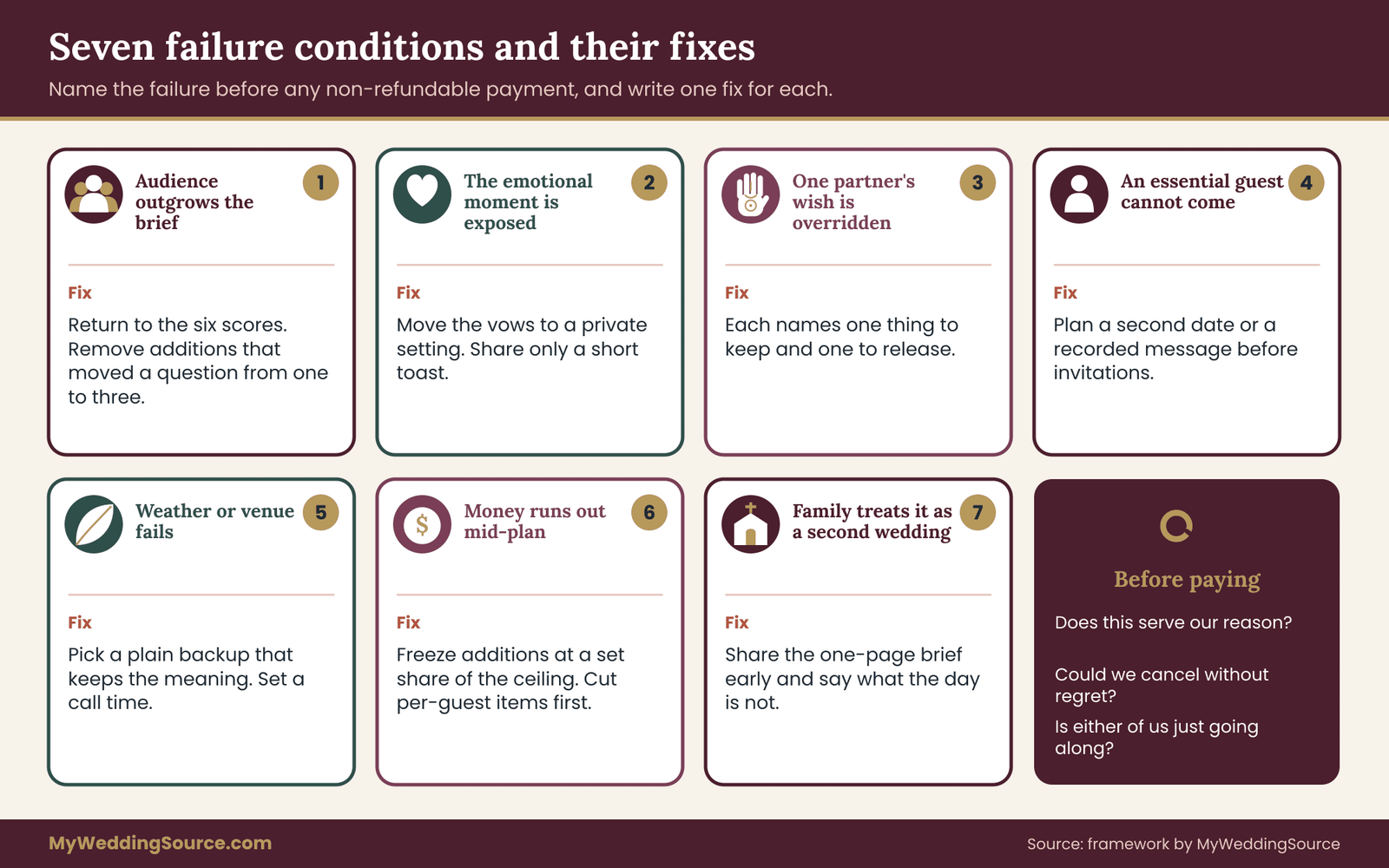
A vow renewal guide plan fails when its structure no longer serves its reason. These are the conditions that most often cause it, with a fix for each. Review them before you book anything that cannot be refunded.
The audience outgrew the brief. The guest list grew beyond the ceiling and the budget no longer fits. Fix: return to the six scores and remove the additions that moved a question from one to three.
The emotional moment is exposed. The vows are meant to be private but are performed before people who change how you speak. Fix: move the exchange to a private setting and share only a short toast.
One partner’s wish is quietly overridden. A veto wins by persistence rather than by agreement. Fix: each partner names one thing they will not give up and one they will release, and the plan keeps both lists.
An essential person cannot attend. Illness, distance or conflict changes who can come. Fix: have a second date or a way to include them, such as a recorded message or a later visit, before sending invitations.
The weather or venue fails. An outdoor ceremony loses its place. Fix: choose a backup that keeps the meaning, even if it is plain, and decide the cut-off time for the call.
The money runs out in the middle. Costs surpass the ceiling after deposits. Fix: freeze new additions at the point where spending reaches a set share of the ceiling, and cut per-guest items first.
The family treats it as a second wedding. Relatives push for traditions that do not fit. Fix: share the one-page brief early and describe what the day is and is not.
A pre-commitment test
Before any non-refundable payment, each partner answers three questions on paper. Does this plan serve our reason? Could we cancel it without regret if one thing changed? Is there any part of it that either of us is going along with? If any answer is uncertain, pause, because the cost of a week’s delay is smaller than the cost of an unwanted booking.
When to ask for professional help
If a renewal is part of a larger repair in your marriage, a licensed counselor can help with the conversation, which no ceremony can replace. This vow renewal guide cannot assess that and does not try to. If the question is a legal or tax matter, speak to a qualified professional in your state. For religious matters, ask the person who leads your community.
Your next steps
Pick one evening this week and do three things from this vow renewal guide. First, each partner completes the sentence about the moment they want to remember and scores the six selector questions separately. Second, compare the scores, apply the override rules and write the one-page brief with the reason, the format, the moments, the guest ceiling and the budget ceiling. Third, list the failure conditions for your plan and one fix for each.
Then work through the vow renewal guide in order. Fix the format, set the guest rule, build the ceremony from the five-part outline, draft the vows and time them, gather quotes only for what you truly need, and ask each vendor for terms in writing. If you are weighing a bigger gathering, revisit the decision-making approach on the site to keep the conversation calm.
Keep the plan small enough that you can still feel the moment while it is happening, and let this vow renewal guide be the document you check when the plan starts to grow.
FAQ
Do we need a marriage license or an officiant to renew our vows?
No. A renewal has no legal effect, so no license is issued and nothing is filed. An officiant is optional and is chosen for the experience, such as writing a script and keeping time. If a faith community is involved, ask the person who leads it about its customs. For a copy of your original marriage certificate, contact the office that holds the record.
How do we choose between a private, family and hosted renewal?
Start with the reason, then use the selector in this vow renewal guide to score six questions: witnesses, speaking comfort, spending, planning time, number of moments and guest travel. A low total points to private, a middle total to family and a high total to hosted. Apply the override rules, especially for fragile reasons, a firm money ceiling or an essential guest who cannot travel.
How many guests should we invite to a vow renewal?
Set the number by rule and by budget, not by tradition, which is the approach of this vow renewal guide. Choose a rule such as immediate family and the people who were part of your story, then work backward from your spending ceiling: subtract fixed costs and a reserve, then divide by the per-guest cost. That gives a maximum headcount. Keep it firm when requests arrive.
How long should a vow renewal ceremony last?
Shorter than most people expect, according to this vow renewal guide’s timing ranges. A private exchange can take five to ten minutes, a family renewal ten to fifteen, and a hosted event fifteen to twenty. A ceremony that runs near half an hour usually has too many speakers or moments. Each vow is easier to deliver at about ninety seconds or less.
Should we say new vows or repeat the original ones?
Either works, and the vow renewal guide treats all three paths as valid. Repeating the original words can be moving if they still fit, but read them aloud first and mark any line that has changed meaning. A light rewrite keeps the shape and updates a few lines. New vows suit couples with time to draft them. Whichever you pick, time them aloud and avoid promising feelings; promise actions and attention.
Is it rude to ask guests not to bring gifts?
No. A clear, kind line on the invitation, such as saying that their presence is the gift, removes pressure and prevents confusion. If you would welcome something specific, like a handwritten note or a photograph, name it. If you prefer a donation to a charity, name one organization. Say it once and avoid repeating it at the event.
What if a family member wants a bigger event than we do?
Treat it as a conversation, not a negotiation. Share your one-page brief, say what the day is for and offer an alternative that fits, such as a family dinner afterward or a photograph. Accept financial help only without conditions on the guest list or format. Agree on the list in writing before taking money.
What can go wrong, and how do we reduce the risk?
The failures this vow renewal guide describes are a guest list that outgrows the plan, an emotional moment performed in front of the wrong audience, a partner’s wish overridden, weather or venue problems and costs that exceed the ceiling. Name these conditions before booking, write one fix for each and avoid any non-refundable payment until both partners agree.
Sources
- How to get a copy of a marriage certificate or a marriage license, USAGov
- Where to write for vital records, Centers for Disease Control and Prevention, National Center for Health Statistics
- Information and technical assistance on the Americans with Disabilities Act, U.S. Department of Justice
- Older adult fall prevention, Centers for Disease Control and Prevention
- Copyright basics and frequently asked questions, U.S. Copyright Office
- National Park Service, official site for park rules and permits
- Unmanned aircraft systems, Federal Aviation Administration
- Safe food handling and food safety guidance, U.S. government
- Consumer advice, Federal Trade Commission
- Frequently asked questions on gift taxes, Internal Revenue Service