
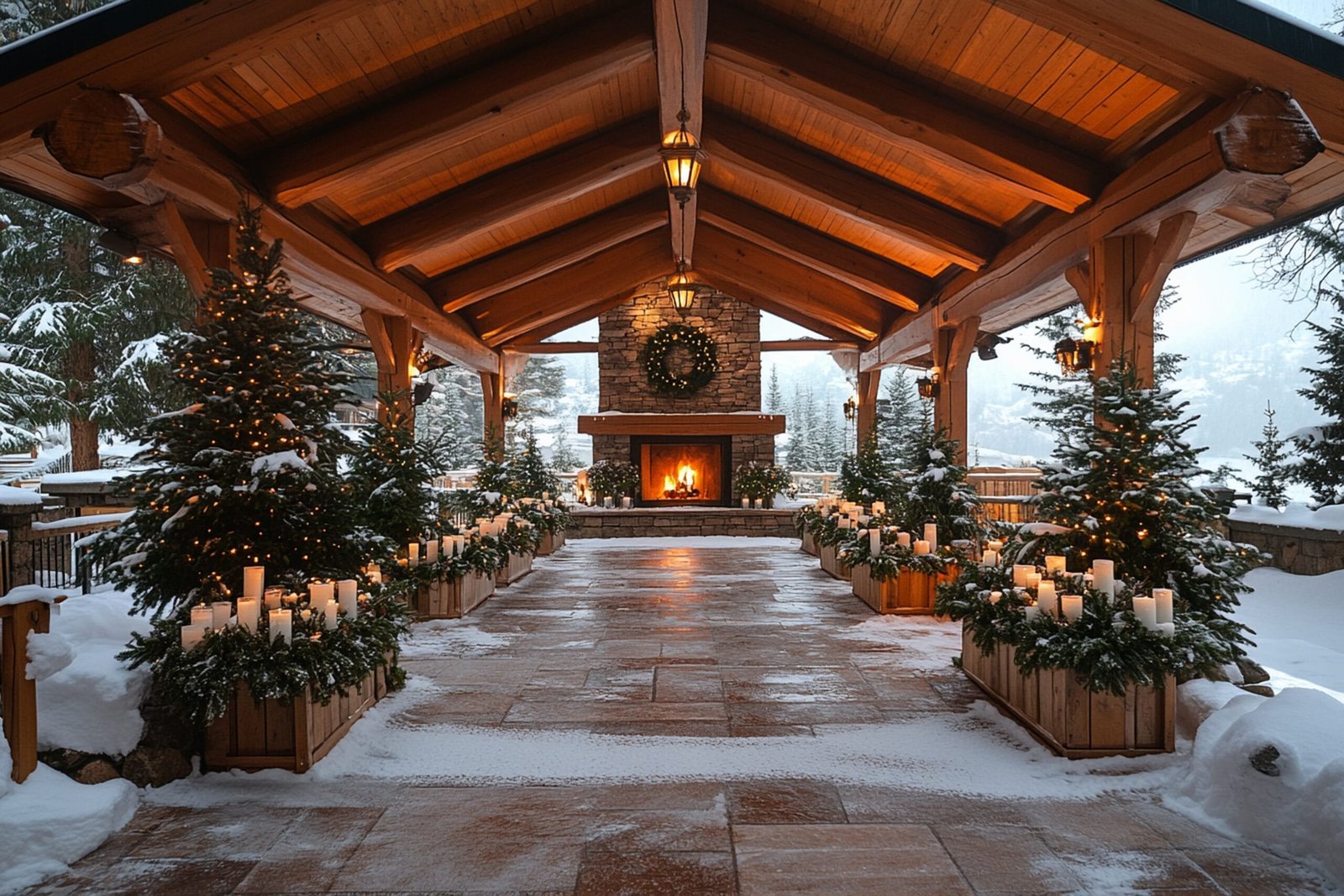
Winter Wedding Venue Costs: Hidden Fees to Check Before You Book
Winter wedding venue costs can be difficult to evaluate because the lowest advertised rental fee is rarely the same as the amount you will ultimately pay. A venue may offer an appealing off-season discount while charging separately for heating, snow and ice removal, extra lighting, backup power, transportation support, coat check, extended setup access, holiday staffing, or an indoor weather plan. Those expenses may not appear in the initial proposal, especially when the venue normally hosts most of its weddings during warmer months.
The problem is not that winter weddings are automatically expensive. In many markets, a winter date can give you access to lower rental rates, greater date availability, flexible minimums, or package incentives. The problem is that winter changes how the property must operate. Guests need safe access from the parking area, vendors may need more setup time, outdoor spaces may become unusable, daylight may disappear before the ceremony, and heating systems may need to support a larger crowd than they handle on an ordinary winter day.
A useful venue comparison therefore needs to include three numbers rather than one. First, identify the advertised starting price. Second, calculate the likely total based on the services you expect to use. Third, estimate a reasonable worst-case total if cold weather, snow, ice, transportation delays, or overtime trigger additional charges.
This guide will help you build those three numbers. You will learn which winter-specific fees to investigate, what to ask before signing the contract, how to compare two venues using the same assumptions, and how to recognize a low quote that transfers too much weather-related risk to you.
The Quick Answer: How Much Does a Winter Wedding Venue Really Cost?
A winter wedding venue really costs the rental fee plus every service required to keep the event warm, accessible, adequately lit, staffed, and operational in cold-weather conditions. Depending on the property, those additions may include heating, snow removal, deicing, coat check, backup power, tent sidewalls, indoor ceremony space, valet attendants, guest shuttles, holiday labor premiums, extra setup hours, insurance, security, and overtime.
You should not assume that an off-season discount will cover these expenses. A venue that reduces its base rental fee by $2,000 could still cost more than a full-service property if you must separately arrange heating equipment, transportation, staffing, or a weather backup area.
The most reliable way to compare winter wedding venue costs is to request a written estimate based on the same event profile from every venue. Use the same guest count, ceremony time, reception length, setup schedule, catering plan, transportation needs, and weather assumptions. Then compare the estimated final costs rather than the first number on each proposal.
A winter venue can still offer good value. It is most likely to do so when the building was designed for year-round events, heating and basic lighting are included, parking areas are routinely cleared, the ceremony and reception can both take place indoors, and the venue has clear weather procedures. A venue becomes harder to price when several essential winter services are described only as “available if needed” without written rates or responsibility clauses.
Why Winter Wedding Venue Pricing Is Different
Winter does not merely change the appearance of a venue. It changes the operational requirements behind the event. A property that functions smoothly for a June reception may require additional equipment, labor, energy, transportation planning, and contingency space for a January wedding.
The Off-Season Rate May Cover Only the Building
An off-season rental rate often reflects reduced demand for the date. It does not necessarily mean the venue’s cost of hosting your event is lower. Heating a large ballroom, clearing a long driveway, staffing a coat room, lighting outdoor paths, and keeping employees on-site during uncertain weather may increase the venue’s operating expenses.
Some venues include those services in the package because they regularly host winter events. Others separate them into optional charges. The distinction matters because an “optional” service may become practically unavoidable. You may technically be allowed to decline valet parking, for example, but that may not be realistic if the standard parking area is across an icy field or down a steep driveway.
Ask what the rental fee includes under normal winter conditions. Then ask what changes if snow, freezing rain, high winds, or extreme cold are forecast. A strong proposal should identify both the included services and the circumstances that trigger additional charges.
Your Location Changes the Risk
Winter planning is highly regional. A venue in an area with routine snowfall may already have commercial snow-removal contracts, insulated buildings, covered entrances, backup power procedures, and experienced winter staff. A venue in a milder region may encounter snow less frequently but have fewer resources available when it does occur.
This is why national cost averages are not especially useful for this decision. The expense depends on the property, local climate, access roads, municipal services, event date, building design, and vendor network. One inch of snow may cause little disruption at a mountain lodge with its own equipment, while the same weather could create major access problems at a rural venue that rarely handles winter events.
Do not ask only whether the venue has hosted winter weddings. Ask what happened during its most difficult winter event, which services were activated, who paid for them, and what the couple would have been charged under the current contract.
The Date Can Matter as Much as the Season
Not every winter date receives the same discount. A quiet Sunday in January may be priced differently from New Year’s Eve, Valentine’s Day weekend, a holiday Saturday, or a date that overlaps with a major local festival or sports event.
Holiday dates may also affect staffing, catering, transportation, hotel availability, and overtime rates. A venue may offer a reduced rental fee but apply holiday labor premiums to security staff, bartenders, valet attendants, maintenance workers, or setup crews.
Request a complete estimate for your exact date. General winter pricing may not reveal date-specific minimums, premiums, or staffing requirements.
Hidden Winter Wedding Venue Costs to Check
The following expenses do not apply to every venue. However, each one should be confirmed in writing before you compare proposals or pay a deposit.
Heating and Temperature-Control Costs
Heating is one of the most obvious winter expenses, but it is also one of the easiest to misunderstand. A venue may say that the building is heated without confirming which rooms are included, when the heat is turned on, whether loading areas are conditioned, or whether the system can maintain a comfortable temperature with exterior doors opening throughout the event.
Confirm Which Spaces Are Heated
Ask whether heating is included in:
- The ceremony room
- The reception room
- Cocktail-hour spaces
- Restrooms
- Hallways
- Dressing rooms
- Vendor preparation areas
- Covered patios
- Tents
- Entryways
- Coat-check areas
A venue may have a heated ballroom but an unheated ceremony space, historic annex, glass conservatory, or tented cocktail area. If guests move between buildings, the transition itself may create comfort and accessibility problems.
The contract should state which spaces are part of your rental and whether temperature control is included. If temporary heaters are required, ask who supplies them, who operates them, what fuel or electricity they use, and whether permits or fire inspections are required.
Ask About Heating Hours
Some venues begin heating the room only shortly before guest arrival. That may work in a modern building but may not be sufficient for a stone barn, converted warehouse, historic estate, or tent.
Ask when the venue begins warming the space and whether the heating period is included in the rental. If your florist, photographer, caterer, or entertainment team needs access several hours earlier, confirm whether the space will be heated during setup.
This affects more than vendor comfort. Flowers, instruments, electronic equipment, food service, adhesives, candles, and décor materials may respond poorly to very cold conditions. A slightly longer heating window may prevent several separate problems.
Understand Supplemental Heating Charges
Temporary heating costs may be quoted as:
- A flat equipment rental
- A daily rental
- A fuel charge
- A delivery and pickup charge
- A technician or fire-watch fee
- A per-hour operating charge
- A power-distribution charge
- A weather-triggered surcharge
Ask for a realistic estimate based on your event length and expected temperature range. A heater listed at $600 may cost considerably more after delivery, fuel, installation, permits, protective flooring, and labor are added.
You should also confirm what happens if the venue’s permanent heating system fails. The contract may exclude mechanical failures, require the event to continue with temporary equipment, or give the venue broad authority to relocate the event to another room.
Coat Check and Guest Storage
A coat check may appear to be a small hospitality detail, but it becomes an operational requirement when most guests arrive with heavy coats, scarves, umbrellas, boots, and winter accessories.
Determine Whether Coat Check Is Included
Some venues provide coat racks but no attendants. Others require professional coat-check staff. A few include a staffed coat room in the rental package.
Ask how many garments the space can hold and whether it is supervised. One rack near the entrance may not be sufficient for 150 guests carrying bulky coats. If the room becomes crowded, guests may place coats over chairs, which can reduce aisle space and make the reception look disorganized.
Staffed coat check may be charged by the attendant, by the hour, or as a flat event fee. Confirm minimum staffing levels and whether gratuity or a service charge applies.
Consider Wet-Weather Storage
Snow, sleet, and rain can leave coats and umbrellas wet. Ask whether the coat room has drainage, floor protection, umbrella storage, and enough space to separate damp items.
You may also need a plan for guest footwear. Some winter venues encourage guests to arrive in practical boots and change into formal shoes. That can improve safety, but it creates a storage need. A bench, numbered bag system, or staffed area may be more useful than an decorative sign telling guests to change shoes without providing somewhere to put them.
Snow Removal and Deicing
Snow removal is not one service. It may involve parking areas, driveways, sidewalks, stairs, ramps, loading zones, ceremony paths, emergency exits, and secondary entrances.
Identify Who Is Responsible
The contract should state who is responsible for snow and ice removal and which areas are covered. Avoid relying on a verbal statement that the property is “always cleared.” Ask whether the venue uses its own staff or a third-party contractor and whether your event receives priority during a regional storm.
Confirm whether the standard rental includes:
- Plowing the main driveway
- Clearing guest parking
- Clearing vendor loading areas
- Shoveling sidewalks
- Clearing stairs and ramps
- Applying salt or ice melt
- Maintaining emergency exits
- Re-clearing during the event
- Clearing the property after additional snowfall
A venue may include the first plowing but charge for repeated service. Another may clear only the main entrance, leaving the couple responsible for a ceremony path or outdoor photo area.
Ask About Triggered Charges
Snow-removal charges may be triggered by accumulation, time of day, repeated visits, or a contractor’s emergency rate. Request the actual fee schedule.
A clause that says “additional snow removal will be billed as needed” is not enough for budgeting. Ask for an hourly rate, a per-visit estimate, or a maximum authorization amount. You should know whether the venue can approve a $300 service without contacting you or whether a severe storm could result in several thousand dollars of additional work.
Review Guest and Vendor Access
Snow removal is only useful if the roads leading to the property are passable. Ask whether the venue is located on a public road, private road, mountain route, or unpaved access lane. Find out who maintains each portion.
The National Weather Service distinguishes between advisories, watches, and warnings, and notes that winter storm or ice storm conditions may make travel difficult or impossible. Your venue plan should therefore include a decision process for changing transportation, timing, or event operations when official weather alerts are issued.
Backup Power and Generator Costs
Winter storms can affect electrical service, and even a brief outage can disrupt heating, kitchen equipment, lighting, elevators, sound systems, restrooms, and payment systems.
Ask What the Existing Generator Powers
A venue may advertise a backup generator without explaining its capacity. It might power emergency lights but not the ballroom heating system. It might support the kitchen but not elevators or guest rooms.
Ask for a written list of the systems connected to backup power. Important questions include:
- Does it power the heating system?
- Does it power the kitchen and refrigeration?
- Does it support emergency and decorative lighting?
- Does it power restrooms and water pumps?
- Does it support elevators or accessibility equipment?
- How long can it operate?
- Who refuels it?
- How frequently is it tested?
- Is a technician available during events?
You do not need to evaluate the generator technically yourself. You need the venue to explain what will continue working if normal power is interrupted.
Understand Temporary Generator Charges
If the venue requires a rented generator for winter events, ask whether the quote includes delivery, fuel, cables, distribution panels, installation, pickup, noise control, weather protection, and an operator.
Also ask whether the generator is mandatory or optional. A venue may describe it as optional during booking and later require it based on the forecast. The contract should explain who makes that decision and when.
Indoor Backup Space
An indoor backup plan is different from simply having another room somewhere on the property. The backup space must fit your guest count, ceremony layout, vendor requirements, accessibility needs, and schedule.
Confirm That the Backup Space Is Reserved
Some venues sell the backup room separately. If another event books it, your weather plan may become a hallway, restaurant section, or reduced-capacity room.
Ask whether the backup space is held exclusively for your wedding. If not, determine the deadline for reserving it and the additional charge. A backup plan that depends on the room remaining unsold is not a dependable plan.
Ask What Changes When the Backup Plan Is Used
Moving indoors may affect:
- Guest capacity
- Aisle length
- Ceremony seating
- Cocktail-hour location
- Floral installations
- Sound equipment
- Lighting
- Photography
- Vendor access
- Room turnover time
- Staffing
- Rental requirements
Ask whether the venue charges a room-flip fee if staff must transform the ceremony space into the reception area. Confirm how long the transition takes and where guests will wait.
Review the Weather Decision Deadline
The venue may require an indoor or outdoor decision several days before the wedding. That deadline may be driven by staffing, tenting, equipment, or room setup.
Ask who has final authority. Some contracts allow the venue to move the event indoors for safety reasons. That can be reasonable, but the criteria should be clear. Temperature, wind, snow, ice, ground conditions, and emergency access may all influence the decision.
Winter Lighting Costs
Winter weddings often require more lighting because sunset arrives earlier and cloudy conditions can reduce natural light during the afternoon.
Separate Safety Lighting From Decorative Lighting
Safety lighting may be needed for:
- Parking areas
- Walkways
- Stairs
- Ramps
- Building entrances
- Vendor loading zones
- Restroom routes
- Shuttle pickup areas
- Emergency exits
Decorative lighting may include chandeliers, uplighting, string lights, candles, pin spots, or illuminated installations. Do not assume that a venue’s included “lighting package” covers both categories.
Ask which areas are permanently lit and which require rented equipment. A venue may include ballroom fixtures but charge separately for exterior pathway lights or parking-lot towers.
Account for Installation and Power
Lighting proposals may include fixtures while excluding installation, extension cables, generators, rigging, dimmers, delivery, or technicians.
If lighting must be installed on the wedding day because the venue limits earlier access, labor costs may increase. Ask whether your lighting provider can install the day before and whether the venue charges for early access.
Transportation, Shuttle, and Valet Costs
A winter venue may be beautiful but difficult to reach. Long driveways, limited parking, steep roads, unpaved lots, and distant hotels can create a transportation problem before the ceremony begins.
Decide Whether Guests Can Park Safely
Ask to see the parking area during winter conditions if possible. Determine whether it is paved, illuminated, level, and regularly cleared.
A grass overflow lot that works in summer may be unusable when frozen, muddy, or covered in snow. If the winter parking capacity is lower than the venue’s advertised capacity, you may need shuttles or valet service even if the venue does not normally require them.
Price the Entire Shuttle Schedule
A shuttle quote should account for more than transporting guests to the ceremony. You may need:
- Early vendor or wedding-party transportation
- Multiple hotel pickup times
- Guest transportation to the venue
- Return trips during the reception
- A final departure
- Extra time for slow winter roads
- An accessible vehicle
- A standby vehicle
- Driver waiting time
- Parking or staging fees
A shorter route does not always produce a lower total if the vehicle must remain reserved for eight or ten hours.
Review Valet Requirements
Some venues require valet service during winter to reduce guest walking distance or manage limited cleared parking. Ask whether valet is included, required, or recommended.
Confirm staffing minimums, hourly rates, gratuity, insurance requirements, weather gear, lighting, and the location where vehicles will be stored. If the lot is not on-site, additional shuttle or driver time may apply.
Holiday Premiums and Seasonal Minimums
A date can be off-season and still carry holiday premiums. Christmas week, New Year’s Eve, Valentine’s Day weekend, Presidents’ Day weekend, and dates near major local events may have separate pricing.
Ask Each Vendor About Holiday Labor
The venue’s rental fee is only one part of the cost. Caterers, bartenders, security companies, valet operators, transportation companies, rental providers, and cleaning crews may apply holiday rates.
Ask the venue whether preferred or required vendors publish holiday pricing. A venue discount is less useful if its exclusive vendors charge significant premiums on your date.
Check Food and Beverage Minimums
A venue may lower the room rental but keep the same food and beverage minimum used during peak season. If your winter guest list is smaller, meeting the minimum may require menu upgrades, additional courses, premium beverages, or a payment for unused minimum spending.
Ask whether the minimum is calculated before or after service charges and taxes. Also ask whether vendor meals, late-night snacks, bar packages, or rehearsal events count toward it.
Setup Access and Delivery Restrictions
Winter installations can take longer. Vendors may need additional time to unload safely, protect floors, assemble equipment indoors, and work around limited loading access.
Confirm the Setup Window
Ask for the exact time vendors may enter the property. If access begins only two or three hours before the ceremony, determine whether that is realistic for your décor, lighting, entertainment, rentals, and floral plan.
A short setup window can create overtime charges from multiple vendors. Paying the venue for an additional hour may be less expensive than paying five different vendors for rushed or after-hours labor.
Ask About Day-Before Access
Some winter venues have more calendar flexibility and may allow day-before setup. Others charge a full additional rental day even when no other event is scheduled.
Ask whether you can purchase limited access rather than a second event day. For example, you may need only four hours for lighting, stage, and rental delivery.
Review Loading Conditions
Confirm whether vendors have a covered loading area. Carrying furniture, instruments, food, flowers, and electronic equipment across snow or ice increases time and risk.
Ask who protects the floors after wet deliveries, whether carts are available, and whether the venue requires additional cleanup or protective covering.
Event Insurance and Venue Insurance Requirements
Insurance requirements can affect both the cost and the level of protection you receive.
Understand Liability Insurance
Many venues require the couple to provide a certificate of event liability insurance. The contract may specify coverage limits, liquor liability, additional insured parties, and submission deadlines.
Ask whether the venue offers coverage through its own provider or requires you to purchase a separate policy. Compare the coverage, deductible, exclusions, and claims process rather than selecting only by price.
Understand Cancellation and Postponement Coverage
Special-event insurance may provide protection for certain cancellations or postponements, including some events affected by adverse weather or natural disasters. Coverage varies by policy, and you should ask specifically what is included, what is excluded, how reimbursement is calculated, and whether existing policies or credit-card benefits provide overlapping protection.
Do not assume that a policy will pay because guests cannot travel or because the forecast is unpleasant. The covered reason, severity of the event, timing of purchase, policy exclusions, and contractual obligations may all matter.
Compare Insurance With Contract Risk
Insurance does not replace a fair venue contract. A policy may exclude circumstances that the venue could address through rescheduling, refunds, or transferable deposits.
Review the venue’s cancellation and postponement terms before buying coverage. Then ask an insurance professional how the policy interacts with those terms.
Overtime and Weather-Delay Charges
Winter weather can slow nearly every part of the schedule. Vendors may arrive late, guests may need more time to travel, the ceremony may begin behind schedule, and loading out may take longer.
Confirm Event Overtime
Ask how much the venue charges if the reception extends beyond the contracted end time. Determine whether overtime is billed in 15-minute, 30-minute, or one-hour increments.
Also ask which additional charges are triggered. Venue overtime may automatically extend security, bartending, valet, transportation, cleaning, and staffing. A $500 venue extension could become a much larger combined expense.
Confirm Setup and Breakdown Overtime
Event overtime is not the only concern. Your vendors may need additional time before or after the reception because of weather or difficult loading conditions.
Ask when the property must be fully cleared. If rental pickup cannot occur until the next morning, confirm whether overnight storage or next-day access is allowed and what it costs.
Create a Delay Decision Plan
Your timeline should identify who may authorize overtime and how much they may approve. Without a limit, a coordinator or family member may agree to several extensions without understanding the combined cost.
A practical contract-management plan could authorize the coordinator to approve up to $1,000 in essential weather-related expenses, while requiring direct approval for anything higher. The exact amount depends on your budget, but the decision should be made before the wedding day.
How to Calculate the Total Winter Wedding Venue Cost
A useful comparison separates fixed costs, likely variable costs, and weather-triggered costs.
Step 1: Establish the Same Event Assumptions
Use the same assumptions for every proposal:
- Guest count
- Ceremony and reception locations
- Event date
- Guest arrival time
- Ceremony start time
- Reception end time
- Vendor access time
- Breakdown deadline
- Catering format
- Bar plan
- Parking needs
- Shuttle schedule
- Indoor backup requirement
- Expected décor and lighting
- Coat-check needs
If Venue A is priced for 120 guests and Venue B is priced for 100, the totals are not directly comparable. Request revised estimates before making a decision.
Step 2: Separate Included and Excluded Services
Create three labels for every cost:
- Included: The service is part of the quoted package.
- Required extra: The service is mandatory but billed separately.
- Conditional extra: The service is charged only under certain conditions.
Conditional charges deserve special attention because they are easy to omit from the initial budget. Snow removal, generators, room flips, overtime, additional heaters, and shuttles may all fall into this category.
Step 3: Calculate a Likely Total
The likely total should include every cost you reasonably expect to use. If the venue’s parking is distant and most guests are staying at the same hotel, transportation should probably be treated as a likely cost rather than an emergency option.
Do not reduce the estimate merely because you hope the weather will be mild. Use the venue’s normal winter operating plan as the baseline.
Step 4: Calculate a Weather-Adjusted Maximum
The weather-adjusted maximum is not a prediction of disaster. It is a planning number.
Include realistic charges such as:
- One or two additional snow-removal visits
- Supplemental heating
- A generator
- Extended shuttle time
- Venue overtime
- Extra setup access
- A room-flip fee
- Additional lighting
- Rescheduling administration fees
You do not need to budget for every imaginable problem simultaneously. Instead, identify the combination of charges that could reasonably occur during a difficult winter weekend.
Step 5: Compare Refundable and Nonrefundable Amounts
Two venues with the same total cost may expose you to different levels of financial risk. One may require a large nonrefundable deposit, while another allows a date transfer under defined weather conditions.
Track:
- Initial deposit
- Payment schedule
- Refundable amounts
- Nonrefundable amounts
- Rescheduling fees
- Date-transfer rules
- Minimum cancellation notice
- Weather-related exceptions
- Vendor deposit obligations
This helps you compare not only how much the venue costs, but how much money is at risk.
Side-by-Side Example: Low Rental Fee vs. Full-Service Winter Venue
The following examples are illustrative planning scenarios, not national price averages or actual venue quotes. They show how two proposals can change once winter-specific costs are added.
Assume both venues are being considered for a 120-guest Saturday wedding with an indoor ceremony, cocktail hour, and five-hour reception.
| Cost category | Venue A: Converted Seasonal Barn | Venue B: Year-Round Hotel Venue |
|---|---|---|
| Base rental fee | $4,500 | $7,500 |
| Ceremony fee | $750 | Included |
| Tables and chairs | $1,400 | Included |
| Basic indoor heating | Included | Included |
| Supplemental heat estimate | $1,200 | Not required |
| Heater delivery and fuel | $650 | Not required |
| Coat check | $480 | Included |
| Snow removal | $600 estimated | Included |
| Deicing and walkway service | $300 estimated | Included |
| Basic ballroom lighting | Included | Included |
| Exterior safety lighting | $750 | Included |
| Backup generator | $1,100 | Existing backup power included |
| Indoor backup space | $1,000 | Included |
| Room-flip labor | $700 | $500 |
| Parking attendants or valet | $900 | Included |
| Guest shuttle estimate | $1,800 | $800 |
| Additional setup access | $600 | Included |
| Event liability insurance | $250 | $250 |
| Likely venue-related total | $16,980 | $9,850 |
Venue A begins with a rental fee that is $3,000 lower. Once the likely winter requirements are included, however, its estimated total is $7,130 higher than Venue B.
This does not automatically make Venue B the better choice. Venue A may offer an atmosphere, location, vendor flexibility, or food policy that matters more to you. It might also reduce some of the estimated costs after a detailed review. The purpose of the comparison is not to prove that a hotel is always cheaper. It is to show that the rental fee alone does not identify the more affordable venue.
Weather-Adjusted Comparison
Now assume a significant storm requires repeated plowing, additional shuttle time, and one hour of event overtime.
| Weather-triggered cost | Venue A | Venue B |
|---|---|---|
| Additional plowing visit | $450 | Included |
| Supplemental heater fuel | $300 | Not required |
| Extended shuttle service | $600 | $300 |
| One hour of venue overtime | $900 | $750 |
| Extended valet or parking staff | $350 | $250 |
| Total weather-triggered additions | $2,600 | $1,300 |
| Weather-adjusted maximum | $19,580 | $11,150 |
The larger difference comes from risk allocation. Venue B charges a higher base price but absorbs more routine winter operating expenses. Venue A transfers more of those costs to the couple.
A Second Example: Two Similar Hotels With Different Contract Terms
Assume Venue C and Venue D both quote approximately $12,000 for a winter wedding.
Venue C includes parking, coat check, indoor ceremony space, and a generator. However, its contract states that payments are nonrefundable and that postponement requires a new rental payment unless the property becomes legally inaccessible.
Venue D charges $500 more and requires separate event liability coverage. Its contract allows the deposit to be transferred once to another available date if local authorities close the main access road or if the venue determines that the property cannot operate safely.
Venue C has the lower likely cost. Venue D may have the lower financial risk.
This is why a total-cost comparison should include contract flexibility. A venue can be more expensive on paper while providing a more useful weather plan.
Questions to Ask Before Signing a Winter Wedding Venue Contract
You do not need to ask every question during the first tour. Use the initial conversation to determine whether the venue is a realistic option. Send the detailed questions before signing or paying a nonrefundable deposit.
Heating and Building Operations
- Which rented spaces are permanently heated?
- Is heating included during vendor setup and breakdown?
- What indoor temperature does the venue normally maintain?
- Are supplemental heaters ever required?
- Who decides whether additional heating is necessary?
- What are the equipment, fuel, labor, delivery, and permit charges?
- What happens if the permanent heating system fails?
- Are dressing rooms, restrooms, hallways, and vendor areas heated?
- Can exterior doors remain closed during loading, or will deliveries affect room temperature?
- Are portable heaters restricted by the venue or local fire rules?
Snow and Ice Management
- Who clears the driveway, parking areas, sidewalks, stairs, ramps, and loading zones?
- Is snow removal included in the rental?
- How many plowing or deicing visits are included?
- What triggers an additional charge?
- What is the rate for repeated service?
- Who maintains the public and private roads leading to the property?
- What happens if a contractor cannot reach the venue?
- Is there a written deadline for determining whether the property is accessible?
- Who has final authority to delay, relocate, or cancel the event?
- Are outdoor ceremony paths or photography areas included in snow removal?
Backup Space and Power
- Is the indoor backup room reserved exclusively for our wedding?
- Does it fit the full contracted guest count?
- Is there a room-flip charge?
- How long does the room conversion take?
- Which systems are supported by backup power?
- Does the generator power heating, kitchen equipment, restrooms, elevators, and event lighting?
- Is generator fuel included?
- When was the backup system last tested?
- Is a temporary generator required for any part of the event?
- Who pays if additional power is required because of the forecast?
Parking and Transportation
- How many parking spaces are available during winter?
- Are overflow lots usable in snow or freezing conditions?
- Is the parking area paved and illuminated?
- Is valet service included, optional, or required?
- Does the venue require a particular valet or shuttle company?
- Where can buses or shuttles turn around and wait?
- Is there an accessible drop-off area near the entrance?
- Are there additional fees for transportation staging?
- What happens if the event schedule changes because of road conditions?
- Can vehicles remain overnight if guests decide not to drive?
Setup, Overtime, and Staffing
- What time may vendors enter the building?
- Is day-before access available?
- What does additional setup time cost?
- Is the loading area covered and cleared?
- What is the event overtime rate?
- Which staff or vendor charges increase when overtime is added?
- What is the breakdown deadline?
- Can rentals remain overnight?
- Is next-day pickup available?
- Are holiday labor premiums applied to our date?
Insurance, Cancellation, and Disputes
- What liability coverage must we purchase?
- Is liquor liability required?
- Which parties must be listed as additional insureds?
- Does the venue require cancellation insurance?
- What happens if the venue cannot safely operate?
- What happens if roads are open but many guests or vendors cannot travel?
- Can payments be transferred to another date?
- Which payments are refundable?
- Are weather decisions and fee approvals provided in writing?
- What process does the contract require for resolving billing disagreements?
A venue does not need to provide the answer you hoped for in every category. It does need to provide a clear answer. Unfavorable but specific terms can be budgeted and compared. Vague terms leave the final cost uncertain.
Common Hidden-Fee Mistakes That Increase Winter Venue Costs
Comparing Only the Base Rental Fee
The most common mistake is treating the advertised rate as the venue cost. That number may cover little more than access to the room.
Before comparing venues, add every required and likely expense. A $5,000 venue with heating, parking, backup space, and staffing included may be more affordable than a $3,000 property that charges separately for each service.
Treating Winter Services as Optional
A shuttle, generator, coat check, or supplemental heater may appear under “optional services.” That does not mean you can realistically host the event without it.
Ask whether couples normally purchase the service and what conditions make it mandatory. If most winter weddings use it, include it in your likely budget.
Relying on Verbal Assurances
Statements such as “we take care of the snow” or “we have backup power” are not detailed enough for a contract decision.
Ask the venue to confirm the service, limits, and charges in writing. A friendly tour conversation may not be enforceable or remembered accurately months later.
Ignoring Setup Conditions
Couples often calculate the cost of the ceremony and reception but overlook the hours before and after the event.
Winter delivery and installation can be slower. Limited setup access may create overtime for your florist, rental company, lighting provider, entertainment team, caterer, and planner.
Assuming Indoor Space Eliminates Weather Risk
An indoor ballroom protects the event from direct exposure, but guests and vendors still need to reach the building. Parking, walkways, loading, power, staffing, and hotel transportation remain important.
Evaluate the entire guest and vendor journey rather than only the ceremony room.
Forgetting the Cost of a Room Flip
A venue may offer one room for both ceremony and reception without clearly pricing the transition.
Ask who moves the chairs and tables, where guests wait, how long the process takes, and whether additional labor is required. The room may be included while the conversion is not.
Using the Best-Case Schedule
A timeline that assumes normal travel speeds, fast unloading, and on-time guest arrival may not hold during winter weather.
Build reasonable buffers into vendor arrival, guest transportation, ceremony start, and breakdown. This can reduce expensive overtime and rushed decisions.
Failing to Review Required Vendors
A discounted venue may require exclusive caterers, rental providers, valet companies, or transportation services. Those vendors may have their own winter minimums and holiday rates.
Request representative estimates before signing the venue contract. A venue price cannot be evaluated separately from mandatory vendor pricing.
Buying Insurance Without Reading the Venue Contract
Insurance can be useful, but it should not be treated as a substitute for understanding cancellation and rescheduling rules.
Compare the venue’s responsibilities with the policy’s covered reasons, exclusions, deadlines, and reimbursement limits. Ask questions about any gap between them.
Not Setting an Approval Limit
A winter event can produce last-minute expenses. Without a preapproved limit, several people may authorize costs independently.
Create one decision chain. Identify who may approve snow removal, transportation extensions, heating, or overtime and how much they may authorize.
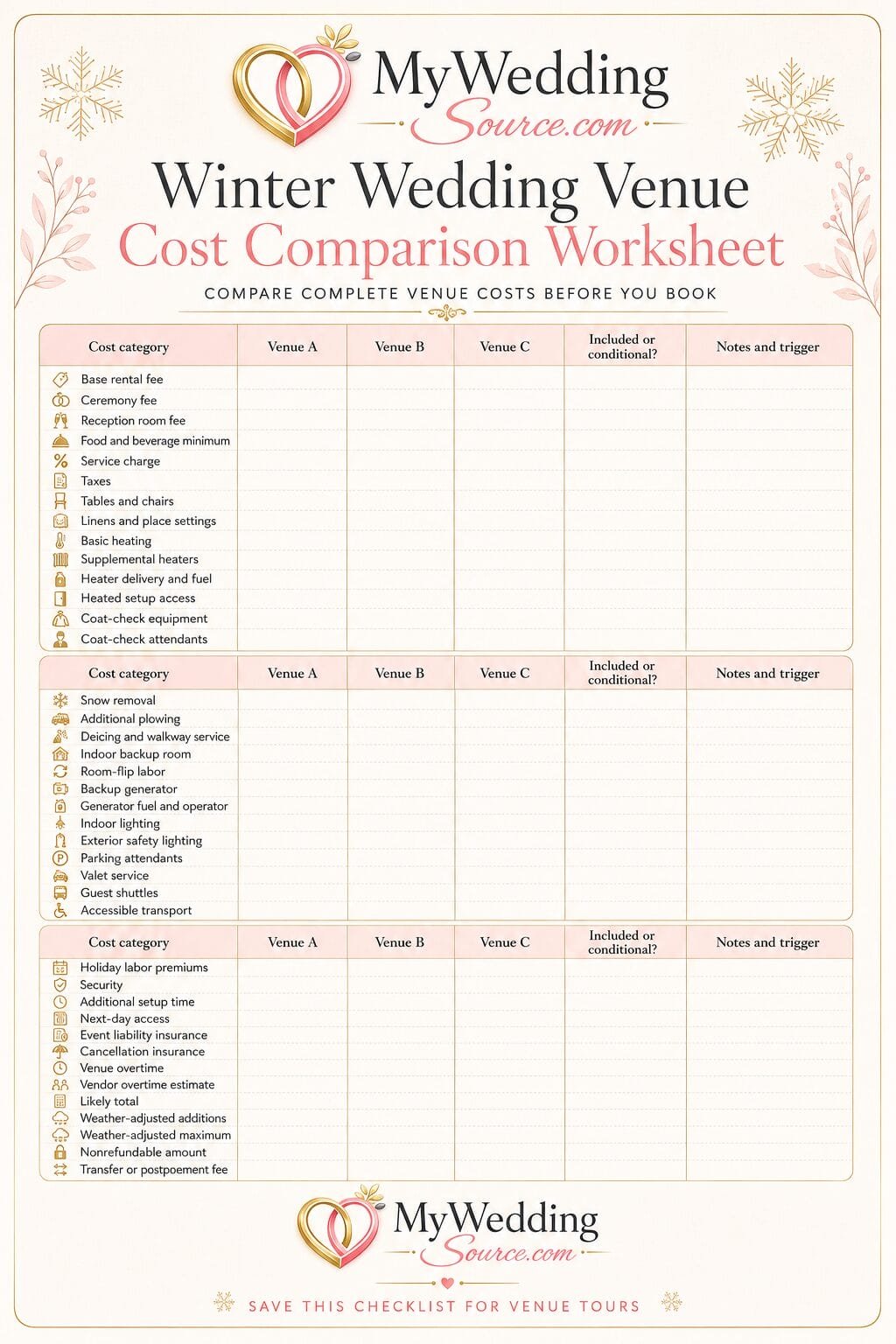
Winter Wedding Venue Cost Comparison Worksheet
Use this worksheet for each venue you are seriously considering. Enter zero only when the proposal clearly states that the service is included without a separate charge.
How to Use the Worksheet
First, enter the written proposal amounts. Do not estimate unless the venue has confirmed that a charge may apply but cannot yet provide an exact figure.
Second, mark every row as included, required, or conditional. This prevents an empty cell from being mistaken for an included service.
Third, add the likely costs. Use the services you expect to need under normal winter conditions.
Fourth, calculate the weather-adjusted maximum by adding a realistic combination of conditional charges. This is the number you can use when deciding whether the venue still fits your budget.
Finally, compare the nonrefundable amounts and postponement terms. The lowest likely total may not be the safest financial commitment.
When a Winter Wedding Venue Can Be a Good Value
A winter wedding venue can provide strong value when its lower seasonal pricing is supported by a complete year-round operating plan.
Look for properties that:
- Host winter events regularly
- Have permanently heated indoor spaces
- Include parking-lot and walkway maintenance
- Offer a full-capacity indoor ceremony room
- Have permanent backup power
- Provide clear weather-decision procedures
- Include adequate exterior lighting
- Offer covered loading access
- Have nearby hotel and transportation options
- Provide written pricing for conditional services
- Allow useful setup access
- Offer reasonable date-transfer terms
A higher package price may be worthwhile when it reduces the number of separate vendors and uncertain charges you must manage. That does not mean full-service venues are automatically better. It means the package should be evaluated by what it includes and what risk it removes.
You may also find meaningful savings by choosing a Friday, Sunday, or non-holiday date, reducing the number of separate event spaces, using the venue’s existing lighting, selecting a property near guest hotels, or choosing a building that does not need temporary heating.
The goal is not to eliminate every winter-related expense. The goal is to spend deliberately on the services that protect guest access, comfort, and event continuity.
What to Do If a Venue Charge Becomes a Dispute
Most disagreements are easier to address when the contract, proposal, receipts, change orders, and email conversations are organized.
If a venue charges for a service that you believed was included, begin by locating the relevant contract language and written correspondence. Ask the venue for an itemized explanation and identify the resolution you are requesting. Keep the communication specific and professional.
USA.gov recommends gathering documents such as contracts, receipts, work orders, and emails before making a complaint. It also recommends contacting the company first and escalating the matter to management, consumer-protection programs, or legal assistance if the issue cannot be resolved directly.
This section is general consumer-planning information, not legal advice. Contract rights and remedies vary by state and by the wording of the agreement.
Frequently Asked Questions
Are winter wedding venues usually cheaper?
Winter venues can be cheaper when demand is lower, but a lower rental fee does not guarantee a lower final cost. Heating, snow removal, lighting, transportation, backup power, coat check, staffing, and insurance may offset the seasonal discount.
Request a complete estimate for your exact date and guest count. Compare the likely total and weather-adjusted maximum rather than relying on a general off-season percentage.
Who normally pays for snow removal at a wedding venue?
The venue often arranges snow removal, but the contract determines whether the cost is included or passed to the couple. Some venues include routine service and charge only for repeated plowing or emergency contractor visits.
Ask which areas are covered, how many visits are included, what triggers additional service, and whether the venue can authorize extra charges without your approval.
Do you need a generator for a winter wedding?
Not every winter wedding needs a rented generator. A year-round venue may already have permanent backup power.
Ask which systems the existing generator supports. Emergency lights alone may not keep the heating system, kitchen, elevators, restrooms, or entertainment equipment operating. A temporary generator should be priced only after you understand the venue’s existing capacity.
Is wedding insurance worth considering for a winter event?
It may be worth considering when you have substantial nonrefundable payments or meaningful weather-related risk. However, policies vary and may not cover every travel disruption, forecast, or postponement.
Compare the venue contract with the policy. Ask what reasons are covered, which losses are reimbursable, when the policy must be purchased, and what exclusions apply.
What happens if guests cannot reach the venue because of snow?
The answer depends on the contract, the venue’s operating status, transportation conditions, and any applicable insurance coverage. A venue may remain open even when travel is difficult, which can limit refund or postponement options.
Ask about this scenario before booking. Determine whether the contract distinguishes between the venue being inaccessible and individual guests being unable to attend.
Should a winter wedding have an indoor ceremony plan?
An indoor plan is advisable when the ceremony depends on outdoor space. The backup area should accommodate the full guest count and preserve essential accessibility, sound, seating, and vendor needs.
Confirm that the room is reserved, not merely available if unsold. Also ask about room-flip labor, décor changes, and the weather decision deadline.
How much extra time should you add to a winter wedding schedule?
The appropriate buffer depends on local conditions, travel distance, and the venue’s access. Rather than adding one universal amount, build extra time into vendor arrival, guest transportation, parking, coat check, and breakdown.
Ask local vendors what they recommend for the property. Their previous winter experience may reveal delays that are not obvious during a summer venue tour.
Can you negotiate winter venue fees?
You may be able to negotiate package details even when the base rental fee is fixed. Useful requests may include included setup time, waived room-flip fees, complimentary coat check, reduced backup-room charges, or a capped snow-removal rate.
Negotiation is usually more effective when you request specific inclusions rather than asking for a general discount. Focus on services that improve cost certainty.
Compare the Full Cost Before You Book
Winter wedding venue costs should be measured by the complete operating plan, not the seasonal rental rate. Heating, snow removal, lighting, transportation, backup space, power, setup access, insurance, staffing, and overtime determine whether the venue can support your event without creating expenses you did not anticipate.
Before signing, request written answers to the winter-specific contract questions and complete the comparison worksheet for your top venues. Calculate the advertised price, the likely total, the weather-adjusted maximum, and the amount of money that would remain nonrefundable under each contract.
A venue with a higher starting price may cost less once essential winter services are included. A less expensive venue may still be the right choice if its additional requirements are clear, manageable, and consistent with your priorities.
Your next step is to send the same winter-cost questionnaire to every venue on your shortlist. Once the proposals are based on the same assumptions, you will be able to compare real costs instead of promotional starting prices.
