
Understanding your November wedding timeline is crucial for planning a successful event. This comprehensive guide will help you navigate the specific challenges and considerations of a November wedding timeline to ensure your big day runs smoothly.
When constructing your November wedding timeline, consider including essential moments such as the first look and family portraits during daylight hours to capture the perfect images.
One key aspect of a November wedding timeline is the importance of planning your ceremony and portraits around the sunset. This guide will offer tips on maximizing daylight and optimizing your November wedding timeline for the best results.
The Quick Answer: Build Your November Wedding Timeline Backward From Sunset
Start by finding the sunset time for your exact wedding date and venue location. Do not rely on the time for the nearest major city unless your venue is actually within that city and has a similarly open horizon.
For a successful November wedding timeline, ensure your planning incorporates the local sunset time for your venue. This ensures critical moments are captured in natural light.
Utilizing your November wedding timeline effectively means making sure each part of the day is aligned with sunset times to avoid rushing through important moments.
Next, ask your photographer how much usable natural light they want for the photographs that matter to you. Sunset is not the same as immediate darkness, but it should not be treated as the beginning of an unlimited portrait period. Trees, mountains, tall buildings, heavy cloud cover, and the direction of the ceremony site can make a location feel dark before the published sunset time.
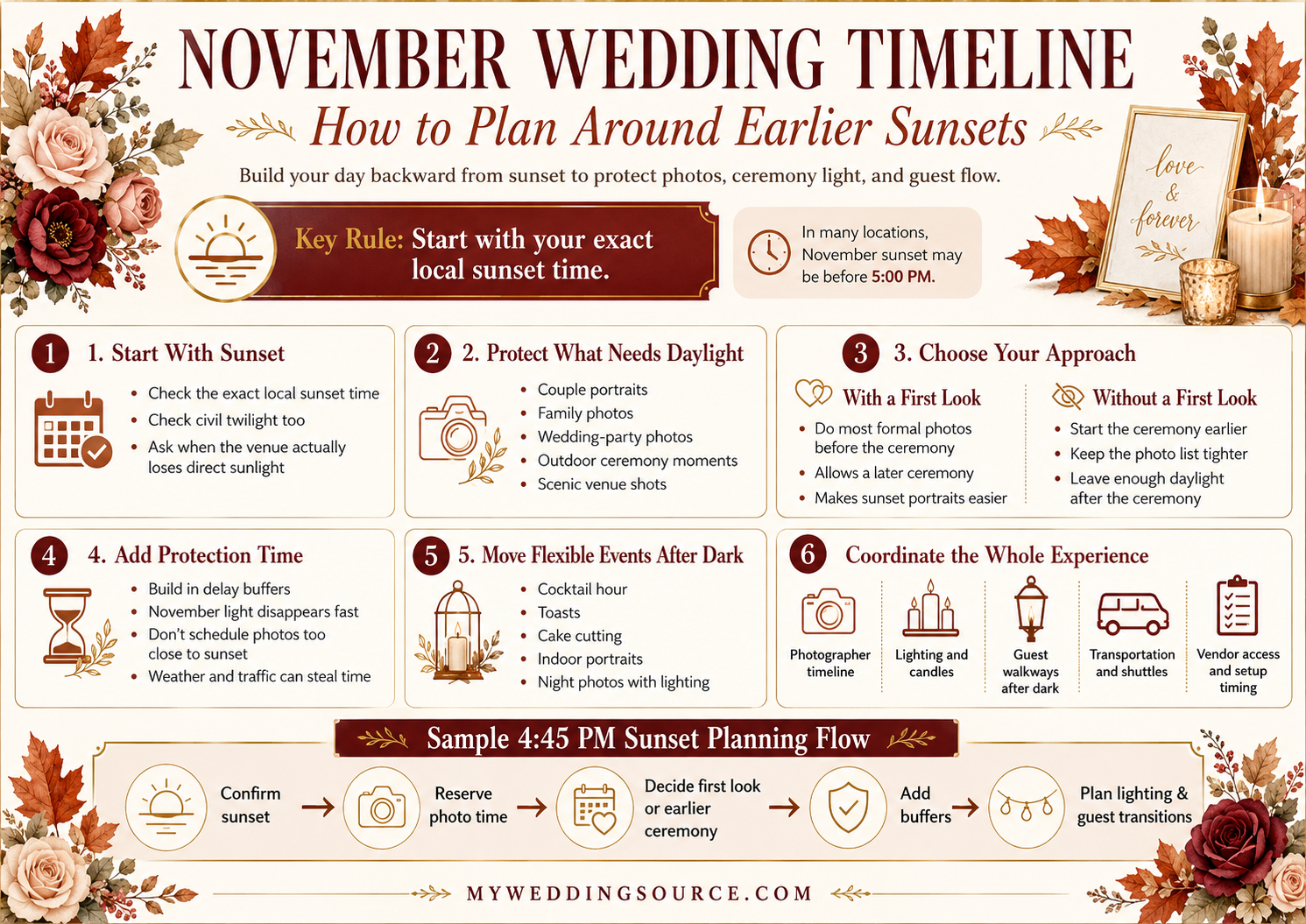
A workable planning sequence is:
- Confirm the exact local sunset and civil twilight times.
- List the outdoor photographs you consider essential.
- Decide whether you will have a first look.
- Reserve a realistic amount of time for those photographs.
- Set the ceremony time around the remaining daylight.
- Add transition and delay buffers.
Remember, each component of your November wedding timeline is interconnected, and understanding how they fit together can lead to a more relaxed celebration.
- Coordinate cocktail hour, dinner, transportation, lighting, and vendor access around the resulting schedule.
For many couples, the most important decision is not simply, “What time should the ceremony start?” It is, “Which parts of the day do we want to experience and photograph in daylight?” Once you answer that question, the ceremony time becomes easier to determine.
As you develop your November wedding timeline, consider how to best utilize the available daylight. Photographers often suggest scheduling essential portraits before the sun sets.
Taking the time to carefully plan your November wedding timeline will ultimately pay off, creating a seamless experience for you and your guests.
Why November Daylight Changes the Entire Wedding Schedule
The constraints of a November wedding timeline often mean less room for error. Understanding how to navigate these constraints is key to a smooth wedding day.
Summer wedding timelines often have room for adjustment. A ceremony can run slightly late, family portraits can take longer than expected, and the couple may still have daylight available during cocktail hour. November provides less flexibility. The shorter window does not make the wedding more difficult by itself, but it makes delays more consequential.
Sunset Is a Fixed Deadline
Your florist may be able to add 15 minutes to installation. Dinner service may be shifted slightly. Toasts can be shortened or moved. Sunset cannot be delayed because the ceremony started late.
This matters because wedding-day delays tend to accumulate. Hair and makeup may finish 10 minutes behind schedule. Getting dressed may take longer because a button, bustle, veil, or piece of jewelry needs attention. Transportation may arrive late. Guests may take extra time to park and find their seats. A ceremony scheduled for 3:30 p.m. may not actually begin until 3:45 p.m.
During a June wedding, that delay may be inconvenient. During a November wedding with a 4:45 p.m. sunset, it can remove a significant portion of the remaining portrait window.
When planning your November wedding timeline, keep in mind that your scheduled activities should allow ample time for unexpected delays, especially as sunset approaches.
A useful timeline therefore includes two types of time:
- Activity time, which is the period required to complete a task.
- Protection time, which absorbs ordinary delays before they affect a fixed deadline.
If family photographs realistically require 25 minutes, do not reserve exactly 25 minutes before sunset. Reserve 35 or 40 minutes so the entire plan does not depend on every family member being present and ready at the correct second.
The End of Daylight Saving Time Can Cause Planning Errors
Most of the United States changes from daylight saving time to standard time on the first Sunday in November. The change does not suddenly shorten the astronomical day by one hour, but it moves sunrise and sunset approximately one hour earlier according to the clock.
For 2026, daylight saving time ends at 2:00 a.m. local time on Sunday, November 1. Couples planning early-November weddings should verify that the sunset time in their spreadsheet, venue materials, or planning app reflects standard time rather than daylight saving time.
This is especially important if you began planning more than a year in advance or copied a timeline from an October wedding. A ceremony time that worked on the final Saturday in October may leave much less daylight one or two weeks later.
Not every U.S. location observes daylight saving time. Confirm the rule for your venue rather than assuming that every state follows the same clock change.
Sunset Does Not Mean Complete Darkness
Published sunset is the time the sun drops below the horizon. Some light remains afterward during evening twilight. Evening civil twilight begins at sunset and ends when the center of the sun is six degrees below the horizon.
That remaining light can be useful, but it should not automatically be treated as normal daylight. The sky may still have color while faces, clothing, and shaded areas become substantially darker. Your photographer may be able to create strong images during twilight or after dark, but the appearance will be different from bright, evenly lit daytime portraits.
The practical distinction is:
- Before sunset: usually the safest period for formal outdoor photographs.
- Near sunset: often useful for softer or more dramatic couple portraits.
- Civil twilight: possible for selected photographs, depending on weather, surroundings, and equipment.
- After twilight: artificial lighting or a well-lit indoor location becomes essential.
Incorporating the sunset into your November wedding timeline is essential for capturing beautiful photographs and creating lasting memories.
Consider how the lighting changes as your wedding timeline progresses into the evening. A well-planned November wedding timeline ensures that you capture both daylight and twilight moments.
Your photographer’s working style matters. Some photographers frequently use flashes, video lights, or continuous lighting and are comfortable creating portraits after dark. Others build their work primarily around natural light. Neither approach is automatically better, but your timeline should reflect the photographer you actually hired.
How to Find the Correct Sunset Time for Your Venue
Searching for “November sunset time” is not specific enough. Sunset varies by date, latitude, longitude, time zone, and local daylight-saving rules. Even two venues in the same state may have meaningfully different sunset times.
Use the Exact Wedding Date
The amount of daylight changes throughout November. A timeline for November 7 should not automatically be reused for November 28. The difference may be several minutes or more, which matters when your portrait schedule already has little flexibility.
Enter the actual year as well. Calendar dates fall on different days of the week each year, and the daylight-saving transition must be applied correctly.
Use the Venue’s Location
Start with the venue’s street address or geographic coordinates rather than the location of your hotel, apartment, or nearest airport. The U.S. Naval Observatory’s Sun and Moon Data page can provide rise, set, and twilight data for a specific location and date.
After finding the published time, ask the venue and photographer whether the property loses direct sunlight earlier because of its surroundings.
A ballroom in a downtown area may be surrounded by tall buildings. A mountain venue may fall into shadow well before the sun reaches the astronomical horizon. A ceremony site in a forest can become dim earlier than an open field. A west-facing rooftop may retain direct light longer than a courtyard enclosed on every side.
Distinguish Sunset From Direct Sunlight
Sunset calculations describe what happens at the horizon. They do not tell you when direct sunlight leaves a particular ceremony lawn, patio, or portrait location.
During your venue tour, ask:
With the right November wedding timeline, you can ensure that every important moment is documented beautifully, from the ceremony through to the reception.
- Which direction does the ceremony face?
- When does the ceremony space usually enter shade in November?
- Are there photographs from weddings held during the same month?
- Do buildings, trees, hills, or mountains block the western sky?
- Does the venue have a well-lit indoor portrait location?
- Can the photographer access the property before the contracted ceremony time?
- Are outdoor areas available after the ceremony, or are they closed once it becomes dark?
A venue employee may not know the exact technical sunset time, but they often know when a lawn becomes cold, shaded, or difficult to use.
Treat Weather as a Light Variable
Clouds do not change the official sunset time, but they can change how much usable light reaches the ground. A bright, open November afternoon may provide workable light through sunset. A heavily overcast day may feel much darker 30 or 45 minutes earlier.
Planning a November wedding timeline requires careful consideration of potential weather conditions, which can affect both the ceremony and portrait opportunities.
This does not mean you should create a separate minute-by-minute timeline for every possible weather condition. Instead, build important photographs earlier than the latest technically possible time.
For example, if sunset is 4:45 p.m., do not schedule all family and wedding-party photographs from 4:15 to 4:45. Place the most difficult group photographs earlier, then reserve the final portion of daylight for a smaller number of couple portraits. If the afternoon is bright, you may gain additional creative time. If it is dark and overcast, you have already protected the images that matter most.
Decide Which Moments Need Daylight
A useful November wedding timeline begins with priorities rather than assumptions. You may not need every photograph outdoors. You may not want a sunset ceremony. You may care more about spending cocktail hour with your guests than creating an extensive portrait gallery.
Before setting the ceremony time, divide the day’s photographs and activities into three groups.
Daylight Priorities
These are moments that would be difficult to recreate indoors or after dark. They may include:
- Couple portraits in the venue landscape
- Outdoor wedding-party photographs
- Large family groups
- An outdoor ceremony
- Photographs with fall foliage
- Portraits with animals, vehicles, or distant scenery
- Cultural or religious activities held outside
- Drone footage, where permitted
- Exterior venue photographs
- Outdoor guest candids
The list should reflect your wedding rather than a standard template. If the venue’s forest, vineyard, mountain view, garden, or city skyline influenced your decision to book it, protecting time to photograph that setting may be a high priority.
Flexible Activities
These activities can happen before or after sunset if the venue and vendor team are prepared:
Make sure your November wedding timeline prioritizes key outdoor moments that benefit from natural light, ensuring that your photographs reflect the beauty of the season.
- Invitation and detail photographs
- Getting-ready photographs
- Indoor family portraits
- Toasts
- Cake cutting
- First dances
- Guest-book photographs
- Reception room details
- Indoor couple portraits
- Night photographs using artificial light
Moving some flexible activities away from the daylight window creates room for the parts of the day that genuinely depend on natural light.
Low-Priority or Optional Activities
Wedding timelines become difficult when every possible photograph is treated as essential. Decide which activities can be shortened or removed if the schedule changes.
You might decide that you do not need individual photographs with every wedding-party member, 20 separate extended-family combinations, or multiple portrait locations. That does not make the photography less meaningful. It prevents the day from becoming a long sequence of people waiting to be arranged.
Ask yourselves:
- Which five photographs would we be most disappointed not to have?
- Which groups must be photographed together?
- Which images are optional?
- Do we value more portraits or more time with guests?
- Are we comfortable taking some photographs indoors?
- Do we want sunset to shape the ceremony atmosphere or the portrait schedule?
These decisions should be made before the final photography timeline, not while relatives are waiting outside in November temperatures.
Choose the Ceremony Time Based on the Experience You Want
There is no single correct ceremony time for every November wedding. The better choice depends on whether the ceremony is indoors or outdoors, whether you will have a first look, how many portraits you want, and how much daylight remains at the venue.
An Outdoor Ceremony in Full Daylight
If you want the ceremony space and guests to remain clearly visible in natural light, schedule the ceremony early enough to finish well before sunset. A practical target is often to complete the ceremony at least 45 to 90 minutes before sunset, depending on how many photographs must follow.
For a 4:45 p.m. sunset, a 3:00 p.m. ceremony may be appropriate when:
- The ceremony lasts about 20 to 30 minutes.
As you approach your wedding day, ensure your final November wedding timeline reflects a balance between structured scheduling and flexibility for delays.
- You are not having a first look.
- Most family and wedding-party photographs will happen afterward.
- The ceremony and portrait locations are close together.
- Your formal photo list is controlled.
- You have added a delay buffer.
A 3:30 p.m. ceremony may work if you have completed most formal photographs before the ceremony or need only a brief couple portrait session afterward.
A Ceremony Close to Sunset
Your November wedding timeline should also account for guest comfort, including providing warmth and shelter during the ceremony and cocktail hour.
A ceremony beginning 30 to 45 minutes before sunset can create a darker, more atmospheric setting, but it changes the rest of the timeline. You should not expect to complete a long list of natural-light photographs after the ceremony.
This approach works more easily when:
- You have a first look.
- Family and wedding-party portraits are completed beforehand.
- The ceremony is short and likely to start on time.
- Your photographer is comfortable working in low light.
- The venue provides sufficient aisle and guest lighting.
- Cocktail hour takes place indoors or in a heated, well-lit area.
- You accept that the final couple portraits may have a twilight or nighttime appearance.
The schedule should also account for the position of the sun. A ceremony advertised as a “sunset ceremony” may place the sun behind guests, behind the couple, or behind trees rather than directly within the ceremony view. Visit the space or review photographs from the same season before building the visual concept around a specific effect.
An Indoor Ceremony
An indoor ceremony removes some weather and visibility concerns, but it does not eliminate the daylight decision. If you want outdoor couple, wedding-party, or family portraits, those photographs still need to be scheduled before sunset.
An indoor ceremony can provide more flexibility because you may place it after the formal photographs without worrying about guests sitting in declining temperatures. However, check the room’s actual lighting. A space with large windows may appear bright at 3:00 p.m. and much darker at 4:30 p.m. Your photographer and videographer may need additional lighting once the sun sets.
A Longer Religious or Cultural Ceremony
Do not calculate the timeline using only the ceremonial portion that appears on a standard wedding-planning template. Include processions, signing rituals, blessings, musical selections, translations, clothing changes, and transition time.
The intricacies of a November wedding timeline often require strategic planning to ensure that all important moments are captured in the best light.
If the ceremony lasts an hour and sunset is 4:45 p.m., a 3:30 p.m. start provides almost no reliable daylight afterward. You may need to complete portraits before the ceremony, start earlier, move formal photographs indoors, or accept nighttime images.
Discuss the full order of service with your officiant before confirming the photography plan. “The ceremony is usually about 30 minutes” is not specific enough if your actual ceremony includes additional traditions.
First Look or No First Look: How November Changes the Decision
A first look is not required for a successful November wedding. It is simply a scheduling tool that allows the couple to see each other and complete portraits before the ceremony.
The decision should be based on your priorities rather than pressure from a vendor, family member, or wedding trend.
How a First Look Helps
A first look can move several major photo groups into the earlier part of the afternoon:
- Couple portraits
- Wedding-party photographs
- Immediate-family photographs
Understand how your November wedding timeline will impact the overall flow of the day, from guest arrivals to the final send-off.
- Some extended-family combinations
- Portraits at more than one venue location
This makes it easier to hold the ceremony close to sunset without sacrificing important elements of your November wedding timeline.
A first look may be particularly useful when:
- Sunset is before 5:00 p.m.
- You have a large wedding party.
- You want many family combinations.
- The ceremony and reception are in different locations.
- Your venue’s landscape is an important photography priority.
- You want a later ceremony time.
- You prefer not to extend cocktail hour.
- You want time alone together before the event becomes busy.
The trade-off is that you see each other before the ceremony. For some couples, that changes a moment they have imagined for years. It may also require earlier hair, makeup, dressing, floral delivery, and photography coverage.
How to Keep the Aisle Moment Meaningful
Seeing each other before the ceremony does not automatically remove the emotion from the processional. The ceremony involves music, guests, vows, clothing, movement, and the significance of the event itself. It is a different context from a private first look.
However, this is a personal preference, not a planning fact. If the first moment at the ceremony matters more to you than completing portraits earlier, you do not need to abandon that preference. You need a timeline that supports it.
Planning Without a First Look
A no-first-look timeline usually requires one or more of the following:
- An earlier ceremony
- Fewer post-ceremony photo combinations
- Separate pre-ceremony portraits of each partner
- Pre-ceremony photographs with each side of the wedding party
- Pre-ceremony family photographs that do not require both partners
- A longer cocktail hour
- Indoor or artificially lit portraits
- Less time at multiple outdoor locations
You can still complete meaningful photography without seeing each other before the ceremony. The important step is to identify which photographs can be separated.
For example, one partner can take portraits with their parents, siblings, and attendants before the ceremony. The other partner can do the same in a different location. After the ceremony, the photographer needs only the combined family groups, full wedding party, and couple portraits.
A Practical Decision Test
Choose a first look when preserving daylight, reducing post-ceremony logistics, and joining cocktail hour matter more to you than waiting until the processional to see each other.
Choose no first look when the ceremony reveal is a major personal priority and you are willing to start the ceremony earlier, limit the formal photo list, extend cocktail hour, or take some portraits after dark.
Neither option is automatically more romantic or more efficient in every situation. The better option is the one whose trade-offs you understand and accept.
As you finalize your November wedding timeline, be sure to communicate clearly with all vendors involved to ensure a seamless experience on the day of.
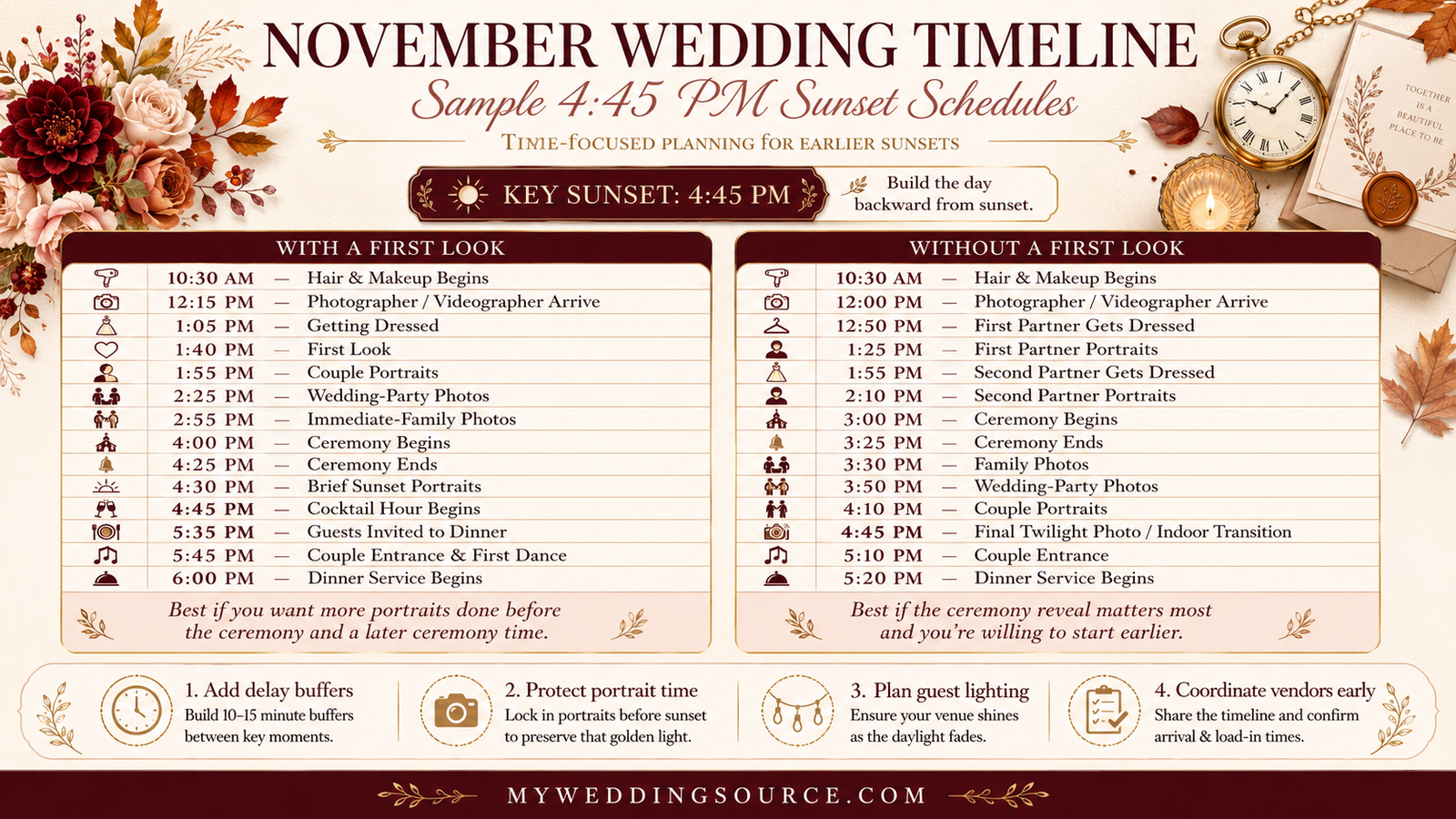
Sample November Wedding Timeline With a First Look
Your November wedding timeline should be structured with the sunset in mind so that each moment is not only well documented but also enjoyed to the fullest.
The following example assumes:
- Sunset at 4:45 p.m.
In planning your November wedding timeline, keep the flow of events in mind, ensuring that guests feel welcomed and engaged throughout the day.
- Ceremony and reception at the same venue
- A 25-minute ceremony
- A moderate-size wedding party
- Immediate-family photographs before the ceremony
- Cocktail hour beginning after the ceremony
- Most portraits completed in advance
- Ceremony scheduled close to sunset
Your photographer, venue, beauty team, caterer, and transportation provider should adjust the times to your specific plans.
10:30 a.m. — Hair and Makeup Begins
The exact start time depends on the number of people receiving services, the complexity of the requested styles, and the number of artists. Work backward from the time everyone must be dressed, not from the ceremony.
If the first look is scheduled for 1:40 p.m., the person receiving the final beauty service should not be expected to finish at 1:35 p.m. Allow time to get dressed, make adjustments, use the restroom, eat, and gather personal items.
12:15 p.m. — Photographer and Videographer Arrive
The photography team begins with details, venue exteriors, invitation items, clothing, accessories, and getting-ready coverage.
Florals should be delivered early enough for bouquets and personal flowers to appear in portraits. If the bouquet arrives at 1:45 p.m., it cannot be included in a 1:40 p.m. first look.
12:45 p.m. — Final Hair and Makeup Checks
The beauty team completes final services and makes small adjustments. Members of the wedding party who will help with dressing should be dressed before the couple.
This avoids the common situation in which the couple is ready but must wait for attendants to change clothes before dressing photographs can begin.
1:05 p.m. — Getting Dressed
Reserve more time than the physical act of putting on clothing appears to require. Buttons, ties, jewelry, veils, shapewear, corsages, pocket squares, and last-minute steaming can all extend the process.
Personal belongings should be packed before this point if the getting-ready suite must be cleared.
1:40 p.m. — First Look
Choose a location that provides privacy, workable light, and convenient access to the next portrait area. A first look does not need to become a long production. Approximately 10 to 15 minutes may be sufficient for the reveal and initial reactions.
Avoid placing the first look at a distant scenic location unless transportation time has been included.
1:55 p.m. — Couple Portraits
Reserve approximately 30 minutes for the primary couple portrait session. This provides enough time for variety without depending entirely on the final minutes before sunset.
The photographer can still take a smaller set of sunset or twilight portraits after the ceremony.
2:25 p.m. — Wedding-Party Photographs
A wedding party of six people requires less time than a group of 20. Allow approximately 20 to 35 minutes depending on the group size, number of combinations, walking distance, and whether bouquets and boutonnieres are ready.
Keep people nearby until the photographer confirms that the group is complete.
2:55 p.m. — Immediate-Family Photographs
Reserve approximately 25 to 35 minutes for a focused list. Photograph parents, siblings, grandparents, and other essential groups before the ceremony.
Extended family can be added if time allows, but every additional combination requires gathering, arranging, photographing, and releasing people.
3:25 p.m. — Couple Steps Away From Guest Areas
The couple returns to separate private spaces, refreshes, drinks water, and prepares for the ceremony. The photographer captures ceremony details and arriving guests.
This 20- to 30-minute interval also functions as protection time. If portraits run slightly late, the ceremony does not immediately need to move.
3:30 p.m. — Guest Arrival and Seating
Transportation should be designed so most guests arrive before the ceremony processional. If parking is remote, shuttles need enough time to unload guests and return for another group.
November guests may need additional time to remove coats, find indoor restrooms, and walk carefully on leaves, gravel, wet pavement, or dim paths.
3:55 p.m. — Processional Lineup
The planner or coordinator gathers the wedding party, confirms the officiant is ready, checks music cues, and verifies that important family members are seated.
4:00 p.m. — Ceremony Begins
A 4:00 p.m. ceremony with a 4:45 p.m. sunset creates a lower-light atmosphere. Because formal photographs are complete, the timeline does not depend on a large post-ceremony photo session.
If you want the ceremony itself to appear brighter, move it to 3:30 or 3:45 p.m.
4:25 p.m. — Ceremony Ends
The couple completes the recessional and has a brief private pause or signs required documents, depending on local and officiant procedures.
Following a well-structured November wedding timeline can help mitigate potential issues, allowing you to enjoy your special day with peace of mind.
4:30 p.m. — Brief Sunset Portraits
Reserve approximately 10 to 15 minutes for a second couple portrait session. These photographs may have softer or more dramatic light than the earlier session.
Because the primary portraits are complete, weather or ceremony delays will not eliminate the entire couple gallery.
4:45 p.m. — Cocktail Hour Begins
Guests move to a heated or indoor space with sufficient lighting. The couple can join cocktail hour after portraits or take a brief break.
If the bar opens immediately after the ceremony, confirm that bartenders, glassware, garnishes, water stations, and appetizers are ready before guests enter.
5:35 p.m. — Guests Invited to Dinner
Allow time for guests to find escort cards, check the seating chart, visit the restroom, and move into the reception space.
5:45 p.m. — Couple Entrance and First Dance
The exact order may vary. Some couples prefer to complete the first dance immediately, while others move directly into dinner.
6:00 p.m. — Dinner Service Begins
An earlier November ceremony may result in an earlier dinner than guests expect from a summer wedding. This is generally manageable if the invitation and event schedule are clear.
Coordinate speeches with the caterer so hot food does not sit while multiple people speak.
7:15 p.m. — Toasts and Parent Dances
The schedule can place these activities between courses or after dinner, depending on the catering format.
7:45 p.m. — Dance Floor Opens
The reception continues according to the venue’s end time, entertainment plan, and transportation schedule.
This timeline’s main advantage is flexibility. Even if the ceremony begins 10 minutes late, most essential portraits have already been completed.
Sample November Wedding Timeline Without a First Look
This example also assumes a 4:45 p.m. sunset, but the ceremony begins earlier because the couple, full wedding party, and combined family groups must be photographed afterward.
Taking time to finalize your November wedding timeline will ensure that you and your guests have a memorable experience, no matter the weather.
The assumptions are:
- Ceremony and reception at the same venue
- A 25-minute ceremony
- Separate pre-ceremony portraits
- A controlled formal photo list
- Approximately 70 minutes of post-ceremony photography
- A 75-minute cocktail period
- No major travel between the ceremony and portrait locations
10:30 a.m. — Hair and Makeup Begins
The start time may be similar to the first-look timeline because both partners still need pre-ceremony portraits. The lack of a first look does not necessarily mean photography begins later.
12:00 p.m. — Photographer and Videographer Arrive
The teams begin details, getting-ready coverage, and venue images.
The photographer should know how the venue will keep the couple in separate areas. Accidental encounters are more likely when both groups use the same hallways, lobby, courtyard, or transportation route.
12:50 p.m. — First Partner Gets Dressed
The first partner completes individual portraits, photographs with attendants, and photographs with their available family members.
1:25 p.m. — First Partner’s Pre-Ceremony Portraits
Possible combinations include:
- Individual portraits
- Partner with parents
- Partner with siblings
- Partner with grandparents
- Partner with attendants
- Separate portraits of attendants
- Personal details and bouquet photographs
The partner then returns to a private space before the other group enters shared portrait areas.
1:55 p.m. — Second Partner Gets Dressed
The photographer changes locations or a second photographer covers the other group.
2:10 p.m. — Second Partner’s Pre-Ceremony Portraits
Complete the corresponding separate combinations. The more groups finished before the ceremony, the less pressure remains afterward.
2:35 p.m. — Final Refresh and Guest-Area Separation
Both partners move to their designated private locations. The photography team captures ceremony details and guest arrivals.
2:40 p.m. — Guests Begin Taking Seats
An invitation listing a 3:00 p.m. ceremony should not assume everyone will arrive at 2:59 p.m. Parking, shuttles, coat storage, and seating need time.
2:55 p.m. — Processional Lineup
The coordinator confirms that the couple cannot see each other, gathers the wedding party, and checks ceremony cues.
3:00 p.m. — Ceremony Begins
This start time creates a more realistic post-ceremony portrait window. Starting at 3:30 p.m. would leave only about 45 minutes until sunset, which is usually insufficient for combined family, wedding-party, and couple photographs unless the lists are extremely limited.
3:25 p.m. — Ceremony Ends
The couple proceeds directly to a private location or designated family photo area. Avoid an unplanned receiving line if portraits need to begin immediately.
Greeting 100 guests individually can consume the daylight window. You can greet guests during cocktail hour, dinner, or the reception instead.
Ultimately, your November wedding timeline should reflect your preferences and priorities, taking into account the unique characteristics of the season.
3:30 p.m. — Combined Immediate-Family Photographs
Begin with grandparents, older relatives, young children, and anyone with mobility or health concerns. Release people as soon as their required combinations are complete.
Reserve approximately 20 minutes for a controlled list.
3:50 p.m. — Full Wedding-Party Photographs
Because separate attendant photographs were completed earlier, this session can focus on the full group and a limited number of combined arrangements.
Reserve approximately 15 to 20 minutes.
4:10 p.m. — Couple Portraits
The couple has approximately 30 to 35 minutes before sunset. The photographer should begin at the most important outdoor location rather than spending the first 15 minutes walking across the property.
If the weather is dark or heavily overcast, the photographer may transition to artificial lighting before the official sunset.
4:45 p.m. — Final Twilight Photograph or Indoor Transition
The couple enters the cocktail space, takes a short private break, or completes a small number of artificially lit photographs.
3:30–4:45 p.m. — Guest Cocktail Period
Guests have a 75-minute cocktail period while photographs are completed. Make the extended duration intentional rather than leaving guests uncertain.
Provide adequate seating, appetizers, beverages, heating, restrooms, and lighting. Music or a simple interactive element may help, but guests do not need a complicated entertainment program if they are comfortable and well served.
4:55 p.m. — Guests Invited to Dinner
The couple has a few minutes to refresh while guests locate their seats.
5:10 p.m. — Couple Entrance
The reception begins.
5:20 p.m. — Dinner Service
Coordinate the catering schedule with the realistic end of photography. The kitchen should not plate food based on a portrait session that has no delay buffer.
This no-first-look schedule protects the ceremony reveal, but it requires an earlier ceremony, a disciplined photo list, and an intentional guest experience during cocktail hour.
Plan Family Photographs Before They Control the Schedule
Family photographs often take longer than expected because the photography itself is not the slowest part. Finding and arranging people creates the delay.
A list containing 15 combinations is not automatically a 15-minute list. Each group may involve relatives leaving the bar, using the restroom, helping children, looking for personal belongings, or misunderstanding where photographs are taking place.
Create a Specific Shot List
Do not write “all family combinations.” List the exact groups.
For example:
- Couple with Partner A’s parents
- Couple with Partner A’s parents and siblings
- Couple with Partner A’s grandparents
As you finalize your November wedding timeline, remember to communicate with all vendors to ensure a seamless experience on your wedding day.
- Couple with both sets of parents
- Couple with Partner B’s parents
- Couple with Partner B’s parents and siblings
- Couple with Partner B’s grandparents
This allows the photographer to order the groups efficiently and tell each person when they are finished.
Photograph Vulnerable Guests First
Start with grandparents, older relatives, young children, pregnant guests, and people with mobility needs. These guests should not be required to stand outside while every other combination is completed.
If November temperatures are low, provide an indoor waiting area near the photo location. Blankets and heaters can help, but they do not replace a realistic schedule.
Assign Family Coordinators
Choose one person from each family who knows the relatives and is comfortable directing them. The photographer may know the names on the list but will not necessarily recognize every aunt, cousin, stepparent, or sibling.
The coordinator should not be someone who is needed in every photograph. They need enough freedom to locate the next group while the current group is being photographed.
Account for Family Dynamics
Divorced parents, estranged relatives, remarried parents, blended families, and sensitive relationships should be discussed privately with the photographer before the wedding.
A clear sequence prevents awkward improvisation. It also allows the photographer to position groups respectfully without requiring the couple to explain family relationships in front of everyone.
Limit Large Extended-Family Groups
Large groups can be meaningful, but they require space, time, and coordination. Consider scheduling one photograph with an entire side of the family rather than many overlapping combinations.
The goal is not to eliminate family portraits. It is to spend daylight on images you will actually use and value.
Coordinate Cocktail Hour With the Photography Plan
Cocktail hour often becomes the hidden pressure point in a November wedding timeline. When portraits run after the ceremony, guests need somewhere comfortable to wait.
Decide How Long Guests Will Actually Wait
A standard 60-minute cocktail hour may work with a first look because only a brief couple session remains. Without a first look, 60 minutes may be tight if you need family, wedding-party, and couple photographs.
It is usually better to plan an intentional 75-minute cocktail period than to advertise 60 minutes and leave guests waiting an unexplained additional 20 minutes.
Keep Guests Warm and Comfortable
An outdoor cocktail hour may look appropriate in venue photographs but feel very different after sunset in November. Evaluate:
- Expected temperature
- Wind exposure
- Rain plan
- Heaters
- Indoor capacity
- Seating
- Coat storage
- Restroom access
- Pathway lighting
- Accessibility
- Distance from the ceremony
- Bar and food service locations
Heaters work best in defined areas. They may have limited effect on a large, open lawn. Confirm venue rules, rental requirements, fuel responsibilities, and fire-safety restrictions.
Provide Food Early Enough
If the ceremony begins at 3:00 p.m. and dinner begins after 5:00 p.m., guests may be comfortable with passed appetizers or stations during cocktail hour. The amount of food should reflect the length of the wait and whether guests have traveled.
Ask the caterer how many pieces per person are included, how frequently trays will circulate, and whether food service will continue for the full cocktail period.
Tell Vendors When Photography Must End
The planner, photographer, caterer, entertainment team, and venue should use the same reception start time. A kitchen working toward a 5:00 p.m. entrance and a photographer working toward a 5:20 p.m. entrance will create avoidable conflict.
The final timeline should state:
- When guests enter cocktail hour
- When the couple is expected to finish portraits
- Whether the couple will join cocktail hour
- When guests are invited into dinner
- When the kitchen begins plating or releasing food
- When reception introductions begin
Adjust Transportation for Darkness and November Conditions
Transportation timing is often designed around distance alone. A November wedding also needs to consider darkness, weather, guest mobility, and the amount of time required to load and unload vehicles.
Schedule Guest Shuttles Earlier
A shuttle arriving at the venue five minutes before the ceremony is not on time. Guests still need to exit, walk to the ceremony, use restrooms, remove coats, and find seats.
If the ceremony starts at 3:00 p.m., the final shuttle should generally arrive well before 2:45 p.m. The exact buffer depends on the walking distance and venue layout.
Inspect Routes After Dark
A path that appears easy during an afternoon tour may be difficult after sunset. Walk the guest route at the approximate time of your event, if possible.
Check:
- Parking-lot lighting
- Steps and uneven surfaces
- Gravel or grass
- Signs and directional lighting
- Distance to restrooms
- Handrails
- Accessibility routes
- Shuttle pickup points
- Weather protection
- Staff visibility
Decorative candles are not a substitute for safe pathway lighting.
Include Travel Time Between Locations
If the ceremony and reception are separate, calculate the schedule using realistic door-to-door time. Include loading, traffic, parking, unloading, walking, and winter-weather delays.
A 15-minute drive may require a 35-minute transition for a wedding party carrying flowers, clothing, and personal items.
If outdoor photographs are scheduled at the reception venue, the couple and photographer may need to leave the ceremony before the guest shuttle. Otherwise, the remaining daylight may be lost during transportation.
Plan the Couple’s Vehicle
Confirm who is driving, where the vehicle will wait, and whether personal belongings have been loaded. The vehicle should not be blocked by vendor vans or guest parking.
A transportation plan is not complete until the driver has the timeline, addresses, contact numbers, and parking instructions.
Design the Lighting Plan Before Sunset
Earlier darkness can support a warm November atmosphere, but only if the lighting is functional as well as decorative.
Ceremony Lighting
If the ceremony continues through sunset or twilight, ensure that the couple, officiant, readers, musicians, and processional route remain visible.
Ask:
- Are permanent lights installed?
- Can they be dimmed?
- When are they switched on?
- Do they create harsh shadows or color casts?
- Are electrical outlets available?
- Can the photographer and videographer add lights?
- Are flames permitted?
- What happens if wind or rain affects candles?
Lighting should be tested before guests arrive. Switching on bright overhead fixtures halfway through the vows may solve visibility but change the atmosphere abruptly.
Pathway and Exterior Lighting
Prioritize safety around:
- Stairs
- Curbs
- Gravel
- Grass
- Parking
- Restrooms
- Shuttle stops
- Tent entrances
- Water features
- Changes in elevation
Battery lanterns, string lights, and uplighting may contribute, but the venue should confirm whether they provide enough illumination for safe movement.
Cocktail and Reception Lighting
A room can look appropriately lit to guests while remaining difficult to photograph or film. Discuss the lighting plan with the photographer and videographer before selecting an extremely dark reception design.
Consider separate lighting needs for:
- Dining tables
- Toasts
- First dances
- Cake cutting
- The bar
- Food stations
- Guest-book areas
- Outdoor lounges
- Signs and seating charts
Candles create localized light. They do not necessarily illuminate faces across a large room.
Power and Backup Planning
Outdoor lighting may require generators, extension cords, cable covers, weather protection, and staff who know how the equipment operates.
Confirm who provides power, who turns lights on, and what happens if equipment fails. “The rental company installs it” does not answer who manages the system during the event.
Coordinate Catering With an Earlier Ceremony
A November wedding may move dinner earlier than the caterer’s standard summer schedule. This can work well, but the kitchen needs the final timeline rather than a general ceremony time.
Decide Whether Guests Need a Pre-Ceremony Refreshment
Guests arriving for a 2:30 or 3:00 p.m. ceremony may appreciate water, hot cider, coffee, tea, or another nonalcoholic option, especially if transportation requires early arrival.
The service should not delay seating or create cups that guests do not know where to place.
Match Dinner Timing to Cocktail Hour
If the ceremony ends at 3:25 p.m. and cocktail hour lasts 75 minutes, dinner may begin shortly after 5:00 p.m. That is earlier than some guests expect, but it is not unreasonable when clearly communicated.
Avoid extending cocktail hour solely to reach a conventional dinner time. A longer wait can increase food, beverage, staffing, and entertainment costs without improving the guest experience.
Protect Hot Food From Photography Delays
The caterer should know the latest acceptable time for the couple to enter the reception. If portraits run late, the planner needs a decision process.
Possible adjustments include:
- Inviting guests to sit before the couple enters
- Serving a first course before introductions
- Shortening the entrance sequence
- Moving one speech
- Reducing the private room reveal
- Ending portraits at the agreed cutoff
The kitchen should not be expected to hold plated entrées indefinitely because the sunset session expanded.
Schedule Vendor Meals Realistically
Photographers, videographers, planners, and entertainment professionals often need to eat while guests are eating so they are ready for speeches and dances.
An early dinner may also mean an early vendor meal. Confirm the timing, location, quantity, and dietary requirements in advance.
Account for Vendor Access and Setup
Earlier darkness affects the setup schedule even when the ceremony begins in the afternoon.
Outdoor Work Becomes More Difficult After Sunset
Florists, rental teams, lighting crews, musicians, and planners need enough daylight to unload and install equipment safely. Complex outdoor installations should not depend on staff completing final work in darkness.
Ask the venue when vendors can enter the property and whether additional access time costs extra.
Photography Coverage May Need to Begin Earlier
A first look at 1:40 p.m. may require photography coverage beginning around noon. If your package includes eight hours, an earlier start also creates an earlier end unless you purchase additional coverage.
Decide which part of the day matters more:
- Extended getting-ready coverage
- A complete daylight portrait schedule
- Late-night dancing
A successful November wedding timeline hinges on clear communication with your photographer and other vendors to capture every moment beautifully.
- A formal exit
- After-dark couple portraits
You may not need every part of the day photographed. Choose coverage based on priorities rather than automatically adding hours.
Florals Must Arrive Before Portraits
Bouquets, boutonnieres, corsages, ceremony flowers, and personal items should be ready when the relevant photographs begin.
If portraits start before the florist’s standard delivery time, coordinate an earlier delivery or separate personal-flower delivery.
The Planner Needs a Lighting Cue
Assign a specific person to switch on ceremony, pathway, cocktail, and reception lighting. The timeline should not simply say “sunset.”
A practical lighting sequence may be:
- Test all lights before guests arrive.
- Switch pathway lights on before the ceremony.
- Activate ceremony lighting shortly before the processional.
- Turn cocktail lighting on before guests enter.
- Confirm reception lighting before room access.
- Recheck exterior lighting after full darkness.
Regional Sunset and Venue Caveats
A November wedding in Miami does not have the same daylight conditions as one in Seattle, Boston, Denver, or Anchorage. National advice should be treated as a framework rather than a substitute for a local calculation.
Northeast and Upper Midwest
These areas often experience early clock-time sunsets, colder temperatures, and a greater chance that guests will move between spaces in darkness. A late-afternoon outdoor ceremony may require heaters, indoor waiting areas, pathway lighting, and an earlier portrait schedule.
Bare trees may create more open light later in the month, but overcast skies can make outdoor spaces feel dark before sunset.
Southeast and Gulf Coast
Sunset may occur somewhat later than in northern locations at the same point in November, but weather remains a planning variable. Rain, wind, humidity, and rapid temperature changes can affect outdoor comfort and photography.
Do not assume that a southern location guarantees bright or warm conditions.
Mountain Regions
Mountains and ridgelines can block direct sunlight well before the published sunset. A venue on one side of a valley may lose light earlier than another property only a few miles away.
Ask the photographer or venue for the time the ceremony space enters shadow, not only the official sunset time.
Pacific Northwest
Cloud cover and rain can reduce usable light before sunset. Outdoor portrait schedules should include an indoor alternative with enough space and uncluttered backgrounds.
Covered spaces can be valuable, but verify whether they are bright enough for group photographs.
Southwest and Desert Locations
Clear skies may provide predictable sunset color, but the transition from direct sun to darkness can feel rapid. Temperatures may also drop after sunset.
Avoid scheduling every portrait for the final 20 minutes simply because the forecast is likely to be clear.
California
Coastal haze, hills, tall trees, urban buildings, and inland terrain produce different conditions within the same state. A beach, vineyard, redwood property, downtown rooftop, and mountain venue require different timelines.
Confirm whether public or coastal portrait locations have access limits, permits, parking restrictions, or closing times.
Alaska
November daylight can be extremely limited, depending on the location. A conventional afternoon ceremony may not leave meaningful daylight for portraits.
Couples may need a morning or midday portrait schedule, an indoor-focused plan, or a deliberate nighttime photography style.
Hawaii and Locations Without a Seasonal Clock Change
Locations that do not observe daylight saving time will not experience the same early-November clock shift. Sunset still changes seasonally, so the exact local date and venue remain important.
The central rule is consistent across regions: use your venue’s local data, then adjust for the property’s actual horizon and conditions.
Common November Wedding Timeline Mistakes
Using a Generic Sunset Time
The nearest city may have a different time zone, horizon, elevation, or longitude. Use the venue’s location and wedding year.
Scheduling the Ceremony at Sunset and Planning Portraits Afterward
A ceremony beginning at sunset does not leave standard daylight for formal photographs. Complete portraits beforehand or plan for low-light and nighttime images.
Treating Twilight as Guaranteed Portrait Light
Twilight conditions depend on clouds, surroundings, and the photographer’s approach. Protect essential photographs before sunset.
Creating a Timeline With No Delay Buffer
A plan that works only when every person and vendor is exactly on time is not a practical plan. Add protection time before the ceremony and sunset.
Keeping the Full Family Photo List Until After the Ceremony
Complete separate family combinations beforehand and limit the combined list.
Ignoring Guest Comfort During an Extended Cocktail Hour
Guests need adequate food, beverages, seating, warmth, restrooms, and communication.
Forgetting the Daylight-Saving Transition
Verify that the sunset time reflects the correct clock setting for the wedding date.
Assuming Decorative Lighting Is Functional Lighting
Candles and string lights may support the atmosphere without making steps, paths, signs, food, and faces sufficiently visible.
Allowing Portraits to Delay Dinner Without a Cutoff
Set an agreed time when photography ends and the reception begins.
By paying attention to the details of your November wedding timeline, you can create a day that flows effortlessly and captures the magic of the season.
Choosing Multiple Portrait Locations
Travel and walking can consume a large portion of the remaining light. Prioritize one main location and use additional locations only if the schedule clearly supports them.
Questions to Finalize Your November Wedding Timeline
Before approving the final schedule, ask your venue, photographer, planner, caterer, transportation provider, and lighting team the following questions:
- What are the exact sunset and civil twilight times for the venue?
- When does the ceremony or portrait area lose direct sunlight?
- Which photographs must be completed outdoors?
- How much time does the photographer recommend for each photo group?
- Will you have a first look?
- What photographs can be completed separately before the ceremony?
- What is the latest realistic ceremony start time?
- What happens if the ceremony begins 15 minutes late?
- How long will guests remain in cocktail hour?
- Is the cocktail location heated, covered, accessible, and well lit?
- When must photography end so dinner remains on schedule?
- Who is responsible for turning on each lighting area?
- Are guest routes safe after dark?
- When can vendors access the venue?
- Does the photography package cover the earlier start time?
- What indoor portrait location is available in poor weather?
- How will the timeline change if clouds reduce usable light?
- Who has authority to shorten photographs or adjust the reception schedule?
A final timeline should answer these questions in writing. The wedding day is not the time to decide which priority should be sacrificed when the schedule runs late.
Frequently Asked Questions
What time should a November wedding ceremony start?
For many U.S. November weddings, the ceremony may need to begin between approximately 2:30 and 4:00 p.m., but the correct time depends on the local sunset, ceremony length, first-look decision, and photography priorities. If you are not having a first look and need family, wedding-party, and couple portraits afterward, plan to finish the ceremony at least 60 to 90 minutes before sunset. If most formal photographs will be completed beforehand, the ceremony can begin closer to sunset. Do not select the time solely because another couple used it. Calculate backward from the exact venue sunset and the amount of portrait time your photographer recommends.
How long before sunset should an outdoor November ceremony begin?
A ceremony that should remain fully in daylight will often need to begin at least 45 to 90 minutes before sunset. Longer ceremonies and no-first-look timelines may require an earlier start. For example, with a 4:45 p.m. sunset, a 3:00 p.m. ceremony may be appropriate when formal photographs will follow. A 4:00 p.m. ceremony may work when portraits are already complete and the couple wants a lower-light atmosphere. Include a late-start buffer. A 25-minute ceremony scheduled to begin at 3:30 p.m. may not finish by 3:55 p.m. if guests, transportation, or the processional run behind.
Is sunset the same time as complete darkness?
No. Some light remains during evening twilight after the published sunset. However, that light becomes less reliable for standard natural-light portraits. The sky may still show color while faces and shaded areas become significantly darker. Trees, buildings, mountains, and heavy cloud cover can make the venue feel dark earlier. Treat twilight as useful creative time rather than the main period for essential family photographs. Ask your photographer what they can realistically produce during that period.
Do we need a first look for a November wedding?
No. A first look provides scheduling flexibility, but it is not required. Without a first look, you may need an earlier ceremony, separate family and wedding-party photographs before the ceremony, a shorter combined photo list, an extended cocktail hour, or some portraits after dark. Choose based on which trade-off matters more to you. Waiting until the ceremony may be worth an earlier schedule. Completing portraits in advance may be worth changing the reveal. Both options can work when the timeline reflects the decision.
Can wedding portraits be taken after sunset?
Yes, but the appearance and process will be different. Your photographer may use flashes, video lights, venue lighting, lanterns, headlights, architectural light, or illuminated indoor spaces. After-dark portraits can be dramatic and useful, but they should not automatically replace every daylight image. Large family groups are generally easier to organize and photograph before dark. Review your photographer’s nighttime portfolio. Do not assume that every photographer approaches low-light work in the same way.
Should cocktail hour be longer if we skip the first look?
It may need to be. If family, wedding-party, and couple portraits all happen after the ceremony, a 60-minute cocktail hour can become tight. A planned 75-minute period may be more realistic. Make the additional time comfortable with sufficient appetizers, beverages, seating, warmth, restrooms, and music. An extended cocktail hour should be a deliberate part of the guest experience, not an unexplained delay while the kitchen and guests wait for the couple.
What happens if the ceremony starts late?
Your vendor team should know which parts of the schedule will be shortened first. Do not leave this decision until sunset is approaching. Possible adjustments include removing optional family combinations, using one portrait location instead of two, shortening couple portraits, moving selected photographs indoors, reducing the private reception-room reveal, or delaying a non-food reception activity. Agree on a photography cutoff with the planner, photographer, and caterer. Protecting dinner service may be more important than adding another optional portrait once essential photographs are complete.
How should we plan for a cloudy November wedding day?
Schedule essential outdoor photographs earlier than the final possible daylight period and identify a practical indoor alternative. Clouds can create soft, flattering light, but heavy overcast may make the property feel dark earlier. The official sunset time does not change, yet the usable-light window may. Ask the photographer to identify one outdoor location and one indoor location that can be reached quickly. A backup plan requiring a 20-minute drive will not protect the timeline.
How much lighting does an outdoor November wedding need?
You need enough lighting for safety, ceremony visibility, photography, food service, signs, and guest movement. Decorative lighting alone may not meet all of those needs. Prioritize stairs, paths, parking, restrooms, shuttle stops, ceremony participants, dining areas, bars, and food stations. Then add decorative elements. Ask the venue to demonstrate the installed lighting after dark. Daytime tours can make it difficult to understand which areas will become unsafe or visually flat once the sun sets.
What if the venue is surrounded by mountains or trees?
Assume the property may lose direct sunlight before the published sunset. Ask the venue and photographer for the approximate time the specific portrait and ceremony areas enter shadow. Mountain, forest, canyon, and urban venues require site-specific planning. A sunset calculator describes the astronomical horizon, not every obstruction around the venue. Schedule important photographs according to the property’s usable light rather than the latest online time.
Build the Timeline Around the Light You Actually Have
A November wedding timeline becomes manageable when you stop treating sunset as a minor photography detail. It is a fixed point that affects the ceremony, portraits, guest flow, transportation, lighting, catering, and vendor schedule.
Begin with the exact sunset and civil twilight times for your venue and date. Then identify which moments genuinely need daylight. Decide whether a first look supports your priorities, reduce unnecessary post-ceremony photo combinations, and add enough protection time that a small delay does not remove the entire portrait window.
A first-look timeline may allow you to hold the ceremony closer to sunset and spend more of cocktail hour with guests. A no-first-look timeline can preserve the ceremony reveal, but it will usually require an earlier start, a more controlled photo list, or an extended cocktail period. Neither structure is universally better. The useful question is whether the schedule honestly accounts for the trade-offs.
Your next step is to send your exact venue address, wedding date, ceremony length, family photo list, and first-look preference to your photographer. Ask them to mark the latest safe start time for each outdoor photo group. Once those daylight deadlines are visible, the rest of the November wedding timeline can be built around them with much greater confidence.
