
A clean wedding playlist is a set of songs whose lyrics have been checked, version by version, against the standard your couple and your families actually hold. This guide gives you a four-pass lyrics review, a one-card worksheet for each song, and a worked example, so the grandparents, the flower girl and the coworkers can all stay in the room when the dance floor fills.
Do not trust a “clean” tag on its own. Write down your family-friendly line first, then review each song in four passes: identify the exact recording, read the lyrics while you listen to the exact file, test the lines against the people who will be in the room, and give the song a verdict (play, play a specific edit, limit to a time slot, or cut). Hand your DJ or band the verified files and a short list of timestamps. A clean wedding playlist is a verified list, not a labeled one.
Most couples hear a song at a wedding the way they hear it in a car: as a beat, a chorus and a feeling. The lyrics register in pieces. That works until the one verse you never really listened to plays through a speaker system with ninety people standing within earshot, including a six-year-old reading the words off a toddler’s face and an uncle who has been quietly dreading the DJ.
Building a clean wedding playlist is a fixable problem, and it does not require you to become a lyrics scholar or to give up the songs you love. It requires a small amount of structured attention at the right moment. The method below takes about ten minutes per unfamiliar song on a clean wedding playlist and about two minutes per song you already know well, and it shrinks the work further by sorting songs into tiers so you do not review everything with equal intensity.
A note on scope. This is general planning information, not legal advice. Music licensing, venue rules and platform terms vary, so where a rule matters the article points you to the organization that publishes it. The guide also assumes a reception with a mixed-age guest list in the United States, and it uses invented song titles and an invented couple in the examples so that no real artist is described.
What a clean wedding playlist is, and what it is not
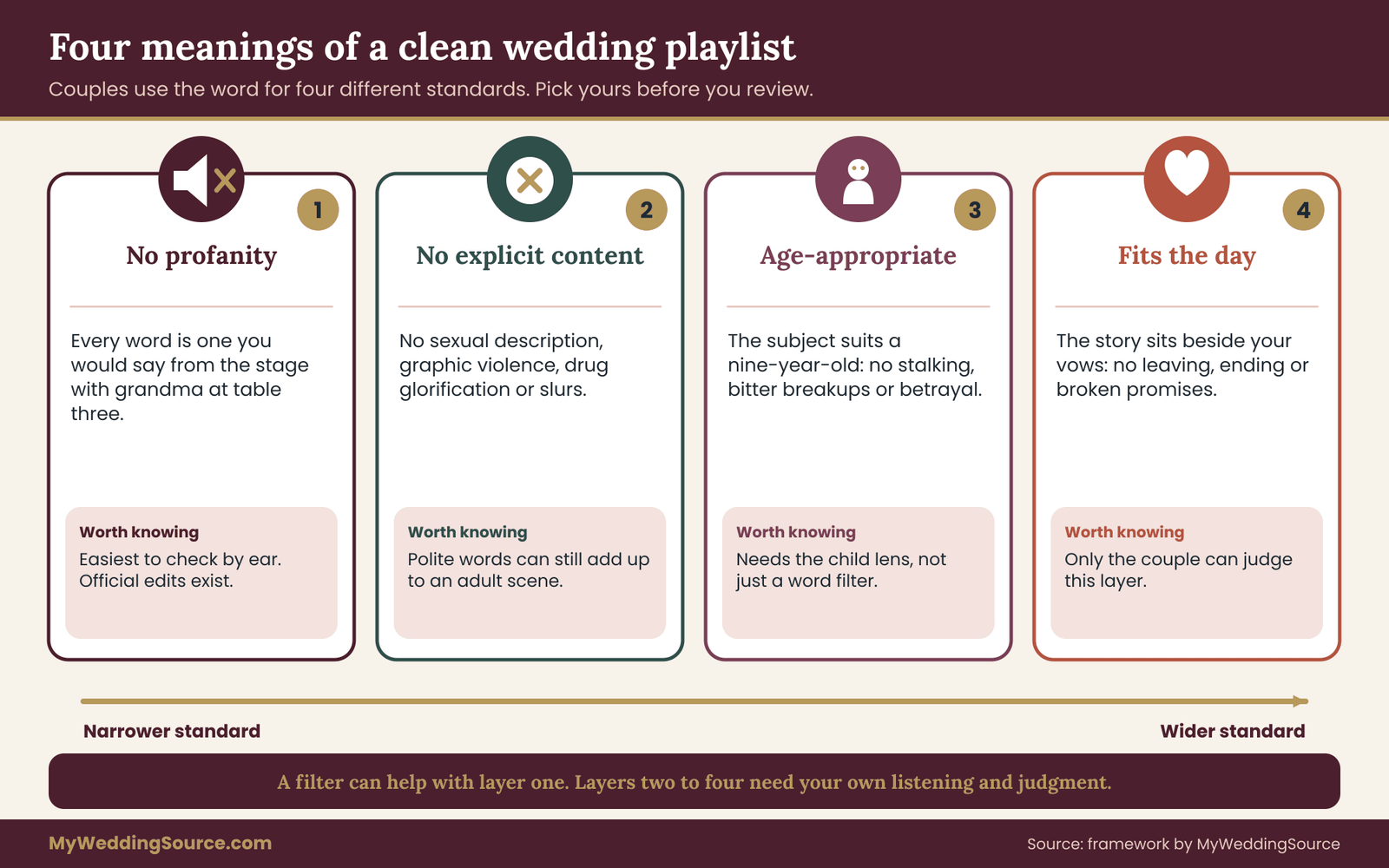
The phrase sounds precise, but couples use it to mean at least four different things. Sorting out which one you mean is the first piece of real work, because each meaning leads to a different review.
No profanity. The narrowest meaning. Every word on the recording is one you would be comfortable hearing from the stage while your grandmother is at table three. This is the easiest standard to check, because profanity is audible and there are official edits designed to remove it.
No explicit content of any kind. A broader meaning: no sexual description, no graphic violence, no glorification of drug use, no slurs. A song can pass the first standard and fail this one, because the lines are polite words arranged into something you would not want to explain to a child.
Age-appropriate throughout. The standard many parents quietly want. Even when nothing is explicit, the subject matter might not suit a nine-year-old: infidelity, heavy grief, a narrator stalking someone, a breakup told in bitter detail. The words are fine and the content is not.
Fits the day. The widest meaning, and the one that matters most for the couple. Some songs are clean and still wrong, because the lyrics describe a relationship ending, or a promise being broken, or someone leaving. Nobody is offended, but the lyric sits oddly beside two people who just promised each other forever.
Those four layers are why a clean wedding playlist cannot be produced by a single filter. A switch on a streaming app can screen out the first layer in many cases. It cannot decide the other three, because they depend on your guests and your day.
The two jobs a lyrics review does for a clean wedding playlist
A lyrics review has two distinct jobs, and mixing them up is how couples get frustrated. The first job is verification: confirming facts about a specific recording. Which version is this? Does it contain the words the label says it contains? What exactly happens at the 2:14 mark? These questions have right answers, and you or your vendor can find them by listening carefully and checking sources.
The second job is judgment: deciding whether a verified fact is acceptable to you. Is a single mild word in the bridge a problem? Is a song about a failed relationship all right at the cocktail hour but not at the first dance? Those questions have no universal answers, and no vendor can answer them for you. They need your own line, which the next sections help you set.
Keep the jobs separate on the worksheet for your clean wedding playlist. Verification goes in one box and judgment in another. When the facts are wrong, the judgment is wasted, and when the judgment is missing, the facts are only trivia.
Who needs a clean wedding playlist most
A clean wedding playlist matters in every wedding, but the review matters most in these situations: a reception with many children, a guest list that includes a religious community with firm expectations, a workplace-heavy guest list, a venue with a conduct clause or an events manager who has been burned before, and a family where the couple’s own taste runs to music that is clearly adult. In each case the cost of a wrong song is different, which is why the review has a tier system rather than one rule.
For the broader job of shaping the whole evening, including energy, generations and sound levels, see the guide to wedding reception music. This article stays narrower: the lyrics.
Why a clean wedding playlist fails when you rely on the label
If a song says “clean,” that should settle it. Often it does. But the label is a claim made by someone, at some point, about some version of a recording, and each of those three qualifiers is a place where the claim can come apart from what plays through the speakers on the day.
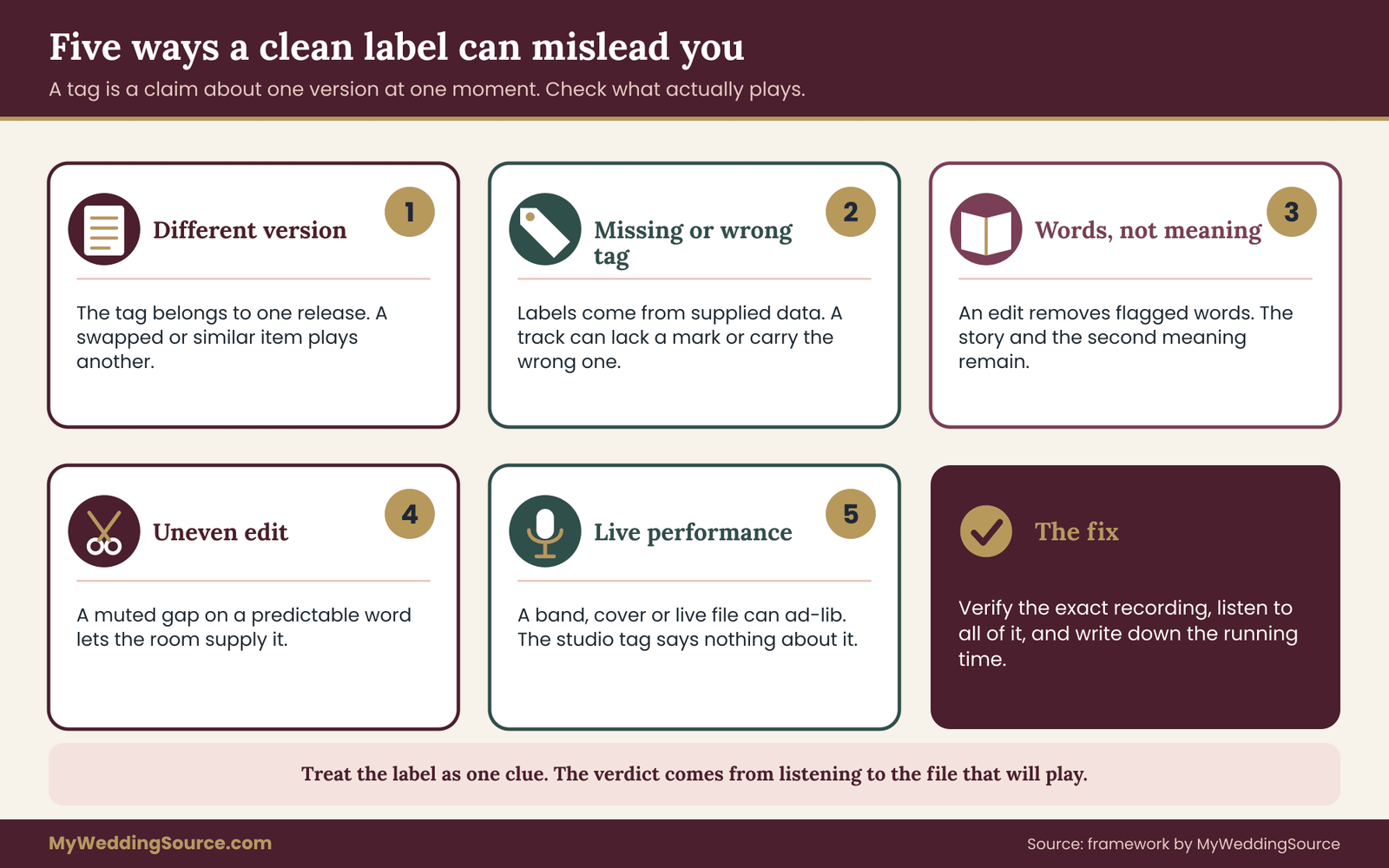
The label describes a different version. A single song can exist as an album track, a single release, a radio edit, a “clean” version, an extended mix, a live recording, a remix, a cover by another artist and a karaoke-style backing track. These are separate audio files with separate content. A tag on one does not transfer to another. When a playlist app swaps in a similar-looking track, which can happen when a region’s catalog differs or when a rights change removes an item, the tag you checked may belong to a recording you are no longer hearing.
The label is missing or inconsistent. Streaming services generally mark tracks that contain explicit lyrics, and the marking is supplied through the metadata that the music’s rights holders deliver. That is a reasonable system, but it is a system run by people and files. A track may carry no mark because it is clean, or because nobody applied one, or because the mark was applied to the album and not the single. The service’s own help pages describe what its explicit marker means and how its content settings work, and they are the right place to check, not a forum thread or a memory.
“Clean” means “without the words flagged,” not “suitable.” An edit that mutes a word leaves the rest of the line intact, and listeners fill in the gap. A track can be technically free of profanity and still have a verse that describes something you would never say aloud to a room containing your aunt’s new baby. The label is a statement about specific words. It is not a statement about meaning.
The edit is uneven. Some clean versions are well made, with the word removed, reversed or replaced by a substitute. Others leave a stray syllable, a half-word, or a swap that changes the line into something odd or accidentally worse. You find out only by listening to the edit end to end.
The lyrics changed in the performance. If your band or a live performer plays the song, the words are theirs on the night. A cover may soften, sharpen or ad-lib. A DJ who plays a live recording or a remix may be playing audience banter or additions that are not in the studio lyrics. A promise of “this song is clean” is not a promise about this performance.
What actually sits behind a “radio edit”
The term “radio edit” has a particular origin. Broadcast radio and television in the United States operate under content rules enforced by the Federal Communications Commission, which publishes a plain-language guide to what it treats as obscene, indecent and profane on the air. Because broadcasters need to follow those rules, labels have long produced edited versions of songs for them: words muted, lines replaced, sometimes a shorter running time as well.
Two things follow for you. First, those rules govern broadcasters, not private receptions, so a radio edit is a convenience for you, not a legal requirement. Second, an edit made to suit a broadcast standard is built to that standard and no other. It will not remove a verse that is perfectly acceptable on the radio and unsuitable at your reception, such as a song that is gentle in vocabulary and bleak in subject. The edit answers a different question than the one you are asking.
The four failure patterns couples report
If you read the same advice about a clean wedding playlist from enough DJs, four patterns come up repeatedly. They are worth naming now, because the review in later sections is designed to catch each one.
The first is the swapped version: the couple approved a clean tag on a platform, the DJ played a different file with the same title. The second is the buried verse: a song everyone knows the chorus of, with a second verse nobody had heard in years. The third is the language gap: a song in a language the couple does not speak, approved because the melody was beautiful, with lyrics a guest then recognized immediately. The fourth is the mood mismatch: a perfectly clean song whose subject quietly contradicts the occasion, which only the couple’s closest friends noticed, one of them out loud.
Each of the four is a verification or a judgment problem, and each can be caught on paper before the day if you treat the clean wedding playlist as a document to check, not a mood to trust. The rest of this guide shows how.
Setting your family-friendly line before you build a clean wedding playlist
You cannot review a clean wedding playlist against a standard you have not written down. “Keep it clean” sounds like a standard and works like a mood. Two people who agree on it in the abstract will disagree on the third song they check, and a DJ who hears only the phrase will fill the gap with their own habits. The fix is a short written line, agreed once, that you can apply quickly and hand to others.
Start with the people, not the songs. Who will be in the room, and what would each of them be uncomfortable hearing? A line built from real guests is a more reliable base for a clean wedding playlist than a line built from a general idea of propriety, and it is easier to defend if a relative objects, because it came from a decision about who was invited, not from taste alone.
Five questions that shape your clean wedding playlist
Sit down together with the guest list and answer these in plain sentences. Write the answers on one page.
How many guests are under the age of twelve, and who is responsible for them? A few children whose parents are in the room is a different situation from thirty children in a separate area with a sitter. If children will be present during the main dance set, your standard for sexual and violent content rises accordingly. If the children leave at a set time, you have a natural boundary to build the playlist around, which the tier section later turns into a schedule.
Which guests hold firm expectations, and how firm? A religious officiant, a grandparent from a community where certain topics are simply not heard in company, a coworker group that will be mortified by language: each might set a different bar. You do not need to meet every bar, but you should know which ones exist and decide, on purpose, which to honor.
What does the venue require? Some venues attach a conduct or content clause to their rental terms, or an in-house events manager has opinions based on past events. Ask for the rule in writing, then keep a copy with your records. The wedding vendor contract guide explains how to read the clauses that sit alongside music and noise terms, and it is worth skimming before you assume your venue is silent on the subject.
What would genuinely spoil the day for you? This is not about guests. Some couples find that a particular theme, such as a song about a relationship ending, feels wrong beside their vows even when it is mild. Others do not care at all. Naming your own line prevents you from approving a song you will wince at in the photographs.
Which exceptions are you willing to make, and for what? A single mild word in a song everyone loves might be acceptable at 10:30 p.m. after the children have left and unacceptable at 6:00 p.m. The line can include exceptions, as long as they are written down and attached to a time or a condition.
Turning the answers into a written line
A usable line has three parts: a list of things that are never acceptable, a list of things that are acceptable only in certain conditions, and a short statement of what the playlist is for. Here is an invented example of how a couple might write it down.
“Never: slurs, explicit sexual description, graphic violence. Conditional: mild language only after 9:30 p.m. and only if the edit is clean of the strong words. Mood: no songs about breakups, betrayal or death at the ceremony, first dance or parent dances. The clean wedding playlist exists so every generation can stay on the dance floor.”
Notice what that does. It names categories, not individual words, so you do not have to decide each word in advance. It attaches a condition (time) to one category, so the late-night set can be looser without becoming a free-for-all. And it carries a purpose statement, which is what you will point to if a friend asks for a song that does not belong on your clean wedding playlist.
The severity scale
Within each category, songs on a clean wedding playlist vary in how far they go. A rough three-step scale keeps your reactions consistent, so the fifteenth song gets the same treatment as the first.
Mild. Brief, vague or comic references that most listeners would not remark on, such as a nod to drinking in a party song or an off-hand reference to a romantic night. Many couples accept these at any hour.
Moderate. A single strong word that an edit can remove, a pointed innuendo, a verse about a subject that makes the room shift, or a theme most guests find heavy. Moderate content is the territory where time slots and edits matter.
Severe. Sustained explicit content, slurs, graphic descriptions, or lyrics that are hostile to a group of people. These are outside the line for a family reception for nearly every couple, and no edit makes them suitable.
Apply the scale to each category separately. A song can be mild on language, moderate on sexual content and severe on violence, and the verdict follows the most severe rating, not the average. Averaging is how an otherwise lovely song with one terrible verse ends up on a clean wedding playlist.
Agreeing when you disagree about the clean wedding playlist
Partners sometimes hold different lines for the clean wedding playlist. One finds a song charming and the other finds it embarrassing. A workable rule is that either partner can veto a song for any reason, with no argument required, because the point of the exercise is a room you will both be happy standing in. If a veto feels unreasonable in the moment, move the song to the optional list described later and revisit it after a week. Most disagreements dissolve with distance.
If the disagreement is between you and a parent who is paying or hosting, the situation is a family-decision question more than a music one. The guide on wedding decision rights covers how to separate input from control, and the short version is useful here too: invite opinions about the line, but keep the final verdict with the couple.
Know your versions: the recordings behind a clean wedding playlist
The most common error in reviewing a clean wedding playlist is checking a song when you should be checking a recording. A “song” is an idea, a set of words and a melody. A “recording” is a specific audio file that you can play, with a specific length, specific edits and a specific voice. The review applies to recordings, because only a recording can be verified.
Here are the versions you will run into and what each one means for your review.
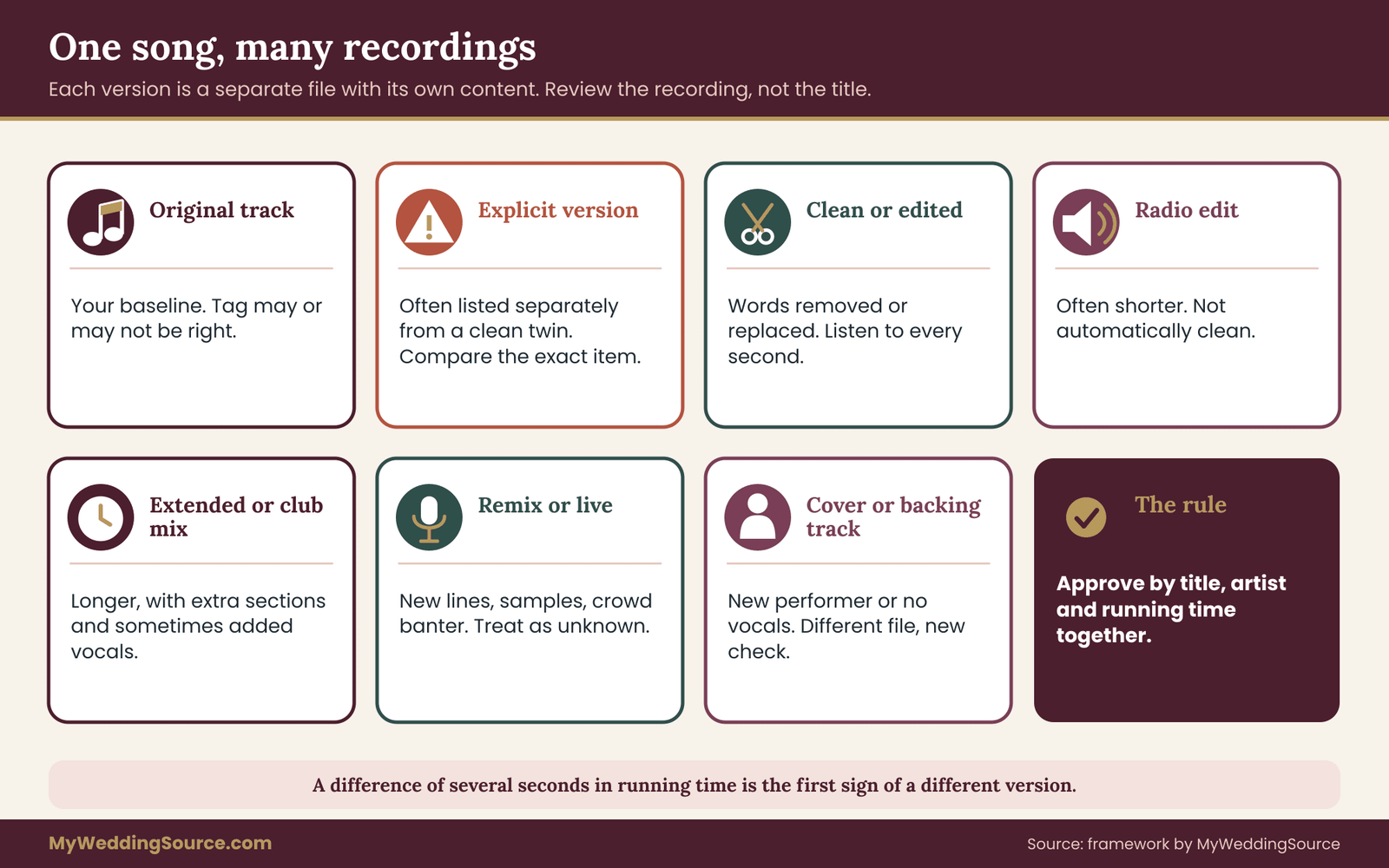
Original album track. The recording as the artist first released it. It may or may not contain explicit lyrics, and its tag may be correct. Use it as the baseline for comparing other versions.
Explicit version. A recording marked as containing explicit content. When a song has both an explicit and a clean release, the platform may list them as two items with the same title, and your playlist might contain the wrong one. This is the swap described earlier, and the check is to compare the exact item you added.
Clean or edited version. A release in which flagged words are removed, muted or replaced. It is usually produced by the rights holder or with their approval. Because quality varies, listen to all of it, not only to the parts you know. Remember that an edit changes words, not subject matter.
Radio edit. Often shorter, sometimes with an altered intro or outro, and sometimes with a cleaned lyric as well. The term refers to length and format as much as to content, so a radio edit is not automatically a clean version. Verify each separately.
Extended mix or club mix. Longer versions made for DJs and dancing, usually with extended instrumental sections. Check whether the content matches the shorter version, because extra sections sometimes include added vocals or samples.
Remix. A reworking by another producer. Remixes can add new vocal lines, samples and spoken passages that are not in the original, so a clean original gives you no information about a remix.
Live recording. A concert performance, sometimes with crowd noise, banter and ad-libs. Treat each live recording as an unknown, no matter how well you know the studio version.
Cover. A song re-recorded by a different artist. The lyrics may be adjusted, translated, shortened or extended, and the new performer is not bound to match the original’s edits.
Instrumental or karaoke backing track. No vocals, and so no lyrics to review, but also a different file with a different feel. These matter when you plan to have live singers perform over a backing track, which puts the lyrics in the singer’s hands. For a cover band or a friend who sings, your review shifts from the recording to the performer, covered in the vendor section.
How to pin down which recording you are hearing
Four identifying details turn a vague “that song” into a specific recording you can verify: the title exactly as listed, the performing artist, the release or album name, and the running time. Write all four on the worksheet. If you add a track to a playlist on a streaming service, note the running time shown on the service and compare it to the file you will eventually give the DJ or band. A difference of several seconds is the first sign you are looking at two different versions.
For a DJ, the practical measure is the file name and file length, because a DJ plays a stored file, not a stream. A good DJ will tell you exactly which file they hold for each song and where it came from. A hesitant answer to that question is useful information, and the vendor section later gives a script for asking it.
The “same title” trap
Because titles are often identical across versions, the most reliable single habit for a clean wedding playlist is to refuse to approve by title alone. Approve by title, artist and running time together. This takes seconds and eliminates the most common cause of a surprise, which is a correct song in an incorrect form.
A related habit helps with covers and remixes: when you search a title on a service and see several results, open each one briefly. If you can tell the difference by the album art and run time, you can tell it by the metadata too, and you will know which one you meant.
The four-pass lyrics review for your clean wedding playlist
This is the core process for building a clean wedding playlist. Each song goes through four passes in a fixed order, and the order matters because each pass depends on the one before it. You cannot judge lyrics until you know the recording, and you cannot assign a verdict until you have judged. Skipping straight to the verdict is how people end up approving a song they have only half heard.
The passes are named so you can refer to them in conversations about your clean wedding playlist with your partner and your DJ: Identify, Read and Listen, Room Test, and Verdict. A song that clears all four goes on the clean wedding playlist. A song that stalls at any pass is held, edited, limited or dropped according to the rules below.
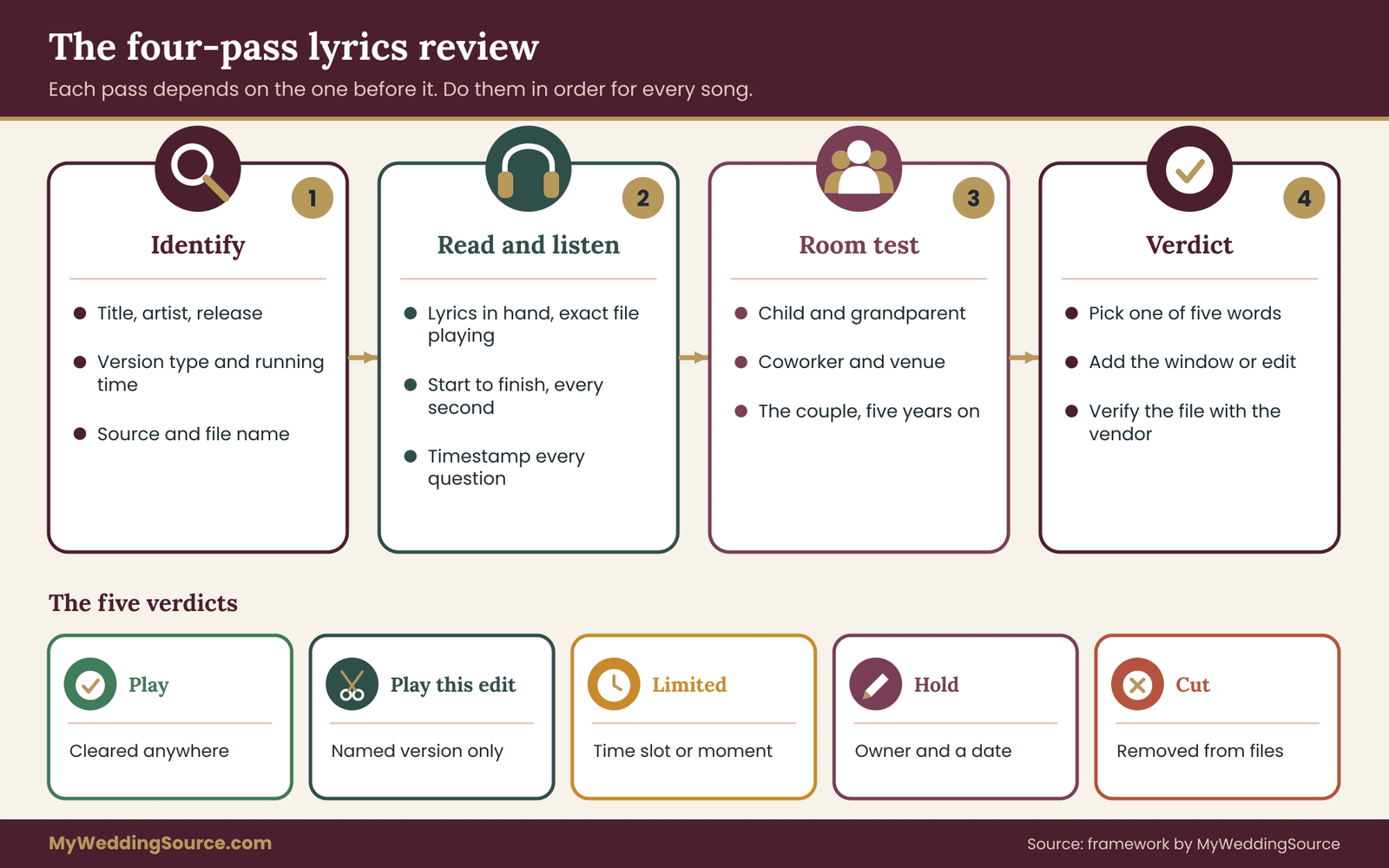
Pass one: Identify the recording
Write down the title, artist, release, running time and the version type (original, explicit, clean, radio edit, remix, live, cover). Then add two lines that people forget. The first is the source: where you found this recording, such as a streaming service, a file the DJ supplied or a purchased download. The second is the file or item identifier you will hand to the vendor, which might be a link, a file name or a track number on an album.
The reason for the source line is accountability. If a surprise happens later, you need to know whether the item was swapped between your review and the event. If you wrote down the source and running time, you can compare in thirty seconds.
If you cannot identify the recording, because several similar versions exist and you do not know which one you added, stop and resolve that first. Reviewing an ambiguous recording produces a verdict about nothing.
Pass two: Read and listen together
This pass is the one that catches most problems on a clean wedding playlist, and it has a particular shape: you read the full lyrics while you listen to the exact recording from start to finish, with the volume at a level you can hear every word. Reading alone fails because lyrics pages can be wrong, incomplete or written for a different version. Listening alone fails because sung words are easy to mishear, and people hear what they expect.
Do them together. Follow the printed lyrics with your eye, and mark anything that does not match what you hear. A mismatch is itself a finding. It might mean the lyrics page is for a different version, or the edit changed something, or a word is obscured by production.
Where to get lyrics matters a little. A lyrics display built into a licensed streaming service is generally supplied through a licensing arrangement and tends to be more reliable than a user-edited page, though neither is perfect. For any line that looks odd, trust your ears and check a second source. Never rely on a lyrics page alone for a verdict.
Mark timestamps. For every line that raises a question, write the time in the recording, such as 1:47, and a brief note. These timestamps become the single most useful thing you hand to a DJ, because they turn a vague worry into an instruction: the DJ can fade early, cut at a specific point, choose a different edit or time the song for a moment when it matters less.
Listen for what is not written. Spoken intros, background voices, ad-libs, samples and bridge vocals often do not appear in the printed lyrics. If you only read, you miss them. If you only listen to the chorus, you miss everything else. The whole recording needs to play, because the line that causes trouble is rarely in the chorus.
Handle languages you do not speak. If part or all of the song is in a language you do not read, the review needs a person who does. A native or fluent speaker from your circle is best, because they catch slang, double meanings and regional connotations that dictionaries do not. A machine translation is a start but not a verdict, because it misses tone and idiom, and idiom is where trouble lives. A later section treats language more fully.
Pass three: The room test
You now know exactly what the recording says. The third pass asks how those words will land on the specific people who will hear them. This is a judgment task, and it is easier when you do it against named audiences, not an abstract crowd. The section on the room test later in this guide describes five lenses: a child, a grandparent, a coworker, a venue or officiant, and the couple. For now, understand the purpose: each lens asks one question about the lyrics, and any lens that answers “no” is a finding to record.
Record the finding as a short phrase, and record which lens raised it. “Child lens: second verse about drinking” is far more useful, a week later, than “a bit much.”
Pass four: The verdict
Every reviewed song on a clean wedding playlist ends in one of five verdicts. Use these words consistently so that the DJ, your partner and your later self all read the list the same way.
Play. Cleared. No limits. The song can appear anywhere on the schedule that suits the music.
Play this edit. Cleared only in a specific version, such as the clean release or a named radio edit. The worksheet names the exact version, and the DJ must confirm they hold it. If the DJ cannot supply that exact version, the verdict falls back to Cut.
Limited. Cleared only for a time slot or a moment, such as after the children have left, or only as background music during cocktail hour when conversation covers the lyrics. The worksheet states the limit.
Hold. Undecided because something is unresolved: a language check pending, a version unconfirmed, a partner who has not yet listened. A Hold has an owner and a date, and a song that is still on Hold after the review deadline becomes a Cut.
Cut. Not played. A cut song is not a failure, and often it is a song you still love that simply fits some other room. Do not argue with a cut after the fact unless the facts change.
That last sentence about the deadline is worth enforcing. Holds are comfortable, and an uncleared list full of Holds on the morning of the wedding is the same as an unreviewed list.
The one-card worksheet for a clean wedding playlist, and how to fill it
The clean wedding playlist worksheet is one card per song. The word “card” is deliberate. It is small enough to fill in two minutes for a song you know and ten for one you do not, and it can be a note on your phone, a row in a shared document or an index card. What matters is that every song has the same fields in the same order.
The fields, in the order you fill them:
- Title, artist, release. Exactly as listed on the source.
- Version type and running time. For example, “clean edit, 3:42.”
- Source and identifier. Where it lives and what you will hand over.
- Lyrics source. The page or service where you read the lyrics, and whether you also have a second source for any odd line.
- Listened start to finish. A checkbox, the date and who did it. Two people listening is better than one.
- Flagged lines with timestamps. A short note and a time for each question.
- Category and severity. For each flagged line, the category from your written line and a rating of mild, moderate or severe.
- Room test result. Which lenses raised a concern, if any.
- Verdict and limit. One of the five words, with the time slot or version if it applies.
- Verified by and date. The person who confirmed the final file with the vendor, and when.
The last field is the one that closes the loop. A card without a “verified by” is a plan, and a card with one is a fact.
What a filled-in card looks like
Here is an invented card for an invented song, “Parking Lot Moon,” by an invented artist, so you can see the level of detail that works.
Title: “Parking Lot Moon,” Northbound Radio, album Small Hours. Version: clean edit, 3:38. Source: DJ-supplied file, named in the cue list. Lyrics source: licensed lyrics display plus the liner notes. Listened: both partners, Nov. 3. Flags: 1:12, one strong word removed, edit leaves a gap and the listener supplies the word; 2:31, verse about a night out, mild. Category: language moderate, subject mild. Room test: coworker lens raised the gap at 1:12. Verdict: Limited, after 9:30 p.m. Verified by: DJ confirmed file and length, Nov. 10.
That card took about eight minutes the first time. The next song in the same genre takes less, because you are now fluent in the format. The card also reads well to a vendor, who can act on it without asking you anything.
Keeping the clean wedding playlist review from growing too large
Reviewing every candidate for a clean wedding playlist at full depth does not scale. A five-hour reception has room for about sixty to seventy recordings at typical lengths, and a request list from a larger guest group can run to several hundred candidates. If you review all candidates at ten minutes each, you have signed up for dozens of hours. The tier system in a later section lets you skip the full process for songs that sit at the safe end of the spectrum, and spend your time where the risk actually is.
The rule of thumb for a clean wedding playlist is to match effort to uncertainty. A song you have heard a hundred times from start to finish and know to be mild needs the short version: confirm the recording and the running time, and move on. A song you know only by its chorus, or a song in a language you do not read, gets the full four passes.
Two reviewers are better than one on a clean wedding playlist
If a partner or a trusted friend can do a second listen on any song that carries a moderate rating, do it. People mishear different words. A second reviewer will also notice tone, which a single reviewer who is deeply attached to a song may rationalize away. The second reviewer does not need to understand the whole project, only the written line and the card.
Choose someone who will say “that is a problem” without being embarrassed, and who is not so invested in the evening that they will soften an honest reaction. A sibling or close friend often fits. A parent sometimes does and sometimes does not, depending on the family.
The room test: reading lyrics through five audiences
Pass three of the clean wedding playlist review deserves its own section, because it is where most of the judgment lives and where couples tend to rush. The idea is to stop asking “do I like this” and “is it clean,” and instead ask the same question five times from five different positions. Each position has a specific, answerable question. Any “no” is a finding.
The five lenses are the child, the grandparent, the coworker, the venue or officiant, and the couple. They are not stereotypes. They are roles, and every wedding contains people in each of them.
The child lens. Imagine a seven-year-old hearing this song and asking you a question about a line. Could you answer in one calm sentence? If the honest answer is a long explanation or a change of subject, the lyric has failed this lens.
Children repeat what they hear, and they hear more than adults assume. This lens is about subject matter more than vocabulary: a song can contain no strong words and still describe something you would rather not explain at a reception. The guide to wedding guest care covers how to plan for babies, children and older relatives across the day, and it is the natural companion if children are a big part of your guest list.
The grandparent lens. Imagine the oldest guest who is fully paying attention, perhaps leaning forward to hear because the music is loud. What would they take from the lyric? This lens catches two kinds of issue. One is plain discomfort with content. The other is a generational mismatch of meaning: a phrase that is harmless to a thirty-year-old and carries a different or crude meaning in older usage, or the reverse. When you cannot tell, ask a person from that generation, not a search engine.
The coworker lens. Imagine the colleague you will see on Monday, or the boss who came because it was polite. This lens is about professional embarrassment: a song that is fine among friends and awkward when a manager is two chairs away. It is also the lens that notices mild language you have stopped hearing. If the guest list has a large workplace contingent, treat this lens as heavier.
The venue or officiant lens. Imagine the person who is responsible for the building or the ceremony reading the lyrics sheet. A venue may have conduct rules, a neighbor-facing noise or content policy, or an events manager who will step in. A religious officiant or a place of worship may set expectations about what is played during the ceremony and in its spaces. This lens is mostly about asking, not guessing. A two-line email to the venue costs nothing and removes the guesswork.
The couple lens. Imagine yourselves watching the video five years from now. Does this lyric sit comfortably beside your vows, your families and your sense of the day? This is where the “mood mismatch” songs are caught, the ones with clean words and the wrong story.

Recording the room test result for the clean wedding playlist
For each lens, the answer is yes, no or unsure. Unsure is a finding, and it sends the song to Hold with an owner. Record the lens next to the flagged line on the card, so you can see at a glance whether a song has one concern or five.
A song that fails the child lens only might be a candidate for a Limited verdict after the children leave. A song that fails the couple lens is usually a Cut for the key moments and might remain acceptable as background at another time. A song that fails the venue lens needs a conversation before anything else, because it may be out of your hands.
When the lenses disagree
They will. The grandparent lens may find a love song perfectly sweet while the couple lens finds it saccharine, and the coworker lens may object to a song the child lens considers harmless. Disagreement is not a problem to solve; it is information to use. Apply your written line: the never list always wins, the conditional list governs the time slot, and everything else comes down to the couple’s preference. The lenses exist to make sure you build your clean wedding playlist with your eyes open, not to produce unanimity.
Hard cases on a clean wedding playlist: double meanings, gaps, other languages
Some lyrics are difficult to place on a clean wedding playlist because the problem is not a word but an effect. The cases below come up often enough that they deserve their own rules.
Double meanings and innuendo
A line can be polite in every word and still carry a second meaning that most adults will catch. Innuendo is the commonest reason a clean wedding playlist ends up with a song that is not suitable for children. The test is not whether a line is explicit, but whether a reasonable adult would hear a second meaning and a child, hearing the same line, would ask about it.
The rule of thumb is to read the song twice, once for the surface and once as an adult listening for the other reading. If the other reading is obvious, rate it moderate and apply the child lens. If the whole song depends on the second meaning, rate it by the second meaning, because that is what the song is.
Be wary of relying on your own tolerance, which may be higher than the room’s. A line you find witty may land differently with a relative who takes it at face value, or a guest who takes it exactly as intended and is not amused.
Edited gaps
When an edit mutes or removes a word, the gap itself becomes information. Listeners hear the rhythm and rhyme and supply the missing word. If the gap lands on a word everyone knows, the edit has not removed the word from the room; it has handed it to the audience. This matters most for the coworker and grandparent lenses, and it matters for children who have learned what the missing word is.
Some edits handle this well, by replacing the word with a substitute that fits the line or by reversing the audio so that it reads as a rhythmic effect. Others leave a silence. Neither is right or wrong, but you should listen for which kind you have and rate the gap honestly. A gap on a strong word is moderate, not mild, even when the word is technically gone.
If you have the option, choose an edit that substitutes a word or that removes an entire line cleanly, and avoid edits that leave a conspicuous silence on a predictable word. When a song offers only the bare-gap edit, consider limiting it to a late time slot or skipping it for a daytime reception.
Songs where the clean words tell a hard story on a clean wedding playlist
Some of the most popular songs that turn up on a clean wedding playlist are about love going wrong: a narrator who is left, a promise that fails, an affair, a stalker presented as a romantic. The vocabulary is entirely polite and the content is not. A reception is a good place for many songs but a poor place for a song whose story is a warning.
The test is to summarize the song in one sentence, as if telling a friend what it is about. If the sentence is “a man begs his ex to come back,” “a woman explains why she is leaving” or “a couple argues until one walks out,” you have found a mood mismatch. These songs are fine in the car and may be fine as late-night singalongs where nobody is attending to the verses, but they are usually poor choices for the first dance, parent dances and the ceremony, where people do listen.
This is a place where your own taste matters, and where the couple lens decides. If you love a song and know it is about heartbreak, you may still choose it for the dance floor, where its energy is the point, and keep it away from the moments when guests are watching and listening. Doing that knowingly is very different from discovering the story from a cousin in the middle of the first dance.
Songs in other languages
For many families, music in a language other than English is central to the day, and a clean wedding playlist has to make room for it. Reviewing it requires more care, not less, because a listener who does not speak the language cannot judge the lyrics at all, and a listener who does will catch things you cannot.
The process is straightforward. Find a fluent speaker you trust, ideally someone from the family or community that the music belongs to, and ask them to listen to the exact recording and to tell you plainly what it says. Ask specifically about slang, regional vulgarities, and double meanings, which are the things translation tools handle worst. Then record their findings on the card in English, with timestamps, so that your DJ and your partner can use them.
Resist two shortcuts. One is assuming that a popular or traditional song is automatically suitable, because popularity says little about content. The other is assuming that a song is inappropriate because a few words sound strong to your ear. A fluent reviewer solves both. They also respect the music: asking an elder or a friend to check a song for the wedding is usually received as an honor, not an imposition.
If a song has a widely known clean version in its own language, the same rules as for English apply: confirm the exact recording and listen to all of it with someone who understands it.
Samples, spoken sections and surprise endings
Some recordings include a sampled voice, a spoken skit, an outro that changes mood or a final line that reframes the whole song. Because these often sit outside the standard lyric text, they are the easiest to miss. The only way to find them is to listen to the entire recording once, including the last thirty seconds. If you plan to play only the first portion of a song, a common practice for DJs who fade out early, then you only need to clear the portion that will play, and the card should say so: “clear to 3:00; fade out before the outro.”
Mashups and blended sets
DJs often blend songs, layering the vocal from one over the instrumental of another, or moving between tracks in a medley. In a blended set, a clean wedding playlist review has to cover a sequence, and the combined effect of two clean lines can be different from either alone. If your DJ builds mashups or custom transitions, ask to hear them in advance, or ask for a list of the recordings used in each, so you can run the review on each component. Brief transitions rarely cause trouble. A fully layered mashup is a new recording and deserves its own card.
Sorting a clean wedding playlist into tiers and time slots
A reviewed song on a clean wedding playlist does not need to play at every point in the evening. Reception time has a natural shape: the early hours include children, grandparents and people who will leave before the late set, and the later hours are looser. A clean wedding playlist that respects this shape lets you keep more of the music you love, because you are no longer asking every song to pass the strictest test at the strictest moment.
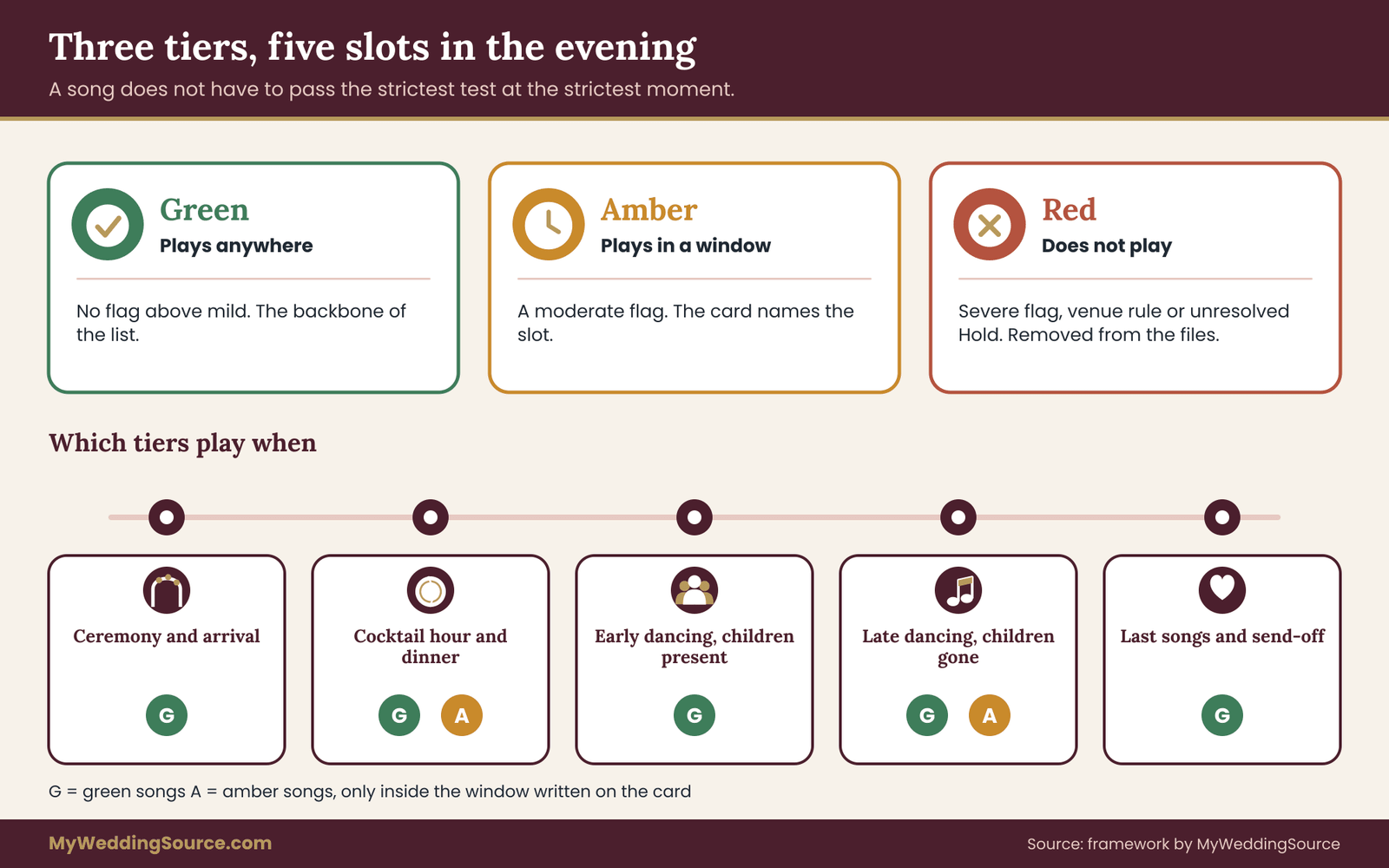
The tier system for a clean wedding playlist has three levels, and each reviewed song lands in one. The names are plain on purpose.
Green: plays anywhere. The song passed every lens with no flags above mild. It can appear in any slot, including the ceremony if it suits the mood. Green songs form the backbone of the clean wedding playlist. If you have only half the playlist reviewed when the week of the wedding arrives, you can rely on the green songs and drop the rest.
Amber: plays in a window. The song has a moderate flag or a lens concern that depends on who is listening. It can play within a window, for example after the children have left, in the late dance set, or as low-volume background during dinner. The card states the window.
Red: does not play. A severe flag, a failed couple lens at a key moment, a venue rule, or an unresolved Hold past the deadline. Red songs are removed from the files given to the vendor, not merely marked, so no one has to remember not to play them.
Mapping tiers onto the evening for a clean wedding playlist
Divide the evening into slots that match who is present, and decide which tiers of your clean wedding playlist are allowed in each. A typical shape for an evening reception might look like this, and you should adjust the times to your own event.
Ceremony and arrival. Green only. Listeners are attentive, the room is quiet and lyrics carry weight. Choose songs whose words suit the occasion or choose instrumentals.
Cocktail hour and dinner. Green, plus amber songs that are low-key and instrumental-forward, since conversation covers the lyrics. The guide to the wedding cocktail hour has more about the pacing of this part of the day, if you want to think through how music supports it.
Early dancing, children present. Green only. This is the slot with the widest audience, and it is also the slot where the strongest bridge songs, the ones that bring grandparents and teenagers onto the floor together, belong. The reception music planning guide describes how to build those transitions, and the green tier gives you a safe pool to draw from.
Late dancing, children gone. Green and amber. The room has changed. A song rated moderate for language or innuendo can move here, provided the venue allows it and your written line permits it. This is where the conditional section of your line does its work.
Last songs and send-off. Back to green for the final stretch, if elderly guests, children or the couple’s parents will return for the exit. The last song is also the one photographs and videos remember, so the couple lens counts double.
Why tiers save time on a clean wedding playlist
Tiers reduce the work in two ways. First, they let you skip the full review for songs that are obviously green: songs you know well and rate mild on every category. Second, they let you apply different standards to different slots without rewriting the list. You keep a song you love at an amber rating, instead of choosing between an uncomfortable green and a painful cut.
The cost logic is simple. If a full review takes ten minutes and a short check takes two, and a couple has forty songs already known to be mild and forty unfamiliar, the full review on forty songs is about six and a half hours, and the short check on the other forty is about an hour and twenty minutes. The tier system is what makes that split legitimate. Without it, you are reviewing eighty songs at full depth, which is closer to thirteen hours, and most couples abandon the process halfway.
Setting a maximum for amber on a clean wedding playlist
It is tempting to rate everything amber and defer decisions to the night. Resist that. A long amber list means the DJ must make live judgments about who is in the room, and the whole purpose of the review was to take those judgments off the DJ at the worst possible moment. A practical limit is to keep amber songs to a fraction of the total, perhaps a quarter, and to require each one to have a written window. If you have more than that, the line is probably too permissive for the guest list, or the playlist is leaning on songs that do not fit the event.
Special songs on a clean wedding playlist: ceremony, first dance, parent dances and slideshows
Some songs matter more than others because people listen to them closely. In those moments the lyrics are not background. They are the content. The tier system covers most of a clean wedding playlist, but these songs deserve a stricter pass.
Ceremony music
A ceremony is quiet, the guests are seated and facing forward, and the words of any sung music are heard clearly. If the music includes lyrics, apply the full four passes and apply the venue or officiant lens with extra care. Religious ceremonies and places of worship may have their own expectations about what is played, and some do not permit recorded secular music at all. Ask early, in writing, and keep the reply.
Many couples choose instrumental versions for the processional and recessional, and that is a sound approach, because an instrumental carries the mood without a lyric to review. If you choose an instrumental version of a familiar song, remember that guests may supply the words in their heads, and the original lyrics can still color the moment. Review the original lyrics anyway, and check the instrumental recording as a separate file.
Cue timing matters too. A song that is clean but too long for the walk down the aisle will be faded or cut, and the fade point should land on a line that makes sense. Your ceremony cue sheet should name the exact recording, the start cue and the fade point, and the card from the review gives you the timestamps to build it.
The first dance
The first dance is the moment where the couple lens is most important and the room is most attentive. Guests watch you, the photographer is working, and the music is the only sound. Every lyric will be heard.
Run the first-dance song through all four passes, and then do one extra thing: read the lyrics aloud, slowly, as though you were reading a card to your partner. Many songs that sound tender in the car sound odd when spoken: a line about leaving, a promise phrased as a threat, a metaphor that falls apart. If you find yourself skipping a line while reading aloud, you have found the problem.
Also consider the length. A full first dance can run several minutes, and many couples ask the DJ to fade after the second chorus. If you plan to fade, the review needs only cover the part that will play, and the card should record the fade time.
Parent dances
Parent dances add a third person’s feelings to the picture. A song chosen for a parent carries meaning for them, and the lyrics may touch on loss, a deceased relative or a family history the couple knows more about than the audience does. Involve the parent in the review if you can, or at least ask them privately. A song that is lovely to you may mean something painful to them, and the reverse is also true.
Be especially careful with songs about parents and children. Some are tender, and some are about a parent’s absence, a child’s leaving or a complicated relationship. A parent dance is a poor place to find that out in front of everyone.
Slideshows, videos and special performances
If your reception includes a slideshow or video, the music under it is part of the review. The lyrics will play against images, and the combination can create unintended meanings, such as a lyric about leaving over photographs of a grandparent. Review the track against the pictures, not alone. Using commercial music in a video raises separate rights questions, and the song you cleared for the dance floor may need different permissions when it is attached to a recording that someone will keep and share. Ask your videographer how they handle music, and keep that question separate from the lyrics review.
If a friend or relative will sing or perform, the review shifts from a recording to a person. Ask for the song title and version in advance, listen to a rehearsal if you can, and ask them directly whether they plan to change or add anything. Most performers appreciate being asked.
Songs requested by guests before the wedding
Some couples invite guests to add song requests for the clean wedding playlist on the RSVP or in a shared document. This is generous, and it multiplies the review work, because every submitted song enters the queue. Decide in advance how you will handle submissions: you might accept requests only as suggestions, review them in batches, and tell guests that the final list is the couple’s. A sentence on the request form saying that songs are reviewed for the family-friendly standard of the day sets expectations before anyone is disappointed. The etiquette in wedding etiquette on handling guest preferences gracefully applies here as well.
A worked example: building a clean wedding playlist from 118 songs
The following example of building a clean wedding playlist is invented. The couple, the songs and the numbers are made up to show how the process runs from start to finish, and none of them describe a real event or a real recording. The arithmetic is simple, and you can substitute your own numbers.
Priya Alvarez and Sam Whitfield are planning a Saturday evening reception for 110 guests. Fourteen of the guests are under twelve, including two toddlers, and about twenty are over seventy. Sam’s employer will send six colleagues. The venue’s rental terms include a sentence saying that music should be “appropriate for a mixed-age audience,” which the events manager clarifies, by email, means no profanity before 9:30 p.m. and no explicit sexual content at any hour. Priya’s grandmother has asked that a particular song in Portuguese be played, and Sam’s brother has sent a long list of party favorites.
Step one: write the line for the clean wedding playlist
On a Sunday evening they spend an hour on the five questions. Their written line says: never slurs, explicit sexual description or graphic violence; conditional mild language after 9:30 p.m., only in an edit that removes the strongest words; no songs about breakups or betrayal at the ceremony, first dance or parent dances. They add the venue’s 9:30 rule, with the email attached, to the conditional line. The whole page is under 150 words, and they keep a copy in their records folder.
Step two: assemble candidates and triage
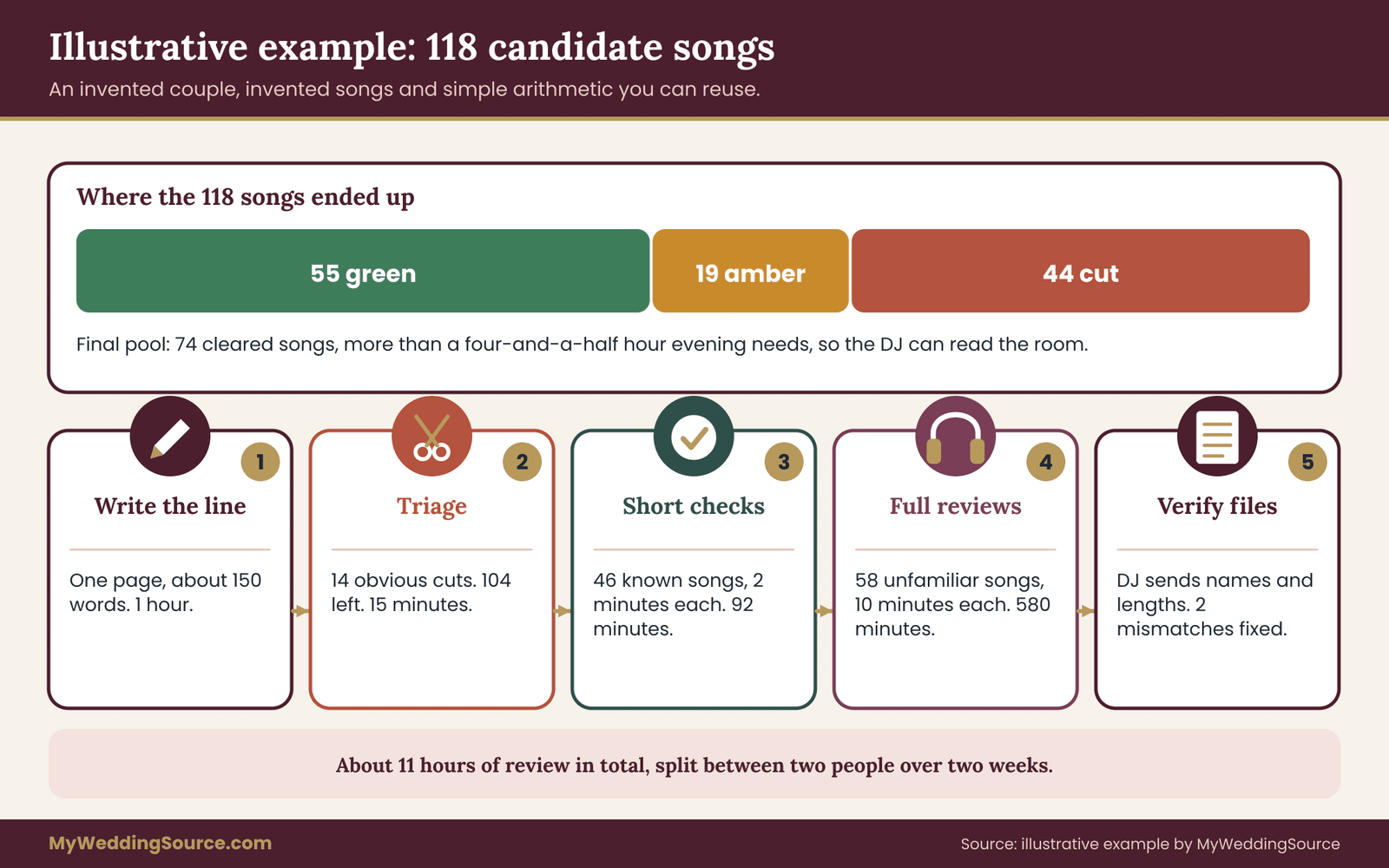
The candidate list comes from three sources: 52 songs chosen by the couple, 31 sent by family and friends, and 35 suggested by the DJ from past events. That is 118 songs in total. On the first pass they skim the list for obvious problems. Fourteen songs, mostly from Sam’s brother’s list, are marked explicit on the streaming service they use, and the couple can tell from the titles and artists that they are not suitable. Those 14 are cut immediately with no further review, a decision that takes about 15 minutes.
That leaves 104. Priya and Sam divide those by familiarity. Forty-six are songs they know well from start to finish, such as long-time favorites and standard party staples. The other 58 are songs they know by chorus only or have never heard, including three in other languages.
Step three: short checks and full reviews
The 46 familiar songs get the short check, about two minutes each: confirm the title, artist and running time, and confirm that the recording is the one they know. That is 92 minutes in total. The 58 unfamiliar songs get the four passes at about ten minutes each, 580 minutes in total. Together, the reviews come to about eleven hours, which they split evenly across two weeks, roughly 45 minutes per evening each. The numbers match the earlier rule of thumb: effort tracks uncertainty.
Here is what the full reviews turn up in a few cases:
A party song with a clean edit. The edit mutes one strong word at 1:12, and the gap lands right where the rhyme demands the word. They rate language moderate, record the timestamp and give it an Amber verdict for after 9:30 p.m.
A love song that sounded perfect. It is a favorite for the first dance until the second listen, when the lyrics reveal a narrator asking someone not to leave a relationship that is already over. They keep it for the dance floor, as Amber, and choose another song for the first dance.
An energetic song by an artist they like. The studio version is clean, but the version in the DJ’s suggestion list is a live recording with crowd banter and a spoken introduction at the start, 48 seconds long, with several strong words. The card is marked “studio version only,” and the live file is removed from the list.
A song in Portuguese. Priya’s grandmother’s request. The couple does not speak the language, so they ask Priya’s aunt, a fluent speaker, to listen with the lyrics in hand. She reports that the song is a gentle folk melody about a village festival, with one verse containing a regional phrase that older speakers use as a mild curse. She suggests playing it during dinner when conversation covers it, and also notes that her mother, Priya’s grandmother, loves the song and has heard the phrase all her life. The couple rates it Amber, window: dinner, and confirm the choice with the grandmother, who laughs and agrees.
Five songs on Hold. Two typical examples: a cover whose version they cannot identify, and a song in Spanish that nobody has yet been able to have reviewed. Each Hold gets an owner and a date, five days out.
Step four: resolve the holds and close the clean wedding playlist review
By the end of the review period, the result is as follows. Of the 104 songs reviewed, 52 are Green, 19 are Amber, 28 are Cut and five are Hold items at the midpoint. Of those five Holds, three are resolved to Green when the DJ confirms the exact files, including the cover, and two, the Spanish song and one where the DJ cannot supply the clean edit, are cut. The final tally across all 118 candidates: 55 Green, 19 Amber and 44 Cut, which includes the 14 cut at triage.
The final clean wedding playlist is 74 songs, which is more than the evening needs. A reception of about four and a half hours of music uses roughly 65 to 75 recordings at typical lengths, so the DJ has a pool with room to respond to the crowd. That extra room matters. A pool of exactly the right size forces repeats and removes the DJ’s ability to read the room, while a bigger pool lets the DJ pick among cleared songs.
Step five: hand off and verify
Priya and Sam give the DJ their clean wedding playlist in three parts: the 74 cleared songs with exact versions, the Amber windows, and the timestamp notes for each song that needs them, such as “fade at 3:00” or “studio version only.” The DJ replies within a week with the file names and running times for each.
Sam compares them to the cards, finds two mismatches in length, and the DJ supplies corrected files. Both partners initial the “verified by” line. The week before the wedding, the DJ plays the first 30 seconds and last 30 seconds of every Amber song for Priya over the phone, which takes twenty minutes and finds nothing new.
What the example shows
Three features of this example carry over to any clean wedding playlist. First, most of the savings came from triage and tiers, not from cutting corners: the 14 obvious cuts and the 46 familiar songs consumed under two hours between them. Second, the problems were found in the unfamiliar songs, in editions and in languages, not in the songs everyone already knew. Third, the verification step caught two mismatches that would have gone unnoticed, which is the whole reason it exists.
Working with your DJ or band to protect a clean wedding playlist
A review you do privately only becomes a clean wedding playlist on the night if the person operating the sound system plays what you reviewed. The handoff is where good reviews sometimes fail, because the vendor has habits, a library of their own files and a sense of what the crowd wants. The aim is to make your verified clean wedding playlist the default, and to agree in advance what happens when the room asks for something else.
What to ask a DJ about your clean wedding playlist
Put these questions to any DJ you are considering, and keep the answers with your contract. A professional will have clear answers.
Do you play from stored files or from a streaming service? Stored files are more predictable. If a streaming service is used, ask how the service’s content settings are applied and what happens if the internet connection drops.
How do you source clean versions, and can you name the version of each song on our list? An answer like “I use official edits and I can send you the list” is good. An answer like “I edit them myself” opens a different set of questions about quality and rights, which the licensing paragraph below touches on.
Will you play only the cleared versions, and will you remove red songs from your system? Removing them from the working library is stronger than a promise to avoid them.
What is your policy on requests? The request section later in this guide explains why you want this to be a written rule: requests are the largest single source of surprises.
Who is responsible for a lyric that was on our cleared list? This is an awkward question and a useful one. If the file was verified and a surprise still occurs, you need to know how the vendor will respond. Many DJs will state a simple policy: they will cut or fade as soon as they hear it.
Ask for the answers in writing and consider whether they belong in your vendor contract or in an attached music brief. A note that the client has supplied a cleared list and an explicit-content policy is a reasonable line to ask for. A contract is a legal document, so for anything beyond a plain statement of expectations, have the vendor’s terms reviewed by someone qualified.
Working with a live band on a clean wedding playlist
A live band changes the problem from verifying recordings to verifying performance. The lyrics are whatever the singer sings, and bands often adjust songs for their style. Ask for the set list in advance, ask which songs they change, and ask whether they are willing to perform a specified lyric version or skip lines you flag. A professional band that regularly plays weddings will have fielded these requests before.
Listen to a recording of the band doing the actual songs, if they will share one, instead of relying on a description. Covers differ from the original, and the band’s version is the one that counts. If a song is on your cleared list as a studio recording, ask whether the band’s rendition matches the same lyrics. Where it does not, the card needs a new line, and the review is on the band’s version.
Files and backups for your clean wedding playlist
Ask where the cleared files live and who holds a copy. If the DJ’s laptop fails, a backup that contains the unreviewed library is worse than useless. Your own copy of the cleared list, with the verified files if the DJ will share them, gives you a fallback. The digital contingency plan covers backup communication, files and permissions for the whole day, and the music list belongs in that plan: who has the files, who can start a backup playlist and how long it takes.
Licensing and rights, briefly
Rules about playing music at public events are a separate subject from reviewing a clean wedding playlist for lyrics, and this guide does not try to settle them. A few points are worth knowing so you can ask good questions.
Playing recorded music for an audience involves the rights of the songwriters, publishers and performers, and in the United States the U.S. Copyright Office publishes general information about copyright law and licensing. Venues and event businesses commonly hold licenses from performing rights organizations such as ASCAP, BMI and SESAC, and those organizations explain on their own sites what their licenses cover. Whether a given venue’s license covers your event, and whether a DJ’s arrangements do, depends on the specifics.
Consumer streaming accounts are generally offered for personal use under their terms of service, and those terms can limit using a personal account to play music for an audience at an event. A professional DJ usually works from licensed or purchased files for this reason. If you plan to run the music yourself from a personal account, read the service’s terms and ask the venue what it permits.
Do not assume that a vendor’s, a venue’s or a platform’s rights cover every use. If the answer matters, such as a venue clause that you do not understand or a plan to record and share the music in a video, ask the venue and the vendor in writing, and consider asking a music licensing professional or lawyer. Rights are beyond what a lyrics worksheet can settle.
Guest requests and a clean wedding playlist on the night
Requests are where a verified clean wedding playlist is most likely to break. A guest who has had two drinks and loves a particular song will go to the DJ with their phone in hand, and the DJ has a few seconds to decide. The solution is not to forbid requests, which sours the mood and rarely works anyway. It is to give the DJ a rule that takes thirty seconds to apply.
A thirty-second request rule
Agree on a short rule with the DJ and write it into the music brief. Something like this works for most couples:
Requests are welcome from the cleared list. If the guest asks for a song that is already cleared, the DJ plays it in the next suitable slot, and the guest is happy.
Requests off the list get one check. The DJ looks at the title and artist, confirms the version they hold is the clean edit, and asks themselves two questions: would this pass the child lens, and is it a slot where it fits? If both answers are yes and they hold a clean version, they play it. If either is no, they decline politely.
The DJ never plays an unfamiliar song unchecked. If the DJ has not heard the clean version, the answer is “not tonight, but thank you.” A guest who is turned down kindly almost always accepts it.
The rule lets the DJ say yes quickly where it is safe and no without drama where it is not. It also protects the DJ, who is otherwise stuck choosing between pleasing a guest and following the couple’s brief.
Words the DJ can use
DJs have their own scripts, but it helps to supply a line so that the couple’s preference is the reason, not the DJ’s taste. A short example:
“Thanks for the request. The couple asked for songs that work for all ages tonight, so I have a list I am sticking to. Can I play something like it instead?”
The phrase “so I have a list I am sticking to” puts the responsibility on the brief, not on the guest. It lets the DJ offer a cleared alternative, which turns a refusal into a trade. Most guests are fine with the trade.
A request box and a cleared-alternatives list
Some couples set up a request box or a shared form before the event, which routes requests into the review queue in advance. Others give the DJ a short list of “if someone asks for X, offer Y” pairs, such as a cleared song with a similar feel. Both are low-effort and reduce live decisions. The pairs work best when you build them from the cards you already have: a Red song with an energetic Green cousin is an easy pair.
Requests from important guests
An uncle, a boss or a friend who has been generous may ask for a song that is not cleared. The easiest path is a private word before the event: “We are keeping the music family-friendly, and I wanted to check about your request.” That conversation is much easier at the table the week before than at the DJ booth at 10 p.m. The same polite, direct wording that works for any guest preference works here.
When something slips through a clean wedding playlist: a recovery plan
Even a careful clean wedding playlist review leaves some residual risk. A vendor may play the wrong file, a live performer may ad-lib, or a line you cleared may land differently than expected in a loud room. Having a plan means the moment passes in seconds instead of dominating the evening.
Agree on a signal. Pick a person, who might be a planner, a coordinator or a trusted friend, who can communicate with the DJ without pushing through the crowd. A discreet hand signal or a text works. Their job is to say, “fade it” or “skip it,” not to debate.
Give the DJ permission to cut. The most important part of the plan is that the DJ knows they will never be criticized for cutting a song early. Fading a song out and moving smoothly into the next one is a normal move, and the room rarely notices. Make that explicit in the brief.
Have a neutral song ready. Ask the DJ to keep a short list of safe, familiar green songs, so a replacement starts without a pause. A pause of a few seconds feels long, and a smooth change feels intended.
Do not make an announcement. Calling attention to the problem turns a small slip into a topic. If a mistake happens, fix it quietly and carry on. If a guest or relative is clearly upset, someone from the family can have a quiet word later.
Record what happened. After the event, add a note on the card for any song that caused trouble, with the version and the timestamp. If you work with the same vendor again, or if you are passing your notes to a friend planning their own wedding, this becomes a reliable record.

What to do if the problem was the vendor’s error
If the vendor played a file that did not match the verified list, the matter is a performance issue under your agreement. Keep the facts: which song, what time, what was said. Ask for a conversation after the event, not during it. Your vendor contract may describe what remedies exist, if any, and many vendors will respond with an apology and a plan for future events. Rushing to a public review or a dispute rarely helps, and a calm, factual note is more effective.
Mistakes to avoid with a clean wedding playlist, and honest limits of this method
The review makes a clean wedding playlist safer and does not make it risk free. Being honest about both parts helps you decide how much effort to put in.
Mistake: approving from the chorus. The chorus is the part you know. Problems live in the verses, the bridge and the outro.
Mistake: trusting a tag as a verdict. A tag is one input. It identifies words, not meaning, and it describes a version that may not be the one you will hear.
Mistake: setting the line after the review. If the line is written after you have listened to songs, it will bend to fit your favorites. Write it first.
Mistake: reviewing everything equally. Treating every song at full depth burns time on the safe ones and leaves less attention for the risky ones. Use triage and tiers.
Mistake: leaving Holds open. An unresolved Hold on the morning of the wedding is a risk you have chosen not to look at. Give every Hold an owner and a date.
Mistake: not verifying the handoff. The most careful review fails if the file that plays is not the file you reviewed. The verification step costs minutes.
Mistake: making the clean wedding playlist so restrictive that nobody dances. A playlist so narrow that it clears the dance floor serves no one. If you find yourself cutting most of what the room wants to hear, revisit the line, not just the songs. The point is a room where every generation can stay, and that includes the generation that wants to dance.
Limits you should know about
A clean wedding playlist cannot promise that no guest will be uncomfortable. Tastes differ, and a lyric that no one in your circle flags might still bother someone. It also cannot cover recordings you have not reviewed, so a request that slips past the DJ’s check is outside it. And it does not settle questions of licensing, venue contracts or platform terms, which belong to the venue, the vendor and the organizations that publish the rules. When those questions matter, ask the source in writing. For current rules and fees, consult the issuing organization, since policies change and this guide was written in November 2026.
The method also depends on your own accuracy in listening. If you are unsure about a line, treat it as a Hold and find someone to listen with you. A wrong guess costs more than a minute of asking.
Your next steps
Start with an hour on your clean wedding playlist. Sit down together, answer the five questions about your guests and your venue, and write your family-friendly line on one page, with a never list, a conditional list and a mood statement. Next, gather your candidate songs in one place and triage them: cut the obvious ones, mark the songs you know well for short checks and put the unfamiliar ones in line for full reviews.
Then work through the cards over two weeks, ten minutes at a time. Give every song a verdict, give every Hold an owner and a date, and send your DJ or band the cleared list with versions, windows and timestamps. Verify the files they send, agree on a request rule and a signal for cuts, and keep your cards in your wedding records. The broader planning sequence in the wedding planning checklist can help you decide when to schedule each step. After that, your clean wedding playlist is a short, checked list that a vendor can follow without guessing.
FAQ
What does a clean wedding playlist actually mean?
It means a list of songs whose lyrics you have reviewed, version by version, against a written standard for your guests. Some couples mean only no profanity, while others also exclude sexual content, adult themes and songs about breakups. Decide which meaning you hold, write it down, and apply it to each specific recording, since a tag or a setting cannot make those decisions for you.
Can I trust the explicit and clean labels on streaming services?
Use them as a starting point, not a verdict. The labels come from information supplied about each release, and they can be missing, applied to the wrong version or silent about meaning, since they track specific words. Check the service’s own help pages for what its marker covers, then listen to the exact recording from start to finish before you approve it.
Is a radio edit the same as a clean version?
Not always. A radio edit is often a shortened version made for broadcast, and it may or may not have cleaned lyrics. Broadcast content rules, which the Federal Communications Commission explains, apply to broadcasters and not to private receptions. Confirm each edit separately by listening, and ask your DJ for the exact file name and running time.
How long does it take to build a clean wedding playlist?
About two minutes for a song you know well and about ten for an unfamiliar one, including reading the lyrics while listening and writing a short card. A list of 100 candidates can take around ten hours between two people, so triage matters. Cut the obvious problems at once and spend your full attention on songs you do not know.
What should I do about songs in another language on a clean wedding playlist?
Ask a fluent speaker you trust, ideally from the family or community the music belongs to, to listen to the exact recording with the lyrics in hand. Ask about slang, regional meanings and double entendres, since translation tools often miss them. Record their findings in English with timestamps on the song’s card, and treat a song nobody can check as a Hold.
Do I need to tell my DJ about my clean wedding playlist?
Yes, and in writing. Send the cleared songs with exact versions, any time windows for songs that only work later in the evening, and timestamps for fades or cuts. Agree on a rule for guest requests and on a quiet signal for cutting a song. Ask the DJ to confirm file names and running times, and compare them with your cards.
Can my venue or officiant restrict my clean wedding playlist?
Yes. Venues can attach content, noise or conduct terms to a rental, and places of worship and officiants often have expectations about ceremony music. Ask early, in writing, and keep the reply with your contract. If the rule is unclear, ask the venue to explain what it means in practice, such as which words or hours it covers.
Do I need a license to play music at my reception?
It depends on the venue, the vendor and how the music is delivered. Venues and event businesses often hold licenses through performing rights organizations, and consumer streaming accounts are generally meant for personal use. Ask your venue and DJ what their arrangements cover, read the service’s terms if you plan to run the music yourself, and consult a licensing professional if a use is unusual.