
A planetarium wedding puts your ceremony or reception under a dome that normally exists to show the sky. That changes what you can project, where guests can sit and when the room is available. This guide gives you a five-line dome brief you can send to a planetarium before you ask for a date, so every rights, seating and timing question is answered in writing.
Treat a planetarium wedding as a booking with five separate questions, not one. What will play on the dome (the show)? Who holds the rights to it for a private planetarium wedding (the rights)? Can every guest see and hear from a real seat (the seats)? Can the room be dark and still safe and accessible (the dark)? And does the schedule fit the show cycle and the public day (the clock)? Put those five lines in one written brief, send it to the event contact, and book only when each has a plain written answer.
Most couples who look at a planetarium wedding venue are drawn by one image: the two of them standing under a field of stars. It is a fair thing to want. It is also an image that depends on a long chain of permissions most wedding venues never ask of you. A ballroom does not care what is on its ceiling. A dome does, because the ceiling is the screen, the screen runs licensed content, and the room is built so that everyone faces the same way in the dark.
This article is about the decisions that sit between “we love the idea” and “we have a signed agreement.” It does not try to cover every part of planning a planetarium wedding in a science venue. The general rules for museums and libraries, such as who may rent, what the building protects and how public hours work, are covered by the site’s guides on museum and library weddings, and the broader choice of venue is in the main wedding venues guide. Here the subject is narrower and more practical: projection rights, seating and timing under a dome.
A note on scope. This is general information, not legal, tax or financial advice. Licensing terms, fire and safety rules, and accessibility obligations differ by place and by institution, so the planetarium and the agencies named in the Sources section are the final word on current requirements.
What a planetarium wedding venue actually rents you
The word planetarium covers several different rooms, and the differences matter more than the building’s name. Before you fall for a photo, work out which kind of room you are really being offered.
A fixed dome theater. This is the classic room: a domed ceiling, rows of seats that all face one direction or sit in a gentle ring, and a control booth. Many of these now use digital projection that fills the dome with moving images. Others still use an optical star projector, a machine in the middle of the room that casts a sky of pinpoint stars. Some have both.
A small or portable dome. Schools, universities and traveling educators use smaller domes, including inflatable ones. They hold fewer people, often seated on the floor or on low seats, and they are usually run by a single operator. They are rarely a wedding venue in the usual sense, but a few offer private sessions.
The lobby and exhibit spaces. Most planetariums sit inside a science center, a university or a museum. The dome is one room, and the rest of the building offers a lobby, a gallery or a terrace that might suit a cocktail hour or a reception.
The public schedule around all of it. A planetarium is usually a working education facility. It may run school groups by day and public shows in the evening. A private planetarium wedding has to fit around that, or it replaces it, and that choice sets both the price and the available hours.
Why the dome is not like other rooms for a planetarium wedding
In a normal venue, you ask whether the room fits your guest count and your decor. Under a dome, a few features of the room itself change the planning.
The seating is built for watching, not for facing each other. In most domes every seat points toward the same part of the ceiling, and many seats recline. That is wonderful for a star show and awkward for a ceremony where guests expect to see the couple’s faces at eye level.
The room is designed to be dark. Darkness is what makes the projection work, and it is also what makes a crowded room with a long dress, a cane or a toddler harder to manage. Exit lighting and clear paths still have to exist, and they stay on.
And the ceiling is a controlled system. The projectors, the audio and the playback software belong to the planetarium. Outside equipment, outside content and outside operators are all questions, not assumptions.
None of this makes a planetarium wedding a bad idea. It makes it a venue where the paperwork carries more weight than usual, because the thing you want, the projection, is the thing the venue does not own outright.
The five-line dome brief for a planetarium wedding
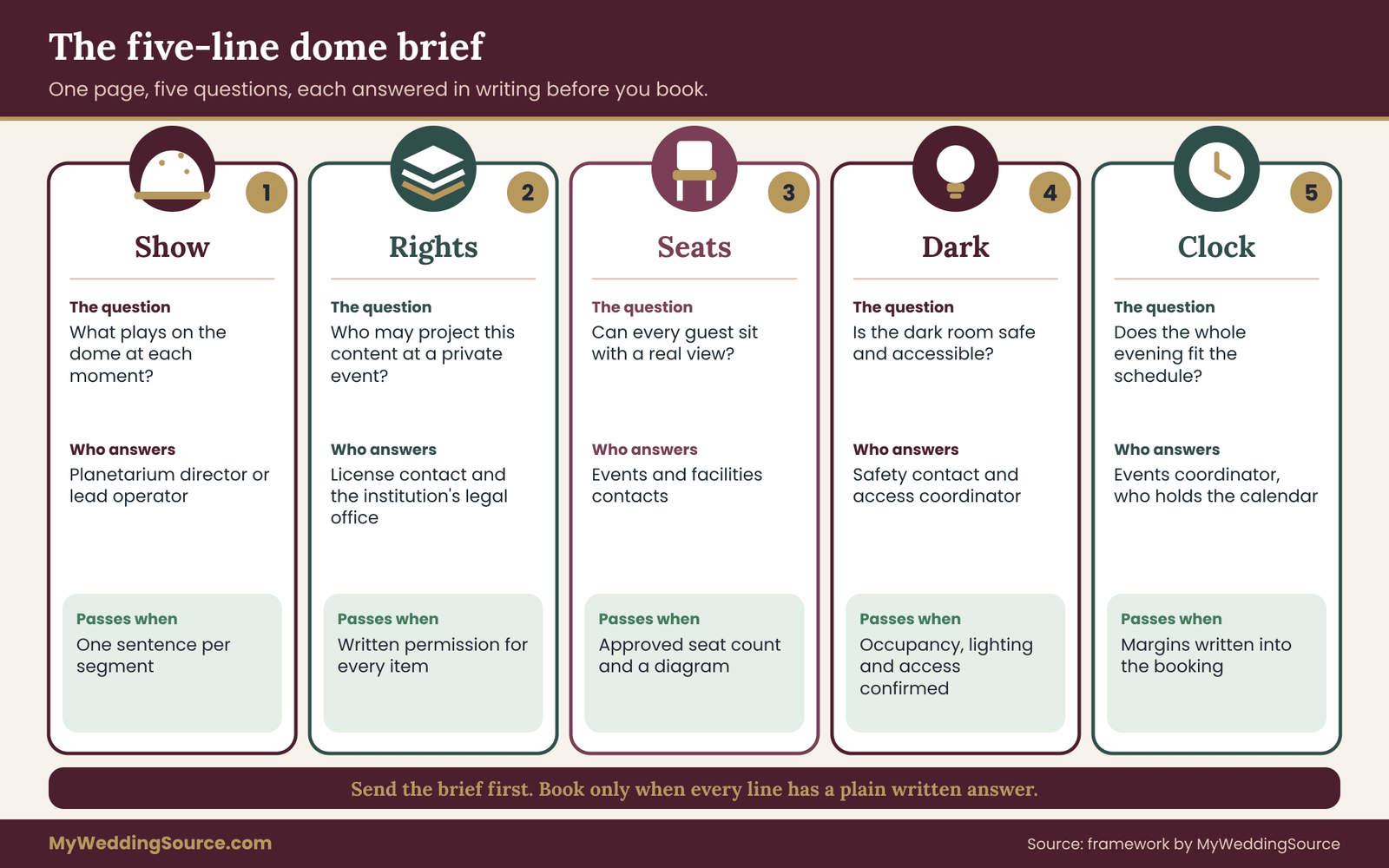
The method in this guide is a one-page document with five lines: Show, Rights, Seats, Dark and Clock. You fill it in before the first serious conversation, you send it to the venue’s event contact, and you ask them to answer each line in writing. Each line has a question, a person who can answer it, a piece of evidence and a pass-or-fail test.
The reason for a written brief is simple. Planetarium staff are usually enthusiastic about weddings, and the conversation on a tour can feel like agreement. But the answers that matter often sit with someone you have not met: the person who licenses the show content, the person who signs off on fire safety, or the institution’s risk office. A brief turns warm enthusiasm into a list of named answers.
Line one, Show. What exactly will be on the dome at each moment of the planetarium wedding? A live star talk, a licensed show, content you supply, or a still sky with no program. Every other line depends on this one.
Line two, Rights. Who has the legal right to put that content on the dome for your private planetarium wedding, and in what form? This covers the show itself, any music inside it, and anything you bring.
Line three, Seats. How many people can sit, where, facing what, and with what view of the couple? This includes the wheelchair spaces and companion seats.
Line four, Dark. What lighting stays on, how do guests with different needs move in a dark room, and what content or effects need a warning?
Line five, Clock. How long does each piece take, how does it fit around show cycles and the public day, and what happens to the sky outside while you are inside?
You do not need to be an expert to fill in a planetarium wedding brief. You need to ask in a form that gets a yes, a no or a number. The next sections take the lines one at a time, show what a good answer looks like, and give wording you can borrow. The method works for any planetarium wedding, whether the venue is a grand city dome or a small campus theater, because it asks about the same five things in both.
Who answers each line of a planetarium wedding brief
It helps to know in advance who should reply, so you can ask for the right person when the event coordinator says “let me check.”
Show questions go to the planetarium director or lead operator, the person who runs the dome day to day. Rights questions go to whoever manages content licenses, which is often the same director, with the institution’s legal or contracts office behind them. Seats and Dark questions go to the facilities and safety contact, and to the person who handles accessibility for the building. Clock questions go to the events coordinator, who holds the calendar.
If one person says they can answer all five, that is fine. Ask them to name who they checked with for the rights and safety lines. A short, specific answer such as “our fire marshal’s occupancy letter allows this many” is a good sign. A general “we do weddings here all the time” is friendly but is not evidence.
The pass-or-fail idea for a planetarium wedding
Each line ends in a simple test. Show passes when you can write one sentence naming what plays at each moment. Rights pass when the permission for each item is in writing from the party who can grant it. Seats pass when every guest on your list has a real seat with a view. Dark passes when the safe-movement plan and the content warnings are agreed. Clock passes when the whole day fits the venue’s schedule with a margin for delays.
If a line fails, you do not necessarily drop the venue. You change the plan until it passes, or you move that part of the day outside the dome. Later sections cover how to do that, and the section on failure conditions explains when to walk away instead.
Line one: what actually plays at a planetarium wedding
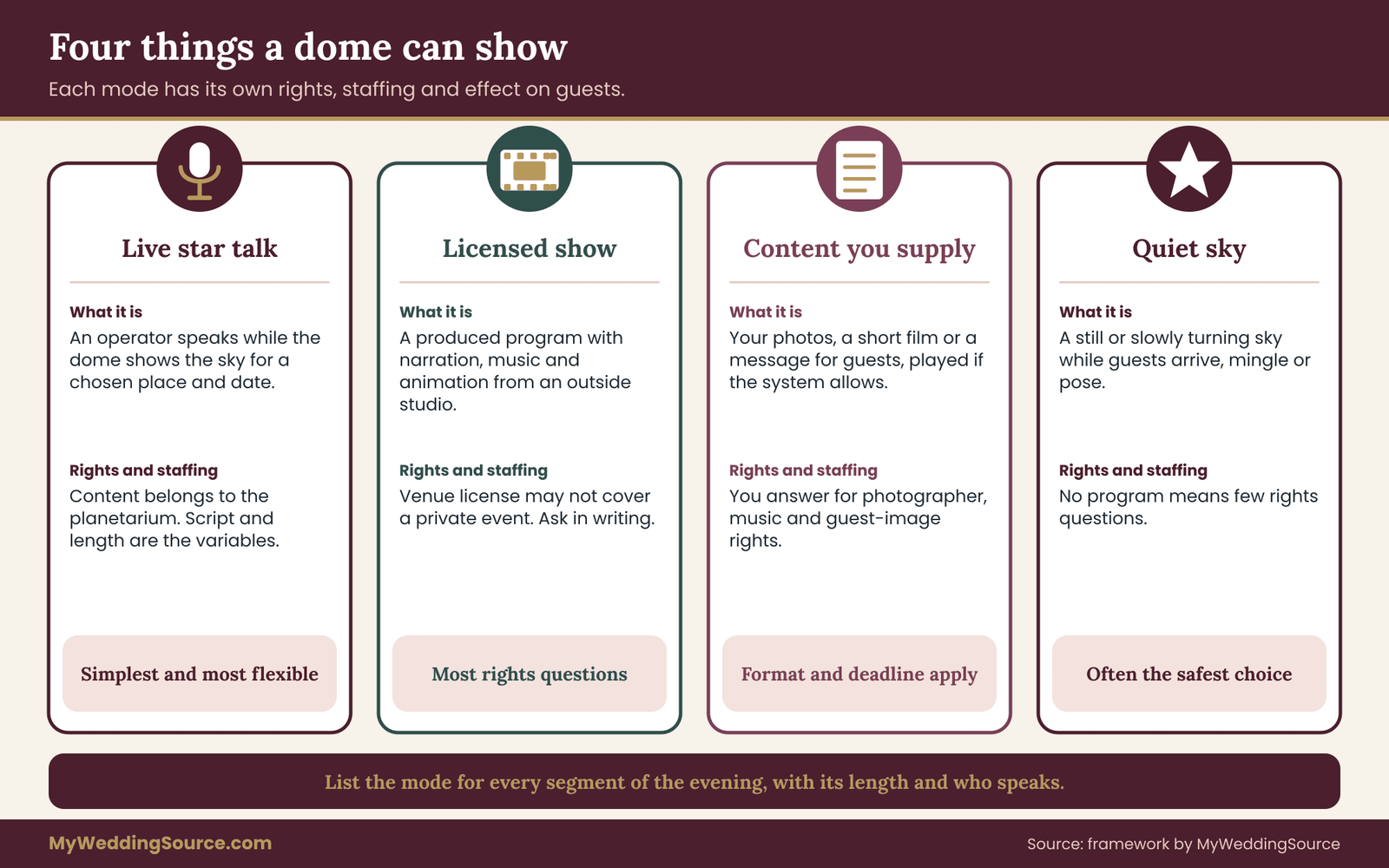
The first line of the brief is the one couples skip, because it feels obvious. Of course the stars will be on. But a dome can do at least four quite different things during an event, and each one has its own rights, its own staffing and its own effect on your guests. Decide which of the four you mean before you ask anyone a price.
Mode one: a live star talk. An operator or educator speaks while the dome shows the sky as it appears from a chosen place and time, usually generated by the planetarium’s own software or star projector. This is the plainest mode. The content belongs to the planetarium, the operator is already on payroll, and the main variable is the script.
Mode two: a licensed show. A produced program with narration, music and animation, made by an outside studio and licensed to the planetarium. These are the immersive pieces people remember. They are also the mode with the most rights questions, covered in the next section.
Mode three: content you supply. Your photographs, a short film, a slideshow of the two of you, a message to the guests. The planetarium plays it on the dome if its system and policy allow. The rights here are yours to check, because you are the one bringing the material.
Mode four: a quiet sky. The dome shows a still or slowly turning sky, with no program, while guests arrive, mingle or take photographs. It sounds like the cheapest choice and in practice is often the safest and most flexible.
Choosing a mode for each moment of a planetarium wedding
An event is not one mode. It is a sequence, and the brief should list the mode for each segment. A typical sequence might look like this in prose: guests enter under a quiet sky, the ceremony takes place with a live star talk replaced by silence or a short reading, the couple walks out, and guests return for a short licensed show or a set of your own photographs.
You can mix modes freely, but each switch has a cost. Every change means the operator cues something, the audio source changes, and the lighting changes. A segment list with the mode and the length beside it gives the operator a run sheet and gives you something to compare against the quote. If a planetarium cannot tell you how many operators are needed for your sequence, ask again after you send the list. The answer depends on the sequence, not on the venue’s general policy.
The ceremony is the weakest use of the dome in a planetarium wedding
This surprises people. A ceremony is a small, quiet event that wants eye contact and a clear sound for vows. A dome show wants the opposite: attention directed upward, reclined posture and a darkened room. Putting both together takes thought.
A common pattern is to hold the vows with a gentle quiet sky or a slowly changing starfield in the background and lights partly raised on the couple, then use the stronger projection afterward, when guests are settled and the pressure of the vows has passed. Another is to hold the ceremony in the lobby or outside and use the dome only for a shared moment afterward. Neither is a compromise. They match the room’s strength, which is a shared experience of looking up together.
If your ceremony is religious or cultural, there may be specific requirements about the setting, such as a canopy, a lit flame or a particular direction, that a dome cannot meet. The guide on interfaith wedding ceremony planning helps you decide who owns each ritual element, and that conversation should happen before the venue visit, not during it.
Sky choices: what the dome can say about your date
One of the real pleasures of a planetarium is that the sky can be set to a date and place. Many systems can show the sky as it appeared from a given city on a given day, so a couple can ask to see the sky from the night they met, from the hometown of a grandparent, or from the wedding date itself.
This is a nice idea and it is also a checkable one. Ask whether the system can set a date and location, whether that is a manual setting on the operator’s console or a prepared segment, and whether the planetarium charges for preparing it. Then ask what the sky will actually show. A dome sky for a daytime wedding hour will not include a dark night unless the operator chooses to simulate one, and a sky set to a date years in the past is a straightforward setting for most software but may be unavailable on older optical projectors.
Be careful with claims in your own program notes. If you print that a particular planet or constellation will be overhead, confirm it with the operator, who can check it in the software. A guest who happens to know the sky will notice an error, and a printed program makes it permanent.
What to write on line one
Write a short list of segments. For each one, give a number, a mode, a length and who speaks. Here is the pattern in plain words rather than a table:
Segment one is guest arrival, quiet sky, thirty minutes, no speaker. Segment two is the ceremony, quiet sky with the lights partly up, twenty minutes, officiant speaks. Segment three is a short program, licensed show or live talk, with a length the planetarium names. Segment four is photographs, quiet sky, with lights raised. Segment five is exit.
You will adjust the numbers, but the habit is what matters. When the brief lists the modes, every later question about rights, seating and timing has something concrete to attach to. Without it, those questions float, and the planetarium has to guess what you mean.
Rights: who may project what at a planetarium wedding
Line two is where a planetarium wedding differs most from any other venue. A hotel ballroom has no opinion about your slideshow. A dome has several parties with legitimate interests in what appears on it, and most of them are not in the room.
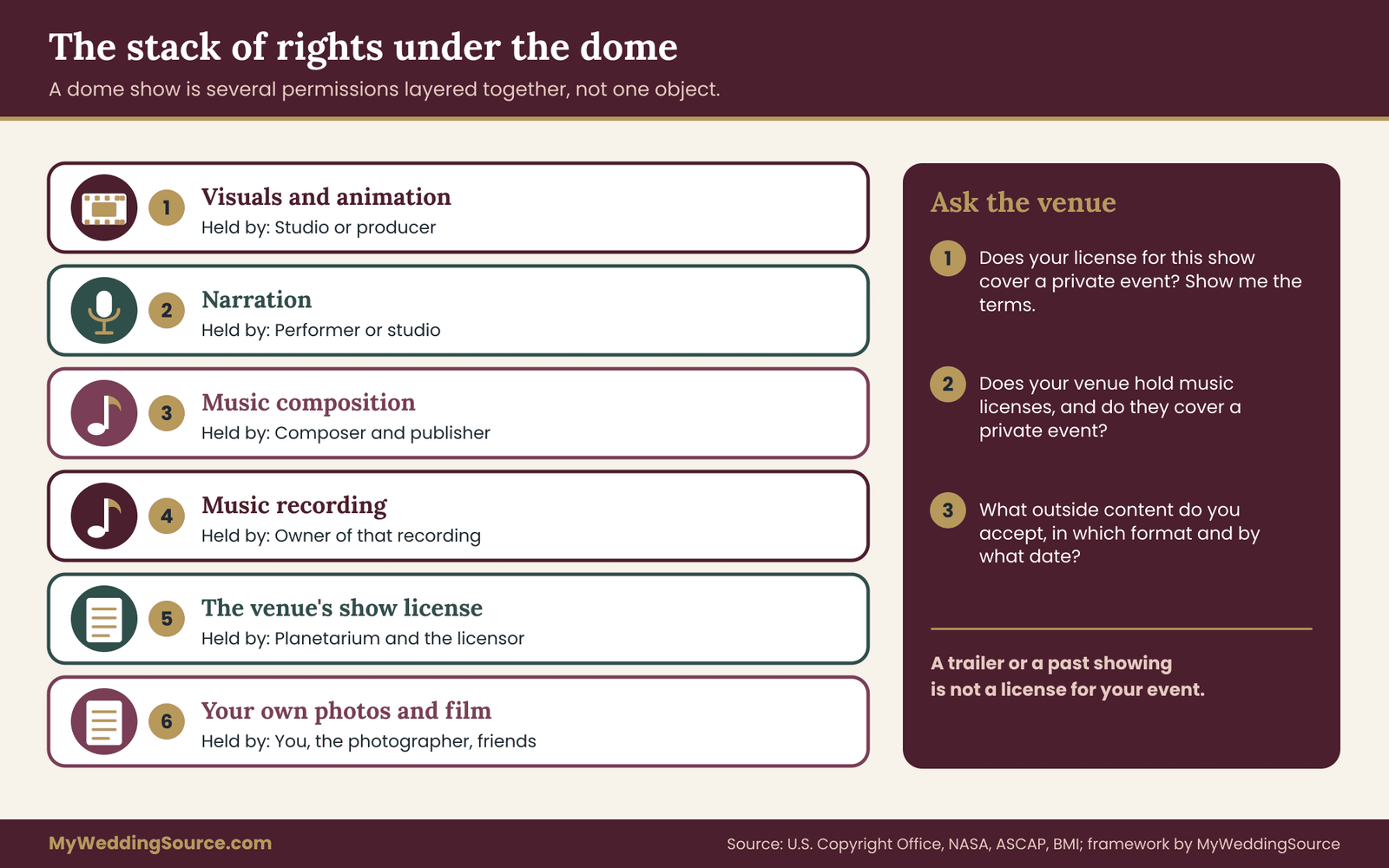
Start with the idea that a dome show is not a single object. It is a stack of rights. The visuals belong to a studio or producer. The narration may belong to a performer or the studio. The music belongs to composers, publishers and sometimes a separate owner of the recording. The planetarium holds a license that lets it show the program to its audiences under certain terms. Your private planetarium wedding is not automatically inside those terms.
The licensed show at a planetarium wedding
Studios generally license fulldome shows to planetariums for exhibition. The license may specify the number of showings, the type of audience, whether tickets are sold, the length of the term, and whether the show may be used for private or corporate events. A planetarium that runs the show for the public every weekend might still not have permission to run it for a ticketless private group, or might need to ask the studio for a one-time clearance.
The honest question to ask is not “can we play this show?” but “does our license for this show cover a private planetarium wedding, and can you show me the relevant terms or the studio’s written answer?” Staff will often know the answer from experience. If they do not, they can ask the producer, and many are glad to when a clear request arrives.
Do not assume that a show you saw at the planetarium is available because it was shown there. Do not assume a show you found online is permitted either. A trailer on a studio website is a sample of work, not a license.
Industry bodies exist for exactly these conversations. The International Planetarium Society and the Giant Screen Cinema Association, both listed in the Sources, are places where planetarium staff and producers meet, and their materials are a reasonable place to see how licensing in the field is usually discussed.
Music and narration inside a planetarium wedding program
Music is the layer most couples forget. If you want a favorite song under the dome, you are asking for two different permissions, and neither is the same as owning a copy of the song.
The first is the right to perform music publicly. In the United States, performing rights organizations such as ASCAP and BMI license that right on behalf of composers and publishers, and many venues hold blanket licenses for the music played in their spaces. Whether a given planetarium holds one, and whether it covers a private planetarium wedding, is a question for the venue, not an assumption for you.
The second is synchronization: pairing a piece of music with moving images, as you would in a slideshow or a short film. That generally requires permission from the owner of the composition and, if you use a particular recording, from the owner of that recording. Buying a song from a store or streaming service does not grant it. The U.S. Copyright Office explains the basics of these rights on its website, and it is a good plain-language starting point.
For a live event, the simplest route is usually the cleanest.
The options are a live musician playing public-domain music or their own, a recording made by someone who has agreed in writing, or the planetarium’s own library of tracks that it already licenses for its programs. A quartet in the lobby, with the dome used for the quiet sky, avoids most of the question entirely. If you already have a music plan for other parts of the day, the guide on wedding reception music planning covers how to build a set that suits different generations, and the same thinking applies here.
Your own photographs and film in a planetarium wedding
When you supply photos or a short film, you are the one who needs to answer for the rights. For most couples this is simple but not trivial.
If a professional photographer took the pictures, their contract decides what you may do with the files. Many contracts grant a personal-use license, which may or may not stretch to projecting images in a public room. Ask the photographer before you build a program, and put the answer in writing. If a friend or family member shot some of the images, ask them directly. If guests appear in your slideshow, think about whether they would be comfortable seeing themselves ten feet wide, and ask yourself the same about children.
Images of the sky itself have their own status. NASA states that its images and media are generally not subject to copyright in the United States, but that some material comes from other sources and may be copyrighted, and that its name and insignia cannot be used to suggest endorsement. If you use space imagery in your content, check the specific image’s credit line and the agency’s media usage guidelines, which are linked in the Sources.
Outside equipment and operators at a planetarium wedding
A third rights question concerns hardware. Some couples want a favorite DJ to play a set, a video team to run their own projection, or a friend with software to take over the dome. In a planetarium that is almost always a no, or a narrow yes, for reasons that have little to do with rights and a lot to do with risk. The dome projection system is expensive and specialized. Operators are trained for it. The planetarium’s insurer and its parent institution probably restrict who can touch it.
Ask three questions. Can an outside vendor connect to the audio system, and under whose supervision? Can outside content be loaded onto the dome, and in what file format and by what date? And is an in-house operator required for the whole event, and at what hourly or flat rate? The answers affect both the plan and the price, and they belong in the contract. The guide on wedding vendor contracts explains what a good vendor agreement states, and it applies equally to an in-house operator provided by the venue.
What to write on line two
List every item that will appear or be heard: the show, each song, each photo set, each film clip, the narration. Beside each item, write who holds the rights, what permission you have, and what the permission says. If you do not know, write “unknown” and add it to the questions for the planetarium.
A line passes when each item has a name beside it and a written permission, or when you have dropped the item. A common outcome is that a couple replaces a licensed show with a live star talk from the planetarium’s own operator, keeps their own photo slideshow with permission from the photographer, and uses live music in place of a recording. That plan is less flashy than the one on the original Pinterest board and much less likely to be stopped at the door.
Line three: seats and sightlines at a planetarium wedding
If rights are where a planetarium wedding is most legally careful, seating is where it is most physically different. A dome theater is built for a particular kind of watching, and your ceremony has to either work with that or move out of the way of it.
How dome seating works for a planetarium wedding
In many fixed domes, seats sit in rows on a floor that may be level or gently raised. Seats may recline, so that guests can look up without strain, and they often all face one direction, toward the front of the room. Some rooms arrange seats in a ring around a central projector, so guests face inward. The floor tilt, the seat angle and the position of the screen all vary from room to room.
For a wedding, three practical effects follow. First, guests who recline to view the dome cannot easily see a couple standing at the front at normal height. Second, if all seats face one way, the couple stands with their back to the dome or in front of the first row, and guests in the back rows see them from far away and at a low angle. Third, aisles may be narrow, and a processional with a long dress or a wheelchair through the aisle may need rehearsal.
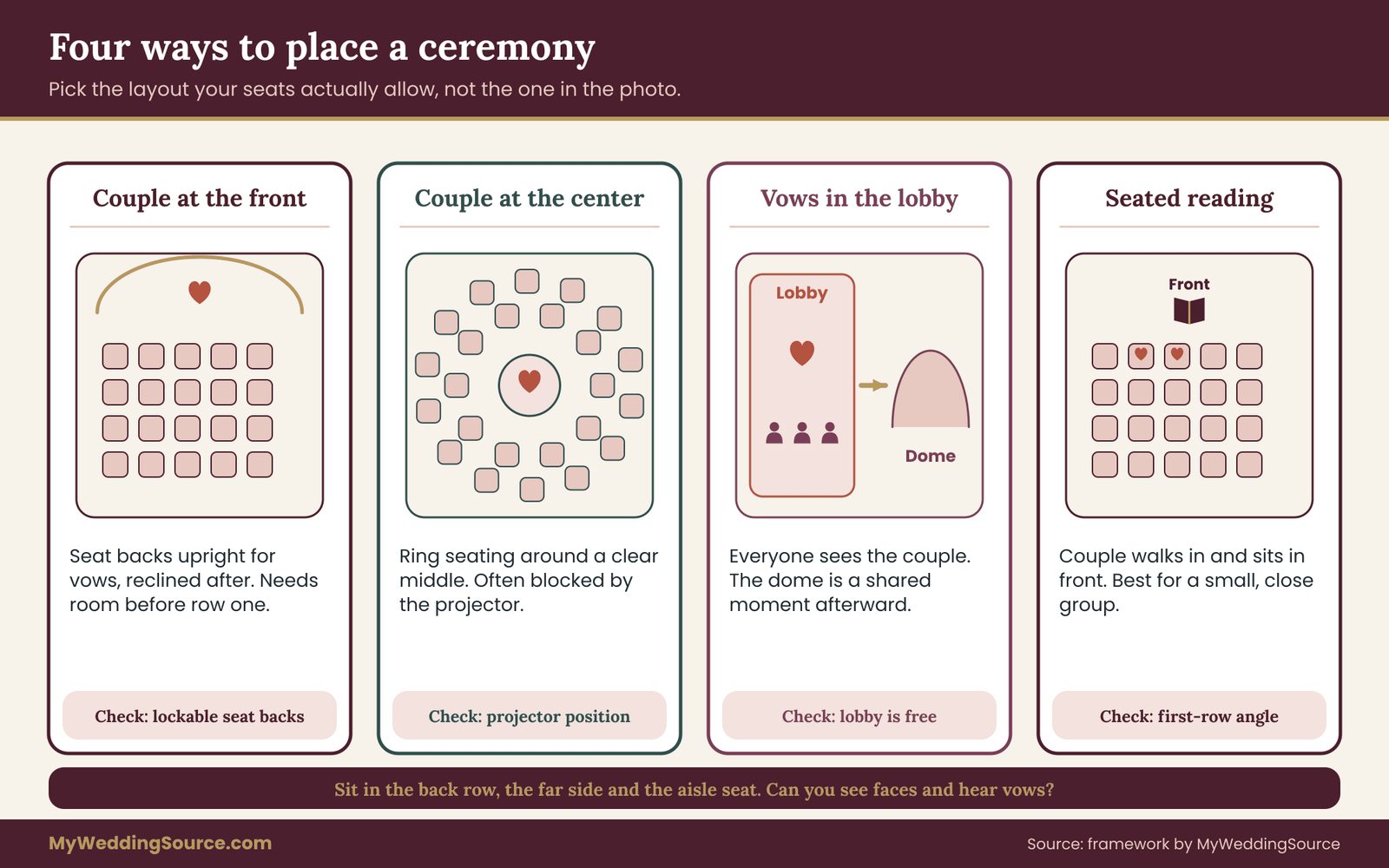
Four ways to place a planetarium wedding ceremony
There are four sensible layouts. The right one depends on the seats you have, not on the picture you saw.
Couple at the front, guests recline. The couple stands where the show’s host would stand, in front of the first row. Guests keep their seats upright for the ceremony and recline afterward for the show. This works in rooms where the first row is far enough back for the couple to stand comfortably. Ask whether seat backs can be locked upright for the ceremony.
Couple at the center. In a ring or a room with a central projector, the couple stands near the middle and guests surround them. The projector often occupies that spot, so this is usually possible only in some rooms or with a mobile structure, and it must be cleared by facilities.
Couple outside, guests inside. The vows take place in the lobby or on a terrace, and guests enter the dome after the ceremony for the shared moment under the sky. This avoids almost every sightline problem and keeps the dome for what it does best.
No couple on the dome floor. The couple enters at the back, walks the aisle, and takes seats in the front row for a short reading, a star talk or a toast, rather than a standing ceremony. This is the simplest layout and fits a small, intimate group.
The sightline test
Before you commit, walk the room with the event contact and do a simple test. Sit in the back row, in a seat at the far side, and in a seat nearest the aisle. Ask the contact to stand where the couple would stand. Can you see their faces? Can you hear a normal speaking voice? If the room has an amplification system, ask for a short test with a microphone and listen from three seats.
A dome has a second feature that surprises people: sound. Curved ceilings can focus or scatter sound, so a voice that is clear in one seat may be muffled or echoing in another. A venue that regularly runs live talks will know where the good and poor seats are. Ask them. Their answer is more reliable than yours after one visit.
Also ask about the first-row rule. In many domes the front seats look nearly straight up at a steep angle that suits a show and wears the neck during a long event. Parents and grandparents, who tend to be seated in the front for a ceremony, might be better placed in a comfortable mid-room seat. The guide to wedding seating charts covers how to decide who sits where, and the same decisions apply here with an added question about neck comfort.
Capacity: the number that decides a planetarium wedding
Every dome has a seat count, and it is usually smaller than a couple expects. The count that matters is not the figure in a brochure. It is the number of seats that remain after you subtract wheelchair spaces, companion seats, the control booth, any seats that are removed for equipment, and any seats the fire authority will not allow you to use.
Ask for the exact count that the planetarium will approve for a private planetarium wedding, and ask for it in writing. If your guest list is larger than that number, you have a decision to make, and the options are covered later: split the planetarium wedding, host the dome portion for family only, or use the dome for a part of the day and a larger room for the rest. The guide on cutting a wedding guest list helps if the number forces hard choices.
What to write on line three
Write the seat count you need, the layout you prefer and a fallback layout. Add the number of guests who need accessible spaces or companion seats, with the real number from your RSVPs rather than a guess. Add the question, “Can you confirm the approved seat count for a private planetarium wedding and send a seating diagram?” A diagram settles most disputes, because it shows both of you the same room.
Line four: the dark, accessibility and comfort
A dome show works because the room is dark. A wedding works because everyone can find their seat, their coat, the restroom and the exit. Line four is where those two facts have to agree. It is also the line where a planetarium wedding is most likely to leave one guest uncomfortable without anyone noticing until afterward.
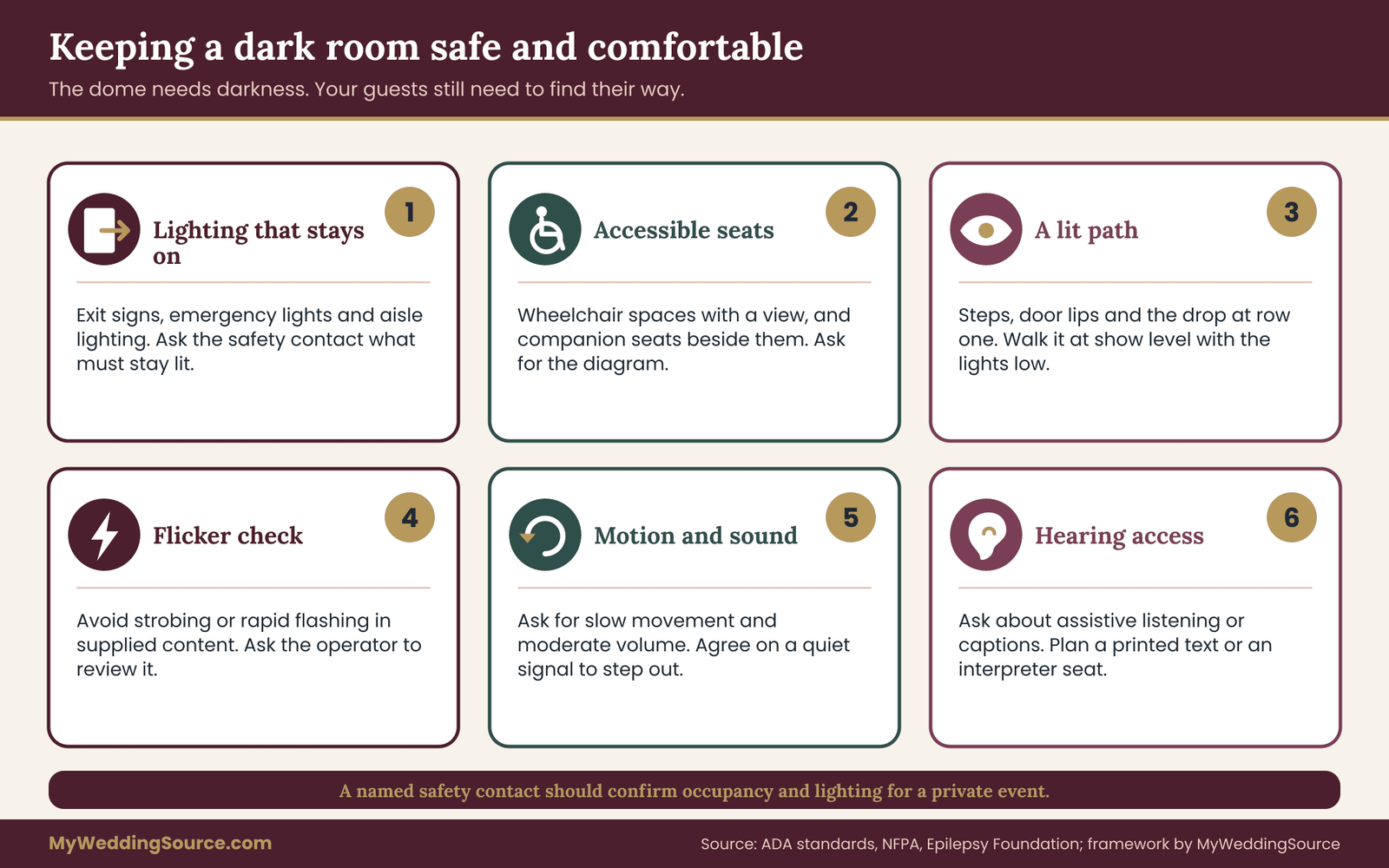
What stays lit during a planetarium wedding
Every public room with an audience has lighting that cannot be turned off, including exit signs and emergency lighting that guide people out if something goes wrong. In the United States, fire and life safety codes for places where people assemble address exits, signage, emergency lighting and occupancy limits, and the local fire authority applies them. The National Fire Protection Association publishes the model codes that many jurisdictions adopt, and its site explains the framework in general terms.
You do not need to read a code. You need to ask the planetarium which of these facts apply to a private planetarium wedding: the maximum occupancy of the dome as approved for assembly, the minimum lighting that must stay on during the planetarium wedding, and whether an attendant or staff member must be present throughout. The answers should come from the facilities or safety contact, not from the events coordinator’s memory. Ask for the occupancy figure on paper.
A dim path is not a safe path for everyone. Steps in the aisle, a raised lip at the dome door, a drop at the first row and cables near the projector are all things a guest may not see in low light. Ask whether aisle lighting, step markers or handrails are present, and walk the path yourself with the lights at show level.
Wheelchairs, companions and access at a planetarium wedding
Accessibility in a dome is not an extra. It is a core planning item, and it begins with the seat count. In the United States, the ADA design standards address wheelchair spaces in assembly areas, companion seats next to them, and lines of sight so that people using wheelchair spaces can see. The Department of Justice publishes the standards at ada.gov, and the planetarium’s access coordinator or legal office applies them to its building.
For your guests, the practical questions are specific. How many wheelchair spaces does the dome have, and where are they? Can a guest sit in a space and still see the dome and the couple? Are companion seats beside the space, so a family member does not sit rows away? Is the path from the entrance to the space step-free and wide enough, in the dark, with a lit route? And what is the plan for guests who use a cane, a walker, or who tire easily and cannot recline for long?
If any of your guests need these things, say so early. Most venues are glad to plan a specific arrangement when told, and are less able to help when told on the day. The guide on accessible wedding venue red flags lists warning signs to look for when you tour, and many of them apply to a dome: narrow doors, unmarked steps, no seating for a companion and a lack of any accessible restroom nearby.
Hearing access matters as well. A dome show typically relies on audio from speakers around the room. Ask whether the planetarium offers assistive listening or captioning, and how a guest who is deaf or hard of hearing would follow a live talk or a vow. The ADA standards also address assistive listening in assembly areas that use amplified sound, so the venue should be able to say what it offers. If it offers nothing, you can still plan around it: a printed text of the ceremony, a sign-language interpreter near the front, or a seat near a speaker.
Flicker, motion and sensory comfort at a planetarium wedding
Dome content is full of movement. A fly-through of a star cluster, a sweeping rotation of the sky or a rapid sequence of lights can look beautiful to most people and feel unpleasant to some. A few things deserve a line in your brief.
Flashing or flickering light can affect people with photosensitive epilepsy. The Epilepsy Foundation explains photosensitivity and the kinds of visual patterns that can be a trigger. If you plan to supply your own content, avoid rapid flashing, strobing sequences and quickly repeating high-contrast patterns, and ask the operator to check anything they run. If there is any chance a guest has this condition, a short heads-up at the door is an act of care and costs nothing.
Motion on a dome can cause dizziness or nausea in some viewers, particularly when the whole ceiling seems to move. Ask the operator whether they can keep movement slow, and agree on a signal so a guest can step out quietly. A seat near the door, or a seat in the lobby with a view of a screen, is a good option for anyone who wants to leave without disturbing others.
Darkness and loud sound can be hard for some guests, including some autistic guests, young children and people with anxiety. Seating near an exit, a short break between segments and a quiet space nearby make the planetarium wedding easier. The guide on wedding guest care planning offers a way of thinking about babies, children and older relatives, which includes many of the same needs.
What to write on line four
Write the minimum lighting you require during each segment, the number of accessible seats you need, the content that will be checked for flicker and motion, and the plan for a guest who needs to leave. Add a question: “Who is the named safety contact, and can you confirm the occupancy and lighting conditions for a private planetarium wedding?”
A line passes when a named person has confirmed the occupancy and lighting limits, accessible seats and companion seats are marked on the diagram, and the content has been checked for flicker. If the planetarium cannot name anyone for safety, treat that as a serious gap.
Line five: timing a planetarium wedding around show cycles and the sky
The last line is the clock. A planetarium is a facility with a daily rhythm, and a wedding has its own rhythm. Fitting them together is a puzzle with real constraints, and a few of them are easy to miss.
The building’s day around a planetarium wedding
Many planetariums run school groups in the morning, public shows in the afternoon, and on some nights a late program. A private planetarium wedding might fit into a gap, take over the evening after the last public show, or take the whole building on a closed day. Each of these has a different price and a different practical effect.
Ask what the possible windows are, how long the dome is available inside each, and how much time the planetarium needs for setup and reset. A wedding needs room before and after the events: decor, rehearsal, tech check, cleanup. A dome that is available from seven to nine may in practice give you ninety minutes of real use, with the rest taken by staff who need to arrive early and leave late.
The show cycle and a planetarium wedding
A dome program has a fixed length, and there is often a turnaround period between programs for staff to reset the room. If your planetarium wedding includes a licensed show, the length is not negotiable. If it includes a live talk, the operator can often adapt the length, but needs a number.
For a rough sense of what fits, here is a way of thinking rather than a promise. A ceremony of twenty minutes or so, a program of about the same length and a short period of photographs and mingling can all fit inside a ninety-minute dome window, provided that guests are seated at the start and that nobody is held up at the door. A long ceremony, a long show and a slow entry will not fit, and the sensible response is to cut or move one of them.
Guest flow: entering and leaving a dark room
Dark rooms slow people down. Guests enter in small groups, stop to let their eyes adjust, search for seats and ask each other where to go. A crowd of ninety can take much longer than you expect to settle. Build in time for it, and ask the planetarium how long a typical audience takes to enter and seat.
The same is true at the end. After a show, a room of seated guests stands up slowly, particularly if seats recline. If the next segment is a reception in the lobby, the exit takes time, and the staff need the room cleared to reset. The guide on reception guest flow explains how to plan entry, seating, food and exit as a sequence, and that sequence applies at each doorway between the dome and the rest of the building.
The sky outside a planetarium wedding
A planetarium wedding also happens beneath the real sky, which is a separate fact from the one on the ceiling. If your planetarium wedding happens near sunset, the light in the lobby and outdoors will change as guests move between spaces. Photographers care about this in particular. The U.S. Naval Observatory’s astronomical applications site provides sunrise, sunset and twilight times for any location and date, so you can plan the outdoor portion around real light rather than a guess.
There is a nice option here that costs nothing: use the real sky as part of the day. A short step onto a terrace at dusk, followed by a return to the dome, links the real and the projected sky, and it also gives the venue a natural way to manage entry. Whether it is possible depends on the building and the weather, so make it a bonus and not the plan.
What to write on line five
Write the date options, the time window you need, the length of each segment, the setup and reset time you expect to need, and the buffer you want at the end. Ask the planetarium to confirm the dome window, the earliest load-in, the latest departure and any public programs that overlap with you.
A line passes when the planetarium’s confirmed schedule contains your whole sequence, with ten to fifteen minutes of margin around the dome segment, and when the margin is written into the booking, not agreed on the phone.
Vendors under the dome at a planetarium wedding
Once the five lines are in good shape, the vendors come next. A planetarium wedding asks different things of a photographer, a florist, a caterer and a musician than an ordinary room does, and each of them should hear about the dome before they quote, not after.
Photographers and video teams at a planetarium wedding
A dark dome is a hard room to photograph, and a photographer who has not worked in one should be told what to expect. The light comes from the projection overhead, which changes color and brightness through the program. Faces can fall into shadow. Flash may be prohibited, because it spoils the show for everyone else and can wash out the dome. A tripod may be restricted for safety in a dim room.
Ask your photographer whether they have shot in low light without flash, and ask to see examples from similar rooms in their own portfolio. Do not accept a general promise. Then ask the planetarium for three things: whether flash is allowed at any time, whether there are moments when the lights can be raised for portraits, and whether the photographer may visit the room beforehand to test settings.
A useful compromise is to schedule portraits with the lights up, before or after the dome segment, and to treat the dome segment as a documentary moment with available light. A walkthrough before the day lets the photographer see how the projection falls. The guide on venue technical walkthroughs explains how to measure and record what each vendor needs, and a planetarium visit is a strong case for it.
A videographer has an extra question: does the planetarium allow recording of its content? The visuals you see on the dome may be licensed, and a recording of a licensed show shared online could create rights problems of its own. Ask the planetarium whether the video team may record the ceremony only, the show, or both, and make sure your video agreement matches.
Flowers and decor for a planetarium wedding
Decor under a dome has three rules, and they are mostly practical. Nothing should block sightlines or exits. Nothing should hang from the dome or the ceiling structure. And nothing should reflect or glow in a way that disturbs the projection.
Tall centerpieces are the first problem. In a room where guests recline and look up, a tall arrangement in the aisle is both a view blocker and a trip hazard. Low arrangements near the front, or arrangements at the lobby tables instead of the dome, are usually safer. Real candles and open flame are almost always prohibited in a theater with fixed seating, so battery-powered lights are the alternative, and they should be dim, because a bright bulb can wash out part of the sky.
Ask about fog, haze, confetti, petals and sparklers. A projector is sensitive to dust and particles, and many facilities say no to anything that might drift into equipment. Ask about adhesives on walls and signs, and about weight on the floor. The same principle applies to anything you might fix to a wall: ask before you attach it.
Catering and drinks at a planetarium wedding
Most dome theaters do not allow food or drink in the seating area. The reasons are simple: spills near electronics, crumbs in seats and cleanup time between programs. Expect the cocktail hour and the dinner to happen in the lobby, a gallery or a hall rather than under the dome, and ask the planetarium which rooms are available for serving and where the kitchen access is.
If you plan a toast under the dome, ask whether a drink may be carried in, and in what kind of container. Some venues allow a sealed or covered cup in the room for a short moment. Others do not allow any drink at all. An alternative is to raise glasses in the lobby, then walk in for the dome segment.
For a food plan that covers different ages and dietary needs, the main food questions are covered elsewhere on the site, but at a planetarium the first question is where service is allowed, not what is on the plate. Alcohol raises further questions. If the planetarium is a public or educational facility, its policy may restrict or prohibit alcohol, or require a licensed bar service and a security presence.
Music and sound
Ask whether the dome’s audio system can be used for the ceremony and, if so, who runs it. Many domes have a high-quality system designed for the show, and a live microphone may need to be patched in by the operator. A wireless microphone for an officiant is an easy request in some rooms and a long conversation in others.
An outside DJ is a harder request, as covered earlier. For a reception, the more common route is to move the dancing to a room that is not the dome. A lobby or hall with its own audio, with a DJ or a band, is a more natural setting than a theater with fixed seating and no dance floor.
Insurance and the vendor paperwork
Public venues and their parent institutions often require outside vendors to carry insurance and to provide a certificate naming the institution. Ask early, because insurers can take days to issue a certificate, and the venue may reject a certificate with the wrong wording. Ask the venue for its exact wording requirements in writing.
Ask also about the venue’s approved vendor list. Some planetariums, like some museums, require you to use their caterer or their preferred vendors. If so, ask about the terms and costs early, before you commit to other contracts. Then run any vendors you choose through the checks in the wedding vendor due diligence checklist, so a vendor’s first visit to the dome is not a surprise to either side.
Sending the inquiry brief to a planetarium wedding venue
You now have enough to write the actual brief. This is the document you send, and it is built for a busy event contact who wants to say yes but needs to know what you are asking. Short, specific and numbered is better than warm and long.
What the email contains
Open with who you are, the date range and the guest count. Then give the five lines, each in two or three sentences. Close with a request for a written reply to each line by a stated date, and an offer to visit.
Here is a sample, in your own words, adapted to your situation. The numbers are placeholders.
“We are planning a private planetarium wedding for about eighty guests on one of three dates in the autumn. We would like to hold a short ceremony and a program under the dome, and a reception in your lobby or a nearby room. We have five questions and would be grateful for a written answer to each.”
“One, show: we would like a live star talk and a quiet sky, and we are open to a licensed show if your license allows it. Two, rights: can you tell us whether your license for each show covers a private planetarium wedding, whether any music we supply needs clearance, and what outside content you accept?”
“Three, seats: what is the approved seat count for a private planetarium wedding, how many wheelchair spaces and companion seats are there, and can you send a seating diagram? Four, the dark: what lighting must stay on, who is the safety contact, and what is the occupancy limit for assembly? Five, clock: which dates and time windows are open, how long are setup and reset, and which public programs overlap?”
“Could you reply to each by a date two weeks from now? We would also like to visit the dome and sit in a few seats, if that can be arranged.”
How to read the reply to a planetarium wedding inquiry
A good reply addresses the five lines, in order, and names a person for rights and safety. A mixed reply answers three and ignores two. Do not read silence on a line as consent. Write back with the specific missing items, in a short follow-up.
Watch for three signals. Warm language with no specifics, such as “we love weddings, come and see,” means you do not yet have an answer. A specific answer with a named person and a document, such as a seat diagram or an occupancy letter, is a real answer. And a “we will see” on rights usually means the planetarium has not asked the licensor yet. Ask them to.
Keep the reply together with your brief in one folder. If a later change occurs, such as a new operator or a changed schedule, you can compare against the written answers and ask for an amendment rather than relying on memory. Keeping contracts and email in order is a habit that starts now, with this first thread.
A worked case: one planetarium wedding brief, filled in
The best way to see the brief work is to fill one in. What follows is an invented example, built to show the method. The couple, the dome and every number below are made up for illustration, and none of it describes a real venue or a real event.
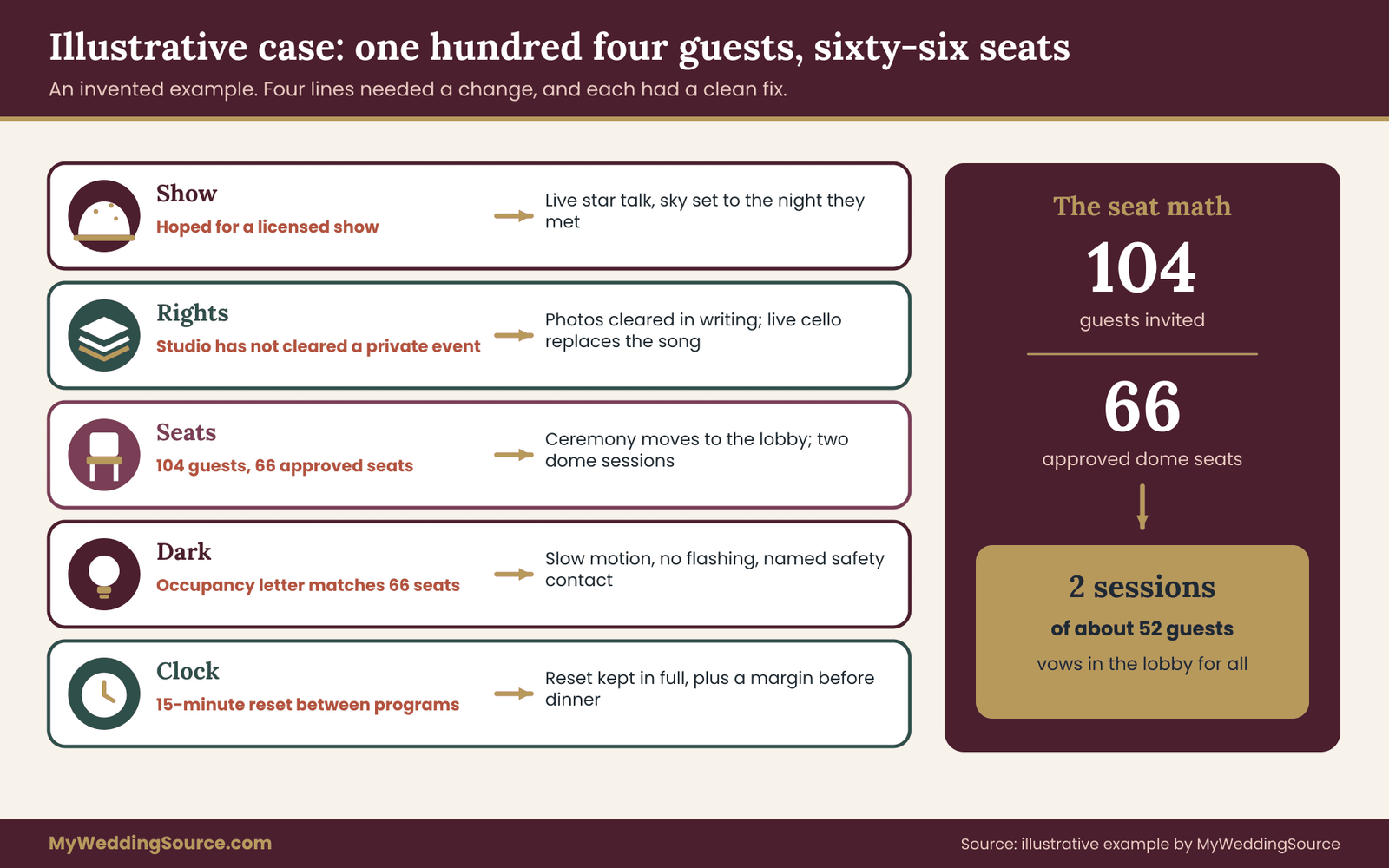
Call the couple Dana and Luis. They have a guest list of one hundred and four people and a university planetarium in mind. They have toured the lobby and love the dome. They send the five-line brief and, after two weeks, get written replies.
What came back
Show. The planetarium offers a live star talk by its own operator, a quiet sky and a licensed show that it runs for the public on weekends. Dana and Luis hoped for the licensed show.
Rights. The planetarium’s reply says that its license for the show covers public programs and that it has not confirmed whether a private planetarium wedding is included. It offers to ask the studio, which may take several weeks. Dana’s photographer confirms in writing that the engagement photos can be projected. The couple wanted a pop song under the slideshow, but the venue holds no license for supplied recordings and suggests a live cellist or the planetarium’s own library of tracks.
Seats. The approved seat count for a private planetarium wedding is sixty-six, after removing the control-booth positions, with four wheelchair spaces and four companion seats included in that figure. The seats face one direction and recline.
Dark. The fire authority’s occupancy letter matches the sixty-six seats. Aisle lighting and exit signs stay on. The operator will keep motion slow and avoid flashing on request. A named facilities contact is given.
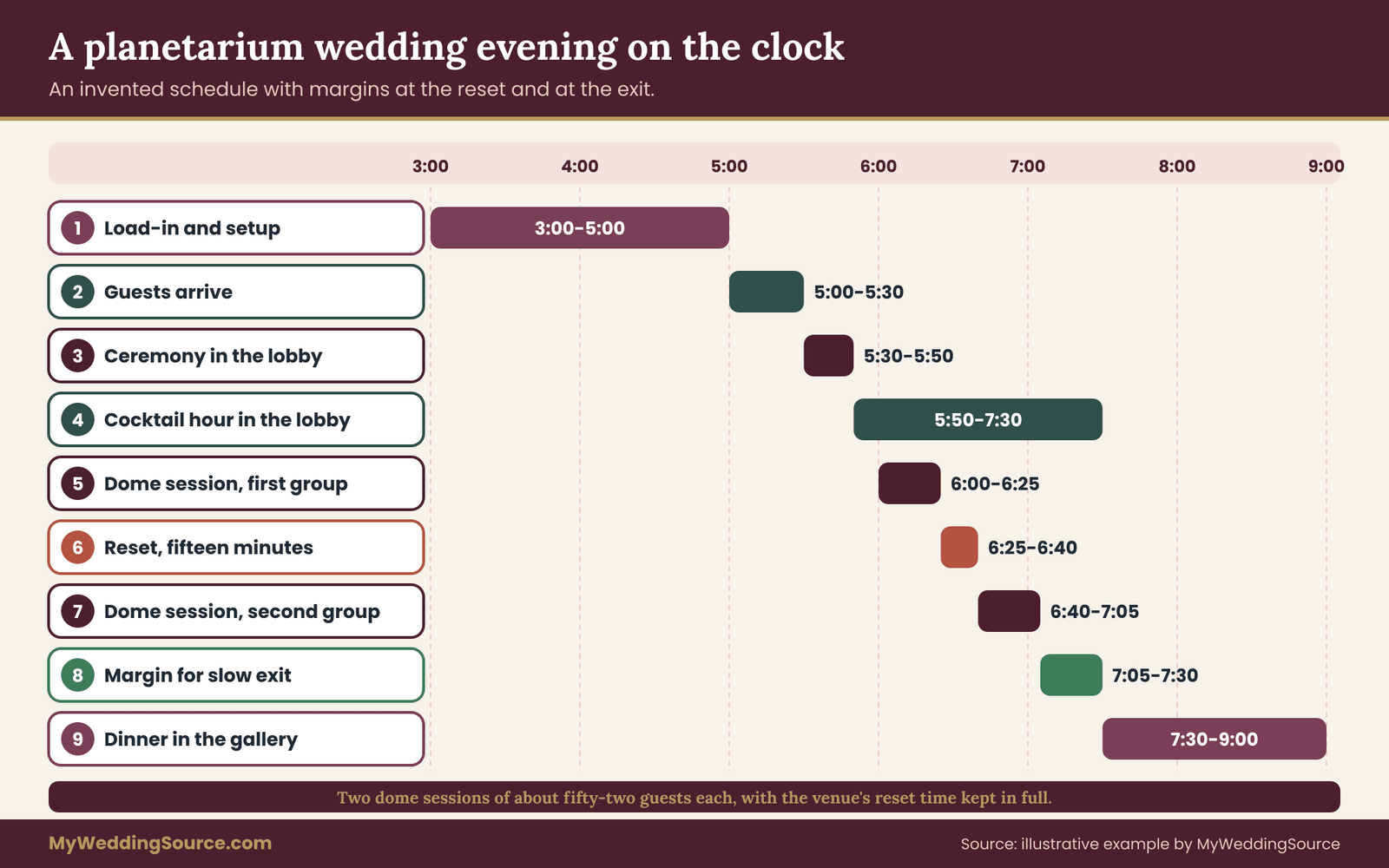
Clock. The dome is available from five to nine on a closed Friday, with load-in at three and a reset period of fifteen minutes between any two programs.
The decisions for the planetarium wedding
Four of the five lines have a problem, and each has a clear response.
The show line leads to a decision about the licensed program. Because the rights answer is unresolved, Dana and Luis stop waiting for the studio. They choose a live star talk, with the sky set to the date and city where they met, and they treat the licensed show as a bonus only if the studio replies in time.
For rights, the slideshow stays, with the photographer’s written permission, and the pop song goes. A cellist from the couple’s circle plays during the slideshow, and the planetarium’s operator confirms in writing that the cello can be played in the room.
For seats, the arithmetic is simple: one hundred and four guests, sixty-six seats. They do not try to squeeze in. Instead, they move the ceremony out of the dome altogether, holding it in the lobby so that all one hundred and four guests see the vows. Then they run two dome sessions of about fifty-two guests each, while the other half enjoys the cocktail hour.
For the clock, they build a plan with real margins, laid out below.
The schedule they built
Guests arrive at five o’clock and the ceremony begins at half past, in the lobby, lasting twenty minutes. At ten to six the cocktail hour begins and the first group of guests heads to the dome. The first session runs from six to twenty-five past, including entry time. The planetarium’s fifteen-minute reset follows, and the second group enters. The second session runs from twenty to seven until five past seven. Dinner begins at half past seven, in the gallery, and the venue closes at nine.
Notice what the margins do. The reset is fifteen minutes in the planetarium’s terms, so the schedule uses fifteen, not a hopeful ten. Dinner starts twenty-five minutes after the last dome session ends, which absorbs a slow exit from a dark room. And the couple confirms in writing that the nine o’clock closing leaves time for cleanup. The plan is less elegant than the dream, and it works for every guest on the list.
What the example teaches
Three points apply to almost any planetarium wedding.
First, the dream and the plan can differ and still be good. The couple wanted the stars as the setting for the ceremony. They got the stars as a shared experience just after it, with every guest present.
Second, the written answers made the decisions easy. Each line produced a number or a named permission, and the numbers were what drove the layout. Without the brief, the same conversation could have continued for weeks on friendly assumptions.
Third, the most significant risk was not the dome but the licensed show. If the couple had planned around it and waited, they would have lost time, and possibly the date, for an answer they could not control. Treating an unconfirmed right as a bonus, not a foundation, is the most useful habit in the whole method.
When a planetarium wedding will not work: alternatives and failure conditions
Sometimes the five lines will not pass. That is information, not failure on your part. A dome is a specialized room, and some events do not fit it. The goal is to recognize the situation early and respond with a good alternative instead of forcing the plan.
Failure conditions for a planetarium wedding
Here are the signs that a planetarium wedding is the wrong choice for part or all of your day. Any one is serious. Two or more together usually mean you should change the plan.
The approved seat count is much smaller than the guests who must be present, and splitting the group would hurt the planetarium wedding. If your family expects to be together for the ceremony, two sessions may not work.
Rights for the content that matters most to you are unavailable or cannot be confirmed in writing before the date you must decide. A show you cannot show is not a plan.
The venue cannot name a safety contact, will not give an occupancy figure or cannot say how guests with wheelchairs will get a seat with a view.
The date and time windows do not allow a margin, so one late vendor or slow entry pushes you past the closing time.
The venue requires an outside operator or system that you cannot accept, or refuses a request you need, such as a microphone for the officiant, with no workaround.
The price depends on charges that the venue will not itemize before you sign. The next section explains how to ask for them.
What to do when a line fails
A failed line has three possible responses. You can change the content, so that a licensed show becomes a live talk. You can change the layout, so that a ceremony in the dome moves to the lobby. Or you can change the venue, using the dome for part of the day or not at all.
Change the content first, because it is the cheapest. Then change the layout. Walk away from the venue only when the failure is in seats, safety or schedule, because those are the lines where a workaround is least likely to be honest. The general principles for choosing among venues are in the venue planning hub, and a fresh look at your options is often helpful after a venue falls through.
Alternatives to a planetarium wedding that keep the sky
If the dome does not work, the idea of the sky can still be part of your day. Here are options, all gentler on logistics.
A private star talk for a smaller group. The wedding takes place elsewhere, and a rehearsal dinner, a family gathering or a morning-after event takes the dome. A small group is easier to seat and the stakes are lower.
A public program with a reserved block. Some planetariums let you reserve seats at a regular public show. That avoids many rights questions, because the show is running under its normal license, and it offers a shared outing for out-of-town guests.
An observatory or an astronomy club evening. Local astronomy clubs, and some university departments, host viewing nights with telescopes. They depend on weather and are best as an informal addition, not a core event.
A portable dome. Some educators and vendors bring an inflatable dome to a site. These hold fewer people and have their own considerations, such as floor space, power and the operator, but they let you choose a venue that suits the rest of your day.
Starry decor in an ordinary room. A lighting designer can create a night-sky feel with lights and drape in a hall. It is not a dome, and it is free from most rights and seating limits. It is also a separate design project.
Contract language and cost logic for a planetarium wedding
The brief gets you answers. The contract keeps them. Planetarium venues vary widely in how they price and paper an event, and a few clauses deserve particular attention because they come from the dome itself.
Clauses that carry the five lines in a planetarium wedding contract
Each line of the brief should show up in the agreement in some form, so that the replies do not stay in an email thread.
Show. The contract should list what will be on the dome and for how long: the live talk, the quiet sky, any licensed show. If a licensed show is conditional on the studio’s approval, write that, along with what happens if approval does not arrive: a named substitute, for example, with no change in price.
Rights. Include a line stating that the venue is responsible for the licenses covering its own content, and that you are responsible for the content you supply. If the venue has agreed to clear a show or a piece of music for the planetarium wedding, say who pays for it and by what date.
Seats. State the approved seat count for the event and the accessible spaces. If the layout needs a change, such as locking seat backs for the ceremony, include it.
Dark. Name the lighting conditions and the safety contact, and say who is on site throughout the planetarium wedding. Add the rule on flashing or motion content, so the operator is expected to follow it.
Clock. Write the load-in time, the dome window, the reset time between segments and the departure time. Add what happens if the event runs over, and at what rate.
The guide on wedding vendor contracts covers the general clauses to check in any vendor agreement, including cancellation, payment schedules and liability. At a planetarium, the five lines above are the extra layer on top of those basics.
Cancellation, weather and the changing program
Two things can change after you sign. The first is the venue’s schedule. A planetarium may need to cancel or move a private planetarium wedding because of equipment failure, an emergency or a major institutional event. Ask what you receive in that case: a new date, a refund, or both, and whether the venue pays any costs you have already incurred for vendors.
The second is the content. A show license can end, a projector can fail, a software update can change a feature. Ask what the substitution rule is. A good clause is plain: if the dome is unavailable or a named program cannot be shown, the venue will offer a substitute of similar length from its own program, or a refund of the dome portion of the fee.
Outdoor segments add weather, as in any venue. If you planned any portion on a terrace, add a rain plan to the brief and the contract. The same applies to the walk between buildings on a campus.
How to think about cost without inventing numbers
Prices vary so widely by place, day and institution that any figure here would mislead you. What helps instead is a way to see what you are paying for and compare quotes.
A planetarium quote usually combines some of the following: a room fee for the building, a fee for the dome and its operator, a fee for any licensed content cleared for the planetarium wedding, a charge for staff such as security, facilities or an access attendant, and extras such as setup time, cleaning or parking. Ask for each as a separate line. A single package number tells you little, and it hides the items most likely to grow.
Compare quotes by hour of real use, not by headline price. A cheap evening with a two-hour window, of which ninety minutes is setup, can cost more per usable minute than a pricey one with a full block. Ask how many hours of dome time are included, and what overtime costs per hour.
Look for the costs that attach to the five lines. A licensed show may carry a clearance fee. A required operator may carry an hourly rate. A required attendant for accessibility or safety may be a separate staff charge. A vendor insurance requirement may carry the cost of an extra certificate. These are not unusual, but they should appear in the quote before you sign.
The site’s guide to the wedding budget explains how to set up categories and track the actual numbers, and its approach works well here: write the planned figure for the dome next to the quoted one, and update it as answers arrive.
A final review before you sign a planetarium wedding contract
Read the contract against the brief, one line at a time. Mark each line as covered, partly covered or missing. If a line is partly covered, ask for a sentence that completes it. If it is missing, ask whether it can be added, and if the venue refuses, ask why. A refusal with a clear reason is workable. A refusal with no reason is a sign that you should think hard before signing.
Then send the final contract to a person you trust who has not seen the plan. Ask them one question: could you hold this event using only these documents? If they cannot, a detail is missing.
Your next steps
Start with the five lines, on one page, before you contact anyone. Write the modes you want under the dome, the content you plan to supply, your guest count and accessible needs, your lighting and sensory concerns, and your date window. Then send the brief to your top planetarium by email and ask for a written reply to each line by a date two weeks ahead.
While you wait, check your own rights. Ask your photographer for permission in writing to project your images, choose live music or ask the venue about its own library, and pull together any space imagery with its credit lines. When replies arrive, compare each line against the pass test, change the content or layout where a line fails, and book only when every line has a written answer. If the dome cannot hold your whole day, give it the part it does best, a shared moment under the sky, and let the rest happen in a room built for it.
FAQ
Can I get married inside a planetarium dome?
Often yes, but it depends on the venue and the institution. Some planetariums host ceremonies and receptions, some allow only part of an event, and some do not rent for private use at all. The right question is not whether weddings are allowed but what your specific plan needs: seats, lighting, content rights and a schedule. Send the five-line brief and ask for written answers to each line.
Can the planetarium show its regular show at my event?
Not automatically. A planetarium’s license for a produced show usually covers the way it normally presents it, often public programs. Whether a private planetarium wedding is covered depends on the terms and, in some cases, on the studio’s permission. Ask whether the license covers a private planetarium wedding and request the answer in writing. A live star talk from the venue’s own operator is usually the simpler choice.
Can I play my own music or video on the dome?
Sometimes, with conditions. You need permission for the music, which involves the public performance right and, with moving images, a synchronization permission. You also need permission for any photos or clips you did not create. Then the planetarium must accept the file format and approve the content. Live music or the venue’s own licensed library avoids most of the paperwork.
How many guests fit in a planetarium wedding?
Fewer than the brochure suggests. The number that matters is the approved seat count for a private planetarium wedding, after wheelchair spaces, companion seats, equipment positions and the fire authority’s occupancy limit. Ask for that figure and a seating diagram in writing. If your list is larger, consider running two dome sessions, holding the ceremony in the lobby or giving the dome to family only.
Is a planetarium wedding accessible for wheelchair users?
It can be, but check before you assume. Ask how many wheelchair spaces the dome has, where they are, whether guests in those spaces can see the dome and the couple, and whether companion seats sit beside them. Also ask about the path in a darkened room, the doorway and nearby restrooms. In the United States the ADA standards address these features in assembly areas.
Can we have food, drinks or candles under the dome?
Usually not in the seating area. Most dome theaters restrict food and drink because of electronics and cleaning time, and open flame is almost always prohibited in a theater with fixed seating. Plan the cocktail hour and dinner in a lobby or gallery, and use battery lights if you want a candle effect. Ask whether a covered cup for a toast is allowed.
How long should the dome part of the event be?
Many couples find that a short program works best, often around twenty to thirty minutes, because guests are reclined in the dark and the room needs resetting after. The right length depends on the show or talk and on who is attending. Ask the planetarium for the length of each program and the reset time, and add margin for slow entry and exit.
What if the planetarium will not approve our plan?
Change the content first, then the layout, then consider the venue. A licensed show can become a live talk, and a dome ceremony can move to the lobby. If seats, safety or schedule fail, the venue may be the wrong fit. A star talk for a rehearsal dinner, a reserved block at a public show or a portable dome can keep the idea.
Sources
- ADA standards for accessible design, including assembly areas, U.S. Department of Justice
- Copyright basics and music licensing information, U.S. Copyright Office
- Performing rights licensing for music users, ASCAP
- Performing rights licensing for music users, BMI
- Life Safety Code and assembly occupancy information, National Fire Protection Association
- NASA media usage guidelines for images and media, National Aeronautics and Space Administration
- Photosensitivity and seizures, Epilepsy Foundation
- Sun and moon data for one day, Astronomical Applications Department, U.S. Naval Observatory
- International Planetarium Society
- Giant Screen Cinema Association