

A honeymoon budget works best when you build it from the bottom up, one line at a time, instead of starting with a single number you hope the trip will fit inside, because the lines that surprise couples are rarely the flights or the hotel and nearly always the small items stacked on top of them.
Quick answer
Split your honeymoon budget into seven lines: getting there, lodging, local transportation, food and drink, activities, paperwork and protection, and a reserve. Price each line as an all-in number that includes taxes, mandatory fees, and baggage, then divide the total by the nights you will actually spend at the destination. The Knot reports an average honeymoon cost of about $5,300 for couples married in 2024, but that is a survey average with no stated inclusions, so treat it as a sanity check, not a target. Hold roughly a tenth of the total as a reserve and decide in advance what it is allowed to pay for.
Most advice about money on a honeymoon is really advice about picking a destination. This guide on the honeymoon budget is narrower. It assumes you already have a rough idea of where and when, and it helps you answer a different question: what will this trip cost the two of you, which parts of that number can you control, and how do you keep the number from drifting between the day you decide and the day you fly home? If you are still choosing the kind of trip, our honeymoon planning guide covers purpose, timing, documents, and recovery time, and this page picks up from the money.
Everything below that involves a dollar figure falls into one of four kinds, and we label each one. A reported figure is a survey result published by someone else, such as The Knot. A rule is something a government agency or an insurance regulator says in writing. An estimate is our own arithmetic. A hypothetical is an invented, round-number example that exists only to show a method. None of the hypothetical prices in this guide is a quote, a forecast, or a recommendation, and every one should be replaced with a current quote for your dates before you rely on it. This is general education, not financial, insurance, or legal advice.
Separate the price drivers before talking about the total for honeymoon budget
A total tells you almost nothing about how to change it. Two honeymoon budgets of $6,000 can behave completely differently when the plan shifts, because one of them may be mostly fixed commitments and the other mostly daily spending. Before you add anything up in your honeymoon budget, sort the lines by how they respond to the two things couples most often change: how many nights they stay and how many people are on the trip.
Classify fixed, per-person, per-night, and minimum-bound costs
Four cost shapes cover nearly everything on a honeymoon. Once you can name the shape of a line, you know what happens to it when you change the plan.
A fixed cost does not change with the length of your stay. A per-person cost scales with the number of travelers, which for most honeymoons is two, but matters if parents or friends join part of the trip. A per-night cost grows with each night you add. A minimum-bound cost has a floor that you cannot get below, such as a two-night minimum stay, a flat transfer fee, or a tour with a set price per couple.
Show which lines move with travelers and nights
Here is how the seven lines of a typical honeymoon budget usually behave. This is our own classification, based on how these charges are normally structured, and it is meant as a starting point, since individual sellers differ.
| Budget line | Usually behaves as | Controllable or structural | What changes it |
|---|---|---|---|
| Getting there (airfare, baggage, seat fees) | Per-person, fixed for the trip | Partly controllable (dates, airports, bags) | Route, season, how early you book, bag count |
| Lodging (room, taxes, mandatory fees) | Per-night, with fees that may be per-night or per-stay | Controllable (property type, neighborhood), taxes are structural | Season, room category, board basis |
| Local transportation (transfers, rail, rental car) | Fixed per trip, or per-day for a rental | Mostly structural once the destination is set | Distance from the airport, number of stops |
| Food and drink | Per-person, per-day | Highly controllable | Included meals, dining style, alcohol |
| Activities and tours | Per-person or per-couple, per-booking | Highly controllable | How many you book, private versus group |
| Paperwork and protection (passports, entry authorizations, insurance) | Per-person, fixed for the trip | Structural, with some choice in insurance | Passport status, destination rules, trip cost insured |
| Reserve | A percentage of everything above | Controllable by decision | How much risk you want to absorb |
The important column is the second one. Lines that are fixed or per-person for the whole trip are the ones that make a short trip expensive per night. Lines that are per-night or per-day are the ones that make a long trip expensive in total. When couples say “we can’t afford another night,” or “it’s barely more to stay longer,” both statements can be true, depending on which shape dominates their particular plan. We put numbers on this in the scenarios section below.
Expose minimums and thresholds that break simple math
Simple math assumes every extra unit costs the same as the last one. Several costs in a honeymoon budget do not behave that way.
Minimum stays are the most common example. A property in a busy season may require three or four nights, so a two-night trip is not available at any price. Flat transfer prices are another: a private car from a distant airport can cost the same whether you are staying two nights or ten, so it is a heavy line on a short trip and a light one on a long trip. Tours often price per couple, which means they do not get cheaper when you travel as two instead of four, and a private option may cost much more than a group one for the same hours.
Thresholds matter too. If you decide to add a stop, you may add a second set of transfers, a second set of lodging taxes, and a second check-in day when you are not really on vacation. A one-night add-on that looks cheap on the hotel line can be expensive once you count the logistics around it. The practical rule is simple: when you add or remove a night, add or remove the full cost of that night, including food, tax, and the transfer that goes with it, not just the room rate.
Define what is and is not inside the honeymoon budget
A second source of drift is vague boundaries. Couples say “the honeymoon budget” and mean different things on different days. One of you may be thinking of the trip, and the other of the trip plus the new suitcase, the pre-trip haircut, and the extra week of unpaid leave.
Keep wedding-adjacent costs explicit
Decide, once and in writing, which costs belong to the wedding budget, which to the honeymoon budget, and which to neither. The items that most often fall in the gap are wedding-night lodging, a gift to a family member who watches your pet, new luggage, clothing bought for the trip, a pre-trip salon visit, and time off work that is unpaid. There is no correct answer. What matters is that an item counted in both places is spent once, and an item counted in neither is not forgotten.
If the honeymoon is a line inside a larger wedding plan, our wedding budget calculator is a good place to see how it sits beside everything else, and our average wedding cost guide explains what reported averages do and do not include. If you are deciding where the money will come from, our guide to how to pay for a wedding walks through the options.
The Knot reports that 74% of couples paid for their honeymoon from their own savings, and that 23% of couples created a honeymoon fund. Those are reported figures from its 2024 honeymoon study of 662 U.S. couples, and they describe habits, not advice. If you plan to use a fund, treat the money as arriving in unknown amounts on an unknown schedule. Build the honeymoon budget from your own savings, and let gifts shrink the amount you need to draw from them.
Distinguish quoted price from all-in price
The single most useful habit for a honeymoon budget is to write down two numbers for every purchase: the quoted price, which is the number in the headline, and the all-in price, which is what leaves your account. They are often different by a meaningful amount, and the difference is made of small items.
For lodging, the all-in price includes taxes, any mandatory resort or facility fee, and any mandatory service charge. For flights, it includes bags, seat selection if you want to sit together, and any payment fee. For tours, it includes gratuities if they are expected and not included, and park or entrance fees if they are separate. For transfers, it includes tolls, waiting time, and late-night surcharges if your flight lands after normal hours.
There is no shortcut around asking. Request the total price for both of you, in writing, before you pay, and keep the message. If a seller will not give you that number before you commit, that is information about the seller. We could not verify the current text of the Federal Trade Commission’s rules on hotel and lodging fee disclosure for this guide, so we do not describe them here; check the FTC’s website for the current status of any total-price requirement that applies to your booking.
With the cost shapes in mind, the next step in the honeymoon budget is to price each of the seven lines. This section goes through them in the order couples usually book them. For each, the aim is to turn a headline price into an all-in price, and to know which questions to ask while you still can change your mind.
Flights and the cost of getting there
For most honeymoons that involve a flight, getting there is the largest single fixed cost, and it is the one you pay for first. That combination makes it the line most worth understanding before you commit.
Fares, bags, seats, and the total for two
Compare flights as a total for two travelers, with everything you will actually need. A fare that looks lower on the search page can end up costing more once you add a checked bag each, seat selection so you sit together, and any fee for paying by card. Write the total for both of you on the honeymoon budget worksheet, and write a separate line for the return if you are flying into one airport and out of another, since that is another price you have to confirm.
Remember that your honeymoon luggage may be heavier than a normal trip’s. Wedding gifts, a dress or suit you want to bring to a formal dinner, and a second pair of shoes all add weight. If you are planning to leave straight from the reception venue, ask whether you can send some things home ahead of time instead of paying for extra bags.
What the cancellation and refund rules say
Flights are the only line where a federal agency spells out refund rights, so it is worth knowing them. According to the U.S. Department of Transportation, you are entitled to a refund if an airline cancels your flight, or makes a significant change to it, and you choose not to travel or accept the alternative. For domestic flights, the Department lists a departure or arrival three or more hours different from your original schedule as significant, and for international flights, six or more hours. The Department also says that if you bought directly from the airline and reject an alternative, you should receive an automatic refund, within seven business days for a credit card purchase.
The Department also describes a 24-hour rule: for tickets bought at least seven days before departure, an airline must either let you cancel for a full refund within 24 hours or hold the fare for 24 hours. That rule does not apply to tickets bought through a travel agent or online agency, according to the same page. In practice, this means that the cheapest way to protect an early flight purchase is to book directly with the airline and note the 24-hour window in your calendar.
These rules cover airline-caused changes. They do not cover a non-refundable ticket that you choose to cancel because your plans changed, and they do not give you back the cost of a hotel you already paid for. That gap is where travel insurance comes in, which we cover below.
Lodging and what the nightly rate leaves out
Lodging is usually the second-largest line, and it is the one where the headline number is most likely to understate what you will pay.
Taxes, resort fees, and service charges
A nightly rate in a search result is a starting point. The all-in nightly cost adds local room taxes, any mandatory property fee, and any mandatory service charge. Rates for these differ by location, and some are charged per night, some per stay, and some as a percentage. In some places a tax applies to the fee as well as the room.
For the honeymoon budget worksheet, convert the nightly rate into an all-in nightly rate by asking the property, in writing, for the total for your exact dates. Then multiply by the number of nights. Do not use a percentage you read online unless you can confirm it for the specific property and dates. If you cannot get a firm number before you budget, use a clearly labeled estimate and replace it at booking.
All-inclusive, board basis, and what is not covered
The Knot notes that an all-inclusive package can cost more upfront and avoids unexpected expenses, since the price covers more. That is a fair description of the trade-off, and it is worth testing with your own numbers instead of assuming. An all-inclusive price is a better deal if you will eat and drink most of your meals on the property and would otherwise pay à la carte. It is a worse deal if you plan to spend your days away from the property, eat at local restaurants, or drink little.
When you compare, build the room-only version of the same trip, with realistic meals and drinks for each day, and put it beside the package. Ask what the package excludes: premium drinks, specialty restaurants, activities, spa treatments, and resort credits that cannot be used on certain items are common examples. Ask whether gratuities are included. The goal is not to find the winner in the abstract, but to find out which one is cheaper for the way the two of you actually travel.
Transfers, meals, and activities
These three lines are the ones that make a honeymoon feel like a honeymoon, and they are also the ones that cause the most overspending, because each purchase is small and the total is not visible until later.
Local transportation and transfers
Count every leg between your front door and your bed on the first night, and every leg back. That includes the ride to your home airport, parking if you drive, the transfer from the destination airport, any rail or domestic flights between stops, a rental car with its insurance, fuel, and parking, and a ride to the airport at the end. Each of these is small, and together they can be a visible share of the trip.
If your flight lands late, ask whether the transfer price or availability changes. A pre-booked transfer is usually easier to budget, and a taxi or rideshare is usually cheaper but unpredictable. Either way, write down the price you expect and the one you would accept, so that a surprise at the curb is a decision and not a scramble.
Food and drink
Food is the most controllable line in a honeymoon budget, which makes it the best place to protect your plan and the easiest place to lose track. Start by writing the number of meals you will pay for. If breakfast is included, you may be paying for lunches and dinners. If you are on an all-inclusive plan, you may be paying only for what is excluded.
Choose a daily placeholder for the two of you, label it as an estimate, and revisit it after you look at actual menus for the places you want to eat. Decide in advance how many special dinners you want, because a few memorable meals are often the point of the trip, and the number is easier to hold when it is written down. A daily average is a useful tool for planning, and a tally on the trip is a useful tool for noticing.
Activities and tours
Choose the activities you would be disappointed to miss, and put those in the honeymoon budget at their quoted prices. Then add a smaller line for activities you cannot predict, such as a day trip a local recommends. Check whether each price is per person or per couple, and whether gratuities, park fees, equipment, photos, or transport to the meeting point are included.
Be careful with prepaid activities booked far ahead. They can lock in availability, and they can also lock in your money before you know the weather or how you will feel on the day. Ask about the cancellation and weather policies in writing, and prefer options you can cancel without a penalty if the plan is uncertain.
Tips, cash, and card fees
Small charges are easy to dismiss and hard to total, and they are where a honeymoon budget leaks. This subsection is about the money that does not appear on any booking confirmation.
Gratuities and service charges
Tipping customs differ by country, by type of service, and by whether a service charge is already added to the bill. We did not research tipping norms for specific destinations for this guide, so we give no recommended percentages. What we can offer is a method. First, ask each property and tour company whether gratuities are included and whether a service charge is already on the bill. Second, read the State Department’s country information page for your destination, which may or may not cover local customs. Third, put a placeholder on the worksheet, and label it as one. As a purely editorial placeholder, not a norm from any source, you might hold a small percentage of your food and activity lines for gratuities until you learn the local practice. Then replace it with a real figure and adjust.
If you plan to tip in cash, decide how much cash to carry and where you will get it. Withdrawing small amounts repeatedly can add up in fees, and carrying a large amount creates its own risk.
Currency, card, and payment fees
When you spend abroad, three things can add cost: a fee your card issuer charges on foreign purchases, a fee a machine charges for withdrawing cash, and the exchange rate you are offered when a merchant asks whether you want to pay in dollars or in local currency. We have not verified current fee levels for any card or bank, and they vary widely, so the practical step is to read your card’s terms before you travel and ask your issuer which fees apply. On the worksheet, add a small line for payment friction if you will be abroad, and label it as an estimate.
It also helps to know what recourse you have if something goes wrong. The Federal Trade Commission explains that under the federal billing-error rules for credit cards, a dispute letter must reach the issuer within 60 days after the first bill showing the error was sent, and the issuer must acknowledge it within 30 days and resolve it within 90. The FTC also notes that for disputes about the quality of goods or services, the purchase generally has to be made in your home state or within 100 miles of your billing address, and must exceed $5, though those limits do not apply if the seller is also the card issuer. That distance limit is worth noticing: a honeymoon is the kind of purchase that is usually far from home. Billing errors, such as a wrong amount or services not delivered as agreed, are covered by the separate error procedures. Keep records of what you were promised and what you received, and treat a card as a convenient payment method, not as a guarantee.
Paperwork and protection
The sixth line of the honeymoon budget is easy to forget because it is not part of the trip itself. It is also the line where a small cost avoids a large one.
Passports and entry authorizations
If either of you needs a passport, build the cost and timeline into the plan early. The State Department lists the fee for a first-time adult passport book as $130 plus a $35 acceptance fee, a total of $165, and $130 for a renewal. Expedited service adds $60. Its page, last updated in October 2025 when we read it, gives estimated processing times of about four to six weeks for standard service and two to three weeks for expedited service, counted from when the application is received and not including mailing time. Treat those as estimates and check the current page, because fees and timing change.
Some destinations require an entry authorization, and the cost is small but real. GOV.UK, for example, lists the fee for the United Kingdom’s Electronic Travel Authorisation at £20 per traveler and says everyone traveling, including babies and children, needs one, and it warns about websites that imitate government services. Other countries have their own rules, and we have not checked them. For your destination, read the State Department’s country information page and the destination government’s official site, and budget for each traveler.
Travel insurance: what the regulator says it costs and covers
The National Association of Insurance Commissioners describes several coverage types: trip cancellation, interruption, and delay; baggage loss or delay; travel medical; medical evacuation; and cancel for any reason. It says travel insurance typically costs 5% to 10% of the total trip price, depending on factors such as season, origin, destination, and the age of the traveler. It says cancel-for-any-reason coverage typically reimburses a partial amount, often 50% to 75% of the trip price, usually has purchase-window and full-trip-cost requirements, and can add about 50% to the total insurance cost. It also lists common exclusions, including pre-existing health conditions, pandemics, civil and political unrest at the destination, and risky activities.
The State Department adds a point that matters for budgeting: it says very few health insurers cover medical evacuation to the United States, and that evacuation can cost more than $50,000. The patient is responsible for medical bills, since the U.S. government does not pay them. Whether you buy insurance is a personal decision, and this guide does not tell you to. What it does say is that if you buy it, it belongs on the worksheet as a real line, priced from a quote for your trip, and its cost scales with the prepaid, non-refundable amount you are insuring. Our guide to wedding insurance explains how that policy differs, since it does not cover a honeymoon unless a policy says so.
Reading the cost numbers in this guide
The only reported figures here are The Knot’s honeymoon numbers (an average of $5,300 for couples married in 2024, plus the shares who paid from savings or used a honeymoon fund), the State Department’s passport fees, GOV.UK’s travel authorization fee, and the insurance cost ranges described by the National Association of Insurance Commissioners. Every other dollar figure is our own hypothetical arithmetic with invented round prices, shown only to demonstrate a method. Replace each one with a current quote for your dates, and keep the labels (quoted, estimated, paid) beside every number you track.
Build scenarios instead of pretending there is one average for honeymoon budget
An average is a statement about other couples. It cannot tell you what your plan costs, and it hides enormous differences in length, distance, and style. The Knot’s reporting makes this clear: it gives an average cost of about $5,300 for couples married in 2024 and an average trip of about seven days, but a long weekend and a three-week trip both feed into the same number, and the page does not say what the figure includes or separate domestic from international trips. A better tool for a honeymoon budget is a short set of scenarios built from your own lines, with assumptions written down.
Model low, base, and high cases with stated assumptions
The three honeymoon budget scenarios below are hypothetical. They use invented round prices for two travelers, apply the seven-line structure, and add a reserve of 10% of the subtotal. The 10% reserve is an editorial rule of thumb, not a figure from any source. Taxes and fees are modeled as a blended percentage on lodging, which we vary on purpose. They are not predictions about any destination, and no scenario is “right.”
| Line | Low: 4-night nearby trip | Base: 7-night longer trip | High: 12-night far trip |
|---|---|---|---|
| Getting there | $400 | $1,300 | $3,400 |
| Lodging (rate plus blended 15%, 18%, 20% taxes and fees) | $828 (4 x $180 + 15%) | $2,313 (7 x $280 + 18%) | $5,040 (12 x $350 + 20%) |
| Local transportation | $60 | $160 | $700 |
| Food and drink (placeholder per day for two) | $440 ($110 x 4) | $1,190 ($170 x 7) | $2,760 ($230 x 12) |
| Activities | $150 | $450 | $1,400 |
| Paperwork and protection | $70 | $250 | $1,100 |
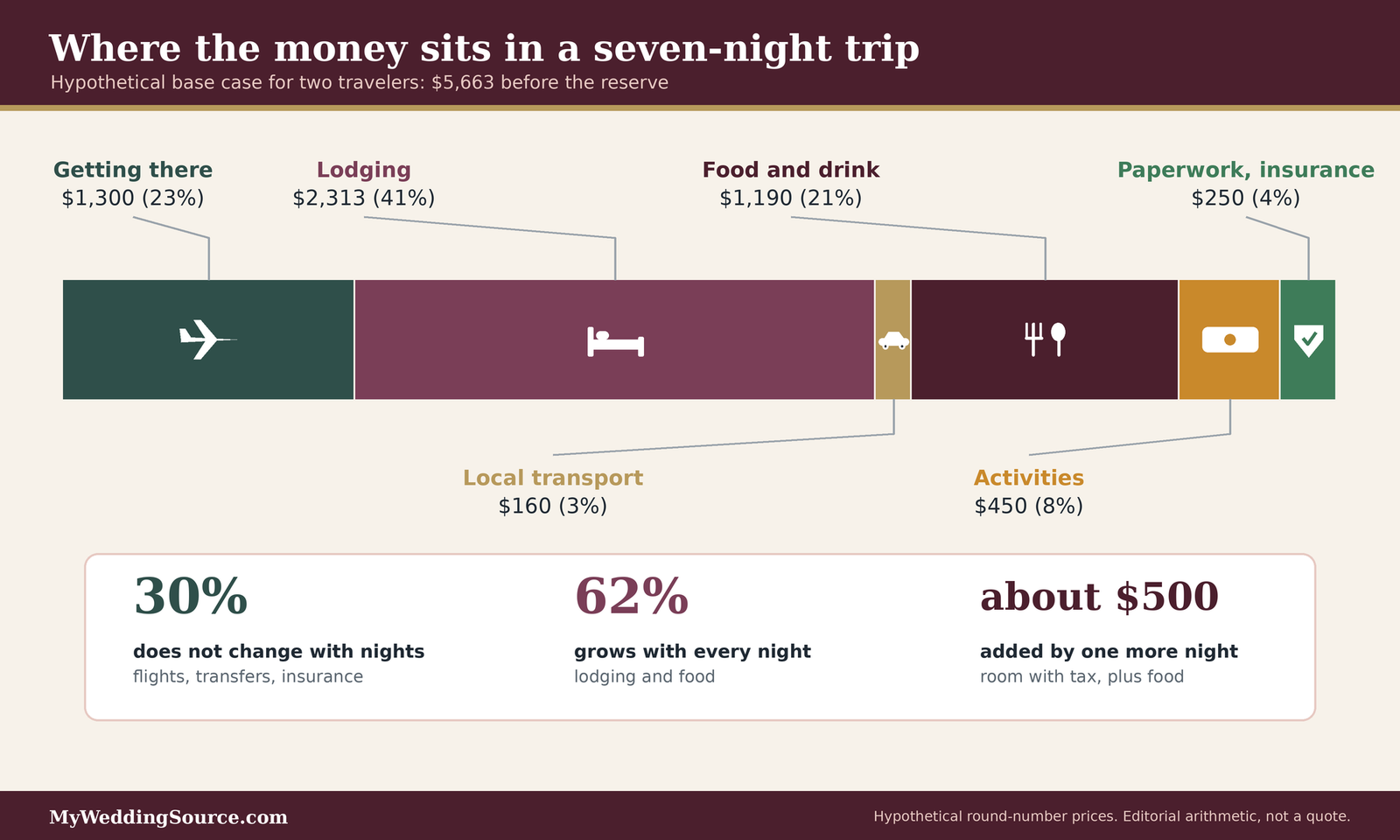
| Subtotal | $1,948 | $5,663 | $14,400 |
| Reserve (10% of subtotal) | $195 | $566 | $1,440 |
| Total | $2,143 | $6,229 | $15,840 |
| Total per night on the ground | about $536 | about $890 | about $1,320 |
The per-night row divides the total, reserve included, by nights on the ground, so it will not match the per-night figures in the sensitivity discussion further down, which use the subtotal before the reserve.
A few notes on how these were built. In the low case, getting there is a hypothetical drive or short flight for two, and paperwork and protection is a small insurance placeholder with no passport costs. In the base case, the insurance placeholder is about 7% of roughly $3,600 in prepaid, non-refundable costs, which sits inside the 5% to 10% range the NAIC describes. In the high case, paperwork and protection includes one first-time passport at $165, an estimated amount for two travel authorizations, and an insurance placeholder of about 8% of roughly $11,000 in prepaid costs. All three are our estimates.

Compare the base case to the Knot’s $5,300 with care. The base subtotal of $5,663 is not an apples-to-apples match, since we do not know what the Knot’s figure includes, and our figure includes insurance and taxes that the survey figure may not. The comparison is useful in only one way: it tells you that a plan in this range is not strange. It does not tell you that your plan should cost this much.
Show how nights and travelers change the total
Use the base case of the honeymoon budget to see how the cost shapes work. Add up the lines that do not change with nights: getting there ($1,300), local transportation ($160, treated here as fixed transfers), and paperwork and protection ($250). That is $1,710, about 30% of the $5,663 subtotal. Lodging and food together are $3,503, about 62%, and they grow with each night. Activities at $450 are about 8% and sit in between, since they are chosen, not automatic.
That mix produces a predictable result. An added night costs roughly $500 in this model: about $330 for lodging after the 18% blended tax and fee, plus about $170 for food. Using the same assumptions, here is what happens to the cost per night on the ground as the length changes. At five nights, the subtotal is about $4,663 and the cost per night is about $933. At seven nights, it is $5,663 and about $809. At eight nights, it is about $6,163 and about $770. Notice what that does and does not say. A longer stay lowers the cost per night because the fixed lines are spread out, and it raises the total. If your constraint is total cash, a longer trip is not “cheaper.” If your constraint is how much trip you get per dollar, it can be.
Travelers work differently. Adding a third person, for example a parent who joins for a few days, adds a full set of per-person lines (airfare, food, activities, protection) and may or may not add lodging, depending on the room. Be explicit about whether a guest is covered by someone else, because “we thought they were paying” is a common source of friction.
Show fee and tax multipliers separately
A blended percentage hides what is driving it in a honeymoon budget. Take the base case’s 7 nights at a $280 headline rate, which is $1,960 before taxes and fees. Consider two hypothetical properties with the same rate. Property X has a 12% room tax and no other charge, which adds $235 and brings lodging to about $2,195, or 12% above the headline. Property Y has the same 12% tax, plus a mandatory $35-per-night facility fee, and the tax also applies to the fee. The fee adds $245, the tax on rate plus fee is about $265, and lodging comes to about $2,470, about 26% above the headline.
Same rate, same city, and a difference of about $275 over a week, all from two lines that never appear in the nightly price. The base scenario’s 18% sits between these two examples, which is why we call it a blend and not a rule. Whether the fee is taxed, and whether it is per night or per stay, varies, so ask for the total for your dates and note which parts are taxes and which are fees. Separating them lets you see which are fixed by law and which are set by the property, and the second kind is a fair thing to compare when choosing between two hotels.
Find the decisions that create the biggest swing in the honeymoon budget
Not every choice matters equally. A scenario table helps you find the few decisions in a honeymoon budget that move the total most, so that you spend your attention there.
Rank the top three controllable cost drivers
In our scenarios, three controllable choices dominate. Your own ranking may differ, but the method is the same: look at the table, find the lines with the biggest dollar amounts, and ask which of them you can actually change.
The first is distance and route, which sets the getting-there line and often the local transportation line. Moving from the base case to the high case multiplies getting there by about 2.6 in this model. The second is how many nights you stay, because it scales lodging and food, which together are the majority of the subtotal. The third is how you eat, since food is the most controllable per-night line and the one most affected by choosing an all-inclusive plan or a room-only plan with local restaurants.
Notice what is not on the list: individual small purchases. Skipping a $40 activity matters far less than choosing a destination that is a different flight away. That is not an argument against being careful with small items. It is an argument for making the big choices deliberately, early, and while they are still cheap to change.
Identify false savings that shift cost elsewhere
A saving is false if it lowers one line and raises another by as much or more. Four patterns are worth checking.
A cheaper flight with a long layover can lower the fare and raise the food, lodging, and fatigue costs, and it can eat into the days you meant to enjoy. A cheaper room far from the places you want to visit can lower lodging and raise local transportation. A non-refundable rate can lower the price and turn any change into a loss, so the saving is real only if the plan is certain. An all-inclusive package that looks inexpensive can be poor value if you plan to eat elsewhere, and a room-only rate can be poor value if you plan to eat and drink on the property.
Another false saving deserves a mention: skipping insurance or a reserve to make the total look smaller. That removes a line without removing the risk behind it. The risk simply moves to your credit card. Whether to insure is your decision, and whether to hold a reserve is too, but both are better made with the numbers in front of you than by leaving the line blank.
Our wedding planning stress guide is a useful companion at this point, since the fastest way to lose a calm plan is to discover a gap in the budget in the last month.
Turn the budget into a control system for honeymoon budget
A budget that lives in one spreadsheet cell on the day you build it is a wish. A budget that has owners, thresholds, and a schedule for being checked is a control system, and that is what keeps a plan from drifting. None of this needs software. It needs a few decisions made in advance, while you are both calm, and written where you can both see them.
Set approval thresholds and a contingency reserve
Most overspending against a honeymoon budget is not one big mistake. It is a series of small yeses, each of which seemed reasonable at the time. Thresholds turn those yeses into conversations.
Define who can approve changes
Pick a dollar amount below which either of you can spend without asking, and above which you talk first. The right number depends on your total, and it should be small enough that the conversation is not a formality. For a trip in the base case above, something like fifty or a hundred dollars for a single purchase might be sensible, but that is only an example. What matters is that the rule exists and that you both agreed to it.
Add a second rule for anything that changes a booking: a new flight, a different room, an added night, or a tour with a deposit. Those changes ripple through several lines at once, so they deserve a pause and a recalculation before anyone clicks “confirm.” If someone else is contributing money, such as a parent or a honeymoon fund, decide who sees the tracker and who can ask questions about it. That is a family question as much as a financial one, and settling it early is kinder than negotiating it mid-trip.
Create a rule for using the reserve
A reserve in a honeymoon budget without a rule gets spent on whatever feels urgent. Write down what it is for. A sensible list has three kinds of entries: things that go wrong (a rebooked flight, a night in an airport hotel, a medical co-pay), things that cost more than expected (a transfer after a late landing, a tax that was not in the quote), and a small allowance for something you did not know you wanted.
Then write down what it is not for: upgrades you considered and declined at booking, and purchases that would be fine in a month but are not urgent today. If you reach the last day with the reserve mostly intact, you can decide together how to spend it. If you reach the middle of the trip with the reserve gone, the plan did not fail. The numbers told you something, and it is better to hear it on day four than on the credit card statement.
As a reminder, the 10% figure we use is a rule of thumb of our own. A trip with a long flight, a tight connection, or a hurricane-season date may deserve a larger reserve. A short, flexible, drive-to trip may need less. The National Hurricane Center says the Atlantic hurricane season runs from June 1 to November 30, with its peak on September 10 and most activity between mid-August and mid-October, and the eastern Pacific season runs from May 15 to November 30. Lower prices in those months can be real, and so can the risk of a change. If you travel in a hurricane window, make sure you know what each seller will refund before you rely on the saving.
Reforecast when inputs change
The honeymoon budget you made nine months before the trip is not the one you will follow. Dates shift, a quote expires, and a passport application takes longer than expected. Reforecasting means updating the whole picture at once, on a schedule, instead of patching one line at a time.
Update dates, quotes, and timing together
Change one input and several lines move. A new departure date changes the flight price, the lodging rate, and sometimes the insurance quote. A different number of nights changes lodging, food, and possibly activities. A destination change can alter every line, including the paperwork line. So when one thing changes, re-run all seven.
A simple schedule works well for a honeymoon budget. Reforecast at each of these moments: when you choose a destination, when you book the first major item, when a quote expires or changes, about eight weeks before you leave, and about two weeks before you leave. At each moment, replace every “estimate” with a “quote” where you can, and note how much the total changed and why. The point of reforecasting a honeymoon budget is not to be anxious. It is to avoid the surprise of finding, in the final month, that three small changes added up to a large one.
If you are working backward from a timeline, our wedding planning timeline shows where a honeymoon fits among the other deadlines, and our wedding planning checklist is a good place to record the dates of each deposit and cancellation deadline.
Track committed, paid, and still-estimated money separately
One total is not enough. Use three columns for every line: paid, which has left your account; committed, which you are obligated to pay even if you have not yet, such as a balance due on a date; and estimated, which is still a guess. Add them for each line and you get a picture of how much of your plan is real.
Early in the honeymoon budget, nearly everything is estimated. As you book, estimated money becomes committed and then paid, and the share of the total that is still a guess shrinks. That shrinking share is the useful signal. If, two months before the trip, a large share is still estimated, you know exactly where your uncertainty lives, and you can decide whether to firm it up or enlarge the reserve.

The figure above shows this for the base scenario, using hypothetical checkpoints. It is an illustration of the pattern, not a schedule you should copy. Your own pattern will depend on when your sellers require deposits and when balances are due. Record those dates the day you book, and ask whether a deposit is refundable.
Keep the honeymoon budget tally going on the trip itself. A shared note with a rough daily total is enough. The purpose is not to police each other. It is to know on day four whether the reserve is intact, so that a splurge on day five is a decision and not a surprise. If you used a honeymoon fund, our wedding registry guide explains how registry options work, and it is worth reading the terms of any platform before you share a link.
Questions to ask before you pay for any line of the honeymoon budget
The questions below work for nearly every seller on the trip: an airline, a property, a transfer company, a tour operator, or an insurer. Put them in writing, and keep the answers with your confirmation.
Questions to ask before you pay
- What is the total price for both of us for these exact dates, including every tax and mandatory fee?
- Is the price per person or per couple, and does it change if our dates move by a day?
- What is included, and what costs extra: meals, drinks, bags, transfers, gratuities, entrance fees?
- What is the cancellation or change policy, with exact dates, and what is refundable?
- If the seller cancels or changes the service, what do we receive, and how long does it take?
- Is the name on the booking exactly the name on our travel documents?
- Does this price assume a minimum stay or a minimum spend?
- When does insurance coverage start, and what is excluded?
Questions that protect the price
These questions confirm that the number you wrote down is the number you will pay.
Price and inclusions
Ask for a line-by-line list of what the price covers, and ask what is conditional. This keeps the honeymoon budget honest. If something is described as free, ask what it depends on, since “free” is sometimes tied to a minimum stay, a prepayment, or a package. Ask for the answer in an email or on the confirmation, not only by phone.
Fees that appear late
For an accurate honeymoon budget, ask directly about resort or facility fees, mandatory service charges, local taxes, parking, baggage, airport or departure charges, and payment fees. Ask whether any of them are charged at the property and not at booking, since those do not appear in the price you pay online and can be missed in a comparison. If the seller cannot answer, ask who can.
Questions that protect the plan
These questions confirm what happens if something changes.
Changes, cancellations, and refunds
Ask for the cancellation deadlines and any fee for each change, and write those dates in your calendar the day you book. For airlines, remember that the Department of Transportation describes refund rights for cancellations and significant changes, and that tickets bought through a travel agent can follow the agent’s terms for other changes, so ask who the merchant of record is on your card statement.
Who to call when something goes wrong
Before you leave, save the phone number and email of every seller and of your insurer where you can reach them without your phone’s internet connection. Know which seller to call first for each kind of problem. A canceled flight, a lost bag, a room that is not as described, and a medical issue all have different first calls, and it is easier to know that at home.
FAQ: honeymoon budget questions
Setting the number
How much should a honeymoon budget be?
There is no correct figure. The Knot reports an average of about $5,300 for couples married in 2024, but it does not say what is included. Build your own honeymoon budget from current quotes for each of seven lines, add taxes, fees, and insurance, and hold a reserve. Then compare it with what you can afford after the wedding.
What costs do couples forget in a honeymoon budget?
The usual gaps are baggage fees, seat selection, mandatory property fees, local taxes, transfers from the airport, gratuities, payment fees abroad, passport or entry-authorization costs, and insurance. Wedding-adjacent items such as new luggage or unpaid leave also get missed. Write each one in the honeymoon budget, even as an estimate, so it is counted.
Is it cheaper to book everything as a package?
Sometimes, but not always. The Knot says an all-inclusive package can cost more upfront and avoid unexpected expenses. Build the room-only version with realistic meals and drinks and put the two side by side. A package is better value if you will use what it includes, and worse if you will eat and spend away from the property.
Timing and protection
How far ahead should we plan our honeymoon budget?
The Knot quotes a travel expert who suggests booking about a year ahead for better availability and rates. For the budget itself, start as soon as you pick a rough destination and season, then reforecast whenever a quote or date changes. Early estimates are expected, and the goal is to turn them into quotes over time.
Do we need travel insurance?
That is your decision, and we do not give insurance advice. The National Association of Insurance Commissioners says travel insurance typically costs 5% to 10% of trip price and describes coverage types and common exclusions. The State Department notes that few health plans cover evacuation. If you buy a policy, price it from a quote and read the exclusions first.
What is a sensible reserve?
Many planners hold about ten percent of the subtotal, but that is a rule of thumb, not a standard. A longer flight, a hurricane-season date, or non-refundable bookings can justify more. A short, flexible trip may need less. Whatever the amount, write down in advance what the reserve is allowed to pay for.
Paying and tracking
Should we pay with a credit card or debit card?
We do not give financial advice, but there is a consumer-protection reason to know the rules. The FTC explains that credit card billing disputes have time limits, such as 60 days from the first bill showing an error. Check your card’s terms, keep records of what you were promised, and ask your issuer about foreign-transaction fees before you travel abroad.
How do we keep track of spending on the trip?
Keep a shared note with a rough daily total, and check it once a day, not once a purchase. Compare it with the honeymoon budget’s daily placeholders for food and activities from your worksheet. The aim is to know whether the reserve is intact by midweek, so any splurge is a decision you make together and not a surprise afterward.
Your next steps
Build the number
Fill in the seven lines
Open a blank page for your honeymoon budget and write the seven lines: getting there, lodging, local transportation, food and drink, activities, paperwork and protection, and reserve. Put a quote or a labeled estimate beside each. If you are not sure the honeymoon budget fits inside your wider plan, our wedding budget calculator can help you check.
Compare two options by cost per night
Convert two real options into all-in totals for the same dates, add the missing lines to each, and divide by nights on the ground. Look at the difference after normalizing, not before.
Keep it under control
Write your three rules
Agree on an approval threshold, a reserve and what it is for, and a reforecast schedule. Put them at the top of the page you both can see. For the rest of the plan, our wedding planning guide shows how the pieces fit together, and our honeymoon planning guide covers timing, documents, and recovery.
Record every deadline
The day you book anything, note the cancellation date, the balance date, and who to call. A deadline you wrote down is a deadline you can use.
Sources & methodology
How we built this guide
What we relied on
This guide combines honeymoon survey reporting from The Knot, airline refund rules from the U.S. Department of Transportation, credit card billing-dispute rules summarized by the Federal Trade Commission, passport fees and processing estimates and health-abroad guidance from the U.S. Department of State, a consumer guide to travel insurance from the National Association of Insurance Commissioners, hurricane-season dates from the National Hurricane Center, and the United Kingdom government’s travel authorization page. Where a statement comes from a company or a survey, we say so. The cost-shape matrix, the three scenarios, the sensitivity arithmetic, the fee and tax comparison, and the reserve and approval rules are our own editorial tools, built on invented round numbers, and none of them is a quote, forecast, or recommendation. We read these sources in November 2026.
What we did not do
We did not price any trip, test any booking site, or verify costs for individual destinations, airlines, hotels, or cards. Our attempts to read the Federal Trade Commission’s pages on lodging fee disclosure failed, so we describe no rule on that topic, and we did not research tipping norms or card foreign-transaction fees, so we give no figures for them. The Knot’s page labels its cost figure as 2025 while the data it cites are from 2024, and it does not define what the average includes. Prices, fees, entry rules, and refund policies change. This guide is general education and is not financial, insurance, or legal advice.
Source list
Government and regulatory sources
- U.S. Department of Transportation, Airline refunds: https://www.transportation.gov/individuals/aviation-consumer-protection/refunds
- Federal Trade Commission, Disputing credit card charges: https://consumer.ftc.gov/articles/disputing-credit-card-charges
- U.S. Department of State, Passport fees: https://travel.state.gov/content/travel/en/passports/how-apply/fees.html
- U.S. Department of State, Your health abroad: https://travel.state.gov/content/travel/en/international-travel/before-you-go/your-health-abroad.html
- National Hurricane Center, Climatology: https://www.nhc.noaa.gov/climo/
- GOV.UK, Electronic Travel Authorisation: https://www.gov.uk/eta
Industry, survey, and consumer sources
- The Knot, Average cost of a honeymoon: https://www.theknot.com/content/average-cost-of-honeymoon
- The Knot, Domestic honeymoon cost: https://www.theknot.com/content/domestic-honeymoon-cost
- National Association of Insurance Commissioners, Travel insurance: https://content.naic.org/insurance-topics/travel-insurance