
A bridal clutch is the one small bag that has to carry the day’s few essential items while your hands, your dress and your schedule all compete for it. This guide shows how to size a bridal clutch from the items up instead of from a product listing down: measure what you need, test what fits, and decide who holds the bag at each point of the day.
Choose the items first, then the bag. Sort what you want to carry into three zones: on your body, in the bridal clutch, and with a trusted handoff person. Measure every item in the clutch zone by length, width and thickness, add roughly a fifth of spare room, and compare the total to the usable inside of the bridal clutch, not the outside size on the label. Pack it, walk around with it, sit down with it, and write a one-page handoff sheet so someone else can find everything without opening your phone or asking you.
Most people shop for a bridal clutch the way they shop for any evening bag. They look at the shape, the fabric and the price, check that it matches the shoes or the dress, and assume the rest will work out. Then the morning of the wedding arrives. The phone only fits sideways, the lipstick rolls into the lining, the tissue packet will not close the flap, and the bag that looked roomy in the product photo turns out to hold about as much as a thick envelope.
None of that is bad luck. A bridal clutch is a small container with a hard limit, and a wedding day has a long list of small things that want to live in it. The mismatch can be solved on paper, with a tape measure and a kitchen table, weeks before anyone is watching.
This article is built around one method, called the Fit Box Method here, with a companion handoff sheet. The method answers three questions in order. What truly belongs in the bag? Does it physically fit, with room to spare? And who is responsible for the bridal clutch at each stage of the day, so it is never abandoned on a chair? The rest of the guide covers styles, closures, dress compatibility, buying checks, edge cases and a dry run.
A note on scope. This is general consumer information, not legal, tax or financial advice, and it does not replace advice from your own clinician about any medical item. Bag sizes, materials and store policies vary by maker, so verify every measurement and return term with the seller before you buy.
The broader question of how every accessory on the day works together, including jewelry, veils and shoes, belongs in the wedding day accessories planning guide. This article stays inside the bag.
What a bridal clutch actually has to do
A bridal clutch has four jobs, and they pull in different directions. Naming them helps because it explains why the prettiest bag is not always the right one.
The first job is carrying. The bridal clutch must hold a short list of items without bulging, because a bulging bag looks wrong in photographs and presses against the dress when it is held at the waist. The second job is access. You should be able to reach the one thing you need, such as a tissue or lip balm, without emptying the bag onto a table or handing the bouquet to someone.
The third job is protection. The contents, and the bag itself, need to survive a long day of hugging, dancing, sitting on folding chairs and being passed between hands. The fourth job is appearance. The bridal clutch appears in more photographs than most people expect, held at the waist during portraits, placed on the table at dinner and tucked under an arm in candid shots, so it needs to look like it belongs with the outfit.
When one job wins at the expense of the others, trouble follows. A rigid, beautifully beaded box wins on appearance and loses on access. A soft pouch wins on capacity and loses on photographs. The goal is a deliberate balance, chosen by the day you actually have.
Who the bridal clutch is for
The person carrying the bridal clutch is not always the person getting married, and not always a bride. Couples of every kind plan weddings, and plenty of grooms, partners and attendants also carry a small bag at some point. This guide says “you” throughout. If you are shopping for someone else, treat the measurements and handoff steps the same way and let them choose the final list.
It is also worth being honest about the limits. A clutch is not a storage locker. If your list of essential items fills a medium handbag, the right answer may be a smaller list, a second bag held by an attendant, or a plan that moves some items elsewhere. The method below makes that decision visible instead of leaving it to the morning of the wedding.
Where the bag spends the day
Think of the bridal clutch as traveling through a series of places rather than sitting on one arm. It begins in a getting-ready room, moves to a car or a venue entrance, and may sit out of sight during the ceremony. It reappears for portraits, goes to a head table or a sweetheart table at dinner, travels to a dance floor edge, and finally goes home in a bag, a trunk or a hotel room.
Each stop has its own risks. A bag on a car seat can be sat on. A bag on a ceremony chair can be mistaken for a guest’s. A bag on a dinner table can be spilled on.
Drawing that route on paper, even roughly, changes what you pack. Items that are only needed during portraits may not need to be in the bag at the ceremony at all. Items that are needed only at the very end, such as a spare phone cable, may be better in a car.
Why a bridal clutch size label tells you so little
Product listings usually give three numbers: width, height and depth. Those numbers describe the outside of the bridal clutch. What you care about is the inside, and the two can differ by a surprising amount.
Several things eat the difference. A rigid frame or boxy structure adds wall thickness. A lining and interfacing add layers on every side. A flap or closure takes up the top edge. A gusset, the folded fabric panel on the sides, may allow the bag to expand, or it may be stitched flat and add nothing. Decorative beading, sequins or embroidery can make the outside look larger while the inside stays small.
The practical response is to stop trusting the label and measure the usable inside yourself, or ask the seller for interior dimensions in writing. If you are buying in a shop, bring your actual items. If you are buying online, ask for the interior width at the opening, the interior depth, and the height from the base to the closure line.
Opening size matters as much as interior size
An item can fit inside a bag that it cannot get into. A rigid frame clutch with a narrow opening may hold a phone comfortably once the phone is inside, yet refuse to let it in without a struggle. A bag that is easy to load in a store may be awkward to open at a dinner table with one hand.
Check the opening in three ways. Measure its width and compare it to the widest item you want to carry. Try the opening one-handed, since the other hand may be holding a glass or a bouquet. And look at how far it opens: a clasp that only opens a quarter-inch gap is a different tool from a flap that lifts fully.
Soft bags and hard bags change the math
A soft pouch or fabric wristlet gives a little under pressure, so a slightly oversized item can still ride along. A hard box clutch or frame bag does not. If the item is one millimeter too thick, the lid will not close. That is why the slack allowance in the Fit Box Method is larger for hard bags than for soft ones, a point the measuring section returns to.
Soft bags have their own cost. They conform to what is inside, which means a rigid phone or a hard case can print through the fabric as a rectangle, a problem that also shows up with dress pockets. Dress pockets have the same print-through problem, and the same fix applies: test with the real items.
What the product photo hides
Photos are shot with the bag styled and usually empty, sometimes stuffed with tissue paper to hold its shape. A model’s hand may be placed to hide how thin the bridal clutch is. Scale can be misleading too, since a small bag shot close up fills the frame like a large one.
Look for a photo that shows the bag open with something recognizable inside, such as a phone. If the seller offers none, ask. A seller who cannot say whether a standard phone fits is giving you information in itself.
The three zones of carry
The core move in this guide is to stop treating the bridal clutch as the only place things can go. Every item on your list belongs in one of three zones, and deciding which zone each item belongs to is most of the work.
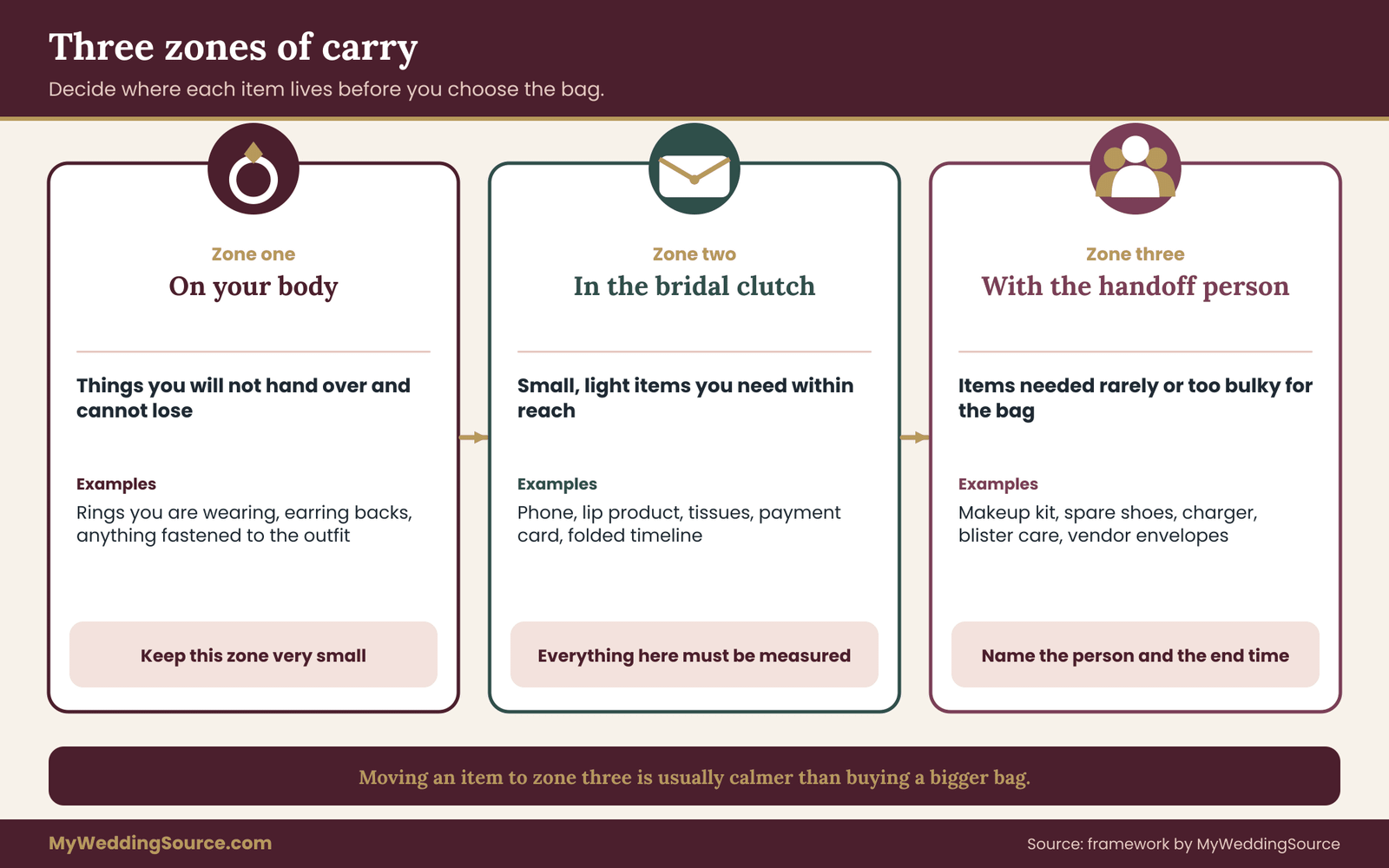
Zone one: on your body. These are things you will not hand to anyone and cannot easily lose, such as a ring you are wearing, an earring back, or an item sewn into a seam. This zone is small and most items do not belong in it.
Zone two: in the bridal clutch. These are the items you want within reach for much of the day: a phone, a lip product, tissues, a small comb or a folded note. The bridal clutch is a compromise. Everything in it has to be small, light and genuinely needed by you rather than by someone else.
Zone three: with the handoff person. These are the items you only need occasionally, or that would damage the bag’s shape. A full makeup kit, a spare shoe pair, a charging brick, blister care, a safety pin set and a sewing kit all belong here. The handoff person is someone you trust, such as an attendant, a sibling, a planner or a friend who agrees to hold a bag and stay reachable.
The rule that sorts items into zones
A simple question sorts most items. Ask how often you will need it, and how much trouble it causes if it is not within arm’s reach. An item you need many times and that is quick to use belongs in zone two. An item you need once, or that someone else could hand you in a minute, belongs in zone three. An item that would be a disaster to lose and that is small enough to wear or fasten belongs in zone one.
When an item fails to fit zone two, resist the urge to buy a larger clutch. A larger bag is also heavier, harder to hold with a bouquet, and more likely to disrupt the line of the dress. Moving the item to zone three is usually cheaper and calmer than upsizing the bag.
Why the handoff person belongs in the plan from the start
Many couples treat the handoff person as a favor requested at the last minute. That rarely works. The person needs to know what they are holding, where they will be, and what to do if you ask for something. They also need to be released from the task at a defined time, because an attendant who is carrying your bag cannot also be fully present at the ceremony or the toasts.
The handoff checklist later in this guide treats this as a small piece of stage management, much like the cue sheets used by officiants and musicians. If you want to see how those cue sheets are built, the wedding ceremony cue sheet guide is a good model for how to write short, clear instructions that someone else can follow without you.
Building the item list for your bridal clutch
Start with a blank page and write down everything you imagine wanting during the day. Do not edit yet. The first draft is usually long, and that is useful, because the trimming that follows is where the decisions get made.
Group the draft by purpose rather than by size. A group for communication, such as the phone and a printed card with key phone numbers. A group for appearance, such as lip color, blotting paper, a small comb or a mirror. A group for comfort, such as tissues, mints, a hair tie and a small pack of lozenges. A group for repair, such as a couple of safety pins, double-sided tape and a tiny sewing kit.
A group for money and identification, such as a card, a few folded bills for tips and a small amount of change. A group for the ceremony itself, such as a folded vow card or a ring that is not yet on a finger.
Sort by when you will need each item
For each item, write down the moment you are most likely to need it. Pre-ceremony, during the ceremony, portraits, cocktail hour, dinner, dancing and departure make a useful set of stages. Some items cluster in one stage, which is a clue that they can be handed over after that stage ends.
A tissue is needed at the ceremony and during the toasts, and it is also needed at the farewell. A lip product is needed after eating, so it spans dinner and dancing. A vow card is needed for a few minutes only. Seeing those patterns on the page is what lets you drop items that appear to be essential but are only needed once.
The three tiers: carry, maybe, leave
After the draft, sort every item into three tiers. Carry means you need it in your own hands and it is small. Maybe means it is useful but could be handed off. Leave means it is better in another place, or not needed at all.
A good test for the carry tier is the stranded test. Imagine you are at the far end of a long room, no attendant is within shouting distance, and you need this one thing in the next ten seconds. Would missing it be a real problem rather than a small inconvenience? If yes, it earns a place in the bridal clutch. If you would shrug and wait two minutes, it belongs in the maybe tier.
Phones need their own decision
The phone is the largest item most people want to carry, and it controls the size of the bag. A modern phone is long and flat, and it lands in a clutch as a rigid rectangle that sets the minimum interior length of the bridal clutch. Measure it with its case on, because a thick case can add noticeable bulk.
There are good reasons not to carry a phone at all during the ceremony, and good reasons to carry one the rest of the day. If you decide the phone goes to the handoff person for the ceremony, the bag can be smaller for that segment, and the phone goes back in afterward. The digital side of this decision, including who holds backup contacts and files, is covered in the wedding day digital contingency plan, which treats the phone as one part of a communication system rather than a personal accessory.
Cash, cards and tips
If you plan to tip vendors on the day, money can occupy more space than expected, particularly if it is in labeled envelopes. A common arrangement is to hand all vendor envelopes to a planner, a parent or a best friend who delivers them at the right moments. That removes a stack of envelopes from the bag and also removes the awkwardness of handling cash in a gown.
For your own use, a single payment card and a small fold of cash is usually enough. Keep an identification card only if you may need it, since losing it is more costly than losing a lipstick. This is a place where zone one or zone three often beats zone two.
Items people forget to include
A few useful items appear on nobody’s first draft. A small pack of blotting tissue helps with shine without disturbing makeup. A clear hair elastic or a bobby pin can rescue a loosened style. A pair of earring backs is tiny and can save a lost earring. A folded copy of the day’s timeline, small enough to disappear, helps when your phone is not in reach.
Equally, a few items appear on everyone’s list and often should not be there. A full-size perfume bottle, a large compact with a mirror, a charging brick and a pair of folded flats rarely survive the trimming. They can still exist in the day. They just live elsewhere.
The Fit Box Method: measuring what goes into a bridal clutch
The Fit Box Method has five steps. It is deliberately low-tech, so it can be done with a ruler, a pen and a few minutes per item.
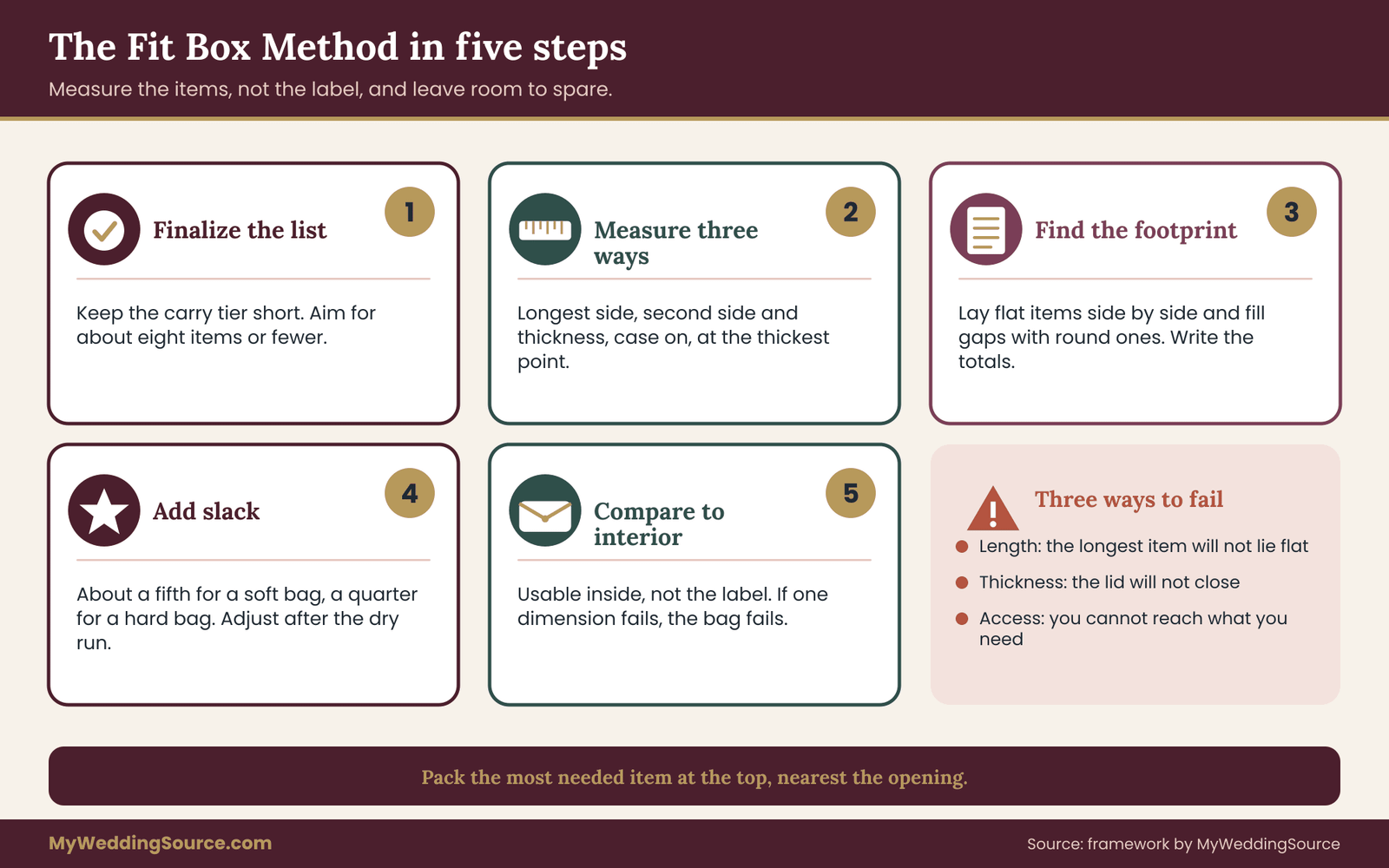
Step one: finalize the carry list. Use the carry tier from the section above. Aim for a short list. If you have more than about eight items, look again, since each extra item adds both bulk and the time it takes to find the one you want.
Step two: measure each item in three directions. For every item, record the longest side, the second longest side and the thickness. Thickness is the number people forget, and it is the one that decides whether the bridal clutch closes. Measure at the thickest point, including any cap, case or bulge.
Step three: find the packed footprint. Items rarely fit with perfect geometry. Lay the flat items, the phone, a card, a folded note, side by side or stacked, and the round or odd-shaped items, a lip product or a mint tin, in the remaining gaps. Write down the total width the stack needs and the total thickness it makes when packed.
Step four: add slack. Add spare room to the packed footprint. A reasonable working rule is to add about a fifth for a soft bag and about a quarter for a hard bag, since a hard bag will not forgive anything. These are design margins, not measured industry figures, so treat them as a starting point and adjust after the dry run.
Step five: compare to the usable interior. Take the packed footprint with slack and compare it to the bag’s usable inside, measured in the same three directions. If any one dimension fails, the bridal clutch fails. A bag can be long enough and still too shallow, and it will not close.
A short worked calculation
Suppose the flat items are a phone that is long and thin, and the other items are a lip balm, a folded tissue pack and a payment card. The phone sets the length and the thickness. The lip balm stands upright in a gap beside the phone, and the tissue pack lies flat on top. The card slides into the phone’s side.
Measure the packed stack at its widest point and thickest point. Add about a fifth for a soft bag. The result is a target interior width and a target interior depth. Then check whether the bag has them. Doing this once on paper, before buying, prevents a return.
The three failure modes
A bag can fail the Fit Box in three distinct ways, and naming them helps you fix the right thing.
A length failure means the longest item will not lie flat. The phone sticks out of the opening or has to be carried diagonally. This is the most visible failure and is often solved by a different shape, such as a wider envelope style, not a bigger bag.
A thickness failure means the bag will not close, or closes with a bulge. This is the one that photographs badly, because a swollen lid is obvious. The fix is fewer or thinner items, or a bag with a gusset or a pouch-style opening.
An access failure means everything fits but you cannot get to what you want. The item you need is at the bottom, under three others. This is solved by order of packing, a small inner pouch, or the choice of a bag with a wide opening.
Packing order is part of the fit
The order in which items go in matters as much as whether they fit. Put the item you need most at the top and nearest the opening. Put heavy, hard items against the back so they do not press on the front panel that faces outward in photographs. Keep loose small items, like a mint or a bobby pin, inside a tiny pouch or a corner of the lining so they do not drift.
Pack the bridal clutch the day before and photograph the packed bag open, so there is a record of what is in it and where. That photo becomes part of the handoff sheet later.
Bridal clutch styles, closures and straps compared
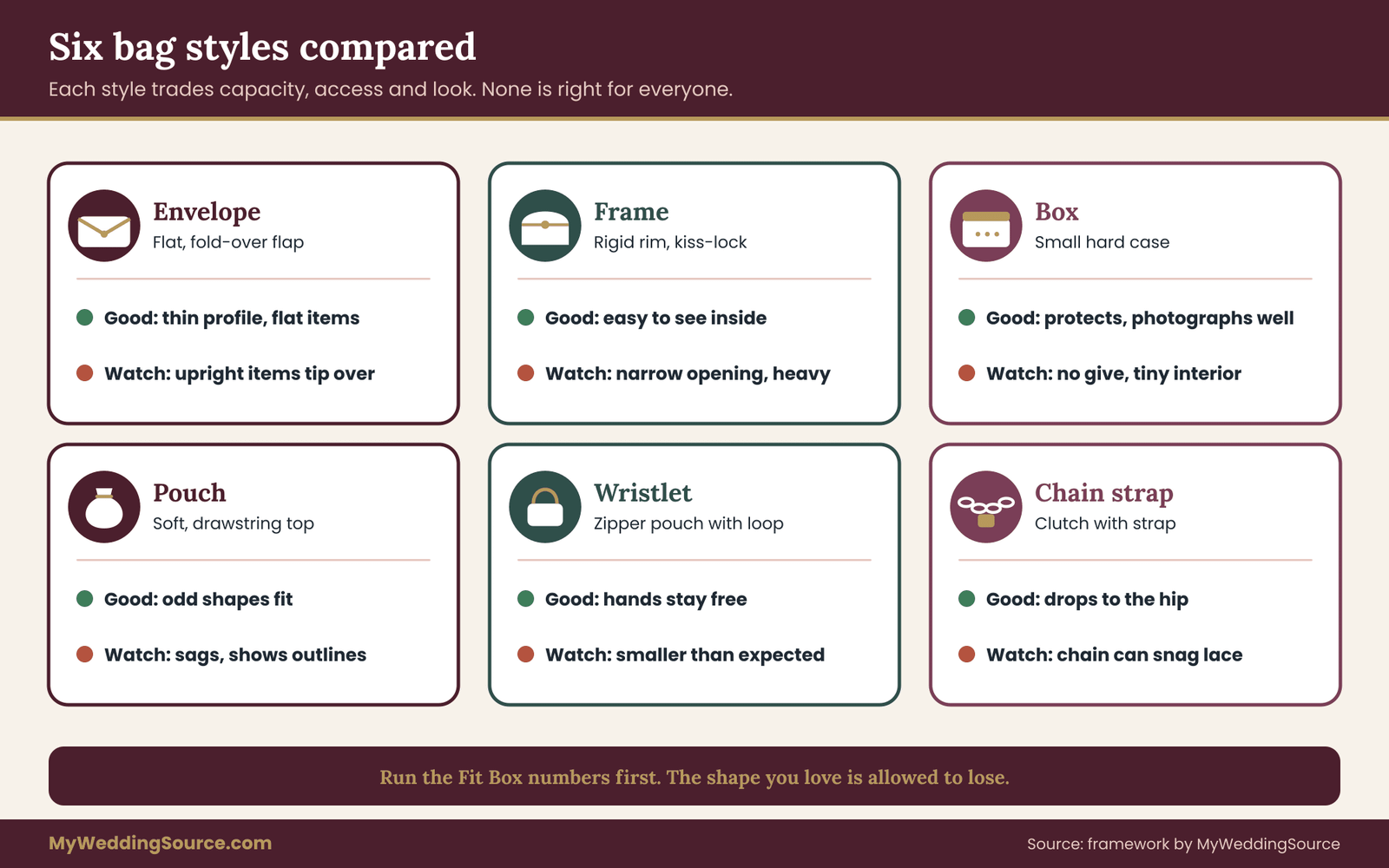
Once you know how much needs to fit, the shape question becomes practical. Different styles of bridal clutch solve different problems, and none is best for everyone. The comparison below is in prose on purpose, because the right answer depends on your list and your day, not on a score.
Envelope clutch
An envelope clutch is a flat, usually soft or semi-rigid rectangle with a fold-over flap. It carries flat items well, since the phone, a card and a tissue pack lie in a stack. It does poorly with upright items such as a lipstick or a perfume rollerball, which tip over inside.
The flap is both a feature and a risk. A magnetic or snap closure keeps the bag shut and makes one-handed use possible. A tuck-in flap with no closure looks clean but can open when you hold the bridal clutch under an arm. Envelope styles hold a thin profile, which suits fitted gowns and photographs, and they run out of room quickly once you add anything thick.
Frame clutch
A frame clutch has a metal or rigid rim at the top that opens with a kiss-lock or clasp. The rim holds the opening in a fixed shape, which makes it easy to see inside and to reach items, as long as the opening is wide enough. The shape is classic and tends to look formal.
The tradeoff is the opening width and the rigid walls. The phone has to pass through a fixed gap, and the walls will not stretch. Check that the longest item passes through the opening, not only that it fits inside. Hard frames also tend to run heavier, which matters for an hour of holding.
Box clutch and minaudière
A box clutch or minaudière is a small rigid case, often metal or covered in beads or crystals, with a hinged lid. It protects fragile items well and is a decorative object in photographs. It is also the least forgiving bag in this guide. The interior is small, the walls are hard, and there is no give for a phone that is a few millimeters too thick.
Many box styles are sold as a jewelry accent, and their interior is sized for a card and a lipstick rather than a phone. If you love the look, plan to carry less in it and send the rest to zone three. Measure the interior carefully, because the outside size will mislead you the most here.
Pouch and potli
A pouch, sometimes called a potli when it has a drawstring and a rounded base, is a soft bag with a gathered top. It carries the most oddly shaped items, because it conforms, and it takes a slightly overfilled load without complaint. It can also hold a small amount more than its size suggests.
The cost is structure. A pouch sags, shows the outline of what is inside, and can look bulky against a streamlined gown. Access depends on the drawstring, which is easy with two hands and fiddly with one. Pouches suit relaxed weddings, richly embroidered outfits and anyone who wants a bag that doubles as a decorative element on the wrist.
Wristlet and wrist-strap styles
A wristlet is a small zippered pouch with a loop that sits on the wrist. Its great advantage is that the bag stays attached to you while your hand is free, which is useful when you are holding a bouquet, shaking hands or lifting a hem. A wristlet is hard to lose and easy to find.
It is also smaller than most people expect, and the strap can drag on the sleeve or interfere with a bracelet. A wrist loop does not stay in the right place when you are hugging someone, so the bag may swing into the person’s back. Test the loop with the actual dress sleeve, if it has one, before you commit.
Straps and chains
A detachable chain or strap turns a clutch into a crossbody or shoulder bag. That helps during a long day, since you can drop the bridal clutch against your hip instead of holding it. It can also be a problem, because a chain across a bodice can catch lace, scratch a beaded surface or leave a mark on delicate fabric.
If the bag has a chain, check the metal and the clasps where they touch the dress. A lined, smooth link and a leather or fabric tab sits better against a delicate gown than a bare metal edge. Decide whether the strap will be used at all, and if not, whether it can be removed and stored with the handoff person.
Closures and what they mean for access
Closures fall into a few families, and each changes how the bridal clutch behaves on the day.
A magnetic closure is quick to open and close, and works one-handed. It can fail to hold if the bag is overstuffed, and a strong magnet may sit close to a payment card or other items, so ask the seller whether the magnet is shielded. A snap or press stud is secure but takes two hands for a clean closure.
A zipper is the most secure closure and the best choice for items you cannot afford to spill, but it needs a fairly wide opening to be usable at a dinner table. A kiss-lock clasp on a frame is quick and classic, though a worn clasp can pop open on its own. A drawstring is easy and flexible and is the least secure choice if the bag is carried loosely.
Materials and what they do against the dress
The fabric of the bridal clutch matters because it touches the dress. Smooth satin and silk dupioni hold up well against smooth gown fabrics, yet water spots, shows fingerprints and can snag on rough nails. Leather and faux leather are durable and wipeable, and a stiff edge can mark delicate fabrics. Beaded, sequined and embroidered surfaces add visual interest and snag lace, tulle and fine knits.
The snagging risk deserves its own check. Run the bag gently along a hidden part of the dress at a fitting, such as the inside of a seam allowance, and watch for pulled threads. A beaded bag against a lace bodice is the classic trouble pairing. The same caution applies to every accessory that touches the gown.
Pocket depth and interior lining
Open pockets inside a bag are rare in a bridal clutch, but a single slip pocket or card slot is sometimes included. A slip pocket is a small, useful bonus, because it gives a fixed place for a card and a key and stops them from migrating. Check that the pocket is wide enough for the card and deep enough that the card does not fall out.
The lining color affects visibility. A very dark lining hides a lip product in a dim reception room. A light lining shows stains. A mid-tone, plain lining is the easiest to work with, and a lining that is smooth rather than rough means items slide in and out without catching.
How to choose between styles
If you carry mostly flat items and wear a fitted dress, the envelope clutch is usually the most comfortable. If you carry a phone and a few oddly shaped items and want the least risk of a bulging lid, a pouch or a wristlet is easier. If your list is small and you value a polished object in photographs, a box or frame style makes sense, as long as you accept its limits.
None of these rules is fixed. The fit box numbers and the dry run decide, and the shape you love is allowed to lose if it does not pass.
Matching the bridal clutch to the dress and the day
A bag that fits its contents can still fail the day. The second check is how the bridal clutch behaves with the dress, the ceremony and the schedule, since a good bag in the wrong setting becomes a nuisance.
The dress and the bag meet at the waist
Where you hold the bridal clutch matters. Many people carry a bridal clutch at waist height in front, resting against the dress. A rigid, heavy or beaded bag held there can crease a soft fabric, press into a corset line or catch on lace. A bag held at the side hangs against the skirt and can snag the same way.
Look at your gown’s fabric and structure, then think about where the bag will actually sit. A gown with a structured, firm skirt takes a hard bag easily. A gown with a soft chiffon or a delicate lace needs a smooth, soft-edged bag. For help judging how your gown reacts to additions, the wedding dress fit and alterations guide explains what a tailor can check and adjust.
Hands are the limited resource
At a ceremony, your hands may hold a bouquet, your partner’s hands, a ring, a vow card or a hem. A bag adds one more demand. Decide in advance where the bag is during the ceremony. Most people hand it to an attendant or leave it with a trusted person in the front row, rather than holding it. The handoff sheet in the next section builds this into the schedule.
At a reception, hands hold a glass, a fork, a microphone or another person. A wristlet keeps the bridal clutch attached, while a clutch needs a place to sit. Put the bag where you can see it, not on a distant chair, and consider asking your venue where a bag can sit safely at the head table.
Photographs and the visible bag
The bridal clutch appears in photographs more often than you might expect. It shows up in detail shots of the outfit, in portraits where it is held at the waist, and in candid moments. A bag that clashes with the outfit, or one stuffed so full that it bulges, can distract from an otherwise good frame.
Tell your photographer if the bridal clutch is meant to be part of the detail shots, and bring it to the detail session. If you want it kept out of frame during portraits, tell them that too. The wedding family photo list can help you plan where the bag goes while group photos are taken.
Color, weight and the long day
Color is a matter of taste, though a few practical notes apply. A bag that matches the shoes rather than the dress can look polished and is forgiving of small shade differences. A metallic bag matches most outfits and hides scuffs. A white or ivory bag shows every mark, and cleaning it later can be difficult.
Weight accumulates. A bag that feels light at a fitting can feel heavy after an hour of holding with the other hand occupied. Pack the bag with everything on the list and hold it for twenty minutes in front of a mirror, as part of the dry run described later. If your forearm tires, the bridal clutch is too heavy, whatever its size.
A worked example: one bridal clutch, tested
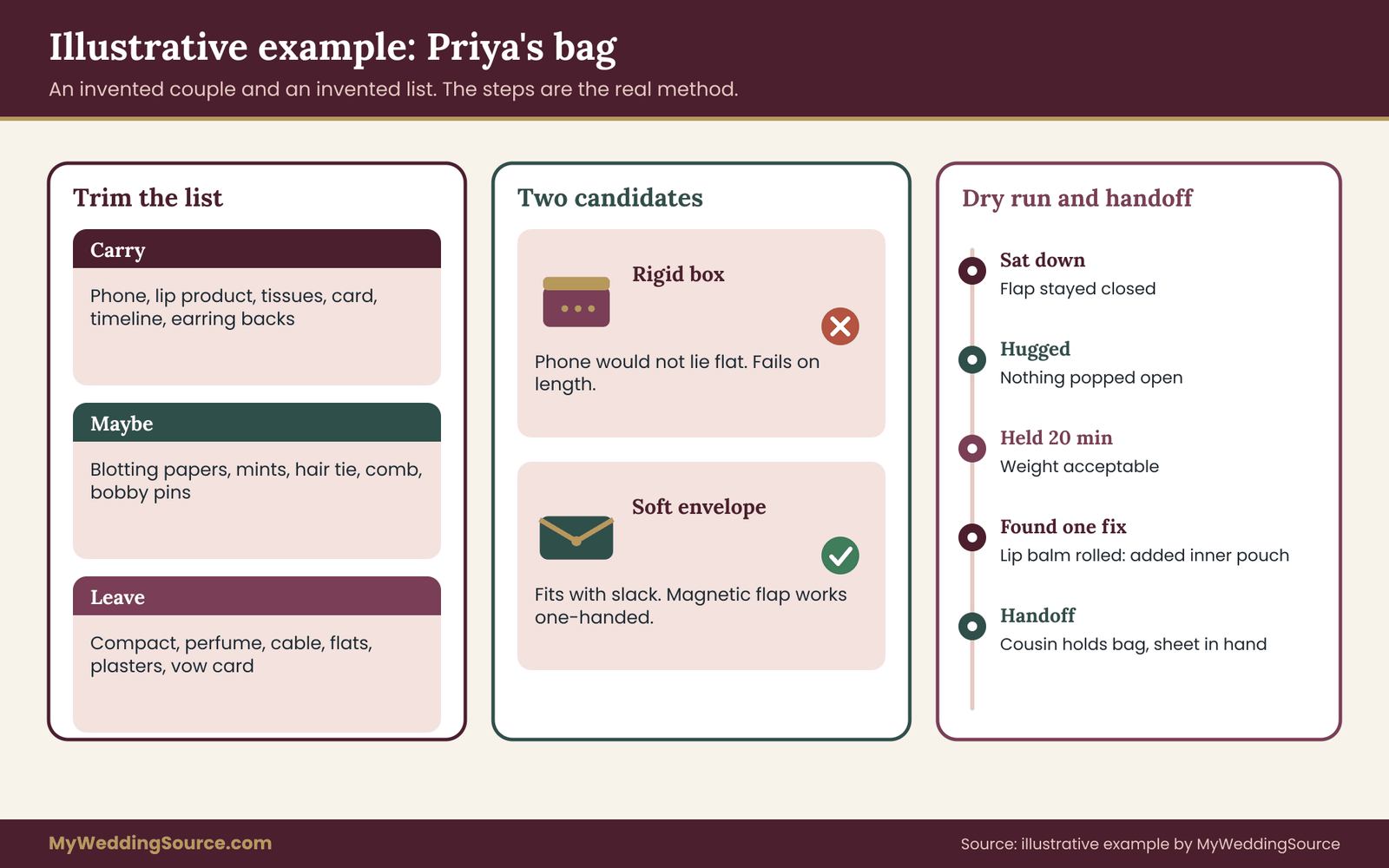
The example below is invented to show the method in motion. The people, items and results are illustrative, not data from real weddings or tests, and your own numbers will differ.
Imagine a couple, Priya and Daniel, planning an afternoon ceremony in a garden and an evening reception in a restaurant room. Priya wears a fitted crepe gown with a small train and plans to carry a bridal clutch from the first photographs until the last dance. Her first draft list had nineteen items.
Step one: trim the list
She sorted the draft into the three tiers. Carry: phone, a lip product, tissue pack, a payment card, a folded timeline card and two earring backs. Maybe: blotting papers, mints, a hair tie, a small comb and a bobby pin set. Leave: a compact, a perfume bottle, a charging cable, a spare pair of flats, blister plasters and a vow card.
The vow card was a surprise. She decided to hand it to her maid of honor, who would pass it to her at the ceremony, since she only needed it for three minutes. That one choice removed a stiff rectangle from the bag.
Step two: measure and pack
She measured each carry item in three directions and found that the phone set the length and the thickness, with its case on. The lip product stood upright in the gap beside it. The tissue pack and the folded timeline lay on top. The card slid behind the phone.
Adding about a fifth of slack for a soft bag, she got a target interior that she compared to two candidates. A rigid box clutch that she loved failed on length: the phone would not lie flat. A soft envelope clutch with a magnetic flap passed on length, and its thickness left just enough slack.
Step three: the dry run
She packed the envelope clutch and tried three things. She sat down on a dining chair with the bridal clutch on her lap and checked whether the flap stayed closed. She hugged a friend with the bag in one hand and noted that the flap did not pop open. She held the bag with the other hand empty for twenty minutes and judged the weight acceptable.
One problem showed up. The lip product rolled toward the opening whenever the bridal clutch tilted, and she wanted to find it faster. She added a small inner pouch for loose items and kept the lip product at the top. The test cost her an evening and no money.
Step four: the handoff
Priya assigned her cousin as the handoff person for the ceremony. The cousin would keep the bridal clutch in her own tote from the end of portraits until the end of the toasts. The cousin held a one-page sheet listing what was in the bag, in which order, and what to do if Priya asked for something.
At dinner the bridal clutch went to a small ledge behind the head table, where it was visible and out of the splash zone. At the end of the night, the sheet told the cousin to take the bag to the hotel room, not leave it on a table. The method did not make the day perfect. It meant fewer small questions and no searching for the bag.
What the example shows
Three lessons repeat across most cases. The item list changed more than the bridal clutch did, since trimming made the bag choice easy. The thickness number, not the length, decided which bag passed. And the handoff plan mattered as much as the fit.
You can run exactly this sequence at home. The numbers will differ and the winning bag may be a pouch, a wristlet or a frame, but the order of steps stays the same.
The handoff checklist: who holds the bridal clutch, and when
A bag that fits perfectly can still go missing. The handoff checklist turns the bridal clutch’s route through the day into a few clear assignments, so nobody has to remember or improvise under pressure.
Choose the handoff person with care
The ideal handoff person is reliable, calm, physically close to you for much of the day and willing to be a little bored. An attendant who is also giving a toast, performing a reading or managing small children is a poor choice at the moment those duties peak. A planner or day-of coordinator, if you have one, is often a better fit, because holding a bag is within their job. A relative who is delighted to help and will not wander away is an equally good choice.
Ask in plain terms. A message such as the one below sets the scope and the end time, which spares both of you an unclear favor.
“Could you carry my small bag from the end of portraits until after the toasts? I will give you a one-page list of what is inside and when I might ask for something.”
The five handoff points
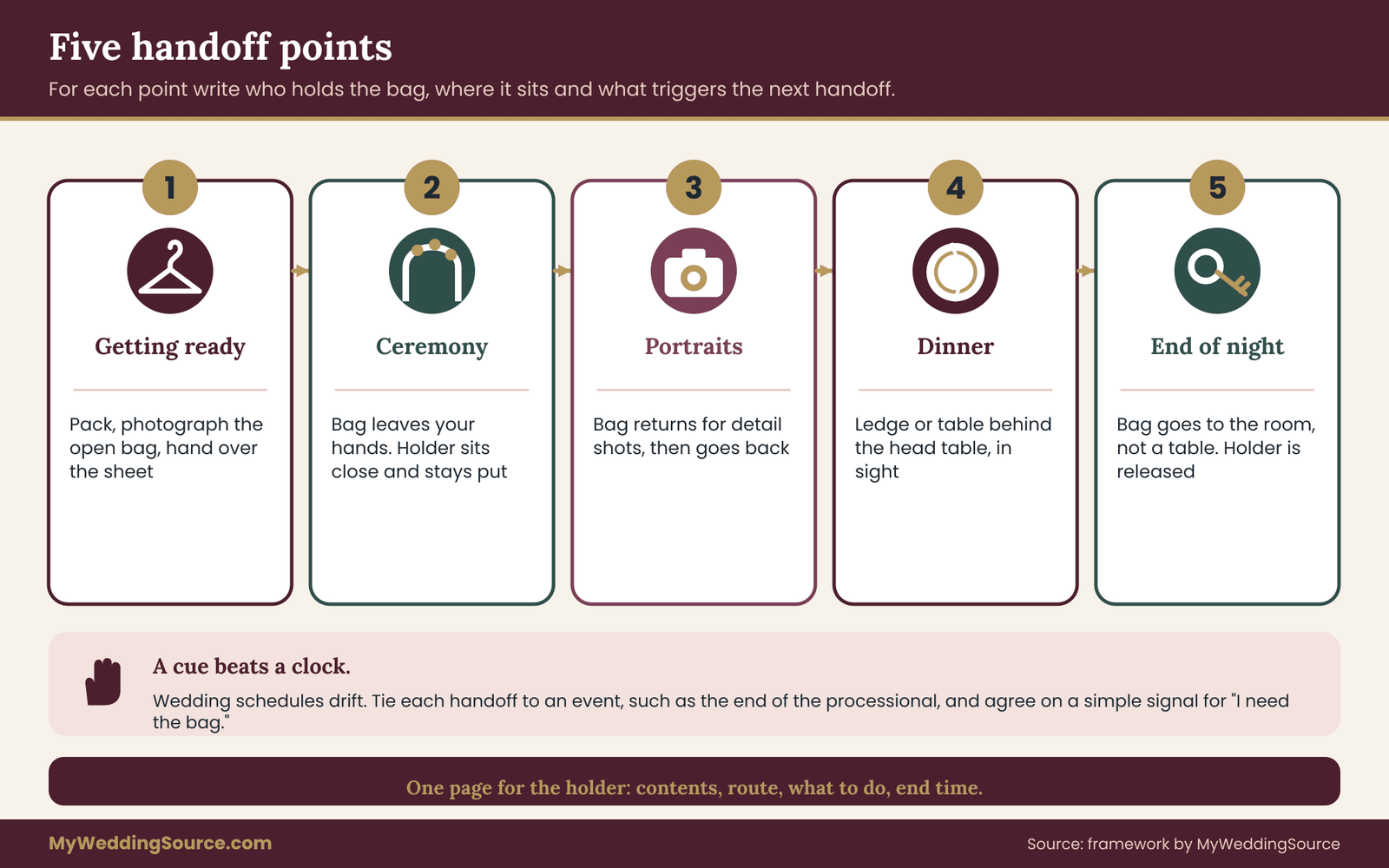
Most days contain five natural handoff moments, though yours may have fewer.
The first is the getting-ready room, where the bag is packed and photographed. The second is the ceremony start, where the bag leaves your hands. The third is portraits, where it may return briefly for detail shots. The fourth is the reception entrance or dinner, where it goes to a table or ledge. The fifth is the end of the evening, when it needs a clear destination.
For each point, write who has the bridal clutch, where it sits, and what triggers the next handoff. A trigger can be a time, a cue such as the end of the processional, or a message. Triggers with a cue are more reliable than triggers with a clock, because wedding schedules drift.
The handoff sheet
The sheet is one page, written in plain language, and printed or saved where the handoff person can reach it. It has five parts.
The first part lists the contents, in packing order, with the top item first. The second part gives the route, using the five handoff points. The third part says what to do if you ask for something and what to do if you cannot be found. The fourth part lists any item that must stay with the bag, such as a medical item, and how to reach the right person if there is a problem. The fifth part gives an end time and a destination, so the handoff person knows when they are done.
A photograph of the open, packed bag goes at the top of the sheet. It shows the handoff person what normal looks like and lets them notice if something is missing. Do not put a phone number for anyone who has not agreed to be called, and keep private information such as a card number off the sheet entirely.
Labeling and recognition
A small bag on a crowded table looks like many other small bags. A discreet label inside, with a name and a contact, helps if it is misplaced. A distinctive ribbon or tag tied to a strap makes the bridal clutch recognizable from across a room, though it also adds visual clutter, so choose something subtle.
Tell the venue staff if the bag will sit on a table or ledge, particularly if the room has a coat check, a gift table or a staff station. The venue contact usually knows where bags are safe. Ask what the venue can watch over and what it cannot, and get the answer in writing if the bag holds anything valuable.
Plan for the moment you want something
The point of carrying items is to use them. Agree on a signal that means “I need the bridal clutch,” and keep it simple. A glance and a raised eyebrow works with a close friend. A short text works with a planner. Practicing the exchange once, in the getting-ready room, takes thirty seconds and removes confusion later.
If the handoff person is out of reach, have a fallback. This may be a second trusted person, or a rule that the bag always sits at a particular spot at the head table. A single point of failure is the main way a bag disappears.
Questions to ask and checks to make before buying a bridal clutch
Buying is where a good plan can still go wrong, because online listings and shop displays say little about what you need. This section is a set of questions and checks, followed by cost logic, so you can compare options without relying on a photo.
Questions for the seller
Ask for the interior dimensions in all three directions, along with the opening width. Ask whether the bridal clutch is rigid or soft and whether the sides expand. Ask what the closure is, and whether the magnet, if there is one, is shielded from cards. Ask what the lining is made of and whether the bag has a pocket or a card slot.
Ask whether a standard phone with a case fits flat, and request a photo of the bag open with a phone inside. Ask about the materials and whether the surface can snag fine fabric. Ask for the return window, who pays return shipping, and whether the bridal clutch must be unused. Ask how long a custom or made-to-order bag takes, and whether it can be returned.
Get the answers in writing, such as a reply message or an order note. A verbal promise in a shop is hard to prove later. If the seller cannot answer the basics, that is useful information about the product and about how a return would go.
Checks to make when the bag arrives
Treat delivery as the start of the test, not the end. Open the box and inspect the bag in daylight for loose threads, uneven stitching, crooked clasps and glue marks. Check the hardware, such as the clasp, zipper or magnet, a dozen times and see whether it sticks or loosens.
Load the bridal clutch with your real items and run the Fit Box steps again, since the numbers in the listing may differ from what you hold. Measure the actual interior against your packed footprint. Smell the bag, because a strong chemical odor from glue or finish can transfer to fabric and is difficult to remove. If anything is wrong, note the date and the problem and contact the seller in writing within the return window.
Return windows and wedding timing
A return window is a date on a calendar, and a wedding date is a date on a calendar. If the window closes before your dry run, you may be stuck with a bag that does not work. Order the bag early enough that you can test and still return it, and keep the packaging, tags and receipt until the dry run is done.
If you are buying a custom or made-to-order bag, ask about lead times and make a note of the final date to change your mind. The same logic applies to shoes and other accessories, which is why it helps to place accessory deadlines on the same timeline as vendor deadlines, as the broader guide to planning every wedding day accessory suggests.
Cost logic without invented numbers
Price is the least reliable guide to quality here. An expensive bag can be too small, and an inexpensive one can fit perfectly. A better way to think about cost is the full cost of getting the right bag, which includes the purchase price, shipping, a possible return and the time spent.
A useful comparison is between buying once and buying twice. A cheaper bag that fails the dry run and has to be replaced costs the original price, return shipping if it is not free, and a second purchase. A bag that costs more but passes the first time may cost less overall. Be wary of price as a proxy for size or quality, since neither follows reliably.
Also decide whether the bridal clutch has a second life. A neutral clutch that works for future events may justify a higher price than a bag that only suits the wedding day. A highly decorative bag that you love as a keepsake has value of another sort. Neither is wrong, as long as you decide on purpose.
Rental, borrowed and heirloom bags
Borrowing a bag from a family member or renting one from a service can be a good, economical choice, and it brings special checks. Ask for measurements and test with your items. Inspect the lining and the hardware, since older bags may have weakened stitching or clasps that no longer hold.
Heirloom bags may be fragile and carry sentimental value that is hard to replace. Consider whether the bag is meant to be used or displayed. If the answer is used, ask a specialist or a trusted tailor to inspect the stitching and the lining. For storage guidance after the wedding, museum conservation resources, such as those from the National Park Service, recommend acid-free materials and avoiding plastic wraps for long-term storage.
Beaded and delicate surfaces
A heavily beaded or crystal-covered bag needs a close look. Check that every bead is secure, then rub a soft cloth gently across the surface to see whether anything catches. Loose beads can detach in a crowd and end up on the floor or in a dress. If you notice any, ask the seller about repair, or choose a plainer surface.
Delicate surfaces also react to the dress. For a fine lace or tulle gown, a smooth satin or leather bag in a matching tone is often a safer choice than a sparkling one. The seller, a tailor or a fitter can tell you more about how your particular dress handles contact.
Commercial relationships and recommendations
No bag is recommended or ranked in this guide, and no seller or brand is promoted. If you read reviews or lists elsewhere, check whether the author discloses payment or free products. The Federal Trade Commission publishes guidance on endorsements and reviews, and it is a useful way to judge how much weight to give a review. Look for reviewers who show the bridal clutch open and loaded, because that is the evidence that matters for the Fit Box Method.
Edge cases: when a standard bridal clutch plan needs changes
Standard advice assumes an ordinary day with no complications. Several common situations change the plan, and it is worth reading the ones that apply to you before you buy.
Medical items
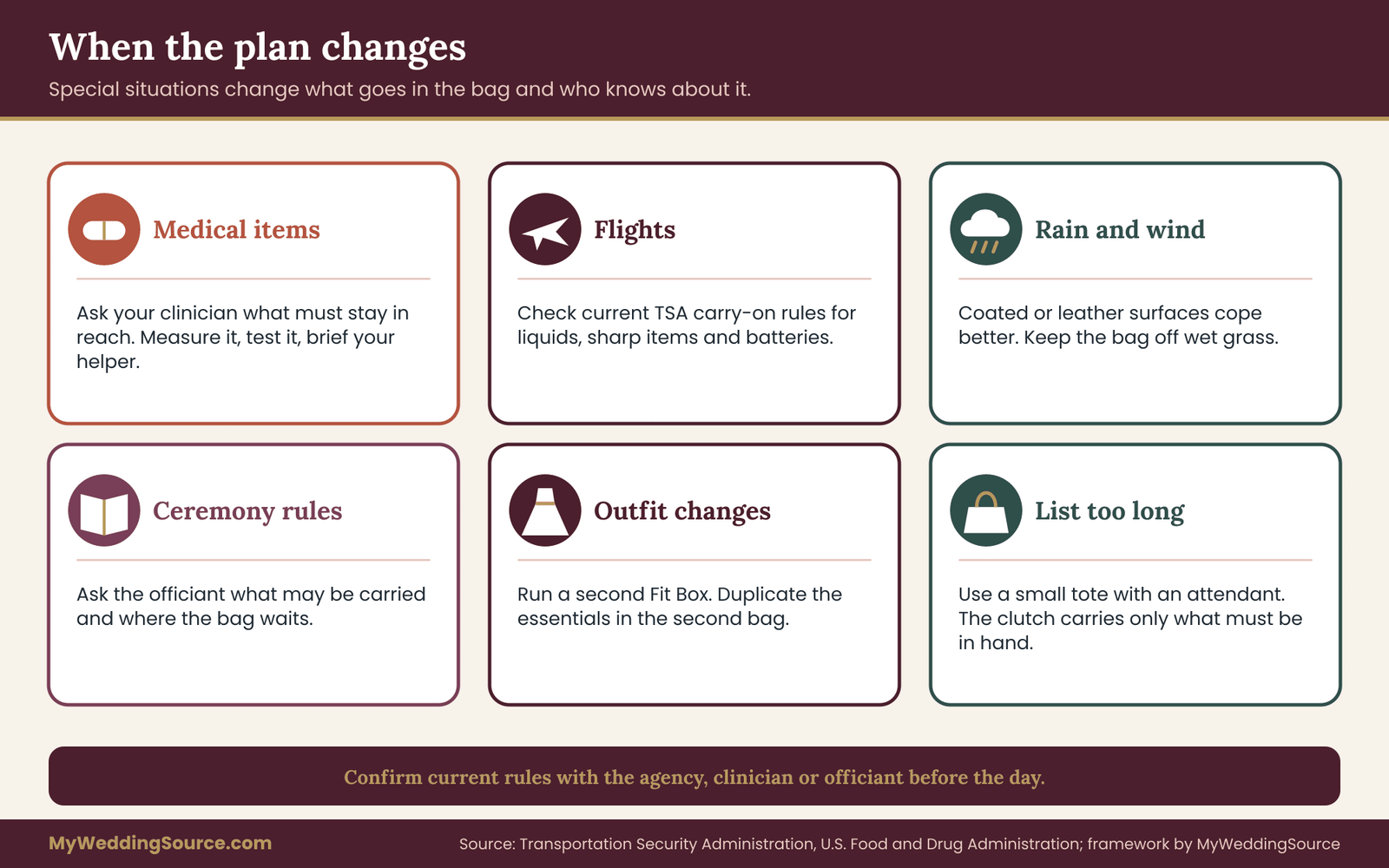
If you carry a medical item, such as an inhaler, an epinephrine auto-injector, glucose tablets, a prescription or any other item that you may need quickly, the bag is no longer a fashion decision. Decide with your own clinician what you need to have within reach and what conditions it must be kept in, such as temperature or light. The U.S. Food and Drug Administration publishes general guidance on medicine storage and use, but your clinician and the product label are the authority for your own situation.
A medical item should not be assumed to fit. Measure it and test it with the bag. If it does not fit, do not leave it behind. Change the bridal clutch, or carry the item in another way, and make sure your handoff person knows what it is and what to do. Medical information on a handoff sheet should be limited to what the helper needs, and only with your consent.
Destination weddings and flights
If the bag travels by air, it must also work for security screening. The Transportation Security Administration publishes rules for liquids, sharp objects and batteries in carry-on bags, and a small bag with a perfume, a nail file or a lithium power bank may need adjusting. Check the current TSA guidance before you pack, since rules change.
Also think about crush. A hard clutch in a suitcase may be fine, and a soft one can be flattened. Many travelers carry the bridal clutch inside a larger personal item and pack it on the day. If you are traveling for the wedding, the wedding planning checklist is a good place to add a line for the bag and its contents.
Rain, wind and outdoor venues
Outdoor weddings add weather. A fabric bag can be marked by rain, and a bag with a drawstring can be hard to manage in wind. A leather or coated surface tolerates damp better than satin. Ask whether the bag can be wiped, and carry a small, clear bag or pouch inside it for the most water-sensitive items.
At an outdoor venue, a bag on the grass is likely to be damp, dirty or stepped on. Plan a hook, a chair or a table, and tell the handoff person where it will be. If the ground is soft, heels and bags both sink, so a short cord or a loop that keeps the bridal clutch off the grass can help.
Long ceremonies and traditions that restrict items
Some ceremonies last a long time or have rules about what you may carry. A religious or cultural ceremony may ask that certain items not be worn or held, or may require removal of shoes or covering of the head. Ask the officiant or a community leader what is expected, and plan where the bag will be during that time.
Outfit changes and multiple bags
If you change outfits during the day, the bridal clutch may need to change too. A bag that suits a formal gown may look wrong with a reception outfit, and the second outfit may have different pockets or none. Treat the second bag as a second Fit Box run, and put a duplicate of the essentials list in the second bag so you are not transferring items in a hurry.
Some people choose a single neutral bag that works with both outfits. Others use a ceremony bag and a smaller party bag. Both are reasonable, and both need their own handoff plan.
When the bridal clutch is not enough
Sometimes the honest answer is that the list is too long. A day with long hours, many costume changes, young children or complex medical needs may exceed what any clutch can hold. In that case, the better plan is a small tote or an attendant’s bag that stays within reach, and a bridal clutch that carries only what truly must be in your own hand. That is not a failure of the method. It is the method working.
The dry run, the timeline and the mistakes to avoid with a bridal clutch
The final stage is a rehearsal. A dry run takes less than an hour, and it finds nearly every problem that would otherwise appear on the day. It also gives you a record to hand to someone else.
The dry run, step by step
Do the dry run in the outfit, or as close as you can manage, a week or two before the wedding. Wear the shoes you will use, the dress if it is available, and any accessories that touch the bag, such as a bracelet or a ring.
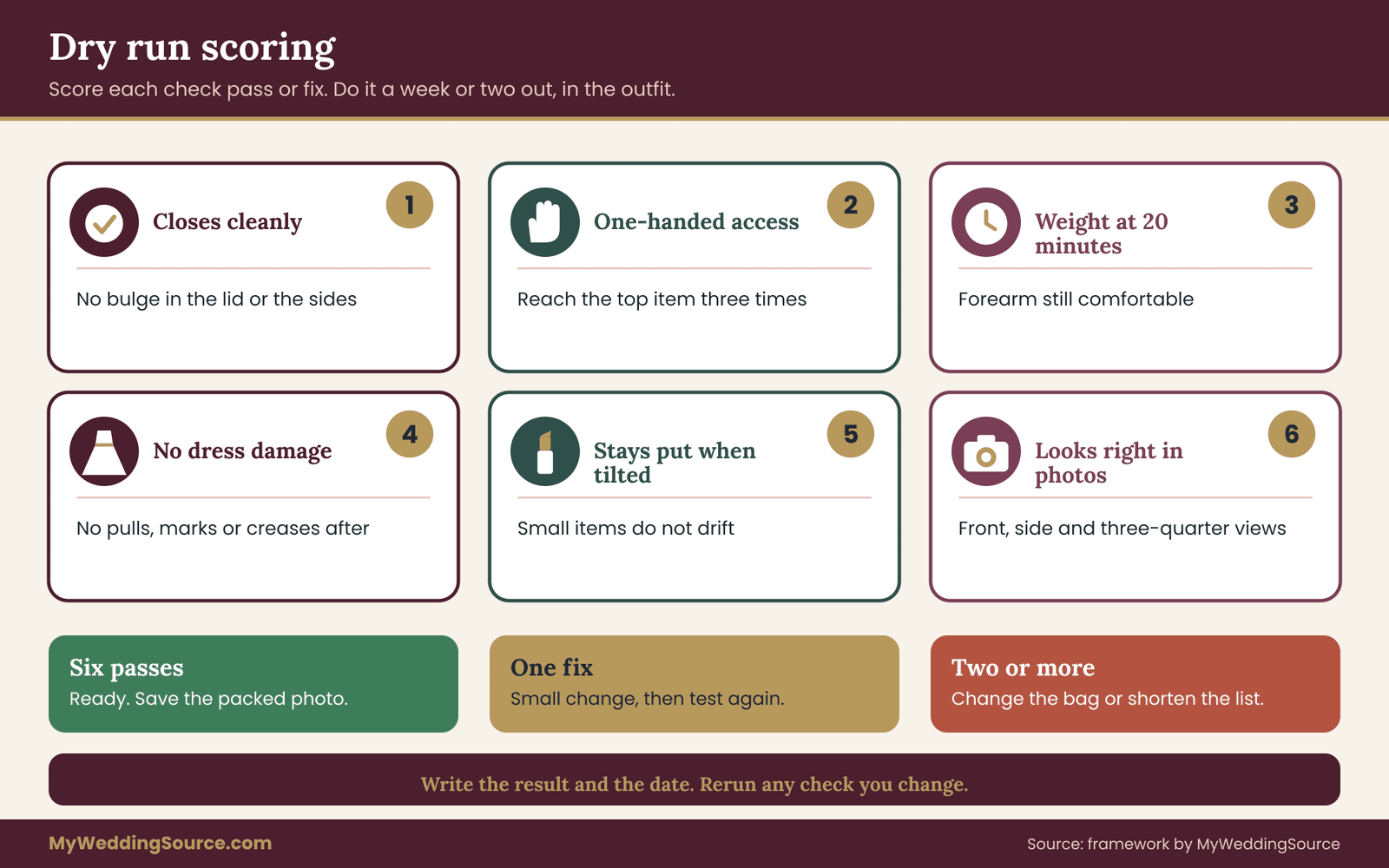
Pack the bridal clutch exactly as planned, in packing order, and close it. Check that it closes without a bulge. Open it with one hand and take out the item you would need most. Do that three times and see whether it gets easier.
Next, carry it. Hold it at the waist for several minutes, then under one arm, then by the wrist or strap if it has one. Walk the length of a room, climb a few stairs and sit down on a chair with the bag on your lap and then on a table. Hug someone and notice whether the bridal clutch knocks against them. Dance for a minute with the bag in hand or set down, if you plan to use it that way.
Then look. Take photographs from the front, the side and three-quarters, with the bridal clutch held where you will hold it. Check whether the bag bulges, whether it clashes with the dress, and whether the contents print through the fabric. Look at the dress afterward for marks, pulls or creases.
The scoring sheet
Give each check a pass or a fix. The checks are closing without a bulge, one-handed access, comfort of weight after twenty minutes, no snagging or marking of the dress, items staying in place when tilted, and a clean look in photographs. A bag that passes all six is ready. A bag with one fix needs a small change, such as an inner pouch or a repacking. A bag with two or more fixes needs a different bag or a shorter list.
Write the result down with the date. If you change anything, run the relevant check again. The sheet gives you a clear answer to the question “is this ready” and lets you stop worrying.
A timeline that works backward from the wedding
Work backward from the date. Start with the list and the zones a couple of months out, which gives time to order a bag and handle returns. Aim to choose and order the bag several weeks before the wedding, so there is time for the arrival checks. Do the dry run a week or two before the date, leaving time to fix problems.
In the last few days, finalize the handoff sheet and give it to the handoff person. Pack the bridal clutch the day before and photograph it open. On the morning, check the contents against the photo. Linking the bag to your other accessory and wardrobe deadlines keeps it from becoming a last-minute chore, and the wedding vendor timeline is a useful template for placing small tasks alongside bigger ones.
Getting ready: the order that protects the bag
When you get dressed, the bridal clutch should be the last thing to arrive. Load it after hair, makeup and the dress are done, so that powder, hairspray and fragrance do not settle into the lining. If a hairstylist or makeup artist is working, ask them what they recommend for touch-ups, and what to carry for them. The bridal hair and makeup planning guide covers what to ask your artist about touch-up products, which helps you decide which items earn a place in the bag.
Keep the bag away from hairspray and perfume during the final stages, because aerosol residue can mark satin and leave a smell. A clean, dry surface is the best resting place before the ceremony.
Common mistakes
Most problems come from a short list of mistakes. Choosing the bridal clutch before the list is the most common, and it leads to a bag that looks right and holds too little. Trusting the outside size on the label is the second. Skipping the thickness measurement is the third, and it leads to a lid that will not close.
Other mistakes are quieter. Forgetting the handoff person’s end time means they spend the whole evening holding the bag. Packing the bridal clutch at the last minute, with no photograph, means nobody can tell what is missing. Leaving the bag on a chair during the ceremony without telling anyone is how bags are mistaken for a guest’s or lost.
A final mistake is carrying too much. A bridal clutch that holds everything may feel safe, and it is usually heavy, bulky and hard to use. Moving items to the handoff person or to a second small bag keeps the clutch light, which makes it easier to hold, to photograph and to forget about.
Limits of this guide
This guide cannot tell you what your own gown, schedule or health requires. It offers a method and a set of questions, not a promise about any bag, seller or product. Test with your real items, confirm every measurement and policy with the seller, and ask your clinician about any medical item. The checks work best when you do them with your own list rather than a generic one.
After the wedding
The bag’s job is not quite over at the end of the night. Empty it as soon as you can, since tissues, makeup and food can stain the lining. Wipe it according to the maker’s care label, or ask a specialist cleaner if the surface is delicate. The Federal Trade Commission’s Care Labeling Rule requires care instructions on most garments, though accessories vary, so ask the seller if no label is present.
Store the bridal clutch with acid-free tissue in a cool, dry place and avoid plastic for long-term storage. If you plan to keep it as a memento, photograph it with the contents laid out. That record is a small keepsake of the day and a reference for the next event.
Your next steps
Take these in order, and finish each before starting the next. You can do most of them in a single weekend.
- Write the full draft list of everything you imagine carrying, without editing.
- Sort the list into the three zones and the three tiers, using the stranded test.
- Measure each carry item in three directions, with its case on, and write the numbers down.
- Add slack to the packed footprint, then compare it to the interior of any bag you are considering.
- Ask each seller the written questions, and keep the answers with your receipt.
- Choose and order the bag early enough to test it and return it if it fails.
- Run the dry run in the outfit, score it, and fix what needs fixing.
- Write the one-page handoff sheet, add a photograph of the packed bag, and give it to your handoff person.
If you only do two things, measure the thickness of your phone with its case and decide who holds the bridal clutch during the ceremony. Those two choices prevent most of the common problems.
FAQ
How big should a bridal clutch be?
Size it from the items, not the label. Measure each item you plan to carry by length, width and thickness, pack them together, and add about a fifth of spare room for a soft bag or a quarter for a hard one. Then compare that to the usable inside of the bag. If any one dimension fails, choose a different bag or a shorter list.
What should go in a bridal clutch?
Only what you need within reach, quickly, and what is small. Typical items are a phone, a lip product, tissues, a payment card, a folded timeline and a few tiny repair items. Move everything else, such as a full makeup kit, spare shoes and a charger, to a handoff person or a second bag, and keep medical needs in your clinician’s plan.
Will a phone fit in a bridal clutch?
Often yes, but many small and rigid styles do not allow it. Measure your phone with its case on, then check the interior length, the thickness and the opening width. Ask the seller for a photo showing a phone inside. If it fits only at an angle or the lid will not close, choose a wider envelope, a pouch or a wristlet.
Who should hold my bridal clutch during the ceremony?
Pick one reliable person who will stay close and has no major duties at that moment, such as a planner, a relative or an attendant who is not doing a reading. Give them a one-page sheet listing the contents, the route through the day and an end time. Name a backup in case the first person is unavailable.
Is a rigid box clutch or a soft pouch better?
Neither is better for everyone. A rigid box protects fragile items and photographs well, but it has the smallest interior and no give. A soft pouch carries odd shapes and tolerates a slightly overfull load, though it sags and shows the outline of items. Choose by your list and run the dry run before you commit.
Can I carry medication in a bridal clutch?
Many people do, but the decision belongs with your clinician and the product label, not a styling guide. Ask what must stay within reach and under what storage conditions. Measure the item and test it in the bag. If it does not fit, change the bridal clutch or the plan, and tell your handoff person what to do.
How do I stop a bridal clutch from snagging my dress?
Check the bag’s surface and hardware against a hidden part of the gown at a fitting. Beads, sequins, rough clasps and bare metal chains are the usual culprits with lace, tulle and fine knits. Smooth satin or leather in a matching tone is often safer. Ask your tailor or fitter about your specific fabric, and see the guide to fit and alterations for wedding dresses for what a fitting can check.
How early should I buy a bridal clutch?
Early enough to test it and still return it. Order several weeks before the wedding, keep the packaging and receipt, and run the full dry run at least a week or two out. Allow extra time for a custom or made-to-order bag, and ask the seller in writing about lead times and return terms.
Sources
- Federal Trade Commission, consumer protection and advertising guidance
- Care Labeling Rule, Federal Trade Commission
- Consumer advice, Federal Trade Commission
- Security screening, Transportation Security Administration
- How do I dispute a charge on my credit card bill?, Consumer Financial Protection Bureau
- U.S. Food and Drug Administration, drug safety and medicine use
- American Podiatric Medical Association
- Museum Management Program and conservation guidance, National Park Service
- Consumer protection, USAGov