
Reception activities are the planned and unplanned things guests do between dinner and the last song, and a good plan gives every kind of guest something to do besides dance. This guide builds a guest interest matrix and a low-pressure zoning method, so quiet guests, children, older relatives and dance-averse friends each have a comfortable place in the evening.
Sort your guests by what they want from the evening (talking, watching, making, playing, gentle movement or rest) and by how much attention they will accept (private, small group or whole room). Offer at least one low-exposure option for each appetite. Place the options in separate zones so none competes with another. Test each of your reception activities against three exits: it starts without an announcement, it can be left without notice, and it can be ignored without comment. Then confirm space, power, staffing, access and permissions with your venue in writing.
Most couples plan a reception around two ideas: a meal and a dance floor. The meal works for nearly everyone. The dance floor works for some. Between them sits a long stretch of the evening when a large share of the room has nothing to do except hold a drink and look for someone to talk to. That gap is where wedding reception activities earn their place.
This is not a case against dancing. Dancing is wonderful for the guests who love it, and the music planning guide covers how to program it well. The question here is narrower. What do the other guests do for four hours, and how do you offer it without turning the party into a program that people have to survive?
The answer is less about picking clever games and more about matching formats to people. A photo wall that delights one guest embarrasses another. A lawn game that gives a restless uncle a purpose may be impossible for a guest who uses a cane. A quiet card table that looks like an afterthought to the planner is the highlight of the evening for a grandmother who cannot hear over a speaker. The method below is built to catch those differences before the day, when they are cheap to fix.
A note on scope. This is general planning information, not legal, safety or accessibility advice. Venue rules, local fire codes, insurance terms and accessibility obligations differ by place, so confirm current requirements with the venue, your vendors and the relevant agency, and use the sources at the end of this guide as starting points.
What wedding reception activities are really for
It helps to say plainly what the reception activities are for, because the purpose decides what you buy and what you skip. Wedding reception activities do four jobs, and most weddings need all four at some point.
They give guests a reason to move around. Seated guests tend to stay in their seats. A reason to stand up, whether a dessert table, a game or a photo corner, breaks the room into smaller groups and lets people meet someone new. That is the first thing reception activities should do.
They give guests a way to connect without performing. Many people can talk to a stranger over a shared task, such as building a card or choosing a song, far more easily than they can talk to a stranger across a table. The shared task carries the conversation so the guests do not have to.
They absorb the slow parts of the day. Photographs, room flips and the gap before dinner leave guests waiting, and the cocktail hour is the clearest example. An optional activity turns waiting into something else.
They let different generations share an evening. A seven-year-old, a thirty-year-old and an eighty-year-old rarely want the same thing. A well-planned set of options lets each choose, while still feeling part of one party.
What reception activities are not for is filling every minute. A reception where every ten minutes brings a new game, a prompt or an announcement is tiring, and it quietly punishes guests who like to sit and talk. Treat reception activities as a menu, not a schedule.
Where this guide fits with the rest of your plan
Activities touch several other decisions, and it is worth knowing where this guide stops. How guests move through the room, where the bar and food sit and how the exit works are covered in the reception guest flow guide. When the formal moments fall (toasts, cake, first dance) belongs to your timeline. This guide covers only the optional layer on top: what guests can choose to do, where it happens and how it is run.
That separation matters because activities fail most often at the seams. A game set up in the path to the restrooms, a craft table placed next to the speaker or a photo wall that blocks the bar line are all flow and timing problems that only look like trouble with reception activities. Plan the layer last, once the structure underneath is settled, because reception activities sit on top of the flow and cannot repair it.
Why the dance floor misses some guests
The mismatch is practical rather than cultural, and it helps to name the reasons guests skip the dance floor, because each reason points to a different alternative.
Some guests avoid dancing because of attention. Being watched is uncomfortable for them, and a floor ringed with seated spectators feels like a stage. Others avoid it because of body and ability. Standing for a long time, uneven footing, joint pain, a recent surgery or a mobility device all make a crowded floor hard or unsafe. Some skip it because of sound. A loud floor is tiring for people with hearing aids, sensory sensitivity or a baby on their lap, and they may not be able to talk for long near it.
Others skip dancing for belief or habit. Some guests do not dance for religious or personal reasons, and others simply never have. A last group is energy and timing. Early risers, parents with a sitter on the clock and guests who traveled all day want something gentle that ends sooner than the dancing does.
None of these guests is being difficult. Each has a perfectly good reason, and each reason suggests a different kind of reception activity. Attention-shy guests need reception activities with no audience. Guests with body limits need seated or low-effort reception activities. Sound-sensitive guests need a quieter place. Belief-based guests need an evening that does not imply dancing is the only way to celebrate. Energy-limited guests need something that works early.
This is the reasoning behind the guest interest matrix in the next section. Instead of guessing which of the reception activities is popular, you ask which guests need which kind of option and build backward.
What the evidence can and cannot tell you
There is no reliable public data on which reception activities guests prefer, and any ranking that claims one should be treated with caution. Surveys by wedding companies are marketing tools, not research, and their samples are rarely described. So this guide does not rank reception activities by popularity. Instead it gives you a way to read your own guest list, which is the only sample that matters when you choose reception activities for your wedding.
Where facts do matter, such as accessibility obligations, product safety or venue rules, the guide points to the issuing agency. For example, the U.S. Department of Justice publishes accessibility guidance at ada.gov, and that is where to confirm what a venue owes guests with disabilities. You will see those references collected under Sources.
The guest interest matrix for reception activities
The guest interest matrix is a simple way to translate your guest list into an activity plan. It has two dimensions, and you only need a pencil and your guest list to use it.
The first dimension is appetite. This is what a guest wants from the evening when they are not eating or watching a formal moment. There are six appetites, and most guests have one or two.
Talk. These guests want conversation with people they know, or with a few new people, in a place where they can hear. They are happiest at a table or a sofa grouping.
Watch. These guests enjoy the event as an audience. They like seeing the dancing, the games and the toasts, and they are content to be near the action without joining it.
Make. These guests like a task with a result: a card, a drawing, a pressed flower, a photo strip. The task gives them something to do with their hands and something to say.
Play. These guests like a game with simple rules and a playful edge, whether cards, lawn games or a quiz.
Move gently. These guests want a little movement without a performance: a walk, a stretch, a slow dance, a game that involves standing but not sprinting.
Rest. These guests need to sit somewhere calm, away from the speakers, for part of the evening. Rest is an appetite, not a failure of enthusiasm.
The second dimension is exposure. This is how much attention a guest will accept while doing the activity. There are three levels.
Private. The guest does the activity alone or with one companion and nobody is watching. A guestbook alternative or a puzzle corner is an example.
Small group. A handful of people share the activity, and it is easy to join or leave. A card table or a craft station is an example.
Whole room. The activity involves, or is visible to, everyone. Group games, sing-alongs and the dance floor itself live here.
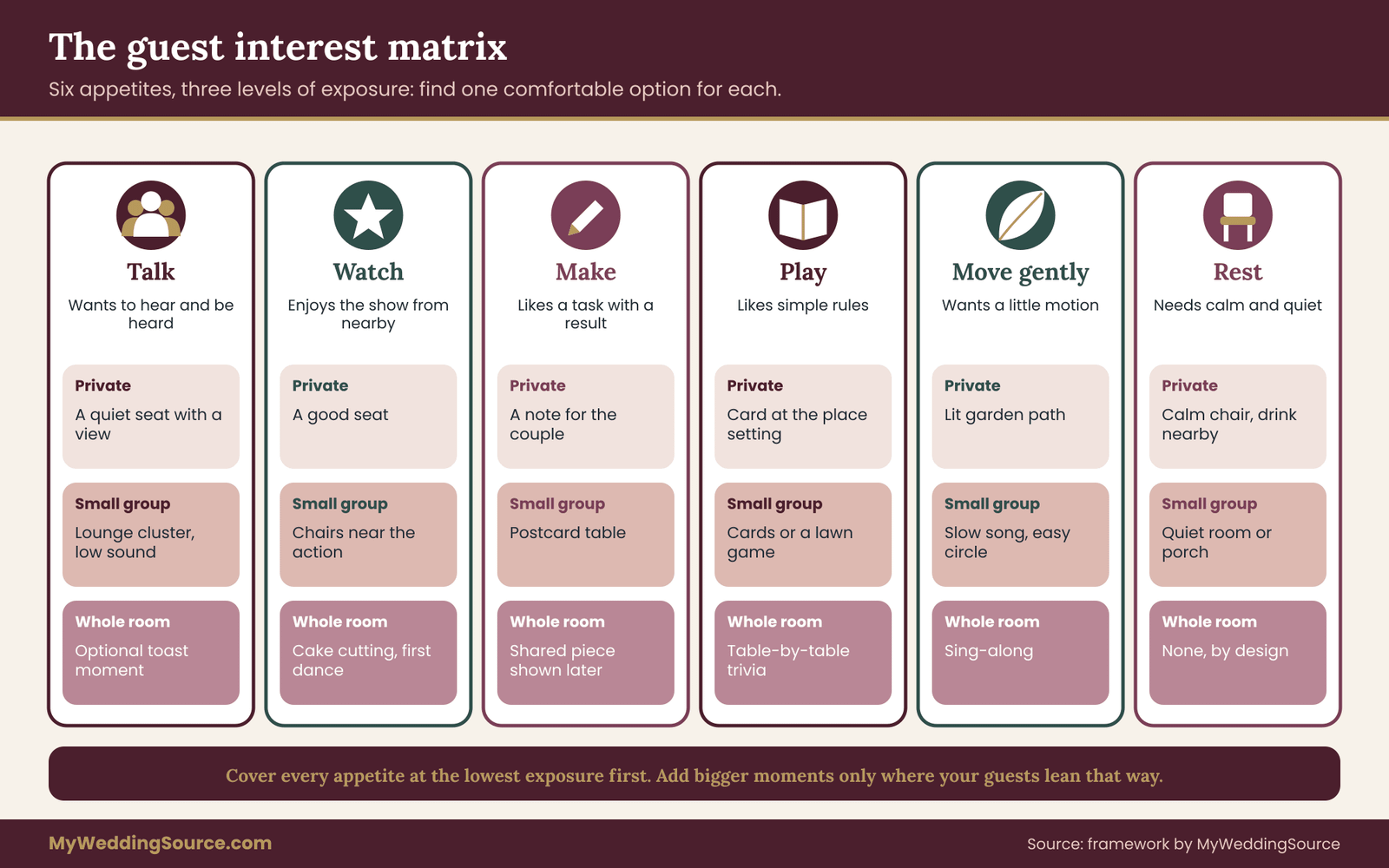
Put the six appetites down one side and the three exposure levels across the top, and you have eighteen cells. Each cell is a question: what could a guest with this appetite do at this exposure level? A guest who wants to make something privately might write a note for the couple’s future selves. A guest who wants to make something in a small group might join a table decoration project. A guest who wants to make something in front of the whole room could contribute to a collaborative piece that is revealed on stage.
You do not have to fill all eighteen cells with reception activities. You have to make sure no appetite is left with nothing at the lowest exposure level.
Filling in the matrix with your real guest list
The matrix is only useful when it reflects the people actually coming, because reception activities succeed or fail on who is in the room. This is a half-hour exercise, and it works best when both partners do it separately and then compare.
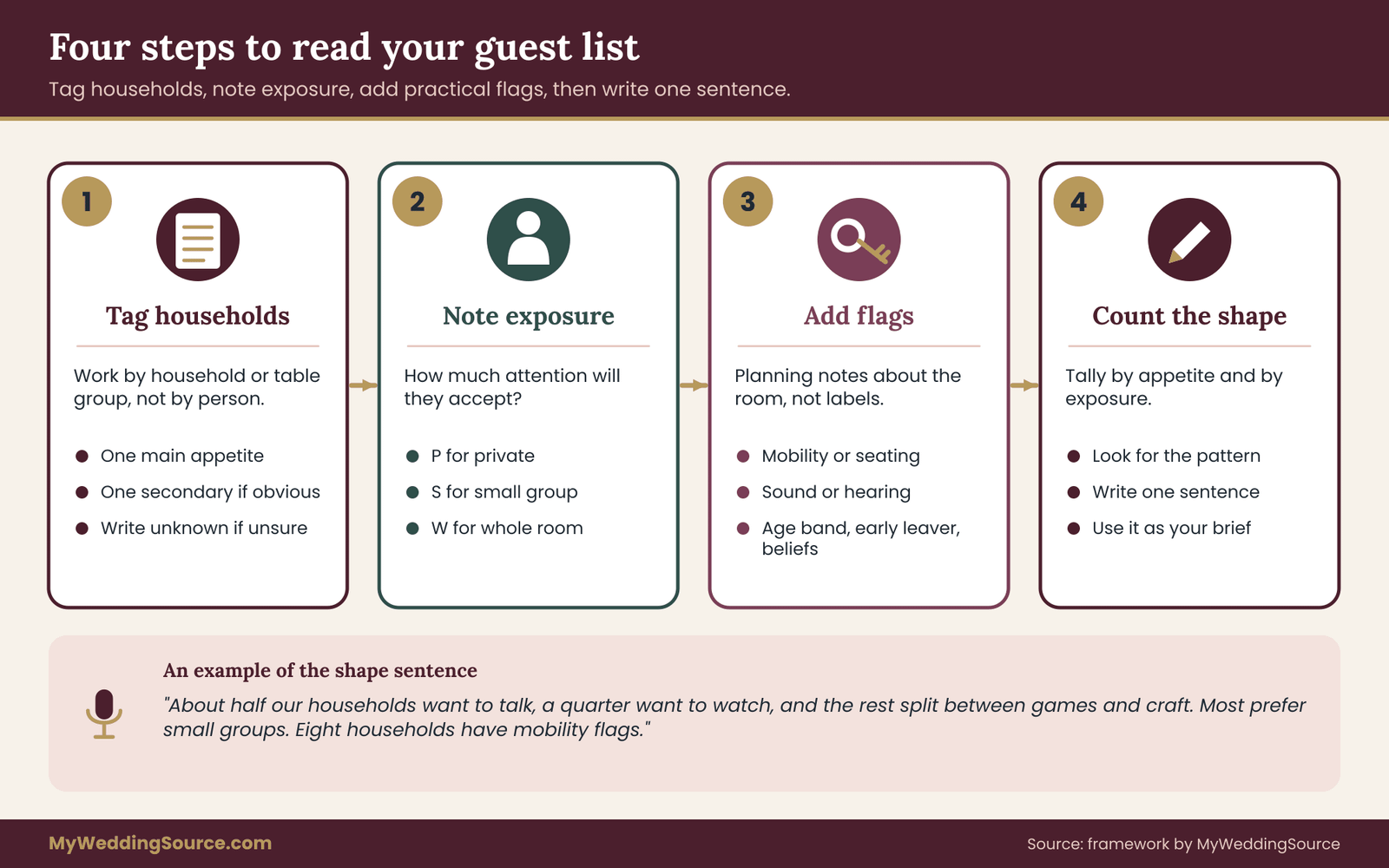
Step one: tag households, not individuals
Open your guest list and work by household or table group. Assigning an appetite to each of one hundred and twenty individuals is slow and invites guesses. Tagging forty households takes minutes and is accurate enough, because people who arrive together usually behave together.
For each household, write one primary appetite and, if it is obvious, one secondary. Use what you already know. The couple who always find the quietest corner at parties is a Talk household. The cousins who started the card game at the last family reunion are Play. The grandfather who comes to watch the dancing and applauds is Watch. The friend who brings a sketchbook everywhere is Make.
If you honestly do not know, write “unknown” and move on. A few unknowns are fine. A list that is mostly unknown is a sign to ask someone who knows the family better, such as a parent or a sibling.
Step two: add the exposure note
Next to each tag, add a single letter for how much attention that household tolerates: P for private, S for small group, W for whole room. Be honest and generous in equal measure. Someone who loves the spotlight at a birthday dinner may still dislike being singled out at a wedding where they know few people. When you are unsure, assume the lower exposure level. Offering a quieter option to someone who would have enjoyed a louder one costs nothing. Doing the reverse can cost the evening.
Step three: add the practical flags
Beside each household, add short flags for the things that change what is possible. These are not labels for people. They are planning notes about the room.
- Mobility: uses a cane, walker, wheelchair or scooter, or cannot stand for long.
- Hearing or sound: uses hearing aids, is sensitive to loud sound or needs a quiet space.
- Vision: has low vision, which affects games with small print or dim corners.
- Age band: children under five, children five to twelve, teens, or older adults who tire early.
- Early leaver: has a sitter, a long drive or an early flight.
- Beliefs: does not dance, drink, gamble or take part in games of chance for religious or personal reasons.
Only record what a guest has already told you or what is plainly known within the family. Do not ask guests to disclose health details for the sake of an activity plan. If you need information, send a general line on the RSVP or the wedding website asking whether anyone in the party needs seating, access or quiet space, and leave it at that.
Step four: count, then read the shape
Now tally. Count households by primary appetite and by exposure level. You are not looking for exact numbers. You are looking for the shape.
A wedding where most households are Talk and Watch at the private or small-group level is a wedding that needs good seating, good lighting and conversation-friendly acoustics far more than it needs games. A wedding with many Play households and many children is a wedding that benefits from tables, space and a person to run things. A wedding with a long list of Rest and mobility flags needs a calm room and seating everywhere before it needs any activity at all.
Write the shape in one sentence. For example: “About half our households want to talk, a quarter want to watch, and the rest are split between games and craft. Most prefer small groups. Eight households have mobility flags and six have early-leaver flags.” That sentence is the brief for every one of your reception activities.
Reading the matrix: what each cell suggests
Once you have the shape, the cells become practical. The aim is not to run eighteen reception activities. It is to pick a small set that covers each appetite at the lowest exposure level, add a few at higher levels where your guests lean that way, and leave everything else out.
Talk
At the private level, talking is simply a quiet seat with a decent view of the room and a small table for drinks. At the small-group level, it is a lounge cluster away from the speakers, with enough seating that a group of four can sit without dragging chairs. At the whole-room level, it is the toast or an open-mic moment, which many Talk guests will not want. Do not put any pressure on the Talk guests at the whole-room level; none of your reception activities should require them to speak.
What Talk guests need most is acoustics. Hard floors and glass walls reflect sound, and a room that is lively for dancers can be tiring for conversation. Ask the venue where the quietest corner is and whether a lounge area can be set up there.
Watch
At the private level, Watch guests need a good seat. At the small-group level, they need a spot near the action where they can see without being asked to join, such as chairs around the edge of the floor or a bar rail with a view. At the whole-room level, they need to know the moments they are watching: the cake cutting, the first dance, the group photo.
The trap with Watch guests is that spectating can feel awkward when it is the only option. A couple who clap from the side for an hour may feel like extras. Give them something to do with the viewing, such as a vote, a scorecard or a request slip, and they become participants without having to cross the floor.
Make
At the private level, Make guests might write on a card, tuck a memory into a jar or draw on a page that goes in a book. At the small-group level, they might join a table with simple supplies and a clear instruction. At the whole-room level, they might add to a collaborative piece that is displayed later.
Make activities need supplies, surfaces and a way to finish. They also need an end point that does not rely on the couple, such as a box where completed pieces go. If one of your reception activities creates objects, someone has to own them afterward. Decide that before the wedding.
Play
At the private level, Play might be a puzzle, a trivia card at each place setting or a pair of dice games at a side table. At the small-group level, it is cards, dominoes, a board game or a lawn game with a few players. At the whole-room level, it is a quiz, bingo or a team game.
Whole-room play is the riskiest cell because reception activities of this kind can slide into coercion if they are run badly. The three-exit test later in this guide is the main protection.
Move gently
At the private level, this might be a path to walk or a garden to sit in. At the small-group level, it might be a slow-dance song offered at the right moment, a circle dance that anyone can step into, or a lawn game with low effort. At the whole-room level, it is a sing-along or a gentle group dance.
Move-gently guests are the ones most often forgotten. They want a little movement but are put off by a loud floor. A short, quieter set of music can serve them without taking over the room.
Rest
At the private level, a rest seat is a comfortable chair in a calm place with a drink within reach. At the small-group level, it is a quiet room or a covered porch where two or three people can sit. Rest has no whole-room level, and that is the point of including it among your reception activities.
Treat Rest as a real offering, one of the reception activities you plan on purpose. A reception that has somewhere calm to sit tends to keep older guests, parents and travelers for longer, because they know they can recover. It is among the cheapest and most overlooked of the wedding reception activities.
Seven rules for choosing from the matrix
After tallying, you will have more ideas than you can run. These rules help you cut the list without arguing about taste.
Rule one: cover every appetite at the lowest exposure level first. Before adding anything bigger, make sure Talk, Watch, Make, Play, Move-gently and Rest each have at least one private or small-group option. This is the floor of the plan.
Rule two: add higher-exposure options only where your guest list leans that way. If the tally shows few Play households, a whole-room game is probably a poor use of the evening.
Rule three: never run more than one whole-room activity per hour. Whole-room moments compete for attention, and guests who disliked the last one need time to recover.
Rule four: give every activity a home. If an activity cannot be placed in a specific zone with enough space, it is not ready, and reception activities that lack a home tend to collide with the bar line or the restrooms.
Rule five: choose reception activities that need no host where possible. A game that requires an enthusiastic emcee will fail the moment the emcee gets pulled into a photo.
Rule six: cap the total. Four to six well-placed reception activities for a mid-sized reception are usually plenty. More options mean more setup, more cleanup and more places where something can go wrong.
Rule seven: drop any activity you would feel obliged to defend. If you are choosing something because a relative expects it, an influencer did it or a vendor recommended it, and not because your tally supports it, cut it.
Low-pressure zoning for reception activities
The matrix tells you what to offer. Zoning tells you where to put it. Low-pressure zoning is the practice of dividing the reception space into areas, each with one purpose, one sound level and one level of visibility, so that guests can choose an activity by walking toward it and can leave by walking away.
The idea comes from a simple observation. Most awkwardness around reception activities is spatial. A guest who wants to talk stands next to the speaker. A guest who wants to play cards has to sit where the dessert line forms. A child’s craft table sits beside the bar. Fixing these collisions on paper is far easier than fixing them during the evening, so zone your reception activities before you order anything.
The five zones
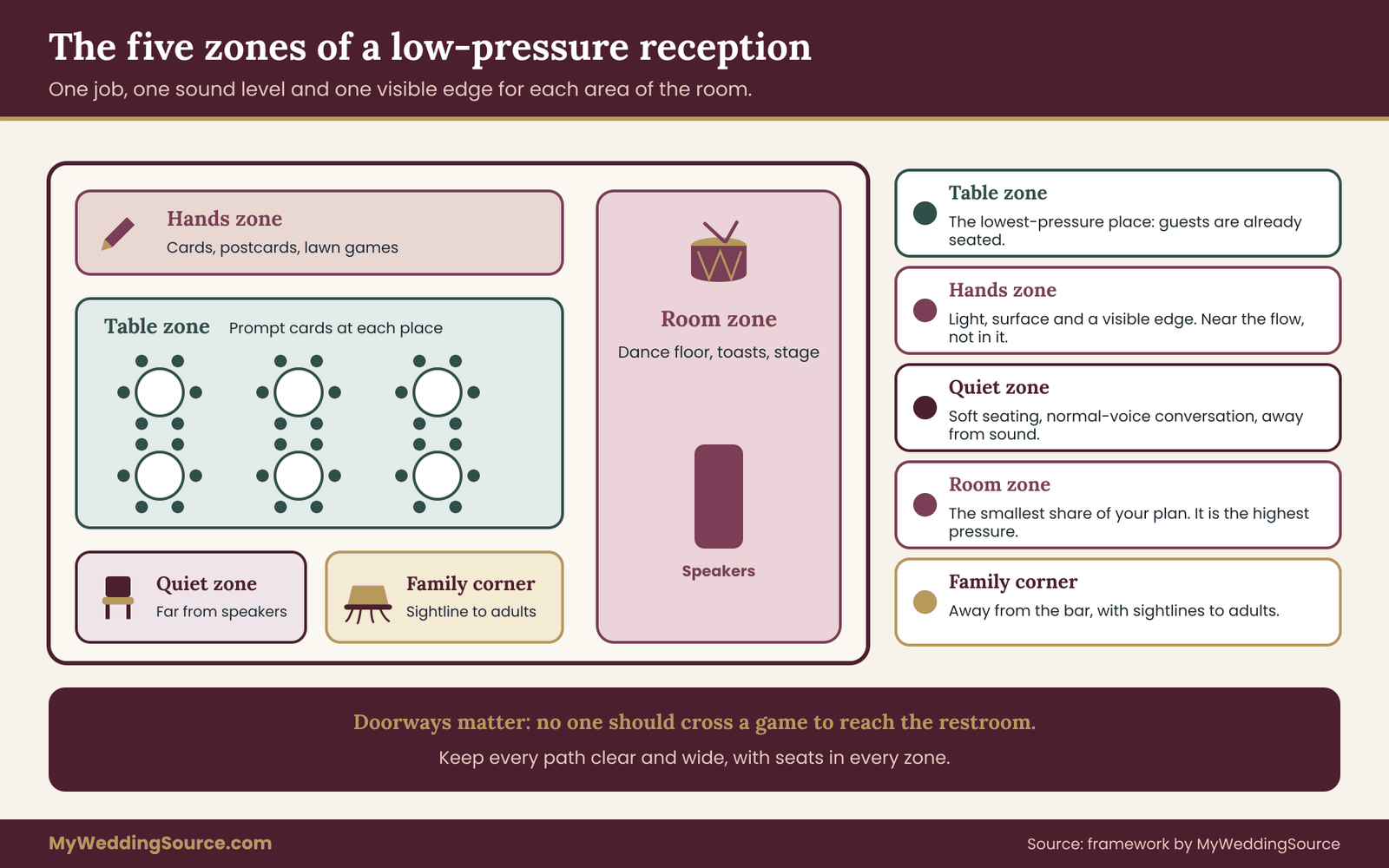
Most receptions can be organized into five zones. Not every room has space for all five, and smaller venues may combine two. Reception activities fit any size of room as long as each zone keeps one job. The zones are described by their job, not by their furniture.
The table zone. This is the main dining area before and after the meal. During the evening, it becomes the home of private and small-group reception activities that live on the table itself: a card at each setting, a deck of cards, a short quiz, a pad for notes. The table zone is the lowest-pressure place in the room because guests are already seated and nobody has to move. Who sits together matters here, so read the seating chart guide before you finalize table prompts.
The hands zone. This is where making and playing happen with equipment: a craft table, a game table, a lawn game area or a small station. It needs light, surface area and a clear boundary. It is often best near but not inside the main flow, such as along a wall or at the edge of a terrace.
The quiet zone. This is the Rest and Talk area. It has soft seating, lower sound and, ideally, a visual separation from the dance floor. A side room, a covered porch, a corner behind a screen or a lounge grouping at the far end of the room can all work. Its defining feature is that guests can hold a conversation at a normal voice.
The room zone. This is the whole-room area: the dance floor, the toast space, the stage. Whole-room reception activities live here. Because it is the highest-pressure zone, it should be the smallest share of your activity plan, not the largest.
The family corner. This is where children play, with sightlines to their adults. It is placed away from the bar and the loudest speakers, near seating for the adults who supervise. The guest care planning guide covers the staffing and supervision side of this corner in more depth.
Rules for each zone
Each zone has a handful of design rules that keep it working.
Sound. Keep the quiet zone as far from speakers as the venue allows. If the room is a single open space, a rough rule is to place the quiet zone on the opposite side from the speakers and the dance floor in between. Sound travels farther than people expect, and soft furnishings absorb it better than bare walls.
Light. Craft and card activities need real light, not candlelight. Candles are lovely and cannot be relied on for reading small print or sorting cards. If your venue is dim, bring task lamps if the venue permits them and confirm power.
Boundaries. A zone should be visible from a distance. A rug, a rope of lights, a change in furniture or a sign tells guests where the area starts. Without a visible edge, a zone dissolves into the room and its activity collides with the next one.
Doorways. Every zone needs a way in and a way out that does not cross another zone. If guests have to walk through the game area to reach the restrooms, the game area is in the wrong place.
Sightlines. Family corners need sightlines to adults. Quiet zones need the opposite: partial privacy, so that a guest who is resting does not feel on display.
Seating. Every zone needs seats. A zone with no place to sit excludes guests with limited stamina, which is a larger group than most planners expect.
The three-exit test
Zoning handles where. The three-exit test handles how. It is a short check you apply to all of your reception activities, and any that fails one of the three should be changed or cut.
Exit one: it starts without an announcement. A guest should be able to begin the activity by walking up and doing it. If it requires a host to explain, gather and launch, then people who want to try it must wait for a group moment, and people who do not want to will be pulled in. Signs with one-line instructions replace announcements.
Exit two: it can be left without notice. A guest should be able to stop at any point without apology. Activities with teams, turns or a final reveal create obligations. If someone leaves midway, the team is short and the game stalls. Design for people drifting in and out.
Exit three: it can be ignored without comment. A guest who does not take part should not be teased, nudged or put on the spot. This is the most important of the three. A game that makes nonparticipants conspicuous, such as a microphone passed around a table, fails this test even if it is fun for those who join.
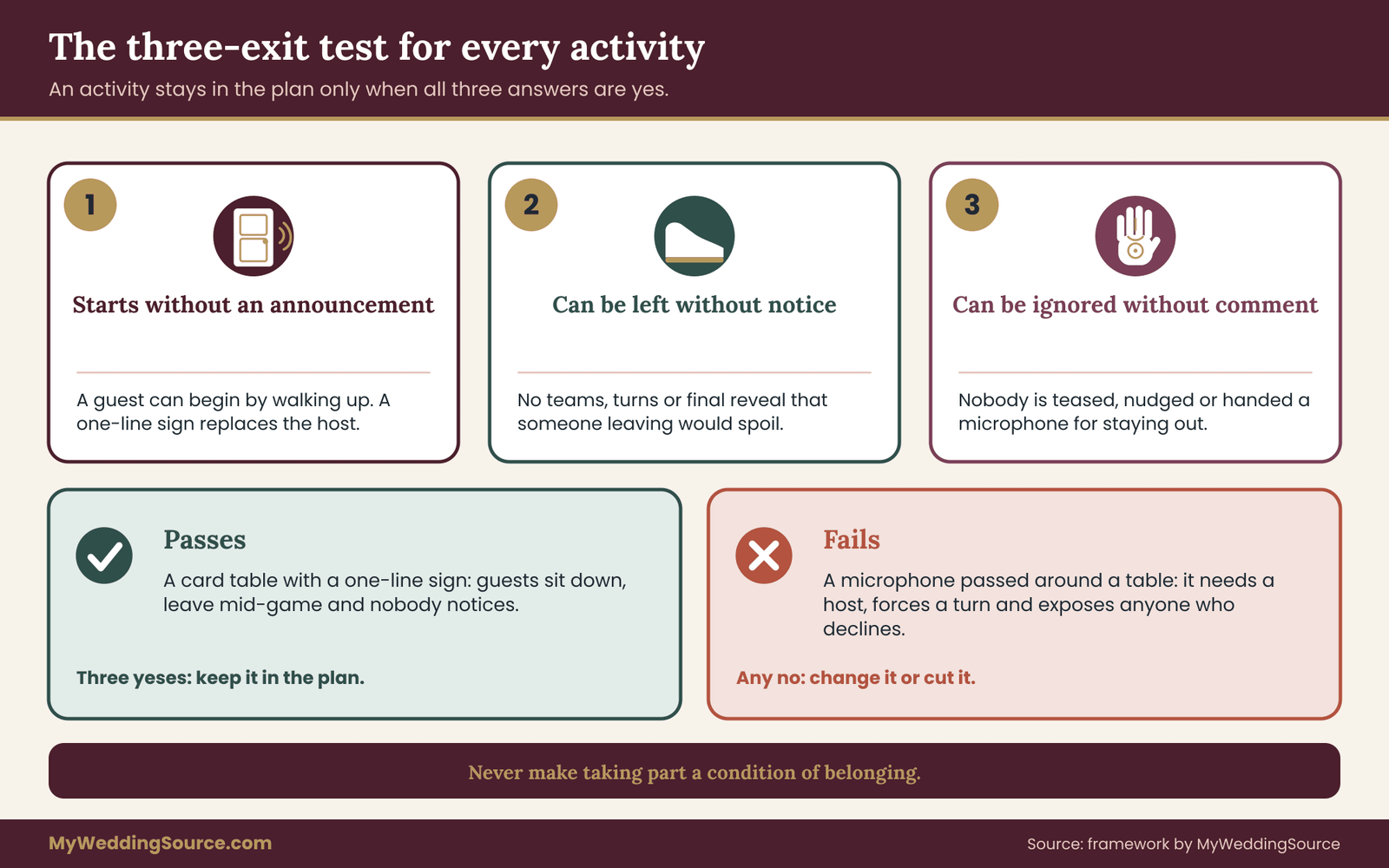
The test is easy to apply. Write the name of each of the reception activities on a card. Under it, answer three yes-or-no questions. Cards with three yeses go in the plan. Cards with one or two noes go back to the drawing board. A few well-known formats, such as a bouquet-style game that calls out single guests, fail all three, and are a good reason to treat tradition and tolerance as separate questions.
Avoiding coercive games
The brief version: never make participation a condition of belonging. Games that single out guests by relationship status, age or appearance, that require physical contact with a stranger or that demand public performance from someone who has not volunteered are coercive in effect, even when the tone is friendly.
If the couple wants a traditional moment that involves volunteers, the safe pattern is to ask for volunteers in advance. A quiet word beforehand, a sign-up on a clipboard or a text from the host to a few chosen guests means people say yes with time to think. Surprise calls from the microphone give them no time to say no.
Child safety belongs in the same conversation. Activities involving children should never separate a child from their adults without the adults agreeing, and any supervised area should have a clear check-in and check-out routine. The same guest care guide goes into that routine in detail.
Reception activities that fit each guest group
With the matrix and the zones in place, you can choose actual formats. This section groups wedding reception activities by the guest they tend to suit. Every item can be adjusted to the three-exit test, and none of these reception activities depends on a particular budget.
For guests who want to talk
Talk guests need places, not programs. The most useful thing you can offer is a set of conversation-friendly seating clusters, a few table prompts that are optional and easy to ignore, and a quiet zone with decent acoustics.
Table prompts work when they are light and non-compulsory. A small card at each place with a question about the couple, a favorite wedding memory or a recommendation for the newlyweds gives strangers a topic. Keep the cards short and put them face down or in a small holder so that guests choose whether to read them.
A longer-form option for Talk guests is a story station, a quiet corner with a chair, a notepad and a prompt asking for a memory of the couple. It suits private exposure and produces something the couple can keep. It is also a place to sit without feeling like you are hiding.
For guests who want to watch
Watch guests are served by good sightlines and by moments worth watching. A well-placed ring of seats around part of the floor, a bar rail with a view and a few chairs near the cake all help.
You can also give Watch guests a role that does not involve leaving their seat. A simple scoring card for a game, a request slip for the band, a song-vote jar or a toast-cue card makes them participants. They can influence the party without performing in it.
Take care with the line between watching and being watched. Placing seated guests in a ring around a small dance floor can make dancers self-conscious and spectators feel like a jury. Angle seating so that guests look at the room, not at one person.
For guests who want to make something
Make guests do best with a single clear project and a place that does not look messy. Examples are a postcard station where each guest writes a note to the couple, a thumbprint or signature piece, a pressed-flower or leaf card, a small drawing table or a simple photo-strip frame.
Keep supplies minimal; the best making-based reception activities need a pen, a card and a box. One or two good pens or markers per table, a stack of uniform cards and a clear box for finished items are better than a table of loose materials. Avoid anything that needs drying time, glue that drips, glitter or paint, because cleanup and clothing damage are real costs at a formal event.
Tell Make guests what happens to what they make. A card that says “These will be read on our first anniversary” feels purposeful. A pile of cards with no stated destination feels like homework.
For guests who want to play
Play guests want rules simple enough to learn in one read. The best formats are ones that can run with no host, no schedule and no minimum number of players.
Card and tile games work well at a side table: a few decks, a cribbage board, dominoes or a mahjong set where the culture and the guest list suit it. Supply a printed card with the basic rules for any game that is not universal, since guests who know a game as a family tradition often play slightly different versions.
Lawn and tabletop games suit outdoor or tent receptions, and they are among the better reception activities for mixed ages, since a ten-year-old and an eighty-year-old can sit at the same board. Choose games that do not require throwing hard objects. Check the Consumer Product Safety Commission’s site at cpsc.gov for recalls and safety notices on any specific toy or game before buying, especially for anything with small parts that younger children might reach.
For a longer game, a trivia or scavenger format that runs across the evening on paper works better than a live quiz. Put a single card at each table with ten or twelve light questions about the couple or the day, and ask guests to hand it to a designated box by a stated time. It suits Talk and Play guests at once, needs no host and is easy to ignore.
Be cautious with games of chance, which are the one family of reception activities where the law varies most. Raffles, betting games and anything that involves money have legal rules that differ by state and, for some guests, personal or religious objections. If you want a prize game, make it a skill or knowledge game with a small token prize and no entry fee, and check local rules before running a raffle of any kind.
For guests who want to move gently
Gentle movement is the least-served appetite at many weddings, and few reception activities are designed for it. These guests do not want to be on the floor for the loudest hour, but they enjoy a little movement and the feeling of being part of the evening.
A short, slower block of music mid-evening can serve them. Ask the DJ or band for one set of songs that are danceable at low energy, with a steady beat and a familiar tune. The music planning guide explains how to brief a performer on a set like this.
A circle dance or line dance that anyone can step into is another option, as long as it follows the three-exit test. If the dance has a leader, the leader should invite, not call people out. If the venue has a garden, a path or a terrace, a lit walking route with a few benches gives these guests a place to stroll in small groups.
A sing-along also works, provided it is announced softly and is easy to join late. Choose songs that most ages know, supply lyrics on a card or a screen and let the room carry it. Skip any song with lyrics you would not want a child or a grandparent to sing. A lyric check ahead of time is a sensible step, and some couples ask the performer to review the list.
For guests who need rest
Rest is the cheapest category to provide and the one most often skipped. A quiet zone is a few comfortable chairs, a small table, a lamp with a warm bulb and a place to set a drink. It needs no staff and no schedule.
Place a few of the chairs with their backs to the dance floor so that the guests there are not facing the party. Add a basket with water, simple snacks if the caterer agrees and, if you wish, a few items of comfort such as a shawl or a folded blanket for a cooler venue. Label the area gently, for instance “Quiet corner,” so that guests understand it is a place to sit and talk and not a place to hide.
Some guests will use the quiet zone for a short time and return to the party refreshed. Others will stay for most of the evening and be perfectly happy. Both are good outcomes.
Reception activities for children, teens and older guests
Age changes what guests can enjoy, how long they can stay and how much supervision they need. Planning reception activities by age band is a useful second lens next to the matrix.
Children under five
Very young children need a safe, soft place near their adults and a short list of simple things to do. Offer a small mat, a few soft toys that are clean and have no small parts, picture books and, if the space allows, a corner away from the loudest speaker where a child can nap. Do not plan structured games for this group. Adults will supervise, and the activity is mostly proximity and calm.
Children from five to twelve
This is the group that benefits most from a planned activity, since many are bored within an hour of a seated dinner. A kids’ table with paper, crayons, stickers or a simple craft kit is a good start. A scavenger list of things to find at the venue, or a card asking them to collect signatures from five guests, gets them moving with a purpose.
If you hire a children’s supervisor or a sitter, the details matter more than the reception activities. The guest care planning guide covers vetting, ratios and check-in routines, and it is worth reading before you decide whether to staff a corner or leave supervision to parents. Whatever you choose, make the choice visible to parents on the program or the wedding site so that nobody guesses.
For safety, keep craft and play supplies free of small parts and loose items for any child who might put things in their mouth, avoid latex balloons near young children, and stay within the venue’s rules about candles, confetti and glitter. The CPSC site mentioned above lists current guidance on children’s products and choking hazards.
Teens
Teens are the hardest group to plan for and the easiest to ignore. Many dislike being treated as children and are too self-conscious for the dance floor early in the evening. They often respond well to a role: running the song-request jar, handling a photo booth, keeping score for a game or serving as photographers of an informal shot list.
A table of their own with a game or two, away from the adult tables but within sight of the room, is often enough. Let them choose to join the dancing later, when the floor is full and attention has drifted. A teen who has been allowed to sit out the early part usually dances more freely at the end.
Older guests
Older guests often want the best seats, the least noise and the shortest walks. They tend to leave earlier, so any activity meant for them should be available in the first half of the evening. A card table, a quiet lounge and a seat with a view of the first dance and the cake cutting serve most of them well.
Avoid assuming that older guests want only quiet activities. Many love to dance, play and take part. The point is to offer options, not to sort people by age. A grandparent who wants to join a circle dance should not be steered to the card table, and one who wants to rest should not be called out onto the floor.
Access, comfort and sensory needs
A reception activity that excludes a guest is a poor activity, however clever, so check every one of the reception activities for access. Access is partly a legal topic, partly a courtesy and mostly a design habit. The practical way to approach it is to build access into each zone, and into all your reception activities, from the start.
What the law covers and what it does not
In the United States, the Americans with Disabilities Act sets obligations for many businesses that are open to the public, and the Department of Justice explains them at ada.gov. Whether and how those obligations apply to a private event at a particular venue depends on the venue and the facts, and responsibility is often shared between the venue and the people who rent it. This guide cannot tell you how the rules apply to your event. It can tell you to ask the venue direct questions and to put the answers in writing.
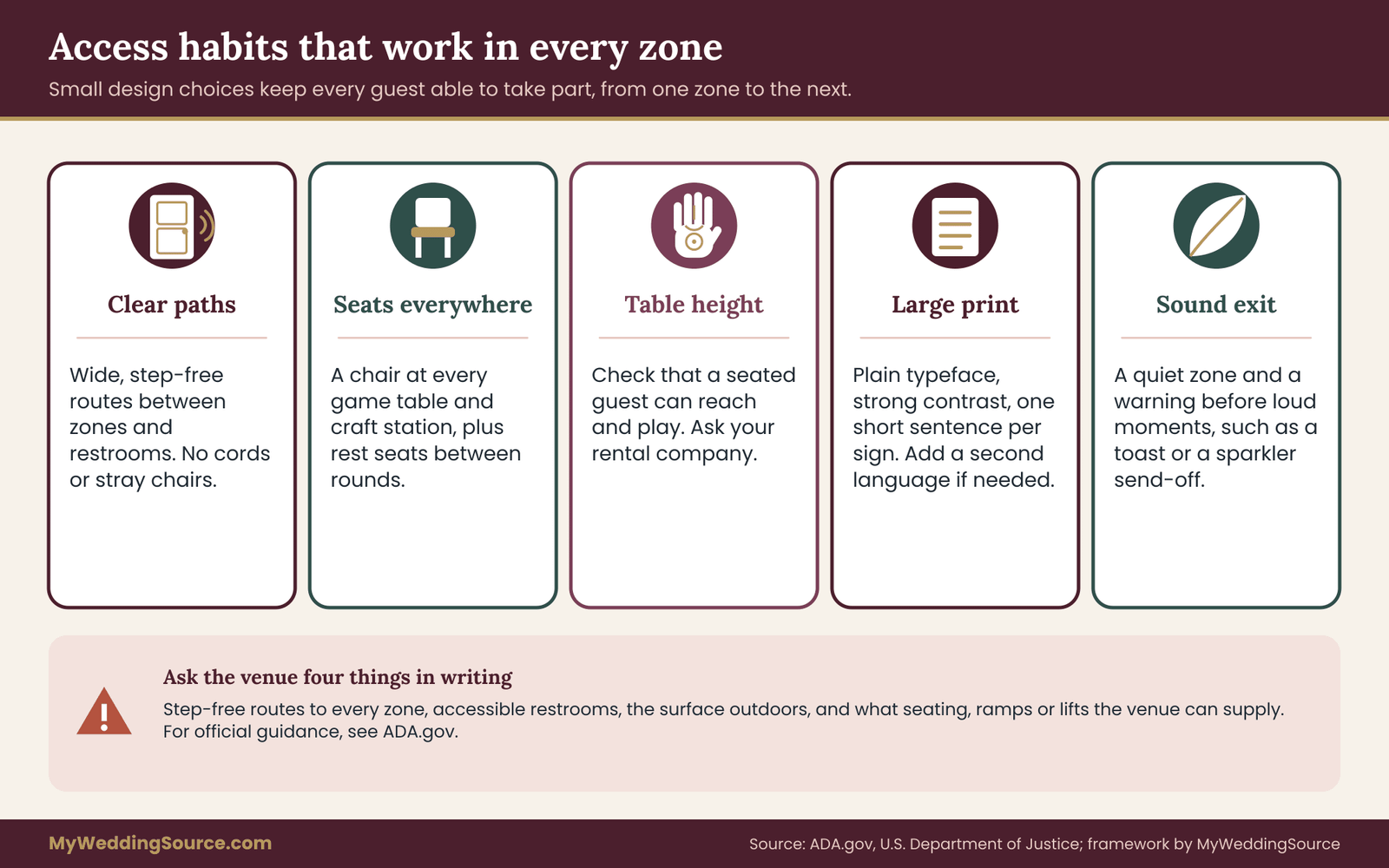
Useful questions include whether the route from the entrance to each zone is step-free, whether restrooms are accessible, what the surface is outdoors, and whether the venue has seating, ramps or lifts it can supply. The accessible venue red flags guide lists warning signs to look for during a site visit.
Design habits that help every guest
Several small habits cover most needs and cost little, and they apply to every one of the reception activities in this guide.
Keep clear paths. A path at least wide enough for a wheelchair or walker, free of cords, thresholds and stray chairs, between every zone and the restrooms, is the most valuable single step. Lawn games and craft tables should not block it.
Offer seats everywhere. Every zone should have chairs, including at game tables and craft stations. A chair at a table means a guest can join without standing, and a place to rest between rounds.
Mind table height. A game table that is too high or too low for a seated guest excludes them. If you rent tables, confirm heights and, where possible, include at least one that suits a seated player.
Print large. Cards, signs and instructions should use a large, plain typeface with strong contrast. Small cursive on a dim table is unreadable for many guests, whatever their eyesight.
Describe, do not assume. A short line on each sign, such as “Seats available” or “Quiet, no music here,” tells guests what to expect.
Sound and sensory comfort
Loud, constant sound is tiring or painful for some guests, including people with hearing aids, some neurodivergent guests and anyone with a sensory sensitivity. The National Institute on Deafness and Other Communication Disorders explains how loud sound affects hearing at nidcd.nih.gov.
You do not have to eliminate loud sound. You do have to give people a way to step out of it. The quiet zone is the main tool. Others include a lower volume during dinner, a warning before loud moments such as a toast with a microphone or a sparkler exit, and a place outside the room where a guest can recover.
Some couples set a volume ceiling with the band or DJ and confirm it in the contract. Others ask for a sound check before guests arrive, so that the volume is set in an empty room and adjusted down once it fills. Either approach reduces the risk of a room that is too loud for the guests who need the most flexibility.
Visual and cognitive access
Dim lighting, flashing effects and busy visuals can be uncomfortable or unsafe for some guests. If you plan strobe or flashing lights on the dance floor, tell guests in advance, and keep an area where they can avoid them. Keep game instructions short, clear and in the same place at each station. A guest who has trouble processing long instructions should be able to understand a game from a sign with one simple sentence and a picture.
Language and cultural access
If your guests speak several languages, put instructions in each. A sign in two languages with a clear icon is more welcoming than a spoken explanation that only some can follow. If a tradition from one side of the family is part of an activity, a brief card explaining it helps guests from the other side join in without embarrassment, and it keeps the activity from becoming an in-joke.
Timing reception activities across the evening
Once the zones are set, the next question is when each of the reception activities is available. A common mistake is to treat the whole evening as one block and open everything at once. Guests have different energy at different hours, and activities compete with the formal moments and with each other.
A more useful approach is to divide the evening into four windows and decide which zones are active in each. Each window has a different mood, and the same reception activity can succeed in one window and fail in another. Timing is half of what makes reception activities work.
Window one: arrival and cocktail hour
This is the window when guests are fresh, curious and standing. It is the best time for private and small-group reception activities that invite people to look around: a story station, a card at the bar, a pair of lawn games on the terrace, a guestbook alternative. The guide to shaping the first hour explains the food, drink and pacing side of this stretch, and it is worth reading alongside this section.
The main design rule for window one is to avoid anything that creates a line. Queues at the entrance to the reception are a flow problem, and an activity that adds to them is a problem too. Place reception activities away from the bar and the food, and give each enough room that three or four people can take part at once without blocking a path.
Keep in mind that guests in this window are often uncertain about where they should be. A sign that says “Optional, no sign-up needed” at the start of a game station makes people comfortable trying it.
Window two: dinner
Dinner is a seated, structured window, and most optional reception activities should pause. The exception is the table zone. Cards, prompts and small puzzles at each place setting are the right scale for dinner, because they do not require anyone to leave their seat.
Keep formal moments short. A toast schedule that crowds the dinner window leaves no time for anything else and leaves guests tired. Keep the dinner window simple and let the schedule you already have set the pace.
One approach that works is to place the table-zone reception activity beside the plate and to mention it once, in a single sentence from the host. Guests who like it will use it, and guests who do not will ignore it.
Window three: after dinner
This is the most important window for the reception activities in this guide. Plates are cleared, the formal moments are done and the room is open. It is when the dance floor opens, and it is when guests who do not dance most need somewhere to go.
Open the hands zone and the quiet zone at the same time the dance floor opens, so that guests see their options at once. If the quiet zone opens later, early leavers never find it. If the hands zone is set up in the middle of a dance song, it looks like an afterthought.
Stagger the whole-room moments. If there is a cake cutting, a group dance or a sing-along, place them with at least thirty to forty minutes between them, and let the evening breathe between each. The three-exit test applies most strongly here, because guests are relaxed enough to enjoy being asked and tired enough to resent being cornered.
Window four: the late evening
By the late window, guests who want to stay have settled into groups. The most useful thing is to keep the quiet zone and a few games open for them, and to avoid adding new structure. Late-evening guests want to keep talking, say goodbye and find their coats.
Late-night snacks, a last song and a clear exit routine matter more than new reception activities. If you plan a send-off, brief the guests who will take part so that those leaving earlier are not left wondering what they missed. The guest flow guide covers exits and the last half hour in detail.
Building a one-page activity run sheet
A run sheet is a single page that lists each activity, its zone, its window, who sets it up, who clears it and what it needs. It is the bridge between the plan and the people who will carry it out. Without it, activities live in the couple’s heads and collapse when the couple is in photographs.
For each activity, write seven lines.
- Name and zone: for example, “Postcard station, hands zone.”
- Window: the hours it is open.
- Setup time and person: who places it, and how long it takes.
- Supplies and power: what must be there, including any extension cords or lighting.
- Instruction sign: the exact one-line text on the sign.
- Reset and clear: what happens to materials during and after.
- Failure plan: what to do if it does not work, such as a table that stays empty or a game that goes missing.
The failure plan is the most useful line. For most of these reception activities, the right failure plan is to take it down quietly. An activity that is not working should vanish, not be promoted. Decide in advance who has permission to remove it.
Give the run sheet to the person who runs the day, whether that is a planner, a coordinator or a trusted friend. If you have no coordinator, assign one reliable person to each zone. A sibling who owns the quiet zone and a cousin who owns the hands zone is a tidy and inexpensive solution, and it works if you ask them early and give them a short, specific job.
Handling delays and changes
Receptions run late, and activities should survive it. If dinner runs thirty minutes over, the hands zone should open when guests are ready, not at the scheduled minute. Tell the zone owners to adjust to the room, not the clock.
If rain or heat moves guests indoors, the lawn games lose their space. Decide in advance which reception activities move and which pause. A deck of cards moves anywhere. A cornhole set does not. For an outdoor plan, pick at least two reception activities that need no particular space and can follow the guests indoors.
A sample evening, built from the windows
Imagine a reception with a seated dinner and about ninety guests. The window plan might look like this in prose. During the first window, the story station and a pair of lawn games open on the terrace, and a few lounge chairs hold the quiet zone. During dinner, each table has a short prompt card and a deck of cards on request. After dinner, the hands zone opens with a postcard station and a game table, the dance floor opens, and the quiet zone moves to the lounge near the bar.
In the late window, the dance floor continues, the game table stays open and a lit path to the garden bench is available for anyone who wants air.
That evening has six optional reception activities, none of which requires a host, and none of which asks anyone to do anything they did not choose. It is modest, and it covers each appetite at the lowest exposure level. You can scale it up or down depending on your tally, your space and your budget.

Vendors, supplies, staffing and cost
Reception activities cost money, time and attention. Most of the cost is not in the supplies. It is in staffing, setup and the time of the people who run it. This section explains how to think about each, without inventing prices that vary by market.
Do you need to hire anyone
Most of the reception activities in this guide need no hired help. Table prompts, a story station, a postcard table and a card game need setup and cleanup, which the venue, the planner or a trusted friend can handle.
Hiring is useful in three cases. A children’s supervisor is worth it when there are many children and the parents want to attend the dinner. A live game host is worth it for a large whole-room game, but only if the three-exit test can be met. A photo booth attendant, or a hosted activity such as a caricature artist or a calligrapher, is worth it if the vendor handles their own setup and cleanup.
When you hire for any of your reception activities, ask each vendor for a written scope that lists their hours, what they bring, what they need from you, their cancellation terms and their insurance. The vendor contract guide covers the clauses to look for. Whether the vendor needs to provide a certificate of insurance for the venue is a question for the venue’s rental terms, so ask early.
Ask for evidence, not adjectives
A vendor who says guests love their activity has told you nothing. Ask for details you can check. How many guests can take part at once? How long does setup take and how much floor space? What power does it need? What happens if the venue bans an item, such as open flame, glitter or confetti? Which events have they run in venues similar to yours, and can you speak to a recent client?
If a vendor gives you a testimonial, treat it as one person’s account. Look for patterns across reviews, not single glowing ones. If a vendor is evasive about terms, pricing or insurance, that is evidence too.
Disclose commercial relationships
If you receive a free or discounted service from a vendor in exchange for a tag, a review or a mention, say so wherever you mention them. The Federal Trade Commission explains endorsement disclosure rules at ftc.gov. This applies to couples who share vendor recommendations publicly, and to any planner or blogger who recommends a vendor on the site. A short line near the mention, such as “We received this service at no charge,” is clear and honest.
A cost logic that does not need prices
Costs vary too much by region and season for a published figure to be useful. Instead of estimating, use a four-line cost logic for each activity.
- Supplies: list what must be bought or rented and who returns rentals.
- People: count the hours of paid or unpaid work for setup, running and cleanup, and who does each.
- Space: note whether the activity requires a rental, a permit or a fee from the venue, such as a fee for using a lawn or a second room.
- Risk: note what could go wrong and what it would cost, such as damage to the floor, a lost rental or an extra staffing hour.
Add them up for each activity and compare with how many guests it serves. One of the reception activities that costs little but serves nobody is more expensive than one that costs more and fills a real gap. The question is cost per interested guest, not cost per item.
Low-cost ways to cover each appetite
If the budget is tight, nearly every appetite can be covered with items you already own or can borrow. A set of cards and a table covers Play. A stack of postcards and a few pens cover Make. A group of lounge chairs and a lamp cover Rest. A printed prompt covers Talk. A good seat covers Watch. A short slow set from the music covers Move gently.
The expensive items, such as a photo booth, a hired performer or a custom lawn game, are not wrong. They are choices that should earn their place by filling a gap that your tally shows, not by being on a popular list.
Safety, permissions and venue rules for reception activities
Every one of your reception activities should clear a short safety and permissions check before it goes on the run sheet. Most items on the check take a single email to the venue, and the answers belong in writing.
Ask the venue four plain questions
What is not allowed? Many venues ban open flame, confetti, glitter, rice, sparklers, adhesive tape on walls, nails, drilling and anything that stains. A craft or sparkler activity that breaks a rule can cost a deposit. Ask for the rule list, not a verbal summary.
What is the power and lighting situation? Task lamps, speakers and charging stations need outlets, and extension cords across walkways are a trip hazard. Ask where the outlets are, whether cords may cross paths and whether the venue supplies cord covers.
What are the limits on space and capacity? Ask for the occupancy limit and the rules about blocking exits and aisles. A game area that narrows an exit path is a safety problem, however pleasant it looks. The National Fire Protection Association publishes the safety codes that many local fire rules draw on, and its site at nfpa.org is a place to start. Your local fire authority and your venue have the final word.
What are the outdoor rules? For lawn games and terrace reception activities, ask about surfaces, noise limits, curfews and any restrictions on stakes, tents or equipment. A game that damages a lawn or breaks a noise rule creates a charge nobody planned.
Insurance and responsibility
Some venues require guests’ vendors to carry liability insurance, and some require the couple to buy an event policy. An activity that involves a hired performer, a rented game or equipment that could injure someone may fall under those rules. Ask the venue what it requires, and ask each hired vendor what coverage it carries. Keep copies of the answers with your vendor files.
If a friend or relative will run a zone, tell them that the role is a favor and not an obligation, and give them a way out. A volunteer who feels trapped is a poor host. A volunteer who knows they can hand off to someone else if they wish to dance is a good one.
Alcohol and activities
Activities and alcohol interact. A game that encourages fast drinking, a dare or a challenge to finish a drink creates risk for the guest and for the hosts. Choose games that work without drinking. If a venue or caterer serves alcohol, their rules and licensing set the limits, and the bar service planning guide covers the planning side. Keep the games sober in design, and let guests decide their own pace.
Photos, video and consent
Photo-based activities, such as a booth, a photo wall or a guest photo challenge, create images of guests. Some guests do not want to be photographed or want to choose where images appear. Place a short sign near any photo activity that says what happens to the images and who can see them, and offer a way for a guest to opt out. The wedding photography consent guide covers wording and boundaries.
Children and supervision
Any activity involving children needs a clear answer to two questions: who is responsible for each child, and how does a child leave the area? Do not set up an unsupervised kids’ room unless the venue permits it and a named adult is present. If you hire a sitter or a service, ask for references, the planned adult-to-child ratio and their check-in routine, and keep the plan visible to parents.
Keep age-appropriate supplies. Small parts, loose balloons, button batteries in toys and loose cords are all hazards for younger children, and the CPSC publishes current guidance and recalls at its site. A fast check of any purchased toy against that site costs a few minutes.
Culture, belief and consent
Activities that touch on belief, culture or tradition deserve a quick conversation with the people they affect. A game based on a custom from one family can be wonderful or awkward depending on how it is introduced and who is asked to take part. Ask the family first, describe the activity in a sentence and let them decide whether and how it is presented.
Where guests do not dance, drink or play games of chance for religious reasons, a plan that offers other ways to celebrate respects them without needing an explanation. The matrix already accounts for this. If a household is flagged as not dancing for belief reasons, make sure its appetite has a low-exposure option and that no host calls on them to join.
Three worked examples
The method is easier to judge when you see it applied. The three examples below are invented, built to show how the matrix, zones and tests lead to different plans for different weddings. They are illustrations, not case studies of real couples, and the numbers are made up to show the reasoning.
Example one: a ballroom with many generations
Park and Adeyemi are planning a reception for about one hundred and forty guests in a hotel ballroom. They expect many children and a fair number of older relatives. They tag the guest list by household and find sixty households.
Their tally shows twenty-two Talk households, nine Watch, eight Play, six Make, five Move-gently and ten Rest, with several tagged as both Talk and Rest. Most prefer private or small-group exposure. Eight households have mobility flags and eleven have early-leaver flags. Fourteen children are expected, six of them under five.
The shape sentence reads: “Most guests want to talk or rest in small groups, a handful want to play or make, and many leave early.” The plan follows from it.
They decide against a whole-room game. They create a quiet zone in the pre-function room next to the ballroom, with soft seating and a view of the dance floor through open doors. They set a hands zone along one wall with a card table and a postcard station, and a family corner with a rug and picture books near the seating for parents. The table zone gets a short prompt card at each place.
They open the quiet zone and family corner at the start of the cocktail hour so early leavers see them, and the hands zone after dinner. They plan one slower set of music mid-evening for the Move-gently households and agree with the band on a volume ceiling during dinner. They ask two siblings to look after the quiet zone and hands zone, with a written one-page run sheet.
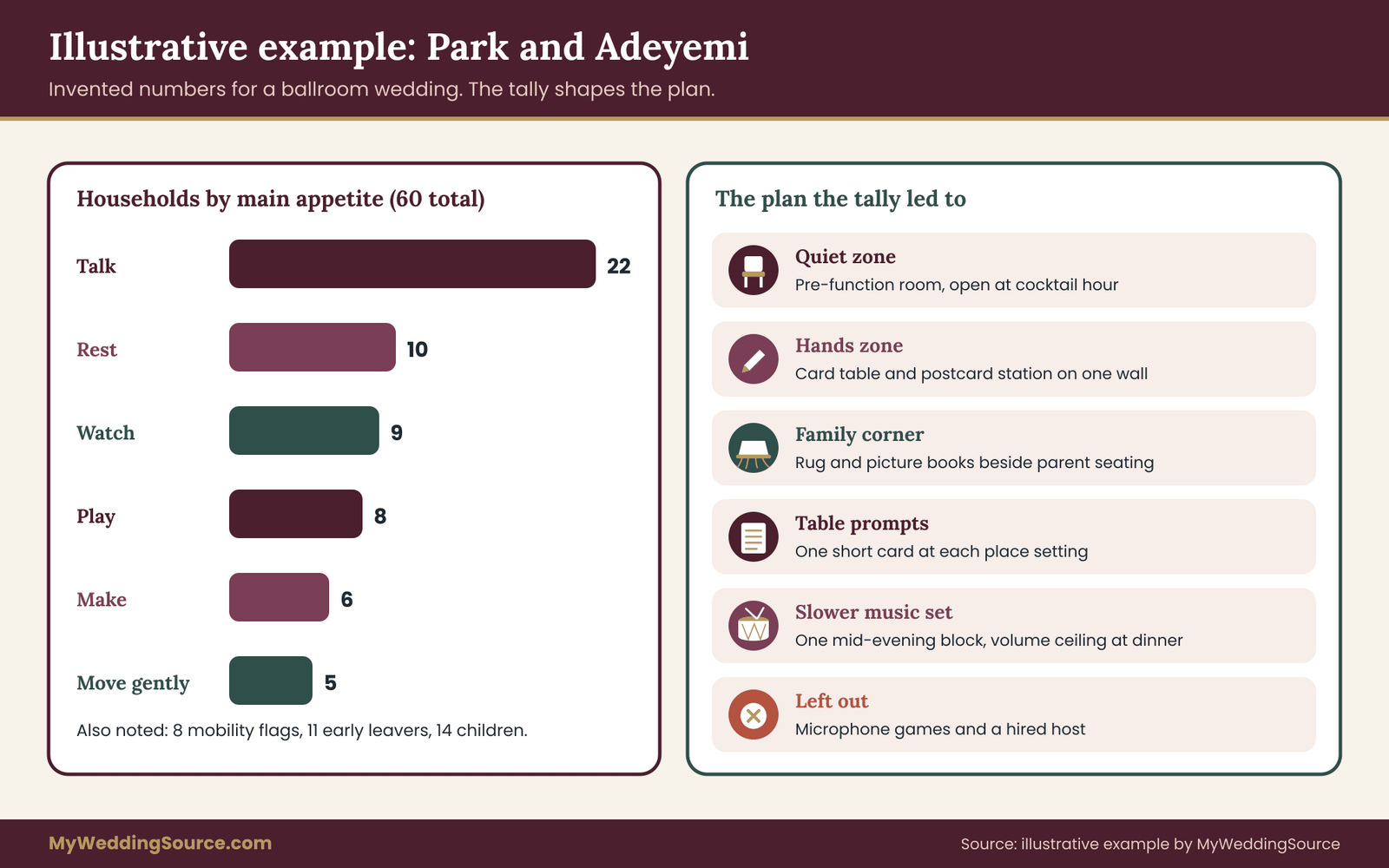
What they leave out matters as much. There is no bouquet-style call-out, no microphone game and no hired host. That is not because those things are wrong, but because the tally does not show enough demand to justify the risk.
Example two: a small restaurant private room
Lindqvist and Moreau have forty-eight guests in the private room of a restaurant, with no space for zones. Their tally shows most guests are friends in their thirties, with strong Talk and Play appetites and a few Watch guests.
With one room, the zones become corners. The restaurant allows one table to be set aside, so they use it as the hands zone with a deck of cards, a short trivia sheet and a pad for notes to the couple. A pair of armchairs near the window becomes the quiet corner. They ask the restaurant to keep music low during dinner, then raise it modestly once plates are cleared.
They add one whole-room moment. After dessert, a short, voluntary game of trivia about the couple, with questions on a card at each table, is passed to a designated captain per table. No microphone is used. Nobody is called on. It passes the three-exit test because tables can start, drift out and ignore it freely.
Their cost is close to nothing beyond a few printed cards, a deck of cards and a sign. The lesson from this example is that a small room does not need fewer ideas. It needs a tighter selection, with each corner doing one job.
Example three: a garden with a rain plan
Okafor and Hale are planning a garden reception for about one hundred and ten guests, with a tent as the weather backup. Their tally shows a mix of Play, Make and Move-gently households and a handful of Rest.
Their plan uses lawn games, a garden path with lanterns and a craft table under a small canopy. The matrix shows that most of these depend on weather, so they identify two reception activities that can follow guests indoors: a card table and the postcard station. They tell the venue about the rain plan in advance and confirm where the tent can host the quiet zone and the hands zone without blocking exits.
On the day, if rain moves the party inside, the lawn games pause and the card table and postcards move without trouble. They designate one person to make the call by a stated time, not at the last minute. They accept that the lawn games may not run, and they do not feel a loss, because the plan did not rest on them.
What the examples share
Each plan began with the guests and not with a list of reception activities. Each covered every appetite at low exposure first. Each used zones to prevent collisions, and each had an owner for every zone. None needed a large budget, and none of the reception activities required a guest to do anything they had not chosen.
Mistakes that repeat
A few errors show up again and again when couples add reception activities to a reception, and each one has a plain fix.
Choosing the activity before the guests. A couple sees a game at a friend’s wedding, loves it and adds it to their reception activities. The fix is to run the tally first and ask which appetite the game serves.
Putting everything in the room zone. When every option is a whole-room event, the guests who want something quieter have nothing. The fix is rule one: cover every appetite at the lowest exposure level before adding anything bigger.
Relying on a host who is also a guest. A friend who agrees to run the game is also supposed to enjoy the party, and they will be pulled away. The fix is to pick reception activities that need no host, or to name a backup.
Placing the quiet zone as an afterthought. Rest areas are often set up last, in whatever space is left, near the speakers or the kitchen door. The fix is to place the quiet zone first, as far from sound as the venue allows.
Forgetting what happens to the output. Postcards, notes and photos pile up, and nobody owns them. The fix is to name a person and a box before the day, and to decide who takes them home.
Over-announcing. A host who announces every activity turns options into obligations. The fix is signs, one sentence of mention at most, and trust in guests to find what they want.
Skipping the walk-through. Plans that look fine on paper fail on site because a pillar blocks a sightline or a door opens into a game. The site walkthrough with the venue is the right moment, and the zone map should be in your hand when you do it.
Edge cases worth planning for
A very small guest list. With twenty or thirty guests, reception activities can be minimal: zones can be as simple as two chairs in a corner and a deck of cards. The matrix still helps, but you can run it in your head, and the main risk is overplanning a party that wants only good conversation.
A very large guest list. Past two hundred, duplicate your most popular zone instead of enlarging it. Two small card tables are easier to join and leave than one long one, and two quiet corners are better than one crowded one.
A venue with a single open room. Use furniture, rugs, plants and lighting to create visual edges. Order the zones by sound, with the quiet zone farthest from the speakers, and ask the venue about any portable screens or dividers.
Couples who love to dance. If the dance floor is the heart of your party, you do not need to shrink it. Add the quiet zone and the table zone anyway, so the guests who do not dance still feel included, and keep the whole-room activities to the formal moments you already have.
Traditions that involve dancing or games. Many cultural and religious traditions include group dances, processions or games, and they are often central to the celebration. Treat them as part of the plan, not as exceptions. Brief guests who may be unfamiliar, offer a way to watch comfortably and let participation be a choice.
Guests who ask for more. Sometimes a relative asks, “Are you doing a game?” Thank them, tell them what you are planning and do not feel obliged to add an item because someone suggested it. A short, kind reply keeps the plan intact.
Phones and hashtags. A photo challenge or a shared hashtag can add fun, but it can also add pressure to post. Make any such reception activity optional, make sure it follows the photography wishes you have set for the day and do not make it the only way to take part.
Late changes. If a guest drops out, a child gets sick or a vendor cancels, trim the plan instead of patching it. Dropping one of the reception activities is almost always better than rushing a replacement.
Scripts for the awkward moments
A few short messages save time and prevent hurt feelings. Use them as written or adapt them to your own voice.
To a relative who wants a particular game:
“Thank you for the idea. We are keeping the evening simple and optional, so we are not adding structured games this time. We would love for you to enjoy the party.”
To a friend you are asking to look after a zone:
“Would you be willing to keep an eye on the quiet corner for the first hour? It means a quick check on the chairs and the water. You can hand it off to someone else whenever you want to join the party.”
To a venue about activities:
“We are planning a few small guest activities, including a card table, a postcard station and some lawn games. Could you tell us about any restrictions on equipment, power, surfaces and noise, and whether there is a space we can use as a quiet seating area?”
To guests, on the wedding website or the program:
“Between dinner and the last song, you will find a quiet corner, a card table and a postcard station for the couple. Everything is optional. Come and go whenever you like.”
A final review before the day
About a week before the wedding, review the plan with three questions. First, does every appetite have at least one low-exposure option in a named zone? Second, do all of the reception activities pass the three-exit test? Third, does every zone have an owner, a run sheet line and a failure plan?
If any answer is no, fix it or cut the activity. A smaller plan that works is better than a larger plan that nearly works.
Your next steps
Start with the tally. Take your guest list, group it by household and write one appetite and one exposure letter beside each. Add the practical flags, count and write your one-sentence shape. That takes about an hour and shapes everything else.
Next, sketch the room. Mark the five zones, check each against the venue’s floor plan and ask the venue the four questions about rules, power, space and outdoor limits. Choose four to six reception activities that cover every appetite at low exposure first, run each through the three-exit test and write the run sheet.
Finally, brief your zone owners, put signs in a large plain typeface and let go. A calm, optional set of wedding reception activities does its work quietly. Guests find what suits them, the room feels full of choices and the evening belongs to everyone, not only to the people on the floor.
FAQ
How many reception activities do we actually need?
Most mid-sized receptions do well with four to six options that cover each guest appetite at a low level of exposure. A smaller list that includes a quiet seating area, one table-based option, one hands-on option and one gentle movement option is better than a long list that needs staff and constant setup. Let your guest tally decide the number.
What are good reception activities for guests who do not dance?
Offer a quiet seating zone, short prompt cards at each table, a card table, a postcard or note station and a lit path for a walk. These options suit guests who want to talk, watch, make something or rest. The key is that each one can be joined, left and ignored without anyone noticing or commenting.
Do we need to hire someone to run wedding reception activities?
Usually not. Table prompts, a postcard station, a card table and a quiet zone need only setup and cleanup. Hire help for a large number of children, a whole-room hosted game or a photo booth. Ask any vendor for a written scope, their insurance details, their space and power needs and their cancellation terms before you sign.
How do we plan activities for children without taking over the evening?
Create a family corner away from the bar and the loudest speaker, with seating for parents nearby, and stock it with age-appropriate supplies. Decide in advance who supervises, and tell parents on the program or website. Keep structured games short and optional, and avoid small parts, loose balloons and anything a young child could swallow.
How can we make sure activities are accessible?
Keep clear, step-free paths between zones, provide seats at every station, check table heights and print signs in large, plain type. Ask the venue about accessible routes and restrooms in writing. For official guidance on accessibility obligations, check the Department of Justice’s ADA site, since the rules depend on the venue and your event.
Are games and raffles safe to include?
Skill and knowledge games with small prizes are generally simple to run. Raffles and games involving money are regulated differently in each state, and some guests have personal or religious objections, so check local rules before running one. Avoid games that involve drinking, dares or physical contact with strangers, and never make participation a condition of belonging.
What should we do if it rains or the plan falls apart?
Pick at least two activities that need no particular space, such as a card table and a postcard station, and tell the venue where they can move. Name one person to make the weather call by a set time. If an activity is not working, remove it quietly, since a smaller plan that works beats a larger plan that nearly does.
How do we handle disagreements about reception activities with family?
Share the tally and the shape sentence so the conversation is about the guests and not about taste. Explain that all activities are optional and that every appetite is covered at a low level of exposure. Thank people for ideas, offer to include a tradition that matters to them if it passes the three-exit test and keep the final decision with the two of you.
Sources
- ADA.gov, U.S. Department of Justice Civil Rights Division
- Americans with Disabilities Act accessibility standards, U.S. Access Board
- Consumer Product Safety Commission, recalls and product safety information
- National Fire Protection Association, codes and standards
- National Institute on Deafness and Other Communication Disorders, noise-induced hearing loss
- CDC National Institute for Occupational Safety and Health, noise and hearing loss prevention
- Federal Trade Commission, advertisement and endorsement disclosure guidance
- HealthyChildren.org, American Academy of Pediatrics
- Ready.gov, event and emergency preparedness, U.S. Department of Homeland Security