
Wedding vendor bundle discounts look simple on a quote: pay for several services together and save a stated amount. This guide shows how to test that claim fairly. You rebuild the same scope from separate quotes, price what it costs to leave the package, and decide with three numbers instead of one headline percentage.
Treat bundle discounts as a claim to verify, not a fact. First, rebuild the package behind the bundle discounts line by line so every hour, deliverable and fee matches what you could buy separately. Second, subtract the bundle price from that matched total to get the real saving. Third, add up the money and flexibility you give up if you drop one service, move the date or cancel. If the saving is small beside the extra amount locked in, the package is not a bargain.
Bundle discounts are one of the oldest sales tools in the wedding industry. A photographer adds video, a venue includes tables and chairs, a planner offers a “full service” tier with preferred vendors attached. Often the offer is real and the saving is honest. Sometimes the saving exists only because the comparison price was inflated, or because the package quietly contains less than the separate services it is measured against.
Couples rarely have time to untangle this. The bundle arrives with a deadline, a deposit and a warm sense that someone is simplifying a hard decision. Wedding vendor bundle discounts also hide the second half of the question, which is what happens if plans change. That part is rarely printed next to the discount.
A note on scope. This is general consumer information, not legal, tax or financial advice. Contract law, consumer remedies and cancellation rules differ by state and by vendor type, so confirm current terms with the vendor and the agency that covers your location, and ask a licensed professional about anything high-stakes.
What bundle discounts really are
The phrase covers several different offers, and these bundle discounts behave differently. Before you compare anything, name the type you are looking at. Four shapes cover most of what couples see.
Same-vendor multi-service bundles. One company sells two or more of its own services at a combined price. Photo plus video, DJ plus lighting, florals plus rentals. The vendor controls every piece, which makes the package simple to run and also makes it simple to hide how the price was built.
Cross-vendor partner packages. One vendor offers a reduced price if you also book a named partner, such as a photographer who discounts when you hire a particular videographer. Each party usually has its own contract, and the discount often depends on both bookings staying in place.
Venue-linked packages. A venue includes catering, bar service, rentals, a coordinator or a required vendor list within one price. Some of these are all-in, some are loose bundles, and some are rules disguised as discounts. The all-inclusive guide on the site, all-inclusive wedding venues, covers how those venues are structured at a higher level.
Planner-managed tiers. A planner or coordinator presents a tier that includes preferred vendors at negotiated rates. The saving may come from a real volume relationship, or the tier may simply carry a margin you cannot see.
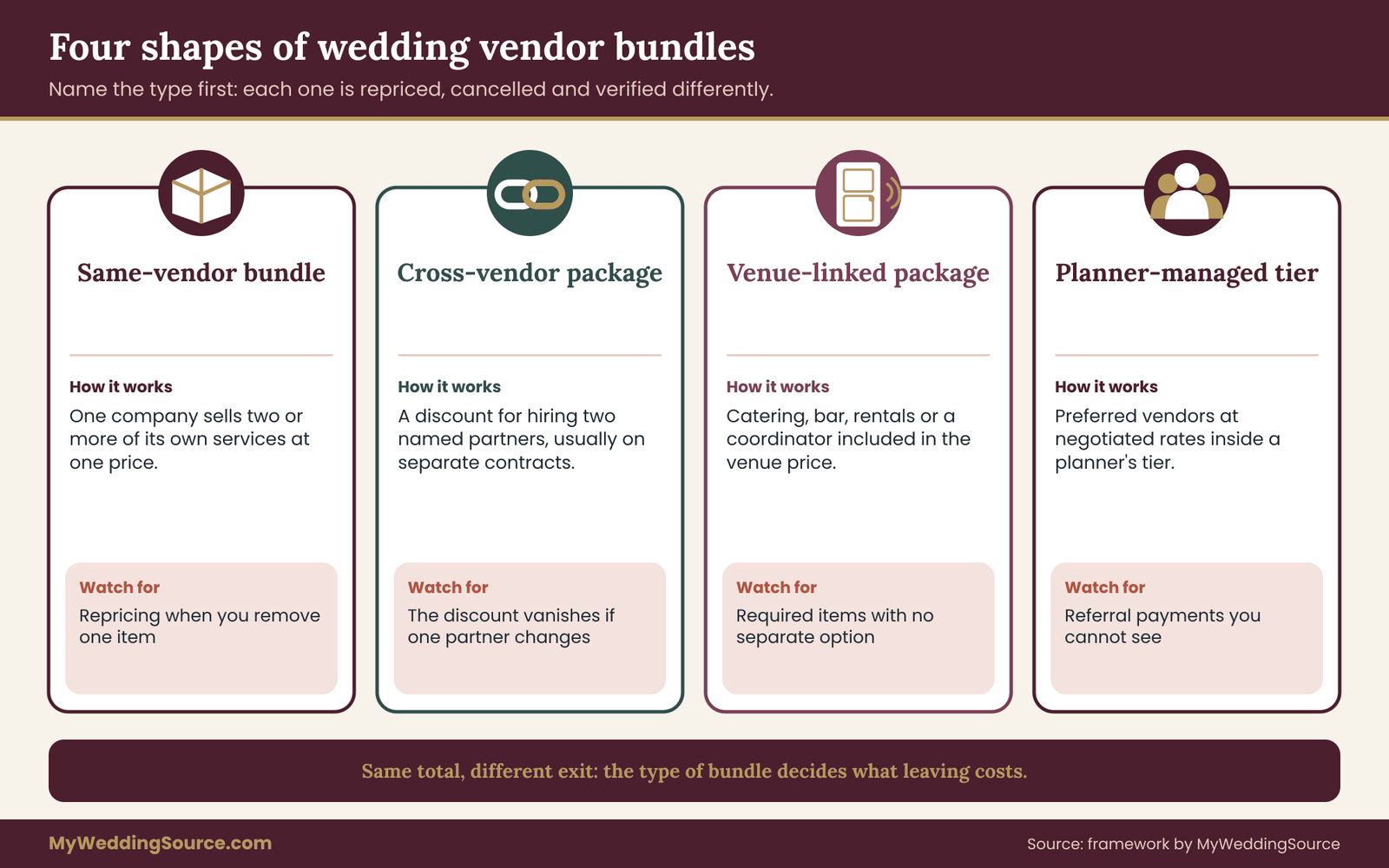
Why does the type matter? Because the exit costs and the verification steps change with it. A same-vendor bundle can be repriced if you remove one item. A cross-vendor package can collapse if one partner is replaced. A venue-linked package may not allow removal at all. A planner tier may bind you to vendors you did not choose.
The two ways bundle discounts can be real
A discount is real in two situations. Either the vendor truly saves cost when it serves you more than once, or the vendor values certainty enough to pay for it. A photographer who also films may save on travel, setup time, client communication and editing logistics. A vendor who gets paid earlier, or books a slow date, may be willing to share the benefit.
Both are fair reasons. Neither guarantees the number on the quote is honest. A real cost saving can be small, and a vendor can still advertise a large one by choosing a generous comparison.
The ways bundle discounts can be thin
Bundle discounts can look better than they are in a few common ways. The comparison price might be a list rate that the vendor rarely charges. The package may include a lower tier of one service than the quote implies. The saving may depend on paying early or in full. It may disappear the moment you remove one component. Or it may be offset by a fee that appears only in the contract.
None of these is necessarily dishonest. They are reasons to compare the scope, not the slogan. The rest of this guide gives you a way to do that without needing legal training or a spreadsheet degree.
Why the headline number misleads
Imagine a quote that says “Package price: a number, regular price: a larger number, you save the difference.” The saving is the gap between two prices, and only one of them is actually being asked of you. The other is a reference price. Whether that reference price is meaningful depends on whether anyone buys at it.
The Federal Trade Commission publishes advertising guidance for businesses, including general principles about price comparisons and about making savings claims that customers can rely on. You do not need to litigate an advertisement. The useful takeaway is that a stated “regular” price should be a price that was genuinely charged, and you are entitled to ask what it was based on. The agency’s business guidance pages are listed in the sources at the end.
Three common distortions in bundle discounts
A reference price built from the vendor’s own add-on rates. Many vendors price extras at a premium because extras are sold in the moment, to people with little time to compare. If the “regular price” behind bundle discounts adds up those premium rates, the saving looks large and means little. The honest comparison is what you would pay for the same work from a comparable vendor, not what the same vendor charges for last-minute add-ons.
A package that quietly changes scope. The photography in a bundle might be six hours while the separate quote you are comparing against is eight. Video might be a highlight reel without full ceremony footage. The reception coverage may end before the cake cutting. A smaller scope at a lower price is a different product, not a discount.
A saving that depends on conditions. Paying the full amount early, booking within a few days, skipping a payment plan, agreeing to share photos publicly, or signing a longer minimum can each be the real price of the discount. If the condition costs you flexibility, that cost belongs in the comparison.
What a fair comparison needs
Two things must be equal before a difference in price means anything. The scope has to match, meaning the same hours, staff, deliverables, timing and limits. And the risk has to be understood, meaning what you owe if the arrangement ends early. A saving of a few hundred dollars that locks several thousand dollars into non-refundable deposits is not a saving in the ordinary sense. It is a trade.
That is the whole logic of the method below for judging bundle discounts. The first number measures the saving after the scope is matched. The second measures what you could lose by leaving. The third measures how much one piece depends on another. Together they let you see the trade.
A short word about emotion and bundle discounts
Bundle discounts are often presented as a relief. You hear that the vendors work well together, that one point of contact makes day-of coordination easier, that you will not need to chase anyone. Some of that can be true and valuable. Day-of coordination between a photographer and videographer who share a studio is a real benefit.
It is also an argument for a price, and you can price it. Ask yourself what a smoother day is worth to you in dollars, say it out loud, and add it to the bundle’s side of the comparison. If the bundle still loses, it should lose, and the discount should not rescue it. If it wins, it wins honestly.
Where the vendor contract fits in
Everything about bundle discounts eventually lands in a contract, and the contract is the only place a promise is enforceable in practice. The site’s guide to the wedding vendor contract explains the clauses that matter in general. This guide is narrower. It focuses on the clauses that change when services are packaged: repricing on removal, shared deposits, cross-default language and cancellation schedules that apply to the whole package.
If you are collecting quotes for the first time, the earlier step is to make them comparable at all. A same-scope request packet, one brief sent to every vendor, makes the unbundled side of every comparison here far easier to build.
The three-number test for bundle discounts
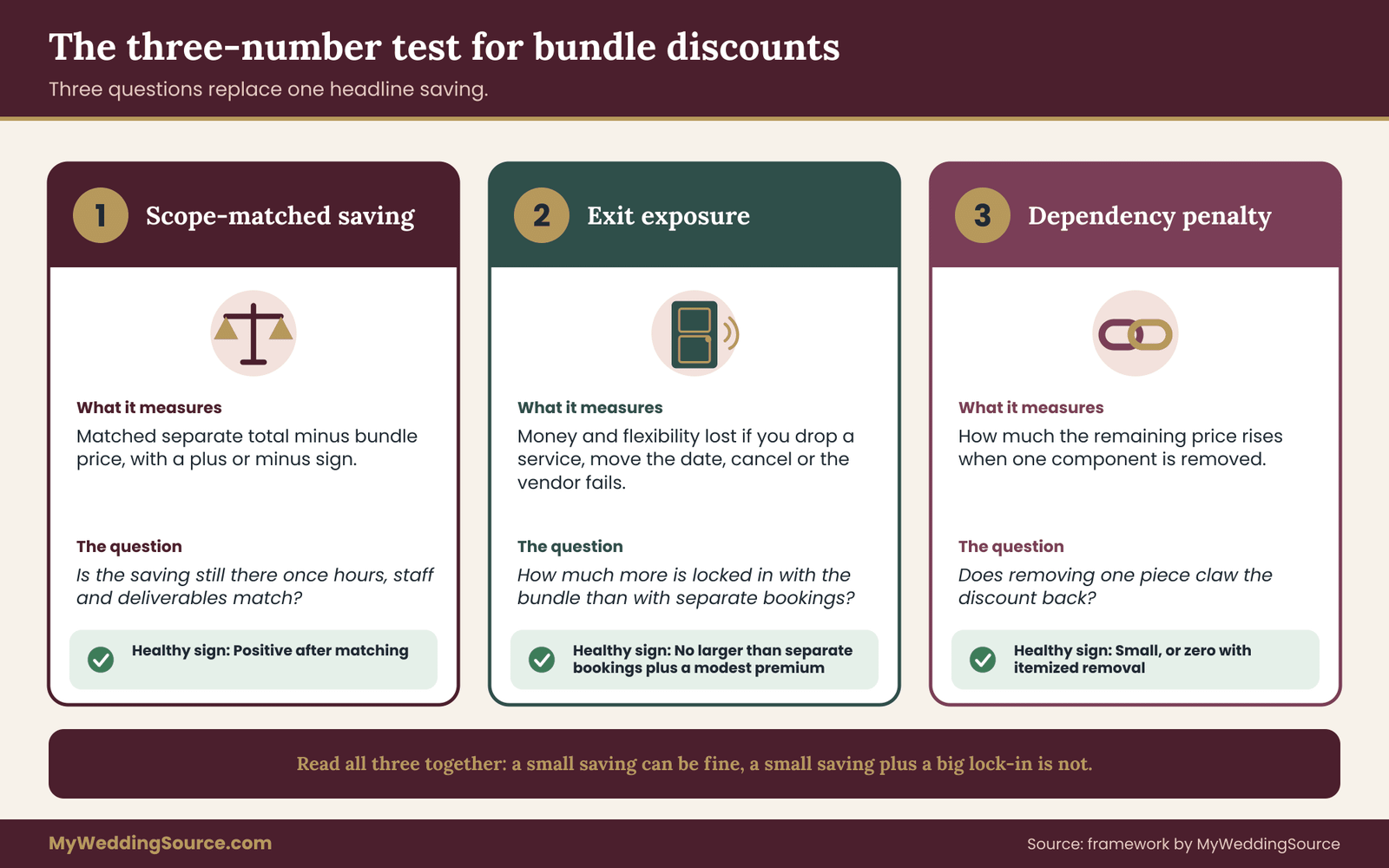
Most advice about bundle discounts stops at “compare the totals.” That fails because the totals describe different things. The test below replaces one total with three numbers, each answering a separate question. You can run it on paper in about an hour per bundle, and you can repeat it quickly when a vendor revises the offer.
Number one: the scope-matched saving in bundle discounts
This is the difference between what the bundle costs and what the same scope costs when bought separately. “Same scope” is the hard part, and the next section shows how to build it. If the package behind the bundle discounts costs less than the matched separate total, the saving is positive. If it costs more, the saving is negative, which happens more often than the marketing suggests.
Write the number with a sign, as you would for any of your bundle discounts. A bundle that costs three hundred dollars more than the matched total has a scope-matched saving of minus three hundred. Seeing a minus sign is the quickest way to stop treating the package as a discount at all.
Number two: the exit exposure of bundle discounts
This is how much money you could lose, and how much flexibility you give up, if you leave the arrangement at each of four points: you drop one service, you change the date, you cancel everything, or a vendor fails to perform. The bundle and the separate bookings will usually differ here, sometimes sharply, because a bundle typically carries one large deposit and one cancellation schedule for the whole.
Exit exposure is not a prediction that you will leave. Most couples never do. It is the price of the option to leave, and the option has value even if you never use it. Exit costs are covered in detail in a later section.
Number three: the dependency penalty in bundle discounts
This one is easy to miss. A dependency exists when one of the bundle discounts, a price or a service only holds as long as another piece stays. If the video drops out, does the photography rate rise? If you move the reception to a different venue, does the in-house bar price change? If the partner vendor cancels, does your discount vanish?
The dependency penalty is the amount your total rises when one component is removed or replaced. If dropping a service raises the remaining price by more than the price of the dropped service, the bundle is working as a trap rather than a discount.
Putting the three numbers together
Read the numbers side by side. Healthy bundle discounts come with a positive scope-matched saving, an exit exposure no larger than your separate bookings plus a modest premium, and a small dependency penalty. A weak one has a saving near zero or negative, a large non-refundable deposit and a steep penalty for removal.
The mixed cases take judgment. A moderate saving might be worth a higher exit exposure if you are certain about the date and vendors. A smaller saving might still be worth taking if the package solves a coordination problem you have priced at real money. The method does not decide for you. It makes the trade visible so that you decide on purpose.
A simple way to express the trade in bundle discounts
Compare the saving to the extra money you would have locked in. If the bundle saves you four hundred dollars and puts two thousand more dollars at risk in non-refundable deposits, the bundle is paying you four hundred dollars to carry two thousand dollars of exposure. Ask whether you would accept that offer if it were presented as a standalone bet. Many couples would not, and the answer tends to become clear once it is stated that way.
You do not need probabilities. You only need to decide how much of your budget you are comfortable having at risk for how long. That comfort level is personal, and it is the right input.
Two quick checks on bundle discounts before you start
Before you spend an hour on the full test, run two quick checks that can end the work early. First, look at the bundle price against the lowest complete separate quote you already have. If the bundle is higher at an equal scope, the saving is negative and the rest is only about whether you want the convenience. Second, look at the deposit. If the package demands more than half of the total at signing and calls it non-refundable, the exit exposure is already large, and the bundle must earn that risk with a visible saving.
These checks are not substitutes for the test. They are filters that save effort when the answer is clear. Most offers pass neither filter cleanly, which is why the full method exists.
What clean bundle discounts look like
It helps to know what you are looking for. Clean bundle discounts show a saving that survives scope matching, a deposit that is no more than a modest step above the separate bookings, a removal clause that prices dropped services at their package amounts, and a date-change rule written down in plain words. Few offers meet all four on the first draft. Many meet three after one polite email. A vendor who is willing to improve the fourth is often a vendor worth hiring, and the willingness itself is useful evidence.
Rebuilding the scope line by line for bundle discounts
The scope-matched saving depends entirely on a fair rebuild. This section shows how to do it without guessing. The principle for testing bundle discounts is to describe the bundle in neutral, countable terms and then ask other vendors to quote exactly that.
Step one: strip the bundle to countable lines
Take the bundle quote or contract and list every promise as a line with a number or a limit. Avoid words like “full coverage” or “premium” and translate them into hours, people, deliverables, dates and limits. Six categories cover almost everything.
Time. Start and end of coverage, any overtime rate, and whether setup and breakdown count inside the hours.
People. How many staff members, what roles, and whether named individuals are promised or only “a team member.”
Deliverables. What you receive, in what format, at what quantity and resolution or size, and by what date.
Inclusions. Equipment, rentals, travel, permits, insurance certificates, backups and any items described as complimentary.
Fees. Service charges, gratuity, delivery, taxes, travel, parking, cleanup, and any fee listed as “standard.”
Limits. Usage rights, number of revisions, guest count caps, time windows and anything the vendor excludes.
Step two: mark what the bundle does not say
Silence is information. If the bundle quote lists video hours but says nothing about delivery date, add a question mark. If it lists an album but not the page count, add a question mark. Every question mark becomes a question for the vendor, and the answer is written into the contract, not just the email.
Vendors usually answer these quickly when asked in writing. A vendor who will not put a scope detail in writing is giving you data about the rest of the relationship.
Step three: write the matched scope as a neutral brief
Now convert the list to a short brief that any other vendor could quote against. Example wording for a photo and video bundle: eight hours of photography with a second photographer for the whole eight hours, six hours of video with a highlight film of a stated length, digital delivery within a stated number of weeks, usage rights for personal use, and a stated album size. Include the date, venue and approximate guest count.
The same-scope approach is the same one used to compare any vendor quotes and it works the same way for any set of quotes. For a bundle you need only a lighter version, because the scope is already defined by the package you are testing.
Step four: request the separate quotes
Send the brief to two or three vendors per component. Ask for itemized quotes with the deposit schedule, the cancellation terms and the fees spelled out. Ask each vendor to state whether the price assumes you are booking them alone or alongside a partner. That one question surfaces most cross-vendor discounts.
Give vendors the same deadline and the same information. Be honest that you are comparing. Vendors compare you against other options too, and most are used to it.
Step five: handle the gaps honestly
You will rarely get a perfect match. One vendor offers seven hours instead of eight. Another includes an album the others do not. Adjust with the vendor’s own stated add-on rate for the difference, and note that you used it. If a gap cannot be priced, say so and treat the line as unmatched rather than guessing.
An unmatched line is not a failure. It is a visible uncertainty, and it should shift your decision toward the option with fewer unknowns. Bundle discounts with three question marks are a worse bet than bundle discounts with none, even at the same price.
Keep a record as you go
Save the quotes, the emails and the version of the bundle discounts you tested. Vendors revise packages, and a later “improved offer” is easier to evaluate if you can see what changed. The purchase-order approach described in the guide to wedding vendor purchase orders is a good model for tying a scope agreement to a final acceptance, and the same discipline applies when a bundle replaces several smaller agreements.
Pricing the other side and reading the fine print of bundle discounts
With a matched scope in hand, the unbundled total can be built honestly. Then the contract language behind bundle discounts needs a close read, because the conditions are usually written there and not on the quote page.
Build the unbundled total with every cost in it
Add each separate vendor’s price, then add the costs that tend to sit outside the headline number. These include travel or setup fees, taxes where they apply, service charges, card processing fees if the vendor passes them on, and any extra coordination time. Card surcharges are one common extra that can change a comparison by a visible amount, so ask each vendor whether one applies.
Be consistent. If you add the surcharge to one vendor, add it to all of them, including the bundle. A comparison that treats fees differently on each side is not a comparison.
Count the coordination cost honestly
Separate vendors mean separate emails, separate payment dates and separate timelines. That has a cost in your time, and sometimes in risk, since two vendors may schedule setup in conflicting ways. Bundle discounts can reduce that burden. It would be unfair to ignore it.
Give coordination a number you can defend. If the extra work is a few emails and a shared timeline, the value is small. If it means a venue with tight load-in windows, where two vendors must be choreographed, the value is larger. Put the number on the bundle’s side as a stated benefit, and keep it modest. A guess of five hundred dollars for a benefit you cannot describe in two sentences is probably too high.
Check the comparison price behind bundle discounts
If the bundle shows a “regular price” or “value,” ask what the vendor charges when each item is sold alone to a client with the same date and scope. Ask for it in writing. A vendor who sells these items separately at those prices can answer quickly. A vendor who cannot may be quoting a list that exists only on the quote.
This question is polite and ordinary. It does not accuse anyone. It simply tests whether the saving is measured against something real, and it gives you the number you need if you later ask the vendor to remove one component.
Read the conditions behind the discount
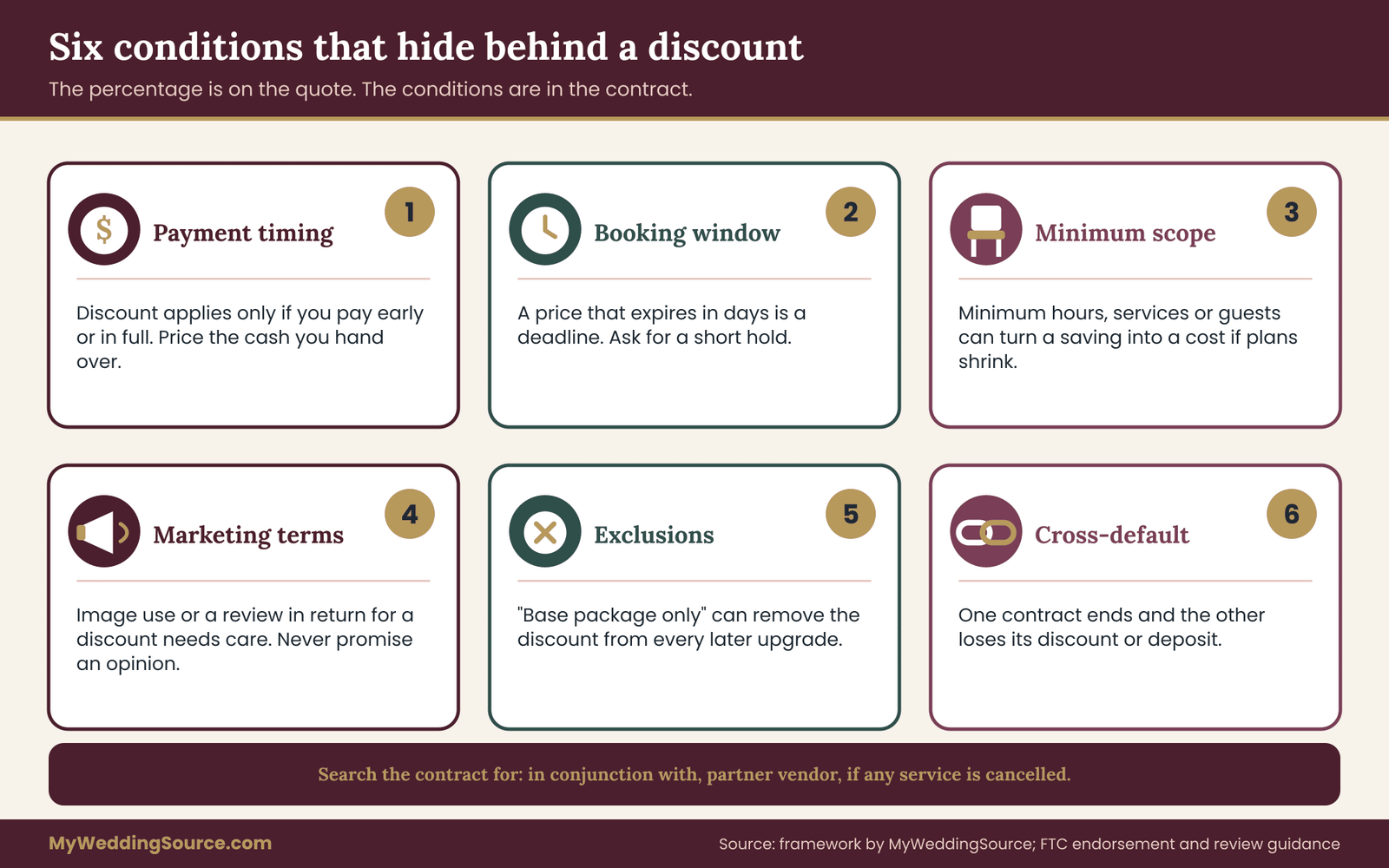
Most bundle discounts are conditional, and the conditions often matter more than the percentage. Look for these in the contract and in any email that describes the offer.
Payment timing. Some discounts apply only when the full amount is paid early or in a single payment. Paying early moves money out of your hands and into the vendor’s, and the cash-flow cost is real. The guide on wedding cash-flow planning explains how deposit and balance timing affect your reserve.
Booking window. A discount that expires in a few days is a deadline, not a feature. Time pressure helps the seller and rarely helps you. A vendor who values your business can usually hold a price for a short, reasonable period. If they will not, treat the pressure as part of the price.
Minimum scope. A discount might require a minimum number of services, a minimum number of hours or a minimum guest count. If your plans may shrink, a minimum can turn a saving into a cost.
Marketing terms. Some packages are cheaper if you allow public use of your images, agree to be featured, or promise a review. These are real exchanges of value. They also deserve care, since the FTC has published guidance on endorsements and reviews that applies when a benefit is given in connection with an online review. Do not agree to a review condition without understanding it, and never promise a particular opinion.
Exclusions. A line saying “discount applies to base package only” can quietly remove the discount from every upgrade you later add.
Put a price on paying early
Several bundle discounts depend on paying the whole amount ahead of the usual schedule. That can be a fair exchange, since the vendor gets cash sooner and carries less collection risk. But the money you hand over has a cost to you, and the cost is easy to calculate in rough terms.
Take the amount you would pay early and the number of months by which the payment moves forward. Ask what that money could do otherwise: earn interest in a savings account, pay down a card balance, or sit as a cushion for a surprise expense. Even a modest rate on a few thousand dollars for a year produces a figure you can write down. If the discount for paying early is smaller than that figure, the discount is not paying you for the cash.
There is a second cost that has nothing to do with interest. Money paid in full is money you have less leverage to recover. A vendor that holds your balance has less reason to hurry when a problem appears, and a refund request is a harder conversation than a withheld payment would have been. For that reason, a discount tied to full prepayment deserves a higher bar than other bundle discounts.
If you do prepay, pay by a method that keeps your dispute rights, keep the receipt, and note the date. A vendor who accepts a card payment for the early amount keeps the billing dispute option open for you, though a surcharge may apply. Compare the surcharge to the protection and decide on purpose.
Spot the cross-default language
This is the single most important clause to find in a cross-vendor package. Cross-default language ties the contracts together so that a failure in one triggers consequences in the other. It might say the discount is void if the partner booking ends. It might say the vendor may keep the deposit if you cancel the partner. It might say the vendor can substitute a partner you did not choose.
You do not need a law degree to spot it. Search for phrases such as “in conjunction with,” “as part of the package,” “partner vendor,” “bundled services,” and “if any service is cancelled.” Mark each one and ask what happens to price and deposit if the other piece changes.
Look at how removal is priced in bundle discounts
Find the clause that covers removing a service after signing. There are usually three versions. The first allows removal at the original itemized price, with the saving shared back fairly. The second reprices the remainder at the vendor’s standalone rate. The third forbids removal and treats any change as a cancellation.
The second version is the one that creates the dependency penalty from the three-number test. It lets the vendor give a discount at signing and take it back on the first change. If your contract says this, calculate it. Take the standalone rate for the remaining service, subtract what the bundle allotted to it, and write the difference as a cost of removal.
Ask who delivers each piece of the bundle discounts
In some packages one company resells another’s service. A venue may subcontract the bar. A studio may use outside editors. A planner may pass your date to a vendor you have never spoken to. That is common and not a problem by itself, but it changes who is responsible if something goes wrong and who holds your deposit.
Ask who performs each service, who is your contract partner for each, and who refunds you if that service fails. Write the answers next to the line items. If the answers are not clear, the discount may be buying you a layer of ambiguity.
Reconcile the bundle to the contract, not the quote
Quotes and contracts drift apart. A quote may list a feature that the contract omits, or the contract may add a fee the quote never mentioned. Always run the three-number test on your bundle discounts against the contract text, since the contract is what governs a dispute. If you already use a purchase-order style approach to scope, your scope sheet and the contract should match line for line.
When they do not match, ask for a corrected contract before signing. Vendors fix these quickly when asked. They fix them slowly, or not at all, once the deposit has been paid. The same logic applies to any change after signing. It also helps to ask whether a payment is called a retainer or a deposit, because the label can affect what you can recover.
Keep a short list of open questions about bundle discounts
By the end of this section you should have a page with three kinds of entries: scope lines that are matched, scope lines that are unmatched, and clauses that need a written answer. Send the clause questions to the vendor in a single email, number them, and ask for answers in writing.
Count how many answers come back clear. That count is a signal. A vendor that answers all of them in a day is easy to work with. A vendor that answers none is telling you how disputes will go. Both facts belong in your decision, and neither shows up in the price.
Exit costs: what leaving bundle discounts really costs
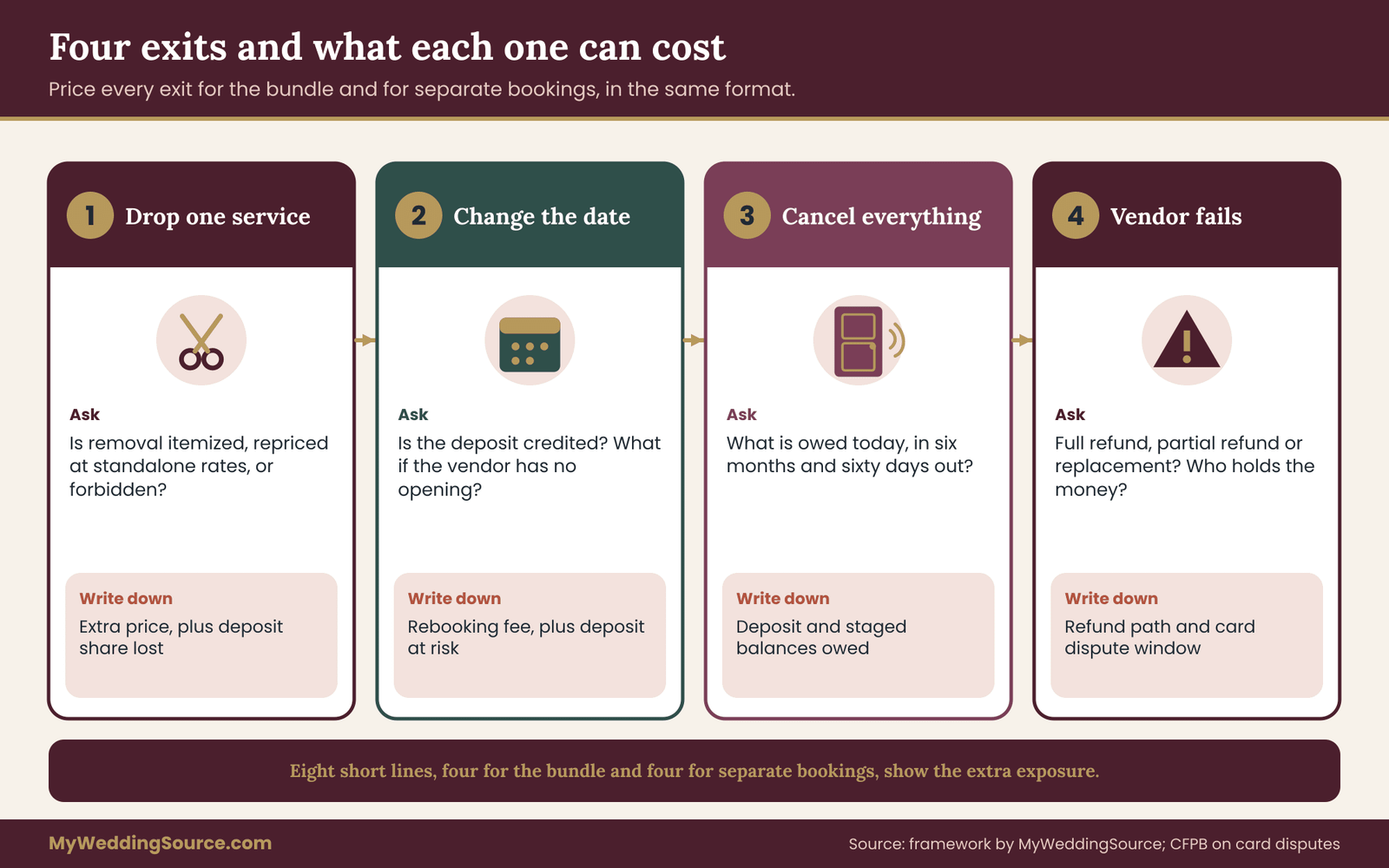
The exit side of bundle discounts is where couples are most often surprised, because it is not shown at the moment of purchase. The saving is on the front page. The cost of leaving is in a payment schedule and a cancellation clause several pages later. This section walks through four exits and shows how to price each one.
Why exit costs matter in bundle discounts even if you never leave
You may be certain about your date, your venue and your vendors. Plans still change, and not always by choice. A venue closes, a family emergency shifts the date, a vendor becomes unavailable, a guest count drops sharply, a budget tightens. Wedding contracts are long-lived, and the gap between signing and the event is often a year or more.
An exit clause is the option to change course at a stated price. Two arrangements with the same headline price can hold very different options. The one with the cheaper exit is worth more, even if the discount on the other is larger. Your task is to turn each exit into a dollar amount you can place next to the saving.
Exit one: dropping a single service
Suppose you decide you no longer want the video, the second venue, the extra rental or the upgrade. What does the package do?
Look for a removal clause. If removal is allowed at the itemized price, the cost is small and mostly the lost saving. If the remainder is repriced at standalone rates, calculate the increase. If removal is forbidden, treat it as a cancellation of the entire package and move to exit three.
Also check whether the deposit moves. Some vendors apply the deposit to the remaining services, some keep a share for the removed one, and some treat the deposit as non-refundable regardless. Write the answer as a number: if I drop service X, I pay Y more, and I lose Z of my deposit.
Exit two: changing the date
A date change touches every vendor at once, and bundle discounts concentrate that exposure. With separate vendors you may be able to move two of three and hold a fee only on the third. With a bundle you may face one decision and one fee, or one decision and no flexibility.
Read the rebooking clause carefully. Typical versions say the deposit is credited to a new date subject to availability, that a rebooking fee applies, or that a date change is treated as a cancellation and a new booking. The difference between credit and forfeiture can be thousands of dollars on a large package.
Sketching the new payment calendar after a hypothetical move is a quick way to stress-test a bundle against this exit.
Exit three: cancelling everything bought with bundle discounts
A full cancellation is the hardest to price because the schedule is usually staged. Many contracts state that the deposit is non-refundable, that a share of the balance becomes owed at set dates, and that the full amount is owed inside a final window. Read the schedule as a table of dates and percentages, and then write down what you would owe if you cancelled today, in six months and sixty days before the event.
Compare that to the separate bookings. Three vendors with a smaller deposit each will typically leave you with less locked in at any given date. A bundle with one large deposit puts more of the money at risk earlier. Not all bundle discounts work this way, so check the actual numbers rather than assuming.
A cancellation clause that states a percentage of the total price owed is not always enforceable in the same way in every state. Courts treat some fixed amounts as reasonable estimates of loss and others as penalties, depending on local law. That is exactly the kind of question a licensed professional should answer for your situation, not a guide.
Exit four: a vendor fails to perform
This exit is the one nobody wants to price and the one that matters most. If a vendor in the bundle cancels, becomes unreachable, delivers late or delivers something far below the contract, what are your remedies, and who provides them?
In a same-vendor bundle, the answer is usually simple: the vendor owes you a refund or a replacement for its part. The question is whether it owes you the whole package price or only the failed piece. In a cross-vendor package, the answer can be harder. Each partner may argue that its own part was performed, while the discount you relied on has vanished.
Check three things. First, does the contract state what happens if the vendor cannot perform, including whether it must refund in full and whether it will help find a replacement? Second, who holds your money and in what form? Third, how did you pay? The Consumer Financial Protection Bureau explains how credit card billing disputes work, and a time limit for disputing a charge applies, so keep payment records and dates close at hand.
A small checklist of questions for every exit
Whatever the bundle, five questions cover most of the ground, and the answers should be in the contract. What portion of the price is due at signing, and what portion of that is refundable under any circumstances? What are the due dates of later payments, and what happens if one is late? What exactly happens to the price if one service is removed? What are the date-change rules, including what happens if the vendor has no opening? What does the vendor owe you if it cancels or fails to perform?
If a vendor answers all five clearly, the bundle discounts may still have a weak spot, but you will know where it is. If the answers are vague or differ between the proposal and the contract, the discount is carrying an unknown, and the unknown belongs on the cost side of the comparison.
Price each exit with the same method
For each of the four exits, write one line in the same format. The format is: if this happens, I lose this much money, I lose this much flexibility, and I get back this much. Do it for the bundle and then for the separate bookings.
When you are finished you will have eight short lines. For most couples, the pattern becomes obvious quickly. Either the bundle’s exits are roughly as cheap as the separate ones, or they cost visibly more. In the second case the extra cost is the exit exposure from the three-number test.
How to turn flexibility into a number
Money is easy to count. Flexibility is harder. A rule that works is to ask how much money you would pay to keep the right to make each change. Would you pay five hundred dollars to be able to move the date by six months without penalty? One thousand? The honest answer, even if rough, becomes a value for flexibility.
You can then compare. If the bundle removes your ability to move the date and saves less than you would have paid for that ability, the bundle costs you. It is a personal calculation and there is no correct figure, but writing one down is better than leaving it as a feeling.
Look for a middle path in the contract for bundle discounts
Exit costs are negotiable more often than the first draft suggests. A vendor who offers discounts for bundling can sometimes agree to a lower non-refundable share, a one-time date change at no fee, itemized removal at the original price, or a deposit credit that carries to a new date. Ask for these before signing, when you have the most leverage, and ask for them in the contract itself.
If the vendor refuses, you have learned the price of the bundle in flexibility, and you can include it. The refusal is also a reason to take a closer look at the separate bookings, where each vendor’s terms may be more modest.
Insurance and bundle discounts: what it does and does not cover
Event cancellation insurance, where it is available, is a separate product with its own exclusions, and terms differ widely. It may cover some costs that a bundle makes harder to recover, such as a vendor’s non-refundable deposit if a covered event forces cancellation. It generally does not cover a change of heart. Read the policy itself, and ask the insurer or a licensed agent what it covers for your situation.
Do not assume insurance replaces a good contract. It is a backstop, and it works best when the contract’s exit terms are already understood. Where a bundle’s exit exposure is large, a policy may narrow the gap, but the cost of the policy belongs in your comparison like any other cost.
A worked example of comparing bundle discounts
The numbers below are invented for illustration. They are not real prices, real vendors or a statistical claim about what photography and video cost. Their purpose is to show how the three-number test handles a bundle that advertises a large saving. Your own quotes will differ, and the method is what carries over.
The situation
Nora and Eli are planning a Saturday wedding with a single venue. They want eight hours of photography with a second photographer for the full eight hours, eight hours of video coverage with a short highlight film, and a thirty-page album. A local studio, called Studio A here, offers a package that covers photo and video together.
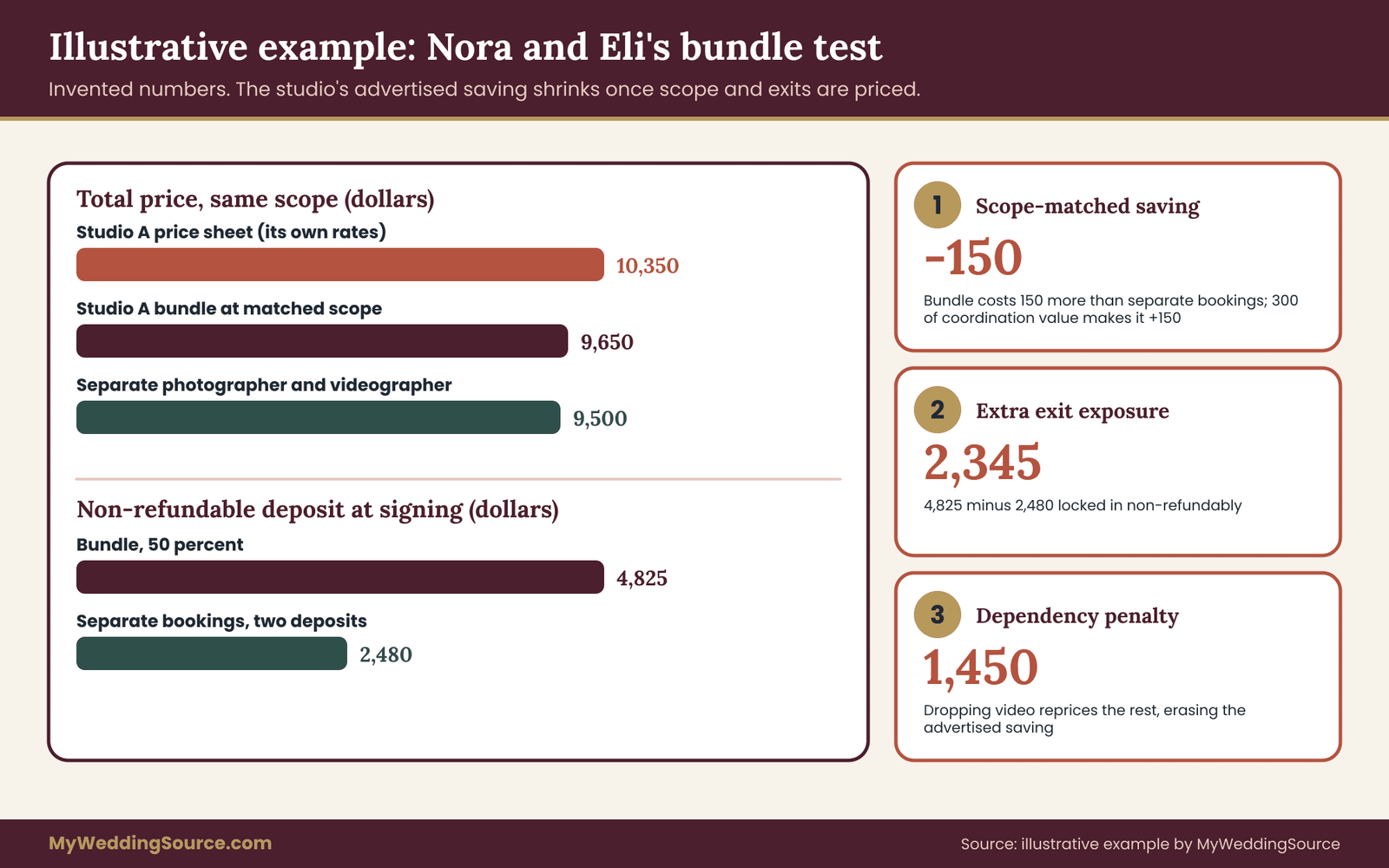
The package costs 8,900 dollars. It includes eight hours of photography with a second photographer, six hours of video with a four-minute highlight film, and a twenty-page album. The quote states “regular value 10,350 dollars, you save 1,450 dollars.” The studio requires a 50 percent non-refundable deposit at signing, with the balance due forty-five days before the wedding.
Step one: strip the bundle to countable lines
Nora lists what the package actually contains. Photography is eight hours, with a second photographer. Video is six hours. The highlight film is four minutes. The album is twenty pages. Delivery windows are stated for photos and not for video, so she marks video delivery with a question mark and asks about it. The studio answers that video arrives within twelve weeks and writes it into the contract.
She then asks what the “regular value” is built from. Studio A sends its standalone price sheet: photography with a second photographer at 6,200 dollars, six-hour video with highlight film at 3,300 dollars, and a twenty-page album at 850 dollars. Those add up to 10,350 dollars, which matches the quote. The reference price is real in the sense that it is the studio’s published sheet. The question is whether anyone else would charge it.
Step two: match the scope to what they actually want
The package falls short of their brief in two places. They want eight hours of video, not six, and a thirty-page album, not twenty. Studio A’s price sheet lists extra video time at 250 dollars an hour and extra album pages at 25 dollars a page. Two more video hours add 500 dollars. Ten more pages add 250 dollars.
The scope-matched Studio A price becomes 8,900 plus 500 plus 250, which is 9,650 dollars. Notice what happened. Before matching, the package seemed to cost 1,450 dollars less than its own sheet. After matching, the starting point for the comparison is different, and the comparison must be made against the independent market, not against the studio’s own sheet.
Step three: get separate quotes for the same scope
Nora sends the same written brief to two photographers and two videographers. She keeps the best complete quote from each side. Photographer B offers eight hours with a second photographer for 5,600 dollars, and a thirty-page album for 650 dollars. Videographer C offers eight hours of coverage with a highlight film for 3,100 dollars, plus a 150 dollar travel fee because the venue is outside the usual area.
Adding those gives 5,600 plus 650 plus 3,100 plus 150, which is 9,500 dollars. Neither vendor charges a card surcharge. Both state delivery windows, and both agree that no price depends on booking the other.
Step four: compute number one, the scope-matched saving of the bundle discounts
The bundle at matched scope costs 9,650 dollars. The separate bookings cost 9,500 dollars. The scope-matched saving is therefore minus 150 dollars. The advertised bundle discounts of 1,450 dollars were measured against a price sheet that no independent vendor charged, and it vanished once the scope matched.
Nora also considers coordination. The venue has a tight load-in window and a shared studio would simplify it. She puts a value on that benefit of 300 dollars, writes down her reasoning, and adds it to the bundle side. Net of coordination, the bundle is 150 dollars ahead. It is a small number and a defensible one.
Step five: compute number two, the exit exposure
Now Nora prices the exits. For the bundle, the deposit at the matched price is 50 percent of 9,650, or 4,825 dollars, and it is non-refundable. Separate bookings carry smaller deposits. Photographer B asks for 30 percent of 5,600, which is 1,680 dollars. Videographer C asks for 800 dollars. Together they are 2,480 dollars.
If Nora and Eli cancelled everything six months out, they would lose 4,825 dollars with the bundle and 2,480 dollars with separate bookings. The extra exposure from these bundle discounts is 2,345 dollars. For a date change, Studio A credits the deposit to a new date if it has availability and charges a 500 dollar rebooking fee, but the contract is silent on what happens if it has no opening. Photographer B allows one free move, and Videographer C charges 250 dollars.
Step six: compute number three, the dependency penalty
Studio A’s contract says that if a service is removed, the remaining services are repriced at standalone rates. Suppose Nora and Eli later decide to drop video. The video portion of the matched bundle is 3,300 plus 500, or 3,800 dollars. Removing it leaves a bundle allotment of 5,850 dollars for photography, second photographer and album.
At standalone rates, the remaining items cost 6,200 for photography, plus the thirty-page album at 850 plus 250, which is 1,100 dollars. That is 7,300 dollars. The difference, 7,300 minus 5,850, is 1,450 dollars. Dropping video would raise the remaining price by exactly the advertised saving. The discount existed only as long as every piece stayed.
Step seven: read the three numbers behind the bundle discounts together
The scope-matched saving is minus 150 dollars before coordination and plus 150 after. The exit exposure is 2,345 dollars higher with the bundle. The dependency penalty is 1,450 dollars. Stated as a trade, the bundle pays Nora and Eli about 150 dollars to carry 2,345 dollars of extra non-refundable exposure and a repricing clause that wipes out the discount on the first change.
That is not an attractive offer as written. It is also not a reason to walk away from Studio A, because the gaps are specific and negotiable.
Step eight: negotiate the bundle discounts, then re-run the test
Nora writes to Studio A with three requests. She asks for itemized removal, meaning a dropped service is deducted at the amount the bundle assigned to it, not repriced at standalone rates. She asks for a 30 percent deposit instead of 50. She asks for one date change at no fee, with the deposit credited if the studio has no opening and refunded if it cannot offer a comparable date.
Suppose Studio A agrees to all three. The dependency penalty falls to zero. The deposit becomes 30 percent of 9,650, which is 2,895 dollars, against 2,480 for the separate bookings. The extra exposure is 415 dollars. With a net saving of 150 dollars after coordination, the bundle is now a modest, reasonable trade, and Nora and Eli can choose it knowing exactly what they are accepting.
If Studio A agrees to none of them, the answer is also clear. They book Photographer B and Videographer C, and they do so with a record of why. In both outcomes the method did its job. It replaced an advertised saving of 1,450 dollars with a clear view of what the bundle discounts were worth, and it gave them leverage to improve it.
What the example of bundle discounts does not claim
It does not claim bundle discounts are generally worse. A studio that serves you twice may save real cost, and a fair package can beat the market. It does not claim these prices are typical. It does not say a 150 dollar difference is meaningful in every budget. It shows only that the same three questions, asked in the same order, can turn a persuasive headline into a decision you can explain to your partner in two sentences.
Negotiating bundle discounts without burning goodwill
Negotiation around bundle discounts is not a contest. The vendor wants a booked date and a client who pays on time, and you want a fair price with an exit you can live with. A calm, specific request usually works better than a demand. This section gives wording and priorities.
Know which terms are worth asking for in bundle discounts
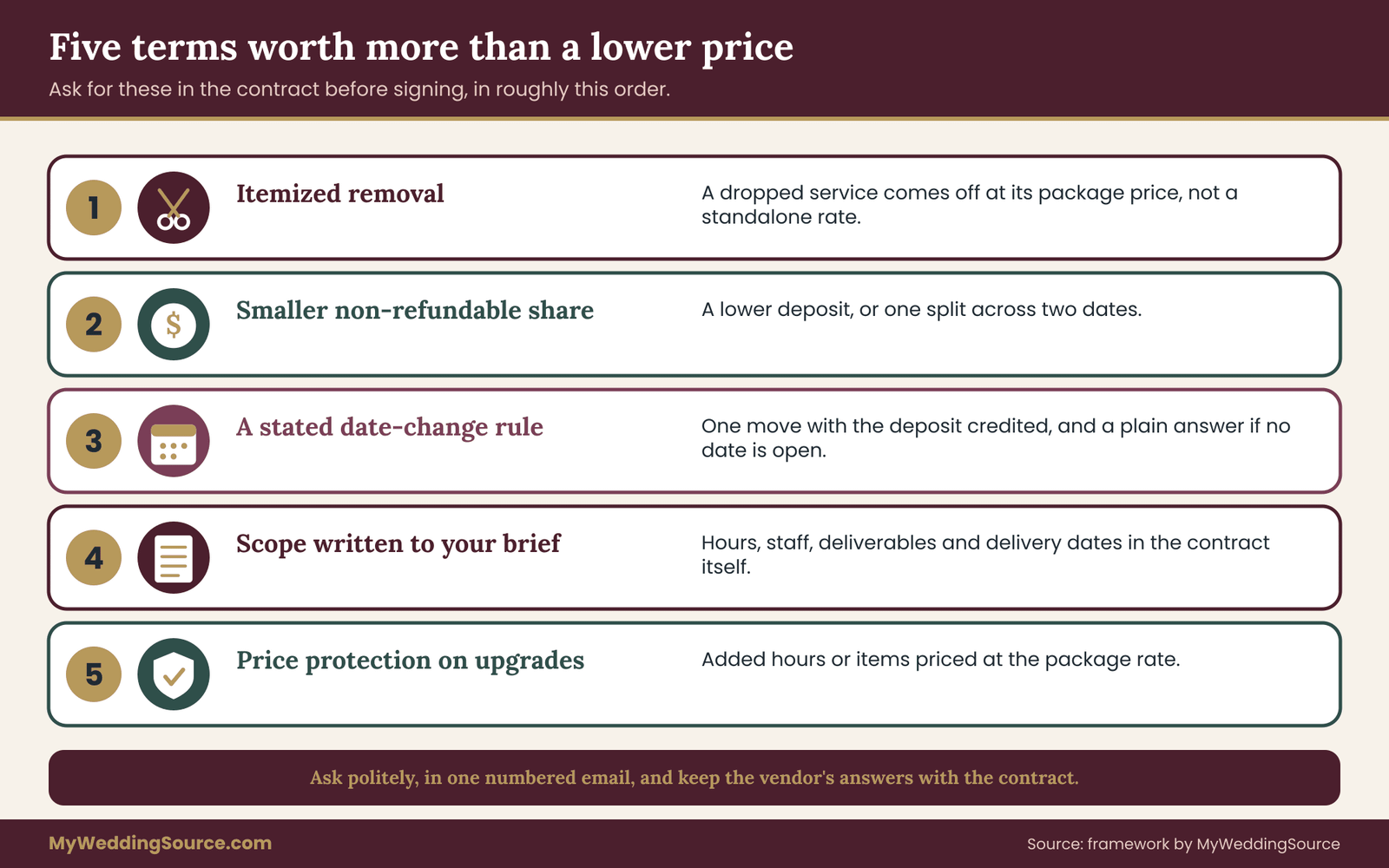
Price is the obvious request, and it is often the least valuable one. A vendor with a fixed rate card may hold the headline price but bend on structure. In rough order of value, these are the terms that tend to matter most when you negotiate bundle discounts.
Itemized removal. If any service is dropped, it comes out at the amount the package assigned to it. This single clause removes the dependency penalty.
Smaller non-refundable share. A lower deposit, or a deposit split across two dates, reduces exit exposure without changing the price at all.
A stated date-change rule. One move with credit of the deposit, and a plain statement of what happens if the vendor has no opening.
Scope written to your brief. Hours, staff, deliverables and delivery dates in the contract, not only in the proposal.
Price protection on upgrades. If you add hours or items later, they are priced at the package’s rate, not at a premium rate.
Wording that works
Be specific and polite. Vendors respond better to a clear list than to a general complaint about risk. Here is a sample you can adapt.
“We like the package and want to book. Before we sign, could you confirm in the contract that a removed service comes off at its package price, that the deposit is thirty percent, and that we can move the date once with the deposit credited?”
If the vendor declines one item, ask for the reason and whether a different term could stand in for it. A vendor who cannot lower the deposit may be able to accept a second installment, and that gives you most of the benefit. Avoid ultimatums. You want a vendor who is glad to work with you in a year, when something has changed.
Use the separate quotes as context, not as a weapon
Your unbundled quotes are information. You can say that you compared the package against separate bookings for the same scope, and that the separate total was close. That tells the vendor the price is competitive, or not, without naming anyone.
Do not share another vendor’s quote or name. It is unnecessary, it can damage relationships, and some vendors treat their quotes as confidential. Describe the comparison in general terms and let the numbers speak.
Trade flexibility for price when it suits you
The negotiation goes both ways. If you are sure of your date and comfortable with a larger deposit, a vendor may give a better price in exchange. That is a legitimate trade, and the three-number test tells you what you are giving up. If the extra discount is larger than the extra exposure you are willing to carry, take it.
What you should avoid is trading without pricing. Saying yes to early payment for a discount that is smaller than the value of your cash reserve, for instance, is a quiet loss. Use the same arithmetic you used to compare the bundle in the first place.
Be careful with time pressure on bundle discounts
A vendor may say the price expires at the end of the week. Sometimes that is true, since a date can be booked by someone else. Sometimes it is a technique. A reasonable test is to ask whether the vendor will hold the date and price for a few days while you review the contract, perhaps with a small refundable hold.
If the answer is no, you have two choices. Accept the pressure as part of the price and decide quickly, or walk away from the offer. Both are legitimate. What is not wise is signing something you have not read because a clock was running. A contract that is fair on Monday will usually still be fair on Thursday.
Keep everything about bundle discounts in writing
Verbal promises are weak evidence. If a vendor agrees to a change, ask for the contract to be updated, or for an email that confirms it and is attached to the contract. Save the final version, and note the date. The purchase-order discipline that carries a scope from agreement through final acceptance applies here: agree the scope, record changes, and confirm acceptance at the end.
Special cases that change how bundle discounts compare
The method works for most bundle discounts. A few situations need adjustments, because the usual levers are missing or the structure is different. Read the ones that apply to you.
Venue-required or venue-linked packages
Some venues, which price their bundle discounts as a package, require you to use their catering, bar, rentals or coordinator, and they price the combination as a package. In that case you cannot always build an unbundled alternative at the same venue, because the separate option does not exist. The comparison shifts from “bundle versus separate” to “this venue’s package versus another venue’s total.”
Ask which parts are optional and which are required, in writing. Ask whether outside vendors are allowed and under what conditions, including any fee for bringing them. Compare total event cost across venues, not line items within one. The wedding venues guide covers venue selection in general terms, and the same total-cost thinking applies.
Planner-managed tiers with preferred vendors
When a planner offers vendor access at negotiated rates, the planner may earn a referral payment from some vendors. This is common and not improper, but it is a material connection, and you are entitled to ask about it. A fair question is whether the planner or the planner’s firm receives any payment from the vendors it recommends, and whether the rate you are quoted already includes it.
You can test the saving the usual way. Ask for the same scope from an outside vendor and compare. If the planner’s price is lower, you have a real benefit. If it is higher, you may be paying for convenience, which is fine if you know it. The vendor due diligence checklist lists checks to run on any vendor, whether it came from a planner or from your own search.
Cross-vendor referral discounts
A discount for hiring two named vendors is the most fragile of all bundle discounts. The two contracts may be separate, and each may state that the discount depends on the other. If one vendor becomes unavailable, you may lose the discount even though you did nothing wrong.
Before agreeing, ask both vendors how the discount is funded, what happens if either side cancels, and whether the discount survives if you keep one and replace the other. Ask them to state it in each contract. If they will not, treat the discount as unreliable and compare as if it did not exist.
Multi-event bundle discounts
Some vendors offer a lower rate if you book an engagement session, a rehearsal dinner, the wedding and a day-after brunch together. The question is whether the extras are things you would have bought. A saving on an event you did not plan is not a saving. Price only the events you want, and treat the rest as optional.
Watch for events that carry their own dates. A discount that requires booking all events at once commits you to dates that may move, and each date adds exit exposure of its own.
Free upgrades and “complimentary” items
A free item is not free if the price of the main package went up to cover it, or if the item is something you would not use. Ask the value the vendor assigns to the item, ask whether it comes off if you decline it, and ask whether declining it reduces the price. Often the answer is no, which tells you the item was a marketing device and not a discount.
If you want the item, take it and note its true value to you. If you do not, spend your energy on the terms that matter, such as the deposit and the removal clause.
Group and shared-cost bundles
Occasionally couples join with another couple, or a family organizes several events, to share a vendor’s minimum or travel cost. Treat the shared arrangement like a cross-vendor package. Settle in writing who is responsible if the other party cancels, because the vendor may hold you to a price that assumed the second booking.
Budget-driven bundle discounts
When money is tight, a package can feel like the safe choice because it caps the number of decisions. That is a good reason to like a bundle. It is not a reason to skip the test. The wedding budget guide explains how to set category limits, and the three-number test fits into that work: it tells you whether a bundle really fits inside the limit you set for the category.
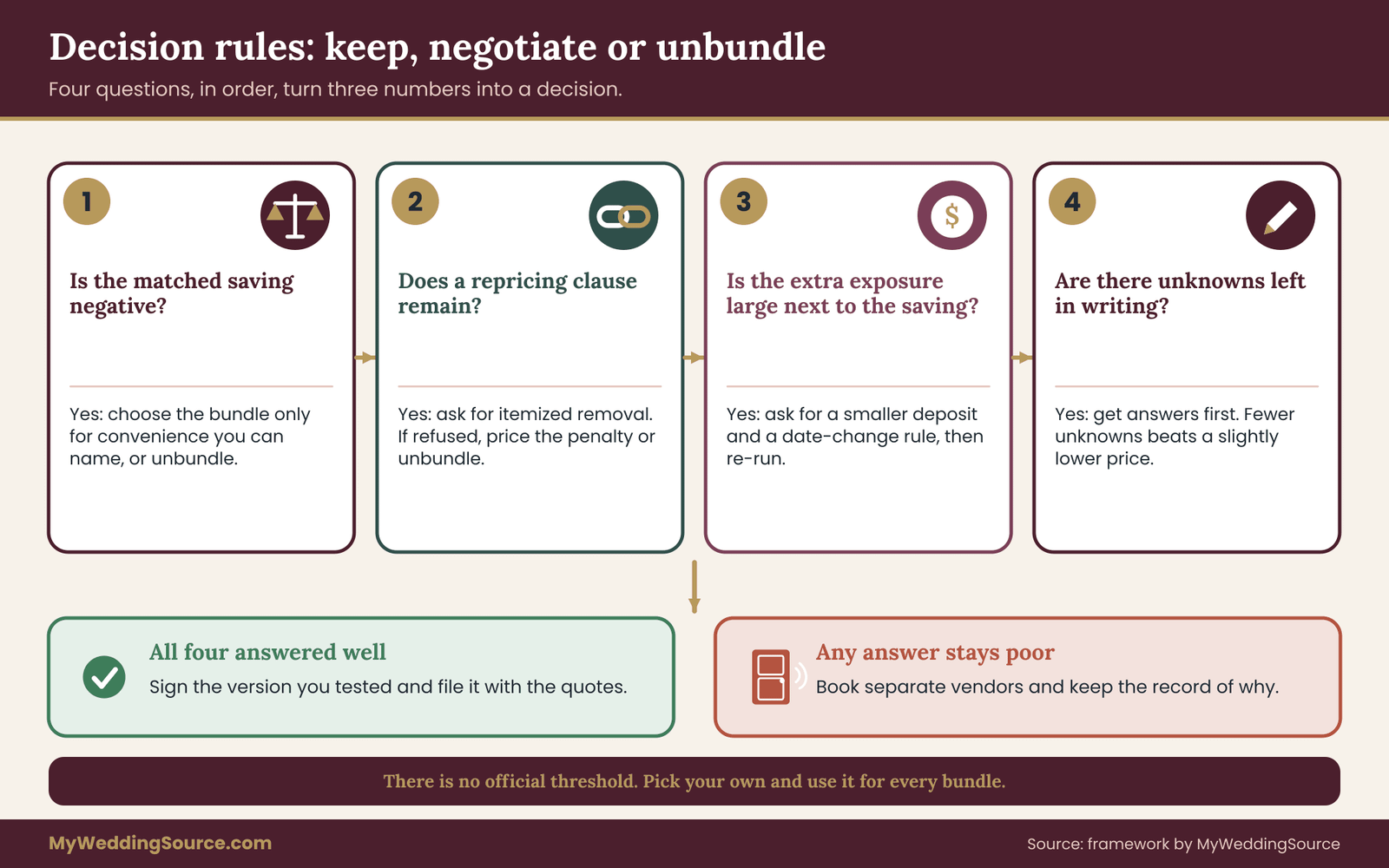
Decision rules for bundle discounts
After the three numbers are written down, a few plain rules turn them into a decision. They are not laws. They are defaults that fit most couples, and you can adjust them to your tolerance for risk.
Rule one: a negative saving ends the discussion
If the scope-matched saving of the bundle discounts is negative, and the coordination value you can defend does not turn it positive, the bundle is not a discount. Choose it only if you want the convenience at that price, and say so plainly. Do not let the word “package” carry a price that the numbers do not support.
Rule two: weigh bundle discounts against the extra exposure
Divide the extra non-refundable exposure by the scope-matched saving. A bundle that saves 150 dollars and adds 2,345 dollars of exposure produces a ratio above fifteen to one. A ratio like that means you are being paid very little for a lot of risk. A ratio near one or below means the discount roughly covers the risk it creates.
There is no official threshold. Pick one that matches your budget and stick to it across bundles, so you are consistent. A couple with a large reserve may accept a high ratio. A couple on a tight budget should accept a low one.
Rule three: a repricing clause is a dealbreaker unless it is removed
A clause that reprices the remainder at standalone rates when any service is dropped is the one most likely to turn a bundle into a trap. Ask for itemized removal. If the vendor refuses, price the dependency penalty and treat it as part of the bundle’s cost. In most cases, a refusal is a reason to choose separate bookings.
Rule four: prefer the option with fewer unknowns
Between two options with similar totals, choose the one with fewer open questions. Unknowns include unpriced scope gaps, vague delivery dates, unclear subcontractors and silent clauses. A cheaper option with five unknowns is a worse bet than a slightly more expensive one with none, because unknowns tend to resolve against the party who did not ask.
Rule five: protect the date and the deposit together
If the date is not fixed, avoid large non-refundable deposits tied to it, in a bundle or not. If the date is fixed and the vendors are well checked, a larger deposit becomes more acceptable, and a better discount may be worth taking. The right answer depends on how certain you are, and an honest self-assessment is more valuable than an optimistic one.
Rule six: let the contract, not the quote, decide
Run the final comparison against the contract text. If the contract is missing a promise made in the proposal, ask for it. If it adds a term you did not expect, ask about it. Sign only the version you have tested.
When to choose bundle discounts with confidence
Bundle discounts are a good choice when the saving is real after matching scope, the exits are no worse than separate bookings, removal is itemized, the vendor answers questions in writing, and the coordination benefit is something you have described in specific terms. When those conditions hold, take the bundle and enjoy the simpler planning.
When to walk away from bundle discounts without regret
Unbundle when the saving is negative or trivial, when the deposit is large and non-refundable, when a repricing clause survives your request to remove it, or when cross-default language would put your discount at the mercy of another party. The separate route takes more emails. It also gives you more control, and for many couples control is the point.
Verifying claims about bundle discounts and knowing the limits
The method rests on facts that vendors supply, so verification matters. It also has limits, and an honest guide should state them.
What to verify, and with whom
Verify the vendor’s identity and standing through the checks in the vendor due diligence checklist: business registration where it applies, insurance certificates, references and reviews that you can trace. Verify prices through the separate quotes. Verify contract terms by reading them and, for high-stakes terms, asking a licensed professional.
If a vendor makes a claim about what the law allows, such as that a deposit is “always non-refundable” or that a cancellation fee is “required by state law,” ask for the citation, and check it with your state attorney general’s consumer office or a licensed attorney. Many of these claims are partly true at best.
Know where complaints and disputes go
If a vendor fails to deliver, begin with a written request to fix the problem, with dates and attachments. If that fails, a credit card issuer’s billing dispute process may help for card payments, within the time limits the issuer and federal rules set. State consumer protection offices accept complaints, and the Federal Trade Commission collects reports of deceptive practices. Links to these agencies are in the sources below.
None of these routes is a guarantee. Outcomes depend on the facts, the payment method and local law, and a small claims court or an attorney may be the practical next step for larger amounts.
The limits of this method for bundle discounts
The three-number test for bundle discounts depends on honest inputs. A vendor can misstate its standalone price. A separate quote can change before you sign. Prices vary by date, region and season, and a quote that was fair last month may not be fair now. The figures in the worked example are invented and are not benchmarks.
The method also does not value things that are hard to price, such as a vendor’s style, a relationship you trust, or the peace of mind from a team that has worked together before. Those can legitimately outweigh a small numerical difference. The aim is to make sure the decision is yours and that it rests on the price of what you give up.
Keep the review current
Vendors revise packages and policies. If the offer changes after you start, run the test again on the new version. Check terms again shortly before signing, and keep a dated copy of the version you accepted. Rules about cancellation, fees and consumer remedies can change, so confirm current requirements with the issuing agency or a licensed professional rather than relying on this guide for legal detail.
Your next steps
Start with one of the bundle discounts you are actually considering. Strip it to countable lines, mark the question marks and send one numbered email with your clause questions. While you wait, send the same brief to two vendors per component and ask for itemized quotes with deposits and cancellation terms.
When the answers arrive, write the three numbers: the scope-matched saving, the exit exposure and the dependency penalty. If the trade is poor, ask for itemized removal, a smaller deposit and a date-change rule, then run the test again. If it is good, sign the version you tested and save it with the quotes. Either way, you will know what your bundle discounts are worth.
FAQ
Are wedding vendor bundle discounts usually a good deal?
Sometimes. A vendor serving you more than once can save real time and cost, and some pass part of that on. But the advertised saving is often measured against the vendor’s own price sheet. Rebuild the same scope from separate quotes before you decide, and look at the deposit and cancellation terms, not only the total.
How do I compare a bundle with separate vendors fairly?
Convert the bundle discounts into countable lines: hours, staff, deliverables, delivery dates, fees and limits. Ask other vendors to quote exactly that scope in writing. Add the same extras to both sides, such as travel and card fees. The difference between the totals is your scope-matched saving, which may be zero or negative.
What is a dependency penalty in a bundle?
It is the amount your price rises when you remove or replace one part of a package. If a contract reprices the remaining services at standalone rates when you drop one, the discount can disappear on your first change. Ask for itemized removal, where a dropped service comes off at its package price.
Should I worry about large non-refundable deposits in a bundle?
Yes, compare them. A package often carries one large deposit, while separate bookings carry several smaller ones. If you cancel or move the date, the larger deposit puts more money at risk. Ask whether the deposit can be lower, split over two dates or credited to a new date, and get the answer in the contract.
Is it rude to ask a vendor how a bundle price was built?
No. Asking what the regular price is based on, and what each part costs on its own, is a normal commercial question. Ask politely and in writing. A vendor who has a clear answer will give it quickly, and one who avoids it is giving you information about the offer.
Can a vendor require a review or social media post for a discount?
Some do, and you should read the terms with care. The Federal Trade Commission publishes guidance on endorsements and reviews, including when a benefit given in connection with a review must be disclosed. Do not promise a particular opinion. If the condition is unclear, ask for it to be removed or explained in writing.
What if a venue says I must use its bundled package?
Ask which parts are required and which are optional, whether outside vendors are allowed, and whether a fee applies. Then compare total event cost across venues, since a separate option may not exist at that venue. Get the answers in writing, and treat unexplained requirements as part of the price.
Who can help if a bundled vendor does not deliver?
Start with a written request to the vendor, then consider a credit card billing dispute if you paid by card and are within the issuer’s time limit. State consumer protection offices and the Federal Trade Commission accept complaints. For larger amounts, a licensed attorney or small claims court may be appropriate, depending on your state.
Sources
- Consumer advice, Federal Trade Commission
- Advertising and marketing guidance for businesses, Federal Trade Commission
- Report fraud and deceptive practices, Federal Trade Commission
- How do I dispute a charge on my credit card bill?, Consumer Financial Protection Bureau
- Submit a complaint, Consumer Financial Protection Bureau
- State consumer protection offices, USAGov
- Find your state attorney general, National Association of Attorneys General
- Uniform Commercial Code and uniform state laws, Uniform Law Commission