

Wedding video music copyright licensing is the question of who has the right to put a particular song under your wedding film, and what you need in writing before it goes online. This guide explains how wedding video music works in plain terms, gives you a clearance checklist, and shows how to brief a licensed alternative so the film still sounds like your day.
::: {.mws-callout} Quick answer: A commercial song is usually two separate copyrights, one in the composition and one in the recording, and putting it under a video generally needs permission for both. A venue or band license covers music played in the room, not wedding video music synced to your film. For wedding video music, decide first where the film will live, then choose one of five sources: a licensed library, a commissioned piece, a cleared commercial song, a platform’s own music tool, or no wedding video music at all.
Whatever you pick, keep the license or the written permission with the video file. :::
Most couples meet this topic by accident. The videographer sends a draft highlight film, the first dance song is playing under the vows, and the couple loves it. Then someone asks whether the film can be posted, and the room goes quiet. Nobody did anything wrong. Wedding video music is simply one of those areas where the way people use songs every day (streaming, sharing, playing a favorite at a party) does not match the rules that apply once a song is attached to a recorded film.
The good news is that the problem is small and well understood once you can see its parts. You do not need to read statutes. You need to know which kind of permission applies, who can give it, how to read a license written by someone else, and how to ask a videographer to deliver a film that you can actually share. This article covers those pieces in the order you will meet them.
A note on scope. This is general information, not legal advice. Copyright rules, license terms and platform policies differ and change, so where a rule matters the article points you to the agency or company that publishes it, and a lawyer who handles music or media can answer questions about your own situation.
Two boundaries keep this guide focused. First, it is about recorded wedding video music placed in a video. The separate question of who holds the performance permissions for a live band or DJ in the room is covered in the site’s guide to wedding reception music planning, and the two questions should not be mixed up.
Second, it is about personal wedding films: the highlight reel, the full-length edit, the teaser, the social clip and the slideshow. A videographer who wants to show your film in a business portfolio is a related but different case, and that case comes up later.
What wedding video music copyright means
When people say “copyright” about a wedding film, they usually mean one of three things, and it helps to keep them apart.
The first is ownership. Someone wrote the song and someone made the recording, and those people or companies hold exclusive rights in what they made for a long time. Those rights include the right to reproduce the work, to distribute it and to perform it publicly. They also include the right to authorize others to combine it with moving images, which is the right that matters for a film.
The second is permission. A copyright owner can say yes to a particular use, usually through a license. The license may be a simple click-through on a music library site, a signed agreement with a publisher, or a line in a performer’s contract. Permission is specific. It covers certain uses, in certain places, for a certain time, and it does not stretch beyond those terms because the use feels harmless.
The third is enforcement. Rights holders, and the platforms that host video, use different mechanisms to find unlicensed use and respond to it. For couples the enforcement you are most likely to meet is not a lawsuit. It is an automated claim on a platform that mutes the audio, blocks the video in some countries or sends the money from any ads to someone else. We will come back to that in the section on platforms.
Wedding video music sits where these three meet. You hold the film, and your videographer likely holds the editing files. Neither of you holds the song. So the practical job is to line up a permission that matches the way the film will be used. That is the whole subject, and everything below is a way of doing that job with less guessing.
The words you will hear about wedding video music
A few terms appear in every conversation on this topic, and each has a plain meaning.
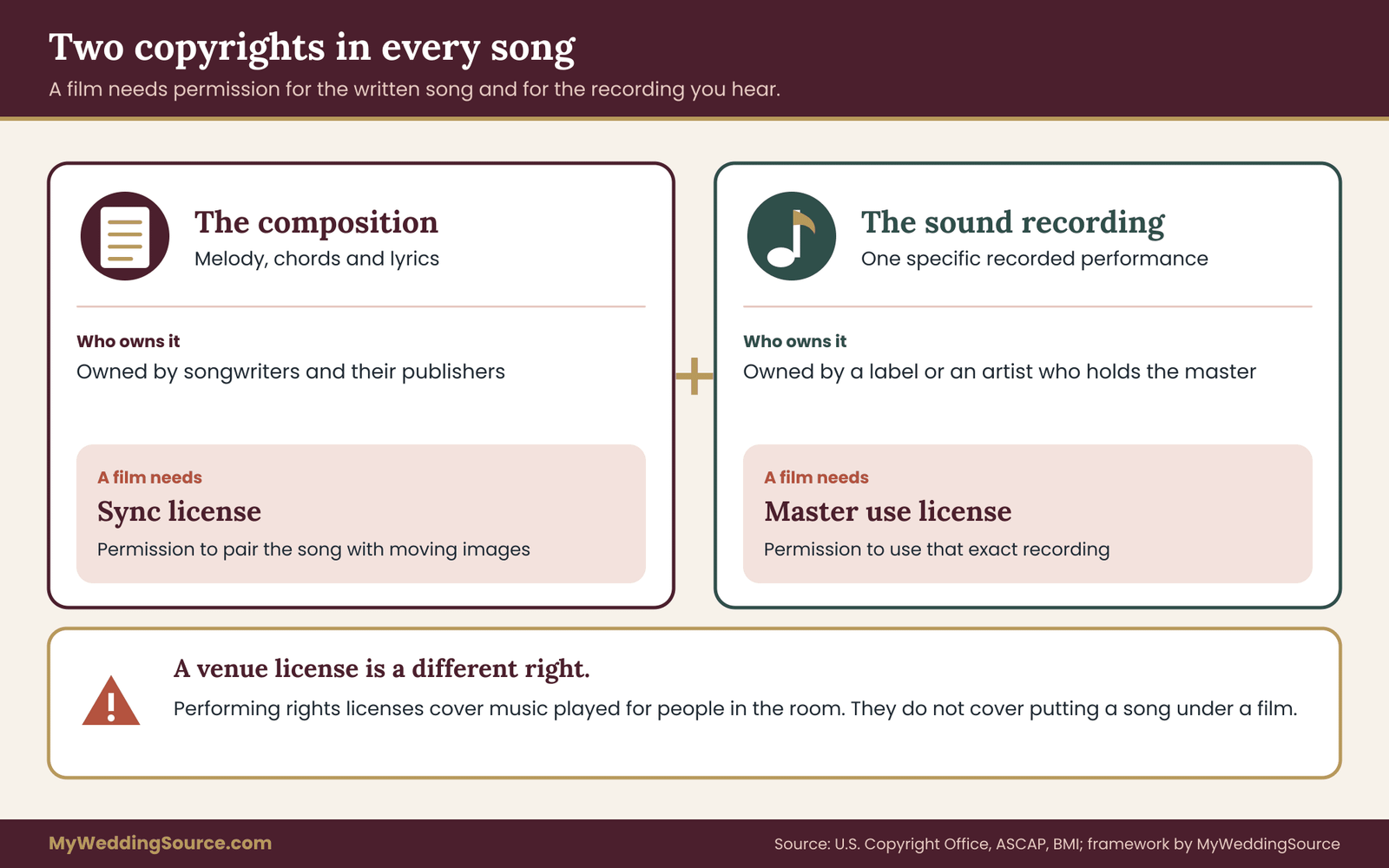
Sync license. Short for synchronization. It is permission from the owner of the composition (the written song: melody, chords and lyrics) to pair the song with moving images. Music publishers usually grant it.
Master use license. Permission from the owner of the sound recording (the specific recorded performance) to use that recording. Record labels, or artists who own their own masters, usually grant it.
Public performance license. Permission to play or perform a song for an audience. In the United States, performing rights organizations such as ASCAP and BMI license this on behalf of songwriters and publishers, and venues, radio and restaurants commonly hold blanket licenses with them. Public performance is a different right from sync.
Royalty-free. This describes how a license is priced, not whether a license exists. Royalty-free wedding video music is generally licensed for a one-time or subscription fee without per-use royalties. It still comes with terms, and the terms are what you should read.
Mechanical license. Permission to reproduce a composition in audio copies, such as making and distributing a recording of a cover song. It is not the license for putting a song under a film.
You do not need to memorize these. The point is that “we have a license for music at the venue” and “we have a license for music in the video” are statements about different rights, and only the second one answers your question. The Copyright Office’s general information pages and the websites of the performing rights organizations describe these categories in more detail, and the sources at the end of this article list them.
What this guide will and will not do
It will give you a decision frame you can use in an evening, a checklist for clearing a commercial song if you decide the song is worth the trouble, and a way to write a brief for a licensed alternative. It will not tell you that a particular use is safe, because that depends on facts about the song, the platform and the terms you hold.
It also will not give you a price for clearing a song. Quotes vary widely by song and use, many rights holders do not license to individuals at all, and any number printed here would only mislead you.
What it will do is shorten the conversation with your videographer. A couple who can say “we want a licensed track in this style, delivered with its license, in a version we can post” gets a very different result from a couple who says “we want our song.”
Why wedding video music involves two copyrights
Take any song you might love for your film and picture two objects. One is a piece of paper, or its modern equivalent: the written composition. The other is a recording, a specific performance captured in a studio or at a show. The song you hear in your head when you say its name is almost always a recording, but the right to use it sits in both objects.
This is the single idea that explains most of the confusion. A song on a streaming service is licensed for you to listen. That license is between the service and the rights holders, and it covers streaming to you personally. It does not give you the right to take the recording and attach it to a film. That requires the sync permission from the composition’s owner and the master permission from the recording’s owner, each separately.
Who owns which layer
The owner of the composition is typically one or more songwriters and their music publishers. A popular song may have several writers, each with a share, and each share may be held by a different publisher. To clear the composition you often need agreement from every share holder, or from an administrator who speaks for them.
The owner of the recording is typically a record label, or an artist who owns their own masters. A catalog that has changed hands may now sit with a company the artist never signed with. Identifying who currently holds a master can take real research.
There are exceptions that help. If a recording is a cover version made by someone else, there are two different owners and neither is the original artist’s label. If a recording is a live performance by your own band, you may own that recording yourselves, but the composition still belongs to its writers unless the piece is old enough to be in the public domain.
If a track comes from a production music or royalty-free library, the library typically controls both layers and licenses them to you together. That is the main reason library music is simple to clear: one counterpart, one set of terms.
Why wedding video music is slow to clear for popular songs
Clearing a well-known commercial song means finding the publishers, finding the label, asking each for a quote, and waiting for answers. Publishers and labels often respond to requests from film and advertising projects with budgets, not to individual couples with a wedding film. Some decline small personal requests. Some quote prices designed for commercial releases. Some do not reply before your wedding anniversary.
None of this is a judgment about your film. It is a business reality, and it is why this guide spends more time on licensed alternatives than on clearing hit songs. Clearing a commercial song can work, and the section on it later gives you the steps. It just should not be your only plan.
The question that sorts every wedding video music choice
When you are unsure whether you can use a piece of wedding video music, ask one question: who could say yes to this use, and have they? If you cannot name a person or company that gave permission, and you cannot point to a license that covers the use, then you do not have permission, however famous or old or personal the song is.
That question works for every case in the rest of the article. It works for a pop song, for a cover your cousin recorded, for a track a friend sent as a gift, and for a piece from a free site. It also works for the videographer’s own choices, which is where the next sections lead.
Where the video lives decides the wedding video music risk
Before you pick any song, answer a plain question: where will this film actually be seen? The answer changes which options are reasonable, and it is a better starting point than the song. Most couples want more than one destination, so list them all. Then give the film its strictest destination. That is the one that should set the wedding video music rules.
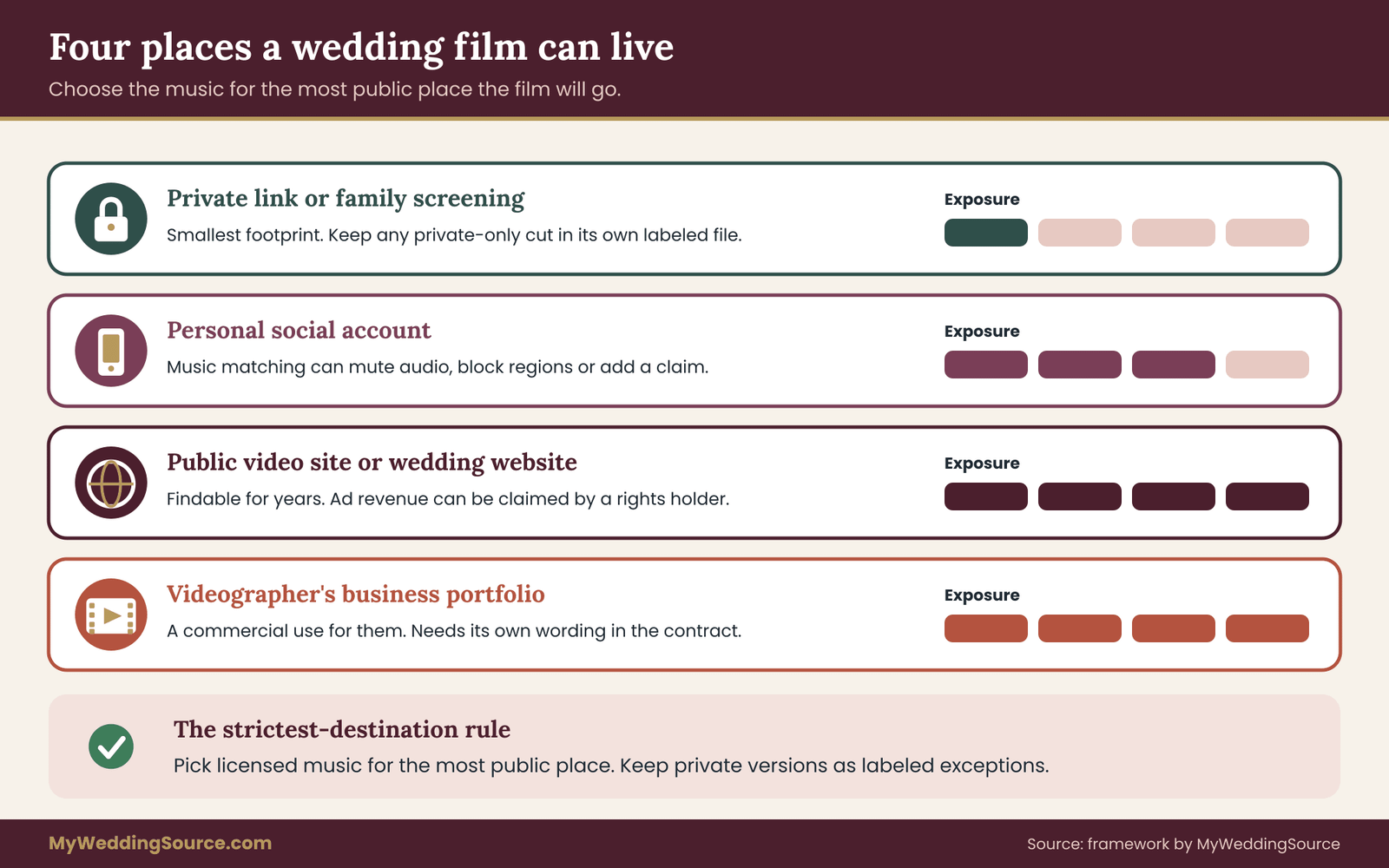
Four places a wedding film can live
On a private link or a family screening. A film shared by private link with family, or played on a television at an anniversary party, is the smallest footprint. Even here a commercial recording is not licensed for the use, and nobody should tell you otherwise. But the practical exposure is small, and many couples reasonably keep their favorite song for this kind of private viewing while using licensed wedding video music for anything public. If you do, be honest with yourselves about what you are doing and keep that file separate and labeled, so it does not get uploaded later by someone who assumes it is cleared.
On a social platform under your own account. Posting to a personal account puts the film in front of an automated system. Most large platforms run music-matching tools. A match can mute the audio, restrict the video by country, add a claim or, on some platforms, count toward a penalty on your account. Some platforms also offer their own licensed wedding video music tools for personal accounts, and those are a separate path covered under the five sources below.
On a video site or a public page. A film on a public video site, your wedding website or a blog is findable and can stay online for years. If the site supports ads, a rights holder may claim the revenue. Public pages also draw takedown requests that a private link would not.
In a business portfolio. If your videographer wants to show the film on their website, in ads or on their business social accounts, the use is commercial for them, even though the film is personal for you. A license that covers your personal use may not cover theirs. This is not a loophole to avoid. It is a normal part of the delivery conversation, and it should be settled in the contract.
What platforms generally do
Platforms differ and change their rules, so treat this as a map and not a promise. The pattern is consistent enough to plan around.
Large video platforms run automated matching against reference files supplied by rights holders. YouTube describes its system, called Content ID, in its help center: when a match is found, the rights holder can choose to block the video, track its viewing statistics, or monetize it by running ads, depending on the policy they set. Other platforms have their own versions of this and publish their own rules for music in personal and business accounts.
Separate from automated claims, the law in the United States has a notice-and-takedown process in section 512 of the copyright statute. A rights holder can send a notice to a platform, and the platform removes the material to keep its legal protection, then tells the uploader. The uploader can respond with a counter-notice in some cases. Platforms commonly also have policies for repeat infringers. The Copyright Office describes this process on its pages about online service providers, and the source list below points to it.
For a couple, the plain consequences are these. A claim on a wedding film is more often an irritation than a disaster: muted audio, a blocked country, a notice in an email. But it happens at the worst moment, such as right after you share the film with relatives abroad, and in some situations it can affect the account that hosts the video. Choosing licensed wedding video music avoids the whole sequence.
The strictest-destination rule for wedding video music
Here is the rule in one sentence: pick the wedding video music for the most public place the film will go, and make private versions the exception.
Suppose the couple wants the highlight reel on their wedding website, in a family chat and on social media. The strictest of those is social media and the website. So the reel should use wedding video music that is licensed for public online use. If they also want a private cut with their first-dance song for their parents’ anniversary party, that can exist as a second, labeled file that does not leave the family.
Two small habits make this rule work. Name the files so that the destination is clear (for example, “highlight-public” and “highlight-private”). And ask the videographer to deliver them as separate exports, with the license documents for the public one, so nobody has to remember which is which a year from now.
Fair use, free wedding video music and other shortcuts that do not hold up
Several ideas circulate among couples, friends and even some vendors, and they sound reasonable. Each deserves a close look, because relying on them is how most wedding video music problems start.
“It is only thirty seconds”
There is no safe number of seconds. The Copyright Office’s fair use pages say directly that there is no formula, and that no minimum amount of a work can be used without any possible issue. A short clip of a recording is still a use of the recording and of the composition. Length can matter in a legal analysis, but it never turns an unlicensed use into a licensed one.
“Fair use covers personal videos”
Fair use is a legal defense, not a permission. It is decided case by case, by weighing four factors that the statute names: the purpose and character of the use, the nature of the copyrighted work, how much of it was used and how important that part was, and the effect on the market for the work. The Copyright Office keeps an index of court decisions so you can see how varied the outcomes are.
A personal, non-commercial use can help on the first factor. It does not decide the matter. Using a whole song as the soundtrack to a film does not transform the song into something new, and the film does not comment on the song. Nobody can tell you in advance whether a court would accept the argument for your film. And you do not want your wedding film to be the test case. Treat fair use as something a lawyer evaluates after a dispute starts, not a plan you make before one.
“We bought the song, so we can use it”
Buying a download, or subscribing to a streaming service, gives you a license to listen under that service’s terms. It does not include sync or master use rights for a film. Terms of service commonly say so in plain words. The purchase is real, but it is a different transaction.
“The videographer will handle it”
Sometimes true, sometimes not, and the difference lives in the contract. A videographer who uses a music library may well deliver licensed tracks. A videographer who drops in the couple’s chosen song as a courtesy has not licensed it, and has pushed the risk to the couple. The section on working with your videographer gives you the questions to settle this in writing. Do not assume. Ask.
“It is on a free site, so it is free”
Free to download is not the same as free to use. Some sites collect wedding video music that the creators have chosen to license under open terms. Others collect wedding video music that was uploaded without anyone checking whether the uploader had the right to share it. The first group has license terms you can read. The second is a trap. The only thing that matters is whether you can point to a written license from someone who had the right to give it.
“It is old, so it is public domain”
Age helps, but only in a specific way and only for a specific layer. A very old composition may be in the public domain, which means no one controls it. A recording of that composition made last year is a new work with its own owner. The same goes for a new arrangement of an old tune. If you want a classical piece under your film, the safe route is usually a recording that is itself licensed, or one made for you, not a recording you found.
Public domain status also depends on the date and place of publication, and on rules that have shifted over the decades. When a piece is truly old, confirm its status through the Copyright Office’s resources or a lawyer before you rely on it, and still get the license for the recording you plan to use.
“Credit the artist and it is fine”
Giving credit is not permission. Some licenses, notably certain Creative Commons ones, require attribution as one of their conditions, so attribution matters there. But on its own, a credit line only tells viewers who made the wedding video music. It does not turn an unlicensed use into a licensed one.
“Nobody will notice”
Maybe, and maybe for years. But that is a bet about enforcement, and enforcement is automated and keeps getting better at finding matches. A film that was fine for a year can be claimed later when a rights holder adds a new reference file. The cost of choosing licensed wedding video music at the start is small compared with re-editing a film after the fact, especially when the original project files are with a vendor who has moved on.
What these wedding video music shortcuts have in common
Each one tries to answer a permission question with something that is not a permission: length, intent, purchase, price, age, credit or luck. The question from the last section still stands. Who could say yes to this use, and have they? If you can answer, you are done. If you cannot, pick a different source of wedding video music, which is the subject of the next section.
Five sources for wedding video music
Once you know where the film will live, you can choose where the wedding video music comes from. There are five realistic sources. Each trades off cost, control, emotional fit and effort differently, and most couples end up combining two of them.
Source one: a licensed music library
Production music libraries and subscription services license large catalogs for film use. You search by mood, tempo and instrument, listen, and download a track with a license. Videographers often subscribe to one or more, and some wedding videographers build their entire process around a library they trust.
Strengths: the library typically controls both the composition and the recording, so there is one set of terms. Prices are predictable, the catalog is searchable, and many tracks come in several lengths with stems, which makes editing to the beat of your day easier. Weaknesses: you will not find your actual first dance song, and some library music sounds like library music. The fix for that is a careful brief, which gets its own section below.
The most important fact about library licensing is that licenses differ. A subscription license may cover videos published while you are subscribed. A single-track license may be perpetual for specific platforms. Some licenses are for the subscriber’s business and do not pass to the end client automatically. Reading the license is the work, and the next section shows you how.
Source two: a commissioned or original piece
A musician or composer writes or arranges something for your film. This can be a friend who plays, a composer found through a local music school, or a studio that offers short custom pieces. You can ask for a melody that quotes the feel of your first dance without copying it, for an arrangement of a public domain tune recorded fresh, or for a piece built around the length of your ceremony.
Strengths: complete creative control and a piece no one else has. Weaknesses: it takes time, it costs more than a library track, and rights must be written down. A verbal “of course you can use it” is exactly the kind of understanding that falls apart later. Get a short agreement that says who owns the wedding video music, what you may do with it (personal film, public posting, any platform), whether the musician may reuse it, and whether credit is required.
If the musician is playing a cover of a copyrighted song, the composition still needs its own license. Even a friend’s recording of a commercial song is not cleared by the friendship.
Source three: a cleared commercial song
You identify the publisher or publishers and the owner of the recording, request sync and master licenses, pay the quotes and receive signed permission. This is the only way to use your actual first dance song, legally, in a film you plan to share. It can be done, but see the earlier remarks on cost, speed and willingness to license. The full process is in a later section.
The honest decision rule is to treat this route as a stretch goal. Start the requests early, run a licensed alternative in parallel, and use whichever arrives first with the paperwork in hand. If the requests succeed, you swap the track. If they do not, you were never relying on them.
Source four: a platform’s own music tool
Some social platforms offer built-in music libraries for personal accounts, usually in a short-form video editor. These tracks are licensed to the platform, and the platform’s terms define what you may do with them. The tool is easy and the catalog includes many popular songs, but the license is the platform’s license to its users, inside the platform. In practice, that usually means the video must be created and posted within that platform, the wedding video music may be unavailable for business accounts, and the track may be removed or limited by region later.
A film made in a platform tool is not a film you can export with the wedding video music and put on your website, a family drive or another platform. The permission does not travel with the file. For a short teaser posted only to that platform, the tool can be sensible. For your archive copy and your main film, it is not a replacement for a license.
Source five: no music, or the day’s own sound
A film can work with ambient sound, the vows, the toast and the room. Many couples find that natural audio makes the film feel more like their day, and a version with no music can be the strictest-destination cut that you post freely. Careful: ambient sound is not automatically free of music. If a band or a DJ was playing during the clip, the recorded audio includes that music, and the composition is still someone’s work.
A guest dancing to a pop song in the background of a short clip is one thing. A long clip with the song clearly audible is another. Ask the videographer to flag any clips where licensed wedding video music is audible.
Choosing among the five sources of wedding video music
A short decision rule for wedding video music works for most couples.
- If the film will be public and you want it soon, choose a library track (source one).
- If the film will be public and you want it to feel unique, commission a piece (source two), and run a library track as a fallback.
- If you must have a specific song, start a clearance request (source three) and use a library track meanwhile.
- If you want a quick clip for one platform, a platform tool (source four) is acceptable, as long as it stays there.
- If you want a version you can post anywhere without a license, use natural sound (source five).

Reading a library license before you pay
A library license for wedding video music is a contract written by someone else, and it is the document that answers the key question. You do not need legal training to read it. You need to know six things to look for, and the patience to look.
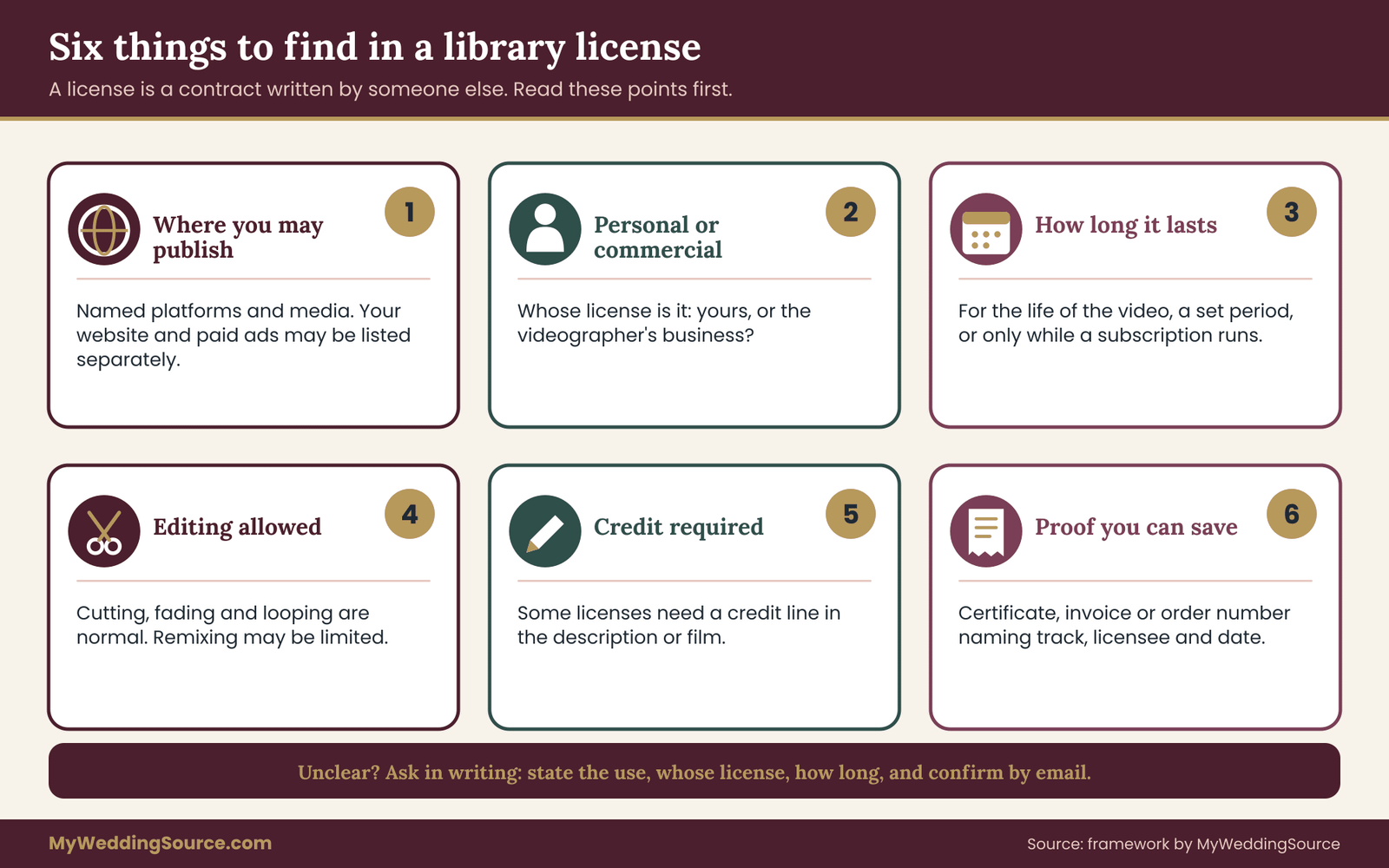
Where may the film be published
Look for a list of platforms and media: social platforms, video sites, websites, television, broadcast, cinema, events, paid advertising. A license for “online video” may not cover “paid advertising.” A license for “social media” may not cover “your own website.” If the license names the places and yours is not on the list, ask the library before you publish.
Personal use versus commercial use
Some licenses are written for creators who earn money from their videos, some for businesses, and some for personal projects. A wedding film is personal for you but may involve a business (the videographer) who delivers it. The question is whose license covers the final film, and whose account holds it. If the videographer holds the subscription, the license may be the videographer’s, and you may be a client who receives the film under it. That can be fine, but it needs to be stated.
Duration
Does the license run for life of the video, for a set period, or only while a subscription remains active? Some services state that videos published during an active subscription remain licensed afterward, and others require ongoing payment for continued use. Read how your library handles it. If a license ends, you do not want to learn that when a claim arrives three years from now.
Editing and derivative use
You will cut the track, loop it, fade it and maybe layer it. Most library licenses allow editing for the intended use, but some restrict remixing, stripping a track for sampling, or using it as the main element of a product. For a highlight film, cutting to length is normal. Check anyway.
Attribution
Some licenses require credit in the description or in the film, and some do not. Where they do, write the credit line into your plan and into the video description so it does not get forgotten. Where they do not, you can still choose to credit the composer.
Proof
The best license in the world is no help if you cannot produce it. Look for a license certificate, an invoice, an order number or a downloadable PDF that names the track, the licensee and the date. Platforms may ask for proof when a claim is filed. Save it with the video.
Questions to send before buying
If anything is unclear, send the library a short message. Plain questions get plain answers, and the reply itself becomes part of your records.
“We are a couple publishing our personal wedding film on a private website and a social account. Does this license cover that use, and is it in our name or our videographer’s? How long does it last? Please confirm in writing.”
That example is short on purpose. State the use, ask whose license it is, ask the duration, and ask for confirmation in writing. A library that responds clearly is a library worth using.
Red flags
A few things should slow you down. A site that cannot say who owns the catalog. A track described as “copyright free” with no license document. A promise that you can use “any song” for a flat fee. Terms that change after you purchase without a clear record of what you agreed to. A library that is vague about whether the track has been registered with a content identification system, which can lead to later claims against licensed use unless the library handles whitelisting.
If you hold a license and still receive a claim, the proof you saved is how you resolve it. Ask the library how they handle disputes before you buy, because a clear answer is part of what you are paying for.
Clearing a commercial song for a wedding video
If a particular song matters enough that no alternative will do, you can try to clear it. Go in with realistic expectations and a calendar. This is a process of requests, answers and paperwork, and it works best when the requests go out months before the film is due.
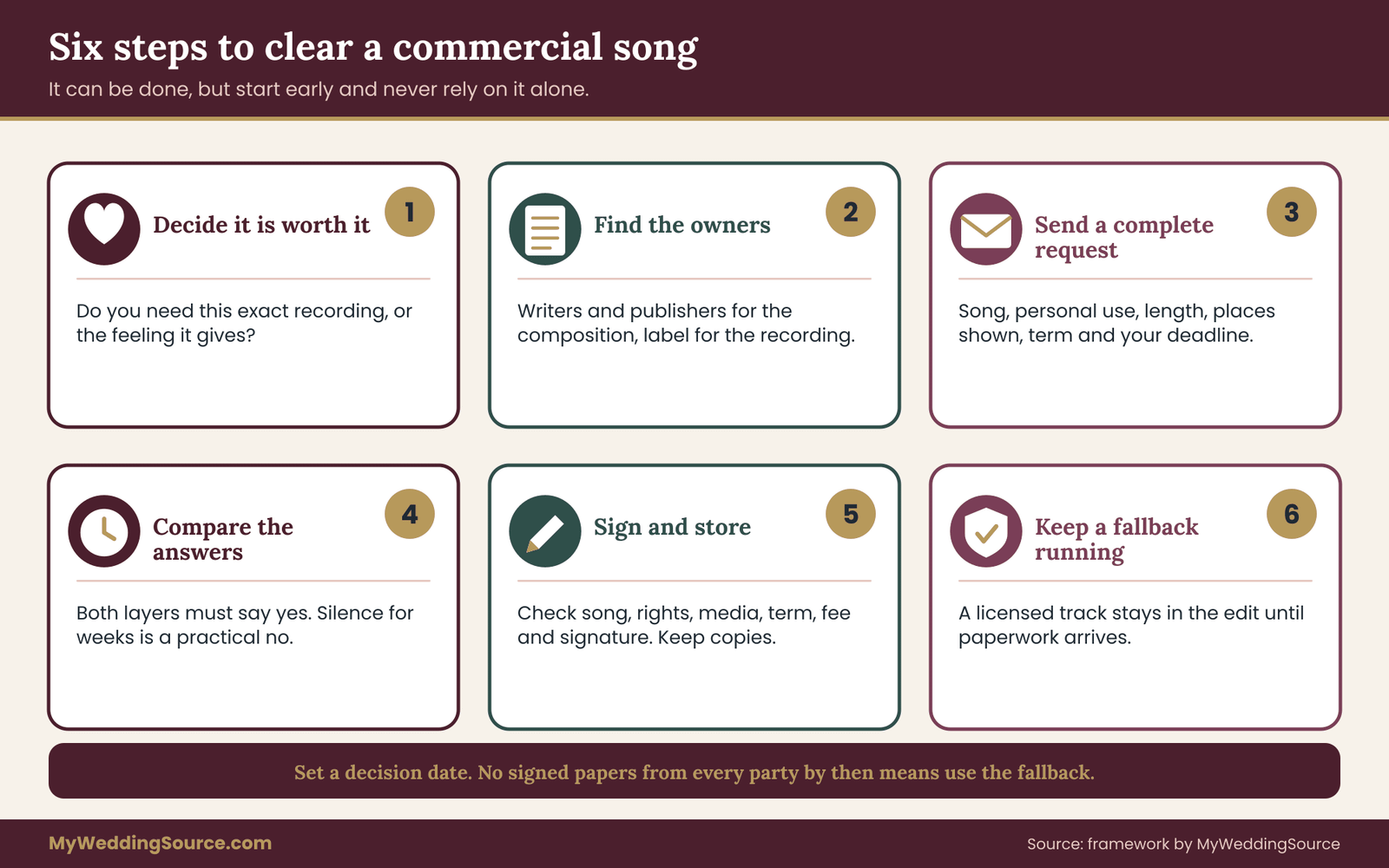
Step one: decide whether the song is worth it
Be honest about what you want from the song. If you want the exact recording, with the voice you know, nothing else will do, and clearing is the only route. If you want the feeling the song gives, a licensed alternative can often deliver it, and the brief in the next section is the tool for that. Couples sometimes discover that what they wanted was the emotional arc (quiet start, lift at the chorus, soft landing) and that arc can be matched with other wedding video music.
Also ask how much of the film the song needs to carry. A song under a two-minute teaser is a smaller request than a song under a full-length film. Some rights holders price by length, and a request that is clear about duration is easier to answer.
Step two: identify the layers and the owners
For the composition, look up the song’s writers and publishers. The databases kept by the performing rights organizations (ASCAP and BMI each publish a searchable repertory) list writers, publishers and share splits for many songs, and the sources at the end of this article include their sites. Mechanical licensing organizations such as the Harry Fox Agency handle certain licensing for publishers, though they typically handle audio reproduction, so check what a given organization can and cannot grant before you assume they can sign your sync request.
For the recording, look for the label named in the credits or on the streaming service’s information page. Credits also name the artist, and some artists own their masters outright. If the label has been acquired, the rights may sit with its successor.
Write down every party you find, with the share each has in the composition where it is listed. A song with four writers may mean four publishers, and each of them may need to agree.
Step three: write a clear request
Rights holders receive many requests and answer the ones that are complete. A good request is short and covers these points:
- The song title, the artist and, if you know them, the writers.
- That the use is a personal wedding film, not a commercial or promotional one.
- The length of the clip used and how it will be used (under a highlight film, in a full film, as a background).
- The places where the film will be shown, and whether they are public.
- How long you need the license to last, and whether you need it for all time.
- Your contact details and the date you need an answer.
Keep the tone plain and polite. Send the same request to the publisher or publishers and to the label, and say you are requesting both sync and master use permission. Do not send a vague note asking “can we use this song?” That kind of message tends to go unanswered.
Step four: compare answers honestly
You may receive no reply, a decline, a quote, or a request for more information. A decline is common and is a final answer. A silence for several weeks is a practical decline. A quote needs comparing with the value of the song to you, and with the cost of the licensed alternative. Remember that both layers must be licensed. A yes from the publisher with no answer from the label is not a yes.
When a quote arrives, check that it states the song, the rights granted, the media and territories, the term, the fee and the signature of someone authorized to grant it. If the paperwork is missing any of these, ask for a clearer document.
Step five: pay, sign, store
If both layers say yes at a price you accept, sign the agreements and keep copies. Pay by a method that leaves a record. Then store the signed licenses with the final video file and note the terms in your records, including the term, the territory and any credit line.
Step six: keep a fallback running
Throughout this process, keep a licensed alternative in the edit. If the clearance succeeds, swap in the real song. If it does not, nothing has been lost, and the film is ready. Couples who skip the fallback often end up posting a film with an uncleared track because the deadline arrived first.
A note on timelines for wedding video music clearance
Rights holders do not work on wedding timelines. A reasonable plan starts the clearance request as soon as you know you want the song, which is often before the wedding itself, since the song is chosen for the first dance. If you hear nothing by the time the first edit is due, treat the silence as a no and go with the alternative.
When one layer is easier than the other
Sometimes you hold a piece of the puzzle. A friend who plays the song live in the ceremony, with you holding the recording, means you may own the master of that recording but still need the composition license. A cover band that records a version for you may license its own recording, but the composition still needs the publisher’s approval.
A song written by someone in your family may be simple to license in writing from the writer, but if the writer has a publisher, the publisher may hold the rights. In each case the two-layer view tells you exactly which permission is missing.
The part people skip: the video platform’s view
Even a cleared song can trigger an automated claim, because the matching system does not know about your license. If you hold the license, you can dispute the claim with proof, and having the document saved is what makes that quick. Some rights holders also provide a way to whitelist your account. Ask when you receive the license whether they offer one, and if they do, give them the exact account name.
Writing a licensed alternative brief for wedding video music
A licensed alternative is not a lesser option when the brief is good. The brief is a short document that describes what the music needs to do, so that you, a library search or a composer can find something that does it. It works because a song is rarely loved for its title. It is loved for what it does under a specific moment: a slow build as the bride walks, a lift at the first kiss, a gentle finish over a last shot of the venue lights.
Why a brief beats a playlist for wedding video music
Couples often hand the videographer a list of favorite songs. The list tells the videographer what you like but not what the film needs, and it invites the videographer to either use those songs without clearance or guess at substitutes. A brief says what the wedding video music must do and leaves the sourcing open. It also gives the videographer, who knows the footage, a way to make choices that you will both recognize as right.
What goes in a brief
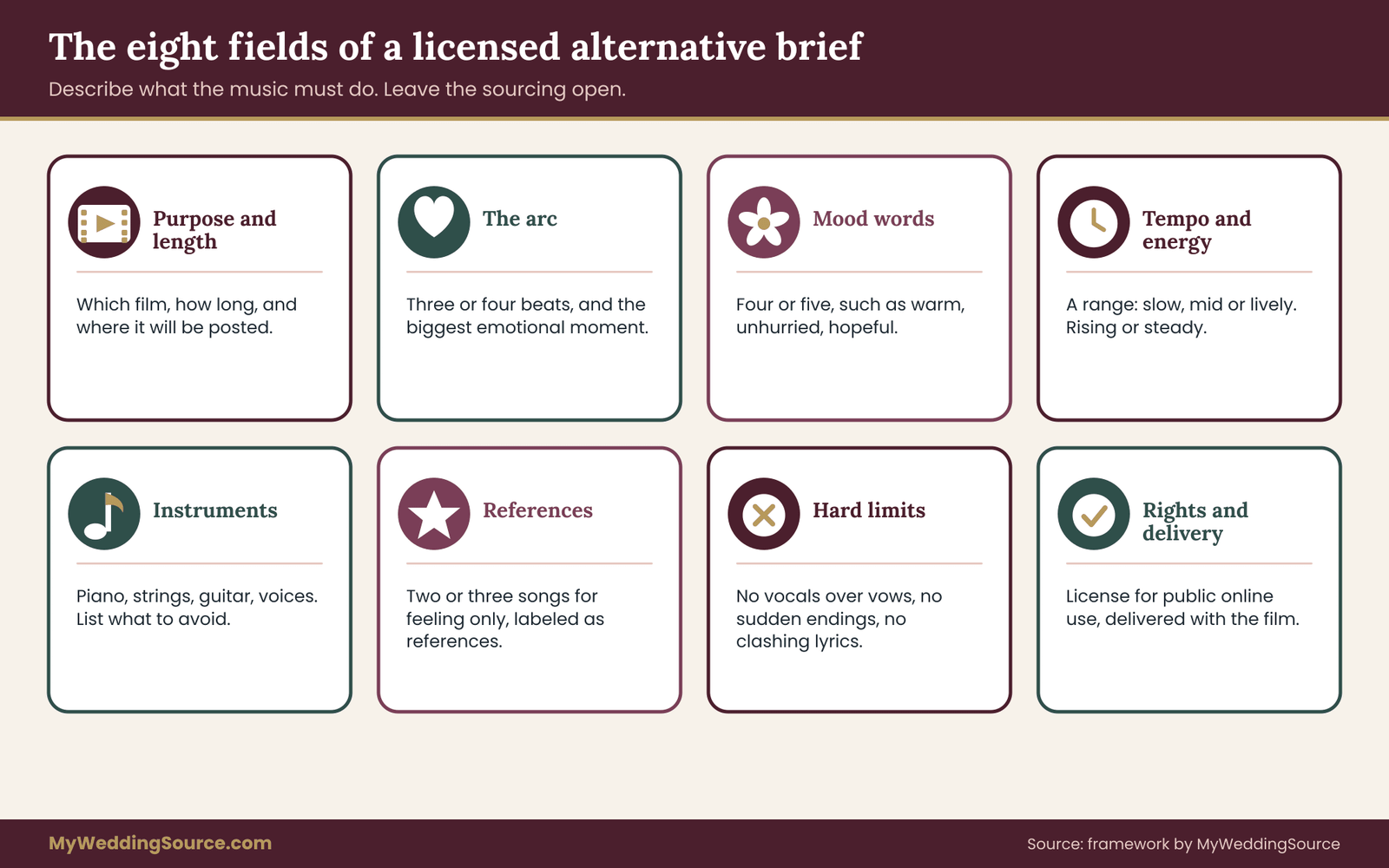
A one-page brief covers eight points.
Purpose and length. Which film is this for (highlight, teaser, full film, slideshow), and how long is it? A two-minute teaser and a twelve-minute film need different wedding video music strategies.
The arc. Describe the film in three or four beats. For example: quiet and close in the morning, a lift at the ceremony, joy at the reception, a soft close. Mark where the biggest emotional moment falls and what it is.
Mood words. Choose four or five words, such as warm, unhurried, hopeful, lightly playful. Avoid words that describe a genre only. “Acoustic” says little. “Acoustic and unhurried with a bright lift” says more.
Tempo and energy. Not a precise number, only a range: slow, mid, lively. Also note whether energy should rise steadily or hold.
Instruments and sound. Piano, strings, guitar, soft percussion, voices. Also list what you would like to avoid: heavy bass, synthetic drums, a very modern sound if the day was traditional.
References. You can name two or three songs you love as references, to show a feeling. Label them clearly as references and not as tracks to use. A good library search or composer can find wedding video music in the same territory without copying anything.
Hard limits. Anything the wedding video music must not do: vocals over spoken vows, lyrics that clash with the moment, sudden loud endings, religious references that do not fit the ceremony.
Rights and delivery. State that every track must come with a license for public online use, in the couple’s name or with a written transfer from the videographer, and that the documents should be delivered with the film.
An example of a filled brief
A short example shows the level of detail that works. The couple in this invented case wants a two-and-a-half-minute highlight film for their website and social accounts.
Film: Highlight reel, two and a half minutes, public online use. Arc: Quiet morning, building through the ceremony, joyful dancing, a soft last minute with the venue lights. Mood: Warm, unhurried, hopeful, a little playful near the end. Tempo: Slow to mid, rising once at the first kiss. Sound: Piano and acoustic guitar to start, strings joining, light percussion later. No heavy bass. Avoid vocals over the vows. References: Two songs we love, for feeling only, not for use. Limits: No sudden ending. No lyrics about leaving or loss. Rights: License for public online use, in our name or transferred in writing, delivered with the film.
That is about eighty words, and it is enough for a library search to produce a shortlist in an hour.
Turning the brief into a wedding video music shortlist
With the brief in hand, there are three ways to use it. You can search a library yourself, using the mood words and instruments as search terms. You can pass the brief to the videographer and ask for three candidate tracks that fit. Or you can send it to a composer and ask for a short sketch before committing. In every case, the brief gives you a way to compare options that is not “do I recognize this.”
A listening method keeps the process short and fair. Play each candidate under the actual footage, not alone. A track that sounds lovely in isolation can fight the vows or drown the toast. Check three moments: the opening few seconds, the biggest emotional beat and the last ten seconds. If the track survives all three, it is a serious candidate.
Then score each candidate on four questions, and write the scores down so the decision is not a mood.
- Does it do what the arc asks, in the places the arc asks for it?
- Is it free of anything on the hard-limits list?
- Does its license cover the strictest destination, and can we prove it?
- Will we still like it in ten years, or does it sound like a trend?
A track that wins on the first three and is a close call on the fourth is usually a good choice. Remember that you will watch this film for decades, and the question you will ask then is whether it feels like your day.
Matching a licensed track to the footage
Editors match wedding video music to a film by choosing where the music’s own turns land. A track with a clear lift at forty seconds can be placed so the lift lands on the first kiss. Library tracks often come in several lengths and with stems, which are separate layers such as melody, rhythm and bass that can be muted or added.
Ask the videographer whether the chosen track has alternate cuts, because a track with a short version, a long version and a stripped-down version gives the editor far more control than a single file.
If the track is a close match except for the ending, ask whether the library allows editing and fading. Most do, and a clean fade solves most ending problems. If the track is almost right but the instrumentation is off, a composer can often rework it, and commissioning a variation may be reasonable.
What a licensed alternative cannot do
It cannot be your song. That is the honest trade, and it is worth naming so no one feels cheated later. A licensed track can match the tempo, the instruments and the feeling, but it will not carry the memory of the song you danced to. If the memory matters most, consider keeping your song for the private cut and for the live dance floor, where it is the DJ or band’s license that covers the room, and giving the public film a track that works well and carries no risk.
Many couples find a second option that works well: the ceremony or the first dance gets its moment of natural audio in the film, with the real song heard in the room, and the licensed track covers the montage sections. That way the film still holds the sound of the day, and the montage carries a clean license.
What to settle with your videographer
The videographer is the person who actually places the wedding video music, which makes the contract the most practical tool you have. Most disagreements about wedding video music come down to a gap between what the couple assumed and what the videographer assumed. A few lines in the agreement close the gap.
The five questions to ask before you sign
Ask these in a call or an email, and ask for the answers in writing.
- Who selects and licenses the wedding video music? Does the videographer use a library, or do you supply songs? If you supply songs, who is responsible for clearance?
- Whose license is it? Is the license in the videographer’s name, yours, or shared? If it is the videographer’s, does it extend to your personal posting of the film?
- Where may we publish? Which platforms, and are public websites and social accounts included? Is there a difference between public and private use?
- What do we receive? Do we get the license documents, the track names and the credits with the film files?
- What if a claim arrives? Who will respond, and will the videographer help with disputes? How long does that obligation last?
You are not interrogating anyone. These are normal vendor questions, in the same family as the ones in the guide to wedding vendor contracts, and a professional will have clear answers. A videographer who has never been asked will usually appreciate the chance to be precise.
Contract wording for wedding video music
You can ask for language in your own words. The point is to cover who is responsible and what is delivered. A simple clause might say that all wedding video music in the delivered films is licensed for the couple’s personal use, including posting on public online platforms, that the videographer will supply the license documents with the files, and that if a claim is made against a delivered film because of the videographer’s music, the videographer will help resolve it or replace the audio.
If your own song is involved, add a clause that says so. For example, that the couple has asked for a specific song to be used in a private version only, that the videographer has not licensed it, and that this version will not be published. This protects the videographer as well, and a good one will welcome it.
The portfolio question for wedding video music
If the videographer wants to show your film publicly, ask how the wedding video music is covered. A library license that covers the videographer’s business use is common. A cleared commercial song that you paid for is usually licensed for your use only, and it should not appear in their portfolio. A good clause says which version is used for the portfolio and which wedding video music it has. It is also fair to ask for a version with natural sound only if you do not want your cleared track shown.
This is also a privacy question. The portfolio use of a film that shows guests is a separate permission from the wedding video music, and the site’s guide to wedding photography consent covers how to set boundaries on image use, which applies to video as well.
If the wedding video music is already in the film
Many couples read this after the film is delivered. That is fine, and the fix is short. Ask the videographer what wedding video music is in the film and where it came from. If it is licensed library music, ask for the license documents. If it is a commercial song that was added without clearance, ask for a version with licensed music or natural sound for public use, and keep the original in a private file.
Most videographers can swap a track in an hour or two, and many include one revision. If the contract has no provision for it, offer to pay a reasonable editing fee. That cost is almost always lower than the trouble of a claim.
Scripts for talking about wedding video music
If you are not sure how to start, these plain scripts work.
At booking: “We want to post our highlight film publicly. How do you handle music licensing, and will we get the license documents with the files?”
At the first draft: “We like the track in this draft. Can you tell us where it comes from, and whether it is licensed for public posting? If not, can you send two alternatives in a similar style?”
When your own song is the issue: “We would love our first dance song in a private cut for family. For the public film, could you use licensed music? Please label the private file so it does not get posted by mistake.”
After delivery: “Could you send the track names, the license documents and any credit lines for the films you delivered? We keep them with our records.”
Each script states a use, asks a specific question and asks for a record. That structure works for almost any vendor question, and it keeps the exchange friendly.
What a good answer about wedding video music sounds like
A confident answer names a source (“I license from a subscription library and deliver the license with each film”), explains scope (“the license covers personal posting on any platform”) and offers help (“if a claim arrives, send it to me and I will handle it”). A vague answer, such as “don’t worry, we always use good music,” is a reason to ask again, kindly, for specifics.
You are not accusing anyone. You are doing the same diligence you would do for any other paid deliverable, and the wedding vendor due diligence checklist on this site lays out how that works for other vendors too: wedding vendor due diligence checklist.
Delivery formats and wedding video music
Ask for the wedding video music to be delivered in a way that survives later edits. A film delivered only as one flattened file with the wedding video music baked in cannot be edited without redoing the wedding video music. If you may want to re-edit, ask whether the videographer will keep the project files for a set period, or deliver an audio-free version alongside the finished film.
A version with no music and with the natural sound intact is a useful insurance policy. It lets you drop in another licensed track in the future, or share the film in a place where wedding video music rules are strict.
Also ask about file names and notes. A short text file listing each track, its source and its license, delivered with the video, is the simplest way to keep proof attached to the film. The film’s records belong in the same archive as the contracts and photos, and the guide to organizing wedding records after the event explains a simple structure for that.
Worked example: one first-dance song, three outcomes
An invented couple, Tessa and Jun, show how the pieces fit together. They are not real people, and the details are made up to illustrate the process.
Tessa and Jun are married in the spring. Their first dance was to a well-known ballad by a major artist. They have booked a videographer for the ceremony and reception, and they want a two-and-a-half-minute highlight film for their wedding website, a longer film for their families and a private cut for Jun’s parents’ anniversary party.
Step one: list the destinations
They write down every place the films will go. The highlight film goes on their wedding website and on a personal social account. The longer film goes to a private link shared with relatives. The anniversary cut plays on a living-room television. The strictest destination is the website and social account, so the highlight film’s wedding video music will follow the strictest rule: licensed for public online use.
Step two: separate the song they love from the feeling they want
They discuss what the ballad does for them. Tessa says it is the memory of the dance. Jun says it is the slow build to a big last chorus. They decide the memory belongs to the private cut and the family film, and that the highlight film needs the build.
Step three: ask the videographer five questions
The videographer replies that she subscribes to a music library, that the subscription license is in her name, that it covers personal posting on common platforms for films delivered during the subscription, and that she delivers a PDF of license details with the files. She has never dealt with a couple’s own song and says she would rather not place an uncleared song in any file that leaves her studio. The couple asks for the license in writing, and she sends a short email confirming each point.
Step four: start a clearance request in parallel
Because the ballad is the soul of the film, they decide to try clearing it for the longer family film at least. They look up the song’s credits, find the label and two publishers, and send a request to each. The request describes a personal wedding film, a ninety-second use in the longer film, private link only, and a term of ten years.
They set themselves a decision date: if they have signed paperwork from every party by two weeks before the film is due, they will use the song. If not, they will not wait.
Step five: write the brief and pick a licensed track
They write the brief from the last section: slow to mid, piano and strings, a single lift near the first kiss, no vocals over the vows. The videographer returns three candidates. The couple listens to each under the actual footage and scores them. The second one has a quiet beginning, a lift at forty-five seconds and a gentle ending, and it fits.
The three outcomes
Here is how the three films turn out.
The highlight film uses the licensed library track. The couple saves the license PDF and the videographer’s confirming email with the video. They post the film on their website and a social account. If an automated claim ever appears, they have proof.
The longer family film waits for the clearance requests. One publisher replies with a quote, the other publisher does not reply, and the label declines. Because both layers are required, the couple treats the request as unsuccessful, thanks the one who answered and does not publish with the song. The film uses a second licensed track for the montage sections and natural sound for the first dance, where the real song can be heard in the room. They check that the natural-sound section is short and that the song is not the focus of the shot.
The private anniversary cut uses the ballad over the first-dance footage. The file is named “private-family-only” and is stored in a separate folder. Jun’s parents play it at home on their television. The couple understands that the song is not licensed for this use, and they have decided that keeping the file private and unposted is the choice they are comfortable with. That is their call, and the guide does not describe it as risk-free. They agree that nobody uploads that file, and they put a line in the folder note.
What the couple did that mattered
Four habits made this work. They set the strictest destination first. They separated the memory of the song from the feeling the film needed. They asked for license proof in writing before the first draft was approved. And they ran the clearance and the alternative at the same time, with a decision date, instead of waiting for permission that never came.

What they saved in their wedding video music records
At the end, Tessa and Jun’s folder for the films holds seven items: the final highlight film, the longer film, the private anniversary file in its own labeled subfolder, the library license PDF, the videographer’s confirming email, the one clearance reply with the decline and the quote, and a one-page note listing each film, its wedding video music and where it may be posted. The note takes ten minutes to write and answers every question they will have in five years.
Edge cases that catch couples out
The main process for wedding video music covers most films. A handful of situations come up often enough to deserve their own notes. In each, the question is the same one: who could say yes to this use, and have they?
Guest videos and phone clips
Guests record the first dance on their phones, and the song is audible. A guest posting their own clip to their own account is the guest’s decision and the platform’s problem. If you gather guest clips into your film, you are the one combining them, and the song in the background is still part of the audio.
Where possible, use clips where the wedding video music is not clearly audible, or replace the audio with a licensed track. Gathering guest clips also raises a consent question, which the site’s guide to wedding photography consent covers for photos, and the same thinking applies to video.
A cover version recorded by a friend
A friend records a cover of your favorite song for the ceremony and lets you use the recording. You have the friend’s permission for the recording, which is the master layer, if the friend owns it and says so in writing. The composition still belongs to its writers, so a sync license from the publisher is still needed. A cover removes the label from the equation but not the publisher.
A live band’s recording or a DJ’s mix
A band may record the reception and offer you the file. The band’s permission covers its recording, if the band owns it. The songs it played still belong to their writers. A DJ’s mix is a collection of other people’s recordings, and the DJ cannot license them to you for a film. Ask what the file is for. If it is for personal listening, that is one thing. If it is going under video, the layers still need clearing, and the safer course is natural sound or licensed replacement.
Ceremony music in the film
The ceremony may include a hymn, a classical piece, a song performed live or a processional. For old music, check the recording, not just the composition. For a live performer, the performance is recorded in the film, and the same two layers apply unless the piece is in the public domain and the performer agrees in writing to the recording.
A ceremony film is often the most personal part of the day, so it is worth asking the officiant, the musician and the venue about any rules on recording, which are separate from copyright. Some places of worship have their own policies about recording and posting.
A song that is the title of the film
If you want the film titled with a song’s lyric, the lyric is also protected. Short titles are usually not an issue, but a printed lyric as a caption is a copying of the text. If the film includes lyrics on screen, treat them as part of the composition.
A slideshow at the reception
A slideshow of photos with music, played on a screen at the reception, is a different use from a published film. Venues often hold performing licenses that cover music played in the room, which can make room playback less of a concern, but a slideshow file that you make and keep is also a recorded work with a soundtrack.
If you plan to keep or share the slideshow file, apply the same licensing logic as for any film. If the slideshow is only played from a device at the event, ask the venue and the DJ how the room’s licensing applies.
Rehearsal dinner and engagement films
These are separate films with their own destinations. The same rules apply, and the same checklist works. Because these films are often made by friends and relatives, the music has often been chosen without any thought of rights. Ask the person making the film what the music is, and treat their answer with the same questions as a vendor’s.
Music you made yourselves
If one of you or a friend composed the piece, a simple signed note that grants the use and says who owns what avoids later confusion. If the piece uses samples from other recordings or a borrowed melody, the original rights holders still matter. Original means entirely original.
International audiences
If relatives in another country will watch the film, remember that rights and platform rules vary by country, and a video that plays freely in one place may be blocked in another by a claim. Licensed library music with worldwide scope avoids this. If a license says the territory is limited, check that your audience falls inside it.
Livestreams and recordings of livestreams
A livestream of the ceremony is a public performance and a recording in one. The music in the room, the wedding video music in the stream and the saved recording each involve different permissions. The site’s guide to the wedding day digital contingency plan covers what to do when the technology fails, and your streaming plan should include what the stream will do about wedding video music.
The safest approach is to ask the streaming service and the performers what is covered and to keep recorded wedding video music out of the stream where you can.
A one-page clearance checklist
Copy this into your notes and work through it in order. It keeps the whole subject to a page, and the finished list becomes the record you store with the film.
Before the edit
- List every place each film will be seen: private link, family screening, social account, website, public video site, vendor portfolio.
- Mark the strictest destination for each film. That destination sets the wedding video music rules.
- Decide which films get licensed wedding video music, which get natural sound and which, if any, stay private.
- Ask the videographer the five questions and save the answers in writing.
- Write the one-page brief, and label any favorite songs as references only.
During the edit
- Listen to each candidate under the real footage and score it on the four questions.
- Check that every track has a license that names the places where you will publish.
- Save the license, the order number or the email that proves it.
- If you are trying to clear a favorite song, send complete requests to every publisher and the label, set a decision date, and keep the alternative in the edit.
At delivery
- Ask for the track names, the sources, the license documents and any credit lines.
- Ask for a version with natural sound only, as insurance.
- Name the files by destination, and keep any private-only version in its own folder with a short note.
- Store the films, the licenses and the note together with your other wedding paperwork.
After posting
- If a claim arrives, do not panic and do not delete anything yet. Read what the platform says, find your license and send the proof, or ask the videographer to help.
- Once a year, check that the license terms still apply, especially if they depend on a subscription, and look at whether platform rules for personal accounts have changed.
The limits of this wedding video music guide
A checklist cannot tell you whether a specific use is allowed. It can tell you what to ask, what to save and who to call. Where a license is unclear, where a rights holder makes a claim you do not understand or where a dispute involves money or a threat of legal action, talk to a lawyer who handles copyright or media. Rules and platform policies change, so use the sources below to confirm the current version before you rely on any detail here.
The checklist also does not replace the conversations. A short call with a videographer, a clear message to a library, a polite request to a publisher: these are small tasks, and each one turns a guess about wedding video music into a document you can find later. The broader schedule for these conversations fits inside the wedding planning checklist, and the music itself belongs in the larger plan for programming reception music, where the room’s permissions are handled separately.
Your next steps
Tonight, list where each film will be seen, and mark the strictest destination. Tomorrow, send your videographer the five questions and ask for the answers in writing. This week, write the one-page brief and mark your favorite songs as references. If one song truly matters, send complete requests to its publishers and label now, and set a decision date.
Then keep everything in one folder with the film. By the time the first draft arrives, your wedding video music will already be a settled plan, and the first draft can be judged on how it feels, not on whether it can be shared.
FAQ
Can we use our first dance song in our wedding video if we bought it?
Buying or streaming a song gives you permission to listen under that service’s terms. It does not include permission to put the recording under a film. That generally needs a sync license from the composition’s owner and a master use license from the recording’s owner. If you want it only for a private family viewing, the practical exposure is smaller, but the song is still unlicensed.
Is a short clip of a song allowed under fair use?
There is no safe length. The Copyright Office says fair use is decided case by case on four factors, and it gives no minimum amount that is automatically allowed. A short clip can still be a use of the song, and a court would weigh the purpose, the nature of the work, the amount and the market effect. Treat fair use as a defense a lawyer evaluates, not a plan.
Does the venue’s music license cover our video?
Usually not. Venue licenses from performing rights organizations generally cover public performance, meaning music played for people in the room. Putting a song under a film is a separate right, called synchronization, plus permission for the recording itself. Ask the venue exactly what its license covers, and do not assume it reaches recordings or posted films.
What is royalty-free music, and is it safe for a wedding film?
Royalty-free describes pricing: you pay a fee and do not owe per-use royalties. It is not the same as free of rules. The license still limits where you can publish, for how long and for whose use. It is a good option when you read the license, confirm it covers your platforms and save proof with the film.
What happens if our wedding video gets a copyright claim?
It depends on the platform and the rights holder. Common results are muted audio, a block in some countries, or ads whose revenue goes to the rights holder. A formal takedown notice can remove the video. If you hold a license, you can dispute the claim with proof. If you do not, replacing the wedding video music is usually the quickest fix.
Can our videographer post our wedding film on their website?
Only if the wedding video music and your agreement allow it. Your personal license may not cover the videographer’s business use, and the reverse can also be true. Put the portfolio use in the contract, say which version they may show, and ask them to confirm how the wedding video music is licensed for that use. You can also set limits on showing guests.
Can a friend record a cover of our song for the video?
A friend’s recording solves the recording layer if they own it and agree in writing, but the song’s composition still has its own owner. A sync license from the publisher is still needed for a commercial song. If the song is very old and in the public domain, the composition may be free, so confirm that status first.
Do we need a lawyer for wedding video music?
Not for the usual path of licensed library music with documents saved. A lawyer who handles copyright or media is useful if you want to clear a major commercial song, if a license is unclear, if you receive a formal notice, or if money or a dispute is involved. For routine films, clear questions and written answers go a long way.
Sources
- Copyright Office, Fair Use, U.S. Copyright Office
- Frequently Asked Questions, U.S. Copyright Office
- Copyright Law of the United States (Title 17), U.S. Copyright Office
- Online Service Providers and Section 512, U.S. Copyright Office
- Music Modernization Act, U.S. Copyright Office
- ASCAP, American Society of Composers, Authors and Publishers
- BMI, Broadcast Music, Inc.
- Harry Fox Agency, music licensing
- Using Content ID, YouTube Help
- Creative Commons licenses, Creative Commons