
Ceremony acoustics describe how a room treats sound, and in a stone chapel, a tiled hall or a glass-walled atrium they can turn a lovely quartet into a smear of noise. This guide shows how to test the room, match instruments to it, place the musicians well and keep vows audible, using a simple plan you can finish in one site visit.
Test ceremony acoustics before you book the music, not after. Visit the room with your musician, clap once, speak at normal volume from the front, and play the actual instrument at the actual spot. Favor instruments with clear attacks and short sustain (fingerstyle guitar, harp, solo violin or cello, a small vocal group) in rooms that ring. Keep the players close to the guests, slow the tempo, and plan for the room to sound different once two hundred coats and bodies fill it.
Picture the moment. The doors open, the processional piece begins, and instead of a clean melody the guests hear a wash of overlapping notes, each one still ringing when the next arrives. In the front row, the couple cannot tell whether the cellist is rushing.
In the back, a grandmother hears a low hum and a few bright peaks. Then the officiant begins to speak, and half the room hears only vowels. None of this is the musician’s fault, and very little of it is a matter of talent. It is the room. That is the practical heart of ceremony acoustics.
Most advice about wedding music is about choosing songs. This guide is about a narrower and more practical question: how to choose and place live acoustic instruments when the venue echoes. Churches, stone barns, restored warehouses, museum halls, courthouses with marble floors, and modern glass-and-concrete event spaces can all be beautiful and all be difficult. They share a trait. Hard surfaces bounce sound around for a long time, and that long tail changes how music, speech and silence feel. Keep this in mind whenever ceremony acoustics start to feel abstract.
You do not need a degree in acoustics to deal with this. You need a short test, a few rules of thumb, and the willingness to let the room tell you what it can do. The sections below give you a ceremony acoustics test plan, an honest comparison of instruments and positions, a worked example, and a list of the things that can still go wrong. If you are also planning the dance-floor music, the guide to programming wedding reception music covers that separate job.
A note on scope. This is general planning information, not legal, tax or financial advice. Music licensing, fire codes and venue rules vary, and where one matters the article points you to the agency or the venue to confirm the current version.
Why ceremony acoustics change what live music can do
A ceremony is a different listening job than a reception. At a reception the music competes with talking, clinking glasses and a dance floor, and a lively room is often welcome. At a ceremony, a few hundred people sit still and listen to three kinds of sound in turn: music, then speech, then music again. The room has to serve all three. A space that flatters a choir can bury a spoken vow. Good ceremony acoustics are mostly a matter of small, sensible choices like this one.
Ceremony acoustics also work on a different time scale than most couples expect. A processional might last two or three minutes. Vows last about as long as it takes to say a few sentences. These are short windows, and an acoustic problem inside them is hard to repair on the fly. You cannot ask the cellist to stop in the middle of the aisle and try again from a different corner.
There is a second reason to care. The people most likely to struggle with a room with ringing ceremony acoustics are often the people you most want to include. Older guests, guests who wear hearing aids, and anyone who is hard of hearing lose clarity first when a room rings, because reflected sound blurs the consonants that carry meaning. Children get restless when they cannot make out what is happening. A ceremony that is clear to the back row is a kindness to everyone. Couples who understand ceremony acoustics make calmer decisions about music.
What counts as a reverberant venue
Reverberation is the persistence of sound after the source has stopped. In a small carpeted living room it lasts a fraction of a second, so you barely notice it. In a large stone church it can last for several seconds.
Reverberant venues usually share a few traits: high ceilings, hard walls and floors (stone, plaster, brick, concrete, tile, glass), little fabric or upholstery, and a large volume of air. Wooden pews and a carpeted aisle help a little. Bare floors and a vaulted ceiling do not. None of this requires special training, only attention to how ceremony acoustics feel from a guest’s seat.
You can often predict a ring before you hear it. Walk in and listen to your own footsteps. If they come back to you as a soft, sustained wash, the room is live. If the sound seems to die within a step or two, the room is dry. Neither is wrong. Live rooms reward certain instruments and punish others, and that is the whole subject of this guide.
What a good result sounds like
It helps to define the goal before you test, so you know what you are listening for. A good ceremony acoustics result has four marks. Every note in a melody is distinct, so a listener can follow the tune. The music has warmth, not a hollow ring. Speech from the front is understood in the last row without strain. And the music can start and stop cleanly, so silence feels like silence, not like a room still humming from the last chord. Write the result in your notes, because ceremony acoustics are easy to forget once you leave the room.
You will rarely get all four from a difficult venue without compromise. The plan in this guide is about choosing which compromises to make on purpose, rather than discovering them while guests are seated.
How a room holds sound: a plain-language primer
You do not have to master the physics, but four ideas explain nearly every problem you will meet. They are direct sound, early reflections, the reverberant tail and background noise. Hold these in mind and the rest of this guide will read as common sense.

Direct sound is the part that travels in a straight line from the instrument to a listener’s ears. It carries the clearest information: the sharp start of each note, the words in a sentence. Direct sound weakens with distance, and it is blocked by anything in the way, including a row of people standing up. Musicians placed far from the guests, or behind a pillar, deliver less direct sound.
Early reflections are the first bounces off nearby walls, floor and ceiling. They arrive a few thousandths of a second after the direct sound, and the ear merges them with it. Early reflections are mostly helpful. They add fullness and loudness and make a small ensemble sound bigger. A wall close to the players, such as a stone alcove, can feed useful early reflections to the first rows.
The reverberant tail is the dense cloud of later reflections that builds up as sound bounces repeatedly through the room. This is what you hear as echo or ring. It is not a single distinct repeat. It is a long decay that blends one note into the next. The tail is the main enemy of fast music and quiet speech, because each syllable and each note lands on top of the remains of the last.
Background noise is everything else: air handling, traffic outside, a refrigerator hum in a hall kitchen, a coffee urn, a fountain, wind in a tent. In a reverberant room noise also rings, so a steady hum can fill the space and raise the floor under everything you say or play.
Direct versus reverberant sound, and why distance matters
The balance between direct and reverberant sound is what decides clarity, and the balance depends on distance. Close to a source, direct sound dominates and you hear detail. Far from the source, the reverberant tail dominates and you hear a blur. There is a distance at which the two are roughly equal, and beyond it, clarity falls away. In a very live room that distance can be only a few feet.
This one idea explains most of the advice that follows. Putting musicians close to the seats raises direct sound relative to the tail. Using an instrument with a strong, quick attack raises it. Using a small amplifier pointed at the guests, instead of a large speaker pointed at the walls, raises it. Slowing the music lowers the damage the tail can do. Nearly every good fix is a way of improving the direct-to-reverberant balance. This is where ceremony acoustics reward a little patience.
A rough sense of timing
Sound travels about one foot in a thousandth of a second. So a wall thirty feet away returns a reflection about sixty thousandths of a second after the direct sound. When a reflection arrives later than roughly a twentieth of a second, listeners begin to hear it as a separate echo, not as part of the original. That is why a big, hard-walled hall can make a fast, plucked passage sound doubled or stuttering. The notes are not wrong. The room is answering them.
You do not need to calculate any of this. The point is that echo has a time signature, and music has a time signature too. When the two fight, slowing the music, spacing the notes, and favoring long, smooth lines over fast, busy ones will help. The ceremony acoustics test plan in the next section shows you how to find out how much the room needs. It is a small point, but ceremony acoustics are built from small points.
Empty room versus full room
One more idea needs stating early, because it catches many couples out. A room sounds different when it is full. People and their clothing absorb sound. A hall that rings like a cathedral at a Tuesday afternoon visit may sound much calmer with a few hundred guests in wool coats and dresses. Seats with cushions help too. Ask the musician what they hear, since experienced players read ceremony acoustics quickly.
This works in your favor, but only partly. You should plan on the room being somewhat better than it was at your visit, and you should not count on it being fully fixed. If the empty room is very live, a full room will likely still be live, only less so. If your wedding is small, with thirty or forty guests in a large space, the room will stay lively, and you should plan as though you were still standing in the empty hall. The ceremony acoustics test plan builds this into its final step.
A ceremony acoustics test plan you can finish in one visit
The ceremony acoustics test plan is the center of this guide. It has six steps, it needs no equipment beyond a phone, and it takes about an hour if the musician comes along. It produces something you can use: a short written note on what the room does, which instruments it favors, and where the players should sit.
Run it on the same day of the week and the same time of day as the wedding if you can, because traffic, HVAC and sunlight change between a Tuesday morning and a Saturday afternoon. The same idea applies to any venue, because ceremony acoustics follow the same few rules everywhere.
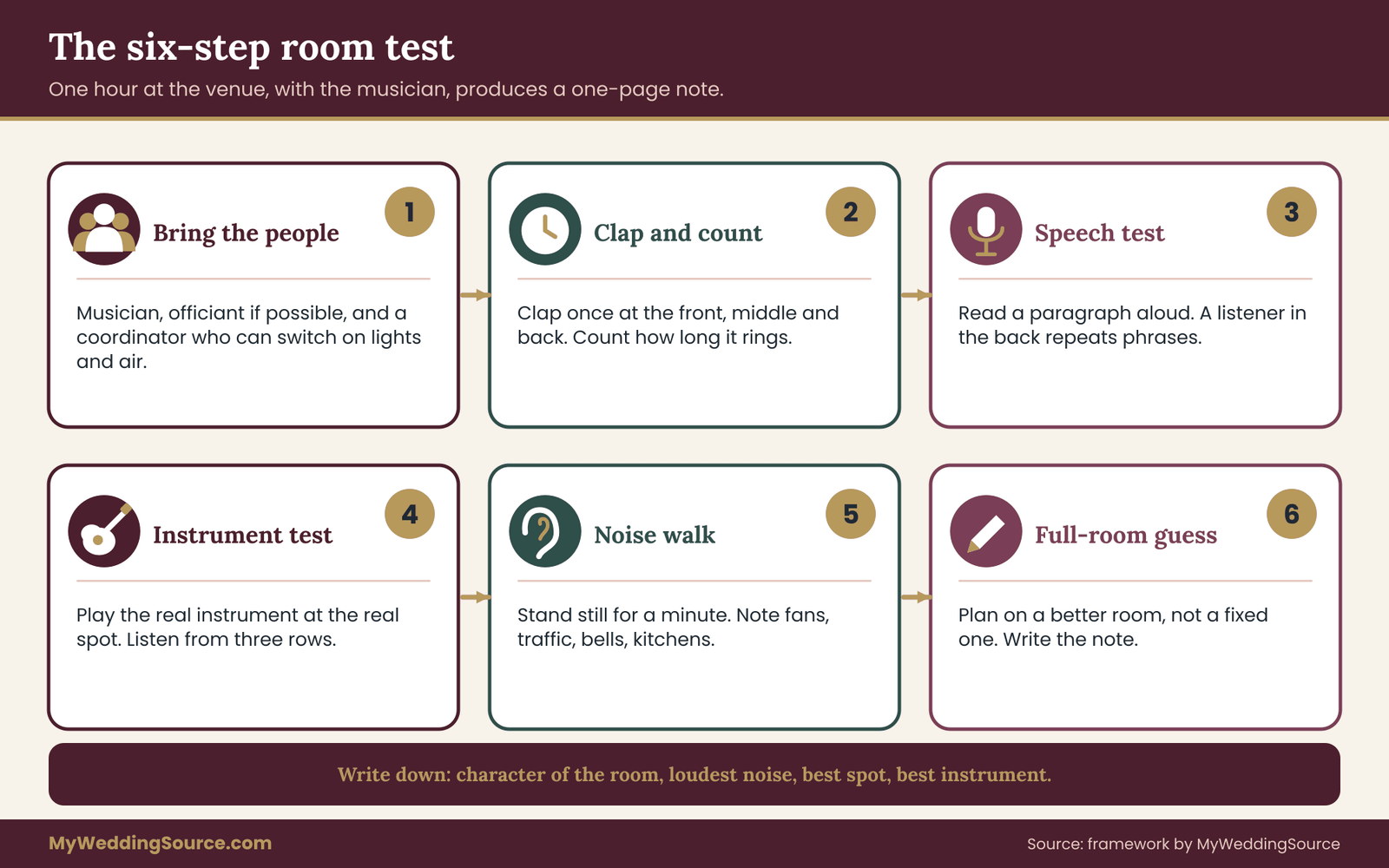
Step one: bring the right people. Ask your lead musician, or the ensemble leader, to join the visit. If your musician is not local, ask whether another player of the same instrument can stand in, or ask the musician for a recording made in a similar room. Bring your officiant if the officiant is available, because speech matters as much as music. Ask the venue coordinator to attend and to switch on the lights, heating or cooling and any fans, so the room is in its working state.
Step two: the clap and the count. Stand where the couple will stand and clap once, sharply. Listen to how long the sound lingers. Count in your head or watch a stopwatch on your phone. A short, dry snap that disappears in under a second means a room that is workable for almost anything.
A clap that rings for two or three seconds, and keeps rolling after you stop counting, means a room that will blur fast music. Do this from several spots: the front, the middle of the seats and the back. Rooms often have a dead spot and a live spot, and you want to know where each is.
This is not a measurement a professional would sign. It is a good enough sort. If you want a more careful number, an acoustician can measure reverberation time with proper equipment, but for a wedding that is rarely necessary.
Step three: the speech test. Have one person stand at the front and read a paragraph aloud at the volume the officiant would use without a microphone. Have another person sit in the back third and note what is clear. Then try the same paragraph at a slower pace. The slower pace is usually the one that works. Ask the listener to repeat back a few phrases, not just to say that it sounded fine. People overrate their own understanding. If the listener misses words, you have learned that the room will need a microphone, a slower officiant, or both.
Step four: the instrument test. Ask the musician to play the actual instrument, at the actual position, using the actual piece or one with the same tempo. Walk the room while they play. Stand in the first row, the middle and the last row. Stand near an aisle and near a wall. Do not rely on the musician’s judgment alone, because the player is hearing the instrument from inches away and the room only a little. Your ears in the seats matter more.
Step five: the noise walk. Stand still for a full minute and listen to the background. Is there a hum from ventilation? Does an adjacent room, a kitchen or a lobby leak sound? Is there traffic, a train line or a school nearby? Ask whether the heating, cooling and fans can be switched off or set to low during the ceremony, and whether any of the building’s systems will cycle on without warning.
Step six: the full-room adjustment. Write down the problems you heard, then rank them by how much a full room will likely fix. Clear a large part of the ring only if the room is large and well attended. Plan to use nothing you heard as a promise. A full room is a better room, but not a transformed one.
What to write down
Keep the notes short and specific. The record should include the room’s character (live, medium, dry), the loudest noise source, the best and worst positions for the players, and which instruments sounded best. Add one line saying what you would change if you could. The note turns an impression into a plan, and it makes it easy to share with the musician, the officiant, the sound technician and the coordinator.
A simple template for the note might read: front of room is bright and ringing; clap lasts a little over two seconds; speech intelligible at slow pace up to row eight; ventilation hum audible at the rear; guitar clear at the front corner, harp pleasant but quiet; plan a small speaker for the officiant and keep the processional piece slow. If you remember one thing about ceremony acoustics here, remember the distance between players and guests.
If you cannot visit before booking
Sometimes the venue is out of town and a visit is impractical. You still have options. Ask the venue for a recording of a prior ceremony or a rehearsal, ask other musicians who have played there what they found, and ask the coordinator which positions musicians use and what they have heard from past wedding musicians. Experienced local players often know the room’s habits in detail. If the venue allows it, schedule a short video call with a walk-through while someone claps. It is a poor substitute, but it is better than nothing.
If no visit is possible, favor flexible arrangements: instruments that can be moved and played at several positions, a musician who agrees to arrive early and test, and a clause in the booking that lets the musician change the piece list on the day if the room demands it. The booking questions later in this guide cover that. Treat ceremony acoustics as a planning item, not a surprise to be solved on the day.
Reading the surfaces and noise sources before you choose
The ceremony acoustics test plan tells you how the room behaves. A quick survey of surfaces tells you why, and it points to fixes. Look up, look down and look sideways before you decide anything.
The floor. Stone, tile, polished concrete and hardwood reflect sound strongly, and they also reflect sound from the players to the first rows, which is a help. A carpeted aisle or a runner absorbs some of the ring. A rug under the musicians dampens a cello’s floor resonance and softens a harp’s reflection. If the venue allows it, laying a rug or runner in the front of the room is among the cheapest fixes.
The ceiling. A high, hard, vaulted ceiling is the largest contributor to a long tail. You cannot change it, but you can avoid positions directly under the highest part, where the sound disappears upward and returns delayed. Low ceilings return sound quickly, which can make a room feel loud and boxy rather than echoing.
The walls. Parallel hard walls produce flutter echo, a rapid ping-pong that makes sharp sounds buzz. Clap in a hallway or a long narrow hall and you will hear it. Curved or domed surfaces can focus sound onto certain spots and leave others thin. If you hear a sound that seems to come from a strange place, a curved surface is a likely cause.
The glass. Windows and glass walls are acoustically hard and often thin, so they reflect sound inside and let outside noise in. A glass-walled venue is both live and noisy. Curtains help a little if they are heavy and the venue allows them.
The furniture and decor. Fabric absorbs. Heavy drapes, banners, upholstered chairs, wool coats, bunting, large floral installations, greenery walls and cloth-covered tables all take some energy out of the room. Ask the venue and the florist whether a large arrangement or a fabric backdrop can sit behind or beside the musicians. Do not expect miracles. Decor is a mild help, not a treatment.
The noise sources. List every machine that runs in or near the room and ask who controls it. Some venues can pause air handling for a short window. Others cannot. Know which kind you have well before the day, and ask in writing.
Treating the room without treating the room
Couples sometimes imagine hanging acoustic panels or renting heavy curtains. That is rarely allowed in a historic or shared venue, and it rarely pays off for a single short event. Focus on what you control: the instruments, their positions, the tempo, the amplification and the seating. These four levers are enough in almost all cases.
If a venue has a permanent installation, such as a stage shell, a reflective canopy over the platform or movable partitions, ask the coordinator how it is used for concerts, since the staff often know a good arrangement. A few minutes spent on ceremony acoustics now saves a lot of worry later.
The size of the room against the size of the guest list
A final survey point is scale. A 150-seat chapel filled with forty guests has a very different acoustic from the same chapel with 140 guests. A small guest list in a big room is the hardest case for ceremony acoustics, because there is little absorption and a lot of volume.
In that case, consider roping off the back rows, bringing the seats forward, or using only the front half of the room. A smaller listening zone gives the players a better direct-to-reverberant balance and makes the officiant easier to hear. Guests feel closer to the couple as well, which is usually the point of a small wedding.
Instrument choices for a room that rings
Once you know what the room does, instrument choice becomes a matter of matching. Two properties of an instrument matter most where ceremony acoustics are live: how sharp the start of each note is, and how long the note lasts after that start. A sharp start helps the ear locate each note.
A short sustain keeps the tail from piling up. A soft start with long sustain, by contrast, blends into the room, which can be glorious in a large cathedral built for it and muddy in a stone barn with a flat ceiling. Ceremony acoustics also change with the season, the weather and the number of guests.
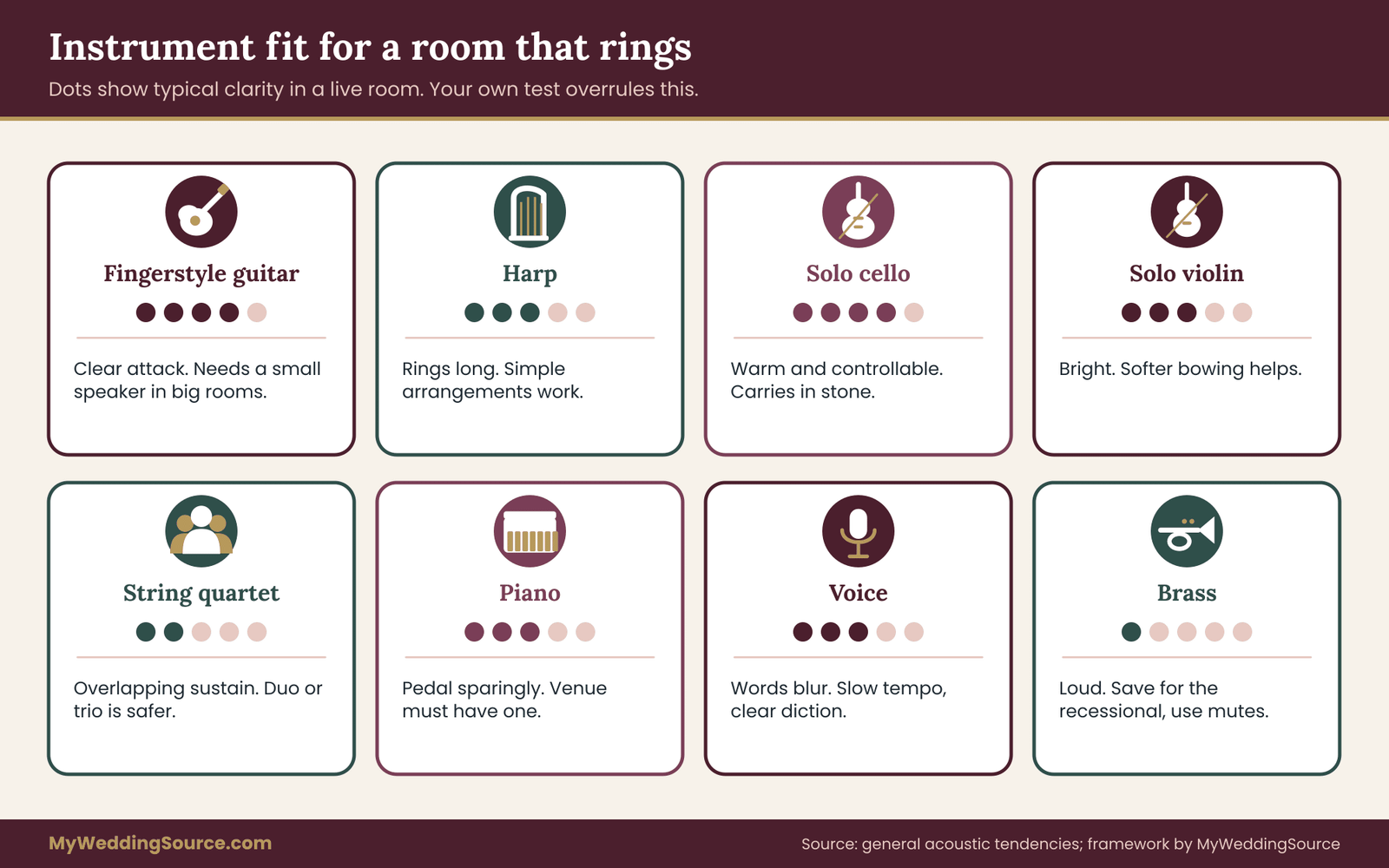
No instrument is wrong in all rooms, and most are good in some. The comparisons below are general tendencies, not guarantees. Your own test, from the previous section, outranks any rule here.
Fingerstyle acoustic guitar
Classical and fingerstyle guitar have a plucked attack that cuts cleanly through a reverberant room, and the notes decay naturally. A single guitar is quiet enough not to excite the room strongly, and a guitarist can adapt to the tail by leaving space between phrases. The weaknesses are volume and projection.
In a large space with a lot of guests, an unamplified guitar can be too quiet at the back. A small, clean pickup into a modest speaker pointed at the guests often solves it. Strummed chords ring more than picked lines, so ask the guitarist to favor arpeggios and single-note melodies in a live room.
Harp
The harp is a favorite for ceremonies because it looks and sounds ceremonial, and in a live room it sounds like a bigger instrument than it is. The trade-off is that the strings ring for a long time, so fast, busy arrangements can smear. Harpists know how to damp strings with the hand, and a good one will adjust the arrangement to a ringing room.
A harp is also physically fixed in position once it is set up, so choose the spot carefully. It is relatively quiet, which is often fine in a small room and may need gentle amplification in a large one. This is one reason ceremony acoustics deserve their own line in the plan.
Solo violin or cello
A solo bowed string instrument has a clear tone and a controllable sustain. The player can shorten notes, use lighter bowing and shape phrases to the room. A solo cello has a warm midrange that fills a room without fighting the speech frequencies, and many couples find it carries well in stone spaces. A solo violin projects strongly and can sound bright and sharp in a hard room, which some listeners find piercing. Ask the violinist to try a softer bow stroke and a slightly slower tempo, and listen from the back.
String duo, trio and quartet
More players add richness and volume, but they also add overlapping sustain and a bigger source of sound in the room. A quartet in a very live space can sound lush, or it can sound like a single sustained cloud. The result depends on how tightly the players listen to each other. Experienced ensembles are used to this and may position themselves closer together or shift the tempo.
If the room is extremely reverberant, a duo or trio is often a safer bet than a quartet, because there is less overlap. If the venue is large, the larger ensemble may be necessary for volume. This is a decision to make with the ensemble leader, not against them. Share this detail with the whole team, since ceremony acoustics affect the musician, the officiant and the coordinator alike.
Piano and keyboard
An acoustic piano has a strong attack, long sustain and a large sound. A grand piano in a live room can sound magnificent, and a sustain pedal in a ringing hall can produce chaos. A good pianist will use the pedal sparingly and may choose pieces with open textures.
The practical limits are bigger: the piano must already be in the venue or be rented and moved in, it must be tuned after any move, and it occupies a large footprint. A digital piano is more portable and has a more controlled sound, but it needs amplification, which brings its own set of choices. Your own ears in the seats are the best instrument for judging ceremony acoustics.
Pipe organ
A pipe organ is built for resonant buildings. If your venue has one and the venue’s organist is available, you get an instrument designed for the space, along with an experienced player who knows how it sounds from the pews. The cautions are a venue’s rules (some require their own organist), the repertoire the organist is willing to play, and the way a large instrument can overpower a vocalist or a speaker. Ask for a short listen, and ask how the volume will be set for a sparsely filled room.
Flute, clarinet and other woodwinds
Woodwinds have a gentle attack and a pure tone, and the pure tone of a flute can float well in a room with ringing ceremony acoustics, though the soft start makes fast passages less distinct. A clarinet has a warm tone and a wide dynamic range. A solo woodwind with a guitar or harp accompaniment can be a lovely pairing, because the accompaniment supplies the rhythmic definition the woodwind lacks. Notice how often ceremony acoustics come back to the same trade-off between warmth and clarity.
Brass
Brass is loud and projects strongly, which can be thrilling for a recessional and overwhelming in a hard room. A trumpet in a stone hall can reflect off every surface at once. If you want brass, ask for a small group, ask the players to use mutes or a softer volume, and keep the brass for the recessional, where the guests are standing and the room is full of movement and noise.
Voice
A solo singer, a small vocal group or a choir can be extraordinarily effective where ceremony acoustics are live, because the human voice has a built-in tradition of singing in resonant spaces. The challenge is the words. Lyrics are a form of speech, and they suffer from the same blur.
A song in a language the guests know may need a slower tempo and clear diction, and a song in a language the guests do not know matters less for the words and more for the sound. Singers are also affected by the room more than most players, since they hear themselves with their own ears. Ask the singer to test the room with the actual song. Many venues have never been asked about ceremony acoustics, so expect to explain what you want.
Handpan, dulcimer and similar instruments
Handpans, hammered dulcimers and kalimba-style instruments are popular for outdoor and unconventional ceremonies. They are sustaining and bell-like, so they can pile up quickly in a live room. They suit larger, more open, or more absorbent spaces, and they may need to be played more sparsely in a reverberant one. Ask the player to demonstrate in the venue, and to select pieces with space between phrases. Do not let ceremony acoustics become a source of stress; they are a puzzle with sensible answers.
Bagpipes and other very loud instruments
A bagpipe is designed to be heard across hills. Inside a stone hall it can be physically overwhelming and can make speech unintelligible for a while afterward. Many couples with a Scottish tradition play the pipes outdoors for the arrival, then bring in softer instruments for the room. If the pipes must be inside, ask the piper about a practice chanter, a shorter set and a position at the back of the room or in an entrance hall.
A decision rule for instrument choice
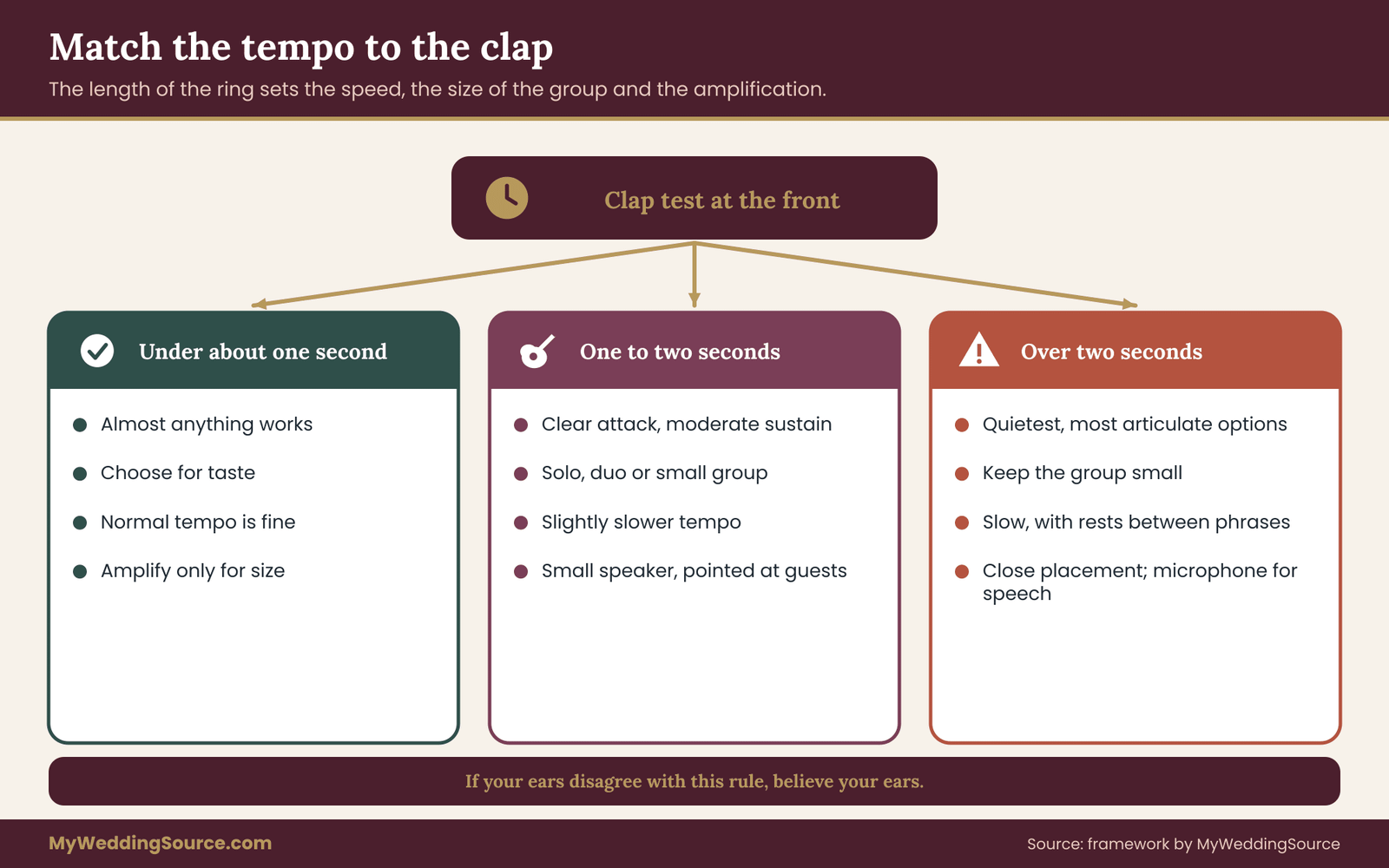
Use the clap test to sort the room, then match. In a room with a clap tail under about a second, almost anything works, and you can choose for taste. In a room with a tail of one to two seconds, choose instruments with a clear attack and moderate sustain: guitar, solo or duo strings, a vocal soloist with a gentle accompaniment.
In a room with a tail over two seconds, choose the quietest, most articulate options, play slowly, and keep the group small. In very live rooms, also consider whether the venue’s own instrument, such as a pipe organ, is the best answer. Plan for ceremony acoustics the way you would plan for weather, with a main option and a backup.
This rule is a guide, and the test overrules it. If your guitarist sounds poor and your quartet sounds wonderful in the same room, believe your ears.
Combinations that help each other
Pairing can solve problems that a single instrument cannot. A plucked instrument gives rhythm and definition under a sustained one, so guitar with violin, or harp with flute, can balance each other. A voice with a single instrument keeps the words clearer than a voice with a full band. A solo instrument for the processional, when guests are arriving and talking, and a fuller ensemble for the recessional, when the room is noisy and the music is meant to be big, can give you the best of two approaches without the compromises of a single choice.
Instruments to be careful with
Some choices need extra scrutiny in a reverberant room. Electric instruments and drum kits are loud and often bring their own amplification, which can exaggerate the tail. Very large ensembles, fast-tempo classical pieces and heavily layered arrangements can pile up. A pre-recorded track played through speakers behaves differently, and the ceremony acoustics apply to speakers just as they do to live instruments.
None of these is forbidden. They simply deserve a test before commitment, and a musician who will tell you honestly what the room is doing. It helps to name the problem plainly: ceremony acoustics, not musician skill, set the limits here.
Placing musicians when ceremony acoustics are difficult
Position is the cheapest and most effective tool you have. Moving a player ten feet can change clarity more than a different instrument would. The rules are simple: closer is clearer, facing the guests is clearer, and a bare wall behind the player is more helpful than a distant one. The hard part is balancing those rules against the practical reality that musicians also need a stable spot, power, shade, a place to sit, and a view of the cues.

The map above shows five typical positions in a rectangular room. Here is how each one behaves.
Position A: front corner beside the couple
This is the most common spot, and it is common because it usually works. The players are close to the front rows, they face the guests, and a side wall behind them sends a helpful early reflection forward. They also sit near the officiant, which makes cueing easy.
The risks are that the music competes with the spoken parts, since both come from the same area, and that musicians in a corner can excite a booming low-frequency buildup. If a cello or a piano sounds boomy, move the player a few feet out from the corner. That is a fair summary of how ceremony acoustics treat most acoustic instruments.
Position B: along a side wall, midway down the aisle
A mid-room, side position places the music closer to more of the seats, which improves the direct-to-reverberant balance for the middle rows. It also makes the music feel part of the room, not a show at the front. The drawback is that the players are visible to a good share of the guests during the ceremony and can distract from the couple. Some venues also have little space at the sides. Parallel side walls can create flutter echo near the players, so test it with a clap. Seen this way, ceremony acoustics are less mysterious than they first appear.
Position C: the balcony, choir loft or rear gallery
Many churches and halls have a rear gallery built for music, and it can be spectacular. Sound from above and behind the guests fills the room, and the organ or a choir is often meant to be heard this way. The disadvantages are timing and cueing.
The players are far from the couple and the officiant, they may not see the cues, and the processional piece needs a signal. Sound from a loft also reaches the front of the room slightly later than it reaches the middle, which can make timing feel loose with a moving processional. Use a clear visual cue, an assistant with a signal, or a headset, and rehearse.
Position D: behind the guests
Placing the players at the back puts the sound ahead of the room’s reverberation, and the guests face the couple, not the players. It can work well for a soloist who sings or plays as guests arrive, then stops. It works poorly for any piece that must stay in time with the processional, because the players cannot see the couple. It also makes the music a distant bed rather than a presence, which can feel flat in a big room. Keep a short list of ceremony acoustics questions for the venue, and bring it to the visit.
Position E: out of the main room
An entrance hall, a vestibule, a side chapel or an anteroom is sometimes the best spot for prelude music, because it puts the music in a smaller, drier space and keeps the main room quiet for conversation. Some venues have an outdoor porch or cloister where players can perform for arriving guests. For the ceremony itself, this position is rarely ideal.
A side-by-side comparison in prose
If you compare the five positions on three questions, a pattern appears. For clarity in the seats, A and B are usually strongest, because they keep the players close and facing the guests. For cueing and timing, A is strongest, because the musicians can see the couple, the officiant and the coordinator.
For atmosphere, C and D often win, because music that seems to come from the space itself feels grand. For a room with very difficult ceremony acoustics, a front or side position with a small sound source usually beats a distant one, even if the distant one looks more romantic. The details of ceremony acoustics differ by room, but the habit of testing does not.
Many weddings use two positions. A soloist or ensemble at the back or in the vestibule can play the prelude while guests gather, then walk or turn to the front for the processional, vows and recessional. Another approach is a single front position all through. Either works, as long as the move is planned and the players do not need to cross the aisle at the wrong moment.
Platforms, risers and floors
A small riser lifts the players above the first row, which improves sightlines and sends the sound over the heads of the guests, not into them. In a reverberant room, a riser also isolates the players from floor vibration. A cello or a harp on a wooden platform will sound different from the same instrument on stone.
Ask the venue if risers are available, and ask the musician if they want one. A rug or a runner under the players is also a help, since a bare stone floor can bounce too much low-frequency energy back at them. It is worth repeating the check after any change, because ceremony acoustics shift with the setup.
Facing, angles and the audience
Where the instrument points matters. A guitar’s sound hole and a violin’s top plate project mainly forward and a little upward. A harp projects toward the player’s side and the front. A cello projects mostly to the front and sideways. Ask the player to angle toward the middle of the seating, not straight at the back wall, which would send the sound into the reflection field.
For a quartet, avoid a layout where the players face each other with their backs to the audience. A shallow arc facing the seats is better. Be specific when you describe ceremony acoustics to vendors, and use what you heard rather than guesses.
Sightlines and the cue chain
Whatever the position, make sure each musician can see the cue. This is where ceremony acoustics and ceremony logistics meet. A processional cue usually runs from the coordinator to the musician to the couple, and a missed cue means dead air or music that starts too early. Decide whether the cue is visual, a hand signal, or spoken through an earpiece, and rehearse it. The guide to wedding ceremony cue sheets walks through the officiant, music, readers and timing as a single document, and it is worth reading once you know your positions.
What to avoid
Avoid positions directly under the highest part of a vaulted ceiling, where sound is lost upward and returns late. Avoid placing a speaker or an instrument facing a large glass wall, which reflects sound back to the front of the room as a delayed echo. Avoid standing the players in a tight corner of two hard walls, which boosts the bass and the boom.
Avoid putting players where guests will walk past them with a bag, a coat or a child. And avoid using a space the venue has not approved, since sound equipment, stands and cables can run into fire and safety rules. Confirm with the venue in writing. Guests will never name ceremony acoustics, but they will feel the difference in the first minute.
Positions for ceremonies with processional variety
Not every ceremony has a straight aisle. A circular seating plan, a ceremony in the round, a processional that comes down a staircase or through a garden, or a ceremony without an aisle changes the geometry. The guide to a wedding processional without an aisle covers walking patterns for those cases.
From an acoustic point of view, circular seating tends to put guests close to the center and to the players, which helps clarity, but it also leaves less room for a distant position. Walk through the actual path with the musician and decide where the sound should be at each moment: when the guests are seated, when the first person enters, when the couple enters, and when everyone stands.
Moving players during the ceremony
Some ceremonies include a moving moment: a singer who walks the aisle, a violinist who plays beside the couple during a ritual, a quartet that shifts between a prelude and the processional. Moves introduce risk, because the sound changes with each step, and a player in motion cannot always hear their own cues. Keep the moves few and simple, and rehearse them in the room with the actual shoes.
If the venue allows a rehearsal, even a short one the day before, that is the single most valuable use of time for ceremony acoustics. If it does not, arrive early on the day, test each position quietly, and settle on the one that works. If ceremony acoustics are the one thing you test, test them with the real instrument and real tempo.
Tempo, repertoire and amplification in an echoing room
Once instruments and positions are set, three adjustments remain: how fast the music goes, which pieces you choose, and whether to amplify. These are the places where an informed couple can help most, because the choices are theirs and cost little.
Tempo: let each note finish before the next one starts
The single most useful change in a room with ringing ceremony acoustics is to slow down. When the tail lasts two seconds and the melody moves at one note per half second, each note lands on top of four earlier ones. When the melody moves at one note per second or slower, the room has time to clear. Musicians know this instinctively, but they may default to the tempo of a recording they love. Tell them it is fine to take a piece slower than the original and to leave rests between phrases.
A practical way to hear what you need is to ask the musician to play the same passage at three speeds during the test, once at the usual tempo, once a notch slower and once much slower. Sit in the middle of the room. Most people choose the middle speed or the slow one, and the choice is often obvious. Record the winner in the test note. A calm approach to ceremony acoustics usually leads to better, simpler music choices.
Slow does not mean dull. A slow, sustained melody on a cello in a stone chapel can be the most moving thing in the day. The point is to match the music to the room, not to drag.
Repertoire: favor lines over busy textures
Some pieces suit a live room and some do not. The pattern is mostly about density. Pieces with a clear melody, simple accompaniment and room for sustained notes do well. Pieces built on fast runs, repeated notes, dense counterpoint or rapid chord changes tend to blur. The same melody can be arranged either way. A simple arrangement of a pop song for solo cello might work beautifully where a fast arrangement would not. Each of these choices is easy to adjust once you have a clear picture of your ceremony acoustics.
If the guest list prefers contemporary songs, ask the musician for acoustic arrangements designed for a slow tempo and an open texture. If the guests prefer traditional pieces, many classical and sacred works were composed for resonant spaces and carry their own pacing. Ask your musician which of their pieces they think suit the room, and trust them to say no to some of yours. A musician who says “I would rather not play that here, and here is why” is giving you a gift.
Also consider key and register. Very low notes can boom in a stone room and very high notes can sound shrill. A transposed arrangement that moves a melody into a more comfortable range can improve a piece in a given venue. This is a request to make in advance, since transposition requires prepared music. Venue staff often know more about ceremony acoustics than they volunteer, so ask direct questions.
Dynamics: smaller is often better
In a reverberant room, loud music sounds louder than it is, because the reflections add up. A modest volume that sounds almost too quiet in an empty room can be right once guests arrive. Ask the musician to set their level so that a person in the back row can hear them, not so that the front row is comfortable. The result is often a more intimate sound, and the guests lean in to listen rather than sit back from a wall of sound.
Amplification: when and how
Amplification is a tool, not a verdict. Some ceremonies in reverberant rooms are perfect with none, and others need a small system. The question to ask is not whether to amplify but what kind of amplification suits the room.
The safest rule is small and close. A modest speaker placed near the players and pointed at the seats increases direct sound without pouring energy into the walls. A large speaker pointed down the length of a hall excites the room and increases the echo.
If a speaker is needed, ask the sound technician to angle it toward the audience and to set the level lower than first instinct suggests. Two small speakers placed at the sides, aimed at the seating, can give better coverage than one large one. Think of ceremony acoustics as the third performer in the room, alongside the players and the officiant.
Microphones for instruments can help in a large room, but they can also pick up the room’s own echo and send it back through the speakers. Ask for close microphone placement and a gentle approach to the mix. A good sound technician with experience in churches and halls will know how to do this, and you can ask them directly for experience in reverberant rooms.
If there is a built-in sound system, ask whether it was designed for speech or music. Many venue systems are tuned for speech, and some use column speakers or distributed speakers that keep sound close to the audience and out of the ceiling, which is exactly what a live room needs. Ask for a test with the officiant and with the instrument. This is also the moment to check that your notes on ceremony acoustics are shared and current.
A quick comparison in prose: unamplified, lightly amplified and fully amplified
An unamplified ensemble gives the most natural sound and the best blend with the room, and it works when the room is small to medium and the guests are close. A lightly amplified setup, with one or two small speakers and gentle mixing, extends the reach to the back rows and tends to be the best compromise for medium to large venues.
A fully amplified setup with microphones on every instrument is rarely the best choice for a ceremony, because it brings feedback risk, more setup time and a less natural sound, and it makes the room’s reverberation louder. Use it only when the venue is large or the guests many, and the sound technician is experienced. Where in doubt, choose the simpler, slower and quieter option for ceremony acoustics that ring.
Microphone for the officiant and the couple
Speech is the other half of ceremony acoustics. Vows and readings should be heard by all. In a reverberant room, a microphone near the mouth gives direct sound a head start over the tail, and it is often the single best investment of the day. A lapel or headset microphone for the officiant leaves the hands free.
A handheld or stand microphone for the couple works if they are comfortable with it. If the couple prefers an unamplified exchange, ask the officiant to repeat the vows in a clear voice for the guests, or consider a smaller listening area with chairs pulled close. The speech test from the plan tells you which way to go.
Assistive listening
Some guests rely on hearing devices, and many venues have assistive listening systems, such as induction loops or FM and infrared receivers, that send the sound directly to a hearing aid or a receiver. The Americans with Disabilities Act sets requirements for assistive listening in certain public assembly places, and the U.S. Access Board publishes the technical guidance.
Whether your venue has a system, and whether it is in working order, is a question for the coordinator. If a guest has told you they need it, test it before the day. It is also a fine example of how a single acoustic choice can improve the ceremony for everyone, since direct sound to every seat is the whole purpose. In short, ceremony acoustics reward preparation more than money.
Feedback and the first-note problem
Feedback, the howl of a microphone picking up its own speaker, is more likely in a room with ringing ceremony acoustics, because the reflected sound is strong and easy for the microphone to pick up. Keep speakers in front of the microphones, not beside or behind them, and set the levels at the sound check with the room as empty and as full as you can approximate. A reliable sound technician will arrive early for a check. Ask them to run a test with the officiant walking and speaking, because the microphone moves as the officiant moves.
The first-note problem is smaller but common. The first note of the processional sets the room’s character in the guests’ minds, and it is the one the musician has least control over, because the room has not yet been excited by anything. Ask the musician to play a short, quiet passage while guests are being seated, so the first note of the processional arrives in a room that has already been sounding. Once the plan is set, ceremony acoustics become one more item on the checklist, not a worry.
Silence is a part of the program
Reverberant rooms ring after the last note, and a poorly timed end can leave the officiant starting to speak into a room still humming. Rehearse the endings. Ask the musician to end on a clear cut-off, let the room fade for a moment and then signal the officiant.
The pause costs only a few seconds, and in a live room it feels like a held breath. Handle the change from music to speech the way you would handle any other cue, with a clear signal and a rehearsed rhythm. Make the decision once, write it down and let the ceremony acoustics notes guide the rest.
Pre-ceremony music and conversation
The prelude, played while guests arrive, faces the opposite problem. Guests talk, and in a reverberant room the talking raises the noise, and the music must rise to compete. A gentle prelude at a modest level works best, and the room fills with sound, not silence. Consider a smaller or quieter ensemble for the prelude, and move to the full group for the processional. If the venue has an anteroom or entrance hall, a soloist there can greet arriving guests in a drier space.
Worked example: a stone chapel, 90 guests and two musicians
An example makes the process concrete. The couple below is invented, and so are the numbers, which are chosen to show the reasoning, not to describe any real venue.
Dana and Marcus are marrying in a restored stone chapel with a vaulted wooden ceiling, a flagstone floor and wooden pews. They expect ninety guests. They had imagined a string quartet because they heard one at a friend’s wedding. They book a visit with the venue coordinator and ask a cellist they like to come along. Compare what you heard against your notes, since ceremony acoustics can sound different on a second visit.

The clap test. Standing at the front, Dana claps. The sound rolls for what feels like three seconds and the coordinator says the room is lively. At the middle pews it is a little shorter, and at the back, near the heavy door, the clap seems to flatten. They write down: long tail at the front, calmer at the back.
The speech test. Marcus reads a paragraph from the front at a normal pace, and Dana sits near the back. She misses several words. He reads it again, more slowly, and she catches most of them. They note that the officiant will need to slow down, and that a small microphone is worth asking about.
The instrument test. The cellist plays a slow piece from the front left corner. In the middle pews it is warm and clear. At the back it is quieter but still pleasant. She then plays a fast passage and the notes blur into one another in the middle of the room. They agree to choose slower pieces and to avoid the busy ones. The cellist suggests that a quartet might overlap too much in this room, and that a duo with a guitarist or a harpist might be more distinct.
The placement test. They try the corner, then a spot about six feet out from the wall near the front row. The out-from-the-wall spot sounds less boomy, so they choose it. They also try the choir loft at the back, which sounds grand but leaves the cellist unable to see the cue. They decide to use the loft for nothing.
The noise walk. The chapel has a quiet ventilation hum, a bell tower that chimes on the hour, and a street on one side. The coordinator tells them the bells can be silenced for the ceremony by arrangement, but the street cannot. They confirm the bell arrangement in writing and note that the ceremony will start at ten minutes past the hour so the chimes do not intrude.
The full-room adjustment. The chapel will be about half full with ninety guests, so they expect the room to improve less than they hoped. They plan as though the room were still lively. They decide to seat the guests in the front two-thirds of the pews and to rope off the back rows, which brings everyone closer and improves clarity.
The decision. The couple chooses a cellist and a guitarist, playing slower arrangements, positioned a few feet out from the front-left wall. The guitarist has a small clean pickup and a compact speaker pointed at the pews, set low. The officiant will use a headset microphone and a small speaker on each side. For the prelude, the cellist plays alone at a modest level. For the recessional, both play at a slightly brisker tempo with the guests standing.
What they confirmed in writing. The bell schedule, the use of the front-left position, the availability of a sound technician for a thirty-minute check before guests arrive, the permission to rope off the rear pews and the venue’s rule about plugging in equipment. Their musician agreed to arrive an hour early and to adjust the piece list if the room sounded different on the day.
What the example shows
The couple did not buy any special equipment, and they did not change venues. They ran a one-hour test and made six decisions: instrument mix, tempo, position, amplification, seating and noise control. Each decision came from something they heard. The quartet they had imagined turned out not to be the best choice here, which they found out before booking rather than after.
The example also shows how little of the process depends on technical vocabulary. They clapped, spoke, listened and wrote things down. If you can do those four things, you can run this plan.
Variations on the example
A larger guest list, say two hundred, would change the calculation. The room would absorb more, the back rows would be farther away, and the couple might add a second small speaker and a violinist. A smaller list, say thirty, would make the room more lively and the intimate seating more important, and the couple might choose a solo guitarist and a compact seating area.
A ceremony outdoors in front of the chapel would change everything, as the section on outdoor and tent settings explains. Every venue treats ceremony acoustics a little differently, which is why a visit beats any general rule.
Licensing, venue rules and what to confirm before the day
Acoustics are only part of the job. Music at a public or semi-public event involves rights and rules, and a few questions are worth asking early. None of this makes the ceremony complicated, but missing it can.
Music rights and performance licenses
Live performance of copyrighted songs can involve performing rights. In the United States, the Copyright Office explains the general framework, and performing rights organizations such as ASCAP, BMI, SESAC and Global Music Rights license public performance of the works in their catalogs. Many venues hold blanket licenses that cover live and recorded music in their spaces, and many professional musicians work under arrangements of their own. But practice varies, and a private wedding is treated differently from a public concert in some settings and not in others.
Do not assume that your venue’s license covers you, and do not assume it does not. Ask the venue, in writing, how it handles music licensing for private events, and ask your musician what they cover. Our guide to wedding music licensing questions lists the specific questions to ask, and the Copyright Office page linked in the sources gives the official starting point. For anything unusual, such as a livestream or a recording of the ceremony, ask the venue and, if the stakes warrant it, a lawyer who works in music rights.
Sacred and traditional music may be in the public domain, but a specific arrangement or recording may not be. Your musician can usually tell you which pieces are safe and which are not. Ask them to confirm the source of the arrangement for any piece you request, particularly if you plan to record or stream the ceremony. Do not worry if your first test is imperfect; ceremony acoustics improve with a second listen.
Venue rules for sound and equipment
Venues often set rules on volume, on the hours of amplified sound, on the equipment that can be plugged in, on where cables can run and on whether tape or stands can touch surfaces. Historic and religious buildings may have strict rules about instruments, such as restrictions on placing a piano or harp on certain floors, or limits on the organ.
Ask for the written music and sound policy, read it and ask follow-up questions. A venue’s technical walkthrough, which our guide to a venue technical walkthrough explains in detail, is a good time to raise the music questions together with the power, access and load-in questions. These points apply with extra force when ceremony acoustics are already difficult.
If the venue is a place of worship, ask who has authority over the music. Some congregations require their own musicians, others accept outside players with approval, and some limit what can be played. These are normal rules, and the earlier you learn them the better.
Safety, power and open flames
If your ceremony includes candles, unity candles or similar flames, they interact with the music in practical ways, for example by being close to a harp or a piano, or by being moved by air from a fan. Fire codes and venue rules govern candles, and the National Fire Protection Association is the usual reference. Cables for amplification need to be taped or covered where guests walk. A sound technician will know this, but it is worth asking. It is reasonable to let ceremony acoustics outweigh decor in a close call.
Hearing safety
Very loud instruments in a reverberant room can pose a hearing risk to the musicians themselves and to guests nearby. The National Institute for Occupational Safety and Health publishes guidance on noise exposure at work, which musicians and sound technicians follow. For a short ceremony the risk is small, but it is a good reason to keep levels moderate, especially with brass, bagpipes and amplified instruments in a hard room, and especially for children and for guests seated close to the source.
What to ask the musician at booking
A short list covers most of the important questions. Ask whether they have played in similar rooms and what they changed. Ask whether they will attend a site visit or a short call. Ask how they handle a room that sounds different on the day and whether the piece list can change. Ask about their own sound equipment, whether they bring a small amplifier, and who sets it up.
Ask whether they carry insurance, what the cancellation and replacement policy is, and what the arrival and setup time is. Put the answers in the contract or in a confirming email. Our guide to wedding band break music covers the reception side of these questions. The aim is a ceremony that sounds natural, and ceremony acoustics are how you get there.
What to ask the venue
Ask where musicians can set up and where they cannot. Ask about power outlets near each position. Ask about heating, cooling, fans and any equipment that cannot be turned off. Ask about any noise from adjacent rooms, from bells, from outdoor events or from construction.
Ask about the sound system, who operates it and whether there is a technician. Ask whether a rehearsal or a sound check is allowed and for how long. And ask whether anything about the room has changed, such as renovations, new flooring or a new ventilation system, since past recordings may not reflect the current acoustics.
Outdoor settings, edge cases and a backup plan for ceremony acoustics
Everything so far assumes a hard-walled room. Plenty of couples face the opposite problem, or a mix, or a day when the plan changes. This section covers the cases that tend to catch people out, and it ends with a day-of run sheet.
Outdoor and tent ceremonies
Outdoors there are no walls to produce a tail, so the problem is reversed. Sound disappears into the open air, and quiet instruments are hard to hear past the first few rows. Wind, traffic, birds, water and nearby events take over. A guitar or a harp that sounds perfect in a chapel can be nearly inaudible in a garden. Plan for modest amplification, a position close to the guests, and a windscreen for any microphone.
Fabric tents and pergolas reflect some sound and absorb some, and a tent with solid sidewalls can sound dead, while a tent with open sides sounds like outdoors. Ask the tent company how the structure behaves, and test with the sides in the position they will be on the day. Bring a notebook, because ceremony acoustics details are easy to lose.
Weather changes the plan. The National Weather Service publishes forecasts and alerts, and a rain plan should name the indoor location in advance. When the ceremony moves inside, the music must move too, and the indoor room may be reverberant when the outdoor one was not. If your venue offers both, test both. The guide to indoor and outdoor wedding transitions covers the logistics of switching rooms, and the acoustic ceremony acoustics test plan in this guide works in either one. Sound travels the same way for every couple, so ceremony acoustics are fair game for any budget.
Temperature, humidity and the instruments themselves
Heat, cold and humidity affect instruments directly. Strings go flat or sharp as temperature changes, wooden instruments respond to humidity, and a harp can need retuning after a change in the room. A ceremony in a cold stone church in winter may need warm-up time for fingers and for instruments. A hot, sunny outdoor ceremony can send a violin out of tune within minutes. Ask your musician about shade, a place to tune and a short tuning window before the guests arrive. This is basic craft for working musicians, and it only needs a little room in the schedule.
Very small and very large guest lists
A very small ceremony in a large room has the least absorption, the longest tail and the smallest audience to fill it. Seat the guests close, use the front of the room, and consider a single quiet instrument. A very large ceremony in a large room has more absorption and more distance, so the back rows may need a speaker even if the room rings. In both cases, repeat the test with the real guest count in mind. A little humility helps with ceremony acoustics: the room always has the last word.
Hearing aids, accessibility and quiet guests
A room with ringing ceremony acoustics is hard for guests who use hearing aids, because the devices amplify the tail as well as the speech. If you know guests who need help, offer seats near the front, near a speaker or at the end of a row with a clear line of sight to the officiant, and ask the venue about assistive listening.
Some guests are also sensitive to loud or sudden sound, including young children, guests with sensory sensitivities and older relatives. A soft, steady opening is kind to them. You can tell guests where the quieter seats are in the program or in the seating instructions.
Multiple languages and spoken ritual
Some ceremonies include readings or rituals in more than one language, or spoken prayers and blessings that rely on exact words. In a room with ringing ceremony acoustics, a language the listener knows less well is the first to suffer. Give those speakers the microphone, ask them to slow down and consider printing the text in the program. If the wording matters to the family, treat the speech test as essential rather than optional. Check this once more on the day, since ceremony acoustics can change with the crowd.
When the musician cannot visit
If your musician cannot attend a site visit, the next best thing is a recording of the musician playing in a room of similar size, a conversation about their experience in similar spaces and a clear agreement about what happens on the day if the ceremony acoustics sound worse than expected. Choose a player known for adapting. Also arrange for a longer arrival window, so the musician has time to walk the room, test positions and adjust.
What if the room is simply too difficult
Occasionally the room defeats the plan. The ring is too long, the noise too loud, and the options too limited. You have three honest choices. You can accept the room and plan the simplest possible music, a solo voice or a single instrument with a short program and good speech amplification. You can move the ceremony to a different space at the same venue, such as a smaller room, a side chapel or a garden.
Or you can change venues, which is a big step but sometimes the right one, especially early in the planning. If the ceremony is the heart of the wedding, it is reasonable for the ceremony acoustics to weigh in your decision. The wedding planning checklist can help you see where this decision fits in the larger timeline. Whatever you choose, tell the team what you decided about ceremony acoustics and why.
Recording the ceremony
If you plan to record audio or video, remember that the microphone hears the room very differently than the listener does. A camera microphone at the back of a reverberant room will capture mostly echo. A separate recorder placed close to the officiant and a feed from the sound system, if there is one, gives a far better result. Tell the videographer about the room in advance, and ask the venue about any recording rules, including music rights for any recording you plan to share online. Remember that ceremony acoustics apply equally to speech and to music.
The limits of this plan
No test can promise a perfect result, and some honesty is useful. A clap and a few minutes of playing do not replicate a full room, a different time of day, a change in weather or a nervous musician. The plan reduces surprises. It does not remove them. Wear down the risk by building in a margin: slower tempos than you think you need, a microphone for the speech even if it seemed fine, a musician who can adapt and a coordinator who knows the cues.
A day-of run sheet
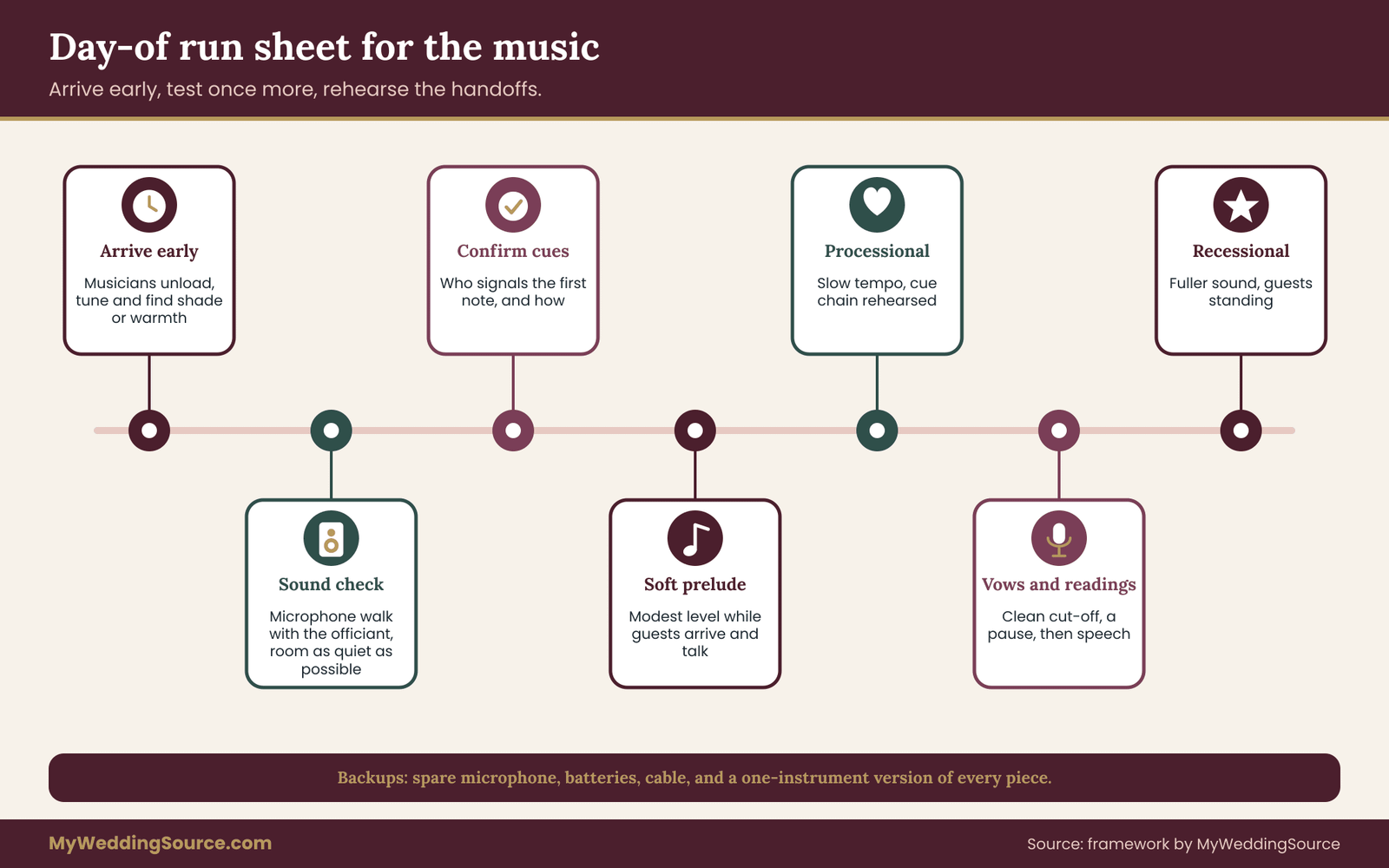
The run sheet above shows the order of the last hours. Arrive early, tune and check sound with the room as quiet as possible. Test the microphone for the officiant with a walk. Place the players and confirm the cue chain. Seat guests toward the front. Open the doors to a soft prelude.
Rehearse the first note, the handoffs to speech and the final cut-off. Keep a backup: a spare microphone, spare batteries, a second cable, and a simple version of every piece that can be played on one instrument if something fails. It is easier to adjust ceremony acoustics early than to apologize for them later.
Assign one person, usually the coordinator or a trusted friend, to watch the sound during the ceremony and to signal the musician quietly if the level is wrong. Give them the authority to make small changes without asking the couple, since the couple will be busy.
Your next steps
Start with a visit. Book an hour at the venue with your musician or a stand-in, run the six-step ceremony acoustics test and write a one-page note. Use the note to choose instruments, tempo and positions, and to decide whether you need a microphone for the officiant. Then confirm four items in writing: the sound policy, the positions, the power and the noise controls, such as bells, fans and doors. Few couples think about ceremony acoustics until a rehearsal, so you are ahead already.
If the same musicians will also play the evening, the guide to reception music for different generations and dance styles shows how to carry the plan into the party. Two weeks before the wedding, send the note and the run sheet to the musician, the officiant, the coordinator and the sound technician. On the day, arrive early and test once more. With a little preparation, the room that worried you becomes the one that carries your ceremony.
FAQ
What does a reverberant venue do to live wedding music?
Hard surfaces keep sound bouncing around after a note stops, so each note mixes with the one before it. Fast, busy music blurs, spoken words lose clarity, and quiet instruments can sound washed out. The fix usually is not a different venue but a better match: clear, plucked or lightly bowed instruments, slower tempos, players close to the guests and a small microphone for the officiant.
Which acoustic instrument works best in an echoing room?
There is no single winner, but fingerstyle guitar, a solo cello or violin, and a small vocal group are common safe choices because their notes start clearly and can be shaped by the player. A harp can also work if the arrangement leaves space. Test the real instrument at the real spot, and trust what you hear in the seats rather than a general rule.
Should we use a microphone and speakers for the ceremony?
Usually yes for speech, and sometimes for music. A microphone near the officiant’s mouth gives clear direct sound that the room’s echo cannot easily cover. For music, a small speaker near the players and pointed at the guests often helps more than a large system. Avoid big speakers aimed down the hall, which excite the room and make the echo louder.
How can we test the ceremony acoustics if the venue is far away?
Ask the venue for a recording from a past ceremony, ask local musicians who have played there, and schedule a video call where someone claps and reads a paragraph aloud while you listen. Choose a musician who adapts well, arrange a long arrival window on the day, and allow the piece list to change if the ceremony acoustics sound different from what you expected.
Will a full room sound better than an empty one?
Yes, to a degree. People, coats and upholstered seats absorb sound, so a full room rings less than an empty one. But a small guest list in a large hall absorbs little, so plan as though the room will stay lively. Seating guests close to the front and roping off the back rows helps both clarity and atmosphere.
Is a string quartet a bad idea in a stone chapel?
Not necessarily, but more players mean more overlapping sustain. Some quartets sound lovely in a stone chapel because they listen closely and adjust tempo and bowing. Others blur. A duo or trio is often safer in a very live room. Test the ensemble in the space, or ask them about their experience in similar rooms before you commit.
Do we need a license for live music at our ceremony?
It depends on the venue, the music and how the event is arranged. Many venues hold blanket performance licenses, and many musicians handle their own arrangements, but practice varies. Ask the venue and the musician in writing how licensing is handled, and check the U.S. Copyright Office for the framework. If you plan to record or stream, ask again, since those uses can differ.
What if the room is too echoing for any plan to work?
You have three options. Simplify the music to a single quiet instrument or voice with good speech amplification, move the ceremony to a smaller or drier space at the same venue, or reconsider the venue if you are still early in planning. Weigh how much the ceremony matters to you, and let the ceremony acoustics be part of that decision rather than an afterthought.
Sources
- U.S. Copyright Office
- ASCAP, performing rights organization
- BMI, performing rights organization
- SESAC, performing rights organization
- Global Music Rights
- Noise and hearing loss prevention, National Institute for Occupational Safety and Health
- U.S. Access Board, accessibility guidelines
- Americans with Disabilities Act, U.S. Department of Justice
- National Fire Protection Association
- National Weather Service