
A wedding processional without an aisle is still a processional: a planned way for the people in your ceremony to arrive, in an order that everyone can see and that everyone can physically manage. This guide compares the real entry routes, gives you a short test for choosing one, and shows how to build cues that work for guests and wedding party members who move slowly, use a mobility device, or cannot see well.
Start by deciding where guests will face and where the couple will stand. Then test five routes against three filters: sight lines, clear width, and a usable cue. A side entry, a front reveal, a walk through the seating, a perimeter walk and a gathered start each solve a different problem. Pick the one that keeps a clear path for every person who has to walk or roll, write the cues for each person by name, and rehearse the wedding processional route in the actual room with the actual chairs in place.
Many ceremony spaces were never designed for a long straight walk. A restaurant private room, a hotel ballroom set with round tables, a courtyard with a fountain in the middle, a living room, a rooftop terrace, a museum gallery, a park shelter with posts down the center. Couples fall in love with a place and then discover, usually at the first site visit, that there is no obvious place to put a runway of chairs. That is not a reason to give up the place. It is a reason to design the arrival on purpose.
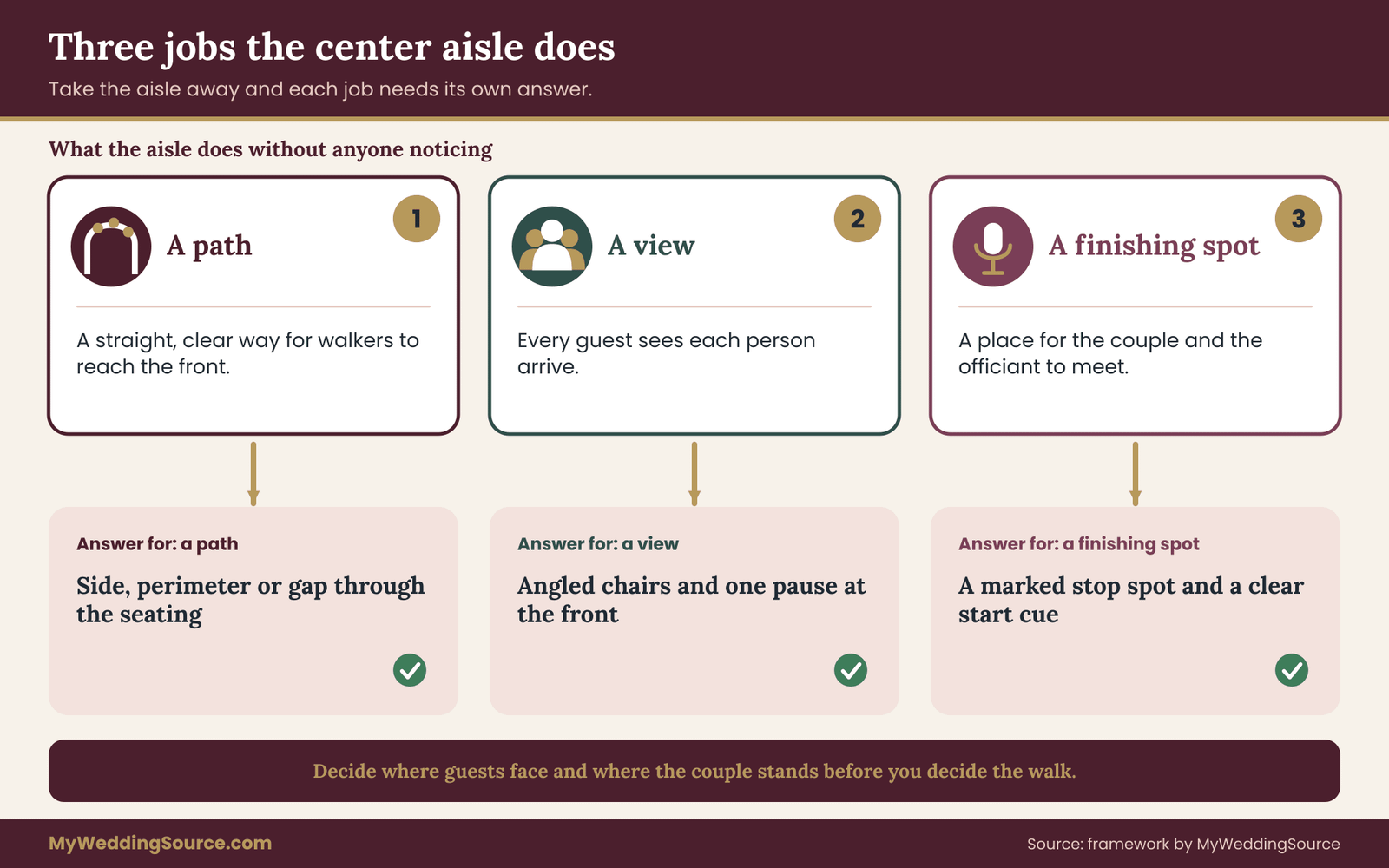
The good news is that the traditional center aisle is only one way to handle a wedding processional. It solves three things at once: it gives the walkers a straight path, it gives guests a clear view, and it gives the officiant a natural spot to wait. When the room cannot offer a straight path, you have to solve those three jobs separately. That sounds like more work, and it is a little more, but it also means the result fits your room instead of fighting it.
This article stays on that one question. If you want the full order of a ceremony, from welcome to pronouncement, the wedding ceremony step-by-step guide covers it. If you want a master document that lists every cue, reader and music change, the wedding ceremony cue sheet guide is the place for that. Here the subject is narrower: how to get people into position when the room has no center aisle.
A note on scope. This is general planning information, not legal advice. Whether a ceremony needs a particular officiant, witnesses or a particular spoken declaration depends on your state, and a processional is not what makes a marriage legal. The USA.gov page on marriage licenses is a good starting point for finding your state’s rules, and you should confirm local terms with the issuing office.
What a wedding processional without an aisle has to do
Before comparing routes, it helps to strip the idea down to its jobs. A wedding processional, in any room, does five things. It marks the start of the ceremony so guests know to stop talking. It places each person in the spot where they will stand or sit. It gives guests a moment to see the people who matter to the couple. It sets a pace that matches the music. And it ends with the couple, or both partners, in front of the officiant, ready to begin.
None of those five jobs requires a straight line of chairs. A line is just the cheapest way to do all five at once. When you remove it, you can move each job to wherever the room can support it. The start signal can come from the music or from the officiant stepping forward.
Placement can happen by walking, by standing, or by simply being there already. Seeing the wedding party can happen on arrival or in a short introduction. Pace can be set by the music or by a cue from a coordinator. And the final position can be reached from the side, the front or the back.
This is why the phrase “wedding processional without aisle” can mislead. People hear it and imagine something improvised or lesser. In practice, many of the most memorable arrivals happen in spaces with no aisle at all, because the couple had to think about each person’s path instead of copying a template.
The three questions that frame everything
Every decision in this guide comes back to three questions.
First, where will guests face? In a room with no aisle, guests may sit in a half circle, in a square, in rows split by a gap, at round tables, or on a patio with chairs placed around a focal point. The direction guests face decides which entrances look good and which look awkward. An entry from behind the guests is fine if they can turn. It is a poor choice if they are in fixed seats at tables.
Second, where will the couple stand? Often there is one obvious spot: in front of a window, an arch, a fireplace, or a garden feature. Sometimes there are two reasonable spots, and you can pick the one that gives the cleaner approach. Decide this before you decide the wedding processional, because the wedding processional exists to serve the spot, not the other way around.
Third, who has to get there, and how? A bride and groom who walk without help have the most options. A grandparent who uses a walker, a child who is four, a best man on crutches, a parent who uses a wheelchair, and a reader with low vision each need something slightly different. The route that looks elegant on a floor sketch may fail the first time someone with a walker tries to turn between two chairs.
What counts as a processional here
For the purposes of this guide, a wedding processional is any planned arrival of ceremony participants before the officiant begins. That includes a formal walk with music, a quiet gathering at the front while guests settle, a staggered entrance from different doors, and a moment where everyone is already in place and only the couple arrives. Calling all of these processionals keeps the vocabulary simple. The choice among them is the real decision.
Why spaces end up without a center aisle
Knowing why a space has no aisle helps you predict what will go wrong. The reasons fall into a handful of patterns, and each pattern comes with its own hidden constraints.
Furniture and fixed features
Round tables, banquet booths, stages, columns, fountains, planters, pillars and built-in benches all break up a straight line. Some of these can be moved by the venue and some cannot. Ask directly which items are fixed and which are movable, and who moves them. A venue may be glad to clear a stretch of floor but unwilling to move a fixed bar or a column. Moving furniture also costs staff time, so ask about both permission and timing.
Fire and safety rules
Many venues set their seating layouts around exit paths. Local fire officials, and the venue’s own capacity rules, often govern how much seating may go where and how wide the paths must be. Those rules vary by place, and the details are not something a couple should guess at. The National Fire Protection Association publishes the model codes that many jurisdictions build on, but your venue’s own layout approval is what matters on the day. If you want a layout that differs from the venue’s standard, ask them to confirm it in writing.
Weather and backup rooms
A ceremony planned for a lawn often has a rain location, and the rain location is frequently a room with a very different shape. The garden may have had a clean grass aisle. The backup room may be a square hall with a dance floor in the middle. If a rainy day would push you to the backup room, you need a second route for the wedding processional, not just a second set of chairs. The indoor and outdoor transitions guide covers how to think about the switch between the two.
Guest counts and layouts that change late
A room that works for forty people can stop working at ninety. Late RSVPs, plus-ones that arrive uninvited, and extra chairs for guests with mobility needs can all squeeze a path that looked comfortable on the plan. Build your wedding processional route with a little room to spare, and decide in advance which chairs will be removed first if the room gets tight.
Accessibility problems that nobody noticed
Some rooms have no aisle because they also have steps, thresholds, narrow doors or uneven ground. These problems affect the processional and the guest experience at the same time. A site that works for a couple who walk easily can still shut out a guest who uses a wheelchair. The accessible venue red flags guide lists what to look for on a site visit, and it is worth reading before you commit to a space with an unusual layout.
A useful habit is to write down, at the first site visit, the one sentence that describes why the room has no aisle. “The ballroom is set with round tables and the dance floor is the only clear space.” “The courtyard has a fountain in the center.” “The living room has one door.” That sentence usually points directly at the best route.
Five entry routes compared for a wedding processional without an aisle
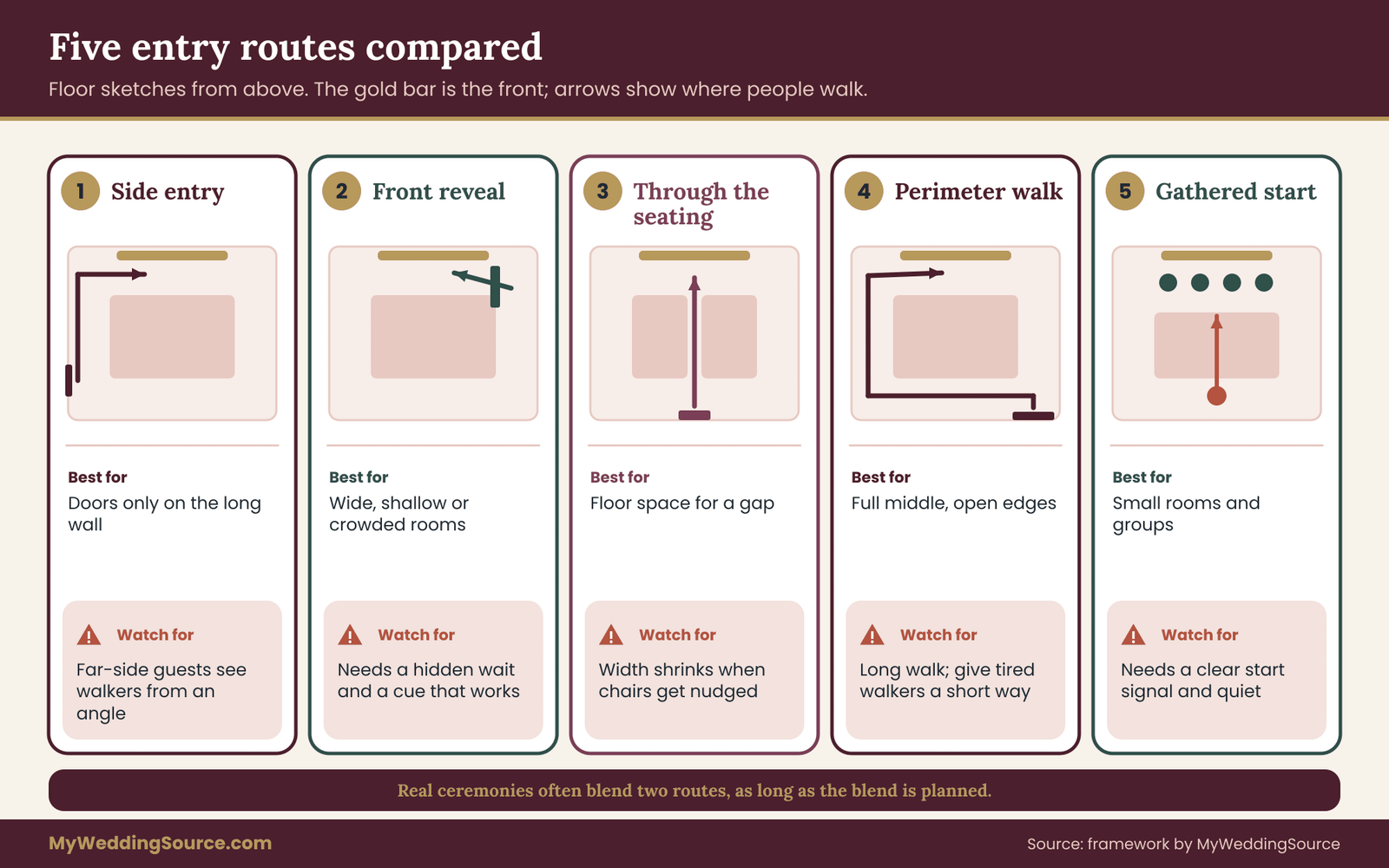
The rest of the article rests on five routes. They are not rankings. Each is the right answer in some rooms and the wrong answer in others, and most real ceremonies use one route for the couple and a simpler version for everyone else. Reading all five before choosing helps, because the one that first looks best is often not the one that survives a rehearsal.
Route one: the side entry
In a side entry, the wedding party and the couple enter from a door or opening at the side of the seating, walk along the edge of the room, and turn toward the front. This is the most common solution when the seating faces a focal point and the only doors are on the wall to the left or right.
Its strengths are plain. The path usually runs along a wall, so it stays clear even when guests spill out of their chairs. It tends to be short, so people with limited stamina do not have to walk far. And it keeps the officiant and the focal point in one visual frame, because guests do not turn their backs to them.
Its weaknesses are also plain. Guests on the far side may see people only from behind or from a sharp angle. The turn at the corner is the hardest part, because a person using a walker or a wheelchair needs more space to turn than someone walking. And if the door opens directly into the front of the room, the entry feels abrupt, with no moment of approach.
A side entry works best when you add one deliberate pause. Many couples have each person stop for a half-second at the front corner, face the guests, and then step to their place. That pause gives the guests time to see them and gives the person a stable place to adjust a walker or a bouquet.
Route two: the front reveal
In a front reveal, the guests are seated first and the participants arrive from behind a screen, a doorway, a curtain, a hedge or a corner at the front of the room. Nobody walks past the guests at all. The couple appears already close to their spot, and the wedding party takes only a few steps.
This is the wedding processional route to consider when the room is wide, shallow or crowded, and when the front area has a natural hiding place. It also suits couples who dislike the idea of being stared at while they walk. Guests see everything from the front, so the picture is clean, and the walkers have a very short path with no turns past chairs.
The cost is that the wedding processional loses its sense of journey. For some couples, the wedding processional is the point. A front reveal can feel more like a stage entrance than a procession. A second cost is practical: you need a hidden waiting area with enough room for the whole group, with a way to hear the cue, and with a path that is stable underfoot. A person waiting for ten minutes behind a screen needs a chair, and a person with a mobility aid needs a floor that is level.
If you choose a front reveal, decide how the group will know the music has started. The cue should not depend on someone peeking around a corner. A coordinator, a trusted friend with a signal, or a simple text message to one person can work, but it should be tested in the room.
Route three: through the seating
Here the walkers go through the guests. In a room set in a half circle or a square, a gap is left in the seating, and the participants walk through it from the back to the front. Technically this is an aisle. The difference is that it is an improvised one, usually shorter and often curved, and it may exist only because chairs were placed with a gap.
This is the wedding processional route that most closely matches the traditional experience, and it is often the best answer in a room with enough floor space. It gives guests the moment of seeing each person pass. It also gives the couple the wedding processional they imagined.
The risk is width. A path that looks wide on a diagram shrinks when chairs are nudged during seating. People with wheelchairs, walkers or canes need a path that stays clear, and they also need it to stay clear when two people walk side by side, as in a parent escorting a partner.
The Americans with Disabilities Act sets standards for accessible routes in many public places, and the Access Board publishes the technical detail. A private event does not always trigger every rule, but the published standards are a useful reference for how much room a wedding processional route needs. Ask the venue what width they have used before and measure on the day.
One more caution. A path through the seating tends to bunch up at the front, where the gap meets the open space. Decide where each walker stops so there is no pile-up at the end.
Route four: the perimeter walk
In a perimeter walk, participants circle the outside of the seating, along the walls or edges of the space, until they arrive at the front. This is common in rooms where the seating fills the center, such as a ballroom with chairs set in rows and a wide band of free floor around the edge.
The perimeter walk is long, which is both its strength and its weakness. A long walk gives guests time to see each person and lets the music breathe. It also can tire anyone who has limited stamina, and the longer path gives more room for a stumble. If you use a perimeter walk, give a short route to anyone who needs one. A grandparent can enter from the nearer corner while the wedding party takes the long way.
The other issue is sight lines. Guests in the middle will see participants over the heads of people on the sides, but guests at the edges may only see backs. Setting chairs in a slight angle toward the walkers can help, and so can adding one or two standing spots along the way where the group pauses.
Route five: the gathered start
In a gathered start, people are already in position. The wedding party stands at the front before guests arrive or while they settle, and the couple enters last, either together or one at a time. In some versions, everybody is simply seated among the guests, and the officiant invites the couple forward.
This route is the simplest to build and the easiest to make accessible, because nobody has to walk a long way. It suits small ceremonies, living-room weddings, restaurant ceremonies and any place where space is tight. It also removes the dependency on music timing, since there is no need to match steps to a beat.
It does ask for a different kind of cue. Without a walk, the ceremony needs a clear start signal, such as the officiant stepping forward, a short piece of music that ends, or a spoken welcome. It also asks guests to be seated and quiet before the couple arrives, so a staff member or a friend should settle people in time.
A quick reading of the five routes
If the room has doors on the side only, think of the side entry first. If the front has a hiding place and the space is wide, a front reveal is likely to look best. If you have floor space for a gap in the seating, a path through the seating is the closest to tradition. If the middle is full and the edges are open, the perimeter walk fits. If the room is small or the group is small, the gathered start is calm and quick.
Real ceremonies often blend two routes. The couple may take a perimeter walk while the wedding party uses a gathered start, or the parents may enter from a side door while the couple uses a path through the seating. Mixing is fine when it is planned. The trouble starts when the mix grows up by accident.
Choosing a wedding processional route with a simple fit test
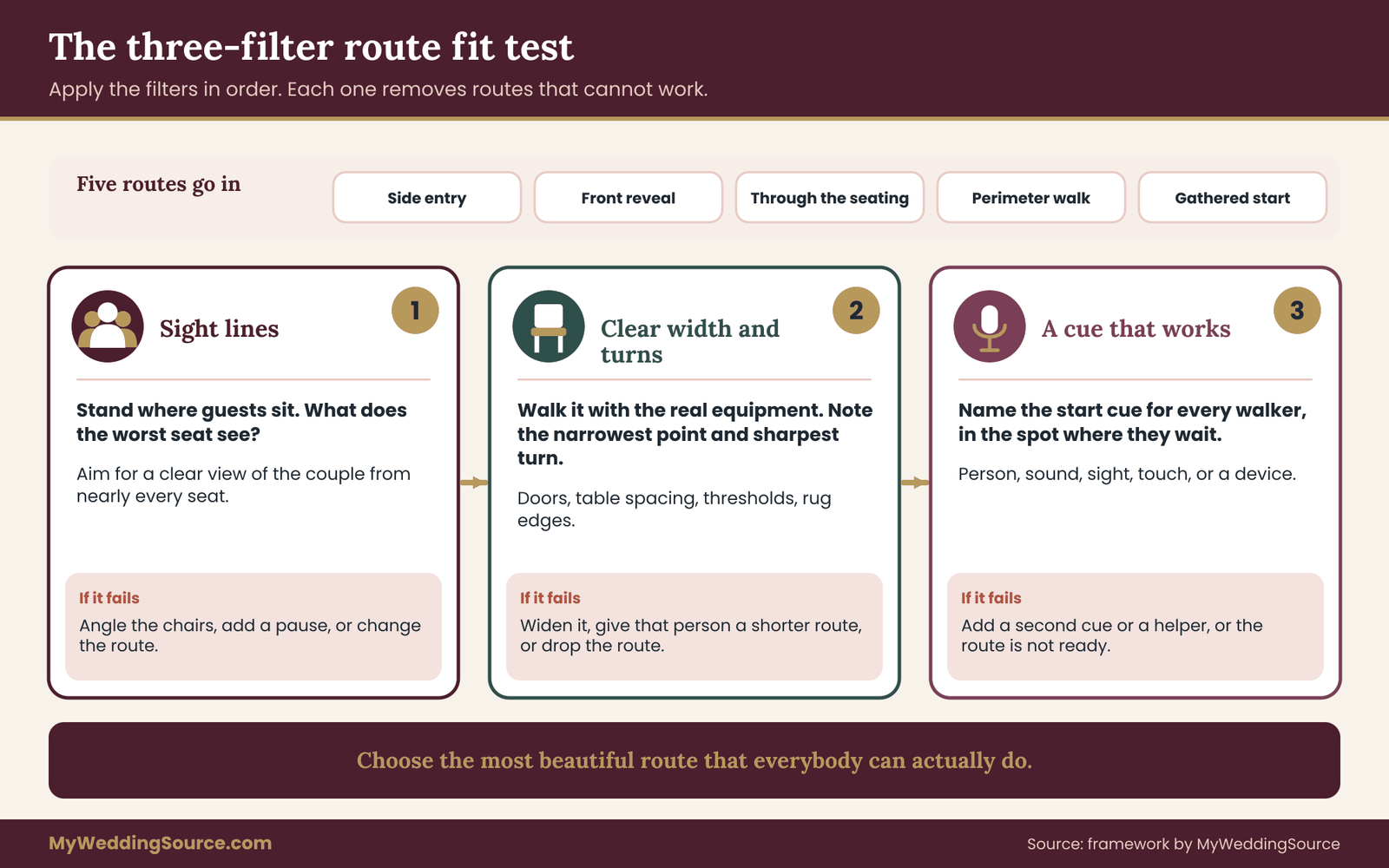
The comparison above tells you what each wedding processional route does. This section gives you a way to choose without guessing. The route fit test uses three filters, applied in order. The order matters, because the first filter removes the wedding processional routes that cannot work, and the last one picks among the survivors.
Filter one: sight lines
Stand where guests will sit. If you cannot, use the floor plan and mark each seat. For each candidate route, ask what a guest in the worst seat will see. A guest in the back corner of a half circle might see the couple’s face during a front reveal, and only the back of a head during a perimeter walk. A guest at a round table might see nothing at all if the table backs onto the walkers.
A useful rule of thumb is that a route passes this filter if at least nine out of ten seats have a clear view of the couple when they reach the front, and most seats have a view of the walkers at some point. This is not a scientific standard, only a practical one. If you find that a third of the seats see nothing, the wedding processional route needs changing or the seating does.
Filter two: clear width and turns
Now walk the wedding processional route with the real equipment. That means measuring, if you can, the narrowest point and the sharpest turn. People who use wheelchairs or walkers need room to turn that is larger than a person’s body width, and a wedding processional route that squeezes through a doorway at a right angle may be harder than one that runs straight for twice the distance.
For each wedding processional route, write down the narrowest point and the tightest turn. If you cannot measure, ask the venue for the width of the doors, the spacing of the tables, and any steps or thresholds. Do not rely on a floor plan you did not draw. A drawing does not show a rug edge or a slight ramp.
Where a route fails this filter for one person, you have three options. You can widen it by moving chairs. You can give that person a different, shorter route. Or you can drop the wedding processional route. The second option is often the right one and is described in the section on cues below.
Filter three: a cue that works
The last filter asks whether a person who has to start walking will know when. In a room with no aisle, the usual cue, a door opening at the back with music rising, may not exist. A person on the far side of a room may not hear the music clearly. A child may not see the coordinator. A person with low vision may not see a hand signal.
For each candidate, name the cue for each walker. If you cannot name one, the wedding processional route is not ready. A cue can be a person standing next to the walker, a touch on the arm, a sound, a countdown whispered, a light, or a vibration signal on a phone. The point is that no one should have to guess.
Using the three filters together
Take two routes that both pass sight lines, then compare clear width. If one route fails for a key person, eliminate it or shorten it for that person. Among the remaining routes, choose the one whose cues are easiest. In most rooms, this process leaves one or two clear winners, and the decision becomes quick.
A worked example later in this article shows the test applied to a specific room. For now, keep one idea: you are not looking for the most beautiful route. You are looking for the most beautiful route that everybody can actually do.
Mobility-friendly cues for a wedding processional
A cue is the signal that tells a person to move. In a standard ceremony with an aisle, cues are nearly invisible because everyone watches the person ahead. When the room has no aisle, the people in the wedding processional may be spread across two doors, a hallway and a front corner, and the usual chain breaks. Cue design is the part of the work that couples most often skip, and it is where mobility needs matter most.
The phrase “mobility-friendly” here covers anyone who needs more time, more width, more stability or a different kind of signal than the typical walker. That includes people who use wheelchairs, scooters, walkers, canes or crutches. It includes people with chronic pain or fatigue, people recovering from surgery, pregnant guests, small children, and older relatives who prefer an arm to lean on. It also includes people who cannot see or hear the usual signal.
Cue types and when each one works
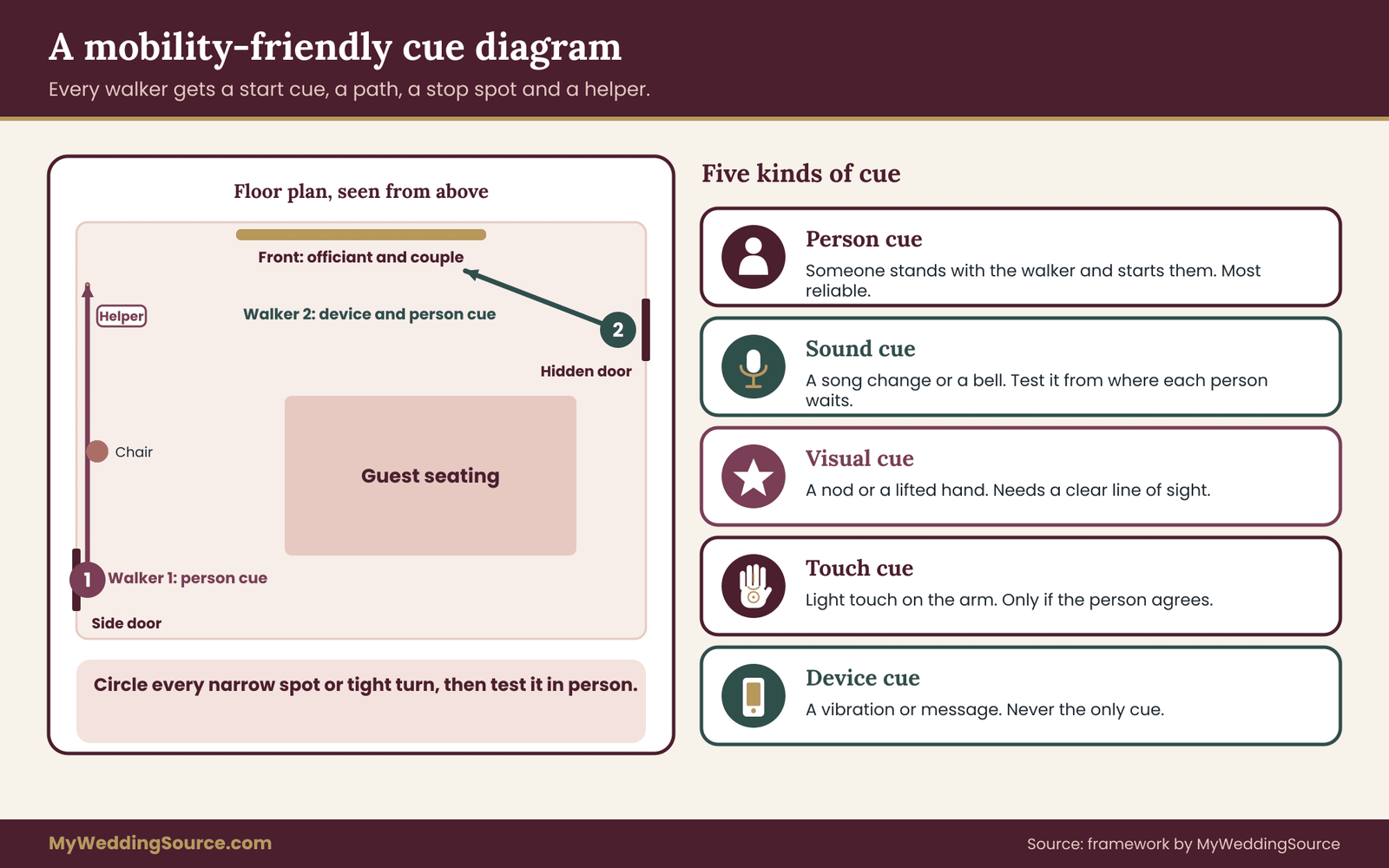
There are five kinds of cue, and a good plan usually combines two of them for each person.
A person cue means someone stands next to the walker and starts the wedding processional. It is the most reliable. It works for children, for older relatives, and for anyone who might be nervous. The weakness is that it needs a person, so count the helpers before you count on the cue.
A sound cue is a particular piece of music, a bell, or the start of a verse. It works across the room, which is why it is the usual choice. The weakness is that sound is hard to judge in a space with echo, wind or a noisy hallway, and some people will not hear it clearly. Test it from the spot where each person will stand.
A visual cue is a nod, a hand lifted, a card, or a light. It works for people who are near enough to see it. The weakness is that it needs a clear line of sight, which a room with no aisle may not offer.
A touch cue is a hand on the shoulder or arm, or a light squeeze. It is the best choice for a person with low vision or hearing loss, but only if that person has agreed to it. Never assume touch is welcome.
A device cue is a vibration from a phone or a watch, or a message to one person. It suits a hidden waiting area, but it should not be the only cue. Phones fail, and silent mode, low battery or poor signal can quietly end the plan.
Writing a cue for each person
Put the cue for each person in writing, with their name. A simple line is enough: who, from where, to where, signal, and helper. For example, “Grandmother, from the side door, to the front-left seat, starts on the second verse, helped by her nephew.” One line per person means nobody is relying on a general feeling that “it will be fine.”
When a person has a particular need, ask them directly what would help, instead of deciding for them. Many people with mobility devices have strong, specific preferences. One may want to arrive early and be seated before the music starts. Another may prefer to be part of the main procession. Another may want a helper to carry a bouquet. Letting them decide protects their dignity and often solves the problem faster than a clever route would.
Reading the cue diagram
The diagram above shows how cues can flow through a wedding processional with two entry doors. Each walker has a start cue, a path, a stop spot and a helper. The arrows show the order. The point of the diagram is that the cue comes from a known place, not from guesswork. You can draw your own version on a printout of the floor plan in about twenty minutes, and it is worth doing before the rehearsal.
Draw the room’s shape. Mark the doors, the focal point and the guests. Draw one arrow per person from the start spot to the stop spot. Next to each arrow, write the cue. If two arrows cross, mark which one goes first. If an arrow passes through a narrow spot, circle it. The circles are the places to test in person.
Time and pace
People who move slowly need more time, and the music has to allow for it. A common mistake is to choose a piece of music with a fixed length, and then to squeeze the walkers into it. Instead, count the time each person needs, and add a margin. If one participant needs a minute to cross the room, the music needs to last at least that long before the next person starts, or the next person needs a later cue.
Ask the musician or the DJ whether the music can be extended, looped or held at a quiet level. Many can. The cue sheet guide on this site goes into how to write that kind of music note, so that the person running the sound knows when to fade and when to hold.
A good rule is that nobody should feel they are late or early. If the walker is rushed, the wedding processional looks anxious and the guests feel it. If a walker stands waiting for twenty seconds in front of everyone, the same applies. Aim for a rhythm that feels easy, and then let the music follow the people rather than the people following the music.
Support that does not look like support
Some people prefer a walk that looks the same as everyone else’s. That can be achieved without making the person feel managed. A helper can walk slightly behind. A chair can be placed along the wedding processional route, within a step or two, so that a person can sit if needed. A rail or a table edge can serve as a place to rest. A short path can be arranged so that the person is in place when the guests turn, rather than needing to walk all the way.
For wheelchair users, check that the wedding processional route has a smooth surface. Gravel, grass, thick rugs and cables can all stop a wheel. If the surface is a concern, ask the venue whether a path can be laid, such as a flat runner secured at the edges, or whether the wedding processional route can follow a hard surface instead. Check, too, that the final spot has a flat, level place to stop.
Hearing and vision
For people with hearing loss, a visual or touch cue is better than a sound cue. For a guest or participant with low vision, a person cue or a touch cue is better than a visual cue. Describe the room before the day. Tell them how many steps, where the turns are, and where the chairs are. A walk-through before the ceremony, even five minutes long, makes a large difference.
Where you have a reader who uses large print or braille, put the text in their hand early, and give them a place to stand where the lectern or table is stable. The low-vision signs guide covers contrast and size for printed material, and the same ideas apply to ceremony cards.
Children
Young children are a special case. A child under about six may not understand the idea of a procession, and may freeze, run or turn back. Give a child a clear, short route, an adult at the end, and a way out if they decide to stop. Never make a procession depend on a child doing what was rehearsed. The safest design is one where the ceremony continues smoothly whether or not the child walks.
Matching each wedding processional route to its cues
Different routes pair with different cues. Putting the two together early saves a lot of rehearsal time.
A side entry pairs well with a person cue at the door and a sound cue to start. Because the walkers are close to the door, a helper can stand with each one until the moment they step in. The risk is that the door becomes crowded, so give each person a place to wait that is out of sight.
A front reveal pairs well with a device cue and a person cue behind the screen. Everyone is in the same small space, so the helper can start each person with a touch. It helps to give the group a rehearsal inside the hidden space, because acoustics there can differ.
A path through the seating pairs with a sound cue, a visual cue from the front, and a helper standing at the first row. Because the walkers travel a distance, they benefit from a clear stop spot. A piece of tape on the floor, a flower pot, or a person standing in the right place can all work.
A perimeter walk pairs with a sound cue and a series of helpers along the way, one at the start, one at each corner, and one at the front. Because the wedding processional is long, it is easy for a person to lose track of the music. A second cue at the corner can save the timing.
A gathered start pairs with a spoken cue from the officiant. It may be as simple as “Please welcome.” The risk is that guests keep talking, so build in a quiet moment first.
Working a wedding processional out with the venue, officiant and musicians
A route on paper is not a wedding processional route until the people who control the room agree to it. This section covers who to ask, what to ask, and what to put in writing. It also covers the official sources worth checking, since a few rules do touch a ceremony, even though the processional itself is not a legal requirement.
The venue
Ask the venue for four things. First, a to-scale floor plan of the ceremony space, with doors, fixed features and any steps marked. Second, the maximum seating allowed in each layout they offer, and the minimum path width they require. Third, who sets up and who tears down the chairs and how early, because a gap in the seating needs to be kept clear while guests arrive. Fourth, any rules about candles, aisle runners, petals, ribbons or floor decor. A runner that looks lovely can be a tripping hazard, and many venues prohibit loose petals for the same reason.
If the venue offers a layout you have not seen, ask for a photo of a past ceremony in the same layout. Photos from earlier events show real chair spacing and real sight lines, which is more useful than a diagram. For a deeper look at how to prepare for the visit, the venue technical walkthrough guide lists what to check about power, sound and access.
The officiant
Your officiant should know the wedding processional route, because the wedding processional route changes where they stand and how they signal the start. Some officiants prefer to walk in with the couple. Some stand at the front from the beginning. Some like to give a short welcome before the wedding processional. If your ceremony is a gathered start, the officiant is the cue, so they should know that and be comfortable with it.
The officiant also decides some legal matters. Requirements differ widely by state, including who may officiate, whether witnesses are needed, and how the license is returned. The wedding officiant requirements guide explains the usual questions to ask, and the USA.gov marriage license page points to the state-level rules. None of that depends on the wedding processional route, but the order in which people arrive affects who is where when the license is signed, so it is worth a short conversation.
The musicians or the DJ
The person running the music needs three facts: the start cue, the wedding processional route length, and the number of separate entrances. Tell them whether there is one song or several, whether the pace is slow or normal, and whether they can see the people they are cueing. If they cannot see the door, they need a signal from someone who can.
Ask whether the sound system reaches the waiting area. In many rooms, a speaker covers the guests but not the hallway, and the walkers cannot hear the cue. A small portable speaker, or a second feed, can solve this. A string quartet or a solo guitarist can often move to the point where the walkers can see them, but that takes extra space.
Coordinators and helpers
If you have a coordinator, give them the wedding processional route and the cue list, and let them run it. If you do not, choose one trusted person who is not in the wedding party, and ask them to take charge of the walkers. Do not ask a parent or a member of the wedding party to do this job. They have their own role.
The helpers who stand with the walkers do not need training. They need to know where they stand, what the cue is, and what to do if something goes wrong. Give each a one-line note and make sure they know that their job is to help the person look comfortable, not to move them.
Putting it in writing
Write the final route into the cue sheet, with the floor plan attached. Send it to the venue, the officiant, the music person and the coordinator. Ask each to reply with a short confirmation. A reply is better than a verbal “sounds good,” because it gives everyone a chance to catch a mistake while it is still cheap to fix.
A worked example: one wedding processional in a room with round tables
Abstract rules are easier to trust once you see them applied. The example below is invented. It is not a real couple or a real venue, and the numbers are round on purpose. It exists to show the order of decisions.
Suppose a couple, Dana and Marcus, has chosen a restaurant’s private dining room for a ceremony and dinner for sixty guests. The room is rectangular.
There is a wide window at one end, a service door and a main door on the long wall at the other end, and a fixed bar along one side. The restaurant sets the room with eight round tables for the meal and offers to set the ceremony in rows instead, in a single block facing the window. That leaves no center aisle, because the block fills the width between the bar and the opposite wall, with a clear strip of about a person and a half on each side.
Step one: the three questions
Guests will face the window. The couple will stand in front of the window. The people who have to get there are the couple, two parents of the bride who walk easily, a father of the groom who uses a walker, a best woman, a groomsman, and a flower child who is five.
Step two: the five routes
A side entry from the main door is possible, since the main door sits on the long wall near the back. A perimeter walk along the open strip is possible too. A path through the seating would need a gap in the block, which costs about eight chairs. A front reveal is possible using the service door, if the service door leads to a back hallway that opens near the window. The gathered start is possible, since the room is small.
Step three: the fit test
For sight lines, the side entry along the open strip shows guests the walkers from the side, which is fine. The path through the seating gives the best view, but costs chairs. The front reveal gives a clean view but only at the end.
For clear width and turns, the strip along the bar is about a person and a half wide. That is enough for one walker with a helper but not for two people walking side by side, and not enough for a father with a walker to turn with comfort. The other strip, along the wall, is wider, because the venue offers to move a service cart. The narrowest point on either side is the corner where the strip meets the front.
For cues, the walkers can hear a sound cue in the main room but not in the hallway behind the service door, because the hallway has no speaker.
Step four: the decision
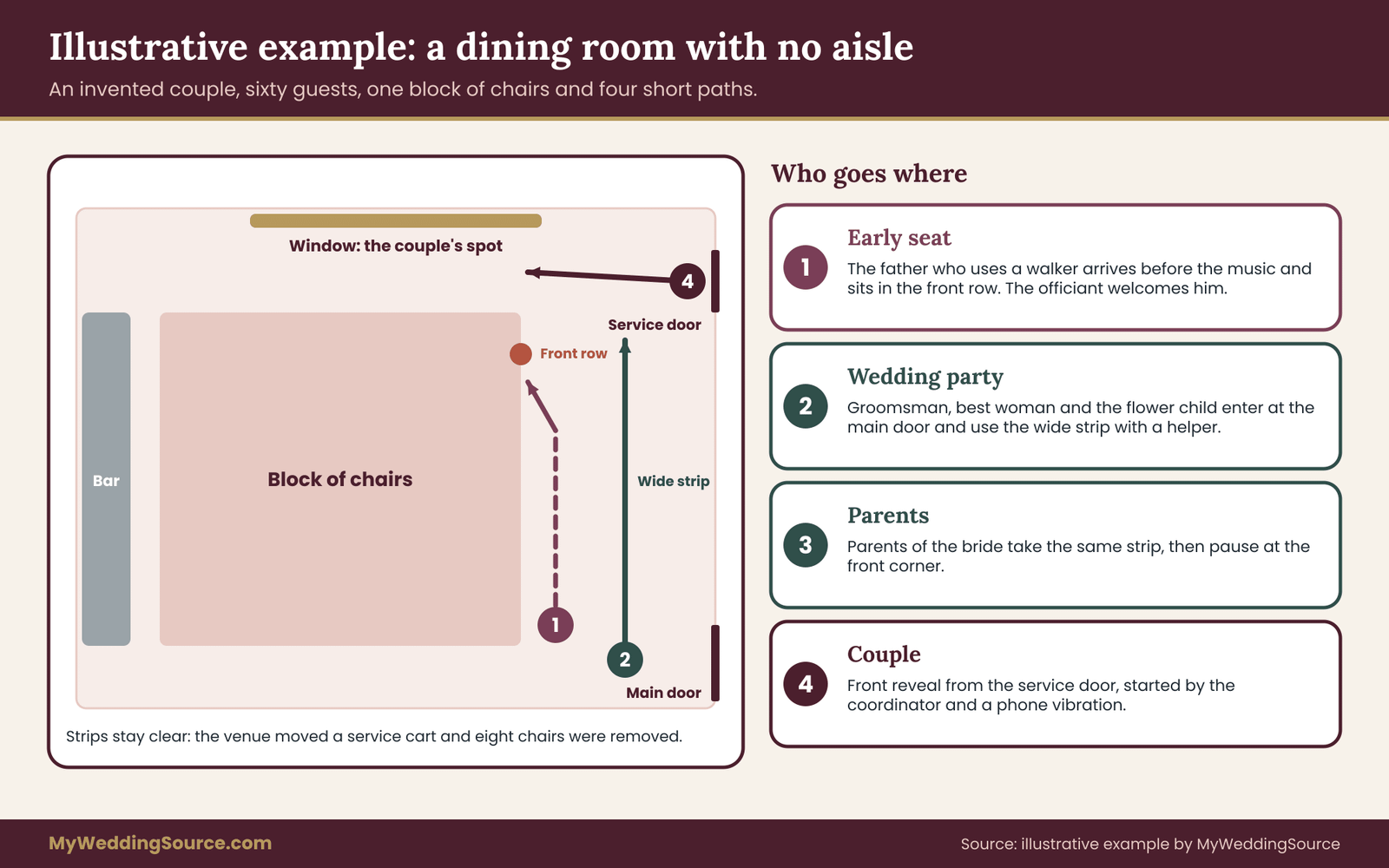
Dana and Marcus choose a blend. The groomsman, the best woman and the flower child start at the main door and take the wide strip along the wall, helped by the coordinator. The father with the walker enters earlier, before the music starts, and is seated in the front row on that side, with a chair already in place.
He is introduced by the officiant as a welcome gesture, with a few words, so that guests see him and his arrival is part of the ceremony instead of a delay. The parents of the bride enter from the main door on the same strip. The couple uses the service door for a front reveal, with a person cue from the coordinator and a vibration cue on the coordinator’s phone, since the hallway has no speaker.
That is a wedding processional with four different paths, and none of them is an aisle. Each path is short. Each walker has a cue and a helper. The only cost to the couple is eight fewer chairs than the venue’s maximum, because the strip along the wall needs to stay clear. The block of seating becomes a slightly narrower rectangle, and the venue is happy with the layout because both exit strips remain open.
What the example shows
Three lessons come out of this. First, the best route for the whole group is rarely one route. The right answer was a blend, built person by person. Second, the person with the greatest need shaped the plan, but not by being singled out. The father’s early arrival became a moment in the ceremony. Third, the weakness of the room, no speaker in the hallway, was found at the fit test and solved with a cue that did not rely on sound.
If Dana and Marcus had skipped the fit test and simply copied a standard plan with a center walk, they would have discovered each of these problems during the ceremony, in front of everyone.
Special cases that change a wedding processional
A few situations come up often enough to deserve their own notes. Each one changes the wedding processional route or the cue, and each one is easier to handle when planned.
Two entrances for two partners
Many couples want each partner to enter on their own, from different sides. A room with no aisle often makes this easy, because there are naturally two doors or two sides. The risk is that the two walks are not symmetrical, so one partner walks farther than the other. If that matters to you, measure both. If it does not, accept the difference and tell the guests with a short line from the officiant, so they know where to look.
Partners can also arrive together, from the same spot. This is simpler to cue and often the best answer in a very tight space.
Parents and escorts
Escorting a partner is a tradition that depends on a long, straight walk. When there is no aisle, an escort can start closer to the front, or can walk a shorter, curved route. A parent who uses a mobility device can be the escort too, with the partner walking beside, rather than on an arm. Ask the people involved what they would like, and do not push a tradition that makes someone uncomfortable.
Some couples skip the escort altogether and have both partners enter alone or together. That is a common choice in rooms with no aisle, and it removes the dependency on a path wide enough for two.
Large wedding parties
A wedding party of eight or ten people can overwhelm a short route. If the path is short, send people in pairs, or have the party already in position, as in the gathered start. A long line of people standing at the front also blocks sight lines, so consider a staggered line or a smaller party at the front, with the rest seated among guests.
Different heights and footwear
A wedding on grass, gravel, stone or a polished floor changes how people walk. High heels sink into a lawn. Smooth soles slip on polished stone. Ask each walker what they plan to wear and test the surface with that footwear if you can. A simple fix, such as flat shoes for the wedding processional and heels for the reception, is easy to arrange.
Multiple languages or customs
Some ceremonies have a set order of arrival that comes from a faith or a culture. Some include a group walk, a dance, a ritual or a presentation of the couple. If your ceremony follows such a tradition, speak with the person who leads it before you decide on the wedding processional route. A change to the wedding processional should respect the meaning of the custom. The interfaith ceremony planning guide and the wedding traditions guide cover some of these questions.
Outdoor spaces without a path
A garden or a park may have no clear path at all. The ground may be uneven or soft. Here the wedding processional route needs surface planning. Ask whether a path of boards, mats or a firm runner can be laid. Check that the surface is firm enough for a wheelchair and stable enough for a walker. For public parks and other publicly managed land, ask the managing agency about permit rules, since some limit what can be put on the ground.
Wind and sun matter too. A route that faces the sun leaves walkers squinting. A route into the wind can blow a veil across a face. A glance at the weather forecast the week before can help you choose between two routes, and the National Weather Service publishes forecasts for the local area.
Ceremonies held during a meal or a party
A few couples hold the ceremony in the middle of a larger gathering, such as at a family dinner. In that case, the wedding processional may be as short as a few steps from a table to a spot in the room. The cues are easier, because everyone is already present, and the main task is to get attention. A clink on a glass, a song, or a spoken line from the officiant can do that. The gathered start is nearly always the best route here.
Rehearsing the wedding processional in the actual room
A rehearsal for a wedding processional without an aisle is not optional in the way it sometimes is for a standard walk. A standard walk has a built-in structure: you go down the middle and stop at the front. A route without an aisle has turns, waiting places, partial paths and several start points, and the only reliable way to find the problems is to walk it.
When and where to rehearse
The ideal rehearsal happens in the ceremony room, with the chairs set as they will be on the day. If the room is in use before the wedding, ask the venue whether the chairs can be placed for a short test in the morning, or the day before. If the room is not available, rehearse in a space of the same size, and mark the doors, the front and the chairs with tape or objects.
Do the rehearsal at the time of day when the ceremony will be held, if you can. Light, sound and temperature all change how a wedding processional route feels, and a room that is calm at ten in the morning may be noisy at five in the evening.
Who attends
Everyone who walks, plus the helpers, the officiant, the person running the music and the coordinator. If a participant cannot attend, a stand-in can walk their route, but the person with a mobility need should come themselves if at all possible, since only they can tell you whether the wedding processional route works. If travel makes it impossible, a short video call during which a helper walks the wedding processional route and describes it is better than nothing.
What to test
The point is to answer a short list of questions, in order.
Can every walker find the start spot and wait there comfortably? Is there a chair, if needed, and is it out of the guests’ sight? Can every walker hear or see the cue from the spot where they stand? Is the wedding processional route clear of cables, rugs, thresholds and chairs? Does each person reach the stop spot without bunching? Can the person at the front see the next one arrive? Does the whole group fit at the front without blocking the couple? Is there enough time between people for the pace of the music?
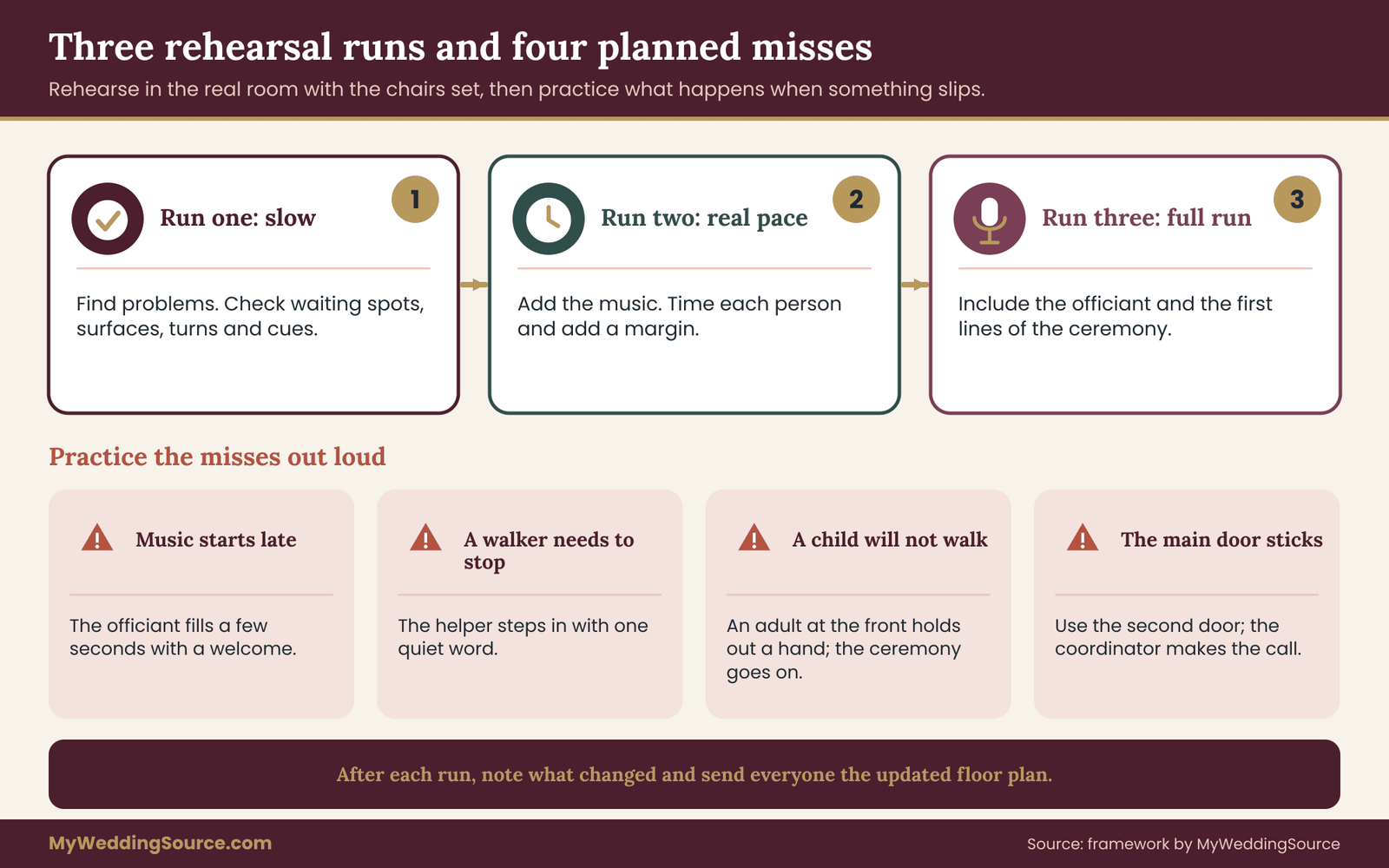
Walk it three times. The first time is slow, to find problems. The second time is at the real pace, with music. The third time is a full run with the officiant, including the first few lines of the ceremony. After each run, note what changed and fix it before the next. If a route needs more than three runs, it probably needs a change.
Practicing the failure cases
A rehearsal should include a few deliberate misses. What if the music starts late? What if a walker needs to stop? What if a child refuses to walk? What if the main door sticks? A simple response to each is usually enough. For example, the coordinator can say a quiet line to the walker, the officiant can fill a few seconds with a welcome, and a helper can step in. Decide who does what, and say it aloud.
Capturing the result
After the rehearsal, take a photo of the floor plan with the final arrows and cues. Send it to the same people who received the first version. The rehearsal result is the one that matters, and everyone should have the updated copy. A version with a note about what changed is more useful than a clean new document, because it shows people what to look for.
Day-of: running a wedding processional without an aisle
On the day, the work shifts from design to execution. A calm morning makes a calm walk, and a few habits make a large difference.
Set the room early
Chairs and any floor decor should be in place with time to spare. Walk the wedding processional route once with a coordinator, looking for anything that has moved since the rehearsal. Cables, flower stands, a bag left behind, a chair out of line. Do not trust the setup crew to remember the path; give them a copy of the floor plan or stand at the entrance and point.
Place small markers where they are needed. A piece of tape at a stop spot, a chair at a waiting place, a sign pointing to the hidden waiting area. Remove them or hide them before guests arrive.
Hold the guests
In a room with no aisle, guests often wander. They may stand in the path, move chairs, or stop to chat near the front. A greeter at the door, or a short announcement, can ask guests to take their seats a few minutes before the start. A sign on the path, such as a rope, a stanchion or a pair of flowers, can mark the area to keep clear. The directional signage guide covers how to point guests the right way without crowding the space.
The people with mobility needs should be seated first, with a seat near the end of a row, or a spot where a wheelchair can park without blocking a path. The venue may have chairs that can be removed on short notice, and it is worth asking in advance.
Starting the wedding processional
Give the cue only when three things are true: the guests are seated and quiet, every walker is in place, and the person running the music is ready. A coordinator who is checking all three is worth a great deal. If one is missing, a short delay is better than a poor start. Most guests will not notice a delay of a minute. They will notice a start that is chaotic.

During the wedding processional
Helpers should stay near, but not hover. If a walker stops, the helper can step in with a quiet word. If the music ends before the walker arrives, the music person can extend or loop, which is why they should be able to see the wedding processional route. If a child stops, the adult at the end can hold out a hand. The goal is to keep the picture calm, not to correct every small thing.
At the front
Once the walkers reach the front, the group needs a few seconds to settle. Make sure the stop spots are marked or obvious. Give people a moment to face the guests, and let the officiant wait for a breath before beginning. A hurried start tends to make the first minute of the ceremony feel rushed.
After the wedding processional
When the wedding processional is over, the coordinator should check that the path is clear for the recessional. In a room with no aisle, the way out may be the same route in reverse, or it may be a different one. Decide in advance whether the couple walks out through the guests, along the side, or through a different door. A recessional is shorter than a processional and often easier, but it still needs a clear path.
Photographers, videographers and the wedding processional
A room without an aisle changes where your photographer and videographer should stand. A center aisle gives the photographer a straight shot down the middle. Without one, they have to choose a side, or a front corner, and the choice affects what they can see.
Share the wedding processional route early
Send the floor plan and the cue sheet to your photographer and videographer, and ask where they plan to stand. A photographer who stands at the front corner of a side entry can capture faces, while one at the back sees only backs. In a front reveal, a photographer at the side can capture the couple’s expression as they appear. In a gathered start, a photographer can move around the edges.
Keep the path clear
Photographers and videographers sometimes stand in the path of the walkers, especially in a room with limited space. Agree in advance where they may stand and where they may not. A person with a mobility device needs a path that stays clear, and a photographer’s tripod can block it. A simple line in the vendor agreement or a short email can settle this.
Consider guests with phones
Some couples ask guests to put away phones during the ceremony, which also keeps the path clear. If you want that, the unplugged ceremony wording guide covers how to phrase the request kindly. A guest leaning into a path with a phone can cause a stumble.
Lighting and sound
A path that is dark can be hard to walk and hard to photograph. If the room is dim, ask the venue whether lights can be raised for the wedding processional. If the ceremony is outdoors near sunset, think about which direction the sun will fall and which route puts it behind the walkers. The sunset ceremony time guide discusses how light changes across the hour.
Music, words and timing when the room has no center aisle
The music and the spoken words are what turn a set of movements into a ceremony. In a standard walk, the music is chosen to fit a single long path. When the room has no aisle, the music has to fit several shorter paths, a hidden wait, or a quiet gathering. This section looks at how to choose and time it without paying for more than you need.
Choosing music for several short paths
A single long song works for a perimeter walk. For a side entry or a gathered start, it often does not, because the walks are short and the song is long. There are three common solutions.
The first is to use one piece and let the walkers enter in sequence while it plays. This works when the walkers have their own cues, and when the piece has a steady pulse that keeps the group together. Instrumental music tends to be easiest, since it does not compete with the officiant.
The second is to use a short piece for each group. The wedding party enters to one piece, the parents to another, the couple to a third. This works well with a front reveal or a blend of routes, where the groups arrive from different places. Each piece is a few minutes at most, and the changes are the cues.
The third is to use silence. A gathered start, or a very short walk, can work with no music at all, or with a few notes at the start. Silence has the advantage that nobody has to hear a cue, and a person walking slowly does not feel rushed.
Timing by counting people, not songs
Rather than choosing a song and fitting the walkers into it, count the walkers first. Estimate how long each one needs to reach their spot, add a few seconds as a margin, and add the pauses. The sum is the music you need. A rough rule many planners use is about a minute for a short route, longer for a perimeter walk, but your room will differ, so time it yourself at the rehearsal.
Then ask the musician or the DJ to prepare more music than you need, with a clean way to stop. A piece that fades well, or a loop that can be cut, is better than a piece that ends at a fixed time. The cue sheet guide shows how to write a music note with start, hold and fade instructions. If you use a recording, make sure the person running it has a way to pause and fade without searching for a button.
If your ceremony uses music that is not in the public domain, check whether the venue or the platform has licensing requirements. Some venues hold licenses that cover live or recorded music played in the space, and some do not. Ask the venue, and for details on the rules, the U.S. Copyright Office publishes general information about music and copyright.
Voice and sound in a room without an aisle
A room with no aisle usually has guests on several sides, which affects where a microphone should go. If the officiant stands at the front and guests are in a half circle, a single speaker behind the officiant may not reach the sides. If guests are at round tables, sound may need to come from two points.
Check the sound at the far seat, not only at the front. Ask someone to stand there and say whether they can hear the officiant. If the room has an echo, a lavalier or handheld microphone is often better than relying on voice alone. For guests with hearing loss, some venues have loop systems or assistive listening devices. Ask early, because they are not always installed.
Words that carry the structure
A wedding processional with no aisle can benefit from a few spoken lines. The officiant can say, “Please stand for the couple,” or “Please welcome the parents of the bride.” These lines tell guests where to look. They also give walkers a clear moment, since each introduction becomes a cue.
Keep the lines short. A long introduction of each person makes the wedding processional drag. A single sentence for the group is usually enough, and the names can go in the program. If someone prefers not to be introduced, respect that.
A script of cues
Here is a plain example of how a short script might read for a blended route. It is only a model, and you should shape it to your own people.
“The officiant steps to the front and says, ‘Friends and family, please take your seats.’ The music begins. The coordinator signals the first helper, who walks with the grandfather to the front row. The coordinator then signals the wedding party at the door. They enter, pause at the corner, and take their places. The officiant says, ‘Please stand.’ The music changes. The couple enters from the service door. The officiant says, ‘Please be seated,’ and begins.”
Even a short script like this ensures that every person has a place and a moment. If you can write it in under two hundred words, the wedding processional route is probably simple enough to execute.
Costs, trade-offs and what to ask for in writing
Most of the choices in a wedding processional without an aisle are free. They are choices about where to stand and when to walk. A few have costs, and it is worth knowing which.
What can add cost
Staff time is the main one. If the venue moves tables, resets chairs or clears a cart, they may charge for it, or they may include it in a package. Ask which. A runner or a path of boards may be a rental or a purchase. Extra helpers, such as a coordinator or a day-of assistant, cost money if they are hired, though friends can help if the role is clear. A second speaker or a microphone may add to a sound fee. A second rehearsal slot in the room may carry a room fee.
None of these needs to be large. A route that needs eight chairs removed and a cart moved is a small request, while a wedding processional route that requires rebuilding the room is a large one. The question to ask is whether the venue’s standard setup can support your wedding processional route, and what it would take to change it.
What can save money
A shorter route often reduces cost. A gathered start needs no runner, no extra speaker and no long rehearsal. A route that follows existing paths needs no extra surface. A simple music plan needs less editing. Many couples find that the plain route is both cheaper and calmer.
Trade-offs between beauty and ease
Some routes look more dramatic. A long perimeter walk, a front reveal with a curtain, a path of petals. Each one has a price in complexity. The more complex route has more points of failure, and when something fails, it is visible. A calm, short route that everyone can do gracefully usually looks better than a dramatic route that people struggle through.
Ask yourself what you want guests to remember. If the answer is the first sight of the couple, a front reveal serves that. If the answer is the presence of family, a side entry with introductions serves that. If the answer is the quiet of the moment, a gathered start serves that. The route should match the memory.
What to put in writing
Get the following in writing from the venue and your vendors, by email or in the contract: the ceremony layout and the path width; who sets and moves the chairs; the rain or backup layout; the rehearsal time and whether chairs are set; access to the room before the ceremony; any rules about floor decor; sound coverage of the waiting areas; and the start time. A written record also helps if something changes later. The wedding vendor contract guide covers the wider habit of keeping every agreement on file, and layout agreements belong there too.
A final point on documentation. Keep a single current version of the floor plan, and name it clearly. A mess of versions is a common cause of day-of confusion. Date each version and delete the old ones from shared folders.
Limits of this guide
A few honest limits belong here. This guide cannot see your room, your guests or your family, and it cannot replace a site visit. The routes and cues above are patterns, not guarantees. Rules about seating, exits, accessibility and permits differ by place, and they change, so the venue, the local fire authority, the park or agency that manages the space, and your state’s marriage office are the sources to trust for current requirements.
The article also cannot judge whether a particular person can manage a particular route. Only that person, and sometimes their doctor or physical therapist, can say. Ask, listen, and let them decide.
Finally, a wedding processional is a matter of personal preference. Some couples want no walk at all. Some want the longest walk the room allows. Neither is wrong. The aim of this guide is only to make sure that, whichever you pick, the people in it can do it comfortably and the guests can see what matters.
Your next steps
Work through these in order. Each takes an evening or less.
- Write the one-sentence reason your room has no aisle, and the three answers to the framing questions: where guests face, where the couple stands, and who needs a clear path.
- Ask the venue for a to-scale floor plan, the layouts they offer, the path width they require and who moves the furniture.
- Draw each of the five routes on a printout, and run the fit test: sight lines, clear width and turns, and a cue that works.
- Ask each person with a mobility, hearing or vision need what would help, and write down their answer in their own words.
- Write one cue line for every walker: who, from where, to where, signal, helper.
- Share the draft with the officiant, the music person, the photographer and the coordinator, and ask for a short written reply.
- Book a rehearsal in the room with the chairs set, and run the wedding processional route three times.
- Save the final floor plan with the cues, and send the same copy to everyone.
FAQ
Is a wedding processional required for a legal marriage?
No. A wedding processional is a custom, not a legal requirement. What makes a marriage legal is set by your state, and it usually involves a license, an authorized officiant and a signed record. Check with the issuing office, and use the USA.gov marriage license page to find your state’s details. Whether you walk, stand or simply begin is up to you.
What is the easiest wedding processional for a very small room?
A gathered start is usually the easiest. People stand or sit in place, and the couple arrives last or is invited forward by the officiant. There is little to walk, little to time and no long path to keep clear. It also works well for guests with mobility needs, since nobody has to travel far to reach their spot.
How wide should the path be for a wheelchair or walker?
The exact width depends on the equipment, the turns and the surface, so measure with the real equipment if you can. The Access Board publishes accessible route guidance under the Americans with Disabilities Act, which is a useful reference. Ask the venue what width it has used before, and leave extra room at turns and doorways.
Can the couple enter together instead of separately?
Yes. Many couples enter together, especially in rooms with no aisle, because one cue covers both people and the path only needs to fit one pair. If you prefer separate entrances, use two doors or two sides, and check that the walks are close enough in length that neither partner waits much longer.
What should I do if the hallway or waiting area has no sound?
Do not rely on music as the only cue. Use a person cue, such as a coordinator standing with the group, plus a second signal, such as a message or a vibration on a phone. A small portable speaker can also help. Test every cue from the exact spot where the walkers will wait, at the rehearsal.
How do I include a guest who uses a wheelchair in the wedding processional?
Ask what they would like. Some people want to be in the main group, while others prefer to arrive early and be seated. Check that the wedding processional route has a smooth surface, enough width and a flat stop spot. A helper can walk or stand nearby. Let the guest decide, and plan the cue around their choice.
How many times should we rehearse a wedding processional without an aisle?
Three full runs in the ceremony room is a useful target: one slow, one at pace with music, and one with the officiant. If you cannot use the room, rehearse in a similar space with the layout marked. Walk the wedding processional route again briefly on the wedding day, before the guests arrive, to catch anything that moved.
What if the weather forces a move to a backup room?
Plan a second route for the backup room in advance, not just a second set of chairs. The room may have different doors, different width and different sound. Repeat the fit test for that space, write the cues, and share both versions with everyone. Decide who makes the call on the weather, and by what time.
Sources
- Get a marriage license, USA.gov
- Americans with Disabilities Act information and technical assistance, ADA.gov
- ADA accessibility standards and guidelines, U.S. Access Board
- Codes and standards for life safety and egress, National Fire Protection Association
- Local forecasts and weather safety, National Weather Service
- Special events and permits on public land, National Park Service
- Copyright and music information, U.S. Copyright Office
- Emergency and severe weather preparedness, Ready.gov