

A bilingual ceremony program is a printed or digital guide that lets two language communities follow the same wedding ceremony without anyone feeling like a guest at someone else’s event. This guide shows how to build one that is translated accurately, reviewed by a second reader and checked against the clock, so the ceremony you rehearse is the ceremony you get.
Choose a language model first (every segment twice, alternating segments, or a summary plus key moments). Draft the English or source text, have a qualified translator produce the second language, and have a different native reader check register, names and dialect. Then read every segment aloud in both languages with a stopwatch and write the durations next to each line. A bilingual ceremony program only works when the translation and the timing are reviewed together, line by line.
Couples usually come to this problem from one of two directions. Either two families speak different languages and the grandparents will understand almost nothing without help, or the couple themselves grew up in two languages and want both to be present at the moment that matters most. In both cases the bilingual ceremony program is the piece of paper in everyone’s hand. If it is wrong, awkward or too long, thirty or sixty people notice at the same time.
The usual way this goes wrong is quiet. A cousin who is “fluent” translates the officiant’s script on a Thursday night. Nobody checks whether the second language runs noticeably longer when spoken. The bilingual ceremony program gets printed, the ceremony stretches, the readers lose their place, and a line that was meant to be tender comes out stiff because the cousin used a register you would use with a bank. None of that is a disaster. All of it is avoidable with a short, repeatable review.
A note on scope. This is general planning information, not legal advice. Whether a particular phrase has to be spoken in a particular language for the marriage to be valid, who may officiate, and how the license is completed all depend on the state or country where you marry, so confirm those points with the issuing office and your officiant.
What a bilingual ceremony program has to do
A monolingual program has an easy job. It tells people the order of events, names the people involved and gives them something to keep. A bilingual ceremony program has four jobs, and the first three are the ones people forget.
The first job is comprehension. A guest who reads only one of the two languages should be able to follow what is happening, in the right order, without guessing. That means the bilingual ceremony program carries the meaning of the spoken words, not just a list of headings.
The second job is timing. When two languages are spoken in one ceremony, the length changes. A ceremony that runs fifteen minutes in one language can run well past twenty-five in two if every segment is simply repeated. The bilingual ceremony program should signal where the ceremony will pause for the second language, so that people read the cues instead of wondering whether something has gone wrong.
The third job is equal dignity. Neither language should look like the afterthought. That is a design question (type size, order, placement) and a translation question (the same warmth and formality in both versions). A second language that sounds clipped or clinical tells the people who read it something you did not mean to say.
The fourth job is the ordinary one: names, order of events, music, readings, a thank-you and a keepsake. It matters, but it is the easiest part to get right, so it comes last in this guide.
The bilingual ceremony program is not the ceremony script
Be clear about the difference. The ceremony script is what the officiant, readers and the two of you will actually say. The bilingual ceremony program is what the guests will read. They overlap, but they are not the same document, and treating them as one is the most common source of bilingual trouble.
A script is written to be spoken: short sentences, breathing room, repeated phrases that help the room settle. A bilingual ceremony program is written to be scanned: headings, names, a line or two of description. Some couples print the full text of vows and readings in both languages, which is a legitimate choice, but then the bilingual ceremony program has become a booklet and the review work grows with it.
Decide which you are building before you begin. The step-by-step guide to the wedding ceremony explains the usual sequence of a ceremony, which is useful when you are deciding which parts of that sequence deserve printed text in two languages.
Who actually reads the bilingual ceremony program
A program has at least four readers, and each one wants something different. Naming them early keeps the design honest.
The guest who reads only one language. This reader is the reason for the exercise. They want to find their language quickly, follow along when the spoken language is the other one, and understand what the ceremony is doing at each moment. They may be an older relative, a family friend, a coworker or a child. For this reader, clarity beats elegance.
The bilingual guest. This reader sees both versions, notices every difference and quietly judges them. They are also the person most likely to catch a mistake or to be moved by a well-chosen word. They do not want to read everything twice, so a layout that forces them to read both versions in full for every segment will tire them.
The participants. Readers, the officiant, musicians and the ceremony director use the bilingual ceremony program to confirm their cue. If a reader is asked to deliver a passage in the language they are less comfortable with, the printed text becomes their safety net, and its accuracy matters even more.
The keepsake reader. Weeks or years later, one of you will pick up the bilingual ceremony program and read it as a memory. This reader wants to see who stood up, what was read and which music played. A bilingual ceremony program that doubles as a record of who spoke which language, and why, is worth keeping.
Three moments when the bilingual ceremony program is read
People do not read a bilingual ceremony program once. They read it at three distinct moments, and each moment has a different need.
Before the ceremony, while seated and waiting, guests read it closely. This is when long text is tolerable: a short welcome note, a line about the traditions in the ceremony, the names of the wedding party. If you want to explain something a guest might not recognize, this is where it goes, in both languages.
During the ceremony, guests glance at it. They look down to find their place, to confirm that a reading is coming, or to read along with a translation of what was just said. Text in this moment has to be findable in a second. That argues for clear headings, consistent order and a layout where the second language is always in the same spot.
After the ceremony, guests carry it to the reception, and it ends up on a table or in a bag. The back page, the thank-you note and any contact or website information live here.
Design each page for its moment, and the bilingual ceremony program stops feeling like a wall of two languages. If you are also preparing a written order of events for the officiant, music and readers, the wedding ceremony cue sheet guide covers how to hand off cues, so you can reuse the same sequence for both documents instead of maintaining two that drift apart.
Who is in your guest group, and what that implies
Before choosing any layout, spend ten minutes describing your guests plainly. Not by percentages you invent, but by the situations you can actually name.
Start by counting households, not individuals. How many households will not follow the ceremony at all without help? How many will follow most of it but miss the finer points? How many are fully bilingual? If you do not know, ask the family members who do. A parent can usually tell you in one sentence which relatives will need the translation and which will not.
Next, note any other language needs that are not part of the pair you are translating. A deaf or hard-of-hearing guest may need a sign language interpreter, or a printed text that matches the spoken words closely enough to follow in real time. A guest with low vision may need a large-print copy. A guest who reads a different script from the one you are using may need a transliteration.
These are not extras bolted on at the end; they change what the bilingual ceremony program has to contain. If a venue or a guest raises an accessibility need, the Americans with Disabilities Act pages at ADA.gov on effective communication are the place to see what the law expects of businesses and public entities, and the venue is the party to ask about its own obligations.
Then consider age. A bilingual ceremony program that works for a thirty-year-old bilingual friend may be too small or too dense for a grandparent. Children can be given a simplified one-page version, which also gives a shy child a role: handing programs to guests at the door.
Finally, think about how guests use the languages in daily life, not only which language they were “born into.” Some guests read their first language fluently but speak it with a regional vocabulary that differs from the translator’s. Some read the second language better than the first because they were educated in it.
The language that a guest speaks at home may not be the language they read most comfortably. When in doubt about a specific person, ask that person or their closest relative. A short, kind question costs nothing, and a wrong guess costs the person an hour of squinting at text they cannot follow.
What the guest picture tells you about the bilingual ceremony program
The guest picture leads to one early decision that shapes everything after it: how much of the ceremony will be spoken in each language. There are really only a few workable models, and the next section walks through them with their costs. The point to hold on to now is that the guest picture, not the couple’s preferences alone, should drive the choice. A ceremony where a quarter of the room depends on the translation is a different project from a ceremony where everyone understands both languages and the second language is a gesture of respect.
Choosing the language model before you write a word
The language model is the answer to a simple question: when something is said aloud at the ceremony, in which language or languages is it said? Everything in the bilingual ceremony program follows from it, including how long the ceremony runs and how much the printed text has to carry. Five models cover most real weddings.
Full sequence. Every spoken segment is delivered twice, once in each language, usually by the same speaker or by two speakers in turn. It is the most generous model and the most time-consuming. It suits short ceremonies, small guest lists and rooms where nearly everyone needs one language or the other.
Alternating segments. Some segments are spoken in one language and others in the other, with the printed bilingual ceremony program carrying a translation of whatever was not said in the guest’s language. The welcome might be bilingual, the first reading in language A, the officiant’s address in language B, the vows in each partner’s own language. The ceremony stays close to its natural length, and each language gets real air time.
Core in one language, key moments in both. The officiant speaks mainly in one language, and a bilingual host or the officiant themselves summarizes or repeats only the moments that matter most: the welcome, the question of consent, the declaration. The printed bilingual ceremony program carries fuller translation. This works when most guests understand one language and a smaller group needs support.
Live interpretation. A person interprets as the officiant speaks, either in short alternating phrases or in whispered or headset form for guests who need it. It keeps the ceremony the same length as a single-language ceremony, but it asks a lot of the interpreter, and it needs equipment and a rehearsal. The printed bilingual ceremony program then carries a light version of the translation instead of the full text.
Printed translation only. The ceremony is spoken in one language, and the program carries a complete translation in the other. It is the shortest option and the least inclusive in the moment. It can work for a small share of guests who are comfortable following along on paper, and poorly for a guest who cannot read quickly or well.

A decision rule that fits on one line
Here is a rule that cuts through most of the debate. Count the households that would be lost without help. If almost none, use printed translation only or core in one language. If a meaningful group would be lost during the spoken portions, move to alternating segments or live interpretation. If most of the room depends on both languages, accept the length and use the full sequence for the short segments and alternating for the long ones.
Then add one overriding question: what is the longest the ceremony can run before you lose people? Ceremony length is not only a matter of patience. It affects the schedule of the day, the light for photographs, the venue’s hours and the comfort of older guests and young children. If your ceremony has a hard window, state it now and design to it.
Two cautions belong here. First, do not use the model to settle a family argument. If one side wants the full sequence and the other wants as little second language as possible, the model is carrying a disagreement that no layout will solve. Settle that conversation first. Second, do not choose a model because it looks good on paper. A full sequence for every segment looks generous, but if it makes the officiant’s address run twice as long, the room will feel it.
Where the legal and required parts sit
Some parts of a ceremony have a legal job. Depending on where you marry, the officiant may need to say particular words, ask a particular question or complete a particular form, and the license has its own language. Rules differ, and the way to resolve them is to ask. Before you write the bilingual ceremony program, ask your officiant and the office that issues marriage licenses whether the legal declaration or the license paperwork has language requirements, and whether a bilingual ceremony changes anything.
The USAGov marriage license page is a reasonable starting point for finding the right office, and the guide to officiant requirements explains how officiant authority varies and what to confirm. Whatever the answer, put the legally required words in the language the office requires, and treat any translation as a courtesy printed beside it.
Layout choices for a bilingual ceremony program
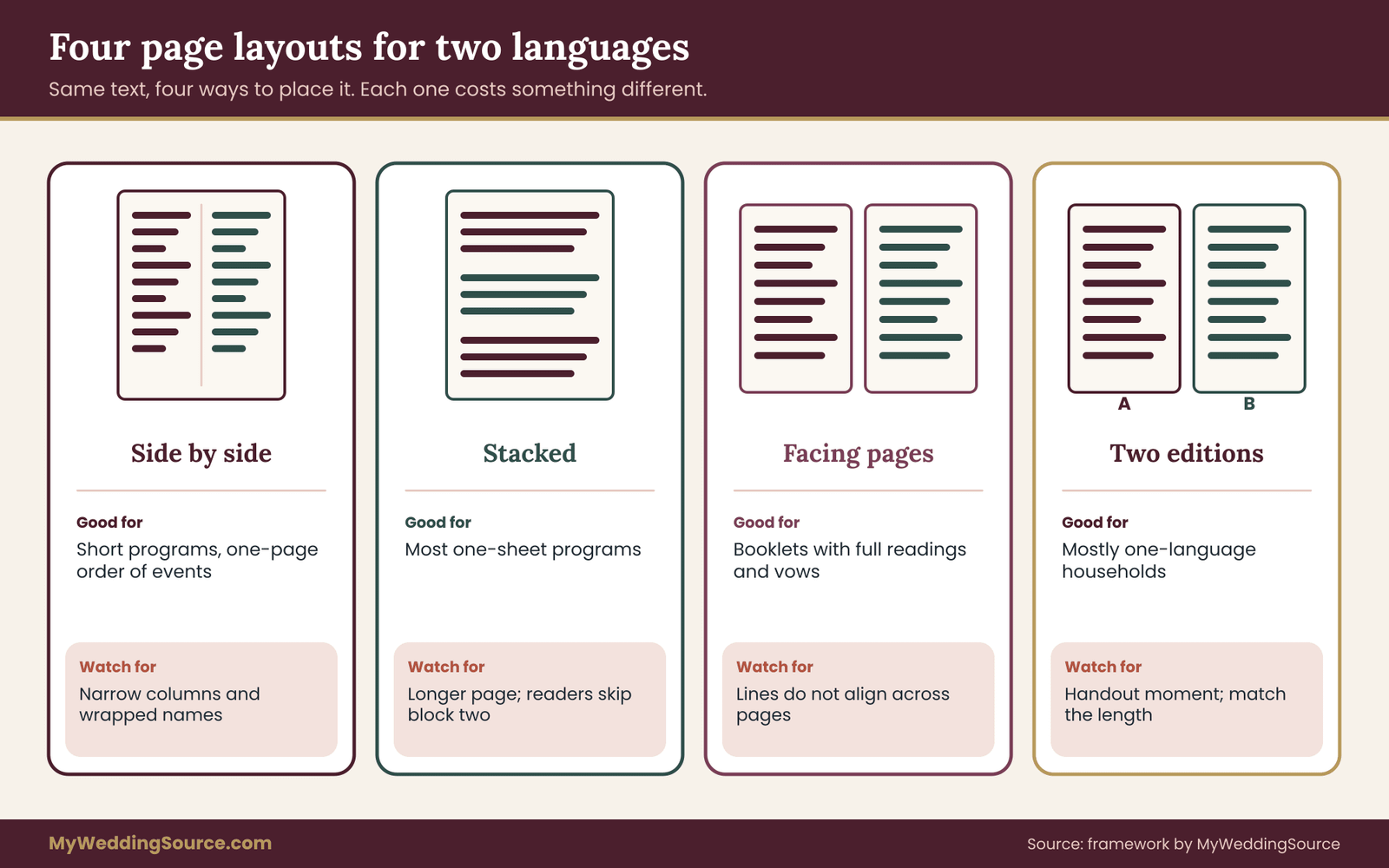
Once you know how the languages will be spoken, you can decide how they will sit on the page. There are four layouts worth considering, and each has a cost.
Side by side. Two columns, one per language, on the same page. The reader sees the whole segment in both languages at once. It is easy for a bilingual reader to compare and for a one-language reader to find their column. The cost is width: columns get narrow, headings wrap and long names break awkwardly. It works best for short programs and for a single page of order of events.
Stacked. Each item appears in one language and then, directly below, in the other. This keeps the full line width and reads naturally top to bottom. The cost is length, and the risk that readers skim past the second block, assuming it repeats the first. Use a consistent visual difference between the two blocks, such as a lighter weight or an italic for the second language, so the eye learns the pattern.
Facing pages. A folded program where the left page is one language and the right page is the other. It looks balanced and lets each language have its own typography and its own breathing room. The cost is that segments rarely land on the same line across both pages, so a reader looking for “the second reading” in the other language has to hunt. It also takes a four-page or six-page format, which affects the print budget.
Two editions. Separate programs, one per language, handed out according to what each guest prefers. Each guest gets a clean single-language document. The cost is the handout moment: someone has to ask each guest which version they want, and a bilingual guest or a mixed household may want both. Make sure the two editions are the same length and structure, so a reader holding one can follow someone holding the other.
Choosing a layout for the bilingual ceremony program
A short program of a single sheet, with a couple of readings and a moderate order of events, is usually best as side by side or stacked. A booklet with full text of vows and readings is usually best as facing pages or two editions. If you cannot decide, ask the printer for a mock-up of two layouts using your real text. Seeing the real wrap and the real length settles the question faster than talking about it.
Whatever layout you choose, keep the order of the two languages consistent through the whole bilingual ceremony program. If language A comes first on page one, it comes first everywhere. Switching the order midway can look like a message about priority, even when it was only a layout convenience. If you want to avoid any implication of priority, choose a rule, such as alphabetical order of the language names, or the order in which the two families will be seated, and apply it throughout.
Language on the rest of the paper trail
The bilingual ceremony program is one document in a set. Your invitation, save-the-date, signage and day-of paperwork also communicate in some language, and guests will notice if the languages used at each stage do not match. If your invitation was bilingual, the bilingual ceremony program should be too. If your invitation was in one language, a sudden bilingual ceremony program is a welcome surprise, but think about whether the guests who needed the translation got the information they needed to come at all.
The wedding invitation etiquette guide covers wording and what to include, which helps you keep the bilingual ceremony program consistent with what guests already received.
Deciding what to translate, what to keep, and what to adapt
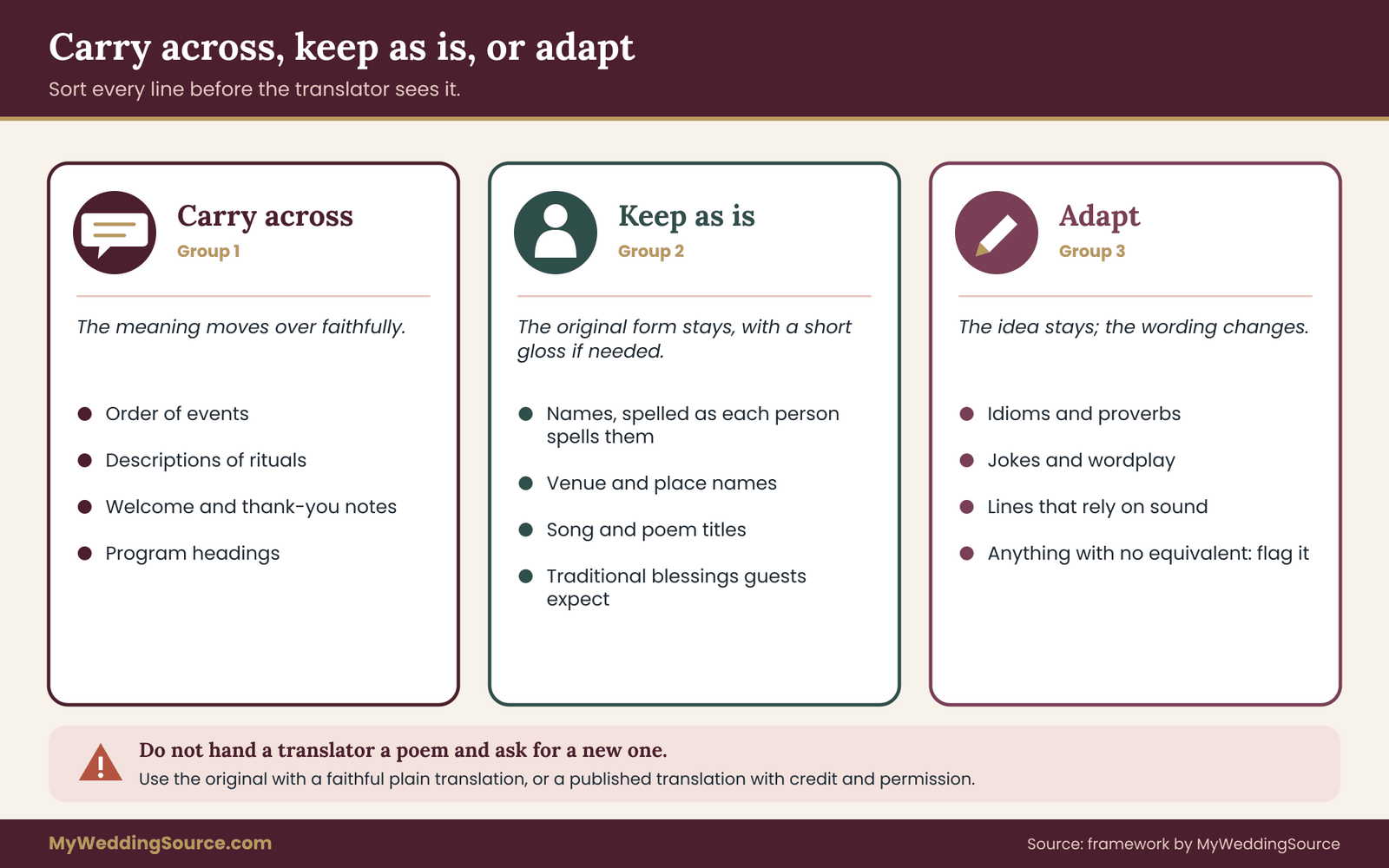
Not everything in a ceremony should be translated the same way. Some words must be carried across. Some should stay exactly as they are. Some need adapting, meaning the idea is kept but the wording changes because the literal version would not work. Sorting each bilingual ceremony program item into one of these three groups, before the translator sees the text, saves time and avoids hurt.
Carry across. Order of events, descriptions of rituals, welcome and thank-you notes, the officiant’s explanation of what is happening, the bilingual ceremony program’s own headings. These have a clear meaning that a translator can render faithfully.
Keep as is. Names of people, which should be spelled exactly as each person spells them. Place names and venue names. Titles that function as names, such as the title of a song or a poem in its original language. Some religious or cultural terms that guests expect to hear in their original form, such as a blessing in a traditional language. Where a term is kept as is, a short gloss in the other language tells those who do not know it what it means.
Adapt. Idioms, jokes, proverbs, humor in a welcome, and any line that depends on a sound or a double meaning. A literal translation of an idiom is usually either nonsense or a different joke. The translator should be asked to find the nearest equivalent that carries the same feeling, and to tell you when no equivalent exists so you can choose whether to cut the line or keep it with a note.
Names and titles in a bilingual ceremony program
Names look simple and cause more friction than anything else. Decide in advance how each person’s name will be written in each version. Keep the diacritical marks, the order of family and given names that the person uses, and any preferred spelling. If a name is written in a non-Latin script, decide whether the bilingual ceremony program will show the original script, a romanization or both, and ask the person which they prefer. A name written without its accent marks is not neutral; it is a small error in someone’s identity.
Titles and honorifics follow a similar rule. A form of address that is respectful in one language may be too formal, too casual or missing in the other. For grandparents, aunts, uncles and family friends, ask the family what each person is called. For the officiant, the bilingual ceremony program can use their title as they would introduce themselves. If you are unsure, add a short line to the translator’s brief: “Use the form of address each family actually uses, and flag any you are unsure about.”
Readings, songs and poems
A reading is a special case, because a poem or a passage has an author and a form. Do not ask a translator to rewrite a poem from scratch unless you want a new poem. There are three honest options. Print the original text in its own language with a faithful plain translation beside it, and say so. Use an existing published translation, with credit and with permission where the text is still under copyright, which means asking the publisher or rights holder rather than assuming. Or choose a reading that exists in both languages, written by a person who wrote in each.
Song lyrics follow the same logic, with the added complication that lyrics are almost always protected by copyright. Printing a title and the performer is fine as a program credit. Printing full lyrics or a full translation is a rights question, so skip it unless you have permission, and let a short description of the song’s meaning in your own words carry the idea instead.
Religious texts and ritual wording deserve a conversation with the person who will lead them. If your ceremony includes a blessing or prayer from a particular tradition, ask the officiant or a community member which wording is the accepted one in each language, because translations of liturgical text can vary between communities. The interfaith ceremony planning guide discusses who owns which ritual, which is a useful starting point when the language question and the ritual question overlap.
The review chain: how a translator checks a bilingual ceremony program
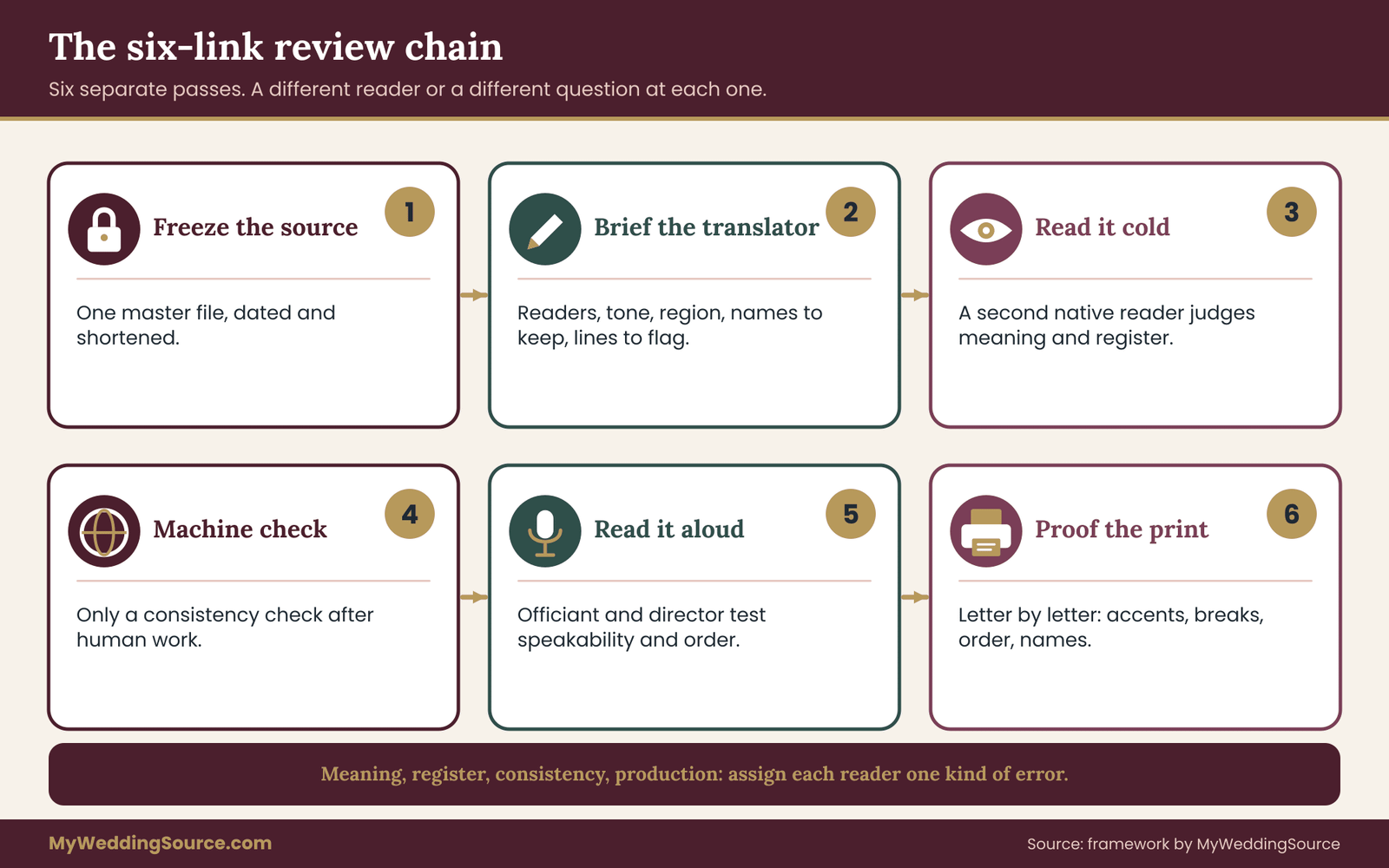
A translation done once by one person is a draft. A reviewed bilingual ceremony program has passed through a chain of different readers, each looking for a different kind of problem. The chain below has six links. You do not need six separate people. You need six separate passes, and ideally at least three different pairs of eyes.
Link one: the source text is settled
The review chain starts before translation. If the source text keeps changing, the translation will lag behind it or contain a mix of old and new wording. Freeze the source text, meaning the bilingual ceremony program as you want it in your first language, and date it. Keep one master file. When a change is needed later, make it in the master and send the translator only the changed lines with the reason.
Freezing also forces a useful discipline: shorten the source. Every unnecessary sentence in the source becomes a sentence in the translation, and then a sentence to proofread, fit on the page and, in some models, say aloud. Cut descriptions that do not help a guest understand what is happening.
Link two: the translator works from a brief
Give the translator a one-page brief, not just a file. Tell them who will read it (guests of mixed ages and education levels), where it will be read (a wedding ceremony, in print), the tone you want (warm, plain, moderately formal), and which words to keep, adapt or flag. Tell them the regional variety your guests speak, if you know it, because vocabulary and formality differ between regions of the same language.
Ask for specific things: a clean translation, a list of any lines where the translator made a judgment call, and a note on any line that is much longer or shorter than the source. A translator who sees a line that will run long can often offer a shorter alternative before the type is set.
If you hire a professional, the American Translators Association is a reasonable place to see how the profession describes its standards and how to find qualified members, including those certified in particular language pairs. A professional charges for time, and a short bilingual ceremony program is a small job. A relative or friend can be a valid choice for a personal note, as long as the rest of the chain is in place and the person is comfortable being asked to revise.
Link three: the second reader checks meaning and register
The second reader is the most valuable link, and the one couples skip. This is a different native speaker of the target language, ideally from a background close to your guests, who reads the translation without seeing the source first. They answer three questions. Does this read naturally, as if written in this language? Is the tone right for a wedding, neither stiff nor too casual? Would a guest from our family understand every word?
Then they read the source alongside the translation to check for meaning errors, omissions and additions. This order matters. A reader who sees the source first tends to forgive awkward phrasing because they can see what it was meant to say. A reader who sees only the translation finds the awkwardness.
The second reader is also where regional differences come out. A word that is ordinary in one country can be odd, old-fashioned or mildly embarrassing in another. If your two families come from different regions that share a language, have one reader from each look at the key lines. When they disagree, choose the wording that the older and less formal readers find easiest to understand, or use neutral wording that both accept. If no neutral wording exists, flag the line and decide as a couple.
Link four: the machine pass is a check, not a source
Machine translation tools are tempting, and they have a legitimate use at one specific stage: as a quick consistency check after the human work, to see whether a line reads differently when run through a tool. Do not use a machine translation as the translation itself for a ceremony document. Tools tend to handle names, set phrases and formal register inconsistently, and they can produce text that is fluent and wrong at the same time. That combination is the hardest kind of error for a non-native reader to spot.
If you do use a tool as a first draft, label it internally as a first draft and run the complete chain, including a human translator who is willing to rewrite rather than polish. A translator asked only to “fix” a machine draft can anchor on its errors.
Link five: the officiant and ceremony director read it for the room
Next, the people who will say or cue the words read the final text aloud. This is a different kind of review: not accuracy, but speakability. They look for tongue-twisters, long sentences that need two breaths, names they are unsure how to pronounce and places where a pause would help. The officiant may want to change a phrase so that it sits better in the mouth, which is a legitimate change only if the translator agrees it keeps the meaning.
This link is also where the ceremony director, or the person who will cue the readers, confirms that the printed order matches the order that will actually happen. If the bilingual ceremony program says a reading follows the welcome and the director plans it after the vows, the mismatch will be obvious to every guest holding the bilingual ceremony program.
Link six: the print proof is read letter by letter
The last link is the proof. After layout, someone reads every line of the proof against the approved text, not against memory. Printing errors in a second language are common because the person setting the type may not read it. Accent marks vanish, hyphenation breaks a word in the wrong place, a character is replaced by a box, a line is cut off at the column edge. The reader who knows the language checks these by eye, and the couple’s own eyes are not enough, because after many readings you stop seeing what is on the page.
Who does what on a simple bilingual ceremony program
For a short, one-page program with a plain translation, the chain can collapse to three people: the couple, who write the source and freeze it; a translator, who translates and flags; and a second native reader, who checks the result and later the print proof. The officiant reads the final text during rehearsal. That is enough, provided each person does a different job, and provided the second reader did not see the translation while it was being produced.
Four kinds of error the chain is designed to catch
It helps to know what you are looking for. Reviews fail when everyone reads for “mistakes” in general and nobody reads for a specific kind. Assign each reader a specific kind.
Meaning errors. The translation says something different from the source. These range from a wrong word (a false friend that looks similar in both languages but means something else) to a dropped negative that reverses a sentence. The translator and the second reader catch these when they compare line by line.
Register errors. The meaning is right, but the tone is wrong: too formal, too chatty, too religious, too secular, too old-fashioned. A wedding register is warm and moderately formal, and each language has its own version of that. The second reader, who reads the translation cold, is best placed to hear it.
Consistency errors. The same word is translated two ways in different places, a name is spelled two ways, or a ritual is called by two different terms. Readers feel this as sloppiness even if they cannot say why. A short glossary kept by the translator prevents it. Ask for that glossary, even if it only lists ten terms.
Production errors. Everything that goes wrong between the approved text and the paper: lost accents, wrong line breaks, mismatched fonts, text that does not fit, wrong order of items. The print proof pass catches these.
A short brief you can adapt
If you are writing the translator’s brief and want a starting point, here is a version in plain language. Replace the bracketed parts with your own details.
“This program will be handed to guests at a wedding ceremony. Readers range from teenagers to grandparents, and many will read it only in [language]. Please use a warm, clear, moderately formal tone and the vocabulary used in [region or community]. Keep names exactly as listed. Tell us about any line you changed for meaning, any line that is much longer than the original, and any term that has no good equivalent.”
That brief is short enough to read in a minute and specific enough to prevent the three most common misunderstandings: tone, vocabulary and flagging.
Paying for review of a bilingual ceremony program without overspending
There is no need to guess about cost, and no reason to invent a figure. Ask two translators for a quote based on your actual word count, and ask what the quote includes, such as one round of revisions, a glossary and a second read. A bilingual ceremony program is a small document, but the risk is concentrated in a few lines, namely the welcome, the officiant’s explanation, the readings and the thank-you.
If the budget is tight, spend the money on the translator for the key lines and the second reader for the whole text, and handle the print proof with volunteers who read the language.
What you should not do is skip the second reader to save a small amount. It is the cheapest link in the chain and the one most likely to catch the error that guests will remember.
What to do when reviewers disagree
Disagreement between the translator, the second reader and a family member is normal, and it is information. When two competent readers disagree about a line, the line has more than one defensible version, and the choice is yours. Ask each reader to explain their preference in one sentence. If the reasons are about accuracy, go with the more accurate version. If the reasons are about taste, choose the version that the least comfortable reader finds clearest. If a reader’s objection is that a family member will be offended, ask that family member directly, with the two versions in front of them.
Record the decision in the line ledger described later in this guide. A line that was settled after a discussion should not be reopened at the last minute by someone who was not part of the discussion.
Parallel time cues for a bilingual ceremony program
Translation review answers the question “is it right?” Timing review answers the question “does it fit?” The two cannot be separated, because a translation that is perfect but runs far longer than the source changes the ceremony. A parallel time cue is a simple idea: for every spoken segment, you record how long it takes in each language, side by side, and you use those numbers to build the ceremony timeline and to decide where to cut, merge or shift.
Why the two languages do not take the same time
Languages differ in how many syllables and words they need to carry the same meaning, in how quickly speakers normally talk, and in how many small connecting words they use. For many language pairs, one version of a sentence is noticeably longer than the other when spoken. Spanish, for instance, often runs longer than English for the same content, while some other pairs go the other way. Treat that as a reason to measure, not as a rule to apply. The only reliable figure is the one you get from a real person reading your real text at ceremony pace.
There are further reasons the numbers differ from what a word count suggests. Formal registers tend to be slower and longer. Names and honorifics add syllables. Pauses for emphasis in one language may be shorter or longer than in the other. A reader who is less comfortable in their second language will go slower, and that matters if you ask a guest or a relative to read in the language they use less often.
And then there is the switch itself. Moving from one language to the other costs a beat: the speaker finishes, the room shifts, the next speaker begins. In a full sequence that is repeated at every segment, those beats add up.
How to time a bilingual ceremony program
Measuring takes an hour and a stopwatch, and it is worth doing before the bilingual ceremony program is printed. Follow these steps.
First, break the ceremony into segments. Use the same segments that appear in the bilingual ceremony program: welcome, first reading, officiant’s address, vows, rings, declaration and so on. Include the non-spoken segments with their own times, such as the processional and the recessional, since they set the frame.
Second, have the actual speaker, or someone with a similar pace, read each segment aloud in each language at the speed they would use in the ceremony, not the speed they would use to get through it quickly. Time each reading. Do it twice and take the longer figure, since nerves and a full room slow people down more often than they speed them up.
Third, write the numbers beside each line. This is your set of parallel time cues. For each segment you now have a time in language A, a time in language B, and the difference.
Fourth, add the transition beat. For each switch between languages, add a small allowance, a few seconds for the speaker to hand over and the room to settle, and use a larger allowance when the speaker changes physically, such as someone walking to the microphone.
Fifth, total the columns according to the language model you chose. A full sequence adds both columns. An alternating model adds only the parts that will actually be spoken. A core-and-key-moments model adds the full core language and only the key segments from the second.
Reading the numbers
Once you have the totals, three questions turn them into decisions.
Does the total fit the window you set earlier? If not, you need to cut or shift. The first thing to cut is rarely a translation; it is a sentence in the source that does not need to be said twice.
Is any one segment out of proportion? A single long segment, such as the officiant’s address, often accounts for more of the overrun than all the others. Splitting a long segment into a short bilingual summary and a fuller printed version can save more time than trimming ten small ones.
Does the second language sit at the same point in every segment? Consistency helps guests. If the second language comes after the first in the welcome and before it in the address, people will not know when to listen and when to read.
Pace and silence in a bilingual ceremony program
Do not attempt to recover time by asking speakers to talk faster. A ceremony is not a presentation, and a rushed delivery undoes the warmth you are building. Recover time by cutting content, by moving a segment to the printed bilingual ceremony program or by choosing a different model for a long segment. Silence is also a legitimate part of the timeline. A pause after the vows or before the declaration is part of the moment, and if you cut it for time you lose the part guests remember.
Where time cues live in your documents
Time cues do not belong in the guest-facing bilingual ceremony program in most cases. Guests do not need to know that the officiant’s address runs three minutes. What they need are the cues that help them follow, such as a short line saying a reading will be given in one language with a translation printed below.
The numbers themselves belong in your working documents: the line ledger described in the next section and the cue sheet the ceremony director and the officiant carry on the day. If you are building a cue sheet, the processional timing and cue sheet guide walks through how to organize cues and handoffs for the officiant, music and readers, and the parallel time cues drop straight into that structure as additional columns of information. In practice, you simply add the second-language duration beside each existing cue.
Three kinds of time cue
It helps to separate three kinds, because each is used differently.
Duration cues record how long a segment takes. They set the total and show where the overrun comes from.
Handoff cues record who speaks next and what signals the handover. In a bilingual ceremony the handoff is more important than usual, because speakers change languages, and sometimes people. A glance, a nod or a short spoken phrase can serve as the signal, but it has to be agreed in advance. Write the signal into the cue sheet in plain words, such as “officiant finishes the welcome and steps back; reader two steps forward.”
Buffer cues record the small allowances you build in: the transition beat, the pause after a moving line, the time a guest needs to turn a page. A ceremony without buffers looks fine on paper and runs long in practice.
The effect on music and movement
Music is the most rigid element in a ceremony timeline. A processional piece has a fixed length, a recessional starts when the officiant says it does, and a musician who plays during a reading needs to know when to stop. If the bilingual ceremony runs longer than planned, the music does not stretch. That is why you give the musicians the measured times, not the original English-only estimate.
Movement matters too. If the officiant steps aside while a bilingual reader delivers a passage, the walk takes time. If the couple turn to face each other for vows in two languages, it takes a moment to turn back. These are small, and they add to the total, so write them down.
Worked timing: a short illustration
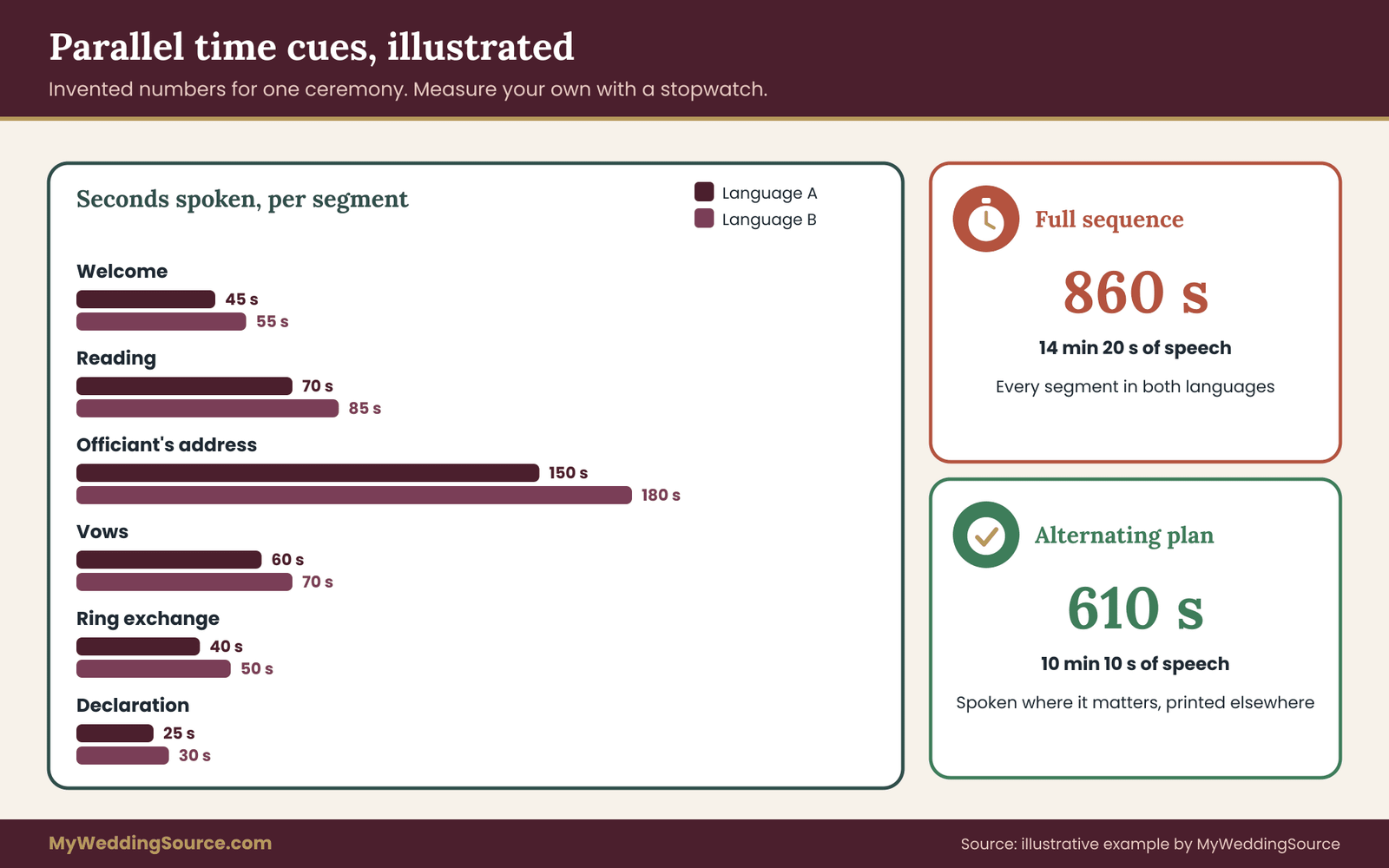
To make this concrete, here is an invented illustration with plain numbers. The segments, durations and totals below are made up for the example and are not a benchmark. Your numbers will differ.
Suppose a ceremony has six spoken segments. The welcome runs forty-five seconds in language A and fifty-five in language B. The reading runs seventy seconds and eighty-five. The officiant’s address runs a hundred and fifty seconds and a hundred and eighty. The vows, taken together for both partners, run sixty seconds and seventy. The ring exchange runs forty seconds and fifty. The declaration runs twenty-five seconds and thirty.
In language A alone, the spoken total is three hundred and ninety seconds, or six and a half minutes. In language B alone, it is four hundred and seventy seconds, or just under eight minutes. A full sequence, with every segment in both languages, adds up to eight hundred and sixty seconds, a little over fourteen minutes of speech, before the processional, the recessional and the pauses. That is more than double the single-language speech time.
Now compare an alternating plan. The welcome is delivered in both languages, a hundred seconds. The reading is given in language B only, with the translation printed, eighty-five seconds. The address is given in language A, with a forty-second spoken summary in language B, a hundred and ninety seconds. The vows are spoken by each partner in their own language, with translations printed, a hundred and thirty seconds.
The rings are spoken in one language, fifty seconds, and the declaration is delivered in both, fifty-five seconds. The speech total is six hundred and ten seconds, about ten minutes, a saving of more than four minutes against the full sequence, and every guest has still received the whole ceremony in some form.
The saving did not come from cutting meaning. It came from deciding, segment by segment, where the second language would be spoken and where it would be printed. That decision is the heart of the parallel time cue method, and it is why the times need to be measured before the layout is final.
What the example does not tell you
The example uses clean numbers to show the arithmetic. Real measurements are messier. A speaker will take longer on a segment than you expect, and a name that is hard to pronounce will slow the vows. Use the example as a method, not a template, and replace every number with your own.
Deciding where the second language is spoken and where it is printed
The measurement leads to a practical decision rule for each segment. Ask three questions in order.
Is this segment emotional or ceremonial, where hearing the words matters as much as understanding them? Vows, the declaration and a welcome are usually like this. Speak these in both languages, or in each partner’s own language, and keep them short.
Is this segment informational, where understanding matters more than the sound? Explanations of a ritual, a description of who is doing what, a list of thanks are usually like this. Speak these in one language and print the other.
Is this segment long, where repeating it would stretch the ceremony? A long address or a long reading falls here. Speak it in one language, give a brief spoken summary in the other and print the full translation.
Applying the rule to every segment gives you a map of the ceremony that the bilingual ceremony program can mirror exactly. Guests who read the bilingual ceremony program see in each line which language will be spoken and where to look for the other. That is the practical meaning of a bilingual ceremony program that supports the ceremony instead of competing with it.
The line ledger: a translator-reviewed matrix for a bilingual ceremony program
Everything so far produces a lot of small facts: which language is spoken, who translated a line, who reviewed it, how long it takes in each language, who gave final approval. If those facts live in five email threads, they will contradict one another by the week of the wedding. The line ledger is a single working document that holds them all, one entry per line of the bilingual ceremony program. Think of it as the matrix that sits behind the printed page. It is not a guest document, and it does not need to be elegant. It needs to be complete and current.
Because a table is hard to read in a narrow space, here is the ledger described in words. Each entry has the same eight fields, in the same order.
Line number and heading. A simple running number and the segment’s name, so that everyone can say “line seven” and mean the same thing.
Source text. The exact words in the first language, as frozen.
Target text. The exact words in the second language, as approved or as currently proposed.
Handling. Whether the line is carried across, kept as is or adapted, using the three groups from earlier.
Spoken plan. Which language is spoken aloud, who speaks it, and whether the other language is printed, summarized or omitted.
Time cue. The measured duration in each language, plus any transition allowance, written the same way every time.
Review trail. Who translated it, who read it cold, who checked it for speaking and who checked the proof, with dates.
Status and notes. One of a small set of statuses, plus any open question.

Why eight fields and not three
It is tempting to keep only the text and the status. The other fields earn their place because they answer questions that come up late and cause trouble. When the officiant asks why a line changed, the review trail says who changed it and when. When the ceremony runs long, the time cue shows the cost of each segment. When a family member objects to a word, the handling field shows whether the line was adapted deliberately.
A small set of statuses
Use as few statuses as you can, and define them. Five are enough.
Draft. The line exists but has not been reviewed.
Translated. A translator has produced the target text and flagged any judgment calls.
Read cold. A second native reader has checked the target text on its own and then against the source, and any changes have been made.
Spoken. The person who will say the line has read it aloud and the time cue is recorded.
Locked. The line is approved for print, and any further change requires saying so to everyone who holds a copy.
A line cannot be locked until it has passed through the earlier statuses. The status is the quick way to see where the work stands. If twelve lines are locked and four are still translated, you know exactly what remains before the print deadline.
Keeping one version of the bilingual ceremony program
The ledger fails if two versions of it circulate. Keep one master copy and give everyone else a read-only copy or a link. When a line changes, change it in the master and note the change in the review trail. When you send the text to the printer, send the locked lines only, and keep the dated file you sent. If a question comes up after printing, the dated file tells you what was approved.
A shared document where one person has edit rights is usually enough. The point is not the software; it is the rule that only one copy is the truth.
Handing the ledger to the officiant and the ceremony director
The officiant and ceremony director do not need every field. Give them the line number, the spoken plan, the time cue and the target text, and ask them to read it before rehearsal. Their feedback goes back to the person who keeps the ledger, who decides whether it changes the text or only the delivery. Having one owner of the ledger prevents the common situation where three people quietly edit three copies.
When the program has a reading that comes from a published source, add a note in the ledger recording where the text came from and what permission, if any, applies. Readings that are very short may be fine; longer ones may need the publisher’s agreement. Readings from texts in the public domain are simpler, though the translation you print may still be someone else’s work, so note the translator too.
If you are building a ceremony around readings with a non-religious tone, the guide to non-religious ceremony scripts offers ways to structure readings and might help you choose passages that exist well in both of your languages.
Typography, access and print proofing
Good translation can be undone by a page that is hard to read. The typography of a bilingual ceremony program is not decoration. It decides whether a grandparent can read the text at all.
Type size and weight in a bilingual ceremony program
Choose a body size that an older reader can read in dim light. Ceremonies are often held in rooms or outdoor spaces where the light is low, and program text that looks fine on a desk can be hard to read on a lap. Print a test page on the paper you plan to use and read it in the lighting you expect. If you cannot comfortably read it at arm’s length in dim light, the size is too small.
Give both languages the same type size and weight in body text. Differences in size read as a ranking. If you need a visual distinction, use a different style such as italics or a muted color for the second language, and apply it consistently. Remember that italic text is harder to read in some scripts, and some scripts do not have an italic form at all, so test your actual scripts.
Fonts, scripts and special characters
Pick a typeface that supports every character you need in both languages. A typeface designed for one language can lack accented letters, special punctuation or whole scripts, and the software then quietly substitutes another font, producing mismatched text or empty boxes. The Noto font family and the Unicode standard are widely used references for broad language coverage; the Unicode Consortium’s site explains how characters from different writing systems are encoded, which is the reason a properly built file keeps accents intact when it moves between programs.
For your purposes, the practical advice is simple: ask the printer or designer to confirm that the chosen font includes every character in your text, and look at the proof for boxes or substitutes.
If either language uses a non-Latin script, give extra care to line breaking, spacing and the baseline. Scripts differ in line height, in how words are separated and in how text should be broken at the end of a line. A designer who does not read the script may not notice a bad break. Ask the second reader to check the proof for this.
Right-to-left scripts, if you are using one, require a layout that supports them, including the direction of columns. In a side-by-side layout, decide which column the right-to-left text goes in and keep the whole page consistent. Do not simply paste right-to-left text into a left-to-right layout and hope it works; the punctuation and numbers often end up in the wrong place.
Access beyond the page
Some guests will need more than a standard printed program. A large-print edition, with the same content in a bigger size, is simple to prepare and welcome to many readers. Ask guests when they respond to the invitation if they would like one, and print a few extra.
A digital version, such as a web page or a PDF reachable from a printed link or a code on the bilingual ceremony program, can help a guest who uses a screen reader or who wants to enlarge the text on a phone. If you build a web version, set the page language correctly for each section, so assistive software reads each language with the right pronunciation; the World Wide Web Consortium’s internationalization pages explain language tagging in plain terms. A digital version also lets you offer a third language later, if you discover a guest who needs it, without reprinting.
For a deaf or hard-of-hearing guest, a spoken-word ceremony needs a different kind of support: a sign language interpreter, a written script that matches the spoken words closely, or both. Ask the guest what they prefer, and ask the venue what it can provide. The ADA.gov effective communication pages describe what covered businesses and public entities are expected to do, and the guest’s own preference should lead. If you arrange an interpreter, share the ledger text with them in advance, since interpreters work better when they know names, terms and the order of events.
The proof pass, step by step
When the printer sends a proof, read it in a fixed order. First check the order of items against the ledger, since a missing or swapped item is easy to miss. Then check names, one by one, against the list of preferred spellings. Then read each language on its own from beginning to end, the second reader taking the second language. Then compare the two languages line by line for alignment: does the heading in one match the heading in the other, and does each line land beside or below its partner as planned?
Finally check the details that change nothing in meaning but a lot in impression: accents, hyphenation, page numbers, the date, the venue name and the spelling of the officiant’s title.
Do not approve the proof the same evening you receive it. Leave it overnight and read it again. Errors that you did not see at ten at night often appear at eight in the morning.
Printing quantities for a bilingual ceremony program
Order more copies than the guest count, since some guests take two, some get damaged, and some are needed for the keepsake box and for the officiant, the readers and the musicians. If you are using the two-editions layout, order each edition with its own overage, because running out of one language is a worse problem than having extra of the other. Keep a single spare of each edition clean and flat, to be used as the master record of what was printed.
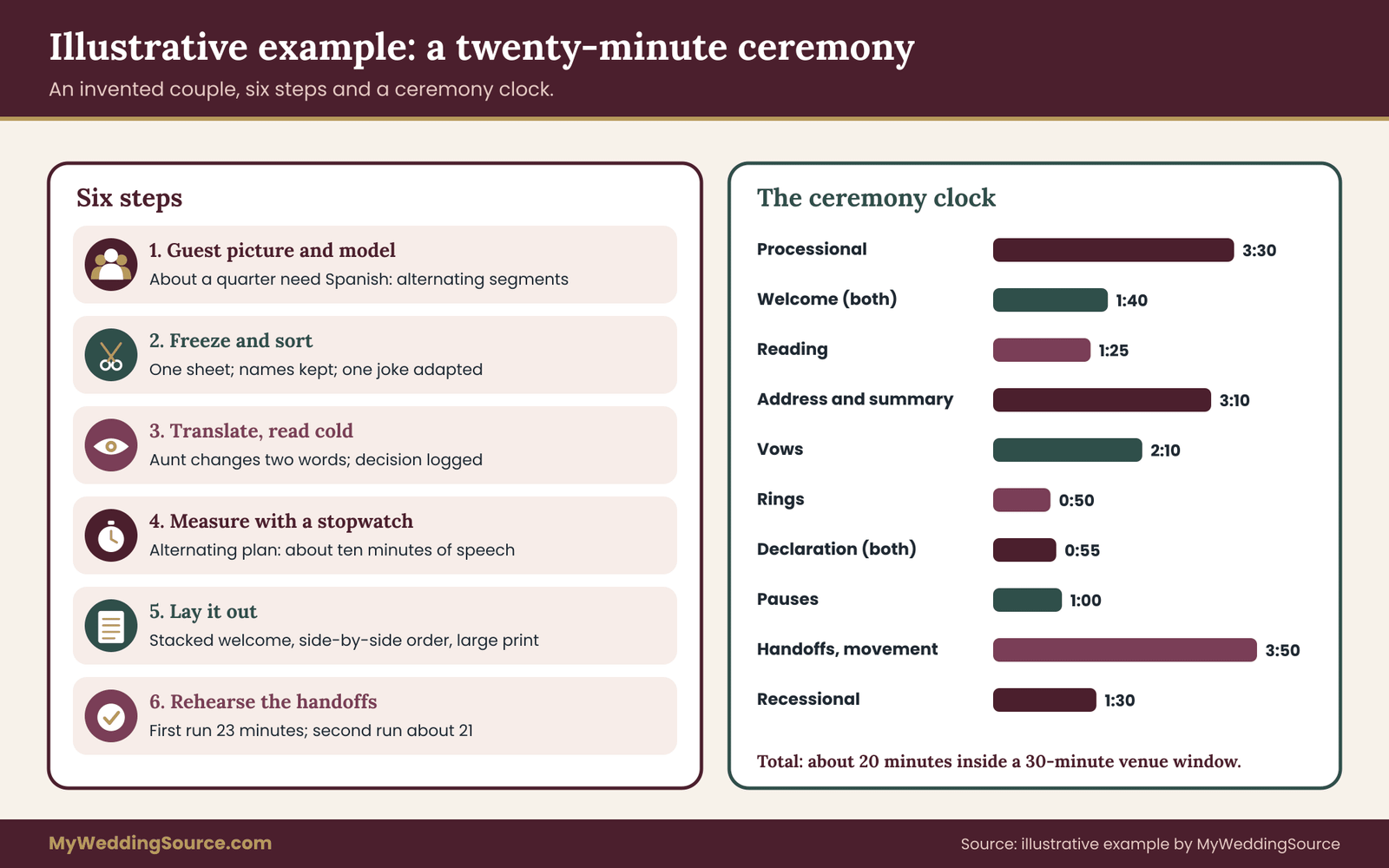
A worked example: a twenty-minute bilingual ceremony program
The following example is invented to show the method end to end. The people, the languages and the numbers are illustrative, and nothing here describes a real wedding.
Marisol and Daniel are marrying in front of about a hundred and twenty guests. Marisol’s grandparents and several aunts and uncles read and speak mainly Spanish. Daniel’s relatives and most of his friends read and speak mainly English. Many of Marisol’s cousins and friends are fully bilingual. The officiant, Reverend Pell, speaks English well and enough Spanish to pronounce it correctly but not to improvise. The couple want both languages to feel at home in the ceremony, and the venue has told them the ceremony space is booked for a thirty-minute window including guest seating.
Step one: the guest picture and the model
They count households. About a quarter of the room would be lost without Spanish, and a smaller group would be lost without English. That rules out printed translation only. A thirty-minute window with a twenty-minute target rules out the full sequence. They choose alternating segments with a brief spoken summary for the longest segment, and they write down the rule they will use: emotional segments in both languages, informational segments in one language with the other printed, long segments with a short summary.
Step two: freeze and sort
They write the bilingual ceremony program in English, shorten it to fit one folded sheet, and freeze it. Then they sort each line. The order of events and the welcome are carried across. Their names are kept exactly, including Marisol’s accent marks and the compound family name. The reading is a poem that exists in a published Spanish translation, so they keep the original and the published translation and note the source in the ledger. One line in the welcome, a joke about the weather, is marked as adapted, because the literal Spanish version of the English wordplay means nothing.
Step three: translation and the cold read
They hire a professional translator for the bilingual ceremony program text and the officiant’s address, with a short brief. The translator was trained in a different region from Marisol’s family, which is exactly why the second reader matters. Marisol’s aunt, a retired teacher, reads the Spanish cold. She changes two words that the translator used and that her family would not say, and she suggests a warmer form of address for the grandparents. The translator agrees with one change and explains the other. They settle the second by choosing a word that both readers consider natural. Each decision goes into the ledger’s review trail.
Step four: the measurement
Reverend Pell and the bilingual friend who will read in Spanish read every segment aloud, with a stopwatch, at the pace they would use in the ceremony. The numbers match the illustration earlier in this guide. The English-only speech total comes to about six and a half minutes, the Spanish-only total to just under eight, and a full sequence would be more than fourteen minutes of speech.
The alternating plan comes to about ten minutes of speech. With a processional of three and a half minutes, a recessional of about a minute and a half, a minute of pauses and the transition beats, the ceremony lands at roughly twenty minutes. That is inside the venue window with a margin for guests who arrive late and for a slow processional.
Step five: the bilingual ceremony program layout
The program is a single folded sheet. Page one has the names, the date and a short welcome in both languages, stacked, with the same type size. The inside spread has the order of events side by side, with a narrow column for time-neutral descriptions. Each segment shows which language will be spoken, using a small plain label, and where to find the other language. The reading appears in both languages on the inside right, with its source credited. The back page has a thank-you note and the names of the wedding party in a single list, since names do not need translating.
A large-print copy is printed for the two guests who asked for one when they replied to the invitation. A short web page with the same text lets a hard-of-hearing aunt follow along on her phone, and a sign language interpreter arranged through the venue receives the ledger text a week ahead.
Step six: the rehearsal and the handoff
At the rehearsal, the ceremony director walks through the order with the printed bilingual ceremony program in hand, and every handoff cue is spoken aloud. A first run comes in at twenty-three minutes. They find the extra three minutes in two places: a slow walk to the microphone for the Spanish reader, and a longer pause than planned after the vows. They keep the pause, move the microphone so the reader does not have to walk, and trim the summary of the address by one sentence. The second run comes in at about twenty-one.
What the example shows about a bilingual ceremony program
Three things stand out. The saving came from a decision about where each language lived, not from cutting meaning. The best catch of the process, the two words that the second reader changed, came from someone who knew the family, not from a tool or a professional. And the time check at rehearsal found the problem that the arithmetic missed: movement, not speech. A bilingual ceremony program built from this method is not a guarantee against surprises on the day. It is a way to meet them in rehearsal instead of in front of the guests.
Verification, limits and where the method fails
No method is complete, and it is worth being plain about the places where this one has limits.
What you must verify with an authority
Some facts belong to an issuing office, a venue or a vendor, and no amount of careful translation substitutes for asking them.
For the legal side of the ceremony, ask the office that issues marriage licenses in your jurisdiction, and your officiant, about any language requirement for the declaration, the license paperwork or the officiant’s role. Rules differ by place and change over time, and USAGov points to the right state or local office. Do not assume that a bilingual ceremony changes nothing, and do not assume that it changes something.
For accessibility, ask the venue what it can provide and what it must provide, and ask each guest who needs support what would help. The ADA.gov pages on effective communication describe general expectations for businesses and public entities; the details for your venue are a question for the venue.
For print, ask the printer to confirm in writing that the font supports every character in both languages, what proofing is included and what happens if an error is found after approval. A printer who offers a digital proof and one round of corrections is common; one who prints without a proof is a risk.
For rights, ask the publisher or rights holder before printing longer readings, translated passages or lyrics. Short credits and titles are generally fine; reproducing a full text is a different matter.
For language access in a broader sense, the federal interagency site LEP.gov explains language access principles for people with limited English proficiency. It is written for agencies, not weddings, but its plain guidance on using qualified translators and interpreters instead of untrained helpers is useful as a mindset.
Where the translator-review method has limits
A translator-reviewed program reduces error. It does not remove it. Translation involves judgment, and two qualified translators will produce two defensible versions of a line. The method does not tell you which is right; it makes sure someone made the choice deliberately and recorded it.
The method also cannot judge what is appropriate in a family. A phrase that is neutral to a translator can carry a history for a particular family, and only someone who knows them can say so. That is why the second reader should be someone close to the guest group.
Timing measurements are estimates. Real ceremonies include nerves, late arrivals, a crying child and a dropped ring. Measure, add a buffer and then add a little more.
Finally, the method does not replace professional interpretation. If a significant part of the room depends on live interpretation, or if a guest needs a sign language interpreter, hire a qualified interpreter and give them time to prepare. The printed bilingual ceremony program is a support, not a substitute.
When the second reader and the translator cannot agree
Occasionally the two cannot agree on a meaning, not just a wording. When that happens, stop and ask the person who owns the line. If the line is a vow, the person speaking it decides what they mean. If it is a welcome from the couple, the couple decide. If it is the officiant’s explanation of a ritual, the officiant or the community that owns the ritual decides. If no one owns the line and it cannot be settled, cut it. A line that no one can agree on will not read well in either language.
Edge cases that change the plan
Most weddings fit one of the models above, but some situations need extra thought.
Three or more languages. If a significant group of guests reads a third language, the full sequence becomes impractical. Choose one language for the spoken ceremony, and print translations in the other languages as single-language sheets or inserts. The printed insert approach scales more easily than a booklet with three columns. Keep the same segments and order in every insert, so that guests holding different sheets can still follow each other.
A couple who do not share a language fluently. If the two of you communicate in one language and one of you is learning the other, the vows may be the place where the language choice matters most. Some couples speak their vows in the language in which they know each other best, and read a short phrase in the other. That is a personal choice and a good one; the bilingual ceremony program can show both languages without implying that either partner is reading something they do not understand.
Children as readers or participants. A child asked to read in a language they are still learning needs a short passage, a phonetic guide in the ledger and a rehearsal. Keep it brief and kind. The printed text for the child is for the child’s use, so give them a large-print card.
A dialect or regional difference between families. When two families share a language but not a regional vocabulary, avoid terms that mean something different in each region. The second reader from each region helps, and a short glossary in the translator’s notes records the choices.
Late changes. A last-minute change to the wedding party, the readings or the order of events affects the bilingual ceremony program and the ledger together. If the printing deadline has passed, a small insert slip or a handwritten correction card is better than a second print run, and the slip needs its own review in both languages.
Signage and other printed matter. The program is one piece of paper among several. The wedding signs, the welcome sign and any directional signs will also be seen by guests in both languages. The wedding signage system guide covers readability, placement and proofing, and the same translation review chain applies to every sign that carries words.
Day-of handoff and the ceremony director’s copy
By the wedding day the work is done, and what remains is making sure it survives contact with a crowd. A bilingual ceremony needs a slightly more careful handoff than a single-language one, because more people hold part of the plan and because the plan has more places where a cue can be missed.
The three copies of the bilingual ceremony program that matter
Three people need their own working copy, and each needs something different.
The ceremony director, or whoever runs the order on the day, needs the full cue sheet: the segments in order, the spoken plan, the measured time for each, the handoff signal and the buffer notes. This copy is the one that decides whether the ceremony stays on schedule. It also carries the contact details of each speaker and the location of any equipment, such as a second microphone or a set of interpreter headsets.
The officiant needs the spoken text in both languages for the segments they will say, marked with the pronunciation of any names and terms. A phonetic note written in the officiant’s own spelling system is more useful than a technical transcription. The officiant also needs to know exactly what the legal portion requires in the jurisdiction, which the guide to officiant requirements can help you confirm with them before the day.
The readers and any bilingual host need only their own passages, printed in a large size, with a clear marker for where they begin and the cue that tells them to start. Do not give a reader the full ledger. A reader who sees the whole plan can get nervous about the parts that are not theirs.
The handoff signals
A bilingual ceremony runs on small signals. Agree on them at the rehearsal and write them in plain words.
When the officiant finishes a segment in one language and a reader is meant to step forward, what tells the reader? It can be a spoken phrase (“Please welcome our reader”), a pause and a nod, or a cue from the ceremony director. Choose one signal and use it consistently, so that speakers learn to look for it.
When a speaker switches language mid-segment, how does the room know? Often a short spoken bridge helps, such as one sentence in the second language saying that the next part will be repeated or summarized. Bridges are short and warm, and they prevent the silence in which guests wonder if something is wrong.
When something goes off script, who decides? Name one person, usually the ceremony director, who has the authority to cut a segment, shorten a summary or skip a translation if the ceremony is running long. Agree in advance which segments can be cut without loss, and write that list on the cue sheet. A decision made calmly at the rehearsal is better than one made in a panic at the microphone.
A short script for the opening
If the officiant or host would like a few words to set expectations at the start, plain language works best. Adapt this to your own languages and style, and have it reviewed through the same chain as the rest of the text.
“Welcome, everyone. Today’s ceremony will be spoken in two languages, and the bilingual ceremony program in your hands has the other language beside or below each part. Please follow along in whichever language you prefer.”
Two or three sentences are enough. A long explanation of the language plan takes time and tends to make guests feel that the ceremony is an exercise instead of a celebration.
What to bring on the day
Pack a small kit for the ceremony director. It should hold the cue sheet, a clean spare of each edition of the bilingual ceremony program, the large-print copies, a printed copy of the ledger’s locked text for emergencies, a pen, a small flashlight for low-light venues and a charged phone with the digital version of the bilingual ceremony program. If the ceremony uses any listening equipment, add spare batteries and the name of the person who knows how it works.
After the ceremony: filing the bilingual ceremony program
Keep a clean copy of each edition of the bilingual ceremony program, along with the final ledger and the dated file that went to the printer. In a few years, when a relative asks what was said in the second reading or who translated the vows, you will have the answer. Some couples also write a note on the back of one copy about which guest needed which language and why, which becomes part of the story of the day.
Your next steps
Start with the guest picture and the language model. This week, count the households that would be lost without each language, choose the model, and write down the maximum length your ceremony can run. Then ask your officiant and the office that issues marriage licenses whether the bilingual ceremony changes anything about the legal portion.
Next, freeze the source text, sort every line into carry across, keep as is or adapt, and send a short brief to a translator. Book a second native reader for the cold read, and a volunteer who reads both languages for the print proof.
Then measure. Have the real speakers read each segment aloud in both languages, write the times in the line ledger and compare the total with your window. Decide which segments are spoken in both languages, which in one language and which only printed, and build the layout to match.
Finally, run the proof pass overnight, hand the right copy to the right person and rehearse every handoff aloud. If you do those things in that order, the bilingual ceremony program will do what it is meant to do: let every guest follow the ceremony in the language they read best, without making any language feel like an afterthought.
FAQ
How many versions of a bilingual ceremony program should we print?
It depends on the layout. A side-by-side or stacked bilingual ceremony program needs only one edition, since both languages share the sheet. Two separate editions need a print run for each, with its own overage. Add a few large-print copies for guests who ask, and a clean spare of each edition for your records. Ask guests about large print when they reply to the invitation so you can count them.
Can a bilingual friend translate the bilingual ceremony program instead of a professional?
Yes, for a short and personal program, as long as someone else reads the result cold. A friend who is fluent may still use a register or regional vocabulary that does not suit your guests. The risk is not skill so much as a lack of a second check. For legal text, long readings or an officiant’s full address, a professional translator is a safer choice.
Should both languages be spoken during the ceremony or only printed?
It depends on your guests and your time window. Emotional moments such as vows, a welcome and the declaration are often spoken in both languages. Informational parts can be spoken in one language and printed in the other. Long segments can be summarized aloud and printed in full. Measure the time for each segment before deciding, since the total can grow quickly.
How much longer does a ceremony run when it is bilingual?
It depends on the model and the languages, so measure rather than assume. A full sequence that repeats every segment can more than double the speech time, while alternating segments with printed translation can keep the extra time small. Read each segment aloud in both languages with a stopwatch, add a short allowance for each switch and check the total against your venue window.
Do we need a certified translator for a wedding program?
No certification is required for a bilingual ceremony program, since it is not an official filing. Still, a translator with professional training or a recognized credential, such as one found through the American Translators Association, brings consistency and a glossary. If any part of your ceremony paperwork needs an official translation, ask the issuing office what it accepts, because requirements vary by jurisdiction.
Which language should come first on the page?
Choose a neutral rule and apply it throughout, such as alphabetical order of the language names or the order of the two families’ seating. Switching the order halfway can look like a statement about priority. Using the same type size and weight for both languages matters more than which comes first, so make that equal.
What if guests read different regional versions of the same language?
Have a second reader from each region check the key lines, and choose vocabulary that both find natural and clear. If no neutral word exists, flag the line, discuss it with the two families and record the decision. Keep a short glossary of any terms where regions differ so that future documents, such as thank-you notes, stay consistent.
What should we do if we find an error after printing?
Decide how serious it is. A misspelled name or a wrong date deserves a correction slip or a handwritten card tucked into each bilingual ceremony program, reviewed in both languages like any other text. A small typographical slip may not justify a reprint. Ask the printer about reprint terms, and update the ledger so that your record shows what was actually distributed.
Sources
- Marriage license and certificate information, USAGov
- USAGov, official guide to government information and services
- Effective communication requirements, ADA.gov, U.S. Department of Justice
- Limited English proficiency, LEP.gov, federal interagency website
- American Translators Association, about translation and certification
- Internationalization resources, World Wide Web Consortium
- Unicode Consortium, character encoding standard
- Noto fonts for broad language coverage, Google Fonts
- Languages spoken at home, U.S. Census Bureau