
A wedding retainer and a wedding deposit can look identical on an invoice and behave very differently in a contract. This guide shows how to read the payment language before you sign: what each word is supposed to mean, what the clause actually says about refunds, and when the wording deserves a second opinion from a lawyer in your state.
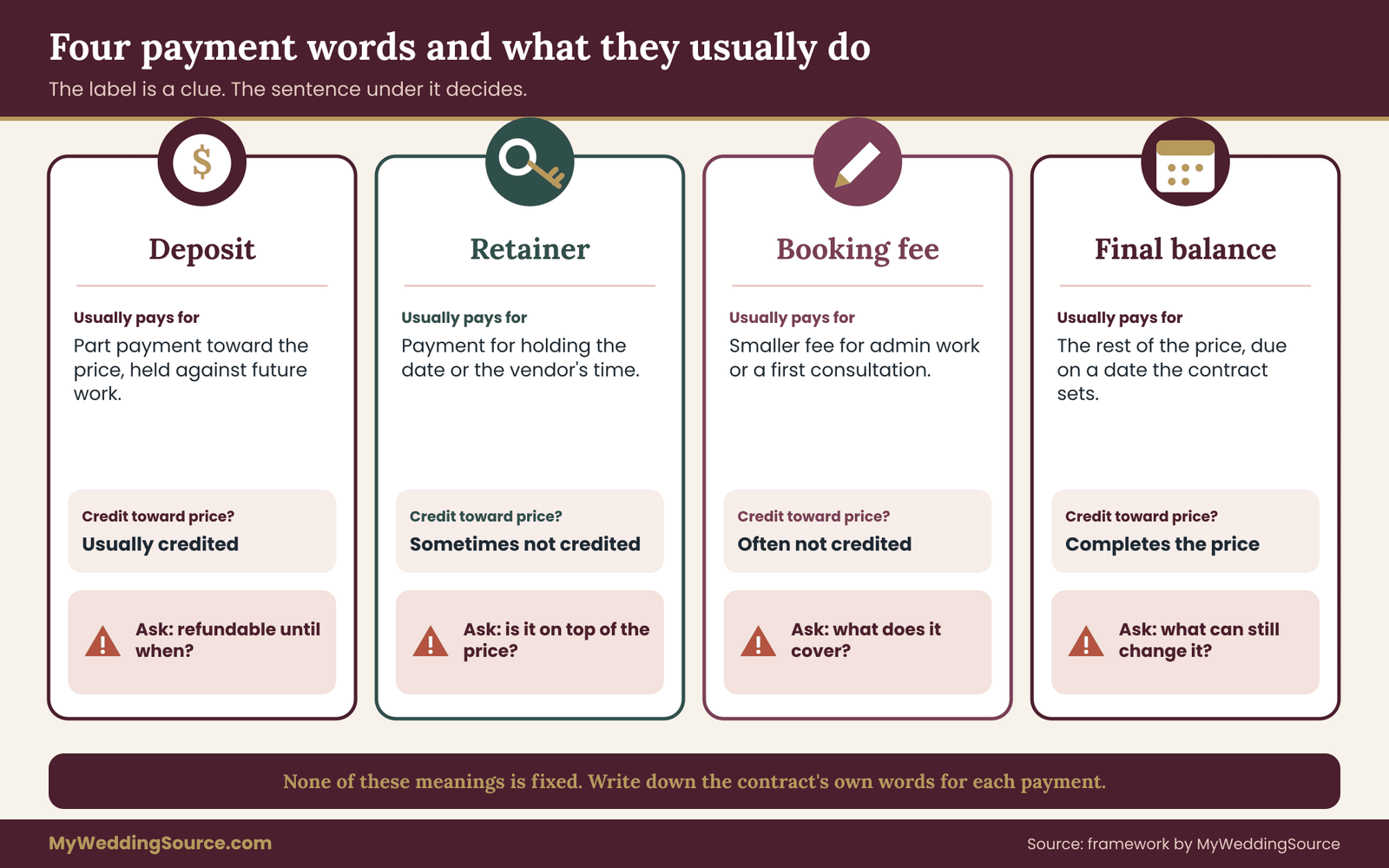
“Deposit” and “retainer” are not legal terms with one fixed meaning in wedding contracts. A deposit usually counts toward the price and may be refundable in some situations. A wedding retainer is often described as payment for holding a date or reserving the vendor’s time, and it is frequently written as non-refundable and sometimes not credited toward the total. Ignore the heading and read three things: whether the money is credited to the price, what happens to it if you or the vendor cancels, and whether the clause says the amount is earned when paid.
Most couples meet the difference between a deposit and a retainer at the worst possible moment: when a plan changes. The date moves, a family situation intervenes, or a vendor closes, and someone opens the contract to ask whether the first payment comes back. If the clause says “non-refundable retainer” and the couple assumed “deposit,” the gap between those two words can be several hundred or several thousand dollars.
The goal here is not to make you suspicious of vendors. Most wedding professionals use payment terms to protect a date they cannot sell twice, and many are open to clearer wording when asked politely. The goal is to make the contract say, in plain sentences, what your first payment is for and what happens to it. A wedding retainer you understand is a fair business arrangement. One you only assume you understand is a risk you took without noticing.
A note on scope. This is general information, not legal, tax or financial advice. Contract law, consumer rules and deposit limits differ by state and by industry, and a lawyer who has read your actual contract can tell you things no article can.
What a wedding retainer is, and why the label is not a standard
The word “retainer” comes from the legal and consulting worlds, where it traditionally means a payment that secures a professional’s availability. Lawyers, for example, often hold client funds in a way governed by professional conduct rules, and a true advance payment is treated differently from a fee that is already earned. Wedding vendors borrow the word because it describes something real in their work: when a photographer, band or planner agrees to your date, they stop taking other bookings for that day. The wedding retainer pays for that lost opportunity.
That borrowing is the source of the confusion. In the legal setting the term comes with a body of professional rules. In a wedding vendor’s template contract it comes with whatever the vendor’s template author decided. Two vendors can use the same word for opposite things, and one vendor can use “deposit” and “retainer” in the same document for payments with different rules.
Here is the pattern most often seen, described as tendencies and not as rules.
A deposit is typically a partial payment toward the contract price. It reserves the booking, appears as a credit on the final invoice, and may or may not be returned if you cancel. Some contracts say it is refundable until a certain date. Many say it is refundable only if the vendor can rebook the date.
A wedding retainer is typically a payment for reserving the vendor’s time and availability. It often is described as non-refundable. In some contracts it is credited toward the total, in others it is a separate charge that sits on top of the price. That second case catches people out, because the total you budgeted is not the total you owe.
A booking fee or reservation fee is often a smaller payment, sometimes described as covering administrative work, and sometimes not credited at all.
A final balance is the remainder of the contract price, due on a date the contract sets.
None of those descriptions is binding on any particular vendor. Each one is a starting guess that the actual clause either confirms or overrides.
Why vendors care about the distinction
To see why a vendor might prefer a wedding retainer, picture a photographer with fifty Saturdays in a season. If you book one and cancel four months out, the photographer might still fill the date, or might not. Many vendors would like to avoid depending on luck, so they write the first payment as compensation for the hold itself. They are saying the money has been earned the moment the date is reserved, because the vendor gave up other work to reserve it.
A deposit framed as a pre-payment works differently. The vendor holds the money against future work. If the work never happens, there is at least an argument that the money should go back, less any actual loss. That is why the same dollar amount can feel very different depending on the label and on the sentence that explains it.
You are not trying to win an argument about vocabulary. You are trying to find out whether the money is treated as earned on receipt or as an advance against future work, because that one fact drives most of what follows.
Where the confusion usually enters
Three places account for most misunderstandings.
First, the proposal and the contract use different words. A friendly proposal email says “deposit to secure your date,” and the formal agreement later says “non-refundable retainer.” The couple remembers the email. The vendor relies on the signed document.
Second, the invoice label is not the contract term. An online invoicing tool might default to a line item named “Deposit” no matter what the agreement says. The line item is a billing convenience. The agreement is the thing a court or a card issuer would look at.
Third, the credit is unclear. The contract names a payment but does not say whether it reduces the final balance. If a wedding retainer is not credited, you owe the retainer plus the full price, and that is a very different number from the one on the proposal.
“Could you confirm in writing whether the first payment is credited toward the total price, and what happens to it if we need to change or cancel?”
A question like that one is short, neutral and easy to answer. Vendors who run careful businesses can usually answer it in a sentence. Save the reply with the contract.
The words that move money: deposit, retainer, booking fee and balance
It helps to treat the payment language as a small vocabulary and learn which words carry weight. A contract’s headings are often less important than a handful of operative phrases inside the clause. These are the phrases that deserve a highlighter.
“Credited toward” or “applied to.” This phrase means the payment reduces what you still owe. If it is present, the payment is part of the price. If it is absent, ask. A payment that is “in addition to” the price is a separate charge, and your budget needs to include it separately.
“Non-refundable.” This phrase says that the vendor will not return the payment in at least some circumstances. Read the sentence it sits in. “Non-refundable if the client cancels” is narrower than “non-refundable under any circumstances,” and the second version raises an obvious question about what happens if the vendor cancels.
“Earned upon receipt” or “fully earned when paid.” These phrases are the clearest signal that the vendor treats the money as already theirs. They usually appear alongside a wedding retainer. They do not necessarily settle whether the clause would be enforced, which depends on your state and the circumstances, but they tell you how the vendor will behave.
“Liquidated damages.” This phrase describes a pre-agreed amount that stands in for the vendor’s likely loss if the contract is ended early. The general legal idea is that such an amount should be a reasonable estimate of loss and not a penalty. Whether a particular clause meets that test is a question for a lawyer in your state.
“Transferable” or “may be applied to a new date.” This phrase tells you whether a rescheduled wedding keeps the money. It is one of the most useful phrases a contract can contain, and it is frequently missing.
“Subject to availability.” This phrase usually qualifies a date change. A vendor may agree to move the booking but only if the new date is open. The payment may be held, forfeited or reapplied depending on the next sentence.
“Force majeure” or “impossibility.” These clauses deal with events outside anyone’s control. Their wording varies widely, and their effect on a wedding retainer is rarely obvious. Later in this guide, the section on changing plans looks at what to check.
Reading a clause sentence by sentence
Take an invented clause: “A non-refundable retainer of a stated amount is due at signing to reserve the date. The retainer is earned upon receipt and is not credited toward the balance. The balance is due thirty days before the event.”
Read it one sentence at a time and ask one question of each.
The first sentence tells you that the payment is non-refundable and that its purpose is to reserve the date. The second tells you the vendor treats it as earned and that it is separate from the price. The third tells you when the rest is due. Put together, the total cost of the service is the retainer plus the balance, and the retainer is spent from the moment you pay it.
Now compare that with a second invented clause: “A deposit of a stated amount is due at signing and will be applied to the final invoice. If the client cancels more than ninety days before the event, the deposit will be refunded less a stated administrative charge. If the client cancels within ninety days, the deposit is retained.”
Here the deposit is part of the price, it has a refund window, and the amount at risk changes depending on when you cancel. The two clauses might both be attached to the same dollar figure, but they describe different obligations.
A one-line test for any early payment
When you meet an unfamiliar payment term, ask yourself one question: if we cancel tomorrow for reasons that are nobody’s fault, what do we get back? Then find the sentence in the contract that answers it. If you cannot find one, the contract is silent, and silence is a reason to ask before signing, not a reason to assume the best.
The wedding vendor contract guide on this site walks through the other clauses in a typical agreement. This article stays narrow and looks at the payment words only, so that you can run the same four checks on every vendor in the same way.
A payment-terms evidence checklist for every wedding retainer
The checklist below is the working tool of this guide. It treats each early payment in a contract as a small piece of evidence that needs four findings: its label, its function, its fate and its proof. You fill it in once per payment, per vendor, before you sign. It takes about ten minutes for each contract, and it turns a vague worry into a short page you can compare across vendors.
The reason for calling it an evidence checklist is that each finding must point to words in the document. “I think the wedding retainer is refundable” is a belief. “Section four says the wedding retainer is refundable until ninety days before the event” is evidence. If you cannot point to a sentence, the answer for now is “unknown.”

Lens one: the label
Write down exactly how the document names the payment, using the document’s own words. “Retainer,” “deposit,” “booking fee,” “reservation payment,” “advance,” “initial installment.” If the proposal, the contract and the invoice use different names for the same money, write all three. Mismatches are not automatically a problem, but they tell you where to ask a question.
Also note the amount and the due date, because they matter later. A payment due at signing has a different risk profile from one due in the spring.
Lens two: the function
Function is what the payment buys. There are only a few possibilities, and the contract usually favors one.
The payment may be a down payment on the price, credited in full to the final invoice. It may be a fee for holding the date, kept by the vendor whatever happens and either credited or not. It may be a payment for work already begun, such as a design consultation or a custom order. Or it may be an advance for costs the vendor must pay up front, such as a custom item that cannot be resold.
Each function suggests a different refund logic. A down payment pays for something that has not happened yet. A date hold pays for something the vendor has already done: giving up the date. Work begun pays for time already spent. A pass-through cost pays for money already out the door. Ask which of these the clause is describing. A wedding retainer typically falls under the date hold, though some vendors blend it with a design fee.
Then check the credit. Does the contract say the payment reduces the balance? Write “credited,” “not credited” or “unclear.”
Lens three: the fate
Fate means what happens to the money in five situations. Test each one against the document.
- You cancel early. What is returned, and by when must you cancel?
- You cancel late. What is retained, and does the vendor owe you anything?
- You change the date. Can the payment move to a new date, and is there a fee?
- The vendor cancels or cannot perform. What is returned, how fast, and what else does the vendor owe?
- Something outside anyone’s control happens. Does the contract speak to it at all?
The fourth situation is the one most often missing. A clause that carefully protects the vendor when you cancel but is silent when the vendor cancels is a one-way clause. That is not always a reason to walk away, but it is a reason to ask for a sentence that goes both ways.
Lens four: the proof
Proof is how you will demonstrate that you paid, and what you paid for. A payment with no proof is a payment that someone can dispute later. Write down how you will pay (card, check, bank transfer, a payment app), whether the vendor issues a receipt, and where the receipt and the signed contract will be stored. Also note whether the vendor’s invoice labels the payment the same way the contract does.
If the vendor accepts card payment, the card issuer’s dispute process may be available for certain problems. The Consumer Financial Protection Bureau explains how dispute rights generally work for credit cards, and you should read the issuer’s own terms for the details. Payment method is a choice with real consequences for proof and for your options later, so it is part of the checklist and not an afterthought.
Putting the four lenses on one page
The simplest format is one short block per payment:
- Label: the document’s words, with section number.
- Function: down payment, date hold, work begun or pass-through cost.
- Credit: credited, not credited or unclear.
- Fate: one line each for the five situations, or “unknown.”
- Proof: payment method, receipt, storage location.
You will notice that most gaps are in the fate lines. That is normal. A good number of vendor templates simply never anticipated the questions, and a short message usually fills the gap.
For the broader cash planning around these payments, the guide to wedding cash-flow planning shows how to place each due date on a calendar. This article concentrates on what each early payment means, so that the calendar is built from accurate facts.
Why vendors choose a wedding retainer and what they are protecting
Once you have the four lenses, it helps to understand the vendor’s side. A wedding retainer is rarely a trap. It is usually a blunt tool for a real problem, and knowing the problem helps you ask for a fair adjustment.
The vendor sells a date, not just a service. A venue, a photographer, a musician and an officiant all have a limited number of wedding dates. Once yours is held, the vendor declines other inquiries. If you cancel a month later, the replacement inquiries may be gone. The wedding retainer is a way of pricing that lost opportunity.
The vendor carries costs before the event. Some work happens long before the wedding: consultations, planning calls, design proofs, a custom order, a second shooter hired for your date. A payment that arrives at signing helps cover that effort, and the vendor may describe it as earned for that reason.
The vendor wants a commitment signal. A signed contract with a payment attached is a more reliable booking than a verbal yes. Vendors who have been burned by no-shows tend to write firm terms afterward.
The vendor often copies a template. Many small businesses use a contract template from a trade group, an online platform or a former colleague. The words “retainer” and “non-refundable” may be inherited, not chosen. That is good news for you, because a vendor who did not choose the wording may be willing to adjust it.
What this means for how you ask
Because the vendor’s concern is usually the unsellable date, the fairest request is often tied to that concern. Instead of “can we make the wedding retainer refundable,” you might ask: “If we move the date and you can rebook the original one, could the payment carry over to the new date?” That request acknowledges the vendor’s logic and offers a path that costs them nothing. Vendors tend to respond better to a scoped request than to a demand to rewrite the clause.
Signs of a clearly written clause
A well-built payment clause tends to share some features, and you can use them as a quick quality check.
It names the payment once and uses the same word everywhere. It states the amount and the due date. It says whether the payment is credited to the price. It describes what happens in at least the cancellation, date change and vendor cancellation cases. It does not rely on a separate policy page that is not attached to the contract. And it is written in sentences a non-lawyer can follow.
A clause that lacks these features is not necessarily unfair. It is simply less certain, and that uncertainty is what you are paying to remove by asking questions before the signature, when asking is cheap.
Signs of a clause that needs a second look
Some wording should slow you down. A wedding retainer described as “non-refundable under all circumstances,” with no mention of what happens if the vendor cannot perform, is one. A payment described as both “deposit” and “retainer” in different sections is another. A clause that refers to “our standard cancellation policy” without attaching it is a third. So is any clause that lets the vendor change the payment terms later without your written agreement.
Where several of these appear together, or the amount is a large share of the total cost, the section on state-law review triggers below explains when a short consultation is likely to be worth the fee.
A quick comparison in plain words
Put the two concepts next to each other and the difference is clear. A deposit says: “We are holding your money against future work, and here is how it works out if the work does not happen.” A wedding retainer says: “We are paid now for holding your date, and here is what we keep.” Neither is wrong. The problem begins only when the document uses one word while the couple assumes the other, which is why the checklist asks for the document’s words and not your impression.
Building the payment page: a worked layout
To make the checklist concrete, here is how a finished payment page might look for a single vendor, written out in sentences so you can copy the layout into any notes app or spreadsheet.
For an invented photography contract, the page might read: “Payment one. Label in contract: non-refundable wedding retainer, section three. Label on invoice: deposit. Amount and date: due at signing. Function: date hold, described as earned on receipt. Credit: contract says it is credited toward the package price in section three, but the sample invoice shows it as a separate line, so unclear. Fate: couple cancels early, retained; couple cancels late, retained; date change, silent; vendor cancels, silent; outside events, a short clause that suspends the contract without mentioning money. Proof: card payment, emailed receipt, saved to the vendor folder.”
Notice what that page does. It does not pass judgment on the vendor. It records facts, marks four unknowns and produces a short list of questions: Is the wedding retainer credited, and can it move to a new date? What happens if you cannot perform? What does the outside-events clause do with money?
Three questions, asked in one email, and the page is nearly complete. The remaining sections show what to do with the answers, how to recognize when the situation is beyond a checklist, and how to prove everything afterward.
State-law review triggers: when a wedding retainer clause needs a second look
A checklist can tell you what a contract says. It cannot tell you whether a clause would hold up where you live. That second question belongs to a lawyer licensed in your state, and paying for an hour of their time on every vendor contract would be unreasonable. The practical middle path is a short list of triggers. If none of them is present, you can usually proceed on your own judgment. If one or more are present, a brief legal review is more likely to be worth the cost.
These triggers are working rules for deciding when to ask, not legal tests. They do not predict how any court would rule.
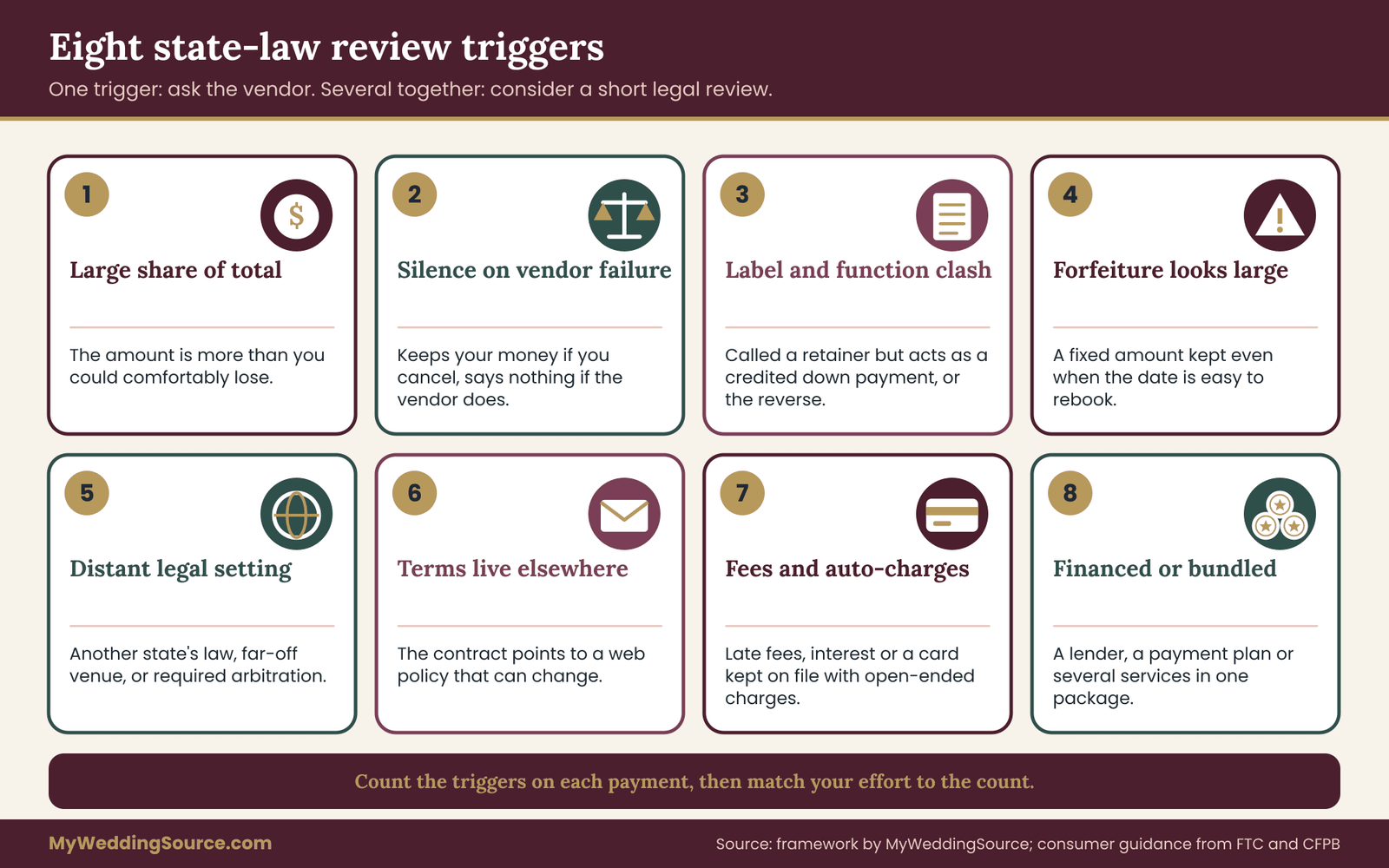
Trigger one: the amount is a large share of the total
A small booking payment that is lost is an annoyance. A payment that represents a large fraction of the whole contract price is a different matter, especially when it is non-refundable and due at signing. There is no universal threshold. Decide your own: the amount you would be seriously unhappy to lose. If the wedding retainer crosses that line, treat it as a trigger.
Trigger two: the clause pairs “non-refundable” with silence about vendor failure
A contract that keeps your payment if you cancel and says nothing about returning it if the vendor cancels creates an imbalance. Whether the law fills that silence in your favor depends on the state and the facts. The existence of the gap is the trigger.
Trigger three: the label and the function disagree
If the document calls a payment a “retainer” but describes it as a down payment credited to the price, or calls it a “deposit” but says it is earned on receipt, the document contradicts itself. Courts and card issuers generally look at what a clause actually does and not only at its heading, so the mismatch is something a lawyer will want to read closely. At minimum, ask the vendor to correct the heading.
Trigger four: the clause uses a fixed forfeiture that looks large compared with the likely loss
Many states apply a legal test to pre-agreed cancellation amounts, asking in general terms whether the amount is a reasonable forecast of the vendor’s loss or a penalty. If a clause keeps a substantial sum even when the vendor could easily rebook the date, you might have a question worth taking to a lawyer. You do not need to answer the legal test yourself. You only need to notice when the amount seems out of proportion to anything the vendor lost.
Trigger five: the contract points to a distant or unusual legal setting
Look for a “governing law” or “venue” clause. If the vendor is based in another state, or the contract requires disputes to be handled somewhere inconvenient, your local protections may not work the way you expect. Some contracts also require arbitration or waive the right to join a group claim. Those clauses affect how a dispute would be resolved, so they are worth a lawyer’s reading when the sums are large.
Trigger six: the vendor’s terms live outside the contract
When the contract says “see our policies” or “subject to our terms of service” and the policy sits on a web page that can change, you cannot be sure what you agreed to. Ask for the version you are bound by to be attached or dated. If the vendor will not do that, treat it as a trigger.
Trigger seven: late fees, interest or automatic charges are attached to the payment
Some contracts allow the vendor to charge a card on file, add late fees or charge interest on unpaid balances. State rules on fees and interest vary, and a recurring authorization to charge your card deserves careful reading. If the clause is open-ended, ask for a fixed schedule and a written notice before any charge.
Trigger eight: the vendor is a regulated type of business or the payment is unusually structured
Some payments are held under different rules because of the type of business. A venue that also sells packages, a travel-related service, or a vendor selling a financed product may be subject to rules that ordinary vendors are not. If a payment is described as financed, or the vendor is partnering with a lender, treat it as a trigger and read the financing terms separately.
What to do when a trigger appears
A trigger is a prompt to take one of three steps.
First, ask the vendor to clarify or amend. Many triggers disappear when a vague sentence is replaced by a clear one.
Second, read the state attorney general’s consumer protection pages or the consumer-protection resources of your state or locality to see whether any specific rule is mentioned for the kind of service. The National Association of Attorneys General maintains a directory of state offices, and the Federal Trade Commission publishes general consumer guidance. Third, consider a short consultation with a lawyer who handles contracts in your state, taking the checklist page with you so the time is spent on the clause and not on explaining the situation.
Many bar associations run referral services, and some local legal aid organizations answer basic questions. Availability varies, so check what exists near you.
What a lawyer can and cannot do for a wedding contract
A lawyer can read the clause against your state’s law, tell you whether a particular sentence is likely to be enforced, and suggest edits that fit your jurisdiction. A lawyer usually cannot make a vendor change a template, and may advise you to walk away from a contract more often than to rewrite it. Going in with specific questions from your checklist, such as “is this forfeiture likely to be treated as a penalty here?” gets more useful answers than asking whether a contract is fine.
If you are working with a planner, tell the planner you want a legal read on a particular payment clause. Planners often have worked with the vendor before and can say whether the wording is routine. They are not a substitute for legal advice, but their experience helps you decide whether a trigger is worth acting on.
Using triggers in a calm, proportionate way
It is easy to read a list of triggers and conclude that every contract is a minefield. That would be the wrong lesson. Most wedding contracts are signed, performed and closed without incident. The point of the triggers is to match effort to risk.
A reasonable working rule: one trigger, ask the vendor a question; two triggers or one large trigger, ask the vendor and read the state consumer pages; three or more, or a large payment combined with silence about vendor failure, get a short legal review before signing.
Consider two quick cases. In the first, a florist’s contract has a modest booking payment labeled “retainer,” credited to the total, with clear refund terms until a stated date. No triggers, or one minor one. Ask any remaining questions and sign.
In the second, a venue contract requires a large non-refundable wedding retainer at signing, not credited to the price, governed by the law of another state, with no mention of what happens if the venue closes. That is several triggers on a single payment, and the amount is large. A legal read would likely be money well spent, and a request to the venue to rewrite two sentences might be in order first.
The role of the timing of your review
Do the review before you sign and before you pay. Once the first payment has been made, your bargaining position changes, because the vendor now holds the money and you hold only a contract. Asking questions at the proposal stage costs nothing, while asking after the signature can feel like reopening a deal.
If you have already signed, you can still ask. Many vendors will clarify a sentence in a short written addendum, particularly for a modest request such as confirming that a payment may be applied to a new date. The worst outcome is usually a no, and you will at least know where you stand.
Keep the legal question separate from the relationship question
There are two different decisions in front of you whenever a clause looks uncomfortable. One is whether the clause is legally sound. The other is whether you want to do business with a vendor who wrote it. A clause can be perfectly lawful and still be a sign that the vendor will be rigid in a pinch. Equally, an unusual clause may simply reflect a vendor who is new to contracts and happy to fix it.
Pay attention to how the vendor responds when asked. A clear, friendly answer is useful information. A defensive or evasive answer to a plain question about refunds tells you something about how a later conversation might go. That information is worth having before any money changes hands.
Verifying the terms with the vendor and with official sources
Verification has two sides: confirming what the vendor means, and confirming what the rules around the vendor allow. Neither takes long if you know where to look.
Verifying with the vendor
Ask in writing, and ask for answers in writing. A phone call is fine for starting the conversation, but follow it with an email summarizing what you understood. For example: “Thanks for the call. To confirm, the first payment is credited toward the package total and can be moved to a new date if you can rebook the original date. Please reply if I have that wrong.” A reply of “yes” turns a spoken promise into a record.
If a vendor makes a change, ask that it appear as a signed amendment or a revised contract and not only as an email. An amendment attaches to the contract, and a loose email can be lost or argued about. When the vendor uses an online signing platform, ask whether the amendment can be added there so that everything lives in one file.
Also ask who is the legal party. The contract might be with an individual, a studio, a company with a different name or a franchise. If you ever need to claim a refund, you need to know who owes it. Check that the name on the contract matches the name on the receipt and the name on your card statement.
Verifying with official sources
For general rules about payments, disputes and consumer rights, the federal agencies publish plain-language pages. The Consumer Financial Protection Bureau explains how to dispute a card charge and what a chargeback is. The Federal Trade Commission explains how credit card dispute rights work and offers a sample letter for disputing a charge. For state-specific consumer rules, your state attorney general’s consumer protection office is usually the right starting point, and the National Association of Attorneys General keeps a directory.
These pages explain general processes. They do not decide whether your particular wedding retainer is refundable, which depends on your contract. Use them to understand your options and deadlines, such as how quickly a card dispute must be raised, and then check the card issuer’s own terms for the details that apply to you.
Dates that matter
Several time limits can affect what you can do with a payment. Card dispute windows are measured in weeks or months from the statement date, not from the wedding date. Contract cancellation windows are measured from the event date or the signing date, depending on the clause. A vendor’s refund deadline may fall a year before the wedding. Put every one of these on your calendar when you sign, with a reminder a few weeks before each. A refund right you forget about is a refund right you do not have.
Worked example: the same price, two contracts, one wedding retainer
Numbers make the difference between a deposit and a wedding retainer easier to feel, so here is an invented case. The couple, Lena and Marcus, are choosing between two photographers. All figures are made up for illustration and say nothing about what photographers charge.
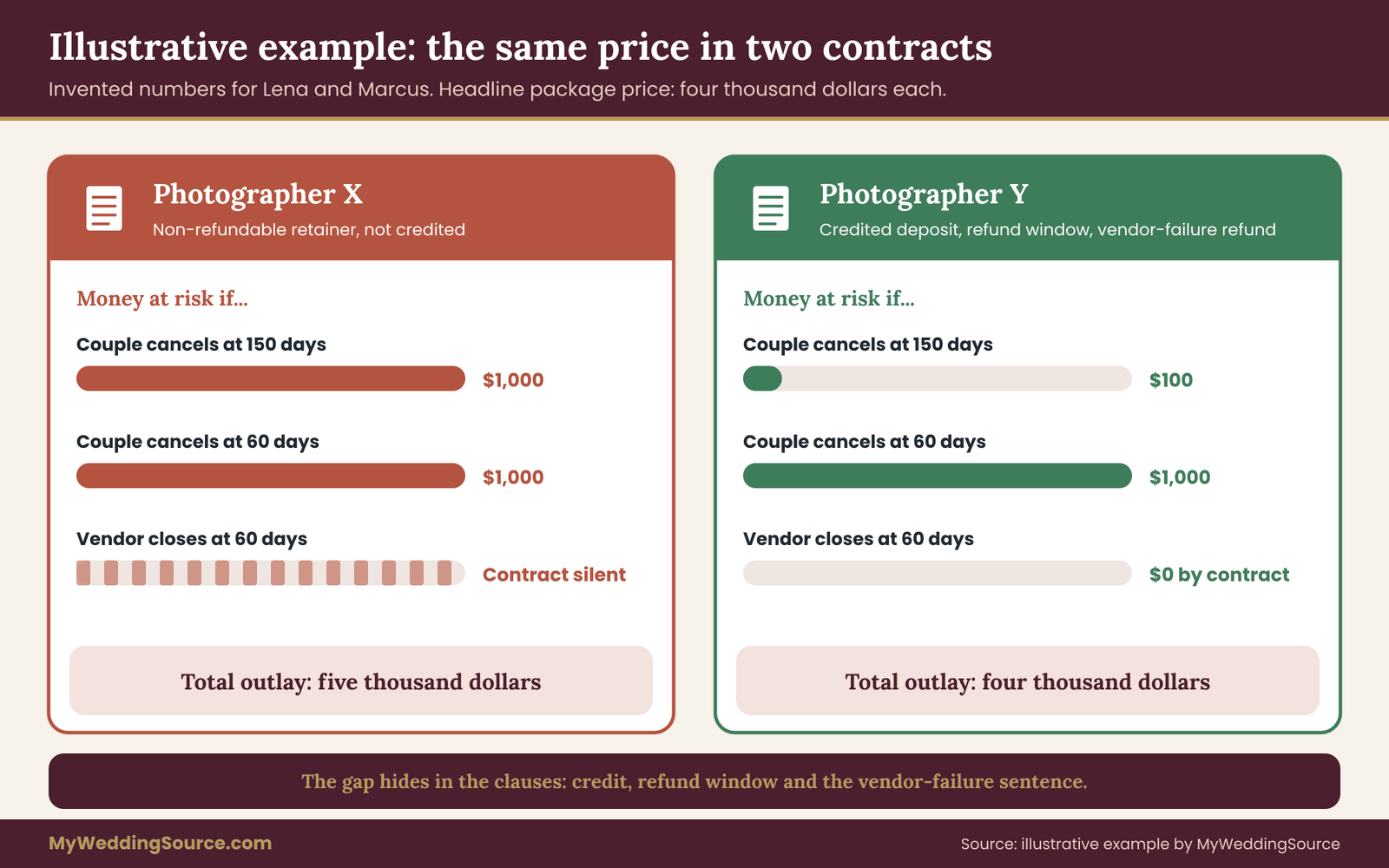
Photographer X advertises a package price of four thousand dollars. The contract asks for a non-refundable wedding retainer of one thousand dollars at signing. A later section says the wedding retainer “secures the date and is earned upon receipt,” and the balance of four thousand dollars is due thirty days before the wedding. The contract says nothing about the wedding retainer being credited and nothing about a date change or about what happens if the photographer cannot attend.
Photographer Y also advertises a package price of four thousand dollars. The contract asks for a deposit of one thousand dollars at signing, applied to the final invoice, so the balance is three thousand dollars. The deposit is refundable, less a one hundred dollar administrative charge, if the couple cancels at least one hundred twenty days before the wedding, and retained after that. It may be applied once to a new date if the photographer is available. If the photographer cannot perform, the deposit and all other payments are returned within thirty days.
Step one: find the all-in price
The headline prices match, but the contracts do not. In contract X the wedding retainer is not credited, so the couple’s total outlay is the wedding retainer plus the balance: five thousand dollars. In contract Y the deposit is credited, so the total is four thousand dollars. The thousand-dollar gap is invisible in the marketing and visible only in the clauses. Comparing the all-in price is the first benefit of the checklist.
If Lena and Marcus had read only the proposals, they would have thought the two photographers cost the same. That is exactly the kind of comparison error that language in a contract can create.
Step two: map the money at risk by date
The second step is to ask how much of the couple’s money is exposed at different moments if plans change. Take three moments and apply the contract words.
One hundred fifty days before the wedding, the couple cancels. With photographer X, the wedding retainer of one thousand dollars is retained. With photographer Y, the couple is within the refund window and gets back nine hundred dollars after the administrative charge, so one hundred dollars is lost.
Sixty days before, the couple cancels. With X, the same thousand dollars is gone. With Y, the refund window has closed, so the deposit of one thousand dollars is retained. At this point both contracts cost the couple the same amount.
Sixty days before, the photographer closes the business. With Y, the contract says all payments are returned within thirty days, though the couple should know that a written promise from a business that has closed is only as good as the vendor’s ability to pay. With X, the contract is silent. The couple would have to rely on general law, which depends on their state, and might have to dispute the charge or file a claim.
The comparison shows that the contracts diverge in the early period, converge in the late period and diverge again in the vendor-failure case. A person who only considers the case where the couple cancels late would see little difference. The case that reveals the weakness of X is the one the contract never mentions.
Step three: check the triggers
Applied to contract X, the state-law triggers give a clear picture. The payment is described as non-refundable and earned on receipt, and it is a real share of the total, so triggers one and four may apply. The contract is silent about vendor failure, which is trigger two. The word “retainer” is paired with a description that matches a date hold, so the label and the function agree, and trigger three does not apply. If the contract also named another state’s law for disputes, trigger five would apply too.
Applied to contract Y, the picture is cleaner. The deposit is credited, the refund terms are stated, the vendor-failure case is covered, and there is a defined window. No triggers apply, or at most a minor one about the card on file, if the clause allows it.
Step four: decide with the evidence
The couple now has facts to weigh. Photographer X may be a better artist, and Lena and Marcus may prefer X’s style. That is a legitimate reason to choose X. What the checklist adds is the cost of that choice: a thousand dollars more in the contract price and a gap in protection. They can now decide with eyes open, or they can ask X for specific changes.
They write to X: “We love your work and would like to book. Could the wedding retainer be credited toward the package price, and could the contract say what happens to our payments if you are unable to photograph the wedding?” Two possible replies follow, and both are useful.
If X replies that the wedding retainer is credited and adds a sentence about vendor cancellation, the gap closes, and the couple can sign with confidence. If X replies that the terms are firm, the couple has learned that the price they should compare is five thousand dollars and that the risk is theirs to carry. Either way they decide with real information.
What the example does and does not show
The example shows how a wedding retainer can change the effective price and the risk profile without changing the headline price. It does not show that wedding retainers are bad or that deposits are always better. Many excellent vendors use a wedding retainer clause, and some deposit clauses are poorly written. The example is a method, not a verdict.
It also leaves out considerations a real couple would weigh: the vendor’s reputation, availability on the date, how well the couple connects with the person, and whether the vendor’s pricing is otherwise fair. The payment language is one input. A wedding retainer is one piece of the contract, and the contract is one piece of the decision.
A decision rule for choosing between a deposit contract and a wedding retainer contract
If you are comparing vendors with different payment structures, a simple rule can keep the comparison honest. It uses three numbers and two questions.
Number one: the all-in price. Add every payment the contract requires, including any wedding retainer that is not credited. Do not use the package price alone.
Number two: the money at risk at signing. This is the portion you could lose if you cancelled the next day for no reason. For a refundable deposit with a small administrative charge, it is that charge. For a non-refundable wedding retainer, it is the full amount.
Number three: the money at risk at the one-third mark. Pick a date roughly a third of the way between signing and the wedding, and ask how much would be at risk then. This shows how the refund window moves.
Question one: is the vendor-failure case addressed? A yes is worth something. A silence is a cost you can name.
Question two: can the payment move to a new date? A yes is also worth something, because date changes are among the most common reasons plans shift.
Score the vendors on the numbers and the questions, without pretending it is a formula. If two vendors are close in quality and one has a clearly lower all-in price and lower money at risk, the choice is easy. If the vendor you prefer costs more or exposes more of your money, you can decide whether the difference is worth paying, and you can try to negotiate before you sign.
When a wedding retainer is a reasonable arrangement
It is worth saying plainly that a wedding retainer is sometimes the fair structure. A solo musician who turns down every other offer for your date, with a short season and few openings, is entitled to a payment that does not disappear if you change your mind. A planner who spends significant time in the first month on research and vendor outreach is doing real work before the event. A designer who begins a custom piece of stationery is spending hours on something no one else can use.
In each case, a non-refundable payment that is clearly labeled, credited toward the price, and described in the contract as paying for a date hold or work begun is a reasonable arrangement. What makes it reasonable is clarity and proportion, not the word. A well-written wedding retainer tells you what you are paying for, how much it is, whether it counts toward the price, and what happens if the vendor cannot perform.
When a deposit is not as safe as it sounds
The opposite warning also applies. A “deposit” does not guarantee a refund. Many contracts titled “deposit” describe a payment that is non-refundable after signing, or refundable only if the vendor rebooks the date. Read the sentence, not the heading. A deposit that is refundable only at the vendor’s discretion is, in practice, much like a wedding retainer with a friendlier name, and the checklist treats it that way.
Asking for clearer wording without damaging the relationship
Knowing what a clause means is half the work. The other half is getting the vendor to make it clearer, and that is a conversation, not a legal filing. The approach that works best is small, specific requests, tied to the vendor’s own concerns, made early and in writing.

Start by asking for facts, not changes
Your first message should not propose edits. It should ask what the clause means. People respond more openly to a question than to a proposal. For example: “Before we sign, we want to be sure we understand the payment terms. Is the first payment credited toward the total, and what happens to it if we need to move the date?” This message accuses no one and makes no demand. It also produces an answer you can compare against the written clause.
If the answer differs from the written words, that is the moment to ask for the contract to be updated to match: “Thank you, that is helpful. Could the contract reflect that? We would like the written terms to say the same thing.”
Ask for one change at a time, in order of value
If you want several changes, rank them. Typically the most valuable are, first, a sentence about what happens if the vendor cannot perform; second, a sentence about whether the payment is credited toward the price; third, a sentence allowing the payment to carry over to a new date once. Ask for the first, and let that conversation finish before asking for the next. A vendor who has agreed to two small edits is more likely to agree to a third than a vendor who has been handed a page of redlines.
Offer something in return
Many vendor concerns can be addressed without removing the wedding retainer. If the vendor is worried about an unsellable date, you can offer a longer notice period for the refund window, or a shorter window for date changes. If the vendor is worried about cash flow, you can offer an earlier second payment. If the vendor values certainty, you can offer to sign promptly. A trade shows that you understand the vendor’s side, and it often moves a vendor who would refuse a one-sided request.
Sample wording for common requests
Here are four requests written in plain language. Adapt them to your own voice.
To confirm credit. “Could you add a sentence stating that the wedding retainer is credited toward the total price, so the balance is the package price minus the wedding retainer?”
To allow a date change. “If we need to move the wedding, could the payment be applied to a new date, subject to your availability, without an additional booking charge?”
To cover vendor cancellation. “Could the contract state that if you are unable to provide the services on our date, all payments are returned within a set number of days?”
To fix a label mismatch. “The proposal calls the first payment a deposit and the contract calls it a wedding retainer. Could you confirm which one is correct and update the document so they match?”
These requests are short, specific and cost the vendor very little. A vendor who plans to perform has no reason to refuse the third one.
What to do when the answer is no
A refusal is information, not an insult. Decide in advance what you will do with it. Options include signing with the clause as written and treating the money as spent, choosing another vendor, or asking a lawyer to review the clause if it triggers any of the concerns above. The right answer depends on how much you want this vendor and how much money is at risk.
If you sign with a firm wedding retainer, adjust your plans to match. Put the amount in your budget as a cost that is spent on the signing date, not as a payment that might come back. The guide to wedding budget planning explains how to track committed spending separately from money still available. Treating a non-refundable payment as spent from day one prevents the unpleasant surprise of counting on a refund that was never available.
Keep the tone steady
You do not need to apologize for asking, and you do not need to be adversarial. A plain and friendly tone works with almost every vendor. If a vendor reacts to a basic question about refunds with hostility, you have learned something valuable before paying anything.
How the word is used across different kinds of wedding vendors
Different vendor types tend to use payment terms differently. The following descriptions are tendencies, not rules, and every contract still needs to be read. They are included so that you know what to expect and what to ask.
Venues. Venues often require a substantial first payment and may call it a deposit, a reservation fee or a wedding retainer. Many treat part or all of it as non-refundable, and some include a payment schedule that builds up over the months. Ask whether any of the payments are refundable if the venue can rebook the date, whether the payments can move to a new date, and whether the venue’s policies cover the case where the venue itself cannot host the event. The wedding venues guide covers how to compare venue options more broadly.
Photographers and videographers. These vendors commonly describe the first payment as a wedding retainer that holds the date. Many credit it toward the package. Ask whether the wedding retainer is credited, whether the date can move, and what happens to prepaid items if the vendor is unavailable. Also ask whether the vendor has a backup arrangement for illness or emergency, because that affects what “unable to perform” means in practice.
Planners and coordinators. Planners often charge a wedding retainer for early work, and the amount may be described as earned as the work is done. Ask how the wedding retainer relates to the final fee, whether it is credited, and what you receive if the engagement ends early. Because a planner’s work builds up before the event, partial refunds often make sense and can be written in.
Caterers. Caterers typically take a deposit and tie the final balance to the confirmed guest count. The risk is less about the first payment and more about minimum spend and headcount rules. Minimum spend and guest-count clauses deserve their own read. Ask which payments are refundable and how the headcount deadline interacts with the deposit.
Musicians, DJs and officiants. These vendors often have a limited calendar and rely on a wedding retainer to hold dates. Ask whether the vendor has a substitute policy and whether the payment can be applied to a new date.
Florists, rentals and stationers. These vendors often incur costs for materials or custom production, and they may describe the first payment as covering those costs. Ask when the money is spent on your order and whether any portion is returned if production has not begun.
For each type, the checklist still applies. The vendor type tells you which questions are likely to matter most, and the contract tells you the answers.
Reading the vendor’s description of its own policy
Vendors often explain their payment policy on a website or in a sample proposal. Treat that as a starting point and not as a contract. If the website says “retainers are fully refundable up to ninety days,” ask for that sentence in the contract. A statement on a web page can change, and it does not protect you unless the signed document includes it.
Save a copy of the page, with the date, when you receive the proposal. If the page and the contract differ, you have a concrete question to ask. A screenshot or a printed page costs nothing and may become useful evidence of what was promised.
Paying a wedding retainer and keeping proof
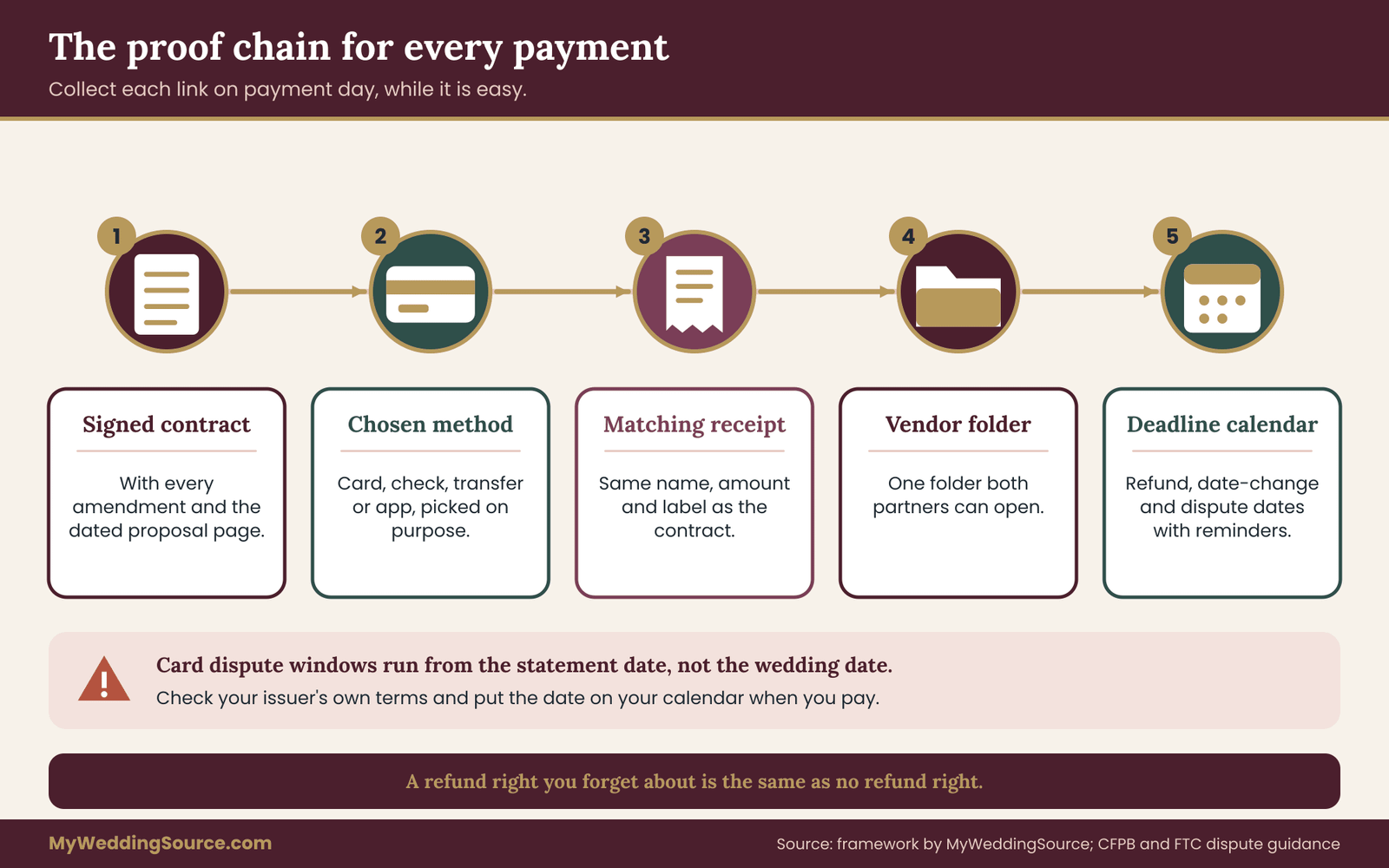
A clear contract protects you only if you can show what you paid and when. Proof is the fourth lens on the checklist, and it deserves its own plan, because the evidence you need later is easiest to collect at the moment of payment.
Choose the payment method deliberately
Vendors accept different methods, and each has different consequences. A credit card generally gives you access to the issuer’s dispute process, which the Consumer Financial Protection Bureau and the Federal Trade Commission describe in plain language. A debit card, a check, a bank transfer and a payment app each have their own rules, and some give you fewer options if something goes wrong. Read your own account terms, because the details differ between issuers and between products.
Some vendors add a surcharge for cards or offer a discount for another method. Weigh that against the protection you value. For a large wedding retainer, many couples decide that the dispute option is worth a small fee, while for a modest payment they may take the discount. There is no single right answer, but the choice should be made on purpose and not by default.
Also be careful with payment apps and transfers to individuals. Scam warnings from the Federal Trade Commission often involve payments that are hard to reverse. If a vendor you have not verified asks for an unusual payment method, treat it as a reason to slow down and verify the business first. The wedding vendor due diligence checklist covers how to confirm a vendor is who they say they are.
Collect a receipt that matches the contract
When you pay, ask for a receipt or an invoice marked paid. Check that it shows the vendor’s legal name, the date, the amount and a description. Then compare the description with the contract. If the contract calls the payment a wedding retainer and the receipt says “deposit,” you have the label mismatch from the earlier discussion, now in your records. It is easier to ask for a corrected receipt in the same week than a year later.
For card payments, your statement will show a merchant name that may differ from the vendor’s trade name. Note both in your records so that you can match them later.
Build a small proof file for each vendor
A proof file needs only five items. The signed contract with every amendment. The proposal or web page that describes the terms, with a date. The receipt for each payment. The emails in which the vendor answered your questions. And the checklist page you filled in.
Store them in one folder per vendor, in a place both partners can open. The payment calendar method in the cash-flow guide shows how to line each folder up with your due dates. Keep the folder until the vendor file is closed and the event is long past, because disputes sometimes surface late.
Write down the dates that protect you
Every payment has dates that decide your options: the refund deadline, the last day for a date change, the final balance date, and the card dispute window. Put each on a calendar with a reminder. A refund right that you do not notice expiring is the same as no refund right. This takes five minutes per vendor and is one of the more valuable habits in the whole process.
When plans change: cancellation, date changes and vendor failure

The payment language you studied before signing matters most when something shifts. Here is how to use it in the three common situations.
You need to move the date
Start by reading the clause on date changes, not the cancellation clause. Many couples think of a date change as a cancellation, and the contract may treat it differently. Ask the vendor in writing, as soon as you know: “We are considering moving our wedding. Could you tell us whether our payments can be applied to a new date, and what the process and deadline are?”
If the vendor is available on the new date, many are willing to carry the payment over. If the vendor is not available, the question becomes whether the payment is retained, applied to a different service or returned. The answer depends on the wording of the wedding retainer clause and on the vendor’s own judgment. A courteous request, with some flexibility on your side about alternative dates, often goes further than a demand.
You need to cancel
Cancel in the way the contract specifies, usually in writing, by the date the contract sets. Keep a copy. Then ask for a written statement of what is returned and what is retained. If the contract says the payment is non-refundable, you can still ask whether the vendor was able to rebook the date and, if so, whether any portion could be returned. Some vendors will do so out of goodwill, but it is a favor and not an entitlement unless the contract says so.
If you believe a clause is unreasonable, or the vendor has retained more than the contract allows, the next steps are the ones in the earlier sections: read the relevant consumer pages, consider the card dispute process if you paid by card and the deadline allows, and consider a short legal consultation. The Consumer Financial Protection Bureau accepts complaints about certain financial products and services, and state attorneys general handle many consumer complaints about businesses.
The vendor cannot perform
This case is both the most stressful and the least discussed in vendor templates. If the vendor cancels, closes, becomes ill or is otherwise unable to perform, your first step is to read the clause that covers it, if any, and ask in writing for a refund of all payments. Keep the request factual and dated.
If the contract is silent, general law and the vendor’s goodwill decide the outcome. Your state’s rules on contracts and consumer protection may support a refund, but the specifics depend on where you live and what happened. If you paid by card, check the issuer’s dispute deadline immediately, because it runs from the statement date and may expire quickly. If the vendor has closed and cannot be reached, the card dispute route and a complaint to your state consumer protection office are worth exploring.
Some couples buy event insurance that addresses vendor failure or cancellation for covered reasons. Policies differ greatly in what they cover and exclude, so read the terms and ask the insurer directly. This article does not recommend any product.
Outside events
Weather, illness, travel disruptions and public emergencies can all affect a wedding. A contract’s force majeure clause, if it has one, may suspend obligations without saying anything about money. Ask what happens to the wedding retainer in that case: is it applied to a new date, returned in part or retained? Because language here varies so much, this is a good question to put to the vendor before signing, when the world is calm and a straightforward answer is easiest to give.
Keep a short log of every change
When plans change, write down what you asked, whom you asked, when, and what they answered. A simple dated list is enough. This helps you stay consistent if the story gets complicated, and it gives a lawyer, a card issuer or a consumer office a clear record if you need help. Memory fades faster than anyone expects, and a month of rescheduling can blur which email promised what.
The limits of this guide and common mistakes with a wedding retainer
Every method has edges, and it is better to know where this one stops. The checklist helps you read what a contract says and decide what to ask. It does not interpret the law, predict how a dispute would end or replace a lawyer’s advice about your particular document.
It cannot tell you what a court would do. Whether a non-refundable clause is enforceable depends on your state, the exact wording and the facts. Two similar clauses can be treated differently.
It cannot verify the vendor. A well-written contract from a business that later closes is worth only what the business can pay. Verification of the vendor’s history and standing is a separate task, which the due diligence guide covers.
It cannot cover every payment structure. Financed purchases, third-party payment processors, package deals across several vendors and venues that bundle services can follow different rules. If a payment does not fit the four lenses, that is a sign to ask more questions.
It does not know current fees or local rules. Rules and typical practices change. Confirm current requirements with the agency or office that issues them, and check the vendor’s own latest terms.
Mistakes that cost couples money
Some errors come up often enough to name.
Trusting the heading. Treating “deposit” as a promise of refund, or “retainer” as a promise of loss, without reading the sentence below it.
Comparing package prices instead of all-in prices. A wedding retainer that is not credited raises the true cost.
Skipping the vendor-failure sentence. Reading every clause about what you owe and none about what the vendor owes.
Relying on a verbal promise. A kind assurance on a call is easy to forget and hard to prove. Put it in the contract or in a dated email at minimum.
Missing the dates. Refund windows and card dispute windows pass quietly.
Paying by an unusual method before verifying the vendor. Speed is rarely worth the loss of options.
Counting on a refund that was never promised. If the contract says a payment is non-refundable, plan as though it is spent.
Keeping this in proportion
Contract reading can become a kind of worry that eats weeks of planning. Keep it proportionate: run the checklist, ask your questions, sign what you understand, and move on to the parts of the wedding that are more fun. The goal is that no payment surprises you, not that no payment ever carries risk. Every wedding involves some commitments that cannot be unwound, and a clear wedding retainer is a commitment you can see.
Your next steps
- Gather the contracts and proposals you have so far, and list every early payment: retainer, deposit, booking fee, advance.
- For each payment, fill in the four lenses: label, function, fate and proof, with section numbers.
- Mark every unknown, and write one short email per vendor asking the questions that fill the gaps.
- Compare vendors by all-in price and by money at risk, and count the state-law triggers on each payment.
- For any payment with several triggers or a large amount, read your state consumer protection pages and consider a short consultation with a contract lawyer.
- Pay in a way you chose on purpose, ask for a receipt that matches the contract, and store a proof file for each vendor.
- Add every refund deadline, date-change deadline and card dispute window to your calendar, and link the dates to your wedding planning checklist.
- Compare your finished pages with the wedding vendor purchase order checklist so that what you ordered, what you paid and what the contract says line up.
FAQ
Is a wedding retainer the same as a deposit?
Not necessarily. A deposit is usually a partial payment credited toward the price, while a wedding retainer is often a payment for holding the date or the vendor’s time and may not be credited. Neither word has one fixed legal meaning in wedding contracts, so read the clause: whether the payment is credited, what happens if you or the vendor cancels, and whether it is described as earned when paid.
Is a wedding retainer always non-refundable?
No. Many vendors write a wedding retainer as non-refundable, but some allow refunds before a set date, apply the payment to a new date or return it if the vendor cannot perform. What the contract says controls the practical outcome. If the clause is silent about a situation, ask the vendor to add a sentence before you sign, and keep the reply in writing.
Does the wedding retainer count toward the total price?
Sometimes, and sometimes not. If the contract does not say the payment is credited or applied to the balance, you cannot assume it is. A wedding retainer that sits on top of the package price raises your real cost. Ask for a sentence stating whether it is credited, and compare vendors by the all-in total, not the advertised package price.
What if the contract calls the payment a deposit but the invoice says retainer?
Treat it as a mismatch and ask the vendor which label is correct, then request that the documents be updated to agree. Invoicing software often uses default line names that differ from the contract. The signed agreement is generally what matters most, but a consistent paper trail makes any later conversation, with the vendor or a card issuer, much simpler.
When should I ask a lawyer to review a payment clause?
Consider a short review when the amount is large for you, the clause is non-refundable with silence about vendor failure, the label contradicts the description, or the contract names another state’s law or requires arbitration. One trigger usually calls for a question to the vendor, while several together justify a consultation with a contract lawyer licensed in your state.
Can a wedding retainer be moved to a new wedding date?
Only if the contract or the vendor agrees. Some contracts say the payment may be applied once to a new date, subject to availability. Others are silent. Ask in writing as soon as you think the date may change, offer flexibility on alternatives, and ask for any agreement to be added as a signed amendment so it stays attached to the contract.
What can I do if the vendor cancels and keeps my payment?
Start with the contract clause on vendor cancellation, then ask for a refund in writing with dates. If you paid by card, check the issuer’s dispute deadline right away, because it runs from the statement date. You can also contact your state consumer protection office, and the Consumer Financial Protection Bureau accepts complaints about some financial products. A lawyer can advise on larger amounts.
Which payment method is safest for a wedding retainer?
No method is safest in every case. Credit cards generally offer an issuer dispute process, while checks, transfers and payment apps may offer fewer options, and some vendors add card surcharges. Read your own account terms, weigh any fee against the protection, and avoid unusual payment requests from vendors you have not verified. Keep the receipt either way.
Sources
- Using credit cards and disputing charges, Federal Trade Commission
- Sample letter disputing credit and debit card charges, Federal Trade Commission
- How do I dispute a charge on my credit card bill, Consumer Financial Protection Bureau
- What is a chargeback, Consumer Financial Protection Bureau
- How do I get a refund, Consumer Financial Protection Bureau
- Submit a complaint, Consumer Financial Protection Bureau
- How can I spot and avoid scams, Consumer Financial Protection Bureau
- ReportFraud, Federal Trade Commission
- State attorneys general directory, National Association of Attorneys General
- Consumer Advice, Federal Trade Commission