
Wedding vendor communication deadlines are the dates by which you must tell a vendor something, approve something, or hear something back, and missing one quietly can change what you pay, what you get, or who shows up, so it helps to put every one of them on a single shared calendar with a signed or written approval beside it.
Quick answer
Most wedding vendor communication deadlines come from three places: your signed contract, the vendor’s or venue’s written policies, and common practice in published planning advice. Gather them all, convert each one to a real calendar date, and record two dates for every item: the date you will send the information and the date the vendor must give you written confirmation. Published sources suggest reconfirming every vendor about one to two weeks before the wedding and finalizing the day-of timeline about one month ahead, but guest-count and payment deadlines vary by vendor, so take those from your own paperwork. When a vendor changes something or you do, ask for a written yes from a named person and file it where your partner and planner can find it. This guide gives you the calendar structure, a tracker you can copy, and the scripts to use when someone goes quiet. It is general information, not legal advice.
What wedding vendor communication deadlines are, and why they matter
A wedding involves a long list of people who each need something from you at a specific time, and wedding vendor communication deadlines are how those needs show up on your calendar. The florist needs your final colors and delivery address. The caterer needs a guest count. The photographer needs a timeline, and the DJ needs a do-not-play list and a set of announcements. Each of those needs is a deadline, and most are written somewhere you may not have looked since signing.
This guide treats wedding vendor communication deadlines as a system rather than a pile of reminders. A system has one place where everything lives, one way to record that a message was sent and received, and one rule for what counts as “approved.” That is what the shared approval calendar in this article is.
Three kinds of dates hide inside every vendor relationship
It is easy to talk about wedding vendor communication deadlines as if they were one thing. In practice there are three different kinds, and mixing them up is how couples miss the one that matters.
Dates the vendor sets for you
These are the wedding vendor communication deadlines written in the contract or the vendor’s policy sheet: the day the final guest count is due, the day a balance must be paid, the last day to change a menu choice or a bouquet recipe, the last day to send song requests. They are the ones with money or availability attached, so they tend to be firm. A published example from one venue operator, Wedgewood, ties the final guaranteed guest count and the final payment to a date ten days before the event, and says the venue uses that number to order food and linens and to schedule staff. That is a vendor-set date, and it appears in the vendor’s own materials.
Dates you owe the vendor
These are the things the vendor cannot do their job without: a day-of timeline, a shot list, a floor plan, a delivery address with a contact person, a list of dietary needs, a playlist. Many vendors will not name a hard date for these, which makes them easy to postpone. Your advantage is that you can set your own earlier date and treat it as a deadline anyway. The Knot’s timeline guidance, for example, suggests finalizing the wedding-day timeline about one month ahead so there is time to share it with your wedding professionals.
Dates when someone must confirm back
The third kind is the one most couples skip. It is the date by which you need to have heard back from the vendor in writing. If you send a final timeline on a Monday and never see an acknowledgment, you do not actually know whether anyone read it. The Better Business Bureau advises reconfirming all services one to two weeks before the event and checking every detail against the contract, and it advises keeping written records of correspondence. Confirm-back dates turn a one-way message into a closed loop.
What a missed date can actually cost
Not every missed date is expensive, and it would be inaccurate to suggest otherwise, but wedding vendor communication deadlines do not all fail in the same way. But the same three kinds of dates have different failure modes, and it helps to know which is which before you decide how much attention each deserves.
Money and quantity
Guest-count deadlines are the clearest money-linked example. In one catering policy from a university dining office, the host is charged for the greater of the guaranteed count or the number who actually attend. In a venue operator’s policy, if a count drops after the final meeting the host is still charged for the original guaranteed number, and if it rises the higher number becomes the new guarantee. The details differ by vendor, which is the whole point: the date and the rule are in your contract, not in a general guide.
Quality and fit
Missing an input deadline rarely triggers a fee, but it can quietly lower quality. A florist who receives final colors late may work from an earlier mood board. A DJ who receives announcements the day before has less time to ask questions. A photographer who never saw the family-photo list will improvise. None of this is dramatic, and none of it is a legal problem, but it shows up in the results.
Trust and the paper trail
The least visible cost is trust. If you and a vendor remember a conversation differently and nothing was written down, the vendor’s version is the one backed by their own files. The Wisconsin Department of Agriculture, Trade and Consumer Protection (DATCP) advises never signing a blank contract and getting delivery and completion dates written into the agreement. The same logic applies after signing: a deadline that exists only in someone’s memory is not much of a deadline.
Finding the wedding vendor communication deadlines already in your paperwork
Before you invent a schedule, collect the wedding vendor communication deadlines that already exist. For most couples, the first pass of this work is a scavenger hunt through contracts, emails, vendor portals, and venue handbooks. Expect it to take an evening per vendor group, and expect to find at least one date you had forgotten.
Where deadlines hide
Wedding vendor communication deadlines turn up in unexpected places because they are written by different people at different times. A contract may say “final details due thirty days prior” in one clause and “final headcount due fourteen days prior” in another, while a portal prompts you for a third date that appears nowhere in the paperwork.
Contracts, addenda, and attachments
Read the signed agreement end to end, including any attached schedule, rider, or policy sheet. Look for words like “due,” “no later than,” “prior to,” “confirm,” “deadline,” “notice,” and “final.” Also look at the section on changes and cancellations, because many agreements say what counts as a valid change and when it must be made. Our guide to wedding vendor contract red flags explains how to read the clauses that tend to carry dates, and our wedding vendor due diligence checklist covers the earlier step of checking a vendor before you sign.
Online portals and questionnaires
Many planners, photographers, and venues use an online client portal with forms and due dates. Those dates are real even when they are not in the contract, because the vendor’s workflow depends on them. Screenshot or export each portal’s task list into your calendar once, then check it again after any vendor update, since portals sometimes change due dates without an email.
Venue handbooks and vendor rules
Venues often keep a separate document for outside vendors with load-in windows, insurance paperwork dates, and access rules. If you are using an independent florist or DJ at a venue, the venue may have its own advance-notice rule that your vendor must meet. In one published venue operator Q&A, independent bakers and DJs are asked to provide a business license and proof of liability insurance, and vendors such as florists, bakers, and DJs may need advance notice for changes. When the venue and the vendor each have a clock, put both on your calendar.
Reading a clause for its clock
Once you find a date, the next question is what it means. Wedding vendor communication deadlines written in prose can be ambiguous, and ambiguity is easiest to fix before the deadline arrives.
Count from the right starting point
Most deadlines count backward from the event date, but some count from signing, from a prior payment, or from the vendor’s receipt of something. If a clause says “ten days before the event,” decide whether that means the tenth day counting back from the day of the wedding and write the resulting calendar date down. If you are unsure, email the vendor a one-line question with the date you calculated and ask them to confirm it.
Business days versus calendar days
A deadline of five working days is not the same as one of seven days. One university catering office publishes a final-count rule of five working days before the event, with an earlier estimate due seven working days before. Another says the count is final seven days before. A weekend or holiday can move a working-day deadline earlier on the calendar than you expect, so convert each one to a date and note whether it is a business-day or calendar-day count.
Who must receive it, and how
Some contracts say notices must go to a particular person or a particular email address. If yours does, follow that exactly and copy anyone else who needs to know. If a clause says changes must be in writing, a phone call to your usual contact may not meet it. We cover what makes a change official in more detail in our guide to wedding contract change orders.
Example clocks from published sources
It can help to see what real deadlines look like side by side. The figure below collects examples from published sources and policies we found, drawn on a shared axis counted back from the wedding day. It is not a standard. It is a picture of how much wedding vendor communication deadlines vary from one business to the next.
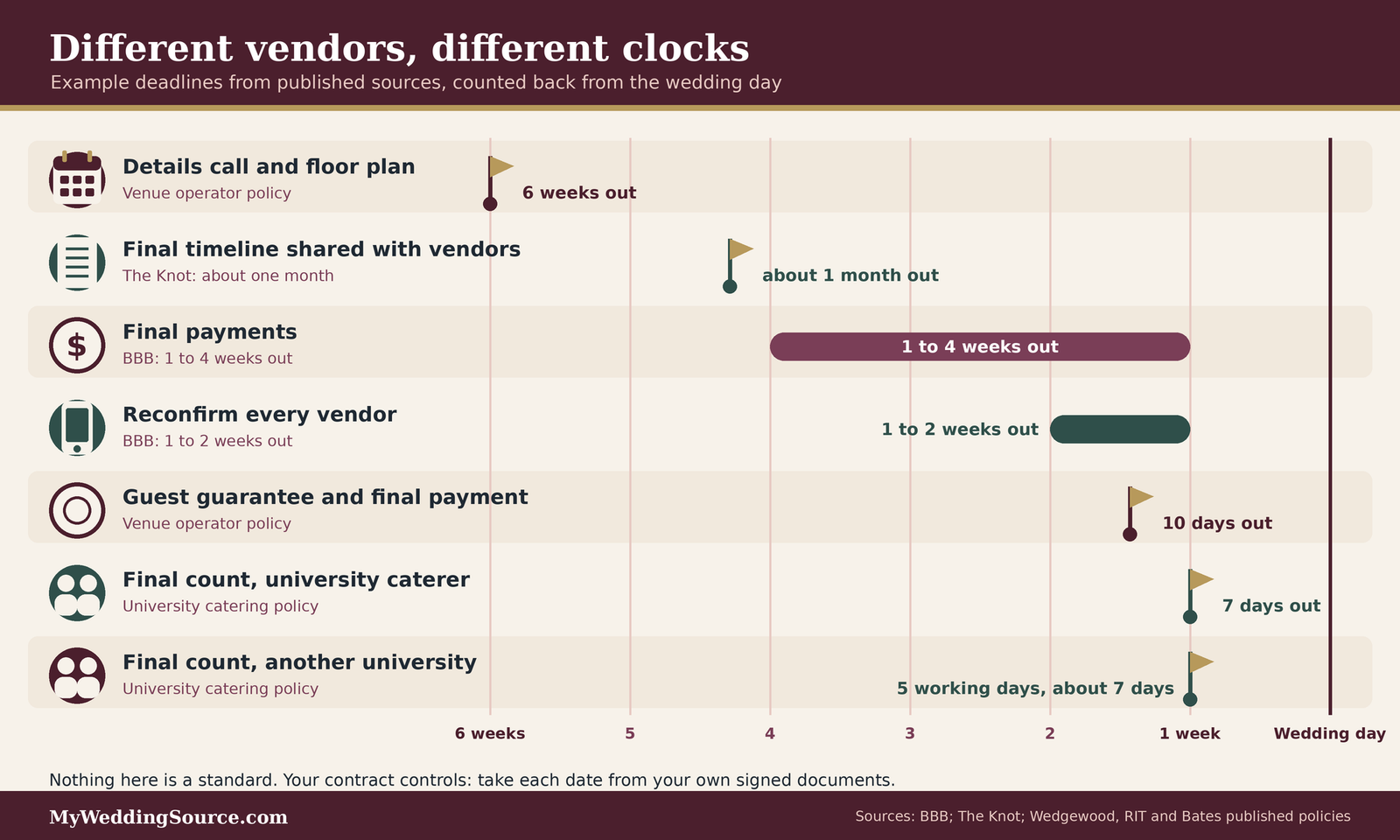
The most useful thing about this picture is not any one date. It is the spread. Some of these clocks start at six weeks, some at about a month, and the money-linked ones tend to cluster in the last two weeks.
Where the examples come from
The examples in the figure come from three types of sources, and it matters which type you are looking at because each carries a different level of authority over your wedding.
Venue operators and caterers
Wedgewood, a venue operator, publishes a schedule that includes a details call about six weeks before the event, where the floor plan is created and early access is arranged, and a final meeting ten days before the event where the guest count and payment are due. Two university catering and event offices publish counts due at seven days and at five working days. These are the policies of specific businesses, not industry rules. A private caterer or a different venue will have its own.
Consumer guidance
The Better Business Bureau and The Knot publish general timing advice, such as the BBB’s suggestions to reconfirm vendors one to two weeks out and to make final payments one to four weeks out using the method in your contract, and The Knot’s suggestion to finalize the day-of timeline about a month ahead. This is guidance, not a rule that binds any vendor, and it is a useful default only when your contract is silent.
Your own signed documents
The most important source is your contract, and it should override everything else on this page. When a published example and your contract disagree, follow the contract and, if the difference is large, ask the vendor about it in writing.
Using examples without borrowing them
A table of other people’s wedding vendor communication deadlines can tempt you to copy it. The safer use is as a prompt for questions.
Treat each example as a question to ask
For wedding vendor communication deadlines, if a venue operator uses a six-week details call, the useful takeaway is that you should ask your own venue whether it has a details call and when it falls. If a university caterer sets the count at five working days, the takeaway is to ask your caterer exactly what its number is and whether the count can rise after it. The figure is a way to notice the questions, not a source of answers.
Do not assume a default
No source we found establishes a universal deadline for final headcount. The BBB’s key-dates guidance, in the version we read, says to ask caterers when the final count is due. That is the right instinct. Ask, write down the answer, and put it on the calendar.
A shared approval calendar for wedding vendor communication deadlines is a calendar that more than one person can see and, where appropriate, edit, built so that each entry carries an action, a due date, and a status. It is less glamorous than a binder and far more useful, because it sends the reminders for you.
Who needs to see it, and who needs to edit it
Sharing is where good calendars for wedding vendor communication deadlines go wrong. If everyone can edit, entries get moved or deleted by accident. If only one person can see it, you have rebuilt the problem you were trying to solve.
The couple and the planner
The two people getting married, plus a planner or coordinator if you have one, are the core group, and they should have full editing rights. If you work with a planner, decide in advance who is the point of contact for each vendor. The BBB suggests identifying a single point of contact, and a calendar makes it easy to put that name on every entry. See our guide on wedding planner vs coordinator if you are still deciding who will carry that role.
Family and wedding party
Parents, a maid of honor, or a best man often need to know when something is happening, such as a delivery or a vendor arrival. A view-only or event-details permission is usually enough. Google Calendar’s sharing options, for example, include seeing only free and busy time, seeing event details, making changes, and managing sharing, so you can match the permission to the person. For group communication, our guide to wedding party group chat rules covers how to keep logistics from drowning in banter.
Vendors and the venue
Most couples do not give vendors editing access, and there is usually no reason to. A better option is to send each vendor a short email of their own dates, with the due date and confirm-back date, and ask them to reply. That reply is the record. If a vendor wants to share a portal calendar instead, treat it as a second source and compare it with yours.
Setting it up so it works
The mechanics of tracking wedding vendor communication deadlines are simple, but a few choices make the difference between a calendar you use and one you abandon in month two.
One calendar for the wedding
Create a dedicated calendar for your wedding vendor communication deadlines rather than adding entries to a personal one. A dedicated calendar can be shared with specific people, hidden when it is not needed, and handed off to a planner without exposing everything else in your life. In Google Calendar, you open the calendar’s settings, choose the sharing option, add people by email, and pick a permission level for each. Other calendar apps have similar options. Review the list of people with access every few months, and remove anyone who no longer needs it. Our guidance on wedding planning password sharing covers the related question of who gets which logins.
Reminders that arrive early enough
Set at least two reminders per entry. Google Calendar lets you add more than one notification to an event and choose how far ahead each arrives, by email or pop-up. A sensible pattern, which is our suggestion rather than a published standard, is one reminder a week before the send date and another two business days before. For the confirm-back date, set one reminder on the day itself so a missing reply is noticed immediately.
Time zones and all-day entries
If a vendor works in a different time zone, or you are marrying away from home, note the time zone in the entry. For a deadline that is a date rather than a moment, use an all-day entry and write “by end of day, vendor’s local time” in the description if the contract does not say.
Naming entries so they are readable at a glance
A calendar of wedding vendor communication deadlines full of entries called “Florist” is nearly useless. A consistent format fixes that.
A simple entry format
Use a pattern such as: vendor, action, who sends. For example, “Caterer: send final count (Alex)” or “DJ: confirm announcements list received (Sam).” The vendor name groups entries visually, the verb makes the task clear, and the name in parentheses makes ownership obvious. Add the contract clause or source in the description so you can find it again.
Two dates per item
Each item should appear twice: once on the date you will send or decide, and once on the date the vendor must acknowledge or the vendor’s own deadline, whichever comes first. If an item has a hard vendor deadline, add a third entry a few days before it labeled as a buffer, so a slipped message does not become a missed deadline.
The written amendment and signed-approval tracker
This is the working part of the guide for anyone managing wedding vendor communication deadlines. The tracker is a simple table, one row per decision or deadline, that records what was asked, who must approve it, how the approval arrived, and where the proof lives. It works in a spreadsheet, a shared notes app, or on paper. What matters is that every row ends in a recorded approval, not a vague sense that someone agreed.
The columns and what each one prevents
Each column exists to prevent a specific kind of confusion. If a column feels like overkill for your wedding, merge it with another, but do not drop the approval and evidence columns, because those are the whole point.
The twelve fields
| Column | What to write | What it prevents |
|---|---|---|
| Item | One line, for example “Final guest count” | Vague entries that nobody can act on |
| Vendor and contact | Company and the named person | Messages sent to the wrong inbox |
| Source of the date | Contract clause, policy sheet, portal, or “our own target” | Confusion about whether a date is firm |
| Our send date | The day we will send or decide | Last-minute scrambling |
| Vendor deadline | The vendor’s own date, if any | Missing a firm date |
| Confirm-back date | When we need a written reply | Assuming silence means yes |
| What we are asking for | The exact content, number, or choice | Mismatched understanding |
| Who approves for us | Named person or both partners | A planner or relative approving without authority |
| Who approves for the vendor | Named person and role | Informal approval from someone who cannot bind the vendor |
| Status | One of the words listed below | Ambiguity about where things stand |
| Evidence | Link, filename, or location of the email or signed page | Hunting for proof under pressure |
| Money effect | Added, reduced, or none, with the amount | Surprise charges |
Status words that mean one thing each
Use a short, fixed list of statuses so that anyone opening the tracker reads it the same way. A useful set is: Not started, Drafted, Sent, Acknowledged, Approved in writing, Signed, Filed, and Changed after approval. The difference between Acknowledged and Approved in writing is the one that matters most. Acknowledged means the vendor says they received it. Approved in writing means the vendor, or you, said yes to a specific stated thing. A row is not finished until it reaches Approved in writing or Signed and has an evidence link.
A filled-in example
Seeing a few rows makes the structure clear. The vendors, dates, and amounts below are invented for illustration. They are not recommendations and do not come from any source.
Four sample rows
| Item | Source of date | Our send date | Vendor deadline | Confirm-back | Approval record | Status |
|---|---|---|---|---|---|---|
| Final guest count to caterer | Catering contract, clause on guarantees | Nov 3 | Nov 8 (10 days out) | Nov 4 | Caterer’s reply email naming the count | Approved in writing |
| Day-of timeline to photographer and DJ | Our own target (about one month out) | Oct 20 | None stated | Oct 24 | Both reply “received, no changes” | Acknowledged |
| Floral change: swap one bouquet flower | Florist portal form | Oct 1 | Oct 15 | Oct 3 | Revised invoice, signed | Signed |
| Add one hour of DJ coverage | DJ contract, overtime clause | Oct 10 | None stated | Oct 12 | Written addendum, both parties | Approved in writing |
How to read the example
Notice that the timeline row stops at Acknowledged. That is honest: both vendors said they got it, but neither approved a specific plan. If a vendor’s reply says “received” and nothing else, that is a perfectly good status. It tells you the row is not closed, which is useful when you look at the tracker a week later. Notice also that the floral row and the DJ row involve money. Those are the rows where a signed page or written addendum matters most, and where our guide to change orders goes into the content of the page itself.
Keeping the tracker alive
A tracker of wedding vendor communication deadlines is only as good as its last update. The easiest way to keep it current is to make updating it part of sending the message.
Update it in the same sitting
To keep wedding vendor communication deadlines current, when you send a request, add or update the row immediately, with the send date and the confirm-back date. When a reply arrives, paste the link or filename into the evidence column before you do anything else. This takes under a minute per item and removes the need for a catch-up session.
Decide where the proof lives
Pick one place for evidence: a shared folder, a dedicated email label, or a notes app. Name files with the vendor, topic, and date, such as “caterer-final-count-2026-11-04.” The BBB advises keeping written records of all correspondence, and a consistent naming pattern makes those records searchable. If you share the folder, set permissions deliberately. Our guides on spreadsheet permissions and planning-site privacy and security cover the sharing choices in more detail.
From request to written yes
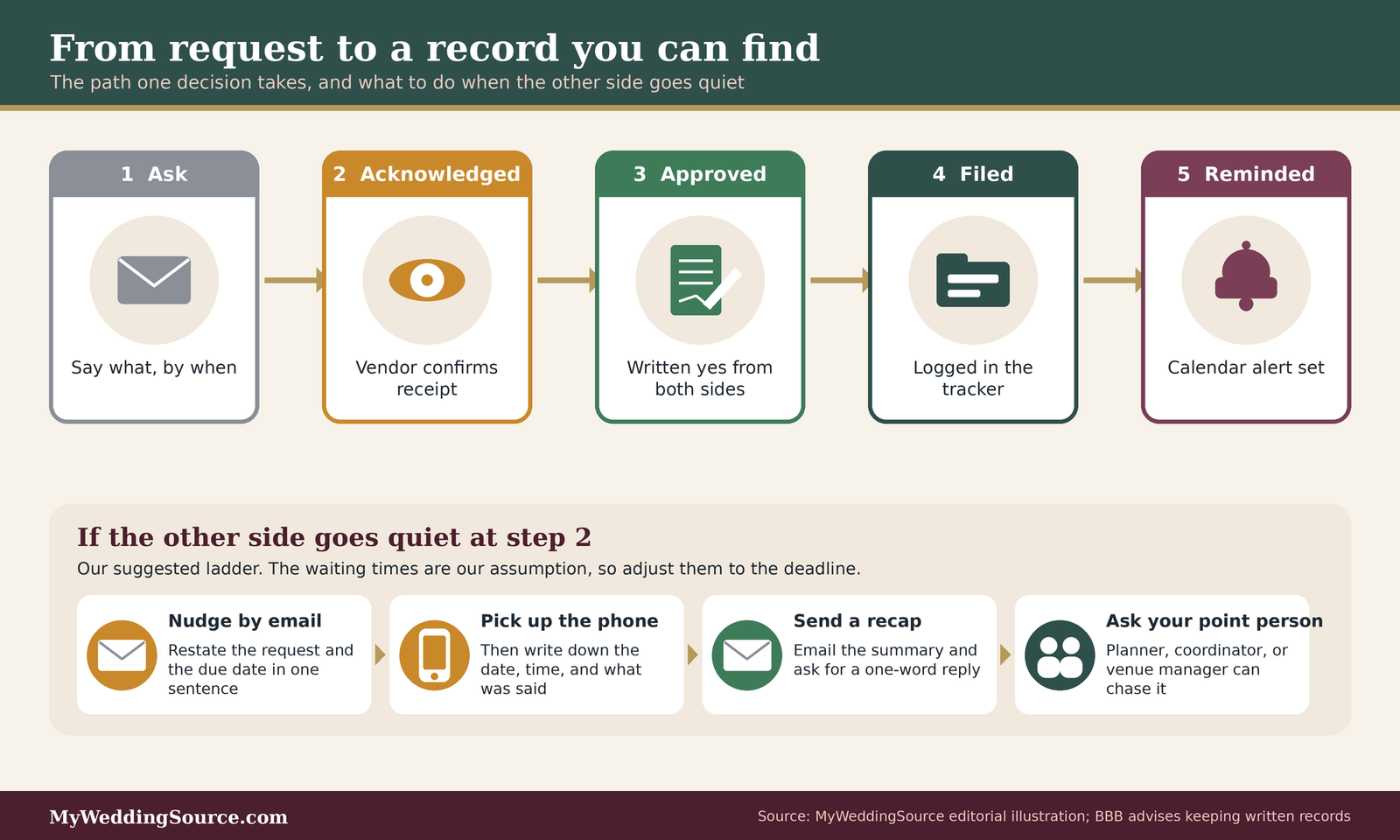
Wedding vendor communication deadlines are only met when the information arrives and the other side confirms it. The figure below shows the path one decision takes through the tracker, and what to do if the vendor goes quiet. The waiting times in the lower panel are our suggestion, not a published rule, so adjust them to how close the deadline is.
The five steps in order
The path is deliberately short. Most missed deadlines happen not because a step is hard but because a step is skipped without anyone noticing.
Ask, acknowledge, approve
Start by saying exactly what you are asking and by when, in a message a stranger could understand. Then wait for acknowledgment, which proves the message arrived. Finally, get approval, which proves the content was accepted. If you ask a florist to swap a flower, acknowledgment is “got your note.” Approval is “confirmed: we will substitute X for Y at no change in price, per your revised invoice.”
File and set the reminder
Once you have approval, file the evidence and update the row. Then make sure the next date is on the calendar, such as the vendor’s own deadline for the next step. Filing without a reminder leaves you with a tidy record and no prompt to look at it.
What counts as approval
Couples tracking wedding vendor communication deadlines reasonably ask how formal approval needs to be. The honest answer for wedding vendor communication deadlines is that it depends on the contract and on what is at stake, and that a short, specific written confirmation is usually better than none.
Email, text, and portal messages
Federal law, in the Electronic Signatures in Global and National Commerce Act, says a record or signature may not be denied legal effect solely because it is in electronic form, for transactions in interstate or foreign commerce. In plain terms, an email can be a real record. That does not mean every email is a binding amendment. Whether a particular message changes a contract depends on the contract’s terms and on your state’s law. Treat that as a reason to be specific and keep the record, and consider asking an attorney about anything large.
What your contract may require
Some vendor agreements say that changes must be in a signed writing. Under the Uniform Commercial Code provision on modifications, which covers sales of goods and not services, a signed agreement that requires modifications to be in a signed writing generally cannot be changed orally between merchants. Many wedding services are not sales of goods, so we cannot say how that rule applies to your vendor, but it illustrates why you should read what your own contract says about changes and follow that process. When in doubt, use the contract’s method, and use email to document the conversation around it.
Approval from the right person
Check that the person approving can approve, because wedding vendor communication deadlines mean little if the wrong person says yes. A venue’s day-of manager may not have authority to waive a policy that the owner set. A photographer’s assistant may confirm a time without being able to commit the lead photographer. Write the approver’s name and role in the tracker. If you have a planner, the planner agreement should say what the planner may approve on your behalf.
When the other side goes quiet
Silence is the most common failure of wedding vendor communication deadlines, and it is rarely hostile. Vendors are busy, especially in peak season, and inboxes are crowded. The goal is to have a calm sequence ready so you do not have to improvise.
A suggested escalation ladder
A ladder that many people find workable, which is our suggestion, is: a short follow-up email restating the request and date; a phone call, followed by a written note of what was said; a recap email asking for a one-word reply; and finally a request to your point person at the planner, coordinator, or venue to chase it. Leave more time between steps when the deadline is far away and less when it is close.
Write down phone calls
A phone call can be helpful, but it leaves no record. After any call, send a two-line email: “Thanks for the call today. To confirm, we agreed X by Y. Please reply to confirm.” That email turns a verbal exchange into the evidence the tracker needs.
Responsiveness is information
The BBB notes that difficulty reaching a vendor early on is a warning sign, and it advises paying attention to responsiveness before you sign. The same applies after signing. If a vendor routinely misses confirm-back dates, raise it with them politely, move critical items earlier, and add a backup contact to the row.
Guest counts, payments, and the deadlines that move money
Some wedding vendor communication deadlines are mostly about convenience. Others are tied directly to what you owe. Those deserve extra care, because a missed date can turn into a charge.
How guaranteed guest counts work
A guest guarantee is a number you commit to by a date, after which the vendor orders and staffs to it. The rules for what happens when the real number differs are written into the vendor’s policy, and they are not the same everywhere.
Two published rules
Wedgewood’s published policy says that if the count rises after the final meeting, the higher number becomes the new guaranteed count, and that if it drops, you are still charged for the original guaranteed count, with guests beyond the guarantee billed as extras. Bates College’s catering policy says the host is charged for the greater of the guaranteed count or the number who actually attend. Both are examples of the same idea: the guarantee works like a floor, and a late drop does not refund the difference.

A worked example with invented numbers
For wedding vendor communication deadlines tied to money, the figure uses an invented price of $95 per guest and a guarantee of 100 guests, with one plate standing for ten guests. If you tell the caterer about a drop to 90 before the deadline, the guarantee is reset and the bill is about $8,550 before tax and service charges. If the same drop is reported after the deadline under a rule like Wedgewood’s, the bill stays near $9,500, so ten empty seats cost about $950. If the count rises to 110 after the deadline, the higher count becomes the guarantee and the bill is about $10,450. These figures are our own arithmetic on invented numbers, and your vendor’s rules, taxes, service charges, and per-person prices will differ.
Cost check
In our invented example, a single late change of ten guests moves the bill by about $950 in either direction, and it does so only because of when the vendor was told. The lesson is not that the number is large. It is that the date, not the headcount, determines which rule applies. Put the guarantee deadline on your calendar with a buffer a few days earlier, and send the number in writing so the vendor’s reply fixes the figure. All amounts here are illustrative and exclude tax, gratuity, and service charges.
Final payments and the way you pay
The BBB’s key-dates guidance suggests making final payments about one to four weeks before the wedding using the method set out in your contract. The contract controls, so look for the date and the accepted methods.
Pay by a traceable method
DATCP advises paying as little up front as you can, and paying by credit card where possible because the card issuer may help if something goes wrong. The BBB similarly warns against paying the full amount up front and says a credit card gives more protection. Put the payment date on the calendar with the confirm-back date for the receipt, so you have proof of payment as well as proof of the amount.
Billing errors have their own clock
If a charge is wrong, a separate federal timeline applies. The Federal Trade Commission explains that for a credit card billing error, your written notice must reach the card issuer within sixty days after the first bill showing the error was sent, and that the issuer generally must acknowledge it within thirty days and resolve it within ninety days. This is general consumer information, not legal advice, and a dispute about whether a vendor met a contract is different from a billing error. Add a calendar reminder to read each statement after a vendor charge posts.
Deadlines that sit behind the money
Several non-payment wedding vendor communication deadlines affect cost indirectly. They are worth knowing because they often come as a surprise.
Counts that drive other orders
A guest count can drive more than food. In Wedgewood’s published policy, the cake is sized from the final count given ten days before, and the number of centerpieces is set at the final meeting. Rentals, linens, printed menus, and seating charts may also depend on the same number. When you send a final count to the caterer, ask which other vendors use it and whether they need it separately.
Overtime and timeline changes
If a timeline change adds hours, the vendor may charge overtime under the contract. FindLaw notes that vendor contracts may include additional charges such as overtime. Our guide to vendor overtime rates explains how to read those clauses, and our guide to vendor travel and lodging fees covers charges that appear when a timeline or location changes.
Cancellation fees rise with time
FindLaw also notes that cancellation fees usually rise as the event approaches. That means a deadline to cancel or reduce is often earlier than people expect. Ask each vendor for the date after which a cancellation or reduction costs more, and add it to the calendar as its own entry.
Edge cases and awkward situations
Real weddings do not follow the tidy version. These are the situations where a shared calendar and a tracker earn their keep, and where you may need to adapt the process instead of following it step by step.
When someone else is doing the talking
The more people who contact vendors, the more likely it is that two instructions about wedding vendor communication deadlines will conflict. A relative who calls the florist with a “small tweak” can undo a decision you approved a month earlier.
A planner or coordinator speaks for you
If you have a planner, decide in writing what they can approve alone and what needs your sign-off. A reasonable arrangement, which is our suggestion, is that the planner can confirm logistics already in the contract, such as arrival times, while anything that changes cost, quantity, or scope comes back to you. Put the planner’s authority in the tracker’s “who approves for us” column, and ask vendors to copy you on confirmations.
Family members who mean well
Tell parents and the wedding party, kindly, that vendors take instructions from one or two named people. Give those people’s contact details to the vendors and ask the vendors to flag any change request that arrives from someone else. Our guide to wedding party coordination explains how to divide tasks so fewer people need to contact vendors at all.
A venue coordinator in the middle
At some venues, the venue coordinator relays information to outside vendors. That can help, but it adds a link where a message can stall. Ask whether the vendor also needs your message directly, and put both on the entry. In Wedgewood’s published Q&A, independent photographers are asked to check in on the wedding day so the venue can brief them, which is the kind of last-link detail worth asking about.
When the vendor changes something
Wedding vendor communication deadlines are not only yours. Vendors change staff, hours, delivery windows, and policies, and the change should flow through the same tracker.
A new staff member or substitute
If the contract names a specific photographer or musician and the vendor proposes a substitute, ask for the change in writing and compare it to the contract. DATCP’s contract guidance for photographers highlights naming the specific photographer who will work your event. Our guides to vendor replacement policies and vendor subcontractors explain what to ask when a vendor changes who shows up.
A moved deadline or new policy
If a vendor emails new wedding vendor communication deadlines that differ from your contract, do not just overwrite your calendar. Add the new date, note the source, and reply asking whether the contract date still applies. Keep both until the vendor confirms in writing which one governs.
A vendor who is no longer reachable
DATCP advises staying in contact with vendors after signing to confirm they are still in business and ready for your event. If a vendor stops replying across several steps of the ladder, tell your planner or venue, check the contract for the stated way to give notice, and see our guide to wedding vendor replacement for what to ask next. We cannot say what remedies you have, because that depends on your contract and your state, and an attorney can advise on a serious dispute.
When time is short
Late changes happen, and they test your wedding vendor communication deadlines hardest. Illness, weather, a venue change, or a guest list that shifts all create deadlines you did not plan for.
Compressing the process
When there is little time, shorten the loop, not the evidence. Send the request, call, and send the recap email the same day, and ask for a reply within hours. The goal is still a written yes, only faster, even for last-minute wedding vendor communication deadlines. For the last week, our wedding week checklist and our guide to the wedding vendor timeline cover what typically needs to happen when.
Changes after the final deadline
If you must change something after a vendor’s deadline, ask rather than assume. Some vendors can accommodate a late change, sometimes for a fee, and some cannot. Wedgewood’s published Q&A says that if a count rises after the final meeting, you should tell the venue as soon as possible, which is consistent with the general advice to raise a late change early, not at the last minute. Record the answer and any fee in the tracker.
Weekend and holiday effects
Working-day deadlines can land on a weekend or holiday in ways that surprise people. If your final-count date is a number of working days before a weekend wedding, convert it to a calendar date and check whether a holiday in between moves it earlier. Then send the information a few days sooner than the formal deadline.
Bigger events and unusual setups
A multi-day event, a destination wedding, or a wedding with many outside vendors multiplies the number of wedding vendor communication deadlines.
Weekend events
If your plans include a welcome party, a rehearsal dinner, and a brunch, each may have its own count and its own vendor. Give each event its own set of rows or its own color on the calendar so the deadlines do not blur together. Our guide to wedding weekend event planning explains how to structure the events themselves.
Destination and distant vendors
When vendors are in another time zone or country, deadlines and working days may differ, and replies may be slower. Allow extra time, state the time zone in each request, and ask vendors how they prefer to receive urgent changes. See our destination wedding checklist for the wider planning picture.
Venues with their own vendor rules
Some venues require outside vendors to submit insurance paperwork or follow set arrival windows. Put those dates on your calendar as items you are tracking for the vendor, and ask the vendor to confirm in writing when they have been submitted. Our guide to wedding insurance explains how insurance fits into the picture.
Questions to ask and scripts to send
Good questions early save you from missed wedding vendor communication deadlines later. The block below collects the questions that turn unwritten deadlines into written ones.
Questions to ask each vendor about deadlines
- What are all the dates on which you need something from us, and which ones are in the contract?
- Which of those dates is firm, and which is a target?
- Are your deadlines counted in calendar days or business days, and in what time zone?
- Who is our single point of contact, and who covers when that person is unavailable?
- How do you want us to send information, and what counts as your written confirmation?
- What happens if we are late, and what happens if we change something after the deadline?
- Who on your side can approve a change, and who on ours should you take instructions from?
- Do you share any of our information with other vendors, and do those vendors have their own dates?
- When will you reconfirm details with us before the wedding, and how?
How to ask without sounding rigid
Written processes for wedding vendor communication deadlines can feel formal, and some vendors bristle at being asked to confirm things. A friendly framing helps.
Explain why you are asking
Most vendors appreciate a client who wants to get details right. A line such as “We are keeping a shared calendar so nothing slips, and we would love to have your confirmation on file” explains the purpose without suggesting distrust.
Make replying easy
Ask for a short reply, such as “Please reply ‘confirmed’ if this matches your records.” A one-word answer is easier to give than a letter, and it still creates a record. Our guide to wedding vendor timelines can help you decide what to include in the information you send.
Scripts you can adapt
These short messages are starting points. Edit them to fit your relationship with each vendor, and keep the date and item in the first lines.
A request with a confirm-back date
“Hi [Name], here is our final guest count for [event]: [number]. We understand the due date is [date] under our agreement. Could you reply by [date] to confirm you have it and that the number is final on your side? Thank you.”
A follow-up when there is no reply
“Hi [Name], I am following up on the message I sent on [date] about [item]. Our calendar shows [date] as the deadline, so I wanted to make sure it reached you. A quick reply confirming receipt would be a big help.”
A recap after a phone call
“Thanks for the call today. To confirm what we discussed: [item], [what was agreed], effective [date]. Please reply to confirm this matches your notes. If anything is different, let me know and we will sort it out.”
FAQ: wedding vendor communication deadlines
The basics
What are wedding vendor communication deadlines?
They are the dates by which you must send information, approve a choice, or receive written confirmation from a vendor. Some come from your contract, some from a vendor’s policies, and some are your own targets. Examples include final guest counts, day-of timelines, payment dates, and confirmation calls in the last weeks.
Where do I find my vendors’ deadlines?
Start with the signed contract and any attached schedule or policy sheet, then check emails, client portals, and venue handbooks. If a date is missing, ask the vendor in writing. Published guides such as the BBB’s suggest reconfirming vendors one to two weeks before the wedding, but your own paperwork controls.
Do I need a shared calendar if I already have a checklist?
A checklist shows what to do, while a shared calendar of wedding vendor communication deadlines shows when and who. Use both if you like, but put the dates somewhere that sends reminders and that your partner and planner can see. The tracker adds the approval record that neither a checklist nor a calendar provides by itself.
Approvals and records
Does an email count as written approval?
Often it can serve as a useful record. Federal law says a record cannot be denied legal effect solely because it is electronic, though whether an email changes a contract depends on the contract and your state. Ask the vendor to reply with a specific confirmation, and consider an attorney for large or disputed changes.
What if a vendor never replies?
Follow a calm ladder: a short follow-up email, a phone call with a written recap, and then ask your planner or venue contact to chase it. Keep a note of each attempt in the tracker. If a date is close, shorten the gaps between steps, and if the vendor stays silent, consult your contract about notice.
Who should approve changes on our side?
Name one or two people, usually the couple, and put them in the contract paperwork or an email to every vendor. A planner can handle logistics if your agreement says so, but changes to cost, quantity, or scope should come back to you for a written yes before they are final.
Timing and money
When should I send my final guest count?
Send it by the date in your catering contract or venue policy. Published examples range from five working days to ten days before the event, and sources like the BBB suggest asking when the count is due. Send it a few days early and ask for written confirmation of the number.
What happens if I miss a vendor’s deadline?
It depends on the contract. Some vendors can accommodate a late change, sometimes for a fee, and some cannot. A published venue policy says a count that rises late becomes the new guarantee, while one that drops is still charged at the original number. Ask quickly and record the answer.
Your next steps
Gather the dates
Collect every contract and policy
To start on your wedding vendor communication deadlines, put each signed agreement, addendum, portal task list, and venue handbook in one folder. For each, list every date and every confirm-back requirement in a single document. If you have not yet finished choosing vendors, our wedding vendor due diligence checklist and wedding planning checklist show what to settle first.
Ask for the missing ones
For each vendor, and for each of your wedding vendor communication deadlines, send the questions from the block above and ask for answers in writing. Add every answer to your list with its source, and note anything still unknown.
Build and run the system
Set up the calendar and tracker
Create the shared calendar, add two or three reminders to each entry, and copy the tracker columns into a spreadsheet. Fill in the first rows with the dates you already know. Our wedding planning guide can help you place these tasks in the broader plan.
Review it on a schedule
Choose a regular time for your wedding vendor communication deadlines, such as a short weekly check, to read the tracker and look for rows that are stuck at Sent or Acknowledged. Move anything stuck up the ladder, and update the status of anything that is done. For the final stretch, use our guide to the wedding vendor final walkthrough to plan the last conversation with each vendor.
Sources & methodology
How we built this guide
What we relied on
This guide combines consumer guidance from the Better Business Bureau and the Wisconsin Department of Agriculture, Trade and Consumer Protection, federal consumer information from the Federal Trade Commission, the text of the federal electronic signatures statute and a Uniform Commercial Code provision, product help pages from Google Calendar, and published policies from a venue operator and two universities. Where a statement comes from a vendor or venue policy, we say so, because those policies reflect one business and not an industry rule. The guest-count example uses invented numbers and our own arithmetic. The waiting times in the escalation ladder, the calendar reminder pattern, and the tracker columns are our own suggestions. We checked these pages on November 12, 2026, and links and policies can change.
What we did not do
We are not lawyers and this is not legal advice. We did not review any specific contract, and state law varies. We did not test any calendar software beyond reading its published help pages.
Source list
Government and public-agency sources
- Federal Trade Commission, Disputing credit card charges: https://consumer.ftc.gov/articles/disputing-credit-card-charges
- Wisconsin Department of Agriculture, Trade and Consumer Protection, Wedding consumer guide: https://datcp.wi.gov/Pages/Publications/Wedding219.aspx
- Legal Information Institute, 15 U.S. Code 7001, General rule of validity (electronic records and signatures): https://www.law.cornell.edu/uscode/text/15/7001
- Legal Information Institute, Uniform Commercial Code 2-209, Modification, rescission and waiver: https://www.law.cornell.edu/ucc/2/2-209
Consumer organizations and legal publishers
- Better Business Bureau, Wedding tips: https://www.bbb.org/article/money/16783-bbb-wedding-tips
- Better Business Bureau, Weddings: key dates: https://www.bbb.org/article/news-releases/19283-weddings-key-dates
- FindLaw, Common wedding vendor contract terms you should know: https://www.findlaw.com/legalblogs/law-and-life/common-wedding-vendor-contract-terms-you-should-know/
Planning publishers, venue operators, and caterers
- The Knot, Wedding timeline: https://www.theknot.com/wedding-timeline
- WeddingWire, Wedding planning group texts: https://www.weddingwire.com/wedding-ideas/wedding-planning-group-texts
- Wedgewood Weddings, Resource center Q&A: https://coda.io/@wedgewoodweddings/resource-center-updates/q-a-26
- Rochester Institute of Technology, What is the deadline for confirming numbers: https://www.rit.edu/gcr/eventmanagement/what-deadline-confirming-numbers
- Bates College Dining, Catering guidelines, billing and payment: https://www.bates.edu/dining/cateringguidelines-billingandpayment
Software help pages
- Google Calendar Help, Share your calendar with someone: https://support.google.com/calendar/answer/37082
- Google Calendar Help, Change event notifications: https://support.google.com/calendar/answer/37242