
A live wedding band stage plot is a one-page drawing, paired with a channel list, that tells the venue and the sound crew exactly where the band stands, how much power it draws, which wireless gear it carries, and when the trucks can unload, so the reception does not start with a scramble.
Quick answer
Ask the band for its current stage plot and input list, then check four things against your venue: stage footprint (will the band fit with room to move), power (how many separate circuits, and who else is on them), wireless (how many transmitters, which frequencies, how many spare batteries), and load-in (door, path, time window, and quiet hours). A live wedding band stage plot is a vendor document, so the band draws it. Your job is to read it, compare it with the venue’s limits, and get the answers in writing. Electrical, generator, and rigging work belongs to qualified professionals.
What a live wedding band stage plot is, and who reads it
Couples tend to meet the live wedding band stage plot late, usually as an attachment in a vendor email a few weeks out, and it looks like a technical chore. It is better understood as the shortest path to a calm reception. One page answers questions that otherwise surface at four in the afternoon on the wedding day, when the venue manager, the caterer, the planner, and the band’s sound engineer are all standing in the same hallway.
Two documents, not one
People use the phrase loosely, and a band may mean one page or three. It helps to separate the pieces so you know what to ask for.
The stage plot is the drawing
A stage plot is a top-down diagram of the performing area. According to one live-music education site, it shows where each item should sit relative to the others. A useful live wedding band stage plot marks performer positions, drum kit, keyboards, amplifiers, vocal microphones, monitor wedges, direct boxes, and the spots where power is needed. A music-industry blog adds that it should carry the band name and a contact person, ideally the most technical member, and should favor legibility over decoration.
The input list and rider are the numbers
The input list names every sound source the engineer must connect to the mixing console, along with the microphone or direct box each one needs and the stand type. Another practical guide recommends numbering channels in a standard order, with drums first, then bass, then vocals. A band’s technical rider may add requests for the venue, such as a minimum number of power outlets, a covered or level stage, or a place to park a trailer. For a wedding, treat the rider as a conversation opener. Venues often cannot meet every line, and a good band will tell you which items are firm and which are preferences.
Who actually uses it
The live wedding band stage plot looks like it is for the band, but at least five people depend on it, and each one reads a different part.
The people who read it on the day
The band’s sound engineer uses it to place microphones and monitors before the first guest arrives. The venue manager uses it to decide where the stage can go and where power can come from. The planner or day-of coordinator uses it to schedule load-in and to keep other vendors out of the way. The DJ or emcee, if there is one, uses it to plan handoffs and to know where a microphone will be. The lighting provider, if you have one, uses it to see where performers stand. Our audio and lighting checklist covers how those vendors fit together, and this guide focuses on the band’s side of that picture.
What you do as the couple
You do not need to draw anything or learn audio vocabulary. You need to forward the documents to the venue and the planner early, ask a short list of questions, and record the answers. A guide for performers recommends sending the live wedding band stage plot and input list about a week ahead and bringing a printed copy on the day. For a wedding, a longer lead is kinder to everyone, so we suggest asking for it as soon as the band is booked and again about a month out, since lineups change.
Stage size: fitting the band to the space
Bands do not occupy a standard amount of room, which is why a live wedding band stage plot matters before the contract is signed. A trio with a cajon and acoustic guitars is a different footprint than a nine-piece with horns, a full drum kit, and a keyboard rig. The venue often cites a stage size, or gives you a corner of the room, and you want to know whether the two match before contracts are signed.
Footprint arithmetic with stated assumptions
Nobody publishes a single correct footprint for a wedding band, so the figures below are our own planning estimates. They are meant to help you ask better questions, not to replace the dimensions in your band’s own plot.
The assumptions we used
For a rough check we assumed that each standing performer with a microphone stand needs about a three-foot square of floor, a drum kit with its stool and cymbal stands needs about a six-by-five-foot area, a keyboard rig with a bench needs about five feet by three feet, a guitar or bass amplifier needs about two feet by two feet plus the player’s space, and a monitor wedge needs about two feet by one foot with some clearance in front. We also assumed about two feet of walkway along the front and one foot behind the drum kit for cables. These numbers will not match every live wedding band stage plot, and a band with a large percussion setup or a horn section will need more.
Reading the table
| Band shape | Rough floor area we would plan for | Stage we would ask the band to confirm |
|---|---|---|
| Duo or trio, acoustic or lightly amplified | 60 to 100 square feet | A floor area about eight by ten feet |
| Four to five piece with drums and keyboard | 150 to 200 square feet | A stage about twelve by sixteen feet |
| Six to eight piece with horns or backing singers | 220 to 320 square feet | A stage about sixteen by twenty feet |
| Nine piece or larger, or any band with a riser plan | 350 square feet and up | Venue and band should walk the space together |
The point of the table is to compare it with the venue’s number. If the venue offers a small corner and the band’s plot suggests a larger footprint, that is the moment to decide whether the band can slim down, whether the stage can move, or whether a different arrangement of the room will work. Ask the band to confirm the exact dimensions from its own plot instead of relying on our estimate.
Where the stage sits in the room
A stage that fits on paper can still fail in the room. Three practical questions decide most of it.
Dance floor, sightlines, and the first dance
Dancers need a floor that is close enough to feel the music and far enough to avoid the wedge monitors and the speakers. Guests at dinner tables need to be able to talk, so tables closest to the speakers often get an unpleasant volume. Our guide to wedding dance floor size walks through sizing the floor, and the live wedding band stage plot should sit comfortably next to it on the floor plan. If the first dance is lit, the spotlight position matters too, and our first dance lighting guide explains how that plan interacts with where the band stands.
Ground, slope, and cover outdoors
Outdoor receptions add three problems that stage plots rarely mention. The surface under a drum kit needs to be level and firm, and grass often is not. A stage under a tent can be shaded and protected from rain but can also be hotter and more crowded. A stage in open air is exposed to wind, sun on equipment, and sudden weather. Walk the space with the band’s sound engineer if you can, and ask whether the band brings its own flooring, whether the venue provides a stage or riser, and what happens to the drum kit if the surface is soft.
Risers, tents, and the stage that does not exist
Some venues have a built-in stage. Many do not. Plan for the case where the stage is a patch of floor.
The floor-level band
A band playing at floor level can work well in a smaller room because guests feel close to the performers. The trade-offs are sightlines for guests at the back and a higher chance that dancers bump into cables and monitors. If the band will be at floor level, ask them to mark the cable paths on the live wedding band stage plot and ask the venue about tape, cable ramps, and where guests will walk.
Risers and platforms
A riser lifts the drummer or the whole band. It helps sightlines and keeps cymbals and speakers from sitting at table height, but it needs to be stable, have a safe edge, and be assembled by someone who knows how. Ask who supplies it, who sets it up, and whether the venue has load limits. Rigging and structural questions are for qualified staff and the venue, not for guests or friends who happen to own a truck.

Power: counting circuits instead of guessing
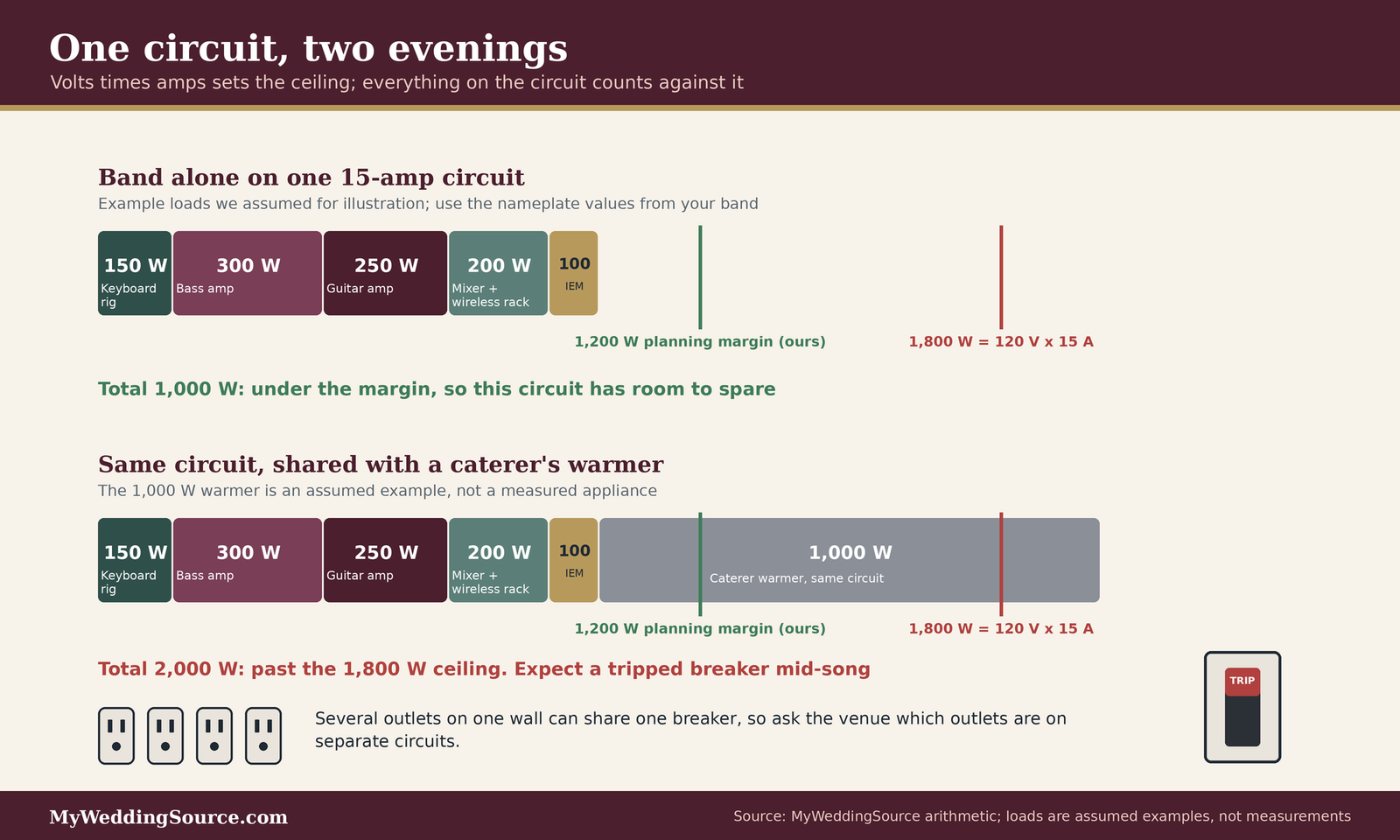
Power is the least visible part of a live wedding band stage plot and the one most likely to cause a mid-song silence. Bands arrive with amplifiers, keyboards, wireless receivers, a mixing console, and sometimes lighting. The venue has outlets, but outlets are not circuits, and several outlets on one wall can share a single breaker.
The arithmetic of a circuit
You do not need to be an electrician to understand the basic limit. You do need to know that it exists.
Watts, volts, and amps
Power in watts equals volts multiplied by amps. In North America a common household-style circuit runs at 120 volts, and a common breaker rating is 15 amps. That is a ceiling of about 1,800 watts for the whole circuit, and everything plugged into outlets on that circuit counts against it. For planning, we use a more conservative figure of about 1,200 watts per 15-amp circuit. That margin is our own cautious assumption, not a code value, and it exists because motors, heaters, and power supplies surge when they start. Ask a licensed electrician or the venue’s technical staff for the real limit at your location.
Who else is on the circuit
The caterer’s warming equipment, a coffee cart, a photo booth, a DJ, the lighting vendor, and the band can all want power in the same corner of the room. On the wedding day, a breaker that trips for any of them can silence the band. Ask the venue for a map showing which outlets share a circuit, or at least which walls are on separate breakers. If the venue cannot say, ask the band how many circuits it prefers and ask the venue to confirm in writing which outlets can be used. Our outdoor wedding infrastructure checklist covers the same question for outdoor sites, where power can be much further away.
Putting power on the stage plot
A good plot does more than show the amplifier. It shows where each piece plugs in and how many outlets are needed.
Drop locations and counts
Ask the band to mark power drops on the live wedding band stage plot, one symbol for each outlet or power strip location, with a count. One practical guide recommends listing how many outlets or extension cords you will need and where. Typical locations are stage left, stage right, behind the drum kit for the keyboard rig, and near the mixing position. If the band carries its own power distribution, ask what its rating is and which wall circuit it needs to connect to.
Cords, covers, and ground-fault protection
Any cable crossing a walkway is a trip hazard and, when wet, an electrical hazard. Ask the band and the venue who supplies cable covers and how cords will be routed away from guest paths. For temporary power outdoors, safety guidance for work sites calls for ground-fault circuit interrupter protection on 125-volt, 15-, 20-, and 30-amp receptacles that are not part of a building’s permanent wiring, and for inspecting extension cords for damage before use. A wedding is not a construction site, and those rules are written for workplaces, but they are a reasonable benchmark to ask about. A related electrical-safety organization adds that equipment should be rated for the environment it is used in, indoor or outdoor, and should be located where it is protected from vehicle traffic.
When the venue cannot supply enough
Some sites, such as fields, vineyards, beaches, and unfinished buildings, simply do not have the power a band needs. Others have power but not near the stage.
Generators and where they go
A generator is a possible answer, and it is also a hazard if handled badly. The Consumer Product Safety Commission warns that portable generators should be run only outdoors, never in garages, sheds, porches, or other enclosed or partly enclosed spaces, and should sit at least twenty feet from buildings people can enter, with exhaust directed away from them. It calls carbon monoxide the invisible killer because it is colorless and odorless. For a wedding, that means a generator belongs away from the tent, the dining area, and the cocktail space, with fuel handled by trained staff. Our wedding generator rental guide explains rental questions in more detail.
Qualified staff and what we do not advise
We do not give electrical advice, and you should not run temporary power yourself. Ask the venue or the rental company who connects the generator, who checks the cords, and who is on site if something trips. A band’s sound engineer can tell you what the band needs, but wiring a distribution panel is a job for a licensed electrician. If you cannot get a clear answer, that is a sign to move the band’s set to a different space or to choose a quieter, lower-power format.
Where the money goes
Power problems on a live wedding band stage plot cost money in three places: a generator or electrician hired for the day, extra staff time for load-in, and overtime if the set starts late. We cannot quote current prices, since they vary by region and season, so build a simple budget from quotes instead. Ask for each item separately, add a line for fuel and delivery, and ask whether the band’s fee changes if the venue cannot supply power. Our guide to vendor overtime rates explains how late starts turn into extra charges, and our wedding vendor contract guide shows where to record who pays.
The wireless mic channel and spare-battery audit
This audit is the deliverable most couples never see, and it belongs beside the live wedding band stage plot and the one that prevents a dead microphone during a toast. A wireless audit has two halves: counting how many wireless channels the band uses, and counting how many batteries it needs to get through the night. Both are simple arithmetic once you have the band’s gear list.
Step one: count every transmitter
A live wedding band stage plot should show wireless gear, and that is more than the lead singer’s handheld. Anything that sends audio without a cable counts.
Microphones, in-ear monitors, and instrument packs
List every wireless handheld, every body-pack transmitter for headset or lavalier microphones, every in-ear monitor system, and every wireless instrument pack. The Federal Communications Commission notes that low-power auxiliary devices such as in-ear monitors, instrument links, and wireless intercoms follow the same frequency rules as wireless microphones. Add the officiant’s or emcee’s microphone if the band supplies it. Add a spare handheld the band keeps in the case. The total is your channel count.
Systems in the next room
A manufacturer guide recommends counting wireless systems you will need now and later, and also counting nearby rooms, since their signals can still interfere. At a venue with several events, another wedding down the hall or a conference in the ballroom next door may run wireless gear too. Ask the venue whether other events are scheduled and whether the venue has its own wireless systems in the building. Our guide to wireless ceremony audio covers the ceremony side and the questions to ask about microphones that move between spaces.
Step two: confirm frequencies and compliance
Bands that perform regularly should already know this, and a good live wedding band stage plot notes it. The questions below make sure they have checked for your venue.
What the FCC says, and what we did not verify
An FCC document on operating wireless microphones, last reviewed in October 2019, says that unlicensed wireless microphones may operate in the TV bands below 608 megahertz, in the 902 to 928 megahertz band, and in a few other bands, with a power limit of 50 milliwatts in the TV bands. It says wireless microphones have been prohibited since 2010 in the 698 to 806 megahertz band, and that much of the 600 megahertz band was auctioned for new services, with users of affected equipment told to check frequencies with the manufacturer and modify or replace gear as needed. We read that document directly, but it is several years old, and rules and frequencies change, so we could not confirm what applies to your date and location today. Ask the band to confirm that its gear is currently legal and not in a band that was repurposed.
Scanning on site and avoiding collisions
Manufacturers explain that two transmitters can create extra interference signals at predictable frequencies, and that digital systems can be spaced more tightly than analog ones. Professional systems often use unused TV channels, and a major metro area may have only one or two open, while a rural area typically has several. One manufacturer offers a frequency finder that shows open channels for an address, and its receivers can scan for clear frequencies and tune to them. For the wedding, the question is simple: ask the sound engineer whether they scan at the venue, and when. Scans should happen early, ideally before guests arrive, and again if the room fills and conditions change.
Step three: the spare-battery math
A dead battery is one of the most avoidable failures in a live setup, and it follows from a simple calculation.
The formula and our assumptions
For each transmitter, take the hours it must be on from load-in sound check to the last song, and compare that to the rated runtime in the manufacturer’s manual. Because rated runtime is measured under specific conditions and batteries age, we plan to use no more than about three quarters of the rated number. That derating is our own conservative assumption. If a transmitter must be on for a longer time than that, plan a scheduled swap. Count one fresh set installed at soundcheck, one fresh set ready for the swap, and at least one spare set per type of transmitter for emergencies.
A worked example
| Transmitter | Hours on, soundcheck to last song | Assumed rated runtime | Planned usable runtime (about 75%) | Swap needed | Fresh sets to bring |
|---|---|---|---|---|---|
| Lead vocal handheld | 7 | 8 hours | 6 hours | Yes, at the midpoint | 3 |
| Second vocal handheld | 7 | 8 hours | 6 hours | Yes, at the midpoint | 3 |
| Guitar instrument pack | 6 | 10 hours | 7.5 hours | No | 2 |
| Headset pack for emcee or officiant | 3 | 8 hours | 6 hours | No | 2 |
| In-ear monitor pack for drummer | 6 | 6 hours | 4.5 hours | Yes, after the dinner set | 3 |
The rated runtimes in the table are assumptions we chose for the example. The band’s actual gear will have different numbers, and the point is the method. Ask the band to fill in the real values.
Rechargeable batteries and alkaline batteries
One manufacturer says its rechargeable lithium-ion packs last about as long as two AA alkaline cells and are rated for roughly five hundred or more recharges, and that its system shows remaining time in hours and minutes. The same source says many users install fresh batteries before every event and keep partly used ones in a bin labeled for rehearsal. Neither choice is wrong. What matters is that the band knows its system, labels spare batteries, and does not rely on a half-used set at a wedding. Ask what the band uses and whether batteries are tested before the day.

The audit sheet to copy
Put the following checklist into a message to the band with the live wedding band stage plot request, or ask the band to fill in its own version. It is the practical output of this guide.
The columns to fill in
| Column | What the band writes | Why it matters |
|---|---|---|
| Transmitter name | For example lead vocal, drummer in-ear | Everyone refers to the same item |
| Type | Handheld, body pack, in-ear, instrument | Shows total channel count |
| Frequency band and group | As shown on the unit | Lets the engineer spot collisions |
| Battery type | Alkaline or rechargeable | Affects spare plan |
| Rated runtime | From the manual | Starting point for the math |
| Hours on | Soundcheck to last song | Shows whether a swap is needed |
| Swap time | Clock time | Avoids guessing mid-event |
| Spare sets on hand | Number and where stored | Avoids searching for batteries |
The day-of swap plan
Agree on a swap schedule in advance, and put one person in charge of it. A quiet moment between sets, during dinner, or before speeches works better than the middle of a song. Ask the band to label spare batteries by transmitter, keep them within reach of the sound position, and test them before leaving home. A spare handheld, already tuned, is the cheapest insurance in the whole plan.
Load-in, soundcheck, and the timeline behind the plot
The live wedding band stage plot says where things go. The load-in plan says how they get there. Most day-of stress comes from this part, and it is almost entirely a scheduling problem.
Load-in logistics
A band with a van and a trailer is not a florist with a car. The equipment is heavy, bulky, and fragile, and it needs a clear path.
Doors, paths, and distance
Once the live wedding band stage plot is settled, ask the venue where the band should park, which door it should use, how far the path is from the vehicle to the stage, whether there are steps, an elevator, a loading dock, or a service corridor, and whether any of it is shared with the caterer or the rental company. For outdoor sites, ask about surface, slope, gates, and whether a vehicle can drive close or has to park in a lot. Add the answers to the live wedding band stage plot as a note. Our wedding vendor timeline shows how to avoid vendors arriving at the same door at the same time.
Access windows and quiet hours
Venues set access windows, and some have restrictions on noise or vehicle movement during an event. A band arriving during the ceremony, or setting up during cocktail hour in the same room, will be heard. Ask when the band may enter, when the room is available for setup, and whether there is a time after which equipment cannot be moved. Our venue questions guide includes the broader set of questions about access and restrictions.
Soundcheck windows
Soundcheck is when the engineer sets levels, tests wireless channels, and finds problems. It is also the part most likely to be squeezed.
Working backward from the first guest
Start with the time guests are allowed into the room, and work backward from it so the live wedding band stage plot and the schedule agree. Subtract the time the band needs to check sound, then the time to set up, then the time to load in. Add a buffer for traffic, an elevator that is slow, and a missing cable. The table below shows one example schedule, and the numbers are illustrative, not a recommendation for your wedding.
| Milestone | Example timing | Notes |
|---|---|---|
| Guests enter the reception room | 6:00 p.m. | Starting point |
| Soundcheck finished and room quiet | 5:30 p.m. | Allows a buffer |
| Soundcheck begins | 4:45 p.m. | About 45 minutes for a mid-size band |
| Setup complete, gear powered on | 4:15 p.m. | Includes wireless scan |
| Load-in begins | 3:00 p.m. | Longer if stairs or a long path |
| Band arrives on site | 2:45 p.m. | Check parking and door |
Guests, rehearsal volume, and hearing
Loud checks while guests or vendors are in the room are a common friction point. Ask the band to check at a moderate level, using a small number of songs, and to tell the venue if it needs to run louder. The National Institute for Occupational Safety and Health recommends keeping noise exposure at or below 85 A-weighted decibels averaged over an eight-hour workday, and notes that decibels are logarithmic, so a sound ten decibels louder is ten times more intense. That standard covers workers, not wedding guests, but it is a useful reminder that volume affects the band, the staff, and the guests at the nearest table.
A sample reception timeline
The live wedding band stage plot should be consistent with the schedule of the evening. A band that plays in two sets with an announcement between them has different power and battery needs than a band that plays continuously.
Mapping the band onto the evening
Ask the planner and the band to put the band’s start, break, and end times onto one page. Mark the grand entrance, first dance, toasts, cake, and last dance. Note which of these use the band’s microphones and which use the DJ’s or venue’s system. Our guide to the wedding reception explains how those parts fit together.
Buffers and overtime
Plan for the evening to run late. A toast that runs long or a dinner that starts late pushes the band back. Ask the band what its overtime policy is, whether the venue has a hard stop, and who decides to extend. Our vendor overtime guide covers the way these charges work.
Monitors, volume, and noise limits
Volume is both a comfort question and a legal one, and a live wedding band stage plot shows where the speakers and monitors point. A band that is too loud can empty the dance floor, and a venue that is too strict can make the set sound flat.
Monitors and in-ear systems
Performers need to hear themselves, and how they do it changes the live wedding band stage plot.
Wedges on the floor
Floor monitors are speakers angled toward the performer. They take floor space, they point sound back toward the stage, and they can contribute to feedback in a small or reflective room. Ask the band where wedges go, how many mixes it needs, and whether it can lower stage volume for a smaller space. Our guide to preventing feedback at an outdoor ceremony explains the cause and the usual fixes.
In-ear monitors and wireless count
In-ear systems reduce stage volume and free floor space, but each one adds a transmitter that needs a frequency and batteries. Include them in the audit above. Ask whether the drummer or any other performer uses them and whether the engineer has planned frequencies for the full set of wireless devices.
Volume agreements and local rules
The venue, the city, and the neighbors may all have an opinion.
What to ask about limits
Ask the venue whether there is a decibel limit, where it is measured, who measures it, and what happens if it is exceeded. Ask when the music must end and whether a limit changes after a certain hour. Local noise ordinances vary, and we did not verify the rules for any specific place, so check with the venue and the local government. Our upcoming guide on wedding reception noise limits is planned as a deeper look at this topic, and our wedding permits guide covers when a permit may be needed.
Sharing the number with the band
If the venue has a limit, give the number to the band in writing, early. A band that knows the limit can plan its setup, choose a smaller drum configuration, or lower amplifier volume. A band that learns about it at soundcheck has fewer options. Ask the band how it handles a limit and whether it has a decibel meter on its engineer’s table.
Weather and outdoor edge cases
Outdoor events need a plan for the band’s equipment as much as for the guests, and the live wedding band stage plot is the place to write it down.
Lightning, wind, and heat
The National Weather Service organizes its public safety pages around lightning, heat, and wind, and each page links to forecast tools and safety information.
Lightning and the stage
The National Weather Service says that if you hear thunder, you are likely within striking distance of a storm, and its guidance is to go indoors. It also says there is no safe place outside when thunderstorms are in the area. For a band, that means a plan for stopping the set, shutting down equipment, and moving people and gear to shelter. Decide in advance who makes the call and how it is announced. Ask the band and the venue who has authority, and put that name on the live wedding band stage plot.
Wind and heat on gear
Wind can tip stands, speakers, and lighting, and can blow sheet music and decor across the stage. Heat and direct sun can overheat amplifiers and make screens unreadable, and they affect the people playing. Ask the band what it does about shade, water, and ventilation. If the stage is under a tent, ask who is responsible for anchoring it and for keeping cables away from the edges.
Backup plans
Weather and equipment can both fail, and one backup plan can cover both.
An indoor fallback
If the primary site is outdoors, ask whether there is an indoor option and whether the band can fit there. The live wedding band stage plot for the second room may be different, with a different power layout and a smaller stage. Ask the band to supply a second plot if the plan is realistic. Our rain backup guide discusses the photography side, and our upcoming guide on a wedding AV backup plan is planned for the audio side.
Covering equipment
Ask whether the band carries covers for amplifiers and keyboards, and whether the stage has a roof. Equipment that gets wet is a safety issue as well as a financial one. If the band’s equipment is not rated for wet conditions, the right plan may be to move indoors or cancel the set, not to hope.
Edge cases that change the plot
Some situations do not fit the standard live wedding band stage plot. These are the ones we hear most often.
Sharing the stage
Many weddings have more than one sound source.
Band and DJ handoffs
If a DJ plays before or after the band, ask where the DJ sets up, whether the two share a mixing console or speakers, how long the changeover takes, and who handles announcements. A DJ’s setup needs power and space too. Our DJ questions guide lists what to ask the DJ, and the two plots should be compared on one floor plan.
Ceremony musicians and moving equipment
A string quartet or soloist at the ceremony may use the same microphones, stands, or power as the band. If the band is moving equipment from the ceremony space to the reception, ask who moves it, how long it takes, and whether the band needs a different set of wireless frequencies in each space.
Changes in the lineup or the room
Plans change, and the live wedding band stage plot should change with them.
Guest performers and last-minute additions
If a friend wants to sing or a relative wants to play, tell the band early. An extra microphone is an extra channel, and an extra instrument may need a direct box or a stand. Ask the band whether it can accommodate a guest and what it needs in advance.
Remote, rural, and destination venues
If the venue is far from the band’s home base, ask what the band carries, what it expects the venue to provide, and what the plan is for a failure of any critical item. A band that travels with a spare of the most important pieces is more resilient than one that depends on local rentals. Ask what the travel and rental costs are and who pays.
Contract and vendor checks
The best live wedding band stage plot in the world does not help if it is not tied to the agreement.
What to get in writing
Everything on the live wedding band stage plot that depends on someone else should be in the contract or an addendum.
Technical details in the agreement
Ask for the band’s current plot and input list to be attached to the contract, and for the contract to state the stage size, power needs, load-in time, soundcheck time, set times, overtime rate, and what happens if the venue cannot supply what the live wedding band stage plot requires. Our wedding vendor contract guide explains how to read these clauses. We are not lawyers, and this is not legal advice. If the contract is complex or the amounts are large, a qualified professional can review it.
Who is responsible for what
Write down who supplies the stage, who supplies power, who supplies cable covers, who handles a generator if one is used, who is the contact on the day, and who has the authority to stop the music in an emergency. Ambiguity here is where disputes begin.
Warning signs
Most bands are professional, and the following are small signals that more questions are needed.
Vague or missing documents
A band that cannot produce a live wedding band stage plot, cannot say how many wireless channels it uses, or says that it will figure out the power on the day may be less prepared than it sounds. A plot that is a blurry photo of a sketch is a sign to ask for a clearer one. Ask for a current live wedding band stage plot with a date on it.
Pressure or shifting responsibility
Be cautious about a vendor who insists that you handle the electrical, who will not name a point of contact, or who says the venue must supply everything without having asked. Those problems are fixable, but they need to be fixed before the day.
Questions to ask before you sign
Questions to ask the band and the venue
- Can you send your current stage plot and input list, with the date it was updated?
- What stage size and floor area do you need, and what is the smallest you can work in?
- How many separate power circuits do you need, and where on the live wedding band stage plot are they?
- How many wireless transmitters do you use, including in-ear systems and instrument packs?
- Who scans for frequencies at the venue, and when?
- How many spare batteries do you bring for each transmitter, and what is the swap plan?
- What is the load-in route, access window, and soundcheck time?
- Is there a sound limit or end time, and who enforces it?
- What is the weather plan, and who decides when to stop?
- What does the contract say if the venue cannot meet your requirements?
For the band
These questions go to the band’s leader or sound engineer.
Technical readiness
Ask the band to describe its setup in plain terms, to share its live wedding band stage plot and input list, and to explain how it handles a failed microphone, a tripped breaker, or a dead battery. A confident answer is a good sign.
Experience with your type of space
Ask whether the band has played the venue or a similar one, whether it has worked outdoors, and what it would change about the setup for your room.
For the venue
These questions go to the venue manager or technical director.
Power and access
Ask for a power map, the number and rating of circuits near the stage, the access route, and the load-in window. Ask about other events on the same day and any wireless systems in the building.
Rules and limits
Ask about sound limits, end times, restrictions on generators or open flames, and who the contact is on the day. Write down the answers and send them to the band and the planner.
FAQ: live wedding band stage plot questions
Plans and documents
Who should make the stage plot?
The band should. It knows its gear, positions, and wireless setup, and it will use the document at soundcheck. As the couple, you review it, forward it to the venue and planner, and ask for an updated version if the lineup changes. Do not try to draw one yourself from a photo of the band.
How early should I ask for the plot?
Ask as soon as you book the band, then again about a month before the wedding. Lineups and gear change, and venues need time to answer questions about stage size, power, and access. A current version, dated and sent to the venue and planner, prevents most last-minute surprises.
What is the difference between a stage plot and an input list?
A live wedding band stage plot is a drawing that shows where people and equipment sit. An input list is a table of every sound source the engineer connects, with microphone or direct box type and stand. Together they show the venue how much space, power, and wireless capacity the band needs.
Power and wireless
How many outlets does a band need?
It depends on the band, so ask for the number on the live wedding band stage plot. Venues often have several outlets that share one circuit, so the number of circuits matters more than the number of outlets. Ask the venue to confirm which outlets are on separate breakers and who else is using them that evening.
Do wedding bands use wireless microphones?
Many do, for lead vocals, headsets, instruments, and in-ear monitors. Each wireless device needs its own frequency and its own batteries. Ask how many transmitters the band uses, who scans for clear frequencies at your venue, and what the spare-battery plan is for a long evening.
How many spare batteries should a band bring?
There is no universal number. A sensible plan gives each transmitter a fresh set at soundcheck, a second fresh set for a scheduled swap if needed, and a spare set per type. Ask the band to show its math and where spares are stored during the event.
Space and load-in
What stage size does a wedding band need?
It varies with the lineup. A small acoustic group can work in a corner of a room, while a larger band with drums, keyboards, and horns needs a deeper stage. Ask the band to confirm its minimum dimensions from its own plot, and compare them with the venue’s actual stage or floor space.
What if the venue cannot provide enough power?
Ask the venue about other outlets or circuits, a different stage location, or a rented generator operated by qualified staff. Generators must be outdoors, well away from buildings and guests. If none of those works, ask the band whether a smaller or lower-power setup can still work.
Your next steps
Collect the documents
Ask the band for the plot and audit
Send the band the audit sheet from this guide and ask for its current stage plot and input list. Request dated copies, and ask the band to mark power drops, wireless gear, and load-in notes on the live wedding band stage plot.
Send them to the people who need them
Forward the documents to the venue manager, the planner, and the DJ if there is one. Ask each to confirm in writing that the stage, power, and access are workable. Our wedding audio and lighting checklist can help you see how the rest of the sound and light plan fits around the band.
Lock in the details
Put the answers in the contract
Ask for the live wedding band stage plot to be attached to the contract and for stage, power, load-in, and overtime terms to be written down. Keep copies in a shared folder that the planner can open.
Review again a month out
Ask for an updated plot a month before the wedding and a final check in the week of the event. Our wedding vendor timeline can help you place those checkpoints on the calendar.
Sources & methodology
How we built this guide
What we relied on
This guide draws on a Federal Communications Commission document about wireless microphone operation, a Consumer Product Safety Commission release on portable generator safety, National Weather Service lightning and hazard pages, a National Institute for Occupational Safety and Health noise page, work-site electrical safety fact sheets, and published how-to guides from live-sound educators, a performer-services blog, and a wireless microphone manufacturer. Where a statement comes from a manufacturer or a trade guide, we treat it as practical guidance and not as a regulation. The footprint figures, the circuit planning margin, the battery derating, and the sample timelines are our own estimates with stated assumptions. We read each source on the date below, and rules and manufacturer guidance can change.
What we did not do
We did not test equipment, measure venues, or quote current prices. We did not verify local noise ordinances, venue policies, or current radio-frequency rules for any specific location, and the FCC document we read was last reviewed in 2019. We do not give legal, electrical, or engineering advice. Ask the venue, a licensed electrician, and a qualified live-sound professional about your own site. Sources were checked on November 12, 2026.
Source list
Government and public-safety sources
- National Weather Service, Safety hub: https://www.weather.gov/safety
- National Weather Service, Lightning safety: https://www.weather.gov/safety/lightning-safety
- Federal Communications Commission, Operation of wireless microphones (reviewed October 15, 2019): https://www.fcc.gov/sites/default/files/operation_of_wireless_microphones.pdf
- Consumer Product Safety Commission, Carbon monoxide and portable generator safety release: https://www.cpsc.gov/Newsroom/News-Releases/2022/CPSC-Releases-New-Report-on-Carbon-Monoxide-CO-Fatalities-Urges-Generator-Safety-in-New-PSA
- CDC and NIOSH, Noise and hearing loss prevention: https://www.cdc.gov/niosh/noise/about/index.html
- Oregon OSHA, Fact sheet on temporary power and GFCI protection: https://osha.oregon.gov/OSHAPubs/factsheets/fs14.pdf
Industry, education, and manufacturer sources
- Electrical Safety Foundation International, Temporary power safety guidance: https://www.esfi.org/?p=1112
- SoundGirls, How to make an input list and stage plot and patch a stage: https://soundgirls.org/how-to-make-and-input-list-stage-plot-and-patch-a-stage/
- Sonicbids, How to create a stage plot and input list that sound techs will love: https://blog.sonicbids.com/how-to-create-a-stage-plot-and-input-list-that-sound-techs-will-love
- Robot Needs Home, How to put together a tech spec, the stage plot and channel list: https://www.robotneedshome.com/resource/how-to-put-together-a-first-tech-spec-the-stage-plot-and-channel-list
- Shure, DIY Wireless Part 1, choosing a frequency (manufacturer guide): https://www.shure.com/en-US/conferencing-meetings/ignite/diy-wireless-part-1-choosing-a-frequency
- Shure, DIY Wireless Part 2, transmitters and batteries (manufacturer guide): https://www.shure.com/en-us/insights/diy-wireless-part-2-transmitters-and-batteries