

A floral wedding arch is the one piece of ceremony decor that has to stand up in the weather, pass a venue’s rules, carry fresh flowers without a block of foam, and still look right from the guests’ chairs and the photographer’s position, so it is worth planning like a small structure before you plan it like a bouquet.
Quick answer
Decide four things in this order: where the arch will stand and what the venue allows, how much wind it must survive, what the frame and flower attachment method will be, and only then how full and colorful it should look. Wind pushes on a floral wedding arch with a force that grows with the square of wind speed, so a covered arch that is calm at 15 mph is working much harder at 30 mph. Ask every florist for an installed, itemized quote that names the frame, anchoring, delivery, setup, teardown, and what happens if flowers must be substituted.
Start with the room, the weather, and the rules your floral wedding arch must fit
Most arch inspiration photos hide the real constraints: the ground it stands on, the breeze, the permitted setup window, and the distance between the guests and the vows. Those constraints are not obstacles to a good design. They are the brief. Once they are written down, the choices about flowers get easier, and a florist can give you a quote that holds up on the day.
Measure the physical constraints before choosing a look
A design is a promise that something can exist in a particular place. The place has dimensions, a surface, a sun angle, and a path that the florist and the rental truck will use. Collect those facts first, ideally during a site visit with the florist or planner, and keep them in one note that every vendor can see, so everyone is pricing the same floral wedding arch.
Record dimensions, sightlines, heat, wind, and access
Write down the width of the aisle or the gap between the first row of chairs and the officiant’s spot, the ceiling height if the ceremony is indoors, and the surface the arch will stand on: lawn, sand, gravel, deck, stone, or carpet. Note where the sun will be at ceremony time, which direction wind usually comes from at the venue, and whether there is shade. Measure the doors, gates, elevators, and steps between the loading area and the ceremony spot, because a six-foot-wide frame that cannot get through a doorway will be assembled on site, and that changes your labor time. Photograph the spot from the aisle, from the back row, and from where the photographer will probably stand. Our wedding ceremony guide covers how the ceremony space itself is usually laid out.
Identify venue rules that override inspiration
Venues write rules about decorations for reasons that have nothing to do with taste: protecting plants and floors, keeping exits clear, controlling open flames, and limiting the time vendors occupy a space. A venue may ban nails and screws, forbid tying anything to trees, prohibit candles, cap setup and teardown time, or require you to use approved vendors. Ask for the written decoration policy before you design anything, and ask specifically about freestanding structures, anchoring on lawn or sand, ceiling or truss attachments, and any fire-marshal requirements. If the venue’s answer is verbal, ask for it by email. A later section of this guide covers fire code and venue rules in detail, and our garden wedding venues guide shows why outdoor and garden sites tend to have the strictest decoration policies.
Choose the design function in the floral wedding arch decision
A floral wedding arch earns its place by doing a job. Naming the job before you choose the flowers keeps the budget focused and stops the design from turning into a collection of pretty items that do not work together.
Decide whether the element guides, frames, softens, photographs, or personalizes
Some arches mark the spot where the couple stands, so the eye goes to them. Some frame a view, such as a lake or a garden, and need to be airy enough that the view stays part of the picture. Some soften a hard backdrop like a brick wall or a plain barn door. Some exist mainly to look good in photographs, and others personalize the ceremony with a color, a family flower, or a cultural element. Most arches do two of these. If you can say in one sentence what yours does, you can judge every design suggestion against it: does this stem, this ribbon, this extra cluster help the floral wedding arch do that job, or does it only add cost?
Remove decorative elements with no job
Once the function is clear, look for items that do nothing. A second garland that nobody will see from the chairs, trailing ribbon that will whip in a breeze, or a hanging element that blocks the officiant’s face are examples. Ask the florist to rank each element by how much it contributes to the function and to price it separately. Removing the bottom third of the list often lowers the cost, the weight, and the wind exposure at the same time, which is a rare case where one change improves three things about a floral wedding arch.
How a floral wedding arch behaves in wind
Wind is the least glamorous topic in ceremony planning and the one most likely to cause a real problem. A floral wedding arch is a tall, narrow object with a large face, and flowers, foliage, and fabric add to that face. The good news is that wind behavior follows a few simple relationships, and you can use them without any engineering background to ask better questions.
Why wind force grows faster than wind speed
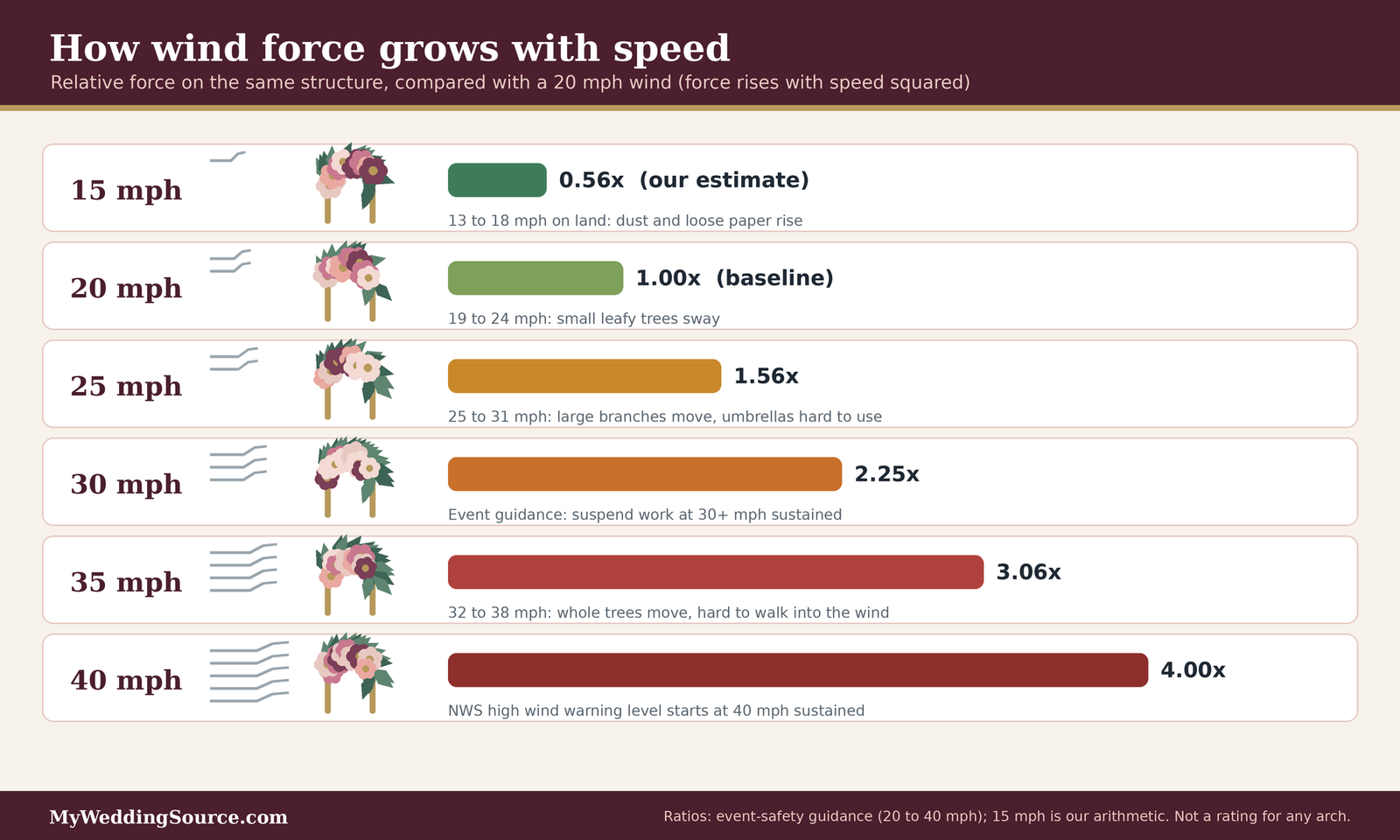
People often assume that doubling the wind doubles the push. It does not. Event-production safety guidance publishes a table showing that, relative to a 20 mph wind, the force on a structure is about 1.56 times as great at 25 mph, 2.25 times at 30 mph, 3.06 times at 35 mph, and 4 times at 40 mph. That pattern is the square of the speed ratio, which our own arithmetic confirms: 30 divided by 20 is 1.5, and 1.5 squared is 2.25.
The speed-squared arithmetic
By the same arithmetic, a 15 mph breeze produces about 0.56 times the force of a 20 mph wind, which is our estimate and not a published figure. The practical meaning is that a floral wedding arch that feels perfectly stable at a light breeze is not twice as stressed in a stiff wind; it is several times as stressed. The National Weather Service’s Beaufort descriptions give a feel for those speeds on land: at 13 to 18 mph, dust and loose paper rise and small branches move; at 19 to 24 mph, small leafy trees sway; at 25 to 31 mph, large branches move and umbrellas are hard to use; and at 32 to 38 mph, whole trees move and walking into the wind is difficult. If you can picture umbrellas failing, the arch is already being tested.
Surface area counts as much as speed
Force also depends on how much surface the wind meets. Event-structure guidance notes that even open mesh still produces roughly 30 to 60 percent of the drag of an equivalent solid surface, so an arch does not become wind-proof just because it has gaps. Fabric, draped greenery, hanging flowers, and ribbons all add face. This is why a lightly flowered arch on a bare frame and a heavily covered arch with fabric panels can behave differently in the same wind. When a design grows, ask the florist and the rental company whether the anchoring was planned for the finished size or for the empty frame. Guidance for event stages makes the same point: surfaces added after a structure was reviewed can change the loading and undermine the weight calculations.
Anchoring a floral wedding arch on different ground
A flowering arch stays upright because of its weight, its base, and how it connects to the ground. Which of these can be used depends on the venue’s rules and the surface.
Weight, placement, and connection
Event-production guidance stresses that stability depends on total weight, where the weight sits, and how it is tied to the structure. It notes that moving ballast even a foot or two toward the center reduces its resistance to tipping, that water-filled ballast must be completely filled, and that ballast should be recalculated whenever surface area is added. For a ceremony, this translates into questions rather than formulas: What is the base made of? Where are the weights, and are they tied to the frame? Does the weight change if the design gets bigger? Be wary of any floral wedding arch plan that depends on the flowers hiding a base that is too light.
Lawn, sand, deck, and indoor floors
Each surface has a different answer. Stakes may be an option on lawn but are often restricted or banned in gardens and parks; one public-parks policy we reviewed limits tent stakes to six inches and bans nails in trees. Sand can make stakes unreliable and may call for weighted bases. Decks and patios often forbid drilling or staking, so weight is the main option. Indoor floors may need protective pads under bases. None of these is a universal rule, so treat them as questions for your venue and rental company, and have the answer written in the contract.
Decide in advance when the ceremony changes plans
The worst time to decide what is too windy is while guests are already seated. Agree on the thresholds with your planner, florist, and venue ahead of time, so that a weather decision is a procedure and not an argument.
Thresholds borrowed from event production
Event-production safety guidance, written for stages and large temporary structures, describes a staged response: normal operation under 15 mph sustained; raised awareness and monitoring at 15 to 20 mph sustained or gusts around 25; removing soft goods and clearing routes at 20 to 25 mph sustained or gusts of 30 to 35; securing or removing nonessential elements at 25 to 30 mph sustained; and suspending operations at 30 mph sustained or gusts of 40 and above. A wedding arch is not a stage, and these numbers are not a safety certification for your arch. They are useful as a template for your own plan: a first level where someone watches the forecast, a second level where hanging elements come off, and a stopping level where nobody stands near the structure. The National Weather Service uses 31 to 39 mph sustained winds, or gusts of 46 to 57 mph, as its wind advisory range, so a day that reaches an advisory is a day to move the ceremony or the arch.
One person with authority, and a fallback plan
Name one person who can call it, and make sure the officiant, florist, and venue all know who that is. Agree on what the fallback looks like: remove hanging garlands and fabric, lay the floral wedding arch flat, move to a sheltered spot, or hold the ceremony without the arch and carry the flowers to the reception. A fallback that has been priced and approved in advance costs far less than one invented under pressure, and a florist can often prepare the arch in sections so that the delicate parts come off quickly. Our wedding insurance guide explains how weather-related problems are, and are not, usually handled in event policies, and it is worth reading before you assume a policy will cover a damaged installation. ## Frames and mechanics: how the flowers stay on a floral wedding arch
A floral wedding arch has two separate systems. The frame holds the shape, and the mechanics are the way flowers and foliage attach to the frame and get water. Mixing them up leads to confusion in quotes, because a florist may be charging for a build, a rental, or both.
The frame
The frame decides how tall the floral wedding arch is, how wide, whether it can stand alone, and what the flowers can attach to. It also affects how much of the budget is reusable.
Self-supporting frames, weighted bases, and anchored frames
Some frames are freestanding and rely on a weighted base. Some are anchored into the ground, and some attach to an existing structure such as a pergola, a tree limb, or a ceiling truss. Each option has trade-offs. Freestanding frames are the most flexible about location but need the most weight. Anchored frames are more stable but depend on the surface and the venue’s permission. Attaching to an existing structure can be the simplest for flowers but requires that the venue approve what touches it and that the structure itself is sound. Ask who is responsible for confirming that the structure behind your floral wedding arch can carry the load, because a florist may not take on that responsibility unless the contract says so.
Rented, built, or owned
A rented frame is returned, so you pay for the use and not the object. A built frame, made by a florist or a carpenter, can be adapted to your site but may need storage or disposal afterward. A frame you buy outright can be reused or resold. The right answer depends on whether you will use it again, who has storage, and who is responsible for damage. Whichever you choose, ask for the frame’s dimensions and weight in the quote, and ask whether the price includes delivery, installation, and removal. Our wedding decor guide covers the wider question of which decor items are worth owning and which are better rented.
Foam-free mechanics
For years, a block of water-absorbing green foam was the standard way to hold stems in an arrangement. Florists and researchers now question it, and many couples ask for foam-free design. Understanding the reasons helps you ask for it properly, and it helps you judge whether a foam-free quote is realistic.
Why floral foam is under scrutiny
Researchers at RMIT University reported in a peer-reviewed study that floral foam breaks into tiny particles that become microplastics, that all of the aquatic invertebrates tested ingested it, and that chemicals leaching from it were more toxic to those animals than leachates from other plastics they compared. The researchers said more work was needed to understand the effects. A survey by the Sustainable Floristry Network of more than 1,200 florists found that about two-thirds used foam, and most of those poured the foam’s wastewater down a drain. That is a study of an environmental question, not a health warning for wedding guests, and it does not prove harm in a specific wedding. It is a reasonable basis for a couple to decide they would rather not use it.
What florists use instead
Florists who work without foam describe a toolbox of alternatives: chicken wire shaped into a cage or pillow, pin frogs and pin cups for heavier stems, willow or wire forms, water picks and water tubes for single stems, and stem bundles tied into a cage-like frame. One florist educator describes building arbors with chicken wire in place of foam and notes that, without foam, stems can be repositioned without ruining the structure. She also reports including the cost of reusable frogs in her prices and letting clients keep or return them. Because this is one practitioner’s account, treat it as an example and not as a rule, and ask your florist which mechanics they use for a vertical piece, because the choices that work for a table centerpiece do not all work overhead.
Keeping flowers fresh on a vertical piece
Flowers on a floral wedding arch are fixed in place, often in the sun, and sometimes for hours before the ceremony. The mechanics need a plan for water, timing, and replacement.
Water sources and how long to hold
Foam-free arches commonly use water picks, tubes, or a hidden water source for focal clusters, and dry or sturdy materials for areas without water. A florist who knows a venue will be warm and exposed may recommend more hardy stems, shorter time on site, or building the arch near the ceremony time. A North Carolina State University trial of specialty cut flowers found that a holding preservative usually extended vase life under controlled indoor conditions, though not for every variety, and that a separate hydrating solution did not reliably help. Lab results are not a promise about a sunny lawn, but they support a simple question: what preservative and hydration steps does your florist use before and after installing?
Time on site and the sun
Ask when the florist plans to arrive and how long flowers will be installed before guests sit. A longer gap raises the risk of wilting, especially in direct sun or warm weather, while a very short gap raises the risk of rushed or unfinished work. Agree on an installation window that fits the venue’s rules and the florist’s method, and ask whether a second visit to refresh the arch or add late flowers is possible. If the ceremony and the reception are in different places, ask who moves the floral wedding arch flowers and when. Our seasonal wedding flowers guide covers which flowers are more likely to be available and sturdy at different times of year.
Build the composition from scale, color, texture, and repetition for a floral wedding arch
With the physical and mechanical constraints set, you can design the look. The aim is not to include more but to make the arch readable from a distance and in photographs, while keeping weight and wind exposure reasonable.
Set one focal point and supporting elements
A floral wedding arch can feel crowded when everything is equally important. A single focal point, supported by simpler elements, is easier to read, lighter, and often cheaper.
Use proportion rather than item count
The arch frame has a height and width, and the flowers should relate to those proportions. A common approach is to cluster the fullest, most colorful flowers in one place, such as one upper corner, one side, or the crown, and let foliage or open space carry the rest. Ask your florist to show the proportions as a sketch with the arch dimensions and the couple’s heights, since a drawing without scale can mislead. The point is that the floral wedding arch should look intentional from the guests’ chairs, not that it contain a particular number of stems.

Control height and negative space
Height matters because couples stand under the floral wedding arch. Check that the lowest hanging element clears the tallest person in the ceremony, including the officiant and anyone wearing a hat or veil, with room to spare. Negative space, meaning the parts of the frame left open, helps the arch read as a shape instead of a mass. It also reduces the area that wind meets. If you love a fuller look, concentrate it in one area instead of spreading it evenly, so you keep the open sections that lighten the structure.
Test the design under real lighting and camera conditions
Flowers that look balanced in a shop can look washed out outdoors at noon or nearly invisible at dusk. Testing before the wedding is cheap compared to discovering a problem on the day.
Check daytime and evening appearance
Visit the site at the same time of day as your ceremony, if you can. Strong overhead sun flattens pale colors and creates harsh shadows under the arch. A backdrop of dark trees makes light flowers stand out, while a backdrop of similar colors can swallow the design. For evening ceremonies, ask whether the venue lighting reaches the floral wedding arch and whether lights will be added to it. Any lights or cables are additional items to price and to check against venue and fire rules. If you cannot visit at the right time, ask the florist for photos of a similar arch in similar light.
Photograph samples from guest and photographer angles
Take a sample cluster or a sketch to the site and look at it from the back row and the sides. Share the design with your photographer and ask how they plan to frame the ceremony, since the arch may sit behind the couple’s heads, off to one side, or be used as a frame for the aisle shot. Our wedding photography guide and wedding photographer shot list show how to talk through the key ceremony photographs, and an arch that suits those photographs is easier to defend in the budget.
Match the design matrix to your situation
The table below turns the design factors into a quick comparison. It is a planning aid and not a catalog: the rows describe common design choices and the factors to check, based on the physical and mechanical points above.
| Design choice | Scale and sightline | Material and weight | Lighting | Venue rule to check | Guest impact |
|---|---|---|---|---|---|
| Garland on the crown only | Reads from the back row if the garland is dense on top | Lightest option; least wind face | Catches overhead light well | Attachment points on the frame | Keeps the view of the couple open |
| Asymmetric cluster on one side | Strong focal point; sketch it with the couple’s heights | Moderate; weight is uneven, so check the base | Works well against dark backdrops | Anchoring on lawn or deck | Balanced if the aisle side is clear |
| Fully covered frame | Dominates the ceremony space | Heaviest and largest wind face | Needs color contrast with the backdrop | Ballast, fire code, setup time | Can hide the officiant if too tall |
| Flowers added to an existing pergola or tree | Depends on the structure | Light, but depends on the host structure | Follows natural light | Attachment rules; no nails in trees | Natural frame for the view |
| Open frame with minimal flowers | Light and graphic | Low weight and wind face | Silhouette in evening light | Frame rental or purchase terms | Leaves the setting visible |
When rows disagree
Sometimes the look you want for a floral wedding arch conflicts with the venue rule or the wind plan. A fully covered frame, for example, may be the most photogenic option but also the one most affected by wind and venue anchoring limits. Treat disagreement as a prompt to ask a question, not as a verdict: could the dense part go on the side that faces away from the wind, or could the delicate elements be added after a wind check?
When none of the rows fit
If your plan is a different shape, such as a hanging installation, a moon gate, or a freestanding wall of flowers, use the same columns anyway. Describe the scale, material, lighting, venue rule, and guest impact, and ask the florist to fill in the row. A florist who can answer those five questions has probably thought about the structure as well as the flowers. ## Fire code and venue rules for a floral wedding arch
Fire and venue rules sit above design preferences, including those for a floral wedding arch. They are written by local authorities and property owners, they differ from place to place, and they are the area where a florist most needs your help getting a clear written answer. This section is general education and not legal or code advice; the venue and the local fire official decide what applies.
What fire officials look at
Fire rules about decorations generally focus on three things: whether the material burns easily, whether it blocks the way out, and whether it sits near a flame or heat source. Your arch touches all three.
Natural materials, flame-retardant treatment, and sprinklers
One county fire marshal’s guidance on decorative vegetation, written for holiday trees but covering decorative vegetation in general, says natural cut trees and other flammable vegetation are prohibited in many occupancy types, including assembly spaces, unless the area has a maintained sprinkler system, with a specific allowance for places of worship. It says artificial decorations must meet a flame-propagation standard and be certified by the manufacturer. That guidance applies to its own jurisdiction and its own subject, so it does not tell you what your venue’s rules are, but it shows the kind of question to ask: does the venue treat fresh greenery as a flammable decoration, is the ceremony room sprinklered, and do faux or fabric elements need a flame-retardant certificate? If your floral wedding arch includes faux flowers, ribbon, or fabric, ask for the product’s certification documents before you assume they will be accepted.
Exits, aisles, and open flames
The same guidance says decorations cannot reduce the width of an exit path or block access to or sight of an exit, and that candles and open flames must stay away from decorative vegetation and are banned in aisles and standing areas. Translating that to a floral wedding arch: keep the base and any trailing elements out of the aisle and exit routes, and confirm with the venue before adding candles, lanterns, or flame-style lights to flowers. Many venues prohibit open flames entirely; one botanical garden’s rental rules we reviewed prohibit candles and open flames of any kind. Battery lights are often accepted, but the venue still has to say so.
What venues commonly restrict
Beyond fire rules, venues protect their grounds and schedules. The details are specific to each property, so these examples show the range and not a standard.
Attachments, stakes, and plants
A city parks policy we reviewed allows decorations to be tied to trees, requires them to come down when the ceremony ends, and prohibits nails in trees. A botanical garden’s rental rules allow decorations only if placing and removing them does not damage plants or property, and prohibit nails and screws. Policies like these often do not mention arches by name, so the answer to “can we use a freestanding frame here?” may be in the contract and not in the public rules. Ask directly, and ask about the base: whether a weighted base, stakes, or sandbags are allowed, and whether there are limits on the length of stakes.
Petals, confetti, and time limits
Some venues approve flower petals as an alternative to rice or confetti; the parks policy above does, while the botanical garden’s rules prohibit all confetti, including petals. That difference matters for arch design if you were planning to scatter petals at the base. Time limits matter too. The parks policy limits a garden ceremony to two hours including setup and takedown, and the botanical garden requires setup, the event, and cleanup to fit inside the rental period, with no early setup. A big arch that takes ninety minutes to install will not fit a short window, so ask for the real setup time in the quote.
Fit the schedule to the rules
When rules and schedule both constrain you, write them side by side. A short timeline, with arrival, installation, florist exit, ceremony, and teardown, shows whether the plan works before anyone is standing on a lawn with a truck.
Installation windows and vendor access
Ask the venue when vendors can enter, where they may park, what route they must use, and whether heavy items are permitted on certain surfaces. Some venues require proof of insurance from vendors, which is a question for your florist and rental company. If the venue has a coordinator, ask them to review the florist’s setup plan. Also ask who will let the florist in if the coordinator is not there early.
Teardown and what happens to the flowers
Teardown often gets less attention than setup and can take place while guests are leaving, so decide in advance who removes the arch, who takes the flowers, and where they go. A venue may require that decorations be removed immediately after the ceremony. If you want the flowers moved to the reception, ask the florist whether that is included and who does it. If you plan to donate or give away the flowers, say so before the wedding, because the florist may need extra time or containers.
Price the installed floral wedding arch, not the inspiration photo
Photos show the finished arch and hide the work. A quote for a floral wedding arch should show the whole job: design, frame, flowers, mechanics, delivery, installation, removal, and risk. Comparing quotes only on the headline number is the most common way to be surprised.
What the numbers show
The Knot’s Real Weddings Study, which surveyed 10,474 U.S. couples married in 2025, reports an average of $2,800 for wedding flowers, covering bouquets, boutonnieres, wedding party flowers, and centerpieces. That figure is for all flowers, not a ceremony arch. In the same article, a florist says a simple arbor floral piece could start at a few hundred dollars and quickly scale up to several thousand depending on how much of the structure is covered and the ratio of flowers to foliage. Treat both as survey and anecdotal context, not as a price for your wedding. Real quotes depend on your city, season, venue, and design.
Include labor, mechanics, delivery, rentals, teardown, and damage risk
A quote that lists only flowers will leave out the largest parts of an arch’s cost: a designer’s time to build it, labor to install it, and often a rental. Ask for line items.
Separate reusable inventory from consumed materials
Reusable items include the frame, bases, weights, pin frogs, cages, and lights. Consumed items include the flowers, foliage, tape, wire, and anything that cannot be reused or returned. A foam-free design may include more reusable inventory than a foam design, and the quote should say who owns it afterward, whether it must be returned, and what happens if it is damaged. If a florist’s price includes reusable frogs that you can keep or return, as one florist educator describes doing, ask whether you will be credited if you return them. These are questions about terms, not claims that foam-free is always cheaper or more expensive; we found no source that supports either claim in general.
Flag venue labor or fire-code requirements
Some venues require their own staff to move heavy items, supervise setup, or inspect decorations, and they may charge for it. If a fire official must review an installation, ask whether that review has a fee and a deadline. These costs may not appear in the florist’s quote at all, so ask the venue separately and add them to your own budget. Our wedding budget calculator can help you track which costs are estimates and which are confirmed.

Create a substitution plan before market or weather changes force one
Fresh flowers on a floral wedding arch are agricultural products, and a specific stem may not be available or may not look the way it did in the sample. The time to agree on a plan is in the contract, not on the morning of the wedding.
Define acceptable color, flower, and material substitutions
List the three or four flowers that matter most to the design and the colors that matter most. For each, agree on acceptable substitutes in the same color and similar size, and on the elements that must not be replaced, such as a family flower. Ask the florist to describe what will change in the design if a substitution is made, and ask for photos in advance if the change is significant. If part of the floral wedding arch is a rented frame, agree on a substitute frame of similar dimensions, in case the first is damaged or unavailable.
Require approval rules in the contract
Ask the contract to say who approves substitutions, how quickly, and how: by text or email, with a photo. Ask what happens to the price if the florist substitutes less expensive materials, and whether the contract allows them to use more expensive ones without your permission. Also ask what happens if weather prevents installation. We are not offering legal advice, and contract terms vary, but a short, clear paragraph on substitutions and weather is often the difference between a minor change and a dispute. Read the full contract carefully, and consider asking a qualified professional to review it if you are unsure.
Normalize quotes before comparing them
Two quotes for a floral wedding arch can look far apart when they simply include different things. A worked example shows how to put them on the same footing. The numbers below are invented for illustration and are not market prices.
A worked example with made-up figures
Suppose Quote A is $1,200 and says “ceremony arch, delivered and set up,” and Quote B is $950 plus line items: frame rental $180, delivery $90, teardown $75. Quote B totals $1,295, which is $95 more than Quote A, and Quote A might already include everything, or it might exclude teardown and a frame. The difference is that you do not know. Add every missing item to a column for each quote, mark unknowns with a question mark, and email the florists to fill them in before comparing totals.
The normalization checklist
For each quote, confirm the frame (rented, built, or owned), the base and anchoring, the flowers and the foliage, the mechanics, the delivery, the installation window, the teardown, the substitution rules, the weather plan, and the payment and cancellation terms. Fill in a single table with one column per florist. A table of this kind also exposes the odd item that appears in one quote and not in the others, which is often where the surprise lives. The table below lists the line items to look for.
| Line item | Consumed or reusable | Who usually supplies it | What to confirm |
|---|---|---|---|
| Frame | Reusable | Florist, rental company, or you | Size, weight, rental period, damage terms |
| Base, ballast, anchoring | Reusable | Same as the frame | Method, weight, venue approval |
| Flowers and foliage | Consumed | Florist | Varieties, colors, quantity |
| Mechanics: wire, cages, frogs, picks | Mixed | Florist | Foam-free or not; who keeps reusable pieces |
| Design time and labor | Service | Florist | Hours, crew size, setup window |
| Delivery | Service | Florist or rental company | Distance, access, timing |
| Teardown and removal | Service | Florist or venue | Who, when, what happens to the flowers |
| Lights or fabric | Mixed | Florist or rental company | Venue and fire rules, power source |
| Substitution plan | Contract term | Florist | Approval method and price effect |
Reuse: making a floral wedding arch work twice
Because a floral wedding arch is an investment of money and effort, many couples ask whether it can serve more than once: at the ceremony, at the reception, in photographs, or after the wedding. Planning for reuse early makes it practical; thinking of it at the last minute makes it a scramble.
Move it from the ceremony to the reception
A floral wedding arch can be repositioned as a photo backdrop, a sweetheart table backdrop, or a bar feature. That plan needs agreement from the venue, the florist, and the people who will do the moving.
Who moves it and when
Moving an arch while guests are leaving, or while the venue is flipping a room, requires a crew and a clear window. Ask the venue whether the ceremony and reception rooms can be changed over in time, and ask the florist whether moving is included in the price. If the arch is built in sections, ask whether it is practical to lift them. Our wedding reception guide explains how receptions are usually timed, which helps you judge whether a move is realistic.
What to plan for the flowers
Flowers on a floral wedding arch that spent an hour in the sun may look different at dinner. Ask the florist whether the flowers will be refreshed or replaced, and whether cluster elements can be separated and used elsewhere, such as on a cake table or at the entrance. Foam-free construction can make parts easier to reposition, because, as one florist educator notes, stems can be moved without ruining the structure, but that depends on how the arch was built.
Reuse the structure and the materials
Beyond the day itself, the frame and the mechanics may have a second life, and the flowers can be given away or composted if the florist and venue agree.
Owning, renting, selling, or lending the frame
If you own the frame, decide in advance who will store it. If the venue or florist cannot, ask a friend or consider selling it after the wedding. Photographs and clear dimensions make resale easier, and keeping the receipt helps document condition. If you rent, ask how late the rental company may collect the frame and whether you will be charged for extra days. If you are lending the frame to a friend, ask the rental or purchase terms whether that is permitted.
What to do with the flowers
If you want the flowers to be donated, shared, or composted, ask the florist and venue in advance, since some venues restrict removing items or have their own disposal rules. Floral waste from foam-free designs may be easier to compost than foam, but ask your local composting service what it accepts, and do not assume. Wires and picks must be separated from stems. If you want to dry or press some flowers, tell the florist so they can set them aside in time.
A planning timeline for a floral wedding arch
A timeline puts the sequence in one place. The months below are suggestions based on how decisions depend on one another, not industry rules, and a shorter engagement can compress them.
Before you book
The earliest decisions for a floral wedding arch are the ones that constrain everything else: the venue’s rules and the ceremony location. Other choices follow from them.
Venue, rules, and site visit
Get the venue’s written decoration policy as soon as you book the venue. Visit the ceremony spot with a florist or planner, take the measurements and photographs described earlier, and note the wind direction and the sun position. If the venue is outdoors, ask about the rain and wind plan for the ceremony itself. Our wedding planning timeline shows where these tasks fit in the larger sequence.
Quotes, contract, and approvals
Request itemized quotes from two or three florists and normalize them using the checklist above. Ask each for a sketch, a wind and anchoring plan, a substitution list, and a teardown plan. Sign a contract only when all of these are written down. Keep a copy of the venue’s approvals with the florist’s contract.
The last few weeks and the day itself
As the date approaches, the work shifts from deciding to confirming. A few specific checks reduce the chance of a surprise.
Final confirmations
Confirm the installation time, the loading route, the venue contact, and the weather plan. Review the forecast several days ahead and then the morning of the ceremony, and decide with your planner whether to activate the fallback. Share the final design and the timeline with the photographer. If anything on the substitution list has changed, ask the florist to send photos. The wedding planning checklist can help you keep these confirmations with the rest of the details.
On the day
Name the person who checks the floral wedding arch before guests sit, the person who can call a weather change, and the person who handles teardown. Give each a phone number for the florist. After the ceremony, take photographs of the arch for your own record, particularly if it will be reused. Return any rented items on time and keep the receipt. If something was damaged, notify the florist and rental company promptly and follow the contract.
Questions to ask before you sign
Good questions protect you from vague quotes and from design promises that the site cannot support. Ask for the answers in writing and keep them with the floral wedding arch contract.
Questions worth asking your florist and venue
- What are the exact dimensions and weight of the frame, and how is it anchored at this venue?
- What wind speed would make you remove hanging elements or lay the arch down, and who decides?
- Is the design foam-free, and which mechanics will you use on a vertical piece?
- How long before the ceremony will the flowers be installed, and how will you keep them fresh?
- What are the venue’s written rules on freestanding structures, stakes, nails, candles, lights, and petals?
- Is the ceremony room sprinklered, and does the venue or fire official require anything for fresh greenery, fabric, or lights?
- Who removes the floral wedding arch, when, and what happens to the flowers afterward?
- What substitutions are acceptable, who approves them, and how does the price change?
About the structure and the site
The first set of questions confirms that the arch can physically exist where you want it.
Frame, base, and weather
For a floral wedding arch, ask for the frame size, the base type, how the base is secured on your surface, and what the wind plan is. Ask whether the plan was made for the finished size with flowers. If the answers are vague, ask the florist to talk with the venue or the rental company directly. If the venue prohibits stakes or drilling, ask what the alternative is and whether it changes the price.
Venue rules and fire code
Ask the venue to confirm in writing what is permitted and to point to the rule if there is one. Ask whether the fire official or insurance carrier needs anything. Take those answers to the florist so the design reflects them from the start.
About the contract
The second set of questions confirms that the commercial terms match the design.
Scope, substitutions, and weather
Ask what is included, what is excluded, how substitutions are approved, and what happens if the weather prevents installation. If the contract is silent on any of these, ask the florist to add a sentence.
Payment, cancellation, and damage
Ask when payments are due, what happens if you cancel or change the date, who is responsible for damage to rented frames, and how a dispute would be resolved. This is general education and not legal advice; for contract questions specific to your situation, consult a qualified professional. ## FAQ: floral wedding arch questions
Weather and structure
How much wind is too much for a floral wedding arch?
There is no single published number for wedding arches. Event-production guidance suggests suspending work around 30 mph sustained or 40 mph gusts, and the National Weather Service issues wind advisories at 31 to 39 mph sustained. Because force rises with the square of speed, agree on your own lower thresholds with your florist and venue.
Does a floral wedding arch need to be weighted or anchored?
A freestanding frame generally relies on weight at the base, and an anchored frame relies on the ground or an existing structure. Either way, ask your florist how it is secured at your venue and whether the plan accounts for the finished flowers. Many venues restrict stakes and drilling, so confirm what is allowed before design decisions are final.
Will a venue allow fresh flowers on an arch?
Usually, but fire and venue rules vary. One fire marshal’s guidance restricts natural vegetation in many assembly spaces unless sprinklers are maintained, and it requires flame-propagation certification for artificial decorations. Ask the venue for its written policy, and ask whether the ceremony room is sprinklered and whether candles or lights are permitted near the arch.
Design and flowers
Is floral foam necessary for a floral wedding arch?
No. Florists describe alternatives such as chicken wire cages, pin frogs, water picks, and stem bundles. Researchers at RMIT reported that foam fragments into microplastics, which is why many couples avoid it. Ask your florist which mechanics they use for vertical pieces and whether they have built foam-free arches before.
How early should the florist install the arch?
It depends on the venue’s access rules, the weather, and the florist’s method. A long gap before guests sit raises the risk of wilting in sun or heat, and a very short one can mean rushed work. Ask for the planned arrival time, the installation window, and whether a refresh visit is possible.
Cost and contracts
How much does a floral wedding arch cost?
It varies widely with size, coverage, flowers, frame, and labor. The Knot’s survey of 2025 weddings reports an average of $2,800 for all wedding flowers, and a florist quoted there says a simple arbor piece can start at a few hundred dollars and reach several thousand. Ask for an itemized quote.
Can the arch be reused at the reception?
Often, but it needs a plan. Ask the venue whether the room can be changed in time, ask the florist whether moving is included and who does it, and decide whether the flowers will be refreshed. Foam-free construction can make stems easier to reposition, but how the floral wedding arch is built decides what is practical.
What should a florist contract say about substitutions?
It should list the flowers and colors that matter most, name acceptable substitutes, say who approves changes and how, and explain how price changes if materials change. It should also cover weather and installation problems. This is general education, not legal advice; ask a qualified professional to review a contract if you are unsure.
Your next steps
Lock the constraints
Get the rules and measurements in writing
Request the venue’s decoration policy, ask about freestanding structures and anchoring, and record the dimensions, surface, sun, and wind direction. Our garden wedding venues guide and wedding ceremony guide can help you frame the site questions.
Set your thresholds
Agree with your planner, florist, and venue on the wind levels at which hanging elements come off and the arch is laid down, and name who decides. Our wedding insurance guide explains what to check about weather-related coverage.
Compare and book
Normalize two or three quotes
Use the installed-cost checklist to make each quote list the same items, then compare totals. Track the result in our wedding budget calculator, and see the wedding decor guide if you are deciding what to rent and what to own.
Sign a contract that matches the plan
Make sure the contract states the frame, anchoring, mechanics, installation window, teardown, substitutions, and the weather plan. Add the dates to your wedding planning checklist.
Sources & methodology
How we built this guide
What we relied on
This guide combines a university study on floral foam, a survey of florists reported by that university, The Knot’s 2025 Real Weddings Study, National Weather Service wind descriptions and advisory criteria, event-production wind guidance, one county fire marshal’s guidance on decorative vegetation, two public venue policies, a florist educator’s description of foam-free mechanics, and a university cut-flower trial. Where a statement comes from a florist, a venue, or an event-safety company, we say so, because each reflects its own setting. The wind-force ratio for 15 mph, the example quotes, and the arch coverage drawings are our own illustrations and arithmetic, not published data.
What we did not do
We did not test arches, measure wind on a real structure, or give engineering, fire-code, legal, or financial advice. A wedding arch is not a stage, and the event-production thresholds are a model for planning, not a certification. Your venue, local fire official, florist, and rental company decide what is safe and permitted for your event, so get their answers in writing.
Source list
Government, university, and professional sources
- National Weather Service (Miami), Beaufort wind scale: https://www.weather.gov/mfl/beaufort
- National Weather Service (Newport/Morehead City), Non-thunderstorm wind hazards: https://www.weather.gov/mhx/NonThunderstormWindHazards
- RMIT University, Floral foam adds to microplastic pollution problem: study: https://www.rmit.edu.au/news/all-news/2019/dec/floral-foam-microplastic
- Fairfax County Fire Marshal, Guidelines for decorative vegetation: https://www.fairfaxcounty.gov/fire-ems/fire-marshal/guidelines-decorative-vegetation
- NC State Extension, Postharvest treatment of specialty cut flowers (2007): https://cutflowers.ces.ncsu.edu/cutflowers-postharvest/2007-postharvest-treatment-of-specialty-cut-flowers
- Salt Lake City Public Lands, Parks wedding policy: https://www.slc.gov/parks/wedding-reservations/salt-lake-city-parks-wedding-policy/
Industry, venue, and florist sources
- The Knot, Average cost of wedding flowers (Real Weddings Study 2025): https://www.theknot.com/content/average-cost-wedding-flowers
- TSE Entertainment, Guide to wind risk and structural safety in outdoor event production: https://www.tseentertainment.com/white-paper/the-definitive-guide-to-wind-risk-and-structural-safety-in-outdoor-event-production/
- Williamsburg Botanical Garden, Rental rules: https://williamsburgbotanicalgarden.org/rental/rental-rules/
- Team Flower, Sustainable floral design mechanics: https://education.teamflower.org/learn/design/sustainable-floral-design-mechanics