
An heirloom wedding dress is a garment that has already outlived the day it was made for, and the decisions you make about it now will shape how long it lasts. This guide gives you a clear referral rule for when a textile conservator should look at the heirloom wedding dress, a handling checklist you can follow yourself in the meantime, and a worked case that shows the rule at work.
Look at the heirloom wedding dress in daylight and score it against five groups of triggers: fiber, structure, surface, history and plans. No triggers means careful home storage and a yearly check. One or two means a photo-based consultation with a textile conservator before you change anything. Active mold, pests, shattering silk, unknown stains, or any plan to wear, alter, ship or exhibit the dress means a hands-on conservation appointment first. Until then, handle it as little as possible and do not clean it.
Most families do not decide to treat a dress as an heirloom. It happens slowly. A garment from a grandmother’s wedding sits in a closet box for forty years, someone mentions it at a shower, and suddenly there is a question on the table: should it be worn, stored, repaired, or sent to a professional? The answer depends less on how pretty the heirloom wedding dress is than on what it is made of, what has already happened to it, and what the family wants from it next.
This article is about that last step, the decision to call a specialist or not. It is deliberately narrower than a general guide to caring for a gown after a wedding. If you are looking after a dress that was worn recently, the broader advice on cleaning, storage and alterations in the wedding dress fit and alterations guide is the better starting point. Here the focus is on a dress that is old, irreplaceable, or both, where a wrong move cannot be undone.
A note on scope. This is general information, not legal, tax or financial advice, and it cannot replace a conservator’s examination of your actual dress. Fabric condition, treatment results and the value of any garment vary a great deal, so nothing here promises a particular outcome or price.
What makes an heirloom wedding dress different from a keepsake gown
A keepsake gown is a recent dress you want to remember. An heirloom wedding dress is a garment whose age, materials or family meaning make it effectively impossible to replace. The two can look identical in a box. They behave very differently when something goes wrong.
Age is the first difference. Fibers weaken with time even when nothing dramatic happens to them. Light, heat, humidity swings, acid from old paper and the dress’s own manufacturing history all leave a mark. A gown from the last few years usually still has most of its original strength. One from several decades ago may be fragile in ways you cannot see, because the weakness sits inside the thread rather than on the surface.
Materials are the second difference. Dress makers in earlier periods used treatments and fibers that were normal for their time and behave badly now. Some silks were weighted with metallic salts to feel heavier and drape better, and that treatment is known to make silk brittle as it ages. Early synthetic fabrics, metallic threads, glued trims and rubberized elastic all have their own failure patterns. A conservator learns to recognize these. Most families do not, and there is no reason they should.
Meaning is the third difference. A recent dress that is damaged is a financial and emotional loss. An heirloom wedding dress that is damaged may be a loss of the only physical link to a person, a year and a story. That raises the cost of a mistake, which is exactly why the referral decision deserves some structure.
Why the usual aftercare advice can do harm
Advice written for a gown worn last month often says to have it professionally cleaned soon, because stains set over time. That is sound for a modern dress with ordinary fibers. For an heirloom it can be the opposite of safe. Standard dry cleaning solvents, steam, heat pressing and water immersion can all weaken, distort or discolor old textiles, and a stain that has been stable for fifty years is not necessarily better off for being disturbed.
The same caution applies to many popular products. Sealed “preservation” boxes, plastic garment bags, mothballs, scented sachets, tape and glue all show up in family attics, and most of them cause more problems than they solve. The point of this guide is not to scare you into doing nothing. It is to move you from guessing to a short, repeatable decision.
Who this guide is for
You may be the person who inherited the dress, the relative who has been asked to look after it, or the bride who is thinking of wearing it. You might be a couple deciding whether a family gown can be altered for a modern wedding, or a family member preparing for a move and wondering how to pack something precious. The decision rule is the same in each case. What changes is the set of plans you bring to it, and plans turn out to be one of the strongest triggers of all.
If the dress is a more recent purchase that you are still deciding whether to keep or sell, the questions are different, and an article about preservation versus resale decisions will serve you better. Nothing here assumes the heirloom wedding dress has monetary value. Many of the most meaningful family dresses were homemade, inexpensive or heavily altered, and they deserve the same careful handling. If a professional will be involved, the basics of a written agreement are covered in the vendor contract basics guide.
The three-lane referral framework at a glance
The framework has three lanes and a short scoring step. You inspect the dress, count triggers, check for red flags, and the result tells you which lane you are in. It takes under an hour for most dresses, and you do not need special equipment beyond good light, a clean table and a camera.
Lane A: steward at home. No triggers are present, nothing is changing, and the heirloom wedding dress has no current plans attached. You store it carefully, check it once a year and write down what you see. A conservator is not needed now, though you may want to know who you would call.
Lane B: consult by photos. One or two triggers are present, or you are unsure how to read something you see. You photograph the dress, write down what you know about its history, and send both to a textile conservator for an opinion. Many conservators will give a short written response or a phone consultation about whether the dress needs examination. You change nothing until you hear back.
Lane C: hands-on referral. A red flag is present, three or more triggers are present, or the family plans to wear, alter, ship, exhibit or insure the heirloom wedding dress. The dress goes to a conservator for an in-person examination and a written treatment proposal. In the meantime you stabilize it in place and stop handling it.
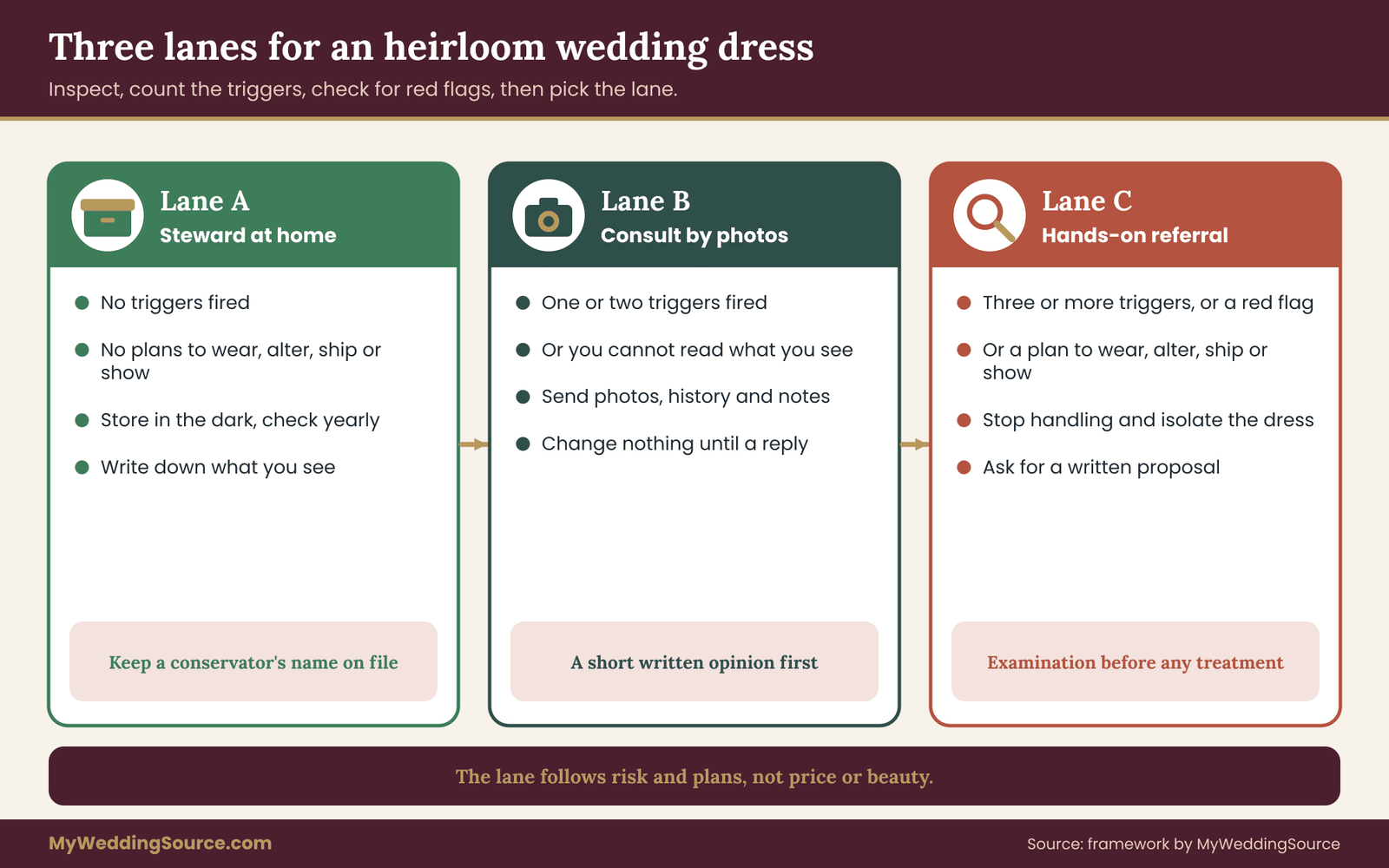
The lanes are not a judgment about how valuable the heirloom wedding dress is. A plain cotton dress with active mold belongs in Lane C. An ornate silk dress in perfect, stable condition with no plans attached can live happily in Lane A. The framework sorts dresses by risk and by what you intend to do, not by price or beauty.
Why a framework beats a gut feeling
People tend to make this decision in one of two ways. Some assume that anything old needs a specialist and book an expensive appointment for a dress that is fine. Others assume a gown that looks fine is fine, and discover a problem when the shoulder seam gives way during a fitting. Both errors come from treating the decision as a single yes or no.
A three-lane rule separates what you can judge by eye from what needs a trained examination, and it tells you what to do in each case. It also makes the next steps cheaper. A well-prepared Lane B photo set can save a conservator time and can save you an appointment you did not need. A well-prepared Lane C visit means the conservator starts with the dress’s history rather than spending the first half hour reconstructing it.
What a textile conservator actually does
A textile conservator is a trained specialist who examines, documents and stabilizes historic textiles, using methods meant to be reversible and to change the object as little as possible. Training and professional standards vary by country, and in the United States the American Institute for Conservation maintains a directory where you can search for conservators by specialty.
Conservation is not the same as restoration, cleaning or tailoring. A dry cleaner removes soil. A seamstress alters and repairs to make something wearable. A conservator’s first question is different: what is the most stable condition this object can be kept in, and what is the least that needs to be done to get it there? Sometimes the answer is a careful surface cleaning and a custom support. Sometimes it is a recommendation to leave the dress alone and store it better. That honesty about restraint is part of what you are paying for.
The sources listed at the end of this article include museum and conservation guidance on textile care, and they are worth a look before your first call.
Reading the fabric: how fiber and age change heirloom wedding dress risk
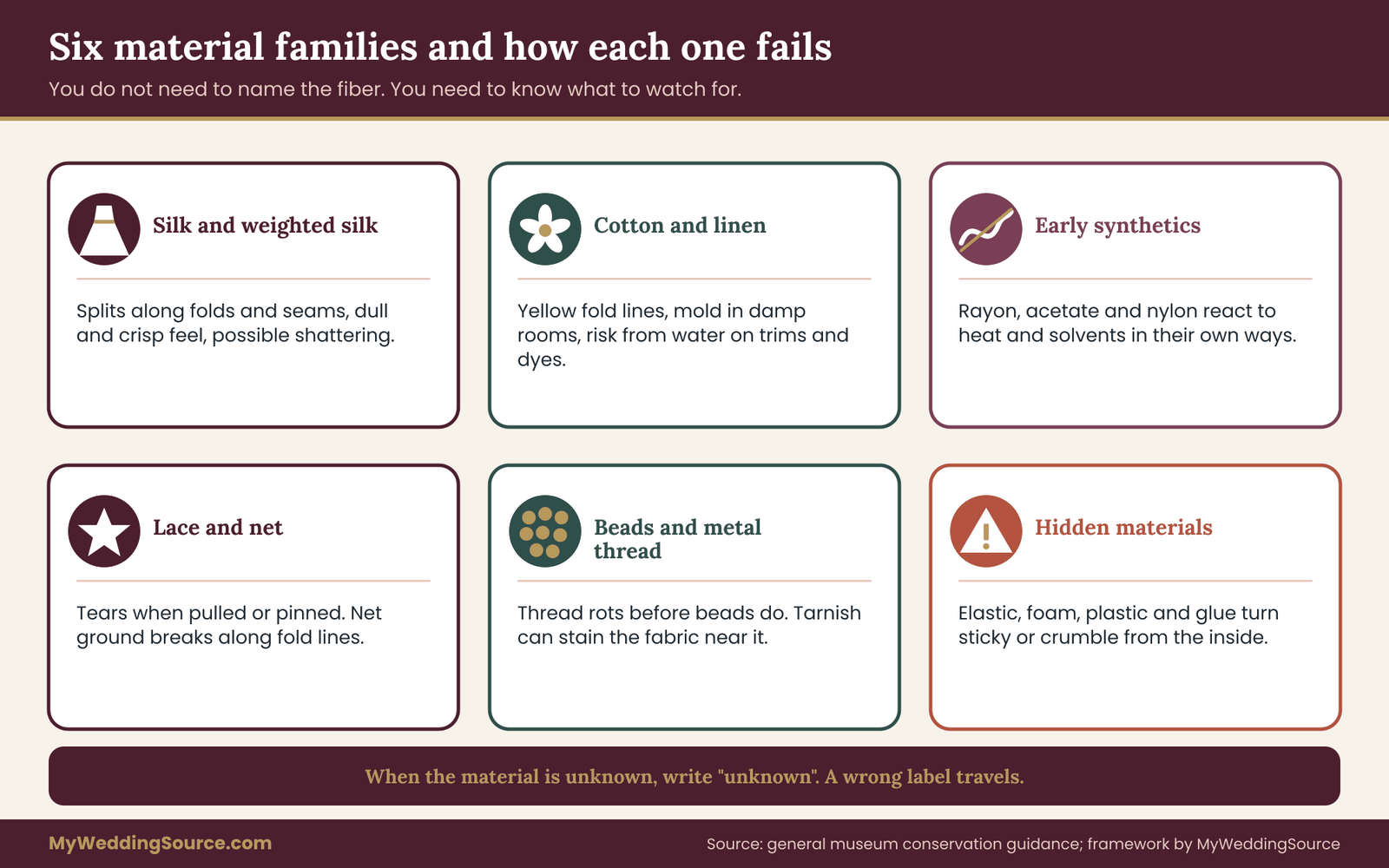
Before you score any triggers, it helps to know roughly what you are looking at. You do not need to identify a fiber with certainty. You need to know which broad family the dress belongs to, because each family fails in its own way and each one raises a different set of questions for a conservator.
Look first for a label. Maker’s labels, size tags, union labels and fiber content tags are all useful, and an old dress may have a handwritten tag sewn in by a dressmaker or a family member. Photograph every label before you do anything else. If there is no label, the weave, the weight and the way the fabric catches light give clues, and the photos you take can carry those clues to a specialist.
Silk, and the problem of weighted silk
Silk is the most common fiber in older formal wedding dresses, and it is a protein fiber, which means it responds to light, perspiration, humidity and age in particular ways. Fresh silk is strong. Aged silk, especially silk that has spent decades in light or in a folded position, can become dry, brittle and prone to splitting along folds and seams.
Some silks have an additional vulnerability. For a long stretch of the late nineteenth and early twentieth centuries, silk was commonly weighted with metallic salts to make it heavier, stiffer and richer in hand. Conservation literature describes this weighting as a major cause of shattering in historic silks, where the fabric splits into strips or powders at stress points. If your heirloom wedding dress is silk and was made in that period, assume it may be weighted, and treat any splitting as a trigger rather than a repair job.
You cannot reliably tell weighted silk by looking. What you can notice is a fabric that feels crisp, makes a dry rustle, shows long vertical splits, or looks grayish and dull where it should be glossy. Those observations belong in your photos and notes.
Cotton, linen and other plant fibers
Plant fibers behave differently. Cotton and linen are generally more tolerant of washing than silk, but that does not make washing safe for an old dress. A cotton dress with delicate lace, metal fasteners, dyed trims or fugitive colors can be damaged by water even when the base fabric is sound. Linen can yellow and weaken along fold lines. Both fibers are vulnerable to mold in damp storage.
One practical point: plant fibers and protein fibers often prefer different storage materials. Many conservation sources recommend buffered, acid-free tissue for cotton and linen, and unbuffered tissue for silk and wool, though recommendations differ depending on the dye and the object. This is one of the many reasons a short consultation is worth having before you buy supplies.
Early synthetics: rayon, acetate, nylon and polyester
From the early twentieth century onward, rayon, acetate and later nylon and polyester appeared in bridal wear, often blended or used for linings, nets and trims. These fibers are not simply inferior silk. Each reacts to heat, solvents and light in its own way, and some are damaged by common cleaning methods or by the products used on other fabrics. A dress with a satin outer layer and a synthetic net underskirt may need different handling for each part.
If a dress is more than a few decades old and you do not know what the fibers are, avoid steam, heat and solvents entirely. A conservator can often identify synthetic fibers by simple tests under magnification, and the answer changes what is safe.
Lace, net and handmade trims
Lace may be the most fragile component of an heirloom wedding dress. Handmade lace is built from fine threads with large open areas, and the net ground in particular can tear when it is stretched, pinned or pulled by the weight of the dress. Machine lace is usually sturdier but can still shed or distort. Old net often yellows and breaks along fold lines.
When lace is the dominant feature of the heirloom wedding dress, handle it as though it were the weakest part of the structure, because it often is. Keep a short question list for the lace: how old is it, is it original to the dress, has it been repaired, and what is it attached to?
Beads, sequins, metallic thread and embellishment
Beadwork is heavy, and it hangs from thread that is often weaker than the beads it holds. Over decades the thread can rot, loosen or break, and one pulled bead can unravel a row. Sequins can be gelatin or early plastic, both of which can warp, stick together or degrade. Metallic threads tarnish, and corroded metal can stain the fabric around it.
These embellishments also change how you can store the dress. A beaded bodice that is hung from the shoulders is carrying the whole weight of the skirt plus the weight of the beads. A beaded dress folded in tissue can have beads press into the fabric and leave impressions or cut threads. Neither plan is automatically right, and the best option depends on the dress’s construction, which is a conservator’s judgment.
Hidden materials: elastic, foam, plastic and adhesives
Later twentieth-century gowns often include materials that nobody thinks of as fabric. Elastic in waistbands and bodices, foam in bust cups or shoulder pads, plastic boning, and glued trim all age quickly. Rubber elastic can become brittle and sticky. Foam can crumble and stain the fabric next to it, sometimes in ways that cannot be reversed. Adhesives can darken or migrate.
Because these materials sit inside the structure, you may never see them until they fail. If the heirloom wedding dress has any stretchy or padded parts, or if you notice a sticky feel or a sweetish chemical smell, note it. These are conditions where a conservator would want to know about the problem before the dress is moved at all.
Dyes, colors and the “white” that is not white
Bridal white is not one color, and many heirloom wedding dresses are ivory, cream, champagne or a pastel. Dyed fabrics can bleed, fade or change when they meet moisture or certain chemicals. A dress that has yellowed unevenly may have been bleached or finished differently across its panels. Do not assume a yellowed dress can be whitened. Conservators often treat color change as part of the object’s history rather than a flaw to be erased, and attempts to bleach old textiles at home commonly weaken them.
What the fiber tells you about the lane
Fiber alone does not decide the lane, but it sets the starting risk. A plain cotton dress with sturdy construction and no embellishment starts with low fiber risk. A heavily beaded, weighted silk or early synthetic dress with lace and stretchy elements starts high. The fiber group feeds directly into the scoring in the next part of this guide.
When you cannot name a fiber, do not guess in your notes. Write “unknown, feels like silk” or “possibly acetate lining, not confirmed”. A confident wrong label tends to travel from one family member to the next and gets treated as fact. An honest “unknown” keeps the question open for someone who can answer it.
A short worked example of fiber reading
Suppose a family has an ivory dress from the middle of the last century. The outer fabric is smooth and heavy, with a slight sheen, and the label says only a department store name. The lining is a thinner, slippery fabric that looks different from the outer layer, and there are fabric-covered buttons at the back and a stiff net petticoat.
From that description alone, you can say useful things. The outer fabric might be silk satin, acetate satin or a blend. The lining is probably a different fiber. The net could be nylon, cotton or silk. The buttons suggest hand finishing and possibly thread that has aged. The stiff petticoat may be starched or treated with a finish. Four or five layers means four or five possible behaviors. A family that writes all of that down, with photos, has already done half the work a conservator will ask for.
The sensible response is to record what you see in plain terms, avoid naming fibers you cannot confirm, and move on to the triggers. The next part explains exactly what to look for.
The triggers that send an heirloom wedding dress to a conservator
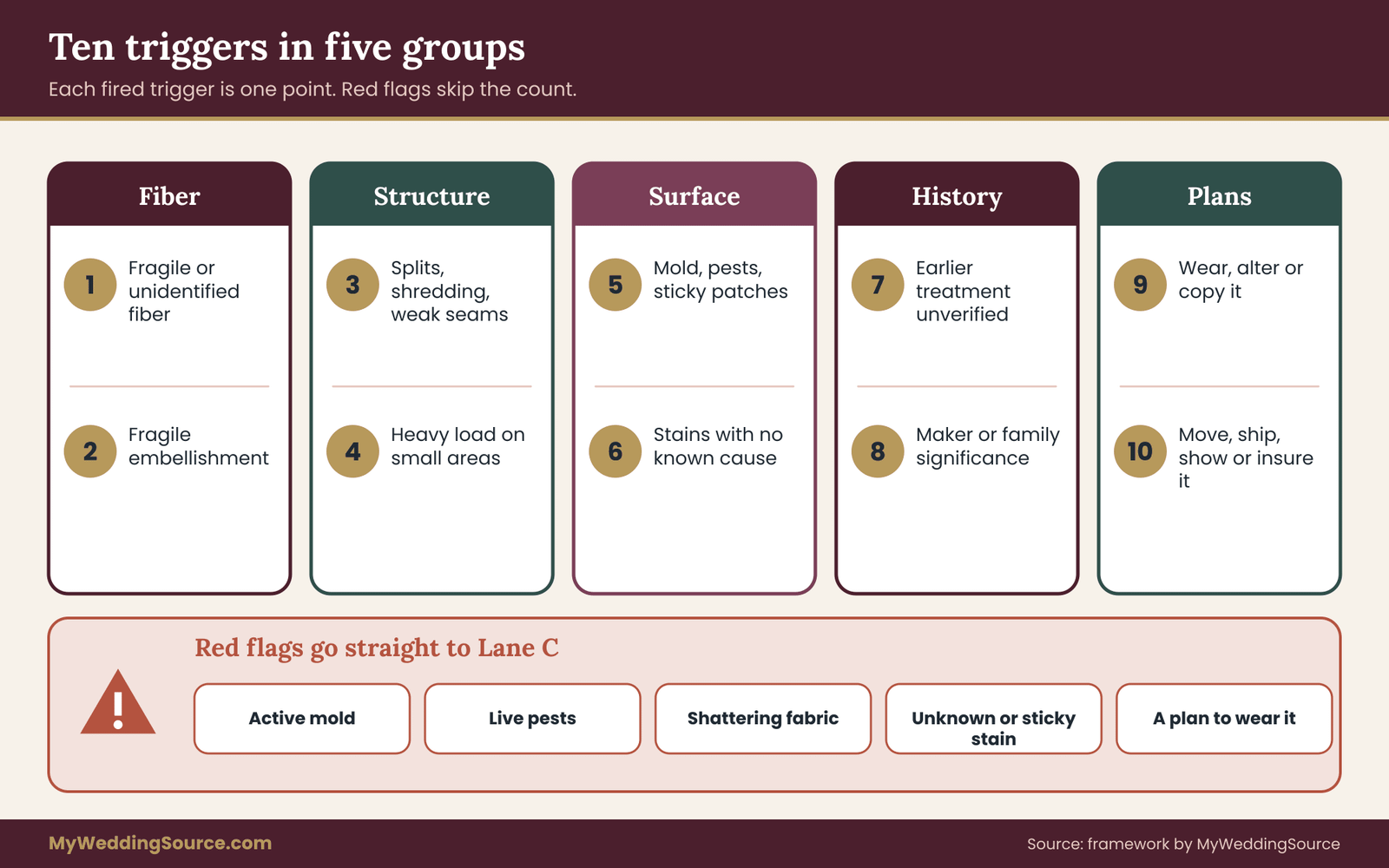
This is the core of the framework. There are ten triggers in five groups, and you check each one against the heirloom wedding dress in front of you. A trigger is not a diagnosis. It is a reason to ask a specialist before you act. Check the dress in daylight or bright, even light, on a clean flat surface covered with a clean white sheet, and do not unfold, unpack or turn it more than you must to see each area.
Work through the groups in order and write a short note for each one, even if the note is “nothing seen”. The notes become your record and later your handoff to the conservator.
Group one: fiber triggers
Trigger 1: fragile or unidentified fiber. The dress is silk of an age where weighting is possible, an early synthetic you cannot identify, or a mix of layers you cannot name. The trigger fires if you could not say with reasonable confidence what the main fabric is and the heirloom wedding dress is more than a few decades old.
Trigger 2: fragile embellishment. The dress has beadwork, sequins, metallic thread, handmade lace or glued trims. Any of these on a dress of heirloom age fires the trigger, because the decorative parts usually fail before the base fabric does and they change how the heirloom wedding dress can be supported.
Group two: structure triggers
Trigger 3: weakness you can see or feel. You find splits, shredding, powdery edges, or fabric that tears or gapes when it is lightly supported. Long vertical splits in silk and open seams at stress points such as shoulders, underarms and the waist count here. If you can see light through a thin area, note it.
Trigger 4: unsupported weight. The dress has a heavy skirt, a beaded bodice or long train, and it has been stored hanging or in a way that loads a small area. The trigger fires if the shoulders, waist seam or hanger loops are carrying a load they were not built for, whatever condition they are in today.
Group three: surface triggers
Trigger 5: active or unexplained deterioration. There is mold, a musty smell, fuzzy or spotted patches, pest holes, tiny casings, fine grit under the dress, or sticky patches. Any sign of an active process is a red flag by itself and moves the heirloom wedding dress straight to Lane C.
Trigger 6: stains you cannot explain. Brown spots, rust marks, waxy patches, yellow bands along fold lines or discoloration under the arms are common on old dresses. The trigger fires when you do not know what caused the mark. A stain with a known cause, such as a documented wine splash decades ago, still deserves a note, but an unknown mark deserves a specialist.
Group four: history triggers
Trigger 7: earlier treatment you cannot verify. The dress has been dry cleaned, “preserved”, sealed in a box, repaired with tape or glue, or altered by someone whose work you cannot assess. Prior treatments can leave residues and weaken fibers, and the real question is what was done, not whether it was done well.
Trigger 8: provenance or significance. The heirloom wedding dress has a documented maker, a period of historical interest, a connection to a notable event or person, or may be a candidate for donation to a museum or historical society. This trigger is about value in the broad sense, including historical value. It does not need a dollar figure.
Group five: plan triggers
Trigger 9: a plan to wear, alter or copy it. Someone intends to wear the dress, even once and even briefly. Someone wants it taken in, let out, shortened or restyled. Someone wants a pattern made from it. Each of these places stress on old fabric, and each is a decision that deserves a specialist’s view first.
Trigger 10: a plan to move, ship, display or insure it. The dress is going on a plane, into a long-term exhibit, into a shared family closet in another state, or onto an insurance schedule that will need documentation. Movement and display are two of the most common ways heirloom textiles are damaged. If the heirloom wedding dress needs a condition report or valuation for insurance, ask who is qualified to supply each.
Red flags that skip the count
Five findings send the dress straight to Lane C, no matter how many other triggers fire. Active mold. Evidence of live pests. Shattering or powdering fabric. An unknown, spreading or sticky stain. Any plan to wear the heirloom wedding dress, because the stress of being worn is high and unpredictable on aged fabric.
If you have a red flag, the useful move is to stop handling the dress, isolate it from other textiles, and arrange an examination. Do not wash, brush, vacuum, spray or rewrap it. A conservator can usually tell you by phone how to hold the dress until the appointment, and a quick call is worth making the same day.
Scoring in practice
The scoring is simple. Count each trigger as one point. Zero points and no plans puts you in Lane A. One or two points and no red flag puts you in Lane B. Three or more points, any red flag, or a fired plan trigger puts you in Lane C.
The plan triggers deserve extra attention because they change the dress’s situation without changing the heirloom wedding dress. A dress that scores one point sitting in a closet may be fine for years. The same dress, once a family member says “I think I will wear it in the spring”, becomes a Lane C case on that sentence alone, because the physical risks of a fitting, a zipper, a day of movement and a stage of cleaning are real.
Edge cases that confuse the count
Several situations make the score harder to read.
A dress with mixed ages is one example. A hundred-year-old bodice with a skirt added fifty years later has two different aging histories, and the join between them is a structural stress point. Score the older section and note the repair.
A dress with a modern lining or a recent zipper might look newer than it is. Look at the outer fabric, not the replaced parts.
A dress that “feels fine” is a common trap. Fiber strength is invisible. A silk that does not split when lightly lifted may still fail under a fitting. Rely on triggers, not on the feel of one lift.
A dress with a repair that looks neat is another. Neat is not the same as safe. An old repair may use thread, tape, glue or fabric of a different weight that now strains the surrounding area. Count it as an unverified earlier treatment.
How honest scoring helps you
The framework works only if you score honestly. If you want the dress to be Lane A because Lane C feels expensive, the framework will not help you. The more useful mindset is that each trigger is an inexpensive piece of information. If you score a trigger and later learn it was a false alarm, the cost was a few minutes. If you skip a real trigger and the heirloom wedding dress is damaged, the cost cannot be recovered.
If two family members score the dress differently, that is useful too. It means a trigger is unclear and probably belongs in the photos you send to a conservator, with both opinions noted. Disagreement is a reason to ask, not a reason to average the scores.
Checking the plan against the family
A final step belongs to the scoring stage, and it is easy to skip. Ask the people connected to the dress what they expect from it. One relative may assume it will go to a particular grandchild. Another may assume it will be worn. A third may think it should go to a museum. These expectations are plan triggers waiting to happen, and surfacing them early prevents the awkward situation where a conservator’s recommendation conflicts with something the family has already promised.
Write the expectations down in one or two sentences each. You will use them again in the section on handing the heirloom wedding dress down, and a conservator will find them useful when deciding what kind of treatment makes sense.
The handling checklist in the next part tells you what to do with the dress while you are scoring, and what to do with it afterward whatever the lane.
A handling checklist for an heirloom wedding dress
Handling is where most accidental damage happens, and it happens quickly. The checklist below is meant for the moments when you need to look at, move or document the heirloom wedding dress before a conservator has seen it. It is deliberately conservative. If a step feels risky for your particular dress, skip it and note why.
The basic principle is that every touch is a small amount of wear, so each handling session should have a purpose, a plan and an end point. Do not take the dress out to show someone, to try a veil with it, or to see how it looks. Take it out to inspect, photograph or move it, and put it back.
Before you open the box
Prepare the space first. Choose a clean, dry room with good light, away from pets, food and drinks. Clear a large table, wipe it, and cover it with a clean white cotton sheet or a roll of clean, unprinted, acid-free paper. The surface needs to be longer than the dress’s longest dimension, so that no part hangs over an edge.
Remove rings, bracelets, watches and any necklace that could catch on lace or beadwork. Wash and dry your hands, and keep a clean towel nearby. If you are working with beadwork, metallic thread or any trim that holds oils, nitrile gloves are a sensible option. Cotton gloves can catch on lace and beads, and they reduce your sense of touch, so many conservators prefer clean bare hands for lace and nitrile gloves for metal.
Gather a camera or phone, a ruler or tape measure, labels, clean unbleached muslin or acid-free tissue for padding, and a notebook. Do not bring pins, tape, scissors, a marker, a steamer, a lint roller or anything sticky near the dress.
Ask a second person to help. A heavy dress is much safer to lift with two people, and the second person can take notes and photographs while you hold.
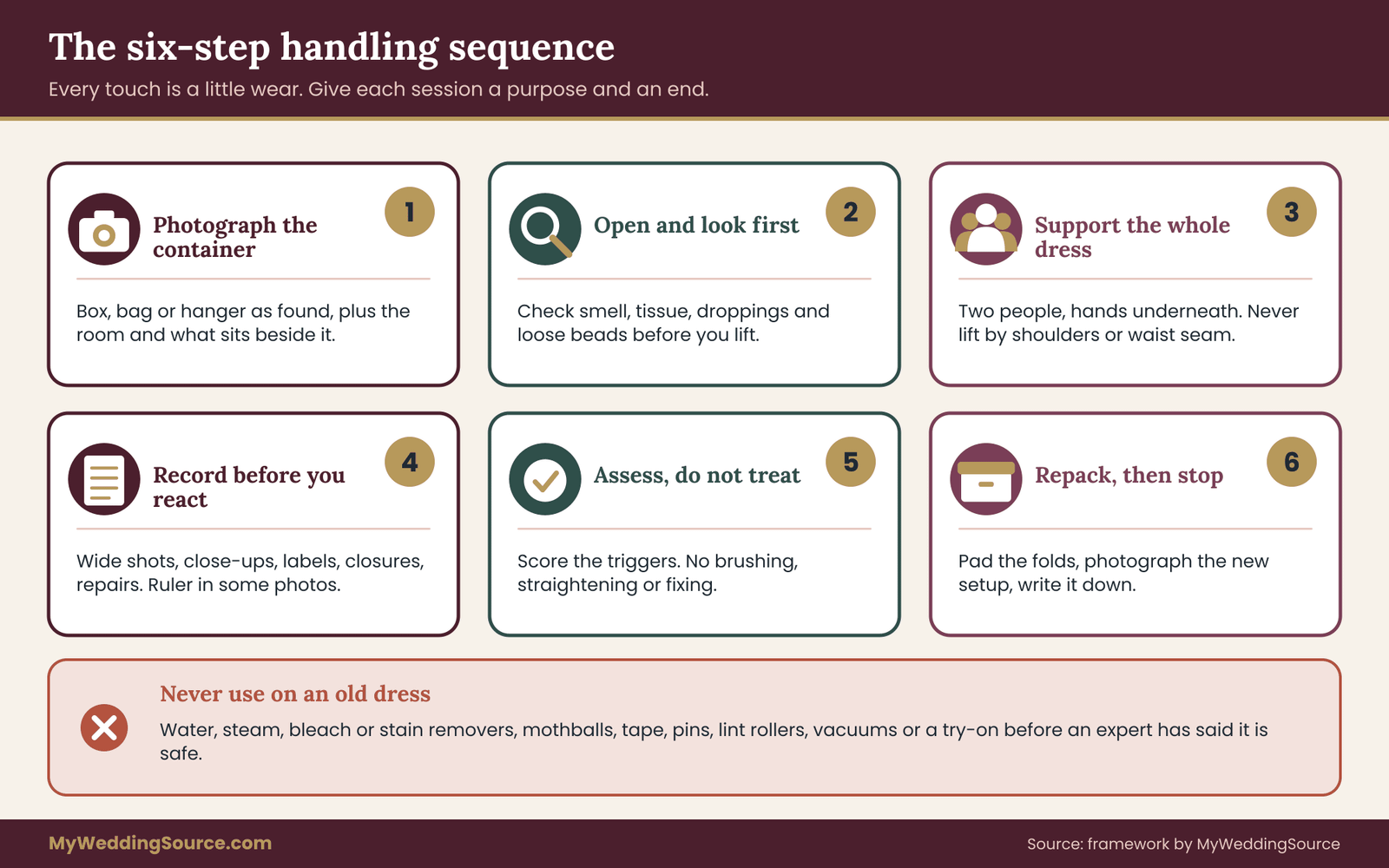
The six-step handling sequence
Step one: photograph the container. Before you open it, photograph the box, bag or hanger as you found it. How a dress was stored is evidence. Note whether it was in a sealed box, a plastic bag, a pillowcase, a hanging bag, or loose in a trunk. Note the room, the shelf and anything stored beside it.
Step two: open slowly and look before you lift. Take off the lid, unwrap the tissue and look at what is visible without moving the heirloom wedding dress. Smell the air gently. A musty, sweet or chemical odor is a data point. Look for pest casings or droppings on the tissue, and for any loose beads, threads or fragments in the box. Collect loose bits into a clean labeled envelope rather than discarding them, because a conservator may be able to reattach them.
Step three: support the whole dress. Slide both hands under the dress, with the second person on the other side, and lift it as one unit onto the prepared surface. Never lift by the shoulders, the waist seam, the hanger loops or the train. Support the weight from beneath, as you would a sleeping child, and keep the heirloom wedding dress as flat as it was in the box.
Step four: record before you react. Photograph the whole dress, then each area. Take wide shots, close-ups of any damage, close-ups of seams, the interior, the labels, the closures and any repairs. Hold a ruler or a plain card in some photos to show scale. Note the date and what you did.
Step five: assess, do not treat. Use the triggers from the last section. Resist the urge to straighten a wrinkle, brush off dust, close a gaping seam or push a bead back into place. Each of those is a small treatment. Your job at this stage is to see and record, not to fix.
Step six: re-pack or support, then stop. Return the dress to its container or to a better support, with padded folds as described below, and stop. Write down how it is now stored. Photograph the final arrangement so the next person can match it.
What not to do
Several habits show up again and again in stories of damaged family dresses. Here they are in plain terms.
Do not wash, soak, spot clean or steam the dress. Water and heat can set stains, spread dyes, tighten or relax fibers unevenly and weaken old fabric. A stain that has been there a long time may be part of the dress’s history, and a conservator will decide whether it should be touched.
Do not use household stain removers, bleach, sprays, baking soda, vinegar or “natural” cleaning products. Each has a chemistry that can interact with old fibers and finishes.
Do not use mothballs, cedar blocks or scented sachets near the heirloom wedding dress. They are sometimes sold as protection, but their odors and chemical residues can linger and may harm fabric and the people handling it.
Do not hang an old dress that is heavy, beaded or fragile. If it must be moved on a hanger for a short time, support the bodice and skirt separately and do not leave it that way.
Do not pin, tape, glue or staple anything onto the dress or its tissue. Pins can rust or leave holes. Tape and glue can damage fibers and leave residues that are difficult to remove.
Do not try the heirloom wedding dress on, or ask someone else to, until a conservator has said it is safe. Even a short try-on can split a seam, pop closures or tear underarms. A dress form is better than a person, though a form should be properly padded and appropriately sized, and it can still stress the fabric.
Do not use a vacuum, a lint roller, a brush or compressed air to remove dust. A conservator may vacuum through a screen at low suction. You should not.
What to do about odors and air
Old dresses often smell. Some smells are harmless, such as a faint scent of old fabric or tissue. Others signal a problem, including a musty odor from mold or damp, a sharp chemical smell from adhesives or degrading plastics, and a heavy perfume smell from mothballs or sachets.
Airing a dress in a breezy room for a few minutes is a common suggestion, but direct sunlight, outdoor air and humidity are all risks for old textiles. Treat odor as information and mention it to the conservator. If you suspect mold, a damp storage history or pest activity, isolate the dress by placing it in a clean, dry area away from other textiles and ask for advice instead of airing it.
Storage you can do at home while you decide
Whatever lane the dress falls into, it has to be stored somewhere while you wait for an answer, a consultation or an appointment. Good home storage is mostly about stability and absence. You want steady conditions, little light, no pests, no chemicals and no unnecessary movement.
Choose the room before the box
The best storage space is a living area of the home that stays at a moderate, steady temperature and humidity, such as an interior closet or a space under a bed in a regularly used room. The worst spaces are the ones many families default to: attics, basements, garages, sheds and storage units without climate control. These swing widely in temperature and humidity, and damp or heat accelerates deterioration and invites mold and pests.
Keep the heirloom wedding dress away from exterior walls, water pipes, radiators, heating vents and windows. Avoid putting it on the floor of a closet where a leak or flooding could reach it. A shelf above floor level in an interior closet is a better choice. Museum guidance consistently emphasizes steady conditions over perfect numbers, so a dress that sits in a stable home environment is better off than one in an environment that is ideal on paper and fluctuates.
Box, tissue and support
A box of the right materials can help, and a box of the wrong materials can harm. Look for archival boxes made from lignin-free, acid-free board, with no PVC plastic windows, no glues that give off fumes and no coatings that smell of chemicals. Avoid ordinary cardboard, which can release acids, and avoid sealed plastic containers, which can trap moisture and fumes.
Line the box with clean, washed, undyed cotton muslin or acid-free tissue, and use more of the same to pad every fold. The purpose of the padding is to turn sharp folds into soft, rolled curves, which reduces creasing and stress. Pad the bodice and sleeves from the inside as well, so that nothing presses on a beaded or lace surface. Support heavy areas from beneath and do not let the weight of the skirt pull on the bodice.
If the dress is too large, too fragile or too heavily beaded for a box, ask the conservator for a custom support. They can often recommend or create a padded form, a rolled support or a flat tray that carries the dress’s structure better than any home arrangement.
Light, pests and checks
Light is cumulative, so keep the heirloom wedding dress in the dark. A closed box on a shelf in a closed closet is ideal. Do not display an heirloom wedding dress in a sunny window or under bright lights, and do not leave it on a mannequin in a room with daylight, even for a short while.
Pests such as clothes moths and carpet beetles are attracted to protein fibers, soil and sweat residues, and they can ruin a dress quietly. Signs include small holes, a fine gritty frass that looks like sand, casings, webbing and live larvae. Keep the storage area clean, inspect it, and consider sticky monitoring traps in the room, not on the dress. If you see evidence of pests in the box, do not shake the dress or clean it. Isolate the container in a sealed clean bag if you must, and call for advice.
Inspect the heirloom wedding dress on a schedule. Once a year is a reasonable pace for a Lane A dress, and some conservators suggest checking more often during the first year after any change. Each check follows the same sequence as the handling steps above, with a short note and a few photographs.
What to write on the label
A simple label on the outside of the box saves handling later. Write the dress’s description, the date of the last check, who to contact about it, and a one-line instruction such as “Do not open without clean hands and a second person.” Do not write on the dress, the tissue or the muslin. Use a label on the box and a separate sheet kept in the notebook.
That sheet is also where you record the plan for the heirloom wedding dress, which leads to the question of how to work with a specialist when the framework puts you in Lane B or C.
How to find and brief a textile conservator for an heirloom wedding dress
If your score puts the dress in Lane B or Lane C, the next job is finding the right person and giving them what they need. Good preparation shortens the first conversation, makes the quote more accurate and lowers the chance of misunderstanding. It also tells you quickly whether the specialist is a good fit for your dress and your family.
Start with the professional directories. In the United States, the American Institute for Conservation runs a public “Find a Conservator” search where you can look for professionals by specialty and location, and the directory is listed in the sources at the end of this article. Canada has its own professional network, and the Canadian Conservation Institute publishes care guidance. Museums, historical societies and university costume collections also know local textile specialists, and they may refer you to one even if they cannot take the heirloom wedding dress themselves.
Conservator, dry cleaner, seamstress, preservation company: who does what
These four roles are easy to mix up, and the confusion causes real problems.
A textile conservator examines, documents and stabilizes historic textiles, and aims to keep intervention minimal and reversible where possible. They write a condition report and a treatment proposal, and they can advise on storage, display and handling.
A specialist gown cleaner cleans wedding dresses as a service. Some are very good at modern gowns, and some offer “heirloom” processes. A cleaner is not a conservator unless they have conservation training, and a good one will tell you where their expertise ends.
A seamstress or tailor alters and repairs dresses for wear. A skilled one with experience in vintage garments can be a valuable partner after a conservator has said alterations are possible. A seamstress working on an unassessed heirloom is a Lane C risk.
A preservation company sells a cleaning-and-boxing service, usually for modern gowns. Some sell packages with claims about how long a result will last. Read such claims carefully and ask what is actually being done to the dress and with what materials.
Ask each person plainly: what training do you have with historic textiles, what would you do with a dress like this, and what would you decline to do? The answer to the last question is often the most informative.
What to prepare before the first contact
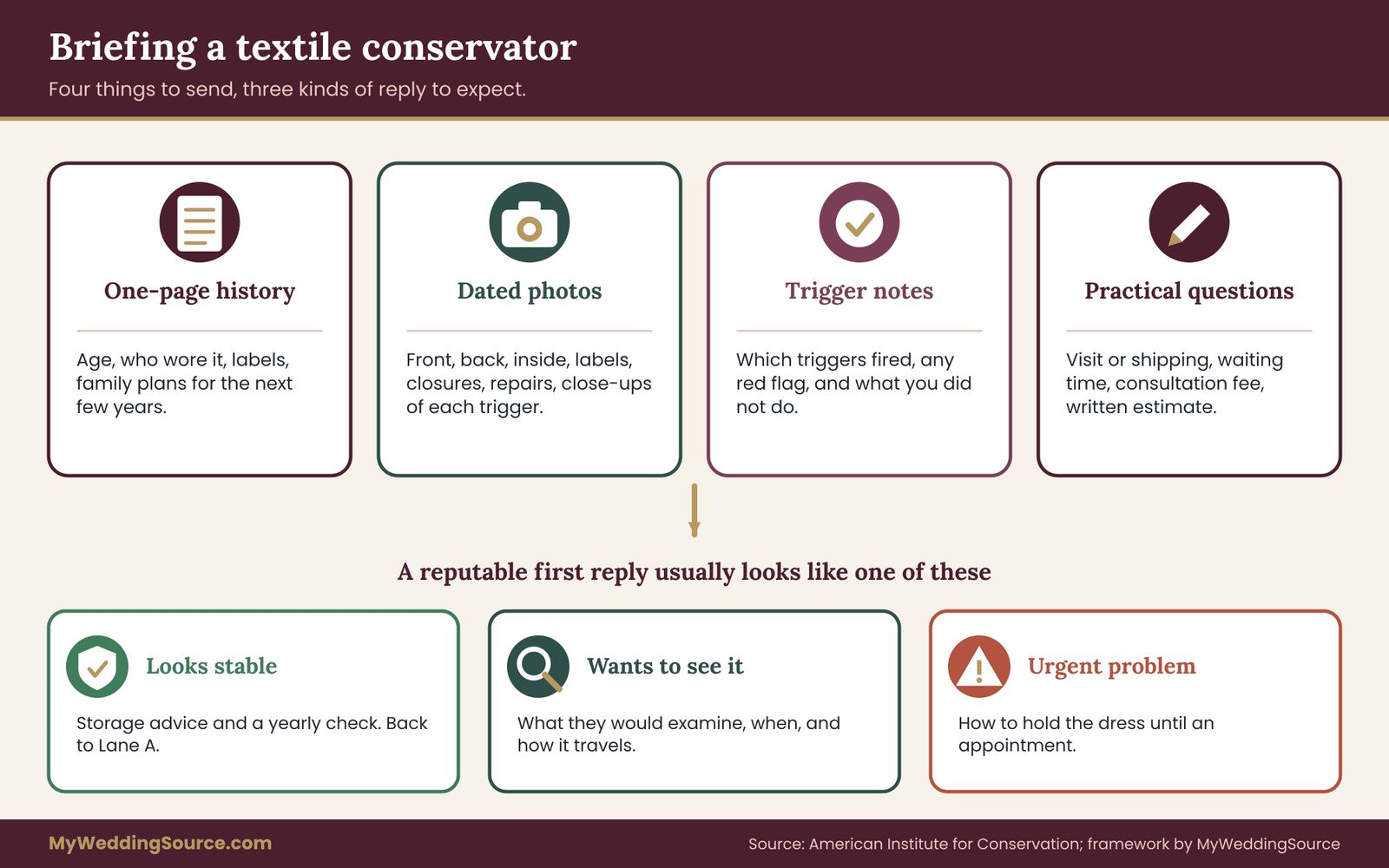
Assemble a short package. It does not need to be elaborate, but it should be organized.
First, a one-page description. Include the dress’s approximate age, who wore it and when, any known history, every label or inscription, and what the family wants from it in the next few years. State plainly whether anyone wants to wear it, alter it, ship it, show it or donate it.
Second, the photos from your handling session. Send an overall shot of the front, back and interior, close-ups of each area that raised a trigger, close-ups of labels, closures and repairs, and a view of how the heirloom wedding dress was stored. Label each photo with a short note.
Third, your trigger notes. List which of the ten triggers fired, in your own words, and list any red flags. Say what you did not do, such as “no cleaning, no try-on”.
Fourth, practical questions. Ask whether the conservator works in person, how long an examination takes, how long the waiting list is, whether they accept shipped dresses or prefer an in-person visit, and whether they charge for a photo consultation.
What a good first response sounds like
A reputable conservator will usually respond to a photo package in one of three ways. They may say the dress sounds stable and give you storage advice, which puts you back in Lane A with an expert’s reassurance. They may say they want to see the dress, and explain what they would examine. Or they may identify an urgent problem, such as active mold or pests, and tell you how to hold the heirloom wedding dress until an appointment.
Be cautious of responses that are all certainty. A conservator who has seen only photos should not promise a result, and one who quotes a firm treatment plan and a fixed outcome without examining the dress is skipping the step that makes the plan reliable. Equally, a vague response with no suggested next step is not helpful.
The examination, the report and the proposal
A hands-on appointment usually has three outputs. The conservator examines the heirloom wedding dress, often under magnification and sometimes with simple tests, and then writes a condition report. The report describes the fibers, construction, damage, earlier repairs and the dress’s stability. Then comes a treatment proposal, listing what they recommend, why, in what order, and what each step would cost.
Read the proposal as a menu rather than an order. Many proposals are tiered, such as documentation only, documentation plus stabilization, or full treatment. The cheapest tier is often “stabilize, support and store”, which may be what the dress actually needs. You are entitled to ask what happens if you decline each step, and a good conservator will answer honestly.
Keep the condition report even if you decide not to treat the dress. It is a valuable record for insurance, for any future conservator and for the family’s own history.
Questions worth asking at the examination
Consider asking these, in whatever order feels natural.
What is the heirloom wedding dress made of, and how confident are you in that identification? What is the biggest risk to it right now? What do you recommend we do, and what could we reasonably leave alone? What would happen if we did nothing for another five years? Can this dress be worn, even once, and if so under what conditions? If not, what alternatives would you suggest? How should it be stored, and how often should it be checked? What would you want us to document or keep with it?
Notice how the specialist responds to “what could we leave alone?” The best answers acknowledge that doing less is sometimes the right call.
Costs, estimates and written terms for heirloom wedding dress conservation
Conservation is skilled work and is generally priced by the hour or by the project, so costs vary with the size of the heirloom wedding dress, the extent of damage and the region. This article will not quote prices, because any figure here would be invented and out of date. What it can do is help you ask for the right things in writing.
Separate the fees
Ask for an estimate that separates the elements: consultation fee, examination and condition report, each recommended treatment step, custom storage materials or supports, and shipping or insurance if the dress travels. Separating them lets you choose which to approve and gives you something to compare if you speak with another conservator.
Ask whether the consultation fee is credited toward treatment. Ask whether an estimate is a fixed price or a range, and what could cause it to change. Ask when payment is due, and what happens if the work is stopped part way.
Written terms that matter
A written agreement protects both sides. For an heirloom wedding dress, the terms worth confirming include the scope of work in plain language, what the conservator will not do without further approval, how they will document the dress before and after, who is responsible for the heirloom wedding dress while it is in their care, how it will be insured and for what value, how it will be packed for return, and how long they will hold it after the work is finished.
The general principles in the wedding vendor contract guide apply here too: scope, deposits, change approval, cancellation and liability should all be spelled out before work begins. A dress is not a bouquet, and an agreement for textile conservation is not an event contract, but the habit of reading every line and asking about every vague phrase carries over exactly.
Ask specifically about the condition report. You want a copy, with photographs, and permission to share it with other professionals.
Insurance and valuation are separate questions
Two things often get tangled: insuring the dress while it is out of the house, and establishing what the heirloom wedding dress is worth. Your homeowner’s or renter’s policy may not cover a dress while in transit or in someone else’s care, or may have limits on items of a particular type. Ask your insurer directly, and ask the conservator what coverage they carry while the dress is in their studio.
A valuation is typically the job of a qualified appraiser, not the conservator. Appraisers’ professional organizations list members by specialty, and the American Society of Appraisers is included in the sources. Some conservators will comment on condition and significance without giving a dollar figure, and they may politely decline to appraise a dress they are treating. Treat any single figure for “value” as an opinion at one moment, and do not assume it will hold.
Budgeting without false precision
Because costs are variable, it helps to plan around decisions rather than numbers. Decide the maximum you are willing to spend before you have the estimate, so that you can respond calmly. Ask yourself what outcome you would be happy with: a stable dress in a good box, a documented condition report, a dress that can be displayed, or a dress that can be worn. Each level involves progressively more work and more risk.
If you are tracking this alongside other family and wedding expenses, the wedding budget page is a useful place to keep a line for conservation, with a note on what is committed and what is optional. A conservation consultation, an examination and a treatment are three separate decisions. You can stop after any one of them.
A worked case: one invented family dress from inbox to decision
The case below is an invented illustration, not a real family and not a real conservation record. It exists to show how the framework moves from inspection to a decision, including a point where the family’s wishes and the dress’s condition disagree.
Meet the Adeyemi-Lindqvist family, who are made up for this example. Noor is engaged and has been told by her grandmother that the family wedding dress is in a trunk at her aunt’s house. The dress was made for her great-grandmother by a local dressmaker in the late 1940s. It is ivory satin, with a fitted bodice, a long skirt, fabric-covered buttons down the back and a net underskirt. A short net veil is stored with it. Noor’s first thought is simple: could she wear it?
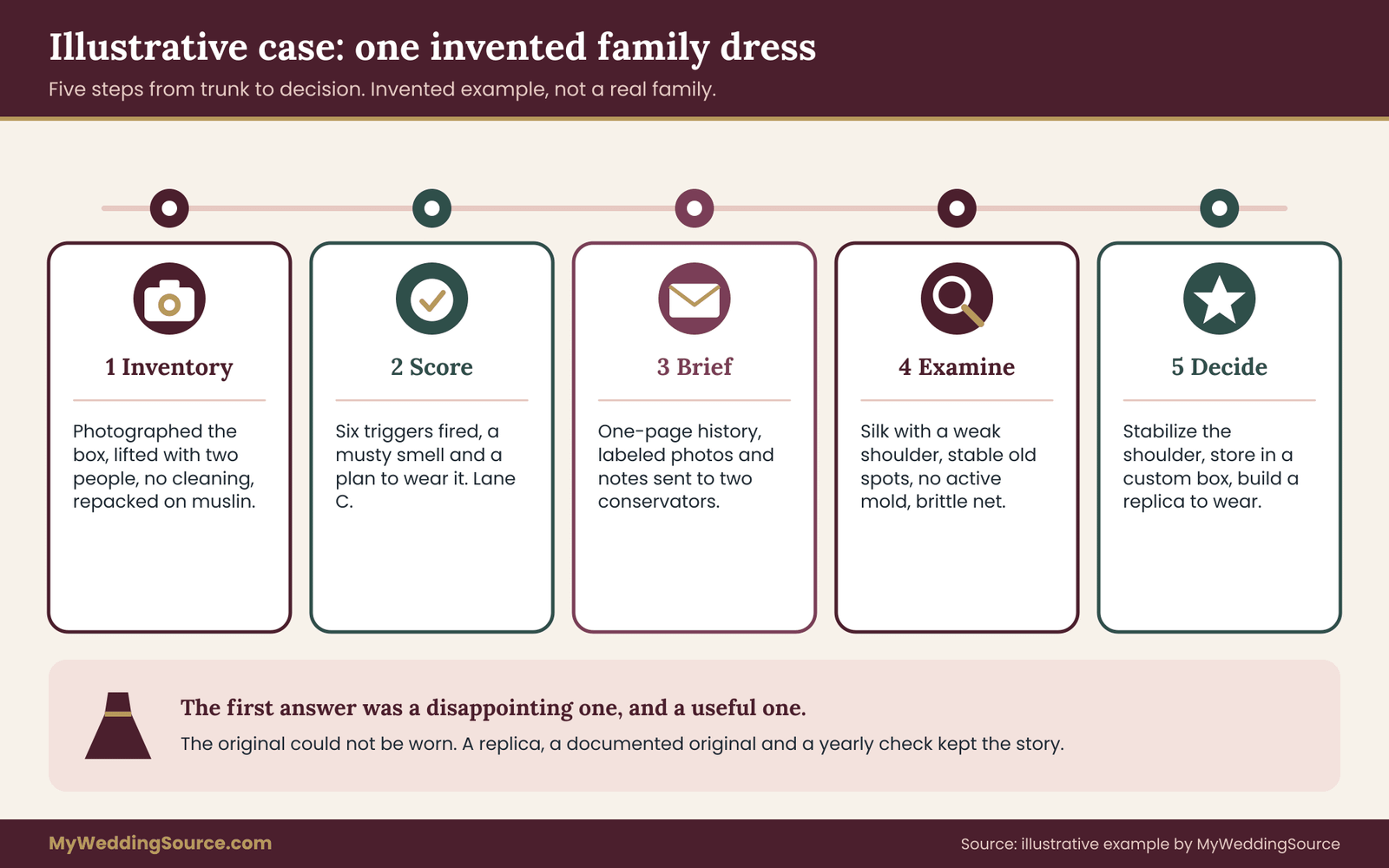
Step one: the inventory
Noor’s aunt and a cousin open the trunk on a clean table, following the handling sequence. They photograph the trunk and note that the heirloom wedding dress had been in a cardboard dress box inside a plastic zip bag, on top of a stack of old linens. The box smells faintly musty and has a few small brown spots on the lid.
Lifting the dress together, they find the satin is a soft ivory with clear yellow-brown bands along the old fold lines at the waist and hem. There are three brown spots near the hem, a split of about a finger’s length in the left shoulder seam, and a small area under the right arm where the fabric looks darker and slightly rough.
The net underskirt is yellowed and a few pieces of net came loose into the box. Two of the covered buttons are missing and one hangs by a thread. There is no tag except a handwritten piece of cotton tape inside the waist with a name and a date.
They do not wash, brush or press anything. They photograph the heirloom wedding dress, the label tape, the splits and the stains, with a ruler in some shots, then repack it into the box on clean muslin and place it on a closet shelf in the aunt’s bedroom, away from the trunk.
Step two: the scoring
Using the ten triggers, the family notes the following.
Trigger 1 fires. The satin could be silk or acetate, and nobody knows. Trigger 2 fires in a minor way, because the buttons are covered and the net is old. Trigger 3 fires, because of the shoulder split and the rough area under the arm.
Trigger 4 does not fire. The dress was stored in a box, not hung. Trigger 5 is uncertain. The musty smell is a possible sign of damp, which belongs in a red-flag conversation. Trigger 6 fires because the brown spots and the fold-line bands have no known cause.
Trigger 7 is unclear, since nobody knows whether the dress was ever cleaned or what the plastic bag did. Trigger 8 fires in a modest way, because of the family connection and the dressmaker’s name on the tape. Trigger 9 fires, because Noor wants to wear it. Trigger 10 does not fire at the moment.
The count is six points, with a possible red flag in the musty smell and a plan to wear it. That puts the heirloom wedding dress firmly in Lane C. The family does not need to decide anything else to know what to do next.
Step three: the brief
The cousin writes a one-page description with the dress’s history as far as they know it, the label text, the storage details and Noor’s plans. The photos are labeled. They say plainly that no cleaning or trying on has happened and that the dress has a musty odor.
They search the professional directory for a textile conservator within reasonable travel distance and write to two. One replies within a few days offering a phone call; the other has a waiting list. The first conservator, after reading the package, asks a few follow-up questions about the smell and the box, tells them to keep the heirloom wedding dress in a dry room away from other textiles, and suggests an in-person examination.
Step four: the examination and the proposal
At the appointment the conservator examines the dress under magnification. In this invented scenario, the findings are as follows. The satin is silk, and the shoulder area is weak. The brown spots are old and stable, and the yellow bands are acid migration from old tissue. There is no active mold, but there are old traces of dampness. The net underskirt is brittle. The darker patch under the arm is perspiration damage to the fibers.
The proposal offers three options. Option one is documentation, a condition report and a custom storage package: a padded box, supports for the shoulders and a plan for the net. Option two adds stabilization of the shoulder seam and the weak underarm with conservation stitching and support fabric. Option three would be a larger treatment, but the conservator says plainly that no treatment would make the dress safe to wear for a full wedding day. The silk is too weakened, and the underarm and seams would bear the load.
Step five: the decision
The family now has real information. Noor cannot wear the heirloom wedding dress. That is not what she hoped, and it takes a few days to absorb. The family compares alternatives.
They decide to approve option two, because the shoulder split is the most urgent structural problem and stabilization carries low risk. They commission a documented pattern and photographs of the dress, with the conservator’s agreement, so that a seamstress can build a faithful replica in a new fabric. They keep the original in the custom storage, with the condition report, the photographs and Noor’s letter to the future.
At the wedding, a small framed photo of the original dress sits on the memory table, and Noor’s replica carries the original’s buttons in a new silk. The family keeps the veil in its own padded box. A yearly check goes into the calendar.
What this example shows and what it does not
The example shows the order of operations: inventory, score, brief, examine, decide. It shows that the first answer can be disappointing and still useful.
It also shows that the outcome, a replica rather than a worn original, is a good one for the family. It does not show costs or timelines you should expect, because those depend on the heirloom wedding dress and the specialist. Nor does it prove that a particular approach will work for your own dress. Another family with a sturdier cotton dress and a calm photo consultation might have finished in an afternoon.
Alternatives when a conservator is not the right move
The framework does not say every old dress needs a conservator. It says every old dress needs a decision. Here are the alternatives, and the situations in which each makes sense.
Careful home stewardship
If the dress scores zero or one low-risk trigger and no plans attach to it, Lane A is a legitimate end point. You store it well, check it yearly and keep a record. This is the right choice for many stable dresses and for families that do not want to disturb something that has done well for decades.
A photo consultation only
A single consultation by photo or phone can resolve doubt for far less effort than an appointment. This works well when you have one or two triggers and want a professional to say whether they matter. Treat it as a way to buy peace of mind and a reading of the risk. Keep any written reply with the dress’s records.
A replica or a modern interpretation
If the family wants a dress to wear that honors the heirloom, building a new dress from the original’s pattern, or borrowing key elements, is a common and respectful path. A conservator or a skilled seamstress can document the pattern without cutting the original. The site’s alterations and fitting advice covers fittings on a new dress, and the same principles apply to a replica.
Be wary of cutting up an heirloom to reuse its fabric. Once cut, the original cannot be recovered, and the story attached to the dress goes with it. If a family does want to repurpose fabric, a conservator should be asked first, and the decision should be documented and agreed among the people who share the heirloom wedding dress.
Wearing a small piece
Sometimes a family can honor a dress by wearing a piece that does not stress it, such as a veil in good condition, a pair of gloves, a sash or a replica of a button. Ask the conservator whether the piece is stable enough. A veil, for instance, may be sturdier than the gown, or far more fragile.
Donation to a museum or historical society
A dress with a documented story may be of interest to a local museum, a historical society or a university costume collection. These institutions have collecting policies, limited storage and their own conservation standards, and they may politely decline. Ask what they collect, what documentation they want and what a gift would involve. Questions about tax treatment of donations belong with a qualified tax adviser, not with the museum or this guide.
Photography and documentation
A thorough photographic record, with measurements, labels and a written history, has value on its own, and it protects the story if the dress is later damaged or lost. For families that want to share the heirloom wedding dress, a set of digital images is a way to include relatives who live far away. The wedding records guide describes how to store digital files safely, and the same principles apply to dress photos: three copies, two kinds of storage, one off site.
Doing nothing, deliberately
Sometimes the right decision is to leave a dress alone, in good storage, and revisit it in a year. Deliberate inaction is different from neglect. It has a date, a place, a note and an owner. If you choose it, write down why, so that the next person understands it was a decision and not an oversight.
Failure conditions: when the framework will not protect the dress
Every decision rule has limits, and it is better to name them. The framework is a screening tool. It helps you decide whether to ask a specialist, and it does not replace the specialist’s examination. Here are the conditions under which it is most likely to fail.
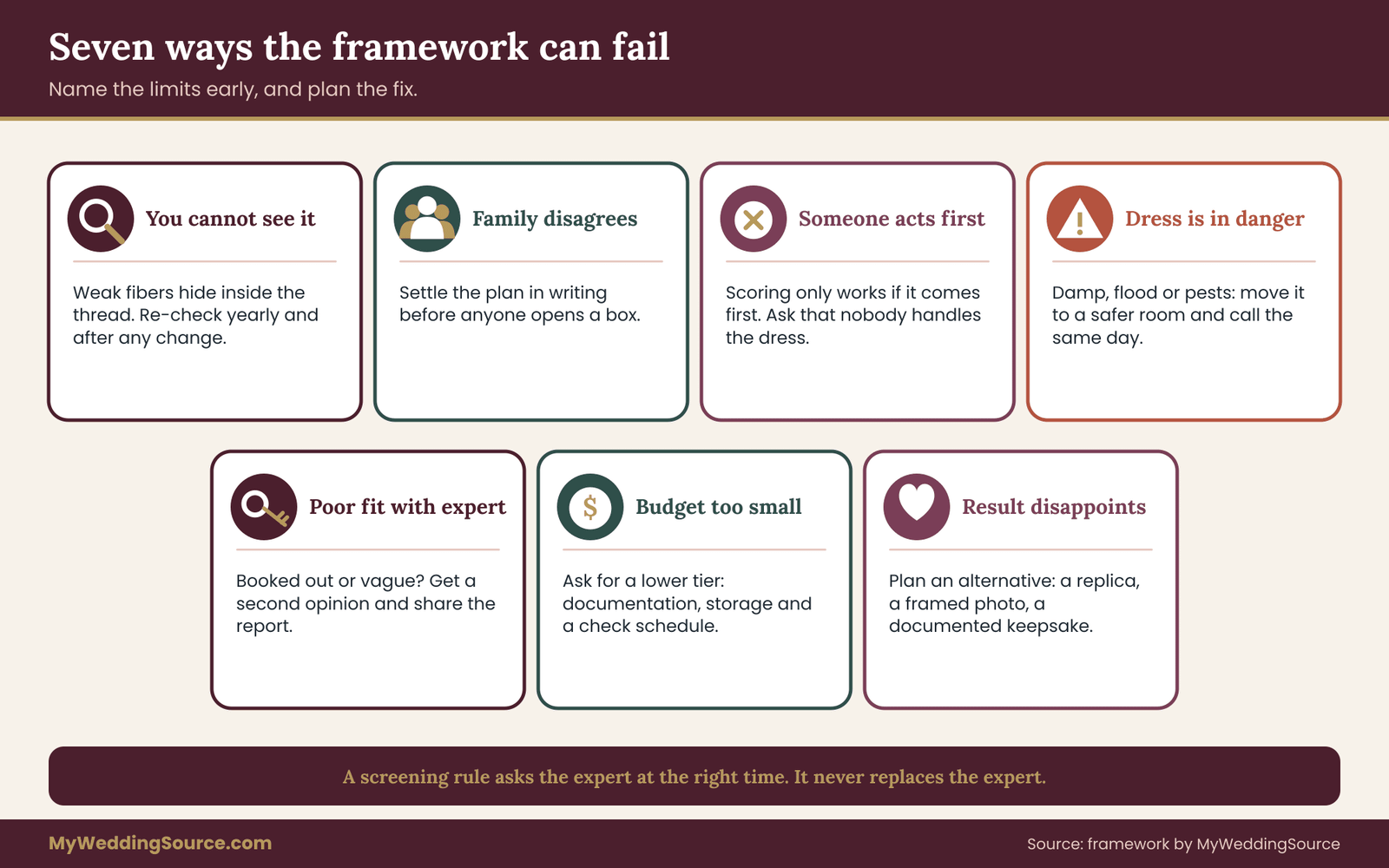
You cannot see the problem
Many forms of deterioration are invisible from the outside. Weakened fibers, acid in the fabric, residues from earlier treatments and corrosion inside embellishments can all exist in a dress that looks fine. If you score zero triggers because you could not see anything, the score reflects what you could see, not what is there. For that reason, Lane A should come with a yearly re-check, and any change in plans should restart the scoring from the beginning.
The family disagrees about the plan
A framework cannot settle a family argument about whether a dress should be worn, kept, shown or passed on. If two relatives hold incompatible plans, the dress is exposed to the risk that one of them acts alone. The fix is not technical. It is a conversation, and ideally a written note agreed by everyone with a stake, before anyone opens a box.
Someone acts before the score is finished
The most common failure is simple: a well-meaning relative tries on the dress, steams a wrinkle or cleans a spot before the family has scored it. Scoring protects the heirloom wedding dress only if it happens first. If you hold the dress for others, say so, and ask that nobody handles it until the checklist is done.
The dress is already in transit or in a bad situation
If the heirloom wedding dress is in a flooded basement, a damp storage unit or a house with a pest outbreak, there is no time for a leisurely scoring session. The priority is to move it, with the support steps above, to a safer room and call a conservator, a museum or a disaster-recovery resource the same day. Where textiles have been in water or a fire, conservation organizations publish emergency guidance, and a prompt call can matter.
The conservator is not the right fit
A conservator may be an excellent specialist in historic costume and still not the right person for your dress. They may be booked for months, too far away, or experienced with museum collections rather than family garments. If the proposal feels rushed, vague or promises more certainty than the evidence allows, a second opinion is reasonable and professional. Ask for the condition report to be shared, so you are not paying twice for the same examination.
The budget is smaller than the proposal
Sometimes the right treatment costs more than the family can spend. That is a real constraint, and it does not mean the dress is doomed. Ask the conservator for a lower-tier plan: documentation, a better storage package and a schedule of checks. Many dresses do well with that alone. Ask whether treatment can be staged over time, with the most urgent step first, and whether a payment schedule is possible.
The result is not what you hoped
A conservator may conclude that the heirloom wedding dress cannot be worn, cannot be altered, or cannot be displayed. That can feel like a loss, and it is worth allowing time to absorb it before making further decisions. The honest answer is usually more useful than a hopeful one that damages the dress. If you set out expecting only one outcome, consider what a satisfying alternative would be, such as a replica, a framed photograph or a documented keepsake.
A short list of signals that you need to restart
Return to the scoring step from the beginning in any of these cases: the heirloom wedding dress is moved to a new location, a new family member takes responsibility for it, someone proposes a new use, you notice a change in smell, color, texture or condition, or a year passes. A dress that was Lane A last spring can be Lane B this spring, and the framework is meant to be reused.
Handing the heirloom wedding dress down: documentation and family agreement
Looking after a dress is a long project, and the people involved change. The last piece of the framework is a plain record that survives the people who made it.
A one-page dress record
Create a single page and keep it with the dress and in your digital archive. Include the description and history; who wore it and when; every label and what it says; the maker, if known; photographs, dated; the scoring from the last review and the lane; the contact for any conservator who has seen it; storage details and the date of the last check; and the family’s agreed plan.
Add a line for decisions and who made them. “Aunt Ruth decided not to have the shoulder repaired in March, pending a second opinion” tells the next person more than a bare list of facts.
Keep one printed copy in the box, on a label or sheet that is not touching the dress, and one digital copy in your family archive. If the heirloom wedding dress moves house, the record moves with it.
A plain family agreement
Ask everyone with a stake to agree to a few lines. Who holds the dress now, and who is next? Who may open it and under what conditions? What is the plan for wearing, copying, showing or donating it? What happens if the holder moves, falls ill or can no longer care for it? Who pays for conservation if it is needed, and how are decisions made?
The agreement need not be a legal document, though a family that wants one should ask an attorney about their situation. A written note signed or acknowledged by the relevant people is enough to prevent most misunderstandings. If the heirloom wedding dress is a gift, note the intention at the time.
Sharing the story, not just the object
An heirloom wedding dress carries a story, and the story is easier to keep than the garment. Record the voices of the people who remember the wedding while they can. Photographs of the original wedding, letters, a program or a guest list belong in the same family archive as the dress record. The wedding family photo list can help you plan portraits of the dress with the relatives who wore it or remember it, when the heirloom wedding dress itself is stable enough to be photographed.
Accessories also deserve a place in the record. Veils, gloves, shoes, headpieces and jewelry tend to travel separately from the dress and get lost. The wedding day accessories planning article covers how accessories interact with a gown on the day, and it is a useful reminder to check that the pieces that belong with the heirloom wedding dress are accounted for before anyone plans to wear them.
Checking vendors who work with the dress
If a seamstress, cleaner or photographer will touch or handle the dress at any stage, treat it as a vendor engagement with a written scope. The wedding vendor due diligence checklist covers references, insurance and questions to ask, and the same habits apply when the vendor is a conservator, a gown cleaner or a framer. Ask what they will and will not do, how the dress will be tracked while it is in their care and what they carry for insurance.
Your next steps
Choose a quiet hour in the next week and take these steps in order. First, ask the family who holds the heirloom wedding dress and what everyone expects from it, and write down the answers. Second, prepare the table and your tools, and open the box only when a second person is there to help. Third, photograph, note and score the dress against the ten triggers, and stop as soon as you reach a red flag.
Then act on the lane. In Lane A, set up careful storage, label the box and put a yearly check on your calendar. In Lane B, send your photos and notes to a textile conservator and wait for a reply before changing anything. In Lane C, arrange an examination, hold the heirloom wedding dress still, and ask for the treatment proposal in writing, with each step priced separately.
Whatever the lane, write the one-page record. The most valuable thing you can give an heirloom wedding dress is a clear decision, made carefully, and written down for the next person.
FAQ
How do I know if my heirloom wedding dress needs a textile conservator?
Check it against the five trigger groups: fiber, structure, surface, history and plans. One or two triggers suggest a photo consultation. Three or more, any sign of mold, pests, shattering fabric or unknown stains, or any plan to wear, alter, ship or display the dress suggests a hands-on examination. If you are unsure, a short consultation costs far less than a mistake.
Can I clean an heirloom wedding dress myself?
It is safest not to. Water, steam, heat, solvents and household stain removers can weaken old fibers, spread dyes and set stains in ways that cannot be reversed. Old stains may also be part of the dress’s history. If cleaning seems necessary, ask a textile conservator first, since the right method depends on fibers and finishes that are hard to identify at home.
Is it better to hang or fold an old wedding gown?
For a heavy, beaded or fragile dress, flat or gently padded storage in an archival box is generally safer than hanging, because hanging puts the whole weight on the shoulders and seams. Pad each fold with clean muslin or acid-free tissue so the creases are soft. Because dresses differ, ask a conservator about yours.
Are sealed preservation boxes safe for an heirloom wedding dress?
Not automatically. Sealed boxes can trap moisture, fumes and residues, and some packages include materials or claims you cannot verify. Ask what the box is made of, whether the dress will be cleaned first and with what, and what the seller promises. For an old dress, an archival, breathable box with padding, stored in a stable room, is a common recommendation.
Can an heirloom wedding dress be worn again?
Sometimes, but not always, and it should not be tried before a conservator has examined it. Aged fabric can split at seams, underarms and closures during even a short fitting. A conservator can tell you whether the heirloom wedding dress is stable enough and under what conditions. If it is not, a replica or a smaller piece, such as a veil, may be the better choice.
How much does textile conservation cost?
It varies with the size of the dress, its condition, the treatment chosen and the region, so no single figure is reliable. Ask for an itemized estimate that separates consultation, examination, each treatment step and materials. You can approve stages one at a time, and the lowest tier, documentation plus storage, is sometimes enough.
Does a conservator also appraise the dress?
Often not. Conservation and appraisal are separate skills, and many conservators decline to give monetary values for objects they treat. A qualified appraiser can provide a valuation for insurance or sale, and professional appraisal organizations list members by specialty. Ask each professional what they will and will not provide, and keep any written report.
Where should I keep an heirloom wedding dress at home?
Choose an interior room in the living area that stays steady in temperature and humidity, away from exterior walls, pipes, vents and windows. Avoid attics, basements, garages and unheated storage units. Keep the heirloom wedding dress in a dark closed box on a shelf, label the box, and inspect it once a year with a second person helping.
Sources
- Smithsonian Institution
- Smithsonian Museum Conservation Institute
- American Institute for Conservation, Cultural Heritage
- Find a Conservator, American Institute for Conservation
- Conserve O Gram series on caring for museum objects, National Park Service
- Canadian Conservation Institute, Government of Canada
- Preservation, Library of Congress
- Preservation, National Archives and Records Administration
- Northeast Document Conservation Center
- American Society of Appraisers