Vow renewal promises work best when they come from the marriage you actually have, not from a template written for people who have never met you. This guide gives you a five-step drafting method that starts with your shared history, turns a few chosen stories into specific renewal promises, and tests the result before you stand up and say it.
Do not start by writing promises. Start by collecting the years: dates, places, hard stretches, small habits. Pick two or three stories that only your marriage could tell. Name the value underneath each story (patience, humor, loyalty, room to change). Then turn each value into one present-tense promise that names a behavior and a limit you can keep. Read the draft aloud, run the swap test (could any couple say this line?), and give your officiant the final text early.
A first wedding vow looks forward and mostly guesses. A renewal looks in two directions at once. You know things now that you could not have known on the first day: how your partner behaves when the car breaks down, what you sound like when you are tired, which arguments repeat and which ones ended for good.
That knowledge is the best material you will ever have for vows, and most couples leave it on the table because they reach for familiar phrases instead. Renewal promises can use that knowledge in a way first vows never could.
The usual result is a pair of vows that sound pleasant and say very little. “I promise to love you through good times and bad” is a fine sentence. It is also a sentence that every couple in the room has heard a hundred times, and it would be equally true of a marriage that lasted two years or forty.
Vow renewal promises that reflect years together should be harder to transfer. Someone who knows you should be able to hear them and think, that is those two, and nobody else.
This article is about that gap. It does not tell you what to believe about marriage, and it does not hand you a script to copy. It gives you a method: a way of mining your history, choosing from it, converting it into promises, and checking the draft for the problems that trip up long-married couples in particular.
It includes one fully worked case, a set of alternative formats for people who dislike traditional vows, and a list of conditions under which a draft should be set aside and rewritten. It treats renewal promises as something you build in stages, not something you wait to feel inspired to write.
A note on scope. This is general information about writing and planning, not legal, tax or financial advice. A renewal ceremony does not replace or change the legal marriage, and rules about licenses, officiants and venues vary, so confirm the details that apply to you with the officiant and venue you are using.
What vow renewal promises are actually for
Before drafting anything, it helps to be clear about the job these words do. Vow renewal promises are not an announcement of love. Your guests, and your partner, already assume you love each other, or you would not be standing there. The words earn their place by doing something more specific: they say out loud what the marriage has become, and they commit to what you intend it to be next. Renewal promises that skip this question tend to drift into general praise.
That gives the text two natural halves. One half is witness. It acknowledges the years: what you went through, what you learned, what you noticed about each other that surprised you. The other half is commitment. It names what you will do, going forward, in plain terms. A draft that is all witness turns into a toast or a eulogy for the past.
A draft that is all commitment turns into a list of rules. Good drafts weave them so that every promise is attached to something that actually happened. Renewal promises that carry both halves feel complete.
There is a third job that people forget. Renewal vows are often the only time two people say something deliberate and sincere to each other in front of an audience that has known them for years. That changes how words land. A mild joke that works at dinner can feel flippant at the front of the room. A tender phrase that works in private can feel exposed. Knowing that, you can choose language with the room in mind without turning it into a performance.
How a renewal differs from a first wedding
Many of the usual wedding conventions assume a couple at the start. The order of events, the focus on the future, and the sense that vows are a leap of faith do not describe a renewal. The leap has been made. What the couple now offers is closer to a report and a recommitment than to a gamble, and the writing should reflect that. Renewal promises should sound like a couple reporting back, not a couple leaping.
If you want the full range of ceremony shapes, including how the renewal promises fit among readings, music and any family participation, the wedding ceremony step-by-step guide lays out the standard sequence you can borrow from and adapt. This article stays on the words themselves.
What these words are not
Renewal vows are not a place to settle accounts. They are not a public apology for a bad year, unless both of you have agreed to that in advance and know exactly what will be said. They are not a performance review, a joke roast, or a way to say through the microphone what you have not managed to say in private. Each of those uses can feel natural while you are drafting and awkward the moment the room goes quiet.
They are also not legal language. A renewal does not create a new marriage, and the sentences you say do not need to match any statutory wording. That freedom is useful. It means you can promise something specific and a little unusual, such as keeping Sunday mornings free of screens, without worrying that the phrasing carries legal weight.
Why stock vows fall flat after years together
Stock vows are not wrong. They are generic, and the longer you have been married, the more generic language costs you. In the first year of a marriage a general promise to “stand by you” carries a lot of weight because there is no track record to compare it to. After fifteen years, everyone in the room, including you, has a track record in mind, and a general promise sounds either redundant or slightly evasive. Renewal promises written from a real history avoid that cost.
Think about what a long marriage actually contains. There is probably a moving day that went badly, a year when money was tight, a stretch when one of you was ill or caring for a parent, a period of distance that you worked through or are still working through.
There are rituals nobody planned: who makes the coffee, who drives, which song comes on in the kitchen. A promise that ignores all of that, and speaks as though you were still strangers deciding whether to trust each other, can feel oddly young.
Three ways generic language fails
The first failure is interchangeability. If you could swap your renewal promises with another couple’s and no one would notice, the renewal promises are not reflecting your years. Later in this guide you will meet a simple check, the swap test, that makes this problem easy to spot.
The second failure is inflation. Long-married couples sometimes feel pressure to match the scale of the occasion, so they write sweeping lines about forever, destiny and completeness. Big abstractions invite the listener to doubt them. A small, true detail is more convincing than a large, vague claim. A sentence about learning to stop narrating each other’s driving is more believable than a sentence about being soulmates.
The third failure is the unkeepable promise. People who feel deeply in the moment will promise “never to go to bed angry” or “always to put you first.” Those are lovely wishes and impossible rules, and a partner who has lived with you for years knows it. Promises you cannot realistically keep sound like a tribute to an ideal, not a statement from you.
The opposite mistake: all inside jokes
Some couples react to stock vows by going fully private. The draft becomes a chain of references only the two of them understand. That solves interchangeability and creates a different problem: the guests become spectators of an event they cannot follow. A good rule is that every reference should either be understandable on its own or come with half a sentence of explanation. You can keep a private joke if you give the room enough to smile along.
What guests are really listening for
Guests rarely remember wording. They remember tone and two or three specific images. They remember that someone mentioned the apartment with no heat, or the time the groom’s father fixed the roof, or the nickname used at the hospital. They remember whether the renewal promises sounded like something the couple would say at their own kitchen table. If you build for those few memorable details and keep the rest short, the renewal promises will land even if a sentence stumbles.
For wider etiquette questions that surround any ceremony, such as how much to involve family or whether to invite people to speak, the wedding etiquette guide covers the general expectations. The rest of this article assumes you have already decided to write your own renewal promises and want a method for doing it well.
A quick self-check before you start
Read your current draft, or the lines you imagine saying, and ask three questions. Could this appear unchanged in a stranger’s ceremony? Does it mention anything that happened to you in the last ten years? Does it promise a behavior, or only a feeling? If the answers are yes, no and feeling, you have a starting point, not a finished draft.
The method below is designed to move you from there. If you want your renewal promises to sound like you, answer those three questions honestly before writing a word.
The story-to-promise ladder at a glance
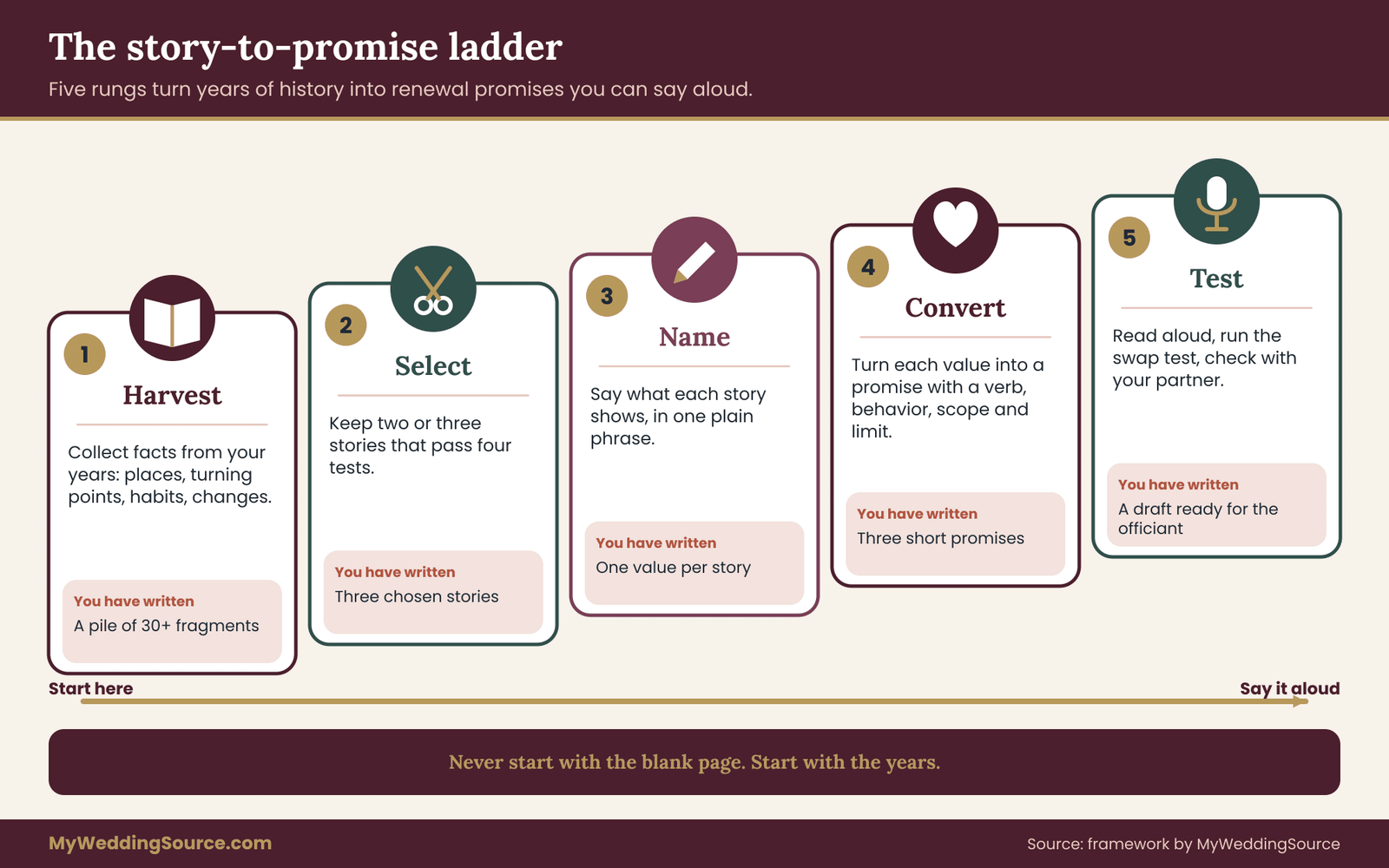
The method in this guide has five rungs. Each rung produces something you can write down, so you always know whether you have finished it. The names are plain on purpose. Each rung improves your renewal promises in a different way.
Rung one is harvest: gather raw material from your years together without judging it. Rung two is select: choose two or three stories using a short set of tests. Rung three is name: write the value that each chosen story shows. Rung four is convert: turn each value into a promise with a behavior and a boundary. Rung five is test: read it aloud, run the swap test, check it with your partner and your officiant, and trim.
You can do the whole process alone in a few evenings, or you can do it together. Many couples split the work: both people harvest separately, then compare and choose together, then each writes their own conversions. The next section describes how to decide which pattern suits you, and how to keep the surprise if you want one. Later sections take each rung in turn, then show a worked case, then cover alternatives and failure conditions.
Choosing how to draft: together, apart or in secret
There are three workable patterns, and each has a cost. Drafting together means you both know what will be said, so nothing surprises anyone, and you can balance length and tone. The cost is that you lose the moment of hearing something new. Drafting apart and reading each other’s vows only at the ceremony keeps the surprise, but it carries a real risk of mismatch: one partner reads two minutes of tender memory and the other reads thirty seconds of jokes.
Whichever you pick, agree on it before anyone starts writing renewal promises.
The middle path works for most couples. Draft apart, then exchange drafts two or three weeks before the ceremony, with an agreement that you will not rewrite in response to each other. You can still be surprised by phrasing and detail, because you did not know which stories your partner would choose. You just will not be surprised by length, tone or a topic that needs a quiet conversation first.
If one partner writes easily and the other freezes, agree in advance on a floor and a ceiling. A floor might be three renewal promises and one story. A ceiling might be ninety seconds. Those limits matter more than people expect, because unequal vows are often felt as unequal effort even when nobody intended it. Equal effort on renewal promises matters more than equal length.
When a secret draft is a bad idea
Keeping vows secret is romantic and sometimes right, but it is a poor choice if either of you is carrying unresolved tension, if the marriage has recently been through a rough period, or if one of you tends to say difficult things in public. A private exchange of drafts removes the risk without removing the meaning.
If you are renewing after a hard stretch, set the boundary explicitly. What may be named, what should stay private, and who gets to veto a line are all questions to settle before anyone writes a word.
Rung one: harvest the years before you write vow renewal promises
The most common drafting mistake is opening a blank page and trying to be eloquent. People who do that produce sentences about love in general. People who first collect material produce sentences about their own marriage. The harvest is a deliberate collection step, with a simple rule: write down facts, not feelings, and do not judge anything yet. Collecting first is the cheapest way to improve renewal promises.
Set aside an hour, preferably two short sessions rather than one long one. Use paper or a plain document. You are not writing vows. You are building a pile of raw material, and the quality of that pile decides the quality of the renewal promises.
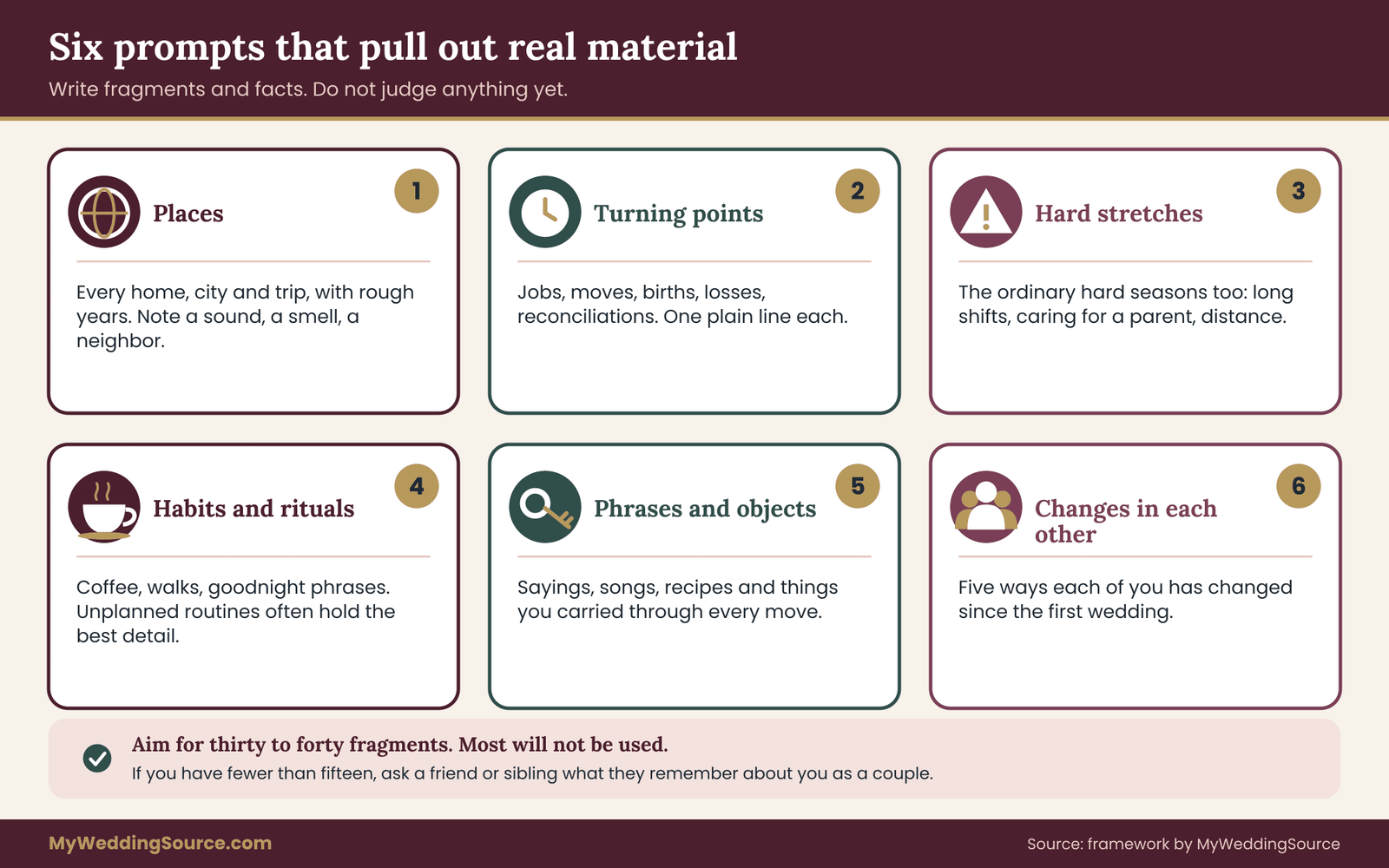
Six prompts that pull out real material
Work through these prompts in any order. Write quick fragments, not sentences.
Places. List every home, apartment, city and long trip you shared, with the rough years. Places are good anchors because they carry details: the sound of the radiator, the neighbor, the stairs, the commute.
Turning points. Jobs gained or lost, moves, births, deaths, illnesses, reconciliations, decisions that changed the course of your life together. Write each as a plain line with a date or season.
Hard stretches. Not the dramatic ones only. The ordinary hard stretches: a winter of long shifts, a year of caring for a parent, a period when you barely talked. You will not necessarily use these, but you need to know what they were.
Habits and rituals. What do you do every day or every week that nobody planned? Coffee order, walk route, the way one of you says goodnight. These are often the most specific and affecting material.
Phrases and objects. Sayings that belong to you, objects you have carried through moves, songs, dishes, recipes. Objects work well in vows because they give listeners something to picture.
Changes in each other. How has your partner changed since the first wedding? How have you? Write at least five changes for each person. This is the prompt that most often produces a surprise.
How to use a shared timeline without turning it into a biography
A year-by-year timeline helps jog memory, especially for couples who have been together for decades. Photographs, calendars, old emails and anniversary cards all help. Keep the timeline as a working tool. It is not meant to be read aloud. A common trap is trying to include every chapter, which produces a vow that sounds like an obituary delivered in advance.
If your memories disagree, note both versions. A disagreement about whether the roof leaked in the second or the third winter is irrelevant to the renewal promises. A disagreement about whether a hard stretch was shared or one-sided is not irrelevant, and it is a reason to talk before you draft.
Include the other people who carried the years
Children, parents, friends and neighbors appear in most long marriages. They are part of the harvest, and some of them may be in the room. Write down who helped, who was hurt, and who is gone. You do not have to put any of them in the renewal promises. You do need to know whether a line might land on someone sitting in the third row.
A reference to a late parent, an estranged sibling or a previous partner can be tender or painful depending on who hears it. Check with the people involved when a detail affects them.
If you plan to include a tribute to someone who has died, the wedding ceremony cue sheet guide shows how to place such a moment in the run of the ceremony so it has room to breathe and does not interrupt the renewal promises themselves.
Facts to verify before they go in a vow
Long memory is unreliable in small ways. Before you commit a date, a place name or a number to a vow, check it. Look at an old calendar, a photograph with a date, or a record. If the vow mentions how long you have been married or the date of the first ceremony, confirm it. The marriage record itself is held by the state or local office that recorded it.
The federal government’s USA.gov page on marriage certificates, listed in the sources at the end of this guide, explains how to find the right office. Most couples do not need a certified copy for a renewal. They simply want the date right.
How much material is enough
You want a pile that feels slightly too big. As a rough guide, thirty to forty fragments across the six prompts is more than enough. If you have fewer than fifteen, add another session and ask a friend or sibling what they remember about you as a couple.
Outsiders often recall details you have stopped noticing. If you have more than fifty, you are probably still in collection mode and have not accepted that most of it will not be used. That is normal. The next rung is about cutting.
Rung two: select the stories that carry the vow
Now you reduce the pile. The aim is two or three stories for each partner. One story is too thin for a vow of any length, and four or more will stretch a ninety-second reading into five minutes. Three is a good default: one from the early years, one from a hard or changing period, and one from the present.
Selection is where most of the quality is made. A vow with two excellent stories and an honest set of promises will outperform a vow with eight stories squeezed in. It also helps to remember that your partner is hearing this for the first time, in front of people, with their own emotions running. They can absorb a few images, not a catalog. Careful selection is the single biggest improvement you can make to renewal promises.
Four tests for a story worth keeping
Apply these tests to each fragment. A story does not need to pass all four, but the stories you keep should pass at least three.
The specificity test. Does it contain at least one concrete detail a listener could picture: a place, an object, a sound, a date? “You were there for me when things were hard” fails. “You drove four hours through the snow to pick me up from the airport that nobody was flying out of” passes.
The shows-not-tells test. Does it show a quality in action instead of naming the quality? “You are patient” is a label. A story about waiting an hour in a parking lot while the other person finished a phone call with a parent shows patience without the word.
The room test. Can everyone present hear it without discomfort? A story that embarrasses a guest, reveals a private health matter, or touches a family conflict fails this test unless the people involved have agreed.
The partner test. Will your partner be glad to hear this said aloud, or will they wince? Ask yourself honestly. If you are not sure, ask them in a general way, for example, “Is there a story you would never want told at the ceremony?” That question alone prevents most unpleasant surprises.
One early story, one turning story, one current story
A balanced vow usually draws one story from each stage. The early story reminds everyone, including you, who you were. The turning story is the one that shows the marriage being tested or changed, and it is where honesty matters most. The current story anchors the vow in the present, which keeps it from sounding like nostalgia.
You can break this pattern. A couple that married late may not have an early period to draw on. A couple that has been through a very difficult recent year may choose to focus on one turning story and one present one. What matters is that the stories are different from one another and that each one gives you a distinct value to work with in the next rung. Renewal promises built on unusual shapes still work when each story shows a different value.
What to do with the stories you cut
Do not delete the leftovers. Save them in a document called something like “not for the ceremony”. Some of them belong in a toast, a letter, a card, a slideshow caption, or a conversation over dinner a week after the event. Cutting is easier when you know the material has a home. It also keeps the vow from becoming a dumping ground for every good memory. Leftovers keep the renewal promises short without losing the memory.
A short example of the selecting step
Suppose a partner has a harvest list that includes a cross-country move, a bad winter, a long stretch of night shifts, a lost dog, a trip to the coast, a promotion, a parent’s funeral and a habit of leaving each other notes on the fridge. The notes on the fridge pass all four tests: they are specific, they show care in action, anyone can hear about them, and the partner would likely love it.
The move is a good turning story if it taught something about trust. The funeral, however thoughtfully handled, may fail the room test if the other partner’s family is in the audience and the grief is still fresh. The point is not that any item is right or wrong. The tests make the decision visible.
Rung three: name the value underneath each story
A story by itself is a memory. It becomes a vow when you can say what it shows about the way you want to live together. That statement is the value, and naming it is the quickest rung in the ladder and the one people most often skip. Without it, the conversion into a promise has nothing to hold on to, and you end up with a story followed by a generic promise that has no connection to it. Renewal promises without a named value tend to float.
The value should be a plain word or short phrase that you could defend. It is not a slogan. “Showing up” is a value. “Being each other’s rock” is a cliché dressed as a value. “Not needing to win” is a value. “Unconditional everything” is not. If you cannot explain the value in one sentence to a friend, it is too vague.
A method for finding the value
Take one chosen story and ask three questions in order. What did one of us do or choose in this story? What did it cost, or what could have gone differently? What did it make possible later? The answers usually point at a value. A story about driving through snow to reach an airport has a cost, which is hours and risk.
It made something possible, which is that the other person was not alone on a hard day. The value is something like reliability when it is inconvenient, or choosing presence over comfort.
You will often find that the same story contains two values. Pick one. The vow has room for a single clear idea per story, and a story forced to carry two will carry neither well.
Watch for the borrowed value
Some values sneak in from outside because they sound right at a ceremony. Honor, devotion and sacrifice are common examples. They are not bad words, but they are heavy, and they can pull a vow away from your voice. When a borrowed value appears, test it: can you point to a moment in your own history that shows it? If you cannot, replace it with something smaller that you can.
Values that are quiet but strong
Long marriages often rest on values that do not sound dramatic: letting the other person finish a sentence, apologizing first without keeping score, accepting that each of you needs a different amount of company. These quiet values make excellent material for vow renewal promises because they are specific, unglamorous and clearly true. They are also the values that guests who have been married a long time will nod at.
Letting the hard story show a hard value
If your turning story comes from a difficult period, the value will usually be less comfortable than the early story’s value. It might be forgiveness, or the willingness to be seen at your worst, or staying when leaving would have been easier. Name it honestly, and do not dress it in a more flattering word than it deserves. Your partner knows what happened. A flattering word that does not fit will sound like a gloss over it, and the vow will lose credibility at its most important point.
If the marriage has recently been through a serious strain and you are considering a renewal as a way of marking recovery, the right pace and boundaries depend on both of you. Decide together what the renewal promises may and may not refer to, and consider talking to a counselor or your officiant before the ceremony if the topic is raw.
Rung four: convert each value into one promise
Now comes the part most people picture when they think about vows: the promise itself. By this point you should have two or three stories and, for each, a value. The conversion rung turns each value into a single sentence that names what you will do. A vow built this way has a natural shape: story, value, promise. You can say all three or only the promise, but you must know all three while writing. Renewal promises at this stage should still be rough.
The conversion is easier if you use a fixed grammar. A strong promise in a vow has four parts: a present-tense verb, a named behavior, a scope, and a limit that makes it honest. You do not need to say every part out loud in every sentence. You do need to know them, because they distinguish a promise from a wish.
The anatomy of a promise you can keep
The verb. Use “I will” or “I promise to,” followed by an action verb. Avoid “I hope to,” “I will try to be,” and “I want to be,” which describe an aspiration. A promise is a decision.
The behavior. What exactly will you do? “Listen” is vague. “Put the phone down when you are telling me about your day” is a behavior. The test is whether your partner could observe whether you did it.
The scope. When and where does it apply? “Always” and “never” are tempting and nearly always wrong. “On the evenings we are both home” is a scope. So is “when we disagree” or “in the winters, when you get low.”
The limit. What are you not promising? A limit is what makes a promise believable. “I will tell you when I am angry, instead of going quiet for days, even when I do not yet know what to say” admits something real. The limit is not an escape hatch. It is the honest edge of the commitment.

Turning the example value into a promise
Take the value “choosing presence over comfort” from the airport story. A weak conversion is “I promise always to be there for you.” A strong conversion is “I will keep answering when you call, even on the days I would rather not, and I will tell you if I truly cannot.” The second version has a verb, a behavior, a scope and a limit.
It also reads like something one particular person might say. The first one reads like it came off a card. Renewal promises that follow this pattern read as personal.
Another example: the value “not needing to win,” drawn from a story about a long-running argument over directions. A weak version is “I promise to be less stubborn.” A strong version is “When we disagree about something small, I will say what I think once and then let it go, and I will not bring it up again next week.” That is observable, bounded and slightly funny, and it points back to the story.
Promises about yourself, not about your partner
A reliable guardrail: every promise should be about your own behavior. “I will never let you feel alone” is, in practice, a promise about your partner’s feelings, which you do not control. “I will check in with you on the days you are not talking” is a promise about your own behavior. The distinction matters because the first kind can be broken without anything you did or did not do, and the second kind cannot. Renewal promises about your own behavior are the only ones you can keep.
For the same reason, avoid promises that are secretly requests. “I promise to stop working so late if you promise to stop worrying” is a negotiation, and it belongs at the kitchen table.
How many renewal promises is enough
Three is a good default, one per story. Two is fine. Five or more starts to sound like a contract. If you find you have seven renewal promises, look for overlap. Often two of them are the same value in different clothes, and you can merge them. You can also treat one of them as the closing line and drop the others. Three renewal promises fit comfortably inside ninety seconds.
Some couples prefer a single sentence that holds everything. That is a valid choice, and it is the format most likely to be remembered. The condition is that it still passes the checks you will meet in the testing rung: specific, bounded, about your own behavior.
Words to treat with caution
Certain words signal that a sentence has drifted back toward stock language. “Always,” “never,” “forever,” “completely,” “everything” and “anything” are not banned, but each should have to earn its place. If you use “forever,” ask whether the sentence would work without it. Often it would, and often it would be stronger. If you want to keep it, it is usually better in a closing line than in the middle of a specific promise.
The same goes for borrowed poetry. Quoting a short line from a poem or song can be moving, but copyright applies to published works, and the U.S. Copyright Office explains how that works in general terms. For a vow, the safest move is to paraphrase in your own words or to quote only a brief line you are sure you may use, and to credit the source aloud. Your officiant can advise on printed programs, where reproducing longer passages is a separate question.
Tone: warm, plain and a little dry
A good test of tone is whether the sentence could be said at your own table without embarrassment. Warmth does not require poetry. A plain sentence said sincerely beats an ornate one said stiffly. Humor can help if it is the kind you actually use with each other, and if it is not at the other person’s expense. One light moment per vow is usually plenty. Plain renewal promises are rarely a mistake.
What to do when the values clash or run thin
Sometimes the method produces a problem instead of a draft. You may notice that all your stories show the same value. Or that the stories you like most make your partner look better than you look. Or that you cannot find a story from a stretch of years that you both remember as hard. These are not failures. They are useful information. Even a rough result teaches you something about your renewal promises.
If every story shows the same value, you have found the center of your marriage as you see it, and a vow built on one value can be strong. Use the three stories as three illustrations of one commitment, and write a single promise with three examples. If the stories flatter your partner more than you, add one that shows you changing or being corrected. A vow where only one person is the hero reads as praise, not as a mutual promise.
If you cannot find a story from a hard stretch, do not manufacture one. Use a story about an ordinary Tuesday. Ordinary days make up most of a long marriage, and a promise about how you will treat the ordinary days is perhaps the most honest one available.
A worked case: from harvest to finished vow renewal promises
The example below is invented. The names, places and events are made up to show the method in action, not to describe any real couple. Treat it as a demonstration of the steps, not as a model to imitate line for line. Your own stories will differ, and they should. The renewal promises that come out of it are invented too.
Meet Marguerite and Tobias, who plan to renew their renewal promises on their twenty-second anniversary at a small gathering of about forty people. Neither of them considers themselves a writer. Tobias worries that his vows will be too short. Marguerite worries hers will be too long. They agree to draft apart, exchange drafts three weeks before the date, and keep a ninety-second ceiling. They treat the renewal promises as a project with a deadline.
Step one: Tobias’s harvest
Tobias spends two evenings on the six prompts and ends with about thirty-five fragments. A sample, shortened here: the apartment over the dry cleaner that smelled of steam; the winter of the second job; the year Marguerite’s mother lived with them; the road trip when the transmission failed outside a town neither had heard of; a habit of Marguerite leaving the porch light on whenever he drove home late; her way of saying “well, that’s that” when something is settled; a long period in his forties when he barely spoke about work; the afternoon he finally did.
For the changes prompt he writes that Marguerite has become less afraid of being disliked, and that he has become less afraid of silence. He had not noticed either change before writing it down.
Step two: selecting three stories
Tobias applies the four tests. The apartment over the dry cleaner is specific and funny but does not show much beyond affection for a past home. The transmission story is specific and shows both of them being cheerful under pressure, but it is also the story everyone already tells at dinners, so it would add nothing. The porch light passes every test: concrete, shows care in action, comfortable for the room, and he suspects Marguerite will be moved.
The years when he did not talk about work show something hard and true. He checks with Marguerite in a general way, asking whether any period was off limits, and she says no, as long as he keeps it short. Selection decides the shape of the renewal promises more than any later edit.
He keeps three: the porch light as the present story, the silent years as the turning story, and the winter of the second job as the early one.
Step three: naming the values
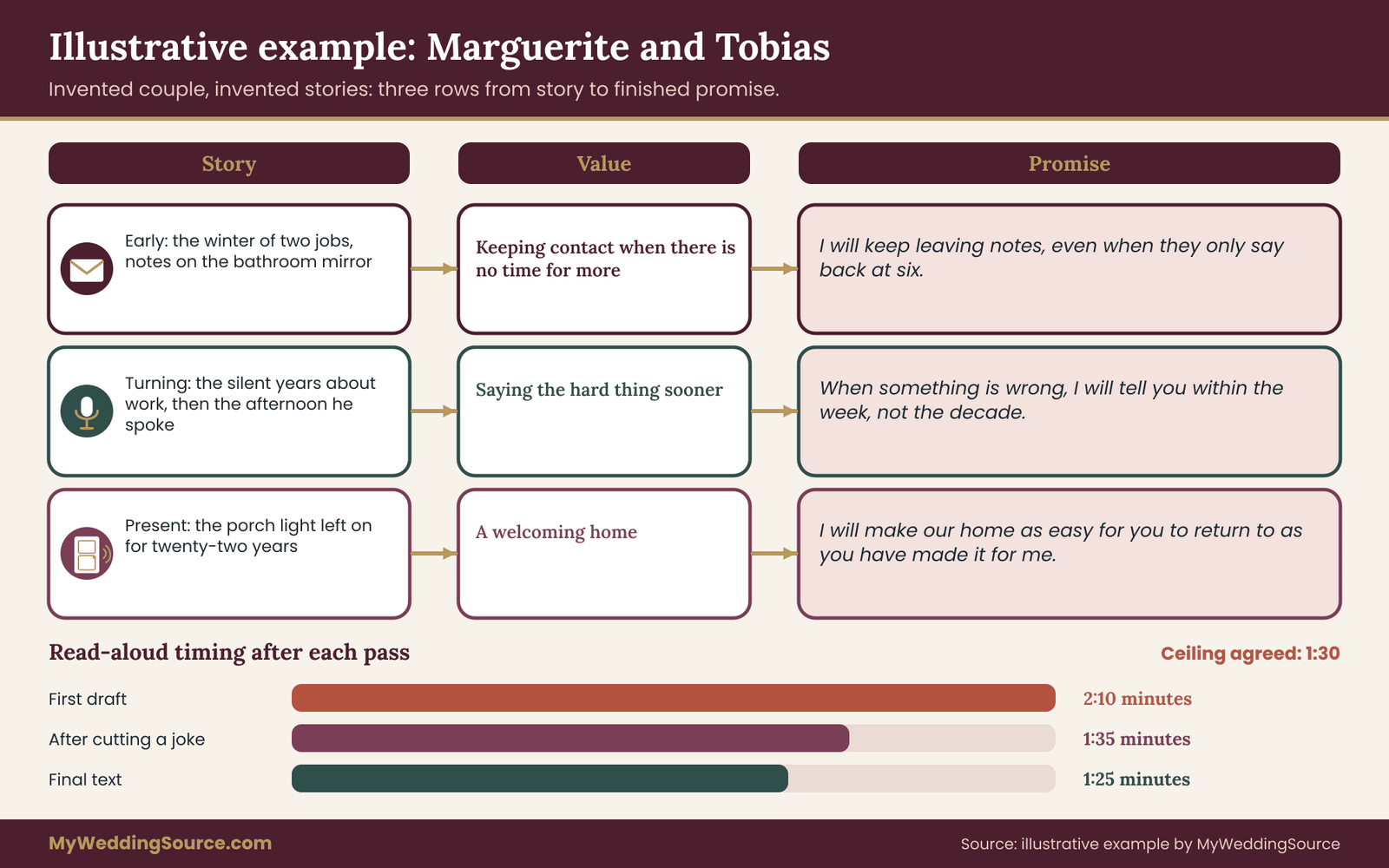
For the winter of the second job, he asks what each of them did, what it cost, and what it made possible. They both worked, rarely saw each other, and still left notes. It cost sleep and time. It made possible the fact that the marriage did not go cold. The value: keeping contact when there is no time for more.
For the silent years: he withheld, she waited, and later he spoke. It cost closeness for a long time. It made possible a better kind of honesty. The value: saying the hard thing sooner.
For the porch light: she keeps a small signal of welcome going without being asked. The value: making home easy to return to.
Step four: converting to promises
Using the verb, behavior, scope and limit grammar, Tobias writes three renewal promises. For the first: “I will keep leaving you notes, even when they only say ‘back at six,’ because a short note beats a long silence.” For the second: “When something is wrong at work, or anywhere, I will tell you within the week and not the decade.
I may not say it well. I will say it.” For the third: “I will make our home easy for you to come back to, the way you have made it for me, and I will remember to turn the light on without being asked.”
The second promise has a scope (within the week), a behavior (tell you), and a limit (may not say it well). It also contains a touch of dry humor that sounds like Tobias.
Step five: the first draft, read aloud
Tobias assembles the stories and promises into a draft. It begins with the winter of the second job in two sentences, moves to the silent years in three, and ends with the porch light. He reads it aloud with a timer and finds it runs two minutes ten seconds, forty seconds over the ceiling.
He cuts the road trip reference he had kept as a joke, shortens the silent years from three sentences to two, and combines two of the renewal promises. It now runs ninety-five seconds. He trims another sentence and lands at eighty-five.
What the finished draft looks like
Here is how the final text might read, invented as part of the example:
“The winter I worked two jobs, you left notes on the bathroom mirror. Most said ‘back at six.’ They kept us a marriage. So I will keep leaving them. And I will tell you what is wrong within the week, not the decade. You waited for me once. I do not want you to wait again. You have left a porch light on for twenty-two years. I will make our home as easy for you to come back to as you have made it for me.”
The text is short and plain, and it contains exactly three renewal promises. Each is tied to a story, each is about his own behavior, and each has a visible edge. A guest who did not know Tobias and Marguerite would still understand the marriage a little better after hearing it. Good renewal promises are often this modest.
Marguerite’s parallel path
Marguerite follows the same steps and ends with a different shape. Her harvest is long, and her first selection includes five stories. She cuts two on the room test, because they involve Tobias’s brother. She cuts a third because it repeats a value. She keeps a story about learning to drive on the day they moved, one about her mother’s year in their home, and one about a quiet morning two summers ago when neither of them said anything for an hour and both were content.
Her renewal promises come out longer in story and shorter in promise.
Her values are bravery with a witness, gratitude for being given room, and enjoying silence. Her promises include one about giving Tobias room in the way he has given her, with a limit: “I will say when I need company and when I need none, and I will not take your silences as a verdict.”
Running the swap test on both drafts
Their officiant, whom they have asked for a neutral read, runs the swap test on each draft: could this line be moved into another couple’s ceremony without anyone noticing? The porch light, the notes and the “within the week, not the decade” line all fail the swap, which means they pass the test. A line Marguerite had added as a closer, “I choose you again, today and every day,” passes the swap easily, because anyone could say it.
She keeps it, deliberately, at the end, where a familiar line gives the room permission to feel something. Her officiant’s advice is that a draft can carry one stock line if everything around it is specific.
What the example shows
The worked case illustrates several things. The harvest produces far more than you need. The selection tests remove some of the best-sounding material because it fails on room or repetition. The values are small and honest, not grand. The renewal promises name behaviors and limits. Reading aloud finds the length problem. And the final text, though simple, could not be mistaken for anyone else’s.
It also shows what the method does not do. It does not make Tobias a poet. It does not guarantee a perfect delivery. It removes the most common reasons that vow renewal promises sound generic, and it gives each partner something true to say.
Using the example without copying it
You should not borrow the specifics. A porch light belongs to Marguerite and Tobias. If you find yourself drawn to a line in the example, ask what it points to in your own marriage. The structure is what travels: a story from a hard stretch, a value that names what it showed, and a promise with a scope and a limit. Fill that structure with your own material, and the result will carry your marriage and not theirs. Your renewal promises will use your own props.
Alternatives when traditional vow renewal promises do not suit you
Not everyone wants to stand and read a paragraph. Some people freeze in front of an audience, some dislike formal language, and some couples simply feel that renewal calls for a different shape. The story-to-promise method works in all of these formats, because the underlying material is the same. What changes is how it is delivered. Renewal promises can be short, shared, written or answered.
Five formats and when each fits
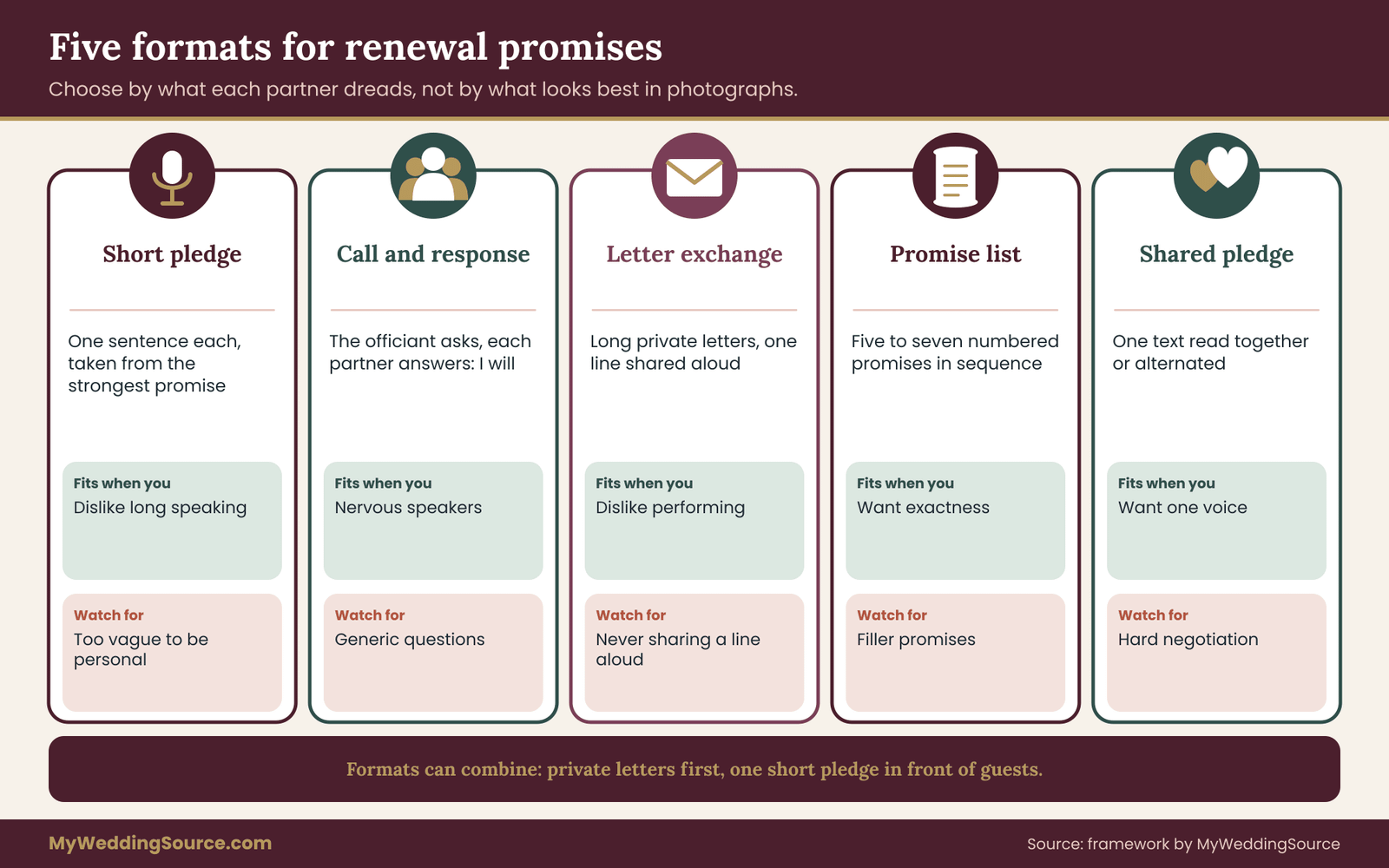
The short pledge. One sentence per partner, drawn from the strongest promise. It suits people who dislike public speaking, and it places the weight on the choice of words. The method still applies in full: you harvest, select and name values, then compress to one promise.
The call-and-response. The officiant reads a line and each partner answers “I will” or “I do.” This is the least demanding format on the speaker, and it works best when the lines are written from your own stories, not from the standard script. A line such as “Will you tell me the hard thing within the week?” carries far more meaning than a generic question.
The letter exchange. Each partner writes a letter, and they exchange them privately before the ceremony or read them aloud in a quiet moment. This suits couples who are uncomfortable performing and gives room for longer, more intimate material. The ceremony itself can then use only one line from each letter.
The promise list. A set of numbered renewal promises, perhaps five to seven, spoken in sequence. This is the format closest to a contract and suits couples who want to be exact. It needs the strictest editing, because a list tempts you to add filler.
The shared pledge. One text, read together or alternated, that belongs to both partners. It requires the most negotiation and is often the most coherent, because both stories and both values must fit under a single frame.
Choosing a format by temperament, not by trend
A useful way to choose is to ask what each partner dreads. If one dreads speaking at length, choose the short pledge or the call-and-response. If one dreads vulnerability in public, choose the letter exchange and keep the spoken part brief. If one dreads vagueness, choose the promise list. If you both want something unmistakably shared, choose the shared pledge.
A format that matches a fear tends to produce a calmer delivery than a format chosen because it looks good in photographs. Choose the format before you finalize the renewal promises, because format changes how long each line can be.
You can also combine. A common blend is a letter exchange before the ceremony, followed by a short spoken pledge in front of guests. The private material holds the long memories, and the public material holds the commitment. It also lets you save the best stories for the person who most needs to hear them. Renewal promises split between private and public are easy to balance.
Faith traditions and cultural customs
If your ceremony sits inside a religious or cultural tradition, some wording may be fixed or expected, and the customs differ between communities and congregations. Ask the officiant or the community leader early which parts are set and which parts are open for personal words.
Many traditions leave a place for personal renewal promises alongside the set liturgy. If one of you is from a different background than the other, the interfaith wedding ceremony planning guide explains how to decide whose customs lead in which part of the ceremony.
For couples who want a script outline to build on without religious language, the non-religious ceremony script shows where personal renewal promises typically sit. For couples within a Christian tradition, the Christian ceremony script shows the same placement within that structure. In both cases you are free to add personal vow renewal promises in the slot the script reserves for vows.
Languages other than English
If one of you speaks another language at home, consider saying a promise in that language, even if the rest is in English. A single sentence in a family language can be the most affecting moment of the ceremony. Ask someone fluent to check the wording, because phrases that translate literally can still sound wrong in the original. If guests will not understand it, have the officiant offer a brief paraphrase beforehand, or print it in the program.
When one partner would rather not speak
Occasionally one partner is firm that they do not want to say anything aloud. Respect that. The renewal can still be meaningful with the officiant reading a pledge both of you have written, or with a short exchange of written cards. A forced speech produces worse results than a quiet and chosen alternative, and the partner who prefers not to speak can still contribute fully in the drafting.
Accessibility and sensory needs
If either of you, or a guest, has a hearing difference, a speech difference, or a condition that makes long speaking difficult, plan the format with that in mind. Printed copies of the text, a signer, a short format, or a seated delivery all work. The ADA site run by the U.S. Department of Justice explains general accessibility expectations for public events and venues, and your venue can tell you what it offers. Build accessibility into the format from the start, not as an afterthought.
Failure conditions: when your vow renewal promises should go back to the drawing board
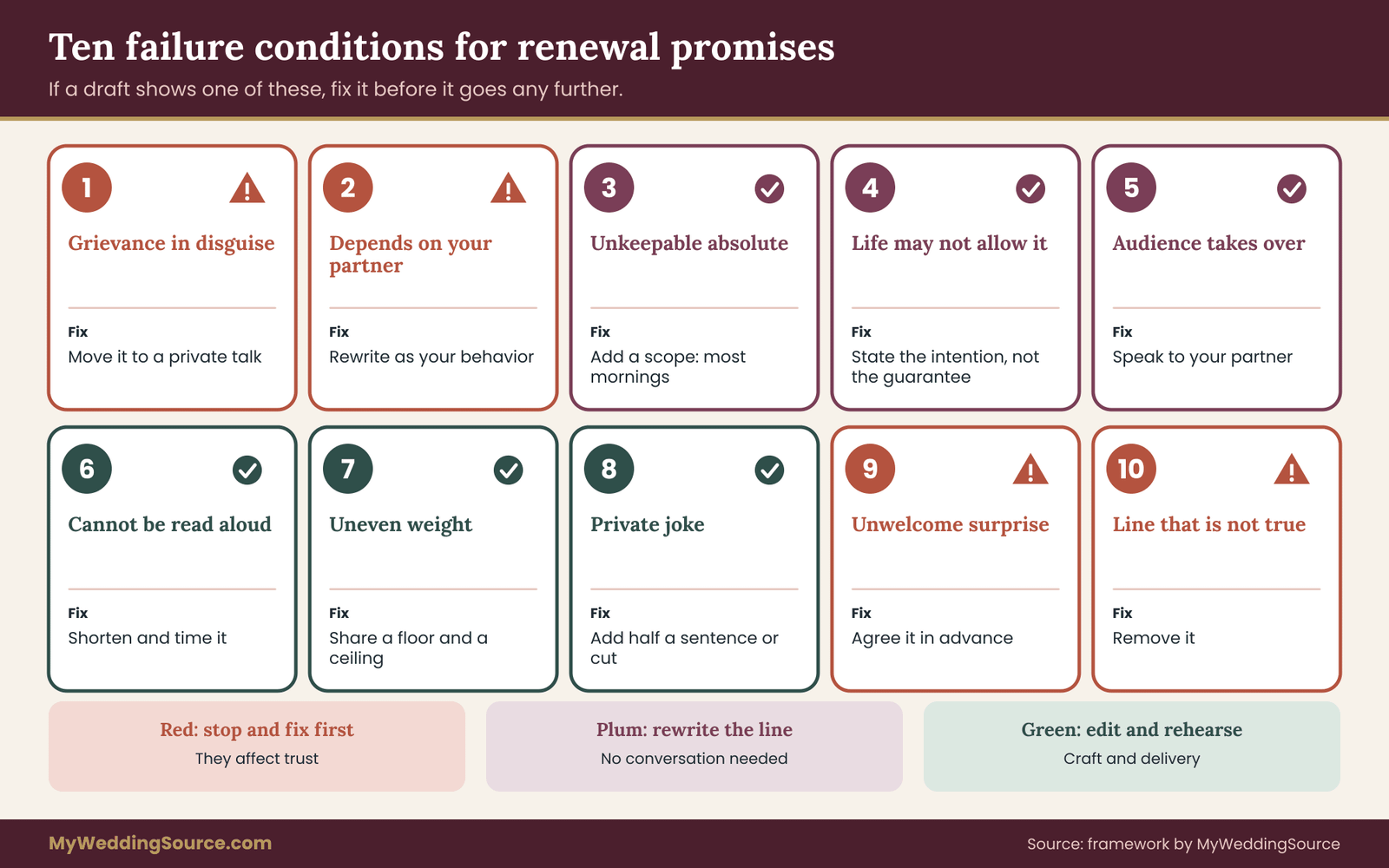
Part of writing well is knowing when to stop and rewrite. The conditions below are signals that a draft is not ready. Each one has a plain remedy. Use them as a checklist after you have a full draft, and again after any significant edit. Use the list below on any draft of your renewal promises.
Failure one: the grievance in disguise
A vow can carry a hidden complaint: “I promise to finally listen to you,” or “I promise to stop being so distant.” Said at a ceremony, these lines read as a public confession or, worse, as a message to the partner dressed as a promise. If a line would hurt to hear if it were about you, ask whether it needs to be said at all.
The remedy is to move the issue into a private conversation before the ceremony and replace the line with a positive, forward-looking version that does not blame the past.
Failure two: the promise that depends on the other person
“I will always be happy with you” and “I promise never to be angry” are not promises you can control. They hand your partner the responsibility for your feelings, and they can be broken by events you did not choose. The remedy is to rewrite each such line as a behavior you control: “When I am angry, I will say so plainly and stay in the room.”
Failure three: the unkeepable absolute
“Always,” “never” and “every day” appear in nearly every stock vow. In a long marriage they invite quiet disbelief. Ask whether you could keep the promise on your worst day, during an illness, or in a crisis. If not, soften it with a scope: “most mornings,” “on the days we can,” “when I notice.” Some couples find that the honest version is more moving than the absolute one.
Failure four: the promise your life may not allow
If your health, work or family circumstances make a commitment uncertain, do not promise it. A promise to travel every year, to retire at a certain age, or to care for a relative in a specific way may be a sincere intention, but it can become a source of guilt if circumstances change. State the intention without the guarantee: “I want us to keep traveling, and I will keep making room for it.”
Failure five: the audience takes over
Some drafts slowly turn into a speech for the guests, with references that please parents, thanks that cover everyone, and jokes aimed at the crowd. The vow is for your partner. If you notice that most of your sentences are addressed to the room, rewrite them in the second person, addressed to your partner. Thank the guests in a separate sentence at the end, or at the reception.
Failure six: the draft that cannot be read aloud
A text that looks good on paper may be hard to say. Long sentences, nested clauses and unusual words cause stumbles. If you run out of breath, or you cannot get through a line without rereading it, the line needs to be shorter. The remedy is a read-aloud pass with a timer, covered in the next section.
Failure seven: the mismatch in weight
If one partner’s vow is a three-minute emotional narrative and the other’s is a one-line pledge, one of you will feel exposed and the other will feel inadequate. This is a failure of coordination, not of ability. The remedy is the floor and ceiling you set at the start, and an exchange of drafts early enough to adjust.
Failure eight: the private joke that excludes the room
Humor that depends on knowledge only you share can leave guests feeling shut out. If a line needs an explanation, give it half a sentence. If it needs more than that, cut it or move it to a private card.
Failure nine: the surprise that is not welcome
If either of you has not agreed to a surprise element, such as a reference to a past hardship, a new announcement, or a public request, treat it as a failure condition. A renewal is a moment to be truly seen, and an unwelcome surprise defeats that. A planned and agreed surprise is a different matter. The principle is that the partner receiving it would say yes if asked in advance.
Failure ten: the line that is not true
This one is the simplest and the most important. If you do not mean a sentence, remove it. A long marriage gives you a good ear for sincerity, and so do your guests. A sentence added because it sounds right at ceremonies will be heard as exactly that. Fewer lines, each one honest, will always serve you better than more lines that sound polished.
A quick severity guide
Not every failure is equal. Failures one, two, nine and ten should stop you from going further until you have fixed them, because they affect trust. Failures three, four and five usually need a rewrite but not a conversation. Failures six, seven and eight are about craft and delivery, and they respond well to editing and rehearsal.
If you find several failures in one draft, take that as a sign to go back one rung, usually to selection, and choose different stories. Serious failures in renewal promises affect trust, so fix them first.
Rung five: test, trim and rehearse your vow renewal promises
By now you have a full draft built from stories, values and promises. The last rung is quality control. Most of what makes spoken words work happens here, and it takes less time than the drafting. Plan for three short passes spread over a week or two, not one long editing session the night before. This is where renewal promises become speakable.
Pass one: read it aloud with a timer
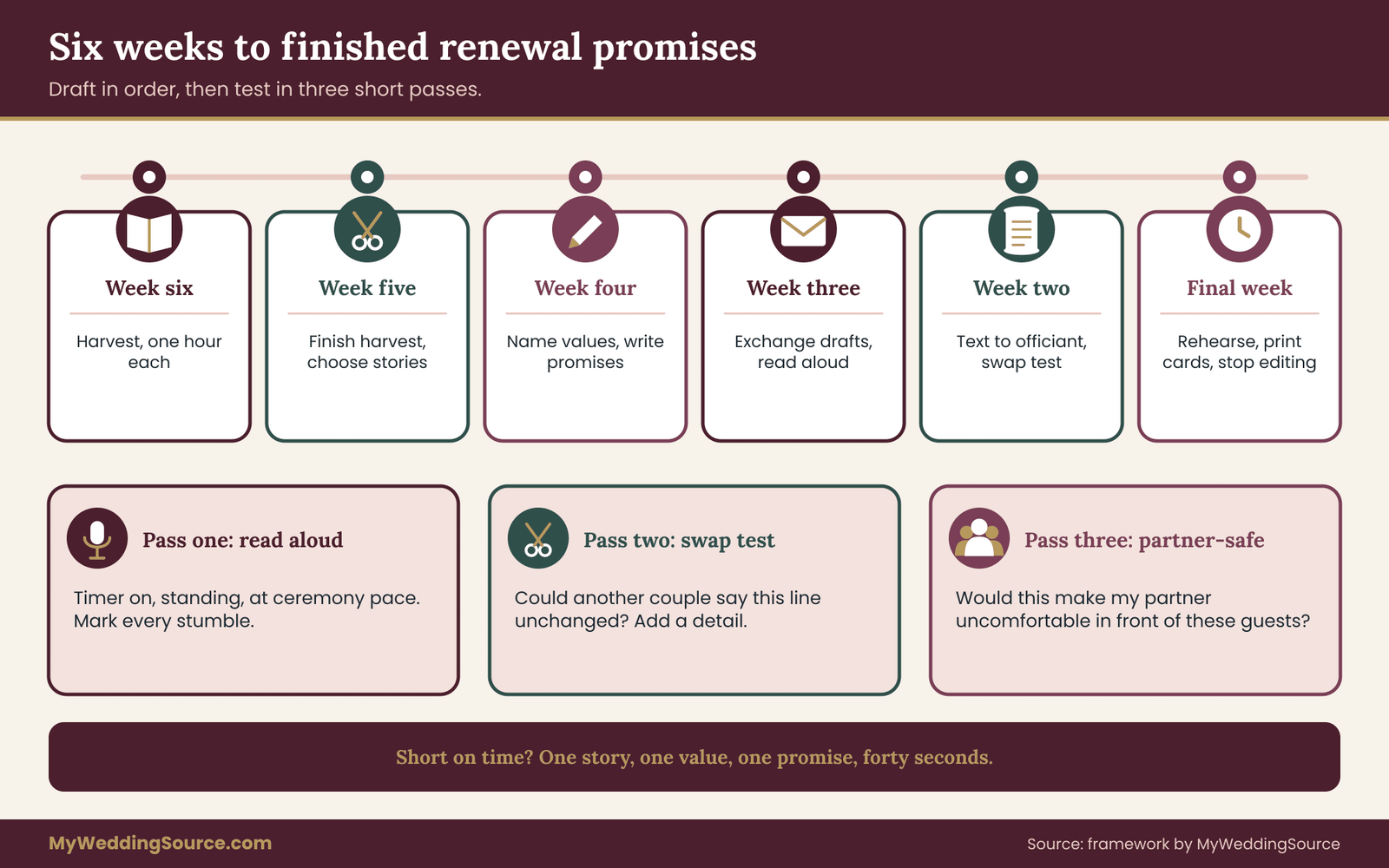
Read the draft out loud at the pace you would use in front of guests, which is usually slower than ordinary talking. Time it. Mark every place where you stumble, run out of breath or feel embarrassed. A line that makes you wince in an empty room will be worse in a full one. Cut or rewrite those lines first.
Do not rely on reading silently. Silent reading hides rhythm problems. Reading aloud also shows you how long each section takes, which matters if your officiant has given you a time slot. If the ceremony has other segments, such as readings, music or a family moment, your portion needs to fit inside them. A cue sheet for the whole ceremony, like the one described in the ceremony cue sheet guide, is the tool for that.
Pass two: the swap test
Go through the draft line by line and ask of each sentence: could another couple say this without changing a word? Mark every sentence that passes the swap, meaning every sentence that is transferable. A few transferable sentences are fine, and one closing line often works well. If most of the draft is transferable, you have drifted back to stock language and need to return to your stories. Run it on every sentence of your renewal promises, not only the ones you doubt.
The swap test has a counterpart: the stranger test. Imagine a person who has never met you hearing the draft. Would they learn something concrete about the marriage? If they would learn only that you love each other, add a detail. If they would learn too much about something private, remove it.
Pass three: the partner-safe check
This is a short and honest question: is there anything in the draft that would make my partner uncomfortable in front of these particular people? Think about their parents, their colleagues, their old friends. Think about any hard period they would rather not hear named. If you are unsure, ask in a general way: “Is there anything you would prefer I not mention?” You do not have to reveal your draft to get a useful answer.
If you have agreed to exchange drafts, this pass becomes mutual. Read your partner’s draft with one question in mind: does anything here make me worry? Raise concerns kindly, offer an alternative, and leave the final choice of words to the author wherever it is not a matter of someone else’s privacy.
Trimming without losing the point
Editing a vow is mostly removal. Start by cutting any sentence that repeats an idea, then any sentence that explains a feeling you have already shown, then any adjective that does not add information. Next, shorten sentences that carry more than one idea. Finally, check that the renewal promises remain intact. It is easy to cut the thing that matters most in the name of rhythm, so protect each promise and cut around it.
Memorizing, cards and delivery
There is no rule that you must memorize. Reading from a card is common, entirely acceptable and often better than a half-remembered recitation. Use a card or a small folded sheet with large type, and put each promise on its own line so you can find your place after looking up. If you are nervous, practice looking up at your partner after each promise, not after each sentence. Renewal promises read from a card are still your own.
Practice standing, with the same posture you will have on the day. If you will be using a microphone, practice with one, or at least ask the venue about it. Soft voices carry badly in open spaces. If your partner has trouble hearing, speak slightly slower and face them squarely.
A good rehearsal habit is to say the vow to one person you trust, such as a friend or sibling, and ask only one question: which line stayed with you? Do not ask whether it was good, because most people will say yes. The line that stayed with them is the one to protect.
What to do about tears and stumbles
Emotion is normal and welcome. If you cry, pause, breathe and continue. Guests will wait. Write a small cue in the margin, such as “breathe,” at the spot where you expect to be moved. If you lose your place, the card is your friend. Stumbles in a sincere vow are forgiven almost instantly. What is not forgiven, in the sense that it stays in memory, is a vow that sounds like it was recited without being meant.
Working with your officiant, your guests and your keepsakes
Once the draft is ready, a few practical steps determine whether the day goes smoothly. They are less glamorous than the writing, but a good draft delivered badly is a loss, and the steps are simple. Delivery logistics are part of finishing renewal promises.
Sharing the final text with your officiant
Give your officiant the final text at least two weeks before the ceremony. They can check length, flag anything that might clash with the venue or tradition, and plan the handoffs between your words and theirs. If you are using call-and-response, the officiant needs the exact lines. If you are reading, they need to know when to cue you and how to handle a pause. Officiants who see renewal promises early can fix problems quietly.
If you do not yet have an officiant, or you are unsure whether your officiant needs any particular credentials for a renewal, start with the officiant requirements guide, which explains how officiant rules work for weddings. A renewal does not create a new legal marriage, so the rules that apply to a legal wedding generally do not apply in the same way, but your venue, your congregation or your community may have its own expectations. Ask early and get the answer in writing if it affects a booking.
The legal point, stated plainly
A renewal ceremony celebrates an existing marriage. It does not replace the marriage license or the marriage record, and it does not change your legal status. If you need a copy of your marriage record for any reason, such as to confirm the original date or to make a keepsake, the issuing office is the place to ask, and the federal USA.gov page on marriage certificates, listed in the sources, points the way.
Nothing you say in a renewal creates a legal obligation, which is one reason you can promise things freely and specifically.
Printed vows, programs and guest copies
Some couples print their renewal promises in the program. Think before you do. Printed text invites guests to read ahead, which can drain the moment of surprise. It also commits you to the final wording earlier than you may want. A compromise is to print a short line, such as the closing promise, and keep the rest spoken. If you quote a poem or song lyric in print, check the source and permissions, because copyright applies to printed reproduction.
If a guest relies on reading support, offer a large-print or digital copy on request. This is a small courtesy that makes a meaningful difference to a guest with a hearing or processing difference, and it does not need to be announced to everyone.
Children, grandchildren and other participants
If your children are part of the renewal, decide whether they speak, hold something, or simply sit in the front row. Do not write renewal promises that assign them emotional duties, such as “we promise our children will always see us happy.” The vow is between the two of you. If you want to acknowledge the children, do it in a sentence of thanks or in a separate moment, and let them take part only if they want to.
Recording and keeping the words
Your vow renewal promises deserve a record, both because you may forget the wording and because it is pleasant to hear them again in ten years. Ask a guest or the photographer to record audio or video of the renewal promises, and check the venue’s and the officiant’s policy on recording during the ceremony.
Keep a clean copy of the written text, signed and dated if you like, with your other keepsakes. If you want to keep the written vows alongside contracts, certificates and photos, the wedding records guide explains how to sort and store them.
A six-week drafting calendar
A simple timeline keeps the process calm. Six weeks out, start the harvest, one hour per partner. Five weeks out, finish the harvest and choose stories. Four weeks out, name the values and write renewal promises. Three weeks out, exchange drafts if you agreed to, and read aloud with a timer. Two weeks out, give the final text to the officiant and run the swap test.
One week out, rehearse once or twice, print cards, and stop editing. The final week is for rest, not rewriting. If you have only two or three weeks in total, compress the schedule but keep the order: harvest, select, name, convert, test. Renewal promises drafted over six weeks improve with each pass.
If the ceremony is soon and you have not started
Sometimes a renewal is planned quickly, around a milestone or a reunion. A compressed version still works. In one evening, spend thirty minutes on a harvest limited to three prompts: places, turning points and habits. Choose one story. Name the value. Write one promise with a behavior and a limit. Read it aloud and cut it to forty seconds. A single honest promise tied to one true story is stronger than five that were rushed. Short renewal promises can be just as sincere as long ones.
Your next steps
Keep the plan small and sequential. You do not need all of it done this week. Renewal promises written in stages feel less like homework.
- Choose how you will draft: together, apart with an early exchange, or in secret. Agree a floor and a ceiling for length.
- Spend one hour on the six harvest prompts. Write fragments, not sentences, and aim for thirty or more.
- Pick two or three stories using the four tests, and save what you cut in a separate file.
- Name one plain value for each chosen story, then write one promise for each with a verb, a behavior, a scope and a limit.
- Run the failure checklist, read the draft aloud with a timer, and run the swap test.
- Share the final text with your officiant and your partner, rehearse twice, and put the written copy in a safe place.
If you get stuck at any step, go back one rung. Most stuck drafts are really selection problems: the stories are wrong, not the wording.
FAQ
How long should vow renewal promises be?
Aim for sixty to ninety seconds spoken, which is roughly one hundred fifty to two hundred twenty words at a calm pace. Longer is possible if your officiant has room in the schedule, but shorter usually lands better. Agree a ceiling with your partner so the two of you are balanced, and time yourself reading aloud before you finalize anything.
Should we write our renewal promises together or separately?
Either works, and the middle path suits most couples: draft separately, then swap drafts a few weeks before the ceremony without rewriting in response. That keeps some surprise while avoiding mismatches in length and tone. If the marriage has been through recent strain, write together or share early so that no line lands as a shock in public.
Can we reuse our original wedding vows?
You can, and some couples say the same words again, which has its own meaning. If you do, consider adding one new promise that reflects what you know now, and one sentence about what the old words mean to you today. Check the original text for wording that no longer fits, such as promises you could not keep or lines that assumed a different life.
What if my partner and I disagree about including a hard period?
Treat it as a private conversation first and a ceremony question second. Agree on what may be named, what should stay unspoken, and who has the final say over a line that concerns both of you. If the topic is raw, consider talking with a counselor or your officiant. A renewal does not need to mention every difficulty to be honest.
Do renewal promises have any legal effect?
No. A renewal ceremony celebrates an existing marriage and does not replace or change the marriage license, the marriage record or your legal status. Nothing said in the ceremony creates a new legal obligation. If you need to confirm the original marriage date or obtain a copy of the record, contact the office that recorded it. Venue and faith traditions may have their own expectations, so ask them directly.
Is it acceptable to quote a poem or song lyric?
A short quotation, credited aloud, is common and usually fine in speech. Printed reproduction, longer passages and recordings raise copyright questions, and the rules depend on the work. The safest approach is to paraphrase in your own words or quote a single brief line you are sure about. Ask your officiant if the text will appear in a program or a video.
How do we avoid cliches without sounding odd?
Replace each general phrase with a specific one from your own history. Use the swap test: if any couple could say the line, add a detail or remove it. You can keep one familiar line, usually at the end, because it gives the room a moment to feel something. Plain, concrete sentences read as sincere. Ornate ones tend to read as borrowed.
What if one of us does not want to speak in public?
Choose a format that fits: a short pledge, a call-and-response with the officiant, a letter exchange, or a written card passed privately. The quieter partner can still contribute fully to the harvest and the renewal promises. A chosen alternative is always better than a forced speech, and guests respond to sincerity, not length or polish.
Sources
- USA.gov: Get a copy of a marriage certificate – how to find the office that holds a marriage record, for confirming the original date.
- USA.gov – the federal government’s general information portal for state and local government services.
- U.S. Copyright Office – general guidance on how copyright applies to quoting poems, lyrics and other published works.
- Library of Congress – background on preserving personal papers, letters and recordings as keepsakes.
- National Archives – guidance on caring for and storing personal records and documents.
- ADA.gov – the U.S. Department of Justice’s information on accessibility for public events and venues.
- National Institute on Aging – information on memory and aging, useful when recalling decades of shared history.
- SAMHSA – federal resources for finding counseling and support if a marriage has been under strain.
- National Institutes of Health – the federal health research agency, a starting point for reliable health information.