
A pronunciation sheet is a one-page document, paired with a few short audio clips, that tells your wedding DJ how every name and non-English phrase in your announcements should sound. This guide shows how to build the pronunciation sheet, the cue sheet that goes with it, and the rehearsal that proves both of them work before the night.
Do not say “just read the names off the program.” Build a pronunciation sheet with one entry per spoken name: the spelling as printed, a respelling in plain letters, the stressed syllable, the language, who it belongs to, and a recording made by someone who says the name correctly. Then build an announcement cue sheet that lists each spoken moment, its trigger, its speaker, its language order and its fallback. Send both two weeks out, run the names aloud at the sound check, and name one person who can fix a mistake in the room.
Most couples who invite guests from two language communities worry about the music. The announcements are what actually go wrong. A DJ who plays a song badly gets a shrug. A DJ who says a grandmother’s name wrongly, in front of two hundred people, gets a silence that everyone in the family remembers.
The fix is rarely a better DJ. It is usually a better handoff. DJs read names off whatever they are given, and what they are given is often a seating list or a program with no sound information at all. A pronunciation sheet closes that gap in about two hours of work, spread over a few evenings.
This guide is narrow on purpose. It covers the document, the audio, the cue sheet, the rehearsal and the failure plan for spoken announcements. It does not cover choosing a DJ, building playlists or handling song requests; for the whole music plan, the reception music planning guide is the place to start. Spoken announcements are one slice of that plan, and they are the slice where one wrong syllable is noticed.
A note on scope. This is general planning information, not legal advice, and it is not a substitute for a professional translator or interpreter where the exact wording of a ceremony or a legal text matters. Where a rule applies, the article points to the agency or organization that publishes it.
What a pronunciation sheet does that a guest list cannot
A guest list answers the question “who is coming.” A seating chart answers “where do they sit.” Neither tells a person holding a microphone how to say the name on the line. A pronunciation sheet answers a third question: “what comes out of my mouth when I read this?”
That sounds small. It is not, because names are the one kind of word where a reader cannot reason their way to the answer. A DJ can guess that “reception” is said with a hard c. They cannot guess whether “Nguyen” is said as one syllable or two, whether the “j” in “Jorge” is an English j or a throat sound, or where the stress falls in “Okonkwo.” Spelling gives no reliable clue, and the same spelling can be said differently by different families.
So the pronunciation sheet does three things. It removes guessing, because each entry tells the reader what to say. It records authority, because the family said it this way and that is the version that counts. And it creates a shared reference, so a second announcer, a backup DJ or an emcee cousin says the same sounds as the first.
Think of the pronunciation sheet as the sound version of an address on an envelope. The invitation etiquette guide explains how names are written for print. The pronunciation sheet is the matching document for the ear, and it should agree with the print in every spelling and every title.
What belongs on it, and what does not
A pronunciation sheet is for words the DJ will actually say aloud. That includes the couple’s names, the names of parents, grandparents and honored guests who will be introduced, the wedding party, anyone giving a toast, the names of dishes or dances if they are announced, and any phrase in a second language that the script contains, such as a welcome line or a blessing.
It does not include every guest. A list of two hundred names with respellings is a document no one reads at a sound table in the dark. A good rule is that a name earns a line only if it will be spoken into the microphone. Table numbers and seat cards are not announced, so the guests at them stay off the pronunciation sheet.
There is one more category worth adding: names the DJ will be tempted to shorten. A guest known to everyone as “Bobby” may be introduced as “Roberto” in the formal order. The pronunciation sheet should state which form is spoken. That one line prevents a surprised look from the person being introduced.
Who ends up using it
The obvious reader is the DJ. In practice at least four people may touch the pronunciation sheet. The DJ or announcer reads it. A venue coordinator may use it if the venue runs the room microphone. A family member who is asked to give a welcome in one language checks the spelling of the other side’s names. And a backup person, perhaps a friend with a phone, needs it if the DJ’s voice is not the right one for a certain line.
Designing for four readers pushes the pronunciation sheet toward plain letters, large type and a layout that works by dim light. It also pushes you to put the recordings somewhere that a phone can play them without logging in to anything.
Deciding which names and phrases go into the pronunciation sheet
Before you write a single respelling, build the announcement inventory. This is a plain list of every moment when someone will speak into a microphone and every name or foreign phrase inside it. The inventory decides how long the pronunciation sheet is.
Walk the evening in order. Which moments are announced? A typical reception has some or all of these: a welcome from the room microphone, a parent introduction, the introduction of the wedding party, the entrance of the couple, a blessing or grace, toast introductions, a cake or dessert announcement, a first dance cue, a dance for a cultural tradition, a last-song call and a send-off or transportation notice. Not every reception has every one, and a small dinner may have only two.
For each moment, write down who speaks, how many names are in it and whether any phrase in a second language is spoken. A welcome in two languages with five family names has more risk than a cake announcement with none. The inventory shows you where to spend the effort.
Three tiers of risk
Names fall into three groups, and the pronunciation sheet should treat them differently.
Tier one is names the DJ will almost certainly say right without help: short, common, phonetic in English. Mark them “standard” and move on. Tier two is names that are probably fine but have a known trap, such as a silent letter, a stress shift or a spelling that suggests a different sound. These get a respelling. Tier three is names the DJ cannot be expected to say without hearing them. These get a respelling and an audio clip.
Sorting this way keeps the pronunciation sheet short. A reception with forty spoken names might have twenty-five in tier one, ten in tier two and five in tier three. The five hard names are where the audio recordings earn their keep, and the other thirty-five stay on the page as a quick reference.
The couple will not always know which tier a name falls in. A good test is to ask a friend who does not know the families to read the list aloud, cold. Every name they hesitate on moves up a tier. This takes five minutes and costs no one anything.
Phrases are different from names
Second-language phrases, such as a welcome or a short blessing, need more than a respelling. A name is a fixed label. A phrase has rhythm, a pitch pattern in some languages and word boundaries that respelling handles poorly. For anything longer than a few words, the safer choice is for a speaker of the language to say it, live or by recording, rather than for the DJ to read a phonetic approximation.
If a DJ must read a phrase, give them the shortest version that does the job, the exact text in the original script, a respelling, and a recording. Then rehearse it. An approximation that is said confidently and slowly is generally received kindly. An approximation said fast and with a sideways glance is not.
A word on machine tools. Automatic translation and text-to-speech can produce a quick draft of a phrase or a respelling, but they are not an authority on how a family says its own name, and they do not replace a human speaker for ceremonial wording. Use them, if at all, to generate a starting point that a native speaker then corrects.
How to write each entry on a pronunciation sheet
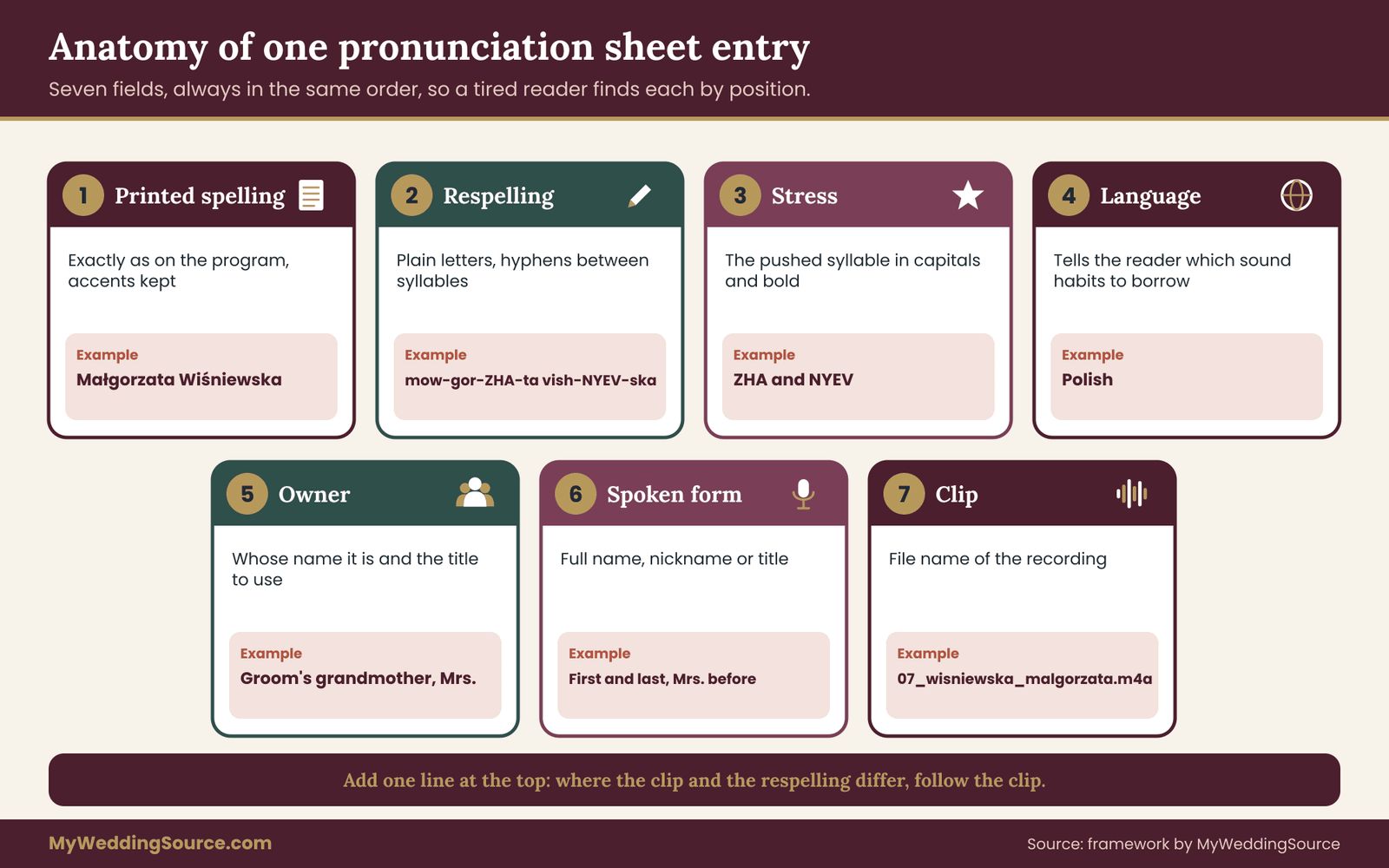
Every entry on the pronunciation sheet has the same seven fields, in the same order, so a tired reader finds each one by position instead of by searching. The fields are the printed spelling, the respelling, the stress, the language, the owner, the spoken form and the clip.
The printed spelling is the name exactly as it appears on the program and the place cards, with diacritics and capitals intact. This matters for two reasons. The DJ’s software and printouts may strip accents, so you want the original visible somewhere. And a mismatch between the pronunciation sheet and the program is how errors multiply, because one document says “Zoë” and the other says “Zoe.”
The respelling is the name written in plain English letters, split into syllables with hyphens. The stress is the syllable that gets the push, written in capital letters inside the respelling. The language field names the language the name comes from, so the reader knows which set of sound habits to borrow. The owner field says whose name it is and how they relate to the couple, so the reader introduces them correctly. The spoken form says whether to use the full name, a nickname or a title. The clip is the file name of the recording.
One worked entry, built field by field
Consider an invented name, used only to show the method: a grandmother called Mrs. Małgorzata Wiśniewska. On a guest list it reads like a typing accident. The pronunciation sheet would carry:
- Printed spelling: Małgorzata Wiśniewska
- Respelling: mow-gor-ZHA-ta vish-NYEV-ska
- Language: Polish
- Owner: the groom’s grandmother, introduced at the parent and grandparent welcome
- Spoken form: first and last name, with “Mrs.” before the surname
- Clip: 07_wisniewska_malgorzata.m4a
The respelling is an English-reader approximation, and it should say so. The pronunciation sheet can carry one line at the top: “Respellings are approximations. Where the recording and the respelling differ, follow the recording.” That sentence protects everyone. The DJ is told that the clip outranks the letters, and the family is told that nobody expects perfection from a respelling.
Keep one authority per name
Every name needs exactly one person who decides how it is said. For a grandmother’s name, that is usually the grandmother or her child. For a guest’s name, it is the guest. For the couple’s own names, it is each of them. If two relatives disagree, which does happen, the owner of the name decides, and the pronunciation sheet records the owner’s version.
This sounds bureaucratic and is not. The most common source of a wrong announcement is not a DJ error. It is a family member who gave the DJ a different version from the one the grandmother uses. Naming one authority per name ends that.
When you ask for the pronunciation, ask the owner directly or through one trusted relative, and ask the question in a way that gets a useful answer. “How do you say your name?” produces a spoken answer you can record. “Is it pronounced like this?” produces a polite yes. The first question gets the truth. The second gets agreement.
Respelling rules a reader can follow without training
A respelling system only works if the reader can use it at speed, in poor light, with a microphone in one hand. That rules out the International Phonetic Alphabet for most readers. The IPA is precise and widely used by linguists, and the International Phonetic Association publishes the chart, but a symbol like ʒ means nothing to someone who has not studied it. A reception sound table is the wrong place to teach it.
Instead, use a small set of plain rules that every entry follows.
Write sounds with common English letter groups the reader already knows: “ay” for the vowel in “day,” “ee” for the vowel in “see,” “oh” for the vowel in “go,” “oo” for the vowel in “boot,” “ah” for the vowel in “father.” Avoid letters that can be read two ways. A bare “a” is ambiguous. “Ah” and “ay” are not.
Separate syllables with hyphens. Write the stressed syllable in capitals. Keep each syllable short enough to read at a glance, three or four letters where possible. If a sound has no English equivalent, pick the closest and add a note rather than inventing a symbol. A short note such as “soft, between zh and sh” helps more than an extra character.
Sounds that need a note, not a symbol
Some sounds are common in names and awkward in English letters. A rolled r, a nasal vowel, a click, a tone, a glottal stop and a long versus short vowel are all examples. A respelling cannot carry them. A note can say “roll lightly,” “nasal, do not pronounce the n,” “tone is falling,” or “hold this vowel twice as long.” Notes are short and sit in the same line as the entry. Their job is to tell the reader that the sound is real and that the clip will show it.
For tonal languages in particular, the respelling is the weakest part of the entry, because the tone is part of the word and cannot be shown in plain letters. Here the clip does nearly all of the work, and the respelling is only a reminder of the syllable count.
Test the respelling on a stranger
A respelling is finished only when someone who has never heard the name can read it aloud and the owner says “yes, that is close.” The test is simple. Hand the pronunciation sheet to a friend who does not know the family. Have them read three entries aloud. Play the owner’s recording. If the friend’s version is recognizably the same, the respelling works. If not, adjust the syllable breaks or the stress.
Run this test on the hard names only. It will take about ten minutes and will change one or two respellings. That is the point.
Recording the audio: who, how and what to name the file
The audio clips are the part of the pronunciation sheet that no document can replace. A respelling tells the reader what to aim for. A recording shows what the aim sounds like. For tier-three names and for any second-language phrase, record.
The recording does not need to be professional. A phone voice memo in a quiet room is enough. What matters is that the speaker is the right person, the name is said clearly and at normal speed, and the file is easy to find.
Who records
The best speaker is the owner of the name. Failing that, a close family member who says it the way the owner does. Avoid recording a name from a person who is only guessing, even if they are fluent in the language, because fluent speakers may say a family name in a regional or family-specific way. If a guest is shy about recording, a relative can record it with the guest present and nodding. The nod is the approval.
Do not use text-to-speech output as the recording of a person’s name. It is acceptable as a way to hear what a standard reading of a word sounds like, but it is not the family’s version, and a DJ who copies a synthetic voice may sound more wrong than one who reads the letters.
How to record
Ask the speaker to say each name three times: once slowly, once at normal pace, and once in the sentence it will be used in, such as “Please welcome Mrs. Wiśniewska.” Three takes give the DJ a slow model for learning and a natural model for matching rhythm. Record in a quiet room, with the phone close but not touching the mouth, and avoid recording near fans, air conditioners or open windows.
Record each name as its own file. A single long file of twenty names forces the DJ to hunt for a name by scrubbing through audio at a sound table, which is the situation the pronunciation sheet exists to avoid.
Naming and storing the files
Name files so they sort in the order of the evening and carry the surname in plain letters. A pattern such as order number, surname, first name, with no accents or spaces, works on every device. The Library of Congress publishes personal digital archiving guidance that recommends consistent, descriptive file names and more than one copy of important files, and that advice fits here.
Store the clips in two places: a shared folder the DJ can open without an account, and a copy on the DJ’s own device or a USB drive handed over before the event. A link that needs a login is a link that fails at the venue. Check that the clips play on a phone with the volume down and a single earbud, which is how many DJs will cue a name.
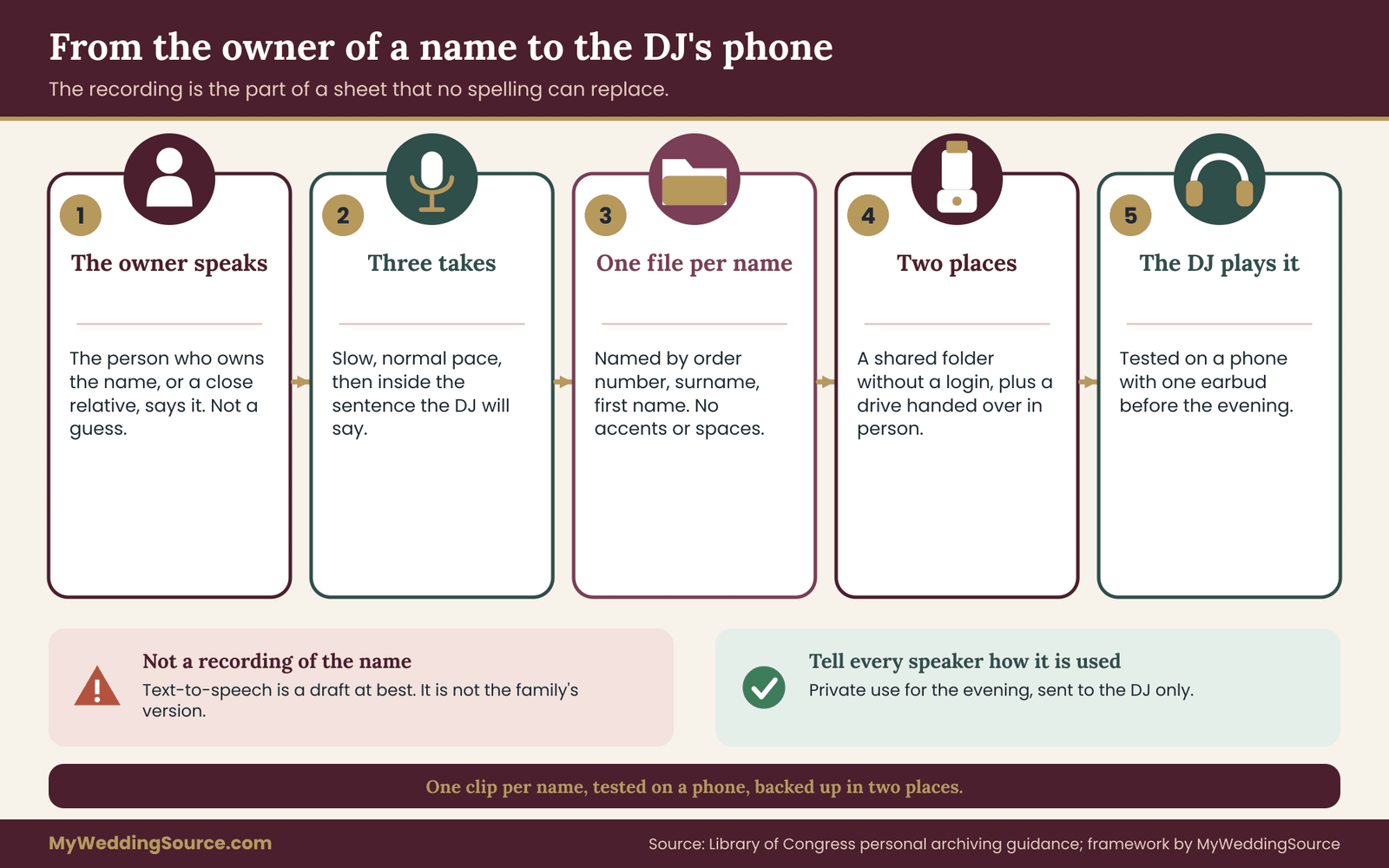
Finally, tell every speaker how the clip will be used. Say that it goes to the DJ, is used for the evening, and will not be posted. People are generally happy to help when they know the recording is private and narrow. For families who prefer not to be recorded at all, a handwritten note that describes the sound and a live phone call to the DJ before the event can stand in. Consent here is a simple courtesy, and it also keeps the clip set short and accurate.
Building the announcement cue sheet beside the pronunciation sheet
The pronunciation sheet says how to say things. The cue sheet says when, who, in what order and in which language. The two documents work as a pair: each cue line points to the entries on the pronunciation sheet that it uses, and each entry on the pronunciation sheet is used by at least one cue line. If an entry is on the pronunciation sheet and nowhere in the cues, it can be deleted. If a name is in a cue and not on the pronunciation sheet, it needs an entry.
A cue sheet for announcements is shorter than a run-of-show for the whole day. It lists only the moments when a voice goes through a microphone. For the ceremony, the ceremony cue sheet guide covers officiant, music and processional timing; this pronunciation sheet borrows its habit of one line per moment and one named person per cue, and applies it to what the reception voice says.
The seven columns of one cue line
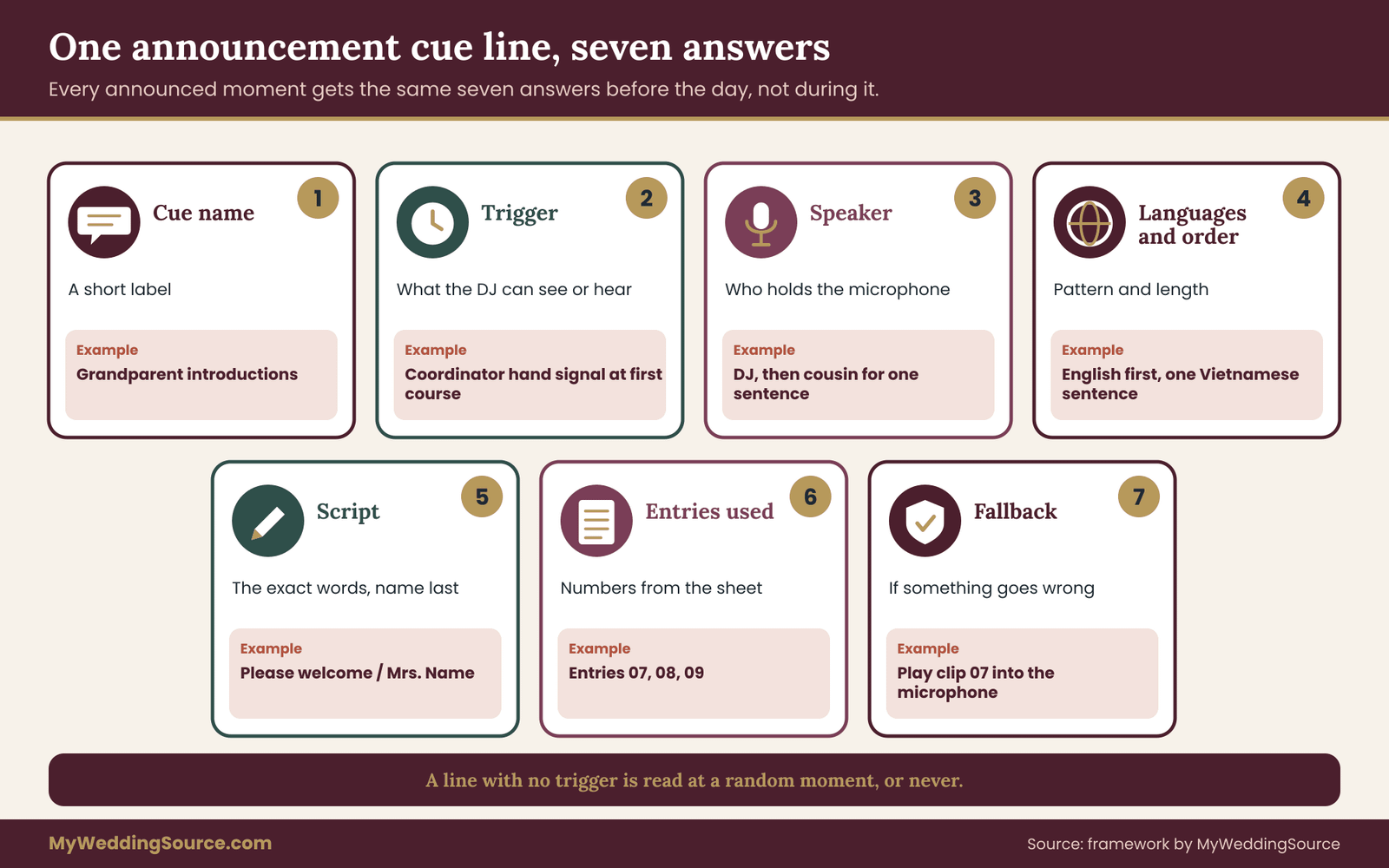
Each cue line carries seven pieces of information. Written in a document, they sit in a single block of text per cue, not a grid, so the line stays readable on a phone.
The cue name is a short label, such as “Grandparent welcome” or “Cake announcement.” The trigger is the event that starts it: “when the last dish is cleared,” “when the couple enters the room,” “when the coordinator nods.” A cue without a trigger gets read at a random moment, or never. The speaker is the person with the microphone.
The languages and order say which language comes first, whether the second is a full repeat or a summary, and how long each runs. The script is the exact text. The pronunciation entries are the numbers of the pronunciation sheet entries used. The fallback says what happens if something goes wrong.
This block of seven is the original piece of the method. You can copy it into any document. The point is that every announced moment gets the same seven answers before the day, not on it.
Triggers: the column most sheets leave empty
Triggers are where cue sheets tend to fail. “After dinner” is not a trigger. It is a hope. A trigger is something the DJ can see or hear without asking: a person standing, a song ending, a light change, a hand signal from a named coordinator, a clock time that the caterer has agreed to.
Because two language groups are present, add one more condition for announcements that depend on a translation. For example, “begin when the interpreter is at the second microphone.” A bilingual announcement that starts before the second speaker is ready becomes a one-language announcement, and half the room hears noise for a minute.
The vendor timeline guide covers how to agree on times across vendors; it is worth reading before you set the triggers, because an announcement that depends on a caterer’s clock needs the caterer to know.
Choosing the language order and length of each announcement
Decisions about language order feel cultural and sometimes political, and they are better made early, by the couple, than at the microphone by the DJ. There are three workable patterns, and each fits different rooms.
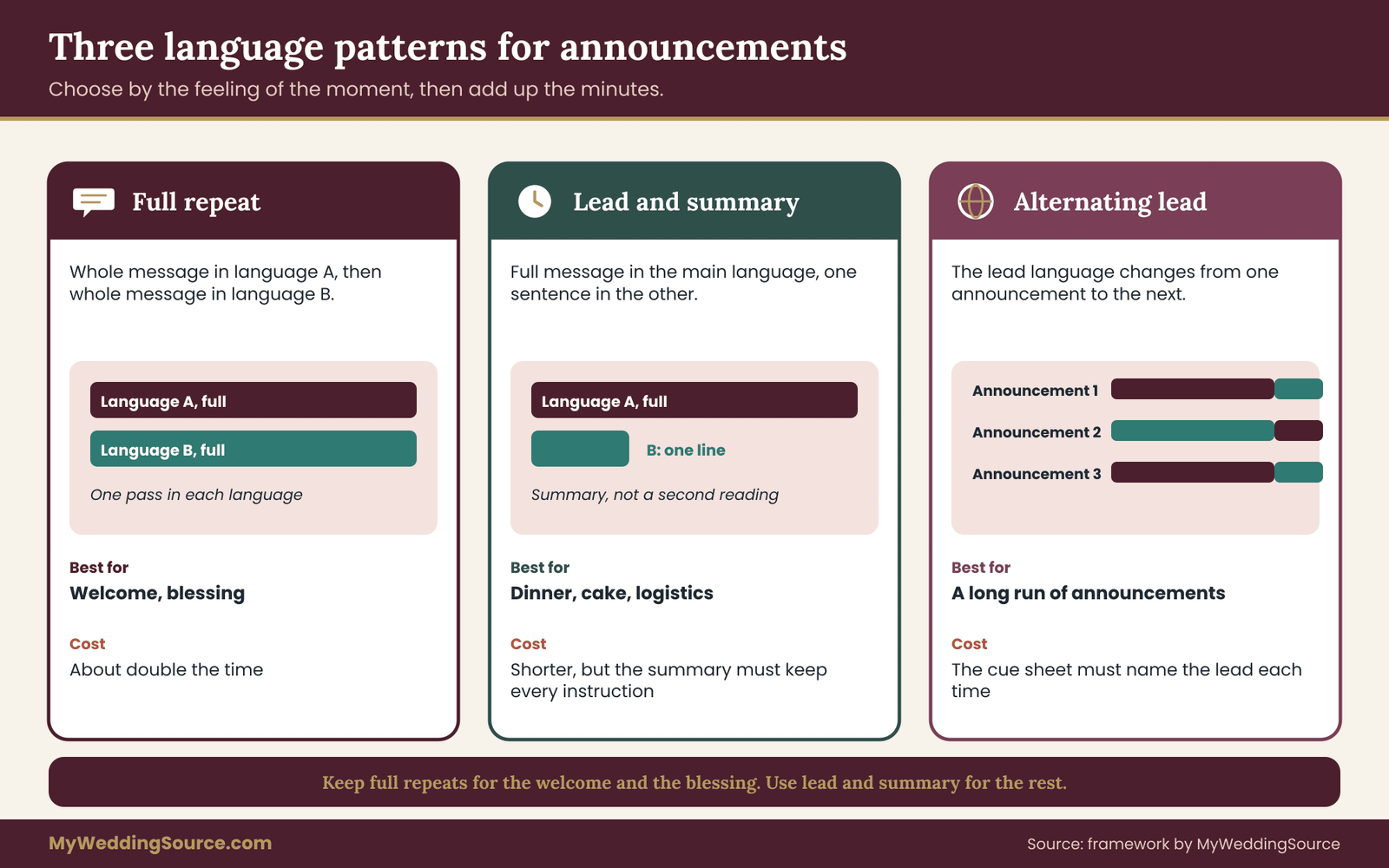
Full repeat. The announcement is said in one language, then fully in the other. It is clear and fair, and it doubles the time. A thirty-second announcement becomes a minute, and across ten announcements that is five extra minutes in which some guests are hearing words they have already understood.
Lead and summary. The announcement is said in full in the main language of the moment and followed by a one-sentence summary in the other. This is shorter and works for routine announcements such as dinner service or the cake. It fails if the summary drops information that matters, such as an instruction.
Alternating lead. The first announcement leads in language A, the next in language B, and so on, with a short summary after each. This reads as even-handed and keeps the total short, but it requires the cue sheet to state the lead language per line, or the DJ will lose track.
Matching the pattern to the moment
Not every announcement needs the same pattern. A welcome and a blessing deserve a full version in both languages, because they carry feeling and the guests are listening closely. A logistics call, such as “dinner is served, please find your table,” can be lead and summary, because the message is functional. A toast introduction can be the shortest of all, a single sentence in each language, because the toast itself will take the time.
Write the pattern into the cue line, so the DJ is not improvising. Then check the total. Add the lengths of all announcements in both languages and compare them with the time the schedule allows. If the total is more than the schedule can bear, cut the pattern from full repeat to lead and summary for the least emotional moments, not the most.
Counting the time, in a worked pass
Suppose there are eight announcements. Three are emotional moments, such as the welcome, the blessing and the first toast introduction, and five are functional. If each emotional announcement takes forty seconds in one language and the functional ones take fifteen, a full repeat of all of them would take about two minutes forty for the emotional set and two and a half minutes for the functional set, a little over five minutes in total.
Lead and summary for the functional five cuts their cost by roughly a third, because the summary is short. The saving is a minute or so. That is small, and it is why the pattern is chosen by feeling, not by arithmetic alone: the time saved is modest, but the effect on the room, which stops hearing everything twice, is larger than the numbers suggest.
You can do this pass for your own reception with a pencil in ten minutes. The numbers are estimates. The point is to see the total before it surprises you, and to see where the pattern should change.
Writing scripts a microphone can carry
A script that looks good on paper may not work aloud. Spoken text needs shorter sentences, fewer clauses, and names placed where a pause can protect them.
Keep each sentence short enough to say in one breath. Put the name at the end of a phrase rather than buried in the middle, because the last word before a pause is the one the room hears most clearly. “Please welcome, from the groom’s side of the family, Mrs. Małgorzata Wiśniewska” gives the name a runway. “Mrs. Małgorzata Wiśniewska, the groom’s grandmother, who traveled from far away, will now say a few words” buries it.
Leave a beat before a hard name. A DJ who pauses for a second, then says the name at normal pace, sounds careful. A DJ who rushes into the name sounds like they are hoping to get through it. The cue line can include a small mark, such as a slash, where the pause goes.
Say the title, not just the name
Titles carry meaning in many languages, and the same title can be a sign of respect or an error depending on how it is used. Put the correct title in the script: Mrs., Dr., Aunt, Grandmother, or the title from the family’s language if the family uses it. If a guest has a title in their own language that the DJ will say in English, the pronunciation sheet should say which to use.
When in doubt, ask the owner: “How would you like to be introduced?” It is a more respectful question than any guess, and it takes a few seconds.
Keep each script to what only the voice can do
Announcements are for things that cannot be shown. A table number belongs on a sign. A schedule belongs on a card. What belongs in the voice is a welcome, a thank-you, a transition and a cue to stand or move. The wedding signage system is the right home for everything that can be read, and keeping information there shortens what the DJ has to say. Every sentence you move from the microphone to a sign is a sentence nobody can mispronounce.
Include a single sentence for the unexpected
Add one short line, in both languages, that the DJ can use when something unscripted happens: a late arrival, a change in order, a technical pause. For example, “One moment, please,” and its equivalent in the second language. A DJ who has this line can cover a gap calmly. A DJ without it fills the gap with improvised words in a language they do not speak well, and that is where errors occur.
The line should be a phrase the second-language speaker would use in conversation, checked by someone fluent. Keep it plain and warm. “One moment, please” is better than a formal phrase that nobody at the table would say aloud.
Accessibility, spoken and written
Some guests will not hear the announcements well, whether because of hearing loss, because of distance from the speakers, or because the room is loud. Where this applies, a printed copy of the key announcements, or a person who can pass along a note, serves them. The ADA.gov effective communication resources describe the general principle that communication should be accessible, and they are a good place to learn more if a guest has asked for an accommodation.
If a guest needs a specific arrangement, ask them directly and early, and add it to the cue sheet as its own line.
When and how to hand over the pronunciation sheet
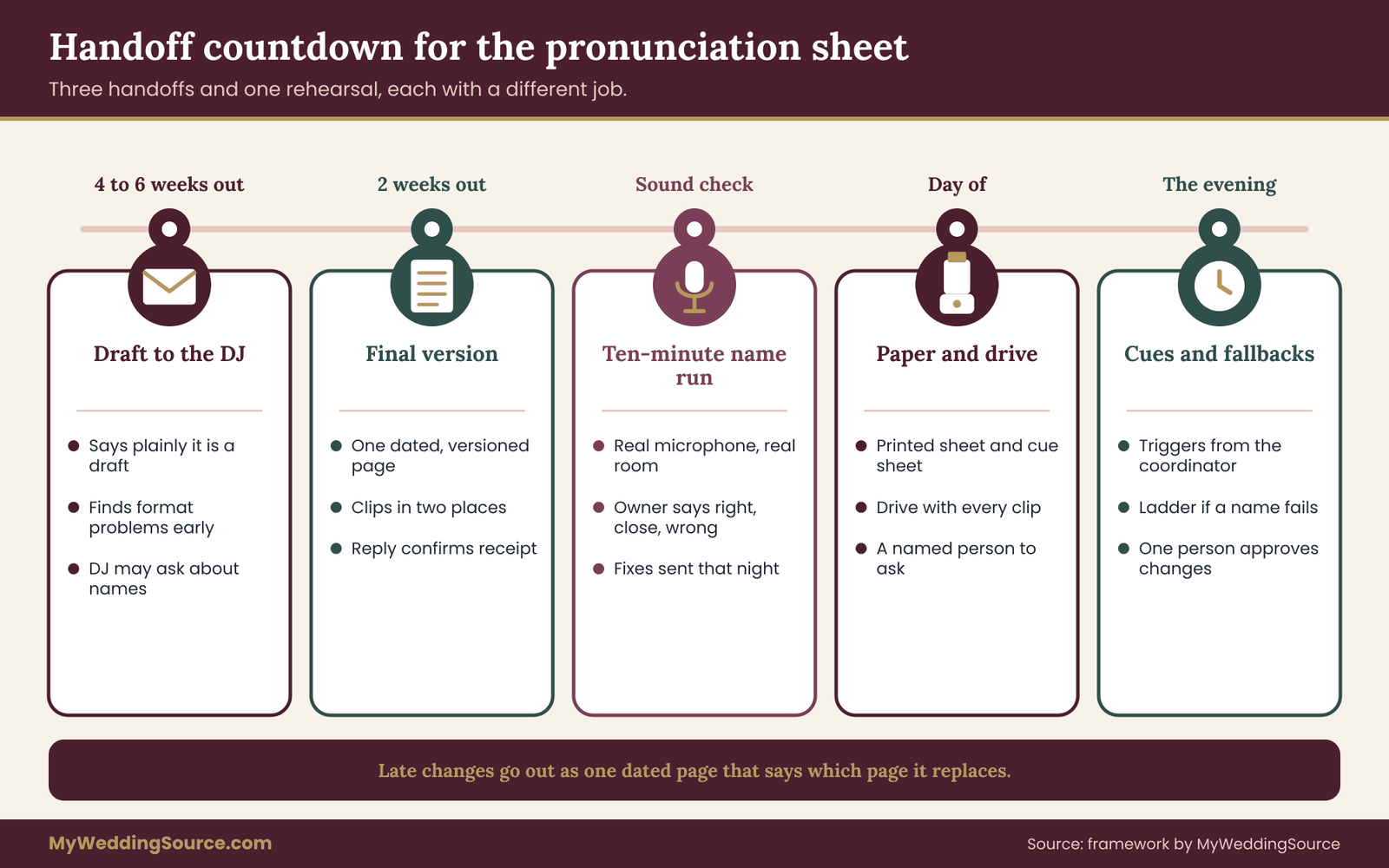
The best pronunciation sheet is useless if it arrives at 6 p.m. on the day of the wedding. Timing is part of the method, and there are three handoff points that each do a different job.
The first handoff is the draft, about four to six weeks before the wedding. It is not final, and it goes to the DJ with a plain note that says so. Its job is to find out early whether the DJ can work with the format, whether they have questions about any name, and whether they want recordings in a different file type. A DJ who gets the draft early can raise a problem when there is still time to fix it.
The second handoff is the final version, about two weeks before. By then the guest list has settled, the program is printed or nearly so, and the recordings are done. Changes after this point should be rare and should be sent as a single revised page, not as scattered texts, with the date written at the top.
The third handoff is the paper and the device on the day: a printed copy of the pronunciation sheet and the cue sheet, a USB drive with the clips, and a phone number for the person who can answer a question about a name. This is the copy that the DJ will actually hold.
Put the pronunciation sheet into the vendor agreement
A pronunciation sheet is a request, and a request is stronger when it sits in the paperwork. Ask the DJ to confirm in writing, by reply to the email that delivers the final pronunciation sheet, that they have received it, will use it and will attend the sound check described below. If the DJ’s contract lists the services, ask that “reading of provided name and announcement sheet” be named, along with the sound check time.
The wedding vendor contract guide explains how to read a service agreement and what to ask a vendor to add. A short addendum or a confirming email is usually enough for a spoken-word duty like this one; it does not need to be formal, but it should be in writing, dated and kept. If the DJ works for a company and a different person arrives on the day, the pronunciation sheet and the cue sheet should travel with the agreement so the substitute has the same instructions.
A delivery packet, in plain terms
The packet is small. It holds the final pronunciation sheet, the announcement cue sheet, the audio clips in a shared folder and on a drive, a one-paragraph note naming the person who can approve changes, and a list of the languages in the room with the rough share of guests who speak each. The share is useful because it tells the DJ how much of the room is relying on the announcements for information, not just ceremony.
Resist adding anything else. A long cover email gets skimmed. A packet with five items, each named, gets opened. The test of a good packet is that a stranger could run the announcements from it with no further conversation, which is closer to what happens if the DJ is replaced at the last minute.
Keep the names aligned with print
Before the final handoff, compare the pronunciation sheet line by line with the program, the place cards and any slide or screen that shows names. A single misspelling in print that is not on the pronunciation sheet will be read aloud by someone, because the DJ will see it on a screen. The invitation etiquette guide covers how names and titles are written for guests, and the same decisions about titles, order and spelling should show up on the pronunciation sheet.
Where a name appears differently in two places, pick one and change the other. Printing a corrected card is cheaper than a mistake at the microphone.
The sound check name run
The sound check is the only point at which you can hear the announcements as the room will hear them. Most couples treat it as a test of equipment. For a bilingual reception, it is also the dress rehearsal for the voice.
Ask the DJ for ten minutes of the sound check for a name run. A name run is simple. Someone who knows the families, ideally one of the owners or a trusted relative, stands in the room. The DJ reads the tier-two and tier-three names aloud into the microphone, in the order of the evening. The person listens and gives one of three signals: right, close, or wrong.
“Right” means move on. “Close” means the DJ should hear the clip again and say it a second time. “Wrong” means stop and listen to the clip together. This takes a few minutes and settles more than hours of email.
Why the microphone changes the name
Names sound different over a speaker. Hard consonants get sharper, soft vowels can blur, and a name said quickly in a large room becomes a smear. A DJ who says a name correctly in conversation may still lose it on a microphone, because the speed and the pitch change. The name run catches this, and the usual fix is to slow down and put a short pause before the name.
Run the name run with the real microphone, the real distance and, if the venue has them, the real speakers. A name run in a quiet office is a start and not a substitute.
Test the second microphone and the second speaker
If a second speaker, such as an interpreter or a family member, will take the second-language half of announcements, the sound check is when they stand at the microphone for the first time. Check three things: the microphone is on and the level is right, the handoff between the DJ and the second speaker is smooth, and the second speaker has a copy of their lines in a size they can read.
A handoff that works on the first try in the sound check will likely work on the night. A handoff that was never tried tends to include an awkward silence while two people look at each other. If the second speaker is a guest, give them a place to stand that is not a long walk from their seat.
Where interpreting is more than a few lines, for example a full toast or a ceremony, a professional interpreter is a different job from reading announcements, and it should be arranged as its own booking. The announcement method here covers short spoken lines, not sustained interpreting.
Fix what the name run finds, in writing
Every correction made during the name run should go back into the pronunciation sheet that evening. If a respelling was wrong, change it. If a clip was unclear, record it again. If a name turned out to be spoken differently by the owner than by the relative who recorded it, re-record with the owner. Then send the corrected page to the DJ and the coordinator and ask them to confirm they have the new version.
This sounds like extra work, and it is a few minutes. It protects against the specific failure where the DJ remembers the correction until the evening is busy, then goes back to the printed page, which still has the old version. A corrected page in the DJ’s hand removes that gap.
Record the name run itself
If the DJ and the family agree, record the name run on a phone. Not for posting, but as a reference. The recording is the DJ’s own voice saying the names correctly, in the room, on the microphone, and it can be replayed before the announcements start. Many people find their own corrected voice easier to match than a stranger’s recording.
Ask first. Some DJs prefer not to be recorded, and a request that is refused should not be pushed. A short written note of what was changed does most of the same work.
What to do if the DJ cannot attend a sound check
Some DJs set up shortly before the event and do not have a separate sound check. In that case, ask for fifteen minutes during setup, before guests arrive, and keep the name run short: the tier-three names only. If even that is impossible, a phone call a few days before can serve as a substitute. The DJ reads the hard names to a family member over the phone, who corrects them in real time. A call is not the same as a room test, but it catches most respelling errors.
If the DJ will not do any of these, treat that as information. It suggests that the announcements will be read cold, and the cue sheet should be simplified to reduce the number of hard names, or a family member should take over the announcements that matter most.
Who stands at the microphone: DJ, emcee or family member
Not every announcement should be read by the DJ. The pronunciation sheet makes a DJ reading possible, but for some moments another voice is better, and choosing by moment is part of the plan.
The DJ’s strengths are timing, volume control and a practiced microphone voice. Their weakness, in a bilingual room, is that they may not speak both languages. A bilingual relative or friend has the opposite profile: they know the names and the language, and they may be nervous or unpracticed on a microphone.
A workable split is this. The DJ reads logistics, the common-language announcements and the English-language lines. A bilingual speaker reads the second-language welcome, the blessing and any line that depends on tone. The pronunciation sheet covers whichever names the DJ must say. And the cue sheet names the speaker for each line, so there is no negotiation at the microphone.
Setting up a family speaker
A family member who will take a microphone needs three things: their lines on paper in large type, a place to stand with the microphone already on, and a cue. If they are unsure, offer a rehearsal in the room, with the microphone, for three minutes. Most people who are nervous at the idea of a microphone are noticeably calmer after one test.
Give them an out. A line such as “if you would prefer not to do this, the DJ will read it” removes pressure. It also gives you a plan if they freeze, because the DJ will already have the script.
When the emcee is better than the DJ
A hired emcee or a trusted friend who runs the evening can replace a DJ for announcements. If nobody is assigned to introduce speeches, the cue sheet should say so and name a fallback; this article assumes someone is. The pronunciation sheet and cue sheet go to the emcee in exactly the same way. The only difference is that the DJ should also have a copy, so the music cues and the voice cues stay together.
A worked case: one invented reception, from inventory to cue sheet
The following example is invented, and the names are made up. It exists to show the method working on a real-sized problem, not to claim that any outcome occurred. Family names and phrases are used the way a couple might meet them; as always, the family decides how its own names are said.
The couple, Linh Nguyen and Daniel Brooks, are planning a dinner reception for one hundred and forty guests. Linh’s side speaks Vietnamese at home and English at work; Daniel’s side speaks English. About a third of the room is more comfortable in Vietnamese, mostly older relatives. The DJ is hired for four hours and speaks English only.
Step one: the inventory
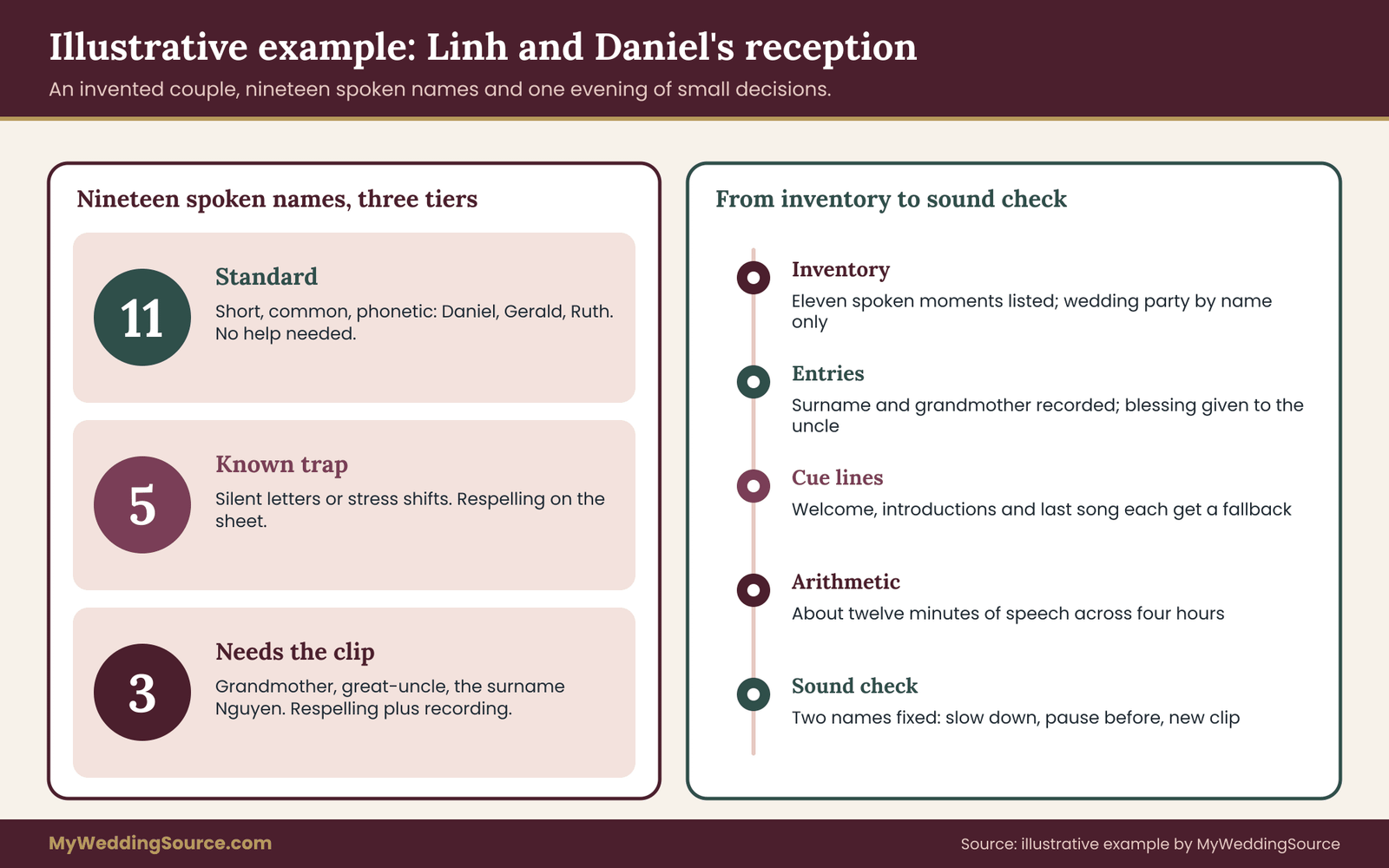
Linh and Daniel walk the evening and list the spoken moments: a welcome, an introduction of both sets of parents and grandparents, the wedding party entrance, the couple’s entrance, a blessing before dinner, a toast introduction, the cake, the first dance, a parent dance, a last-song call and a transportation notice. That is eleven moments. They decide the wedding party entrance will be announced by name only, with no titles, to keep it short.
They count spoken names: the couple, two sets of parents, three grandparents, six wedding party members, two toast givers. That is nineteen names, and they sort them. Eleven are tier one, such as Daniel, Gerald and Ruth. Five are tier two, with a known trap. Three are tier three: Linh’s grandmother, a great-uncle and the surname Nguyen, which they decide to treat as tier three because it is the one name said more than any other.
Step two: the entries
For the surname, the pronunciation sheet carries the printed spelling, a respelling of the commonly used English-speaking version, and a note that the family says it a specific way and the clip shows it. The couple does not try to define the “correct” version, because Vietnamese is spoken with regional differences, and the family’s own usage is the authority. They record Linh’s mother saying it three times, and the pronunciation sheet says “follow the clip.”
For the grandmother, the entry lists her full name with its diacritics, a respelling, her title and the instruction to introduce her with her title first. Linh’s aunt records it with the grandmother present. The grandmother laughs at the first attempt, repeats it, and the aunt records the second. The couple keeps the second.
For the blessing, a short phrase in Vietnamese that Linh’s grandmother wants spoken, the couple decides not to ask the DJ to read it at all. The cue sheet assigns it to Linh’s uncle, who will say it live at the second microphone, with the DJ reading the English version afterward. The pronunciation sheet carries only a pointer: “spoken live by uncle; no DJ reading.”
Step three: the cue lines
Here are three of the eleven cue lines, written out the way they would appear.
The welcome. Trigger: when the coordinator nods and the music is lowered. Speaker: the DJ for the English, Linh’s cousin for the Vietnamese. Order: English first, then Vietnamese, full repeat, about forty seconds each. Entries used: the couple’s names and the two surnames. Fallback: if the cousin is not at the microphone within ten seconds, the DJ gives the English version and says the line “one moment, please” in both languages, then waits.
The grandparent introductions. Trigger: when the first course is served and the coordinator gives a hand signal. Speaker: the DJ. Order: English only, with the grandmother’s name said slowly and with a pause beforehand, then Linh’s cousin says a single sentence in Vietnamese. Entries used: the grandmother, the great-uncle, Daniel’s grandparents. Fallback: if the DJ is unsure, play the clip into the microphone from the phone.
The last-song call. Trigger: ten minutes before the venue curfew, from the coordinator. Speaker: the DJ. Order: lead and summary, English then a single sentence in Vietnamese. Entries used: none. Fallback: the DJ uses the printed card with the Vietnamese sentence.
Step four: the arithmetic
The couple adds the times. The welcome is a full repeat, eighty seconds in total. The blessing is the same, about ninety. The toast introduction and the cake are lead and summary, thirty seconds each. The grandparent introductions run two minutes. The entrances run about three minutes. The rest are short. In all, they estimate roughly twelve to thirteen minutes of speech across four hours. It is not large. They keep the full repeat for the welcome and the blessing and move everything else to lead and summary.
They also note a risk. The Vietnamese portions rely on two relatives, the cousin and the uncle. If either is unavailable, the fallback is a short English line with an apology and the printed card. The couple asks each relative to confirm, in writing, that they can attend the whole evening, and gives each a seat near the microphone.
Step five: the sound check
At the sound check, the DJ reads the five tier-two and three tier-three names. Linh’s mother listens. The DJ’s version of the surname is “close,” so they play the clip, and the DJ repeats it twice. The great-uncle’s name is “wrong” the first time, because the DJ stressed the wrong syllable. The pause before the name fixes the speed, and the clip fixes the stress. The grandmother’s name is “right.”
The couple changes two things in the pronunciation sheet. They add “slow, pause before” to three entries, and they move the great-uncle’s clip to the top of the folder. They send the corrected page to the DJ and the coordinator and ask each to confirm. All of this took about twenty minutes and no more than a few messages.
What the example shows
The example is small on purpose. The method does not remove all risk. It reassigns it: the hard names are rehearsed, the hard phrases go to people who speak them, and every cue has a fallback. Notice what the couple did not do. They did not try to teach the DJ Vietnamese. They did not write respellings for every guest. They did not ask the DJ to read a phrase that a family member could say better. They spent the effort where a mistake would cost most.
Notice also that the couple treated the family as the authority throughout. The pronunciation sheet’s wording on the surname, “follow the clip,” is a small sentence that does a lot: it prevents a stranger from “correcting” a family’s own name.
Laying out the pronunciation sheet so it works in a dark room
Layout is where good content gets lost. A sound table at a reception is usually dimly lit, the DJ’s hands are busy with equipment, and glancing at a page takes a second at most. The physical sheet should be designed for that second.
Use large type, at least fourteen points for the respelling and larger for the name. Put each entry on its own line with white space around it, and group entries by the cue that uses them, not by alphabet. The DJ moves through the evening in order, and an alphabetical list forces a search at the exact moment they have no time to search. A second alphabetical index on the back of the page can serve the person who needs to look up a single name.
Print the stressed syllable in bold as well as capitals, because bold survives photocopies and poor light better than letter case alone. Keep the page to one side if you can and two if you must. A pronunciation sheet of three or four pages will be put down and not picked up.
Paper, device or both
Bring both. A paper copy does not run out of battery, does not lock itself and can sit under a small light. A phone or tablet copy lets the DJ play a clip with one tap and search by name. The risk with a device is that the DJ looks down at a screen while the room waits, and the risk with paper is that a last-minute change is missing from it. The answer is to print the final version, mark any changes by hand with the date, and keep the device copy as the audio player.
Put the clip file names on the paper entries. The DJ then knows which file to open without scrolling, and the number on the page matches the number on the file. This is why the file-naming pattern from earlier matters: order number first, so the folder sorts the same way the page reads.
A short legend at the top
A two-line legend at the top of the page says what the marks mean: capital letters are the stressed syllable, a slash is a pause, an asterisk marks a name where the clip outranks the respelling. Keep it to two lines. A legend that needs a paragraph is a sign that the notation is too complicated.
If you want the DJ to see the order of the evening alongside the names, the ceremony step-by-step guide shows how a sequence of moments can be laid out for people who need to see the whole flow at a glance. Borrow the same simplicity for the reception: a short numbered list of cues, each with its entries, fits on a single page.
Version and date
Write the date and a version label at the top of every page, and put the same label in the file names of the shared folder. When a new version is sent, the DJ should be able to see, in a second, which page is current. It sounds fussy, and it solves a real failure: two versions in circulation, one used at the microphone, the other held by the coordinator.
Ask the coordinator and the DJ to discard old printouts when the new one arrives. Better still, send only the changed page and mark it “replaces page two.” Anyone who has run an event knows that old paper has a way of surviving.
Failure conditions for a pronunciation sheet, and the fallback for each
A method is only trustworthy if you know where it breaks. A pronunciation sheet fails in a small number of ways, and each has a plain fallback. Writing the failures down before the event is the specific decision that separates a plan from a hope.
The pronunciation sheet never reaches the person at the microphone. This happens when the DJ’s company sends a different person, when the pronunciation sheet is attached to an email nobody opened, or when the coordinator holds it and the DJ does not. The fallback is the day-of paper copy and a named person, usually the coordinator or a friend, who hands it over at setup and confirms it was received. Ask the person to say “I gave it to the DJ at five o’clock,” so the handoff is a spoken fact, not an assumption.
The reader ignores the pronunciation sheet. Some announcers prefer their own habits. The sound check name run is the control: if the DJ reads the names correctly there, the habit is not a problem. If they do not, the fallback is to move the hard names to a family speaker.
The respelling is wrong. A respelling can mislead, especially for names in languages with sounds English lacks. The pronunciation sheet’s legend says the clip outranks the respelling, and the name run tests the real voice. If a name turns out to be unfixable by respelling, delete the respelling and keep only the clip and the instruction “play the clip, then say the name.”
The clip will not play. Phones lock, files fail to load, a link needs a login. The fallback is the USB drive and the printed respelling. For the five hardest names, a second copy of each clip on a different device is cheap insurance.
The speaker is missing. A family speaker who falls ill or is delayed leaves a gap in the second-language half. The fallback is a short English line, the printed card and a promise to the room that the second-language version follows when the speaker arrives. Name a substitute speaker for each bilingual cue, even if the substitute only reads a short line.
The name is said wrongly anyway. Even with preparation, a mistake can happen. The plan for that moment appears in a later section. The point here is that the plan exists.
A failure ladder in four rungs
It helps to think of fallbacks as a ladder the DJ climbs only as far as needed. The first rung is the respelling on the page. If that fails, the second rung is the clip played into the ear or the room. The third rung is a family speaker who says the name live. The fourth rung is to leave the name out and use a title and a general description, such as “the bride’s grandmother, who has traveled from far away.” Each rung is less precise and less risky than the last.
The ladder lets the DJ choose calmly, and it lets the couple accept a lower rung for a moment when a higher one is unavailable.
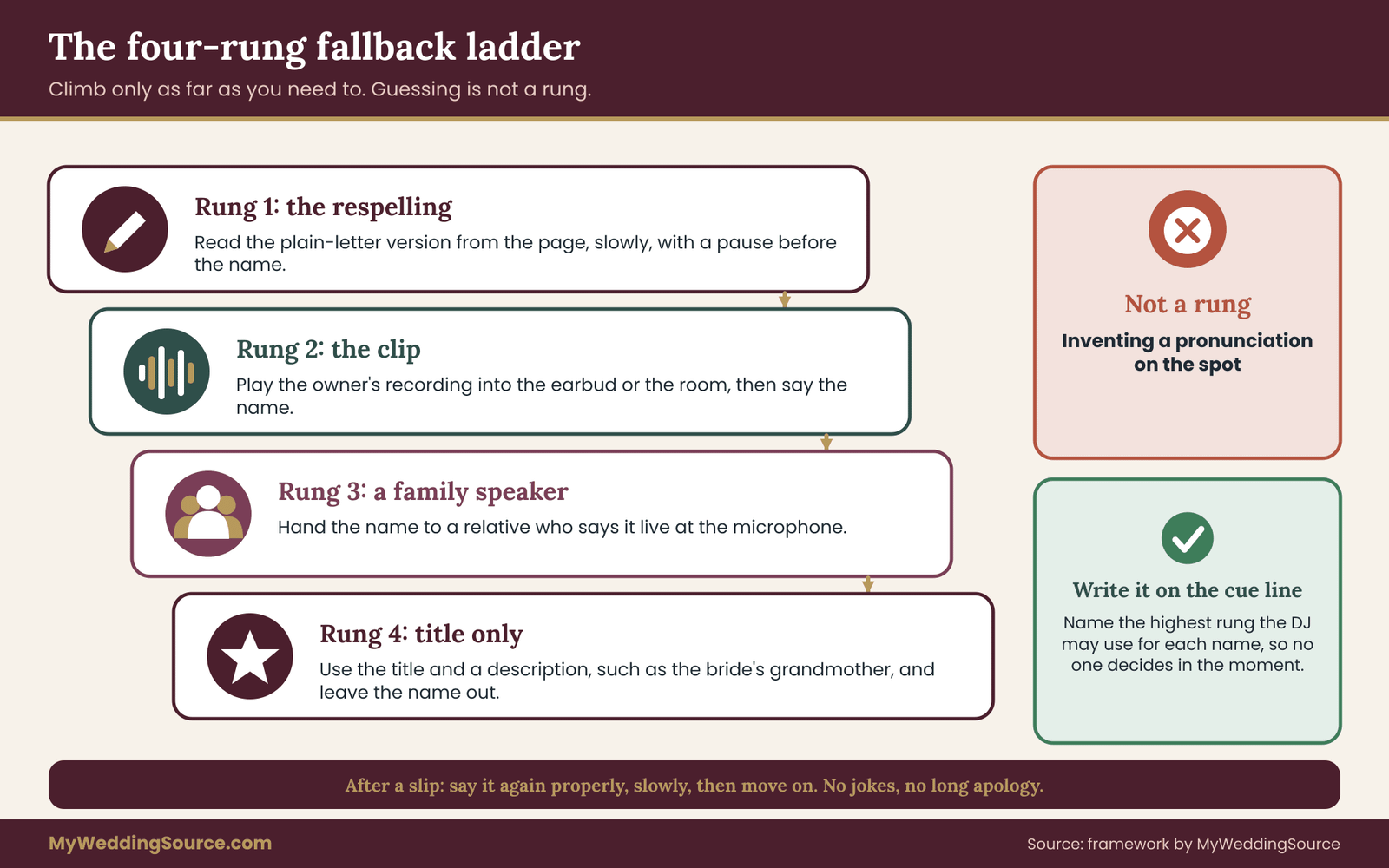
The ladder also shows where not to go. Guessing is not a rung. A DJ who hits the end of the ladder should leave the name out, not invent a pronunciation, and the cue sheet should say so in a sentence.
Special cases the basic method does not cover
Some situations break the usual entry. They are worth thinking through in advance, because they are exactly where a generic template gives bad advice.
Names written in another script
If a name is written in a non-Latin script on the program, such as Arabic, Devanagari, Chinese or Korean characters, the pronunciation sheet should carry the original script, the romanization the family uses and the respelling. The original script is the authority and the romanization is a convenience. Check that the DJ’s software and printouts display the script correctly; a file with missing characters is a common surprise.
The World Wide Web Consortium’s internationalization pages and the Unicode Consortium describe how text in different scripts is handled, and a short test print of the pronunciation sheet will show whether the characters come through.
Names with more than one accepted pronunciation
Some names have two or three accepted forms, depending on region or generation. The pronunciation sheet should pick one for the evening and say which, with a short reason: “family says it this way.” If the owner has a preference, follow it. If the family is divided, ask the owner, not the majority. A name is the one piece of language that belongs to its owner.
Nicknames, married names and changed names
A guest may use a nickname in daily life, a formal name on the invitation and a different name in a second language. The pronunciation sheet states the spoken form, and the cue sheet uses the same form. A guest who has recently changed names, married or otherwise, may want to be introduced by the new name or the old. Ask. The wedding etiquette guide is a reasonable place to read about courtesies around names and titles, and the person’s answer outweighs any general rule.
Names of people who have died
If the program mentions someone who has died, perhaps in a memorial moment or a toast, the family may want the name said in a specific way, with a specific title or phrase. Treat the entry the way you would for a living guest, ask the person closest to the one who died, and record the clip. A name said wrongly in a tribute is more painful than almost any other mistake, and the care needed is the same as for anyone, a little more.
Very long lists
Some traditions announce many relatives, perhaps twenty or thirty people in a procession. A pronunciation sheet of that size needs a different structure. Group names by family, record each family as one clip when the family agrees, and ask one family member to take the microphone instead of the DJ. Reading thirty names correctly in a language you do not speak is a bigger ask than any DJ should be given.
Children and guests who prefer not to be named
Some guests, including children and people with privacy concerns, may not want their names announced. A quick question when collecting pronunciations, “would you like to be introduced by name?”, settles it. If the answer is no, the cue line simply uses a general description. Do not announce names to make a point, and do not record a clip of a person who has not agreed.
Alternatives when a pronunciation sheet is not enough
A pronunciation sheet suits a reception with a modest number of spoken names and a DJ who is open to preparation. Sometimes it is the wrong tool, and it is better to know that early.
A family or friend emcee. If many names must be said and many in a language the DJ does not speak, an emcee from the family may be better than any sheet. The emcee knows the names and the manner. The DJ keeps the music, and the cue sheet keeps them in step. The cost is that the emcee must be comfortable at a microphone and sober enough for the job.
A bilingual hired host or interpreter. For a long program with many speakers, a hired professional costs money and removes risk. The American Translators Association publishes information on translation and interpreting as professions, and it is a sensible starting place to understand the difference between a translator, an interpreter and a bilingual speaker. A professional is the right choice when exact wording matters, for example for a ceremony or a legal element.
Printed or projected names. If a name will be said and can also be shown, a projected slide with the name in both spelling and respelling lets the room follow along and gives the DJ a visual cue. This helps guests who read better than they hear. It also adds a technical dependency, so it should have a paper fallback.
No names at all. Some couples decide that names will not be announced. The wedding party enters to music, the grandparents are greeted by the couple in person, and the DJ announces only functions. This is a legitimate design choice and the cleanest answer to a complicated list. It trades away a moment of recognition and is best chosen on purpose, not by default.
A recorded announcement. A prerecorded welcome by a family member who cannot attend, or by a speaker who prefers not to be live, can be played through the sound system. It removes live risk, but it needs a sound check and an operator who knows when to start it.
None of these alternatives replaces the others. A reception might use a sheet for the DJ, an emcee for the second-language welcome and a recorded blessing from a relative who cannot travel. The cue sheet shows which tool handles which moment.
When a name is mispronounced anyway: what to say on the night
Preparation lowers the chance of a mistake and cannot remove it. The last piece of the plan is what happens in the ten seconds after a name goes wrong, because the room reads the reaction more than the error.
The most useful principle is that the correction should be quick, quiet and kind. A DJ who stumbles on a name and corrects it with a smile has made a small human moment. A DJ who freezes, apologizes at length or jokes about the difficulty has made a larger one, and the family bears the cost of that moment.
A short script for the DJ
The DJ needs a line they can say without thinking. Something like: “Let me say that again properly,” followed by the name said slowly from the clip or the respelling, followed by moving on. That is the entire recovery. No explanation, no comment on the difficulty of the name, no remark about the language. The family member who is being introduced will usually be gracious about a quick correction and uneasy about a long one.
If the DJ is unsure of the second attempt, they can play the clip into the microphone or invite the owner or a relative to say it. “Mrs. Wiśniewska, would you like to say your name for us?” turns an error into an invitation and gives the person control. Use it only when the guest is comfortable; a shy guest should not be asked to perform. The cue line can mark which names are safe for this and which are not.
A script for the family
The couple and their families should agree in advance on how they will react. One simple agreement is this: if a name is said wrongly, nobody corrects it from the table. Instead, the named person’s nearest relative gives the DJ a small signal after the announcement, and the DJ repeats the name correctly at the next natural moment. Calling out corrections from a table turns an ordinary slip into a scene.
The couple can say a quiet word to the people closest to them before the evening: “If a name goes wrong, please smile, we will fix it.” This is not about hiding the error. It lowers the temperature so that a small mistake stays small.
After the moment
After the event, note which names were said wrongly and why, even if the notes are only for yourselves. If the DJ later sends a thank-you or asks for feedback, a plain note such as “the pronunciation sheet worked well for most names; two stress errors in the grandparent introductions” is useful to the DJ and to anyone planning a similar evening. Keep it factual and kind. A DJ who takes the pronunciation sheet seriously is a vendor worth recommending, and a clear note helps them improve.
If a mistake caused real upset, a short personal note from the couple to the person affected, sent in the following days, is better than silence. It need not be elaborate. It says that the name matters and that the error was noticed.
Keeping the pronunciation sheet and clips after the wedding
The pronunciation sheet has a second life. The clips of grandparents and elders saying their own names are, for many families, among the most valued recordings of the whole wedding, and they may be the only ones. It is worth deciding what to do with them before the evening ends.
Save the final pronunciation sheet and the clips in the wedding archive, with the date. If the speakers agreed to private use only, keep them that way. If a relative would like a copy, ask the person who recorded it, and the owner of the name, before sharing. The Library of Congress personal archiving guidance, mentioned earlier, recommends keeping more than one copy in more than one place, and short audio files take very little space.
The pronunciation sheet also becomes a template. A second event, such as a first anniversary, a family reunion or a sibling’s wedding, will use many of the same names. Having a clean, checked set of entries saves the next planner most of the work, and it gives the family a lasting record of how each name sounds in the voice of the person who owns it.
If you plan to reuse the format for another vendor, such as an officiant, a photographer who calls out groupings or a venue coordinator who introduces guests, the same entries apply. The wedding vendor contract guide is a reasonable place to check how such a request fits into a booking, because the pronunciation sheet is more likely to be used if the vendor has agreed to it in writing.
A last review before the day
Two days before the event, run a short review. Is the final version of the pronunciation sheet in the DJ’s hands, with the date matching yours? Are the clips on the shared folder and on the drive? Does every spoken name in the cue sheet have an entry? Does every bilingual cue have a named speaker and a fallback?
Has the coordinator confirmed the triggers? Is there a person named to approve changes? If any answer is no, fix it that evening. Most of these items take minutes, and none of them can be fixed during the reception.
Your next steps
Start with the inventory. Walk the evening, list every moment a voice will go through a microphone, and write down the names and phrases in each. Sort the names into three tiers and mark the hard ones. Ask a friend who does not know the families to read the list aloud cold, and move any name they stumble on up a tier.
Then collect pronunciations from the owners of the names, record the hard ones in a quiet room, and write the pronunciation sheet with the seven fields. Build the cue sheet with its seven pieces of information, choose a language pattern for each moment, and add a fallback to every line.
Send the draft to the DJ four to six weeks ahead and the final two weeks ahead, ask for written confirmation, and book ten minutes at the sound check for the name run. After that, you have done the work that matters; the rest is the evening itself.
FAQ
What is a wedding pronunciation sheet?
It is a one-page document that lists every name and foreign phrase a DJ or announcer will say aloud, with the printed spelling, a respelling in plain letters, the stressed syllable, the language, the owner of the name and the file name of a recording. It sits beside a cue sheet that says when each announcement happens. Together they let someone who does not speak the language say the names the way the families do.
Do we need audio recordings, or is a respelling enough?
A respelling is enough for easy names and a good starting point for hard ones. For names with sounds English lacks, tonal languages and any foreign phrase, a recording is more reliable, because letters cannot carry pitch, length or a rolled sound. Record the hard names in a quiet room with the owner of the name or a close relative, one file per name, and tell the DJ that the clip outranks the letters.
How many names should go on the pronunciation sheet?
Only the names that will be spoken into a microphone. For many receptions that is fifteen to forty: the couple, parents, grandparents, the wedding party, toast givers and honored guests. Do not list every guest. A shorter sheet is used, and a long one is put down. Sort names into three tiers by difficulty and give the hardest ones a recording as well as a respelling.
When should we send the pronunciation sheet to the DJ?
Send a draft four to six weeks before the wedding so the DJ can ask questions, and a final version about two weeks before. Bring a printed copy and a drive with the clips on the day, and ask the DJ to confirm receipt in writing. Send any later change as a single dated page marked as replacing the earlier one, so only one version is in use.
What if the DJ does not speak the second language at all?
The pronunciation sheet is designed for that case. The DJ reads names from the respelling and the clips, and a bilingual family member or friend takes the second-language lines, such as a welcome or a blessing. Assign each line to a speaker on the cue sheet and name a fallback. For a full program or exact wording, consider a professional interpreter, which is a separate booking.
Can we use machine translation or text-to-speech for names and phrases?
Use it only for a rough draft. Automatic tools are not an authority on how a family says its own name, and they do not replace a human speaker for ceremonial or formal wording. A speaker of the language, ideally the owner of the name, should check and record anything the DJ will say. Do not present a machine output as the family’s pronunciation.
What should the DJ do if a name is said wrongly during the evening?
Correct it once, calmly, with a short line such as “let me say that again properly,” then say the name slowly from the clip or respelling and move on. Do not explain, joke or apologize at length. Family members should not call out corrections from tables; a nearby relative can signal the DJ afterward, and the DJ can repeat the name correctly at the next natural moment.
Does a guest who needs communication access change the plan?
It can. Guests who are deaf or hard of hearing, or who are far from the speakers, may need the key announcements in writing or a person who can pass them on. Ask the guest directly and early, and add a line for it on the cue sheet. The ADA.gov effective communication resources describe the general principle; for a specific obligation or arrangement, ask the venue or a qualified professional.
Sources
- Americans with Disabilities Act, ADA.gov, U.S. Department of Justice
- Effective communication, ADA.gov, U.S. Department of Justice
- Limited English Proficiency, LEP.gov, Federal Interagency Working Group on Limited English Proficiency
- Personal archiving: preserving your digital memories, Library of Congress
- International Phonetic Association, the IPA chart and guidance
- Internationalization (i18n) activity, World Wide Web Consortium
- Unicode Consortium, character encoding standard
- American Translators Association, translation and interpreting as professions
- U.S. Copyright Office, copyright basics for recordings