
American wedding customs can look strange, or even rude, to relatives who grew up with a different kind of celebration: a toast that interrupts dinner, a gift list on a website, a ceremony that runs twenty minutes, a party that ends at eleven. This guide gives you a neutral glossary and a simple card method for explaining each custom to overseas relatives before they land, so nobody has to guess what is expected.
Explain American wedding customs with a three-line card for each one: what it is, what the guest does, and what the guest may skip. Send the cards in weekend order (rehearsal dinner, ceremony, cocktail hour, reception, send-off) instead of alphabetical order. Describe, do not defend. Say “here, this usually means” rather than “this is how it is done.” Keep the whole brief to two pages, pair it with a short video call, and name one person at the wedding whom relatives can ask in their own language.
Picture a grandmother who has flown fourteen hours to see her grandchild marry. She steps into a hotel ballroom, and within the first hour she is told to sit anywhere on one side, then to stand for a song, then to hold her applause until a pronouncement, then to wait in a line for drinks that have already been paid for. None of it is wrong. All of it is unexplained. She spends the first hour of the wedding worrying about doing something incorrectly.
That worry is the real problem this guide solves. American wedding customs are not especially complicated, but they are mostly unwritten, they vary by region and family, and hosts rarely notice them because they have seen them all their lives. Relatives from overseas notice every one of these customs. Your job is not to teach a course in American culture, and it is not to defend American wedding customs either. It is to remove the guessing.
This guide is built around a deliverable you can copy: a short, neutral glossary of ceremony and reception customs, each written as a three-line card. It also includes a worked case, a decision ladder for when one of the American wedding customs clashes with a family expectation, and a list of conditions under which this approach fails.
The history and meaning of rituals from many countries is a separate subject. This article stays on one narrow task, which is preparing visiting relatives for what they will see and do at an American wedding.
A note on scope. This is general planning information, not legal, immigration or tax advice. Entry rules, visa decisions and marriage-license requirements are set by government agencies and change, so the article points you to the official sources listed at the end.
Why American wedding customs surprise overseas relatives
Most surprise about American wedding customs comes from three gaps, and each one calls for a different kind of explanation.
The structure gap. Many wedding traditions elsewhere are organized around a long, formal day with fixed roles for elders, a defined order of gifts and speeches, and a single large meal. American weddings are often built from several short events with different dress codes and different guest lists: a rehearsal dinner for a smaller group, a ceremony, a cocktail hour, a seated reception, and sometimes a morning-after brunch.
A relative who assumes the whole thing is one event may arrive in the wrong clothes at the wrong time, or leave before the part that mattered to the family.
The role gap. In some families, parents and grandparents lead the day, hosts greet every guest personally, and the couple is expected to sit and be served. In many American weddings the couple greets guests during a receiving moment or a table visit, the parents are one role among several, and a friend may act as master of ceremonies.
Relatives who meet American wedding customs for the first time may wonder why no one is formally welcoming them, when in fact the welcome is scheduled for a moment they do not know about.
The money gap. Gifts, envelopes, registries, the open bar and tipping are the places where an honest misunderstanding can sting. A relative who brings an envelope of cash to a couple who has a registry has done nothing wrong, but may not know where to put it. A relative who expects to pay for a drink at a hosted reception, or who thinks a cash bar is an insult, needs a sentence of context. Later sections cover each situation.
What an explanation of American wedding customs is not
It helps to name what you are not doing. You are not asking relatives to adopt a new set of manners. You are not claiming that American wedding customs are the standard way to hold a wedding. And you are not apologizing for them. A calm, factual note from the couple, written in plain language and maybe translated, is the most respectful thing you can send. It treats your relatives as capable adults who are missing information, which is exactly what they are.
Why this belongs on your side of the planning, not theirs
Hosts sometimes assume that relatives will ask if they are unsure. In practice, people who feel like outsiders rarely ask. They watch and copy the person next to them, and if that person is also a visitor, errors multiply. Putting the explanation of American wedding customs in writing before travel, and offering a human contact, shifts the work to the people who actually know the answers.
If you have not yet settled who is invited to which event, the wedding guest list guide is the place to fix that first, because a brief that lists the wrong events will cause the confusion it was meant to prevent.
A neutral way to describe American wedding customs
Before writing any card, agree on a voice. The goal is a neutral description that a relative of any background, faith or generation can read without feeling lectured or excluded. Five rules produce that voice, and they are worth applying to every card in the glossary.
Rule one: describe what happens, not what is correct. Compare “At the reception, guests are expected to clap after each toast” with “After each toast, guests usually clap and sometimes raise a glass.” The second sentence is accurate, softer, and leaves room for people who do things differently. Avoid “must,” “should,” “proper” and “traditional” unless you are quoting a specific family rule.
Rule two: name the variation. American wedding customs differ by region, religion, family background and venue. A sentence such as “Some couples do this, many skip it” is both honest and reassuring. It also protects you when your own wedding departs from the pattern.
Rule three: give the practical action. Every explanation should end with something a guest can do. “The couple will cut the cake around nine; there is nothing for you to do except watch and eat a slice afterward” is more useful than a paragraph about the origin of the cake.
Rule four: say what is optional. Overseas relatives often assume that a custom is mandatory because the hosts seem to take it seriously. A line that says “you can stay seated” or “you do not need to bring a gift” releases a great deal of pressure.
Rule five: avoid comparisons to other countries. It is tempting to write, “Unlike in your country, we do not…” Resist it. Comparisons invite arguments, and your reader may know their own tradition far better than you do. If you want to honor a custom from the relatives’ side, ask them about it separately. The wedding etiquette guide covers the general manners that sit behind many of these cards, so you do not need to repeat them in your brief.
A quick test for any sentence about American wedding customs
Read each sentence aloud and ask three things. Could a thirteen-year-old understand it? Could a translator render it without footnotes? Could a proud grandparent read it without hearing criticism? If the answer to any is no, shorten it or cut it. The best explanations of American wedding customs are plain, short and slightly boring, and that is a compliment.
Which relatives need a guide to American wedding customs
You do not need one brief per person, but you do need to know who reads it. A useful sorting question is who will be physically present for which event and what they already know. First-time visitors to the United States need the most context on American wedding customs. Relatives who already know American wedding customs from earlier visits, or who live in the country part of the year, need less.
Older relatives often prefer a printed copy, and younger ones will read a message on a phone, so prepare both formats from the same text. If some guests need a translation, build it from your cards rather than from the whole article; the guide on wedding invitation etiquette explains how to keep the invitation wording itself brief while the brief carries the detail.
The three-line card method for American wedding customs
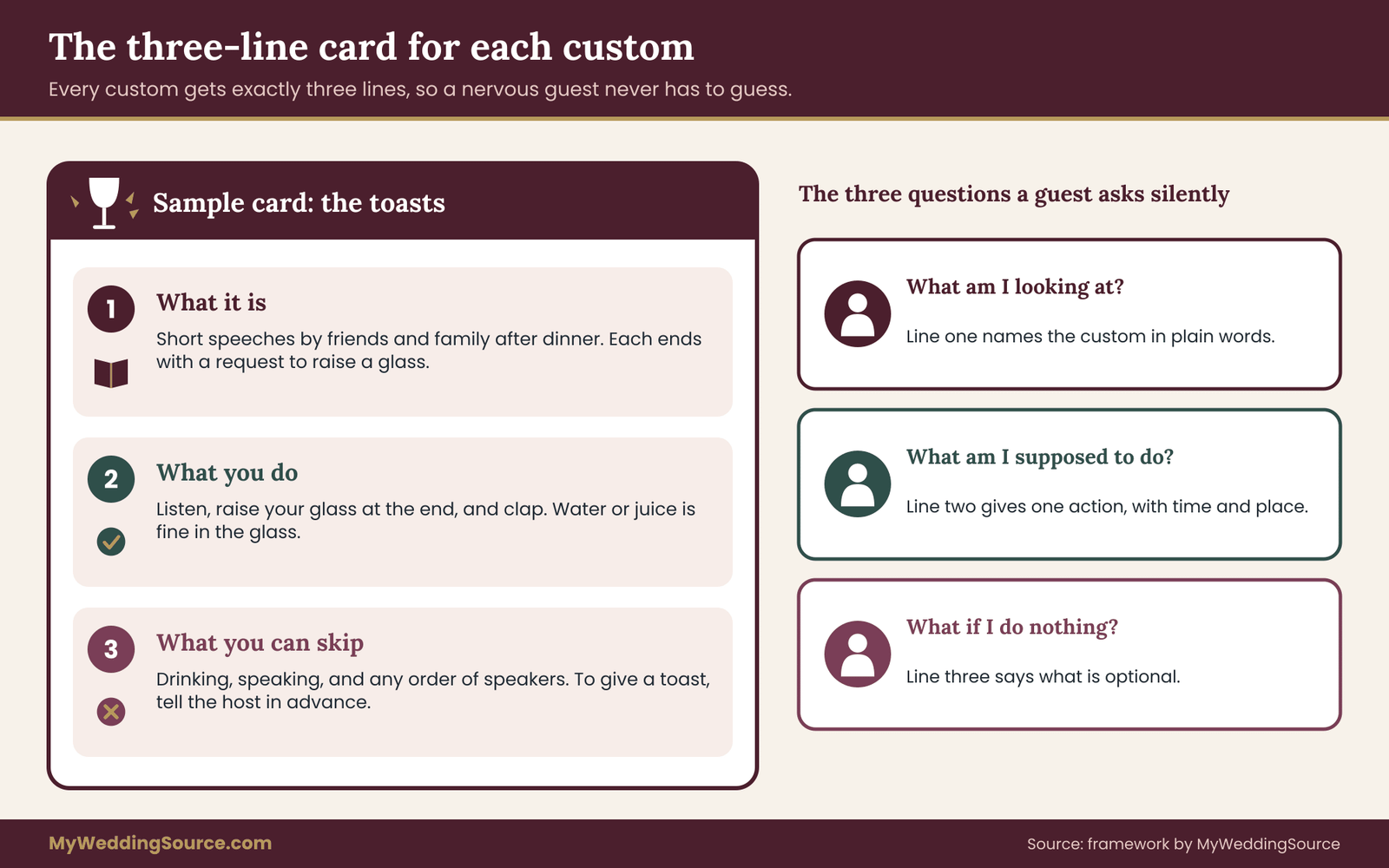
The method is simple enough to explain in one breath. For every one of the American wedding customs a relative will meet, write exactly three lines.
Line one: what it is. One plain sentence, no jargon. “The rehearsal dinner is a meal the night before the wedding for the wedding party, close family and out-of-town guests.”
Line two: what you do. One sentence naming the guest’s action, including the time and place if known. “Arrive at seven, find your name card, and sit with the relatives at table two.”
Line three: what you can skip. One sentence that says what is optional. “No gift or speech is needed. If you would like to say a few words, tell the host in advance.”
Three lines is a hard limit, and it is the point of the method. A card that grows to a paragraph has started to defend the custom, to tell a story about it, or to hedge. Those are different documents. If you want to tell the story, write it separately and let relatives read it if they are curious.
Why three lines work for American wedding customs
Each line answers a question a nervous guest silently asks. What am I looking at? What am I supposed to do? What happens if I do nothing? A card that answers only the first question produces a well-informed guest who is still frozen. A card that answers only the second produces an obedient guest who does not know why, and may resent it. The third line is the one hosts forget, and it is the one that most relieves anxiety.
The method also forces a useful discipline on you when you list American wedding customs. Writing the “skip” line makes you decide what you actually need. If you find yourself writing “you can skip this” for nearly every custom, it may be a sign that your guests do not need a card for it. Cut cards that fail the test, and keep the brief short.
How many cards of American wedding customs you need
Most explanations of American wedding customs need between twelve and eighteen cards in total. The glossary sections below cover the American wedding customs that most often confuse visitors, grouped by when they happen. Add or delete cards to match your day. A backyard wedding with no cocktail hour needs no cocktail-hour card.
A faith-based ceremony with a set liturgy may need one card that points to the officiant or the house of worship for guidance. Where your officiant has particular rules, the wedding officiant requirements guide explains what officiants typically need from couples, which helps you know what to tell guests about the legal portion.
Order matters more than topic
The most common mistake is to sort the glossary alphabetically or by theme, as a dictionary would. A relative reading on a phone in the airport is not studying; they are rehearsing the weekend. Put the cards in the order events will happen, and add a time or a part of the day to each heading.
They will use it as a script for the days, and it also becomes the base for a short itinerary page. The wedding ceremony step-by-step guide lays out the usual order of the ceremony itself, which is a good check for your ceremony cards.
A weekend map of American wedding customs before the glossary
Before any single card, give relatives a map of the whole weekend. A map of the weekend answers the structure gap in one stroke, and every card that follows then has a place to sit. The map is a list of events, each with a short label for who is invited, what to wear and how long it lasts.
Welcome gathering or rehearsal dinner. Usually the evening before. The welcome gathering may be open to all out-of-town guests, while the rehearsal dinner is often limited to the wedding party and close family. Say which one your relatives are invited to, and say it plainly. Nothing is more awkward than a relative arriving at a dinner they were not invited to, or missing one they were.
Ceremony. Typically thirty to forty-five minutes, though a faith-based ceremony or a ceremony with many rituals may run longer. Ask your officiant for the expected length and put it in the brief, because relatives will plan travel, meals and medication around it.
Cocktail hour. A period after the ceremony, often an hour, when guests drink and eat light food while the couple takes photographs. The cocktail hour is the one that surprises people most, because the couple is absent and no one explains why. The wedding cocktail hour guide covers how couples plan this stretch, and the card for your relatives can simply say that the couple will join soon.
Reception. The seated meal, toasts, cake cutting, dancing and the end of the night. This is usually the longest event, and the card set for it is the longest.
Send-off and morning-after. Some weddings end with a formal exit through a line of guests, sometimes with sparklers or bubbles. Many include a casual brunch the next morning. Say whether relatives are expected at either.

What goes on every event line
Four facts make a map of American wedding customs useful. The start time, the end time or approximate duration, the dress, and whether the event is hosted (food and drinks are paid for) or on your own. If any of these is unknown, write “to be confirmed” and promise an update on a date. A relative who has to book a taxi or a babysitter back at the hotel needs to know when the evening ends more than they need to know what a first dance is.
Time and punctuality
Punctuality deserves its own sentence. In the United States a ceremony usually starts close to the printed time, and late arrivals are seated at the back or ushered to wait for a pause. Some relatives come from places where a wedding time is a suggestion and the real event begins an hour later.
Tell them what to expect in neutral language: “The ceremony begins at four. Doors open at three thirty. Guests who arrive after four may be asked to wait until the processional is finished.” That is a statement about the venue, not a criticism of anyone’s habits. For guest-arrival timing in general, the planning ideas in the wedding reception guest flow guide apply equally well to the ceremony.
Ceremony glossary of American wedding customs: before the vows
The following cards cover the American wedding customs relatives will meet from the moment they arrive at the venue until the music starts. Each one is written in the three-line format, using wording you can adapt.
Ushers and seating
What it is: Ushers are friends or family who greet guests, hand out programs and show them to seats. What you do: Tell the usher which side you are related to, or simply say that you are family, and follow their lead. What you can skip: You do not need to choose a side. At many weddings the sides are an old habit, and open seating is common.
A word of context belongs here. In some traditions the families sit on opposite sides, and in others the front rows are reserved by rank or age. If your ceremony has reserved rows, say who may sit there and who will tell them. A written note on the seat, or a quiet word from an usher, spares an elderly relative the embarrassment of being moved.
The program
What it is: A printed or folded sheet listing the order of the ceremony, the names of the wedding party, and sometimes the words of songs or readings. What you do: Read it before the ceremony begins; it is a quick way to learn the order. What you can skip: You can keep it or leave it on the seat. Nobody checks.
If a relative reads the program in another language, a translated program is a generous gesture, but it is also a production task. The detailed approach to bilingual printed material belongs in a separate planning conversation; for the brief, a one-line summary in the relative’s language placed at the top of the English program is enough.
The wedding party
What it is: The people who stand with the couple: usually bridesmaids, groomsmen, a maid or matron of honor, a best man, and sometimes flower girls and ring bearers. What you do: Nothing. You will see them walk in, stand at the front, and later pose for photographs. What you can skip: You do not need to learn the titles. Relatives sometimes worry that they must know who ranks above whom; the answer is no.
Explain, in a sentence, that in American wedding customs the wedding party is chosen by the couple and has no legal role. Many cultures give formal duties to specific relatives, such as an uncle or a sponsor. If your relatives expect their own roles at the ceremony, this is the moment to say honestly whether such roles exist in your plan and whom they should ask. A short private conversation, not a printed card, is the right place for that.
Unplugged ceremony
What it is: A request that guests keep phones and cameras away during the ceremony so the professional photographer has a clear view. What you do: Silence your phone and put it away until the recessional or until you are told photos are welcome. What you can skip: Nothing. This is one of the few places where the request is firm, but it ends when the ceremony does.
Say why in one sentence, because the reason is practical and not a matter of etiquette: a guest’s phone often appears in the professional’s frame. Relatives who are used to recording every moment for the family back home may need a kind alternative, such as a promise that the couple will send the video within a set number of weeks, or a designated friend who will film from the side with permission.
Ceremony glossary of American wedding customs: from the processional to the recessional
This second group of cards covers what happens at the front of the room. These are the American wedding customs that relatives watch most closely, because they carry the most emotional weight. Keep the language gentle, and avoid explaining meaning where the couple has not decided on one.
The processional
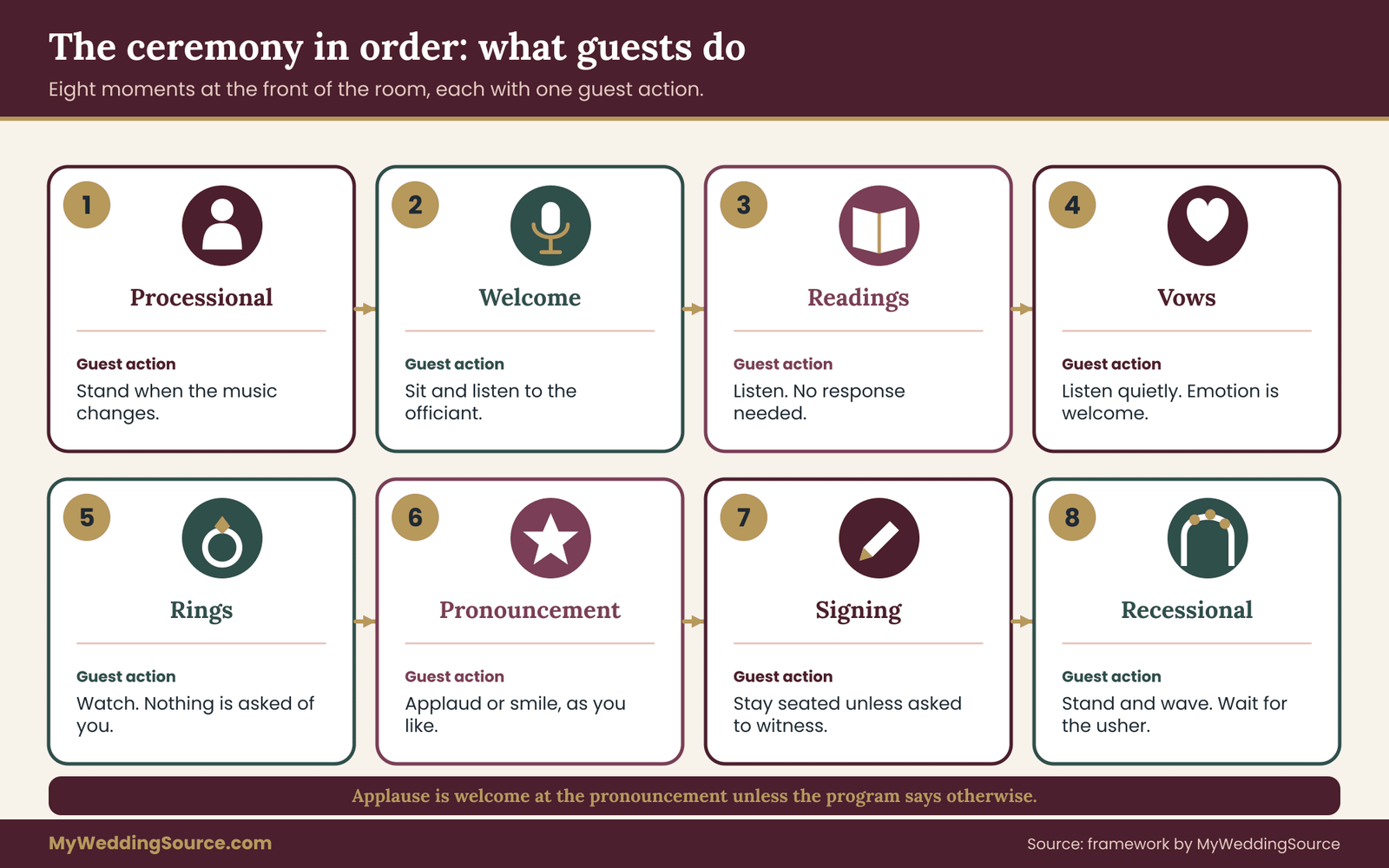
What it is: The entrance of the wedding party, parents, and finally the couple, usually to music, with guests standing for the last entrance. What you do: Stand when the music changes or when the usher or officiant invites guests to stand. Turn toward the aisle. What you can skip: You do not need to stay standing after the couple reaches the front; the officiant will say when to sit.
The order of the processional varies a great deal. One family may have grandparents seated by escorts, another may have both partners walk in together, and a blended family may have several people sharing a role. If your processional is unusual, say so in the card. A relative who expects a father to escort a bride, and sees instead two partners walking in together, deserves to know that it is a choice and not an accident. The guide to wedding ceremony step-by-step shows the common sequences so you can describe yours accurately.
Giving away
What it is: In some American ceremonies a parent or relative walks a partner down the aisle and may say a short phrase of blessing or consent. What you do: Watch. What you can skip: Nothing is expected of other guests.
Some couples skip this entirely, or adapt it so that both partners are accompanied by parents. Others keep it because of family history. Because the custom has a history that some guests find uncomfortable and others find beautiful, the card should describe your version without commentary. A sentence like “Both of our mothers will walk with us” is complete.
The officiant and the welcome
What it is: The officiant is the person who leads the ceremony and, in the United States, is usually authorized under state law to solemnize the marriage. The officiant may be clergy, a judge, a friend ordained for the day, or another authorized person. What you do: Listen, and follow cues to sit or stand. What you can skip: You do not need to respond aloud unless the ceremony includes a spoken response.
Be careful at this point with American wedding customs that touch the law. Who may legally officiate, and what must be said, depends on the state. Do not tell relatives what American law requires, and do not present any of the American wedding customs as legal requirements.
Tell them what your ceremony will include. If a relative asks whether the ceremony will be “legal,” the honest answer is that the couple has met the requirements of the state where the ceremony takes place, and that the marriage license is the legal document.
The details belong to the issuing office, listed in the sources below.
Readings and music
What it is: Short poems, passages from books, or songs chosen by the couple and read or performed by friends or family. What you do: Listen. What you can skip: You do not need to know the pieces.
If a reading is in a language your overseas relatives will understand, mention it. If a reading is religious and some relatives come from a different faith, a one-line note respects them: “One reading is from a sacred text of the couple’s faith; guests of all backgrounds are welcome to simply listen.” That sentence does not ask anyone to join in, and it does not apologize.
Vows
What it is: The promises each partner makes aloud. Some couples use traditional words supplied by their faith or the officiant, and some write their own. What you do: Listen quietly. Some guests may become emotional; that is welcome. What you can skip: Nothing is required of you.
Where vows are personal and written by the couple, tell relatives they will be in English, and offer a printed translation if the relatives would otherwise not follow. It is a small act that lets a grandmother feel part of the most meaningful minute of the day. Your vow length matters for the program: a fifteen-minute vow exchange changes the schedule more than a three-minute one.
The ring exchange
What it is: Each partner places a ring on the other’s finger, often while repeating a short phrase. In the United States rings are commonly worn on the left hand, though this varies. What you do: Watch. What you can skip: Nothing is needed from guests.
A relative from a place where rings are worn on the right hand, or where rings are not part of the ritual, may be curious. A brief neutral note is enough: “The couple will exchange rings. In many American weddings these are worn on the left hand.” Do not add “and that is the right way.”
Unity rituals
What it is: A symbolic act done together, such as lighting a single candle from two, pouring sand into one container, or tying a cord. Not every couple has one. Some use a ritual from a family culture. What you do: Watch. What you can skip: Everything.
If your ritual comes from one family’s tradition, the card is the place to say so and to name whom it honors. This is also a good moment to invite the relative who owns the tradition to explain it, either briefly during the ceremony or in the program. A ritual explained by the person who grew up with it is far more moving than one explained by the officiant.
The pronouncement, the kiss and the applause in American wedding customs
What it is: The officiant announces that the couple is married, and the couple often kisses. Guests applaud. What you do: Applaud, cheer or smile, as you like. What you can skip: You do not need to cheer loudly. A quiet smile is fine.
Of all American wedding customs, the pronouncement is the moment where relatives from more reserved traditions most often wonder whether applause is allowed. It is. If the ceremony is religious and applause would be out of place, say so in the program. Couples who want a specific pronouncement, perhaps one that does not name anyone as a husband or a wife, can choose the wording with their officiant.
Signing the license
What it is: The couple, the officiant and usually one or two witnesses sign the marriage license. Some couples do this at the front of the room, and some do it privately before or after. What you do: Nothing, unless you are asked to be a witness. What you can skip: Nothing, but you may stay in your seat while it happens.
If a relative is asked to be a witness, give them a short note beforehand so they can bring identification if the state requires it, and tell them what they will sign. The licensing office sets the rules, and a rule can change from one county to another.
The recessional
What it is: The couple walks back up the aisle, followed by the wedding party, to music. Guests may throw petals, blow bubbles or simply cheer. What you do: Stand and applaud as the couple passes. Wait for the usher to release your row. What you can skip: You do not need to join the line out.
The recessional is where guests discover the ceremony is over. Add a sentence on what happens next: “After the recessional, guests move to the cocktail hour. Ushers will point the way.” That sentence prevents the common scene in which relatives remain seated for ten minutes, waiting for something else to happen.
A short note on language, not on culture
Overseas relatives are often confident people who have been to many kinds of events. What they lack is the specific English vocabulary. So a card set on American wedding customs should translate words, not values. A glossary entry for “rehearsal dinner,” “cocktail hour” or “open bar” is more useful than a paragraph about why Americans value casual friendliness.
When writing the glossary, choose the plainest possible word for each term and put the American term in parentheses once, so a relative can recognize it on an invitation or on a staff member’s lips.
Here are six terms that appear on invitations and are rarely defined in guides to American wedding customs.
Black tie optional. The event is formal. Tuxedos and floor-length gowns are welcome, and a dark suit or an elegant dress is also acceptable.
Cocktail attire. Dressy but not formal. A suit or a knee-length dress is typical.
Reception to follow. A party after the ceremony, usually in the same place or nearby.
Plus-one. The guest may bring a partner or friend. This appears on the invitation or the RSVP, not as an assumption.
RSVP. A request to reply by a date. Not replying makes planning difficult for the hosts. The RSVP etiquette guide explains why dates matter and how couples follow up.
Regrets only. Reply only if you cannot come. This is uncommon on wedding invitations but may appear on less formal ones.
Put these six near the top of your brief, before the ceremony cards, because relatives meet them first. If the invitation is mailed overseas, the wording should be clear enough to stand alone, and the brief should expand on it, not repeat it.
What to avoid in a glossary of American wedding customs
Three habits spoil an otherwise good glossary of American wedding customs. The first is slang: “open bar,” “wedding party” and “send-off” are standard enough, but “the after” or “the second line” will puzzle anyone. The second is humor that depends on cultural context, such as jokes about the bouquet toss being competitive. The third is explaining a custom by naming its country of origin, as in “this is an English tradition.” The origin may be disputed, and it is not what the guest needs to know.
Keep the glossary of American wedding customs a tool, not an essay. When a card runs long, move the extra material to a separate “if you are curious” page and link to it. That keeps the brief short while still giving curious relatives what they want. The strongest guides to American wedding customs for guests are the ones that respect the reader’s time.
Reception glossary: the American wedding customs that fill the evening
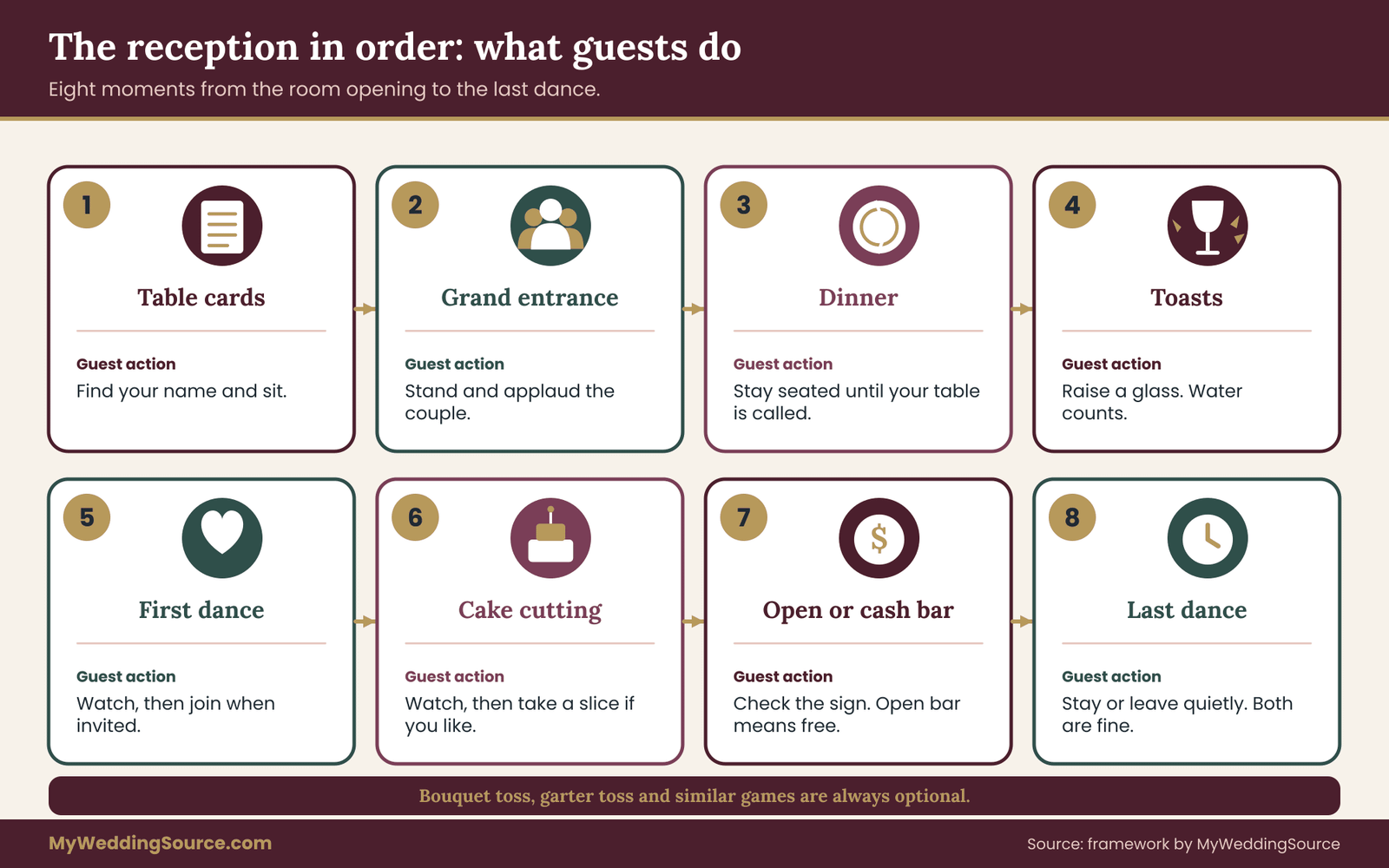
The reception is where most of the unexplained moments live. The cards below describe American wedding customs in the usual order of a seated reception, from the arrival at the room to the last song. Use the ones that match your evening, and cut the rest.
Cocktail hour
What it is: A gap of about an hour between ceremony and dinner, with drinks and small bites, while the couple and wedding party take photographs. What you do: Help yourself to a drink and a snack, chat, and find your table card if one is displayed. What you can skip: You do not need to take photographs of the buffet or wait for the couple before eating.
Among American wedding customs, this is the card that saves the most worry, because the couple’s absence feels like neglect to anyone who does not know the pattern. Add a sentence that says exactly when the couple will arrive. If you would like a more detailed look at how couples schedule this stretch and keep guests comfortable, the guide to the wedding cocktail hour covers the planning side from the hosts’ view.
Table cards and seating
What it is: A small card with a guest’s name and sometimes a table number, assigned by the couple. What you do: Find your name, sit at your table, and introduce yourself to people nearby. What you can skip: Nothing, but you do not need to sit still all night. Many people move between tables after dinner.
If a relative is sitting with strangers, mention that the couple chose the seating on purpose to place people with shared interests or languages. Where you can, seat overseas relatives with at least one person who speaks their language. If you plan seating charts for a complicated guest list, the wedding seating chart guide walks through the decisions in order.
The grand entrance
What it is: The couple, and sometimes the wedding party, are announced by an emcee or DJ and enter the reception to music. Guests stand and applaud. What you do: Stand, clap, and sit when the couple is seated. What you can skip: You do not need to cheer loudly.
Some couples skip it, and some have a very short version. Tell relatives which. The point of the card is to say that the music and clapping are normal and nobody is being asked to do anything difficult.
Dinner service
What it is: Dinner may be plated, served by waiters to each table, or buffet or family style, served from stations or shared platters. Some receptions serve a first course while toasts are given. What you do: Stay seated at your table until staff or the host invites your table to the buffet. What you can skip: You do not need to wait for the couple to start eating, unless they say so.
Add a line on dietary needs, since overseas relatives may have religious or medical dietary rules they did not know how to mention. A note that says “Please tell us by this date about allergies and religious dietary needs” prevents a last-minute scramble. If your venue offers a station-style meal, the explanation in the wedding reception guest flow guide helps you describe how lines will form and when each group is called.
Toasts and speeches as American wedding customs
What it is: Short speeches, usually by the best man, the maid or matron of honor, and often a parent. The speaker ends by asking everyone to raise a glass. What you do: Listen, raise your glass when invited, and clap at the end. What you can skip: You do not have to drink. Raise your glass, even if it holds water or juice.
Some relatives come from places where speeches by elders are essential, long and formal, and where the American habit of friendly, humorous toasts may seem informal. A neutral sentence helps: “Toasts here are often funny and personal. They are short, usually three to five minutes, and there is no fixed order beyond the first few speakers.” If a relative wants to give a toast of their own, say whom to tell and by when.
The first dance
What it is: The couple dances alone to a song of their choice while guests watch. What you do: Watch and applaud. What you can skip: You do not join in until the DJ or band invites everyone onto the floor.
Some couples invite parents and family to dance in the order that follows, often a parent dance and a dance with the wedding party. A card can say, “After the first dance, the floor opens to everyone.” That sentence reassures relatives who may be unsure whether they are expected to dance at all. If you have older relatives who cannot dance, a chair near the floor allows them to participate fully by watching.
Parent dances and special dances
What it is: Dances between each partner and a parent or other important relative. Some families add dances for grandparents or siblings. What you do: Watch, or join when invited. What you can skip: Everything.
Honor your relatives by naming them. If a grandmother from overseas will be invited to dance, tell her in advance and ask whether she would like to. A surprise invitation to dance in front of a hundred strangers is not a kindness. The same applies to any family dance from your own heritage: if you want to include one, plan it with the relatives who know it, and tell guests that they may join.
The cake cutting
What it is: The couple cuts the first slice of the wedding cake together, often feeding each other a bite, and then staff serve the rest. What you do: Watch, and take a slice if you like. What you can skip: You do not need to eat cake. Dessert may also be served separately.
Relatives sometimes ask why the cake is cut in front of everyone. Rather than explain, say what happens next: “After the cutting, staff will serve slices to each table.” That way, nobody leaves hungry or unsure whether the cake is for show.
Bouquet toss, garter toss and similar games
What it is: Some couples throw the bouquet to unmarried guests or remove a garter and toss it. Many couples skip these, or replace them with something else. What you do: If invited, stand with other participants. If you do not want to take part, stay seated. What you can skip: All of it. Participation is voluntary.
This is the card where the three-line method for American wedding customs shows its value. Overseas relatives who see a crowd gathering may feel pushed to join. Tell them plainly that participation is always optional and that the couple will not read anything into staying seated. If you plan to skip these customs, you can leave the card out and avoid raising a question that nobody had.
Open bar, cash bar and the question of paying under American wedding customs
What it is: An open bar means the hosts pay for guests’ drinks. A cash bar means guests pay for their own. Some weddings offer beer and wine only, or a limited cocktail list. What you do: Ask the bartender or check the sign. At an open bar, you do not pay. What you can skip: You do not need to drink alcohol, and the bar will also serve soft drinks.
Be precise about the drinking age. In the United States the minimum legal drinking age is twenty-one in every state, set by state law in line with federal requirements, and venues often check identification. Tell relatives under twenty-one, and parents of teenagers, what will be served to them. For couples planning a drink service, the wedding bar service planning guide covers the choices from the hosts’ side.
Tipping at the reception
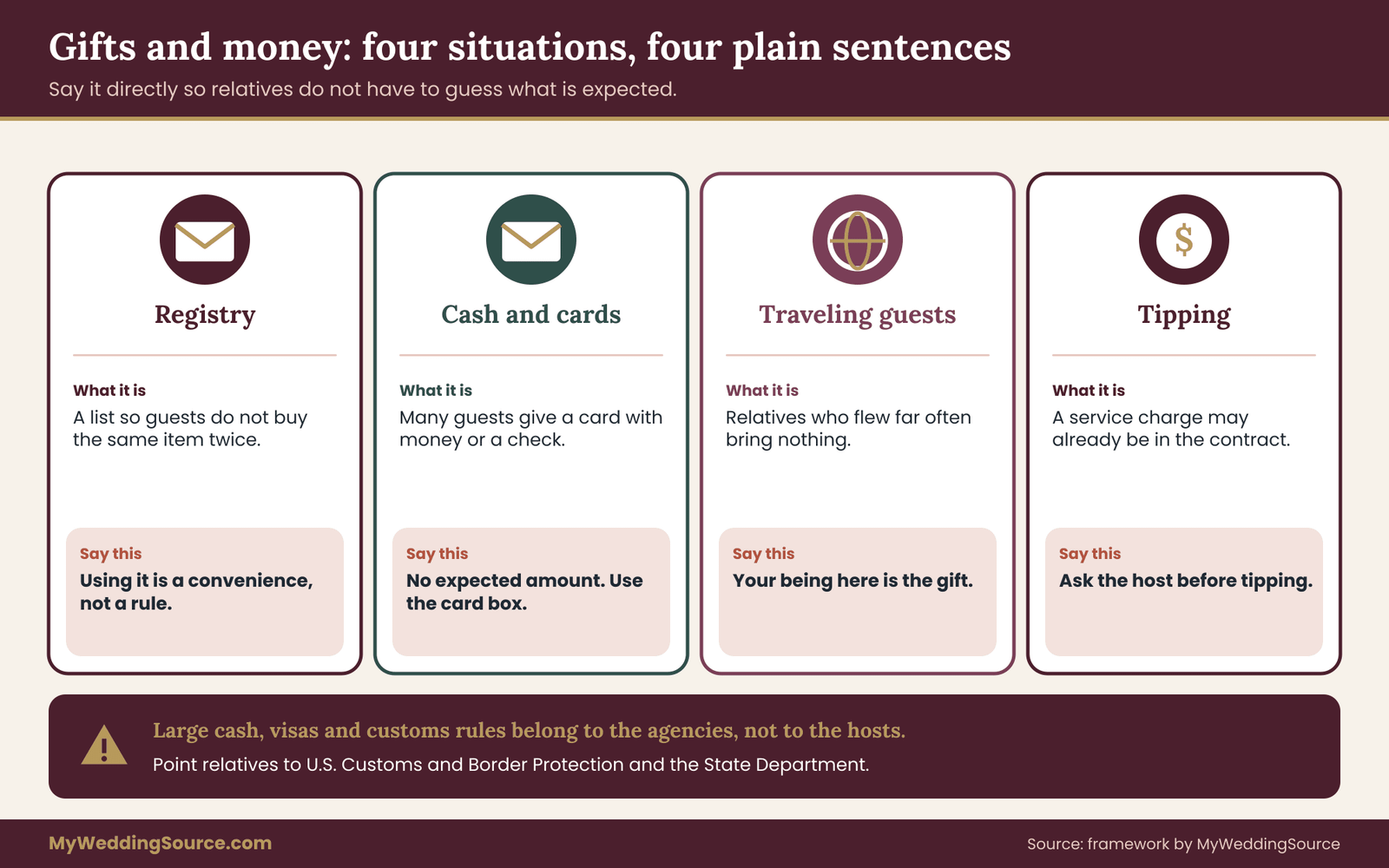
What it is: In the United States, tipping is common for restaurant and event service workers. At many weddings, a service charge or gratuity is already included in the catering contract. What you do: Ask the host before tipping. If a bartender has a tip jar at an open bar, tipping is welcome but optional. What you can skip: Where gratuity is included, you do not need to tip separately.
Tipping is one of the American wedding customs that makes overseas relatives most nervous, because tipping norms vary widely around the world. A short, neutral explanation is kind. The U.S. Department of Labor publishes information on tip rules for workers; hosts should check their catering contract so they can tell relatives whether a gratuity is already paid.
Late-night food and the send-off
What it is: Some receptions serve a late snack, such as pizza or sliders, to keep guests going, and end with a formal exit where guests line up with sparklers, bubbles or flower petals. What you do: Join the line if you like, and wave. What you can skip: You can leave quietly before it begins.
Safety notes belong here. If sparklers are used, a line like “The venue will provide sparklers and staff will supervise” reassures older guests. If the venue does not permit open flame, say so. For long weekends that continue with brunch the next day, tell relatives whether the brunch is hosted, whether it is optional, and when it ends.
The last dance and goodbye
What it is: The final song of the night, after which the couple often thanks guests and leaves. What you do: Dance if you like, then say goodbye to the couple if they are near. What you can skip: You do not have to stay until the end. Leaving earlier is common, especially for older guests and families with young children.
The goodbye is where relatives sometimes feel they have not “properly” greeted the couple. A line in the brief can help: “The couple will greet every table during dinner. If you miss them at the end, we will see you at brunch.” That sentence relieves the pressure to line up for an elaborate farewell.
A reception that does not follow the pattern
Not every reception follows the order of American wedding customs described here. Some couples choose a morning ceremony with a luncheon, a late-afternoon garden party with no dinner, or a casual restaurant gathering. If yours departs from the pattern, rewrite the weekend map first, then the cards. The cards depend on the map, and the glossary is meant to describe your wedding, not a typical one. A good brief about American wedding customs is only as accurate as the day it describes.
Gifts, registries and money: where American wedding customs most often confuse
Money is the topic where a good intention can still produce an awkward moment, so it deserves its own section and its own set of cards. The goal is the same as before for these American wedding customs: describe, give the action, name what is optional.
The registry
What it is: A list of gifts the couple would like, kept on a retailer’s website or on a gift platform, and linked from the wedding website. Guests choose an item, buy it, and have it shipped to the couple or to the store. What you do: If you would like to give a gift, you can choose from the list. What you can skip: You do not need to use the registry, and you do not need to give a gift at all.
The registry is one of the American wedding customs most likely to feel odd to relatives from cultures where the gift is money, jewelry or household goods chosen by the giver. A calm explanation helps: “In the United States, many couples keep a list so that guests do not buy the same item twice.
Using it is a convenience, not a rule.” If your list includes cash funds, experiences or contributions to a honeymoon, explain how those work. The guide to wedding registry ideas covers the range of registry types, and you can point relatives to your own page.
Cash and envelopes in American wedding customs
What it is: Many guests give money, usually in a card, often placed in a box or basket near the entrance of the reception. Some couples prefer checks, and some prefer an online transfer. What you do: If you wish to give cash or a check, bring it in a sealed card with your name on the card, and place it in the box. What you can skip: Nothing is required. A card with a warm note is welcome on its own.
For relatives who are used to giving cash in a specific amount or in a specific form, the American habit may feel too informal or too vague. State plainly that there is no expected amount and that the couple does not keep a ledger that ranks guests. Say it only if it is true. If you do keep a record for thank-you notes, as many couples do, you can say so: “We record every gift so we can thank each person.” That is honest and kind.
A practical point: cash in a box at a reception is at risk of loss. If you have a card box, assign a trusted person to watch it and bring it to a safe place at the end of the night.
Tell relatives who have brought large envelopes where to give them, so they are not carrying cash around the hotel. When your relatives are flying in with cash, the U.S. Customs and Border Protection website explains the reporting rules for larger amounts of currency; hosts should not give advice on this, but they can point relatives to the agency.
Traveling guests and gifts in American wedding customs
What it is: Relatives who travel a long way often do not bring a registry gift. Many American couples consider the presence of a guest who has traveled across the world as the gift itself. What you do: Come and enjoy yourself. What you can skip: You do not need to bring a gift, and you do not need to apologize for not bringing one.
Say it directly, because relatives will not say it themselves. A sentence such as “Your being here is the gift; please do not bring anything” lets a relative arrive without a suitcase of presents and without guilt. Some relatives will bring a gift anyway, out of respect for their own custom. Receive it graciously, and say thank you in person. The expectations on both sides can coexist.
Wrapped gifts and mailed gifts
What it is: Gifts can be mailed before the wedding to the couple, or brought to the reception. At many weddings, a gift table is available. What you do: If you want to give a physical gift, mail it to the address on the registry, or bring it to the gift table. What you can skip: Do not carry bulky gifts on a flight. Shipping is easy and often cheaper.
The United States Postal Service publishes information on international mail and shipping. Relatives who plan to send items from overseas should check the agency’s site for customs forms and restrictions, since some items may be taxed or restricted. Hosts can mention that, but should not give a detailed opinion. A good rule is to tell relatives to use a tracked service and to keep the receipt.
Showers, bachelor and bachelorette parties
What it is: A bridal or couple’s shower is a small party, usually before the wedding, where friends and relatives give gifts. Bachelor and bachelorette parties are social events for the couple’s friends. What you do: Attend only if you are invited. What you can skip: You do not need to attend. These events are separate from the wedding.
Relatives sometimes hear of these events and assume that all American wedding customs around them are obligatory. Say clearly that they are optional and not part of the wedding weekend unless specifically stated. If you plan a shower that overseas relatives could attend, give the date, the host and the dress, in the same format as any other event.
Thank-you notes
What it is: After the wedding, the couple sends a thank-you message to each person who gave a gift or traveled to attend. What you do: Nothing; you will receive it. What you can skip: You do not need to reply.
Describe the timing honestly. Many couples send notes within a few months, and some take longer. If relatives expect a call or a visit as a thank you, say what you plan. A video message is a fine alternative for relatives who are far away or older. A note that says, “We’ll send a thank-you in a few weeks” avoids any suggestion that a delay means a gift went unnoticed.
Dress, children, phones and photographs
This final group is a catch-all of American wedding customs that rarely appear on the invitation but affect every guest’s comfort.
Dress codes in plain words
Relatives from places with formal national dress often wonder whether to wear it, and the answer is nearly always yes. Many American weddings welcome cultural dress, and relatives who arrive in a traditional garment often become the best-dressed people in the room.
Say so: “You are welcome to wear traditional dress from your home country.” Then say what to avoid, such as white or ivory for guests, or a color the couple has chosen for the wedding party if that matters to them.
Dress is one place where a neutral note about American wedding customs should lean generous rather than strict.
For ordinary Western dress, explain the code in plain terms, such as “Formal: a dark suit or a floor-length dress,” or “Semi-formal: a suit or a dressy dress.” Mention footwear if the venue has grass, a beach or a long walk. Mention coats for evening, since many venues are cold even in summer.
Children and American wedding customs
What it is: Some weddings welcome children, and some are for adults only. What you do: Check your invitation. If it names only adults, children are not invited. What you can skip: You do not need to ask whether children are welcome if the invitation lists the names of those invited.
Overseas relatives sometimes assume that children are always welcome, since many cultures include children in all family events. Say plainly whether the wedding is adults-only, and if so, whether childcare will be available. This is also where you explain any other family details, such as the existence of a separate children’s table or an early meal for young guests.
Phones and social media at American weddings
What it is: Guests often take photos and post them online. Some couples ask guests to wait until the couple has posted first, or to avoid posting altogether. What you do: Follow the request on the sign or in the program. What you can skip: You do not need to post anything.
If you have a request about posting, say why in one clause. A relative who shares family photographs with relatives at home will otherwise be surprised by a request not to. Suggest an alternative, such as a shared album the couple will create for relatives. The planning detail for photo consent sits in your photographer’s brief and in the guest-facing wording; the brief for relatives only needs the request.
Toasts in another language
Many relatives would like to say a few words in their own language. Welcome it, and give them a time and a place, ideally during the welcome gathering or the rehearsal dinner, where the audience is smaller. A short message with a translation, spoken first in the original language and then read aloud in English by a friend, turns a potential moment of awkwardness into one of the best parts of the weekend.
Ask the speaker to keep it to two or three minutes, and agree on the time in advance. Guests of all backgrounds respond warmly to a heartfelt sentence they cannot understand, as long as someone tells them what it meant afterward.
Alcohol, food and personal restrictions
Be direct about what will be served: pork, beef, shellfish, alcohol, nuts. If a relative cannot eat a particular food, provide a contact for requests. Describe not only what is served, but how to say no politely: “No thank you” is enough at an American wedding, and nobody will ask why. That small piece of cultural information is often the most reassuring part of the brief for relatives who worry about refusing something offered by the hosts.
A worked case of American wedding customs: one couple, one brief, fourteen cards
The following example is invented for illustration. It is not a real couple and not a report of results. It is meant to show how the method behaves under real constraints, including the places where it goes slightly wrong.
Say a couple, Lena and Marcus, are getting married on a Saturday in October at a hotel in a mid-sized American city. Marcus’s grandparents and two aunts will fly in from abroad. They have never been to a wedding in the United States and have not met American wedding customs before.
Their first language is Portuguese, and the grandparents speak limited English. The aunts speak good English. The wedding has a Friday welcome dinner, a Saturday ceremony at four, a cocktail hour, a plated dinner with toasts, dancing until eleven, and a Sunday brunch.
Step one: decide who gets what
Lena and Marcus start by listing who needs what. The grandparents need the full brief in Portuguese and a person who can speak with them at the venue. The aunts need the brief in English and a short summary in Portuguese they can pass along. A cousin who lives in the United States and speaks both languages agrees to be the point of contact for the weekend. They give the cousin the schedule, a printed copy of the brief and a phone number to call if the grandparents need help.
This single decision, naming one bilingual contact, does more than any other. The cousin is not a translator for the speeches or a chaperone. He is simply the person a grandparent can find, ask and trust.
Step two: build the map of American wedding customs and choose the cards
The couple writes a weekend map of American wedding customs with five events. They keep the welcome dinner short and explain that it is optional for the aunts but open to all family. For the cards, they choose fourteen: ushers and seating, program, unplugged ceremony, processional, officiant, vows, ring exchange, pronouncement and applause, cocktail hour, table cards, toasts, first dance, cake cutting, and money and gifts. They skip the bouquet toss, because they will not have one. They skip the unity ritual card, because their ceremony does not include a ritual.
They write each card in three lines, then read the whole set aloud and cut anything that sounds like a lecture. The toast card, for example, begins as four sentences and ends as three: “Friends and family give short speeches after dinner. Raise your glass at the end of each one. You are welcome to give a toast; tell Marcus’s cousin by Friday.”

Step three: send, talk, adjust
Eight weeks before the wedding, the couple sends the English brief to the aunts and a Portuguese version, prepared by the cousin and reviewed by an aunt, to the grandparents. Four weeks before, they hold a twenty-minute video call with the relatives in which they walk through the weekend map and invite questions.
The questions teach them something the cards did not cover: the grandparents want to know whether the family will be seated together, and whether the grandmother will be asked to say a blessing. Lena and Marcus say yes to the first and offer the second as an option.
They revise the seating note and add a line to the toast card.
In the final week, they send a one-page reminder with times, addresses, dress and the cousin’s phone number. They do not resend the full brief, because new text now would only add to the confusion.
What the example shows
Three things stand out. First, the brief matters less than the conversation it prompts. The video call surfaced two concerns that no card would have covered. Second, the cards keep their value because they are short; the grandparents read all fourteen, and a longer text would not have been read.
Third, the example includes a real limitation: the Portuguese translation was reviewed by a family member, not a professional, and a few terms, such as “cocktail hour,” were awkward. The couple fixed those by adding a one-line explanation. If your relatives rely on a translation for something with legal weight, such as a witness statement or an immigration document, use a professional translator instead.
How long this takes
A brief of this size usually takes a few evenings to draft and a few more to review and translate, if translation is needed. Most of the time goes into deciding which cards to include and what to say about family-specific choices, not into writing. If your wedding is near and time is short, cut the weekend map to a half page and write only the cards for events relatives will attend. A short brief delivered early is better than a thorough one delivered at the airport.
Ways to deliver the brief on American wedding customs so relatives read it
A brief on American wedding customs that is written and never read has failed. The delivery method matters nearly as much as the content, and no single channel suits every relative. The following options work well, singly or together.
A printed one-pager and a longer page. The one-pager has the map and the six invitation terms. The longer page has the cards. Print the one-pager on the back of the program or put it in the welcome bag, and link to the longer page from your wedding website.
A short video call. Twenty minutes with a screen share of the weekend map is more effective than a written note for older relatives, who may not read messages. Record it if you can, with permission, so a relative who could not attend can watch later.
A message group or a text thread. Younger relatives may prefer a group chat where the cards are posted one at a time over several days. This avoids the overload of one long message. Set the pace: one card a day, with the map pinned at the top.
A person on site. A friend or relative who can answer questions in the relatives’ language is the best tool in the whole set. Choose one person, tell them what to cover, and make sure they do not also have a task that keeps them away from guests. A welcome desk at the hotel, staffed by someone who can answer questions, is a variation of the same idea.
A translated card set. If you translate your American wedding customs cards, translate the cards, not the full article. A short text is easier to translate well, and mistakes are easier to spot. Where possible, have a native speaker who knows the topic review it. For anything beyond a card set, hire a professional.
What to put on the first line of every message
The first line should say what the message is and when it matters. “Here is a two-page guide to the wedding weekend. Please read it before you travel” tells the reader exactly what to do. A message that opens with “Hi everyone, I hope you are well” gets skimmed. Put the action first, the thanks second.
The tone to keep
Write as one family member writing to another. Warm, plain and slightly formal, without slang. Avoid exclamation points in every sentence. And avoid the word “just,” as in “just a few things to know,” which suggests the matters are trivial when they may be important to the reader. A calm brief on American wedding customs signals that the hosts have thought about their guests, which is the real message.
When American wedding customs clash with what relatives expect, and when the method fails
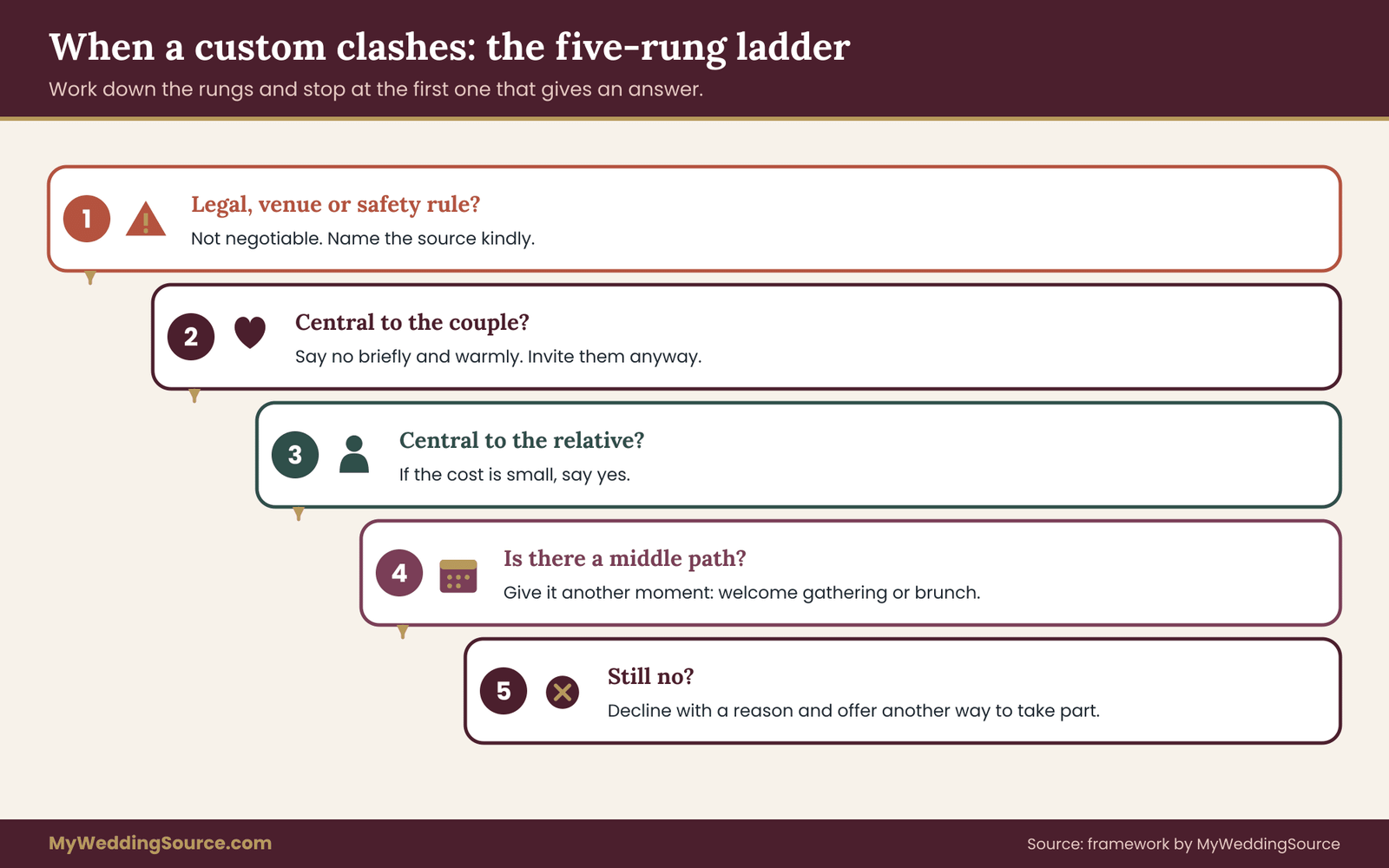
Even a perfect brief on American wedding customs cannot remove every disagreement. Sometimes a relative says that a custom is wrong, or insists on adding one from home that the couple has not planned. A simple ladder helps you decide what to do without making it a family dispute. Work down the rungs in order and stop at the first one that gives you an answer.
Rung one: is it a legal, venue or safety rule? If the custom concerns the marriage license, a venue policy, a fire rule or a safety matter, there is nothing to negotiate. Say so kindly and name the source: “The venue does not allow open flames, so we cannot light candles in the room.” This is not a personal rejection. If you are unsure which rules apply, ask the venue and the licensing office, not relatives.
Rung two: is it central to the couple? Some choices matter to the couple for reasons they may not want to explain. If a relative wants a different ceremony order, a different song or a different dress code, and the couple’s answer is no, a short, kind statement is enough. “We have decided on this, and we would love to have you with us” does not invite debate. The guide to wedding etiquette offers more on how couples hold boundaries without hurting feelings.
Rung three: is it central to the relative? Some customs matter deeply to a grandparent or an aunt: a blessing, a specific food, a moment of prayer, a gift ceremony. If the cost to the couple is small, say yes. A blessing before dinner, a short song, or a seat at the front costs little and gives the relative a real place in the day.
Rung four: is there a middle path? Where both sides care, look for a separate moment. A custom that cannot fit the ceremony may fit the welcome gathering or the brunch. A gift ceremony can happen privately, a day before the wedding. A longer speech can be recorded and played later. The point is to give the custom a home, not to win an argument.
Rung five: say no with a reason and an alternative. If none of the above works, say no clearly, offer another way to honor the relative, and move on. A relative who is respected usually accepts a no more gracefully than one who is deflected.
Alternatives to the card method for American wedding customs
The card method is not the only way to explain American wedding customs, and for some families it is not the best one. If your guests are few and close, a phone call and a single message may be all you need. If a guest strongly prefers spoken explanation, a recorded voice note replaces the cards. If your wedding follows a faith tradition that has its own detailed expectations, the officiant or a family elder may be a better source than a written brief.
And if some relatives will not read anything, a person at the venue who walks them through each moment is the only approach that works. Choose the method that fits the people, and keep the three-line habit in your head: what it is, what you do, what you may skip.
Failure conditions
Any method for explaining American wedding customs has limits, and it is better to name them now than to find them on the wedding day. The brief on American wedding customs will fail, or at least fall short, in these situations.
The cards describe a day that is not the day. If the schedule changes and the cards do not, the brief becomes a source of confusion. Assign one person to update the cards and resend only the changed ones, with the word “updated” and the date.
The language is not the reader’s. A brief in English for a reader who cannot read English is not a brief. If a reader needs a translation and you cannot provide a reliable one, use a spoken explanation instead.
The tone is a lecture. Overseas relatives who feel talked down to tend to stop reading. If readers react with irritation, shorten the cards and remove comparisons.
The brief hides a dispute. If the family disagrees about a major choice, such as who walks whom, who sits where, or whether children are invited, a card cannot settle it. Resolve it in a conversation, then write the card.
The brief makes promises you cannot keep. If you promise a translator, a driver or a quiet room, make sure someone has the job. A guest who was told help would be there and finds none feels worse than one who was told nothing.
The relative is traveling on rules that you are guessing. A brief on American wedding customs is not an immigration guide. Entry, visa and customs questions belong with the U.S. Department of State, U.S. Customs and Border Protection and the relative’s own airline. Do not promise that a visa will be approved or that a particular document will be accepted; only the issuing agency can decide.
A final check before you send
Read the brief once as if you were arriving in a new country. Ask whether you know where to go, when to arrive, what to wear, what to say to a stranger, and what to do with a gift.
If any answer is “I would have to ask,” add a card or a line. If any answer is “I would have to ask, and I would not know whom,” add a contact. That last step, a name and a phone number, is often the difference between a relative who enjoys the weekend and one who spends it anxious.
Your next steps
Start small with American wedding customs. A two-page brief that goes out on time beats a polished one that goes out late.
- List the events relatives will attend, in order, with start times, dress and who is invited.
- Choose the American wedding customs cards you need from the glossary above and write each in three lines.
- Read the set aloud and cut anything that sounds like a lecture or a comparison.
- Name one person who can answer questions at the venue in your relatives’ language.
- Send the brief at least a month before travel, and offer a short video call.
- Ask relatives what they expect and what they hope to take part in, and adjust where you can.
- Send a one-page reminder in the final week, with times, addresses and the contact’s number.
If your guest list or invitation wording is still in progress, begin with the wedding guest list guide so that the people in your brief match the people on your list, and revisit the registry choices in your wedding registry ideas before you point relatives to a gift page.
FAQ
Do I have to explain every one of the American wedding customs to relatives from overseas?
No. Explain only the customs that affect what a guest must do or where they must be, such as the schedule, the dress code, the ceremony phone rule, the bar and gifts. Skip anything a guest can safely watch without acting. A short brief of ten to fifteen cards is usually enough. If a relative is curious about the history of a custom, offer a separate page or a conversation.
What is the simplest way to describe American wedding customs without sounding condescending?
Describe what happens, name what is optional, and avoid comparisons to other countries. Use phrases such as “many couples do this” and “you may skip this.” Write as one family member to another, not as a teacher. Ask a relative from the same background to read the draft, and change any sentence that sounds like a rule or a correction.
Should relatives bring a gift when they travel from overseas?
Not necessarily. Many American couples consider the guest’s presence the gift, especially when the guest has traveled far. Say so directly so that relatives do not feel they must carry presents. If relatives wish to give something anyway, point them to the registry, a card with a note, or a mailed gift. Mailing is often easier than carrying items on a flight.
How do I explain tipping at a wedding reception?
Say that tipping is common in the United States, but that many weddings include a service charge in the catering contract, and that guests do not need to tip separately in that case. Check your contract before you write the card. Tell relatives to ask the host if they are unsure. The U.S. Department of Labor publishes general information on how tips work for workers.
What if a relative wants to add a custom from their home country?
Ask what it involves and what it means to them. If it fits safely and the couple agrees, give it a place, perhaps at the welcome gathering or the brunch. If it does not fit, explain why, thank them and offer another way to take part, such as a blessing, a reading or a toast. Decide as a couple before the conversation.
Do I need to translate the guide into another language?
Only if relatives cannot read English comfortably. Translate the short cards, not the long article, and have a fluent reader review the result. Add the English term in parentheses so relatives can recognize it on invitations and signs. For legal or immigration documents, use a professional translator. For the brief, a family member who knows both languages is usually adequate.
Can I explain these customs in person instead of in writing?
Yes, and for older relatives it often works better. Use a video call or a short meeting with the weekend map in front of you. Walk through the schedule and the few customs that require action. Follow up with a one-page written summary so that relatives can check the details later. A named contact at the wedding is a useful addition.
How do I handle visa or entry questions from relatives?
Do not give advice on eligibility or promise results. Direct relatives to the U.S. Department of State for visa information and to U.S. Customs and Border Protection for entry questions, and suggest that they check current requirements well before booking flights. An invitation letter can describe the event, but it does not guarantee a visa. Only the issuing authorities make those decisions.
Sources
- U.S. Department of State, Bureau of Consular Affairs
- U.S. Customs and Border Protection
- USA.gov, Marriage and Divorce
- U.S. Citizenship and Immigration Services
- National Institute on Alcohol Abuse and Alcoholism, Alcohol Policy Information System
- U.S. Department of Labor, Wage and Hour Division
- United States Postal Service, International Mail and Shipping
- Library of Congress, American Folklife Center
- Smithsonian Institution