
A small backyard vow renewal is a ceremony for 10 to 20 guests held on your own lawn, patio or garden, and it succeeds or fails on host logistics rather than on décor. This checklist gives you a one-page host worksheet, a worked case, the alternatives to consider and the conditions that tell you to change the plan.
Run a backyard vow renewal as five stations: arrival, seating, the vows, the table and departure. Give each station one owner, one supply list and one stop condition. Measure the yard before you count chairs, pick a weather decision time, plan food that survives two hours outside, and write down what each older, young or mobility-limited guest needs. If three or more stop conditions are already true, move the backyard vow renewal to a different place instead of patching the yard.
Most advice about renewing vows talks about the words. That matters, but for a gathering of 10 to 20 people at home the words take about four minutes of a two-hour afternoon. The other one hour and fifty-six minutes is about chairs, shade, food that sits in the sun, a grandparent who cannot manage the back steps, a toddler who needs a nap, and a neighbor who has an opinion about amplified music.
A backyard vow renewal is small enough that it feels easy, and that feeling is the trap. Nobody hires a coordinator for a small backyard vow renewal, so nobody owns the details.
This guide gives you the owner. It treats a backyard vow renewal as a short service that you, the host, are running, and it gives you a compact worksheet to run it with. You will use the worksheet three times: once at the decision stage, to see whether your yard and your budget can carry the plan; once a week before, to lock supplies and assignments; and once on the day, as a card in your pocket.
A note on scope. This is general planning information, not legal, tax or financial advice, and it does not replace the rules of your town, your homeowner association, your insurer or your faith community, which you should confirm yourself. A renewal ceremony does not change your legal marriage in any way, so the paperwork questions that come with a first wedding do not apply here.
What a small backyard vow renewal is, and what this checklist covers
A renewal is a ceremony in which two people who are already married say again, in front of chosen witnesses, that they would choose each other today. A small backyard vow renewal puts that moment in a private outdoor space you control, with a guest list in the range of ten to twenty.
Ten is roughly the point where a couple stops being able to treat the gathering as a dinner with a toast. Twenty is roughly the point where a home yard, a household kitchen and one host’s attention begin to run out. That is why this guide stops at twenty.
The advantages of a backyard vow renewal are real. You control the schedule, nobody rents a room by the hour, children can wander, and the ceremony can happen at the moment the light looks good instead of the moment a venue allows. The costs are also real. There is no venue staff, no backup room, no restroom attendant and no one whose job is to say, kindly, that it is time to move everyone inside.
A backyard vow renewal puts the host in the position of venue manager, caterer and safety officer, while also being the person who is supposed to be emotional about the day.
What this guide does and does not cover
It covers the logistics of the afternoon itself: whether the yard works, who is invited and how, the time plan, seating and sound, food service, guest care, weather, neighbors and cleanup. It also covers a worked case, the alternatives and the failure conditions.
It does not cover the choice of renewal format in the first place, such as whether to renew privately, with family or as a hosted event. If you are still deciding that, start with the site’s broader planning material on the wedding ceremony step by step, which lays out the order of a ceremony that you can shrink or stretch, and come back once you have chosen a hosted, at-home format.
It also does not cover writing vows, outfits, or a long-distance gathering. Those are separate decisions, and mixing them in here would bury the logistics that this article is for.
Who this checklist is for
It is for the person who will actually be standing in the kitchen at noon on the day: usually one of the two renewing partners, sometimes an adult child, sibling or close friend who has been handed the job. If that person is also one of the renewing couple, the checklist includes a handoff step so that they are not carrying the cooler during the vows. If the host is someone else, give them the worksheet first and the rest of the guide second.
The size range also sets expectations. At ten to twenty guests you can seat everyone at one set of tables, hear a speaker without a microphone if the yard is quiet, and feed everyone from one small serving area. Those three facts are the reason this guide can offer a simple method. If your backyard vow renewal list creeps past twenty, the method still helps, but the single-table and no-microphone assumptions begin to fail, and the article notes where.
The host worksheet: five stations, one owner each
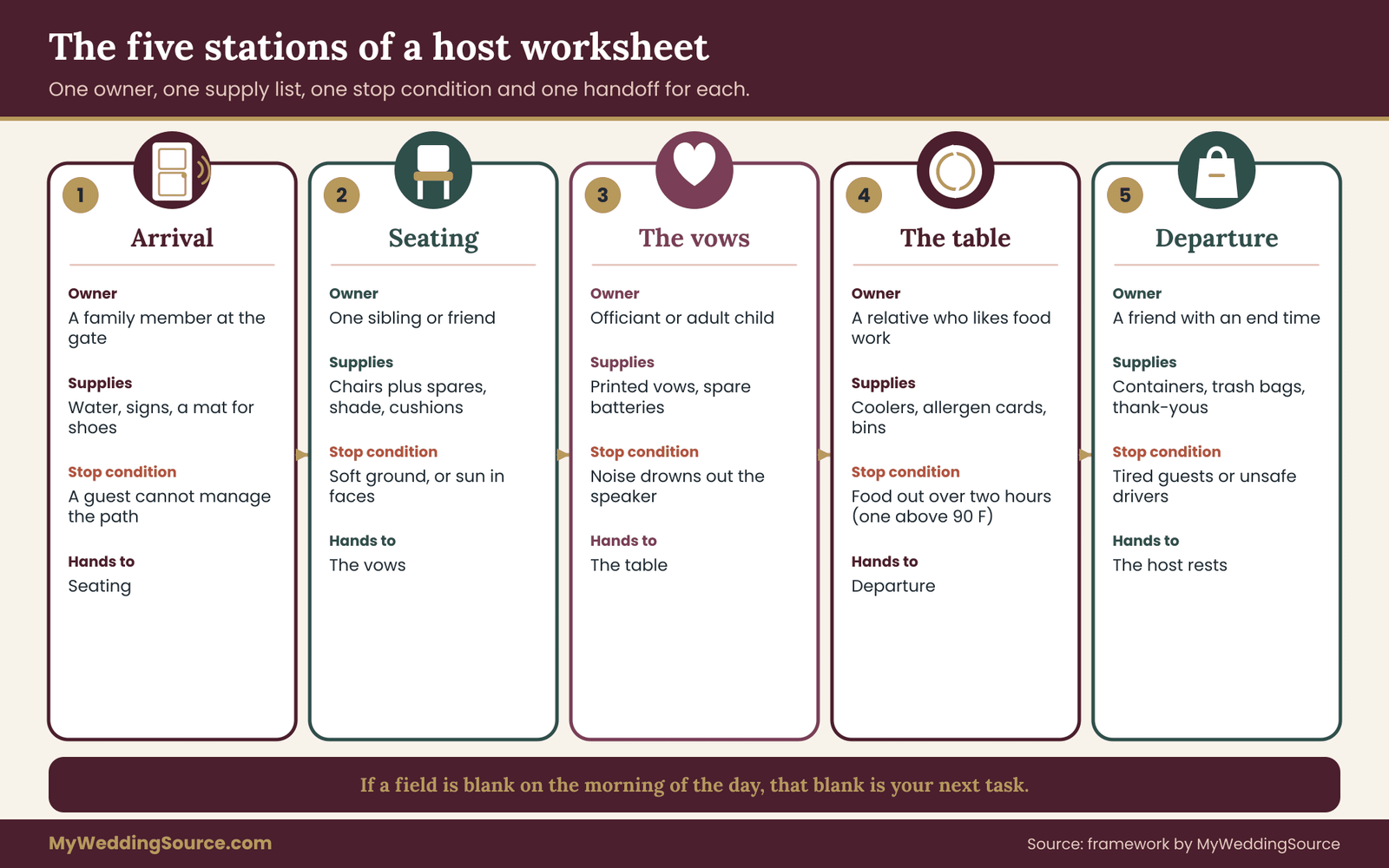
The worksheet at the center of this backyard vow renewal checklist is deliberately small. Instead of a hundred line items it asks you to divide the afternoon into five stations and fill in four fields for each. If a field is blank on the morning of the day, that blank is your next task.
For how guests move through a larger reception, the site’s guide to reception guest flow is the full-size version of this idea. The five stations are the places where guests actually experience the afternoon, in the order they meet them.
Arrival. From the moment a guest leaves the car or the sidewalk to the moment they have a drink in hand and a place to stand. This includes the path, the gate, the doormat question, the shoes question, where bags go and who greets people.
Seating. The ceremony seats, the shade, the sun angle and the route to the chairs. This is where older guests and mobility needs show up first.
The vows. The four to ten minutes of the actual ceremony: who speaks, who holds the officiant role, how people hear, where the photographer or phone stands, and what happens if a child cries.
The table. Food, drink, plates, utensils, trash, allergens, and the temperature of everything that sits outside. This is the station most likely to cause a real problem, and it is covered in its own section later.
Departure. The last twenty minutes: leftover food, thank-yous, who is driving, who helped and when they can go, and the trash. A good departure is the difference between a pleasant memory and an exhausted host.
The four fields for every station
For each station the worksheet has the same four fields.
Owner. One named person, not “the family.” The owner can delegate, but they answer for the station. A cousin who has been asked to “keep an eye on drinks” has been given a task. A cousin who has been told “the table is yours from two o’clock until the cake is cut” has been given an owner role. People behave differently under those two sentences.
Supplies. A short list of physical things that the station needs, such as chairs, a cooler, a trash bag, shade cloth or a speaker. Write quantities next to each, not just names.
Stop condition. The specific fact that tells the owner to pause and call the host. For arrival, it might be a guest who cannot manage the path. For the table, it might be food that has been out for more than an hour in hot weather. A stop condition turns worry into a rule, so nobody has to improvise under pressure.
Handoff. What the owner passes to the next station when their moment is over. Arrival hands guests to seating; seating hands attention to the vows; the vows hand people to the table; the table hands leftovers and trash to departure. Handoffs are where small events drop things, so each one needs a spoken cue, such as “we are going to sit now.”
Using the worksheet at three moments
At the decision stage of your backyard vow renewal, fill in only owner and stop condition for each station. If you cannot name an owner for two or more stations, or if you already know a stop condition is true, you have learned something before spending any money.
A week before, fill in supplies with quantities and fix the weather decision time described later. Share the page with the owners, one station each, and ask them to confirm by message. A confirmation in writing is faster than a phone tree and gives you a record.
On the day, fold the sheet to a pocket-sized card with the five stations, the owners’ names and the stop conditions. The host’s job on the day is not to do everything. It is to read the card, notice when a stop condition has been met and make the call.
A quick test of whether the worksheet fits you
Try a ten-minute test. Take a blank page, write the five station names down the left, and write an owner for each from memory. If you can do it in under ten minutes without help, your plan has a workable shape and the rest of this guide will tighten it. If you get stuck on arrival or departure, that is common: those two stations are the most commonly forgotten, because they happen before and after the part that feels like the backyard vow renewal.
If you get stuck on three or more, read the section on alternatives before you spend anything. Not every backyard vow renewal needs a rescue. Sometimes the right fix is a smaller guest list, a shorter afternoon or a different place, and the sooner you find that out the cheaper it is.
Is your yard right for a small backyard vow renewal?
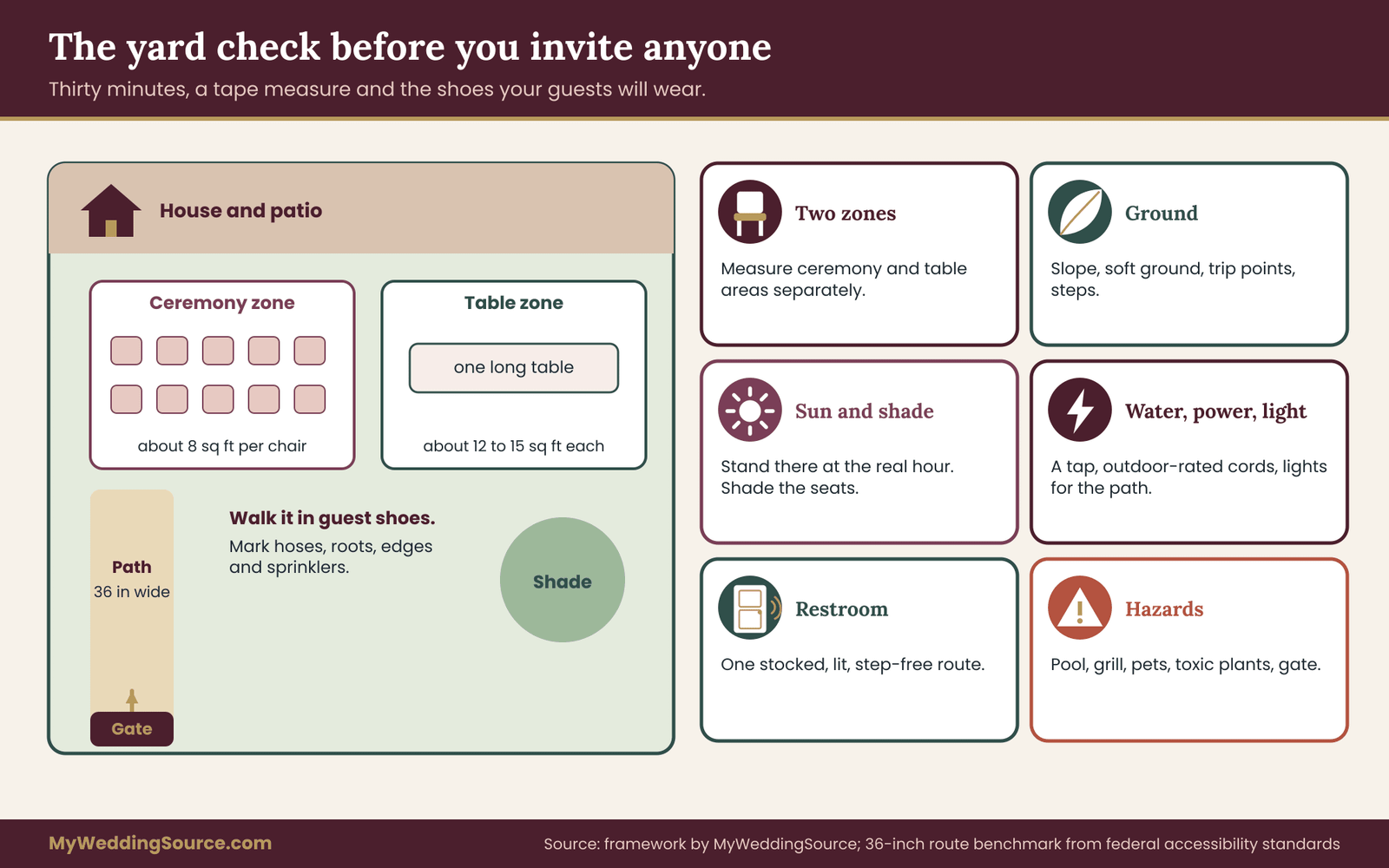
Before you pick a date for a backyard vow renewal, spend thirty minutes in the yard with a tape measure, a phone and a pad of paper. The question for a backyard vow renewal is not whether the yard is pretty. The question is whether eighteen or twenty people can arrive, sit, eat and leave without anyone stepping into a flower bed, a slope or a hazard. A small backyard vow renewal in a yard that fails this check turns into a series of apologies.
Measure the ceremony zone and the table zone separately
The most common mistake in a backyard vow renewal is to measure the yard once and assume everything fits. A gathering has two zones that cannot occupy the same patch of grass at the same time: a ceremony zone where chairs face the couple, and a table zone where people eat. Some couples try to stack them in one area and rearrange between the two. That can work, but it needs helpers and time, and the rearranging happens right when guests are most restless.
As a rule of thumb used by many event planners, and not a safety standard, allow about eight square feet for each person in rows of chairs and roughly twelve to fifteen square feet for each person who is seated at tables with room to move behind them. For eighteen guests plus the two of you that is about 160 square feet for chairs and about 240 to 300 for tables.
Write your own numbers on the worksheet. A yard that is thirty feet by twenty has 600 square feet, which is enough for both zones with a walkway, but not enough if a third of it is flower beds, a fire pit or a slope.
If the zones cannot be separate, choose which one wins. For a small group, tables usually win, because people stay at them longest, and the ceremony can happen standing in a circle for four minutes.
Check the ground, not just the grass
Walk the route you expect guests to take, in the shoes you expect guests to wear. Look for four things.
Slope. A gentle slope looks harmless and feels very different with a walker, a cane or a stroller. Water that runs downhill also carries heavy rain toward whatever you set up at the bottom.
Soft ground. After a watering or a rain, a lawn can hold narrow heels like a drainpipe. Chair legs sink unevenly, and tables tilt. If your ground is soft, plan for mats or boards under the legs, or choose a hard-surface patio, even if it is less attractive.
Trip points. Garden hoses, sprinkler heads, tree roots, a raised edge where the patio meets the lawn, an extension cord. Mark them with a bright tape or move them. Do not trust that everyone will see them in the glow of a conversation.
Steps. Count every step between the car or sidewalk and the ceremony seats, and between the seats and the nearest restroom. A single step is a barrier for someone with a wheelchair, and a short set of steps can stop a guest with arthritis from joining. Federal accessibility standards for public spaces use 36 inches as a minimum clear width for an accessible route, and while a private yard is not bound by those standards, thirty-six inches is a practical benchmark for a path that a wheelchair or walker can use.
Read the sun and the shade for the actual hour
Stand in the ceremony zone at the time you plan to hold the event, not at noon. Where will the sun land on the faces of the guests who are facing the couple? Squinting guests do not hear well and look unhappy in photographs. If the couple faces the sun, the guests will be backlit and the photos will be dark.
If the guests face the sun, they will squint. The usual fix is to turn the seating so that the sun comes from the side, and to put the couple in the shade of a house, tree or canopy.
Shade matters for health as well as comfort. The National Weather Service and the Centers for Disease Control and Prevention both publish heat safety guidance, and both stress that older adults and young children are more at risk in hot weather. For a backyard vow renewal in warm months, plan for shade over seats, not just over the couple, and treat a canopy or a large umbrella as a safety item, not a decoration.
Water, power and light
A small backyard vow renewal needs less infrastructure than a large wedding, but it still needs a few things.
Water. A hose bib or tap near the table zone lets you fill pitchers and wash hands without crossing the house. If the water source is inside, mark the route and decide whether guests will come in. Keep a pitcher of drinking water at the seats, not only at the table.
Power. Count what you will plug in: a speaker, a slow cooker, lights, a phone charger. Outdoor extension cords must be rated for outdoor use, and they should not run across a walkway unless covered. If the outlet is a single one on the back porch, plan which of those devices actually needs power and skip the rest.
Light. If any part of the backyard vow renewal will run past sunset, plan lights before you plan music. Walkways, steps and the path to the restroom need dependable light that does not rely on candles. Candles on the table are fine for atmosphere if they are in enclosed holders and watched. The Consumer Product Safety Commission and the National Fire Protection Association publish general guidance on candle and fire safety, and a lawn with dry grass is a poor place for an open flame.
Restrooms are part of the yard
For a backyard vow renewal, count the number of people, divide by the number of restrooms available, and ask how long a line would be. For ten to twenty guests, one household bathroom is usually workable for a two-hour event, but not for a four-hour one, and it becomes a problem if you have several older guests and children who each take longer. Make sure the restroom is stocked before the day, check that the route is clear and lit, and tell guests where it is during the welcome.
If you have a septic system or an older home, give the plumbing a gentle question before the backyard vow renewal, because twenty guests use more water in two hours than a household does in a normal afternoon.
Pets, pools and other hazards
Walk the yard once more looking only for hazards that could interrupt the backyard vow renewal. Is there a pool or a pond with no fence? A grill that is still hot from lunch? A garden bed with plants that are toxic to children or pets? A dog that is friendly with family but reactive with strangers? Each of these is a stop condition. For a pool or a pond, assign a person who watches children and does nothing else.
For a dog, decide in advance whether the dog is part of the ceremony, in another room or at a friend’s house. A dog that is anxious is a risk to the dog and the guests, and a dog that is cherished is not a reason to put him in the middle of the lawn.
The yard verdict
At the end of the thirty minutes, write down one of three verdicts.
Works as is. The zones fit, the ground is stable, the route is clear, there is shade and a restroom. Proceed.
Works with named fixes. One or two items fail, and you can fix them with a cheap rental or a morning of work, such as a canopy, boards under chair legs or a ramp. Write the fix and the cost next to each. If the fixes add up to more than a quarter of your planned spend, reconsider.
Does not work. Three or more items fail, or any one fails in a way you cannot fix, such as a steep slope between the car and the seats for a guest who uses a wheelchair. In that case a backyard vow renewal is not the right format for this yard. The section on alternatives covers what to do instead, and it is better to decide now than after you have sent invitations.
The rest of this backyard vow renewal guide assumes you landed on one of the first two verdicts. If you did, the next question is who is coming and how you ask them.
Guest list and invitations for a small backyard vow renewal
Ten to twenty is a narrow range for a backyard vow renewal, and the way you build the list inside it changes the whole afternoon. Ten guests plus the two of you is a table-sized gathering where everyone talks to everyone. Twenty is a small party where groups form, and where one person can easily feel left out. Decide which kind of backyard vow renewal you want before you write names down.
Start with a core list, then add in rings
Write the core first: the people whose absence would make the day feel wrong. For many couples that is children, parents, siblings and one or two witnesses who have known the marriage from the inside. Count them. If the core alone is fourteen, you have six seats left, and that number is your real constraint.
Then add in rings. The second ring is close family and friends you see several times a year. The third ring is people you like and would be glad to see but who would not be hurt by not being invited. Fill the second ring first, and stop when you reach your number.
The third ring is where lists grow without anyone deciding, which is why a written cap is helpful. A small backyard vow renewal that grows from sixteen to twenty-six guests is a different event, with different food, seating and bathroom needs, and the extra ten arrived without any decision.
If you are tempted to include a person out of obligation, ask one question: would I be glad they were here during the vows, or only at the food? If only the food, invite them to a separate, simpler gathering afterward, such as a casual dinner, and keep the renewal for people who will be present during it.
Children, plus-ones and the headcount rule
Decide the rules about children and partners before you send anything. A rule that is stated once is easier than a hundred exceptions. Children from the immediate family are usually welcome, and you can say so. For friends’ children, you can choose to include or not, but be consistent. Name each guest on the envelope or message, so a plus-one is clear without a conversation.
Use a single headcount that includes everyone who will eat: guests, the two of you, children of any age, and anyone who is helping and will also be fed. Many hosts count adults and forget the six-year-old and the neighbor who is lending the tent. Add two spare seats and two spare servings to the final number, because there is almost always one person who arrives with someone unplanned, and a spare seat is easier than an awkward conversation.
How to invite for a small gathering
For a backyard vow renewal of this size a personal message works better than a printed invitation, though some couples enjoy sending a card. Whatever you use, include these items in this order, because that is the order people look for them:
- The date, start time and an end time, so people can plan around it.
- The address, with a note on where to park or be dropped off.
- What the backyard vow renewal is, in one sentence: a short ceremony in the backyard where you will renew your vows, followed by food.
- What to wear, with the ground in mind, such as “casual and outdoor-ready, and flats are friendlier on the lawn.”
- What to do about dietary needs, including a date for replying.
- The weather plan, such as “if it rains we will move inside, and we will message by noon.”
- A clear line about gifts, if you want one.
That list is longer than it looks, but each item answers a question that would otherwise reach you as a message at the worst time. One paragraph of plain text can carry all of them. For wording and etiquette around invitation tone and phrasing, the site’s guide to wedding etiquette covers the courtesy questions that carry over, such as how to word a request for no gifts without sounding stiff.
Saying no to gifts and to the plus-one
Many couples renewing vows after years together do not want gifts, and say so. For a backyard vow renewal, a short line works: “Your company is the gift, and we would prefer no presents.” People who still bring something will do so quietly. Do not attach an explanation about registries or donations unless you actually want to direct giving somewhere, in which case name the cause or charity yourself, after checking that it is genuine.
For plus-ones, the kind answer is the clear one: “We are keeping the gathering to the people named on the invitation.” Say it the same way to everyone, and offer no exceptions that you would not give to a sibling.
Reply deadlines that work
Set the reply date about ten days before the event, which gives you time to order or prepare food and to chase the last few. Ask guests to reply to a single person, preferably the host, to avoid scattered answers. When someone has not replied by the deadline, send one short message: “Can I count you in?” A second message is rarely needed.
In the reply, ask for four things only: whether they are coming, how many people are in their party, any food needs, and any access needs, phrased as “anything that would make the afternoon easier for you.” That last question lets a guest quietly mention a cane, a hearing aid or a nap schedule without being singled out. You do not need to ask for a diagnosis or a reason, and you should not.
A short guest roster on the worksheet
On the worksheet, make a simple roster with each guest’s name, the party size, food needs, access needs and a transport note. It is a list, not a table of data: one line per household with the facts that affect your plan. Keep it private, and do not send it around. If you have a helper managing arrivals, give them only the portion they need, which is usually names and access needs.
Inviting the people who cannot come
Some people on the core list will live far away or cannot travel. A short message that says you are sad they cannot be there and you will share a few photos afterward costs nothing and helps. If you plan a livestream for a faraway relative, tell them the start time and a backup plan, and check the internet signal in the yard before you promise it.
A weak signal in the back corner of a garden is common, and a stream that fails during the vows is worse than none. The site’s material on wedding guest care planning covers how to think about babies, children and older relatives, which is useful when your list mixes ages.
The time plan for a backyard vow renewal: ninety minutes to three hours
A backyard vow renewal does not need the hour-by-hour schedule of a large wedding, but it does need a rhythm. Guests who do not know what is coming get restless, and a host who does not know what is coming gets overwhelmed. A short plan with five or six times on it is enough.
Pick the length by the guests, not the mood
The length of a small backyard vow renewal is set by the least comfortable guest. Young children usually have a window of two hours before behavior shifts. Older guests may tire after two to three hours, particularly in heat. Guests with medication schedules or dietary needs may need to eat on time. If your guest list includes any of these, plan for about two hours of formal event, with an option to stay longer for those who want to.
A workable shape for an afternoon event is: guests arrive over twenty minutes, a ten-minute settling period with drinks, the ceremony, photographs, a seated meal or buffet, a short toast, cake or dessert, and then a soft ending. The soft ending matters. It is the point where you say, “We will be here a while longer if you want to stay,” and give anyone with a reason to leave permission to go without feeling rude.
Choose the hour with the weather in mind
Late morning and late afternoon are usually the most comfortable times in warm months, because direct overhead sun and peak afternoon heat are both avoided. In cooler months, the middle of the afternoon is warmest. Ask yourself where the sun will be, how warm it will be at that hour, and when mosquitoes and other insects become active. The Environmental Protection Agency publishes advice on mosquito control around the home, and it is worth a quick read if your yard has standing water.
If you hope for a sunset backyard vow renewal, remember that the temperature drops quickly and light fades fast. Plan the vows for about forty-five minutes before sunset, so the photographs happen in good light and the meal begins as it gets dark, with lights already set.
A sample run of a two-hour afternoon
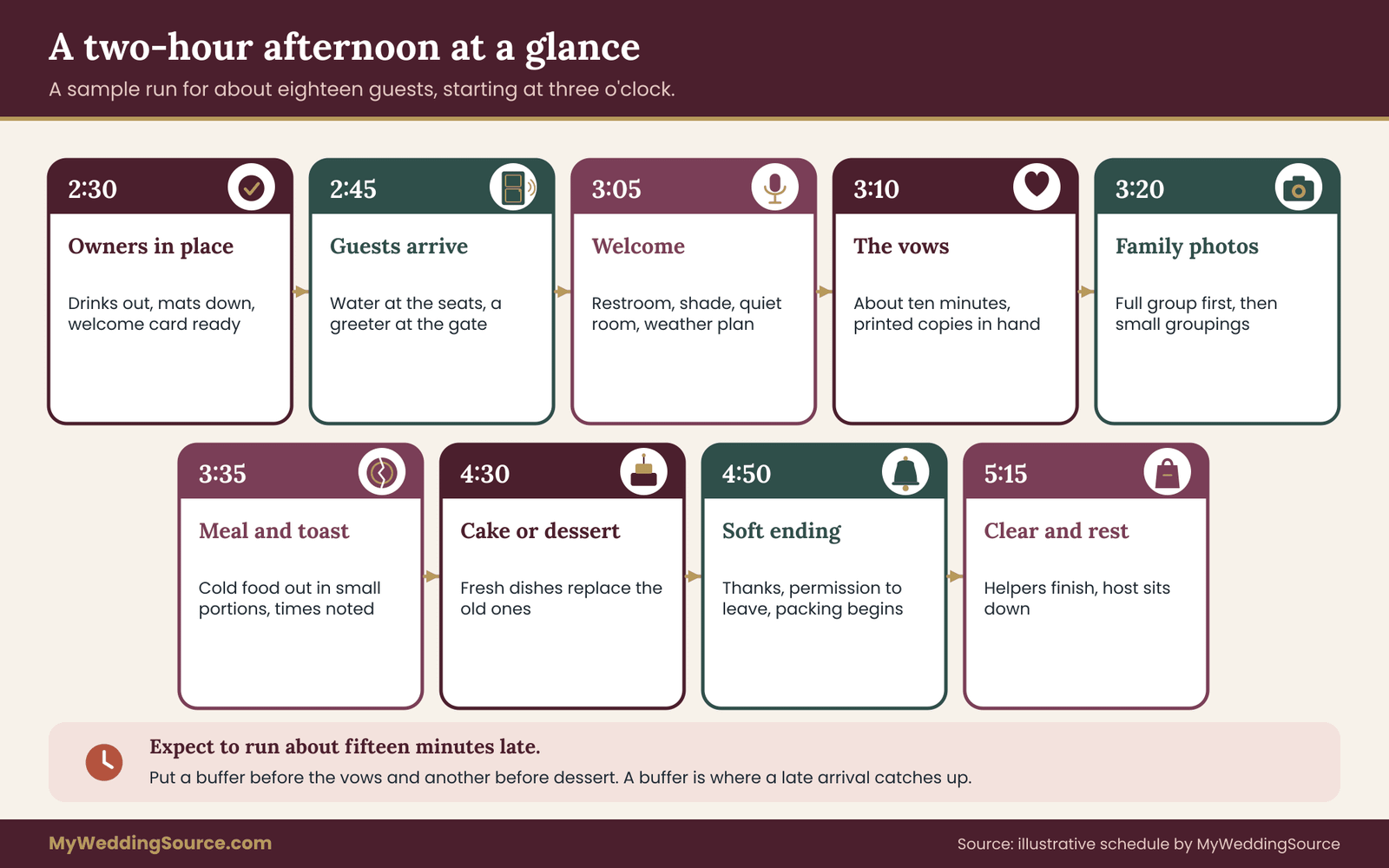
Here is a plan that you can adapt. It assumes a three o’clock start and about eighteen guests.
At 2:30 the arrival owner is in place and the table owner has set out drinks and a first snack. Guests arrive between 2:45 and 3:05. At 3:05 the host welcomes everyone, explains where the restroom is and tells people where to sit. At 3:10 the ceremony begins and lasts about ten minutes. At 3:20 the couple steps aside for ten minutes of family photographs while guests have a drink.
At 3:35 the meal starts, with a short toast during the first ten minutes. At 4:30 the cake or dessert is served. At 4:50 the host thanks everyone, and the departure owner starts clearing leftovers. By 5:15 most guests have left, and the helpers stay to finish.
Build buffers into the plan
Every backyard vow renewal runs about fifteen minutes late. Someone arrives at 3:20, a child needs a restroom, a toast goes long. Add a buffer between arrival and the ceremony, and another between the meal and the dessert. A buffer is not wasted time. It is the space where a late arrival catches up and where the host takes one breath.
If you have a fixed external deadline, such as a neighbor’s quiet hour or a guest’s flight, plan backward from it. Write the deadline on the worksheet. Mention it once to the person who is most likely to stay longest.
Seating, sound and the ceremony at a backyard vow renewal
In a backyard vow renewal the ceremony is the shortest station and the one that guests will remember. For ten to twenty people it can also be the simplest to run, as long as everyone can see, hear and sit comfortably for about ten minutes. A backyard vow renewal that is short and clear usually feels more moving than a long one, and the logistics are what protect that.
Seating layout for 10 to 20 guests
Three layouts work for a backyard vow renewal of this size.
Two short rows facing the couple. Good for twelve to twenty guests. Two rows of six to ten chairs, with an aisle in the middle or none at all. Simple, familiar and easy to photograph.
A horseshoe or semicircle. Good for ten to sixteen guests. People see each other and the couple, and it feels intimate. It needs more floor space, and it works best on level ground.
Standing circle. Good when seats are limited, ground is rough or the ceremony is under five minutes. Place a few chairs at the edge for anyone who needs to sit, and tell guests they can use them without asking.
Whatever you choose, reserve the aisle-end seats in the first row for guests with mobility needs, and put a spare chair at the back for someone who needs to step away. Leave a clear path at least three feet wide, so a walker or wheelchair can come and go without lifting anyone.
Do not put chairs right at the edge of a slope, close to a hot grill or under a branch that looks heavy. Check the chairs themselves: folding chairs on grass need a firm, flat footing, and an older guest should have a chair with arms if possible. A small stool or a cushion beside the seats makes a good place for a child to sit.
Who speaks and who officiates
A backyard vow renewal has no required officiant. Couples choose a friend, a family member, a faith leader, an adult child, or they lead the ceremony themselves. Decide who is in charge of the pace. This person introduces the moment, invites the vows, and closes. They do not need to be an authority. They need to be calm, audible and short.
If your faith community has customs or requirements about renewal blessings, confirm them individually with a leader of that community before the date. Do not assume that a general format will match the practices of a particular tradition. Ask early, because some blessings need a leader to be present and scheduled.
The site’s walkthrough of each part of a ceremony in order gives a sequence of ceremony parts you can trim. For a backyard vow renewal, a four-part outline is enough: a welcome of one or two sentences, the vows, an exchange of rings or a small gesture if you want one, and a closing line that tells guests the ceremony is done.
Sound without a microphone
In a quiet yard at a backyard vow renewal, a person speaking at a steady, clear pace can be heard by twenty seated people without any equipment. Three things work against that: wind, traffic and a lawn mower next door. Test the yard before the day. Stand where the couple will stand, ask a friend to sit in the back row, and say a few lines at a normal speaking volume. If the friend cannot hear you, you have a sound problem.
Fixes in order of cost: move the ceremony nearer to the house, which blocks wind and noise; seat guests closer; ask the speakers to face the guests and slow down; use a small battery-powered speaker with a handheld microphone. If you borrow equipment, test it at the same spot the day before, with fresh batteries and spare ones. Do not rely on a phone speaker for vows.
If a guest is hard of hearing, seat them in the front row and give the person a copy of the vows or a short program with the words. That is a kindness to them and costs a sheet of paper.
The vows themselves, practically
The words of your backyard vow renewal are yours to write, and other guides cover them in depth. For logistics, three points. Decide whether you will read or recite, and bring printed copies either way; people who are moved forget their lines. Keep each person’s vows to about a minute, since a long speech outdoors, in heat or with children, can lose the audience. Hand a printed copy to whoever is officiating, in case of wind or a dropped phone.
If you are including children in the ceremony, give them a clear, small job: carry rings, hold a flower, say one line. A child who has a job has a reason to stay still. A child who has no job will find one.
Photographs, phones and a clear request
A backyard vow renewal is a moment people want to capture, and twenty phones raised at once can block the couple’s view and each other’s. Decide in advance what you want. You can ask guests to keep phones away during the vows and invite them to take photographs afterward. You can name one or two people as photographers and ask the others to watch.
A brief line from the host before the ceremony, such as “We would love for you to be present with us for the next few minutes, and there will be plenty of time for photos after,” works and does not require a long explanation.
If you hire a photographer for an hour, tell them the plan, the shade, the sun angle and the list of groupings you want. For a small backyard vow renewal a family photograph list of five or six combinations is enough: the couple alone, with children, with parents, with siblings, and the full group. Take the full-group photograph before food is served, when everyone is neat and attentive.
If you are recording audio or video of the vows for a keepsake, check the sound beforehand and keep a second recorder, such as a phone in a pocket near the couple. Do not wait for a second take, because there will not be one.
Food and drink for 10 to 20 guests: what survives two hours outdoors
Food is the station where a backyard vow renewal most often goes wrong, usually quietly. A tray of chicken salad left in the sun for three hours does not look dangerous, but it can make people ill. The good news for any backyard vow renewal is that a small number of rules handle most of the risk.
The two-hour rule and the hot-day exception
The U.S. Department of Agriculture’s food safety guidance says that perishable food should not sit out for more than two hours, and for no more than one hour when the temperature is above 90 degrees Fahrenheit. Cold food is meant to be kept at 40 degrees or below, and hot food at 140 degrees or above, according to the same guidance. The agency’s foodsafety.gov site explains the details. These are the rules that matter most for a backyard vow renewal, because the food usually sits on a table in the open air.
Practically, that means you need a plan for time as well as temperature. Put out only part of the food at first, keep the rest refrigerated or in a cooler, and replace dishes with fresh ones instead of topping up the old ones. Cover dishes against insects. Write on the worksheet the time each perishable dish first came out, and give the table owner permission to remove anything that has passed the limit, without asking.
Choosing a food format
There are four common food formats, each with a different load on the host.
Catered and delivered. A restaurant or caterer delivers ready-to-serve food in warming trays. Least work for you, most cost. Ask what the caterer provides: plates, utensils, serving tools, fuel for the warmers, and pickup of trays.
Self-serve buffet from home. You prepare dishes in advance and serve from a table. It is the most common choice for this size. It needs the most refrigeration and the most disciplined timing.
Seated meal at one table. Dishes pass family style, and the table owner clears between courses. It suits twelve to sixteen guests and feels intimate, but needs a table that fits everyone, plus hands to pass and clear.
Light fare only. Small bites, a cake, drinks, and a toast. It is the lowest effort and works well for a short afternoon event that does not overlap with a meal.
If you are cooking at home for twenty, a household kitchen has real limits for a backyard vow renewal this size: oven space, refrigerator room and burner count. For a first attempt, choose dishes that are safe at room temperature for a short time, such as baked goods, fruit, hard cheeses, crackers, grain salads without mayonnaise and cold platters that live in a cooler until needed.
Allergens and dietary needs, without drama
Ask guests about allergies and diets in the reply. The Food and Drug Administration lists the major food allergens in the United States, and these are worth keeping in mind when you plan the menu: milk, eggs, fish, shellfish, tree nuts, peanuts, wheat, soybeans and sesame. You do not need to avoid them all. You need to know which guests are affected and label the dishes.
Write a small card for each dish that names the dish and lists the main allergens it contains. Place a card at each dish, and keep serving utensils separate for each dish so that foods do not mix. For a guest with a serious allergy, a conversation is better than a label: ask what they can eat safely, and consider letting them bring a dish they trust. Do not tell a guest that a dish is safe unless you made it yourself and read every ingredient.
For a guest who follows a diet for religious or personal reasons, ask what they would be comfortable with, and offer at least one dish they can eat fully. A guest who can eat only the side dishes feels like an afterthought.
Drinks, ice and glassware
Plan more drinks than you think. In warm weather, guests drink water continuously, and the host’s job is to make water easy. Put pitchers of water at the seats and the table, and keep a cooler of cold water bottles for the arrival period. Offer at least one non-alcoholic drink that feels festive, such as sparkling water with fruit, so those who do not drink are not left with a plastic cup of tap water at the toast.
Ice is the hidden need. A rule of thumb used by many hosts is about one to two pounds of ice per guest for a warm afternoon, with more if the ice is also keeping food cold. Treat that as a starting point, not a standard. Keep ice for drinks in a separate cooler from ice for food, because drink coolers are opened often and lose their chill.
For alcohol, decide the policy before you decide the quantity. If you serve it, assign one person to keep an eye on the table, offer water and make sure no one drives while impaired. Offer a ride or a place to stay for anyone who needs it. If the ceremony is meaningful to the family and several guests are in recovery or avoid alcohol, a drink-free afternoon with a good toast beverage is a perfectly fine choice.
Plates, utensils and the waste question
For a backyard vow renewal of twenty guests, reusable plates and utensils are easy to borrow or rent and look better than disposable ones. They also cost you the dishwashing. If you choose disposables, pick sturdy ones, since flimsy plates on a lap in the grass are a daily hazard. Provide a trash can and a recycling bin at the table, with a bag in each, and one more bin near the departure path.
The site’s guide to wedding waste reduction explains how to audit what you really need so you do not end up with a bag of unopened items.
Include a small hand-washing option, such as a pitcher of water, soap and towels at the table or near the house. Guests who have touched shared serving spoons or children’s hands appreciate it, and it supports good food hygiene.
The table owner’s checklist for the day
The table owner has a short list of jobs, which you can paste onto their copy of the worksheet:
- Set up cold food in coolers or the refrigerator, and move to the table only what will be eaten within the hour.
- Write the time each perishable dish is put out.
- Place allergen cards and separate serving utensils.
- Refill water and ice, and replace dishes instead of topping them up.
- Remove perishable food that has been out for two hours, or one hour in heat above 90 degrees.
- Keep a thermometer on hand for hot foods, and use it.
- Pack leftovers promptly in clean containers, once the meal ends, and label them.
The table is a lot for one person at a backyard vow renewal, which is why the host should not hold the table role if they are also the renewing couple. Choose a relative who is good at this kind of work and give them a helper.
Guest care: comfort, access and the people who need a little more
Guest care is the quiet half of hosting a backyard vow renewal. The ceremony takes a few minutes. Guest care is what makes the afternoon feel kind. For a backyard vow renewal, you know your guests well enough to plan for them one by one, and that is the advantage of the format. The worksheet helps by asking you to write a one-line need next to each guest who has one.
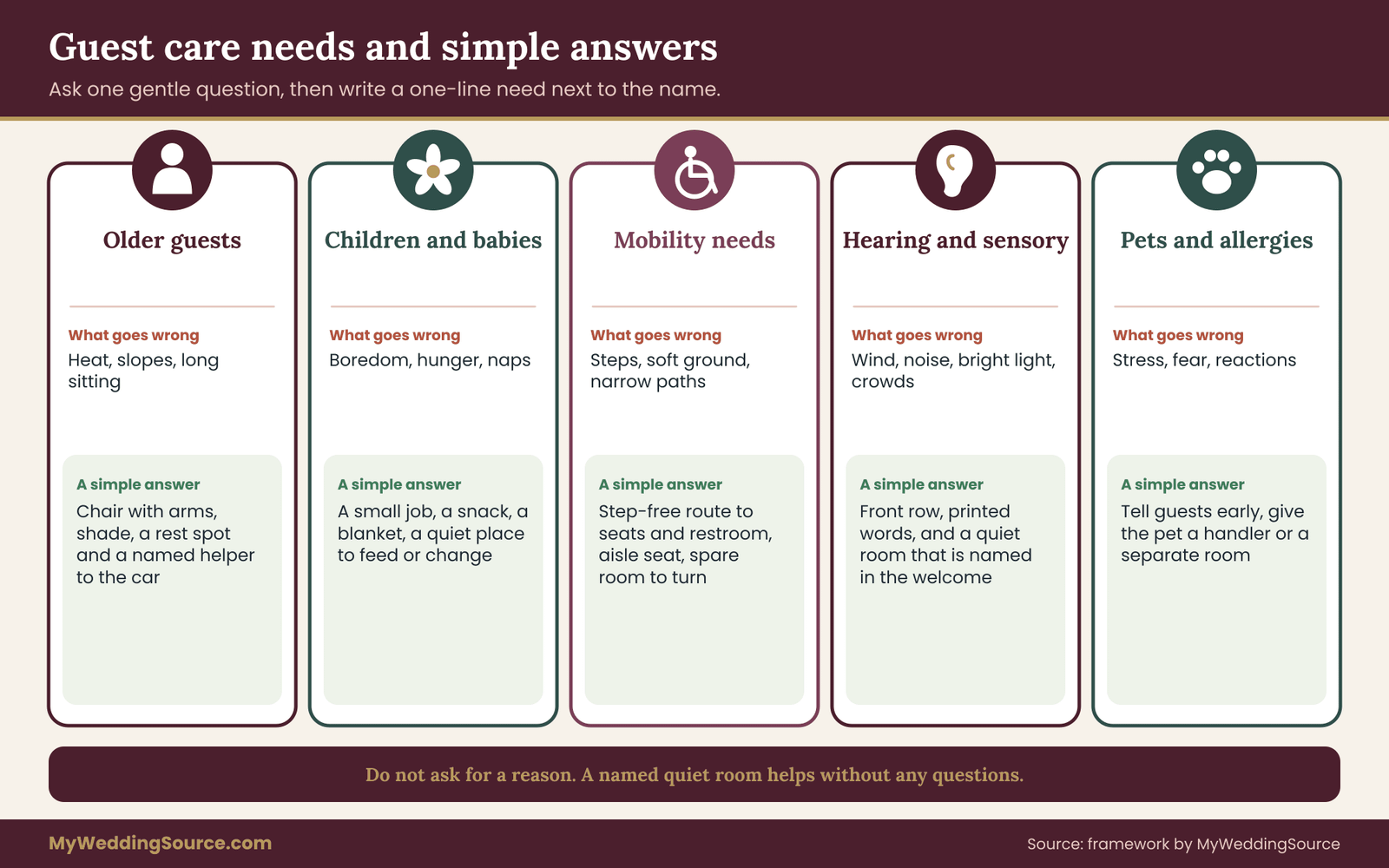
Older guests
Older relatives are often the reason the event exists, and they are the guests most affected by heat, slopes and long sitting. Think about five things for each older guest at the backyard vow renewal: a place to sit within a few steps of arrival, a chair with arms and a firm seat, shade, a nearby restroom with a clear path, and a quiet spot to rest. A shaded chair near the house door, indoors if necessary, is a good place to step away from the noise.
Ask each older guest a gentle question in advance: “Is there anything that would make the afternoon easier for you?” Many will say no, and a few will name something useful, such as arriving early to avoid a crowd or sitting on the left because of one ear. Make sure a family member has agreed to drive them, and plan when they will leave. A named helper who walks them to the car is more useful than a general offer.
Children and babies
For children, the best tool is a job and a snack. Give each child something to do before the ceremony, such as handing out programs or carrying a flower, and have a simple snack ready for after, since hunger often shows up exactly when the vows start. A shaded blanket with books, quiet toys or colored pencils lets a child take a break without leaving the gathering.
For babies, ask parents whether they would like a quiet place to feed or change, and make one available indoors, with a chair and a flat surface. If a baby cries during the vows, nothing has gone wrong. Tell guests, in your welcome, that children are welcome and that parents should feel free to step away if they wish and return without apology.
That sentence takes away the pressure on the parents and the tension in the audience. The site’s material on guest care planning for babies, children and older relatives goes further into how to organize that support at a larger scale, and the same principles scale down for twenty guests.
If children will play in the yard, assign an adult to watch them, with no other job. Water features, grills, steps and gates need an adult within sight. This is not about distrust. It is about the fact that a gathering of adults who are all talking is the setting where a child can wander off unobserved.
Guests with mobility, hearing or sensory needs
For mobility at a backyard vow renewal, plan a step-free route from the car to the seats and the restroom, even if that means using the side gate and not the front steps. A temporary ramp over a single step can be rented, but check the slope and the weight rating, and ask the guest or a family member what works for them before you buy. Do not touch or move a wheelchair or walker without asking.
For hearing, sit the person near the front, face them when you talk and provide printed words. For sensory needs, such as sensitivity to noise, bright light or crowds, offer a quiet space indoors and tell them where it is. You do not need to ask why. A guest who knows there is a quiet room can often manage the rest of the afternoon without needing it.
For guests with medical needs, such as medication timing, blood sugar management or a need to rest, ask in a private message whether anything is useful, and offer a space to rest, a place to keep medication cool, or an extra chair. Do not ask for details. Store any medication that a guest asks you to hold in a safe place, away from children and pets, and return it at the end.
Pets and allergies
If you have a pet, tell guests in the backyard vow renewal invitation, so a person with an allergy or a fear can plan. If you plan to include a pet in the ceremony, give the animal a handler, a leash or a crate nearby, and a quiet exit. Do not ask a guest to look after your pet during the ceremony unless they have agreed in advance. The key point is simple: the animal’s comfort and safety come first, and a stressed animal is a hazard.
A welcome that does the guest-care work
Your short welcome at the backyard vow renewal, about three or four minutes long, is the best guest-care tool you have. It can cover, in a relaxed way: thanks for coming, where the restroom is, where the shade and the quiet room are, how long the ceremony will be, where the food is, and what the weather plan is. It sets everyone at ease, tells them what to expect and makes it easy to ask for help. If you say it once, you will answer five fewer questions during the afternoon.
Weather, heat and the backup-room decision for a backyard vow renewal
The weather is the one part of a backyard vow renewal that you cannot negotiate with, and the only protection is a decision made in advance. People who plan a rain backup for a backyard vow renewal but do not set a time to decide end up standing in the yard at the start time, looking at the sky, while guests arrive. A backup plan is only useful if someone is allowed to call it.
Set a decision time and a decision owner
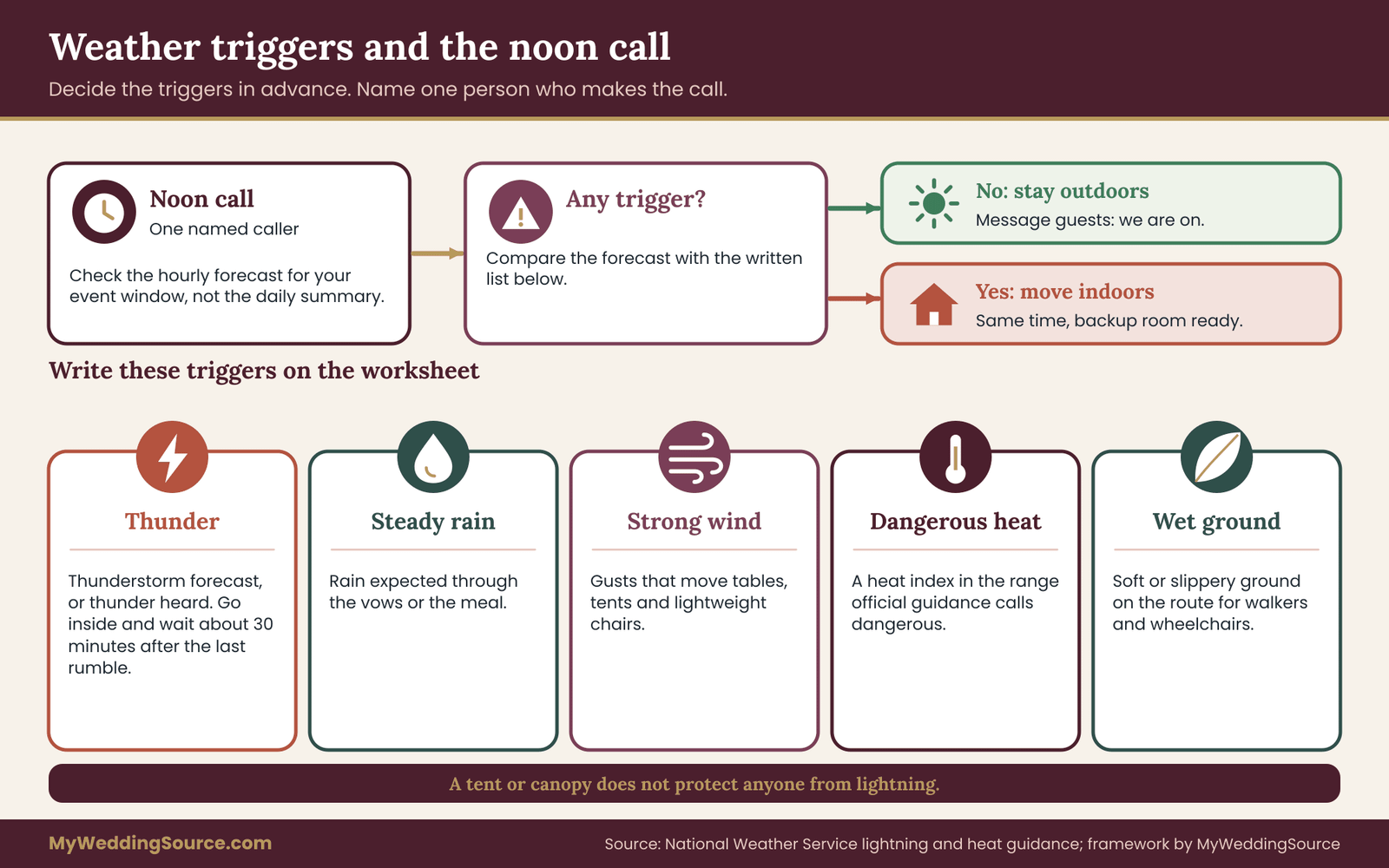
Choose a time on the day, usually two to three hours before the start, when you will make the call. Choose one person to make it. In a couple, it is easy to say “we will both decide” and then each wait for the other. Name one. Write both on the worksheet.
Tell the guests when they will hear. A message at noon that says “we are on, outdoors, see you at three” or “we are moving inside, same time” is enough. If your guests are traveling, send the message earlier and include a second plan if the forecast is truly uncertain.
For the call itself, check the National Weather Service forecast for your location rather than a generic app, and look at the hourly forecast for your event window, not the daily summary. A daily forecast with a thirty percent chance of rain can mean a brief passing shower or a long afternoon storm, and the hourly detail shows which.
Triggers for moving the ceremony indoors
Write the triggers on the worksheet as plain conditions, so you are not debating them at noon:
- Thunderstorms in the forecast within the event window, or any thunder heard once guests are outdoors.
- Steady rain expected for more than a short part of the ceremony.
- Wind strong enough to move tables, tents or lightweight chairs.
- Heat that is dangerous for older guests or young children, as described in the next section.
- Wet ground that makes the route unsafe for mobility devices.
The National Weather Service’s lightning safety guidance is direct: when you can hear thunder, you are close enough to be struck, and the usual advice is to go indoors and wait about thirty minutes after the last thunder before returning outside. A backyard vow renewal should not continue outside in a thunderstorm, whatever the plan said. A tent or a canopy does not protect anyone from lightning.
Heat: the quiet risk
Heat at a backyard vow renewal is more dangerous than it feels, especially for older adults, young children and anyone on certain medications. The National Weather Service publishes a heat index, which combines temperature and humidity into a measure of how hot it feels, and the Centers for Disease Control and Prevention publishes advice on recognizing heat illness. Look up the guidance for your area on the day, and treat a high heat index as a stop condition.
If it is hot, shorten everything. Move the backyard vow renewal to a cooler hour, shrink the ceremony, serve cold drinks early, offer shade and a cool room for rests, and avoid heavy food. Tell guests ahead of time to dress for the heat and bring a hat. If the heat index is in the range that official guidance calls dangerous, move indoors or postpone, and tell guests early. A rescheduled afternoon is a small loss. A guest with heat illness is not.
Cold, wind and early darkness
In cool weather, guests need blankets, warm drinks and a heated or indoor place to eat. A small outdoor heater can help, but it brings its own fire and carbon monoxide risks, and manufacturers say outdoor heaters are for outdoor use only. Read the instructions, keep a clear distance from fabric and chairs, and do not use fuel-burning heaters inside a tent or a closed space.
Wind is the most underestimated factor. A gust can send a table covering into the cake, lift a canopy like a sail or knock over a chair. Anchor tents and canopies with weights recommended by the supplier, and treat a stake in the lawn as an item to check for underground lines before it goes in. If a rental company supplies a tent, ask what wind speed the company says it can handle and when it recommends taking it down.
The backup room, set up in advance
The backup room is part of the plan, not an afterthought. Choose the room now, measure it, and ask yourself whether it fits all the guests and the food. For twenty guests, a living room and dining room together may work, but check whether the doorways are wide enough for a wheelchair, and whether the floor is slippery in wet shoes.
Prepare it enough that the switch takes twenty minutes, not two hours. Decide where the chairs go, and keep a short list of what to move. Keep the backup plan simple: the ceremony indoors, the food at the table, and perhaps a short return to the yard for photographs if the weather clears. A backup that looks like a smaller version of the same event feels like a choice. A backup that looks like a panic feels like a loss, and guests pick up on the difference.
Neighbors, rentals and cleanup after a backyard vow renewal
A small gathering in a private yard still touches the neighbors, the street and your own home. Hosts who think about these three before the day tend to have a calmer afternoon and a calmer week afterward.
Talk to the neighbors first
A brief, friendly note a week before is the easiest way to prevent a complaint. Tell them the date, the hours, roughly how many guests and whether there will be music or a ceremony that could carry sound. Offer your phone number, and invite them to call you instead of anyone else if they have a concern.
Some hosts invite the closest neighbors for a drink. Others offer cake the next day. Either way, the point is that the first time a neighbor hears about the backyard vow renewal should not be at the sound of guests.
Check your local noise rules and any homeowner association restrictions. Many places set quiet hours and sometimes limit gatherings or amplified sound, and those rules differ from one town to the next. Contact your town hall or homeowner association for the current rules, since they differ from one place to the next. Keep any amplified sound low and the music acoustic, and end the event before the local quiet hours begin.
Parking and drop-offs
For a backyard vow renewal with ten to twenty guests, many will share cars, but you may still have six to ten vehicles. Check whether street parking is allowed, whether any driveway or fire hydrant rules apply, and whether the neighbors’ driveways are clear. Tell guests where to park in the invitation. Ask drivers who need access to a step-free entrance to stop at the front for drop-off before parking. Leave your own driveway open for a guest with a mobility need, and move your own car in advance.
Rentals: what you actually need
For a backyard vow renewal, most hosts rent a few things: chairs, one or two tables, linens, a canopy, perhaps a drink station. Do not rent more than the worksheet says you need. Ask each supplier what delivery includes, when they arrive and leave, how the items must be returned, what counts as damage, and whether they charge for items that are dirty.
The site’s wedding rental planning checklist goes through the questions to ask a rental company, and many of them apply to a small yard as much as to a large venue.
Confirm the delivery path. A rental truck that cannot reach the yard because of a narrow gate means a person carrying chairs across the lawn. Measure the gate and the route, and tell the company. Ask whether anything needs to be anchored, and whether underground utilities or irrigation lines might be near the stakes.
If you hire a tent or a canopy, ask whether it needs a permit in your town. Some places require one, especially for larger structures, and the supplier may know. A permit is a local rule, so confirm it with your local building or fire office rather than assuming.
Insurance and liability in plain terms
A homeowner’s or renter’s insurance policy may or may not cover the things that go wrong at a gathering: injuries at a gathering, damage to rented items or alcohol-related incidents. The honest answer is that it depends on the policy. Call your insurer and ask three questions: does the policy cover guest injuries at a private event at home, does it cover rented property while on my premises, and does hosting an event with alcohol change anything.
Write down the answer and the name of the person you spoke to. If the answers are unclear, ask whether a short-term event policy exists and what it would cost, instead of guessing.
If you are renting a home and not owning it, ask the landlord for permission in writing, and check the lease. A gathering of twenty may be fine, or may breach a clause.
Cleanup, trash and the departure station
The departure station of a backyard vow renewal exists because exhausted hosts make poor decisions about trash. Decide at the planning stage where trash goes, who takes it out, and whether the household bin can hold the volume. Twenty guests can fill several bags in an afternoon, and a household bin that is full by dessert is a problem.
Put an extra bag or two and a roll of tape near the back door. Ask a helper to take bags to the curb or the bin as they fill, instead of piling them by the house.
Plan the leftovers. Put perishable food into containers within two hours of serving, or one hour if it is hot out, and offer guests a container to take home. Do the dishes or hand rented items back in the state the supplier asked for. Give helpers a clear end time, so no one feels they have to stay until midnight. Thank them in person, and send a message the next day.
Finally, leave the yard in a state that tells you the backyard vow renewal is over: pick up the stakes, the napkins, the small pieces of plastic and, if you had candles, the wax. Walk the lawn once with a bag, and look for glass, sharp items and food scraps that attract wildlife or are dangerous for pets. A short walk-through the next morning, when the light is good, catches what was missed.
A worked case: sixteen guests, one September afternoon
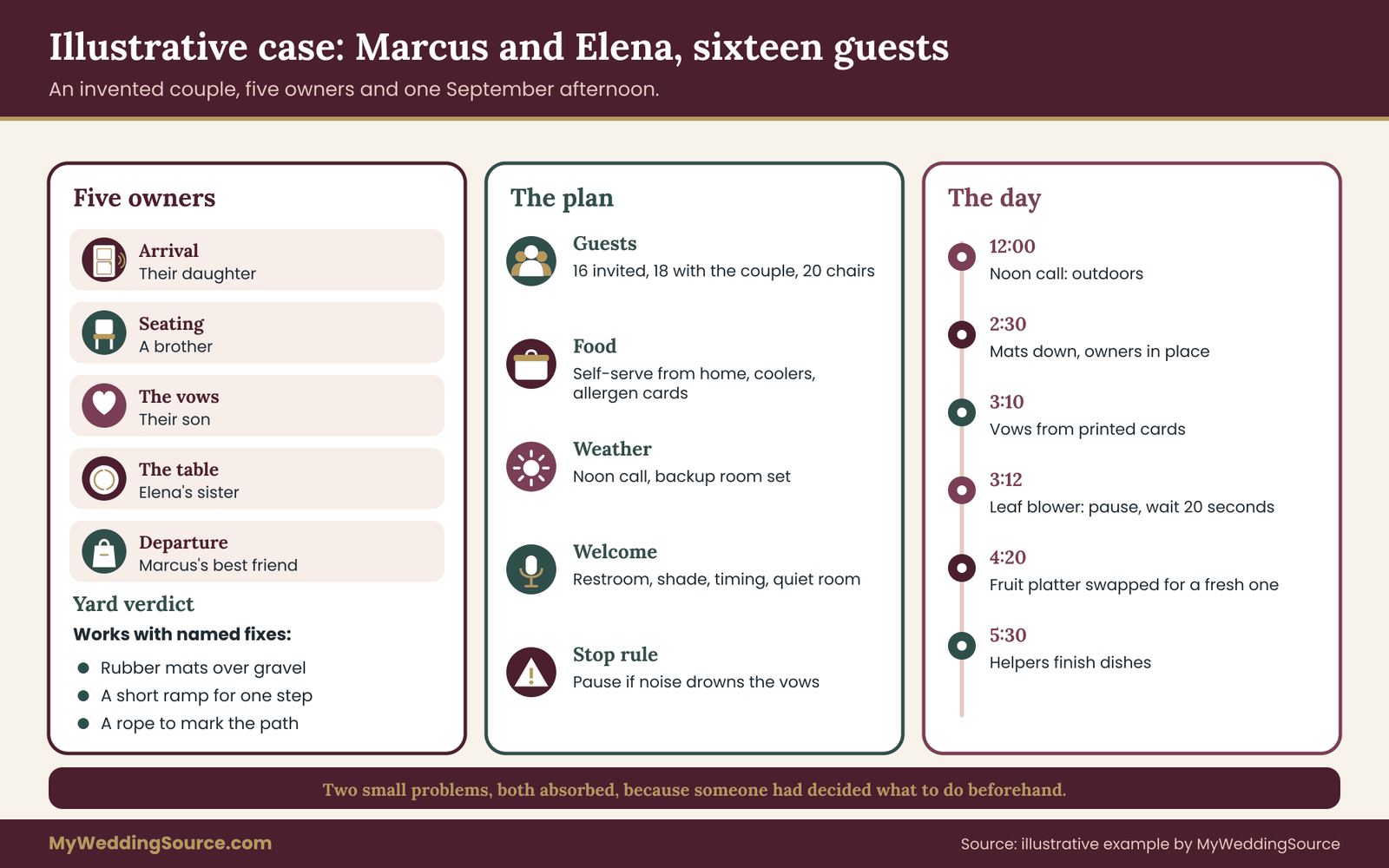
The following backyard vow renewal case is invented to show the worksheet in use. The couple, the yard and the numbers are illustrative, not a real event or a measured result. Call the couple Marcus and Elena, married for twenty-two years, renewing their vows with sixteen guests in their own yard on a Saturday afternoon in September.
The starting facts
Marcus and Elena have a yard about thirty feet by twenty-six, a back patio, a side gate with a gravel path, and a large maple on the west side. The guest list holds sixteen: their two adult children and a partner, four siblings, two parents of one partner (one uses a walker), two close friends and a six-year-old niece and her parents. With the couple, that is eighteen, and they plan two spare seats, so twenty chairs.
They start with the worksheet at the decision stage and fill in only owner and stop condition. Their daughter agrees to own arrival. A brother owns seating. Elena’s sister owns the table. Marcus’s best friend owns departure. A son takes the vows station, meaning he introduces the moment and keeps time. That is five owners, and none of them is the couple.
The yard check and the verdict
The ceremony zone goes on the patio’s edge, in the shade of the house, with chairs in two rows of ten. Eight square feet per chair gives about 160 square feet, and the patio and the nearest lawn strip cover that. The table zone goes on the lawn under the maple, a long table that seats sixteen with two small side tables for drinks and cake.
The walker is the problem. The gravel path from the side gate is soft, and there is one step up to the patio. Their verdict is “works with named fixes.” They lay interlocking rubber mats over the gravel for a path of about four feet, rent a short ramp for the single step after calling the guest’s daughter to ask what works, and mark the path with a rope. The fixes take one morning and a small rental, well under a quarter of their food budget, so they proceed.
The invitation and the headcount
They send a personal message with the date, an arrival time of 2:45, a start of 3:10, an end of 5:30, the address, the parking note, a request for food needs by the tenth, and a weather decision time of noon. The line about gifts says, “Please bring only yourselves.” Fourteen reply yes within the deadline, two need a gentle nudge, and one mentions a shellfish allergy and another mentions a hearing aid. The roster notes both. The final headcount is eighteen, plus two spare servings.
The food and the time plan
They choose a self-serve spread from home with two platters, a grain salad without mayonnaise, fruit, cheeses, bread, and a cake, with coolers holding the cold items. Elena’s sister writes cards for each dish and notes that the bread contains wheat and the cake contains eggs, milk and wheat. The shellfish allergy is not affected because no shellfish is on the menu, but the sister confirms the sauces with the guest before the day.
The schedule follows the sample earlier: arrival from 2:45, welcome at 3:05, ceremony at 3:10, family photographs at 3:20, meal at 3:35, cake at 4:30 and a soft ending at 4:50. The table owner sets out the cold items at 3:25 and notes the time on a card. The forecast for the day shows mild temperatures with a low chance of rain late in the evening, so the decision at noon is “outdoors.”
What happens on the day
At noon, the host checks the hourly forecast and sends the message. At 2:30 the arrival owner is at the gate with the mats down and a pitcher of water at the first row. The man with the walker arrives early with his daughter, sits in the front row on the aisle in a chair with arms and has a clear view. The six-year-old niece has the job of carrying a small basket of petals, and she does it twice because she enjoys it.
The vows take about eight minutes, read from printed cards, because a breeze comes up as Elena begins and her card is easier to hold than a phone. A neighbor’s leaf blower starts during the second vow. Marcus’s son, who owns the vows station, had agreed in advance on a stop condition: if outside noise drowns out the speaker, pause and wait. He holds up a hand, the couple waits twenty seconds and the neighbor, who had been told about the event, turns it off. The vows continue.
At 4:20 the table owner removes the fruit platter after it has been out about an hour in warm sun, on the rule that food above a certain temperature should not sit for long, and replaces it with a fresh one from the cooler. At 4:50 the host thanks everyone, the departure owner begins packing leftovers into containers and guests with early obligations leave without apology. By 5:30 the helpers are doing dishes, and at 6:00 the yard is clear except for the borrowed chairs.
What the case shows
None of the success in this backyard vow renewal came from décor. It came from five owners, one verdict that led to a cheap fix, a decision time, a stop condition that someone used and a welcome that told people where things were. Two things went slightly wrong: the leaf blower and the breeze. Both were absorbed because someone had decided what to do beforehand. That is the point of a worksheet. It does not prevent problems. It reduces the number of decisions the host has to make while emotional.
When a backyard vow renewal is the wrong choice: alternatives and failure conditions
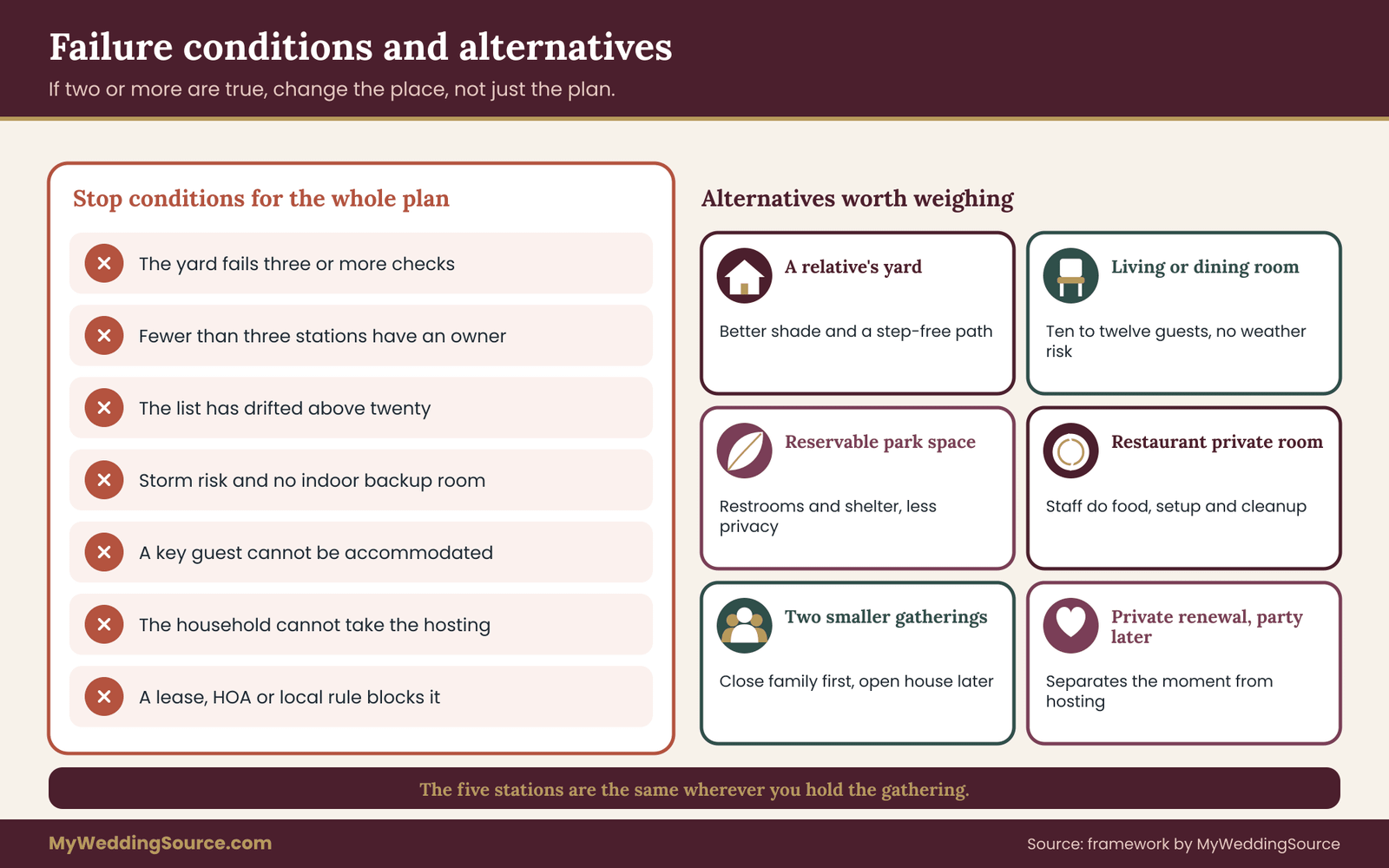
A backyard vow renewal suits some couples and some yards and does not suit others. Knowing the failure conditions in advance lets you change the plan while it is still cheap. Treat each of the conditions below as a stop condition for the whole backyard vow renewal, not just a station.
Failure conditions for the whole plan
The yard fails three or more checks. Steep slope, no shade, no step-free route, no restroom within a reasonable walk, soft ground, no space for two zones. One failure can be fixed. Three suggest a different place.
You cannot name owners for at least three stations. If the host will be doing everything, the host will miss their own vows. Cut the guest list, shorten the plan or recruit help before you invite anyone.
The guest list drifts above twenty. The single-table, no-microphone and one-bathroom assumptions begin to fail. You can still do it, but the plan needs a rental restroom, a microphone, a second serving point and probably a caterer, and the cost and complexity rise quickly.
The forecast fails your triggers and there is no backup room. A backyard vow renewal with no indoor fallback and a storm in the forecast is a gamble with guests’ safety and with your own mood.
A key guest cannot be accommodated. If a person whose presence matters most cannot reach the seats, hear the vows or manage the heat, and the fix is beyond reason, the format fails them, and that is reason enough to change it.
The household cannot take the backyard vow renewal. A caregiving situation, a recent illness, a death in the family or simple exhaustion makes a backyard event harder than it looks. Hosting is physical work. A different format that does not require you to host is a kindness to yourselves.
A rule blocks it. A homeowner association restriction, a lease clause, a local ordinance or an insurer’s refusal can end the plan. Check these first, not last.
Alternatives worth weighing
If the yard or the plan fails, there are several alternatives that keep the spirit and shed the burden.
A relative’s or friend’s yard. For a backyard vow renewal, a host with better shade and a step-free path can take on the logistics, and you stay the guests of honor. Ask clearly, offer to pay the costs and do not treat it as a favor to be repaid in silence.
Your living room or a large dining room. For ten to twelve guests, a ceremony indoors with a meal around the dining table can be warmer than a yard. It has no weather risk and good access. It needs seating for the ceremony and a clear path for those with mobility needs.
A public park or garden with a reservable space. Many parks require a reservation or a permit for a ceremony. A park brings restrooms, parking and shelter, and takes away privacy and the ability to run late. Confirm the rules with the park authority.
A private room at a restaurant. Staff do the food, the setup and the cleanup. It costs more per head, and you give up control of timing. For a ten-guest dinner with a short ceremony at the table, it is often the least stressful choice.
Two smaller gatherings. Split the guest list. A ten-person ceremony and lunch with the closest family, then a casual open house the following week for the wider circle, each of which fits your yard and your energy.
A private renewal with a celebration later. Some couples renew alone or with an officiant and two witnesses, then host a dinner. It separates the emotional moment from the logistics, which is a good idea if you know that hosting would take the emotion out of the day.
None of these is a lesser choice. The goal is a day that both of you remember for the right reasons.
A short decision rule
Use this rule on the worksheet page. If the yard verdict is “works” or “works with named fixes,” you have owners for at least four of the five stations, the guest list is twenty or fewer, the weather has a named backup and no external rule blocks you, proceed with the backyard.
If any of these is false, fix that one item first. If two or more are false, choose an alternative from the list above and use the worksheet for that setting instead, because the five stations are the same wherever you go.
Your next steps
To start your backyard vow renewal this week, walk the yard with a tape measure and write the verdict. Then write your guest cap, and the names of five owners. Next week, send the invitation, set your weather decision time and make the supplies list. The week before, confirm each owner by message, call your insurer with the three questions and tell the neighbors.
On the day, read the card, make the noon call and let your owners work. Afterward, thank each owner in person, and put the worksheet in a folder with your photographs, so the next time somebody in the family hosts a gathering, they can use it as a starting point.
FAQ
How many guests is too many for a backyard vow renewal at home?
For this approach, about twenty. Up to that number you can seat everyone at one table, hear a speaker without a microphone in a quiet yard and manage with one household restroom for a short event. Beyond twenty, you will probably need a rental restroom, sound equipment, a second serving point and more helpers, and the plan stops being a simple home gathering.
Do we need a license or a permit for a backyard vow renewal?
A renewal does not change your legal marriage, so you do not need a marriage license. If you want a copy of your marriage certificate for any reason, USAGov explains how to request one from the issuing state or county. Separately, some towns regulate tents, amplified sound or large gatherings, so check with your local office and any homeowner association.
What is the safest way to serve food outdoors?
Follow the two-hour rule: perishable food should not sit out longer than two hours, or one hour above 90 degrees Fahrenheit, according to U.S. Department of Agriculture guidance. Keep cold food at 40 degrees or below and hot food at 140 or above. Put out small portions, replace dishes instead of topping them up, cover food against insects and label allergens.
When should we decide to move the ceremony indoors?
Choose a decision time two to three hours before the start and name one person to make the call. Move indoors for thunder, steady rain, wind that threatens tents and tables, dangerous heat or wet ground that makes the route unsafe. The National Weather Service advises going indoors when you hear thunder and waiting about thirty minutes after the last rumble.
How do we plan for an older guest who uses a walker or wheelchair?
Ask the guest or a family member what helps, then plan a step-free route from the car to the seats and the restroom. Use a firm, level path, a chair with arms near the aisle, shade and a short walk to a bathroom. Federal accessibility standards use 36 inches as a minimum clear route width, a useful benchmark for a home path.
Should the host also run the backyard vow renewal on the day?
It is better if they do not. The host should hold the card, make the decisions and be present for the vows, while named owners handle arrival, seating, the table and departure. A host who is also carrying coolers and clearing plates misses the moment the day is for. If you must do several jobs yourself, shorten the plan.
What should we say to neighbors about the backyard vow renewal?
Tell them the date, the hours, the approximate number of guests and whether you will have music. Give them your phone number and invite them to call you first if anything is a problem. Check local noise rules and any association restrictions for the current limits, and end amplified sound before quiet hours begin.
What if it rains and our home is too small?
Decide that before sending invitations. Measure the backup room and ask whether it fits all the guests and the food. If not, reduce the list, split the gathering into two smaller ones or choose a different place for the whole backyard vow renewal, such as a relative’s home or a private room at a restaurant. A cramped backup is worse than a smaller plan.
Sources
- How to get a copy of a marriage certificate or a marriage license, USAGov
- Food safety guidance for safe handling, serving and storage, foodsafety.gov, U.S. Department of Agriculture
- Lightning safety, National Weather Service
- Heat safety and heat index, National Weather Service
- Heat and health, Centers for Disease Control and Prevention
- Food allergies, U.S. Food and Drug Administration
- Mosquito control around the home, Environmental Protection Agency
- Consumer product safety information, U.S. Consumer Product Safety Commission
- Fire safety guidance for outdoor events and candles, National Fire Protection Association
- ADA standards for accessible design, U.S. Department of Justice