

Blended family seating is the work of deciding who sits where when the guest list includes ex-spouses, step-relatives, half-siblings, new in-laws and people who have good reasons to avoid each other. This guide gives you a way to turn tense relationships into clear blended family seating rules, test three table layouts against those rules, and keep the reception calm without asking anyone to pretend.
Start by writing a short constraint ledger: a list of pairs or groups that must be apart, should have a buffer, or are free to mix. Rank each pair by distance (same table, neighbor, apart, or zoned across the room). Then draw the room, mark the walking paths to the bar, restrooms and dance floor, and test two or three table layouts against the ledger. One hard conflict that fails the test disqualifies a blended family seating layout, however good it looks. Ask people first, and keep a fallback for each risk.
Most seating advice assumes a simple family: two sets of parents who get along, a few siblings, and cousins who like each other. That advice breaks down quickly when a family has been rearranged by divorce, remarriage, loss or estrangement.
A grandmother may not speak to her former daughter-in-law. A teenager may be meeting a stepsister for the second time. A father may love his new wife and still need an hour away from his former wife’s relatives. None of this makes the wedding unusual. It just means a blended family seating chart carries more weight than a list of names.
Good blended family seating is not about managing people’s feelings for them. It is about removing avoidable friction so that guests can enjoy dinner on their own terms. You cannot fix a decade-old rift with a place card, and you should not try. What you can do is make sure nobody has to sit within earshot of a person they find painful, nobody feels demoted in front of a room, and nobody is placed where they will be cornered at the bar.
A note on scope. This article offers general planning information and one invented example, not legal, tax, financial or family-counseling advice. If a custody order, protective order or safety concern is involved, follow the order and get advice from a qualified professional before you plan anything around it.
What blended family seating has to solve
A seating chart does four jobs at once, and in a blended family each job gets harder. It feeds people, it places them within earshot of conversation they will enjoy, it signals who matters to the couple, and it controls how people move around a room. Standard seating advice (the wedding seating chart guide covers it well) handles those jobs for typical guest lists. This guide covers the extra layer that blended family seating adds when relationships are sensitive.
Three kinds of pressure in blended family seating
The first pressure is conflict. Two people or two groups have a history that makes proximity uncomfortable or unsafe. The history may be an ordinary falling-out, a bitter divorce or something more serious. Your job is not to judge it. Your job is to respect the boundary the people involved have actually stated.
The second pressure is status. Seating communicates rank. A table near the couple says “you are close to us.” A table near the kitchen door says something else, whether or not you meant it. In a blended family, several people may reasonably expect an honored seat: a mother, a father, a stepparent, a long-time stepparent who has raised the child, a grandparent on each side. Not all of them can sit at one table.
The third pressure is belonging. Children and teenagers in a blended family often have two or three households of relatives, and they may know only some of the guests. A thirteen-year-old placed at a table of strangers is not experiencing a seating problem. He is experiencing being left out. Seating that ignores belonging produces quiet misery that no one notices until the photos come back.
What a good outcome looks like
A good outcome from blended family seating is modest. Nobody is forced into a conversation they did not choose. Nobody is publicly ranked below someone else. The people with a hard boundary never meet it by accident. Children have at least one familiar face. And the couple can enjoy the evening without checking the room every few minutes for trouble.
It is not a good outcome if every guest is delighted with their seat. Some guests will be mildly disappointed, and that is acceptable. The goal is to prevent harm and humiliation, not to produce universal happiness. Keeping that standard in mind saves a lot of effort, because you can stop trying to satisfy every preference once the hard rules are secure.
Mistakes that make blended family seating harder
A few habits cause most of the trouble. The first is seating by label instead of by person. A chart that puts “the parents” at one table assumes that everyone in that group wants to be there and wants to be together. In blended family seating, the label hides the very differences you need to see.
The second is deciding in secret and announcing late. A person who learns about their table for the first time on a printed card has had no chance to say that a neighbor is a problem. The third is borrowing a layout from a friend’s wedding. A layout that suited one family was built for that room, that ledger and those people, so copying it tells you nothing about yours.
The fourth is treating a children’s table as a storage area. Children placed together by age alone, with no adult nearby and no say in the matter, tend to drift away from the table within the first hour. The fifth is asking for too much agreement. If you wait until every person approves the chart, you will never finish. Blended family seating needs consultation, then a decision, then calm repetition of that decision.
The sixth mistake is the one that costs the most: moving a hard rule to fit the room. When a table count or a venue constraint pushes two people closer together than they asked, couples sometimes hope for the best. Hope is not a seating plan. Change the room or the list, or go back and talk to the person who set the rule.
Who actually decides
Blended family seating decisions can turn into a negotiation among six or eight adults who each believe they hold a veto. Settle the decision rights early. The couple decides the final blended family seating chart. Parents, stepparents and other close relatives are consulted, and their stated boundaries are treated as constraints, not as votes. The wedding decision rights guide explains how to separate input from control, and the same logic applies here: listening is not the same as handing over the pen.
One practical rule helps. Ask people about their own comfort, never about someone else’s. “Is there anyone you would prefer not to sit near?” is a fair question. “Do you think Aunt Carol should sit near Uncle Ray?” invites gossip and speculation, and the answer tells you little you can use.
The constraint ledger: turning feelings into blended family seating rules
Before you open a seating tool or sketch a layout, write a ledger. It is a plain list, kept private, that converts a murky web of relationships into rules you can test. Without it, most couples seat people by instinct, discover a problem two days before the wedding and start over. With a ledger for your blended family seating, a problem shows up on paper while it is still cheap to fix.
Three kinds of rule for blended family seating
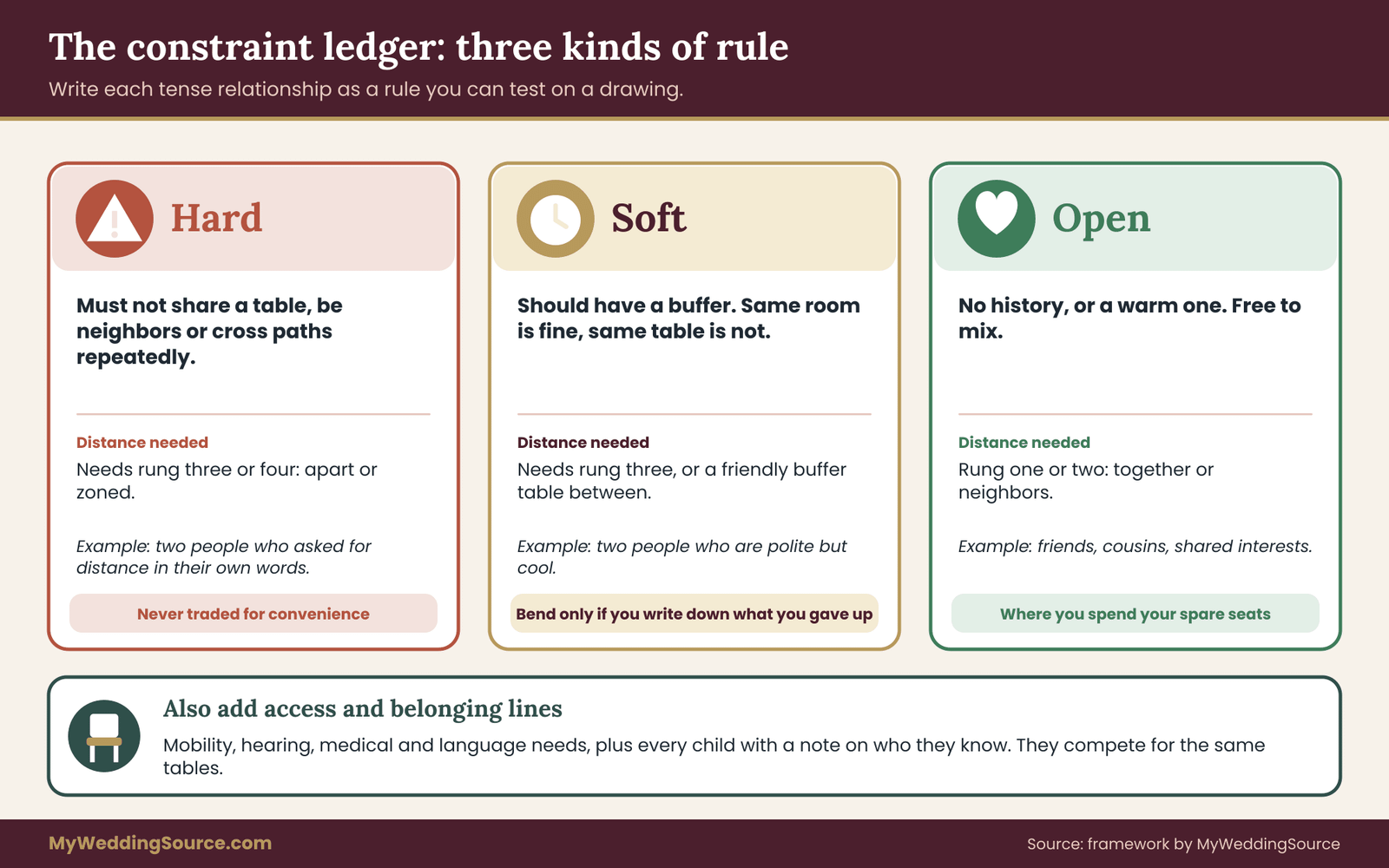
Each line in the ledger gets one of three labels.
Hard. These two people or groups must not share a table, must not be neighbors and must not have to pass each other repeatedly during the evening. A hard rule exists because someone has said, in their own words, that proximity would be painful, or because a legal or safety order requires distance. A hard rule can never be traded for convenience.
Soft. These two should have a buffer. They can be in the same room and even in the same general area, but they should not share a table and should not be left alone together. A soft rule gives you room to bend if the room layout forces it, but you should write down what you gave up.
Open. No history, or a friendly one. Open pairs are where you spend any spare seats: put friends together, group people with shared interests and put chatty guests next to quiet ones.
What goes in the ledger, and what stays out
Write only what is needed for blended family seating. A line might read “Joan and Denise: hard, different zones” with no explanation. You do not need the backstory, and you should not record it. A ledger that grows into a family history becomes a document someone could find, copy or misread. Keep it short, keep it in one place and share it with nobody except a planner or coordinator who needs it to run the room.
Also leave out anything you have only heard secondhand. If your mother says your uncle “cannot be near” your stepfather, go to your uncle or stepfather and ask, kindly and in private. A boundary reported by a third party may be exaggerated, outdated or invented. Seating around a boundary that does not exist wastes your best seats.
Adding access and belonging lines
The ledger also needs lines that are not about conflict. Add any guest who has a mobility need, a hearing need, a small child, a medical need or a language need. Add every child and teenager, with a note on who they know. These lines compete for the same tables as the conflict lines, and a chart that satisfies every conflict but seats a wheelchair user at the end of a crowded row has failed.
The guest care planning guide covers babies, children and older relatives in depth. For the ledger, you only need a short note: where this person needs to be, and what they need nearby.
The distance ladder for blended family seating
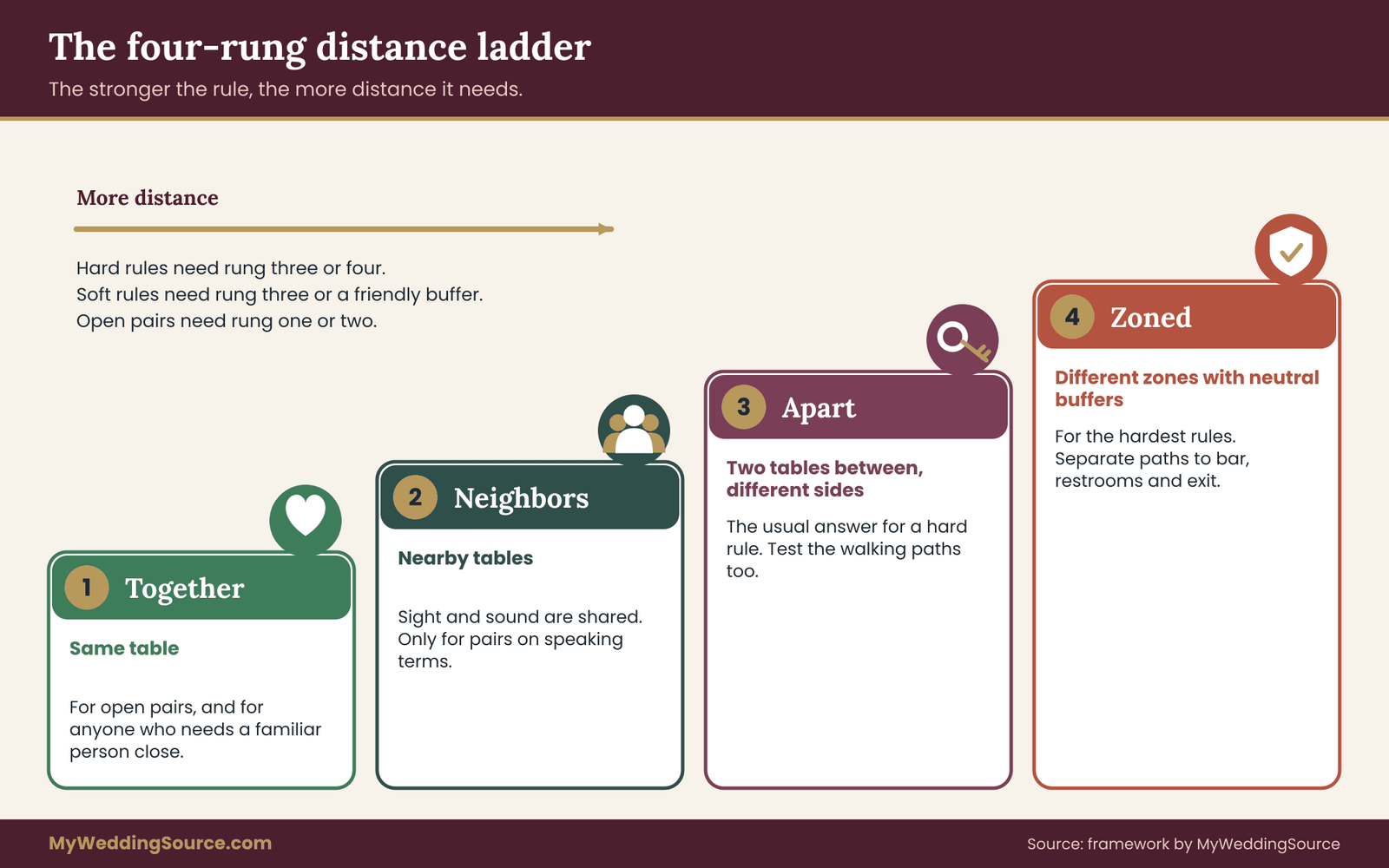
A ledger tells you which pairs in a blended family seating chart need space. The distance ladder tells you how much space. Without it, “keep them apart” turns into an argument about whether two tables is enough, and nobody can answer because nobody defined the measure. The ladder gives you four rungs, each with a rule you can check on a drawing.
Rung one: together
Same table. This rung is for pairs who want to sit together or who have no reason to avoid each other. It also covers the case where one person needs another nearby, such as a child who needs a parent in sight or a guest who needs a companion to help with food. Together is the default for open pairs, and it is the rung you spend your spare seats on.
Rung two: neighbors
Different tables, but close enough that the two groups can see each other and hear each other. Neighbors suit pairs who are on speaking terms and might enjoy a quick hello, such as two sets of grandparents who get along or a stepparent and a birth parent who have worked out a polite routine. Neighbors is not a safe rung for soft rules unless you have confirmed that both sides are comfortable with it.
Rung three: apart
At least two tables between the pair along the ring, and on different sides of the room or the dance floor. Apart is the standard answer for a hard rule when the room is large enough. It keeps people out of each other’s sightlines during dinner, and it means a casual walk to the bar does not put anyone within arm’s reach of the other.
Apart has one weakness: it ignores traffic. Two tables across a dance floor are far apart on a chart, yet if the only restroom is down one wall, both people may walk the same path ten times in an evening. The next section deals with that. For now, define apart as a seating distance only, and plan to test it against walking paths before you call it done.
Rung four: zoned
Different zones of the room, with a buffer of neutral tables and, where possible, separate paths to the bar, the restrooms and the exit. Zoned is the rung for the hardest rules: a safety concern, a protective arrangement, an estrangement that one person has described as non-negotiable, or a history of a public scene.
In a small room, zoned may be impossible, and that fact matters. If you cannot achieve zoned distance in the venue you have, the answer is a different arrangement of the day (a shorter reception, a different guest list or a different room), not a seating trick.
Matching a rung to a rule
The match is simple. Hard rules need rung three or four. Soft rules need rung three or at least a buffer table with a friendly occupant between the pair. Open rules need rung one or two. If a hard rule cannot be met at rung three or four, stop and treat it as a venue or guest-list problem before moving any tables.
The stronger the rule, the more distance it needs, and that is the core logic of blended family seating. A useful habit is to write the target rung beside each line in the ledger. “Joan and Denise: hard, rung three.” “Eli and Ivy: soft, buffer only.” When you test a layout later, you can check each line against its rung and see at a glance what passes.
Why distance is not the same as exclusion
It is easy to slide from “keep apart” to “keep out.” They are different. A hard rule in blended family seating asks for distance during the reception, not for someone to be left off the guest list. If the person with the boundary and the person they avoid are both invited, you owe both of them a seat that treats them with equal dignity. A far table is not a punishment, and you should avoid putting either person at the worst table in the room just because the layout needs somewhere to put them.
Dignity is also about how the table is made up. A person placed apart should still sit with people who like them. A table of strangers and leftovers is a demotion, however far it is from the problem. If you must put two people at distant tables, check who else is at each, and make sure each table has someone warm.
Reading the room before you draw a chart
A blended family seating chart is a plan for movement as much as for sitting. People spend most of a reception away from their seats: at the bar, at the restroom, in line for food, on the dance floor, outside for fresh air. In a blended family, those movements are where an avoided encounter happens. The floor plan decides which encounters are likely, and you should read it before you assign anyone.
Mark the fixed points
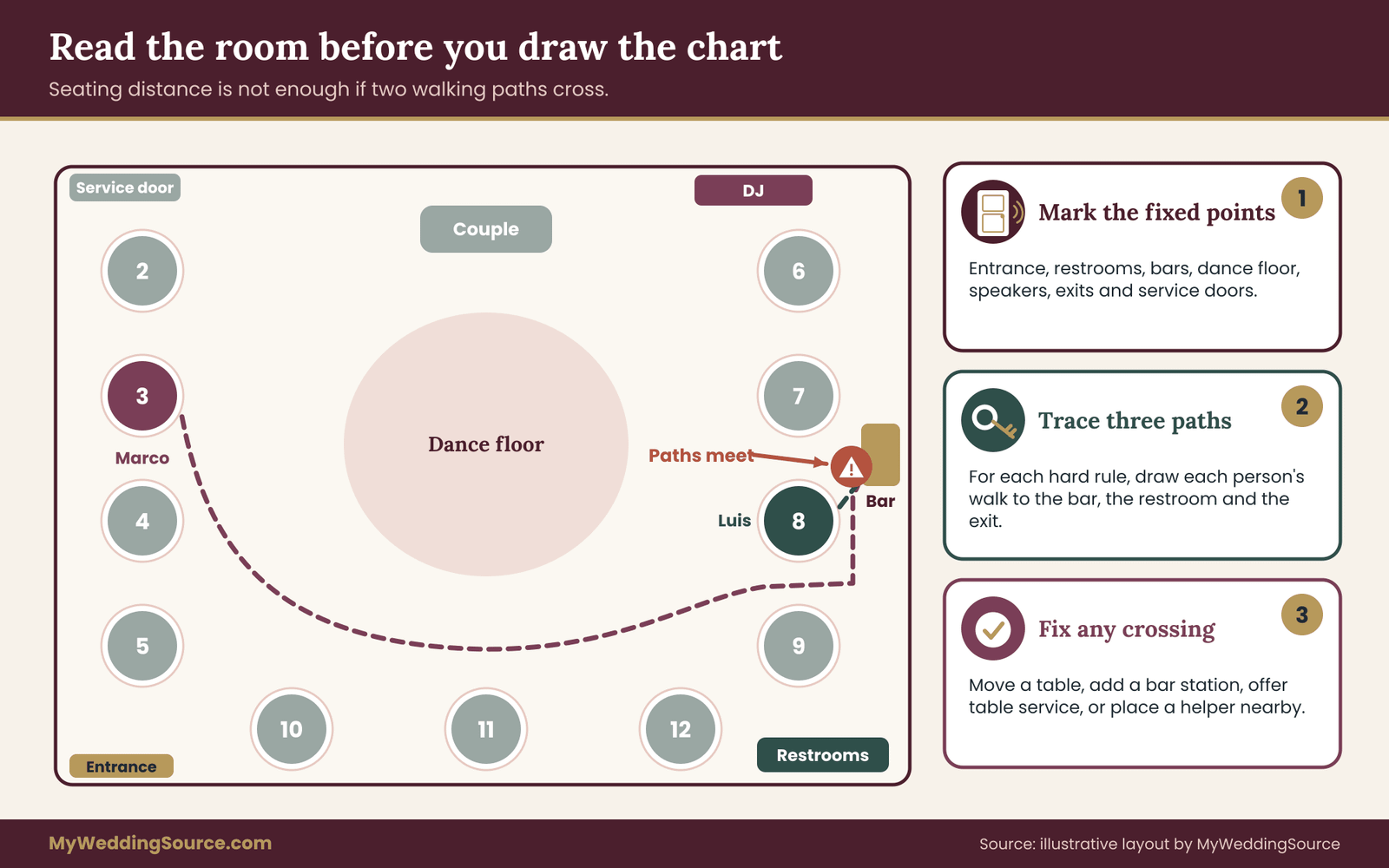
Start with a venue floor plan, which the venue or the rental company can usually supply, and mark the fixed points: the entrance, the restrooms, the bar or bars, the dance floor, the speakers, the head table or sweetheart table, any buffet or food stations, the exits and the kitchen or service door. These points create corridors. A corridor is any path many people will walk repeatedly, and every table beside a corridor is a table where passing traffic will be heavy.
The reception guest flow guide covers entry, seating, food and exit as a sequence. For blended family seating, you only need the map: where will people walk, and who will be on that path?
Trace three paths for each hard rule
For each hard rule, trace three paths on the plan: from each person’s likely seat to the bar, to the restroom and to the exit. Draw them in different colors for the two people. Look for places where the paths cross or run close together. A crossing is not a disaster, but a crossing at a bottleneck (a narrow gap between two tables, a doorway, the end of a bar) is a place where the two people will stand within arm’s reach of one another.
If two paths cross, you have four fixes, in order of effort. Move one table. Add a second bar station or restroom signage that sends each person a different way. Offer table service for the drinks, so fewer walks happen. Or accept the crossing but place a trusted person nearby, such as a planner or a friend, who can step in smoothly if needed.
Check sightlines and sound
Distance on paper is not the same as distance in a room. Two tables at opposite corners may face each other across an open dance floor with nothing between them. For a hard rule, that open sightline may matter, and a screen, a floral piece, a pillar or a change of table orientation can help. Sound matters as well. A DJ speaker beside an older guest’s table makes conversation difficult, and a loud table of friends next to a quiet grandparent works against the whole point of seating them well.
During toasts and speeches, sightlines matter even more. If a speaker faces one part of the room, the people there will be on view. Think about who sits within the speaker’s view and who sits behind. If one rule involves a person who dislikes being the center of attention, put them where they can see the speaker without being in the line of the camera.
Count the real capacity
Before drawing tables, confirm how many tables of what size the room can hold with comfortable aisles. A crowded room reduces every distance on the ladder, and a layout that works on a drawing with ten-foot aisles may not work when the venue’s fire rules require wider ones.
Ask the venue for its maximum seated count and the rules for aisle width and exits, and check with the local fire authority or the venue manager if you are unsure. If you cannot reach the distance you need, a shorter list is often the cleanest answer, and it is fair when you cut by a rule you can explain.
Accessibility sets a floor of its own. Wheelchair users, walker users and guests with limited stamina need clear routes to their seats, to the restrooms and to the exit. The U.S. Access Board and the ADA National Network publish guidance on accessible routes and clearances, and your venue should know what it can provide. Treat those routes as fixed constraints on the floor plan, not as items to fit in after the conflict rules are placed.
Note what the room cannot change
Some rooms make a hard rule in blended family seating impossible to meet. A single small room with one bar, one restroom corridor and one door gives you no zoning at all. If the ledger contains a hard rule at rung four and the venue cannot supply it, say so plainly to the couple before the deposit is paid. Changing the venue after the contract is signed costs far more than raising the problem at the tour stage. If you have already signed, change the evening instead: a split reception, a staggered schedule or a smaller list.
Three table configurations for blended family seating
Once the ledger and the room are on paper, you can test layouts. The point of testing three is not to find a perfect one. It is to see, on paper, which hard rules each layout breaks, so you do not discover it at the reception. The three configurations below are generic patterns that appear in most blended family seating problems. Each one is described in terms of what it does well and where it tends to fail.

Configuration A: household blocks
In household blocks, you seat each household or side of the family together, usually with one side on each half of the room. This is the most common approach and it is popular for a reason. It is easy to explain, easy to read on a chart and easy for guests to find their way. Each person sits with people who know them, which supports the belonging goal.
The weakness is that a blended family is rarely made of two clean halves. When a divorced couple, a stepparent and a former in-law all belong to the same “side,” block seating puts them at neighboring tables by default. A hard rule between two members of one household cannot be met by blocks, because blocks put them together. If your ledger has hard rules inside a side, household blocks will probably fail the test of blended family seating.
Configuration B: mirrored honor tables
In mirrored honor tables, you give each important adult a table near the couple, usually flanking the couple’s table, so both sides look equally honored. This answers the status pressure directly. A mother and a father, or two sets of parents, each get a prominent seat, and nobody looks demoted.
The weakness is that flanking tables are close to each other. They sit two steps apart on either side of the couple’s table, and during toasts and the first dance they look straight at one another. If the two honored adults have a hard rule, mirrored tables put them in a face-to-face arrangement for the most public hour of the evening. Mirrored honor works well in blended family seating when the honored adults are on good terms and badly when they are not.
Configuration C: zoned with buffers
In a zoned layout, you divide the room into zones and fill the middle and the edges with neutral buffer tables. The hard pairs go into different zones. Buffer tables carry friends, colleagues and relatives with no conflicts, and they sit between the sensitive tables like quiet roads between neighborhoods.
Zoned layouts are the strongest blended family seating choice against hard rules and the weakest in simplicity. They are harder to explain to guests, so signage and place cards need more care. They also require more tables than the other two, because buffer tables use up seats that would otherwise go to family. In a small room, the buffers may not fit. In a mid-size room, they usually do.
How to test a layout against the ledger
For each blended family seating layout, go down the ledger line by line and mark each rule pass or fail, using the target rung you wrote earlier. Do not average the results. A hard rule that fails disqualifies the layout, even if every other line passes. The reason is practical: a soft rule that fails produces an awkward moment, while a hard rule that fails can produce a scene, a safety problem or a guest who leaves.
Then count the soft and open lines. Among layouts with no hard failures, the one that passes the most soft lines wins. If two layouts tie, choose the simpler one. Simplicity is worth something, because a chart that guests find easily reduces confusion on the day.
A pre-print check for the blended family seating chart
Before the chart goes to the printer, run one last pass that takes about twenty minutes. Read down the ledger and mark each line pass or fail against the final drawing. Check that every guest appears exactly once, because a blended family seating chart edited many times often loses a name or lists one twice.
Next, read each table as a group of people. Does anyone sit among strangers only? Does anyone with a mobility need have a clear path? Does any table of eight hold three people who all have a boundary with the same person? Then trace the hard-rule paths one more time, since a bar station moved late in planning can undo the work.
Finally, ask one outside reader, such as a coordinator or a calm friend who knows none of the backstory, to look at the chart and say whether any table looks odd. Fresh eyes catch label problems, such as a table that reads as a ranking, which the couple has stopped seeing. A blended family seating chart that survives this check is ready for the printer.
When none of the three passes
Sometimes every layout fails a hard rule. That means the constraint set cannot be met in this room with this guest list. Do not try to quietly bend a hard rule. Return to the options: change the room layout, remove a table, add a second bar station, split the evening, or revisit the guest list. You can also talk to the person who set the rule. Occasionally a boundary stated early turns out to be more flexible once the actual arrangement is described, but only the person who set it can say so, and you should never pressure them.
Hybrid layouts
Real blended family seating charts are often hybrids. A zoned layout can use household blocks within each zone, or mirrored honor tables with a buffer on one side. The tests still apply. Treat the hybrid as a new configuration and run the ledger against it. It is easy to believe a mix has the strengths of both and none of the weaknesses, but the tests are the only way to find out.
A worked case of blended family seating: ninety guests, seven rules
The case below is invented. The names, the room and the relationships are made up to show the method, and they do not describe a real wedding. The case is simplified, because real families rarely give you a cleanly labeled list. The point is the reasoning, so that you can follow the same steps with your own ledger.
The couple and the room
Maya and Ben are marrying. Maya has two sons, Eli, fifteen, and Noah, ten. Ben has a sixteen-year-old daughter, Ivy. There are ninety guests. The reception has one sweetheart table for the couple and eleven round tables of eight. The room has a central dance floor, an entrance at the bottom left, restrooms at the bottom right, a DJ near the bottom wall and a bar station on the right wall. A service door sits at the top left.
The ledger
The couple gathered boundaries for their blended family seating by asking each person privately. The ledger came out as follows.
Hard 1. Joan, Ben’s mother, and Denise, the wife of Ben’s father Frank, must be apart. Joan asked for distance in her own words. Frank and Denise are both invited and both are expected to feel honored.
Hard 2. Luis, Maya’s former husband and the father of Eli and Noah, and Marco, Maya’s brother, must be apart. They had a falling-out over a loan. Both are attending for family reasons.
Soft 1. Rachel, Ivy’s mother, and Joan are polite but cool. They should not share a table.
Soft 2. Eli and Ivy have met twice. Neither should be forced to sit with the other, and neither should be alone.
Soft 3. Luis would rather not pass Marco on the way to the bar.
Access 1. Aunt Pat uses a walker and needs a short path to the restroom, away from the speakers.
Belonging 1. Noah, ten, wants to be near his mother and a familiar adult.
Testing the three configurations
Household blocks put Ben’s side on the left and Maya’s on the right. Joan, Frank, Denise and Rachel all land on four left-hand tables, so Joan and Denise end up two tables apart at most, which fails Hard 1, and Rachel lands among them, which fails Soft 1. Luis and Marco are both on Maya’s side, which fails Hard 2 and Soft 3. The block layout passes only Soft 2, Access 1 and Belonging 1. It is disqualified.
Mirrored honor tables put Joan at the table on one side of the couple and Frank and Denise at the table on the other. They look at each other across the sweetheart table for every toast. Hard 1 fails, and with one bar station Soft 3 fails too, because Luis or Marco must walk past the other. The remaining rules pass, but a single hard failure disqualifies the layout.
The zoned layout passed every line on its second draft. The first draft failed Soft 3, as the next step shows.
Building the zoned layout table by table
Maya and Ben placed the sweetheart table at the top center and sorted the eleven guest tables into two side zones and a neutral bottom row. The left zone ran down the left wall and the right zone down the right wall. The bottom row held three mixed tables near the entrance and the DJ.
Joan took the table nearest the couple on the left, with her sister and Ben’s aunts and uncles. Maya’s parents, her brother Marco and his wife, and Noah took the next table down on the left. Rachel, her partner and a group of Ben’s friends sat at the third left table, so a table full of Maya’s family sat between Rachel and Joan as a buffer. Maya’s friends took the last left table, by the entrance.
On the right, a young people’s table sat nearest the couple. Eli and Ivy had each said yes to it when asked, and Ben’s cousin Tess, who is twenty-four, sat there as the adult anchor, with two friends of each teen placed so that neither teen sat directly beside the other. Frank and Denise, with Frank’s brother and wife, took the second right-hand table. Luis, his sister and some of his friends took the third, beside the bar station.
Aunt Pat, her daughter and some of Ben’s colleagues took the fourth, nearest the restrooms and farthest from the DJ. The bottom row held colleagues, college friends and cousins with no rules attached.
The path check that broke the first draft
On the first pass, every seating distance passed. Then Maya traced the walking paths. The only bar station was on the right wall, beside Luis. Marco, on the left, would have to walk the length of the room to reach the bar, and the route ended beside Luis’s table. Soft 3 failed. Luis had asked not to pass Marco, and a walk to the bar would have put them within a few feet of each other.
The couple fixed it by adding a second bar station on the left wall beside Marco’s table and telling the bartenders to send each side to its own station. They also asked the caterer to offer table-side wine service during dinner, so the first walks to the bar happened after the toasts. After that, no hard or soft line failed.
Honoring Frank and Denise without mirroring
The layout put Joan one table from the couple and Frank and Denise two tables away. The couple looked at this squarely. Distance from the sweetheart table is one signal of honor, but not the only one, and they decided to match the signals that mattered instead of the geometry.
Both Joan and Frank were named in the welcome toast. Both were escorted to their tables by the couple before dinner. Both tables were served at the same point in the meal. Both appeared in the first family photo of the day.
Ben told his father directly why the tables were arranged as they were, and he asked whether the plan felt fair. Frank said it did. Had he said otherwise, the couple would not have swapped the tables, because that would have put Denise across the sweetheart table from Joan and broken Hard 1. They would have added more visible gestures instead, such as a longer mention in the toast and a private visit to his table during dinner.

What the case shows
Three points carry over to any real blended family seating chart. First, a hard failure ends the contest, no matter how attractive the layout. Second, the walking paths found a problem the seating distances missed, so the path check cannot be skipped. Third, equal honor does not require equal geometry, but it does require equal and visible gestures, and a conversation with the person who might feel the difference.
The case is also simpler than a real wedding. Real families have more lines in the ledger, more late changes and less tidy rooms. If your own ledger has fifteen lines, the steps are the same. Test each layout, mark the failures, repair the first draft and test again.
Seating children and teenagers in blended family seating
Children and teenagers are the group most affected by blended family seating and least consulted about it. They are not guests who need to be parked. They are people with preferences, loyalties and limits, and they spend the reception either enjoying it or enduring it depending on where the chart puts them.
Start by asking, not assigning
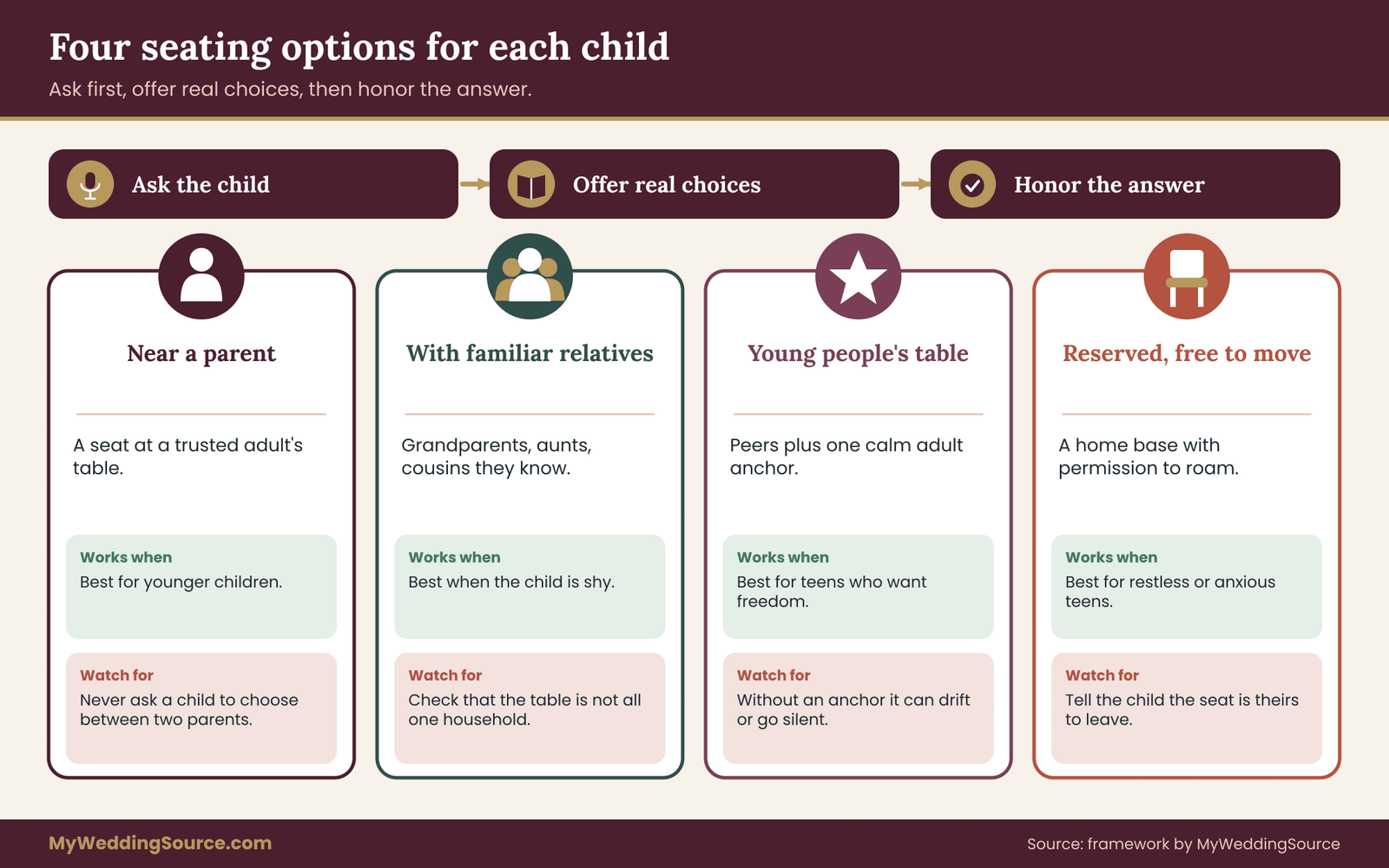
A child’s first question about blended family seating is not “where?” but “with whom?” Ask each child or teenager, in a calm setting, who they would like to sit with and who they would prefer not to. Offer them real choices, such as a table near a parent, a table with cousins, or a young people’s table with an adult anchor. Avoid asking them in front of other family members, and never ask a child to choose between two parents.
For younger children, a parent can ask on the child’s behalf and watch the child’s reaction. For teenagers, ask them directly, and treat the answer as binding unless a safety issue overrides it. A fifteen-year-old who says “I do not want to sit with my stepsister” has just told you something useful, and an adult who dismisses it creates a problem the chart cannot fix.
Four options for each child
In blended family seating, most children fit one of four arrangements. Near a parent, at the table of a trusted adult. With familiar relatives, such as grandparents or cousins. At a young people’s table, with other children and one or two adults nearby as anchors. Flexible, with a reserved seat but permission to move, so the child can wander to the dance floor and come back.
The flexible option works especially well for teenagers who may feel trapped at a fixed seat. A reserved seat gives them a home base. The young people’s table works best when it has an adult anchor who is not a parent, such as a cousin in their twenties. Without an anchor, a teen table can drift into chaos, or into silence.
Two children who barely know each other
Step-siblings who have met only a few times often get seated together because it feels natural to adults. It rarely feels natural to the children. A forced pairing can make both feel watched. Instead, seat them at the same table only if each has agreed, and put a friend of each at the table, so that neither carries the conversation alone. If either says no, seat them at neighboring tables with a friendly face at each.
Photographs raise a related question, but a reception dinner is not the time to force bonding. Sitting together is not the same as getting along.
Young children and practical needs
Small children need a booster seat, a high chair, a kid-friendly meal and an exit route. Seat them near an aisle, not in the middle of a crowded table, so a parent can leave quickly. Put the children’s meals on a separate service note for the caterer. If a child has a food allergy, the table must be labeled and the server briefed. The U.S. Food and Drug Administration explains the major food allergens and the basics of allergen labeling, and the caterer should know them.
Honor seats in blended family seating: the couple’s table, parents and stepparents
Status is the quiet half of blended family seating. Even when every conflict rule passes, a guest can leave unhappy because the chart ranked them below someone else. In blended family seating, status questions are sharper because roles are less standard. A person who raised a child for twelve years may not be a parent in the legal sense and still expects a place that matches their part in the child’s life. Another person may be a legal parent who has had little contact. The chart cannot settle those questions, and you should not presume them.
Do not assume who counts as family
Avoid building honor seats around labels like “mother of the bride” or “stepfather.” Build them around what each person actually wants and what the couple wants. Some stepparents want a prominent seat. Others prefer a quiet one and would feel exposed at the front. Some birth parents want to be at the center. Others prefer a lower profile because of how the day feels to them. Ask, and accept the answer.
The couple should also decide what they themselves want to signal. A seat near the couple may mean “you are central to our day” or it may only mean “this table has the best view of the cake.” Decide which message you mean, then choose seats that say it honestly.
Options for the couple’s own table
The couple has four common choices. A sweetheart table seats just the two of them, which avoids every family-ranking question at the head of the room. A head table seats the couple with the wedding party, which turns the question into one about the party’s partners and family. A family table seats the couple with parents and siblings, which concentrates the status pressure on one table. A couple among guests seats the couple at an ordinary round table with chosen friends or relatives, which removes the head-of-room symbol altogether.
In a blended family with hard rules among parents and stepparents, a family table is the riskiest blended family seating choice. It forces every honored adult into one place, and a hard rule can disqualify it before the chart is drawn. A sweetheart table or a couple-among-guests layout avoids the problem and gives you freedom to place parents at separate tables.
Equal honor without equal geometry
In blended family seating you cannot always seat two honored adults the same distance from the couple. The worked case showed one way through: match the signals instead of the distances. Signals include who is named in toasts, who is escorted to a table by the couple, who is served first, who appears in the first family photograph and who receives a personal visit during dinner. When both people receive the same signals, the difference in distance matters far less.
The signals need to be visible to the person receiving them. A private word of thanks counts, but a gesture in front of the room counts more, because status is a public thing. Plan the signals the way you plan any other part of the evening, with a name next to each one.
Honoring someone who is not there
A blended family sometimes includes a parent, a spouse or a child who has died. A memorial seat or a remembered name at the table is common and can be comforting, but it can also be a pressure point if a new spouse or a stepchild feels displaced by it. Talk with the people closest to the loss before you decide. The wedding etiquette guide covers general courtesy around sensitive moments, and the same principle holds here: ask the people involved, and let the answer shape the gesture.
Grandparents, aunts and other anchors
Grandparents often function as anchors for children in a blended family. A grandparent who is close to both households can seat the child safely and give them an adult to sit beside. Use them. An aunt or an older cousin can play the same role at the young people’s table. Choose anchors who are calm, who like the children and who will not take sides.
Anchors need a quick briefing, and it should be kind and brief. A message like “We have put you at the young people’s table so Ivy and Eli have someone friendly nearby. Please let us know if anything feels off” does the job. It asks for a service, not a performance.
Blended family seating when the guests are adult children
At a second wedding, the blended family often includes adult children, and some of them have opinions about the new partner, the other side of the family or their own seat. Adult children deserve the same respect as any other guest, which means asking them rather than telling them. They are also not props for a family photograph, and they should not be placed to signal approval they have not given.
Seat adult children where they want to be, which is often with their own partners and friends rather than at a table of parents. If an adult child has a difficult relationship with a stepparent, treat that as a ledger line like any other. Blended family seating does not require anyone to fake warmth, and the couple’s best course is to allow distance without comment. A kind word of thanks for coming does more for the relationship than a seat that forces a conversation.
Asking before you assign: conversations and scripts
A blended family seating ledger depends on information from people, and the quality of that information depends on how you ask. A clumsy question can create the conflict you are trying to prevent. A good one can build trust and often shortens the whole process. This section covers who to ask, in what order, and what to say.
Who to ask first
Start with the couple. Each partner writes down their own list of boundaries, comfort points and honor questions before talking to anyone else. If the two lists disagree, resolve the disagreement privately. Then, and only then, talk to the adults at the center of each hard rule. One at a time, in private, by phone or in person if you can manage it.
The order matters. If a parent hears about another parent’s boundary before the couple has a plan, the news can turn into a quarrel. Gather the facts quietly, build a draft, then share only what each person needs to see: their own table, their own neighbors and the reason for any change that touches them.
Questions that work
Good questions are open, short and about the person’s own comfort. “Is there anyone you would like to sit near, or anyone you would prefer to sit away from?” “Do you need anything from the seating, such as an aisle seat or a quiet spot?” “Would you rather be at a table with family or with friends?” Each of these gives the person control without asking them to rule on anyone else.
Avoid questions that ask people to judge a conflict. “Do you think it would be a problem if Mom and Denise are at the same table?” asks them to predict and take a side. Avoid questions that suggest an answer, such as “You wouldn’t mind sitting with your ex, would you?” Avoid group messages that mention the conflict, even obliquely.
Scripts you can adapt
The wording below is meant as a starting point. Change it to match how you speak, and keep it short.
To a person with a boundary: “We want you to enjoy the evening. Is there anyone you would prefer not to sit near? We will keep that private and plan around it.”
To an honored adult who will be seated apart: “We have arranged tables so that everyone has the space they asked for. Your table is with people who care about you, and we will make sure you are included in the toast and the family photo. If anything about it feels wrong, please tell us.”
To a person whose request cannot be met: “We looked hard at that request. In this room, we cannot seat the two of you farther apart than this, and we do not want to promise something we cannot deliver. Here is what we can do instead.”
To a teenager: “We are planning where everyone will sit. Would you like to be with the young people, near family or somewhere else? You can say no to any of these, and we can change it.”
Telling people without announcing a conflict
When you share the blended family seating chart or a single assignment, say nothing about the reasons. Guests do not need to know why two tables are far apart. A simple seating card or a short message is enough: “You are at table seven.” If a guest asks why they were moved or placed where they were, answer with something true and neutral, such as “We were balancing the room and wanted to make sure you had people you enjoy nearby.”
Do not lie about the reason, but do not offer the backstory. A neutral truth protects everyone involved. If you are asked directly about a conflict, you can say, “We want everyone to be comfortable, so we have arranged the seating with that in mind,” and leave it there.
Handling the person who wants a veto
Sometimes one adult insists that a specific person not be invited, or that a seat be changed after the chart is set. That is a different conversation and it belongs to the couple. Listen, thank them for telling you, and say the couple will consider it. Then consider it, privately, against the ledger. A boundary about the person’s own seat can be honored. A demand that someone else be excluded or demoted is a guest-list question, not a blended family seating question. The guest list guide covers how to hold that line.
A calm, repeated answer works better than a long debate: “We have made the decision, and we know it is not what you hoped for.” Say it kindly, as often as needed, and do not reopen the chart.
Alternatives when blended family seating alone cannot solve it
Some blended family seating problems cannot be solved by moving tables. The room is too small, the list is too large or the hard rule needs more than a chart can give. Before you accept a layout that passes on paper but fails in practice, look at the alternatives. Each one changes something other than the chart, and each has costs you should weigh honestly.
Open seating with reserved family tables
In open seating, guests choose their own seats, and only a few tables are reserved. It reduces the work of assigning and gives people control. Open seating can work for blended family seating when the conflicts are mild and the list is small. It works badly when hard rules exist, because open seating gives you no way to keep two people apart. The reserved tables can cover the sensitive relatives, but then the rest of the room has no protection from a surprise pairing.
A useful variation reserves only the tables for the people with hard rules and leaves the rest open. It keeps the protection where it matters and saves effort elsewhere. It does need clear signage on the reserved tables, so that guests do not sit in the wrong place.
Cocktail-style or station-based reception
A cocktail-style reception with food stations and mingling space removes the fixed dinner seating. People move, sit where they like and talk to whoever is nearby. That reduces forced proximity. It also makes walking paths and crowd density more important, because the whole room is moving. A cocktail format suits a smaller, shorter reception and fits couples who want low-key celebration. It suits conflict poorly if two people cannot be in the same space at all, because there is no seat to hold a distance.
If you use stations, keep a few quiet seating areas, and place them in different parts of the room. People with a history may want a place to rest and recover.
A split schedule
Where a hard rule in blended family seating needs real separation, a split schedule can supply it. One person attends the ceremony and the first hour of the reception, and the other joins for dinner and dancing, or the reverse. It is an old idea, and it has costs: both people may feel excluded from part of the day, and the guests may notice. It works best when both people have agreed to it and when each part of the day still matters to them. Never impose a split schedule on someone without their agreement.
A separate small gathering
Another option is to hold a second, smaller gathering on another day for the person who cannot attend the main reception. A brunch for one set of relatives, or a family dinner the night before, gives people time with the couple without the pressure of the whole room. It is not a consolation prize if it is done well. It does require time and money, and it does not replace the main day for someone who badly wanted to be there.
Family-style tables and shared serving
Family-style service puts platters on the table so guests share and pass. It encourages conversation and can warm a table. It also forces more interaction among table mates, which is the opposite of what a table with a soft rule needs. Use it only where the table is full of friendly relationships. In a blended family with conflict at one table, plated service lets guests eat without interacting.
Reducing the list
Sometimes the honest alternative to blended family seating tricks is a shorter guest list. If a hard rule cannot be met in the room you have, and neither person will agree to a split schedule, the choice may be between inviting one of them and inviting neither.
That is a painful decision, and the couple should make it with care and, where possible, by talking with both people first. A guest who is not invited to a reception can still be included in a ceremony or in another event. Make the cuts by a rule you can explain to both people, not by who complains loudest.
Failure conditions and fallback moves for blended family seating
Every layout can fail. The question is whether you know how it will fail and what you will do when it does. This section lists the common failure conditions for blended family seating, the sign that each one is happening and the move to make.
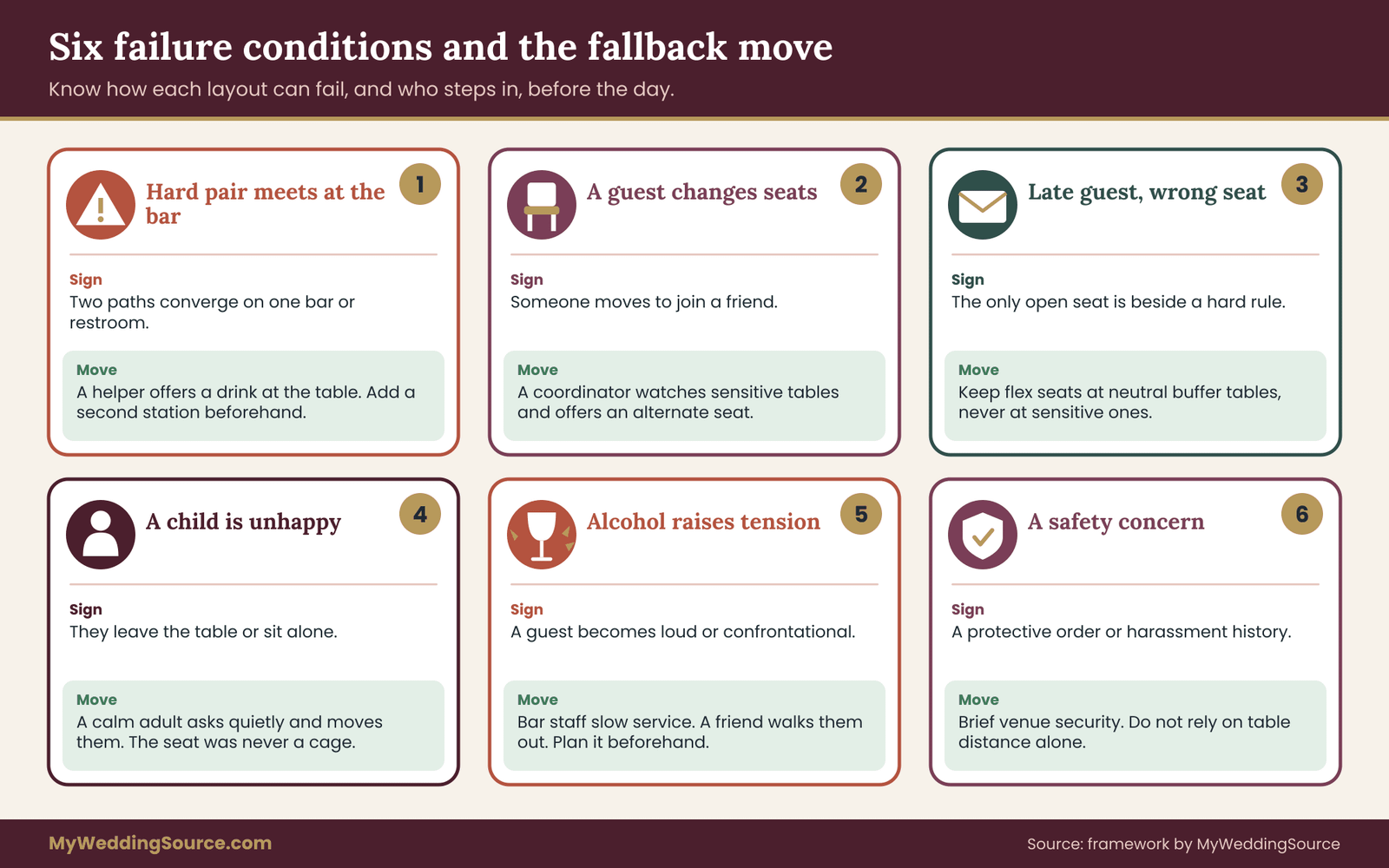
The hard pair meets at the bar
The sign: two people with a hard rule are heading for the same bar or the same restroom corridor, or they have just arrived at the same moment. The move: a planner or a trusted friend steps in early and offers one of them a drink at the table. A second bar station placed in advance prevents most of these moments. If the encounter happens anyway, a calm, light interruption (a question, an errand, a handshake with someone else) is usually enough to break it.
A guest changes seats
The sign: a guest at a well-placed table moves to another table, perhaps to join a friend. Guests do this more than couples expect. The move: place a short card or a quiet word with the table asking guests to stay in the assigned seats for dinner, and assign someone, such as a coordinator or an usher, to watch the sensitive tables. If a hard pair ends up near each other, offer a quiet exit and an alternate seat.
A late RSVP or a plus-one lands in the wrong place
The sign: a guest who was not on the list arrives, or a plus-one is added, and the only open seat is next to a hard rule. The move: keep two or three flex seats in neutral buffer tables, and fill them only from the neutral pool. Do not use the buffer seats for conflict tables. A late guest at a buffer table is a small adjustment, and a late guest at a sensitive table is a risk.
A child is unhappy with the seat
The sign: a child or teenager leaves the table repeatedly, sits alone or looks for a parent. The move: a calm adult goes over, asks quietly where they would like to be and moves them if the answer is clear. The reserved-but-flexible seat helps here, because the child has permission to go. A child who asks to move is giving you information, and moving them is not a defeat.
A guest is intoxicated or aggressive
The sign: a person with a hard rule, or any guest, becomes loud or confrontational. Alcohol is a common factor in tense moments, and the National Institute on Alcohol Abuse and Alcoholism publishes information about its effects. The move: a bartender trained to slow service, a coordinator who can step in and a clear path for the person to leave with a friend or a ride. Plan this with the venue and the bar staff before the day. The bar service planning guide covers cutoff points and staffing.
A safety concern
The sign: a person with a protective order, a history of harassment or a stated safety concern is at the event. The move: involve the venue’s security or a hired professional ahead of time, brief them on the one rule that matters (who must not come near whom), and give a trusted person authority to ask someone to leave. A blended family seating chart is not a safety system. If a real safety concern exists, do not rely on distance between tables, and consider whether the person at risk is safer with a different event plan.
The honored adult is upset
The sign: a parent or stepparent expresses hurt about their seat. The move: listen first, without arguing. Offer a signal that fits, such as a toast mention or a private visit, and do not rework the chart in the moment. If the person is upset enough to leave, ask a friend or relative to go with them and keep the exit quiet.
When to abandon the layout
Abandon a blended family seating layout if two hard rules fail in the final test, if the venue cannot supply the paths you need, or if the person with the boundary says it no longer works. Do not defend a layout you built just because you spent hours on it. A redrawn chart costs less than a hard failure at the reception. Redraw from the ledger, which is why you wrote it first.
Late changes, place cards and the day itself
A blended family seating chart that passes every test in October can fail in November if nobody maintains it. RSVPs arrive late, people cancel, new partners appear, a child changes their mind. This section covers the weeks before the wedding and the day itself, which is where a good layout is protected or lost.
Keep the ledger current after RSVPs
Reopen the ledger when the final RSVP count settles. Check each line again: is everyone still coming, has anyone new joined, has any relationship changed? A cancellation can free a seat that solves a problem, and an addition can create one. Run the test on the revised chart, not on the original. It takes an hour and it is cheaper than discovering a problem at the door.
Set a date after which no one may change tables without a conversation with the couple or the coordinator. A cut-off at about ten days before the wedding is common, and the exact date should match the caterer’s final count and the printer’s deadline. After the cut-off, treat every change as a risk and run the ledger test on it.
Place cards, table numbers and signs
Name cards and table numbers affect the whole evening, and in blended family seating they carry an extra job: they must not reveal a conflict. Use a neutral system for table names or numbers. Avoid names that suggest family sides, such as “Ben’s family” and “Maya’s family,” on table signs or seating displays. Numbers or neutral themes work better because they let guests find their seats without implying a ranking or a divide.
Use the names guests actually use. A stepparent’s preferred name, a guest’s chosen first name or a child’s nickname belongs on the card if that is how they are known. Ask when you gather boundaries. The wedding seating chart guide has details on chart display and legibility, and the same readability rules apply here.
Brief the staff and a few trusted people
On the day, a short briefing prevents most trouble. Meet with the coordinator, the caterer’s lead server, the bartenders and the DJ or emcee for ten minutes. Share only what each person needs. The bartender needs to know which bar station serves which side. The server needs to know which table gets which meal. The coordinator needs the full ledger and authority to act.
Choose two or three trusted guests, such as a cousin or a close friend, as quiet helpers. They are not guards. They know the layout, they know where the sensitive tables are and they can step into a conversation with a friendly question. Brief them kindly, and keep the briefing to the specific tasks they can do: “If you see Marco heading toward the bar on the right, please walk with him to the other station.”
Toasts, the first dance and other whole-room moments
Whole-room moments draw everyone’s attention and can raise tension. Think about the order of speakers, the sightlines and the content. Speeches that mention the past in ways that sting a former spouse or a stepparent are a risk. The couple can ask each speaker to focus on the couple and the future, and to avoid references that could be read as pointed. The wedding etiquette guide covers toast courtesy, and a short note to speakers is usually enough.
For the first dance and other parent dances, consider who stands where. If two people with a hard rule will both be near the floor, place each on a different side. If a parent dance involves a person who will feel exposed, discuss the format in advance. A dance with a stepparent is a gift for some and an ordeal for others, so ask.
What to do with an unexpected moment
Some moments cannot be planned. A guest arrives late and sits at the wrong table. A person with a boundary decides to stay at the bar longer than expected. A child cries and wants to go home. Respond to each by reducing the stakes: move a seat quietly, offer a drink, find a calm adult. Do not make an announcement and do not embarrass anyone.
After the event, a quick debrief with the coordinator helps. What worked? Which table caused stress? Which gesture landed well? Blended family seating is a skill you learn mostly by watching what happened. If you plan a second event, such as a brunch, use what you learned.
Your next steps
You do not need to do everything at once. Work in this order, and stop when the ledger and the first test are done if time is short.
- Write the ledger. List every hard, soft and open pair, plus access and belonging lines, in a private blended family seating document with no backstory. Add a target rung from the distance ladder to each line.
- Ask each person about their own seat. Use short, private questions. Do not ask anyone to judge another person.
- Get the floor plan. Mark the entrance, restrooms, bars, dance floor, speakers, exits and service doors. Trace three paths for each hard rule.
- Draw two or three blended family seating layouts. Test each against the ledger. Disqualify any layout with a hard failure and repair the best one.
- Decide the honor signals. Write who is named in toasts, who is escorted, who is served when and who appears in the first photograph, so equal status does not depend on equal distance.
- Plan the fallback moves. For each hard rule, name who steps in, where the second bar station or quiet exit is and what the plan is for a late guest.
- Retest after the final RSVP count. Run the ledger on the revised blended family seating chart and set a cut-off date for changes.
FAQ
How do I handle blended family seating for divorced parents who do not get along?
For blended family seating, ask each parent about their own comfort in private, then treat the answer as a rule. Seat them at different tables, at least two tables apart and on opposite sides of the room if you can, and give each table warm company. Match the gestures that signal honor, such as toast mentions and a visit from the couple, so neither feels ranked lower. Do not announce the reason to guests or explain it to either parent’s relatives.
Should stepparents sit at the same table as birth parents?
In blended family seating, only if everyone involved wants it. Some families sit together easily, and some do better with separate tables and equal gestures of honor. Ask each adult what they prefer, and watch for mismatched answers, because one person may be comfortable and another may not. If answers differ, the more cautious answer sets the rule. A table that reads as a family may feel like a staged one to someone with a hard boundary.
Where should the children of a blended family sit?
Good blended family seating starts by asking each child where they would like to be, and offer real choices: near a parent, with familiar relatives, at a young people’s table with an adult anchor, or at a reserved seat with permission to move. Do not force step-siblings to sit together. If they agree to share a table, give each a friend there. A child who says no to a seat has told you something useful and should be heard.
Is a sweetheart table better for blended family seating than a head table?
For many blended family seating problems, yes, because it avoids ranking parents, stepparents and wedding party members at the front of the room. It gives you freedom to place honored adults at separate tables. A head table can work when the wedding party is made of friends and has no sensitive pairs. A family table is the riskiest choice if any two of the people at it have a hard rule.
What if a guest refuses to sit near someone?
In blended family seating, ask them to describe their boundary in their own words, then check it against the layout. If the request is about their own seat and the room allows it, honor it. If it demands that another person be excluded or demoted, treat it as a guest-list question and decide privately. Offer what you can do, state what you cannot, and avoid promises that depend on a room you do not control.
How far apart should two people with a conflict sit?
For a hard rule in blended family seating, aim for at least two tables between them on different sides of the room, and trace their walking paths to the bar, restrooms and exit to make sure the paths do not cross. For the most serious rules, aim for separate zones with neutral tables between. Distance on a chart is not enough if the paths converge, so test the real routes through the room.
Can I use open seating for blended family seating?
Only if no hard rules exist. Open seating gives guests control and lowers your workload, but it offers no protection from an unwanted pairing. A hybrid works better: reserve the tables where hard rules apply and leave the rest open, with clear signs on reserved tables. If a hard rule matters a great deal, assigned seating is the safer choice.
What if the room is too small to keep people apart?
With blended family seating in a small room, say so early, ideally before the venue contract is signed. In a small room, the answer is often to change something other than the chart: a larger room, a smaller list, a split schedule, a cocktail-style format or a second gathering for one person. Do not promise distance the room cannot give. If you have already signed, shorten the reception or add a second bar station and separate exits to buy more space.
Sources
- ADA.gov: Americans with Disabilities Act information and technical assistance
- U.S. Access Board: accessibility guidelines and standards
- National Institute on Alcohol Abuse and Alcoholism (NIAAA)
- U.S. Food and Drug Administration
- Centers for Disease Control and Prevention
- Child Welfare Information Gateway, U.S. Department of Health and Human Services
- Administration for Children and Families
- National Fire Protection Association: Life Safety Code
- U.S. Fire Administration, FEMA