
A wedding guestbook attendant is one person whose job at the entrance is to keep arrival moving: greet each guest, point them to the book, and make sure a short signing stop never turns into a line. This guide shows how to decide whether you need a guestbook attendant at all, and how to set up a relaxed greeting station and a rotating shift schedule that does not feel like a checkpoint.
A line at the guestbook table comes from arithmetic, not from a lack of staff. A good guestbook attendant fixes it by greeting people on approach, giving each guest a clear next step, and rotating out every thirty to forty-five minutes. If your guest count is small or arrivals are spread out, a sign and a pen may be enough. If many guests arrive at once, add a second signing point or move the book to cocktail hour.
Most couples picture the guestbook as a quiet table with a pretty book and a pen. Then the ceremony ends, two hundred people move toward the same doorway, and a bottleneck forms around the one spot where everyone wants to stop for thirty seconds. The photographer cannot get a clean shot of the entrance, the bar is blocked, an older relative waits on their feet, and the person who offered to “keep an eye on the book” is now directing traffic without having been told that was the job.
This article treats the guestbook attendant as a small, specific assignment rather than a vague favor. It covers when the role is worth creating, how to calculate whether a line will form, how to design the greeting flow, how to schedule rotating shifts for friends or hired helpers, and what to do when something goes wrong. It stays on one question: how to prevent lines without making the entrance feel formal.
A note on scope. This is general event-operations information, not legal, tax or employment advice, and rules about paying helpers differ by state and situation, so confirm the current rules with the agency that issues them.
What a wedding guestbook attendant is for
The name suggests that the person guards the book. In practice the book is the least important part of the job. A guestbook attendant exists to protect three things: the pace of arrival, the first impression of the event, and the book itself.
Pace. The entrance is where a wedding either flows or stalls. Guests who stop to sign, to read what others wrote, to look for their own name on a list or to find the restroom all create small pauses. A pause by one person is nothing. A pause by forty people in ten minutes is a line. The guestbook attendant keeps the pauses short and spreads them out.
First impression. A guest who is greeted by name or by a warm hello in the first thirty seconds relaxes. A guest who walks into a clump of strangers waiting for a pen does not. The attendant is the first friendly face after the ceremony or after the venue door, and that matters more than any décor on the table.
The book. Guestbooks go missing, get pens pressed through pages, collect drink rings and are sometimes left behind at the venue. Someone who treats the book as a keepsake that has to leave the building with the couple is doing real work, even if it looks like standing near a table.
What the role is not: security, an usher, a gift-card guard, a seating-chart reader or a host who works the room. Each of those is a different job, and mixing them is how an guestbook attendant ends up overloaded. The sections below show how to keep the assignment narrow.
Why “without making it formal” is the real constraint
Couples who ask for this help usually say the same thing in different words. They want guests to be looked after, but they do not want a receiving line, a clipboard or a person who sounds like an airport agent. That tension shapes every choice in this guide.
A formal greeting station has a visible queue, a fixed script and a person who stands behind a table. A relaxed one has movement, small choices for guests and a person who steps out from behind the table. The second feels like hospitality. The first feels like processing. The techniques later on, such as the approach greeting, the side step and the “sign and flow” cue, are all ways of getting the efficiency of the first with the tone of the second.
What this guide does not repeat
The broader question of how guests move through arrival, seating, food and exit belongs to the guide on wedding reception guest flow, and the full picture of who handles setup, service and breakdown sits with the vendor and day-of schedule. This article zooms in on the one doorway where signing happens. If you are choosing between an audio book, a photo book or a classic written book, that is a separate decision about format; here the format is assumed and the question is staffing and flow.
When a guestbook attendant is worth having
Not every wedding needs a person at the table. Adding one costs a favor from a friend or an hour of paid time, and it can make a small, easy entrance feel more managed than it needs to be. Use the following fork to decide, and answer honestly instead of aiming for what looks complete.
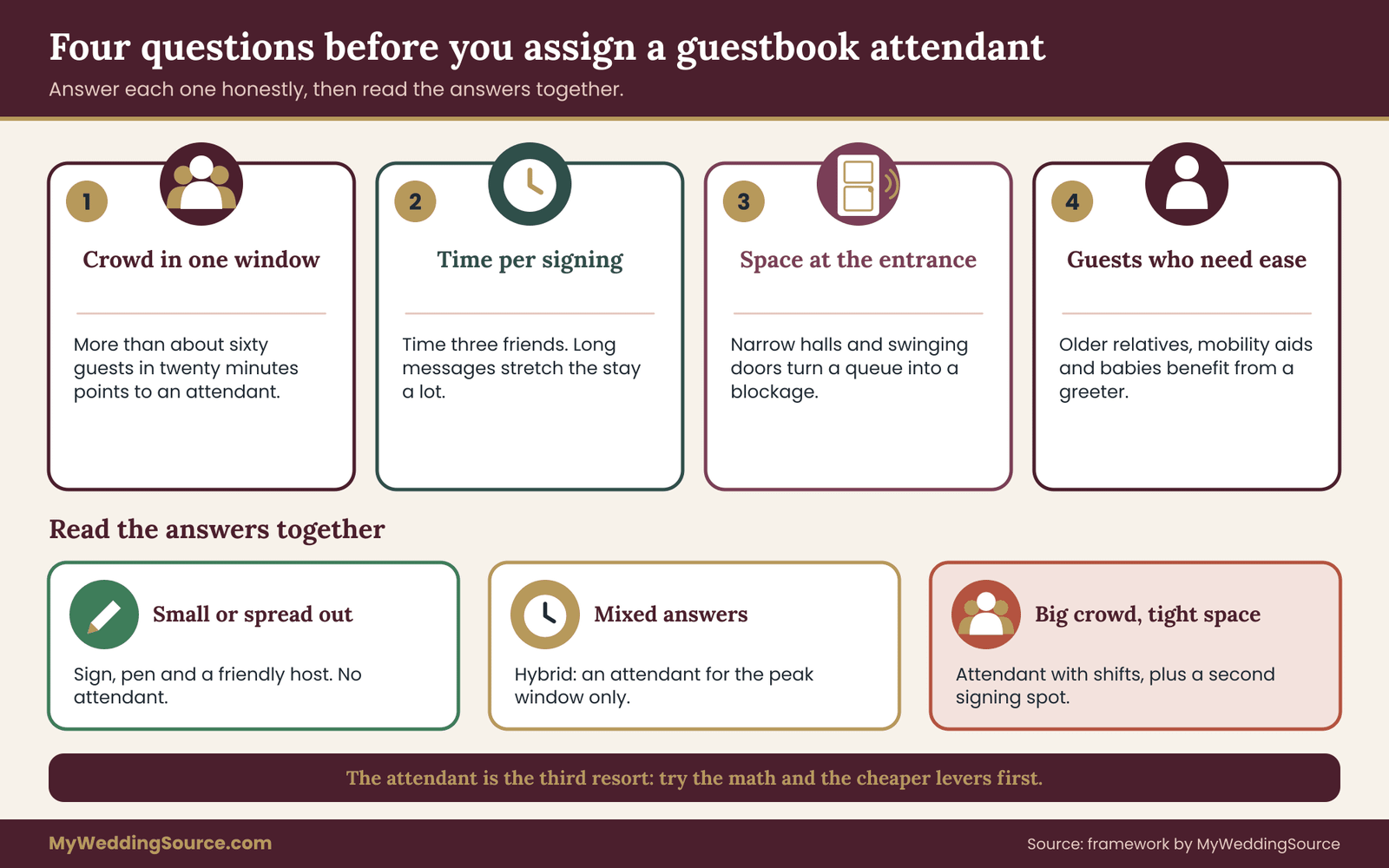
Question one: how many guests arrive in the same window?
Count guests, then count how many will reach the book within the same fifteen minutes. At a ceremony with the guestbook just outside the doors, almost everyone passes within about fifteen to twenty minutes of the start. At a reception where the book is by the cocktail-hour bar, arrivals spread across the entire hour. The same guest list produces a very different crowd depending on where and when the book sits.
As a rough rule, if more than about sixty people will reach the table inside twenty minutes, plan on an attendant. If fewer than thirty will, a sign is probably enough. Between those numbers it depends on the next three questions. Treat these as planning thresholds to test against your own venue, not as measured facts.
Question two: how long does one signing really take?
Time it. Ask three friends to sign a page the way they would at your event, including reading the sign, picking up the pen, writing a line and stepping away. Most couples are surprised that a handwritten message plus a name takes noticeably longer than they assumed, and that guests who write a paragraph take several times longer than guests who sign a name. Whatever number you get, write it down. It becomes the key input in the arrival math in the next section.
Question three: how much room is there at the entrance?
A wide foyer absorbs a queue without anyone noticing. A narrow hallway, a door that opens onto a sidewalk or a patio path turns a queue into a blockage. Walk the entrance with a tape measure or ask the venue for a floor plan. Note where doors swing, where coats will go, where the photographer will stand and where an older guest with a cane or a walker will need a straight path. If the space is tight, an guestbook attendant helps, but a second signing point or a different location helps more.
Question four: who in your guest list needs the entrance to be easy?
Older relatives, guests with limited mobility, parents carrying a baby and people who arrive alone and a little nervous all benefit from a person who says hello and offers a clear path. If a meaningful number of your guests fall in these groups, an guestbook attendant is no longer a nice extra. It is part of looking after guests, and the guide on wedding guest care planning covers the wider set of needs those guests may have.
Reading the four answers together
If question one gives a large crowd in a short window, and either question three or question four points to a tight space or guests who need an easy path, hire or recruit an guestbook attendant and plan shifts. If question one gives a small or spread-out crowd and the space is generous, skip the attendant and rely on signage and a well-set table. If the answers mix, use a hybrid: an guestbook attendant only during the peak window, with the table running on its own before and after.
That hybrid is the most common right answer, and it is also the cheapest. A guestbook attendant does not have to be present for the whole event. They have to be present when arrival is thickest.
A note on tone when you ask a friend
When you ask someone to take the role, describe it as a defined window with a clear end, not as “stay by the book.” People say yes more easily to forty-five minutes than to an open-ended duty, and they stay more relaxed when they know when they will be released to enjoy the party. The later sections give a script for the briefing.
How lines actually form at a wedding guestbook table
Lines are predictable. They follow from three numbers: how fast guests arrive, how long each stays at the table and how many people can sign at once. When the number of guests multiplied by their time at the table exceeds the number of signing spots available in a minute, the excess waits. That is all a queue is.
The arrival curve is lumpy
Guests do not arrive evenly. At a ceremony, a few early guests trickle in, then the bulk arrives in a wave about ten to fifteen minutes before the start, then a handful of stragglers come after the music begins. After a ceremony, the opposite wave happens: almost everyone leaves their seats at the same moment and heads toward the cocktail area. If the guestbook is on that path, the table receives the entire guest list in a few minutes.
Because of this, the useful number is not the average arrival rate over an hour. It is the peak rate over the busiest five minutes. Planning around the average hides the bottleneck, and planning around the peak shows it.
A simple way to estimate your peak
Take your confirmed guest count and decide what share of guests will pass the table in the busiest five minutes. At a pre-ceremony entrance that share is often large, perhaps a third or more of the guests; at a post-ceremony doorway it can be larger still; at a cocktail-hour table it is much smaller. These shares are planning assumptions, not statistics, so test them against the venue’s layout and your own ceremony timing, and ask your coordinator how similar events at the venue have flowed.
Divide the guests expected in that five-minute peak by five to get guests per minute. Then multiply by the average seconds at the table and divide by sixty. The result is the number of signing spots in use at once. If it is more than the number of pens and writing spots you have, a line will form during that peak.
What the arithmetic shows
The worked case later in this guide uses real numbers, but the logic is easy to see with round ones. If sixty guests reach the table in five minutes, that is twelve a minute. If each guest spends thirty seconds at the book, twelve guests a minute need six writing spots at the same moment. One table with one book and one pen gives you one. Even a long table with a couple of pens gives you two or three. The queue is not a failure of staffing. It is a mismatch between the crowd and the surface.
This is why the single most useful thing a guestbook attendant can do is change the numbers. They can shorten the time at the table by offering a ready pen and a clear starting line. They can spread the crowd by suggesting guests sign during cocktail hour. They can add capacity by opening a second spot or moving a loose book onto a side table. Greeting is the visible part of the job, but changing the arithmetic is the real one.
The four levers for any line
Once you know where the numbers do not work, you have four levers. Pull the cheapest one that solves the problem.
Lever one: shorten the stay. Use a pen that works on the first try, put a short prompt on the page so guests do not stare at a blank line, and keep the book open at the right page. A visible example line, such as “name, a wish, a memory,” shortens the pause for people who freeze.
Lever two: add capacity. Provide more than one writing position: a second book, a long scroll, a set of cards or a loose-leaf format that can be signed on any flat surface. More positions means more guests signing in parallel.
Lever three: spread the arrival. Move the book to a place and time where guests are not all passing at once. A cocktail-hour location, a table near the bar line or a spot guests pass on the way to dessert all pull signing out of the peak.
Lever four: change the format. Replace the table with a roaming option such as a basket of cards guests fill out at their seats, a QR link or a photo station. Choosing between formats is a separate decision from staffing, and the same arrival math applies to any of them.
The greeting station flow: approach, sign, release
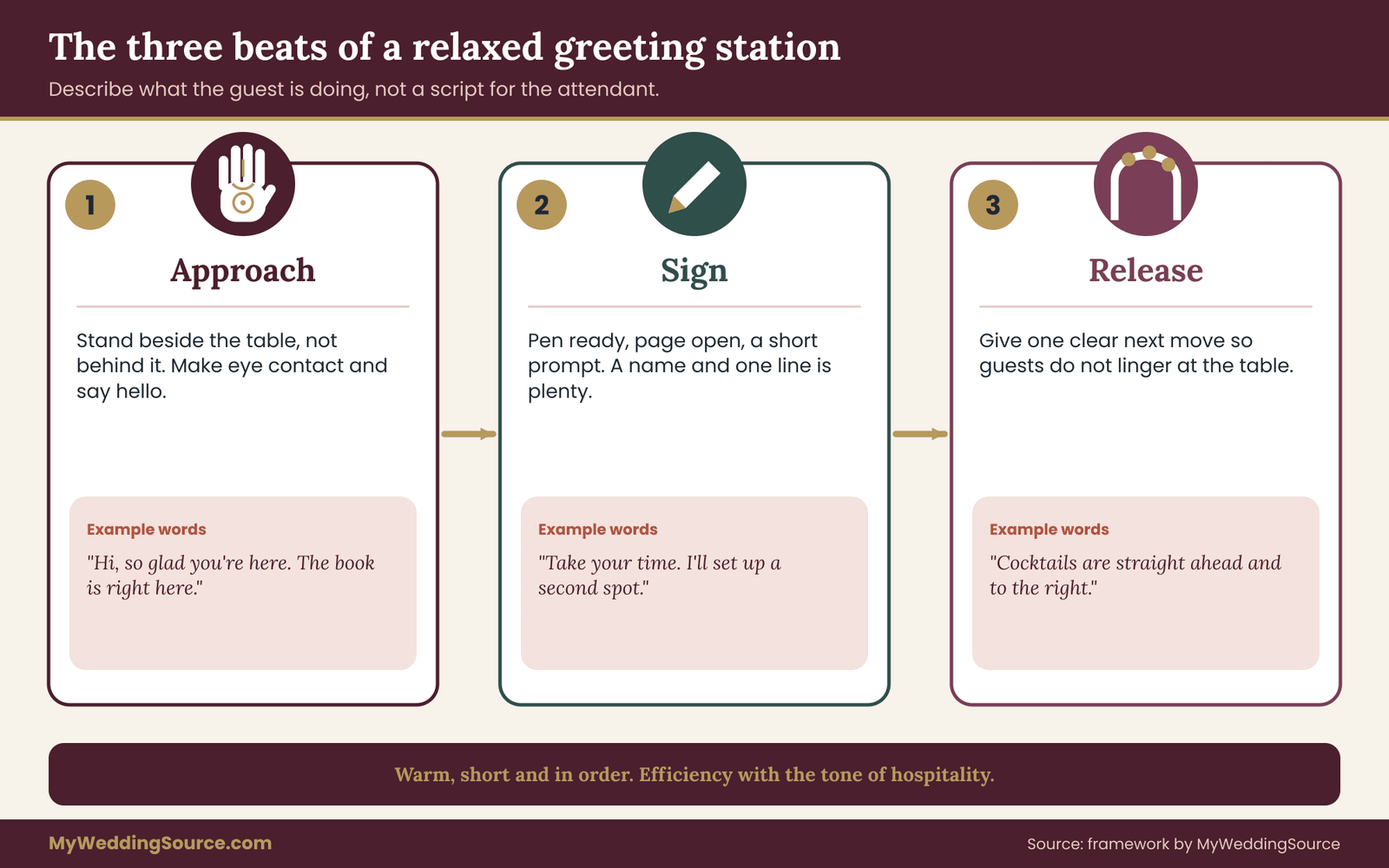
A relaxed greeting station has a shape. Guests should feel it as a gentle sequence, not as a set of rules. The sequence has three beats, and a guestbook attendant’s whole job is to keep those beats in order and short: approach, sign, release.
Beat one: the approach
The approach starts several steps before the table. The attendant stands to one side, not behind the book, and makes eye contact as guests come into view. A simple hello, a first name if they know it and a hand toward the book is enough. Standing beside the table rather than behind it matters. Behind a table you look like a clerk. Beside it you look like a host.
At the approach the guestbook attendant also does the quick triage that prevents trouble later. Does this guest look rushed, as though they are late for the ceremony? Does this guest need a clear path, such as someone with a stroller or a cane? Is this a group arriving together? The answers change what the guestbook attendant says in the next five seconds.
For a rushed guest, the line is “Sign any time tonight, the book will be out at cocktail hour too.” For a group, it is “Take the book in turns, there is a pen on each side.” For a guest who needs a path, it is a step back and a clear gesture toward the open side, with the book offered to them rather than the reverse.
Beat two: the sign
The signing beat is the one that creates lines, so it has the most design. Make it a quick, low-stakes act. Open the book to the current page, hold a working pen ready and give guests a short prompt. A fixed example line, such as a name and a one-sentence wish, tells guests they do not need a speech.
If your book is a classic bound book, put the open page at a comfortable height and keep the previous pages smoothed flat. If it is a set of cards, a stack of blank ones with a basket for finished ones lets guests step to any flat surface. If it is a poster or a frame, set out a few fine pens and a clear line of space so two guests can write at once.
The guestbook attendant’s task here is light. They keep the pen working, replace an empty page, wipe a rim from a drink and watch for the moment a guest is about to start a long paragraph. For those guests the best response is a friendly one: “Take your time, I will hold a spot for the next person at the other side.” That keeps the long writers from stalling everyone else without rushing them.
Beat three: the release
The release is the step most stations forget. After signing, a guest needs a clear next move or they linger at the table. The attendant gives it in one sentence: “Cocktails are straight ahead and to the right,” or “Your seat card is at the next table.” A direction ends the stay and keeps the flow moving.
A good release also keeps the crowd from forming a second line. If the next stop after the guestbook is a seating chart, a drinks table or a coat check, make sure those are placed so guests do not stack up between them. The guide to wedding seating charts covers how to lay out lookup points, and the same principle applies: one stop should not feed straight into another stop that has the same bottleneck.
Why the three beats beat a script
You could hand the guestbook attendant a script and ask them to say the same thing to everyone. The result sounds stiff, and guests notice. The three beats are easier to remember because they describe what the guest is doing, not what the attendant should say. An guestbook attendant who knows the beats can improvise the words, which makes the entrance feel warm even when the staffing is tight.
Setting up the station so the line cannot form
A good setup does half the guestbook attendant’s work before the first guest arrives. The goal is to make the right behavior the easy behavior, so the guestbook attendant spends their time on people rather than on fixing problems.
Placement
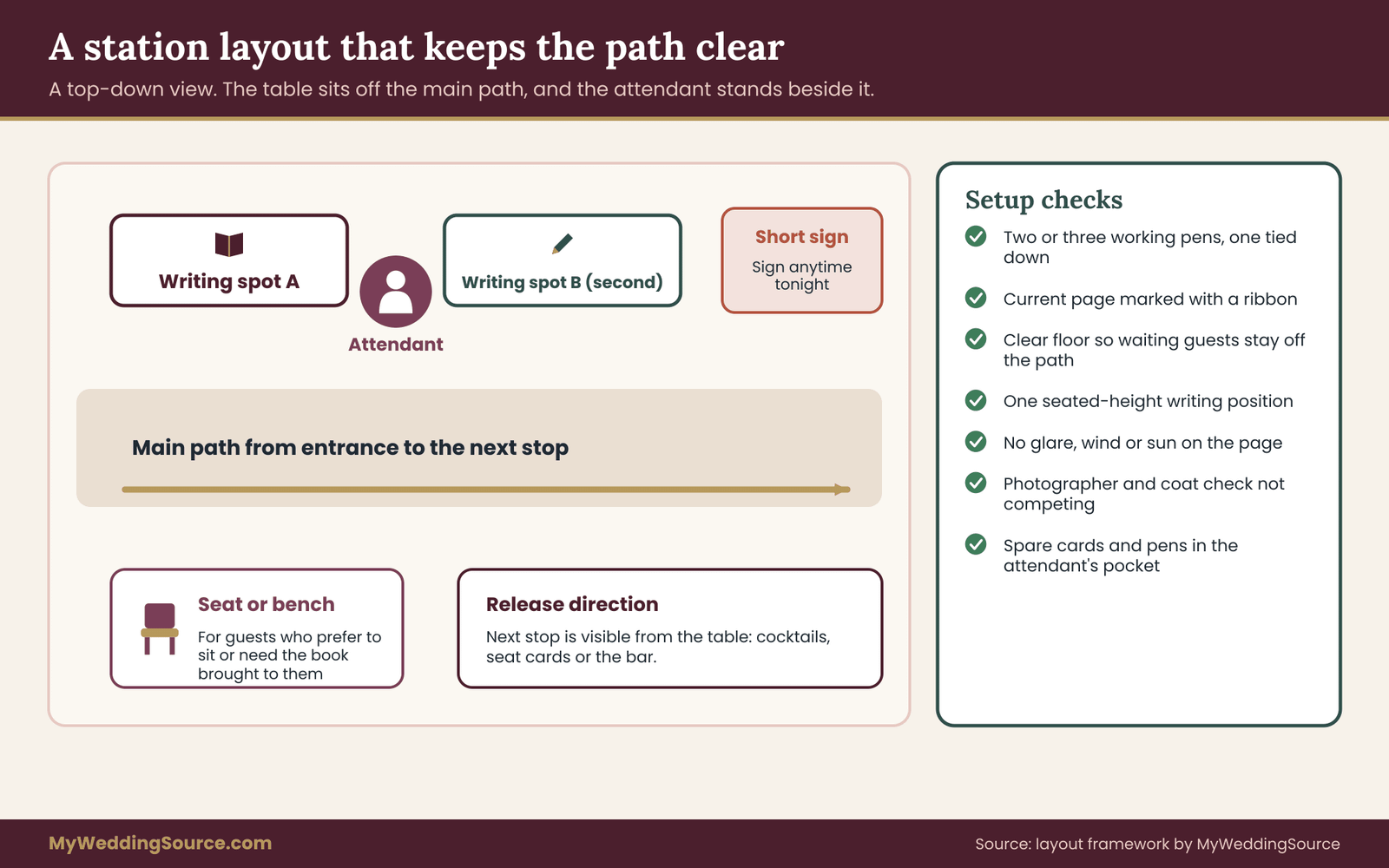
Put the guestbook where guests pass but where stopping does not block the main path. A good spot is just off the direct line from the entrance to the next destination, with enough clear floor in front that two or three guests can wait without touching the walkway. A table placed in the middle of a narrow corridor turns every signer into a roadblock.
Check three things on the walk-through. First, can a person using a wheelchair or walker approach the book and write comfortably? Second, is there glare, wind or sun on the page that will make people squint or hold the page down? Third, will the photographer, the DJ’s equipment or the coat check compete for the same square footage? Moving the table two or three feet often fixes all three.
The signage that tells guests where to go, including a small sign that reads “Sign here” and a second sign pointing to the next stop, belongs to a system rather than to a single decoration. The guide on wedding signage as a system covers readability and placement, and the same logic applies here: two plain signs beat one elaborate one.
The table
A single standard table gives you one writing position, maybe two. If your numbers from the arrival math show a peak, use a longer table or two small tables placed a few feet apart. Spread the writing positions along a line, not into a cluster, so guests can approach from either side.
Keep the table clear. The more objects on it, the slower people move. A book, two or three pens, a small stand of cards if you are using them, a short sign and a single flower or candle are enough. Larger decor belongs behind or beside the table rather than on it.
Pens, pages and backups
Pens fail more often than anything else on this list. Provide at least three working pens, and test each on the actual paper before the event, because some pens smear or bleed on certain stocks. Tie or tape one pen to the table with a short cord so it cannot walk away, and keep a spare in a pocket or a small bag.
For pages, think about what happens when a spread fills. If the book has a fixed number of pages, decide whether guests will write on both sides, how many pages to reserve for the later hours and who will turn the page. A thin ribbon bookmark helps the attendant find the current page quickly.
A backup plan for the pens and pages is a small thing that pays off disproportionately. A single dead pen with a guest standing in front of it creates a pause for everyone behind them.
A short sign that does the talking
The best signs are short and friendly. Something like “Sign anytime tonight” tells guests the book will stay available, which takes pressure off the peak. A line like “One line is plenty” gives permission to be brief. Avoid long instructions. If you have to explain the table, the table is too complicated.
Making room for the attendant
Give the guestbook attendant a place to stand and a small stash of supplies. A stool or a stand beside the table is a thoughtful touch for a two-hour shift, though in most designs the attendant should stand for the peak and sit during quieter periods. A small bag or a tray under the table can hold spare pens, a few extra cards, tissues, a mini lint roller or a phone charger for guests who ask. It sounds like detail, but it prevents the guestbook attendant from walking away during the peak to find something.
A quick test before guests arrive
Do a ten-minute dry run with two helpers. Have one act as a sequence of guests who arrive in a clump and one act as the guestbook attendant. Time the stay at the table, watch where people stand, note where the path narrows and adjust. A dry run reveals problems that no amount of planning on paper will, and it also gives your guestbook attendant a chance to feel the rhythm of the three beats before the real crowd arrives. If you cannot rehearse at the venue, rehearse in a hallway at home with chairs for the table.
Rotating shifts for a guestbook attendant
A single attendant who stays at the table all evening gets tired, misses the cocktail hour and starts to look like a guard. A rotating plan fixes all three, and it also keeps the welcome warm because each person arrives fresh. The plan below is built around the peaks you identified in the arrival math rather than around the clock.
Why rotate at all
There are four practical reasons. First, standing and greeting for an hour or more wears people down, and the quality of the greeting drops quietly. Second, the person you most want at the table, a warm friend or a relative, is usually someone you also want at the party. Third, a short, defined shift is easier to say yes to than an open-ended favor. Fourth, rotation spreads the load so that no single person carries the entire responsibility for the book, which lowers the chance that the book is left alone when the attendant needs a break.
Map the day into windows
Break the entrance into windows, then match each window to a staffing level. For a typical ceremony-plus-reception day, the windows look like this.
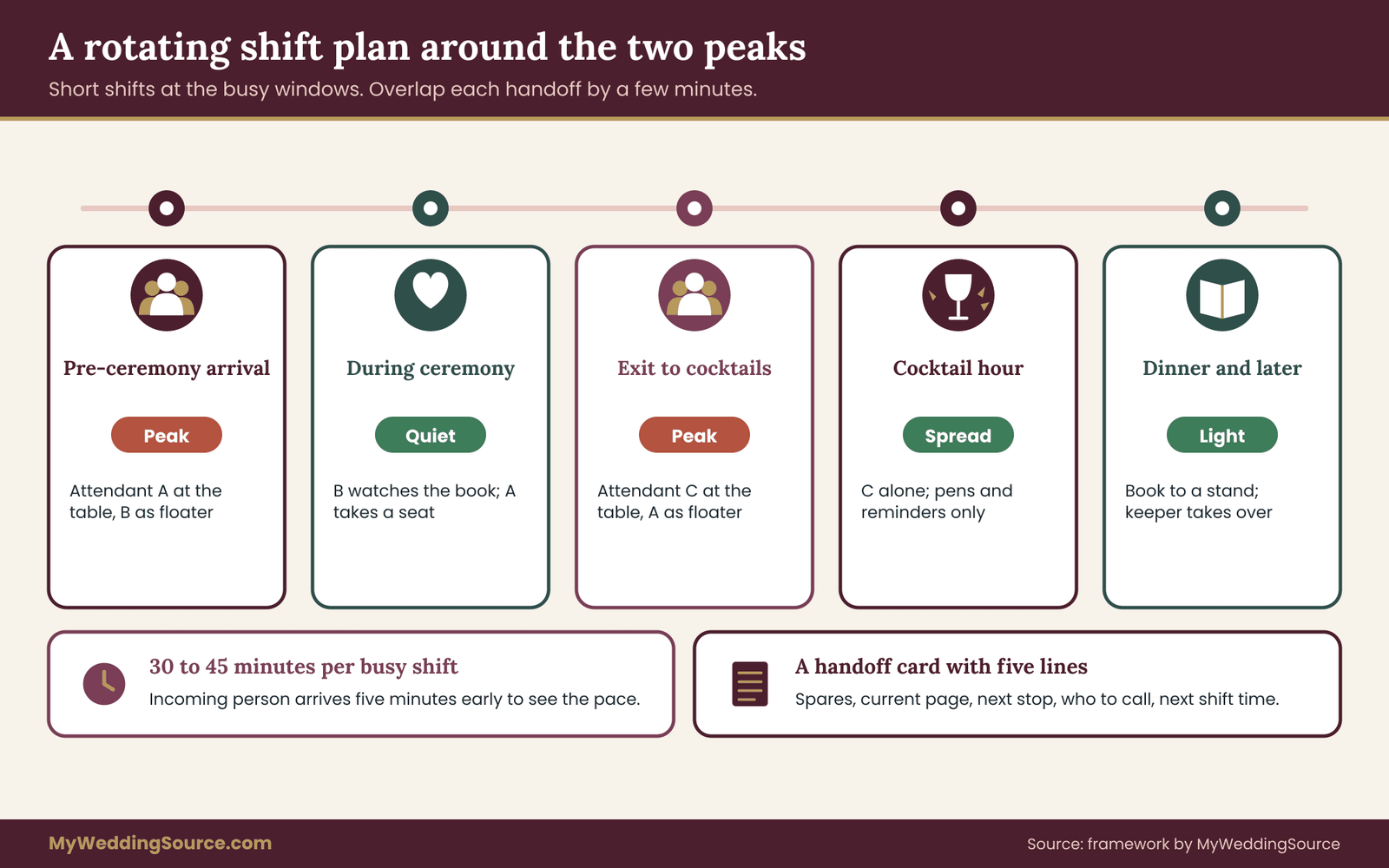
Pre-ceremony arrival. The busiest period if the book is by the ceremony entrance. Full staffing: one guestbook attendant at the table and one floater to help with directions and to cover a break.
During the ceremony. The table is quiet. One attendant at most, and often none, as long as someone is nearby to watch the book and the late arrivals.
Post-ceremony exit. A second peak if the book is on the path to cocktails. Full staffing again, ideally with a fresh attendant who did not work the first peak.
Cocktail hour. If the book moves here, arrival is spread and a single attendant is enough, mostly to keep the pens working and to remind guests to sign.
Reception entrance and dinner. Light. The book may move to a stand near the seating chart or the cake table, with a sign and no assigned person.
Late evening. The book goes back to the couple or to a designated keeper. The guestbook attendant’s last task is a hand-off, not a long wait.
Shift length
Thirty to forty-five minutes is a good range for the busy windows. Shorter shifts make handoffs frequent and add friction. Longer ones tire people out. In quiet windows, a single person can stay an hour or more because the work is light.
Stagger the handoffs so that two people are never leaving at the same moment. A simple pattern is to have the incoming person arrive five minutes before the outgoing one leaves, so the two overlap and the new attendant sees the rhythm of the crowd before taking over.
A rotation you can copy
Consider a three-person team for a day with a pre-ceremony peak and a post-ceremony peak. Person A takes the pre-ceremony window and works with Person B as the floater. During the ceremony, Person B sits near the book as a quiet guard while A goes to find a seat. At the post-ceremony peak, Person C takes the table with A as the floater, since A has already seen the crowd and knows the layout. B joins the party. At cocktail hour, C stays alone and hands the book to a designated keeper when the first reception course begins.
In that rotation, nobody works more than about forty-five minutes at a stretch, nobody misses the ceremony and nobody misses the party. The same pattern works with two people if the day is simpler, and with four if the guest count is large and the entrance is wide.
The handoff card
A short written handoff prevents the common failure where a new attendant does not know where the spare pens are or what to say to a late guest. Put a small card at the table with five lines: where the spare pens and cards are, which page is current, where the next stop for guests is, who to call if something goes wrong and what time the next shift starts. A card the size of a phone is plenty. It also helps when a guest asks the new person a question that the previous person already answered.
The wording of the handoff is simple and friendly. The outgoing attendant says the current page, the status of the supplies and any guest who is waiting or who needs help. The incoming attendant repeats it back in one sentence. The exchange takes thirty seconds and removes a lot of small errors.
Break coverage and backups
Every guestbook attendant needs a way to take a short break without leaving the book unattended. The floater covers the table for a few minutes, or a nearby friend watches it. If you have only one guestbook attendant, agree on a signal and a name of someone nearby who will step in. Never leave the book alone in the peak window. A book on an unattended table is the most common way books end up misplaced.
Have a backup attendant on the list as well. People get sick, get stuck in traffic or get pulled into a family photo. A backup does not need to be at the venue, only reachable and briefed, and the person who coordinates the day should know who it is. The guide to the wedding vendor timeline shows where a rotation like this sits next to the other schedules the day depends on.
Pairing the shift plan with the cue sheet
If your ceremony has a cue sheet, add the attendant’s windows to it. The line “Attendant A on the table from arrival to first reading” costs nothing and prevents confusion about who is where. The guide on ceremony cue sheets explains how timing information like this is shared with the officiant, the music and the other helpers, and the same format works for an entrance team.
Choosing who works as your guestbook attendant
The best guestbook attendant is not the most organized person on your list. It is the person who is comfortable talking to strangers, stays calm when something small goes wrong and can step out from behind a table without feeling awkward. Skills matter less than temperament here.
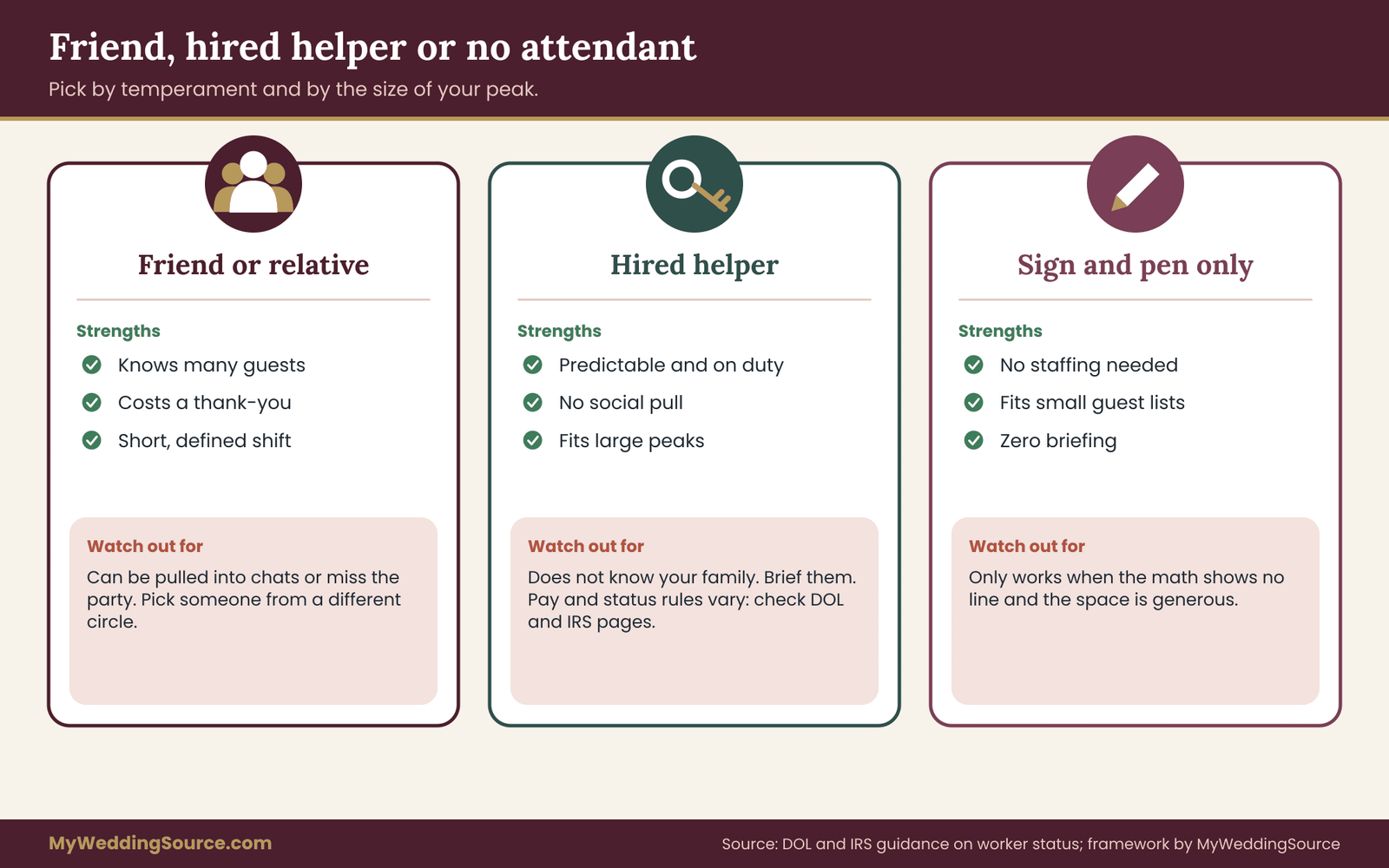
Friends and relatives
A friend or relative is the usual choice, and for good reason. They know many of the guests, they are invested in the day and they cost nothing. They also bring risks that are easy to forget.
A guest who is also the guestbook attendant is pulled in two directions. Old friends arrive and want to chat, which slows the line. A relative with strong opinions about the seating may start to manage the table beyond the job. A close family member may be needed elsewhere at the same moment, for a photograph or a toast. These are not reasons to avoid friends. They are reasons to define the job tightly, keep shifts short and pick people who can say “I will find you later” with a smile.
Good candidates include a cousin who is naturally friendly, a friend from a different social circle who does not need to catch up with half the room, or a younger relative who wants a role. Be cautious about asking the people who are already carrying the heaviest load, such as the wedding party, the parents or the person giving a reading.
A hired helper
A paid helper makes sense when the guest count is large, the entrance is complicated or you want your friends fully off duty. A hired guestbook attendant might come from a staffing company, from your venue’s team, from a planner’s crew or from an individual you hire directly.
The advantages are predictability, no social pull and a person who does the job as a job. The costs are the fee itself, the need to brief someone who does not know your guests and the need to be clear about what they will and will not do. A hired attendant who does not know that Great-Aunt Ruth needs a seat near the door will not volunteer the help that a cousin would.
Ask the venue or planner what they already provide before you hire anyone. Some venues include entrance staff in their package, and some coordinators bring a team member who can cover the book as part of a larger role. The article on wedding vendor contracts explains what to look for in an agreement when a helper is engaged, including scope, hours, cancellation and who supervises them on the day.
Pay, volunteers and classification
If you pay someone, the way you pay them can matter. Whether a helper is treated as an employee, an independent contractor or a volunteer can change which rules apply, including wage rules, payroll obligations and insurance questions. These rules differ by state and by situation, and they depend on facts such as who controls the schedule and how the work is done, not on the label you use.
The U.S. Department of Labor’s Wage and Hour Division publishes plain-language guidance on wages and on worker classification, and the Internal Revenue Service publishes its own guidance on how it distinguishes employees from independent contractors. Read the current pages before you decide, and if you are unsure, ask a qualified professional or the agency itself. This article does not tell you how to classify anyone.
The simplest way to avoid trouble is to hire through a staffing company or a venue that already handles the paperwork, and to put the arrangement in writing. Even informal helpers should know in advance whether they are being paid, what the hours are and who to contact with questions.
A thank-you that fits the role
A friend who works a shift deserves a thank-you that matches the effort. That can be a note, a small gift, a meal set aside for them or simply a clear promise that their shift ends at a stated time so they can enjoy the party. Do not turn a thank-you into an unspoken payment arrangement. If you intend to pay, say so and agree on the terms. If you do not, say that too and keep the role short.
What to look for in anyone you ask
When you consider a person for the role, check four things in a short conversation.
First, can they stand and greet for the length of a shift without discomfort? If someone has a health issue or is wearing shoes that will hurt after twenty minutes, plan for a stool or a shorter shift.
Second, are they at ease with older guests, with children and with people who are nervous? The attendant will see all three within the first five minutes.
Third, will they stay on the job? Some people are wonderful hosts but wander off when a friend arrives. If that sounds like your candidate, pair them with a floater.
Fourth, can they handle a small surprise? A guest who spills a drink on the book, a pen that fails or a late arrival who asks for the ceremony location are all minor events that become big ones if the guestbook attendant freezes.
Briefing the team: what to say and what to hand over
A briefing is a ten-minute conversation that saves an hour of trouble. Do it the week before the wedding and again for fifteen minutes on the day, ideally at the entrance itself.
The one-minute version of the job
Tell each guestbook attendant the job in a single sentence: “Greet people warmly, point them to the book, keep the flow moving and hand off to the next person on time.” Everything else is detail. If the guestbook attendant remembers only that sentence, the station will still work.
Then give the three beats: approach, sign, release. Describe each one in a sentence and let them practice the words in their own voice. Do not hand over a long script. People forget scripts, and a stiff greeting is worse than a rough one.
A sample briefing note
Send each attendant a short note in plain language so they have something to refer to. It might read:
“Thank you for taking the book from [time] to [time]. Your job is to greet guests as they come in, show them where to sign and point them to the next step, which is cocktails straight ahead. If the line gets longer than about five people, open the second spot on the side table and say that the book will be out later too. Spare pens are in the bag under the table. If anything goes wrong, text [coordinator’s name]. We will find you at [time] to hand off.”
Keep the note short enough to read on a phone, and give it to the backup attendant as well.
Scripts for common moments
A few ready-made lines help an guestbook attendant who does not like improvising. They should be treated as starting points, not as lines to recite.
For a rushed guest: “Go on in, the book will be out all night.”
For a long writer: “Take your time, I will set up a second spot for the next few people.”
For a guest who is unsure: “Just a name and a line is perfect.”
For a guest with a mobility need: “Let me bring the book to you, there is a bench just here.”
For a child who wants to sign: “Would you like a pen? You can draw something too.”
For a guest who asks where to go: “Ceremony seating is through those doors. Someone inside will show you a seat.”
For a guest who asks about gifts: “There is a card box by the entrance, my friend will point you to it.” Unless the attendant has been asked to look after the card box, they should say where it is and nothing more.
Who to call and what they can decide
Give the guestbook attendant one name to contact with questions, preferably a coordinator or a trusted friend who is not in the wedding party. Make clear what the guestbook attendant may decide on their own, such as opening the second spot or moving the book, and what they should escalate, such as a guest in distress, a missing item or a request from a vendor. A short list of decisions prevents the guestbook attendant from freezing and prevents them from making choices that belong to someone else.
What the attendant should not take on
It is common for the attendant to be asked, informally, to hold a coat, watch a gift, hold a baby, find a missing guest or answer a vendor question. Each of these draws them away from the table at the moment it matters most. Tell the team in advance that the guestbook attendant has one job. If a guest asks for something outside it, the attendant points them to the right person rather than handling it.
The same applies to anything involving valuables. If cards with cash or checks are being collected, assign that to a different person with a lockable box. A guestbook attendant who is also the card-box guard has two jobs that peak at the same moment.
Photos at the table
Many couples want a photo of the guestbook table or of guests signing. Tell the photographer where the table is and when it will be staffed, so they can capture it at a quiet moment instead of during the peak. If you use a camera at the table, check the consent expectations with your photographer, and read the guide to wedding photography consent for how couples set boundaries about guest images. The guestbook attendant does not need to manage this beyond letting the photographer through.
A worked case: 140 guests, one doorway, two peaks
The following example is invented to show the method. It is an illustration, not a report of a real wedding, and the numbers are planning assumptions you would replace with your own.
A couple, Marisol and Theo, are planning a ceremony and reception at one venue with 140 confirmed guests. The ceremony is at 4:00 p.m., and the guestbook was going to sit in the foyer just outside the ceremony room. Their coordinator suggested a guestbook attendant, and they wanted a plan that did not feel like a checkpoint.
Step one: size the peaks
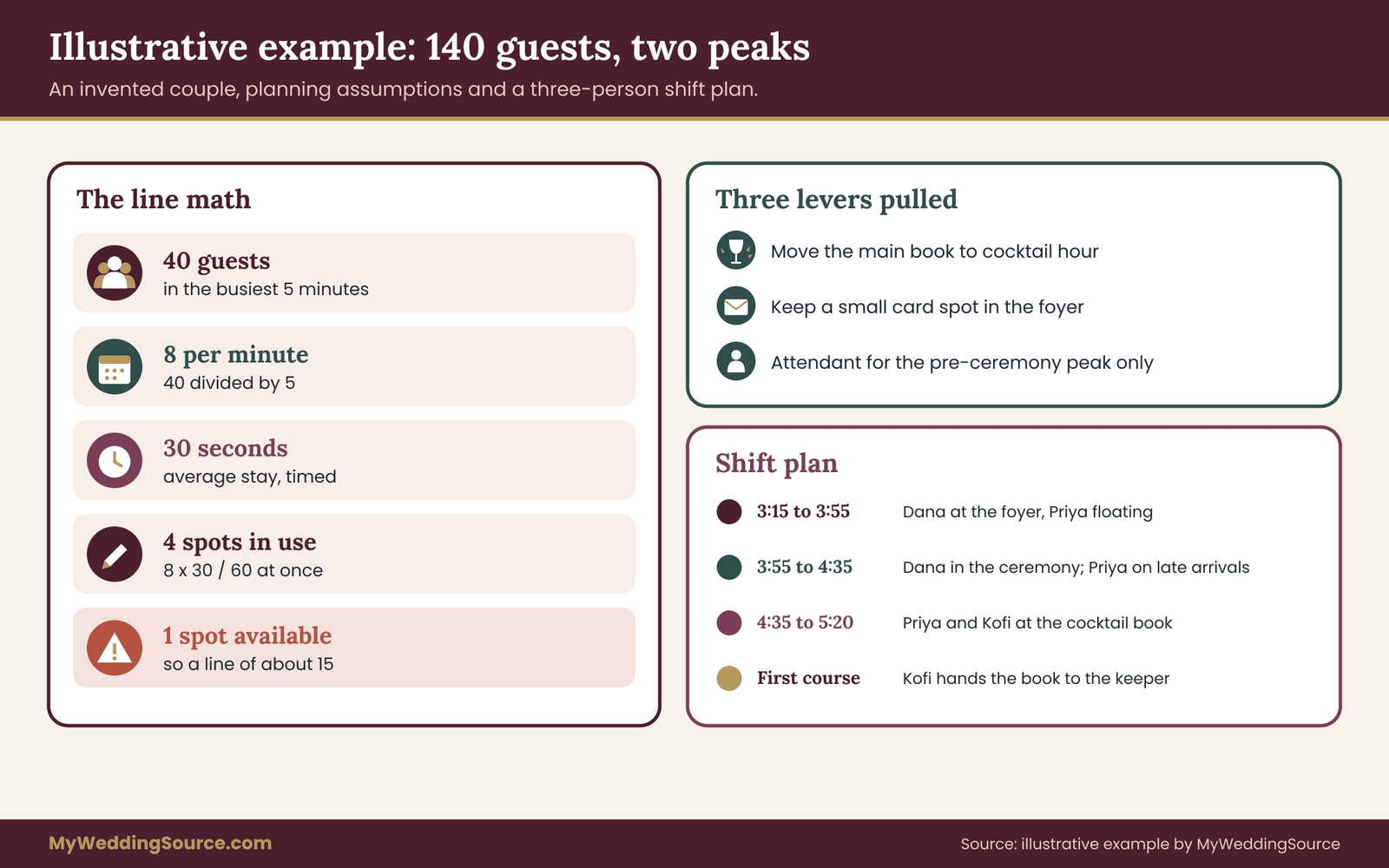
The couple used the fork from earlier. On question one, they estimated that about two-thirds of guests, roughly ninety people, would arrive in the twenty minutes before the ceremony, with the busiest five minutes bringing about forty. After the ceremony, nearly everyone would leave the room within about five minutes and walk through the same foyer on the way to cocktails.
On question two, they timed three friends signing. The average stay, including reading the sign and writing a short line, came to about thirty seconds, with one friend taking well over a minute because she wrote a paragraph.
On question three, they walked the foyer. It was wide in the middle but narrowed near the main doors, and a coat check was planned along one wall. On question four, about twenty guests were older relatives, three used mobility aids and four were bringing infants.
Step two: run the arithmetic
Forty guests in five minutes is eight guests a minute. At thirty seconds each, that is four signing positions in use at once at the peak, and more if a few guests write long messages. With one table and one pen, the best they could do was one or two. The math predicted a line of fifteen or more people during the busiest five minutes, in a narrow part of the foyer, in front of the older guests and the strollers.
After the ceremony, the picture was worse. Roughly the whole guest list moved in a short window with a clear destination, cocktails, and the book was in the way.
Step three: choose the levers
The couple pulled three levers. They moved the main book out of the entrance foyer and into the cocktail area, near the bar line, to spread signing across an hour. They kept a second, smaller signing spot, a set of cards and a basket, in the foyer for guests who wanted to sign before the ceremony. And they added a guestbook attendant for the pre-ceremony peak only, with a role shaped around greeting and direction rather than the book.
That changed the numbers. Before the ceremony, the foyer stop became optional and light, so the peak of forty guests produced a few signers at a time rather than all of them. After the ceremony, guests flowed to the cocktail area where the main book sat, and the hour-long cocktail window turned a five-minute crush into a trickle of about three guests a minute.
Step four: write the shift plan
They recruited three people: Dana, a cousin who knows many guests; Priya, a friend from work who knew few; and a hired coordinator assistant, Kofi, for the cocktail hour.
Dana took the foyer from 3:15 to 3:55, with Priya as floater. At 3:55 Dana slipped into the ceremony, and Priya stayed by the foyer cards for late arrivals. At 4:35, after the ceremony, Priya walked to the cocktail area and worked the book there with Kofi until 5:20. Kofi stayed until the first course, then handed the book to the couple’s designated keeper, a sibling who would carry it to the sweetheart table.
Nobody worked more than forty-five minutes at a stretch. Everyone saw the ceremony or the toast. The foyer greeting was done by a relative the guests knew, and the cocktail table was staffed by a person who knew the flow.
Step five: define the failure conditions
Marisol and Theo wrote three conditions that would trigger a change of plan. If the foyer queue exceeded six people for more than two minutes, Dana would open the second spot and tell guests to sign at cocktails. If rain forced everyone to use a single covered entrance, Priya would move the card basket under the awning. If the book was missing for any reason, Kofi would call the coordinator and switch to loose cards, which the couple would later bind.
None of these conditions required a decision from the couple on the day. The attendants knew what to do, who to call and when to stop trying to fix it.
What the example shows
The final plan had one guestbook attendant at a time, two peaks handled differently and a book that moved. The couple’s greeting station looked relaxed because nobody stood behind a table for long. The real work was in the planning, in the arithmetic and the levers, not in the person at the table.
Notice also what the plan left out. There was no queue rope, no formal receiving line and no clipboard. The guestbook attendant’s tools were a smile, a pen and a clear direction. That is the point of the role, and it is why the example scales both up and down. A small wedding with thirty guests needs only the sign and the pen. A large one needs more levers and more people, but the same three beats.
Adjusting the example to your wedding
If your guest list is half the size, drop the second spot and keep one attendant. If it is double, add a second table and a second floater, and consider a roaming card basket at the seats. If your ceremony and reception are at different places, the book travels with a keeper and the guestbook attendant’s job restarts at the second venue. If your venue is outdoors, add a wind plan for the pages and the cards, and put weights on loose items.
Alternatives to a staffed table
A staffed table is one answer, not the answer. Several alternatives reduce or remove the need for an attendant, and each has costs you should weigh. Choose by the arithmetic, not by appearance.
Seat cards or table cards
Place a blank card at each place setting with a short prompt, and collect them in a basket at the end of the evening. No table, no line, no guestbook attendant. The tradeoff is that some guests will forget, some cards will be lost in the cleanup and the result is a stack of cards rather than a book. It suits dinners with assigned seating and a cooperative cleanup crew.
A roaming book or basket
A friend or a young relative carries the book or a basket of cards through cocktail hour and offers it at tables. This is the lowest-friction way to reach guests who do not like lines. It requires a person, but a lighter one than a stationed attendant, and it can be a child with a cousin as a chaperone.
A moved table
Moving the table to a later or less crowded spot is often enough. A book next to the dessert table, near the dance floor entrance or beside the photo booth catches guests who are already stopping, and it does not compete with arrival.
Digital options
A QR code on a sign or a seat card can link to a form where guests leave a message. This removes the surface constraint entirely, but it adds others. Some guests do not want to use their phones during a wedding, some venues have poor reception and a digital form needs a plan for who owns the data afterward. If you choose this route, decide who owns the responses, where they are backed up and how guests without a phone will take part, and keep a paper option available.
Audio and photo formats
An audio guest book records messages, and a photo guest book collects a picture and a line. Both change the arithmetic, because each interaction takes longer than a signature, and both need their own attendant or a clear instruction sign. If you choose one, treat the interaction as a station with its own capacity, and size the line accordingly. The guestbook attendant becomes more of a host for a small activity than a gatekeeper of a book.
No guestbook at all
Some couples skip it, and some find that a collection of cards or a letter box serves them better. If you are not sure you will read it, the sensible answer may be a modest sign and a small box. The only wrong answer is a large, elaborate station that nobody asked for and that creates the line you wanted to avoid.
Special situations for a guestbook attendant
The core method stays the same, but some weddings bend it. These are the situations that come up most, with the adjustment each one needs.
Two locations, one book
If the ceremony and reception are in different places, the book should not shuttle between them with a single person. Choose one primary location, usually the reception, and use the ceremony entrance only for a small card station or no station at all. The guestbook attendant at the ceremony gets a short shift of greeting and direction. A second person, or the same person if the travel time allows, sets up at the reception. Name a keeper who carries the book in a car, not on a vendor van or a shuttle where it could be separated from you.
A very large guest list
With several hundred guests, a single book is a symbolic object, not a working one. Treat it as a ceremonial copy and add capacity through cards, a long scroll or a set of tables with trained helpers. At this scale you are really running an entrance, and the guest flow guide mentioned earlier is the right reference for how entry, seating, food and exit connect. The attendant’s role becomes shift lead, coordinating two or three people instead of working a single table.
A small, intimate wedding
With thirty or forty guests, an guestbook attendant can feel like too much. Everyone knows each other, arrival is slow and a person standing by the book may feel odd. In that case, skip the role and rely on a sign and a pen, or ask a single relative to say hello and point the way as part of being a host. The three beats still apply, but they are informal and carried out by whoever is nearest.
Guests who arrive with children
Children want to sign, draw and touch. A small section of the table for children, with a few crayons or markers and a card of their own, removes the pressure on the main book and keeps small hands off the fragile pages. The attendant can say, “Would you like to leave a picture?” and point to the kids’ card. It also gives the parent a short pause, which they usually appreciate.
Cultural and family customs
Some families have customs around greeting, offering gifts or recording attendance, and these may overlap with the book. A relative may want to receive guests at the door, to collect envelopes or to introduce elders by name. Ask early, and give those people the roles they want, so the guestbook attendant and the family greeters do not collide. If an elder is the traditional greeter, the guestbook attendant’s job may become supporting them with a pen and a chair rather than leading the greeting.
Outdoor and weather-exposed entrances
Wind, sun, rain and dust change every part of the setup. Use weighted pages or a book with a clip, a table that does not wobble on grass or gravel, a shade for the page and a rain option decided in advance. If the entrance is long, such as a path from a parking area, consider placing the greeting beside the path rather than at a single point, with the guestbook attendant walking a short loop.
Venues with their own rules
Some venues control where tables can sit, how they are decorated, what may be taped or tied and where a person may stand. Ask for the rules before you set the plan. A venue may already staff the entrance or have a house policy about helpers who are not venue employees. Getting this in writing avoids a surprise at setup time.
What a guestbook attendant costs, and how to decide
A guestbook attendant has costs in money, in favors and in attention. None of them are large, but they are easy to forget when you are comparing options.
The money
If a friend does it, the direct cost is a thank-you. If you hire, the cost depends on the market, the shift length and who employs the helper. This article states no prices because they vary by region and provider. Ask for a written quote that lists hours, tasks and any minimum, and compare it with what the venue or planner offers. If you are asked for a minimum shift longer than the time you need, ask whether a shorter booking is possible or whether the helper could cover another task during the rest of the shift, such as the card box, the coat area or the exit.
The favor
Every friend you ask spends something: time at a party they came to enjoy, the chance to be with their date or family and the small stress of responsibility. Keep shifts short, give a clear end time and make sure the person gets a seat and a meal. A good rule is that the attendant should lose no more than a single window of the event.
The attention
A staffed table needs a briefing, a handoff card, a backup and a few decisions. That is perhaps an hour of your own planning time across the weeks before the event. The work pays back by removing a source of stress on the day, but it should be proportionate. If your plan for the guestbook is longer than your plan for the cake, simplify it.
A decision rule you can use
Ask three questions in order. Does the arithmetic show a line? If not, use a sign and a pen. If it does, can a cheaper lever fix it, such as moving the book or adding a second spot? If so, use the lever. If not, add an guestbook attendant for the peak window only. Most weddings stop at the second question, and that is a perfectly good outcome. The attendant is the third resort, not the first.
What to skip
Skip anything that adds formality without adding flow. A velvet rope, a printed script, a uniform, a clipboard and a podium all signal processing. If you want the entrance to feel warm, keep the props few, the language plain and the person human. A cardigan and a smile beat a lanyard.
When the answer is “no attendant”
Sometimes the honest conclusion is that you do not need one. The numbers are small, the space is generous, the guests are comfortable and the cost of arranging a person outweighs the benefit. Choosing not to staff the table is a valid result of the method, not a failure of it. The fork exists to make that choice with confidence rather than by default.
When a guestbook attendant plan fails, and what to do
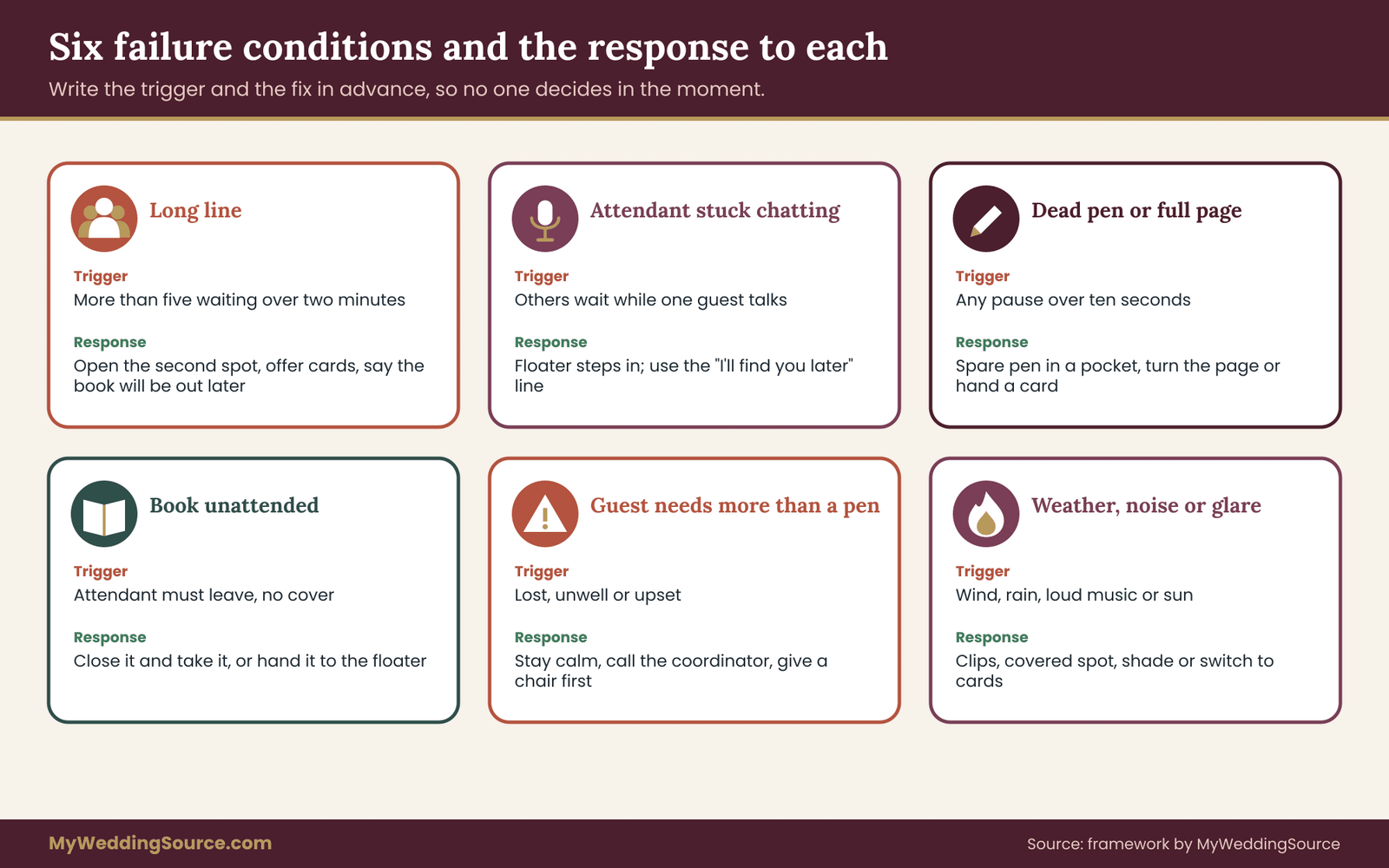
Every plan has failure conditions. Writing them down in advance turns a surprise into a routine adjustment. Below are the conditions that most often disrupt a guestbook attendant plan, with a trigger, a response and a limit on how long to try before switching.
Failure one: the peak is bigger than the table
Trigger: more than about five people waiting for more than two minutes.
Response: open the second writing spot, offer loose cards and tell guests the book will be out later. The guestbook attendant should say this warmly and early, before the line grows, not after.
Limit: if the line remains after five minutes, stop directing guests to the book at all and move to cocktail hour signing. A guestbook that is abandoned for an hour is better than an entrance that is blocked for ten minutes.
Failure two: the attendant is pulled into conversation
Trigger: the guestbook attendant is talking with one guest while two or more others wait.
Response: the floater steps in with a hello, and the guestbook attendant says a short, warm closing line and returns to the flow. If there is no floater, the attendant uses the “I will find you later” line.
Limit: if this keeps happening, the guestbook attendant is too well known to the crowd. Swap in a person from a different social circle for the next shift.
Failure three: a pen dies or a page fills
Trigger: any pause longer than ten seconds because of supplies.
Response: hand over a spare pen, turn the page or give the guest a card. Keep the spare in the attendant’s pocket, not in a bag, so it takes two seconds.
Limit: if more than two pens fail in an hour, replace the whole set. The problem is the stock, not luck.
Failure four: the book is left unattended
Trigger: the guestbook attendant must leave and no one covers.
Response: close the book, take it with you or hand it to the floater. A closed book on a table draws less attention and less spill risk than an open one.
Limit: never leave the book alone in the peak. If a break cannot be covered, the break waits.
Failure five: a guest needs more than a pen
Trigger: a guest is lost, unwell, upset or in need of an accommodation.
Response: the guestbook attendant stays calm, does not try to solve it alone and calls the coordinator or points the guest to a designated helper. A guest who needs a quiet place or a chair should get one before they get a signature.
Limit: if the situation involves safety or a medical concern, the guestbook attendant’s role is to call for help, and the book is secondary.
Failure six: weather, noise or glare
Trigger: wind lifts pages, rain moves guests under a single awning, loud music prevents conversation or sun washes out the page.
Response: weights or clips for pages, a move to a covered spot, a hand gesture and a sign for noise, and a shade or a repositioned table for glare. Decide in advance which location is the rain option so the attendant is not improvising.
Limit: if the weather makes the table unusable, switch to cards and signing at seats.
Failure seven: the book or cards go missing at the end
Trigger: the evening ends and nobody knows who has the book.
Response: assign a single keeper before the event, usually a trusted sibling, friend or coordinator, and put the name on the handoff card. The guestbook attendant’s last task is to hand the book to the keeper in person and say so out loud.
Limit: if the book cannot be found at the end of the night, ask the venue and the coordinator before anyone leaves, and check lost-and-found and the vendor’s load-out area.
Accessibility at the table
A quiet failure is a table that some guests cannot use. A writing surface set at a standing height is hard for a person seated in a wheelchair, and a path that narrows near the book blocks a walker. Plan at least one position where a seated guest can write comfortably, with clear floor in front, and let the attendant offer to bring the book to anyone who prefers.
The U.S. Department of Justice’s ADA information site gives general guidance on accessible design and on the responsibilities of businesses and venues. Ask your venue what accessible features it already provides and what you may add. This article does not state any measurement as a requirement, and the venue or an accessibility professional can tell you what applies.
Also think about guests who cannot easily write. Someone with arthritis, a visual impairment or limited English may prefer a quick spoken message, a pre-printed card or help from a friend. A kind offer from the guestbook attendant, “I can write it for you if you like,” is enough, and it should be offered with the same tone as any other help.
The cost of a mistake
Most failures here are cheap. A pen, a card, a line of text. A few are not: a lost book is a lost keepsake, and a blocked entrance can delay the first dance or the first course. Spend your planning effort on the two expensive failures, a missing book and a bottleneck during the exit from the ceremony, and treat the rest as routine adjustments.
There is also a small reputational cost. A table that feels rushed or fussy affects the tone of the day. The aim is a sense of quiet hospitality, and the guestbook attendant’s mood and posture set it. A relaxed shoulder, an open hand and a smile carry more than any sign.
What to do after the event
The guestbook attendant’s work ends with the handoff, but the book’s story does not. Assign someone to carry the book and the cards to the couple’s car or hotel, then store them flat and dry. If the book contains loose cards, put them in an envelope or a folder before they are packed with other items. Photograph the pages within a few days so there is a copy in case the book is damaged. A scan of the book is a sensible addition to your digital archive of contracts, receipts and photos.
Send a thank-you to each person who worked a shift. A short, specific note, such as naming the thing they did well, is more meaningful than a general one, and it makes it easier to ask again for the next event.
Your next steps
Work through these in order. Each takes a short sitting, and the whole list fits into a couple of evenings a few weeks before the wedding.
- Time a signing. Ask three friends to sign a page the way guests would, and write down the average seconds.
- Estimate your peak. Decide how many guests will reach the book in the busiest five minutes, and divide by five for guests per minute.
- Run the arithmetic. Multiply guests per minute by seconds at the table, divide by sixty, and compare the result with the number of writing spots you have.
- Pick the cheapest lever. Move the book, add a second spot or change the format before you add a person.
- Decide if you need a guestbook attendant. If a peak remains, staff that window only, using the shift pattern above.
- Choose the team and a backup. Prefer people who are comfortable with strangers, and agree on paid or unpaid in advance.
- Write the handoff card and the one-line job description. Share them with each person the week before.
- Add the windows to your schedule. The wedding reception guest flow guide shows how arrival connects to seating and food, and the vendor timeline shows where staffing windows belong beside the other helpers.
- Name the keeper. One person carries the book home, and everyone knows who it is.
If your wedding is small, steps one to four may be all you need. If it is large, add a floater and a second table, and rehearse the handoff once at the venue.
FAQ
Do I need a wedding guestbook attendant if I only have fifty guests?
Usually not. With a small list, arrivals spread out and a sign with a working pen is enough. Check by timing a signing and estimating your busiest five minutes. If only a handful of guests reach the book at once, skip the role. If your entrance is narrow or several older guests need an easy path, a short window of help can still be worth it.
How long should one guestbook attendant work a shift?
Thirty to forty-five minutes suits the busy windows, because greeting wears people down and handoffs stay manageable. In quiet windows, such as cocktail hour with spread-out arrivals, one person can stay an hour or more. Overlap the handoff by a few minutes so the new person sees the pace before taking over, and give a written handoff card.
Should a friend or a hired helper be my guestbook attendant?
Either can work. A friend knows guests but may be pulled into conversations and misses part of the party, so keep shifts short. A hired helper is predictable and fully on duty but does not know your family, so give a briefing. Ask your venue or planner what they already provide before you hire anyone.
Do I have to pay someone who works as a guestbook attendant?
That depends on the arrangement, the state and the facts of the work, and this guide cannot give a legal answer. The U.S. Department of Labor and the IRS publish plain-language guidance on wages and on employee versus contractor status. Hiring through a staffing company or venue that handles the paperwork, and putting terms in writing, avoids most confusion.
How do I stop a line from forming at the guestbook table?
Find the cause first. Lines form when guests arrive faster than they can sign. Shorten the stay with a ready pen and a short prompt, add a second writing spot, move the book to cocktail hour or switch to cards. The attendant’s greeting and a clear next direction after signing keep people from lingering at the table.
Where should the guestbook go to avoid crowding?
Place it just off the direct path, with clear floor in front, rather than in a narrow corridor. For many weddings, the cocktail area works better than the ceremony entrance because guests arrive over an hour instead of fifteen minutes. Check glare, wind and the photographer’s position, and keep at least one position comfortable for a seated guest.
What should a guestbook attendant say to guests?
Keep it short and natural: a hello, a hand toward the book, and a direction after signing, such as where cocktails are. For long writers, offer a second spot. For rushed guests, say the book will be out all night. Avoid a fixed script. Guests respond better to a relaxed host than to a person reciting lines.
What happens to the guestbook at the end of the night?
Name one keeper before the event, such as a sibling, a friend or the coordinator, and have the guestbook attendant hand the book over in person. The keeper carries it home or to the hotel and stores it flat and dry. Photograph the pages within a few days so you have a copy if the book is damaged or lost.
Sources
- U.S. Department of Labor
- U.S. Department of Labor, Wage and Hour Division
- Internal Revenue Service
- ADA.gov, U.S. Department of Justice
- Occupational Safety and Health Administration
- Federal Trade Commission
- U.S. Small Business Administration
- Library of Congress
- National Archives
- Cybersecurity and Infrastructure Security Agency