
A power outage at a wedding venue turns a planned evening into a series of fast decisions: who is safe, who decides, what still works, and when the program resumes. This guide gives you a stop-go response tree for a power outage, built around guest safety first and event recovery second, with a worked example and the conditions under which the tree should not be trusted.
When a power outage hits your wedding venue, run three gates in order. Gate one: is anyone at risk right now, in the dark, on stairs, on medical equipment, or near smoke or sparks? Gate two: does the venue, acting with the utility and local officials, say it is safe to stay? Gate three: can the next program item still happen safely with what works? The answers lead to one of four outcomes: hold, shift, move or stop. Only the venue and qualified staff can authorize lighting, generators and re-entry, so settle those permissions before the wedding day.
Most wedding timelines have no line for a power outage. They assume the building will keep doing what buildings do. The lights stay on, the kitchen stays cold, the sound system hums, the elevator arrives. When the power goes out, all of those assumptions break at once, and the people who suffer first are not the couple. They are an older guest at the top of a dark staircase, a guest who relies on a powered wheelchair or a breathing device, a child who is frightened, and a catering team trying to keep food at a safe temperature.
This article is written for couples, planners and family members who want a plan before the wedding rather than improvisation during it. It does not try to teach electrical work, and it does not replace the venue’s own emergency procedures. It gives you a way to decide, in order, what to do in the first minutes and in the first hour of a power outage, and how to get the evening back on track afterward.
A note on scope. This is general planning information, not legal, safety, insurance or electrical advice. Building rules, fire codes and venue policies differ by place, so confirm the specifics with your venue, your caterer and the local fire authority.
What a wedding power outage breaks first
A power outage is rarely one problem. It is a bundle of five separate losses, and each one has a different clock, a different owner and a different safe response. Thinking of them as separate lanes keeps you from treating a dark room as if it were the only issue.
Light. Overhead and accent lighting go dark. Many venues have emergency lighting and illuminated exit signs that run on batteries or a backup source for a limited time, but those systems are designed to help people leave a building, not to host a reception. Whether they are working, and for how long, is a question for the venue.
Sound. The DJ, the band’s amplifiers, the venue’s public address system and any microphones used for toasts all depend on power unless they have batteries. Losing sound affects the program more than safety, but it also removes your main way of speaking to a crowd.
Food and drink. Refrigeration, ovens, warming equipment, ice machines and beverage dispensers stop. The caterer has food safety obligations of its own and may need to decide what can still be served. That decision belongs to the caterer and, if it comes to it, the local health department, not to the couple.
Climate. Heating and cooling stop. A hot summer room fills with warm air quickly; a cold evening room loses heat more slowly but still loses it. Guests with health conditions, babies and older relatives feel this first.
Movement and water. Elevators stop, automatic doors may stop, electronic door locks behave differently from one building to the next, and some properties lose water pressure because pumps need electricity. These are the lanes that most directly touch guest safety.

The five lanes matter because the first reaction to a power outage is usually to fix the light, and the light is the lane most likely to be solved by someone else. If you spend the first ten minutes arranging candles, you may miss the guest who cannot leave an upper floor because the elevator is out.
Power outage versus a weather delay or a tech failure
A power outage sits between two problems that already have their own planning. A weather delay is about the sky: rain, wind, heat or lightning, and a decision about where guests wait. A technical failure is about one device: a speaker that stops, a projector that will not connect. A power outage can be caused by weather and can look like a technical failure, but it differs in two ways.
First, the cause is usually outside everyone’s control. The utility, the grid, a storm, a car hitting a pole or a tripped breaker inside the building may be responsible, and nobody at the wedding can fix it. That makes the duration uncertain, and uncertainty is the real enemy. Plans that depend on “ten more minutes” fail when the ten minutes turn into an hour, and a power outage is the kind of event that does that.
Second, a power outage changes the safety of the building for everyone at once. A broken speaker does not make a staircase dangerous. A power outage can. That is why this guide puts guest safety ahead of every question about the program.
For the broader picture of what can go wrong on the day, including weather and communications, the site’s wedding planning checklist gives the overall timeline in which a power outage plan belongs. For backup communication and files, see the guide on wedding day digital operations, which covers how to keep contacts and documents reachable when networks or devices fail.
Who decides what during a power outage
Confusion about authority wastes more minutes than the power outage itself. When the lights go out, several people instinctively try to take charge, and some of them should not. Before the wedding, write down who holds each decision, because the person who feels most responsible is rarely the person with the authority.
The venue manager or on-site contact owns the building. That includes emergency lighting, the electrical panel, any backup generator, access to rooms, whether the space can be occupied, and the venue’s own emergency procedure. If the venue has a written plan, its instructions come first.
The caterer’s lead owns food safety and the kitchen. The caterer decides what can still be served, what must be discarded, and how long service can pause. Your role is to ask early and clearly, not to second-guess.
The planner or day-of coordinator, if you have one, owns the timeline and the communication to vendors. They are your link between the venue’s decisions and the wedding program. If you have no planner, appoint one person from your circle to play this role, and make sure they are not the couple.
Local fire and emergency services, and the utility, own anything that involves smoke, fire alarms, sparks, downed lines, gas smells or injuries. If there is any sign of fire, a burning smell or someone is hurt, call emergency services first and tell the venue second.
The couple own the wedding decisions: whether to pause, whether to move the party, whether to shorten the program, whether to cancel the remainder. They should not be the ones locating candles or checking panels. A couple who has handed the operations to someone else can make those calls calmly.
A useful habit is a single sentence of authority written on the planner’s sheet before the wedding: “The venue decides if the room is safe; the caterer decides on food; the planner relays; we decide the program.” It sounds obvious written down. In the dark, with two hundred people looking around, it saves minutes.
Why “just keep the party going” is not the default
Many hosts feel an urge to keep the mood alive, and that instinct is kind. It can also be wrong. If the venue is dark, the exit routes are unclear and the cause is unknown, an instruction to stay and keep dancing can put a crowd in a worse position than a calm pause. The tree later in this guide treats the party as the last thing to protect, not the first. A pause costs a little momentum. A fall on a dark stair costs a great deal more, and it is far harder to repair.
The aim of a power outage plan is not to save the evening at any cost. It is to protect people first, then recover as much of the event as is safe, and to know ahead of time where the line between those two sits.
Contract and walkthrough questions about a power outage
The cheapest time to handle a power outage is months before it happens, in a conversation with the venue. Think of it as buying information, not buying equipment. Most couples never ask, because the question feels pessimistic. Venue managers are used to it. A manager who answers clearly is telling you something useful, and one who goes vague is telling you something too.
The venue technical walkthrough is the natural place for these questions, and the guide to the venue technical walkthrough explains how to run that visit and collect written confirmations. Add a short power outage section to it. The questions below are written so that the answers can be pasted into your planning notes.
Does the building have emergency lighting and exit signs, and who tests them? You do not need to inspect them yourself. You need to know they exist in the rooms and routes your guests will use, including restrooms, stairs and the path to the parking area. Ask whether the venue can describe how long they are designed to run, and what the venue does when they are not enough.
Is there a backup power source, and what does it actually run? Some venues have a generator or battery system. Many such systems are sized to run life-safety equipment only, which may mean exit lighting and fire alarms but not the kitchen, the air conditioning or the ballroom lights. A backup source that keeps the building safe is valuable. One that you assume will keep the reception running is a trap if nobody has told you the difference.
Who is on site who can respond to the electrical panel? A venue with a staff member on duty who knows the building is different from one that opens the door and leaves. Ask who that person is on your date, how to reach them by phone, and what happens if they are off site.
What is the venue’s own rule on candles, battery lights, generators and outside equipment? This matters more than it sounds. Open flames, fuel-burning generators brought by a vendor, and extension cords run across walkways are all things many venues restrict or prohibit. Ask for the rule in writing now, so that in the dark nobody has to argue about it.
What does the contract say if the venue loses power? Look at what the agreement says about interruption of services, cancellation, force majeure and refunds. The wedding vendor contract guide explains how to read those clauses. You are looking for four things: who is responsible for restoring service, whether time lost is made up, whether any fee is reduced, and what happens if the event cannot continue.
Does the venue have a guest communication method that does not need power? A battery megaphone, a handheld radio or a staff member who can speak to a room are all workable. Ask what the venue uses, and whether you may use your own.
Questions for the caterer and entertainment
The venue is not the only party with a stake. Ask your caterer what its plan is for refrigerated and hot food if the kitchen loses power, whether it carries insulated containers, how it decides when food must be discarded, and who makes that call. Caterers often have this written into a food safety plan, and a good one will tell you it exists.
Ask the DJ or band which equipment can run on battery, for how long, and whether a battery speaker and a wireless microphone are part of the standard kit. Ask the photographer how the work changes in the dark, and whether the team can continue with portable lighting if the venue allows it. Each answer is a small piece of your power outage recovery plan, and you will use them in the later sections.
Put the answers on one sheet
Combine everything into a half-page “power sheet” that lives with the planner and a copy with a trusted family member. It should list the venue contact and a backup number, the location of emergency lighting and exits as described by the venue, what the backup source runs, the venue’s rule on candles and generators, the caterer’s lead, the DJ’s battery capability, and the one sentence of authority from the previous section. When the lights go out, nobody has time to search an email thread. The sheet is the whole point of preparing for a power outage.
The first five minutes: guest safety before anything else
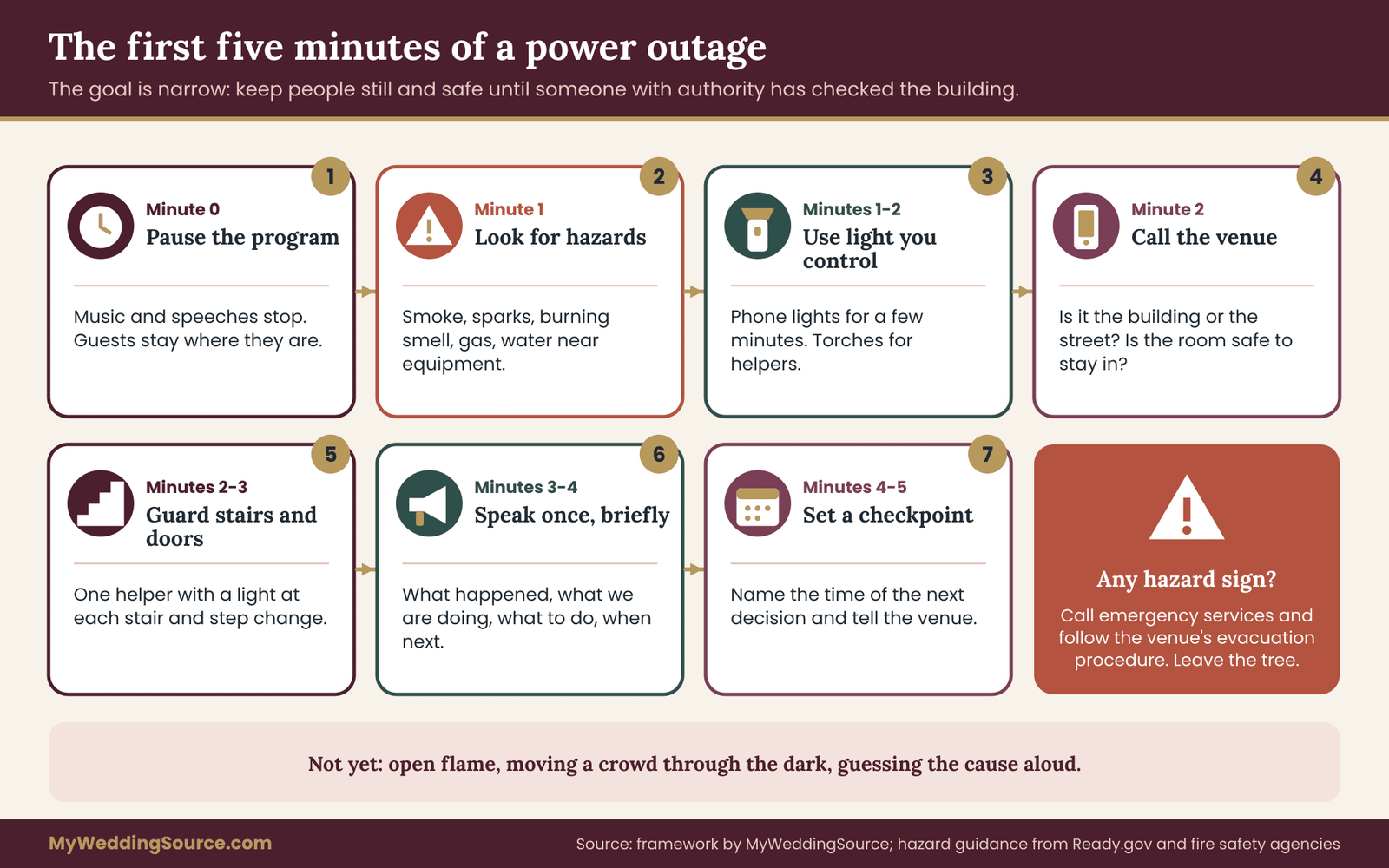
In a power outage, the first five minutes decide whether the rest of the evening is a story or an incident. The goal of those minutes is narrow: keep people still and safe until someone with authority has assessed the building. Everything about the program can wait.
Minute zero: pause the program. Whoever is on the microphone stops. If the music or the speech has died with the power, that is the signal. Do not wait for a fix. A person standing on a dance floor in sudden darkness should be told to stay where they are for a moment.
Minute one: look for hazard signs. The planner or a designated helper checks for anything that suggests more than a lost circuit: a burning smell, smoke, visible sparks, a loud bang, water on the floor near electrical equipment, a smell of gas. Any of these means the situation is no longer a simple power outage. Call emergency services, tell the venue, and follow the venue’s evacuation procedure. Do not try to find the cause.
Minute one to two: switch on light you control that the venue permits. Phone flashlights are a reasonable short-term measure for a few minutes, particularly to light a stair or an aisle, and they cost nothing. They are not a plan for an hour. Batteries run down, and a hundred phones pointed at the ceiling light nothing.
Minute two: contact the venue. The planner calls or finds the venue’s on-site contact. The question is plain: “Is this the building, the street or the utility, and is it safe for guests to stay in this room?” Write down the answer and the time.
Minute two to three: protect movement. Station a helper at each stair, each step change and each doorway the guests are likely to use. A helper with a phone light, a calm voice and the instruction “please stay seated, we are checking” prevents falls better than a speech. Special attention goes to the guests identified in the later section on power-dependent needs.
Minute three to four: speak once, briefly. A single clear announcement tells the room what happened, that it is being checked, that guests should stay where they are for now, and when the next update will come. The wording is covered in the communication section below.
Minute four to five: decide the first checkpoint. The planner sets a time for the next decision, usually a few minutes ahead, and tells the couple and the venue. Naming a checkpoint turns an open-ended wait into a series of small ones.
What not to do in the first five minutes
Some natural reactions make things worse.
Do not light candles or open flames that the venue has not approved. A dark room full of people, decorations, fabric and fresh flowers is exactly where an open flame becomes a hazard, and many venues forbid it for that reason.
Do not move a large crowd through the dark because someone says the lights will be back soon. Moving is a decision with its own risks, particularly on stairs and unfamiliar paths.
Do not let guests wander to find out the cause. A guest who walks to the parking lot to see whether the whole street is dark is a guest who is out of the room when an announcement is made, and a person in a dark car park is at risk of their own kind.
Do not start a debate. If two people disagree about what to do, the venue’s instruction settles it, and the planner relays it.
Do not tell the room the cause of the power outage until you know it. “A transformer blew” spreads faster than the truth. “We are checking the cause” does not cause panic and is honest.
A short script for the planner
“Everyone, we’ve lost power in the building. Please stay where you are and keep your phones for light. Our team and the venue are checking the building now. I’ll update you in five minutes.”
That is all the room needs. It is under thirty words of information, it names what is happening, what to do and when the next news comes. Longer speeches invite questions you cannot answer yet.
The stop-go tree for a power outage
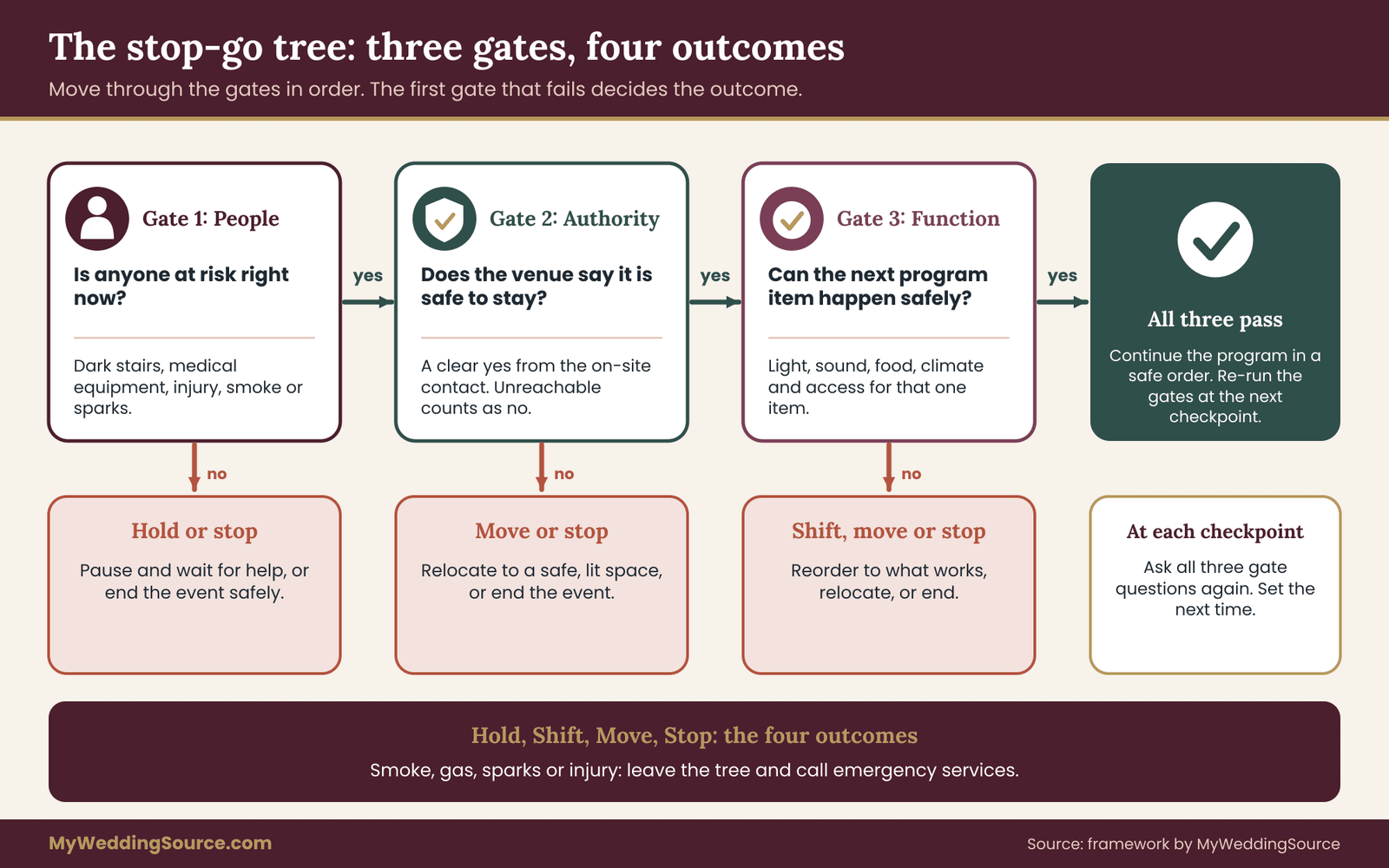
The tree has three gates and four outcomes. You move through the gates in order, and the first gate that fails decides the outcome. It is designed to be read aloud in under a minute by a planner standing in a dark room, so every question has a plain yes or no.
Gate one: people. Is anyone at risk right now? That covers a guest in a dark stairwell, a person on a powered medical device, a person who has fallen or become unwell, any sign of smoke, sparks or burning, and any crowd movement that looks unsafe. If the answer is yes, deal with that person or hazard before anything else, and call emergency services where there is any doubt. A yes at gate one means the outcome of the power outage response is at least a hold, and it may be a stop.
Gate two: authority. Does the venue, acting with the utility and local officials where needed, say the building is safe to occupy? You need a clear yes from the on-site contact, not a shrug. If the venue says the room is not safe, or cannot say, the party does not continue in it. A no at gate two moves you to move or stop. A venue that is unreachable counts as a no until proven otherwise.
Gate three: function. Can the next item on the program happen safely with what still works? Look at the five lanes from earlier: light, sound, food, climate, movement and water. The question is not whether everything works. It is whether the next item has what it needs. A toast needs a voice and a little light.
A first dance needs light, a safe floor and music. A plated dinner needs a kitchen. A cake cutting needs a table, some light and a knife. A yes at gate three means the program continues, perhaps in a changed order. A no means you choose between shifting the order and moving or stopping.
The four outcomes
Hold. Pause everything and stay put. This is the right outcome when the cause is unknown, when the venue is still assessing, or during the first minutes of any power outage. A hold is not a decision to end the evening. It is a decision to wait for better information, with a named checkpoint.
Shift. Keep the guests in the building, but reorder the program to items that work without power or with the lighting the venue has authorized. Toasts by a person with a battery microphone or a loud voice, a family photo session near a window or with portable light the venue has approved, a slow, quiet cocktail hour, an early cake cutting, a stretch of live acoustic music if the musicians can play unplugged. Shift is the most useful outcome for a power outage that lasts more than a few minutes and that the venue considers safe.
Move. Relocate the guests to a space that is safe and has what the next item needs. That might be another room with working emergency lighting, a covered terrace in daylight, a patio, or an adjacent building the venue controls. Move requires the venue’s agreement on the destination and a safe, lit route to it. It also takes longer than people expect, because a crowd of guests, older relatives and children does not relocate quickly.
Stop. End the event, or end the current segment, and help guests leave in an orderly way. Stop is the right outcome when the venue says the room cannot be occupied, when safety at any gate cannot be assured, when the power outage is long enough that the program cannot be saved, or when the couple decides that continuing is not worth the risk or the strain. Stopping safely includes help for guests who need rides, assistance with stairs, and a plan for the food, gifts and belongings left behind.
The shortest runway rule
A power outage creates uncertainty about duration, and uncertainty makes people optimistic. The tree handles this with a simple rule. For each lane, estimate how long the room can carry on before that lane becomes a problem. Call it the runway. The venue’s emergency lighting has a runway. So does the daylight outside, the battery in the DJ’s speaker, the caterer’s insulated containers and the temperature of the room. The shortest runway sets your decision time.
If the utility or the venue cannot give you a restoration estimate, or the estimate is longer than the shortest runway, you do not wait. You move to shift, move or stop before the runway runs out, not after.
Here is how it works in prose. Suppose the venue tells you its emergency lights are designed to last a limited time and that daylight will fade in about forty minutes. The DJ’s battery speaker will last for the evening. The caterer says plated food can hold for a short while but not through a long delay.
The shortest runway is the caterer’s, so that is the clock. If the utility has no estimate, you do not plan to wait. You shift to toasts and photos near the windows while there is still light, and you ask the caterer whether a cold, simple option can replace the hot course.
Checkpoints and who calls them
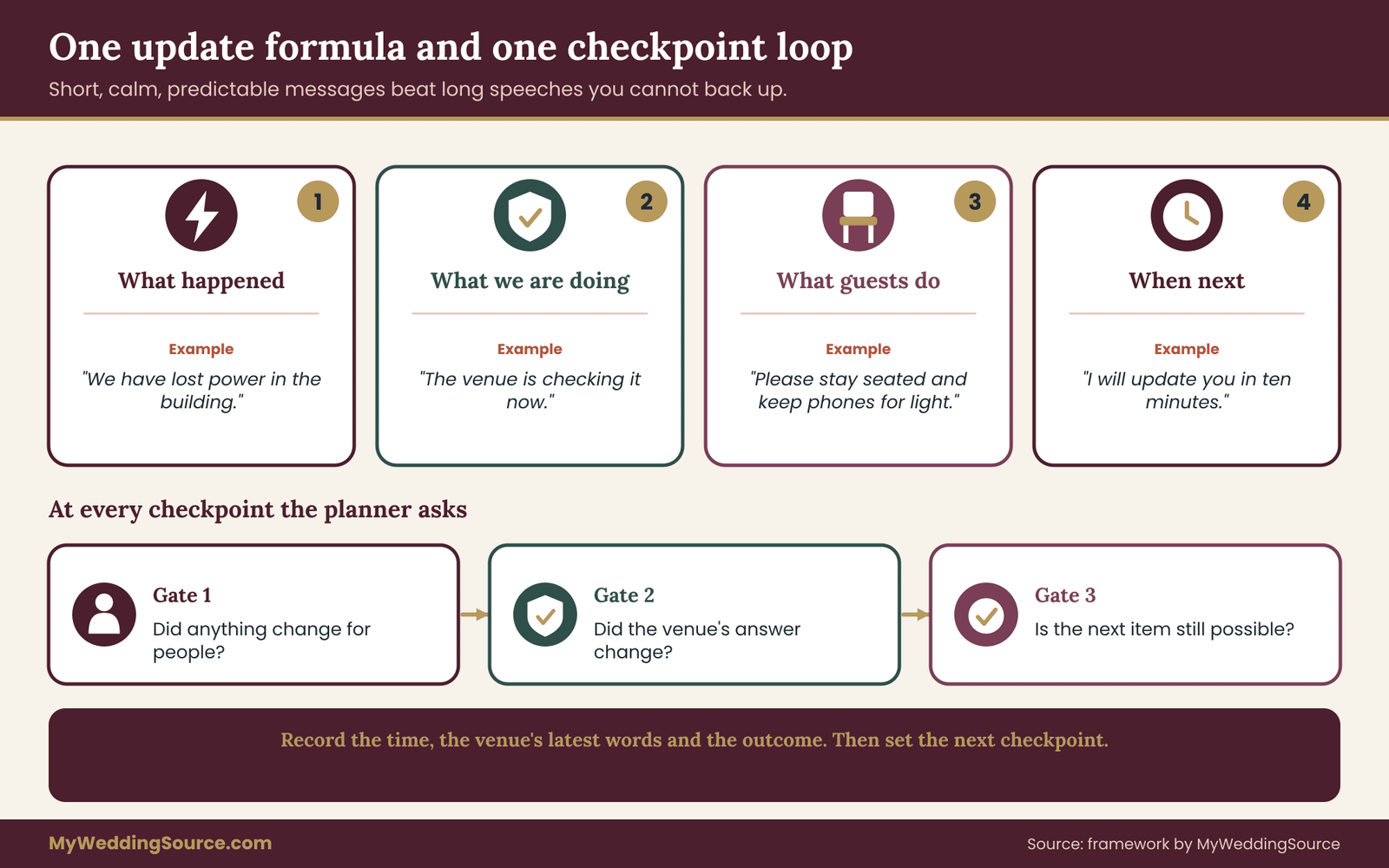
A power outage tree is only useful if you return to it. At the end of every checkpoint the planner asks the same three questions: did anything change at gate one, did the venue’s answer change at gate two, and is the next item still possible at gate three. If nothing changed, the outcome stays. If something changed, you move to a new outcome and set another checkpoint.
How long should a checkpoint be? There is no safety standard for this; the right interval is the one that fits your shortest runway. A common planning habit is a first checkpoint after a few minutes, when the venue has had a chance to look, and later checkpoints at roughly the pace of the program, perhaps every quarter hour. If your shortest runway is short, tighten them. If it is long, you can relax. Write your chosen intervals on the power sheet so nobody improvises.
The planner calls the checkpoint and records the time, the venue’s latest statement and the outcome. The couple approve any change that affects the program. The venue’s word overrides everyone on anything involving the building. That is the whole structure of the power outage response.
Where the tree stops being useful
A tree is a thinking tool, not a guarantee. It fails when its inputs are wrong: when the venue contact gives a confident answer that turns out to be mistaken, when the planner cannot reach anyone, when guests ignore instructions, or when the situation is not a simple power outage at all.
Any sign of fire, smoke, gas, injury or a threat to people takes you out of the tree and into the venue’s emergency procedure and a call to emergency services. The tree is for the ordinary case: a power outage with no obvious hazard, where the questions are about how long and what to do with the evening.
It also fails when you have not prepared. A tree that depends on a venue contact you have never met, on lighting rules you never confirmed and on a caterer whose plan you never saw is a tree with missing branches. The earlier sections are the roots. Without them, the gates are guesses.
In a power outage, light is the lane everyone reaches for first, and it is the lane where good intentions cause the most trouble. A romantic dark room feels manageable; a dark room with flames, cords and a crowd is not. The approach below sorts lighting options into three groups: those that are usually fine, those that need the venue’s explicit permission, and those that are better avoided. The venue’s rule always wins over this list.
Usually acceptable with the venue’s knowledge
The venue’s own emergency lighting and exit signs. These are installed for this purpose. Leave them on, keep exits clear and do not cover or switch off anything.
Battery-powered LED lights. Battery candles, flameless lanterns, small LED uplights and string lights run on batteries are the easiest way to give a room a soft glow without any flame. If you have them, keep a few in a labeled box that the planner can reach. Couples who already use flameless candles for decor have an advantage here, since the same items double as backup.
Handheld torches and headlamps. A small set of flashlights or headlamps for the planner, the venue staff and the helpers posted at stairs is inexpensive and effective. A white headlamp frees both hands, which matters when helping an older guest down a step.
Phone flashlights for short periods. They are fine in the first minutes and for a specific task like lighting a stair. They are poor as the room’s main light, they drain batteries that guests may need to call for rides, and they can blind people when held at eye height.
Ask the venue first
Battery or portable work lights. A caterer, band or photographer may carry portable lights. Some venues are glad to have them; some restrict them because of cords, stands and tripping risks. Ask which kinds are allowed.
Candles and open flame. Many venues forbid open flame entirely, and others allow it only in certain containers or places. If your decor already includes candles, you will know the rule. If you do not, do not light a candle in the dark and ask afterward. Fabric, paper decor and floral arrangements make a dark room an unforgiving place for a flame.
Extension cords from a working circuit. Sometimes a different part of the building still has power, or a generator serves one area. Running a cord to a lamp can look like a good idea. Cords across walkways in the dark are trip hazards, and connecting equipment to the wrong circuit can create other problems. Only venue staff or qualified people should decide this.
Moving the party to daylight or to a lit space. This is often the best lighting solution of all, but it is a Move outcome, and it needs the venue’s agreement on both the destination and the route.
Better avoided
Fuel-burning generators used indoors or near doors, windows and tents. Engines that burn fuel produce carbon monoxide, which is a serious hazard in enclosed or partly enclosed spaces. Public health and emergency agencies warn against running these generators inside or close to openings. A vendor offering to fire up a small generator “just for the lights” should be thanked and sent to the venue manager, who decides.
Anything that needs improvised wiring. Splicing, taping or connecting items to an electrical panel is work for a qualified person. A helpful guest who happens to know electronics should not be invited to touch the panel.
Fireworks, sparklers and similar items as light. They may seem festive in a dark outdoor setting, but they are not lighting, and venues and local authorities regulate them tightly.
A lighting ladder you can use
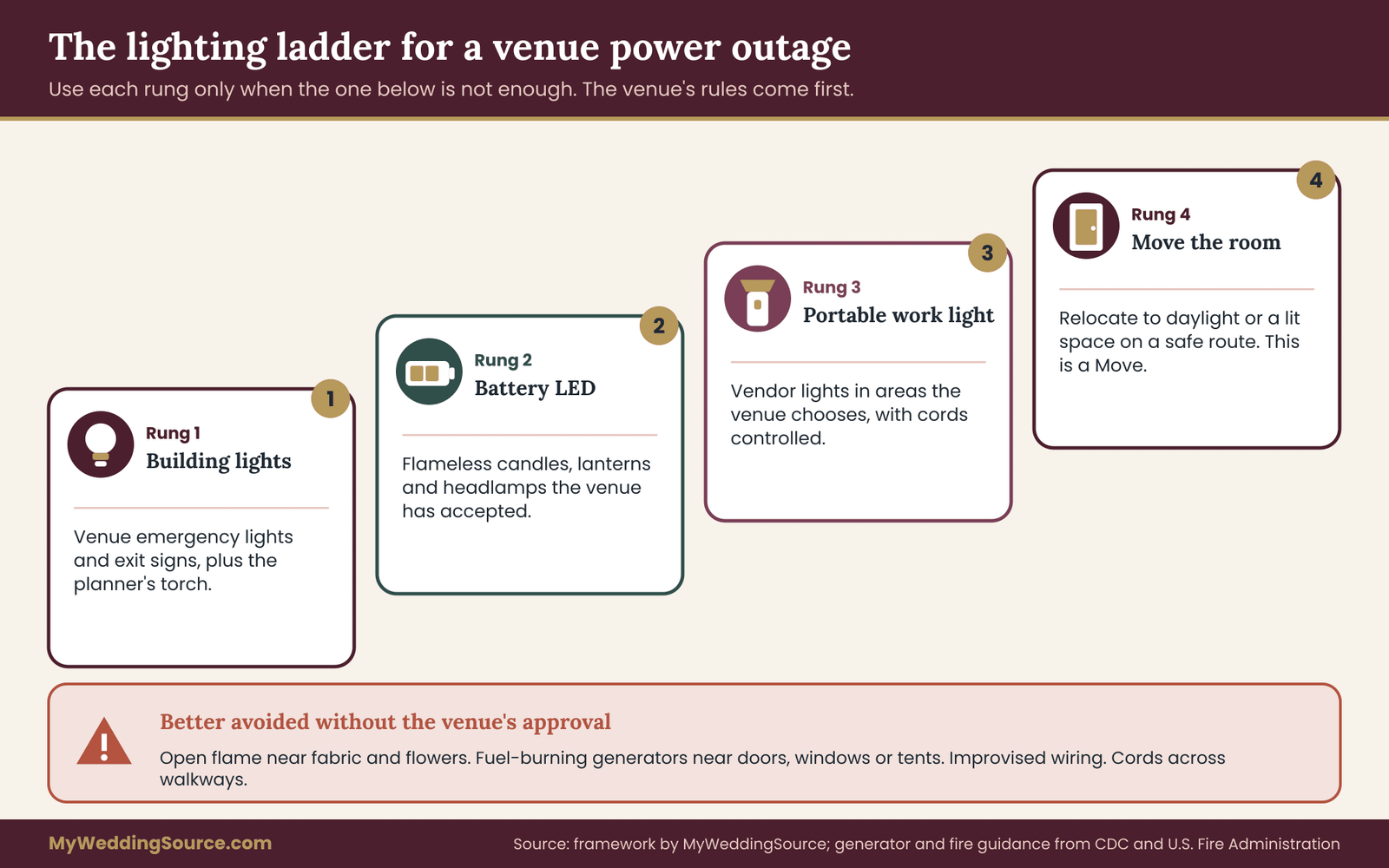
To keep decisions simple, treat lighting as a ladder with four rungs, each one used only when the one before is not enough.
Rung one is the building’s own emergency lighting and exit signs, plus the planner’s torch. That is the baseline, and it exists to help people see where they are going.
Rung two is battery LED light that you or the vendors supply and the venue has accepted. This covers a quiet seated room.
Rung three is portable work lighting from vendors, placed by a person who understands where the cords go, in areas the venue has chosen. This is for tasks such as a first dance or a toast.
Rung four is relocation to daylight or to another lit space. This is not an extra rung of light. It is a change in outcome, because the room is no longer the right room.
The power outage lighting ladder protects you from skipping from rung one directly to something improvised. It also gives the planner a way to say no kindly: “We’re on rung two, and the venue hasn’t approved rung three.”
Sound, food, climate and water during a power outage
Light draws the attention, but the other four lanes shape whether the evening can continue. Each has its own runway, owner and fallback.
Sound
A battery speaker and a wireless microphone are the whole sound plan for a short power outage. Check with the DJ or band whether a battery speaker is part of the kit and how long it runs. A good battery-powered microphone can carry toasts for a hundred guests in a quiet room. In a loud room it will struggle, which is another reason a short hold, with the room quiet, is often better than a rushed announcement.
Acoustic music is the strongest recovery tool in the sound lane. A string player, a singer with a guitar, a pianist on an acoustic instrument or a friend with a violin can keep a room warm without a plug. If your wedding includes live musicians, ask what they can play unplugged and in low light. Musicians reading from sheets need light; those who play from memory do not.
The one thing sound should never do during a power outage is cover an instruction. If the venue needs to speak to guests, music stops.
Food and drink
The caterer owns this lane. Ask early what happens to food that is in the oven, on the line or in a refrigerated unit when power fails. Food safety guidance from agencies generally speaks in terms of how long food can stay in a closed refrigerator or at a safe holding temperature, and in how to decide when food must be thrown away. The caterer should know those rules and apply them. Your job is to ask the caterer for a decision and a time.
Practical options usually include holding service while the venue assesses, switching to items that need no heat, serving what is safe and shelf-stable, and arranging for the kitchen to move to a location with power. Cold canapes, bread, cheese, fruit, a cut cake that was already finished and sealed desserts are the kind of items that can work if the caterer judges them safe.
Ice and drinks can often continue, because a bar does not need much power. The caterer also needs to decide what to do with plated courses already sitting on a pass. That is a food safety call and not a courtesy.
Do not pressure a caterer to serve food it is unsure about. A skipped course is a small loss. A foodborne illness at a wedding is a large one.
Climate
Heat and cold are quiet risks in a long power outage. In a hot room, open doors and windows only where the venue allows and where it does not create a safety problem, give guests water, move older guests and children to the coolest area, and shorten the time in the room. In a cold room, offer blankets or wraps, move guests together and consider a shorter evening. The shortest runway is often the climate one when the weather is extreme.
Guests who are more affected by temperature need earlier attention: very young children, older adults, pregnant guests and people with health conditions. Pay attention to them before they say anything.
Water and restrooms
Some buildings lose water pressure when pumps stop, and restrooms may become unusable or dark. Ask the venue what happens in a power outage, and whether restrooms have emergency lighting. If they do not, a helper near the restroom door with a light is a simple safeguard. If water stops, portable options may be needed, and the venue is the party to arrange them.
Elevators, doors and access
Elevators generally stop, though some buildings have a mode that brings the car to a floor. Automatic doors may open manually, stay shut or revert to a default. Electronic locks differ widely. Ask the venue about each of these ahead of time, and mark on the power sheet any guest who would be stranded by a stopped elevator.
Guests who depend on power: mobility, health and care
Guest safety in a power outage is not evenly distributed. The same dark room is an inconvenience for most people and a real problem for a few. A good power outage plan starts with those few. Planning for those few is the most valuable part of a power outage plan, and it costs almost nothing if it is done in advance.
Identify needs without prying
You do not need medical details. You need to know whether a guest will be unable to manage without help if the lights, elevator or power go out. Many of these needs are already visible in the guest list: older relatives, guests who use wheelchairs or scooters, guests with limited vision, guests traveling with babies, and anyone who has told you about a medical device.
A short, friendly line on the RSVP or in a message to those guests works: “If you have any access needs we should plan around, please tell us and we will do our best.” Keep the answers private and share them only with the planner and the venue contact.
Some guests rely on powered equipment. Power-dependent medical devices, such as oxygen concentrators, breathing aids or powered mobility devices, may have battery backup of limited duration, and emergency planning agencies advise people who use them to prepare for outages. The guest knows their own equipment best. If someone has told you about a device, ask quietly whether they have a battery, what they would need in a power outage, and whether you can help with a charged power bank or a quiet place to wait. Then tell the planner.
Place guests where a power outage hurts less
Seating is a safety tool. A guest who uses a wheelchair or a walker seated on the ground floor near an exit has a different evening from one seated on an upper floor beside a stopped elevator. Older guests are safer near restrooms, near an exit and away from the loudest speaker.
Families with babies need an easy way to leave the room and to warm bottles or feed a child if the kitchen is down. The reception guest flow guide covers entry, seating and exits in detail, and a power outage plan belongs on top of that layout.
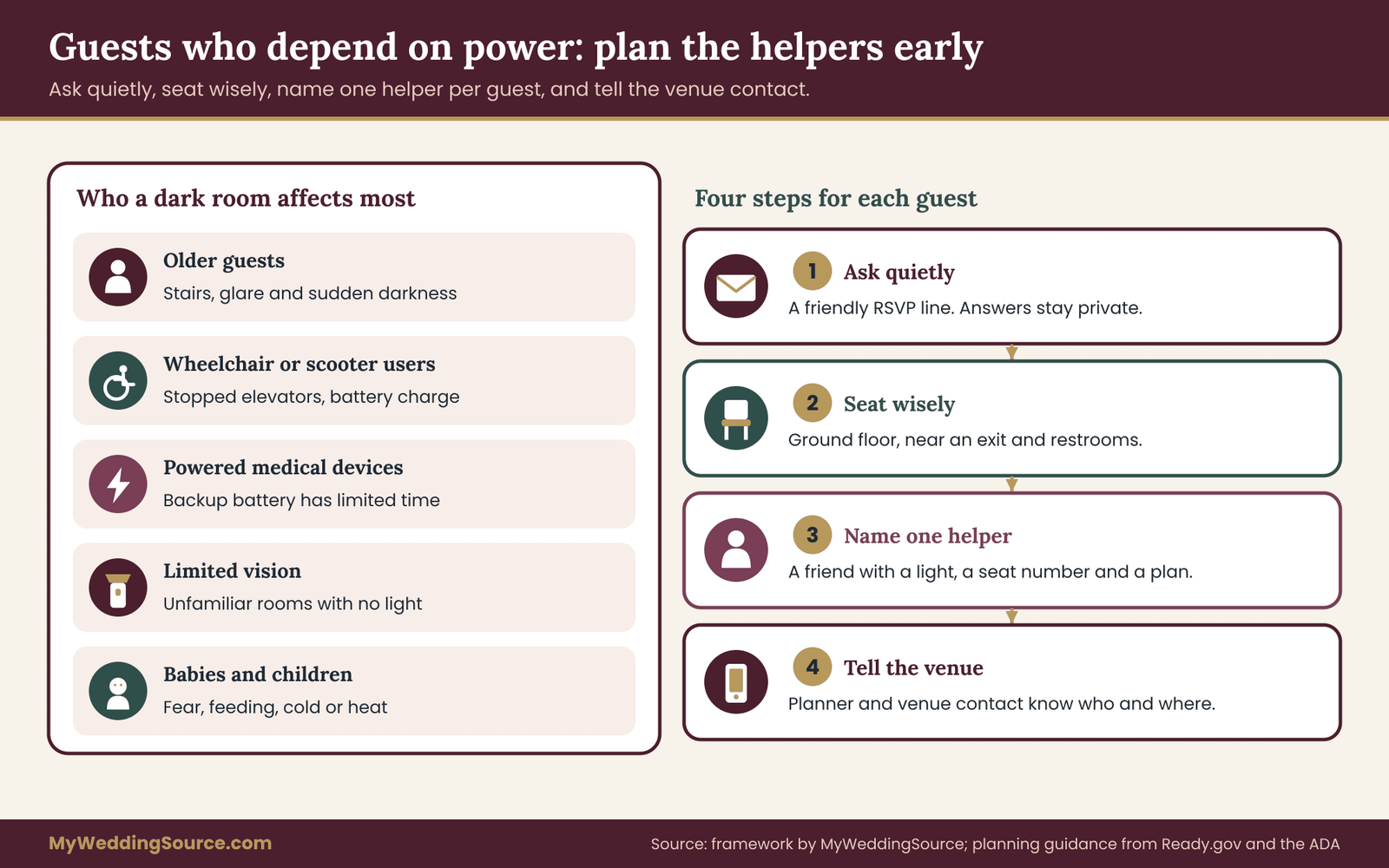
Choose one helper for each guest who may need assistance. A named person, usually a friend or relative, who has agreed in advance, is far more reliable than a general expectation that someone will help. Give that person the guest’s seat number, a small flashlight and a plain instruction: stay with that guest until the venue gives the all-clear or the guest leaves.
Stairs, thresholds and the dark
The riskiest spots in a dark building are the ones that were already awkward in daylight: stairs, ramps, uneven thresholds, step changes between rooms and outdoor paths. During the walkthrough, ask the venue to point out where those are. On the day, the planner should know which ones lie between the ballroom and the exits, and which helper takes which one.
Many venues have specific rules for accessible routes and for assisting guests who cannot use stairs during an emergency. Ask for them. The right answer to “what happens to a guest in a wheelchair on the second floor if the elevator stops?” is the venue’s, and it is better to hear it in the spring than during the toast.
Children and anxious guests
Dark rooms frighten children, and frightened children are noisy and mobile. Give parents a calm option: a place to sit together near the edge of the room, a small light for the child and a clear instruction on where to go if the venue calls an evacuation. For guests who are anxious in the dark, a helper beside them, a calm word and a clear statement about when the next update will come help more than reassurance in general terms.
If a guest becomes unwell
A power outage can trigger problems that have nothing to do with electricity: a fall, a panic episode, overheating, a medical event. Know where the first aid supplies are and who on the team has first aid training, if anyone. If a guest is unwell, call emergency services, tell the venue, and let the person who is trained take the lead. Do not wait for the power outage to end before making that call.
Talking to guests and vendors during a power outage
Communication during a power outage has a double problem. People want information quickly, and you may have none. The solution is not to fill the silence. It is to speak in short, predictable updates, even when the update is “we do not know yet.”
The structure of a good update
Every announcement should contain four elements: what happened, what we are doing, what guests should do, and when the next update will come. Keep each element to a sentence. Do not guess at causes or durations. Do not promise a restoration time that you do not control.
Examples in plain language:
“We have lost power in the building. The venue is checking now. Please stay seated and enjoy your drinks. We will update you in ten minutes.”
“The venue has told us power may take a while to return. We are moving toasts and photos to the front windows while there is daylight. Dinner will follow once the kitchen is ready.”
“The venue has asked everyone to leave the building safely. Please follow the helpers with lights. We will send a message about the rest of the evening within the hour.”
Each of those can be read by anyone with a clear voice. Print them on the power sheet so the planner can use them without composing under stress.
Who speaks
One voice, ideally the planner or the venue contact, gives announcements. The couple speaks only when they decide to address guests as hosts, for example to thank people for their patience. A mix of voices creates conflicting information. If you have no planner, ask your best-prepared friend or relative to take that role and rehearse the script once.
Reaching guests who are not in the room
Some guests will be outside, in the parking lot, in a hotel or on their way. Cell service may or may not work, depending on whether local towers have power or are overloaded. A text to a prepared group list, or a note on the wedding website, can help if the network cooperates. The wedding day digital operations guide covers backup communication channels, and a battery power bank for the planner’s phone belongs on the packing list. Do not depend on one channel.
Vendors
Vendors also need information. The planner tells the caterer, DJ or band, photographer, florist and transport provider what the venue has said, what the current outcome is and when the next checkpoint will be. Ask them to report problems back to the planner rather than acting on their own, particularly where equipment, cords or timing is involved. The transport provider especially needs to know if the end time may change, since drivers and shuttles are scheduled.
What to say to family
Family members will have opinions. Some will want to keep dancing; some will want to leave. Assign one family member, perhaps a parent or sibling, as the family contact who hears the concerns and passes them to the planner. This keeps a dozen well-meaning conversations from drawing the planner away.
When the power outage hits a specific moment
The tree is the same, but a power outage plays out differently depending on the moment of the day.
During the ceremony. If the ceremony is indoors and the room goes dark, the officiant pauses and the guests stay seated. A ceremony needs very little: a voice, a little light, and vows. If the venue says the room is safe, a daylight or window-lit ceremony can continue with a battery microphone or without one, and a short version may be the best choice. The ceremony cue sheet guide shows how to mark the parts of a ceremony that can be shortened without losing their meaning.
During cocktail hour. This is the most forgiving moment. Guests are standing, drinks are mostly cold, and the program is flexible. A hold with a short update is often enough, and a Shift toward moving the cocktail hour outdoors may work.
During dinner. The kitchen lane is at risk. The caterer decides, and the program shifts toward toasts while the food question is answered.
During dancing. Dark, crowded floors are the riskiest for movement. Stop the music, ask guests to stay still, and hold until the venue speaks. Resume only if gate two is a clear yes.
During the send-off. Dark exits and parking areas matter. Helpers with lights, clear instructions for rides and a careful, brief farewell are better than a staged exit in the dark.
A worked case: the dinner hour power outage
The case below is invented, to show how the tree works in practice. It is not a report of a real wedding, and the times are only illustrations. Real venues, utilities and caterers will behave differently, which is why the principle matters more than the numbers.
The setting. Priya and Daniel are married on a late-autumn evening at a converted mill with a ground-floor hall, a mezzanine with a bar, and a covered courtyard. About 140 guests are seated for a plated dinner. Sunset was at about 4:50 in the afternoon. The venue has emergency lighting and exit signs, and a small backup system that, according to the venue’s written answer in the walkthrough notes, runs life-safety equipment only.
The caterer works from a kitchen at the back. The DJ has a battery speaker and a wireless microphone. The planner, Mei, holds the power sheet. Two older relatives, Daniel’s grandmother and an uncle who uses a wheelchair, are seated near the courtyard door on the ground floor, each with an assigned helper.
Minute zero. During the salad course, the hall goes dark and the music stops. Mei takes the microphone, which still works from the DJ’s battery, and says the short announcement from her sheet. Guests stay seated. She asks the two helpers to stay with the grandmother and the uncle.
Minute one to two. Gate one. Mei and the venue manager walk the room. There is no smell, no smoke, no sound of a fault and no sign that anyone is hurt. Emergency lights are on, and the exit signs are lit. A guest on the mezzanine reports that the bar lights are out and that the stairs are dim. Mei sends a helper with a headlamp to the stairs and asks the bar to pause service on the mezzanine until further notice. Gate one passes with a precaution in place.
Minute three. Gate two. The venue manager has called the utility and checked the building panel. The manager tells Mei that the street is dark, that the utility has reported a power outage in the area without a restoration time, and that the building is safe to occupy while the emergency lighting lasts, which the venue describes as a limited period. The venue also says candles are not permitted and that battery lights are fine. Gate two passes, with a limit.
Minute five. Gate three. Mei asks the caterer. The kitchen has lost its ovens. The main course, chicken in a half-finished state, cannot be completed. The caterer can serve the cold starters already prepared, bread, a cheese course and the desserts that are sealed. The caterer says plating a hot main course is not possible. The DJ has battery sound for the evening. The courtyard is dark and cold, so a move there is not helpful. Gate three fails for dinner as planned, and passes for toasts, photos and a cold meal.
The shortest runway. The utility has no estimate. The emergency lighting has the shortest known runway. The venue’s manager cannot say exactly how long it will hold. Mei decides the room cannot wait for an unknown restoration. The outcome is a Shift, with a plan to review at every checkpoint and a trigger for Stop.
The shift. Mei tells the couple the options in two sentences. Priya and Daniel decide to serve a cold supper, hold the toasts while people eat, ask the DJ to play quiet music from the battery speaker and ask the venue for permission to place battery LED lanterns on the tables. The venue agrees. The caterer serves cold items, and a few vendors set out the battery lanterns that Priya’s cousin had used as centerpieces. The room is dim but calm.
Checkpoint at about twenty minutes. The utility still has no estimate. Gate one is unchanged. Gate two is unchanged, though the venue manager now says the emergency lighting will be reassessed in the next half hour. Gate three still allows toasts and cake. Mei records the checkpoint and tells the couple. They decide to bring the cake cutting forward, hold a short family photo session by the lantern light and keep the dancing for the end if power returns.
Stop trigger. Mei had written one line on the power sheet in advance: if the venue says the emergency lighting is nearing its limit or cannot say how long it will hold, the outcome becomes Stop with an orderly exit. At the forty-minute checkpoint the manager says the emergency lights will be reliable for a short time more only. Mei announces calmly that the evening will end early, asks helpers to guide guests, and arranges rides with the transport vendor, who has been told. The couple thank guests at the door.
What the case shows. In this power outage, the outcome was neither “keep the party going” nor “send everyone home at once.” It was a sequence: hold, shift, then stop, each triggered by an answer at a gate. The grandmother and the uncle were safe because they had helpers and a ground-floor seat. The caterer’s decision was respected. The venue’s rule on candles was followed. The couple were never asked to find a candle or a breaker. And one line on a sheet, written months earlier, removed a hard decision in the dark.

What could have gone differently
If the venue manager had been unreachable, gate two would have failed, and the outcome would have jumped to Stop or Move at once. If the emergency lights had failed, the guests would have had to leave in the dark, and the helpers’ lights would have been the main resource.
If the power outage had started during the ceremony in the afternoon with plenty of daylight, the whole sequence would have been different: the tree would likely have ended at Shift with a short ceremony and a cold, simple reception. If the venue had allowed a generator, the venue’s electrician, not a vendor, would have handled it, and the shortest runway would have been the generator’s fuel.
Recovery after a power outage: rebuilding the evening
When power returns, there is a second decision: how much of the evening to restart. Restoration does not mean the power outage is over for the schedule. Equipment may need to be checked, the kitchen may need time, and guests may be tired, cold or ready to go.
The restart checks
Before the lights come back on to full, ask the venue to confirm three things. Is the electrical system stable, or is it flickering or returning in stages? Have emergency systems reset? Is the building cleared for normal use? A surge can damage equipment, and the DJ and band need a moment to power up carefully. The caterer needs time to restart refrigeration and to decide what can be served.
If power returns briefly and fails again, treat it as the same power outage. Keep the outcome in force until the venue says the supply is stable.
Re-sequence rather than replay
The easiest mistake after a long power outage is to resume exactly where the program stopped, as though nothing happened. Guests have been sitting, the food is delayed, children are tired and the schedule has slipped. Instead, rebuild the remaining program around what matters most.
A simple rule is to rank the remaining items by how much the couple would regret losing them. Many couples find the order is: the meal or a reasonable substitute, toasts, the first dance or another dance, cake, the send-off, and then the open dance floor. You protect the top items, shorten or merge the middle ones and let the last ones go without guilt.
For example, if two hours of the evening were lost, you might merge the parent dances into one, shorten the toasts to those that matter most, cut the cake right away and keep an hour of open dancing. The wedding vendor timeline guide explains how vendor end times and handoffs fit together, which is useful when you decide how to compress.
Vendor overtime and end times
Late restarts raise questions of end times, overtime and rides. Before the evening resumes, the planner asks each vendor three things: can you stay later, what will it cost, and who approves it. A vendor can say no. Written overtime terms in the contract help, and the guide on reading a wedding vendor contract shows where to look. Do not commit to overtime without checking the venue’s own end time. Many venues have a fixed closing time for noise, staff or neighbor reasons, and the power outage may not change it.
Be honest with guests about the new plan
Tell guests what the evening will look like now. “Dinner will be served at this time, toasts will follow, cake at this time, and the dance floor will be open until the venue closes.” Giving a clear plan lets guests with rides, babysitters or long drives make their own choices. It also removes the quiet awkwardness of not knowing whether it is polite to leave.
Look after the couple
A power outage is tiring and, for the couple, often emotional. Give them a few minutes alone, food and a drink, and a message that the evening was handled well. Many couples remember the kindness and calm of their guests more than the interruption itself. Tell them, honestly, that the plan worked.
Records, refunds and claims after a power outage
Once the evening is over, the practical work begins, and it is easier if you collect evidence while memories are fresh. Within a day or two, the planner or a trusted friend writes a short timeline: when the power went out, when the venue was reached, what the venue said at each checkpoint, which outcome you chose and when, what the caterer decided about food, which vendors stayed late, and when power returned or guests left. Photos and screenshots with time stamps help. Keep the tone factual. It is a record, not an accusation.
After a power outage, read the contract again with the timeline beside it. Look at the venue’s terms on interruption of services, the caterer’s terms on food that could not be served, the band or DJ’s terms on overtime and any clause on events beyond the vendor’s control.
Ask politely whether any fee should be adjusted for time lost or service not delivered. Some venues will offer a partial credit or an extra hour; others will point to a clause. You will not know until you ask, and a calm written request that cites the facts is more likely to be heard than an angry call.
If you bought event insurance, check what it says about venue closure, utility interruption and cancellation, and about the time limit for reporting a claim. Policies differ widely, and some exclude certain causes or require a minimum length of interruption. A licensed insurance professional or your insurer can tell you what applies. The planning guide on the wedding planning checklist is a good place to keep the policy details beside the rest of your paperwork.
If you paid a deposit by credit card for a service that was clearly not delivered, a billing dispute with the card issuer may be an option, but it has its own time limits and rules. Check the issuer’s terms and, if needed, the Consumer Financial Protection Bureau’s consumer pages before you decide.
Finally, thank the people who helped. The planner who stayed calm, the helper who sat with a relative in the dark and the venue manager who made decisions with incomplete information all deserve a note. It costs nothing, and it is the right thing to do.
Alternatives, trade-offs and failure conditions for a power outage plan
No power outage plan covers everything, and every backup has a cost. This section sets out the main alternatives to the approach above, what each one trades away, and the conditions under which the stop-go tree should not be relied on.
Backup power: generator or battery system
A backup generator or large battery system lets a venue keep more of the building running. The trade is cost, space, noise, fuel and safety. Fuel-burning units create exhaust that must be kept well away from people, openings and tents, which is why a venue that owns one typically has a permanent, correctly placed installation, and a rental brought in by a vendor at the last minute is a different matter.
Battery systems avoid exhaust but have limited capacity. Ask the venue what a backup source runs and for how long. If your venue has none, you can choose to plan around it, choose a different venue, or accept the risk and rely on the tree.
Whether to pay extra to rent a generator for a venue that has none is the venue’s decision as much as yours, because they hold the wiring, the permissions and the liability. Do not hire one on your own for a building you do not control.
Choosing the time and place for lower risk
Some choices reduce the damage of a power outage without paying for backup. A venue with plenty of windows or an outdoor area can carry a daylight program through a power outage. An early ceremony and a reception that begins in daylight leave more room to adjust than a late-evening start. A ground-floor layout with few stairs is safer in the dark than a multi-level space. A venue with a staffed on-site manager is better placed than one with a lockbox.
The trade is that daylight, windows and ground floors may not be what you want for the look of the wedding. Weighing these against one another is the real planning decision. The site’s venue guide explains how to compare venues, and a power outage plan is one more question to add to that comparison.
Battery lighting and sound as a standing kit
A small, cheap kit gives you rung two of the lighting ladder: a box of battery LED lanterns or candles, several headlamps, a battery megaphone or a battery speaker with a microphone, and charged power banks for the planner. The trade is a small amount of money and a place to store the box. Ask whether the venue allows you to bring it in and where it can be kept. Test the batteries before the wedding.
A shorter program as insurance
A program with fewer fixed, equipment-dependent moments is more resilient. If your reception depends on a slideshow, a lit cake display, a complicated light show and a live feed, a power outage breaks more of it. Keeping a few simple, unplugged moments, such as an acoustic song, a spoken toast and a hand-cut cake, makes a Shift easier. You do not need to simplify the whole wedding. You need a few items that survive a blackout.
Doing nothing special
Many couples will choose to do nothing beyond asking the venue a few questions, and that is a reasonable choice. A power outage at a wedding is uncommon, and every hour spent on contingency is an hour not spent on something else. The minimum is the power sheet, a handful of flashlights and the one-sentence authority line. If you do only that, you will still be better placed than most.
Failure conditions: when the tree should not be trusted
The stop-go tree is a tool for the ordinary case. It should be set aside, or at least checked against stronger guidance, in these conditions.
Any sign of fire, smoke, gas, sparks or injury. The venue’s emergency procedure and emergency services replace the tree. Do not wait for checkpoints.
Severe weather or other hazard at the same time. If the power outage comes with a storm, flooding, a heat emergency or a wider emergency in the area, public safety instructions override the plan. Official sources such as the National Weather Service and local emergency management give the current guidance, and the venue will be following it.
No reachable venue authority. If gate two cannot be answered, treat it as a no. A planner who cannot reach anyone with authority over the building has to lean toward a safe stop.
Doubt about the venue’s answers. If the venue’s statements are inconsistent, or you have reason to think the building is unsafe, trust your caution and consult emergency services.
Crowd behavior outside your control. If guests ignore instructions, a crowd surges toward an exit or someone is hurt, the situation has become an emergency, not a planning problem.
Missing preparation. If the power sheet, the helpers and the venue answers do not exist, the tree has no inputs. It will still help you think, but you should say so to yourself and lean cautious.
Specialized needs you do not know about. If a guest relies on power-dependent equipment and you were not told, the plan cannot protect them. That is one reason for the RSVP line and for the habit of asking quietly in the first minutes.
These are not reasons to avoid planning. They are reasons to treat the plan as a guide that supports good judgment and not as a script that replaces it.
Your next steps
You do not need to do everything. Start with the power outage questions to the venue. A sensible order for a power outage plan, starting today, is the following.
First, put three power questions on your next venue conversation: what emergency lighting and backup power exist, who is on site and what the venue’s rules are on candles and generators. Second, ask the caterer and the DJ what they do when the power fails, and write down the answers. Third, build the one-page power sheet with contacts, the authority sentence and the announcement scripts.
Fourth, identify guests who might need help in the dark or who rely on powered equipment, and assign a named helper to each. Fifth, buy or borrow a small battery kit and test it. Sixth, tell your planner or chosen coordinator about the tree and the shortest runway rule, and set your checkpoint intervals and your stop trigger in advance.
If you are still choosing a venue, make the power questions part of the comparison. If you have already signed, ask them anyway, politely and in writing.
FAQ
What should we do first if the power goes out at our wedding?
Pause the program, keep guests where they are and check for hazards such as smoke, sparks or a burning smell. If there are any, call emergency services and follow the venue’s procedure. If not, contact the venue’s on-site manager, put helpers with lights at stairs and doorways, and give one short announcement with a time for the next update.
Can we use candles if the lights go out?
Only if the venue allows it. Many venues ban open flame, and a dark room with fabric, flowers and a crowd is a poor place for one. Battery-powered LED candles and lanterns give a similar glow without the risk. Ask the venue for its candle rule before the wedding so nobody has to decide in the dark.
Is it safe to bring in a generator for the reception?
That is a decision for the venue and qualified people, not for a guest or vendor. Fuel-burning generators produce carbon monoxide and should never be run indoors or near doors, windows or tents. Ask the venue what backup power it has and what it runs. Do not rent or connect a generator on your own for a building you do not control.
How long should we wait before ending the party?
There is no single answer. Compare the expected length of the power outage with your shortest runway: emergency lighting, daylight, battery sound, the caterer’s holding time or room temperature. If the venue cannot give a restoration estimate, or the estimate runs past that runway, shift or stop before it runs out. Write your stop trigger on the planning sheet in advance.
What if a guest depends on powered medical equipment?
Ask quietly, ahead of time, what the guest would need in a power outage and whether they have a battery backup. Seat them near an exit on the ground floor, assign a named helper and tell the venue contact. If the guest becomes unwell, call emergency services at once. The guest’s own advice about their equipment comes first, and their privacy should be respected.
What happens to the food if the kitchen loses power?
The caterer decides, using food safety rules and its own plan, and may involve the local health department. Options often include holding service, serving cold or shelf-stable items, and discarding food that cannot be kept safe. Ask your caterer about its plan before the wedding, and accept its judgment on what can be served on the night.
Will our vendor contracts or insurance cover a power outage?
It depends on the wording. Check each contract for clauses on interruption of services, events outside a party’s control, overtime and refunds. Check any event insurance for utility interruption and venue closure, and for the deadline to report a claim. A licensed insurance professional or your insurer can explain what applies to your policy and situation.
Does a power outage plan need a professional?
Many couples can build the basic plan themselves with the venue’s help. For a large wedding, an unusual venue, a tent or a site with generators, a planner experienced in safety procedures or a licensed safety professional adds real value. Any electrical, fire or structural question belongs to the venue, the fire authority and qualified electricians.
Sources
- Ready.gov, Power Outages
- Centers for Disease Control and Prevention
- Occupational Safety and Health Administration
- National Fire Protection Association
- U.S. Fire Administration
- USDA Food Safety and Inspection Service
- U.S. Food and Drug Administration
- ADA.gov, Americans with Disabilities Act information
- National Weather Service
- Consumer Financial Protection Bureau