

A coat check service is a person, or a small team, whose job is to take guests’ coats and bags at the door, store them safely during the reception and hand them back on request. This guide is about the decision before the logistics: whether a coat check service makes sense for your wedding at all, or whether racks, venue help or a few trusted friends will do the job for less.
A coat check service makes sense when at least three of five pressure tests come back red: cold or wet arrival weather, a storage space far from the room, guests arriving in a tight burst, bags or items that need to be kept secure, and nobody on your side who can be held accountable for the coat check service. With zero or one red, plan self-serve racks. With two, borrow venue or volunteer help. With three or more, hire attendants and put the terms in writing.
Most advice on coats starts with how to run a coat check service. That is useful, but it skips the earlier question, which is the expensive one. Staffing a coat check service means paying people for a block of hours, sometimes with a minimum, and in some venues it also means paying for rack rental, extra insurance paperwork and a service charge. If the coat check service was never needed, that money bought you a person standing beside an empty rail.
The opposite mistake is just as common. Couples reason that coats are a small thing, leave a pile on a spare table, and spend the first hour of the reception watching a guest look for a gray wool coat among forty others. Neither mistake is dramatic, but both are avoidable with a short, honest assessment. The same assessment tells you whether a coat check service belongs in your budget at all.
This article gives you that assessment. It is built around a five-test scorecard, a way to estimate how many attendants the door can actually keep busy, a set of tagging and security rules that suit a hired attendant, and the contract questions worth asking before you sign. It also covers the unglamorous parts: who is allowed to work the coat check service, how to read a quote, and the failure conditions that should make you change course.
A note on scope. This is general information, not legal, tax or financial advice, and wage and worker rules vary by state and by situation. Where a rule matters, the guide points to the agency that publishes it so you can check the current version.
Two related ideas are covered elsewhere on the site, so this guide keeps them brief. The way guests move from entry to seat is covered in the reception guest flow guide, and the general rules for putting a vendor promise in writing are in the vendor contract guide. Here, the focus stays on one narrow question: is this desk worth staffing?
What a coat check service is, and who can provide it
The phrase sounds more formal than the thing itself. A coat check service is any arrangement where someone other than the guest takes responsibility for an item between drop-off and pickup. That is all. What changes from one wedding to the next is who that someone is, how long they are responsible, and what happens when something goes wrong.
It helps to separate three ingredients, because a quote can bundle them or split them, and the price makes more sense once you can see the parts.
People. One or more attendants who greet guests, take items, issue a tag and return the item at the end. This is the part you are really paying for.
Equipment. Rolling racks, hangers, bins for bags and umbrellas, tags or tickets, a table or counter, sometimes a barrier or stanchions to shape the queue. Some venues own all of this. Some attendants bring it. Some couples rent it.
Responsibility. The promise that an item given to the coat check service will come back. This is the least visible ingredient and the one most worth discussing, because it determines who pays if a coat is damaged or missing.
Who might actually provide the coat check service
Several kinds of providers can fill the role, and the right one depends on your venue and region.
The venue itself often has a coat room and staff who tend it, especially hotels, clubs and older banquet halls. In that case the coat check service may be included in your rental, offered for a flat fee, or billed by the hour.
A caterer sometimes supplies attendants as part of the staffing package, since the catering company already schedules servers and has the payroll in place. Ask whether coat staff are on the same team or a separate subcontract.
An event staffing company supplies attendants for a block of hours. These companies usually handle scheduling and payroll, which matters for the worker rules discussed later.
A few local businesses specialize in coat checks for galas and large events. They tend to bring racks, tags and a lead attendant together.
Finally, friends, family or younger relatives can volunteer. This is not a service in the commercial sense, but it is a real option and often the right one for smaller guest lists, provided you treat the role seriously.
What a coat check service is not
It is not the same as security. A coat attendant guards a rail, not a building, and should not be asked to screen guests or manage a crowd. If you are worried about theft in the room more broadly, that is a question for the venue and its security arrangements, not for the person at the hanger rail.
It is also not a valet service for gifts, a card box or a cake knife. Mixing those jobs into the coat check service creates confusion about who is responsible for what, and it is one of the quieter ways a desk fails.
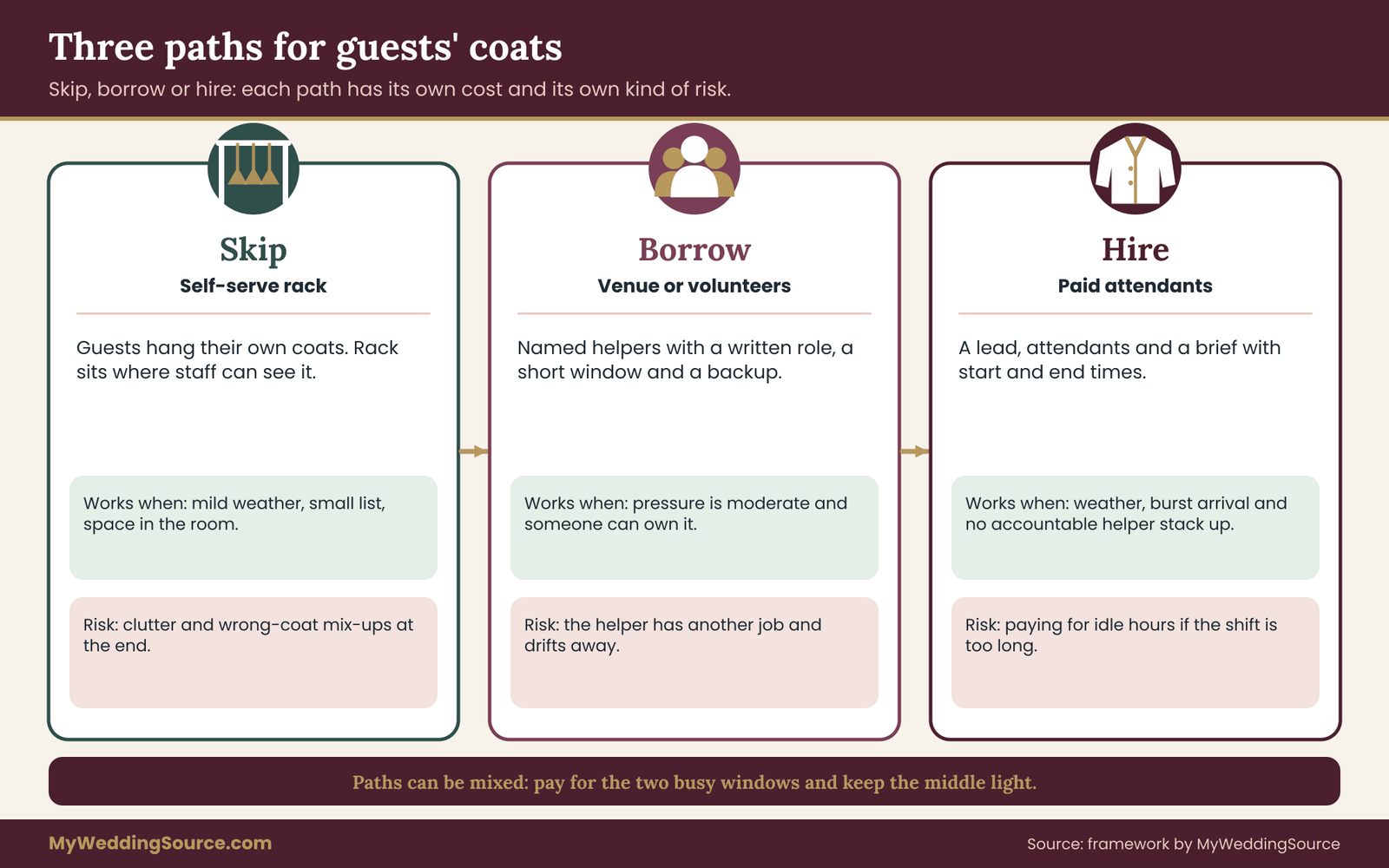
The three paths for a coat check service: skip, borrow or hire
Every wedding ends up on one of three paths, even when the couple never names them. Naming them early makes the later decisions easier, because each path has a different cost structure and a different kind of risk.
Skip: guests hold their own belongings
On this path there is no attended desk. Guests hang a coat on their own chair back, stack it on a nearby bench, or use an unattended rack. It costs almost nothing and works well when the weather is mild, the guest list is small, and the room has places to put things.
The risk is not theft so much as clutter and mix-ups. Chairs with coats draped over them narrow the aisles between tables, and an unattended rack invites guests to rummage for their own items in a crowd. If you choose this path, plan the space deliberately: a rack placed where it can be seen from the room, signs that say what it is, and a few extra hangers.
Borrow: staff or volunteers you do not pay by the hour
Here, someone already on your team keeps an eye on the coats. A venue coordinator who agrees to watch a rack, a catering captain who assigns one server for the first half hour, or two relatives who take the first shift. The cost is low and the oversight is real, but the arrangement is fragile because nobody is assigned only to the coat check service.
Borrowed help works best when the role is written down, the time window is short, and the person has a backup. A volunteer who also happens to be the mother of the groom, and who is therefore hugging relatives at the door, is not really staffing the coats.
Hire: paid attendants with a defined job
On this path someone is paid to be there for the whole window, with a start time, an end time, a lead and a set of rules. This is the path that most closely matches what people mean by a professional coat check service, and the one the rest of this guide tests. It costs more, but it gives you a clear point of accountability and a team that does this repeatedly. A coat check service run this way behaves like any other vendor, with a brief, a price and a person to call.
The three paths are not a ladder where hire is automatically best. A wedding in a mild-weather month at a restaurant with a built-in coat closet may be better served by the skip path with a thoughtful rack. A winter wedding in a ballroom with a coat room down a long corridor and a tight arrival window is a different story. The next section gives you a way to tell which situation you are in.
A mixed path is allowed
Nothing says the whole evening must follow one path. A common pattern is to hire attendants for the arrival and departure windows only, and leave a self-serve rack in the room for people who want to fetch something in the middle. Another is to use venue staff for arrival and volunteers for departure. A later section covers hybrids in more detail, but keep the idea in mind as you read the scorecard: the answer can be “hire for ninety minutes,” not “hire for the evening.”
Five pressure tests for a coat check service
The scorecard below is the center of this guide. Each test asks one question and sorts your wedding into green, amber or red. Red does not mean something is wrong. It means pressure on the coats is high enough that an informal approach is likely to strain. Count the reds at the end, and the count points to a path. Think of it as a quick screen for whether paid help earns its fee.
Answer the tests with your own venue and guest list in mind, not with a general feeling about the season. If a fact is unknown, such as how far the coat room is from the ballroom, treat it as amber until you find out.
Test one: weather at the door
Think about what guests will be carrying when they walk in. In a mild, dry season, many guests will arrive with nothing heavier than a wrap or a light jacket, and some will leave it in the car. That is green. In cold weather, most adults arrive in a coat, a scarf and sometimes boots or an umbrella. That is amber. In cold weather combined with rain or snow, wet items arrive in a rush, drip onto the floor and need space to dry. That is red.
Wet items change the job. A wet coat on a crowded rack soaks the one beside it, and an umbrella stand needs a drip tray or a mat. A person at a desk can manage this. A guest hanging a coat on a chair cannot.
Check the forecast closer to the date, but make the first call from the typical weather for the month and place. The National Weather Service publishes climate normals and forecasts you can use to see what a given week usually looks like. If your date sits in a shoulder season, treat it as amber and write down what would flip it to red, such as a forecast of rain two days out.
Test two: distance and storage
This test is about the physical path between the door and a place to put things. Green means a coat closet or room sits within a few steps of the entrance and inside the sightline of staff. Amber means storage exists but is somewhat remote, such as down a hall or on another floor. Red means there is no real storage and coats would end up in a side room, a corridor or a corner of the reception space.
Distance matters because someone has to carry items there and back. If the storage is far, an attendant cannot both greet guests and walk coats to a closet, so you need two roles, a greeter and a runner. That doubles the staffing math before you even reach the volume question.
Ask the venue for the actual floor plan and walk it, or look at the details from the venue technical walkthrough guide. A coat room that is “available” in the contract may be locked, used for catering storage or too small for a full guest list. Confirm the room, the key holder and the hours.
Test three: arrival compression
Some weddings fill slowly over thirty minutes. Others fill in a few. Compression is the share of guests who reach the door in the same short stretch. It depends on the ceremony ending, on whether shuttles drop guests in groups, and on whether the invitation told people to arrive at a specific minute.
If the ceremony is in another building and guests walk or ride over together, arrival is likely compressed: everyone reaches the reception door within about the same ten minutes. That is red. If guests drift in over an hour during a cocktail window, it is green. A mixed pattern, such as a main group plus stragglers, is amber.
You can read this off your own timeline. Look at the gap between the ceremony end time and the first announced reception event, and ask whether that gap lets guests spread out or squeezes them together. Any entry pacing you have already built into the evening applies directly, and so do the arrival buffers you may have set for guests.
Test four: item value and variety
A rack of ordinary coats is simple. A rack that also holds handbags, backpacks, a diaper bag, a camera case, gift bags, an instrument or a garment bag is not. The more varied and valuable the items, the more a loss would hurt and the more a guest will want to keep an eye on their belongings.
Green means a guest list that is mostly coats and light jackets, with few bags. Amber means a mix, including a noticeable number of bags and a few larger items. Red means a guest list where many people will carry valuables or bulky goods, such as an event with out-of-town guests arriving straight from the airport with luggage, or a gathering where gifts are brought to the door.
If you expect luggage, treat it as a separate question. Many venues will not accept suitcases at all because of fire-code and space limits, and a coat check service is the wrong place to store them. Ask the venue directly, and give out-of-town guests clear instructions in advance about where bags can go.
Test five: accountability
The last test is about people, not objects. Green means there is a named person on your side who has agreed to own the coats for the full window, with a backup, and who is not also a host, a parent of the couple or a member of the wedding party. Amber means someone has agreed informally. Red means nobody has agreed, or the only available helpers are people who will be busy elsewhere.
Accountability is the test couples most often fail without noticing. The coats are everyone’s job on paper and nobody’s in practice. When something goes missing, there is no one to ask, no log to check, and no clear answer to a guest who is understandably annoyed.
Here is a short script you can use to find out where you stand with a possible helper:
“Can you own the coat rack from the first guest arriving until the last coat goes home? That means no other job in those hours, and a named backup.”
If the answer is hesitant, count test five as amber or red.

Scoring the five tests
Write the five answers in a row and count the reds. Count each amber as half a red if you want a finer read, but the simple count is usually enough.
Zero or one red: skip the paid coat check service. Plan a self-serve rack, place it where staff can see it, and add signage. A paid attendant would sit idle for most of the window.
Two reds: borrow. You need real oversight but probably not a full contract. Assign named people, write the role down, and consider hiring attendants for only the busiest ninety minutes.
Three or more reds: hire. A coat check service is justified here. The pressure on the coats is high enough that informal help is likely to fail at the worst moment, and the cost of a bad first impression, or a lost item, outweighs the cost of the coat check service.
Two tiebreakers
Sometimes the count lands in the middle. Two tiebreakers help.
First, ask what a failed fifteen minutes would cost. If a long line at the door would delay the cocktail hour, push back the first dance and leave a hundred guests standing in damp wool, the cost is high and hiring is more attractive. If a slow line would only mean guests chat while they wait, the cost is low.
Second, ask what your guests expect. Older guests, formal evening events and weddings in cities where coat checks are normal at restaurants and theaters tend to carry an expectation of an attended coat check service. Casual daytime weddings in a garden carry almost none. Expectation is not a reason to overspend, but it is a fair factor when the scores are close.
Keeping the scorecard honest
Do the scorecard twice, once now and once about three weeks before the date. Facts change. A forecast shifts, a venue moves the coat room, a shuttle plan changes the arrival pattern, or the guest list grows and adds out-of-town travelers. If the second score differs from the first by one red or more, revisit the path you chose.
Also write the reason next to each answer. “Red, because the coat room is on the second floor” is far more useful in three weeks than “red.” Those short notes become the first draft of your brief to whoever staffs the coat check service. Keep them in the same file as the quote for the coat check service, so the reasoning travels with the price.
One more habit helps: have a second person score the five tests independently, without seeing your answers. Couples often rate their own venue more favorably than a stranger would, because they have grown used to its quirks. A friend who has never been inside the building may spot a long hallway or a narrow doorway that you have stopped noticing.
Arrival throughput: how many attendants a coat check service needs
Once the scorecard says hire or borrow, the next question is how many people the coat check service needs. Many guides answer this with a volume estimate: guests times coats, plus a buffer. Volume tells you how much rack space to rent. It does not tell you how many attendants you need, because a rack can hold a hundred coats and still be unusable if only one person is handing them in.
Throughput is a different quantity. It asks how many guests can be processed per minute at the busiest moment, and how that compares with how fast guests actually arrive. When arrival is faster than processing, a line forms. When processing is faster, it does not. Staffing is the lever that moves processing speed. Everything else follows from this one comparison.
The hand-off time
The core number is the hand-off time: the seconds between a guest reaching the counter and walking away with a tag. It includes greeting, taking the item, putting it on a hanger, attaching a tag, giving the guest their half and moving on.
This guide does not give you a universal number, because it varies with the attendant, the type of item and whether the guest chats. What it gives you is a way to measure your own. At a rehearsal or walkthrough, have a friend play the guest and time ten hand-offs with the real tags and real hangers. Take the average and round up. Use that figure, not a guess, for the math below.
For illustration only, suppose your rehearsal average comes out to thirty seconds per guest party. One attendant could then handle two parties per minute at best. Real attendants slow down when a guest hunts for a pocket or asks a question, so build in some slack and treat that as roughly one and a half parties per minute in practice.
The arrival rate
The other side of the equation is how fast guests show up. Look at your timeline and estimate how many parties reach the door in the busiest ten minutes. A party is a couple, a family or a single guest, since they usually check coats together.
Take your guest count, divide by the average party size, and estimate what share arrives in the peak window. If you have a ceremony in another building with a short walk or shuttle, assume a large share arrives together. If guests arrive on their own over a long cocktail window, assume a smaller share.
Here is the arithmetic written out in words. Suppose a hundred and twenty guests make roughly seventy parties. If sixty percent of the parties arrive in the peak ten minutes, that is forty-two parties in ten minutes, or about four parties per minute. At one and a half parties per minute per attendant, you need between two and three attendants at the counter to keep up. The number is an illustration, not a forecast. The method is what you keep.
Counter staff and runners
Counter attendants and runners are different jobs. A counter attendant takes the item and issues the tag. A runner carries items to the rack or storage room and keeps hangers stocked. If storage is within arm’s reach, one person can do both. If it is down a corridor, you need runners, or the counter slows to the speed of the walk.
A simple rule: add one runner for every two counter attendants when storage is more than a short walk away, and treat the lead as a separate role if the team is larger than three. A lead handles problems, answers questions and decides when to open a second line.
Peak and tail
The arrival wave is short and sharp. The departure wave is usually longer and ragged, because people leave at different times. That asymmetry suggests different staffing. The arrival window needs more hands for a short period. The middle of the evening needs almost none. The departure window needs a steady team, though not as many people as arrival, because guests trickle out.
Some caterers and staffing companies will schedule split shifts or reduce the headcount in the middle. If a quote assumes everyone stays for the entire period, ask whether a lighter middle shift is possible. This is often the single biggest lever on cost, and it is one of the places where a hire decision can shrink without removing the coat check service.

Reading the line as it forms
Throughput math is a plan. Once guests arrive, you will see the line, and the lead attendant should have a rule for what to do. A workable rule is to open a second line when more than five parties wait, and to move a runner to the counter when the queue is long and storage is close. The lead can also ask guests who are only dropping a small item to use a self-serve hook, if you have one, so that the counter handles the bulkier items.
Put the rule on a card the lead can read in a glance. Staff are more likely to follow a rule that is short and written than one that was explained once in a hallway.
What throughput does not fix
Throughput math assumes a smooth process, and several things break it. A single narrow door means guests cannot queue without blocking the entrance. A missing tag roll or a short supply of hangers stops the line. A counter that is the wrong height for guests who use wheelchairs slows hand-offs and, more importantly, excludes some guests. The Americans with Disabilities Act sets accessibility standards for service counters in many places, and the Department of Justice publishes them. Ask your venue how its existing counter or table meets those rules, and keep a lowered surface available.
If your arrival pattern is so compressed that even a generous crew cannot keep up, consider changing the arrival pattern rather than adding staff. A cocktail hour that starts ten minutes before the main entrance opens, or two entrance doors that split alphabetically, can cut the peak in half at no cost.
A short worked check of the method
Take a small example to see the method run end to end. Suppose a venue has one entrance door and a coat room around the corner. Fifty parties are expected, and you assume most arrive in a twelve-minute window after the ceremony.
You time ten hand-offs at rehearsal and find an average of thirty-five seconds, which rounds up to forty. At forty seconds per party, one attendant clears one and a half parties per minute. Arrival in the peak window is about four parties per minute, so a single attendant falls behind by two and a half parties every minute. Over twelve minutes the line grows to roughly thirty parties, which is unacceptable.
With two attendants, capacity is three per minute, and the line still grows, more slowly. With three, capacity reaches four and a half per minute and the line holds. Add a runner because the room is around the corner, and the crew is four people for about twenty-five minutes. That is the real answer to “how many attendants,” and it is a very different number from what a coat count alone would have given. Sizing the coat check service from throughput, rather than from volume, is what keeps the line short.
Matching the answer to your paths
Use the result to check the path you chose from the scorecard. If the math calls for four people for twenty-five minutes, that fits the hybrid pattern of paid attendants for the peak plus lighter coverage afterward. If the math calls for one person, a borrowed volunteer may be enough. If the math calls for six people because the entrance is narrow and arrival is extremely compressed, it may be cheaper to change the arrival pattern than to fund the crew.
Whatever the answer, write the headcount, the hours and the roles into a one-page brief. The brief is the document you will hand to the venue, the caterer or the staffing company, and it should be specific enough that a stranger could run the coat check service from it. The same page will anchor the quote conversation later in this guide.
Secure tagging rules for a hired coat check service
Throughput gets guests through the door. Tagging decides whether the right item comes back. The mechanics of a claim ticket are covered in detail in the site’s dedicated coat check planning material, so this section stays on a narrower question: which security rules should be written into the instructions for people you do not personally supervise?
A volunteer cousin will probably follow common sense. A hired attendant working a dozen events a season follows whatever the lead tells them in the first five minutes. That is why the rules need to be short, specific and agreed ahead of time.
One tag, one item, one number
The simplest control is a matched pair of numbered tags: one stays with the item, one goes to the guest. What matters from a security standpoint is that the number on the guest’s half is the only thing that releases the item.
Ask the attendants to follow three habits. Attach the item’s half to the item itself, not to the rack, so a coat moved to a different spot still carries its number. Never hand an item to someone who does not have a matching half, even when the person describes it accurately and looks sure. And never write a guest’s name on the tag, because a name on a coat on display is a small privacy leak and does not add control.
If your attendants use paper tags, ask for a tag roll with unique numbers rather than a reused set. Reused sets from a previous event can produce duplicates if one stray tag comes home in a coat pocket.

Pockets, valuables and a plain policy
Items left inside coat pockets are the most common source of disputes. A phone, a wallet, house keys or a hearing aid case in a pocket can vanish into a crowded rack, and the guest will reasonably ask whose job it was to look after it.
State a plain policy and print it on a small sign at the counter: the coat check service accepts coats and bags, guests should keep valuables with them, and the coat check service cannot take responsibility for anything left in a pocket. Attendants can say it in a friendly tone as they take the item.
“Happy to take that. Please keep your phone and wallet with you, since the rack can’t be responsible for what’s inside the pockets.”
This script is brief, polite and consistent. The point is not to avoid blame. The point is to reduce the number of things that can be lost in the first place.
A separate place for small and high-value items
Even with a clear policy, some guests will hand over a handbag, a camera or a gift. A good coat check service has a small lockable bin or a designated closed shelf for bags, kept behind the counter and away from the rack. Items in that bin get a different tag color or a letter prefix, so the attendant can see at a glance which tags belong to bags.
If the venue offers a locked closet, ask who holds the key and whether that person will be present throughout the window. A locked room whose key holder has gone home is a problem when a guest needs a medication bag at ten o’clock.
Missing tags and swapped coats
At some point a guest will lose their tag. The attendant should have a simple, firm routine that does not rely on memory or goodwill.
First, ask the guest to describe the item and name anything inside it, such as the color, the brand, a specific object. Second, check whether the described item is on the rack and whether its tag number is still unclaimed. Third, hold the item until the end of the night, once the other items have been returned, and release it only if nothing else matches and the guest can confirm one more detail, such as an item in a pocket. Fourth, write the event in the log with the time and the attendant’s initials.
The delay in the middle is intentional. Releasing an item on a verbal description risks giving someone else’s coat to the wrong person, and that harm is worse than a short wait. Guests tend to accept a ten-minute delay when the attendant explains why. A coat check service that handles this calmly protects its reputation and yours.
Keeping the coat check service staffed and visible
The most effective security measure is a person who is always present and attentive. The counter should never be left empty, even briefly, and the attendant should not step away to socialize. The rack should face the attendant, not a corridor or a blind corner.
If you are using venue staff or a caterer, ask what the break plan is. A break at a bad moment is the quiet way coats get touched by someone who should not be near them. A staffed coat check service with two people can cover for each other. One with a single person needs a named relief person for breaks.
Handover at the end
At close, attendants should do a final walk of the rack and the bag bin, record anything left, and hand the items to a named person, usually the venue contact or the planner, with a note of what remains. That person should be named in advance. Without a named recipient, leftover coats get put in a closet and forgotten.
Add one more line to the brief: items unclaimed after the event are held for a set number of days, and a contact method for guests is given in the guest update. The point is to leave guests with a clear path to retrieve a forgotten scarf, without making the couple the lost-and-found.
Who is allowed to work the coat check service: employees, contractors and volunteers
This is the section where couples sometimes get uneasy, and for good reason. Paying someone to staff a coat check service raises worker-classification questions, and wage rules differ by state. The goal here is not to give you a legal answer. It is to help you ask the right questions of whoever supplies the staff, so you are not accidentally stuck with the paperwork.
Who carries the responsibility
If a staffing company, caterer or venue supplies the attendants, those organizations typically carry the payroll, the tax withholding and the workers’ compensation coverage. That is one of the main things you pay for. If you hire an individual directly and pay them yourself, the situation is less settled, and you may be treated as an employer for that person.
The U.S. Department of Labor’s Wage and Hour Division publishes plain-language guidance on how employee and independent contractor status is determined under the Fair Labor Standards Act, and the Internal Revenue Service publishes its own guidance on the same question for tax purposes. The two agencies use different tests, and state agencies may add more. If you plan to hire anyone directly, read those pages and ask a qualified professional about your state.
Volunteers are not a loophole
Friends and relatives who help for free are volunteers, and that is usually fine when they are truly unpaid and the arrangement is casual. It becomes less clear if you pay a volunteer informally in cash, offer a large gift in exchange for a long shift, or ask a friend who does this kind of work professionally to staff your coat check service as a favor. When money or substantial value changes hands, ask how the arrangement would be classified.
A simple practice that helps: thank volunteers with a gift that is clearly a gift, not wages, and do not promise it in advance as payment for the work.
Younger helpers
Many couples think of teenage relatives as natural helpers. Federal and state rules limit the hours and kinds of work minors may do, and the Department of Labor’s YouthRules site explains the federal framework. A relative who is a minor helping family at a family event may be treated differently from a minor working for a business, but the details depend on the facts and the state. If you plan to rely on young helpers, check the rules and keep their hours short and supervised.
Tips and service charges
Guests sometimes want to tip coat attendants, and a few venues add a service charge. Handling of tips and charges has its own rules. The Department of Labor explains how tips and service charges are treated for wage purposes, and the IRS has guidance on tip reporting. For your purposes, the practical point is to ask the supplier how tips are handled and whether a service charge already covers the attendants. Read the line items on any quote closely so you do not pay for the same service twice.
A tip jar on the counter is a common sight, but it is a choice with side effects. Guests may feel pressured, and some attendants may feel they must perform for it. If you prefer a tip-free coat check service, say so in the brief, and put a small sign saying that gratuity is already included, if that is true.
Questions to ask the supplier
You do not need to audit anyone’s payroll. A few direct questions will tell you whether the arrangement is in good order.
- Are the attendants your employees, and do you carry workers’ compensation for them?
- Who pays them, and when?
- Do you have a certificate of insurance you can provide for the venue?
- How are tips and service charges handled?
- Will the same people who staff the coat check service during arrival also be present for departure?
The vendor due diligence checklist covers the same kind of checks for any supplier. A reputable supplier answers these quickly. If the answers are vague or the supplier seems irritated by the question, treat that as information.
Pricing a coat check service without guessing at numbers
Prices for a coat check service vary a great deal by region, season, supplier and length of shift, and any figure printed in a guide goes stale quickly. So this section does not quote rates. It teaches you how to read a quote, find the pieces that move the total, and compare two quotes that are built differently.
The parts of a typical quote
A quote for attended coat service usually combines several elements. Seeing them separately lets you ask about each one. The cost of a coat check service is rarely one number, and the parts are where the savings hide.
Labor. An hourly rate per attendant, a flat fee per attendant for the shift, or a flat package for the coat check service. Hourly pricing is easier to adjust. Flat packages are easier to compare and harder to change.
Minimum hours. Many suppliers set a minimum shift length, often because the cost of getting a person to the venue does not change much whether they work two hours or four. A minimum can make a short coat check service cost almost as much as a long one.
Lead or supervisor. Some quotes add a lead attendant at a higher rate. For a coat check service staffed by two or three people, a lead may be unnecessary. For a larger crew, the lead is worth it.
Equipment. Racks, hangers, tags, bins, a counter, signs. Sometimes included, sometimes rented separately. Ask who delivers, who sets up and who returns.
Travel and setup. Some suppliers charge for travel time, parking or setup and breakdown time before and after the guests’ window.
Service charge or gratuity. A percentage added to the total, sometimes disclosed only in the fine print. Ask whether it goes to the attendants.
Taxes and fees. Whether sales tax applies to the coat check service depends on the state and the arrangement, so ask the supplier rather than assuming.

Where the total actually moves
Most of the swing in cost comes from three decisions, and you control all three.
The first is the number of attendants. This ties directly to the throughput math in the earlier section. Cutting from four attendants to three at the peak, with a smaller team for the rest, can lower the bill without changing the guest experience much, if the arrival pattern is spread out.
The second is the length of the window. Does the coat check service need to start before the first guest arrives and run until the last one leaves, or only during two active periods? A split shift costs more per hour of presence and less per hour of idle time.
The third is the equipment. Renting racks and hangers through the venue, a caterer or a rental company can differ in price and convenience. The rental planning checklist can help you list what you need and avoid duplicates, and a venue that already owns racks may include them at no charge.
Comparing two quotes honestly
Quotes rarely line up. One supplier quotes an hourly rate per attendant with a four-hour minimum and bring-your-own racks. Another says a flat package including racks, a lead and unlimited hours up to six. The two numbers cannot be compared directly.
Convert both into the same unit. Take your own brief, with the number of attendants, hours and equipment, and ask each supplier to price exactly that. Pricing the same coat check service from every supplier is the only fair comparison. If a supplier will not quote to your brief, that is a sign about flexibility.
When two totals are close, compare the soft terms: cancellation, liability, replacement if an attendant does not show, and what is included if the event runs long.
Overtime and the clock
Ask what happens if the event runs over. Many suppliers charge by the half hour or the hour after the contracted end, and some rates change after a set number of hours. If your departure window is likely to stretch because of a late send-off or an after-party, set the end time with a buffer, or price a block of extra time in advance. A coat check service that closes at the planned time while guests are still leaving will cause its own problems.
Budget logic
To decide how much a service is worth to you, compare its cost with two other costs rather than with the abstract idea of money.
One is the cost of the alternative path. A self-serve rack may cost a rental fee and an hour of someone’s setup time. A borrowed volunteer team costs a few thank-you gifts. If the paid coat check service costs several times more, the question becomes whether the extra protection matches the pressure the scorecard showed.
The other is the cost of failure. Losing a guest’s coat, losing a bag with a prescription or creating a line that holds up the evening has no dollar figure in advance, but it has a real cost in goodwill and in your own mood. Put a rough value on how much you would pay to avoid that, and weigh it against the quote.
Record the final decision with its cost in your budget, and put the payment dates on your calendar. The wedding budget guide and the cash-flow planning guide both help with tracking when deposits and final balances come due.
Deposits and payment terms
Smaller suppliers often ask for a deposit to hold the date and a final balance a week or two before, or on the day. Read what the deposit secures and whether it is refundable if you change the headcount. A coat service can usually adjust the number of attendants up to a cutoff date. After that, the quoted staff may be booked and the cost fixed.
Ask also about payment method. Some suppliers add a fee for card payments. The same questions you would ask any wedding vendor apply here, and a short list of contract basics is in the vendor agreement checklist.
Contract terms and questions for a coat check service
Whether your service comes from the venue, the caterer or a stand-alone supplier, put the key terms in writing. A coat check service is a small line item, and that makes it easy to leave out of the paperwork. The terms below are the ones that matter when something goes wrong.
Scope: what the coat check service does and does not do
The contract or confirmation should say that the supplier provides a stated number of attendants, for stated hours, with stated equipment, at a stated location. It should say what items are accepted and what are not, such as luggage, valuables or perishable goods.
If the supplier’s standard terms limit liability, read that clause. Many service providers state a maximum amount they will pay per item or per event, or exclude items left in pockets. Those limits are common, but you should know them before the day so you can post a clear notice for guests.
Insurance and certificates
Venues often require vendors working in the building to carry general liability insurance, and some ask for a certificate naming the venue as an additional insured. Ask the supplier whether they carry coverage, and ask the venue what it requires. A certificate of insurance is the usual proof, and the supplier’s insurance agent can issue one.
Do not assume that your own wedding insurance, if you bought it, covers guests’ belongings. Policies differ, and many exclude personal property of third parties. Check the policy language or ask the insurer.
Liability for loss and damage
Ask the supplier directly what happens if a guest’s item is lost or damaged. The answer might be that the supplier handles claims, that they refer claims to the couple, or that they disclaim responsibility. Each answer is valid, but only if you know which one applies.
If the answer is that claims come back to you, decide in advance how you would respond. Some couples set aside a small amount for incidentals. Others send guests to a standard script that explains the policy.
No-show and replacement
A single no-show can cripple a small coat check service. Ask the supplier what happens if an attendant is sick or late. A stronger answer includes a named backup, a call-out window and a plan to reach the venue’s contact. A weak answer is “that has never happened.”
Cancellation and changes
Ask what happens if you cancel, reduce the hours or change the date. Weather changes can make a coat check service suddenly necessary or unnecessary. If the forecast improves a week before and nobody will wear a coat, can you reduce or cancel without losing the whole fee? The more flexible the terms, the more attractive a conditional booking becomes.
Confirming details a week before
Send the supplier a short confirmation covering the date, address, load-in door, contact name and phone, start and end times, headcount, equipment, dress and the single person who will meet them. Use a message, not a phone call, so there is a record.
“Confirming the coat desk for Saturday: three attendants from the ceremony end until the last departure, arrival through the side door by the loading ramp, and our venue contact will meet you there. Please reply to confirm the start time and the lead’s phone number.”
That kind of note takes a minute to write and removes most of the ordinary failures.
Skip and hybrid options that replace a full coat check service
If the scorecard sent you toward skipping or borrowing, you are not stuck with a messy pile. A few deliberate arrangements deliver most of the benefit of a coat check service at a fraction of the cost, and they also work as the lighter half of a hybrid.
The supervised self-serve rack
A rolling rack or a row of wall hooks near the entrance, with a sign, a stock of hangers and a clear line of sight from the room. Guests hang their own coats and take them back when they leave. No tags, no counter.
This works when the guest list is moderate, the weather is cool but dry, and the room layout lets someone see the rack from where they stand. The main weakness is the wrong-coat problem at the end of the night, when a dark coat gets picked up in a hurry. Hangers with a numbered clip, or a little tag clipped to the hanger rather than the coat, reduce the problem without needing an attendant.
Place the rack where the room’s usual host, such as a venue captain or a bartender, can glance at it. A rack in a hallway with no staff nearby is the version most likely to cause trouble.
Guest-held coats with chair covers or bench space
In small rooms, such as a restaurant private dining room or a home, the cleanest option may be for guests to keep their coats at their seats or in a bedroom set aside for the purpose. Put a few extra chairs along the walls, and tell guests in the day-of note where to find them.
The caution is aisle space. Coats draped over chair backs can narrow the walkway servers use, and a venue may have rules on aisle clearance and exits. If the room is full, this approach may not hold. Check circulation space against the venue’s own capacity limit.
The bedroom or side-room hold
At a home, a private estate or a small venue with a spare room, one option is to designate a room for coats and bags, with the door open and a person assigned to glance in. Put a bed, a table or a rail inside, cover the surface if needed, and keep the room tidy.
This option takes advantage of space that already exists, and a small room feels less formal than an attended coat check service. Its weakness is supervision: the room is out of sight, and people wander in and out. If valuables will be in the room, assign a person to stand near the door for the first and last thirty minutes, even if nobody sits there in between.
Venue-provided coat room, attended or not
Some venues have a coat room as part of the building. Ask whether it is attended by default, whether you can use it at no charge, and who holds the key. A room that is “available” is not the same as a room that is staffed. If the venue’s staff will keep an eye on it, you may have found a free version of the coat check service. If the room is locked and nobody is assigned, you have storage but not a service.
The venues guide explains what to ask about included amenities and how to compare them across venues, which helps if you are still choosing.
Valet-style hybrids
A hybrid combines two paths. Several patterns are common.
Paid at the peaks, self-serve in between. Two attendants during arrival, a self-serve rack for the middle of the evening, then attendants again for departure. The coat check service disappears for the long stretch when guests are dancing or eating, and returns when it matters.
Venue staff plus a paid lead. A venue employee or server watches the rack, and one hired attendant leads the process, issues tags and handles the busiest period. This shrinks the paid hours and keeps accountability with a single named person.
Volunteers plus a clear rule. Two relatives take the arrival shift, with a written script and a short list of rules. The departure shift belongs to a different pair. The change of hands is the risk, so schedule a five-minute overlap.
Self-serve with a floating attendant. A server or friend circulates and tidies the rack every twenty minutes, straightens hangers and answers questions. This is cheaper than a full coat check service and better than nothing.

Hybrids and the budget
Hybrids tend to cost less than a full-evening coat check service because the paid hours shrink. They also reduce the problem of a bored attendant with nothing to do for two hours. The tradeoff is complexity: two shifts means two briefings, and the handover between them needs a clear rule.
A useful test is whether you can describe the arrangement in two sentences. “Two paid attendants from five to six, then a self-serve rack with a server checking it, then two paid attendants from ten to eleven.” If the description takes a paragraph, simplify it.
Reducing the need for a desk
Sometimes the cheapest solution is to reduce the number of items. A short message in the guest update can ask people to leave umbrellas and bulky bags in the car, wear a coat they will not mind carrying, and bring only what they need. Out-of-town guests can be told where luggage can be kept, ideally at the hotel.
Adjusting the arrival route can help too. A covered walkway or an entrance with a vestibule gives guests a place to shake off rain before they come in. If the ceremony and reception are in the same building, guests may keep coats with them from the start and need less space.
Clear signs help every option. Signs at the entrance, at the rack and at the exit prevent a stream of small questions to staff. The signage system guide covers readability and placement.
When the alternative is better than hiring
There are cases where a paid coat check service is not the best answer even when the scorecard shows several reds. If the guest list is under about thirty people and the room is intimate, a coat check service can feel stiff, and a bedroom hold or a rack near the host may be more welcoming.
If the venue prohibits outside staff, hiring a stand-alone supplier may not be allowed at all. If the quote runs close to what the couple would spend on a similar comfort item, such as extra lighting or a better shuttle, the money may do more good elsewhere.
Treat the scorecard as a guide rather than a verdict, because a coat check service is a tool, not a requirement, and talk the result through with your venue contact, who has seen many weddings in the building.
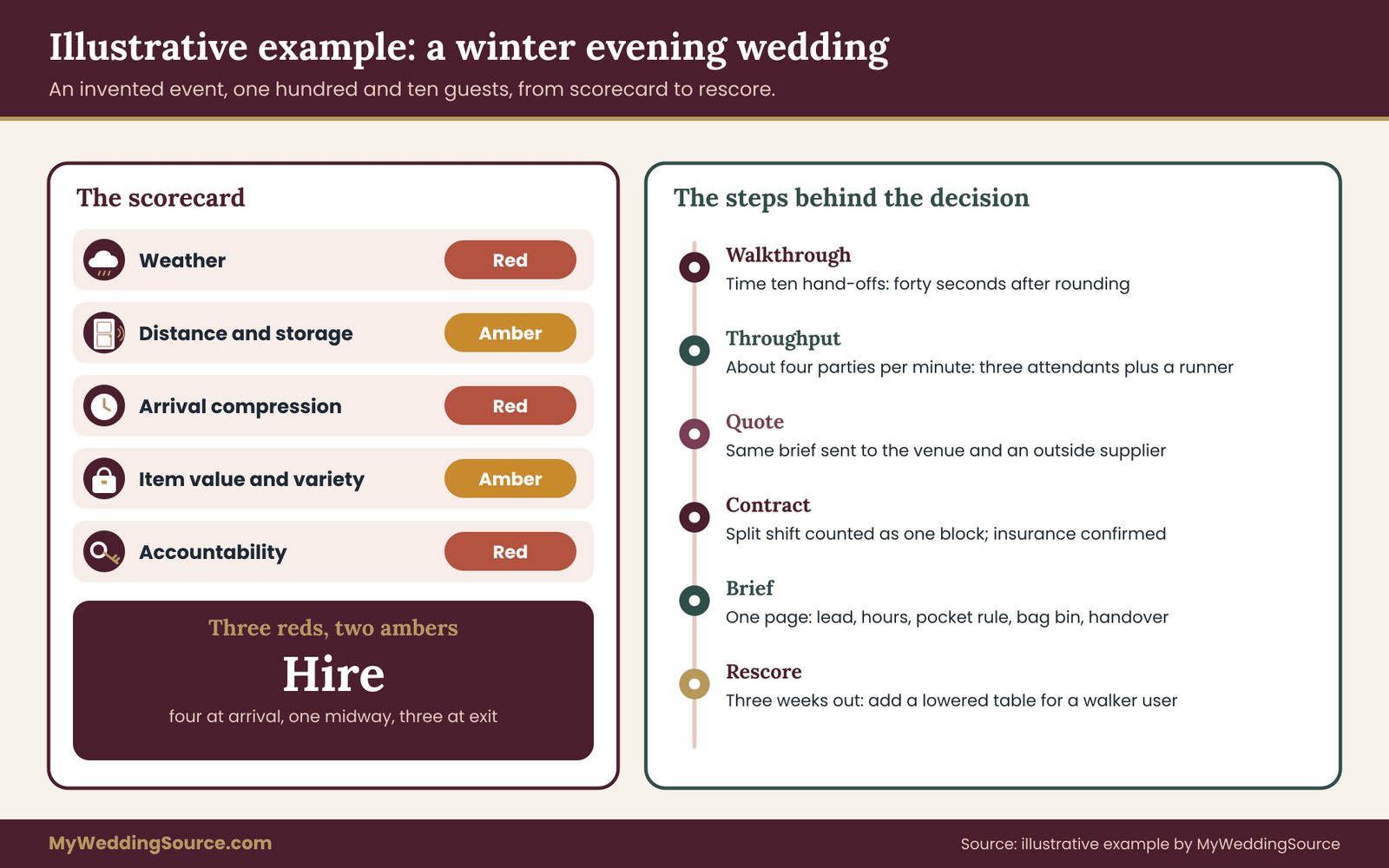
A worked case: a coat check service for a winter wedding of one hundred and ten guests
The following example is invented for illustration, so that you can see the method run from start to finish. The facts are assumptions, not data from a real event.
The setting
A couple is marrying on a January evening. The ceremony is in a chapel across a courtyard, and the reception is in a hall of a historic building with one main entrance and a coat room down a hallway on the same floor. About one hundred and ten guests are invited, and the couple expects around one hundred and five to attend. The forecast for the region in January is cold and often damp. The couple’s best friend has offered to help with the coats, but she is also the maid of honor.
The scorecard
Weather: red. Winter coats and some wet items are likely.
Distance and storage: amber. The coat room exists and is on the same floor, but it is about a minute’s walk from the entrance.
Arrival compression: red. Guests will walk across the courtyard in one group after the ceremony and reach the door within roughly ten minutes.
Item value and variety: amber. Mostly coats, with a few handbags and a handful of out-of-town guests.
Accountability: red. The only offered helper is the maid of honor, who has a role in the ceremony and the photos.
That gives three reds and two ambers. By the rule, the answer is hire.
The throughput check
The couple times ten hand-offs at the venue walkthrough with their coordinator and gets an average of thirty-five seconds, which they round up to forty. They estimate sixty-five parties, with about sixty percent arriving in a ten-minute window. That is thirty-nine parties in ten minutes, roughly four per minute.
At forty seconds per party, one attendant clears about one and a half per minute. Three attendants clear four and a half, which holds the line. Because the coat room is down the hall, they add a runner. The arrival crew is four people for about thirty minutes.
For the evening’s middle, one person is enough to cover the counter and watch the bin. For departure, they plan three people, since guests leave over a longer period.
The quote
The venue offers a coat service through its in-house staff with a minimum of four hours per attendant. A local staffing company offers a flexible schedule, a lead and equipment. The couple asks both to price the same brief: four people for the arrival window, one for the middle, three for departure, with racks, tags and a locked bin.
They compare the two on the quoted total, the minimum hours, what happens if someone does not show, and whether the venue’s own insurance requirements are met. The venue’s offer is more convenient, with equipment already on site and the venue’s own insurance. The staffing company’s schedule is more flexible, but needs a certificate of insurance and a delivery slot. They pick the venue’s service, then ask whether the minimum could be applied to the split shift as a single block. The venue agrees to count the middle hours at the lighter staffing level.
The brief and the changes
The couple writes a one-page brief and sends it to the venue contact. It names the lead, the hours, the pocket-valuables rule, the bag bin, the end-of-night handover and a note for the sign. The maid of honor is released from coat duty, and the couple thanks her with a small gift that is clearly not wages.
Three weeks out they rescore. The forecast has not changed, but a guest says that her mother will arrive with a walker. The couple adds a lowered table at the end of the counter, with a chair behind it, and asks the lead to offer help to anyone who needs it. The score is unchanged, and the decision stands.
What the case shows
The example is not a template to copy. Its value is in the sequence: scorecard, throughput, quote to a written brief, contract questions and a rescore. Each step uses facts about the venue and the guest list, and each can change the answer. A different venue, a mild month or a looser arrival pattern would have changed the headcount, the path, or both.
Failure conditions: when to change course on the coat check service
A decision framework is only useful if it tells you when to stop following it. The conditions below are signs that the path you chose for the coat check service is not working, either in the weeks before the wedding or on the day. Each comes with a response you can use without a long meeting. Most of them apply to borrowed and hired help alike.
Before the day
The supplier will not quote to your brief. If a supplier insists on a package that does not match your headcount and hours, and will not adjust, the quote is built for someone else’s event. Move to the next supplier, or reduce the plan to what the venue can do.
The venue refuses outside staff. Some venues require that all service staff come through them. If so, ask for the venue’s own coat service, or for permission to use volunteers under the venue’s supervision. Hiring around the rule creates a worse problem than the coats.
The coat room is not what the contract implied. If you walk the space and find the coat room is a closet shared with catering gear, rescore test two. A smaller or more remote room may move a green to a red, and the path may change from borrow to hire.
The helper backs out. If a volunteer withdraws two weeks before, do not fill the gap with a vague promise. Rescore test five, name a replacement in writing, or move to a paid attendant for the critical windows.
The guest list grows or the arrival pattern tightens. A change in headcount, a new shuttle plan or an earlier ceremony end can change both the throughput math and the score. Redo the arithmetic with the new numbers, even if it feels like extra work.
The forecast flips. A dry forecast that turns to snow three days before can change test one from amber to red. If you have a conditional booking, use it. If not, ask the supplier whether an extra attendant can be added at short notice, and at what cost.
On the day
A line forms and does not shrink. Trigger the rule on the lead’s card: open a second line, move a runner to the counter, and invite guests with small items to a self-serve hook. If the line is still growing after five minutes, ask a friendly staff member or the planner for two extra hands, even briefly.
The coat room fills. Open the overflow plan: a second rack in the room, a bench by the wall, or a chair-back arrangement in a quiet corner. Do not let guests stack items on the floor of the entrance.
An attendant is missing. Call the supplier’s backup number first and ask for an estimated arrival time. In the meantime, ask the venue contact to cover with someone who can stand at the counter. Reduce the number of tags issued per party by asking couples to share a hanger, which is a short-term fix only.
A guest reports a missing item. Follow the routine from the secure tagging section: description, check the rack, hold, log, and release only when the item is confirmed. Be warm and steady. Most missing items turn out to be on a different rack or in a different coat, and a calm response resolves the problem faster than a hurried search.
The coat check service ends before guests leave. If the coat check service is scheduled to close at a fixed time and guests are still leaving, someone has to make a call. Authorize an extension in advance, with a named person and a rate, so that the lead is not forced to choose between guests and a clock.
After the day
An item is left behind. Follow the handover plan: the named contact holds it, the guest update lists how to claim it, and a deadline for claims is stated. After the deadline, a donation to a local charity is a common choice, as long as the venue and the guest are both informed.
A claim arrives from a guest. Respond kindly and in writing, with the facts you know. If the supplier’s contract places responsibility on them, forward the claim and tell the guest you have done so. If responsibility rests with you, decide in advance how you will respond, and keep a record.
Learning from the first test
If you hold a rehearsal or a smaller event beforehand, such as a rehearsal dinner, treat it as a test of the coat check service. Even a small test shows how long hand-offs take, whether tags stay on, and whether the space works. Adjust the brief based on what you see.
Your next steps
Spend one evening on the decision, and one on the paperwork.
On the first evening, score the five pressure tests with a note beside each answer, and ask one other person to score them independently. Count the reds, pick a path, and write the arithmetic for the busiest ten minutes using the hand-off time from a quick rehearsal. If the result is hire or borrow, draft the one-page brief with headcount, hours, roles, pocket-valuables rule and end-of-night handover.
On the second evening, send the brief to the venue, the caterer and, if needed, one outside supplier. Ask each to price exactly the same brief, and compare the soft terms, such as liability, no-show backup and overtime. Put the cancellation cutoff and the payment dates on your calendar, and set a reminder to rescore about three weeks before the date.
Then let the decision rest. A coat check service is a small part of the evening, and the goal is for guests to barely notice it: they walk in, hand over their coats, enjoy the night and walk out with the right ones.
FAQ
When does a wedding coat check service make sense?
It makes sense when several pressures stack up: cold or wet arrival weather, storage that is far from the room, guests arriving in a tight burst, bags or valuables that need secure handling, and no accountable helper on your side. If three of those five apply, a paid coat check service is usually worth considering. With fewer, racks or borrowed help are often enough.
How many attendants do we need for a coat check service?
It depends on how fast guests arrive, not just how many coats there are. Time a few real hand-offs at a rehearsal, estimate how many parties reach the door in the busiest ten minutes, and divide. Add a runner if the storage is far from the counter. Then check the result with the venue and the supplier.
Can friends or relatives run the coat desk?
Yes, if the role is written down, the hours are short, and each person has a backup. Avoid giving the job to anyone with a role in the ceremony, the photos or the toasts. Thank volunteers with a clear gift rather than payment, and ask a qualified professional if you plan to pay anyone informally.
Are coat check attendants employees or contractors?
That depends on how the work is arranged and on federal and state rules. If a staffing company, caterer or venue supplies the attendants, they usually handle payroll and coverage. If you hire individuals directly, read the Department of Labor and IRS guidance on worker classification and ask a qualified professional about your state.
Should guests tip coat check attendants?
Policies vary. Some venues add a service charge, and some suppliers pass tips to the attendants. Ask what is already included before deciding. If you prefer a tip-free coat check service, say so in the brief and post a small sign. If tips are welcome, ask how they are handled and who receives them.
Who is responsible if a coat is lost or damaged?
It depends on the contract and the supplier’s terms. Some suppliers handle claims, some limit what they will pay, and some exclude items left in pockets. Ask before you sign, post a clear notice at the counter, and decide in advance how you would respond if a claim reached you.
What is a cheaper option than a full coat check service?
A supervised self-serve rack, a hybrid with paid attendants only at the peaks, or a venue coat room watched by existing staff. Adding a short note asking guests to leave umbrellas and bulky bags behind can also shrink the job. The scorecard in this guide helps you match the option to your situation.
Do we need a coat check service in warm weather?
Usually not. In mild, dry weather most guests carry little, and a small rack or hooks near the entrance is enough. Revisit the decision if you expect rain, a large share of guests with bags, or an out-of-town group arriving straight from travel, since those can add pressure even when it is warm.
Sources
- Fair Labor Standards Act, Wage and Hour Division, U.S. Department of Labor
- Misclassification of employees as independent contractors, Wage and Hour Division, U.S. Department of Labor
- State minimum wage laws, Wage and Hour Division, U.S. Department of Labor
- Tipped employees under the Fair Labor Standards Act, U.S. Department of Labor
- YouthRules, U.S. Department of Labor
- Independent contractor, self-employed or employee, Internal Revenue Service
- Tip recordkeeping and reporting, Internal Revenue Service
- ADA standards and guidance, U.S. Department of Justice
- Forecasts and climate information, National Weather Service
- Occupational Safety and Health Administration